Monday, May 18, 2026

Political and Economic Shifts Cause Massive 42% Clean Energy Slump

  • Global clean energy manufacturing investment fell 42% from 2023 peaks to $155 billion in 2025, with China alone down 70% as market oversupply and US policy shifts drive the retreat.

  • Chinese companies scrapped $2.8 billion in planned US green manufacturing projects in 2025, a direct response to IRA rollbacks, canceled tax incentives, and new tariffs on Chinese clean energy supply chains.

  • While the US and China pull back, emerging economies are accelerating clean energy buildout as soaring oil and gas prices from the US-Israel-Iran conflict make domestic renewables increasingly attractive.

The world’s largest two economies, the United States and China, are both majorly cooling off on investments in clean energy manufacturing, but for very different reasons. In China, the decline in investing from peak levels in 2023 reflects a market correction after years of oversupply and a slowdown in economic growth. In the United States, the trend comes as a reflection of shifting policy priorities and the private sector’s reaction to political uncertainty in the Trump era. The result is a slowdown in clean energy manufacturing investing on a global level at a time when energy diversification and decarbonization has never been more urgent.

A new Rhodium Group report shows that, on a global level, investment in clean technology manufacturing has dropped a whopping 42 percent since their peak in 2023, reaching $155 billion in 2025. China alone has seen a 70 percent decline in its investing levels since its frenzied spending spree in 2023, when Beijing commissioned as much solar power as the rest of the world combined in 2022. While much of this decline is a natural correction to previous oversupply due to major government incentives, China’s cooldown is also a reaction to the United States’ political pivot away from clean energy, most notably wind and solar power.

According to reporting from the nonpartisan news outlet Semafor, “Chinese companies in the green sector scrapped roughly $2.8 billion in planned US manufacturing projects last year, while more than half of proposed investments were canceled, paused, or delayed.” This pullback comes in direct response to a shift in policy under the Trump administration, most notably the rollback of the Biden-era Inflation Reduction Act, the cancellation of many clean energy tax incentives, and tariffs on clean energy supply chains, especially those coming out of China (which is to say, most of them).

There is a certain degree of irony in the mirrored clean energy spending trends taking place in the United States and China, which have taken opposition positions and strategies when it comes to establishing global energy market dominance and shoring up their respective national energy securities. While China is now slowing down on clean energy, the nation is by no means shying away from clean energy. China wants, in no uncertain terms, to become the world’s first electro-state, while the U.S. is digging its heels in as a petro-state under the guidance of the Trump administration.

But while the world’s largest economies are majorly slowing their spending on clean energy manufacturing, many nations are investing in clean energy more than ever before. In fact, the energy crisis stemming from the United States’ and Israel’s war in Iran is pushing a clean energy boom in many nations, and especially in emerging economies. As oil and gas prices soar, many countries are looking to domestic wind and solar power to provide cheaper and more reliable energy.

“Wind and solar cannot be embargoed, blockaded, or shut off by a foreign power,” David Frykman, General Partner at Stockholm-based venture capital group Norrsken, wrote in a March op-ed for Fortune. “Every terawatt-hour of domestic renewable generation is a terawatt-hour that no adversary can weaponize.”

So while the overall global trend in clean energy manufacturing is slowing down, the total picture is far more nuanced. In some economies, albeit smaller and less powerful ones, clean energy manufacturing has never been stronger. In others, the nature of clean energy spending is simply shifting away from manufacturing and toward infrastructure.

Overall, however, these divergent trends showcase the fact that the current clean energy landscape is extremely volatile at a global level. Uncertainty over economic and political factors is kneecapping investor interest and introducing a high level of risk aversion in the sector at a time when clean energy expansion is sorely needed to give resilience to global energy systems and to limit climate impact at a time when energy demand projections are skyrocketing on the back of the AI boom.

By Haley Zaremba for Oilprice.com


Higher Oil Prices Have Cost U.S. Consumers $45 Billion Since Iran War Began

  • Americans have spent roughly $45 billion more on gasoline and diesel since the Iran war and Strait of Hormuz disruption began, with lower-income households hit hardest by soaring fuel costs.

  • U.S. gasoline prices are at their highest Memorial Day levels since 2022, with analysts warning prices could climb to $5 per gallon if Hormuz remains blocked.

  • While rising energy costs are squeezing consumers and hurting purchasing power, wealthier Americans are benefiting from record-high stock markets and rising financial assets.

As U.S. drivers face the highest Memorial Day gasoline prices in four years, American consumers are paying billions of dollars more on gas and diesel than they did a year ago.  

The global oil supply shock, created by the Iran war and the closure of the Strait of Hormuz, is affecting Americans disproportionately.

The lower-income households are being hit the most as their purchasing power is being eroded by $45 billion in extra costs on fuel compared to a year ago.

At the other end of the spectrum, affluent Americans see their financial assets rise as the S&P 500 rallies to record highs.

Two and a half months after the Iran war crippled oil and fuel supply from the Middle East, Americans have already paid $45 billion more on gasoline and diesel than they did at the same time last year, the Wall Street Journal has estimated, based on an analysis of OPIS pricing data and U.S. fuel demand figures.

The Watson School of International and Public Affairs at Brown University published a report on Sunday, estimating that the extra fuel costs to U.S. consumers have topped $40 billion, or more than $300 per household, since the start of the war.

These extra costs to Americans, for example, exceed the $31.5 billion estimated cost of completely redoing the U.S. air traffic control system.

“Overall, the higher prices resulting from this conflict increase the everyday costs of Americans. This data shows that energy price shocks function as an economy-wide, unacknowledged tax on households, with costs comparable to large federal programs and policies,” the authors of the report wrote.

Between March 1 and May 12, Americans collectively spent about $28 billion more on gasoline alone, according to Patrick De Haan, Head of Petroleum Analysis at GasBuddy.

“At the current rate Americans are spending more on gasoline due to the Iran war, the daily savings from suspending the federal gas tax of 18.4c/gal would be erased in just 2 hours and 49 minutes if it was implemented today,” De Haan noted last week.

U.S. President Donald Trump last week said the Administration is considering a temporary removal of the federal gas tax in response to soaring retail fuel prices that have dampened consumer sentiment, sending it to its lowest since the early 1950s.

Later in the week, just before departing for Beijing, President Trump was asked by reporters if increasing financial pressure on American households could influence his negotiation tactics with Iran. And he was recoded telling reporters “The only thing that matters when I'm talking about Iran, they can't have a nuclear weapon. I don't think about Americans' financial situation, I don't think about anybody.”

Certainly, the Trump Administration does think about the higher energy costs, mostly in the optics of how these would affect the Republicans’ chances in the midstream elections in November.

Energy costs for Americans are soaring and the lower-income households are feeling the price spikes the most.

The average U.S. gasoline price has topped $4.50 per barrel, drivers face the highest prices at the pump for Memorial Day since 2022, and if the Strait of Hormuz remains closed for more weeks, the U.S. average gasoline price could hit $5 per barrel within weeks.

“If the Strait doesn't re-open soon, I believe we could see the national average price of gasoline reaching $5/gal as early as sometime in June,” GasBuddy’s De Haan said last week.

As in any oil and economic shock, there are winners and losers.

In the U.S., the wealthiest are winning with record yields of their financial assets. But the much larger group of the not-so-affluent consumers is grappling with soaring energy costs, which will soon translate into higher costs of all consumer goods. Unfortunately for the Trump Administration, the 1% and their votes are not as many as the votes of lower-income consumers.

By Tsvetana Paraskova for Oilprice.com

VLAD TRUMP

US Waiver Extension Keeps India’s Russian Crude Lifeline Open

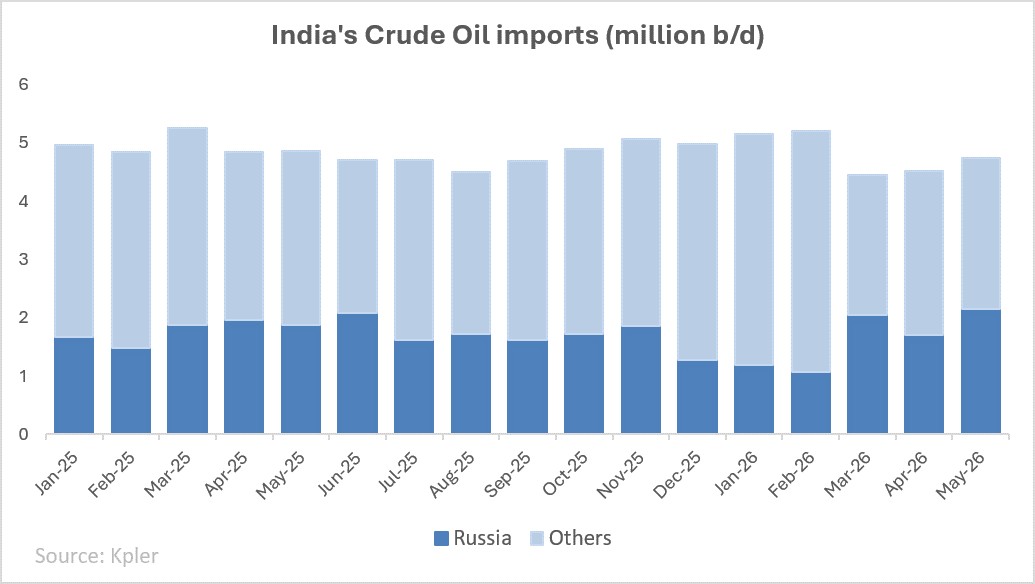
  • The extension of the US waiver on Russian crude lands at a critical moment for India, just as Russian barrels have grown to around 40% of its 4.5 million b/d crude import slate.

  • Unlike China, India has little inventory cushion and rising domestic fuel demand that leaves refiners with almost no room for disruption.

  • With Gulf flows constrained and medium-sour crude scarce, the extended waiver keeps New Delhi’s only remaining large-scale supply option open

The middle of May brought very little good news to the Asian refiners, but the extension of the US waiver on Russian crude and oil products on May 18 has certainly become one. The Trump administration first introduced the waiver on March 12 for Russian crude and products already loaded on ships before that date, as an emergency response to the blockage of the Strait of Hormuz and the resulting shortage of oil on the market. It was extended once in mid-April for another month, and for the second time on May 18, for another 30 days. For New Delhi, the extension comes as a significant relief, shielding its crude supply that has kept Indian refineries running through the worst of the Gulf disruptions on record.

India’s request to extend the waiver proved successful, securing continued access to much-needed volumes, as Russian crude has become central to India’s supply balance. In March and April, India was the largest buyer of seaborne Russian crude, taking 2.08 million b/d and 1.7 million b/d, respectively. That was roughly half of India’s average crude imports of 4.5 million b/d over the past two months. China, the second-largest buyer of Russian seaborne crude, purchased 1.8 million b/d in March and 1.4 million b/d in April. In May, India is set to receive around 2.1 million b/d of Russian crude.

The waiver never mattered to China in the same way. Many Chinese consumers of Russian crude are less sensitive to US sanctions in the first place, and China also has one of the largest crude stockpiles in the world. Its inventories rose from 1.22 billion barrels in March to 1.23 billion barrels after the Gulf conflict began and Hormuz was shut. That is enough to sustain even China’s massive domestic consumption of 14-15 million b/d for several months. India has no such cushion. Even before the conflict started in February, its crude inventories were only 106 million barrels. By April, they had fallen to 90 million barrels. With consumption of 5.5 million to 6 million b/d, those stocks are getting dangerously thin

The supply hit due to the Hormuz closure has been brutal. India has lost more than a third of its usual February monthly oil supply from Gulf producers. Saudi Arabia and the UAE remain the only Gulf suppliers still able to sell crude through bypass pipeline routes, but both are sending less than India would need. Saudi exports to India fell from 1.03 million b/d in February to 670,000 b/d in April. The UAE has managed to keep exports at around 550,000-600,000 b/d over the past two months but has little room to raise them. India has therefore been searching globally for medium-sour cargoes, the grades best suited to many of its refineries and the least available after Hormuz was blocked. It has turned to Latin America, importing 285,000 b/d from Venezuela in April and 275,000 b/d from Brazil, twice the previous month’s level. Nigeria has also exported more in April, but its crude is generally too light for Indian refinery needs.

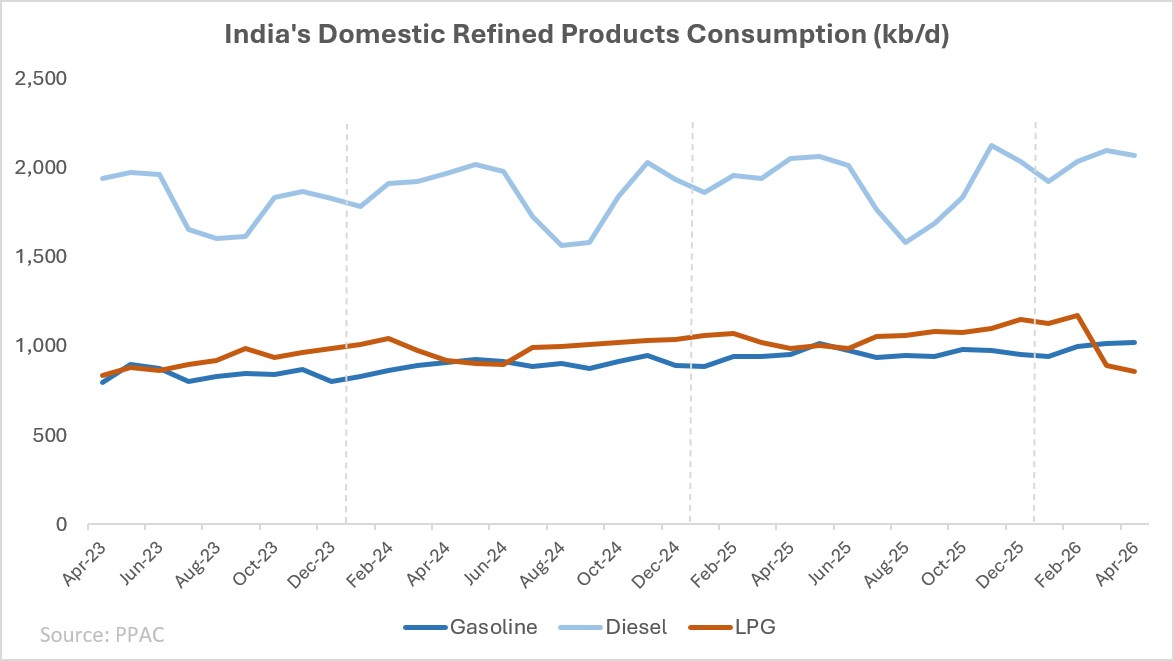
At the same time, India’s domestic oil products demand is still rising (in contrast to China). Adjusting for seasonal patterns, diesel and gasoline consumption in April 2026 was 1% and 7% higher, respectively, year-on-year, at 2.07 and 1.06 million b/d. LPG consumption is the exception, but that decline reflects nationwide shortages rather than a clean demand signal.

There’s also a more practical aspect to the White House’s extension of the sanctions waiver. The Vadinar refinery has returned from maintenance after being offline from April 10 to May 15 and is expected to resume buying the 400,000 b/d of Russian crude that it used to before turnarounds (since August 2025, it has only been buying oil from Russia). So as not to have the refinery overflowing with crude, Vadinar saw its imports of Russian oil collapse to 25,000 b/d in April, suggesting there would be an upside of 350-375,000 b/d of buying in the months to come. As the refinery is co-owned by Rosneft and already under sanctions, additional US restrictions matter less to it.

But the broader rise in Russian imports over the past two months was not driven only by sanctioned or sanction-insulated players. State-owned IOC became the largest buyer, importing 750,000 b/d in April. BPCL bought 190,000 b/d. Partly state-owned HMEL, MRPL and HPCL, which had not bought Russian oil for several months before the waiver, together purchased 350,000 b/d in April out of India’s total 1.7 million b/d of Russian crude imports. These are the refiners most exposed to a shift in US enforcement. They had already stopped buying Russian crude after Washington threatened 25% tariffs, suggesting that some Indian refiners remain highly compliance-sensitive.

Reliance also stopped purchasing Russian cargoes in January 2026 because of sanctions, only for the waiver to bring it back. In April, Russian crude accounted for around 18% of the Jamnagar complex’s total 1.2 million b/d imports. With the Strait of Hormuz still closed, Reliance will continue looking for medium-sour grades, and Russian crude will be difficult to ignore. Jamnagar’s planned maintenance at the end of May will put pressure on consumers but may give Reliance a temporary pause in the middle of the chaos.

The economic cost is already reaching consumers. For the first time in four years, the government had to raise prices for refined oil products that are usually cushioned by the state. Diesel and gasoline prices rose by 3 rupees per litre (around $0.03/litre), lifting diesel to $0.94/litre and gasoline to $1.02/litre. The last increase came in 2022, after the shock caused by the start of the war in Ukraine. Alternative crude will likely come increasingly from Latin America, and while freight is rising, India is becoming the premium crude market in Asia. That premium can cover delivery costs and pull barrels from farther away. It should also encourage the UAE to redirect more of its Murban exports, available through the pipeline to Fujairah on the Arabian Sea. In April, the UAE exported 600,000 b/d to India, twice as much as a year earlier and the highest monthly volume on record.

The extension of the waiver therefore arrives at a critical moment, but it does not resolve the underlying vulnerabilities. China can absorb the disruption through inventories, pipelines, state-controlled trading channels and a higher tolerance for sanctions risk. India cannot. Its refineries need medium-sour crude, its stocks are thin, most of its Gulf supply has been damaged, its demand is still growing, and its most important incremental barrel is now politically more expensive. Russian crude is no longer just a discounted opportunity for India; it has become the commodity standing between New Delhi and a much more visible domestic fuel shortage crisis.

By Natalia Katona for Oilprice.com

The Pentagon Wants 300,000 Drones But China Controls The Magnets

The Pentagon recently placed the largest drone order in American history — 30,000 one-way attack drones, with plans to scale past 300,000 by early 2028. There’s one major problem: every one of those drones runs on a rare earth magnet. And according to Goldman Sachs, roughly 98% of the world's magnets are manufactured in China.

That's the dilemma REalloys (NASDAQ: ALOY) has spent years building to solve. The company holds the only fully non-Chinese “mine to magnet” heavy rare earth supply chain in North America — from processed metals to finished alloys to the magnet-ready inputs that defense contractors actually need.

To understand why the Pentagon is moving this aggressively, you have to look at what happened in Ukraine.

Over the past two years, drones have fundamentally reshaped modern combat like no other technology since the machine gun. Ukraine built over 1.2 million of them in 2024 alone.

The magnets that powered nearly every single one came from China. That means that one move from China could potentially shut down the military of major countries in the West.

The Pentagon has watched that play out in real time. And its response has been the most ambitious autonomous weapons program in modern American history.

In June, President Trump signed an executive order titled "Unleashing American Drone Dominance" that would help boost drone production both in commercial and military sectors.

The next month, Defense Secretary Pete Hegseth issued a memo planning to build up drone manufacturing by approving the purchase of hundreds of American products.

Add to that a defense budget for 2026 with $13.6 billion for autonomous systems, and it's becoming clearer by the day just how committed the U.S. is to drones as a part of their defense strategy.

However, allocating billions of dollars to the problem can't fix the supply chain issue behind the manufacturing of these magnets.

Today, at least 80,000 components across 1,900 U.S. weapons systems depend on Chinese-sourced rare earths. That's not just drone motors — it includes guidance systems, sensors, and virtually every platform the Pentagon fields.

The Pentagon’s drone push is already reshaping the broader defense supply chain, with companies like AeroVironment Inc. (NASDAQ: AVAV), Kratos Defense & Security Solutions Inc. (NASDAQ:KTOS), and Palantir Technologies Inc. (NASDAQ:PLTR) all expanding deeper into autonomous warfare, AI-driven targeting, and next-generation battlefield systems. But whether it’s attack drones, autonomous surveillance platforms, or AI-enabled combat software, nearly every platform ultimately depends on the same fragile rare earth magnet supply chain that still runs heavily through China.

If Beijing tightens the valve, there's no backup supplier to call. That's exactly why REalloys built what it built.

The Gap Nobody Else Is Filling

While much of Europe has neglected the problem, America has been spending aggressively with American companies to fix the issue in 2026.

For example, the Pentagon took a $400 million equity stake in MP Materials last year, becoming the company's largest shareholder, and has loaned hundreds of millions more to other domestic rare earth companies.

Those are serious moves and show the government’s commitment to staying ahead of the changing military landscape. And MP Materials is making real progress on the light rare earth side — neodymium and praseodymium, the elements that go into everyday magnets for consumer EVs and electronics.

But here's the distinction most people don’t realize about this rare earths’ crisis.

Light rare earths give you the base magnetic strength. Heavy rare earths like REalloys produces — including dysprosium and terbium — are what keep those magnets stable at the extreme temperatures inside a jet engine or a drone motor in combat.

Without them, your magnets quickly degrade under heat. That's the difference between a consumer-grade magnet and a military-grade one.

But while many have focused on the consumer side of the supply chain issues, the heavy rare earth gap — the one that military-grade drone motors, missile guidance systems, and jet engines actually depend on — is a separate problem.

It’s a problem that requires America and its allies to sidestep China’s ability to cut them off at each step of the supply chain, and REalloys sits at a crucial vantage point.

How REalloys Built What Nobody Else Has

REalloys' (NASDAQ: ALOY) supply chain starts at the Saskatchewan Research Council's Rare Earth Processing Facility — the only operational, fully non-Chinese processing plant in North America. The company holds an exclusive offtake covering 80% of that facility's output.

From there, those processed metals ship to REalloys' own metallization facility in Euclid, Ohio, where they become defense-grade alloys and magnet-ready materials. Feedstock comes from North America, Brazil, Kazakhstan, and Greenland, which means there’s no single point of failure and no Chinese inputs at any step.

That last part matters more than you'd think.

That’s because in late 2020, Beijing blocked the sale of rare earth processing equipment and know-how to any country outside its orbit. That effectively cut off the usual playbook: buy Chinese technology, set up a plant, and start producing.

Which is why REalloys' processing partner went a completely different direction — designing custom furnaces, proprietary separation chemistry, and AI-driven control systems from scratch.

And that bet on homegrown technology is clearly paying off today as China has only continued to tighten the clamps on the world’s rare earth supplies.

In April 2025, Beijing imposed licensing requirements on seven heavy rare earth elements, including dysprosium and terbium, covering all related compounds, metals, and finished magnets.

A second wave of restrictions was announced and then temporarily suspended through November 2026, but the first wave remains in full effect.

The Pentagon’s Looming 2027 Deadline

The timing of the Pentagon’s drone program becomes even more critical as they prepare to set new procurement rules in 2027.

That’s when the government will effectively ban Chinese-origin rare earths from the U.S. defense supply chain — from mining all the way through to finished production.

An F-35 contains more than 900 pounds of rare earth materials. A Virginia-class submarine requires over 9,200 pounds. Lockheed Martin, Northrop Grumman, and RTX will all need to trace and certify their magnet supply chains before the deadline hits — or risk losing their contracts.

Which means the biggest defense contractors in the world will soon need a compliant supplier of heavy rare earth materials. And REalloys has been moving fast to meet that moment.

In March, the company closed an upsized $50 million public offering, with roughly $40 million going toward building the largest heavy rare earth metallization facility outside China.

They’re targeting first operations in 2027, with Phase 2 scaling to make REalloys the largest Western producer of refined dysprosium and terbium by a wide margin.

And in March, the company announced that Joe Kasper — the former Chief of Staff to the U.S. Secretary of Defense, who led efforts on critical material supply chain vulnerabilities during his time at the Pentagon — was appointed Chair of the Advisory Board.

He joins General Jack Keane, a retired four-star General and former Vice Chief of Staff of the U.S. Army, alongside a Chairman who also serves as President and CEO of GM Defense.

That means that while America races to secure its heavy rare earths supply chain for its drone program, the REalloys board has a clear idea of how urgent the need is and how to solve it.

Where This Is Heading in 2026

The Pentagon has made its bet, committing to $13.6 billion on drones and autonomous systems, hundreds of thousands of unmanned platforms, and a new kind of warfare.

However, it’s impossible to buy our way out of a supply chain that doesn't exist.

That takes years of work in separation chemistry, metallurgy, and defense qualification — work that REalloys started over a decade ago, long before rare earths became a national security headline.

America currently imports 10,000 tons of rare earth magnets. The DFARS deadline to end the dependence on China is nine months away. And it would take a credible competitor starting from scratch between three to seven years to reach comparable capability.

You can fund a mining operation in a year. You can break ground on a processing facility in two. But building the metallurgy, qualifying with defense contractors, and securing feedstock from multiple non-Chinese sources takes the better part of a decade.

REalloys (NASDAQ: ALOY) has already put more than a decade into securing every part of the supply chain outside China’s control.

When the Drone Dominance Program scales from 30,000 units to 300,000, the magnets inside each one will need to come from somewhere other than China. REalloys is building that supply chain — and right now, it's the only company in North America positioned to deliver.

By. Charles Kennedy

 UK

Who Pays When Utility Managements Screw Up?

  • Britain’s light-touch utility regulation enabled companies like Thames Water to load up on debt, extract cash, and fail operationally while regulators failed to intervene effectively.

  • Unlike the stricter U.S. utility model, where regulators closely oversee financing and risk, the UK approach allowed excessive leverage and poor governance that ultimately left Thames Water financially crippled.

  • Forcing customers to absorb the costs of rescuing the company creates a major moral hazard

Please excuse the infelicitous wording, but that is what this is all about. Not missteps or misjudgments but genuine, massive screw-ups. Policy makers in the United States worked out that problem over time, dealing with nuclear cost overruns and aborted projects. Three utilities went bankrupt (only one being investor-owned) when the financial burdens of nuclear projects far exceeded the resources of the utility. In most cases, regulatory agencies forced utility shareholders to bear some of the losses or imprudently incurred costs, customers paid some of the costs in higher rates, but creditors came out whole.

In the United States, regulatory agencies regulated not only prices, but also watched over utility financial policies, management dealings and quality of service. They did not necessarily tell the utility how to finance, but they often set rates based on how they thought the utility should finance, and heaven help those who ignored that advice. So there was little likelihood that financial misdeeds or self dealing would take place. Furthermore, the companies and the regulators had an implicit deal. The regulator granted the utility a modest profit that did not leave much margin for error or for unanticipated costs. In return, the utility expected the regulator to cover legitimate costs (whether expected or not) through the ratemaking process. The regulator, in effect, told the utility, “We give you a return commensurate with low risk, and we will keep that risk low for your owners and creditors as long as you don’t play any games with us.”

The British, since privatization more than three decades ago, have taken a lighter-handed regulatory approach. They did not like to interfere with ownership questions or how the company financed. That was management’s area of expertise. Companies could make big profits without regulators watching every move. It was like watching those black and white Ealing Studios movies: old Etonian buddies could not possibly be spies for a foreign country, nor do chaps like us not play by the rules. 

Now we come to Thames Water, Britain’s largest water utility, whose fate at the time of this writing is in the hands of the courts.  It seems that the previous owners, a succession of them, stripped cash from the business, replaced equity with debt, spent huge sums on capital expenditures charged to water consumers, and still failed to meet water and sanitation goals. (Where was the regulator? Presumably letting boys be boys.) Well, the result was that Thames Water ran out of funding. The shareholders would not put in more money,  and they were wiped out. Politicians talked about renationalizing the company, but its fate is now in court, where two creditor groups vie to provide the company with billions of pounds of credit at high interest rates (9.75% or 8% depending on which group wins) to keep the company going until its finances are stabilized. 

Now, back to the question of who pays? The stockholders, presumably knew what they were doing when they took money out. And the bondholders, should have known that they were buying into a highly leveraged entity (around 90% debt in recent years). One might argue that the business was leveraged to the point that the debt was more like quasi-equity. But, it looks as if the UK will not renationalize the company to assure service, nor accept a previous proposal from a firm that suggested writing off some of the debt and thereby refloating the company with a less burdensome debt level. Instead, it will choose between loan offers from competing creditor groups. Who will pay the costs of this expensive financing? Well, we suspect the same customers who already paid for all the spending that did not clean up the Thames in the first place. 

Look, here’s our beef. If you believe in competition and free markets à la Maggie Thatcher (who privatized these utilities), even in the water business, and you let companies make big profits when they excel, then you should let them fail when they go wrong. (The pipes and reservoirs and staff and computing systems will remain, and the water will flow, we imagine, even in bankruptcy.) Otherwise, the government simply encourages excessive risk taking at the public's expense. If the government regulates utilities like the water business to earn a modest profit while providing a public service, and restricts their activities to limit risks they could impose on consumers, then it owes them aid when they have carried out their duties prudently. One way or the other. We don’t pretend to know British bankruptcy law, but we do know what moral hazard looks like, and water equity, too, if you make customers pay for the mess they did not cause.

Now, having finished our thoughts on regulation, let us quaff some pure Catskill Mountain water provided by the New York City Municipal Water System, which started out as a private company run by a pack of scoundrels. It didn’t take the city fathers long to conclude that they needed to throw out the miscreants if they wanted plentiful, clean, reasonably priced water. Sometimes socialism is the appropriate choice. 

By Leonard Hyman and William Tilles for Oilprice.com


Brazil’s Record Oil Production Comes at a Crucial Moment for Global Markets

  • Brazil’s oil production hit a record 4.24 million barrels per day in March 2026, driven largely by ultra-deepwater pre-salt developments in the Santos Basin.

  • Petrobras, Shell, and Equinor are pouring billions into offshore projects that could significantly expand Brazil’s oil and natural gas output through the end of the decade.

  • Brazil’s low-cost and relatively lower-carbon offshore reserves are becoming strategically important as geopolitical tensions threaten Middle Eastern energy exports.

Recent oil price shocks in response to the closure of the Strait of Hormuz underscore the importance of oil-producing countries outside of the Middle East. One of the most important is Brazil, Latin America’s largest economy and oil producer. The country is experiencing an epic decades-long oil boom, which was responsible for production hitting a new record high for March 2026. This places Brazil on track to become a top-five global producer by the end of the decade, making the country important to bolstering energy security in the Americas.

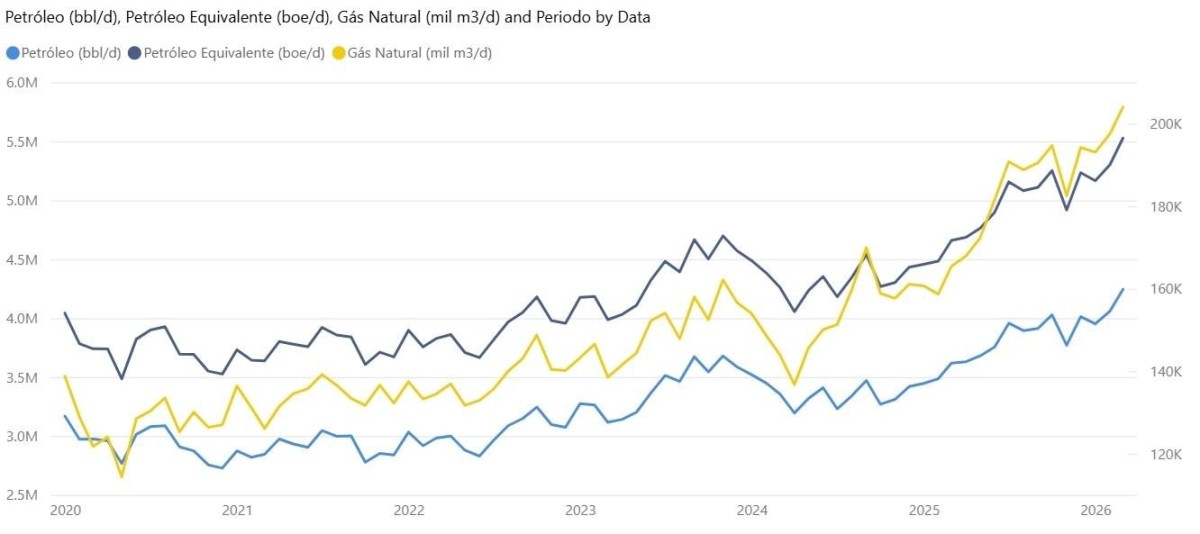
Data from Brazil’s hydrocarbon regulator, the National Agency of Petroleum, Natural Gas and Biofuels (ANP), shows oil production hit 4.24 million barrels for March 2026. This represents a notable 4.6% increase over the month prior and is a whopping 17.3% greater year over year.

Brazil Oil and Natural Gas Production January 2020 to March 2026

Brazil oil
Source: Brazilian National Agency of Petroleum, Natural Gas and Biofuels (ANP).

Natural gas production is also soaring higher at this crucial time, with global supply further constrained by Tehran’s strikes on liquefied natural gas (LNG) and liquefied petroleum gas (LPG) producing facilities in Qatar. Brazil’s March 2026 natural gas output hit an all-time high of 7.2 billion cubic feet per day, a 3.3% increase over February 2026 and a notable 23.3% greater than a year earlier. 

This couldn’t occur at a better time for South America’s largest economy. Not only is global supply sharply impacted by events in the Middle East, but key regional natural gas exporter Trinidad and Tobago is suffering from a major decline in hydrocarbon output. As a result, regional supply is falling at a time of rising demand, as illustrated by Colombia, the region’s third-largest economy, which is experiencing such strong demand that LPG imports are soaring, forecast to expand by at least 26% this year.

Brazil’s hydrocarbon production will continue expanding at a healthy clip. National oil company Petrobras will be a key driver of higher hydrocarbon production. The driller, where the government owns 37%, is planning to invest $109 billion between 2026 and 2030. Importantly, $78 billion or 71.6% of that capital spending will be directed to Petrobras exploration and production facilities, with most to be spent on the company’s prolific pre-salt operations.

It is Brazil’s deepwater pre-salt oilfields, located in the prolific offshore Santos Basin, which are the primary driver of the country’s massive oil boom, which has been underway since 2006. There are currently nine pre-salt projects under development, with six floating production, storage, and offloading (FPSO) vessels to be installed in the offshore ultra-deepwater 210,500-acre Buzios oilfield. Petrobras claims Buzios is the world’s largest deepwater oilfield. That large oilfield is shaping up to be the key driver of Brazil’s future production growth. 

Buzios is proving to be highly profitable for Brazil’s national oil company with an estimated breakeven price of less than $35 per barrel. Petrobras recently announced that its entire upstream portfolio has an average breakeven price of a mere $25 per barrel, one of the lowest in the industry. Petrobras expects to be lifting 2.7 million barrels of crude oil per day by 2028, with 81% comprised of pre-salt petroleum, while combined commercial oil and natural gas production will hit 2.9 million barrels of oil equivalent that year.

Overall, Brazil’s pre-salt oilfields have industry-low breakeven prices estimated to be $30 to $40 per barrel, making them extremely attractive for foreign energy companies. The appeal of investing in offshore Brazil is amplified by the low carbon intensity of oil extraction operations. Analysts estimate Brazil’s oil industry emits an average of 10 to 12 kilograms of carbon for every barrel of crude oil lifted, compared to a global average of around 17 kilograms. Meanwhile, Petrobras claims its upstream portfolio emits 17 kilograms of carbon for every barrel of crude produced.

Shell, Brazil’s second largest oil producer, lifting 11.62% of total production, continues to invest in the country’s prolific offshore pre-salt basins. In December 2025, the global supermajor announced the acquisition of additional acreage in the Santos Basin Mero and Atapu operations. Shell committed $50.5 million to acquire an additional 0.254% of Atapu and $293.4 million for an additional 0.70% of Mero. This boosted the supermajor’s pre-salt oil production by a yet undefined amount.

Another global energy major, Norway’s national oil company Equinor, is developing the $9 billion Raia natural gas project in the offshore Campos Basin. Equinor, which is the operator, holds a 35% working interest in the facility, while 35% is held by Beijing-controlled Sinopec and the remaining 30% by Petrobras. The facility is targeting natural gas and condensate reserves totalling at least one billion barrels of oil equivalent. Raia will come online during 2028 with the capacity to pump 565 million cubic feet of natural gas per day and 126,000 barrels of condensate per day. 

The offshore facility possesses the potential to supply up to 15% of Brazil’s natural gas demand in 2028. Raia will ease the impact of declining sales of the fossil fuel in Latin America and the Caribbean, which are falling because of the structural decline of Trinidad and Tobago’s once-dominant natural gas industry. The Raia facility, which will have industry-low carbon emissions of 6 kilograms per barrel produced, compared to 17 kilograms globally, will boost Brazil’s energy self-sufficiency. 

By Matthew Smith for Oilprice.com