Friday, July 03, 2026

Opinion

The man America forgot to invite to its 250th birthday party

(RNS) — This man didn’t set foot in North America. He never signed a founding document. But there is a compelling case that our country’s great story would look very different without him.


William Tyndale, Protestant reformer and Bible translator. (Image from Foxe's Book of Martyrs/Wikimedia/Creative Commons)


Dirk Smith
July 2, 2026
RNS

(RNS) — George Washington, Benjamin Franklin, Thomas Jefferson and John Adams will be some of the names that will rightly dominate the tributes as America turns 250 in the next few days.

Block parties, fireworks and patriotic speeches will give honor to these men for the leadership, courage and vision that helped birth and shape a nation unlike any the world had seen before.

Yet standing in London beside a book twice the age of the United States, I find myself wondering whether somebody is missing from America’s 250th birthday party guest list.


This man didn’t set foot in North America. He never signed a founding document. He actually died almost 250 years before the Declaration of Independence. But there is a compelling case that our country’s great story would look very different without him.

Let me introduce you to William Tyndale, the man who, 500 years ago, translated the New Testament from the original Greek into English for the very first time.

The book I have just been staring at is one of only three surviving copies of Tyndale’s 1526 New Testament. Printed in Germany, it was smuggled into England and was already ancient when America declared independence. Today it sits safely preserved behind glass at London’s iconic St. Paul’s Cathedral. I am here in Britain filming a mini-documentary series, following Tyndale’s footsteps and learning more of his amazing story.

In the early 16th century, only priests had access to the Bible, but Tyndale became convinced that ordinary people should be able to read Scripture in their own languages. Church authorities fiercely opposed English translations, fearing they would undermine established authority and spread heresy.

Tyndale disagreed. His ambition was simple but dangerous. He famously declared that if God spared his life, he would ensure that a plowboy knew more Scripture than the religious leaders opposing him.

Unable to complete his work in England, he fled to Germany. Working in exile, he launched a movement that would change history. Backed by a team of wealthy businessmen and transporters, copies of his New Testament were printed in 1526 and then secretly smuggled into England hidden among cargo shipments.


The pocket Bible we know today was effectively born not from convenience but necessity. Its size made it easier to conceal and smuggle.

Authorities searched for the books, and church leaders publicly burned them. But the demand proved unstoppable. Historians estimate that up to 18,000 English New Testaments made their way into London.
RELATED: 500 years ago, the first New Testament in English was published – and stirred up a hornet’s nest

Tyndale’s mission eventually cost him his life. In 1536, he was strangled and burned at the stake in Belgium after a year in jail.


William Tyndale is burned at the stake in Belgium. (Image from Foxe’s Book of Martyrs/Wikimedia/Creative Commons)

“Lord, open the King of England’s eyes,” were reportedly the famous last words he shouted before his death.

Remarkably, less than a year later, every church in England was required to have a copy of the Bible chained to its pulpit. And not long after that, English Bibles were printed with royal approval and were made accessible — to everyone. Tyndale’s prayer was answered. The man was dead; the mission lived on.

But that was just the beginning. Tyndale’s masterpiece was on the move and would travel much further than he ever imagined.

As President of EEM, a ministry that delivers more than 2 million Bibles every year to people who have requested them, I know firsthand how Scripture continues to transform lives. We are just one organization carrying Tyndale’s mission forward across the world today.

Most people know Tyndale as a Bible translator, but he was also one of the architects of the English language itself.

“The powers that be,” “fight the good fight,” “the signs of the times” and “the spirit is willing, but the flesh is weak,” are just a few phrases that first appeared in his writings.

He translated Scripture into English that was clear, memorable and beautiful. Five centuries later, these sayings still feel natural because they helped shape the English language itself.

That influence would prove particularly significant across the Atlantic. When the first settlers arrived in North America, they brought more than hopes and dreams — they brought Bibles. And those Bibles carried William Tyndale’s words.

The King James Bible relied heavily on Tyndale’s earlier work. Scholars estimate that roughly 80% to 90% of its New Testament draws directly from his translation.

It’s quite incredible that the book that would shape the moral compass of a nation and become its rock, backbone and manual was translated by a man who remains unknown to most Americans.

George Washington famously said that it is impossible to rightly govern a country without God and the Bible. As I stood before this 500-year-old New Testament, I began to wonder where America would be today without it. How much biblical language and Scripture has formed the fabric of American life? Where would families and communities be without the word of God?

As America celebrates 250 years of freedom, it will rightly honor the soldiers, statesmen and founders who built our great nation. But perhaps it should also remember the British translator who helped shape the world long before 1776.

William Tyndale never lived to see America. He never knew the Founding Fathers. Yet five centuries after his New Testament first appeared and 250 years after America’s birth, his words still echo across the nation today.

For a man most Americans have never heard of, that is quite a legacy.

He may just be the most influential figure absent from the celebration.

(Dirk Smith is President of EEM, a Christian ministry that publishes and delivers approximately 2 million Bibles free every year across 35 countries in more than 30 languages. See www.eem.org for more. The views expressed in this commentary do not necessarily reflect those of Religion News Service.)
As US turns 250, Pope Leo says liberty is represented through life, immigrants and faith

VATICAN CITY (RNS) – The first US-born pope marked America’s 250th anniversary by urging the country to recommit to its founding ideals. Speaking 'as a son of this great country,' Pope Leo highlighted a moral duty to protect life, welcome immigrants, defend religious freedom and seek peace through interfaith cooperation.


Pope Leo XIV waves during the Angelus noon prayer from the window of his studio overlooking St.Peter's Square, at the Vatican, Monday, June 29, 2026. (AP Photo/Alessandra Tarantino)


Claire Giangravè
July 3, 2026 
RNS


VATICAN CITY (RNS) – Pope Leo XIV marked the United States’ 250th anniversary by calling his home country back to its founding ideals, during a speech in which he defined liberty through protecting human life, welcoming immigrants and supporting religious freedom and interfaith cooperation — themes that cut across some of the country’s most divisive debates.

The pope delivered a pro-life and pro-immigrant message, stating that the strength of a country “is deeply tied to the value it affords to human life in every form and condition,” during his live virtual remarks to the National Constitution Center in Philadelphia on Friday (July 3).

The first U.S.-born pontiff, born in the suburbs of Chicago, acknowledged his roots “as a son of this great country.” He earned his bachelor’s degree in mathematics at Villanova University, about 12 miles west of Philadelphia.


Leo, who spoke from the Vatican, was honored at the event with the annual Liberty Medal, in recognition of his work in advancing religious liberty and freedom of conscience. He addressed the gathering alongside figures including Philadelphia Archbishop Nelson J. PĂ©rez and some of the city’s Muslim, Jewish, Black Protestant and Latino Christian leaders.
RELATED: Pope Leo applies Catholic social teaching to artificial intelligence

In his speech, he said the right to life was the first to be enshrined by the U.S. founders and must continue to be cultivated today. Leo said that reverence for God’s gift of life is what “sways the hearts of individuals and inspires laws that recognize and safeguard this gift from the moment of conception to natural death.”

Leo’s remarks come four years after the U.S. Supreme Court overturned Roe v. Wade, ending the federal constitutional right to abortion and returning the issue to the states. Abortion is currently banned in 13 states and remains a contested political and moral debate.

But the pope offered a vision for the respect and protection of life wherever it is vulnerable, which he said includes unborn babies as well as migrants, refugees and elderly, sick and disabled people.

“The moral greatness of a nation is manifested, above all, in its capacity to support, protect and cherish the lives of all, especially the most vulnerable and those whose worth is questioned,” he said.

A descendant of immigrant families, the pope spoke of the U.S. as a nation shaped by successive waves of immigration. In his speech, Leo tied the country’s love of freedom to it becoming a destination for immigrants from all over the world and its defense of freedom abroad.


As of 2025 data, about 51.9 million immigrants live in the U.S., representing nearly 15.4% of the population, according to Pew Research Center. Migration remains one of the most polarizing debates in the U.S. Days before Leo’s address, the Supreme Court rejected President Donald Trump’s effort to restrict birthright citizenship, which sought to add new exceptions to citizenship for children born in the U.S. to undocumented immigrant parents.

The U.S. has long championed religious freedom, the pope said, and enshrined it in its First Amendment. “It is this freedom that holds sacred the inner sphere of the person where convictions are formed and where conscience can guide the decisions made in the intimacy of the human heart,” he said. “This same freedom also ensures the right of every person to worship according to one’s own belief, and of individuals, communities and associations to give public expression to their faith.”

Leo praised the American tradition of interfaith dialogue and interreligious cooperation, which has led to “enriching the debates on the great moral and ethical issues that have faced the nation and shaped the course of its history.”

He said he hopes this will continue in the future, calling for a “public discourse marked by moderation, respect for the views of others and an ongoing effort to find common ground in promoting the cause of peace and reconciliation, at home and abroad.”

Leo’s remarks also came amid renewed debate over Islam and religious liberty in the U.S. In June, 119 congressional Democrats condemned the newly formed GOP Sharia-Free America Caucus as discriminatory toward Muslims. The caucus, launched last December, claims that Islamic religious law poses a growing threat in the U.S., and has backed bills critics say could infringe on Muslims’ rights to free speech and religious freedom.
RELATED: Reeling from Venezuela’s earthquakes, churches rush to inspect buildings, distribute supplies

The pope acknowledged that building a society based on protecting life, religious freedom and the pursuit of happiness “was not always easy and, in many respects, is still a work in progress.”


Drawing from the principle of unity — which has defined his young pontificate so far — Pope Leo reminded his native country that “to flourish, it must be truly united” and urged Americans to see the country’s 250th anniversary not merely as a celebration of the past, but as a recommitment to its founding ideals.
‘God commands us not to kill’: Faith leaders protest 50 years of executions

WASHINGTON (RNS) — On the anniversary of a Supreme Court ruling reinstating the US death penalty, faith leaders, those affected by murder and activists organize to call for an end to the death penalty. But religion has also been present in support for capital punishment.


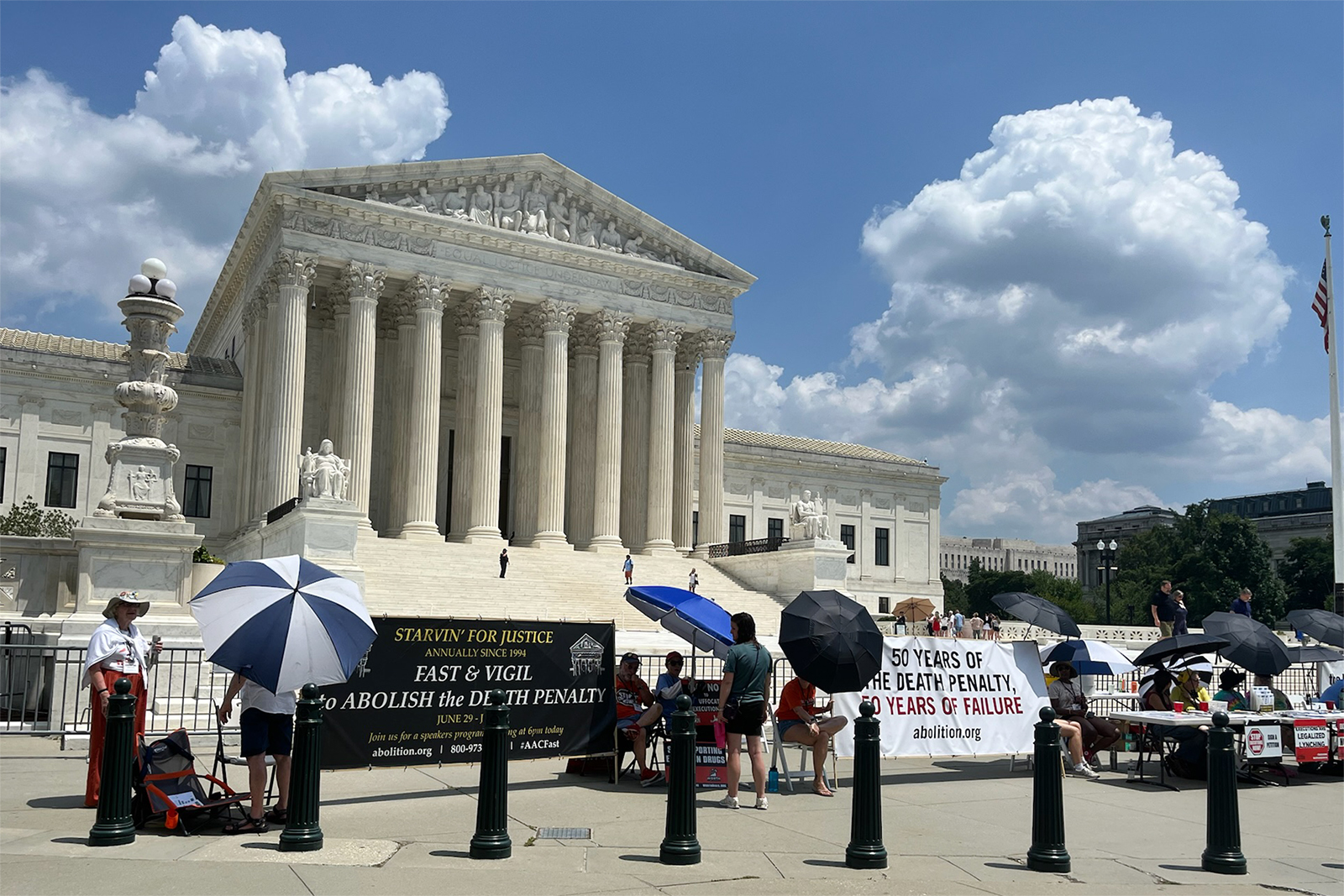
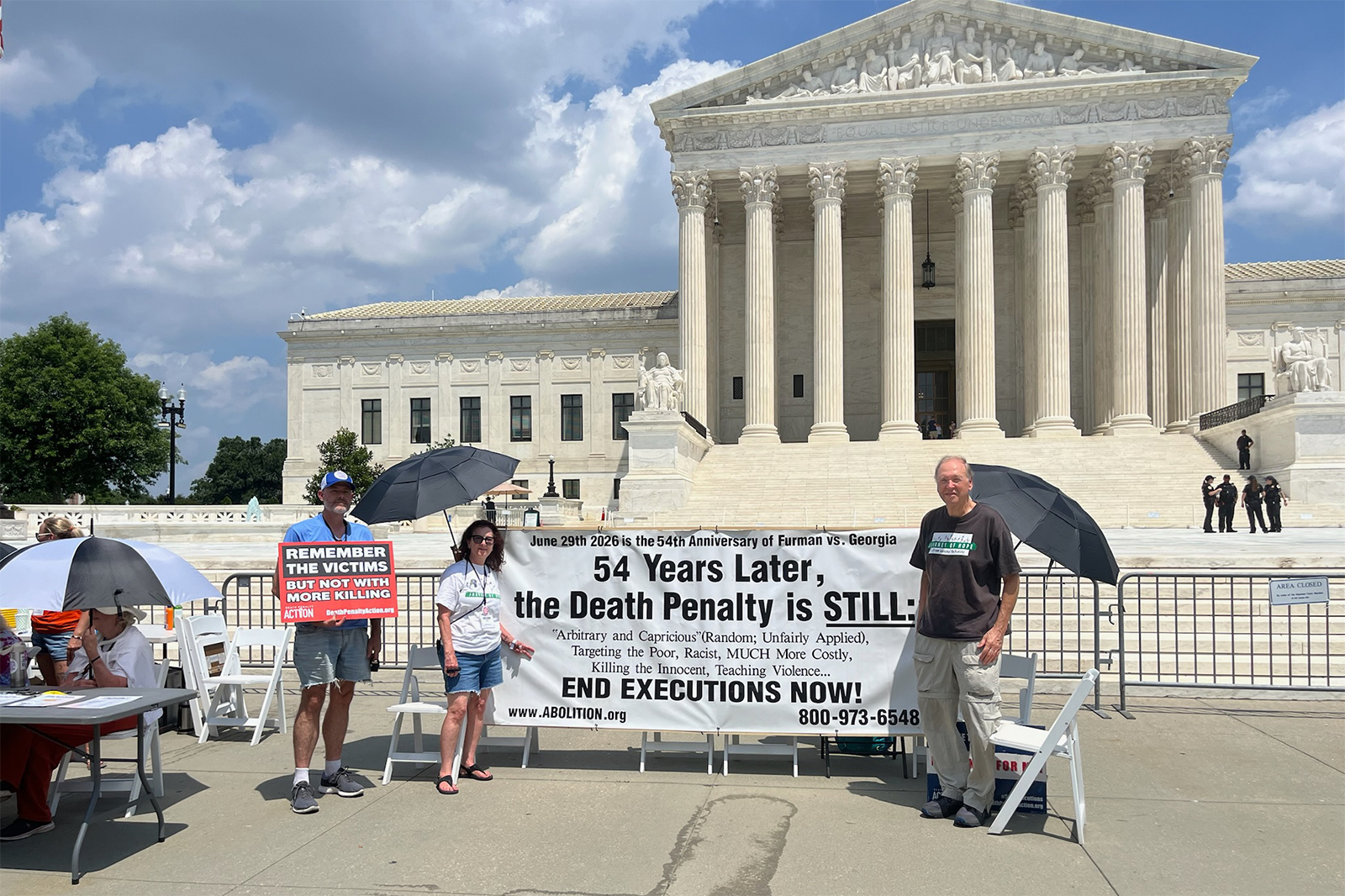
Activists participate in an annual “Starvin’ for Justice” demonstration against the death penalty outside the Supreme Court, in Washington, Wednesday, July 1, 2026. (RNS photo/Aleja Hertzler-McCain)
RNS

WASHINGTON (RNS) — In her first years attending a fast marking the anniversary of the Supreme Court decision that resumed the modern-day death penalty in the United States, SueZann Bosler was still on medication to treat the effects of being stabbed in the head by the same man who murdered her father, the Rev. Bill Bosler, in 1986.

To honor the wishes of her father — a Church of the Brethren minister in Florida who was against the death penalty — Bosler worked for a decade to commute the death sentence of the man who killed her father and injured her, despite initially struggling to forgive him. “ It saved my life, forgiveness,” she said.

On Thursday (July 2), the 50th anniversary of the 1976 Gregg v. Georgia decision that reignited the modern era of the death penalty in the country, Bosler is on her fourth day of fasting. She has been taking shifts as part of the “Starvin’ for Justice” anti-capital punishment protest outside the U.S. Supreme Court to try to convince passersby to join her in opposition as temperatures climb above 100 degrees.


But the solidarity of about 85 protesters involved makes the time joyful, Bosler told RNS, because she’s often the sole person protesting outside the Florida Supreme Court.

In the 50 years since the Gregg decision, faith-based opposition to the death penalty has been a cornerstone of successful abolition and commutation campaigns — even as religious Americans as a whole tend to support the death penalty, data suggests.

“Faith leaders have been instrumental” in death penalty abolition in New Jersey, New Mexico, Connecticut, Virginia and several other states, according to Abraham Bonowitz, the executive director of Death Penalty Action and co-founder of L’chaim! Jews Against the Death Penalty.


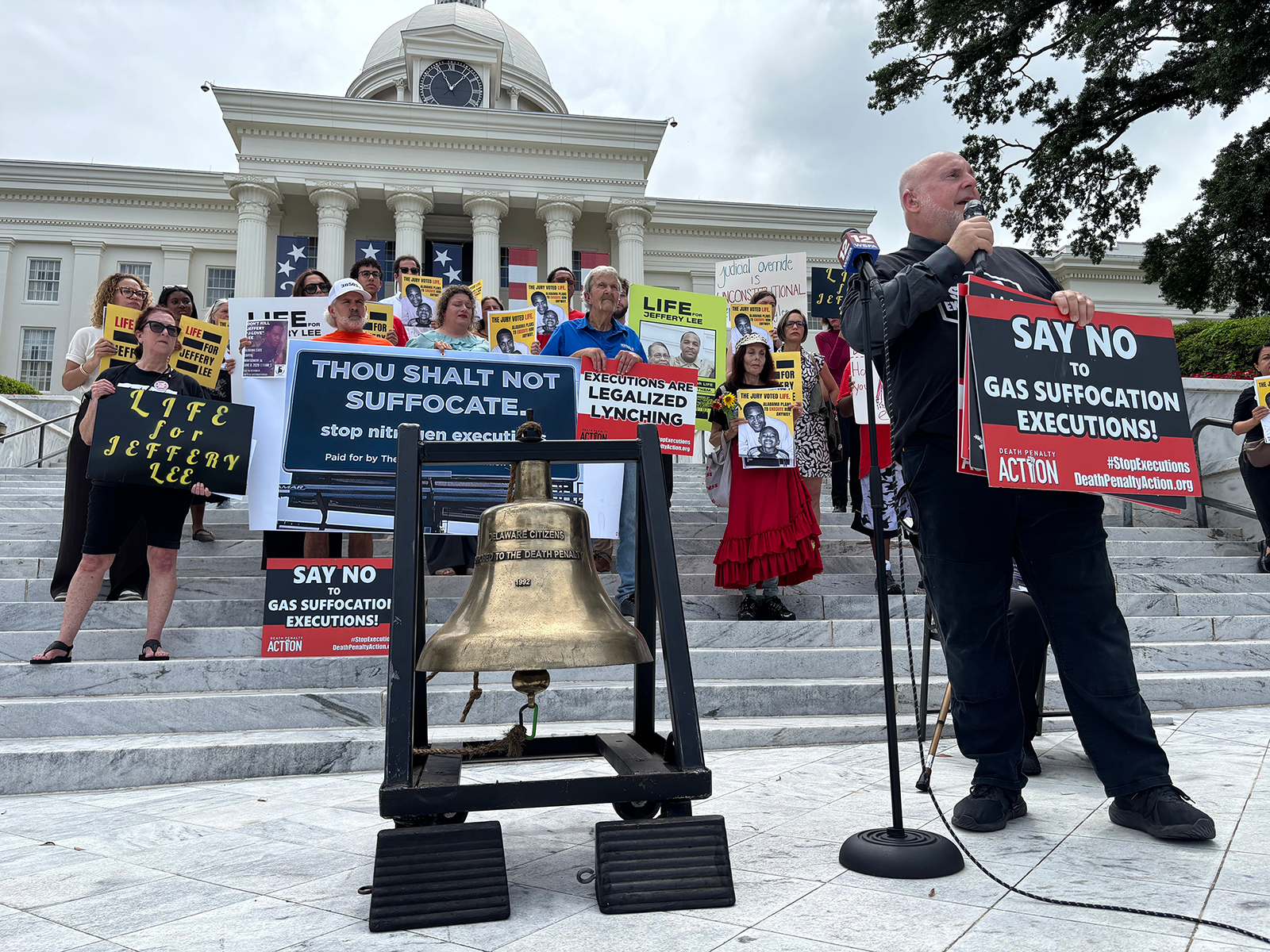
Abraham Bonowitz, of the group Death Penalty Action, leads a demonstration outside the Capitol in Montgomery, Ala., on Monday, June 8, 2026, to oppose an upcoming execution in Alabama. (AP Photo/Kim Chandler)

Bonowitz also credited faith leaders like the Rev. Sharon Risher, whose family members were murdered at Mother Emanuel AME Church in Charleston, South Carolina, in 2015, with successfully pressuring President Joe Biden to commute the sentences of 37 people on death row in the last days of his presidency. Emanuel’s shooter was not among those commutations.

“God commands us not to kill,” said Art Laffin, an organizer of the Starvin’ for Justice protest and member of the Dorothy Day Catholic Worker community. “It’s not an option, it’s a command.”


Laffin, who has publicly prayed for the man who murdered his brother, Paul, said that on the cross Jesus was “given the death penalty of his day” but put “into practice the command to love your enemies” by asking God to forgive his killers. “The best way to honor my brother is to work for the prevention of violence,” he said.
RELATED: Faith groups join other death penalty opponents in new campaign

Executions in the U.S. surged last year, largely driven by an increase in Florida, and religious death penalty abolitionists are feeling renewed energy and searching for any openings they can find to prevent executions.

The death sentence remains a legal punishment in 27 states. Of those, four states — California, Pennsylvania, Oregon and Ohio — have instated execution moratoriums in the last few years. In the 23 states where the death penalty remains, it continues to emerge as a topic of vociferous debate, especially amid criticism over botched executions.


Protesters against the death penalty gather in Terre Haute, Ind., July 15, 2020. (AP Photo/Michael Conroy)

Currently, the federal death penalty applies to all 50 states but is rarely used. Since 1988, there have been 16 fed­er­al exe­cu­tions, 13 of which occur­red in a six-month peri­od between July 2020 and January 2021.

In Sacramento on Tuesday, faith leaders and activists delivered petitions from more than 25,000 people urging California Gov. Gavin Newsom to commute the sentences of all those on death row in the state, alongside 565 LED candles representing their lives.


Faith-based activists are also ramping up pressure on Ohio Gov. Mike DeWine to commute sentences as his term ends this year. Bonowitz said DeWine sometimes attends Mass at the same Columbus parish as his wife, Bonowitz said. The church, St. Catherine, prays for the abolition of the death penalty at every Mass. A spokesperson for the Diocese of Columbus did not confirm or deny those prayers when reached by email.

Last month, DeWine, who had earlier in his career sponsored a bill to reinstate the death penalty in Ohio, called for state lawmakers to abolish the death penalty. Despite pressure, he has commuted only one of the state’s more than 100 death penalty sentences to life in prison without parole.

In Florida, Catholic bishops have written repeatedly to Gov. Ron DeSantis, who is Catholic, asking him to stay the executions of 22 people in the last year. They recently urged DeSantis to prevent the execution of Dusty Ray Spencer, 74, who last week became the oldest person executed in Florida’s modern history. Faith-based activists have also elevated the voice of Ron McAndrew, a former Florida prison warden who says he is haunted by men he executed.


SueZann Bosler, center left, and Art Laffin, right, pose at a “Starvin’ for Justice” demonstration against the death penalty outside the Supreme Court, in Washington, Wednesday, July 1, 2026. (RNS photo/Aleja Hertzler-McCain)

In the nation’s capital, the activists hope to mark the 50th anniversary of the Supreme Court decision by appealing to passersby and the consciences of the justices inside, many of whom are Catholics and have issued decisions advancing the death penalty.

The Rev. Jack Sullivan, Jr., a Disciples of Christ pastor and the brother of a murder victim, Jennifer, told RNS the anniversary “confronts people of goodwill across the country, and particularly people of faith, who believe in the powers of hope and life and love and redemption.”

Like Bosler and Laffin, Sullivan is part of Journey of Hope, a national anti-death penalty organization led by family members of murder victims.

Among the advocates fasting are also those who minister to those on death row. Maureen Bibby, a Catholic from Tennessee, said she’s “become best friends” with the man she visits on death row.

“It’s the only place in the world where you are known only by the worst thing you’ve ever done,” Bibby said. “These are human beings.”
RELATED: Supreme Court stops execution of inmate who became a ministry leader on death row

On July 2, 1976, in a 7-to-2 decision, the Supreme Court ruled capital punishment did not violate the Eighth and Fourteenth Amendments. The decision was a dramatic reversal of the court’s 1972 ruling in Furman v. Georgia, which had halted executions nationwide.

Since Gregg v. Georgia, “1670 people made in God’s image and likeness have been executed,” Krisanne Vaillancourt Murphy, executive director of Catholic Mobilizing Network, an anti-death penalty organization, said in a statement to RNS.

Vaillancourt Murphy added that more than 200 people on death row have been exonerated since 1973 — “a sobering reminder that our criminal legal system is fallible, and that the death penalty is irreversible.” Perjury, false accusations and official misconduct are the leading causes of wrongful convictions, the advocacy group Equal Justice Initiative has found.


In the history of capital punishment, Black Americans have been disproportionately sentenced to death, especially when the crime involves white victims. The majority of state executions since 1976 have occurred in the U.S. South. As a result, several scholars and activists have deemed capital punishment “a direct descendant of lynching” and racial oppression.

“The country has had and continues to have racism flowing in the groundwaters of our land,” Sullivan said, “and it certainly affects the criminal justice system and the handing down of sentences, including and especially death sentences.”

Religion has also been present in support for capital punishment. A 2021 Pew Research Center report found that a majority of religiously affiliated U.S. adults, especially Protestants, favor the death penalty for people convicted of murder — as do a majority of all Americans, per the survey.

NEW: Bring more puzzles and play to your week with RNS Games

In advocating for death sentences, some prosecutors have delivered closing remarks including scriptural quotes such as Leviticus 24:17, Genesis 9:6 and Exodus 21:12 that call for the death penalty as punishment for murder.

Yet Bonowitz, who is Jewish, said those who base their support for the death penalty on Hebrew Scripture must look at rabbinic interpretations, which argue “the death penalty exists” but humans “cannot be trusted with this power to execute.”

Shane Claiborne, the author of “Executing Grace: How the Death Penalty Killed Jesus and Why It’s Killing Us,” told RNS, “The death penalty wouldn’t stand a chance in America without the support of Christians.”


Claiborne, co-founder of Christian social justice group Red Letter Christians and a key figure in the religious left, said he saw opportunities to work with conservatives on the issue. “There’s something deeper that should connect us, which is this profound sense that no one’s beyond redemption and that our government is not infallible, so we shouldn’t entrust it with this power,” he said.

Sister Helen Prejean, part of the congregation of St. Joseph and an anti-death penalty advocate, said in a recent video reflecting on the 50th anniversary of the Gregg decision, “I think it is the most terrible decision the Supreme Court has made after Dred Scott,” which ruled enslaved people were not U.S. citizens.

Prejean is known globally for her decades-long crusade against capital punishment. Her campaign has included making personal appeals to both Pope John Paul II and Pope Francis.

Francis ordered a change to the catechism of the Catholic Church in 2018, which positioned capital punishment as “inadmissible” and “an attack on the inviolability and dignity” of people.

Sullivan, the Disciples of Christ pastor, also acknowledged that central biblical figures such as Moses, David and Saul “committed murder” but “were transformed by the power of God” and became pillars of the Chrisitan faith. “How do we know that on death row, there isn’t another Moses or Esther or David, or Mary or Saul?” he asked.

The 50th anniversary of Gregg falls just days before America celebrates its 250th birthday. For Sullivan, the close proximity of the two milestones gives the nation the opportunity to reflect.


“I expect the state to rise above homicide,” Sullivan said. “I expect the state to adopt non-lethal methods of holding people accountable.”
Globalization isn’t dead, just ‘transformed,’ says IMF chief economist

AFP
June 26, 2026
Image by © AFP/File STR


While the global economy has faced shocks and trade turmoil, globalization is not dead — it is simply being “transformed,” the International Monetary Fund’s chief economist told AFP Friday in an exclusive interview.

The world’s lender of last resort will release an update to its World Economic Outlook on July 8, with all eyes on whether — or how far — it revises down growth estimates from its April update due to the economic fallout of the US-Israeli war on Iran.

By then, however, Chief Economist Pierre-Olivier Gourinchas will have moved on after completing a four-and-a-half year tenure that saw the IMF grapple with the economic fallout from the Covid-19 pandemic, Russia’s invasion of Ukraine, Washington’s upending of global trade through tariffs and the recent war on Iran.

Reflecting on a tumultuous time for the world economy, Gourinchas remains confident that recent upheaval in global trade caused by US President Donald Trump’s tariffs are not necessarily ending globalization — just adjusting certain bilateral relationships.

“Well, it’s certainly not dead,” he told AFP in his office at the IMF’s headquarters in Washington, pointing to solid global trade-to-GDP ratios.

“We haven’t experienced de-globalization,” he said. “We have experienced (that) it’s being transformed.”

IMF Chief Economist Pierre-Olivier Gourinchas believes that globalization is not dead — it is simply being “transformed” – Copyright AFP SAUL LOEB

Gourinchas, a 57-year-old Frenchman, said the latest movements should be seen mainly as “a desire to reduce the bilateral level of trade between the US and China. I don’t think that is something that is a mystery for anyone.”

Since returning to office for a second term, Trump has targeted US friends and foes alike with punishing tariffs, saying he intends to rebase manufacturing to the homeland and to address what he terms unfair trade practices.

Treasury Secretary Scott Bessent and US Trade Representative Jamieson Greer have described globalization as having taken economic integration too far, causing economic pain for American households while benefiting those abroad.

For Gourinchas, however, the latest trade turmoil — which has seen major US trading partners retaliate with tariffs of their own — has provided opportunities, too.

“Other actors have stepped in,” he said. “The supply chains have adapted, the Mexico’s, the Vietnam’s of the world have stepped in… the connector countries that have been able to grow on the back of this.”

Still, it depends on how far Washington and other advanced economies push this fragmentation of the global economy, he said.

“If the strategy is not just to disengage from China, but it’s to disengage more globally — which I don’t think it is, by the way — I don’t think it’s sustainable,” he said.

He is skeptical, too, on whether the drive to move industries to the United States will end up boosting employment, saying it is “very, very hard” to see that happening. New factories in advanced economies are expected to rely heavily on technology and employ fewer workers.

– ‘Middle-income trap’ –

For the world’s emerging market countries, there is another challenge in a fragmenting world economy: What will drive their own growth, if not demand from larger economies?

The last decade has seen growth in developing countries stall, with the World Bank’s Chief Economist Indermit Gill referring to it as a “lost decade” for many.

Gourinchas said that emerging economies had shown remarkable resilience through the shocks of the last five years, mainly due to greater supply-chain integration — but that resilience was not infinite.

“There is this concern about potentially having a middle-income trap for many emerging market economies,” he said, pointing to limited sources of growth in a world where advanced economies were turning inwards.

Since the 1990s, China has been seen as a shining example to be emulated by developing nations — an economy that capitalized on cost disparities to create an export-oriented growth model that it rode to vast success.

But in a world where advanced economies are potentially “closing up,” while China continues to provide cut-throat competition on manufacturing costs, can any of these emerging economies use the same path Beijing did?

“That leaves a very narrow space for them to actually enter into an export-led growth model, which has been the recipe for development and success for many, many countries,” Gourinchas said.

“A country like India, for instance, is very unsure whether it can follow in the footsteps of China,” he said.

After the IMF, Gourinchas will be headed back to a career in academia at the University of California, Berkeley.
World’s largest particle smasher halts for upgrade to boost hunt for dark matter

AFP
June 27, 2026
Some of the 1232 dipole magnets that bend the path of accelerated protons are pictured in the Large Hadron Collider (LHC), which will be shut down for four years of renovations – Copyright AFP/File VALENTIN FLAURAUD

The world’s most powerful particle accelerator will shutter operations on Monday for four years of renovations to dramatically boost its collision-capacity and the potential for unlocking one of the greatest mysteries of the Universe: dark matter.

The Large Hadron Collider (LHC) is a 27-kilometre proton-smashing circular tunnel at the heart of Europe’s physics lab CERN near Geneva. It has most famously been used to prove the existence of the Higgs boson, dubbed “the God particle.”

In the tunnel, running about 100 metres below the French-Swiss border area, superconducting magnets and accelerating structures propel particles to extreme energies and then smash them together at phenomenal speeds.

But from Monday, activity will stop, as the extraordinary device undergoes upgrades aimed to further increase the precision and intensity of particle collisions.

Once completed, the enhanced particle smasher, donning the enhanced name of High Luminosity LHC (HL-LHC), is scheduled to begin operations in June 2030, and to run for about a decade.

“This is a very important moment. From Monday, we will be entering a new phase,” HL-LHC project chief Markus Zerlauth told reporters.

“We still have lots of physics questions without answers. There are still many discoveries to be made.”

The goal is to increase the “luminosity” (the total number of collisions produced over a given period) by a factor of 10 compared to the LHC.

The total cost of the upgrade is expected to tick in at 1.2 billion Swiss francs ($1.5 billion USD).

That will be covered by CERN membership fees, along with in-kind contributions, making up 10-15% of the total, including from the United States, Japan, Canada and China.

The upgrade will require fully replacing the components in 1.2 kilometres of the 27-kilometre tunnel.

New superconducting magnets, capable of further concentrating the particle beams, will be installed to increase the number of collisions.

Once operational, between 140 and 200 collisions will occur each time two packets of particles meet inside detectors in the tunnel, up from 60 currently.

Overall, “the increased number of collisions will allow us to collect up to 100 times more data”, Zerlauth said.

The number of collisions will be so high (several billion per second) that it will be impossible to store all the data produced.

Which collisions should be recorded will need to be selected in real time — a task that will be entrusted to artificial intelligence systems capable of identifying the most promising events.

But “AI does not replace physicists”, insisted Nedaa-Alexandra Asbah, a research physicist at CERN’s ATLAS experiment, which helped discover the Higgs Boson using the LHC.

“It is a powerful tool that helps us make better use of the data.”

The HL-LHC aims to deepen fundamental knowledge, which is CERN’s primary mission.

“We want to look for new particles,” said Filip Moortgat, the operations coordinator for CMS — and the LHC detector designed to explore a wide range of physics fields, including the search for other dimensions and the quest for dark matter particles.

Scientists believe that ordinary matter such as stars, gases, dust, planets and everything on them accounts for just 5% of the universe.

The rest is believed to consist of dark matter (27%) and dark energy (68%), which are two invisible components that scientists have yet to detect or directly observe.

The 2012 discovery of the Higgs boson provided an important piece of the puzzle: it broadened science’s understanding of how particles acquire mass and earned physicists Peter Higgs and Francois Englert the 2013 Nobel Prize for Physics.

Once the upgrade is completed, CERN hopes to dramatically expand its understanding of how the “God particle” works, with the HL-HLC expected to produce around 380 million Higgs bosons over its lifetime, compared to 55 million found since LHC operations began in 2008.

The lab’s main hope meanwhile is to produce two Higgs Bosons simultaneously, which would be a first, and see them interact, Asbah said.

This, she said, “may provide clues about how our Universe evolved shortly after the Big Bang.”
Australia boosts shark-spotting drone coverage at Sydney beaches

AFP
June 27, 2026
Australian lifesavers are expanding shark-spotting drone coverage in New South Wales – Copyright AFP/File DAVID GRAY


Australia will expand shark-spotting drone coverage year-round at beaches across Sydney and beyond from July 1, authorities said Sunday, following a rise in attacks and sightings.

The New South Wales state government said it would invest an additional Aus$34 million ($23 million) in drones, harnessing artificial intelligence and emerging technologies in a “major scale-up” of coverage.

The decision will boost investment in “shark mitigation” in the state to Aus$120 million over the next two years, the government said in a statement.

“While no one can ever promise no shark interactions, this investment is about putting more eyes in the sky so we can spot sharks earlier and give people a clear heads-up when they’re in the water,” said the state’s premier, Chris Minns.

“More drones in the air means we’re getting a better picture of what’s happening offshore and it means we’ll get better at seeing them.”

The enlarged drone monitoring deployment comes after a string of incidents in the state.

A local teacher swimming at Sydney’s popular Coogee beach was mauled by a shark on June 13.

She was left in intensive care in hospital where her family says she has faced multiple surgeries including the amputation of her arm.

In the past week, sightings of a great white shark at Bondi Beach led to beach closures for three days in a row.

A 12-year-old boy died after he was bitten by a shark while playing in Sydney Harbour in January and a bull shark killed a woman swimming at a remote beach north of Sydney in November.

– Shark siren –

In other parts of the country, three divers were fatally mauled in separate incidents between May and June this year — two in Western Australia and the third in Queensland.

Under the expanded drone watch run by the state’s lifesavers, about 70 beaches in New South Wales — including 38 in Sydney — will be monitored every day.

“Surf Life Saving NSW will prioritise beaches with high numbers of swimmers, surfers and paddlers including in Sydney and the North Coast, where shark incidents have become more frequent,” the state government said.

Drone flight hours will be extended from dawn to dusk, and coverage will include popular beaches that are not patrolled by lifesavers.

Australian scientists believe rising ocean temperatures are shifting sharks’ migratory patterns, which may be contributing to an uptick in attacks.

There have been nearly 1,300 shark incidents around Australia since 1791, of which more than 260 resulted in death, according to a database of shark encounters with humans.

Australia has a multi-layered approach to protection against sharks, including old-fashioned nets which have come under criticism for trapping other marine species and their questionable effectiveness.

Lifeguards and drones can also spot the marine predators and alert beachgoers to the danger, often with a siren.

In New South Wales, sharks are lured by bait to “SMART drumlines” where they are then tagged with devices that can be detected when they swim past one of dozens of listening stations along the coast.

That sets off an alarm on a SharkSmart app, giving beachgoers an instant notification on their mobiles and smart watches.
In Idaho, the next generation of US nuclear reactors nears reality

AFP
June 28, 2026

Startup Antares became the first company to run a new-design nuclear reactor in the US in nearly 50 years – Copyright AFP Josh Edelson

A new generation of small nuclear reactors is up and running — or nearly so — in the United States, in what backers are calling a turning point for the industry.

The milestone, made possible by billions in private and government funding, was on display in the middle of the Idaho desert, where a cluster of drab hangars might otherwise go unnoticed.

But the presence of heavily armed soldiers, security checkpoints, and signs warning of radioactivity are anything but ordinary.

It was here, at the Idaho National Laboratory (INL), that startup Antares on June 4 became the first company to run a new-design nuclear reactor in the US in nearly 50 years.

“This is the first real moment in this new nuclear renaissance,” said Jordan Bramble, CEO of Antares.

Aalo Atomics, another participant in the program launched in 2025 under President Donald Trump, is set to do the same in the coming days — also here in Idaho, just hours before a presidential target date: July 4 and the nation’s 250th anniversary.

Meanwhile, on June 18, another startup, Valar Atomics, hit the same milestone in Utah, reaching what is known as criticality — the point at which a reactor can sustain its own nuclear chain reaction.

After developing more than 50 reactor prototypes — including the world’s first to feed electricity into the grid, in 1951 — INL had pressed pause following accidents at Three Mile Island in the US and Chernobyl in current day Ukraine.

Then came the war in Ukraine, followed by the AI boom — putting the energy sector under severe strain and leading both Joe Biden and Donald Trump to revive civilian nuclear power.


– ‘Simpler’ –


Billions of dollars in both private and public funding have already been mobilized to develop these small modular reactors (SMRs) — compact enough that one was transported to the site towed by a pickup truck.

SMRs promise cheaper, faster-to-build nuclear power that can go almost anywhere — from remote military bases to power-hungry data centers. But they have yet to be proven at commercial scale, and some analysts doubt they can compete on cost with wind and solar.

Beyond financial support, the government has put INL’s facilities and staff — who have accumulated nearly 80 years of experience — at the disposal of the selected companies.

The new reactors also use different technology from conventional plants, ruling out the kind of cascading disasters seen at Three Mile Island and Chernobyl, and allowing for far simpler, cheaper construction.

“The whole plant can get simpler. We don’t need to have several feet thick of concrete and steel line containment,” said Yasir Arafat, President and CTO of Aalo Atomics.


– ‘Golden age’ –


Even as the pace has sharply accelerated, Tori Shivanandan, President and COO of Radiant Nuclear, does not want regulatory shortcuts.

The team at the lab, “they hold the line, and we want them to, because ultimately, if we don’t make safe products, we’ll never sell reactors,” she said.

Reaching criticality is not the same as being ready for commercial use.

The reactor designs — whose prototypes operate under a special government waiver — still need to be cleared by the US nuclear regulator, the NRC.

But Energy Secretary Chris Wright, speaking to AFP at a “celebration of the golden age of nuclear energy” in Idaho Falls, was bullish on the timeline.

“We’ll have hundreds by the end of the decade. In fact, our aggressive goal is we will have some of these reactors producing electricity for beneficial use next year,” he said.

If all goes according to plan, Radiant’s first SMRs will go to US military sites, as will Antares’s, while Aalo is targeting data centers.

Nuclear power is also positioning itself as a tool for American influence abroad, with China the only other country operating an SMR.

“Every country I go to asks about the next-generation American nuclear technology. I say…it’s happening right now,” Wright said.

“This will be a massive American export a decade from now,” he added.

Cycling industry bets on smart bikes to boost sales


AFP
June 28, 2026
A man walks past bikes on display at a booth at the EUROBIKE 2026 fair in Frankfurt – Copyright AFP Kirill KUDRYAVTSEV

At the Eurobike trade fair, hopes are high that smart and AI-enabled bicycles can revive an industry that has been dealing with years of flagging sales.

Artificial intelligence, long used in cars and smartphones, is now entering the cycling world in areas ranging from electric motors to safety and services.

At the stand of Avinox, a manufacturer of motors for electric bicycles, the DNA of parent company and Chinese drone specialist DJI has been transposed to cycling.

The motor on display features sensors that continuously monitor the cyclist’s movements and terrain conditions, allowing AI to automatically adjust the motor’s assistance to the pedal drive.

This makes the ride “easier and safer without having to think about it,” Avinox developer Ferdinand Wolf said.

The system even allows a rider to transmit their real-time heart rate so that the e-bike motor modifies the level of assistance as needed.


– Safety alerts –


Elsewhere at the show, there is technology that aims to keep cyclists alive and injury-free.

At Germany’s Canyon, a racing bike equipped with cameras and radars promises to alert cyclists “to the presence of elements they do not necessarily perceive”, company spokesman Ben Hilldson said.

“If a car is parking, the system can anticipate the opening of a door and warn the cyclist,” he said.

The rider would then be alerted via either visual signals on the frame, vibrations in the handlebars or through technology inside their helmet.

Canyon is presenting a helmet fitted with a large visor capable of displaying real-time alerts or receiving an audio signal, depending on the user’s preference.

The products are for now in the prototype stage, Hilldson said.

Canyon is also working with carmaker Volkswagen on a communication system that would allow the bicycle to interact with surrounding cars and other infrastructure, with the launch expected in about three years.

The main obstacle: almost all vehicles currently on the road are not yet equipped to exchange such data.


– Smart networks –


Artificial intelligence is also shaking up services in the cycling industry.

At insurer Linexo “around 90 percent of claims will be handled entirely automatically by the end of the year”, head of the bicycle division Soeren Hirsch said.

Automation handles standard cases, while experts review complex claims and detect fraud, “the only way to keep insurance premiums stable”, he added.

Start-up Wunderfix meanwhile offers repair services linking retailers, customers and shops via an application that allows cyclists to diagnose and, where possible, repair their bicycles themselves.

Some 3,000 service requests have already been recorded this year, the company says.

The rise of AI-enabled and smart bikes has fuelled hopes of a rebound for the business.

The European bicycle market shrunk in 2025 for the third year in a row, with sales dropping four percent to 15.2 million units, according to consultants EY-Parthenon.

“After the boom during the Covid-19 pandemic, the sector has been going through a painful consolidation since 2023: lower sales, high inventories and strong pricing pressure have weighed heavily on many players,” EY-Parthenon analyst Constantin Gall said.

The market is nevertheless expected to stabilise this year before slowly recovering, with revenue forecast at 21.2 billion euros for 2031 — on a par with the record-breaking sales of 2022.

Alongside infrastructure investment, “digital and data-driven offerings” will be a growth-driver, the consultancy said.


Record number of ‘new millionaires’ in 2025, says UBS


AFP
June 30, 2026

Last year, nearly a million people became dollar millionaires – Copyright AFP JUAN MABROMATA


Global personal wealth surged in 2025, with a record number of new millionaires, Swiss bank UBS said Tuesday.

Last year saw nearly one million people worldwide become US dollar millionaires — the equivalent of 2,600 people a day, according to the bank’s estimates.

The United States accounted for almost half of new millionaires in 2025, adding more than 440,000 individuals, followed by China, Japan, Germany, Britain and France, which each count more than two million millionaires in total.

Switzerland’s biggest bank, which is among the world’s largest wealth managers, produces the annual UBS Global Wealth Report, which assesses personal wealth trends.

It covers all financial and non-financial assets, primarily property, minus debts, with asset values converted into dollars.

“The real story is one of continued expansion: more people moving up the wealth ladder,” the report said.

“The gains… point to a world that kept building wealth, deepening its affluent population and extending a long-running upward trend.”

UBS said that in 2025, global personal wealth rose by 10.8 percent in dollar terms, significantly outpacing growth seen in 2024 (4.6 percent) and 2023 (4.2 percent).

Wealth growth was strongest in Europe, the Middle East and Africa, at 17.5 percent — helped by a weaker dollar — followed by the Americas at 8.5 percent. Asia‑Pacific recorded growth of 5.9 percent.

Over half of global personal wealth remains concentrated in the United States and mainland China combined.

Since 2020, South Korea has led growth in real average wealth per adult across the 56 analysed markets, with gains above 50 percent. There have been increases above 25 percent in Croatia, Norway, Latvia, Taiwan and Bulgaria.


– 1.5% are millionaires –


In terms of real average wealth per adult, Switzerland leads the way on $910,382, followed by the United States ($696,277), Luxembourg ($654,732), Hong Kong ($648,267) and Australia ($616,306).

The report said 42 percent of the world population had assets worth less than $10,000; and 41 percent have assets worth $10,000 to $100,000.

At the top end, 15.3 percent have net assets worth $100,000 to $1,000,000, and in the top bracket, 1.5 percent have more than a million dollars.

The report noted that being a millionaire did not mean having a million dollars in the bank, with owner-occupied property representing the single biggest asset for most people up to millionaire level. So rising property values were propelling people into millionaire status.

As for billionaires, in 47 markets covered, UBS counted 3,302 in April — an increase of 383, or 13.1 percent on the last report.

More than 1,000 live in the United States, with 562 in China and 211 in India.

“We count 18 individuals with wealth situated between $50 and $100 billion and a further 19 with assets above $100 billion, 15 of which are based in the United States,” said UBS.


World Bank to phase out lending to China by 2031

AFP
June 30, 2026

World Bank lending to China peaked at $2.42 billion in 2017, but has fallen since then, reducing to $750 million in 2025 – Copyright AFP Eric BARADAT

The World Bank will phase out its lending to China by 2031, according to the organization’s new country partnership framework, a source familiar with the matter told AFP on Tuesday.

The source confirmed an earlier report of the development by the Financial Times.

“China has made significant development advances over the past several decades — progress that the World Bank and others have supported,” said a World Bank official familiar with the matter, speaking on condition of anonymity.

“Now we are reaching a new phase of our relationship, reflecting that reality.”

World Bank lending to China — the world’s second-largest economy — has steadily declined in recent years as the Asian giant saw explosive growth and a reduction in poverty indicators.

In his first term in office, US President Donald Trump demanded that the World Bank stop lending to China entirely, as he adopted a more aggressive approach to Washington’s chief economic rival.

Trump has maintained that tone in his second term, but has not specifically repeated that demand.

World Bank lending to China peaked at $2.42 billion in 2017, but has fallen since then, reducing to $750 million in 2025.

China also contributes funds to the World Bank’s International Development Association (IDA) pool for the world’s least developed countries, with its $1.5 billion under the latest replenishment round making Beijing the fifth-largest donor.

“The World Bank’s role is shifting from lender to knowledge partner, in line with China’s development trajectory,” said the World Bank official.

On June 16, the World Bank announced a similar plan for Poland, planning to reduce loans to zero by 2031 while maintaining technical assistance.