It’s possible that I shall make an ass of myself. But in that case one can always get out of it with a little dialectic. I have, of course, so worded my proposition as to be right either way (K.Marx, Letter to F.Engels on the Indian Mutiny)
Tuesday, July 07, 2026
Authorities in Turkey Turn Away Gay Cruise, Citing "Moral Values"
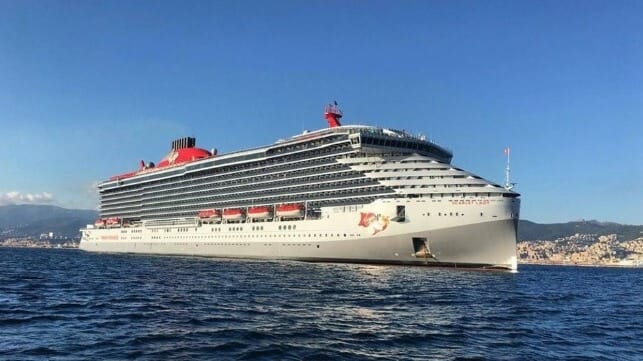
Local authorities in Turkey have decided to temporarily ban the cruise ship Scarlet Lady from calling in Istanbul and Kusadasi, forcing the organizers of the ship's LGBT-themed voyage to alter their itinerary.
The 2020-built Scarlet Lady is currently operating under charter to Atlantis Events, an organizer of gay and LGBT-themed vacations; the company is well-known, with more than 35 years of experience in its travel segment. The latest Atlantis voyage on Scarlet Lady was scheduled to depart July 5 from Athens, calling at Mykonos before arriving at Kusadasi, Turkey on the 7th. She would then head north for two days and one night in Istanbul, allowing guests an opportunity to "experience some of the city's vibrant night culture," then depart again on the 9th.
There was one last-minute hitch, according to Atlantis: officials in Turkey decided that they did not want to have Atlantis' passengers visit their country because of who they are. In a statement, Turkish officials alleged that Atlantis is "known for behaviors incompatible with the fabric of our society and our moral values."
Provincial authorities in Aydin, home to Kusadasi, advised in no uncertain terms that there would be "absolutely no possibility of the group in question visiting our province for an event of this nature."
Atlantis has organized port calls in Turkey before, without any particular fanfare: this particular type of themed cruise is not a new idea, and the company is far from the only organizer of such voyages. But Turkey's government has been inching woards this time is different.
"The reasoning behind it is that it’s a gay group," said Atlantis President and CEO Rich Campbell, speaking to CNN. "We are not there for anything except to spend money, have a good time, take tours and be incredibly respectful to every culture we visit."
Instead of visiting Turkey, Scarlet Lady will make a port call in Alexandria, Egypt and another on the island of Crete. Calls in Dubrovnik, Zadar and Trieste remain on the schedule.
Broadway actress Patti LuPone, who is booked to perform on board, wrote a note of protest following the Turkish decision. "I am furious, but I am sailing, as the ship will make other ports of call. I am ready to perform for all the wonderful men on this Atlantis cruise, who deserve so much better than this," LuPone said in a social media message.
Ukraine Strikes Russian Tankers, Ports, Refineries in Overnight Barrage
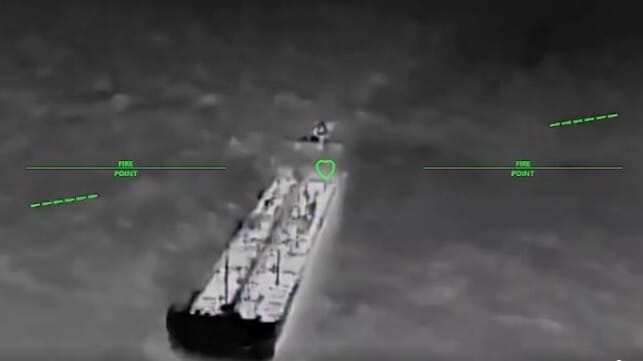
Ukraine struck two tankers in the Sea of Azov in a large coordinated campaign across Russia
Ukraine launched one of its largest coordinated attacks, coordinated by multiple units and hitting targets across Russia, as it continues to target Russia’s energy industry. In addition to hitting ports, two tankers, and refineries, Ukraine, for the first time, triggered air raid sirens in Chelyabinsk, more than 1,000 miles inside Russia.
The Commander of the Unmanned Systems Forces of the Armed Forces of Ukraine reported that they had played a key role in the attack. He reported that on the night of July 6, they struck 47 legal military targets.
One of the focuses was on occupied Crimea. They targeted two tankers sailing in the Sea of Azov. Reportedly, the vessels were each carrying 7,000 tonnes of gasoline coming from the Taganrog area to Crimea. Images released in the video showed one of the vessels in flames.
Another target was an oil storage facility in Kerch, which Ukraine said functioned as a logistics hub to supply Russian troops in occupied Crimea. Unconfirmed reports said much of Crimea had been plunged into darkness by the attacks.
Regional Russian officials started announcing the number of drones in their areas. In Yaroslavl, the governor claimed more than 70 Ukrainian drones were shot down, and Ukraine reported hitting one of the five largest oil refineries in Russia. It was the sixth time since the start of the year that Ukraine had struck the facility, with reports of roads closed around the refinery after last night’s attack.
In the Leningrad region, the governor reported that 62 drones were intercepted. Reports said that Ukraine hit the Ust-Luga and Vysotsk seaports. Other Ukrainian targets reportedly included three aircraft hangars at the Gvardiyske air base and two Russian mobile air defense systems.
Russia’s Defense Ministry reported today that a total of 519 drones had been intercepted overnight. Russia also launched a massive attack primarily targeting the Ukrainian capital of Kyiv. Reports cited heavy damage and casualties. Ukrainian President Volodymyr Zelensky had warned earlier that Moscow was “preparing a new massive strike” and it appears that residential districts in Kyiv were hard hit.
Ukraine claimed that this year alone it has struck more than 800,000 Russian military targets. It claims to have killed or seriously wounded an estimated 167,000 Russian troops since the start of the year.
Both sides appeared to be posturing as the White House reported that Donald Trump had calls with both sides overnight, trying to renew the peace talks. Trump is also scheduled to meet with Zelensky at the upcoming NATO Summit in Turkey this week.
Drone Strike Shuts Russia's Largest Refinery as Fuel Shortages Worsen
Ukraine has landed one of its most consequential blows yet against Russia's energy sector, knocking out the country's largest oil refinery just as Moscow is scrambling to contain a widening fuel crisis.
Industry sources told Reuters that Gazprom Neft's Omsk refinery halted operations after a Ukrainian drone strike damaged key processing units at the 440,000-barrel-per-day facility. The refinery is Russia's largest gasoline producer, making the timing particularly painful for the Kremlin.
According to the sources, the attack set fire to the CDU-10 crude distillation unit, which accounts for about 38% of the refinery's processing capacity. A second major unit, CDU-11, was also shut down after damage to supporting infrastructure, although it could reportedly return to service sooner.
The refinery immediately stopped offering gasoline and diesel on Russia's St. Petersburg commodity exchange.
A few months ago, Moscow insisted fuel shortages were isolated incidents. Then came export restrictions on gasoline and jet fuel. Then President Vladimir Putin publicly admitted motorists and businesses were struggling to find fuel, convening an emergency meeting with oil executives and ordering round-the-clock government monitoring of supplies.
Now Russia's biggest refinery has gone dark.
The latest strike comes as Ukraine continues expanding its long-range drone campaign against Russia's refining network. What began with attacks on export terminals and refineries near the front has steadily moved deeper into Russian territory. Omsk, in western Siberia, sits thousands of kilometers from Ukraine.
The fallout extends well beyond Russia's borders.
Central Asian countries that rely heavily on Russian fuel have already reported shortages and higher prices. Uzbekistan has cut some flights because of jet fuel shortages, while Kazakhstan has explored fuel imports from China as insurance against further disruptions.
Russia has even begun looking abroad for supplies of its own. Last week, Reuters reported that Moscow was preparing to import jet fuel from Asia—an extraordinary reversal for one of the world's largest oil producers.
Ukraine isn't trying to destroy Russia's oil industry. It doesn't have to. It only needs to keep enough refineries offline long enough to turn fuel into one more battlefield—and one more headache for the Kremlin.
By Julianne Geiger for Oilprice.com
IMO Calls for Release of Three Ships Hijacked by Somali Pirates
The IMO is growing increasingly concerned over the fate of dozens of seafarers who are currently being held for ransom by Somali pirates - including crewmembers who are suffering significant health setbacks.
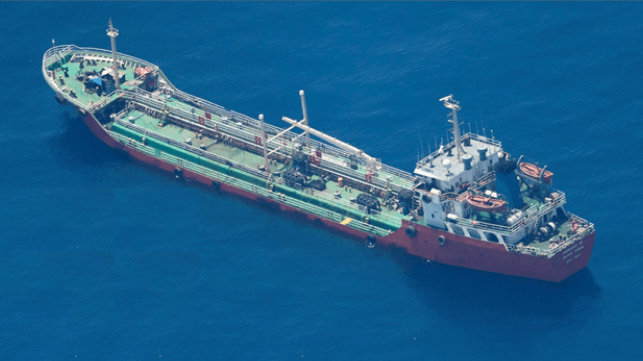
The IMO’s regional piracy initiative - formally known as the Djibouti Code of Conduct/Jeddah Amendment (DCoC/JA) - has received word from the master of the hijacked tanker Honour 25 (IMO 9109735), which was boarded and seized on April 24. All of the 17 crewmembers on board are still alive, the master reports, but conditions are difficult. Five (including the master) have health problems, and the crew are surviving on rice. They are out of safe drinking water, posing further risks to their health. Worse still, the local pirate rivalries on the Somali coast pose a new and unexpected risk to their well-being: a competing pirate action group attempted to approach the already-captured vessel, prompting the pirates aboard Honour 25 to open fire to drive them off - and potentially putting the crew at risk of violence.
"Behind every piracy incident are innocent seafarers enduring fear, deprivation, uncertainty and prolonged psychological trauma," the committee wrote in a statement.
The crew of the Honour 25 includes Indonesian, Pakistani, Indian and Burmese nationals, and the Indonesian government has negotiated directly with the Somali hijackers in an attempt to secure the ship's release. Indonesian foreign minister Sugiono (his full name) confirmed that talks with the pirate action group were ongoing back in May - without successful results.
The crewmembers of two additional vessels - Sward (IMO 9174244) and MV Eureka (IMO 1022823) - are still being held as well, and pirate-like actions off the southern coast of Yemen suggest that would-be hijackers are still actively operating in the area, hoping to capture even more ships and seafarers. The committee called for all parties with influence over the outcome - including the owners, insurers, flags and the coastal state - to take action to bring the hijackings to a swift conclusion.
The resurgence of piracy in the region could have many reasons, analysts suggest. Anti-piracy patrol efforts were redirected to cover the Red Sea during the Houthi maritime security crisis, leaving a gap in the Gulf of Aden that opportunistic actors could exploit. The fuel aboard product tankers like Honour 25 is (or was) more valuable during the surge in pricing caused by the U.S.-Iran conflict, making this vessel class in particular an attractive target.
Whale Sinks Fire Dept. Boat Returning Home After July 4 Parade
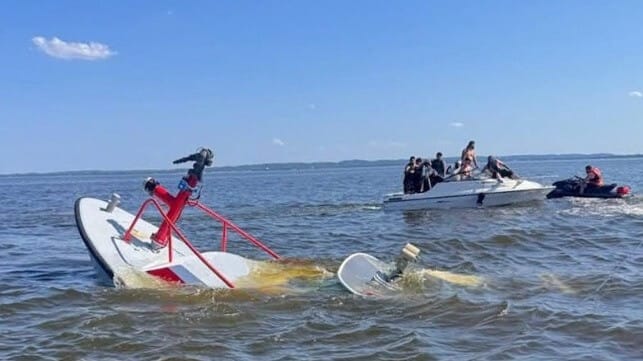
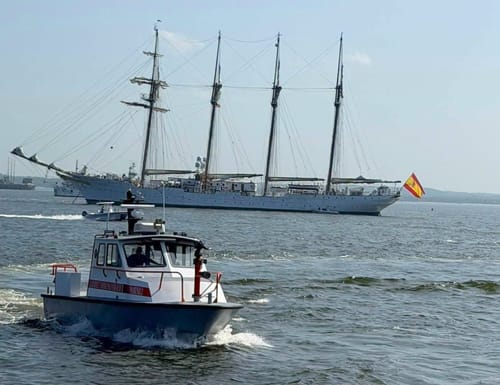
Carteret Fire Department Marine unit sinking after whale strike
The Carteret Fire Department in New Jersey had lent its Marine Unit 2 to aid with the security detail in New York Harbor on July 4. The vessel was spotted patrolling in the harbor and participating in the spectacle for America’s 250th birthday.
After the event had wound down on Saturday afternoon, the boat and its crew were heading back to their base in New Jersey. Around 4:30 p.m. local time, they were near the mouth of Raritan Bay south of the Arthur Kill.
Earlier in the day, the Marine unit was on patrol with a tall ship in the background
A recreational boater in the area said they had seen a pod of whales. From time to time, the whales were surfacing or breaching the water.
CFD Marine 2 reportedly shook violently, and the crew believes it was stuck under the stern by a surfacing whale. As they relayed the story, their boat sustained significant damage and almost immediately began to sink.
The crew was following safety regulations, and each had on their required life jackets. They were forced to immediately go into the water as their boat was sinking out from under them.
A jet ski operator in the area who saw the incident rushed toward the crew in the water. Another boater also went to their aid, and the Perth Amboy Fire Department crew was also able to reach the crew in the water.
The three aided in fishing the crew out of the water with no reports of injuries. But they had a whale of a tale to tell.
Seaplane Crashes Near East River Ferry Terminal
The plane's port side wing submerged as it slows to a stop (via social media)
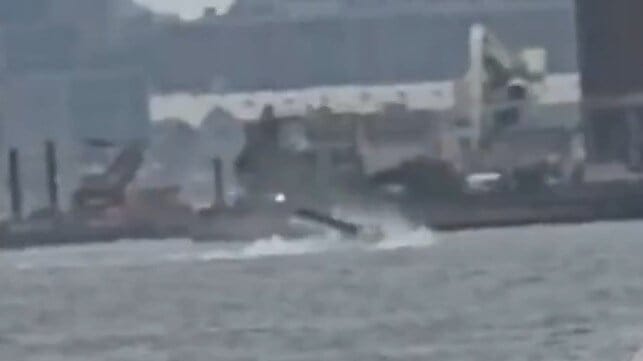
On Sunday, a seaplane made a hard landing in the East River, damaging the aircraft and prompting a rapid SAR response from the New York Police Department and New York Fire Department.
At about noon on Sunday, a Kodiak 100 commuter plane was arriving from the Hamptons and coming in for a landing near the East River ferry terminal at 23rd Street. The plane's floats made contact with the surface, hit a wave and skipped upward, causing the aircraft to bounce off the water. This happened again a second time within several seconds, and then again.
On the third contact with the water's surface, one if the Kodiak's wing struts snapped, and the port-side wing dipped into the water, followed by the propeller. Luckily the plane did not pitchpole or tumble in the rapid deceleration, and it came safely to a stop.
Another seaplane was among the first responders, but New York emergency services personnel were on scene within minutes. All eight people on board were safely rescued by the FDNY, and efforts transitioned to securing the wreckage of the aircraft. No serious injuries were reported.
The Quest Kodiak 100 is a single-engined turboprop with seating for 10. Designed for rough airfields and short takeoffs, it can be converted to use seaplane floats and is often seen in this configuration in commercial service.
Tank Barge Explosion Kills Five Workers on Paraguay River
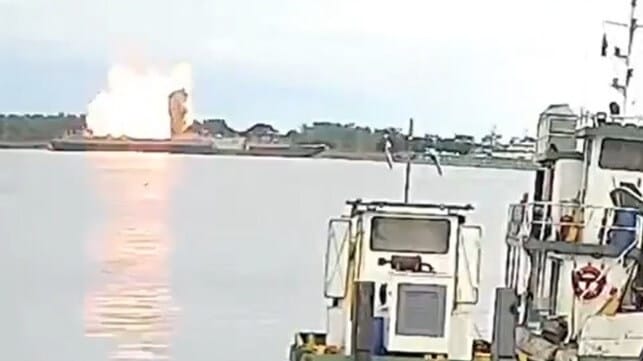
Over the weekend, a blast tore apart a tank barge on the Paraguay River, killing five personnel who were working aboard.
On Saturday morning, a blast occurred inside a cargo tank on a barge at a mooring area across the river from Avenida Costanera Sur, a riverfront road running south from Asuncion. This stretch of the river has about half a dozen barge fleeting areas and maintenance yards. Security surveillance video from the scene show that the explosion peeled the deck off two tanks and about halfway off two more, exposing the inner bulkheads.
According to local media, the tank barge belonged to Lineas Panchita G and was undergoing maintenance at the time of the blast. The tanks were believed to be empty of fuel.
In addition to removing any liquid hydrocarbons, tank vessel maintenance requires extensive degassing measures prior to beginning repairs. An investigation is under way to determine the cause, and authorities will evaluate whether a buildup of flammable gases in the hold could have led to the explosion.
Three people were found dead at the scene, and two injured personnel who were evacuated later died of their wounds, according to Paraguay's General Naval Prefecture. The service identified the victims at Ever Nilson Sosa Rotela (26), Simón Díaz González (34), Giovani Samuel Amarilla Alegre (24), Jesús Alberto Miranda Lovera (28), and Carlos David Pérez Morinigo (31).
The sole survivor of the incident was on board a transport boat at the time of the blast, not the barge itself, naval commander Rear Admiral Óscar Chamorro told local media.
Cargo Ship Reports Attack Near Hodeidah, Yemen
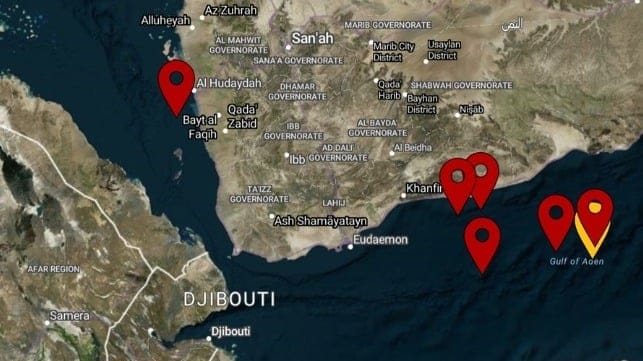
The location of Sunday's attack in the Red Sea, upper left, and recent attacks outside of Houthi territory in the Gulf of Aden, right (UKMTO)
On Sunday morning, a cargo ship reported an attack at a position off the coast of Yemen, where hostilities between Houthi rebels and the internationally-recognized government have been heating up.
UKMTO received a report of the incident at about 0720 hours UTC on Sunday. The master of a cargo vessel issued a distress alert at a position about 30 nautical miles to the southwest of Hodeidah, the largest Houthi-controlled seaport on Yemen's Red Sea coast. The master reported that the vessel was under attack by "unknown armed assailants."
The region has historically been under firm Houthi control, lowering the odds of a for-profit piracy incident. However, the Houthis - the sole instigators of attacks on passing vessels in the area in years past - ceased aggression against international shipping last year. The group recently renewed its threats against against Israeli ships only, citing Israel's territorial incursion into southern Lebanon, where Houthi-allied terrorist group Hezbollah holds sway. The national ties of the vessel involved in Sunday's incident have not been disclosed.
Multiple incidents have been reported off the coast of Balhaf, Yemen, in the Gulf of Aden. The area is on the east side of Bab el-Mandeb and outside of Houthi control.
On July 1, the crew of a vessel reported that a small boat approached, and that armed assailants initiated an illegal boarding. The attackers damaged equipment on the bridge and other nearby compartments while the crew remained hidden in the citadel. Later the same day, the master of a tanker reported a suspicious approach by a craft with four people aboard at a position about 85 nautical miles to the south of Balhaf.
On June 21, a product tanker reported an attempted boarding by five personnel in a skiff in the same region. On June 17, a vessel was attacked by two skiffs with armed personnel on board, and the merchant ship's embarked security team had to drive them off with small arms fire. On June 15, a vessel reported the approach of a small skiff. The assailants in the small boat opened fire on the merchant ship with an RPG launcher. A similar attempted attack occurred on June 9.
IMO Trying to Improve Safety of Navigation off Yemen
The IMO is advancing its Red Sea Project to improve security and the coordination of maritime situational awareness in the Horn of Africa and the waters off Yemen.
Under the project, the IMO supported a four-day workshop for the internationally-recognized Republic of Yemen governmemnt from June 22 to 25, 2026, alongside the European Union-funded Crisis Response Project for the Red Sea and the Western Indian Ocean. The workshop brought together representatives of all Yemeni agencies involved in policing and management of the waters off Yemen in the offices of the Ministry of Transport in Aden.
The workshop objective was to develop a roadmap for the establishment of two entities, a National Maritime Information Sharing Centre based in the headquarters of the Yemeni Coastguard, which exists in embryonic form already, and which then is to feed into the Regional Maritime Information Sharing Centre based 100 yards away on the Aden dockside in the Yemen Maritime Affairs Authority. The IMO was keen that these two bodies adopt the regionally-agreed 2023 Djibouti Code of Conduct/Jeddah Amendment Information Sharing Standard Operating Procedures (SOPs) as the foundation for Yemen’s national procedures. Indicative of the challenges ahead, these SOPs are not yet translated into Arabic, which will become an early task on the project roadmap.
The IMO and EU project is a regionally-coordinated project, so that littoral states in the area can share both information but also procedures to be adopted both for routine reporting and the handling of emergencies.
A separate project proceeding at the same time, sponsored by Saudi Arabia, the United Kingdom, and EU donors, seeks to strengthen the capabilities of the Yemeni Coastguard. The UK has sponsored the introduction into service of two patrol craft, the Aden (IMO 4698611) and the Mayun, now based on Perim Island. This project has also seen improved coordination between what was the Coastguard and maritime patrols operated by the National Resistance Forces operating in the southern Red Sea.
Practical problems, however, are manifold. There has been a power struggle between the Minister of Interior Ibrahim Haidan, who sought to displace Major General Khaled Ali Mohammed Al Qumali as head of the Coastguard, a move quashed by the Saudis. Such internal conflicts tend to arise when individual ministries or departments win foreign aid support, and others seek to benefit as well.
Somali-based piracy is increasing in Yemeni waters, with the Secretary General of the IMO calling for the immediate release of 44 sailors being held hostage since March off Puntland on three tankers, the Palau-flagged MT Honour 25 (IMO 1099735), the Togo-registered?Eureka (IMO 1022823), and the St Kitts & Nevis-flagged Sward (IMO 917424402). More ominously, Houthi-Saudi relations have deteriorated, as talks to come to a general peace, which would involve Saudi subsidies and a lifting of the blockade have stalled; an outbreak of fighting within Yemen would once again threaten a rise in attacks on shipping passing through Yemeni waters.
Maersk and Hapag to Shift One Route to Suez-Red Sea Transit
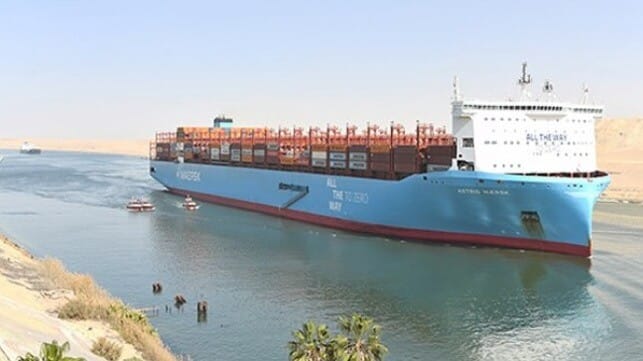
Astrid Maersk returned to the Suez Canal on February 10 only to have the war suspend service just weeks later (SCA)
Maersk and Hapag-Lloyd have jointly agreed to again attempt a return to the Suez Canal and Red Sea transit for one of their shipping routes under the Gemini Cooperation. It is the second time this year that the shipping companies have attempted to revert routes to the region.
The first route to resume transits is one that sails between Asia, the Mediterranean, and Turkey. The company said the Majestic Maersk, a 19,000 TEU container vessel sailing under the flag of Denmark, would be the first to make the transit. AIS transmissions and the online schedule show the vessel departing Malaysia and tentatively reaching the Suez Canal around July 24.
Maersk said the decision was made after thorough assessments of the security situation in the Red Sea area. It highlights that the return to the route is faster, the most sustainable, and the most efficient way to serve customers. However, it said it will continue to monitor the situation, and it could necessitate reverting individual sailings or the wider structural change of service back to the Cape of Good Hope. Maersk reports it has contingency plans in place.
Being strongly encouraged by the Suez Canal Authority, Maersk made its first test return voyages in November and December 2025. It was the first time the carrier had sent vessels into the southern Red Sea area since late 2023, when several of its ships were shot at by the Houthis. By January 2026, Maersk was ready to restart some of its independent routes through the Suez Canal and Red Sea, and a month later, the Gemini Cooperation with Hapag announced the return of its first routes to the region.
The resumption, however, was short-lived. With the outbreak of hostilities at the end of February between the United States and Iran, Maersk and Hapag again suspended their routes. Through the Red Sea.
Maersk says the current return is the start of a process to build back transits. However, it warns that at this point, it has no specific timeline.
The Suez Canal Authority pointed out that in 2023, Maersk had made 1,158 transits with a total net cargo of 127 million tons. While shipping has slowly returned to the Suez Canal, the large fleet container carriers have lagged. CMA CGM has been the primary large carrier to restore routes through the region. The Suez Canal Authority had said it believed Maersk would be the lead and that other carriers would soon follow, restoring ships through the more efficient route.
Three Iran-Linked Tankers Detained in India Driven Toward Shore in Monsoon
Al Jafzia was driven ashore in the monsoon (Indian TV)
The Indian Coast Guard was forced to mount a rescue mission on Sunday, July 5, as three tankers detained by the Indian courts were being driven toward shore in a monsoon. The vessels, all linked to Iran, have been at the center of a controversy since they were detained in early February on charges of being part of a fuel smuggling operation.
The Directorate General of Shipping reported the situation to the Coast Guard as the tankers Asphalt Star, Stella Ruby, and Al Jafzia were dragging their anchors in the storm. The ships had been seized in early February, about 100 nautical miles to the west of Mumbai. India charged that they had been involved in illegal ship-to-ship transfers and were part of a ring stealing and transporting Iranian bitumen. The reports said the vessels had been switching off their AIS transmissions in an effort to evade detection.
The vessels, the Iranian-flagged Stellar Ruby (6191 dwt), the Asphalt Star (14,800 dwt), and the 45,000 dwt Al Jafzia, alternately known as the Chiltern, were placed under arrest. All three had been sanctioned by the United States. Media reports indicate the shipowners and eight individuals were named in court papers in February, with the case still under investigation.
Skeleton crews remained aboard the Stella Ruby and the Asphalt Star, but the Al Jafzia had been abandoned. The three ships are listed as awaiting breaking, but the court has not yet released the first two vessels. The investigation is ongoing in part, complicated by the Asphalt Star falsely claiming to be registered in Mali.
The Al Jafzia appears to have been the shadiest of the three vessels. It was claiming registry in Nicaragua, which was false. Since 2024, records show it had falsely claimed registry in Eswatini, Aruba, and Guyana before Nicaragua.
The Bombay High Court had agreed to repatriate some 50 seafarers from the three ships, stating that the shipowner had abandoned the crews. It also released the Al Jafzia to go to the breakers at Alang.
The Indian Coast Guard vessel Samrat was directed to the three tankers on Sunday to render assistance. Because the Al Jafzia was abandoned, there was little they could do, and the ship went aground. The Coast Guard, however, was able to intervene, and the Asphalt Star and Stella Ruby were secured in a new anchorage, and the crews were reported to be safe. The emergency towing vessel Water Lily was also used to help secure the two tankers.
The Coast Guard positioned its specialized pollution control vessel ICGS Samudra Prahari in the area in case of any pollution. A survey was also underway of the grounded tanker.
Sulfur-Laden Bulkers Face Corrosion Threat After Hormuz Delays
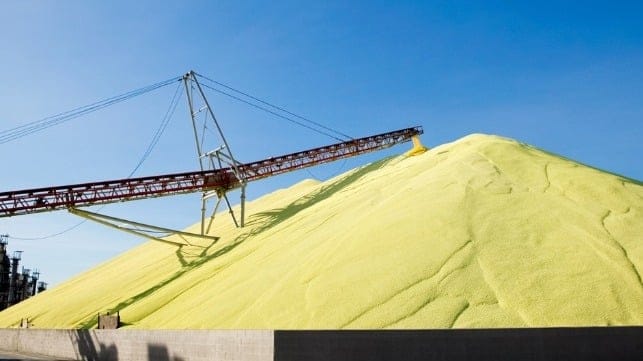
A stockpile of raw elemental sulfur at a refinery (P. Wei / iStock)
The Gulf states are some of the world's most prolific exporters of raw sulfur, the core ingredient for sulfuric acid, the world's most-produced industrial chemical. The region's energy industry enables the trade by putting out an abundance of raw sulfur: when sulfurous Mideast gas and oil are processed, large quantities of the substance are dumped out as a byproduct, then loaded onto bulkers and shipped to industrial end-users. But there is a hitch, according to maritime consultancy Brookes Bell - the Hormuz crisis has delayed many of those bulkers well past the safe time limit for storing sulfur in a steel hold, exposing ships to risk of severe and rapid corrosion.
The consultancy's head of non-destructive testing, Arron Jackaman, is encouraging shipowners and insurers to begin looking closely at any bulkers that have been stuck in the hot, humid Gulf with a load of sulfur for the past two months. The sooner the inspection process begins, he says, the lower the likelihood of damage and high costs for repairs - which often require cropping and replacement of the hold's plating.
The process of safely shipping sulfur usually begins with a limewash coating. The hold is cleaned of any prior cargo's residues, then a fresh barrier coating of lime wash is applied to the hold's surfaces. The lime counteracts the natural formation of sulfuric acid from raw sulfur, slowing down - but not stopping - the process of corrosion. But the wash isn't effective forever: it is generally considered acceptable for up to 20 days, after which accelerated corrosion begins. Moisture and sulfur mixed together lead to the inevitable formation of an acidic environment, turning steel into iron sulfide in rapid progression - swiftly causing heavy pitting in local areas. The rate of attack is far faster than ordinary saltwater corrosion, and far more aggressive; entire ships have been declared a total loss due to sulfur-driven corrosion in the past, according to vendor RBM.
Some of the vessels stuck in the Gulf because of the Hormuz crisis have been there for three times as long as the rated protective time of a limewash application. "That protection has long since been exhausted," says Jackaman. His firm has found pitting of up to a quarter of an inch deep in as little as 50 days - enough wastage to blow through the sacrificial corrosion allowance for tank top plating, bulkhead stools and sloping hopper plating under IACS' Common Structural Rules.
But the appearance of sulfur-driven pitting is often worse than the actual impact on the steel, Jackaman says, and visual assessment can be inaccurate.
"Localized pitting tends to concentrate at points where grab discharge equipment has broken the coating barrier, and on cargo hold tank top plating, which is left uncoated by design. Without correct measurements and quantitative assessment, there is a significant risk that steel within class limits is condemned unnecessarily," he says.
Iran Resumes Attacks on Merchant Shipping With Strike on LNG Carrier
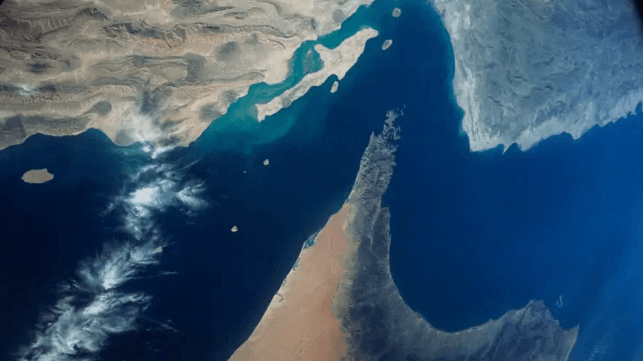
Iran's military forces have once again opened fire on merchant shipping in the Strait of Hormuz in a renewed push to dominate control of the waterway's traffic, according to multiple maritime security sources.
The UKMTO has confirmed that one tanker was hit by an unknown projectile on Monday night at about 2100 hours UTC. The incident occurred east of the Musandam Peninsula, off the small port of Limah. However, the maritime security agency has not confirmed the vessel's name. Security consultancy Vanguard Tech reports that the attack caused a fire, which has since been put out.
Iranian state broadcaster IRIB confirmed one attack on one tanker, and said that it was attacked after "repeated warnings."
According to Martin Kelly of EOS Risk Group, the vessel was the laden LNG carrier Al Rekayyat (IMO 9397339). Bloomberg has confirmed this report with multiple shipping sources. LNG carrier attacks carry a risk of extreme fires if a munition breaches a cargo tank, a rare event that occurred earlier this year in the attack on the LNGC Arctic Metagaz.
Kelly suggested that a second attack occurred, targeting a ULCC in laden condition. He predicted that the U.S. would launch retaliatory strikes in response, as in past cycles of escalation.
"Iran is making another push to direct all Hormuz traffic to its shipping lanes, away from the Omani side," said Bloomberg commodity analyst Javier Blas in a social media post. "Part of its plan seems, too, allowing multiple Japanese ships to cross: yesterday six Japanese oil tankers crossed, and two more are crossing today."
Regime-aligned social media account Dolfiniran confirmed early Tuesday that Iran has intensified its campaign of military pressure to "monopolize passage through the Strait of Hormuz." The account reiterated Iran's interpretation of the recently-agreed White House ceasefire deal: from Tehran's perspective, the MOU requires Iran to facilitate free and unobstructed passage for shipping - but only through Iran's shipping lane, not the Omani lane.
"Iran's commitment is solely to opening the Strait of Hormuz by implementing Iranian arrangements, which are now being implemented, including the designation of the route. Iran will accept no form of compromise regarding the Strait of Hormuz," Dolfiniran suggested.
Shipping interests appear to be reacting to the renewed threat, at least based upon AIS-visible transit data. "The inbound tanker flows have slowed to a trickle and with the latest attack from IRGC using missiles (previously drones), the situation appears to be escalating," wrote contrarian investment outfit HFI Research. "From a flow standpoint, inbound tanker rate is insufficient to change the production shut-in math."
The new disruption comes just as tanker traffic through the strait was beginning to find its footing again. Over July 4-5, Windward counted nearly 80 transits in and out of the waterway - about two-thirds of pre-conflict volumes.
Donald Trump by Gage Skidmore is licensed under CC BY-SA 2.0 / Flickr
It will soon be the 250th anniversary of this country and the Trump administration is already planning its own set of celebrations. In that context, let me be as straightforward as I can: amid his latest war (or do I mean peace?), there’s nothing strait about President Donald J. Trump, despite his recent bombing attacks around the Strait of Hormuz. In fact, his assault on Iran has been about as crooked as you can get, but all too sadly, not as crooked as Donald Trump and his pals (including, of course, Secretary of War Pete Hegseth) might still prove to be.
Let me start, though, by saying this: before he suddenly attacked Iran, more or less out of the blue, none of us would have had the faintest idea (including possibly him) that he might do so. And, of course, given the size and military power of the two countries, if you had paid no attention to American history since the Korean War began in 1950, you might (like “our” president) have imagined that, should he launch an attack on Iran, victory would be a given or at least a more than reasonable probability. As has indeed been true, however, since that war in Korea ended in a victoryless fashion in 1953, no such luck — not for the United States of America anyway — not even, I would bet, if he does convince Congress to increase the Pentagon budget to $1.5 trillion (yes, trillion!) a year.
And as for his full-scale air assault on Iran, as David Faris put it recently at the Nation magazine, it’s turned out to be “a long-overdue Waterloo for America’s decades-long project to topple the Iranian theocracy or force it to its knees.” A Waterloo indeed! And that, of course, makes Donald Trump the world’s strangest modern version of Napoleon Bonaparte. If only he could be exiled to the island of Elba (though, of course, that didn’t work out too well the last time, did it?) or, since I’m not picky, perhaps Long Island, not so far from the city where he was born.
And here’s the truly strange thing in the United States of America in 2026: none of us know what President Donald J. Trump will do two hours, no less two days, two weeks, or (yes, he’ll probably still be president!) two years from now — not even, I’m quite sure, him. And of course, there’s a simple enough reason for that. Donald Trump is a first-class mystery — even, undoubtedly, to himself. And so, while he and his crew have certainly issued militarized threats against both Cuba (”Make a deal before it’s too late”) and Greenland (“One way or another, we’re gonna get it”), that doesn’t faintly mean that those are the places he’s going to face off against and possibly attack next (as he did Iran).
Now, given his record the second time around, he’s not just a war president but PW or President War. And, of course, no one, including him, really knows what he might do next when it comes to this country’s war docket or just about anything else.
The other day, though, it crossed my mind that perhaps, if Iran doesn’t flare up too many times and manage to take the global economy down with it (proving to be a classic Trumpian version of that TV series of his childhood and mine, Victory — or, these days, of course, Defeat — at Sea), and he has a little time on his hands, maybe he might like to take us back to where it all began after September 11, 2001, and launch a new war against Afghanistan. I mean, why not change the subject, especially given how badly Iran has gone for him and the possibility of a war-induced global recession (among other things)?
And what could be a better change of subject than to return to the days after 9/11 by sending the U.S. military back into Afghanistan? I mean, honestly, what could possibly go wrong?
Now, of course, I admit that that’s a completely weird, off-the-wall prediction about our already all-too-strange Trumpian future, especially since, to give him full credit, he did begin the final American military withdrawal from Afghanistan before his first term in office ended (when he was, of course, a different Trump). But hey, why not? Or maybe he’ll just pull a Nicolás Maduro and try to kidnap Afghanistan’s Supreme Leader. (Wouldn’t having the two of them in the same jail cell in Brooklyn be cool?)
And by the way, let’s not forget that at any moment Donald Trump might also go back to war with Iran. Yes, it could certainly happen… or not, which is what you could say about almost anything having to do with him as president.
The thing about Donald Trump is you simply never know… and oh, while I was writing that sentence, I noticed this, in what then was the Guardian‘s latest piece of reporting on Iran: “Iranian negotiators have suspended high-stakes talks with the US in Switzerland in protest at a stream of threats issued by Donald Trump to bomb Iran, and even to kidnap the Iranian negotiating team unless the strait of Hormuz is reopened” or as the president of the United States so charmingly put it then, “You close it and you won’t have a country. You won’t even make it back to your fucking country.” (Of course, he’s also been threatening to blockade the Strait himself or to put all-American tolls on it. But that’s him for you. Nothing he ever says is the final word, not when Donald J. Trump is speaking.)
And give him credit for bluntness, too. Of course, by the time this piece actually comes out, all of the above will undoubtedly be ancient history and who knows where we’ll be, or rather where he’ll be taking us?
In short, on the 250th birthday of this country, he’s distinctly planning to give history new meaning. Think of it this way: When it comes to Donald J. Trump, there is nothing straight about the Strait of Hormuz or, for that matter, anything else and his crooked version of history and of the present moment, just couldn’t be weirder. Maybe — my final thought — sometime in the near future, he’ll launch an operation to kidnap himself. Really, when it comes to him, nothing is beyond the bounds of possibility, is it?
This article was originally published by Tom Englehardt; please consider supporting the original publication, and read the original version at the link above.Email
Tom Engelhardt created and runs the website TomDispatch.com. He is also a co-founder of the American Empire Project and the author of a highly praised history of American triumphalism in the Cold War, The End of Victory Culture. A fellow of the Type Media Center, his sixth and latest book is A Nation Unmade by War.
President Trump was reportedly “shocked” to see many thousands of Iranians in the street mourning at the funeral of the country’s late leader, Ayatollah Ali Khamenei, over the weekend. Khamenei was assassinated by the United States at the beginning of the February US surprise attack on Iran.
The US attack on Iran was sold to Trump by Israeli Prime Minister Netanyahu and US neocons as an easy “cake walk” that would lead the Iranian government to fall and be replaced with a US-friendly regime.
“I thought they hated him,” Trump said of the murdered religious leader of Iran.
Not only did the Iranian people not rise up to replace their leadership with one friendly to Washington, but the society seems to have become even more cohesive and patriotic. This should surprise no one, as when similar tragedies occurred in the United States – assassinations, 9/11, etc – we also as a society came closer together.
In Soccer when you kick the ball into your own goal, it is referred to as an “own-goal.” That is what President Trump achieved with his attack on Iran on February 28th. In fact, it was not just one “own-goal,” but a series of them. The blunder will likely go down in American history as one of the worst foreign policy moves in our history.
The Iranians did not rise up and declare support for the US. American military bases throughout the region are so severely damaged by Iranian retaliation that most cannot be brought back online. Scores of US military equipment has been destroyed or damaged at a cost of tens of billions of dollars. Countries in the region are rethinking their decision to essentially become protectorates of the United States now that it is demonstrated that they cannot be protected by the United States. American military power suddenly looks less powerful.
But perhaps the most destructive “own-goal” of the US attack is the Iranian decision to establish control over the Strait of Hormuz. Even in the US/Israeli attacks of last June, the Strait was kept open by Iran. It is a vital trade route and in everyone’s best interest to keep open for business.
The February attack and Iran’s strong regional response led the country to embrace what some have called a de facto nuclear weapon: control of the Strait. Explaining why he signed the memorandum of understanding with Iran last month, President Trump mentioned the damage being done to the US economy by the closure of the Strait and the possibility that matters may even get worse without the agreement. The US economy desperately needed the Strait to be open.
Now, however, progress toward peace with Iran continues to be thwarted by the stubborn insistence on the US side that the Strait of Hormuz must not be controlled by Iran and that a fee system for passage through the Strait cannot be instituted by Iran and Oman. Several skirmishes have already taken place in the area, threatening to take the US back to war.
It is in the best interest of the United States to abandon claims on Hormuz – which is thousands of miles away – and live with the consequences of Trump’s mistake. Another war cannot win what two previous wars have lost. Let Iran control the Strait and let international trade and commerce be re-established. Let’s leave the Strait alone!
Ron Paul is a former Republican congressman from Texas. He was the 1988 Libertarian Party candidate for president.