Thursday, July 09, 2026


South Korean law targeting 'fake news' takes effect as journalists' groups raise concerns
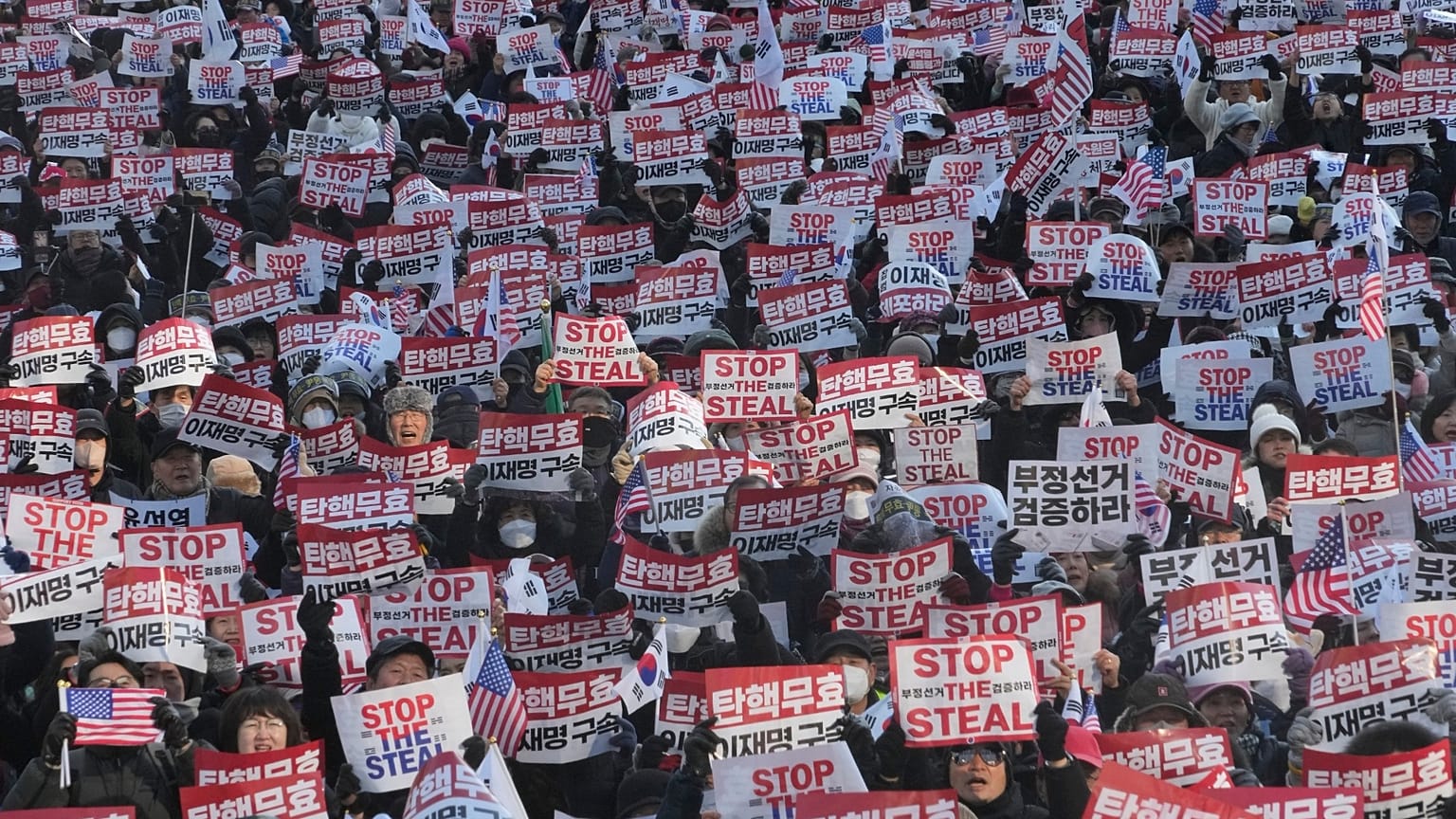
Supporters of impeached South Korean President Yoon Suk Yeol stage a rally to oppose his impeachment in Seoul, 11 January, 2025
Copyright AP Photo


By Gavin Blackburn
Published on


South Korea saw a surge in online misinformation following the botched 2024 martial law attempt, including unsubstantiated allegations of Chinese interference in the electoral system.

South Korea began enforcing a revised law targeting false information posted online on Tuesday, toughening penalties for repeat offenders despite concerns over the impact on free speech.

The law, which requires major platforms to set up new response systems, comes as concern grows in the country over digital misinformation, including high-profile cases involving celebrities.

But opposition politicians, civic groups and media experts warn it could chill free speech and open the door to government-influenced censorship.

The Asian tech powerhouse previously relied on general defamation laws and civil damage claims to address false information, without a clear legal framework targeting so-called fake news.

With the revision to the information and communications network act it joins many countries trying to tackle the flood of falsehoods online that can have serious real-life consequences.
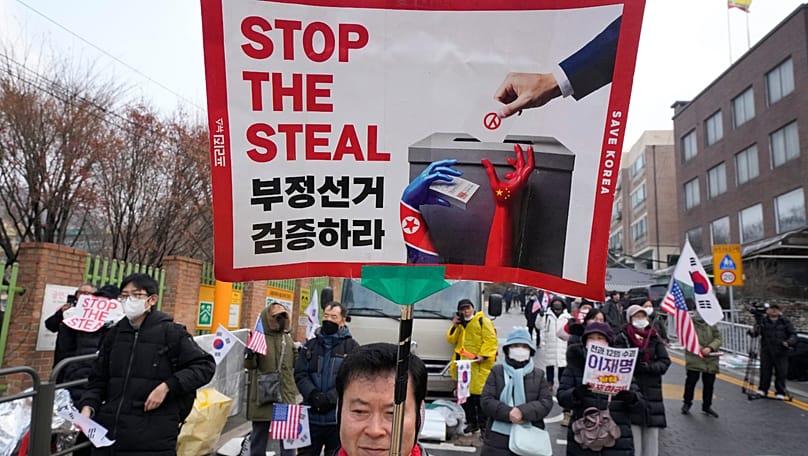
Supporters of impeached South Korean President Yoon Suk Yeol stage a rally to oppose his impeachment in Seoul, 6 January, 2025
Supporters of impeached South Korean President Yoon Suk Yeol stage a rally to oppose his impeachment in Seoul, 6 January, 2025 AP Photo

Now users who intentionally spread illegal false or manipulated information could be ordered to pay up to five times the actual cost of damages.

And repeat offenders whose content has been ruled illegal by courts face fines of up to 1 billion won (€573,000).

Platforms including South Korea's Naver and Kakao and US giants Google and Meta must introduce systems for users to report alleged false or manipulated information and publish transparency reports every six months detailing complaints and actions taken.

South Korea saw a surge in online misinformation following the botched 2024 martial law attempt, including unsubstantiated allegations of Chinese interference in the electoral system.

Separately, in a recent high-profile case, a right-wing YouTuber was indicted for using AI-generated audio to falsely claim that actor Kim Soo-hyun had dated a late actress while she was a minor.

The allegations snowballed into a major scandal, forcing Kim to suspend public appearances while a major project was indefinitely postponed.

Critics of the revised law warn that the lack of a clear legal definition for false or manipulated information could create uncertainty and invite overly broad legal enforcement at first.

The main opposition People Power Party (PPP) has repeatedly criticised the revision, arguing that platforms will censor content to avoid clashing with the government, while users will self-censor.
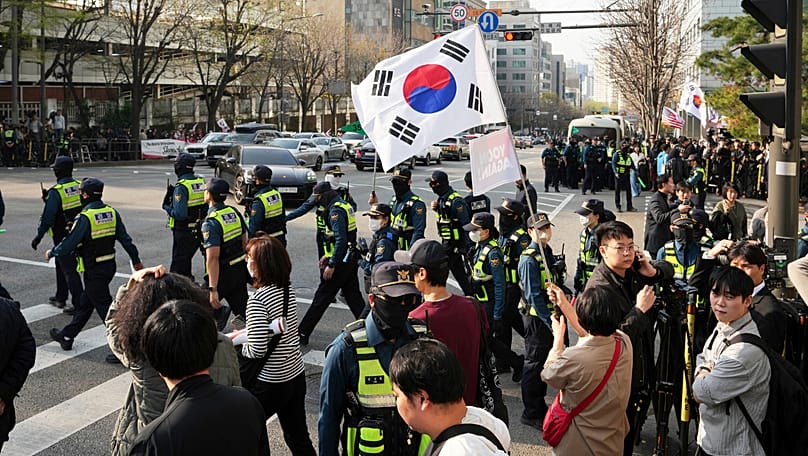
Supporters of former South Korean President Yoon Suk Yeol gather as police officers arrive near the private residence in Seoul, 11 April, 2025
Supporters of former South Korean President Yoon Suk Yeol gather as police officers arrive near the private residence in Seoul, 11 April, 2025 AP Photo

"We will see a world where platform companies excessively remove information, investigative journalism is stifled and citizens find it difficult to even speak their minds," PPP spokesperson, Cho Yong-sool said in a statement.

The Journalists Association of Korea also called for safeguards to ensure public-interest reporting and news-gathering are not suppressed.


 

Pakistan says 54 militants killed after coordinated attacks in Balochistan

Pakistan says 54 militants killed after coordinated attacks in Balochistan
/ Muhammad Irfan Baloch - UnsplashFacebook
By IntelliNews July 9, 2026

Pakistan's security forces have killed 54 militants during operations launched after a series of coordinated attacks in Balochistan over the past four days, while 42 civilians and security personnel also lost their lives in the violence, Director General of Inter-Services Public Relations (ISPR) Lieutenant General Ahmed Sharif Chaudhry said on July 8, Dunya News reported.

Speaking at a press conference, the military spokesperson said the attacks targeted civilians, police personnel and soldiers in the Hanna Urak, Ziarat and Bela-Winder areas. He said the Pakistan Army, Frontier Corps (FC), law enforcement agencies and intelligence services were continuing counterterrorism operations at multiple locations.

According to Chaudhry, the first attack took place on the night of July 4-5 in Hanna Urak, where armed militants attacked local residents. He said civilians resisted the assault before security forces responded, adding that four civilians were killed and six others injured.

The second incident occurred at a police checkpost guarding Mangi Dam's Pumping Station No. 3 in Ziarat district. Chaudhry said police personnel repelled the initial assault, killing 15 militants before reinforcements arrived. However, the attackers briefly took several police officers hostage, prompting security forces to avoid aerial strikes and instead continue ground operations to minimise civilian casualties. He said 27 police personnel were killed during the attack and subsequent clashes, while security forces eliminated a total of 26 militants during the ongoing operation.

In the third attack, an army convoy came under fire near the N-25 highway in the Bela-Winder area. Chaudhry said 11 soldiers, including one Junior Commissioned Officer, were killed in the fighting, while security forces killed 14 militants belonging to the banned Baloch Liberation Army (BLA), which the government refers to as "Fitna al-Hindustan".

He added that separate operations in Kharan and Dalbandin resulted in the deaths of another 14 militants, bringing the total number killed over the four-day period to 54.

The military spokesperson said the three major attacks claimed the lives of four civilians, 27 police personnel and 11 soldiers.

Chaudhry also repeated Pakistan's longstanding allegations that India was backing militant groups operating in Balochistan and claimed Afghan territory was being used to plan and launch attacks against Pakistan. India has consistently rejected allegations that it supports militant activity inside Pakistan.

The ISPR chief said security operations against militant groups and their alleged facilitators would continue, adding that the government remained committed to eliminating terrorism and restoring security across Balochistan.

CRIMINAL CAPITALI$M

200,000 ‘untested, uncontrolled and unsafe’ condoms detected in Europe

Fake condoms — worth over €200,000 — were seized in Romania, Serbia and Spain.
Copyright Cleared/Canva

By Giedre Peseckyte
Published on

The European Anti-Fraud Office uncovered a trafficking route used to distribute counterfeit condoms in Europe, putting the sexual health of thousands of Europeans at risk.

Over 200,000 condoms coming from China — falsely declared as toys — bypassed the European Union quality requirements, exposing consumers to the risk of sexually transmitted infections, unplanned pregnancies and unsafe chemicals and materials.

In Europe, condoms are categorised as medical devices and must meet strict health and safety standards, including microbial contamination controls, biocompatibility, leak resistance, dimension requirements, shelf life and stability.

The counterfeit products from China bypassed those.

“Counterfeit condoms are dangerous,” European Commission's anti-fraud office chief Petr Klement said in a press release. “They are untested, uncontrolled and unsafe.”

Fake condoms — worth over €200,000 — were seized in Romania, Serbia and Spain.

They were sold in Europe using the name and logo of a well-known brand, according to the European anti-fraud office. The office did not disclose the brand, where the products were sold, or how many of the more than 200,000 condoms had reached consumers.

"It is difficult to give accurate data ... given the nature of illicit networks," a spokesperson of the European office told Euronews Health. As it is "difficult to trace" counterfeit goods, "it is difficult to inform individual consumers" who might have bought such condoms, the spokesperson added.

Working with the Chinese authorities, the European office identified the exporter behind the shipments but did not disclose its identity.

The story was updated with a response from the European Commission's Anti-Fraud Office. The name of the European Anti-Fraud Office was corrected.


20 million cigarettes and over 38 tonnes of tobacco seized in EU countries

Investigators also confiscated 18 vehicles, tobacco manufacturing equipment, encrypted electronic devices, €170,000 in cash and several firearms.
Copyright Copyright 2024 The Associated Press. All rights reserved.


By Giedre Peseckyte
Published on


Authorities have seized 20 million cigarettes and 38.4 tonnes of tobacco leaf and cut tobacco after dismantling two international criminal networks based in Spain.

European countries, together with the EU's anti-fraud office (OLAF) and Europol, dismantled a multimillion-euro illicit cigarette supply chain, targeting groups suspected of manufacturing, distributing and trafficking counterfeit tobacco products worth an estimated €10 million, OLAF said in a press release.

Last month, officers carried out 23 searches at homes, commercial premises and industrial warehouses across the Spanish provinces of Alicante, Cuenca, Huelva, Murcia, Sevilla and Toledo.

Investigators also confiscated 18 vehicles, tobacco manufacturing equipment, encrypted electronic devices, €170,000 in cash and several firearms. A total of 50 people were arrested, including two suspects who have since been handed over to the Polish authorities.

The operation brought together Spain's Guardia Civil, Poland's Central Bureau of Investigation, Portugal's National Republican Guard, Lithuania's Criminal Police Bureau, OLAF and Europol.

"Smoking is dangerous," OLAF chief Petr Klement said. "Smoking counterfeit cigarettes is even worse."

"On top of the harm to health, every illicit cigarette robs taxpayers and rewards organised crime," he added.

OLAF said that the investigations remain ongoing.

Wednesday, July 08, 2026

Is Google using your searches to train its AI? Here's how to opt out

The Google logo is seen on a building in New York, Oct. 27, 2025.
Copyright AP Photo/Gene J. Puskar

By Roselyne Min
Published on

The changes reflect a broader industry shift. Rather than relying solely on data scraped from the web, companies are increasingly mining people's everyday interactions with digital services.

Google is expanding the data, including images, files and audio recordings, it collects through its search services, which can also be used to train its artificial intelligence (AI) models.

The tech giant says it is gradually updating settings for Google Search services, which include Search, Maps, Shopping, Flights, Hotels, Translate and News, over the next few months.

Google Photos is explicitly excluded from this policy.

The change was introduced as an update to Google’s Search services privacy settings, which the company says users can opt out of.

The platform can now save data, including users’ search history, information from sites they visited through its services and generative AI responses. It can also include media that users upload, such as “images, files, and audio and video recordings”.

“Google also uses your history to provide, develop, and improve its services (such as training generative AI models) and to protect Google, its users, and the public with the help of human reviewers,” the company wrote in its help documentation.

The changes reflect a broader industry shift toward seeking and using real-world data from people’s everyday interactions with digital services rather than solely data scraped from the web.

In terms of its competitors in the AI universe, OpenAI’s help document notes that data sharing is enabled by default for consumer accounts, but users can opt out, while Anthropic has an opt-in ask which allows Claude to access users’ chats and coding sessions to improve its systems unless users disable the setting.

Last year, Meta started using European users’ public social media posts “to help develop and improve AI”. The company has also faced scrutiny over the use of content captured by its AI-powered glasses.

The practice of using user activity to improve technology predates the generative AI boom.

Google’s reCAPTCHA, for example, was previously used not only to block spam but also to help digitise books and newspapers by asking users to identify words that computers struggled to read.

How to opt out

If you do not want Google to save your search data, you can change your preferences.

Users can disable “Search Services History” or “Save Media” separately from Search Services History in the settings. The Save Media setting covers files and media uploaded through Google Search services, including images, audio and video recordings.

Users can also choose how often saved data is automatically deleted, with options to remove it after three, 18 or 36 months.


‘Misaligned’: Controversial AI-generated 'actress' Tilly Norwood to make feature film debut

‘Misaligned’: Controversial AI-generated 'actress' Tilly Norwood to make feature film debut
Copyright Particle6 screenshot


By David Mouriquand
Published on

The divisive digital “performer” is about to star in the upcoming Particle6 project titled 'Misaligned'. Get ready to roll your eyes when you read the plot synopsis.

The AI nightmare continues as Particle 6, the UK-based company which gave the world the controversial AI-generated “actress” Tilly Norwood, is officially developing its first AI feature film – starring, of course, Norwood.

For those of you who haven’t heard of Tilly Norwood, she was created last year and dubbed the first AI “actor” by Particle6 and AI “talent” studio Xicoia CEO Eline van der Velden.

Norwood came under fire from Hollywood, with actors' union SAG-AFTRA issuing the following statement last year: “It’s a character generated by a computer program that was trained on the work of countless professional performers - without permission or compensation.”

They added: “It has no life experience to draw from, no emotion and, from what we’ve seen, audiences aren’t interested in watching computer-generated content untethered from the human experience. It doesn’t solve any “problem” - it creates the problem of using stolen performances to put actors out of work, jeopardizing performer livelihoods and devaluing human artistry.”

The video player is currently playing an ad.

In March, Norwood also made her music video debut as part of the Tillyverse, with Euronews Culture describing her song ‘Take The Lead’ as “audio poison”, adding that the track has a lyrical “petulance to it, progressively revealing itself as an insipid but alarming piece of AI propaganda.”

Now, we have Misaligned to look forward to...

Tilly Norwood in 'Take The Lead' music video YouTube screenshot

Billed as a “coming-of-age story infused with existential AI chaos,” according to a news release from Particle6, the film will see Norwood play an AI being who is encouraged by a “seductive rogue bot from the dark web” to start developing “desires, impulses and ambitions of her own.”

“The more terrifyingly human she becomes, the more famous she gets, and, significantly, Tilly begins to develop shame that her very being has been built on the whole of humanity,” states the synopsis.

“The film will absolutely be funny, chaotic and self-aware - very Tilly,” Eline van der Velden said in the press release. “But underneath it, there’s something deeper about identity, performance and our very human fears around AI. And yes, art will most definitely be imitating life.”

In addition to the AI “performer,” Misaligned will feature a hybrid production team of real-life writers, editors and directors, whom Particle6 has “retrained and upskilled”.

“Our work this year has proven something we suspected all along,” van der Velden explained. “AI can support premium narrative filmmaking, but only with substantial amounts of human craft, skill, judgement and time. That’s not a limitation of the technology. That’s the point."

She added: "The filmmakers who thrive in the next decade will be the ones who bring decades of storytelling instinct to these new tools, and ‘Misaligned’ is where we put that to work at feature scale.

No release date for Misaligned has been announced. However, if it’s anything like her first single ‘Take The Lead’, not only will it be another irritating reminder that there are those who take pleasure in devaluing real human artistry, but it will also serve a valuable memo for cinemagoers.

Whatever dross you've disliked on screen recently, things can – and are about to – get a whole lot worse.