New Zealand Looks to Future for Troubled Interisland Ferry Service
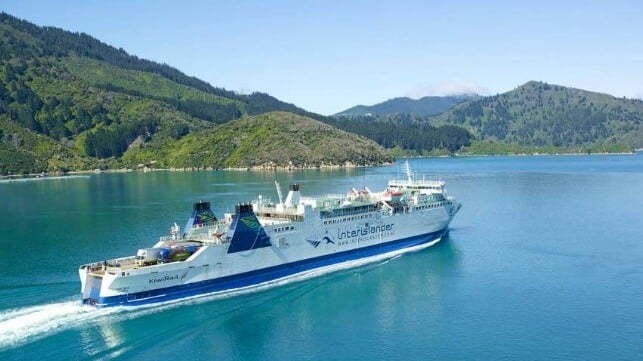
August has marked what many hope will be a turning point and the start of a new beginning for New Zealand’s KiwiRail and its troubled interisland ferry service. It reports that the previous iReX ferry program has been brought to a close with a final settlement with the shipyard, and this week it retired its oldest vessel as the first step in the modernization program.
The company provides a vital passenger and freight operation running RoRo ferries between the North and South islands. According to company data, each year it moves US$8.5 billion in freight, making more than 4,000 crossings. The company says it transports nearly 800,000 passengers and 250,000 cars annually on three vessels, the oldest of which was built in 1988, while the others were built in 1995 and 1998.
With government support, in 2020, it announced plans for two much larger ferries to enter service in 2025 and 2026. Each would have been 50,000 gross tons with a capacity for more than 1,900 passengers, versus the current ships, which have a maximum capacity of 650 passengers. They would also have accommodated 650 passenger cars versus the current 250. Contracts were signed in 2021 with Korea’s Hyundai Mipo Dockyard to build the vessels, which were to be hybrids with battery-electric power.
A new government elected in 2023 was critical of the project and reported it was canceling funding in part due to runaway cost estimates. KiwiRail terminated the order and began settlement negotiations with Hyundai Mipo. Last week, it was reported that a final settlement was completed at a cost of NZ$144 million (US$84.6 million). Along with a previous payment, KiwiRail reports the total cost was NZ$222 million (US$130 million) to Hyundai Mipo and an additional NZ$449 million (US$264 million), including costs of landside infrastructure.
“Doomsayers said cancelling the contract would cost the taxpayer the full NZ$551 million contract value, but these are some of the same people who accepted Project iReX ballooning from NZ$1.45 billion when approved in 2021 to Treasury warning it was on course to NZ$4 billion in 2023 thanks to eyes-bigger-than-their-mouths ambitions and absentee management,” said Ministers Nicola Willis (Finance) and Winston Peters (Foreign Affairs), in a joint statement on the settlement agreement.
They contend that there was not sufficient consideration given to the port infrastructure requirements for the two massive ferries. After winning the election, they allege they were confronted with “billion-dollar blowouts” due to the mismanagement by the prior government of the infrastructure projects.
“KiwiRail remains focused on working with Ferry Holdings Limited and the port companies to deliver two new rail-enabled ferries and the required infrastructure upgrades in Wellington and Picton by 2029. We’re looking forward to ensuring the safe and smooth transition of the new fleet into service for our people and customers when the time comes,” said Jason Dale, KiwiRail Chief Financial Officer.
The service has also experienced breakdowns, reports of poor maintenance, and management issues. In 2023 regulators said they would prosecute the company over maintenance issues which caused one of the vessels to black out during its crossing. In 2024, another one of the ferries went aground departing port with the investigation saying the crew did not know how to turn off the autopilot.
This week, the company began its plan by officially retiring the Aratere after its final sailing on August 18, a three-hour crossing between Picton and Wellington. The retirement of the vessel, which had been commissioned in 1999, is designed to permit the development of new port infrastructure. Aratere was the company’s only rail-enabled ferry, meaning freight cars were moved to the vessel and across the Cook Strait.
Aratere’s wharf in Picton is due to be demolished later this year as part of the new ferry project. Aratere required specialized wharf infrastructure to load and unload, including integrated rail tracks, so it cannot use Interislander’s other berths. Until the new ferries are delivered, freight will have to be transferred into trailers and trucks for the trip between the islands.
The ferry was laid up in Wellington with KiwiRail reporting it is considering options for its sale with a shipbroker. It says the plans for the new ferries are on schedule. Due for delivery by 2029, they will be larger, replacing all three current ships, and will reintroduce rail freight capabilities to the route.
Port of Auckland Gets Greenlight for Expansion Under New Fast-Track Regime
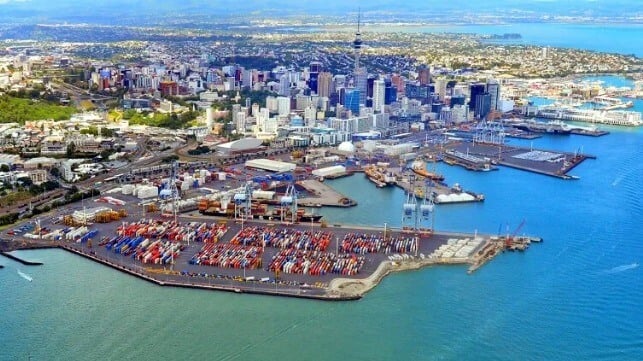
The Port of Auckland in New Zealand is finally set to embark on major infrastructure expansion projects aimed at enhancing its competitiveness. It is proceeding after getting a government greenlight under a new law designed to cut red tape in the approval process for huge infrastructure and development projects.
Under the Fast-track Approvals Act, Auckland’s wharf expansion project has become the first mega project to be granted consent. The greenlight now allows New Zealand’s main import terminal to proceed with the implementation of the Bledisloe North and Fergusson North projects, as well as the construction of a cruise passenger terminal and other upgrades.
The consent was granted by an expert panel set up under the Act, which was introduced in Parliament in March last year and enacted in record speed as part of the coalition government’s plan for its first 100 days in office. The Act, which received Royal Assent in December and became effective in February, establishes a permanent fast-track regime that makes it easier and quicker for large projects to gain approvals. The decision came just 66 working days after the panel was convened.
“The Act helps cut through the tangle of red and green tape and the jumble of approvals processes that have, until now, held New Zealand back from much-needed economic growth,” said Chris Bishop, New Zealand Infrastructure Minister.
Having become the first to get approval under the act, the Port of Auckland will, starting next month, embark on implementing key projects that are critical to future growth. The Bledisloe and Fergusson wharves expansion forms the core of the projects that will not only allow berthing of larger containerships but also make Auckland a hub for cruise shipping.
The Bledisloe North wharf project will include a new reinforced concrete-piled wharf at the terminal, giving it enough depth for large cruise ships and RoRos. For Fergusson North, the project involves a wharf extension that will enable the port to handle 10,000 TEU ships in the future. Currently, the port can only handle ships with a 5,000 TEU maximum capacity.
Auckland has termed the projects as once-in-a-generation infrastructure that is needed to serve the city for decades to come, not only by making the port “big ship capable” but also by providing long-term fit-for-purpose infrastructure. In February, the port that is owned by the Auckland Council revealed it intends to invest NZ$120 to NZ$150 million (US$70 to $88 million) over the next three to four years in infrastructure expansion.
“The Bledisloe North wharf extensions will enable larger cruise ships to berth, and increase New Zealand’s importing and exporting capacity,” said Bishop. The project will deliver lasting economic benefits by boosting the efficiency of a critical part of Auckland’s economy and supporting long-term growth.
Auckland’s infrastructure investments come when the port, the second largest after Port of Tauranga, is recording growth in container throughput to hit the 900,000 TEU mark in 2024.
The Auckland project was among a total of 149 projects on the fast-track list, with others involved in mining, power, and residential development, among others, being under consideration.
APM Terminals Plans $1B Investment to Develop Indian Ports
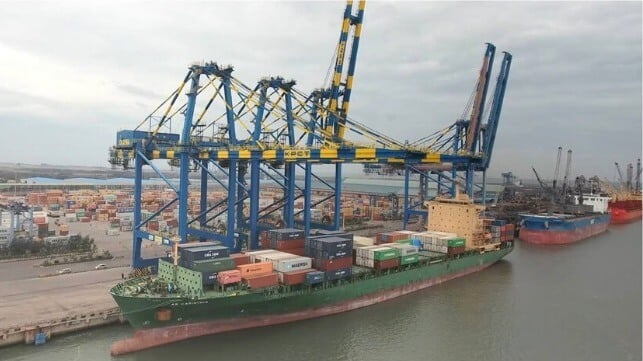
APM Terminals, the terminal operations for AP Moller-Maersk, has entered into an agreement with the authority overseeing ports on India’s east coast along the Bay of Bengal. Under the Memorandum signed in India on August 22, they plan to explore the development of ports to create an “Eastern Gateway” as part of India’s plan to expand trade.
According to officials, the agreement while help realize the vision of creating Andhra Pradesh as the logistics hub of the east. The region has more than 620 miles of coastline. The vision is to develop marine infrastructure such as ports, fishing harbors, and fish landing centers every 30 miles.
The region is currently home to Visakhapatnam, a port city and industrial center, which is the third-largest port by volume in India and one of the country’s 12 major ports. However, it is mostly a bulker port with smaller container operations in the region. The coast currently hosts a total of 15 ports in eight coastal districts, with five operational non-major commercial ports and four green field projects, which will be operational by 2026.
Working with APM, the goal is to accelerate port and terminal development in the state. APM has expressed its intent as part of the MoU to invest approximately $1 billion to modernize ports and terminals. They will focus on the development of the Machilipatnam, Mulapeta, and Ramayapatnam ports and infrastructure.
These are three of the ports currently being developed by the authority in the region. In June, the local authorities reported that Ramayapatnam Port was the most advanced with Phase 1 work nearly two-thirds (64 percent) completed. Both Machilipatnam and Mulapeta have completed more than 40 percent of their Phase 1 development.
APM is seen as a logical partner for the next phase of development, with the local officials noting that it is at the forefront of introducing advanced cargo handling technologies, promoting sustainable operations, and enhancing efficiency in container and bulk handling. APM Terminals has been present in India since 2004 and operates two key assets. The Gujarat Pipavav Port is located 152 nautical miles (10 hours steaming time) from Nhava Sheva in Mumbai. It was India’s first public-private port operation and has a capacity for 1.35 million TEU annually.
APM is also in partnership with India for the operations of APM Terminals Mumbai (Gateway Terminals India), which is the largest container facility in the country. Efforts are currently expanding its capacity above 2 million TEU annually.

No comments:
Post a Comment