'Anxiousness and frustration' hits red state as Trump serves 'bitter pill': rural leader
Cami Koons,
'We've lost a lot of contracts': GOP senator admits Trump trade policy now hurting farmers
Alexander Willis
October 3, 2025
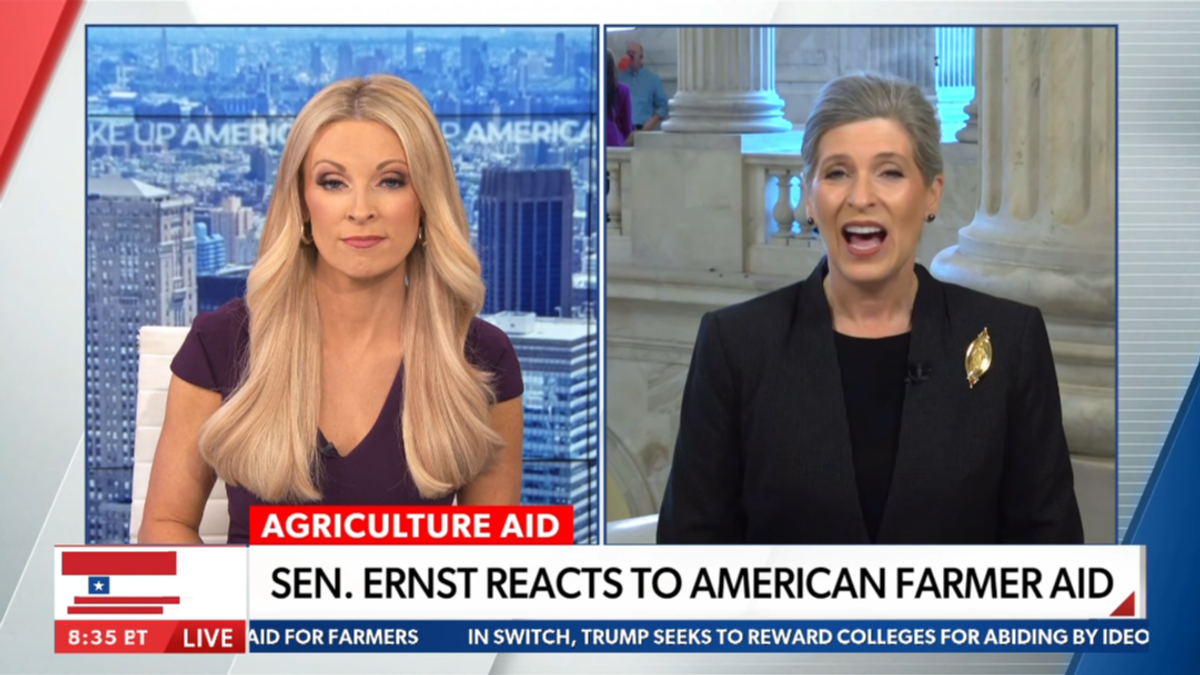
Screengrab / Newsmax
China’s recent boycott of American soybeans may end up costing American farmers billions of dollars, and, according to one Republican senator, blame should be placed directly on President Donald Trump’s trade policy.
“China is just not budging on this, and unfortunately, we've lost a lot of soybean contracts due to these... elongated negotiations,” Sen. Joni Ernst (R-IA) admitted Friday while appearing on Newsmax.
China announced the boycott following Trump’s on-and-off again tariffs on the Asian nation, which in April were raised to as high as 125% before being brought back down as a temporary tariff truce. Given China is, by far, the largest importer of American-grown soybeans, the boycott has left farmers enraged, with Trump, reportedly in panic, considering providing farmers with a $10 billion bailout.
Asked about the potential bailout for farmers, Ernst said farmers were not happy with the offer, and stressed the need to find a way to end China’s boycott, rather than subsidize American crop growers.
“Unfortunately, our farmers do need that assistance,” Ernst said. “They don't like it, they do consider it welfare, they want trade not aid, and so we really need to see some of these new markets opening up around the globe. We need to see additional domestic consumption of our commodities like soybeans and corn.”
Ernst has had a tumultuous relationship with the MAGA movement, with critics accusing the Iowa Republicans of “trying on a MAGA suit” to mixed results. She’s demonstrated a strong allegiance to Trump and frequently votes in accordance with his agenda, though has faced scrutiny from MAGA figures for being insufficiently loyal to the president, particularly after reports that she was skeptical of Trump’s pick for Defense secretary, Pete Hegseth.
Perhaps in an effort to signal her continued loyalty to Trump, Ernst’s parting words on the matter of the potential bailout for farmers were ones of praise for the president.
“But if there's anybody that can make a deal, it's President Trump, so we'll continue to hope for the best and we'll help our farmers where and how we can,” Ernst said.
Cami Koons,
Iowa Capital Dispatch
October 4, 2025
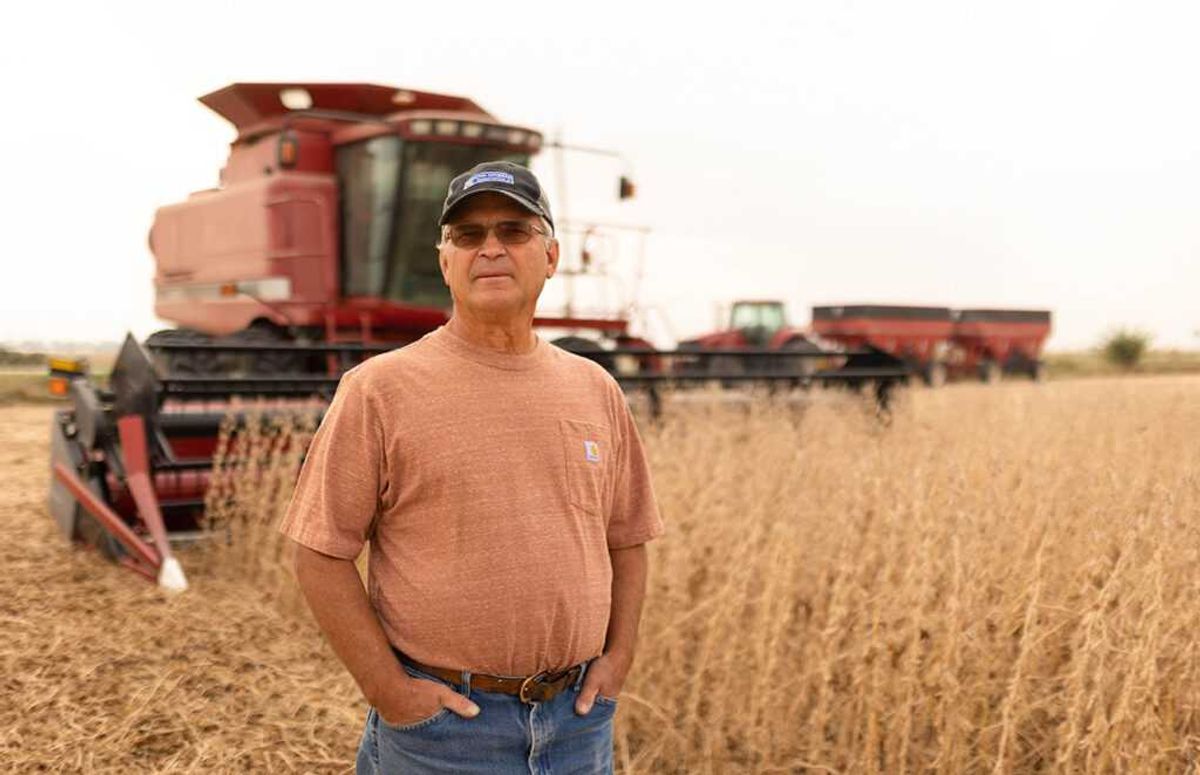
Tom Adam, Iowa Soybean Association president, farms near Harper, Iowa, in Keokuk County.
October 4, 2025
Tom Adam, Iowa Soybean Association president, farms near Harper, Iowa, in Keokuk County.
(Photo by Joclyn Kuboushek/Iowa Soybean Association)
Iowa Soybean Association President Tom Adam urged the Trump administration, in a statement Thursday, to prioritize a trade deal with China and to support soybean farmers who are without their biggest market.
China typically buys 60% of global soybean exports, and the U.S. used to be China’s preferred supplier until it turned to Brazil during the trade wars of the first Trump administration.
Now, China appears to have turned to Argentina for its soybeans, and U.S. farmers worry they’ll be stuck with a bountiful harvest and nowhere to sell it.
China placed an order with Argentina shortly after the U.S. agreed to a $20 billion bailout deal with the South American country. According to the American Soybean Association, China typically purchases soybeans from the U.S. before harvest begins. A couple weeks into the harvest season in Iowa, and China has not placed an order, presumably in protest of U.S. tariffs on Chinese goods.
“Agriculture thrives when America leads on trade,” Adam said in the statement. “We can’t afford to let uncertainty and political maneuvering erode the markets farmers have spent decades cultivating.”
Adam said the mood in rural Iowa is one of “anxiousness and frustration” because of “trade policy that’s severely straining relationships” with key trade partners.
Adam, who also farms near Harper, said President Donald Trump’s current trade policies are a “bitter pill” for farmers, despite the fact that many farmers voted to elect Trump.
“With strong yields and a nearly ideal harvest season underway across Iowa and large sections of rural America, grain bins will soon be filled with quality U.S. soy that needs to find a home,” Adam wrote.
An Iowa State University report from July estimated that reciprocal tariffs – where the country places the same tariff amount on U.S. goods as the U.S. has placed on their goods — could cause losses between $191 million and $1.49 billion to the Iowa soybean industry.
While soybeans stand to lose the most, according to the report, the corn, ethanol and hog industries in Iowa were also projected to lose hundreds of millions because of the reciprocal tariffs.
ISA urged the administration to broker a trade agreement with China that “immediately expedites soybean purchases.”
President Trump has expressed plans to meet with Chinese President Xi Jinping at a trade summit at the end of October, but Adam said every day without a Chinese trade deal “closes the window tighter” on the “critical” sales period for soybeans between October through February.
The release from Iowa Soybean Association said this year, Iowa farmers are set to harvest about 550 million bushels of soybeans across 9.3 million acres.
With no soybean sales to China currently on the books, farmers are worried they’ll have to find a place to store their crops, or find a different market.
Adam also urged Congress to “provide immediate trade mitigation funding” to farmers to tide them over until a deal can be reached.
U.S. Sen. Chuck Grassley said Tuesday that farmers would rather have a market to sell into than rely on a government payout. He also said the administration might find a solution using tariff money instead of congressionally allocated funds.
Adam said a federal farm payment was “not ideal” but that it would “enable many farmers to survive another year.”
Finally, the Iowa Soybean Association president asked the administration to finalize Renewable Volume Obligations – something EPA proposed earlier this year – to boost the biofuels industry. A boost in this industry would give farmers another soybean market to sell into.
“The crop is here,” Adam said. “The quality is proven. The demand exists. What’s missing is the resolve to reconnect America’s farmers with a world of buyers who want to purchase our soybeans.”
This story was originally produced by Iowa Capital Dispatch, which is part of States Newsroom, a nonprofit news network that includes Missouri Independent, and is supported by grants and a coalition of donors as a 501c(3) public charity.
Iowa Soybean Association President Tom Adam urged the Trump administration, in a statement Thursday, to prioritize a trade deal with China and to support soybean farmers who are without their biggest market.
China typically buys 60% of global soybean exports, and the U.S. used to be China’s preferred supplier until it turned to Brazil during the trade wars of the first Trump administration.
Now, China appears to have turned to Argentina for its soybeans, and U.S. farmers worry they’ll be stuck with a bountiful harvest and nowhere to sell it.
China placed an order with Argentina shortly after the U.S. agreed to a $20 billion bailout deal with the South American country. According to the American Soybean Association, China typically purchases soybeans from the U.S. before harvest begins. A couple weeks into the harvest season in Iowa, and China has not placed an order, presumably in protest of U.S. tariffs on Chinese goods.
“Agriculture thrives when America leads on trade,” Adam said in the statement. “We can’t afford to let uncertainty and political maneuvering erode the markets farmers have spent decades cultivating.”
Adam said the mood in rural Iowa is one of “anxiousness and frustration” because of “trade policy that’s severely straining relationships” with key trade partners.
Adam, who also farms near Harper, said President Donald Trump’s current trade policies are a “bitter pill” for farmers, despite the fact that many farmers voted to elect Trump.
“With strong yields and a nearly ideal harvest season underway across Iowa and large sections of rural America, grain bins will soon be filled with quality U.S. soy that needs to find a home,” Adam wrote.
An Iowa State University report from July estimated that reciprocal tariffs – where the country places the same tariff amount on U.S. goods as the U.S. has placed on their goods — could cause losses between $191 million and $1.49 billion to the Iowa soybean industry.
While soybeans stand to lose the most, according to the report, the corn, ethanol and hog industries in Iowa were also projected to lose hundreds of millions because of the reciprocal tariffs.
ISA urged the administration to broker a trade agreement with China that “immediately expedites soybean purchases.”
President Trump has expressed plans to meet with Chinese President Xi Jinping at a trade summit at the end of October, but Adam said every day without a Chinese trade deal “closes the window tighter” on the “critical” sales period for soybeans between October through February.
The release from Iowa Soybean Association said this year, Iowa farmers are set to harvest about 550 million bushels of soybeans across 9.3 million acres.
With no soybean sales to China currently on the books, farmers are worried they’ll have to find a place to store their crops, or find a different market.
Adam also urged Congress to “provide immediate trade mitigation funding” to farmers to tide them over until a deal can be reached.
U.S. Sen. Chuck Grassley said Tuesday that farmers would rather have a market to sell into than rely on a government payout. He also said the administration might find a solution using tariff money instead of congressionally allocated funds.
Adam said a federal farm payment was “not ideal” but that it would “enable many farmers to survive another year.”
Finally, the Iowa Soybean Association president asked the administration to finalize Renewable Volume Obligations – something EPA proposed earlier this year – to boost the biofuels industry. A boost in this industry would give farmers another soybean market to sell into.
“The crop is here,” Adam said. “The quality is proven. The demand exists. What’s missing is the resolve to reconnect America’s farmers with a world of buyers who want to purchase our soybeans.”
This story was originally produced by Iowa Capital Dispatch, which is part of States Newsroom, a nonprofit news network that includes Missouri Independent, and is supported by grants and a coalition of donors as a 501c(3) public charity.
'We've lost a lot of contracts': GOP senator admits Trump trade policy now hurting farmers
Alexander Willis
October 3, 2025
Screengrab / Newsmax
China’s recent boycott of American soybeans may end up costing American farmers billions of dollars, and, according to one Republican senator, blame should be placed directly on President Donald Trump’s trade policy.
“China is just not budging on this, and unfortunately, we've lost a lot of soybean contracts due to these... elongated negotiations,” Sen. Joni Ernst (R-IA) admitted Friday while appearing on Newsmax.
China announced the boycott following Trump’s on-and-off again tariffs on the Asian nation, which in April were raised to as high as 125% before being brought back down as a temporary tariff truce. Given China is, by far, the largest importer of American-grown soybeans, the boycott has left farmers enraged, with Trump, reportedly in panic, considering providing farmers with a $10 billion bailout.
Asked about the potential bailout for farmers, Ernst said farmers were not happy with the offer, and stressed the need to find a way to end China’s boycott, rather than subsidize American crop growers.
“Unfortunately, our farmers do need that assistance,” Ernst said. “They don't like it, they do consider it welfare, they want trade not aid, and so we really need to see some of these new markets opening up around the globe. We need to see additional domestic consumption of our commodities like soybeans and corn.”
Ernst has had a tumultuous relationship with the MAGA movement, with critics accusing the Iowa Republicans of “trying on a MAGA suit” to mixed results. She’s demonstrated a strong allegiance to Trump and frequently votes in accordance with his agenda, though has faced scrutiny from MAGA figures for being insufficiently loyal to the president, particularly after reports that she was skeptical of Trump’s pick for Defense secretary, Pete Hegseth.
Perhaps in an effort to signal her continued loyalty to Trump, Ernst’s parting words on the matter of the potential bailout for farmers were ones of praise for the president.
“But if there's anybody that can make a deal, it's President Trump, so we'll continue to hope for the best and we'll help our farmers where and how we can,” Ernst said.
TOO LITTLE, TOO LATE, IF AT ALL
By AFP
October 2, 2025

Farmers are a key political support base for President Donald Trump, but have been caught in the crossfire as Washington and Beijing traded barbs - Copyright AFP/File JIM WATSON
US Treasury Secretary Scott Bessent signaled Thursday that “substantial support” for farmers would be announced next week, particularly for those growing soybeans, as they struggle with fallout from President Donald Trump’s trade conflicts.
Worries have been growing for weeks of a major hit to farmers, a key part of Trump’s political base, as exports to China dry up over tariffs instituted by Beijing in retaliation to US levies.
“You should expect some news on Tuesday on substantial support for our farmers, especially the soybean farmers,” Bessent told CNBC early Thursday.
The Wall Street Journal also reported Thursday that President Donald Trump is mulling $10 billion or more in aid to American farmers as the trade tensions take a toll.
The Trump administration is considering using revenue collected from the president’s tariffs to fund much of this support, the Journal reported, with the money potentially distributed in the upcoming months.
Asked about the matter, White House spokesperson Anna Kelly said Trump and Agriculture Secretary Brooke Rollins “are always in touch about the needs of our farmers, who played a crucial role in the President’s November (election) victory.”
“He has made clear his intention to use tariff revenue to help our agricultural sector, but no final decisions on the contours of this plan have been made,” she told AFP.
Bessent did not provide figures in his interview with CNBC either, but said: “They’ve had President Trump’s back, and we’ve got their back.”
Farmers have been particularly caught in the crossfire as Washington and Beijing imposed tit-for-tat tariffs on each other’s exports.
On Wednesday, Trump said that he planned to push Chinese President Xi Jinping on purchases of US soybeans when they meet in the coming weeks.
The leaders of the world’s two biggest economies are expected to speak in around four weeks, on the sidelines of an Asia-Pacific Economic Cooperation (APEC) summit in South Korea.
The American Soybean Association warned in August that Beijing’s retaliatory tariffs were shutting US farmers out of their biggest export market going into the 2025 harvest — with China being a top global buyer of soybeans.
But Beijing’s counter tariffs, after Trump targeted Chinese goods with fresh duties, has stunted sales to the country. Instead, Chinese buyers have relied more on other exporters like Brazil and Argentina.
“Nobody wants to trade with us,” said Jonathan Driver, a soybean farmer in Arkansas.
While farmers can still sell their crops, he warned that many are selling them for a loss.
“It’s going to put several people out of business,” he told AFP. “And we’ve had prices of everything continue to go up.”
By AFP
October 2, 2025
Farmers are a key political support base for President Donald Trump, but have been caught in the crossfire as Washington and Beijing traded barbs - Copyright AFP/File JIM WATSON
US Treasury Secretary Scott Bessent signaled Thursday that “substantial support” for farmers would be announced next week, particularly for those growing soybeans, as they struggle with fallout from President Donald Trump’s trade conflicts.
Worries have been growing for weeks of a major hit to farmers, a key part of Trump’s political base, as exports to China dry up over tariffs instituted by Beijing in retaliation to US levies.
“You should expect some news on Tuesday on substantial support for our farmers, especially the soybean farmers,” Bessent told CNBC early Thursday.
The Wall Street Journal also reported Thursday that President Donald Trump is mulling $10 billion or more in aid to American farmers as the trade tensions take a toll.
The Trump administration is considering using revenue collected from the president’s tariffs to fund much of this support, the Journal reported, with the money potentially distributed in the upcoming months.
Asked about the matter, White House spokesperson Anna Kelly said Trump and Agriculture Secretary Brooke Rollins “are always in touch about the needs of our farmers, who played a crucial role in the President’s November (election) victory.”
“He has made clear his intention to use tariff revenue to help our agricultural sector, but no final decisions on the contours of this plan have been made,” she told AFP.
Bessent did not provide figures in his interview with CNBC either, but said: “They’ve had President Trump’s back, and we’ve got their back.”
Farmers have been particularly caught in the crossfire as Washington and Beijing imposed tit-for-tat tariffs on each other’s exports.
On Wednesday, Trump said that he planned to push Chinese President Xi Jinping on purchases of US soybeans when they meet in the coming weeks.
The leaders of the world’s two biggest economies are expected to speak in around four weeks, on the sidelines of an Asia-Pacific Economic Cooperation (APEC) summit in South Korea.
The American Soybean Association warned in August that Beijing’s retaliatory tariffs were shutting US farmers out of their biggest export market going into the 2025 harvest — with China being a top global buyer of soybeans.
But Beijing’s counter tariffs, after Trump targeted Chinese goods with fresh duties, has stunted sales to the country. Instead, Chinese buyers have relied more on other exporters like Brazil and Argentina.
“Nobody wants to trade with us,” said Jonathan Driver, a soybean farmer in Arkansas.
While farmers can still sell their crops, he warned that many are selling them for a loss.
“It’s going to put several people out of business,” he told AFP. “And we’ve had prices of everything continue to go up.”

No comments:
Post a Comment