Showing posts sorted by relevance for query ANTI-ZIONISM. Sort by date Show all posts

Thursday, February 08, 2024

Anti-Zionism is now a protected belief in Britain; time for a reckoning for pro-Israel lobbyists?

February 7, 2024

A protestor holds an Israeli flag during a pro-Israel demonstration outside the Israeli Embassy on May 23, 2021 in London, England [Hollie Adams/Getty Images]

by Nasim Ahmed
Nasimbythedocks

Zionism is a form of racism; the ideology which underpins the occupation state of Israel calls for the ethnic cleansing and disenfranchisement of non-Jews in favour of Jews. Zionism seeks to transform historic Palestine into Greater Israel; its racist aspirations means that it is ideologically bound to lead to the practices of apartheid and genocide in pursuit of territorial control and expansion of Jewish domination.

All of the above statements are not only true, but now we know that holding such anti-Zionist beliefs are protected in the workplace by UK law thanks to Professor David Miller’s landmark legal victory this week. A Bristol-based Employment Tribunal, one of a group of agencies which the UK government describes as independent arbitrators of disputes over employment law, has ruled that “anti-Zionist beliefs qualified as a philosophical belief and as a protected characteristic.”


According to UK law, protected beliefs refer to certain philosophical, religious or political beliefs that are protected from discrimination under the Equality Act 2010. They cover beliefs related to religion or philosophical persuasion, such as Christianity, Islam, Judaism, Hinduism, Buddhism, atheism and agnosticism. Political beliefs are also covered, such as belief in non-violent protest or support for a particular party or ideology. Beliefs around economic theory and animal testing, and beliefs about government policies also have the potential to qualify.

Following Monday’s tribunal decision, anti-Zionism can now be added to the list of protected political beliefs.


Noting the significance of the victory, Miller said that it was unclear whether a belief in the idea that Zionism is a racist, imperialist and colonial ideology could be protected under the Equality Act 2010 as a philosophical belief. This case has proven that anti-Zionist beliefs are indeed protected under the law of the land in the UK.

READ: Harvard faces US govt probe for possible discrimination against Muslims

The case is not only a vindication of Miller, who successfully sued the University of Bristol for wrongful dismissal, but the verdict has also exonerated those who have been warning for years about the weaponisation of anti-Semitism by the pro-Israel lobby against critics of the apartheid state.

The ordeal to which Miller was subjected has its roots in the decades long campaign by pro-Israel lobbyists to conflate anti-Zionism with anti-Semitism, the anti-Jewish racism which has long been illegal, and rightly so. This goal was achieved by planting anti-Zionism and criticism of Israel at the centre of the highly controversial International Holocaust Remembrance Alliance (IHRA) “working definition” of anti-Semitism. Seven of the eleven examples of anti-Semitism mentioned in the IHRA definition conflate criticism of Israel with anti-Jewish racism.

Although the campaign to redefine anti-Semitism to include anti-Zionism has been decades in the making, it took a pernicious turn in 2014 when the pro-Israel Simon Wiesenthal Centre began to campaign on behalf of the IHRA definition. The latter was formulated in 2004 by anti-Semitism expert Kenneth Stern in collaboration with other academics for the American Jewish Committee, a Jewish advocacy organisation founded at the beginning of the 20th century and based in New York.

According to Stern, the aim in formulating the definition was to assist European organisations when monitoring anti-Semitic incidents, not to restrict political discourse regarding Zionism. At the time of its drafting, there was no intent for the IHRA definition to serve as the basis for a legal or punitive framework designed to suppress anti-Zionist perspectives. Rather, it was developed as a practical tool for cataloguing cases of discrimination and hatred directed against Jewish communities themselves.

While it was adopted by the European Union’s Monitoring Centre on Racism and Xenophobia in 2005 to monitor anti-Semitism across Europe, the IHRA definition was dropped in 2014 by the centre’s successor body, the Fundamental Rights Agency, after facing complaints of misuse.

OPINION: From Gaza to Congo: Zionism and the unlearned history of genocide

The controversial definition’s revival in 2014 coincided with the rise of former UK Labour Party leader Jeremy Corbyn MP. As leader of the opposition for almost five years, the Corbyn era was paralysed by a fratricidal row over anti-Semitism. The moral panic that ensued upon Corbyn’s election as leader is widely believed to have been caused by the way in which the IHRA definition was being deployed against critics of Israel. Anti-Zionist Jews were among many who were purged by the party under Corbyn’s successor, Keir Starmer, because of their views on Israel.

At the same time, the adoption of the IHRA definition of anti-Semitism began to have a detrimental impact on academic freedom and freedom of expression. Categorising anti-Zionism under the umbrella of anti-Semitism also had a chilling effect on free speech. Across institutions in the UK and other locales that had adopted the definition, students, professors and staff faced disciplinary action for espousing anti-Zionist views.

Media outlets persisted in publicising rising anti-Semitism rates, fanning public anxiety, while overlooking the fundamental flaws in the definition being utilised to track anti-Jewish prejudice in the first place. Stretching the description of anti-Semitism to cover various types of anti-Zionism fostered a narrative that was disconnected from reality. With this single definition, combatting anti-Semitism turned from fighting hatred into a McCarthyite witch-hunt.

Like many others, Prof. Miller was a victim of this toxic culture. Governments, political parties, employers and universities began to impose speech codes with the clear aim of policing the boundaries of free speech regarding Israel and Zionism. As an expert on the threat to democracy posed by corporate lobbying who exposed, among other things, the role of the global Zionist movement in fuelling anti-Muslim hatred, Miller became an obvious target. He was accused of breaching the IHRA definition of anti-Semitism. The University of Bristol adopted in full the “working definition” in 2019, three years before firing Miller.

When Zionist organisations filed complaints against him that precipitated Miller’s 2022 sacking, Paddy Ireland, the Dean of the Faculty of Social Sciences and Law at the University of Bristol, dismissed their claims. According to official court records, Ireland refuted the applicability of the IHRA definition in evaluating Miller’s conduct. He stated that, “Notwithstanding its adoption by a number of bodies, it is a somewhat controversial definition; it is imprecise and can be used to conflate criticism of the policies of the Israeli government and of Zionism with anti-Semitism.”

Ireland went on to state that “It is not clear that the IHRA definition is compatible with the University’s legal obligations under the Education Act and Human Rights Act. For the purposes of dealing with this complaint, therefore, I have used a simpler and, I hope, less controversial definition of anti-Semitism as hostility towards Jews as Jews.”


Although Miller was cleared of any anti-Semitism, he was nevertheless sacked.

The university claimed that he “did not meet the standards of behaviour” expected of university staff. Miller rejected this and in his statement after the tribunal verdict said: “The University of Bristol maintained that I was sacked because Zionist students were offended by my various remarks. However, it was plain from the evidence provided by the university’s own witnesses, that I was sacked because of the anti-Zionist nature of my comments.”

Miller’s victory has sent shockwaves through the pro-Israel lobby in Britain. Already there are calls for some kind of reckoning to take place over the way in which anti-Semitism has been weaponised to purge members from the Labour Party for their avowedly anti-Zionist views. I think we can expect to see legal challenges to be launched on the back of Monday’s landmark tribunal decision.

OPINION: Weaponised definition of anti-Semitism is a ‘tool’ to undermine free speech

The views expressed in this article belong to the author and do not necessarily reflect the editorial policy of Middle East Monitor.

Monday, December 11, 2023


Anti-Zionism is not antisemitism

Equating the two is designed to stifle criticism and instill fear in those who speak out, Jews and non-Jews alike. 

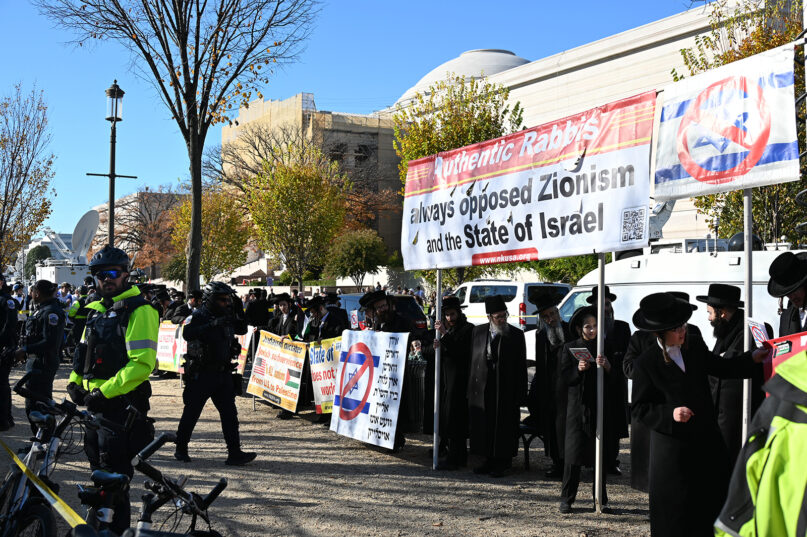
Members of the anti-Zionist subset of the U.S. ultra-Orthodox Jewish community counterprotest during the March for Israel on Nov. 14, 2023, in Washington. (RNS photo/Jack Jenkins)

(RNS) — The Muslim and Jewish communities in the West have a decadeslong history of standing together in solidarity against Islamophobia and antisemitism and supporting one another in times of pain. We have faced a similar bigotry and an uptick of hate-fueled attacks on our communities in recent years. We have been familiar faces to one another at the endless press conferences in the aftermath of so many of those incidents.

But these relationships cannot be confined to empathy at home. When that same hatred is overseas, it has to be just as near to our hearts. And at a time in which Palestinian civilians — two-thirds of whom are women and children — are being killed at a rate of 280 per day, we must affirm that anti-Palestinian racism and bigotry are also extensions of Islamophobia. We must also be crystal clear as to what anti-Zionism is and is not. 

Anti-Zionism is not antisemitism

It is a travesty that we are forced to state and defend what should be an undeniable fact. It is a strategic conflation made by the Zionist lobby, engineered to suppress a shift in narrative and public opinion that increasingly humanizes Palestinians and rejects the Israeli occupation. Over the past two months, Israel’s indiscriminate bombardment and ground invasion has resulted in more than 16,000 Palestinians killed and at least 40,000 more injured. And with that, a global audience otherwise ignorant of the Palestinian catastrophe has been granted firsthand access to the crimes of the Israeli occupation.

House Resolution 894, a resolution that strongly condemns and denounces the “drastic rise of antisemitism in the United States and around the world,” also states “that anti-Zionism is antisemitism.” This is an ignorant at best — malicious at worst — attempt to amalgamate two disparate concepts. Antisemitism is a discriminatory and bigoted view of the Jewish people, a people with a millennialong history, while anti-Zionism opposes a political ideology introduced in the late 19th century that sought the establishment of an ethnostate on Palestinian territory


RELATED: Democrats fracture over antisemitism vote


On December 5, the resolution passed despite last-ditch efforts by three Jewish Democrats, who urged their colleagues to avoid what they termed an “attempt by Republicans to weaponize Jewish pain.” They described the resolution as “just the latest unserious attempt by Republicans to weaponize Jewish pain and the serious problem of antisemitism to score cheap political points.” While 92 Democrats voted merely “present,” a majority voted in favor, marking a dramatic disconnect between Democrats in Congress and their constituents — at a time when Gallup data shows “Democrats’ sympathies in the Middle East now lie more with the Palestinians than the Israelis.”

And the impact of AIPAC lobbying cannot be overstated. As M.J. Rosenberg wrote for the Huffington Post in 2017, “(Democrats) are in the grip of a foreign policy lobby as powerful as the NRA, the American Israel Public Affairs Committee, or AIPAC.” Rosenberg alluded to Democrats’ decadeslong frustration with the National Rifle Association’s lobbying efforts against gun control measures. “Sorry, Democrats: your NRA is spelled AIPAC,” he titled the piece. 

House Republicans, and the GOP at large, began this deliberate mischaracterization of anti-Zionism years ago. In his remarks at the 2019 AIPAC Policy Conference, then-U.S. Secretary of State Mike Pompeo catered to the crowd. “Let me go on the record,” he said. “Anti-Zionism is antisemitism.” He defined anti-Zionism as denying “the very legitimacy of the Israeli state and of the Jewish people.”

And that is exactly the conflation AIPAC hopes to embed and establish in the public discourse, the idea that the Israeli occupation and the Jewish people are inseparable. But as Dave Zirin of The Nation puts it, this is the greatest disservice to the Jewish people. “Anyone who attempts to fasten a 5,000-year-old religion to a 150-year-old colonial project is guilty of antisemitism. They are pushing the idea that my family, merely because of our religion, supports war crimes abroad and the crackdown on critics at home.” It also assumes American Jews are a homogenous group; a Pew Research Center survey found that most American Jewish adults take the position that God “did not literally give” the land of Israel to the Jewish people. 

Anti-Zionists, including thousands of Jews across the globe, reject the notion of an ethno-state that expels the existing Palestinian population. Anti-Zionists oppose the Israeli occupation on the basis of the myriad human rights abuses that Israel has carried out since its founding. These include the displacement and ethnic cleansing of millions of Palestinians, the establishment of an apartheid system that systematically disenfranchises Palestinians, a sustained illegal occupation, the murder of tens of thousands of Palestinians over the past seven decades and the ongoing genocide in Gaza. 


Anti-Zionism is not antisemitism. It would be absurd to be forced to make the same clarifications regarding other distinctly independent concepts, and it is an indictment of the uninformed level of discourse Congress has succumbed to. Equating anti-Zionism and antisemitism is a strategic and calculated measure designed to stifle criticism of the Israeli occupation and instill fear in those who speak out, Jews and non-Jews alike. 

After the resolution’s passage, I wrote on X (formerly Twitter) that, “according to the House of Representatives, the Muslim community that has stood in solidarity in front of synagogues and Jewish community centers against hate for years — yet also opposes Zionism — is to be considered antisemitic. And all of the brave members of the Jewish community standing in solidarity against occupation are also apparently antisemites. Make it make sense.”

Unfortunately, it will never make sense. To equate anti-Zionism and antisemitism is to conflate being Jewish with being Zionist, and, as Dave Zirin posited, “this is rank antisemitism: the assumption that to be Jewish is to support Israel’s crimes.” Ironically, despite the resolution’s stated attempts to condemn antisemitism, it — in fact — fans the flames of bigotry. This resolution seeks to weaponize Jewish pain by criminalizing criticism of the occupation, apartheid and systemic racism, all of which are part and parcel of the current Israeli fabric.

Thursday, April 28, 2022

The broad coalition that conflates anti-Zionism with antisemitism

Amos Goldberg
28 April 2022 

From the far right to progressives, groups that will not tolerate criticism of Israel have varied motivations. But they all delegitimise the validity of a Palestinian liberation movement


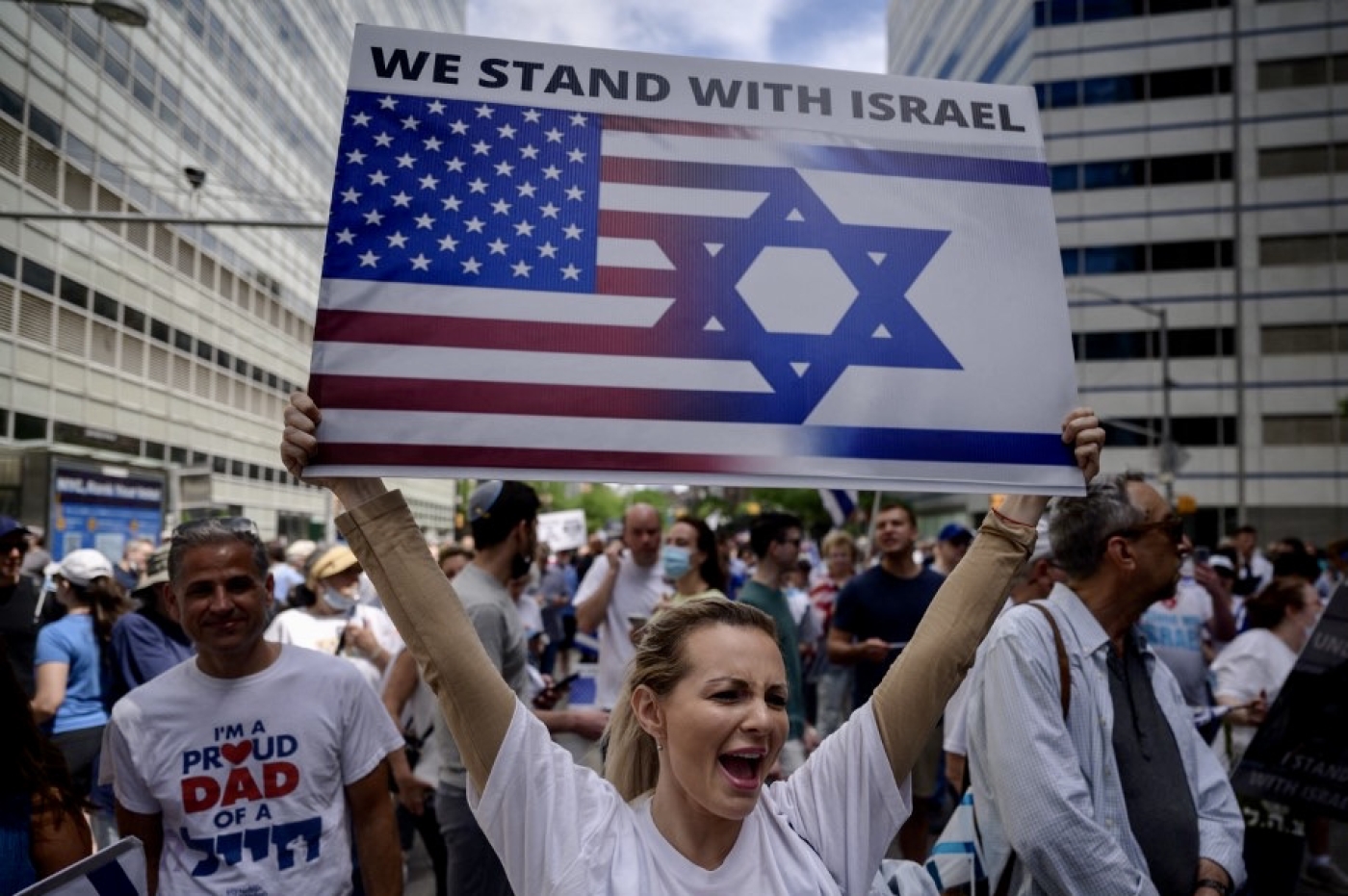
Pro-Israel demonstrators attend a rally denouncing antisemitism and antisemitic attacks, in Manhattan, New York, 23 May 2021
(AFP)

Today is Israeli Holocaust Remembrance Day, which many outside Israel - Jews and non-Jews alike - tend to note. On this day, many mark the struggle against antisemitism as part of the terrible legacy of the Holocaust.

The identification of criticism of Israel and anti-Zionism with antisemitism is unfounded if only because some of the harshest opponents of Zionism were Jews

There is no doubt that antisemitism, and any other form of racism and bigotry, must be fought decisively, and that the critical struggle against these must be one of the clear lessons to be learned on this day.

However, one of the most disturbing phenomena of the last decade or two is the identification of anti-Zionism and even harsh criticism of Israel with antisemitism, as well as the reverse identification of "contemporary" antisemitism first and foremost with anti-Zionism and even criticism of Israel.

These identifications are serious because they are derived from alleged lessons of the Holocaust. And so it appears that any substantial criticism of Israel and Zionism is perceived in public opinion, and especially among national and international political and cultural institutions, as an ideological continuation of the Holocaust.

Thus the emancipatory struggle of the Palestinians for liberation and decolonisation is tagged as a struggle that is in fact a direct continuation of the Holocaust and Nazism.

The identification of criticism of Israel and anti-Zionism with antisemitism is unfounded if only because some of the harshest opponents of Zionism were Jews. In fact, from the moment Zionism appeared on the stage of history at the end of the 19th century, opposition to it was born within the Jewish world.

The Ultra-Orthodox opposed it, the Reform movement opposed it, Jewish liberals and communists, as well as the strong Jewish Socialist Bund movement in Eastern Europe, opposed it - often even sharply and blatantly. Today, the fierce opposition to Zionism within the Jewish world is relatively small, but the Jewish anti-Zionist legacy is persistent.

Dispossessing colonial movement


Arab and especially Palestinian opposition to Zionism is not antisemitic but political. From its inception, and certainly after the 1917 Balfour Declaration, Zionism was perceived as a dispossessing colonial movement designed to take over the land from its indigenous inhabitants in order to establish a political entity with a Jewish majority.

This was the root of the Arab resistance to Zionism and later to Israel. Years of war, occupation, expulsions and denial of rights only reinforced this position.

But this basic position was also most clearly understood by some of the early Zionist leaders. For example, Ze'ev Jabotinsky, the father of revisionist Zionism and one of the greatest leaders of Zionism in the first half of the 20th century, explained in his 1923 article "The Iron Wall" that Arab opposition to Zionist settlement is the same as any opposition of a native population to the colonial occupier:

"My readers have a general idea of ​​the history of colonisation in other countries. I suggest that they consider all the precedents with which they are acquainted, and see whether there is one solitary instance of any colonisation being carried on with the consent of the native population. There is no such precedent."

Pro-Zionism and antisemitism are inseparable, and always have been
Joseph Massad

Nor is the opposition of left-wing movements or people of conscience around the world to Israeli policies or Zionism in itself antisemitic.

This opposition stems in principle from an emancipatory worldview that opposes any form of colonialism in general and settler colonialism in particular, founded on democratic values ​​of national, political and civic equality for all.

As four recent reports by reliable and respected Israeli and international human rights organisations (Yesh Din, B'Tselem, Human Rights Watch and Amnesty International) have shown, Israel has established - certainly in the occupied West Bank but also within the territory of the State of Israel - a regime of structural apartheid and denial of rights.

This is why Israel - and Zionism itself - are severely criticised - similar to South Africa during the apartheid era, to other countries e.g. France during the Algerian war of independence; to the US during the war in Vietnam; to Russia today; and to other countries throughout history whose injustices engendered criticism worldwide.
'New antisemitism'

This does not mean, of course, that there can be no antisemitic motives in opposition to Israeli policy or Zionism, nor does it mean that this opposition cannot use antisemitic images and ideas. This does happen.

Israel uses the weapon of antisemitism, which has become taboo in all western countries, with great success

At its core, however, opposition to Israeli policy and even to Zionism is a legitimate ideological opposition that grows out of an emancipatory worldview of justice, freedom and equality. Whoever wants to claim otherwise, the burden of proof is on him or her.

So where did this position that identifies strong opposition to Israel's policy towards the Palestinians and certainly opposition to Zionism with antisemitism come from and who does it serve?

A significant intellectual milestone was in the late 1960s when Israeli researchers began to develop the concept of "new antisemitism".

Their view was that the old anti-Jewish sentiment that had taken shape and changed form over the centuries was now directed first and foremost against the Jewish political enterprise of Zionism and Israel.

But only in the last decade or two has this position become a dominant one that characterises the mainstream of most of western politics from the left, sometimes even the radical left, through the centre, to the conservative right and in many cases also the populist, proto-fascist or white supremacist right.

An influential political coalition is advancing this position.

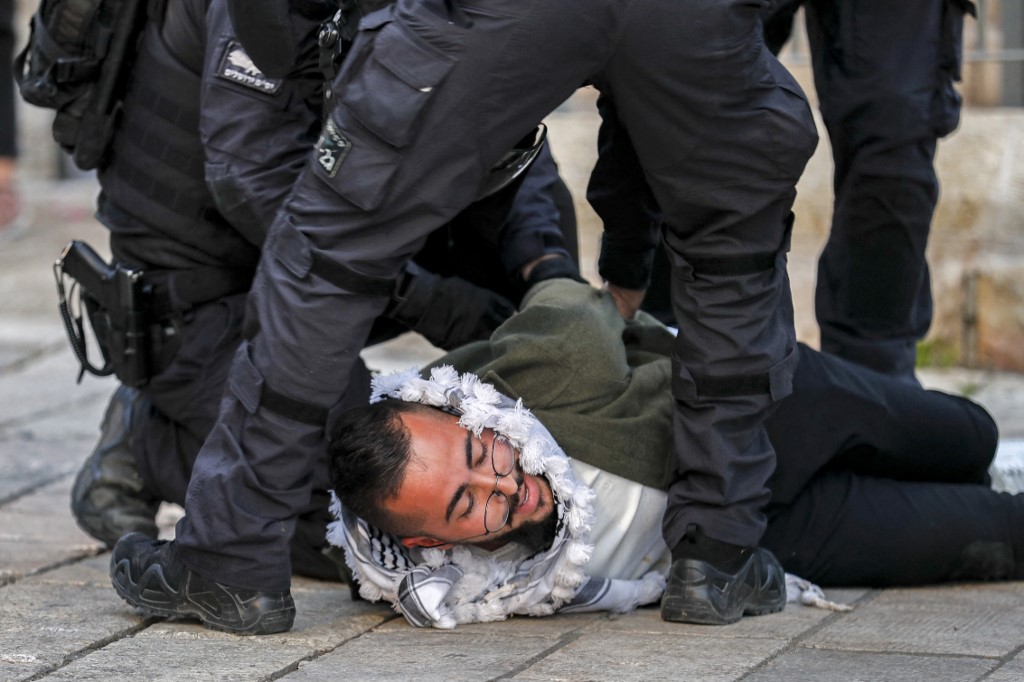
Israeli security forces detain a Palestinian man during a demonstration outside the Damascus Gate of the Old City of Jerusalem, 1 March 2022 (AFP)

First and foremost, Israel, which seems to fail to convincingly justify its occupation, settlement and colonisation policies - particularly in the Occupied West Bank, Jerusalem and Gaza - within any democratic and liberal discourse, and therefore uses the weapon of antisemitism, which has become taboo in all western countries, with great success.

The ultra and populist right - from the AfD party in Germany to Trump, broad wings of the Republican Party and supporters of white supremacy in the US - identify with Israeli racist colonial policies by supporting it and identifying antisemitism with anti-Israelism and anti-Zionism. They try to legitimise themselves and hide their own heavy loads of antisemitism and racism.

Indeed, the initiative of the German parliament to declare the Boycott, Divestment, Sanctions (BDS) movement as a form of antisemitism was brought forward by the AfD and Richard Spencer, one of the leaders of the American racist and antisemitic white supremacy movement, who praised the Israeli racist “nation-state law” and has viewed Israel as a role model for an ethnic nation-state.
Jewish identity

Most mainstream Jewish institutions in North America and certainly in Europe have also sympathised with and strongly promoted this position (although it has also attracted very strong Jewish opposition, especially in the US and Canada).

The reasons for the strong Jewish support for this identification are varied, but they usually do not relate to historical accuracy or political justice but mainly to questions of identity.

A significant intellectual milestone was in the late 1960s when Israeli researchers began to develop the concept of 'new antisemitism'

In recent decades, Israel, and caring for it, has become a central part of Jewish identity around the world. Consequently, a sharp moral critique of Israel and its national ideology, ie Zionism, is experienced as an attack on their very Jewish identity and therefore perceived (wrongly) as antisemitic.

At the same time, it is important to point out that, at times, the hostility of some of the radical European left (as well as the former communist bloc in certain historical moments) towards Israel has been so excessive, and its demonisation so exaggerated, that it has been hard not to feel a sense of antisemitism beneath a thin layer of anti-Zionism.

The Jewish intellectual and Holocaust survivor Jean Amery, for example, pointed this out as long ago as the late 1960s. But the mainstream of European and North American politics also tends to support and promote this position.

Undoubtedly western conflation of antisemitism and anti-Zionism is connected to the good relations Israel has with many of these countries and to geopolitical interests. But there is also no doubt in my mind that this position is supported many times by disguised racist, anti-Arab, anti-Muslim and anti-immigrant sentiments, which have become much stronger in the last two decades.

There is no doubt that it also has to do with the transformation of the Holocaust into a central component of the West’s identity and its special sensitivity to antisemitism (many times beyond the sensitivity to other forms of racism and bigotry e.g. Islamophobia).

An Israeli soldier stands next to a vehicle parked by the fence along the border with the Gaza Strip on 7 December, 2021 (AFP)

But it also stems from the desire and moral obligation in Europe to encourage the flourishing of Jewish existence after the Holocaust.

Mainstream liberal and conservative contemporary European identity is based, among other things, on the conception of a "Judeo-Christian heritage" whose preservation requires a prosperous Jewish existence in Europe, and therefore the EU and its member states make every effort to make Jews feel comfortable and unthreatened across the continent.

Hence major currents in European politics tend to adopt the position of mainstream Jewish organisations on this issue.

Contradictions

This coalition is not made of one skin. It is full of contradictions and includes populists, the far right and white supremacists, with liberals and even progressives; it includes Israel and Zionist supporters who want to strengthen Jewish existence in Israel, together with European elements who want to strengthen Jewish existence in Europe (which is traditionally considered an anti-Zionist goal).

What they all have in common, however, is that in practice, whether intentionally or not they are completely delegitimising the Palestinian national narrative, which legitimately views Zionism as a racist colonial enterprise that has established a modular regime of negating rights of the indigenous people.

Antisemitism has been used to smear the left, while the right targets Jews

Whether intentionally or not, they all participate in radically transforming the image of the Palestinian national movement from an emancipatory liberation movement whose basic demands are legitimate and just (even if one thinks that they cannot all be met) to a racist and antisemitic movement.

All are involved, some intentionally and some not, in radically changing the political discourse on Palestine-Israel: from one that requires Israel to be accountable for its occupation, settlement and colonisation in the West Bank, Jerusalem, within Israel, and the siege on Gaza, to a discourse that focuses on whether this very discussion is antisemitic; from a discourse based on egalitarian values to a discourse that portrays egalitarianism itself, in the context of Israel-Palestine, as antisemitic.

This discourse practically prevents imagining a non-Zionist egalitarian and reconciliatory solution to the conflict - eg bi-nationalism - in which all people in the holy land will gain their full equal human, civic and national rights (and this is at a time when such ideas are so essential as the “two-state solution” seems to have died out).

Instead, this discourse participates in Israel's political project to delegitimise the Palestinian cause and to practically remove once and for all the Palestine issue from the international agenda.

The views expressed in this article belong to the author and do not necessarily reflect the editorial policy of Middle East Eye.

Amos Goldberg is a professor of Holocaust Studies at the Hebrew University of Jerusalem. Among his recent publications is his co-edited volume with Bashir Bashir of The Holocaust and the Nakba: A New Grammar of Trauma and History, Columbia UP 2018

Thursday, July 17, 2025


The instrumentalization of antisemitism and the emergence of Jewish Voice for Peace in the United States


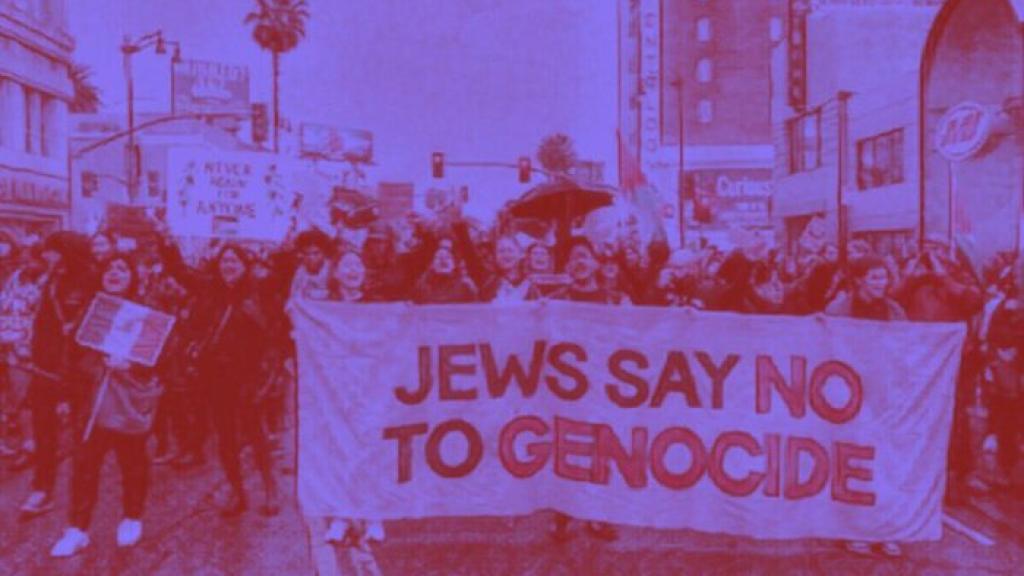
Jews say no to genocide

First published at Tempest.

In this interview, Tempest members Sherry Wolf and Charlie Post provide a historical and contemporary roadmap for understanding the opportunistic, and often state-sponsored, bad-faith conflation of anti-Zionism with antisemitism. They also theorize the central role that anti-Zionist Jews and organizations like Jewish Voice for Peace can play and have played in struggles against Israeli state violence, and how this kind of open organizing on the part of anti-Zionist Jews points the way for building democratic, open membership organizations that can last between the ups and downs of the struggle. Originally published by Révolution Permanente, this interview has been translated into English and lightly edited for clarity.

Many observers have described recent crackdowns on the Palestinian movement in the United States — particularly on college campuses—as a kind of ‘new McCarthyism,’ where accusations of antisemitism are being used to silence dissent. This trend has arguably accelerated under the Trump administration, which has further blurred the line between antisemitism and anti-Zionism in order to delegitimize the movement for Palestine. We’re now seeing figures like Senator Marco Rubio enforcing visa suspensions for foreign students involved in pro-Palestinian protests and even Jewish professors being fired for expressing anti-Zionist views. How do you understand this convergence of state power and pro-Israel advocacy shaping a new era of political repression?

Sherry Wolf: Well, first, I think this is far worse than the old McCarthyism because it’s so much broader. It’s hitting people who had nothing to do with the protests, even opposed the protests, or were somewhat ecumenical about the whole question, and who are now being dragged down into this dragnet. Most of the people whose visas were suspended hadn’t even participated in the encampments. They were mostly apolitical. Typically these were people who were just getting engineering degrees but simply more often than not came from countries that are now being targeted by the administration.

But it’s been quite an effective way of terrorizing people. If you don’t know what you might have written, posted, said, winked at, etc. it could upend your entire life. It has the broad effect of terrorizing people into silence and into confusion. It encourages a certain rise of disengagement and individualism as a response.

Charlie Post: We have to start with a general move towards greater authoritarianism that we’re seeing in all of the so-called capitalist democracies. Todd Gordon and Jeff Weber, in an article several years ago that appeared in Spectre, and hopefully soon in an essay they’re going to be doing on Trump that will appear on our website, made the argument that liberal democracy, the sort of truncated form of electoral politics and representation that characterizes most capitalist regimes historically, has always had a strong authoritarian tendency, which is particularly exacerbated in periods of economic crisis and sharpened political conflict.

So we’ve seen, even before the first Trump administration, a greater move towards authoritarianism. Most people sort of conveniently forget that under the Obama administration there was a coordinated FBI working with local police to go after and clear the Occupy encampments in 2011. The current wave of repression has been tied to and justified by — even in the liberal wing of mainstream politics in the U.S., at least since 2010 — a growing equation of Zionism with antisemitism. This has been very marked under both Democrats and Republicans. There has for instance been a move for more and more states and cities to adopt the International Holocaust Remembrance Association definition of antisemitism, which makes people like you and I, who are anti-Zionist Jews, anti-Semites.

Now this is exacerbated by the rise of far-right electoral politics in the U.S. and globally, where these are the same forces that have been extremely and viciously Islamophobic since the Second Gulf War and the War on Terror, and who are now posing as the champions of Jews, which for them inherently, means the champions of Zionism in the U.S. This has become particularly sharp since October 7th, because even while the equation of anti-Zionism and antisemitism has been — at least in my political lifetime for the last 50-odd years — the last line of defense for support for the Zionist state and its expropriation of the Palestinian population and its hostility to democratic and revolutionary movements in the Arab world, with October 7th, the rightward move of Zionism, the complete marginalization of the traditional social-democratic version in Israel, and the growing opposition in this country, particularly among Jews under 40, to the policies of the Israeli state, the equation of antisemitism and anti-Zionism has become the first, last, and practically only line of defense for U.S. political leaders in their defense of the Israeli state.

The increasing weaponization of antisemitism is essentially a reaction to the fact that support for the state of Israel in the United States is much weaker today than it has been at any point since the establishment of the state, and that, in fact, significant layers of Jews, particularly younger Jews, either explicitly reject Zionism or are highly critical of U.S. support for the current Israeli regime.

I think that’s an important factor to consider, the connection of this new Zionist McCarthyism with the broader authoritarian turn of capitalist states of the Global North, which as you mentioned in the American context started to occur under Obama, and in France under the socialist president François Hollande. The Socialist Party paved the way for the current wave of repression we are witnessing in France — for example, our party spokesperson Anasse Kazib is currently on trial for “apologie du terrorisme” after speaking out against the genocide in Gaza. It is clearly a political trial, aimed at silencing dissent on the question of Palestinian liberation.

To switch gears a little, how do you assess that kind of instrumentalization of antisemitism in terms of its impact on the growth of actual antisemitism? It seems like the more you tell people that protesting against a genocide is antisemitic, the more they’re bound to think that antisemitism is good and wear it as a kind of badge of honor. In what way do you think that those who are presenting themselves as allies to Jews are, in fact, profoundly endangering them?

SW: Absolutely. This conflation is actually stoking real antisemitism and real antisemitic attacks on Jewish people and not just those who support the genocide. I think the way in which the genocide has been legitimized by the Zionist camp has led to an identification of Jews as such with the murderous actions of the Israeli government. And for increasing numbers of Jews, whatever political perspective they’re coming from, life in this country has become much worse and more dangerous.

I will never, ever, ever in my life, again, identify myself as Jewish without qualifying that with, I am an anti-Zionist Jew or I am a Jewish anti-fascist, because to me, to say one is Jewish in this country right now is to immediately raise the question, are you a supporter of the genocide? And I don’t want to ever be conflated with that.

CP: We have to be clear that while I think there has been, particularly among the less organized and less politicized layers of Muslim youth in the U.S., some but limited growth of actual antisemitism, of anti-Jewish sentiment and politics, this has remained very limited. In terms of the actual organized movement for Boycott, Divestment, and Sanctions, for the arms embargo, for the ceasefire that we’ve seen in the last two years, there’s a sufficient layer of politicized militants who have forcefully rejected the conflation of Zionism and Judaism. And the existence of Jewish Voice for Peace, which we’ll get to later, has been a powerful counterweight to that.

But I do believe that the instrumentalization of antisemitism has, in fact, emboldened traditionally antisemitic but pro-Zionist currents in the United States. Whenever I hear that opposition to Zionism is antisemitic, I have to point out that the largest group of militant supporters of Zionism in the U.S. is an organization of anti-Semites. It’s called Christians United for Israel, which has 11 million members, which is a lot more than there are Jews in the U.S. anymore.

The Christian Zionists are quite open anti-Semites. Ilan Pappé, in his 10 Myths About Israel, talks about how, from the beginning, the first Zionists — modern Zionists — were Christian Zionists in Britain. And for them, the idea of the Jews returning to Palestine had all sorts of benefits. You could get a stable pro-European ally in the midst of the Arab world, and at the same time, you have a place to send all these annoying Jews that you don’t want in your own country. And we see in the U.S. the growth of these Christian Zionist groups, whose vision of why they support the state of Israel is so that Jews will go to Palestine and be pawns in this apocalyptic war where there will be mutual destruction of both Arabs and Jews, and thus this will bring the Second Coming. So there, I think, we see that the greatest growth of antisemitism has been among people who are pro-Zionist, at least in the U.S.

There have been disturbing examples of people on our side who are anti-Zionist adopting antisemitic tropes. But I think that’s been fairly rare and quite limited given the attempt of mainstream politics, liberal and conservative, to equate anti-Zionism and antisemitism.

Yes, I agree. Having been a Jew participating in the movement in France for the past year and a half, the care the movement has taken to clearly differentiate the policies of the Israeli government from the Israeli population and from Jews as such, is immense. Yet as you mentioned, I think one of the issues with this kind of weaponization by the far right is that it can function as a kind of self-fulfilling prophecy where it begins as a purely ideological mystification but with time becomes descriptive of the reality. So, we are actually seeing empirically a rise of antisemitic acts, which in turn justifies the increasing instrumentalization of antisemitism against figures of the Left or of the Palestinian liberation movement, which are entirely spurious.

Earlier, you briefly touched on the history of Zionism and how it had actually been embraced by a significant number of anti-Semites as a means to expel Jews from the West. But I was wondering if you could speak to this kind of longer, more contested history of the relationship of Jews and Zionism, particularly in Europe. Many American Jews or French Jews today would assume that Jewish support for Zionism was always widespread, but historically that was not the case. Could you describe these debates among different political traditions of Jews in Europe and talk about the tensions between them?

CP: Zionism among European Jews, among both Yiddish-speaking Eastern European Jews and the more assimilated German and pre–World War I French and English Jewish populations, was always pretty marginal. This was because they saw Zionism as accentuating their Jewishness and as an obstacle to full assimilation and being considered Germans or French or English.

The most consistent and radical rejection of Zionism comes from the Yiddish-speaking Jewish Left in Eastern Europe. The Bund, the Jewish Workers League, which was the largest Marxist organization in the Russian Empire prior to 1905, was always explicitly anti-Zionist. And what they put forward is something that the Zionists are very hesitant to acknowledge, which is that Zionism is essentially a capitulation to antisemitism.

Theodor Herzl is explicit about this in The Jewish State, the first major document of modern political Zionism. He said that it was the Dreyfus Affair that lifted the veil from his eyes. He saw that antisemitism is simply a reality and that the anti-Semites were right: Jews and non-Jews cannot and should not live together as political and social equals in any society. The solution was separation, to retreat from struggling against antisemitism and instead create a Jewish state, which would then require the support of the various great powers, the imperial powers of the late 19th and early 20th centuries.

The Bund and most of the Jewish, working-class Left, basically said: this is a capitulation. We want nothing to do with this. The struggle against antisemitism is a struggle here in Europe. And importantly, in order to defeat antisemitism, we have to defeat capital and the forces of reaction. This was their politics.

It’s also very clear that all the wings of Zionism ended up in their capitulation to antisemitism reinventing antisemitic tropes. Hertzl talks about how the project of Zionism in its state-building project will require the abolition of the Yid — the Eastern European, Yiddish-speaking, working-class scum — and their replacement with the Hebrew, the manly colonial settler who will establish civilization in the Arab East.

The right-wing Zionists echoed the same stuff. They were completely and utterly contemptuous of Eastern European Jews as effeminate, weak, etc. And even the left-wing Zionists — the so-called Poale Zion — echoed much of this in a sort of semi-Marxified language, saying that we really don’t have a Jewish working class because Jewish workers are all in light industry, there’s no machinery. What we need in order for the Jewish working class to fully be a working class is our own state and our own capitalist class.

Before World War II in the U.S., no significant segment of the working-class movement was pro-Zionist. The first indications of former Marxists becoming pro-Zionist is in the 1930s — some of the leadership, the right-wing social democratic leadership of the needle trades unions of the U.S. David Dubinsky, who ended up the International Ladies Garment Workers Union, and Sidney Hillman, who leads the men’s clothing industry, begin to be more sympathetic to Zionism. But they get pushback from the more politicized elements of their own membership, many of whom were either formed in the Bund or formed in the pre-war Socialist Party and rejected Zionism.

This turn to Zionism encourages the leadership to ally themselves with the so-called labor Zionist currents — whether it was the mainstream that becomes Ben-Gurion’s Labor Party or Mapam, which comes out of the more left wing of Poale Zion and Hashomer Hatzair, which basically adopt pro-Stalinist politics.

But the real shift on the Left comes after the Holocaust and after the Second World War. There we see the almost wholesale move of Jewish social democrats towards embracing the Zionist project, which was establishing a Jewish-only colonial society that excluded Arab labor. They saw many of their former comrades running the new state and therefore supported it.

At the same time, the communist parties, which had been consistently anti-Zionist until the war — because of shifts in Soviet foreign policy — started embracing Zionism. The worst of it, the U.S. Communist Party was putting out pro-Zionist pamphlets like The Wall Street Conspiracy Against Israel. This goes until the mid-50s, when Soviet foreign policy shifts from a hope for some sort of alliance with the labor Zionists to an alliance with the Arab nationalists. This remains their line throughout the period and disorients a huge layer of Jewish communists.

Another factor that — at least in the U.S. — plays a role in the shift towards Zionism, which comes through the 1950s and 1960s, was the tremendous transformation of the social structure of the Eastern European Jewish population in the U.S. It’s well known that after the Second World War, a considerable minority of working-class youth are able to go to college and enter, at worst, the pseudo-professions like high school teaching and social work, or actually become attorneys, physicians, etc. And a large number of Jews, you know, become successful small business people, etc. And this, I think, also fuels a growing attachment to the Zionist project.

But prior to the late 1940s-early 1950s, very small minorities of Jews in Europe or in the U.S. were actively Zionist.

Could you explain that a little more? In what way was the upward social mobility of previously immigrant Jews in the United States connected to their increasing attachment to the Zionist state?

CP: Because it goes along with a change in their racial categorization in the U.S. One of the best books I think David Roediger ever wrote was Working Toward Whiteness: How America’s Immigrants Became White: The Strange Journey From Ellis Island to the Suburbs, where he looks at the process by which Southern and Eastern European immigrants prior to World War II were not considered white people in the United States. They were maybe a step above African Americans, but they were definitely not white people.

You see, directly after in the post-war period, Jews become white people. They move to the suburbs, there’s greater levels of intermarriage etc. Consequently, their organizational ties to the Jewish labor movement, which could keep reproducing the political ideas that would be counter to that of Zionism — universalism, anti-racism, etc. — get weaker and weaker.

It’s only after 1967, with the growth of the Six Days’ War and the growth of a new far left, both Maoist and Trotskyist in the U.S., that you begin to see the revival of a Jewish anti-Zionism. And in this, the U.S. Socialist Workers Party, which was the largest and in many ways — I was a member at one point — a rather problematic formation, were very important in producing educational material on the history of Zionism, the history of Palestine, and the history of Jewish anti-Zionism.

Could you address the kind of broader relationship of Jews to the radical Left and to Marxism in the United States?

CP: Because working class American Jews came to the U.S. with strong political organization and traditions from Eastern Europe, they played an outsized role on the Left in the U.S. from basically the early 20th century to the 1970s and 1980s. Being working class and growing up surrounded by these traditions created among U.S. Jews a default towards the Left. This was also the case in the New Left: young Jewish activists, radicalized through the civil rights movement, begin to participate in the Vietnam war movement and become key players in almost all the New Left organizations.

Now, I think the high point of that, prior to the emergence of Jewish Voice for Peace as an anti-Zionist group in the last few years, was the late 1960s-early 1970s. I think there was a significant shift to the right among Jews in the U.S. in the 1970s and 1980s. We also see the complete and utter collapse of all the groups that came out of the New Left in the United States. By the mid-1980s, Maoism, which had become the dominant current on the far left in the U.S. in the late 1960s, had all but disappeared — and disappeared either into an increasingly tepid social democracy, maybe aligning with left-wing trade union officials, etc., or into private life and becoming conservative.

And as a result, I think by the mid-1980s, you see a very different ethnic composition of left activists in the U.S. where Jews do not play the outsized role they had played previously.

Jewish Voice for Peace (JVP) has emerged as one of the most prominent American Jewish anti-Zionist organizations in the U.S. How has JVP’s position evolved over time — from its early focus on human rights and a two-state framework to a more openly anti-Zionist stance? To what extent has this evolution been shaped by broader ideological, generational, and political shifts within the Jewish community in the U.S., including disillusionment with liberal Zionism?

SW: JVP initially comes out of an alliance of a bunch of leftists — mostly anarchists, some socialist-inflected queers in San Francisco—and becomes a national movement in the early 2000s. By 2005, with the launch of the Boycott, Divestment, Sanctions movement, JVP already existed in cities like Chicago, New York, San Francisco, Austin, Texas: the big cities and towns with considerable concentrations of Jewish leftists.

It immediately gets involved with BDS, which was the reason I got so involved with JVP even before its 2018 national vote to formally become an anti-Zionist organization. JVP had not been formally anti-Zionist until about seven years ago. That said, most of its leadership would have defined themselves and identified as anti-Zionist, but their practice as a non-governmental organization, as opposed to a movement with an elected leadership among a collective, did not reflect that. Eventually the leadership of the group went through a years-long debate, deliberation, discussion, education, while they were involved in the activism of BDS, and managed to win over wider and wider circles of people to taking a stance against Zionism full stop and not just being critical of Zionism or the occupation or defining themselves as “non-Zionist.”

I think their transformation over not just these last 20 months but this last sort of half decade has been incredibly important in terms of attracting huge numbers of younger, queer activists, including many Jews of color who are coming from all over the world, whether Mizrahim or, you know, Sephardim, people from the Arab world who identify as Jewish, and have started to become more and more part of the group and part of its leadership as well.

And so it’s also become a more multiracial organization, which is not usually the case for a Jewish-identified group in the U.S. given that the overwhelming majority of Jews in the U.S. are Ashkenazi European white Jews. So it has moved further and further left, and has affiliated itself more and more with the Palestinian and U.S. Left over these years.

The group has grown enormously. There’s at least 40,000 members of JVP. That makes it really the largest far left organization in the United States in practice in terms of its active participants, with even higher levels of participation in many cities than the Democratic Socialists of America. In New York City alone, there are at least a couple of thousand active members who organize on a regular basis. That is a very new development since the genocide that began in October of 2023.

Before that, they would have made calls to action and drawn a few hundred people. But you wouldn’t have had — as we just had — a national membership meeting of well over 2,000 people. You wouldn’t have had calls to action that could draw thousands of people in multiple cities on the same day to have Seders in the streets.

We have taken bold actions in the last couple years. The occupation of Grand Central Station was the first of the big bold actions that people saw probably across the world because images were quite dramatic and they spread. It was a thrilling thing to help organize. I’m very proud of that action.

The blocking of bridges and the mass Seders in the streets have put on the map for people who aren’t even particularly political and don’t necessarily pay close attention to these things the fact that there is Jewish dissent. Even in the mainstream, we cannot any longer be ignored.

Now, after decades of ignoring JVP and ignoring Jewish anti-Zionism, even mainstream press — the New York Times, CNN, MSNBC — has been forced to give time to this reality of Jewish anti-Zionism. It has raised the reality that there’s a debate among Jews and this is not a settled question among us. And that’s new.

It used to be that the only Jews in this country who were anti-Zionist were Jewish Marxists. That’s it. And there weren’t that many of us. And I knew them all! One of the most thrilling things to me is going to a protest and knowing absolutely nobody or knowing one or two people.

So the idea that to be Jewish equals Zionist is no longer an automatic equation among anybody with even a vague level of education about these things.

CP: I agree. The only time in my long political activity that I have emphasized my Jewish identity is when I’ve done anti-Zionist organizing, Palestine solidarity. But I think that today, more than ever, with the weaponization of antisemitism, the existence of an organization of 50,000 to 60,000 Jewish members that is explicitly anti-Zionist, is an incredibly important development. It creates the sort of space for younger Jews to actually organize and take action.

I mean, when I talk to younger comrades—and to my own children for that matter—who are clearly anti-Zionist, I point out that in 1973, I was a sophomore in college, and we were organizing against the Yom Kippur War. You literally took your life in your hands on any American campus. You could be attacked by the Jewish Defense League, which was a Jewish fascist organization. Others who were not JDLers would try to disrupt meetings. Any time between the 1973 war and then the 1982–1983 invasion of Lebanon, when you did any anti-Zionist organizing, one of the key questions was security. How do we make sure that this meeting is not physically disrupted?

Today, it’s not as dangerous physically to be an anti-Zionist Jew in the U.S. as it was then. Now, clearly, there are right-wing proto-fascists and fascist groupings on campuses — Jews and non-Jews — who will physically attack anti-Zionist demonstrators. But increasingly, pro-Zionist political forces of the U.S. have a much more powerful ally from the state, and the greatest threat of repression is not coming from physical disruption by organized Zionists — it’s coming from the capitalist state.

So how and why did this transformation in JVP occur? What are the economic, political, sociological conditions for this move away from Zionism? Or does it have to do more with the current genocidal behavior of the Israeli state?

SW: The genocide killed default Zionism. And by that I mean that for generations people, myself included, were raised with a certain understanding of Israel as, you know, a broadly democratic, broadly progressive country.

And I don’t believe anybody under the age of 40 — who are the widest consumers of social media and get their news primarily off of TikTok and Instagram, not from CNN and MSNBC and what have you — believes that anymore.

And as a result, the unraveling of support, and this of course is the crucial nation to be supporting it because both the financial and even more importantly ideological and military support that the U.S. provides for Israel, the cover, you know, is coming undone. And that could be the undoing of the state of Israel.

This is an existential crisis for them and the only weapon they have is to try to tie our protests, our dissent to the thing that is odious to almost everyone and that is antisemitism and the Holocaust. So they have to play that card. And so this is a desperation move. It’s uglier in its death throes than ever in my life.

CP: I think the primary factor is the changing character of the Zionist leadership. My father and his brothers were good working-class Jewish social democrats. But they didn’t simply support unions. They were anti-racist. They opposed the Vietnam War. But for them, Israel was a social democratic utopia. As a friend of mine put it, it was Sweden on the Mediterranean. So, until I was a teenager, I grew up believing that not only was Israel on the defensive, it was the only democracy in the Middle East, and was a progressive social democratic state. You could justify Zionism. You could easily spin Zionism in Israel as the culmination of Jewish national liberation and point to the history, point to the kibbutzim, point to the level of state ownership of industry, etc. And young Jews who were left liberals or soft radicals could embrace Zionism and maintain their progressive politics in the U.S.

With the global economic crisis, with the rise of neoliberalism, with the shift to the right first by Israeli social democracy and then its complete decline, and now you have a regime that is run by people whose political ancestors marched through Tel Aviv chanting, “Germany for Hitler, Italy for Mussolini, Palestine for us,” and who are allied with openly reactionary religious parties that are militantly homophobic, militantly and blatantly racist, etc. So maintaining any sort of sense of being a Jewish progressive is difficult in that context. If you’re going to oppose Trump, how can you support Israel?

Additionally, with this generation, you’re also seeing more limited opportunities for upward mobility. Since the 2008 recession, growing wage and salary stagnation, growing inequality is affecting some of these young Jewish kids as well. And their prospects for upward mobility are now more limited than they had been.

So I think that may be feeding into it as well.

Bringing them to the Left, and then while they’re on the left, they’re acquiring these more universalistic, anti-racist, anti-Zionist values…

CP: Exactly.

Final question on political strategy: What role do you think that Jews and Jewish socialists should play in the struggle against this international tendency for the right and the far right to instrumentalize antisemitism?

CP: Well, I think that for Jewish leftists in the diaspora, where we’re strongest, our role is to be openly organized as Jews against Zionism. This is one of the few times I would advocate organizing as Jews. Because of the weaponization of antisemitism in the West, it is crucial that there are groups of publicly identified Jews who say: “No, this is not — these people do not speak in my name. We oppose this. We stand with the Palestinians.”

So I think that’s the key role of Jewish socialists: to not retreat from our consistent anti-Zionism, but also to argue for democratic, open membership organizations, where people come together, can learn their politics, develop strategy, etc., so that they can build organizations that can last between the ups and downs of the struggle, and where we can also argue for the need to align with others in solidarity with other political struggles.

Sherry Wolf is a militant for Jewish Voice for Peace and a member of the Tempest Collective.

Charlie Post is an editor of Spectre: A Marxist Journal and a member of the Tempest Collective.

Theodore Deutscher is a militant with Révolution Permanente.

Tuesday, March 06, 2007

Cherniak vs. Chomsky

In another slagging debate about Robert McClelland of My Blahg

Jason Cherniak says the following;
... I think (assume) he means the extreme left. People who follow the likes of Chomsky.

So I said:
"I think (assume) he means the extreme left. People who follow the likes of Chomsky." Once again Cherniak you are equating principled anti-Zionism/Anti-statism with antisemitism, as usual with you a cheap shot.

Then he said:
Jason Cherniak said...

Eugene, Chomsky is a Holocaust denier.


This is not factual it is an old slander from the right wing much like this one;Red Baiting Chomsky

"I have always supported a Jewish ethnic homeland in Palestine. That is different from a Jewish state. There's a strong case to be made for an ethnic homeland, but as to whether there should be a Jewish state, or a Muslim state, or a Christian state, or a white state — that's entirely another matter." Noam Chomsky

You have said you see a "hint of anti-Semitic implications" in the work of Robert Faurisson, the notorious French Holocaust denier. Is Jew-baiting merely a hobby of yours, or is it vocational? LAURENCE COLE, KENT

The facts and the principle have been spelled out dozens of times since 1980 (so it is a bit boring), but once again, briefly.

The last time I had anything to do with this affair, Faurisson was accused of raising questions about gas chambers. Several years later, he was tried and sentenced for "Falsification of History", but there was no charge of Holocaust denial or anti-Semitism (according to Le Monde). The only issue concerning my connection with this sordid affair is whether we should adopt the Goebbels-Zhdanov doctrine that the State has the right to determine Historical Truth and punish deviation from it. As I wrote then, and am happy to repeat, it is a gross insult to the memory of victims of the Holocaust to adopt the doctrines of their murderers. The remark you are misrepresenting is from a personal letter - an interesting source. It reviewed the facts and went on to point out that even denial of huge atrocities would not in itself be evidence for racism, giving a few of the many examples. Thus neither you, nor I, conclude that Americans are vicious racists because they estimate Vietnamese deaths at about 5 per cent of the official figure, or because for centuries even scholarship vastly understated the scale and character of the destruction of the indigenous population. The point generalises to England and others, of course. There can be many reasons for denying horrendous crimes, even in the cases that are the most serious on moral grounds: our own. One special case - purely hypothetical in this personal correspondence - was that denial of the Holocaust would not establish anti-Semitism, for exactly the same reasons.


Cherniak is a Zionist
. As I have pointed out before Zionism is just another right wing nationalist ideology. Being Jewish is irrelevant to his defense of Zionism and Israel. Just as it is for his pal Warren Kinsella who is not Jewish but defends Zionism and the 'State' of Israel.

Cherniak is a politically a right wing statist and a nationalist. Being a Liberal he is also a statist when it comes to the Canadian State. And as I have pointed out before he is a right winger when it comes to progressive left issues in Canada.

He hates the left and he hates the anti-statist left especially. And he despises and disparages the Jewish Left, especially those who do not equate Israel and
Zionism with being Jewish and do not equate Anti-Zionism with knee jerk painting of ones opponents as Anti-Semites.


With regard to anti-Semitism, the distinguished Israeli statesman Abba Eban pointed out the main task of Israeli propaganda (they would call it exclamation, what's called 'propaganda' when others do it) is to make it clear to the world there's no difference between anti-Semitism and anti-Zionism. By anti-Zionism he meant criticisms of the current policies of the State of Israel. So there's no difference between criticism of policies of the State of Israel and anti-Semitism, because if he can establish 'that' then he can undercut all criticism by invoking the Nazis and that will silence people. We should bear it in mind when there's talk in the US about anti-Semitism. Noam Chomsky

Being Jewish is all for Cherniak, yet like many Jews his roots like Chomsky's are in the Slavic community, Cherniak being a common Russian/Ukrainian last name.

Chomsky was born in the East Oak Lane neighborhood of Philadelphia, Pennsylvania, the son of Hebrew scholar and IWW member William Chomsky, who was from a town in Ukraine. His mother, Elsie Chomsky (born Simonofsky), came from what is now Belarus, but unlike her husband she grew up in the United States and spoke "ordinary New York English".

But Cherniak never embraces this aspect of his cultural heritage. When I first read his Blog I considered Cherniak a fellow honky, as in Bohunk, that self depreciating racist epithet used for Ukrainians, Hungarians and Poles. The fact is that in the North American Diaspora one can be both, a honky and a Jew.

By emphasizing his Jewish roots and denying his Slavic ones
he is selective in his cultural identity. In defining himself as a Jewish Nationalist a Zionist, hence a right winger he has made a political decision and a statement of his realpoliticks.

He has made his Jewishness a political fetish.One with which he uses to bash other Jews to his left. Depreciating them as crazy, nuts, etc.

His Zionism is anti-semitic, he hates Jews who disagree with him with a passion. Hence his specific attack on Chomsky. He posted his canard and link to a right wing anti-Chomsky blog because he wants to discredit Chomsky while avoiding arguing about Chomsky's politics; anarchism.

What makes Mr. Chomsky unique is that his criticism of the capitalist economic order takes its point of departure from the classical liberal thinkers of the Enlightenment. His heroes are not Lenin and Marx but Adam Smith and Wilhelm von Humboldt. He argues that the free market envisaged by these thinkers has never materialized in the world and that what we have gotten instead is a collusion of the state with private interests. Moreover he has repeatedly stressed that the attacks on democracy and the market by the big multinationals go hand-in-hand. The rich, he claims, echoing Adam Smith, are too keen to preach the benefits of market discipline to the poor while they reserve for themselves the right to be bailed out by the state whenever the going gets rough. As he puts it : “The free market is socialism for the rich. Markets for the poor and state protection for the rich.” He has spoken positively about the work of Peruvian liberal economist Hernando De Soto who sees the problem of poverty in the Third World as being related to the fact that the poor usually lack clearly defined property rights.

Chomsky has repeatedly stressed that the attacks on democracy and the market by the big multinationals go hand-in-hand

Another aspect of his political work that has been overlooked by foes and critics alike is Mr. Chomsky’s fight against the forces of irrationality that tend to dominate the humanities in the universities. His dismissal of Marxism as a religious “pseudoscience” devoid of all scientific pretensions is one such case. Another is his insistence that the social “sciences” and economics do not meet the methodological criteria that would qualify them as sciences and should thus give up any pretence to being so.


Cherniak hates the left, whether it is the Jewish left or Canadian left, he hates socialism and socialists as his attacks on the NDP in his blog show. But he dresses up his conservative religious and political/social values as progressive because he is a Liberal.

But the only difference between him and the social conservatives on the right is well, actually not much. He is in good company with Stockwell Day, a 'good friend' of Zionism and Israel. Birds of a feather.

Accusations of anti-semitism

Partially because of these criticisms, Chomsky has been accused of being anti-semitic on many occasions. The most outspoken of his critics include writer David Horowitz, who has toured college campuses distributing anti-Chomsky pamphlets, attorney/professor Alan Dershowitz, with whom Chomsky has engaged in many verbal battles through the media, and sociology professor emeritus Werner Cohn, who has written an entire book; Partners in Hate about Chomsky's relationship to Faurisson One of the most common charges is that the difference between anti-Semitism and anti-Zionism is theoretical, and in practice anti-Zionism is a manifestation of anti-Semitism.

Chomsky's support for Israel Shahak, author of Jewish History, Jewish Religion: The Weight of Three Thousand Years, a book that claims that Judaism is a fundamentally chauvinistic religion, has led to more accusations of anti-semitism.

Chomsky rejects charges of anti-Semitism, citing that the definition presented by Israeli apologists is itself racist and ethnocentric. Claiming to speak out against bigotry of all forms, including anti-Semitism, Chomsky is nevertheless often accused of anti-Semitism, which he dismisses as "ad-hominem attacks" and "typical propaganda."


QUESTION: I ask you this question because I know that you have been plagued and hounded around the United States specifically on this issue of the Holocaust. It's been said that Noam Chomsky is somehow agnostic on the issue of whether the Holocaust occurred or not.

CHOMSKY: My "agnosticism" is in print. I described the Holocaust years ago as the most fantastic outburst of insanity in human history, so much so that if we even agree to discuss the matter we demean ourselves. Those statements and numerous others like them are in print, but they're basically irrelevant because you have to understand that this is part of a Stalinist-style technique to silence critics of the holy state and therefore the truth is entirely irrelevant, you just tell as many lies as you can and hope that some of the mud will stick. It's a standard technique used by the Stalinist parties, by the Nazis and by these guys.

QUESTION: There's tremendous support for Israel in the United States at least in elite groups. There's also on another level a very steady, virulent anti-Semitism that goes on. Can you talk about that?

CHOMSKY: Anti-Semitism has changed, during my lifetime at least. Where I grew up we were virtually the only Jewish family, I think there was one other. Of course being the only Jewish family in a largely Irish-Catholic and German-Catholic community--

QUESTION: In Philadelphia?

CHOMSKY: In Philadelphia. And the anti-Semitism was very real. There were certain paths I could take to walk to the store without getting beaten up. It was the late 1930s and the area was openly pro-Nazi. I remember beer parties when Paris fell and things like that. It's not like living under Hitler, but it's a very unpleasant thing. There was a really rabid anti-Semitism in that neighborhood where I grew up as a kid and it continued. By the time I got to Harvard in the early 1950s there was still very detectable anti-Semitism. It wasn't that they beat you up on the way to school or something, but other ways, kind of WASP-ish anti-Semitism. There were very few Jewish professors on the faculty at that time. There was beginning to be a scattering of them, but still very few. This was the tail end of a long time of WASP-ish anti-Semitism at the elite institutions. Over the last thirty years that's changed very radically. Anti-Semitism undoubtedly exists, but it's now on a par, in my view, with other kinds of prejudice of all sorts. I don't think it's more than anti-Italianism or anti-Irishism, and that's been a very significant change in the last generation, one that I've experienced myself in my own life, and it's very visible throughout the society.

QUESTION: How would you account for that?

CHOMSKY: How would I account for it? I think partly that the Holocaust did have an effect. It brought out the horrifying consequences of anti-Semitism in a way that certainly is striking. I presume, I can't prove this, but there must be, at least I hope there is, a kind of guilt feeling involved, because the role of the United States during the Holocaust was awful, before and during. They didn't act to save Jews, and they could have in many respects. The role of the Zionist organization is not very pretty either. In the late 1940s there were plenty of displaced persons in the Jewish DP camps. Some survived. It remained awful, they stayed in the DP camps, in fact, for a while they were dying at almost the same rate they were under the Nazis. Many of those people, if they had been given a chance, surely would have wanted to come to the United States. There are debates about how many, but it's just unimaginable that if they'd been given a chance they wouldn't have wanted to come here. They didn't. A tiny scattering came. There was an immigration bill, the Stratton bill, which I think admitted about 400,000 people, if I remember, to the United States, very few Jews among them. Plenty of Nazis, incidentally, straight out of their SS uniforms. The reason that bill passed, I think it was 1947, was that it was the beginning of the Cold War and priority was being given to basically the Nazis, because we were resurrecting them all over the world, a lot of them were brought in, a lot of Nazi war criminals, and others, but very few Jews. That's not a very pretty sight. You say, during the war you could have given some argument, not an acceptable argument, but you could have given at least a not ridiculous argument that you had to fight the war and not worry about the people being sent to the gas chambers, but after the war you couldn't give any argu- ment. It was a matter of saving the survivors, and we didn't do it. I should say the Zionist organization didn't support it either, they didn't even lobby for the bill. The only Jewish organizations that lobbied for the admission of Jewish refugees to the United States were the non-Zionist or the anti-Zionist organizations. The reason was that they wanted to send them off to Palestine. Whether they wanted to go there or not is another story, the same matter being relived today, incidentally, with the Russian emigres. The Zionist organization wants to force them to go to Israel. Most of them, especially from the European parts of Russia, want to come to the United States, and all sorts of pressures are being brought to bear to prevent that. It's kind of a reenactment at a less hideous level of the same story. I suppose there's some element of guilt, certainly over the Holocaust and maybe over the post-war matter.


See:

Chomsky

Cherniak


Israel

Zionism

Anarchism


Find blog posts, photos, events and more off-site about:
, , , , , , , , , , , , , , ,