Unions in the US and elsewhere must make huge resource investments to build up the working-class strike muscle.
August 14, 2025 Amazon drivers strike in Bologna, Italy, on April 18, 2025. The picket sign calls for higher pay and lighter package loads for drivers.Giuseppe Picconetti
Did you know that Truthout is a nonprofit and independently funded by readers like you? If you value what we do, please support our work with a donation.
Amazon may be one of the most powerful corporations in the history of capitalism, but even its executives must bend when confronted with disruptive worker power.
That’s the lesson out of Italy, where Amazon delivery drivers ratified a new agreement in July that improves pay and job rights and will reduce working hours slightly. The agreement, negotiated between three Italian unions and the association of contracted Amazon delivery companies, came in the aftermath of a powerful driver strike on April 18, Good Friday, which shut down the Amazon network throughout the country.
The new terms for drivers augment the Amazon collective bargaining agreement hammered out in 2021 between the company and Italian unions following a national strike of warehouse workers and drivers. That contract secured rights covering health and safety, workload, and working times. It increased pay and bonuses for warehouse workers and drivers, and built on top of the national logistics sector wage agreement that Amazon is signatory to.
This latest agreement will gradually improve driver pay and performance bonuses over the next three years. It will shorten the full-time work week from 42 to 41 hours, though not until 2027. Workers also made modest gains in getting Amazon’s representatives to increase the percentage of workers covered by long-term contracts — those with greater job security under Italian law — from 60 to 65 percent of the workforce, thereby reducing the number of highly exploitative temporary contract positions. Additionally, workers won the right to stop work during floods or excessive heat waves — “red weather alerts,” a more common occurrence nowadays with climate change. And, in the new agreement, work on some holidays will now be voluntary.
The agreement is a step forward, but it’s far from perfect. While ratified overwhelmingly — nearly 90 percent of workers voted in favor — some drivers expressed frustration that the gains are too modest, and that some improvements will not be realized for at least a couple of years, during which time the rising cost of living will reduce earning power. They argued that union leaders should have considered taking additional, more disruptive, strike action. “In my delivery station in Bologna, we almost all voted against this agreement. About seven workers voted ‘yes,’ I and other around 45 colleagues voted ‘no,’” one driver, who asked to remain anonymous to avoid workplace retaliation, told Truthout. “We all thought we could have done another strike, because we wanted more money!”
Related Story
Amazon drivers strike in Bologna, Italy, on April 18, 2025. The picket sign calls for higher pay and lighter package loads for drivers.Giuseppe PicconettiDid you know that Truthout is a nonprofit and independently funded by readers like you? If you value what we do, please support our work with a donation.
Amazon may be one of the most powerful corporations in the history of capitalism, but even its executives must bend when confronted with disruptive worker power.
That’s the lesson out of Italy, where Amazon delivery drivers ratified a new agreement in July that improves pay and job rights and will reduce working hours slightly. The agreement, negotiated between three Italian unions and the association of contracted Amazon delivery companies, came in the aftermath of a powerful driver strike on April 18, Good Friday, which shut down the Amazon network throughout the country.
The new terms for drivers augment the Amazon collective bargaining agreement hammered out in 2021 between the company and Italian unions following a national strike of warehouse workers and drivers. That contract secured rights covering health and safety, workload, and working times. It increased pay and bonuses for warehouse workers and drivers, and built on top of the national logistics sector wage agreement that Amazon is signatory to.
This latest agreement will gradually improve driver pay and performance bonuses over the next three years. It will shorten the full-time work week from 42 to 41 hours, though not until 2027. Workers also made modest gains in getting Amazon’s representatives to increase the percentage of workers covered by long-term contracts — those with greater job security under Italian law — from 60 to 65 percent of the workforce, thereby reducing the number of highly exploitative temporary contract positions. Additionally, workers won the right to stop work during floods or excessive heat waves — “red weather alerts,” a more common occurrence nowadays with climate change. And, in the new agreement, work on some holidays will now be voluntary.
The agreement is a step forward, but it’s far from perfect. While ratified overwhelmingly — nearly 90 percent of workers voted in favor — some drivers expressed frustration that the gains are too modest, and that some improvements will not be realized for at least a couple of years, during which time the rising cost of living will reduce earning power. They argued that union leaders should have considered taking additional, more disruptive, strike action. “In my delivery station in Bologna, we almost all voted against this agreement. About seven workers voted ‘yes,’ I and other around 45 colleagues voted ‘no,’” one driver, who asked to remain anonymous to avoid workplace retaliation, told Truthout. “We all thought we could have done another strike, because we wanted more money!”
Related Story

Italy Shows How Amazon Can Be Forced to Bargain: Shut Down Its Distribution
Amazon is huge and powerful, but Italian workers have shown it can be forced to negotiate. Could US workers do the same? By Laura Montanari & Jonathan Rosenblum , Truthout April 30, 2025
Still, the Italian Amazon workers stand miles ahead of their counterparts around the world in terms of contractual rights. Drivers in the U.S., Japan, and other countries endure crushing workloads; delivery and warehouse workers in India struggle to get breaks in 120-degree heat waves; and workers in the United Kingdom have to put up with so-called “zero-hour” contracts — essentially, nominal employment with no guarantee of paid work. Amazon workers in these and other countries occasionally have engaged in strikes, but none with the scope and impact of that seen in Italy.
Most of the well-publicized Amazon strikes in these and other countries — often timed with Black Friday or other peak sales periods — are smaller affairs, with groups of workers picketing alongside community supporters, while inside the workplace, the package sorting and delivery system continues largely unhindered. These are “demonstration strikes,” actions that garner publicity and may build worker confidence but don’t come close to forcing Amazon to the bargaining table. They can be steppingstones to more meaningful action, but not more than that.
A few Amazon strikes have had more ambition and militancy. Two years ago, workers in Delhi, India, were informed that their warehouse was closing, and they staged a week-long sit-down strike and blockaded the facility. They won improved severance terms, a signal victory for the fledgling Amazon India Workers Union (AIWU).
Workers in Coventry, England, have engaged in a series of strikes over the last two years, totaling 38 days and disrupting operations at the massive BHX4 warehouse. The strikes — led by the GMB union and involving upwards of 1,000 workers out of a workforce of 3,000 — led to pay raises of 28.5 percent, greater than raises given by Amazon in any other country in Europe, according to Tom Vickers, a professor at England’s Nottingham Trent University who has co-authored, along with Amazon workers, a forthcoming book on the Coventry organizing experience.

Striking drivers outside Amazon’s delivery station in Bologna, Italy, on April 18, 2025.Giuseppe Picconetti
Yet even these powerful single-site job actions don’t have the scope of the Italian strikes. The three Italian unions that coordinated the April job action reported that Amazon driver strike participation was at 85 percent nationally, with 100 percent participation in some cities. That built on the 2021 national strike that drew participation from at least 30,000 — more than 70 percent — of Italian Amazon warehouse and delivery station workers and drivers.
Compare those numbers to demonstration strikes elsewhere. Last December’s Teamster-led strikes in the U.S. generated around 10 percent participation (or even less) at most of the eight participating facilities; the highest turnout was around 25 percent at a delivery station in Queens, New York, according to reporter Luis Feliz Leon. In Germany, the trade union ver.di has reported worker strike participation at individual warehouses as high as 20 to 40 percent — impressive numbers, but still a minority.
The Italian Amazon workers are benefiting from strike experience going back to 2017, including powerful job actions such as in 2020, when warehouse workers in the northern city of Piacenza staged a 13-day strike at the outset of the COVID-19 pandemic that forced Amazon to agree to a range of safety measures. This spring, in the aftermath of the most recent drivers’ strike, one of the Amazon contract companies suspended eight union activists. When the workers immediately threatened to strike again, the company promptly rescinded the disciplinary actions. The Italian unionists have shown that the more you exercise the strike muscle, the stronger it becomes.
Yet even these powerful single-site job actions don’t have the scope of the Italian strikes. The three Italian unions that coordinated the April job action reported that Amazon driver strike participation was at 85 percent nationally, with 100 percent participation in some cities. That built on the 2021 national strike that drew participation from at least 30,000 — more than 70 percent — of Italian Amazon warehouse and delivery station workers and drivers.
Compare those numbers to demonstration strikes elsewhere. Last December’s Teamster-led strikes in the U.S. generated around 10 percent participation (or even less) at most of the eight participating facilities; the highest turnout was around 25 percent at a delivery station in Queens, New York, according to reporter Luis Feliz Leon. In Germany, the trade union ver.di has reported worker strike participation at individual warehouses as high as 20 to 40 percent — impressive numbers, but still a minority.
The Italian Amazon workers are benefiting from strike experience going back to 2017, including powerful job actions such as in 2020, when warehouse workers in the northern city of Piacenza staged a 13-day strike at the outset of the COVID-19 pandemic that forced Amazon to agree to a range of safety measures. This spring, in the aftermath of the most recent drivers’ strike, one of the Amazon contract companies suspended eight union activists. When the workers immediately threatened to strike again, the company promptly rescinded the disciplinary actions. The Italian unionists have shown that the more you exercise the strike muscle, the stronger it becomes.
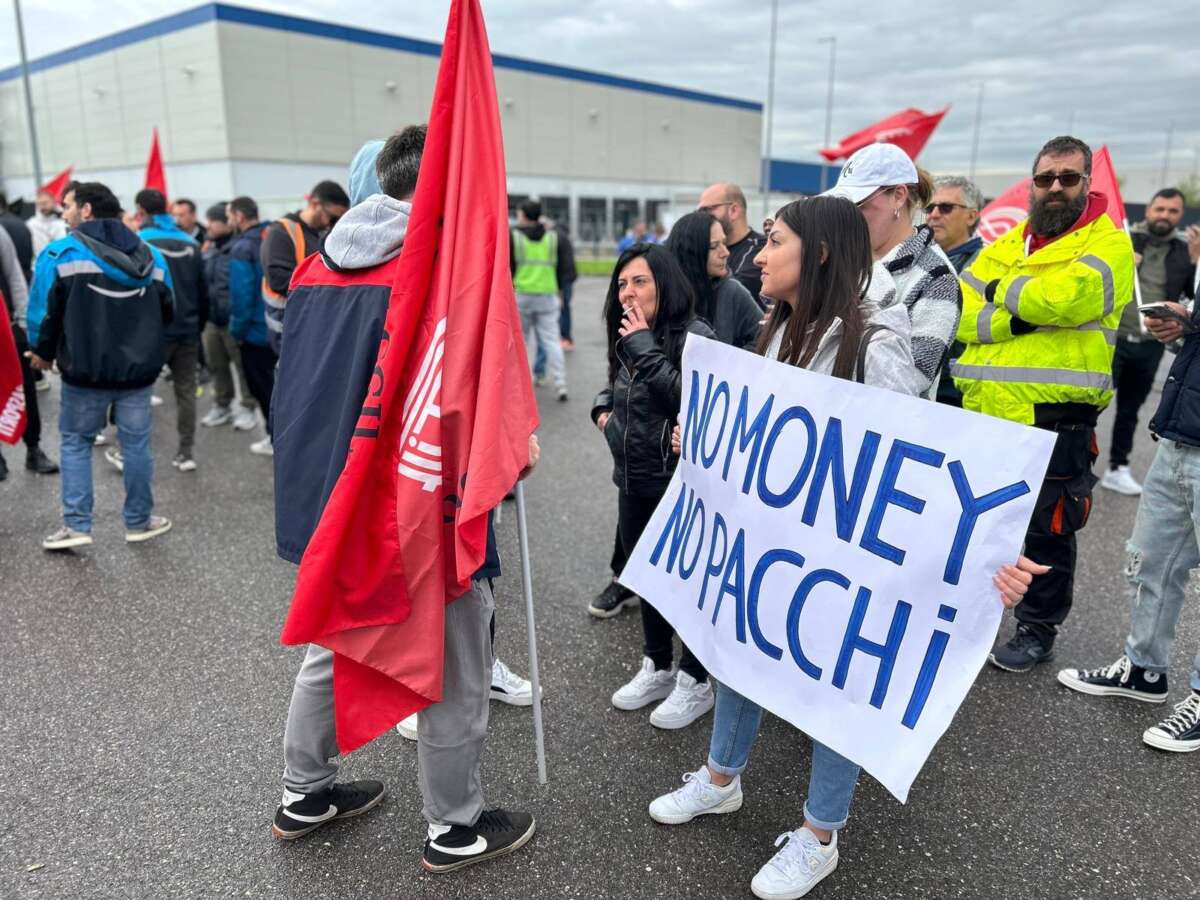
Italian Amazon workers strike in April with a sign reading, “No money, no parcels.”FILT CGIL di Roma e del Lazio
Now imagine, if instead of striking at just the single warehouse in Coventry, the English GMB union had set forth to mobilize workers at dozens of facilities to strike at once. Imagine if next peak shopping season, instead of staging demonstration strikes at a handful of Amazon’s 1,000-plus U.S. facilities, the Teamsters union put the resources into striking at hundreds of warehouses at once, with majorities of workers on the picket lines. Strikes of that scale, carried out over time, could disrupt the Amazon supply chain and give workers the power to force Amazon to the bargaining table.
What would that take?
First and foremost, unions in the U.S. and elsewhere would have to commit orders of magnitude more resources to the fight than they do currently. In the U.S., the Teamsters union is putting about $10 million a year into organizing at Amazon, a company with a $2.4 trillion market value, nearly $100 billion in cash on hand, and political friends at all levels of government.
That meager organizing investment simply won’t do; you can’t beat the behemoth on the cheap. Currently, U.S. unions combined control about $35 billion in assets, a 225 percent increase since 2010, according to union researcher and activist Chris Bohner. Where is the serious organizing investment?
Second, union leaders must heed workers’ calls for bold demands. Movements are built on transformative demands that inspire people to move beyond inertia, fear, and hopelessness. In recent years, rank-and-file activists at several U.S. Amazon warehouses have demanded a $30/hour minimum wage for the lowest paid warehouse worker, a significant boost over the current Amazon warehouse starting pay, which hovers around $19/hour. U.S. labor leaders would do well to take up the workers’ wage call along with other bold demands. Indeed, a powerful rallying cry for a global Amazon organizing movement could be “a living wage for all Amazon workers!” It’s a sensible demand, considering the company registered $59 billion in profits last year and its founder, Jeff Bezos, has accumulated around $240 billion in wealth from the labor of warehouse workers, drivers, tech workers, and other Amazon employees.
Now imagine, if instead of striking at just the single warehouse in Coventry, the English GMB union had set forth to mobilize workers at dozens of facilities to strike at once. Imagine if next peak shopping season, instead of staging demonstration strikes at a handful of Amazon’s 1,000-plus U.S. facilities, the Teamsters union put the resources into striking at hundreds of warehouses at once, with majorities of workers on the picket lines. Strikes of that scale, carried out over time, could disrupt the Amazon supply chain and give workers the power to force Amazon to the bargaining table.
What would that take?
First and foremost, unions in the U.S. and elsewhere would have to commit orders of magnitude more resources to the fight than they do currently. In the U.S., the Teamsters union is putting about $10 million a year into organizing at Amazon, a company with a $2.4 trillion market value, nearly $100 billion in cash on hand, and political friends at all levels of government.
That meager organizing investment simply won’t do; you can’t beat the behemoth on the cheap. Currently, U.S. unions combined control about $35 billion in assets, a 225 percent increase since 2010, according to union researcher and activist Chris Bohner. Where is the serious organizing investment?
Second, union leaders must heed workers’ calls for bold demands. Movements are built on transformative demands that inspire people to move beyond inertia, fear, and hopelessness. In recent years, rank-and-file activists at several U.S. Amazon warehouses have demanded a $30/hour minimum wage for the lowest paid warehouse worker, a significant boost over the current Amazon warehouse starting pay, which hovers around $19/hour. U.S. labor leaders would do well to take up the workers’ wage call along with other bold demands. Indeed, a powerful rallying cry for a global Amazon organizing movement could be “a living wage for all Amazon workers!” It’s a sensible demand, considering the company registered $59 billion in profits last year and its founder, Jeff Bezos, has accumulated around $240 billion in wealth from the labor of warehouse workers, drivers, tech workers, and other Amazon employees.
Striking drivers and their personal vehicles block the entrance to Amazon’s delivery station in Bologna, Italy, on April 18, 2025.Giuseppe Picconetti
Some observers of the Italian strike may argue that the lesson isn’t exportable because Italian workers get to operate within a better organizing environment. It is true that the Italian legal system is more favorable for workers compared to many other countries, but only because of Italy’s history of militant anti-fascist struggle before and during World War II, as well as during the 1960s and ‘70s. Those struggles have produced a stronger labor movement: Today, about one in three Italian workers belongs to a union, a union rate more than three times higher than in the United States. But organizing in Italy still is not easy. Prime Minister Giorgia Meloni and her hard-right government are friends of big business, promulgating laws aimed at limiting the effectiveness of strikes and picketing. And many Italian workers feel that union leaders often put the brakes on more militant organizing and bolder demands.
Italian workers have shown the rest of the Amazon organizing world that it’s possible to get Amazon to the bargaining table, but only when you can strike at a level that disrupts the company’s operations.
To replicate this would be a huge lift for unions outside of Italy, especially those in countries that have much lower union densities and fewer legal protections, and that lack the culture of striking that the Italians established over decades. To catch up to the Italians, unions in the U.S. and elsewhere will need to make huge resource investments to build up the working-class strike muscle. The challenge for these unions — the Teamsters in the U.S., ver.di in Germany, the GMB in England, AIWU in India, and others — is to imagine bold campaigns and then commit the resources that can, over time, disrupt Amazon and force the company into bargaining.
This article is licensed under Creative Commons (CC BY-NC-ND 4.0), and you are free to share and republish under the terms of the license.

Laura Montanari
Laura Montanari is a student based in Germany and is part of Precarious Disconnections collective in Italy and of Transnational Social Strike Platform.
Some observers of the Italian strike may argue that the lesson isn’t exportable because Italian workers get to operate within a better organizing environment. It is true that the Italian legal system is more favorable for workers compared to many other countries, but only because of Italy’s history of militant anti-fascist struggle before and during World War II, as well as during the 1960s and ‘70s. Those struggles have produced a stronger labor movement: Today, about one in three Italian workers belongs to a union, a union rate more than three times higher than in the United States. But organizing in Italy still is not easy. Prime Minister Giorgia Meloni and her hard-right government are friends of big business, promulgating laws aimed at limiting the effectiveness of strikes and picketing. And many Italian workers feel that union leaders often put the brakes on more militant organizing and bolder demands.
Italian workers have shown the rest of the Amazon organizing world that it’s possible to get Amazon to the bargaining table, but only when you can strike at a level that disrupts the company’s operations.
To replicate this would be a huge lift for unions outside of Italy, especially those in countries that have much lower union densities and fewer legal protections, and that lack the culture of striking that the Italians established over decades. To catch up to the Italians, unions in the U.S. and elsewhere will need to make huge resource investments to build up the working-class strike muscle. The challenge for these unions — the Teamsters in the U.S., ver.di in Germany, the GMB in England, AIWU in India, and others — is to imagine bold campaigns and then commit the resources that can, over time, disrupt Amazon and force the company into bargaining.
This article is licensed under Creative Commons (CC BY-NC-ND 4.0), and you are free to share and republish under the terms of the license.
Laura Montanari
Laura Montanari is a student based in Germany and is part of Precarious Disconnections collective in Italy and of Transnational Social Strike Platform.

Jonathan Rosenblum
Jonathan Rosenblum is a union organizer and a member of the National Writers Union, and is Activist in Residence at the Center for Work and Democracy at Arizona State University.

No comments:
Post a Comment