Immigration Detention Has Become a Booming Business for Private Prison Giants
Private prison giants now hold 90 percent of detained immigrants and aim to triple capacity for $1.5 billion in revenue.
By Bianca Tylek & Worth Rises ,
Truthout/TheNewPress
August 14, 2025
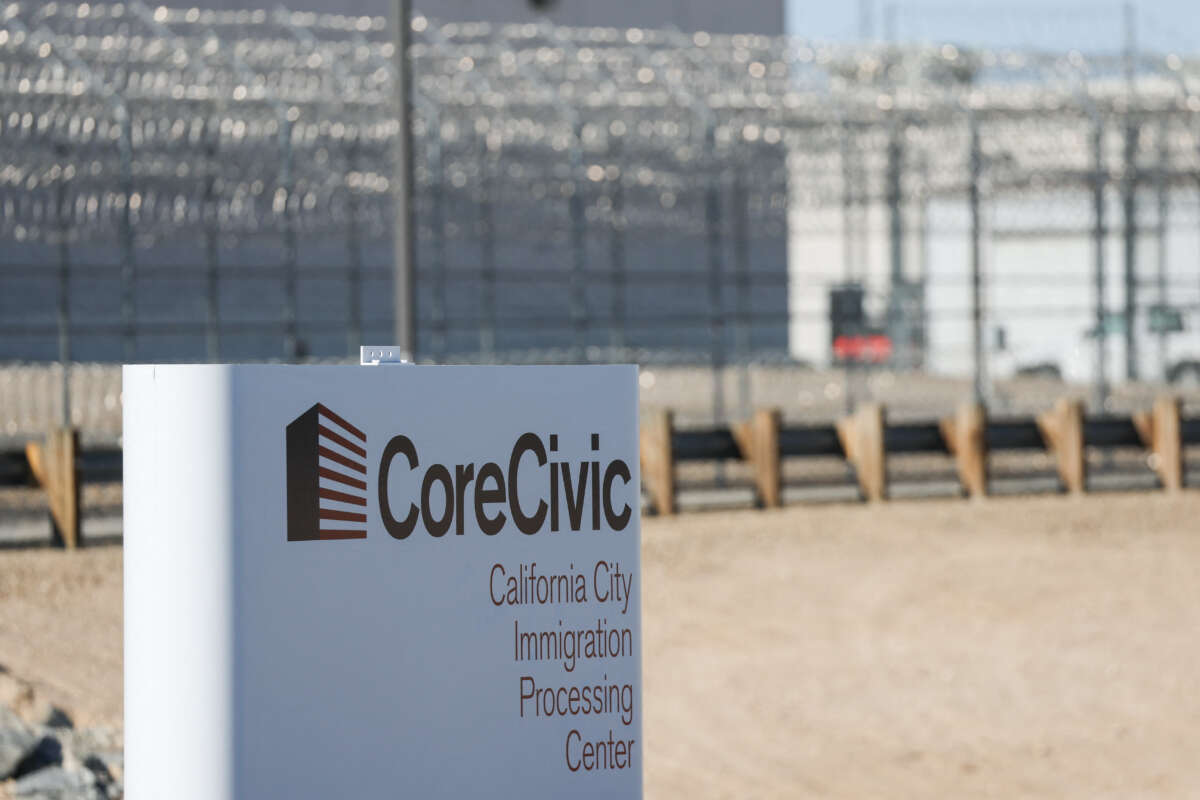
The CoreCivic, Inc. California City Immigration Processing Center stands in the Kern County desert awaiting reopening as a federal immigrant detention facility under contract with the US Immigration and Customs Enforcement (ICE) in California City, California, on July 10, 2025.
PATRICK T. FALLON / AFP via Getty Images
Support justice-driven, accurate and transparent news — make a quick donation to Truthout today!
Note: This article has been adapted from an excerpt of The Prison Industry: How it Works and Who Profits by Bianca Tylek and Worth Rises. Copyright © 2025. Available from The New Press.
Amid escalating anti-immigrant rhetoric and legislative crackdowns at the state and federal levels, private prison corporations are once again expanding their grip on U.S. detention policy. In fact, today roughly 90 percent of detained immigrants are held in privately operated facilities, the highest share in history.
This industry exists despite years of promises to phase out for-profit incarceration that started in 2016 with President Barack Obama and were renewed by President Joe Biden when he took office. Unfortunately, these promises focused exclusively on the Bureau of Prisons and excluded immigration detention. As such, through their presidencies most federal contracts with private prison corporations remained untouched in the immigration detention space.
Now, with another Trump presidency, the industry is instead preparing for explosive growth. On recent earnings calls, CoreCivic executives announced plans to triple the number of beds in their facilities within a few months. That would mean an additional $1.5 billion in revenue for the corporation, more than doubling its annual earnings.
Meanwhile, growing scrutiny of immigration detention practices has led to reports of abuse, medical neglect, and deaths in custody. Privatization, with the cost-cutting practices that define it, is the structural driver of human rights violations at these facilities.
We discuss this all at length in our recently released book, The Prison Industry: How it Works and Who Profits (The New Press, 2025). But as we also explain, private prisons corporations are just one piece of the sprawling prison industry. The U.S. carceral system is comprised of a vast and deeply entrenched network of public-private partnerships that make billions from incarceration and detention every year.
Support justice-driven, accurate and transparent news — make a quick donation to Truthout today!
Note: This article has been adapted from an excerpt of The Prison Industry: How it Works and Who Profits by Bianca Tylek and Worth Rises. Copyright © 2025. Available from The New Press.
Amid escalating anti-immigrant rhetoric and legislative crackdowns at the state and federal levels, private prison corporations are once again expanding their grip on U.S. detention policy. In fact, today roughly 90 percent of detained immigrants are held in privately operated facilities, the highest share in history.
This industry exists despite years of promises to phase out for-profit incarceration that started in 2016 with President Barack Obama and were renewed by President Joe Biden when he took office. Unfortunately, these promises focused exclusively on the Bureau of Prisons and excluded immigration detention. As such, through their presidencies most federal contracts with private prison corporations remained untouched in the immigration detention space.
Now, with another Trump presidency, the industry is instead preparing for explosive growth. On recent earnings calls, CoreCivic executives announced plans to triple the number of beds in their facilities within a few months. That would mean an additional $1.5 billion in revenue for the corporation, more than doubling its annual earnings.
Meanwhile, growing scrutiny of immigration detention practices has led to reports of abuse, medical neglect, and deaths in custody. Privatization, with the cost-cutting practices that define it, is the structural driver of human rights violations at these facilities.
We discuss this all at length in our recently released book, The Prison Industry: How it Works and Who Profits (The New Press, 2025). But as we also explain, private prisons corporations are just one piece of the sprawling prison industry. The U.S. carceral system is comprised of a vast and deeply entrenched network of public-private partnerships that make billions from incarceration and detention every year.
Commissary corporations mark-up basic hygiene items like toothpaste or tampons by 300 percent or more. Private healthcare providers routinely deny or delay treatment, contributing to suffering and preventable deaths behind bars. Private food vendors serve meals that are frequently expired or nutritionally inadequate, all in the name of cutting costs and maximizing returns.

Cover image for The Prison Industry: How it Works and Who Profits
The New Press
To understand how we arrived at this moment, we must pause and get familiar with the larger machinery that gave rise to it. The private prison industry did not emerge in isolation; it is the product of decades of deliberate policy choices that fused mass incarceration and detention with private profiteering.
Below, we share with Truthout’s readers an excerpt from the book’s chapter on the operations and management of private prisons.
The Emergence and Growth of Private Prisons in the U.S.
The first private prison corporation, CoreCivic (then known as Corrections Corporation of America), was founded in 1983. The founding executives included a former chairman of the Tennessee Republican Party and a former warden of the Ramsey Prison Farm in Texas who had used incarcerated Black men as personal servants on his plantation. The new corporation hastily signed its first contract to build and operate a federal immigration detention center in Texas, but things did not start smoothly. When construction took longer than expected, executives rented a motel, put up barbed wire, and opened the nation’s first private immigration detention center. CoreCivic’s largest competitor, the GEO Group (GEO), then known as Wackenhut, got its start the following year with a federal contract for an immigration detention center in Colorado.
Through the 1990s and 2000s, the industry built up its business by pushing draconian criminal laws that drove incarceration across the country. Until 2010, CoreCivic played a prominent role in the American Legislative Exchange Council (ALEC), a conservative trade organization through which lawmakers and corporate executives work together to draft model legislation. As an active member, and at times even corporate chair of ALEC’s Criminal Justice Task Force in the early 1990s, CoreCivic executives helped draft and champion model legislation for mandatory minimum, “three strikes,” and “truth-in-sentencing” laws.
The notorious 1994 Omnibus Crime Bill codified these and other severe sentencing laws at the federal level, and included billions of dollars in prison construction grants for states that passed similar legislation. Within a year, 25 states passed “truth-in-sentencing” laws, which require people to serve a substantial portion of their sentence before they can be eligible for parole.
In 1995, ALEC members drafted the Private Correctional Facilities Act to expand the use of private prisons state by state and the Prison Industries Act to expand the private sector’s access to prison labor. And the following year, thanks to a proposed amendment and testimony by executives at GEO, the Appropriations Act of 1996 amended the original crime bill, which was silent on private prisons, to authorize states to use federal grants issued under the bill to privatize prisons.
The industry thrived again until 2016, when the Obama administration announced it would phase out private prison contracts with the Bureau of Prisons after a study revealed that privately run facilities were less safe than publicly run facilities. The Department of Homeland Security followed by announcing a review of immigration detention centers [immigration jails], but eventually decided it would continue its use of private prisons, citing a lack of alternative options. Still, overnight, the stock price of the largest two private prison operators, Core- Civic and GEO, tanked 40 percent and 35 percent, respectively.
To understand how we arrived at this moment, we must pause and get familiar with the larger machinery that gave rise to it. The private prison industry did not emerge in isolation; it is the product of decades of deliberate policy choices that fused mass incarceration and detention with private profiteering.
Below, we share with Truthout’s readers an excerpt from the book’s chapter on the operations and management of private prisons.
The Emergence and Growth of Private Prisons in the U.S.
The first private prison corporation, CoreCivic (then known as Corrections Corporation of America), was founded in 1983. The founding executives included a former chairman of the Tennessee Republican Party and a former warden of the Ramsey Prison Farm in Texas who had used incarcerated Black men as personal servants on his plantation. The new corporation hastily signed its first contract to build and operate a federal immigration detention center in Texas, but things did not start smoothly. When construction took longer than expected, executives rented a motel, put up barbed wire, and opened the nation’s first private immigration detention center. CoreCivic’s largest competitor, the GEO Group (GEO), then known as Wackenhut, got its start the following year with a federal contract for an immigration detention center in Colorado.
Through the 1990s and 2000s, the industry built up its business by pushing draconian criminal laws that drove incarceration across the country. Until 2010, CoreCivic played a prominent role in the American Legislative Exchange Council (ALEC), a conservative trade organization through which lawmakers and corporate executives work together to draft model legislation. As an active member, and at times even corporate chair of ALEC’s Criminal Justice Task Force in the early 1990s, CoreCivic executives helped draft and champion model legislation for mandatory minimum, “three strikes,” and “truth-in-sentencing” laws.
The notorious 1994 Omnibus Crime Bill codified these and other severe sentencing laws at the federal level, and included billions of dollars in prison construction grants for states that passed similar legislation. Within a year, 25 states passed “truth-in-sentencing” laws, which require people to serve a substantial portion of their sentence before they can be eligible for parole.
In 1995, ALEC members drafted the Private Correctional Facilities Act to expand the use of private prisons state by state and the Prison Industries Act to expand the private sector’s access to prison labor. And the following year, thanks to a proposed amendment and testimony by executives at GEO, the Appropriations Act of 1996 amended the original crime bill, which was silent on private prisons, to authorize states to use federal grants issued under the bill to privatize prisons.
The industry thrived again until 2016, when the Obama administration announced it would phase out private prison contracts with the Bureau of Prisons after a study revealed that privately run facilities were less safe than publicly run facilities. The Department of Homeland Security followed by announcing a review of immigration detention centers [immigration jails], but eventually decided it would continue its use of private prisons, citing a lack of alternative options. Still, overnight, the stock price of the largest two private prison operators, Core- Civic and GEO, tanked 40 percent and 35 percent, respectively.

Panicked executives moved to pay their way to survival. Within days, GEO contributed $250,000 to pro-Trump super political action committees. After Trump’s election, CoreCivic and GEO curried favor with the incoming administration by donating an additional $250,000 each to the Trump inauguration fund. As a further sign of support, GEO also moved its annual meeting to a Trump resort.
This patronage paid off: the Trump administration rescinded the phase-out policy just weeks after taking office, going as far as to instruct Bureau of Prisons officials to identify incarcerated people for transfer to private facilities.
GEO’s donations forced campaign finance watchdogs to sue the Federal Election Committee for allowing the corporation to circumvent the ban on contributions from federal contractors, a claim still being investigated by regulators. But the administration continued its support of the industry with passage of the First Step Act, which while responsible for the release of tens of thousands of people from federal prisons funneled millions into new reentry services provided by private prison operators, among other things.
Then, in January 2021, the new Biden administration issued an executive order reverting back to the Obama-era directive barring new contracts with private prison corporations for the operation of federal prisons. The executive order similarly excluded immigration detention centers. Since then, the number of detained immigrants housed in private facilities has continued to increase.
Despite policy volatility, the industry remains stubbornly entrenched in the federal system today with more than half of its revenues each year coming from federal contracts. But in recent decades, CoreCivic and GEO spent billions diversifying their business lines to ensure their survival.
Private Prison Corporations Maximize Profits at the Expense of Incarcerated People
Compensated for each day a person spends in one of their beds, private prison corporations drive profitability in just two ways: by increasing the number of people in their facilities or cutting costs related to their care. Since their start, these corporations have done both with dire consequences.
For decades now, private prison corporations have spent hundreds of millions of dollars on campaign contributions and lobbying to advance policies that put more people in prison for longer and promote the unregulated use of private prisons. It is a story that has been written about often.
Less known is the way in which they expand their market share by maintaining a revolving door of informal influence with departments of corrections, regularly hiring former correctional administrators into high-paying roles — often just days after leaving their government posts. These new corporate executives use their government experience and relationships to usher in and negotiate lucrative contracts for their new employers.
But these corporations also have even more direct ways to increase prison stays in their facilities or further extract value from incarcerated people, and they exercise them liberally. Disciplinary infractions are just one example. Corrections officers in private prisons, like those in public prisons, can issue disciplinary infractions, hold review hearings, determine guilt or innocence, and hand down punitive sentences. In private prisons, these sentences often involve the loss of good-time credit, lengthening a person’s stay and padding their bottom lines. Unsurprisingly, the rate of guilty findings in disciplinary review hearings is quite high — easily over 95 percent in many private prisons. In one such disciplinary hearing in a CoreCivic facility, a man lost 30 days of good-time credit because he used a broom to sweep the area in front of his cell without permission, which generated an extra $2,000 for the corporation.
Yet, the easiest way that private prison corporations stretch their profit is by lowering operational costs, particularly staff pay, their largest expense. Offering below-market wages and limited benefits, they attract underqualified staff. Making matters worse, they spend, on aver-age, 58 fewer hours training staff than publicly run facilities, and what little training they offer emphasizes use of force — rather than de-escalation — as a response to every situation, including mental health crises. The outcomes are frustrating for officers set up to fail and detrimental for incarcerated people at their whim. At one CoreCivic facility in Tennessee, for instance, poorly trained officers pepper-sprayed a man who had attempted suicide before trying to help him.
Efforts to minimize costs and pad profits also leave facilities to deteriorate. Private prison corporations have little interest in maintaining existing facilities and often let them fall into disrepair. In 2018, MTC was sued by the Southern Poverty Law Center and ACLU for the deplorable conditions in its Mississippi prisons that included incidents of cells with no lights and rats crawling out of toilets.
Privatization Drives Longer Stays and Human Rights Violations in Immigration Jails
The private prison model does not differ much from the corrections system to the immigration detention system. Business is still driven by more bodies, longer stays, and low costs. So, much like it does in the corrections system, the private prison industry pushes for harsh immigration policies intended to drive up immigration detention. And private immigration detention centers suffer from many of the same problems as private prisons and jails, but the people held in them have even fewer rights and thus, at times, can suffer even more abuse.
As they do in their prisons and jails, private prison corporations cut corners on staffing and training in immigration detention centers. In fact, given the lower-risk population, they can drive costs down even more significantly and produce even greater human rights violations. For instance, in 2017, Omar Rivera, an asylum-seeker from El Salvador, led a hunger strike to protest poor conditions at the Adelanto Detention Center run by GEO. In response, staff beat him, pepper-sprayed him, and placed him in solitary confinement for nearly two weeks, according to a lawsuit filed by Rivera and seven others who were detained at the facility. The lawsuit, which was settled for an undisclosed amount, is one of several against GEO involving assaults and deaths at the Adelanto facility.
Importantly, the privatization of the Adelanto facility is itself an impropriety, but a common one in the space. Looking to circumvent rigorous federal procurement procedures, ICE and its private prison contractors often look to intergovernmental service agreements (IGSAs) to indirectly contract through counties. In these agreements, ICE contracts with counties for beds for detained immigrants, and the county in turn subcontracts the operation of its facility to a private prison corporation. The county and private prison corporation then split the per diem ICE pays for each person held in the facility. Interested in seeing more money flow into their districts, county officials have joined the corporations in pushing for harsher immigration laws. IGSAs represent a win, win, win for ICE, counties, and private prison corporations all at the expense of the people detained.
Private prisons are a uniquely U.S. export, which emerged in the 1980s as the perfect encapsulation of the decade’s embrace of Reagan-era privatization and greed. Prisons had always been used to generate revenue, but this was something new: the complete outsourcing of the criminal legal system to the highest bidder. And the corruption of money in politics allowed them to help decimate families in disproportionately Black, brown, and Indigenous communities.
Since then, private prisons have embedded themselves in every facet of the criminal and immigration systems. While people have begun to challenge private prison corporations, there must be vigilant attention paid to the industry’s attempt to change its toxic image and expand into adjacent business lines. After all, whether walls are built out of concrete, wire, or WiFi, a prison is still a prison, and a private prison still needs more bodies to grow. No matter their form, private prison corporations have no place in any system that claims to be about justice.
Copyright © 2025 The New Press.
This patronage paid off: the Trump administration rescinded the phase-out policy just weeks after taking office, going as far as to instruct Bureau of Prisons officials to identify incarcerated people for transfer to private facilities.
GEO’s donations forced campaign finance watchdogs to sue the Federal Election Committee for allowing the corporation to circumvent the ban on contributions from federal contractors, a claim still being investigated by regulators. But the administration continued its support of the industry with passage of the First Step Act, which while responsible for the release of tens of thousands of people from federal prisons funneled millions into new reentry services provided by private prison operators, among other things.
Then, in January 2021, the new Biden administration issued an executive order reverting back to the Obama-era directive barring new contracts with private prison corporations for the operation of federal prisons. The executive order similarly excluded immigration detention centers. Since then, the number of detained immigrants housed in private facilities has continued to increase.
Despite policy volatility, the industry remains stubbornly entrenched in the federal system today with more than half of its revenues each year coming from federal contracts. But in recent decades, CoreCivic and GEO spent billions diversifying their business lines to ensure their survival.
Private Prison Corporations Maximize Profits at the Expense of Incarcerated People
Compensated for each day a person spends in one of their beds, private prison corporations drive profitability in just two ways: by increasing the number of people in their facilities or cutting costs related to their care. Since their start, these corporations have done both with dire consequences.
For decades now, private prison corporations have spent hundreds of millions of dollars on campaign contributions and lobbying to advance policies that put more people in prison for longer and promote the unregulated use of private prisons. It is a story that has been written about often.
Less known is the way in which they expand their market share by maintaining a revolving door of informal influence with departments of corrections, regularly hiring former correctional administrators into high-paying roles — often just days after leaving their government posts. These new corporate executives use their government experience and relationships to usher in and negotiate lucrative contracts for their new employers.
But these corporations also have even more direct ways to increase prison stays in their facilities or further extract value from incarcerated people, and they exercise them liberally. Disciplinary infractions are just one example. Corrections officers in private prisons, like those in public prisons, can issue disciplinary infractions, hold review hearings, determine guilt or innocence, and hand down punitive sentences. In private prisons, these sentences often involve the loss of good-time credit, lengthening a person’s stay and padding their bottom lines. Unsurprisingly, the rate of guilty findings in disciplinary review hearings is quite high — easily over 95 percent in many private prisons. In one such disciplinary hearing in a CoreCivic facility, a man lost 30 days of good-time credit because he used a broom to sweep the area in front of his cell without permission, which generated an extra $2,000 for the corporation.
Yet, the easiest way that private prison corporations stretch their profit is by lowering operational costs, particularly staff pay, their largest expense. Offering below-market wages and limited benefits, they attract underqualified staff. Making matters worse, they spend, on aver-age, 58 fewer hours training staff than publicly run facilities, and what little training they offer emphasizes use of force — rather than de-escalation — as a response to every situation, including mental health crises. The outcomes are frustrating for officers set up to fail and detrimental for incarcerated people at their whim. At one CoreCivic facility in Tennessee, for instance, poorly trained officers pepper-sprayed a man who had attempted suicide before trying to help him.
Efforts to minimize costs and pad profits also leave facilities to deteriorate. Private prison corporations have little interest in maintaining existing facilities and often let them fall into disrepair. In 2018, MTC was sued by the Southern Poverty Law Center and ACLU for the deplorable conditions in its Mississippi prisons that included incidents of cells with no lights and rats crawling out of toilets.
Privatization Drives Longer Stays and Human Rights Violations in Immigration Jails
The private prison model does not differ much from the corrections system to the immigration detention system. Business is still driven by more bodies, longer stays, and low costs. So, much like it does in the corrections system, the private prison industry pushes for harsh immigration policies intended to drive up immigration detention. And private immigration detention centers suffer from many of the same problems as private prisons and jails, but the people held in them have even fewer rights and thus, at times, can suffer even more abuse.
As they do in their prisons and jails, private prison corporations cut corners on staffing and training in immigration detention centers. In fact, given the lower-risk population, they can drive costs down even more significantly and produce even greater human rights violations. For instance, in 2017, Omar Rivera, an asylum-seeker from El Salvador, led a hunger strike to protest poor conditions at the Adelanto Detention Center run by GEO. In response, staff beat him, pepper-sprayed him, and placed him in solitary confinement for nearly two weeks, according to a lawsuit filed by Rivera and seven others who were detained at the facility. The lawsuit, which was settled for an undisclosed amount, is one of several against GEO involving assaults and deaths at the Adelanto facility.
Importantly, the privatization of the Adelanto facility is itself an impropriety, but a common one in the space. Looking to circumvent rigorous federal procurement procedures, ICE and its private prison contractors often look to intergovernmental service agreements (IGSAs) to indirectly contract through counties. In these agreements, ICE contracts with counties for beds for detained immigrants, and the county in turn subcontracts the operation of its facility to a private prison corporation. The county and private prison corporation then split the per diem ICE pays for each person held in the facility. Interested in seeing more money flow into their districts, county officials have joined the corporations in pushing for harsher immigration laws. IGSAs represent a win, win, win for ICE, counties, and private prison corporations all at the expense of the people detained.
Private prisons are a uniquely U.S. export, which emerged in the 1980s as the perfect encapsulation of the decade’s embrace of Reagan-era privatization and greed. Prisons had always been used to generate revenue, but this was something new: the complete outsourcing of the criminal legal system to the highest bidder. And the corruption of money in politics allowed them to help decimate families in disproportionately Black, brown, and Indigenous communities.
Since then, private prisons have embedded themselves in every facet of the criminal and immigration systems. While people have begun to challenge private prison corporations, there must be vigilant attention paid to the industry’s attempt to change its toxic image and expand into adjacent business lines. After all, whether walls are built out of concrete, wire, or WiFi, a prison is still a prison, and a private prison still needs more bodies to grow. No matter their form, private prison corporations have no place in any system that claims to be about justice.
Copyright © 2025 The New Press.

Bianca Tylek is the Founder and Executive Director of Worth Rises. She is one the nation’s for most experts on the prison industry and a nationally recognized leader in criminal justice advocacy more broadly. Bianca is best known for her innovative strategies and successful campaigns to secure free prison phone calls and eliminate financial exploitation across the criminal legal system. Bianca’s work has been featured on the TED stage as well as in The New York Times, The Washington Post, and NPR. She is based in New York City.
Worth Rises is a nonprofit organization dedicated to dismantling the prison industry and ending its exploitation of incarcerated people and their families. Through narrative change, policy advocacy, and corporate activism, Worth Rises has successfully influenced legislation and changed industry practices nationwide.

No comments:
Post a Comment