‘To create model social institutions’: The international Communist Women’s Movement, reproductive labor and the politics of care, 1920–1936
First published at Red Threads.
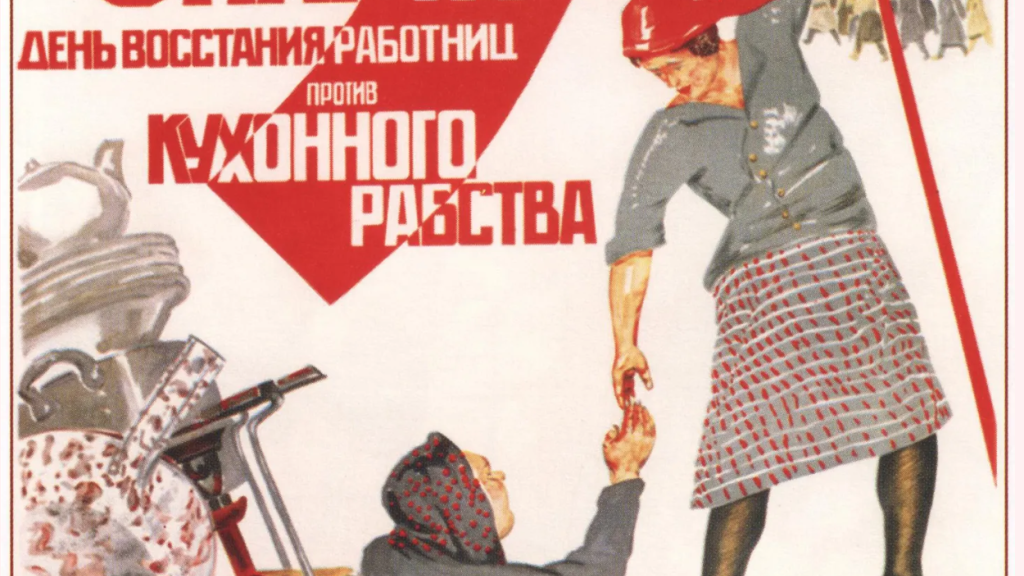
Founded in 1920 as the women’s organization of the Communist International (Comintern), the Communist Women’s Movement (CWM) fought for complete gender equality and the full integration of women into economic, political, and social life. The movement viewed women’s emancipation as an integral element of socialist transformation. Some of the international campaigns that the CWM carried out in its early years concerned primarily working women (which included industrial women workers, housewives, intellectuals, peasants, and servants), such as the struggle for women’s participation in politics, labor rights, and unionization. Among the CWM’s central objectives was the socialization of housework and care, which Communist women conceptualized as the “social economy.”1 This implied complete rethinking and reorganization of reproductive labor and, more broadly, social reproduction.
The following analysis is anchored in CWM’s programmatic documents and unexplored discussions within the CWM’s central executive body, the International Women’s Secretariat (IWS).2 It looks into some internationally coordinated campaigns led by Communist women in the 1920s and 1930s in Europe and beyond around the socialization of housework, care, and state-supported motherhood. I argue that from 1920 onward, Communist women pioneered efforts to link social reproduction to women’s unwaged labor and care work.3 Communist women discussed the economic and social conditions necessary for mothers and families, attentive to class, ethnic, and racial inequalities. This way they formulated core principles of intersectionality and reproductive justice before these frameworks entered mainstream feminist discourse.
This article begins by analyzing the CWM’s conceptualization of housework and care — through policies that were strikingly avant-garde for the 1920s, yet subsequently formed the foundation of post-WWII welfare states worldwide. It then traces how these concepts intersected with their revolutionary vision of motherhood. By shedding light on differences between Communist and Socialist positions, this study demonstrates how the CWM navigated the ideological intricacies of the Comintern’s Left Turn and Popular Front while remaining faithful to the earlier conceptualizations of reproductive labor and working motherhood.
‘Transform the housewife from a slave of the small individual economy into a free toiler in the larger social economy’:4 The CWM’s early vision of reproductive labor
While discussing housework and care, the CWM proposed a concrete plan of transformation of reproductive labor into a socialized industry. Communist women integrated this plan into their programmatic document — “Guidelines for the Communist Women’s Movement” — discussed and elaborated at their founding conference held in Moscow in 1920. This conference brought together over fifty Communist women delegates from Europe, Asia, and North America.5 The initial draft of the “Guidelines” was prepared by Clara Zetkin, a leading German Communist, women’s rights advocate, and from 1920 the de facto head of the IWS, in advance of the 1920 conference. After delegate discussion, it was amended later that year by a specially appointed commission headed by Zetkin. Among many other points, the “Guidelines” urged the transformation of housekeeping, characterized as “the most backward, deformed, and stultifying of the old guild handicrafts” into “the general social economy.”6
Delegates at the first conference were also very enthusiastic about the Soviet experience as, since the October 1917 revolution, the Bolshevik government had acknowledged housework as a major means of women’s subordination. Lenin spoke about how paid work and housework kept women “in a state of double slavery.”7 Alexandra Kollontai, a prominent Russian revolutionary and women’s rights activist, one of the founders of the Soviet Zhenotdel (Women’s Department of the Soviet Communist Party) and the CWM, who in 1917 became the first female minister in history, wrote in 1920: “The individual household is dying. It is giving way in our society to collective housekeeping. Instead of the working woman cleaning her flat, the communist society can arrange for men and women whose job it is to go around in the morning cleaning rooms.”8 Soviet authorities set up public amenities offering different kinds of services (child day care, public kitchens, canteens, communal laundries and cleaning facilities, etc.), although their funding often represented a challenge.
Communist women from outside the Soviet Union spoke about the necessity to elaborate a concrete plan to ease the traditional burden of women in newly socialist countries as well as in capitalist ones. The “Guidelines” analyzed housekeeping as a form of reproductive labor used in capitalism to keep men’s wages low (since the labor of housewives was unpaid) and women intellectually and politically backward by blocking their participation in society. Referring to the Soviet context, the “Guidelines” further insisted on the “creat[ion of] model social institutions that take over women’s economic tasks in the family,” fully involving women themselves in the development of such measures and the creation of relevant infrastructure.9 For women in capitalist (and precapitalist) countries, the “Guidelines” suggested striving for the establishment of similar institutions.
The idea of socializing housework and care was not new in the socialist world. In fact, a few socialist theoreticians had discussed the necessity to liberate women from housekeeping or care labor. August Bebel, in Women under Socialism (1879) promoted radical goals that encompassed the overthrow of patriarchy in domestic spaces. Friedrich Engels expressed similar ideas in his Origin of the Family, Private Property, and the State (1884). However, the CWM’s attention to women’s unpaid care work as directly linked to women’s emancipation was novel in a socialist policy document; it was not present, for example, in the Second (Socialist) International’s program. In this way, the Communist program put “the woman question” at the very center of the socialist project, underlining that women’s emancipation — in both the public and private spheres — was not merely a consequence, but the very goal of socialist transformation.
‘To ease, supplement and improve the work of mothers’: The CWM’s early policies on motherhood, family, and care
Housekeeping and unpaid care work were linked to a revolutionary rethinking of motherhood by Communist women. The CWM’s “Guidelines” rejected the “old petty-bourgeois” view of childrearing as women’s sole calling. Throughout the 1920s, most CWM sections and leaders supported the freedom of choice to have or not to have children and protested anti-abortion laws which were prevalent in most countries across Europe and beyond. Yet Communist women sought to enable the combination of motherhood and work through institutionalized state aid.
Clara Zetkin advocated state support for mothers, seeing motherhood as strengthening the proletarian state. She favored protective labor laws, hospitals, and maternity provisions. Alexandra Kollontai was a long-time supporter of state assistance to mothers, independently of their marital status. Her 1916 Society and Motherhood defined childbearing as a social responsibility, to be shared between the family and society. Kollontai exposed the stark class divide in how motherhood was treated under capitalism, contrasting the protection afforded to bourgeois women with the brutal exploitation of working-class mothers. She argued that the state was to assume collective responsibility for maternal welfare through paid maternity leave, workplace protections, material benefits, and socialization of childcare, all of which she linked to communist social transformation. Kollontai drew inspiration from August Bebel but also the Russian revolutionary democrat Nikolai Dobrolyubov and such feminists as Lily Braun or Helene Stöcker.10 Kollontai argued that both the mother and the socialized institutions were to ensure the children’s wellbeing. In 1918, as Minister of Social Welfare, she played a key role in shaping Soviet decrees that legally safeguarded motherhood and introduced socialized childcare. Other Soviet decrees reinforced the position of women in the family: women’s divorce rights, civil marriage, and equal status for “legitimate” and “illegitimate” children.
The CWM followed this example, integrating into its “Guidelines” the state’s duty to harmonize motherhood with employment outside of the home via public care institutions for maternity, children, and youth. The CWM also drew on the Soviet Labor Code to advance ambitious demands for working mothers outside the Soviet Union. Throughout the 1920s, they campaigned in most European countries for nine months of postnatal benefits, medically supervised deliveries, sixteen weeks of maternity leave, a six-hour day for nursing mothers with possibility to breastfeed at work, and free daycare/school amenities.11
Although many of the CWM’s demands were more radical than those of socialists and social democrats in Europe and beyond, up until 1928, the CWM often organized campaigns in collaboration with socialist women. Many of the latter shared CWM’s vision — albeit, and hélas, most of these campaigns were unsuccessful. This collaboration was in line with the united front policy that the Comintern had adopted in 1921. It called for common action with reformist organizations and trade unions, in specific, limited fights around the defense of workers’ immediate interests. Although many Communist women and men, especially outside of Soviet Union, initially criticized this policy, by 1922 Comintern sections around the world embraced it without abandoning the perspective of world revolution altogether. The CWM’s leadership and Zetkin, in particular, supported the united front strategy, for which she was severely criticized within the German Communist Party.
No Kinder, Küche, Kirche: Communist and socialist diverging visions of motherhood and care
Collaboration with socialists, however, had always been fragile due to major ideological differences between revolutionaries and reformists. It became particularly problematic after the Comintern’s Left Turn of 1928, during the so-called Third Period (1928–34) — the third phase in the post-World War I development of capitalist countries. In Comintern discourse, the Third Period followed revolutionary upheaval and capitalist stabilization, defined by sharper contradictions, economic crisis, and working-class radicalization. This analysis compelled a global “Left Turn” ending the united front with non-communist forces. Events in 1926–27 seemed to confirm this course: the Chinese revolution’s defeat, Britain’s severance of ties with the USSR, Austrian Social Democrats ignoring a communist general strike call, and the dissolution of the Anglo-Russian Trade Union Committee, all suggested the moderate left had turned its back on the “Reds.” The Left Turn thus reflected communist experiences in a hostile political context. The Sixth Comintern Congress (July–August 1928) officially adopted this policy, urging greater mobilization and radicalization against social democrats labeled “social-fascists.” The new policy profoundly affected communists around the world throughout 1928 and 1929. Internal discipline intensified, leading to expulsions across several parties, though the CWM saw weaker impact. Overall, the Left Turn weakened the Left in many European countries, although it did have successes in some national contexts, especially outside of Europe.12
The 1928 break with Socialists was not the first one either. Socialist and Communist women had been part of the same socialist movement and shared many radical ideas before the general split that occurred after the outbreak of World War I. For instance, at the Copenhagen Conference of Socialist Women, organized in 1910 by Clara Zetkin, delegates agreed to demand four months of paid maternity leave. Socialist women then also appeared more unified on the issue of abortion, the need to oppose anti-abortion laws, and the practice of illegal abortions. However, many (though not all) Socialist women gradually shifted toward less radical visions of motherhood, state support for mothers and families, care, as well as reproductive rights, as discussed below.
These differences between Socialist and Communist women became particularly acute with the Comintern’s Left Turn. The questions of reproductive labor and reproductive rights were among the core points of division. At an IWS meeting in Moscow on 4 September 1928, held shortly after the Comintern adopted its new policy, women delegates from the Zhenotdel and communist parties of Yugoslavia, Germany, and Britain discussed the recent conference of the Labor and Socialist International (LSI) held on 3-4 August 1928 in Brussels. The CWM’s report highlighted that, differently from Communist women, very few LSI delegates addressed the question of unpaid reproductive labor done by women or the right to abortion. Furthermore, they pointed out that the proposed socialist policies were far less radical than those of the CWM, and issues like reproductive autonomy, equality for “illegitimate” children, and paid maternity leave proved highly divisive. Yet, the CWM report recognized that the resolution of the LSI conference did incorporate (albeit in a vague form) several demands already implemented in the Soviet Union and promoted by the CWM elsewhere. These were: state support for mothers and pregnant women, medical assistance for mothers, protective measures and free milk for school children, daycare facilities, equality in family law, and “full maternity leave” before and after delivery, though without defining its duration or parameters.13
At 1930 IWS meetings, Communist women highlighted what they saw as Socialists’ conservatism. Soviet Zhenotdel delegate Varvara Moirova criticized German socialist women for their contempt toward unwed mothers, while a Comintern Executive representative mocked the Czech socialists’ “Mother of the Future” care model, which promoted a conventional vision of motherhood that assigned women full responsibility for child-rearing and confined them to the role of housewives, financially supported by the state. Communists labeled this vision that emphasized the woman’s “noble goal [of] bring[ing] up her children for her own joy and the benefit of society” as “petty-bourgeois sentimental nonsense, no different from the view of a woman as belonging to the realm of the Kinder, Küche, Kirche (children, kitchen, church) trinity.”14 By contrast, Communist women envisioned a world where women could experience the joy of motherhood while contributing to society outside the home, a vision encapsulated in their aspiration that “outside employment and motherhood will join together in an unbroken circle for a full life.”15
In Germany that same year, Social Democrats did not support the bills proposed by the Communist faction of the Bundestag to protect women workers, peasants, and domestic servants. One bill called for the protection of motherhood, demanded sixteen weeks of paid maternity leave, and prohibited the dismissal of pregnant women and mothers until twelve months after childbirth. The other bill focused on communal authorities and demanded to establish orphanages, daycare facilities, and maternity hospitals; provide child benefits for low-income families; and offer tax benefits and housing allocations, free school meals, and free transport for children from large families. Both bills were rejected.16
Given these differences, Communist women also strategically used the Left turn to emphasize their own radical agenda within the left-wing circles of women and within the male-dominated worlds of the Communist and Socialist Internationals. They consistently promoted a “working mother model” supported by socialized care, which represented an alternative to both the prevailing male breadwinner model and the double exploitation of women’s waged and reproductive labor. Decades later, Marxist feminists such as Lise Vogel and Silvia Federici would theorize social reproduction as linked to housework and childrearing (usually done by women).17 Thus Communist women prefigured a rethinking of social reproduction as inherently linked to the domestic and care labor essential to sustaining the workforce. Moreover, differently from Federici or even pre-World War I ideas on wages for housework, such as those of Charlotte Perkins Gilman, an American first-wave feminist who advocated for providing financial compensation for mothers and caregivers,18 the CWM was unanimous in promoting the complete abolition of housework as a private responsibility, seeing it as a strategic goal of women’s liberation, achievable only through socialist transformation.
Despite the diverging visions and overall Comintern anti-socialist rhetoric, Communist women often continued collaborating with some socialist women’s groups on practical issues such as women’s wages, food prices, or some aspects of maternity protection. Anti-fascism, which has been part of the Communist women’s agenda since 1922, became another unifying factor, especially since the mid-1930s.
‘Fight for the desired joyful motherhood’: The CWM and the Popular Front
The Great Depression had barely begun to ravage global economies when the political landscape took an even darker turn. In September 1930, the Nazi Party became the second largest force in the Reichstag; three years later, Hitler was appointed chancellor and swiftly moved to outlaw the Communist Party and crush the Social Democrats. By July 1933, the Nazi regime had established a monopoly on power and initiated a massive rearmament program. In Italy, Mussolini had already presided over a fascist government for more than a decade, while fascist movements proliferated across Europe and beyond, including in Austria, Spain, and France. Economic hardship fueled their political gains, making anti-fascism the overriding priority for most European Communist Parties by 1934.
For Communist women, fascism represented more than a political threat: it was a direct assault on women’s rights. Italian fascism constructed its policy toward women around a pronatalist ideology that cast childbearing as a patriotic duty to the nation, while simultaneously discouraging women’s participation in the workforce. The Nazi regime pursued a parallel project, glorifying motherhood while restricting women’s access to employment, higher education, and birth control. These policies were inseparable from the Nazis’ eugenic agenda, which subjected women deemed “unfit” on racial, ethnic or health grounds to compulsory sterilization. Abortion, though formally illegal in Germany, was permitted for some, and functioned as an instrument of state control, deployed in the service of a eugenicist ideology.
The intensifying fascist threat compelled the international communist movement to reconsider its strategic orientation. Amid mounting polarization, the French and Czechoslovak sections of the Comintern urged cooperation with social democrats and other leftist forces in the name of an anti-fascist united front. This proposal was formally adopted in July 1935, encouraging broad anti-fascist alliances with leftist, center-left, and centrist parties, while granting national sections greater autonomy in their implementation of the new line.
The CWM anticipated this shift, implementing unity strategies from fall 1934. The new policy enabled cooperation with socialist women but also required collaboration with center-left and centrist women’s movements, including religious ones, risking de-radicalization. Concurrently, the broader international arena was becoming increasingly complex: while Nazis and fascists were promoting pro-natalism alongside eugenicist policies, many non-fascist governments, such as those of the US and Scandinavian countries, also practiced “voluntary” sterilization based on race, ethnicity, or class. Communist women denounced such policies, effectively practicing — if not explicitly naming — intersectionality in their activism, pointing to a variety of factors such as race, ethnicity, class, or health that added up to women’s oppression under capitalism.19 Consequently, by the summer of 1935 the members of the IWS felt that these global developments put Communist women in a highly precarious position, as their pro-abortion stance risked being misinterpreted as neo-Malthusianism or conflated with far-right eugenicist policies. On the other hand, maintaining their radical vision of working motherhood threatened to alienate their prospective moderate anti-fascist allies.
Moreover, the IWS members were also aware of potential changes to abortion legislation in the Soviet Union. A year later the Soviet government indeed banned abortions. The June 1936 decree, formally titled the “Resolution of the Central Executive Committee and the Council of People’s Commissars of the USSR on the Prohibition of Abortions, Increasing Financial Assistance to Mothers, Establishing State Assistance to Large Families, Expanding the Network of Maternity Hospitals, Nurseries and Kindergartens, Increasing Criminal Penalties for Failure to Pay Alimony and on Certain Changes in the Legislation on Divorce,” simultaneously ended the right to free, medicalized abortion that Soviet women had enjoyed since 1920, while allocating additional funds to support working motherhood and socialized care.20 However, arguably, it was complex international shifts, and not only Soviet reversal of abortion policy, that called for readjustments of the CWM’s policies on reproductive rights, motherhood, and care.
That said, while abandoning the most radical element of its initial platform — the pro-abortion stance — the CWM remained faithful to its policies regarding state-supported motherhood and reproductive labor. In the summer of 1935, a series of meetings took place at the IWS to discuss the stakes of the Popular Front and the line to adopt on the contentious issues of reproductive rights, working motherhood, and care. As a result of these discussions, the movement resolved to continue advocating for the transformation of housework into a social industry, the integration of motherhood with employment outside the home; a sixteen-week paid maternity leave; free maternal medical care; public daycare facilities; and family allowances. While explicit demands for free and medicalized abortion became rare after 1935, giving way to the more neutral slogan “For desired and joyful motherhood” and access to contraception, Communist women in Europe and beyond nevertheless continued to actively protest anti-abortion laws and the devastating consequences of illegal abortions.21 This practice likens the CWM’s advocacy for state-supported motherhood to an early form of reproductive justice activism, occurring decades before the framework was formally coined by women of color activists and scholars in the United States during the mid-1990s.22
Conclusion
The interwar Communist Women’s Movement was not a passive recipient of Comintern or Soviet directives but an active, theoretically innovative vanguard that positioned women’s emancipation at the center of socialist transformation. By linking unwaged domestic labor to social reproduction, the movement pioneered a profound rethinking of care work as a structural economic and political question.
The CWM officially dissolved in November 1935, only months after the adoption of the Popular Front policy. Yet the same activists continued coordinating international efforts until the summer of 1937, and Women’s Departments within Communist Parties kept advocating for a revolutionary reorganization of reproductive labor. Over time, the Popular Front progressively absorbed the movement’s international networks into organizations such as the Women’s World Committee against War and Fascism and the Women’s International League for Peace and Freedom, where Communist women’s experience and connections served new purposes. In this shift, proletarian internationalism recast itself as antifascist solidarity, even as the underlying networks endured under altered forms.
During World War II, Communist women fought actively against Nazis and fascists on the frontlines and within diverse resistance movements. After the war, they revived their networks and, in 1945, established the Women’s International Democratic Federation (WIDF) in Paris. As an indirect successor to the CWM, the WIDF continued many policies first articulated in the 1920s such as anticolonialism, anti-imperialism, and the struggle for state-supported motherhood and socialized care, linking them to the broader fight for women’s status worldwide. Socialist governments in Eastern and Central Europe subsequently adopted many of the CWM’s ideas on reproductive labor at the national level.
Throughout these transformations, from the Left Turn to the Popular Front, from wartime resistance to postwar institutionalization, Communist women remained faithful to their foundational vision of socialization of housework and care. In doing so, they formulated core principles of intersectionality and reproductive justice that anticipated contemporary feminist frameworks. Their legacy of radical care activism challenges and complicates the standard narrative of modern women’s rights movements and the conventional “waves of feminism.” That historical recovery matters urgently today. The very policies the CWM formulated and fought for a century ago now face renewed attacks, even as societies worldwide continue grappling with how to organize care economies effectively and fairly.
Dr. Daria Dyakonova is a historian of transnational left-wing youth and women’s movements, gender, and International Relations. Her research currently focuses on the international Communist Women’s Movement during the interwar period, with particular attention to transnational activism.
- 1
“Guidelines for the Communist Women’s Movement” (hereinafter “Guidelines”), 1921, in Mike Taber and Daria Dyakonova, eds., The Communist Women’s Movement, 1920–1922: Proceedings, Resolutions, and Reports (Leiden: Brill, 2022), 162. The quote from this article’s title from “Guidelines,” 163.
- 2
The International Women’s Secretariat technically existed between the summer of 1920 and the summer of 1926. It was based in Moscow between November 1920 and December 1921 and in Berlin between January 1922 and July 1924. It moved back to Moscow in August 1924. In April 1926 it was transformed into the Women’s Department of the Comintern’s Executive Committee (ECCI), but the name IWS continued to be used until the dissolution of the ECCI Women’s Department in 1935. In this article I use the term International Women’s Secretariat (IWS) for the entire interwar period for the sake of consistency.
- 3
Organizers within the Communist Women’s Movement did not use the term “social reproduction” to define women’s work or gendered material inequality. Yet, their understanding of the relationship between women’s care labor and the wider economy was not only intersectional but also integrative, taking political form in the demand for the socialization of care work.
- 4
“Guidelines,” 162.
- 5
The 1920 Conference had over 50 delegates from 19 countries. See Taber and Dyakonova, eds., The Communist Women’s Movement, 151.
- 6
“Guidelines,” 162.
- 7
V.I. Lenin, “The Tasks of the Working Women’s Movement in the Soviet Republic. Speech delivered at the Fourth Moscow City Conference of Non-Party Working Women, 23 September 1919.” In Collected Works, vol. 30 (Moscow: Progress Publishers, 1965), 40–6. https://www.marxists.org/archive/lenin/works/1919/sep/23a.htm.
- 8
Alexandra Kollontai, “Communism and the Family.” In Alix Holt, ed., Alexandra Kollontai: Selected Writings (London: Allison & Busby, 1977).
- 9
“Guidelines,” 163.
- 10
Lily Braun developed similar ideas in Die Frauenfrage (The Woman Question, 1901). Helene Stöcker led the Deutscher Bund für Mutterschutz und Sexualreform(German League for the Protection of Motherhood and Sexual Reform) and advocated for reforms that would require the state to support single mothers. See Olga Bronnikova and Matthieu Renault, Kollontai. Défaire la famille, refaire l’amour(Paris: La Fabrique éditions, 2024), 84–85.
- 11
“Minutes of the meeting of the IWS,” 27 August 1935, ll. 93-95, 101. Minutes and materials of the meetings of the IWS, 21.08.1935-11.09.1935, fond (fund, hereinafter f.). 507, opys (inventory, hereinafter op.) 2, delo (file, hereinafter d.) 230. Russian State Archive of Social and Political History (hereinafter RGASPI), Moscow, Russia.
- 12
See, for example, Josephine Fowler, “From East to West and West to East: Ties of Solidarity in the Pan-Pacific Revolutionary Trade Union Movement, 1923–1934,” International Labor and Working-Class History 66 (2004): 99–117.
- 13
“Minutes of the meeting of the IWS/WD,” 4 September 1928, ll. 208-209. Minutes of the meetings of the IWS/WD January to September 1928, f. 507, op. 2, d. 119. RGASPI.
- 14
“Minutes of the meeting of the IWS/WD,” 20 May 1930, ll. 185-6. Minutes of the meetings of the IWS/WD January to May 1930, f. 507, op. 2, d. 157. RGASPI.
- 15
“Guidelines”, 153.
- 16
“Minutes of the meeting of the IWS/WD,” 22 May 1930, ll. 1-51. Minutes of the meetings of the IWS/WD for May and June 1930, f. 507, op. 2, d. 158. RGASPI.
- 17
See Lise Vogel, Marxism and the Oppression of Women: Toward a Unitary Theory, revised ed. (Leiden: Brill, 2013); Silvia Federici, Caliban and the Witch: Women, the Body and Primitive Accumulation (Brooklyn, NY: Autonomedia, 2004).
- 18
Charlotte Perkins Gilman, Women and Economics: A Study of the Economic Relation Between Men and Women as a Factor in Social Evolution (Boston: Small, Maynard & Co., 1898).
- 19
“Minutes of the meeting of the IWS/WD,” 1 January 1935, l. 199. Minutes of the meetings of the IWS/WD for January to June 1935, f. 507, op. 2, d. 229. RGASPI.
- 20
In the USSR, abortion was from its introduction regarded as a provisional measure. While not all members of the Zhenotdel enthusiastically supported it, they concurred that it remained necessary so long as society could not guarantee the necessary material conditions for all mothers and children. Kollontai herself was not, strictly speaking, “pro-abortion” in the sense of promoting it as a positive good; rather, she viewed it as a necessity imposed by the material circumstances.
- 21
“Minutes of the meeting of the IWS/WD,” 23 July 1935, l. 221. Minutes of the meetings of the IWS/WD for January to June 1935, f. 507, op. 2, d. 229; and “Minutes of the meeting of the IWS/WD,” 25 August 1935, l. 16 and 27 August 1935, l. 125. Minutes of the meetings of the IWS/WD for August to September 1935, f. 507, op. 2, d. 230. RGASPI.
- 22
See, for example, Loretta Ross and Rickie Solinger, Reproductive Justice: An Introduction (Oakland: University of California Press, 2017).


