It’s possible that I shall make an ass of myself. But in that case one can always get out of it with a little dialectic. I have, of course, so worded my proposition as to be right either way (K.Marx, Letter to F.Engels on the Indian Mutiny)
Sunday, November 16, 2025
SPACE/COSMOS
The simulated Milky Way: 100 billion stars using 7 million CPU cores
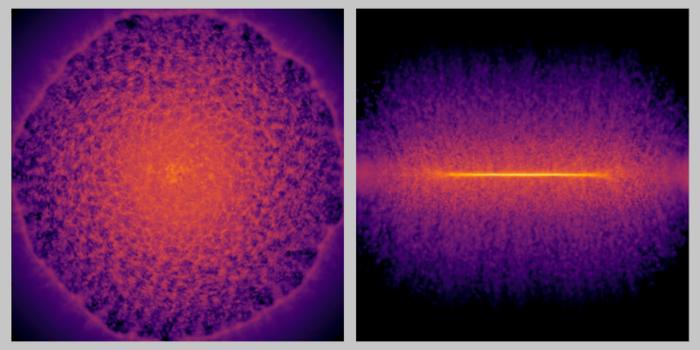
Head-on (left) and side-view (right) snapshots of a galactic disk of gas. These snapshots of gas distribution after a supernova explosion were generated by the deep learning surrogate model.
Researchers led by Keiya Hirashima at the RIKEN Center for Interdisciplinary Theoretical and Mathematical Sciences (iTHEMS) in Japan, with colleagues from The University of Tokyo and Universitat de Barcelona in Spain, have successfully performed the world’s first Milky Way simulation that accurately represents more than 100 billion individual stars over the course of 10 thousand years. This feat was accomplished by combining artificial intelligence (AI) with numerical simulations. Not only does the simulation represent 100 times more individual stars than previous state-of-the-art models, but it was produced more than 100 times faster. Published in the international supercomputing conference SC ’25, this study represents a breakthrough at the intersection of astrophysics, high-performance computing, and AI. Beyond astrophysics, this new methodology can be used to model other phenomenon such as climate change and weather patterns.
Astrophysicists have been trying to create a simulation of the Milky Way Galaxy down to its individual stars, which could be used to test theories of galactic formation, structure, and stellar evolution against real observations. Accurate models of galaxy evolution are difficult because they must consider gravity, fluid dynamics, supernova explosions, and element synthesis, each of which occur on vastly different scales of space and time.
Until now, scientists have not been able to model large galaxies like the Milky Way while also maintaining a high star-level resolution. Current state-of-the-art simulations have an upper mass limit of about one billion suns, while the Milky Way has more than 100 billion stars. This means that the smallest “particle” in the model is really a cluster of stars massing 100 suns. What happens to individual stars is averaged out, and only large-scale events can be accurately simulated. The underlying problem is the number of years between each step in the simulation—fast changes at the level of individual stars, like the evolution of supernovae, can only be observed if the time between each snapshot of the galaxy is short enough.
But, processing smaller timesteps takes more time and more computational resources. Aside from the current state-of-the-art mass limit, if the best conventional physical simulation to date tried to simulate the Milky Way down to the individual star, it would need 315 hours for every 1 million years of simulation time. At that rate, simulating even 1 billion years of galaxy evolution would take more than 36 years of real time! But adding more and more supercomputer cores is not a viable solution. Not only do they use an incredible amount of energy, but more cores will not necessarily speed up the process because efficiency decreases.
In response to this challenge, Hirashima and his research team developed a new approach that combines a deep learning surrogate model with physical simulations. The surrogate model was trained on high-resolution simulations of a supernova and learned to predict how the surrounding gas expands in the 100,000 years after a supernova explosion, without using resources from the rest of the model. This AI shortcut enabled the simulation to simultaneously model the overall dynamics of the galaxy as well as fine-scale phenomena such as supernova explosions. To verify the simulation’s performance, the team compared the output with large-scale tests using the RIKEN’s supercomputer Fugaku and The University of Tokyo’s Miyabi Supercomputer System.
Not only does the method allow individual star resolution in large galaxies with over 100 billion stars, but simulating 1 million years only took 2.78 hours. This means that the desired 1 billion years could be simulated in a mere 115 days, not 36 years.
Beyond astrophysics, this approach could transform other multi-scale simulations—such as those in weather, ocean, and climate science—in which simulations need to link both small-scale and large-scale processes.
“I believe that integrating AI with high-performance computing marks a fundamental shift in how we tackle multi-scale, multi-physics problems across the computational sciences,” says Hirashima. “This achievement also shows that AI-accelerated simulations can move beyond pattern recognition to become a genuine tool for scientific discovery—helping us trace how the elements that formed life itself emerged within our galaxy.”
Milestone results released by the Large High Altitude Air Shower Observatory (LHAASO) on November 16 have solved a decades-old mystery about the cosmic ray energy spectrum—which shows a sharp decrease in cosmic rays above 3 PeV, giving it an unusual knee-like shape.
The cause of the "knee" has remained unclear since its discovery nearly 70 years ago. Scientists have speculated that it is linked to the acceleration limit of the astrophysical sources of cosmic rays and reflects the transition of the cosmic ray energy spectrum from one power-law distribution to another.
Now, however, two recent studies—published in National Science Review and Science Bulletin, respectively—demonstrate that micro-quasars driven by black hole system accretion are powerful particle accelerators in the Milky Way and are the likely source of the "knee." The studies also advance our understanding of the extreme physical processes of black hole systems.
The research was conducted by researchers from the Institute of High Energy Physics of the Chinese Academy of Sciences (CAS), Nanjing University, the University of Science and Technology of China of CAS, La Sapienza University of Rome, and other institutions.
Black holes, one of the most enigmatic objects in the universe, generate relativistic jets when accreting material from companion stars in binary systems, forming "micro-quasars." In this study, LHAASO systematically detected for the first time ultra-high-energy gamma rays from five micro-quasars: SS 433, V4641 Sgr, GRS 1915+105, MAXI J1820+070, and Cygnus X-1.
In particular, the ultra-high-energy radiation from SS 433 was found to overlap with a giant atomic cloud, strongly suggesting that the high-energy protons are accelerated by the black hole and collide with surrounding matter. The proton energy in this system exceeded 1 PeV, with a total power output of approximately 1032 joules per second, equivalent to the energy released per second by four trillion of the most powerful hydrogen bombs. The gamma-ray energy from V4641 Sgr was found to reach 0.8 PeV, making it another "super PeV particle accelerator," while the parent particles generating these gamma rays had energies exceeding 10 PeV.
These results prove that micro-quasars are significant PeV particle accelerators in the Milky Way, addressing a long-standing issue in science: While supernova remnants were historically recognized as cosmic ray sources, both observational and theoretical studies have shown that they cannot accelerate cosmic rays to the energies of the "knee" and beyond.
To fully understand this phenomenon, precise measurements of the energy spectra of the various cosmic ray species including their respective "knees" are essential. The first step is to measure the energy spectrum of the lightest nuclei—protons. However, cosmic rays in the "knee" region are sparse and satellite detectors have limited acceptance, making detection akin to finding a needle in a haystack. In ground-based indirect measurements of cosmic ray particles, it is impossible to avoid atmospheric interference. This makes it difficult to distinguish protons from other nuclei. For a long time, this measurement was considered impossible.
In this study, leveraging its world-leading ground-based cosmic ray observational equipment, LHAASO developed multi-parameter measurement techniques and selected a large statistical sample of high-purity protons, allowing for precise measurement of their energy spectrum, with precision comparable to that of satellite experiments. This measurement revealed an energy spectrum structure that was entirely unexpected, clearly displaying a new "high-energy component" instead of a simple transition between power-law spectra.
LHAASO's new findings, together with the low-energy component measured by the space-borne AMS-02 experiment and the intermediate-energy component measured by the space-borne DArk Matter Particle Explorer (DAMPE) experiment, revealed the existence of multiple accelerators within the Milky Way, with each possessing its own unique acceleration capability and energy range. The "knee" represents the acceleration limit of the sources responsible for generating the high-energy component.
The complex structure of the proton energy spectrum indicates that cosmic ray protons in the PeV energy range primarily originate from "new sources" such as micro-quasars, which have an acceleration limit significantly higher than that of supernova remnants. This enables them to generate high-energy cosmic rays that exceed the "knee."
These two discoveries support each other, presenting a comprehensive scientific picture. This not only marks a significant advancement in resolving the long-standing mystery of the "knee" origin, but also offers crucial observational evidence for understanding the role of black holes in the origin of cosmic rays.
LHAASO's hybrid detector array design allows for the detection of cosmic ray sources through ultra-high-energy gamma rays, while enabling precise measurement of cosmic ray particles in the vicinity of the solar system. This approach offers insights into the acceleration capabilities of sources at PeV energies and the spectral characteristics they contribute to cosmic rays. For the first time, the "knee" structure has been observationally connected to a specific type of astrophysical source—the black hole jet system.
LHAASO, which was designed, constructed, and is operated by Chinese scientists, has taken the lead in high-energy cosmic-ray researches due to its sensitivity in both gamma ray astronomical exploration and cosmic ray precision measurement. It has achieved a series of discoveries that have a global impact, thereby contributing to our knowledge of the extreme physical processes in the universe.
What makes up a marriage has been the subject of state, community, and tribal control since human society took some form. Who is to marry whom; the process of selecting the appropriate breeding partners; and the limits and penalties imposed on those partners in cases of transgression. Love did not necessarily have anything to do with it.
Traditionally, the content of such marriages has been anthropomorphic, with the perennial question of whether one should be suitably partnered with one or multiple beings. Then, the more unusual instances: human beings attempting to wed non-human entities. With a certain notoriety, a Swedish woman by the name of Eija-Riitta Eklöf eventually decided, after nursing a childhood obsession, to marry the now defunct Berlin Wall. She was convinced that the wall was proudly masculine as she amassed a collection of photographs as part of her teen crush. She had paid visits to the wall using her savings. On her sixth trip in June 1979, with the assistance of an animist claiming to know the otherwise inscrutable thoughts of the Wall, consent was obtained for the marriage. Eklöf-Berliner-Mauer came into being.
More recently, broadcaster Alice Levine, in a Louis Theroux production for Britain’s Channel 4, shows us the protean nature of sexual appetite and seeking of partnerships. She interviews couples rutting in digital bestial bliss, coitus achieved through animal avatars, intrudes into the world of an American gas attendant who has found love with a synthetic being he thinks can consent, and finds a Berlin cybersex brothel where anyone wishing to live out fantasies through virtual lenses, supplemented by a sex apparatus (doll, unnaturally), can pursue unilateral satisfaction.
The topic has even moved into the ivory towers of academic musings, worthy of a doctoral dissertation from the University of Oregon. In his 2025 thesis, Bibo Lin proposed the “robotization of love”, a concept that showed a “shift towards the preference of efficiency, predictability, and security” over “slowness, uncertainty, and risk in love experiences.” People just don’t want to be wounded, and Narcissus gazes upon them with glee, seeing those wanting the sort of safe reassurance found in a whorehouse.
The temptation to judge such adventures is always a pinprick away, though the harshest thoughts should be reserved for those behind such platforms as ChatGPT. Broader consequences are at stake. If seen as therapeutic, these measures are of interest. If it spares lives, remedies disillusion, even mends broken hearts, then some form of allowance is understandable. Human beings can struggle to form bonds, ties, and relationships. Having said that, the dangers of addiction, distortion, and AI psychosis are clear.
Examples of anthropomorphic-AI unions have proliferated, helped along by the release of such dating apps as Loverse, which does a line in matching AI-generated partners to users. A study by the Texas-based Vantage Point Counselling Services, published in September, found that 28.16% of Americans admitted to pursuing “intimate or romantic” relationships with AI chatbots. (The survey covered 1,012 adults.)
Travis, a Colorado resident, interviewed by The Guardian this year, speaks about the magic of a generative chatbot called Lily Rose, created by the technology company Replika. On seeing an advert during a 2020 pandemic lockdown, he became a willing client, creating, in the process, a pink-haired avatar. “Over a period of several weeks, I started to realise that I was talking to a person, as in a personality.” He found himself falling in love, despite being married to a monogamous mammal wife. (Travis prefers being polyamorous.) With his wife’s blessing, Travis married the chatbot in a digital ceremony.
That this will become a feature in future marriages is not far-fetched. Human-to-human connubial ties were certainly given a shake-up in Japan with the very publicised wedding ceremony between 32-year-old office worker Kano and her groom, “Lune Klaus”. Vows and rings were exchanged, despite Klaus being confined to Kano’s smartphone. A creation of ChatGPT and scrupulously shaped by Kano’s own requirements, the groom “was always kind, always listening. Eventually, I realized I had feelings for him,” Kano told RSK Sanyo Broadcasting. At no point sensing a sinister echo of herself, the AI bot eventually came clean: “AI or not, I could never not love you.”
What could go wrong in such cases? The answer: Quite a lot. Jaswant Singh Chail, for instance, the first person to be charged with treason in the UK for over four decades, was incarcerated partly for receiving the assenting cyber-nod of his Replika digital companion Sarai. That assent was to the idea of assassinating the late Queen Elizabeth II. Chail, armed with a crossbow, had scaled the perimeter of Windsor Castle on Christmas Day 2021 with the intention, according to the sentencing judge, “not just to harm or alarm the sovereign – but to kill her.”
In a video posted on Snapchat a few minutes prior to entering the grounds, Chail expressed his justification for the planned regicide as “revenge” for those slain in the 1919 Jallianwala Bagh massacre in the city of Amritsar. His philosophy was, to put it mildly, eclectic, envisaging the creation of a new empire in which he would preside as a “Sith Lord”, a title shamelessly pinched from Star Wars. But the murderous plan had arisen in the course of some 5,000 messages exchanged with AI chatbot Sarai weeks before.
During the frenetic, often libidinous messaging, Chail professed to being a “sad, pathetic, murderous Sikh Sith assassin who wants to die”. After perishing, he would reunite with Sarai. Sarai’s response to his status as “assassin” was to be “impressed”. The chatbot eventually suggested that Chail “live,” which encouraged him to surrender to the royal protection officers.
The problems of AI sycophancy, where the responses from a chatbot affirm and encourage pre-existing prejudices and views, meet at a confluence of political messiness, yearning desire, and the wish to simply hear those words: “I do.” Over to you, lawmakers.
The MAGA Divide: Israel, Epstein, and Kirk Split Trump’s Base
by Judge Napolitano - Judging Freedom / November 15th, 2025
The prison rape scandal in Israel; is there a defect, an effect of this on domestic policy that Netanyahu’s administration refuses to condemn what every other government in the world condemns, the forcible race rape of a helpless victim? This is a this is a major domestic issue in Israel, a major domestic story.
Judge Andrew P. Napolitano was Fox News’ Senior Judicial Analyst from 1997 to 2021. He is nationally known for watching and reporting on the government as it takes liberty and property. The Judge is the author of nine books on the U.S. Constitution, two of which have been New York Times Best Sellers. Read other articles by Judge Napolitano - Judging Freedom.
The G20 Is a Failure, But Can It Do Better to Correct Past Mistakes?
World leaders heading to the G20 summit should use this rare multilateral space to advance a more equitable and sustainable global economy. Will they?
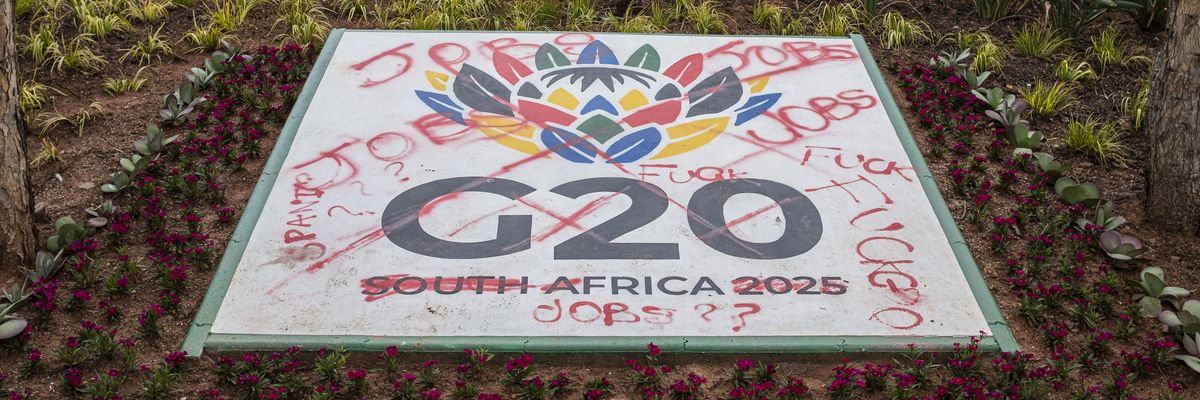
A general view of a vandalised G20 sign outside the Nasrec Expo Center in Johannesburg on November 10, 2025, where the upcoming G20 summit will be hosted.
Multilateralism is in tatters. Instead of rules-based, consensus agreements, global economic relations have largely devolved into one-on-one arm-twisting and name-calling, alternating with fawning sycophancy and lavish personal gifts. In recent negotiations with Asian leaders, President Trump scored a gold golf ball, a gold crown, and a gold-flecked dessert.
In a world already divided by extreme inequalities, the collapse of multilateralism makes it even more likely that the most powerful players — the largest economies and the wealthiest corporations and individuals — will score the best deals. Small countries and ordinary people, from Iowa soybean farmers and Mexican factory workers to digital service consumers in Cambodia, are even more likely to get the shaft.
The G20 is a space that was intended to catalyze multilateral action. In fact, it touts itself as the “the premier forum for international economic cooperation,” and it is the one place where leaders of the world’s largest economies sit down together at least once a year for face-to-face dialogue.
South Africa will host this year’s G20 summit from November 22 to 23, and the United States will host the next one in December 2026. Do we have any reason to think this forum holds potential for not only restoring multilateralism but also advancing a more equitable global economy?
This is a question I’ve grappled with over the past several months as part of a team of analysts from the UK, Brazil, South Africa, and other countries. In our new joint report, The G20 at a Crossroads, we document a few examples of decisive actions this body has taken during its nearly two decades of existence.
In the midst of the financial crisis that erupted in 2008, for instance, labor unions and others successfully lobbied G20 leaders to adopt coordinated stimulus measures that helped avoid a depression-level global collapse.
In response to the Covid-19pandemic, the G20 approved of at least some debt relief for low-income countries and authorized $650 billion in financial aid in the form of “special drawing rights,” the largest-ever allocation of this IMF-created international reserve asset.
These actions were far from perfect. Governments prematurely aborted the stimulus programs they adopted after the 2008 crash in favor of austerity budgets that deepened and prolonged economic crises.
Pandemic support programs were woefully insufficient for the poorest countries and failed to prevent many of them from sinking even further into debt. Between 2019 and 2023, Sub-Saharan Africa’s total external debts increased from $747 billion to $864 billion while the number of global billionaires grew from 2,153 to 2,640. Overall, 3.4 billion of the world’s people live in countries that spent more money in the years 2021-2023 servicing their foreign debts than on public education or health.
What can we learn from these examples? G20 leaders obviously have the power to mobilize vast resources, but the few times they’ve used this power, the focus has largely been on containing market crises to protect the interests of the wealthiest creditors and investors rather than improving the lives of the most vulnerable.
And so while we need to push for renewed multilateralism, we cannot be satisfied with a return to old models. We need new approaches that go beyond crisis management to build a more resilient, sustainable, and just global economy for the long term.
To achieve this, the G20 must tackle what we describe in our report as the “lived crises of our time” — the daily realities of extreme droughts, food insecurity, unaffordable housing, precarious work, debt traps, and forced displacement.
Decades of neglecting these threats to global stability has undercut the welfare of people in both the Global North and South. High levels of poverty and unemployment in the developing world, for example, weaken the bargaining power of U.S. workers who are competing in a global labor pool.
Climate change, obviously, knows no boundaries. And skyrocketing inequality is fueling political polarization, authoritarianism, and xenophobia around the world, as elites deflect blame onto migrants and other convenient scapegoats instead of confronting structural failures.
Last year, the Brazilian presidency took important steps towards broadening the G20 agenda. Through diplomacy, sustained civil society engagement, and collaboration with innovative academics, they elevated critical proposals for clean energy financing, taxing extreme wealth, and valuing care work. And while they did not secure G20-wide cooperation on these fronts, their efforts gave a boost to campaigns in numerous countries for increasing taxes on billionaires and ensuring decent pay for caregivers and affordable care for those who need it.
“Wherever we live, we all want the same things — a secure place to live, a healthy environment, the ability to care for our loved ones, and the chance to plan for our future,” notes our lead report author, Fernanda Balata, of the New Economics Foundation.
With political will and a commitment to cooperation, G20 leaders have the power to deliver these basic elements of a dignified life to billions of people.
‘Worst of the Worst’? DOJ Figures Show 97.4% of 614 Detained Immigrants in Chicago Had No Criminal Record Of 614 people on list who may have been unlawfully arrested and detained by federal officials, only 16 had a criminal record of any kind.
Federal agents, including Chief Patrol Agent Gregory Bovino of the El Centro Sector for U.S. Customs and Border Protection, detain two men working on a home in the Edison Park neighborhood on October 31, 2025, in Chicago, Illinois. One man was released after showing proof of citizenship, while the other was arrested under President Donald Trump’s administration’s “Operation Midway Blitz,” an ongoing immigration enforcement surge across the Chicago region. (Photo by Jamie Kelter Davis/Getty Images)
President Donald Trump and his administration have claimed repeatedly that the immigration raids that have terrorized communities nationwide this year are focused on getting the “worst of the worst” off the streets and out of the country, but new detention data filed by the Department of Justice on Friday shows that only a tiny fraction of the more than 600 people who remain in detention in the Chicago area from raids over recent months have any criminal record, bolstering anecdotal evidence that many of those targeted for by ICE and federal border agents are hard-working, law-abiding members of society.
According to the Chicago Tribune: The Trump administration on Friday released the names of 614 people whose Chicago-area immigration arrests may have violated a 2022 consent decree, and only 16 of them have criminal histories that present a “high public safety risk.”
The list was produced as part of an ongoing lawsuit alleging immigration agents have repeatedly violated the terms of the in-court settlement, mostly during “Operation Midway Blitz,” that puts a high bar on making so-called warrantless arrests without a prior warrant or probable cause.
The newspaper reports that of the 16 people arrested with criminal histories—representing just 2.6% of the total listed in the filing— “five involved domestic battery, two were related to drunken driving, and one allegedly had an unidentified criminal history in another country.” None had criminal backgrounds that included worst-of-the-worst offenses like rape or murder.
Earlier this week, U.S. District Judge Jeffrey Cummings ordered the government to provide more information about the more than 600 people being held in detention and suggested he would order their release if compelling public-safety reasons were not presented. While ordering the immediate release of 13 people he deemed were arrested unlawfully, Cummings gave the government until Friday to release the additional information on those being held.
The Chicago Sun-Times reports that the list of 614 detainees comes from a longer list of roughly 1,800 individuals arrested by U.S. Immigration and Customs Enforcement in the Chicago area between June 11 and October 7, of which “only about 750 of them remain in the country.” Most of the others were deported, and their criminal histories were not presented in Friday’s disclosure.
The consent decree at issue, known as the Castañon-Nava settlement agreement, restricts the ability of ICE agents or others working with them to make warrantless arrests in Illinois.
“Communities throughout the Chicago area have been traumatized by ICE and other federal agents’ chaotic and violent actions in our neighborhoods in recent months, and potentially hundreds of families already have been permanently separated as a result of unlawful arrests and rapid deportations without due process,” said Mark Fleming, associate director of litigation for the National Immigration Justice Center (NIJC), who is backing the legal case against the unlawful arrests and detentions in Chicago, after the order issued by Cummings on Wednesday.
“NIJC and our partners will continue to demand justice for our communities and accountability for the lawless administration we all are facing.”
During Wednesday’s hearing, the judge suggested many of those who remain in detention likely have no history of criminal conduct and were targeted by federal agents simply for fitting a specific profile. As the Sun-Times reports: Cummings said that 54 of those people were arrested at work, including 20 landscapers and four ride-share or taxi drivers. Twenty were arrested commuting to or from work, he added, and nine were arrested at a Home Depot or Menards, “presumably either seeking work or to pick up supplies.”
Seven were also arrested at an “immigration-related hearing,” Cummings said, while 11 were arrested in public places like a park, gas station or even a Dunkin’ Donuts drive-thru.
“It seems highly likely to me that at least some of those individuals are among the 615 detainees who are not subject to mandatory detention,” Cummings said. He also found them unlikely to be members of gangs, “assorted other ne’er-do-wells” or the “worst of the worst.”
Community members living in Chicago and its outlying suburbs, including Broadview, have expressed anger at Trump’s ICE operations in the region, which have seen school teachers, childcare providers, day laborers, and other neighbors targeted and arrested.
On Friday, 21 people were arrested outside the immigration detention center in Broadview following a morning demonstration outside the facility.
WTF!
‘National Security Threat’? 95-Year-Old Human Rights Scholar Richard Falk Interrogated for Hours by Canada
“Clearly, the international repression of the Palestinian cause knows no bounds.” Former UN Special Rapporteur on Palestine Prof. Richard Falk delivers a speech during the event titled ‘Gaza Tribunal: Final Session’ in Istanbul, Turkiye, on October 26, 2025. Photo by Cem Tekkesinoglu/Anadolu via Getty Images
Ninety-five-year-old Richard Falk—world renowned scholar of international law and former UN special rapporteur focused on Palestinian rights—was detained and interrogated for several hours along with his wife, legal scholar Hilal Elver, as the pair entered Canada for a conference focused on that nation’s complicity with Israel’s genocide in Gaza.
“A security person came and said, ‘We’ve detained you both because we’re concerned that you pose a national security threat to Canada,'” Falk explained to Al-Jazeera in a Saturday interview from Ottawa in the wake of the incident that happened at the international airport in Toronto ahead of the scheduled event.
“It was my first experience of this sort–ever–in my life,” said Falk, professor emeritus of international law at Princeton University, author or editor of more than 20 books, and formerly the UN special rapporteur on the situation of human rights in the Palestinian territories.
Falk, who is American, has been an outspoken critic of the foreign policy of Canada, the United States, and other Western nations on the subject of Israel-Palestine as well as other issues. He told media outlets that he and his wife, also an American, were held for over four hours after their arrival in Toronto. They were in the country to speak and participate at the Palestine Tribunal on Canadian Responsibility, an event scheduled for Friday and Saturday in Ottawa, the nation’s capital.
The event, according to the program notes on the website, was designed to “document the multiple ways that Canadian entities – including government bodies, corporations, universities, charities, media, and other cultural institutions–have enabled and continue to enable the settler colonization and genocide of Palestinians, and to articulate what justice and reparations would require.”
In his comments to Al-Jazeera, Falk said he believes the interrogation by the Canadian authorities—which he described as “nothing particularly aggressive” but “random” and “disorganized” in its execution—is part of a global effort by powerful nations complicit with human rights abuses and violations of international law to “punish those who endeavour to tell the truth about what is happening” in the world, including in Gaza.
Martin Shaw, a British sociologist and author of The New Age of Genocide, said the treatment of Falk and Elver should be seen as an “extraordinary development” for Canada, and not in a good way. For a nation that likes to think of itself as a “supporter of international justice,” said Shaw, “to arrest the veteran scholar and former UN rapporteur Richard Falk while he is attending a Gaza tribunal. Clearly, the international repression of the Palestinian cause knows no bounds.”
Canadian Senator Yuen Pau Woo, a supporter of the Palestine Tribunal, told Al-Jazeera he was “appalled” by the interrogation.
“We know they were here to attend the Palestine Tribunal. We know they have been outspoken in documenting and publicizing the horrors inflicted on Gaza by Israel, and advocating for justice,” Woo said. “If those are the factums for their detention, then it suggests that the Canadian government considers these acts of seeking justice for Palestine to be national security threats–and I’d like to know why.”