It’s possible that I shall make an ass of myself. But in that case one can always get out of it with a little dialectic. I have, of course, so worded my proposition as to be right either way (K.Marx, Letter to F.Engels on the Indian Mutiny)
Sunday, November 16, 2025
SPACE/COSMOS
The simulated Milky Way: 100 billion stars using 7 million CPU cores
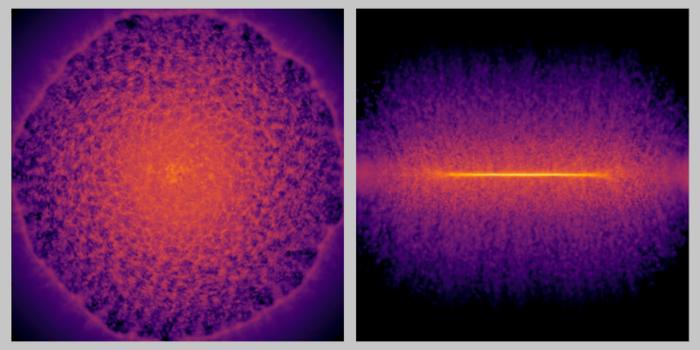
Head-on (left) and side-view (right) snapshots of a galactic disk of gas. These snapshots of gas distribution after a supernova explosion were generated by the deep learning surrogate model.
Researchers led by Keiya Hirashima at the RIKEN Center for Interdisciplinary Theoretical and Mathematical Sciences (iTHEMS) in Japan, with colleagues from The University of Tokyo and Universitat de Barcelona in Spain, have successfully performed the world’s first Milky Way simulation that accurately represents more than 100 billion individual stars over the course of 10 thousand years. This feat was accomplished by combining artificial intelligence (AI) with numerical simulations. Not only does the simulation represent 100 times more individual stars than previous state-of-the-art models, but it was produced more than 100 times faster. Published in the international supercomputing conference SC ’25, this study represents a breakthrough at the intersection of astrophysics, high-performance computing, and AI. Beyond astrophysics, this new methodology can be used to model other phenomenon such as climate change and weather patterns.
Astrophysicists have been trying to create a simulation of the Milky Way Galaxy down to its individual stars, which could be used to test theories of galactic formation, structure, and stellar evolution against real observations. Accurate models of galaxy evolution are difficult because they must consider gravity, fluid dynamics, supernova explosions, and element synthesis, each of which occur on vastly different scales of space and time.
Until now, scientists have not been able to model large galaxies like the Milky Way while also maintaining a high star-level resolution. Current state-of-the-art simulations have an upper mass limit of about one billion suns, while the Milky Way has more than 100 billion stars. This means that the smallest “particle” in the model is really a cluster of stars massing 100 suns. What happens to individual stars is averaged out, and only large-scale events can be accurately simulated. The underlying problem is the number of years between each step in the simulation—fast changes at the level of individual stars, like the evolution of supernovae, can only be observed if the time between each snapshot of the galaxy is short enough.
But, processing smaller timesteps takes more time and more computational resources. Aside from the current state-of-the-art mass limit, if the best conventional physical simulation to date tried to simulate the Milky Way down to the individual star, it would need 315 hours for every 1 million years of simulation time. At that rate, simulating even 1 billion years of galaxy evolution would take more than 36 years of real time! But adding more and more supercomputer cores is not a viable solution. Not only do they use an incredible amount of energy, but more cores will not necessarily speed up the process because efficiency decreases.
In response to this challenge, Hirashima and his research team developed a new approach that combines a deep learning surrogate model with physical simulations. The surrogate model was trained on high-resolution simulations of a supernova and learned to predict how the surrounding gas expands in the 100,000 years after a supernova explosion, without using resources from the rest of the model. This AI shortcut enabled the simulation to simultaneously model the overall dynamics of the galaxy as well as fine-scale phenomena such as supernova explosions. To verify the simulation’s performance, the team compared the output with large-scale tests using the RIKEN’s supercomputer Fugaku and The University of Tokyo’s Miyabi Supercomputer System.
Not only does the method allow individual star resolution in large galaxies with over 100 billion stars, but simulating 1 million years only took 2.78 hours. This means that the desired 1 billion years could be simulated in a mere 115 days, not 36 years.
Beyond astrophysics, this approach could transform other multi-scale simulations—such as those in weather, ocean, and climate science—in which simulations need to link both small-scale and large-scale processes.
“I believe that integrating AI with high-performance computing marks a fundamental shift in how we tackle multi-scale, multi-physics problems across the computational sciences,” says Hirashima. “This achievement also shows that AI-accelerated simulations can move beyond pattern recognition to become a genuine tool for scientific discovery—helping us trace how the elements that formed life itself emerged within our galaxy.”
Milestone results released by the Large High Altitude Air Shower Observatory (LHAASO) on November 16 have solved a decades-old mystery about the cosmic ray energy spectrum—which shows a sharp decrease in cosmic rays above 3 PeV, giving it an unusual knee-like shape.
The cause of the "knee" has remained unclear since its discovery nearly 70 years ago. Scientists have speculated that it is linked to the acceleration limit of the astrophysical sources of cosmic rays and reflects the transition of the cosmic ray energy spectrum from one power-law distribution to another.
Now, however, two recent studies—published in National Science Review and Science Bulletin, respectively—demonstrate that micro-quasars driven by black hole system accretion are powerful particle accelerators in the Milky Way and are the likely source of the "knee." The studies also advance our understanding of the extreme physical processes of black hole systems.
The research was conducted by researchers from the Institute of High Energy Physics of the Chinese Academy of Sciences (CAS), Nanjing University, the University of Science and Technology of China of CAS, La Sapienza University of Rome, and other institutions.
Black holes, one of the most enigmatic objects in the universe, generate relativistic jets when accreting material from companion stars in binary systems, forming "micro-quasars." In this study, LHAASO systematically detected for the first time ultra-high-energy gamma rays from five micro-quasars: SS 433, V4641 Sgr, GRS 1915+105, MAXI J1820+070, and Cygnus X-1.
In particular, the ultra-high-energy radiation from SS 433 was found to overlap with a giant atomic cloud, strongly suggesting that the high-energy protons are accelerated by the black hole and collide with surrounding matter. The proton energy in this system exceeded 1 PeV, with a total power output of approximately 1032 joules per second, equivalent to the energy released per second by four trillion of the most powerful hydrogen bombs. The gamma-ray energy from V4641 Sgr was found to reach 0.8 PeV, making it another "super PeV particle accelerator," while the parent particles generating these gamma rays had energies exceeding 10 PeV.
These results prove that micro-quasars are significant PeV particle accelerators in the Milky Way, addressing a long-standing issue in science: While supernova remnants were historically recognized as cosmic ray sources, both observational and theoretical studies have shown that they cannot accelerate cosmic rays to the energies of the "knee" and beyond.
To fully understand this phenomenon, precise measurements of the energy spectra of the various cosmic ray species including their respective "knees" are essential. The first step is to measure the energy spectrum of the lightest nuclei—protons. However, cosmic rays in the "knee" region are sparse and satellite detectors have limited acceptance, making detection akin to finding a needle in a haystack. In ground-based indirect measurements of cosmic ray particles, it is impossible to avoid atmospheric interference. This makes it difficult to distinguish protons from other nuclei. For a long time, this measurement was considered impossible.
In this study, leveraging its world-leading ground-based cosmic ray observational equipment, LHAASO developed multi-parameter measurement techniques and selected a large statistical sample of high-purity protons, allowing for precise measurement of their energy spectrum, with precision comparable to that of satellite experiments. This measurement revealed an energy spectrum structure that was entirely unexpected, clearly displaying a new "high-energy component" instead of a simple transition between power-law spectra.
LHAASO's new findings, together with the low-energy component measured by the space-borne AMS-02 experiment and the intermediate-energy component measured by the space-borne DArk Matter Particle Explorer (DAMPE) experiment, revealed the existence of multiple accelerators within the Milky Way, with each possessing its own unique acceleration capability and energy range. The "knee" represents the acceleration limit of the sources responsible for generating the high-energy component.
The complex structure of the proton energy spectrum indicates that cosmic ray protons in the PeV energy range primarily originate from "new sources" such as micro-quasars, which have an acceleration limit significantly higher than that of supernova remnants. This enables them to generate high-energy cosmic rays that exceed the "knee."
These two discoveries support each other, presenting a comprehensive scientific picture. This not only marks a significant advancement in resolving the long-standing mystery of the "knee" origin, but also offers crucial observational evidence for understanding the role of black holes in the origin of cosmic rays.
LHAASO's hybrid detector array design allows for the detection of cosmic ray sources through ultra-high-energy gamma rays, while enabling precise measurement of cosmic ray particles in the vicinity of the solar system. This approach offers insights into the acceleration capabilities of sources at PeV energies and the spectral characteristics they contribute to cosmic rays. For the first time, the "knee" structure has been observationally connected to a specific type of astrophysical source—the black hole jet system.
LHAASO, which was designed, constructed, and is operated by Chinese scientists, has taken the lead in high-energy cosmic-ray researches due to its sensitivity in both gamma ray astronomical exploration and cosmic ray precision measurement. It has achieved a series of discoveries that have a global impact, thereby contributing to our knowledge of the extreme physical processes in the universe.

No comments:
Post a Comment