Saturday, November 15, 2025

UN human rights council orders investigation into atrocities in Sudan

The United Nations' top rights body on Friday adopted a resolution ordering an independent fact-finding mission to urgently investigate reports of human rights violations in the Sudanese city of El Fasher, where paramilitary forces are accused of mass killings and other atrocities.


Issued on: 14/11/2025 - RFI

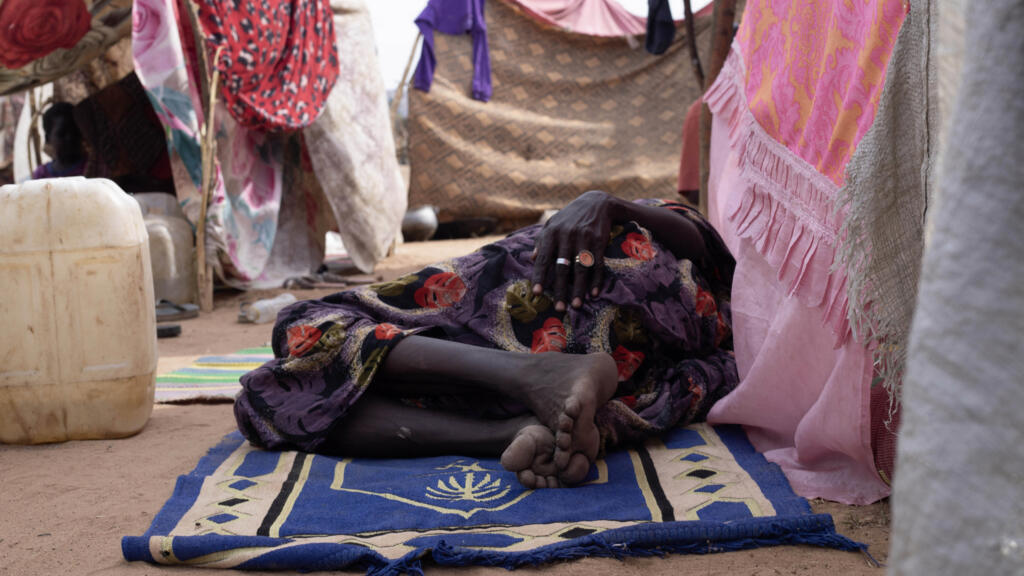
A Sudanese person displaced by fighting in the city of El Fasher rests in the Um Yanqur camp in the western Darfur region on 3 November 2025. © AFP

The text also called on the investigative team to identify suspected perpetrators where possible in a bid to ensure they are held accountable.

The decision came at the end of a special session of the UN Human Rights Council on Sudan, called amid mounting warnings of crimes against humanity and the risk of genocide.

In an opening address to delegates in Geneva, the UN human rights chief Volker Turk urged the international community to act.

"There has been too much pretence and performance, and too little action. It must stand up against these atrocities – a display of naked cruelty used to subjugate and control an entire population," Turk said.

Since breaking out in April 2023, the war between Sudan's army and the paramilitary Rapid Support Forces has killed tens of thousands of people, displaced nearly 12 million more and triggered one of the world's worst humanitarian crises.


The violence has escalated dramatically in recent weeks, with the RSF seizing control of the key town of El Fasher in Sudan's western Darfur region after an 18-month siege.

Reports have emerged of executions, sexual violence, looting, attacks on aid workers and abductions in and around the city, where communications remain largely cut off.

The RSF has denied targeting civilians or blocking aid, saying any such actions are the work of rogue actors.
Cycle of impunity

British ambassador Kumar Iyer, whose country requested the special session along with Germany, Ireland, the Netherlands and Norway, insisted that "the scale and severity of the crisis in Sudan can no longer be met with silence".

"The violence in El-Fasher bears the hallmarks of a coordinated campaign against civilians by the Rapid Support Forces," he said, pointing to "credible reports of actively targeted killings, systematic sexual violence, and the deliberate use of starvation".

Before Friday's resolution was adopted, he urged countries to green-light an investigation: "Without it, accountability will remain out of reach and the cycle of impunity will continue."


The text was adopted by consensus without a vote, although several countries, including Sudan, distanced themselves from sections broadening the scope of the fact-finding mission's investigation.

The UN estimates that nearly 100,000 have fled El Fasher in the past two weeks, many going to the town of Tawila, about 50 kilometres away, or even across the border to Chad.

"Information gathered indicates that hundreds of women and girls were raped and gang-raped along escape routes, including in public, without fear of repercussions or accountability," Mona Rishmawi, from the UN's independent fact-finding mission on Sudan, told Friday's session.

Adama Dieng, the African Union's special envoy and the UN special adviser for the prevention of genocide, warned that "the risk of genocide exists in Sudan. It is real and it is growing every single day."
'Existential war'

Sudanese ambassador Hassan Hamid Hassan cautioned that his country was caught up in "an existential war".

He accused the United Arab Emirates of "supporting [the RSF] with military and strategic equipment", something the UAE denies.

UAE ambassador Jamal Jama Al Musharakh criticised both the paramilitaries and the Sudanese army, accusing the latter of "indiscriminate attacks on markets, villages and hospitals, amid famine, while ignoring international calls for a truce".


Much of Friday's discussion revolved around the need to ensure accountability. Turk warned that the International Criminal Court had indicated it wasfollowing the situation closely.

He also said that "despicable disregard for civilian lives" was becoming apparent in the Kordofan region that borders Darfur.

Kordofan is comprised of three states that serves as a buffer between the RSF's western Darfur strongholds and the army-held states in the east.

"Kordofan must not suffer the same fate as Darfur," Turk said.

(with newswires)
Thieves in France steal jewellery worth up to €1 million: police

Thieves in northern France have made off with jewellery worth up to €1 million, police said on Saturday
.


Issued on: 15/11/2025 - RFI

For the second time in a month, thieves succeeded in a major heist
 in France. 15 November 2025. © Ludovic Marin / AP


The burglars reportedly broke into a jewellery boutique in central Roubaix, near Lille, on Wednesday, and briefly took the jeweller and his wife hostage before making off with the valuables.

The jewels were worth "between €500,000 and €1 million, police said.

They have launched an investigation into kidnapping, organised crime and armed extorsion.

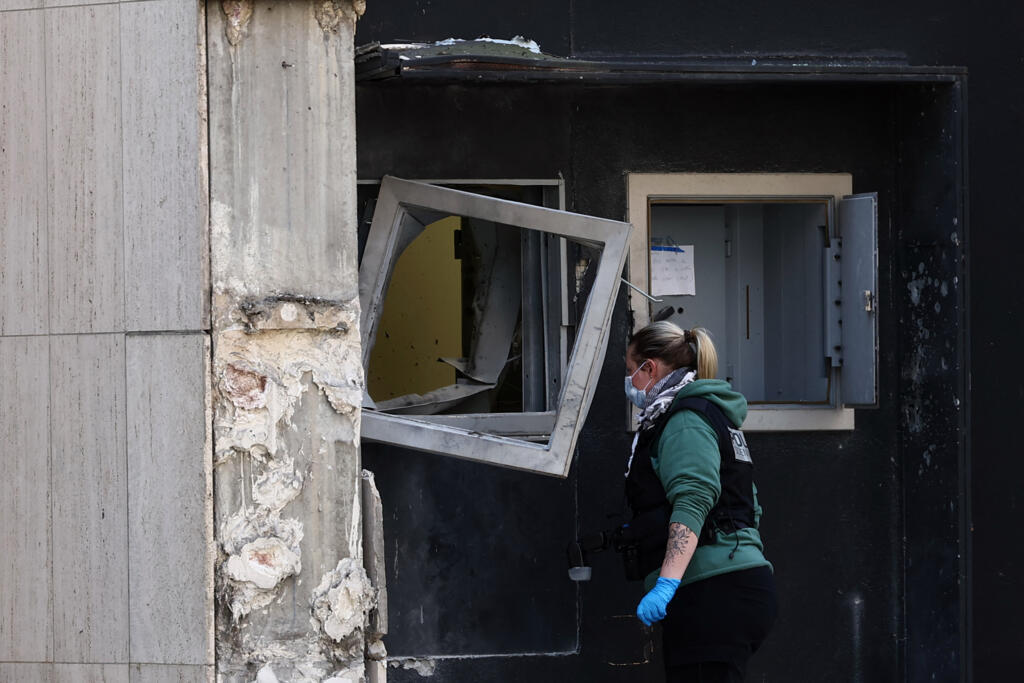
In a separate incident earlier on Wednesday, several individuals blew up a cash transfer safe belonging to Roubaix's main post office and escaped with the bag that was inside it.

A French forensic policewoman inspects the facade of a "La Poste" office, the mail service group of France, in Roubaix on November 12, 2025 following a robbery, local media reported. AFP - SAMEER AL-DOUMY


It later transpired that the bag contained nothing other than more empty bags. Six people were arrested that evening.

The heists come after a gang raided the Louvre museum in Paris in broad daylight last month, stealing jewellery worth an estimated €100 million.

(With newswires)


JAPANESE FASCISM

'Work, work, work!' Japan's new PM under fire for asking staff to come in at 3am

Issued on: 14/11/2025 
Play (12:41 min)
From the show


When she was elected head of Japan's ruling party, Sanae Takaichi declared that she had abandoned the term "work-life balance" and asked fellow party members to "work like a horse". A month into office, the country's first female prime minister appears to have put her words into action. She told parliament that she was only sleeping two to four hours at night, a few days after organising a 3am staff meeting. In a country plagued by a culture of overwork, this hasn't gone down well.

Meanwhile, Japan continues to grapple with an unprecedented level of bear attacks, with a record 13 people killed as of early November. With bear sightings becoming more and more frequent in residential areas, police officers are now allowed to cull the animal with rifles.

Also on the show, three Chinese astronauts have returned home after being stranded in space following a suspected debris strike on their spaceship. After their six-month mission at China's Tiangong space station ended, their return to Earth was delayed for nearly 10 days after the vessel meant to carry them back home was damaged.

Plus, Philippine President Ferdinand Marcos Jr. has vowed to put many of those implicated in a massive corruption scandal behind bars by Christmas. At least 37 senators, MPs and wealthy businesspeople are accused of syphoning off taxpayer money earmarked for flood prevention projects that never happened. The island nation has suffered the worsening impacts of climate change, most recently with a deadly super typhoon, Fung-wong.


Bars, Pride and dating apps: How China is closing down its LGBT+ spaces

ANALYSIS

Apple this week confirmed it has removed two popular LGBT+ dating apps from its app store in China, at the authorities’ request. The decision is the latest in a series of policies that are shutting out China’s gay community.


Issued on: 14/11/2025 - 
FRANCE24
By: Sébastian SEIBT

Several recent measures have targeted LGBTQ+ communities in China. 
© VlatkoRadovic, Getty Image


When two dating apps, Blued and Finka, disappeared from the Apple AppStore in China on November 11, a whole world threatened to disappear.

The apps are two of the most popular among China’s LGBT+ community. Blued had been downloaded tens of millions of times, according to the BBC.

In taking them down, the authorities removed two major LGBT+ spaces, leaving little in their place.

“There are still some local apps available, but they are smaller, and they have limited circulation and popularity,” says Bao Hongwei, specialist in China’s queer culture at the University of Nottingham.

Apple said it removed the apps “based on an order from the Cyberspace Administration of China”.

‘A seismic change’

It is not the first time that the authorities have targeted gay dating apps. In 2022, the American app Grindr was retired in China.

The ban on Grindr could be put down to China’s wider dislike of Western apps, which are often accused of being vehicles for foreign influence. But removing Blued and Finka, which were both developed in China, represents a “seismic change in government attitudes towards homegrown LGBT apps”, says Hongwei.

“The Chinese government used to support the business of Blued,” Hongwei says. “The former Chinese Premier Li Keqiang, actually met with the CEO of Blued [in 2012] and it enjoyed a certain legitimacy.”

The disappearance of both Blued and Finka “will affect a lot of LGBT+ people's lives very significantly”, Hongwei adds. “It sends a chilling and very clear message to ordinary LGBT+ people that they can't pursue their own personal interests and desires.”
Erasing gay culture

Evidence of hardening attitudes towards the LGBT+ community in China has been increasing for some time.

Before targeting Blued and Finka, the Chinese authorities led a campaign against authors of the “Boy's Love”, or Danmei, same-sex romance stories, some of which feature explicit love scenes between men.

Several Danmei writers, most of whom are female, have reported being arrested and questioned by the authorities, and in recent months two major Danmei sites have either shut down, or drastically reduced and toned down their content.

In September, a censored version of American-Australian horror film “Together” was released in China with a gay marriage scene digitally altered to show a heterosexual couple.

And in early 2024, China’s dominant social platform Weibo removed viral images of Chinese dancer and transgender icon Jin Xing waving a rainbow flag.

Despite being a high-profile and immensely popular celebrity in China for years, venues across the country dropped performances by her dance troupe without explanation in January 2025.


‘Three No’s’


China decriminalised homosexuality in 1997 and officially recognised that it was not a mental illness in 2001.

For a long time, China adopted a policy of Three No’s towards homosexuality: no approval, no disapproval and no promotion.

This allowed for a period of “good years in the 2000s where more people were openly gay", says Timothy Hildebrandt, specialist in social politics and sexuality in China at the London School of Economics.

Even so, gay and queer people in China have had to navigate murky legal waters in which their sexuality is legal, but they have no official protections.

For example, while gay marriage is not recognised, a court in 2016 agreed to hear the case of a man suing local authorities for refusing to register his union with his male partner – a first in China.

But the judge ultimately dismissed the case.

Today, “officially, those Three No’s are still in place, but we are seeing evidence that the space for LGBT+ communities is starting to shrink”, says Marc Lanteigne, associate professor of political science at the Arctic University of Norway.

Shanghai Pride shut down in 2020, and one year later the government shut down student LGBT+ accounts for “violating internet regulations”. Grindr disappeared in 2022, and in 2023 the Beijing LGBT Centre closed its doors after 15 years.

In June 2024, the Roxie, Shanghai's last officially lesbian bar, was forced to close “under pressure from the authorities".

“The authorities have been slowly chipping away at those spaces that were open previously,” says Hildebrandt.

With the closure of so many physical spaces, online networks had become “really the only places in which many members of the LGBT+ community could express their sexuality openly” he adds.

A collateral victim

Why is China’s LGBT+ community being targeted in this way? Rather than being specifically singled out, it is likely that it is a collateral victim of Xi Jinping’s notion of “common prosperity”.

Historically, common prosperity has meant an effort by the Chinese Communist Party to promote economic and social equality.

But in contemporary Chinese politics, “the Maoist principles about equality have more to do with uniformity,” says Hildebrandt. “You gain equality by being more like everybody else. You don't gain equality by being diverse.”

In a bid to create greater conformity within the population, “there has been a push in China to reinforce traditional family values and, in some cases, traditional masculine values,” adds Lanteigne.

At the same time, China’s population growth and economy are slowing. “The current population growth couldn't support economic growth,” explains Hongwei, meaning there has been a push to encourage heterosexual couples to have larger families to ensure an abundant future workforce.

In this context of wider policies to promote common prosperity, the LGBT+ community is not the only group facing repression, but it is an easy target.

Since the Covid pandemic, “the Chinese government has endorsed nationalist discourse and LGBT culture is seen as very politicised siding with Western ideologies”, says Hongwei.

“There's the impression that LGBTQ communities are by default connected to the West and could be seen as destabilising forces,” adds Lanteigne.

Broader political and social forces may be at work, but the result is a real loss of liberty for gay and queer people in China. Hildebrandt says: “There is a real sense that it’s become a more difficult environment to be openly gay."

This article was adapted from the original in French.


Starbucks to Burger King: US brands rethink China strategy

DW
November 14, 2025

US multinationals are increasingly aiming to derisk from China amid souring trade ties. Complaints about red tape and favoritism mask a harsher truth: China's market is brutally competitive and local rivals are winning.

Starbucks China has entered a joint venture with a Hong-Kong private equity firm
Image: Hector Retamal/AFP/Getty Images

When Starbucks opened its first store in Beijing in 1999, it wasn't just selling coffee; it was selling Western aspirations to China's rising middle class. The Seattle-based giant expanded rapidly to dominate China’s premium coffee scene.

That early-mover advantage has, however, since eroded. Chinese competitors like Luckin Coffee and Manner have overtaken Starbucks in store count and captured market share, thanks to aggressive pricing, mobile integration and a sharper understanding of Chinese consumer habits. Luckin drives more than 90% of sales via its app, while Starbucks still relies on in-store traffic.

The Financial Times reported recently that Starbucks' China revenues plunged nearly 19% from 2021 to 2024 to $3 billion (€2.58 billion). The coffee retailer's market share over the past five years has fallen to 14% (2024) from 34%, according to Euromonitor International.

With such headwinds affecting its second-biggest market, Starbucks announced this month it would sell a stake in its China operations to a Hong Kong-based private equity firm. The $4 billion deal with Boyu Capital creates a joint venture (JV) in which Starbucks retains 40%.

In a parallel move, Burger King announced a new JV with a Beijing-based private equity partner this week, selling a majority stake for $350 million in investment to expand from 1,250 to over 4,000 stores by 2035.

It's not just US multinationals. French sports retailer Decathlon is planning to sell about 30% of its China business, a stake valued at €1 billion ($1.16 billion) to €1.5 billion, as it faces pressure from local rivals.


Chinese brands speed ahead

For retailers from the United States, the problem is not only slowing demand but the speed and sophistication of local rivals, who launch new products faster and price more aggressively. They also integrate seamlessly into China’s digital ecosystem through mobile platforms like WeChat and Alipay.

"A lot of these global names have started to lose their brand power within China," Chenyi Lin, an affiliate professor specializing in digital transformation at Insead business school, told DW. "The new name of the game is agility and adaptability."

Clues to the hyper‑competitive nature of China's consumer market include its 129 electric-vehicle brands, more than 50,000 coffee chains and over 450,000 bubble tea outlets nationwide.

Local champions have not only saturated the mass market but are now moving upmarket, offering premium products at competitive prices. Even the extent of competition is fierce, with domestic players challenging foreign firms across food, fashion, electronics and mobility.

Jason Yu, Managing Director of CTR Market Research, says Chinese players used to copy from the big multinationals but are now sometimes surpassing them.

"In the coffee market, for example, local chains are launching new products much faster, sometimes in a matter of weeks, while Starbucks has to wait months for global approval," Yu told DW.

Analysts like Yu and Lin expect the JV trend to intensify, as Chinese brands expand globally while continuing to erode the dominance of Western names at home.


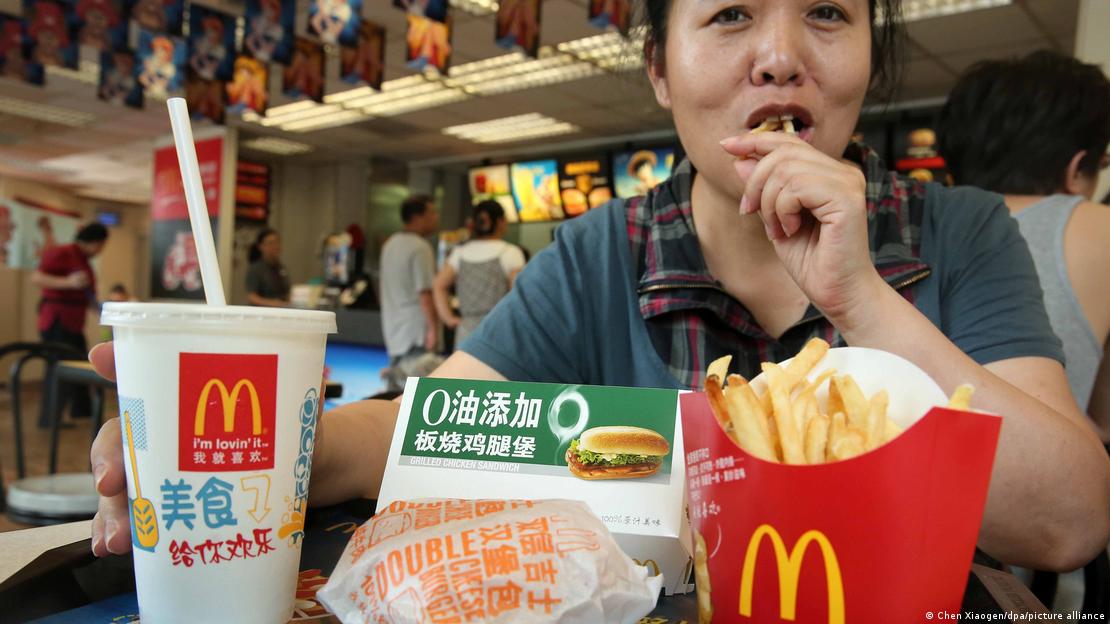
McDonald's boosted its stake in its China JV to 48% in 2023
Image: Chen Xiaogen/dpa/picture alliance


US firms cut China dependence as tariff woes linger

JVs are just one derisking strategy. Several US manufacturers recalibrated their global supply chains after the COVID-19 pandemic to cut reliance on China due to an over‑reliance on a single source for manufacturing and parts. Apple shifted some of its iPhone production to India, while Nike expanded manufacturing in lower-cost markets in Southeast Asia.

Amid uneven growth, US business confidence in China has also hit a historic low, with only 41% of firms optimistic about the next five years, according to industry lobby group AmCham Shanghai's September 2025 survey.

Yet rather than exit, Starbucks and Burger King's JVs with private-equity partners should enable them to gain speed, capital and digital integration in a market where local brands now set the pace.

"[Chinese JV partners] have the local knowledge, connections and resources to help the multinational brand to be more interconnected with the local ecosystem rather than compete on their own," said Yu.

Could this phase of joint ventures be different?

Historically, JVs were the standard way for foreign companies to enter China, mandated by law in the 1990s. However, these arrangements can be risky due to uneven regulatory enforcement, limited control over operations and potential intellectual property exposure.

Many US firms have had bitter experiences, facing diluted control, slower decision‑making and conflicts with local partners. By the 2000s, many foreign brands in China abandoned them, preferring wholly owned operations. Full foreign ownership in retail has only been allowed since 2022.

According to AmCham China, US corporations remain skeptical of JVs. Trade tensions and geopolitics add another layer of uncertainty, the business body said in a recent report. US–China tariffs remain in place on billions of dollars of goods, while rising frictions over Taiwan and other regional issues have also heightened boardroom anxiety.


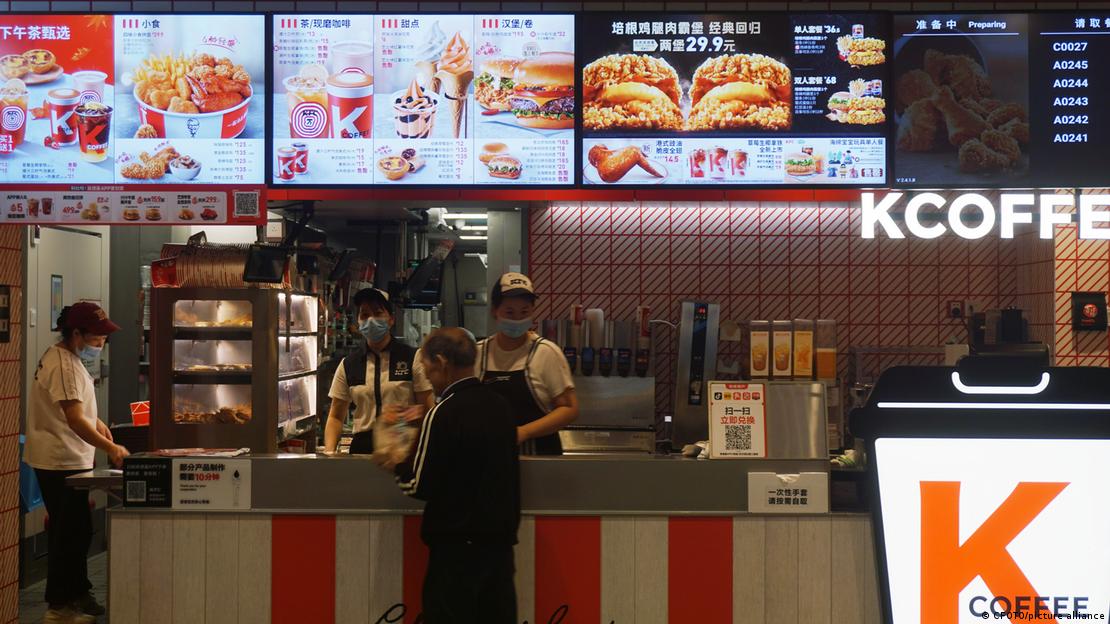
Yum China was spun off in 2016, with the US licensing 
the KFC and Pizza Hut brands
Image: CFOTO/picture alliance


Can US brands retain a competitive edge?


Yu told DW that joint ventures used to be seen as a necessary evil in China, but the latest deals are "very different" as they are less about legal necessity and more about strategic advantage.

"In a market where Chinese competitors launch new products in weeks and integrate seamlessly into digital platforms, agility is everything. Without these partnerships, many US retailers would struggle to keep pace," he said.

The greatest risk for US retailers is not competition but leaving China altogether. Walking away from the world’s largest consumer market would mean surrendering long‑term growth. Exiting may look like derisking, but it also risks irrelevance.

“If you leave China, you don't just lose sales today — you lose the ability to shape the habits of tomorrow's consumers," Lin told DW. "Once those habits are set by local brands, it is almost impossible for foreign companies to win them back."

Edited by: Uwe Hessler
NO PASARAN!
French official to sue over ‘revisionist’ remarks hailing Nazi collaborator Pétain

A senior French official on Saturday said he planned to take legal action over remarks hailing Vichy leader and Nazi collaborator Philippe Pétain as “France’s first resistant fighter”. The comments, which the official described as “clearly revisionist’ were made following a mass in Pétain’s honour.


Issued on: 15/11/2025 
By: FRANCE 24


Samuel Hazard, mayor of the French city of Verdun, said he was deeply hurt by the praise for Pétain. 
© Jean-Christophe Verhaegen, AFP

A senior French official said Saturday he would take legal action over comments made following a tribute to Philippe Pétain, France’s wartime head of state convicted of treason after World War II.

The row is the latest controversy over the legacy of Pétain, a World War I hero disgraced for his collaboration with the Nazis.

Xavier Delarue, the government prefect of Meuse department in eastern France, said he would take action over comments made following a mass for Pétain organised by an association dedicated to restoring his reputation.

Interior Minister Laurent Nunez also condemned the comments.

The Association to Defend the Memory of Marshal Pétain (ADMP) organised a mass Saturday at the church of Saint-Jean-Baptiste in Verdun, where Pétain won a famous WWI battle in 1916.

Around 20 association members attended, while outside about 100 people, watched by police, gathered to protest the ceremony.

After the mass ADMP president Jacques Boncompain told journalists that Pétain had been “the first resistant fighter of France”.

Boncompain also said Pétain’s post-war conviction for treason by a High Court of Justice had not been a fair one.

Delarue, announcing his legal action, said the comments had been “clearly revisionist”.

Nunez, in a post on X, said: “The remarks made today on the sidelines of a mass in ‘tribute’ to Philippe Pétain in Verdun go against our collective memory.”

The minister condemned any attempt to rehabilitate someone linked to WWII collaboration and oppression.
‘Deeply hurt’

The ceremony in tribute to Pétain came just days after France’s Armistice Day on November 11, the day WWI ended, when the nation remembers those who fought and died in the conflict.

Verdun’s mayor, Samuel Hazard, had tried to ban the pro-Petain ceremony, but was overruled by an administrative court ruling on Friday.

“I’m deeply hurt, because I think of all the victims of Nazi barbarism and... Marshal Pétain’s ideology,” he said after Saturday’s ceremony.

Pétain’s admirers stress the role he played as a general in World War I. He is widely seen as the architect of France’s victory over German forces at Verdun, the longest battle of the war.

But he only avoided the death penalty after being convicted at the end of WWII for leading France’s collaborationist Vichy government because of his advanced age.

Pétain died in 1951, six years into his life sentence in exile on the Atlantic island of Yeu.

(FRANCE 24 with AFP)


IT WAS COMMUNISTS, ANARCHISTS, TRADE UNIONISTS, HOUSEWIVES WHO
MADE UP THE RESISTANCE


IS PARIS BURNING
 

Groups Warn Trump Executive Orders Would Spike Cancers Caused by Exposure to Nuclear Radiation

A letter implored the Nuclear Regulatory Commission to “stand up to the executive order’s marching orders to ‘promote’ nuclear power.”


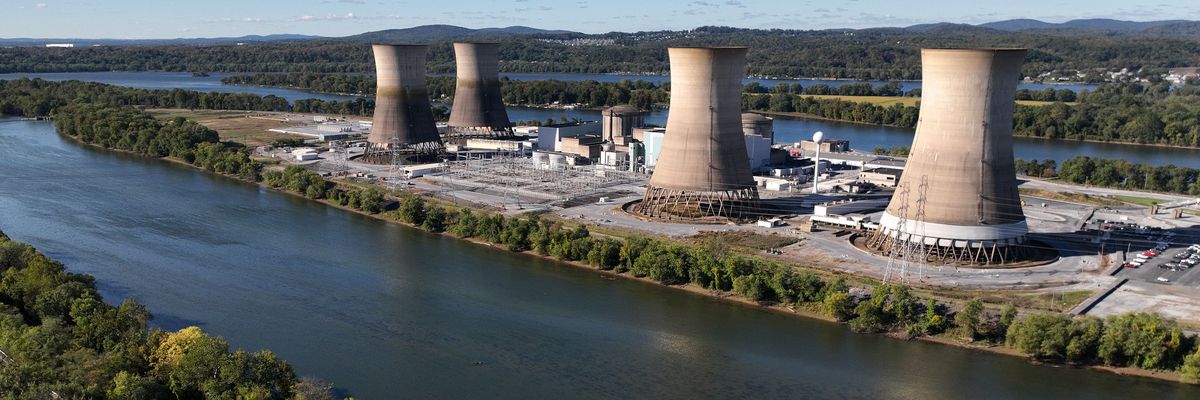
The shuttered Three Mile Island nuclear power plant stands in the middle of the Susquehanna River on October 10, 2024 near Middletown, Pennsylvania.
(Photo by Chip Somodevilla/Getty Images)

Julia Conley
Nov 14, 2025
COMMON DREAMS

A series of nuclear power-related executive orders issued by President Donald Trump seek to legitimize people’s “suffering as the price of nuclear expansion,” said one expert at Beyond Nuclear on Friday, as the nongovernmental organization spearheaded a letter to the Nuclear Regulatory Commission and top Trump administration officials warning of the public health risks of the orders.

More than 40 civil society groups—including Physicians for Social Responsibility (PSR), Sierra Club, Nuclear Watch South, and the Appalachian Peace Education Center—signed the letter to the commission, calling on officials not to revise the NRC’s Standards for Protection Against Radiation, as they were directed to earlier this year by Trump.
RECOMMENDED...


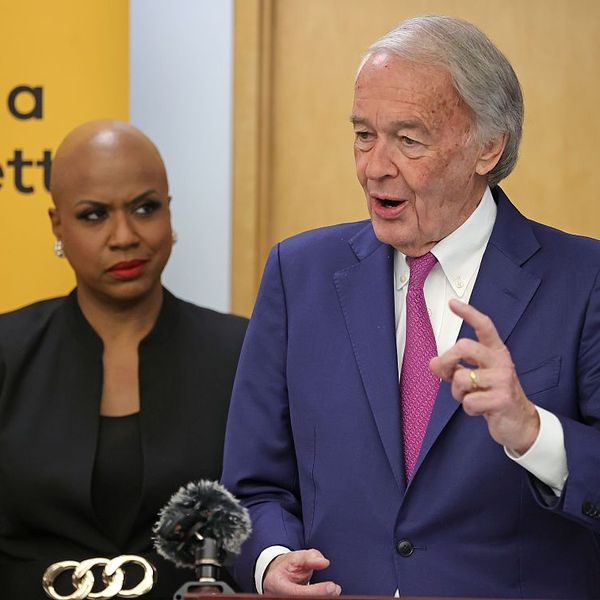
‘A Mistake of Radioactive Proportions’: Markey Pushes Bill to Block Trump From Testing Nuclear Bombs


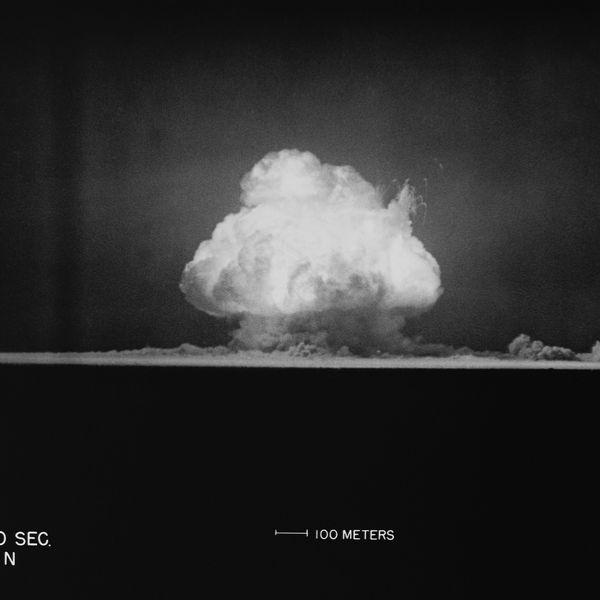
‘Extremely Dangerous for Humanity’: Trump Orders Resumption of US Nuclear Weapons Testing

“NRC has not made a revision yet, and has been hearing that the Part 20 exposure (external only) should be taken from the existing 100 mr [milliroentgen] a year, per license, to 500 mr a year, and in view of some, even to 10 Rems [Roentgen Equivalent Man], which would be 100 times the current level,” reads the letter.

In 2021, noted PSR, the NRC “roundly rejected” a petition “to raise allowable radiation exposures for all Americans, including children and pregnant women, to 10 Rems a year.”

The revision to radiation limit standards would result in anywhere from 5-100 times less protection for Americans, said the groups, with 4 out of 5 adult males exposed over a 70-year lifetime developing cancer that they otherwise would not have.

“Radiation is dangerous for everyone,” said Amanda M. Nichols, lead author of the 2024 study Gender and Ionizing Radiation. “[Trump’s] executive order will allow the industry to relax the current standards for radiological protection, which are already far from adequate. This will have detrimental health consequences for humans and for our shared environments and puts us all at higher risk for negative health consequences. ”

The change in standards would be even more consequential for women, including pregnant women, and children—all of whom are disproportionately susceptible to health impacts of ionizing radiation, compared to adult males.

“Radiation causes infertility, loss of pregnancy, birth complications and defects, as well as solid tumor cancer, leukemia, non-cancer outcomes including cardiovascular disease, increased incidence of autoimmune disease, and ongoing new findings.”

In Gender and Ionizing Radiation, Nichols and biologist Mary Olson examined atomic bomb survivor data and found that young girls “face twice the risk as boys of the same age, and have four to five times the risk of developing cancer later in life than a woman exposed in adulthood.”

Despite the risks to some of the country’s most vulnerable people, Trump has also called for a revision of “the basis of the NRC regulation,” reads Friday’s letter: the Linear No Threshold (LNT) model, the principle that there is no safe level of radiation and that cancer risk to proportional to dose.

The LNT model is supported by decades of peer-reviewed research, the letter states, but one of Trump’s executive orders calls for “an additional weakening of protection by setting a threshold, or level, below which radiation exposure would not ‘count’ or be considered as to have not occurred.”

The Standards for Protection Against Radiation are “based on the well-documented findings that even exposures so small that they cannot be measured may, sometimes, result in fatal cancer,” reads the letter. “The only way to reduce risk to zero requires zero radiation exposure.”

Trump’s orders “would undermine public trust by falsely claiming that the NRC’s radiation risk models lack scientific basis, despite decades of peer-reviewed evidence and international consensus supporting the LNT model,” it adds.

The signatories noted that the US government could and should strengthen radiation regulations by ending its reliance on “Reference Man”—a model that the NRC uses to create its risk assessments, which is based on a young adult male and fails to reflect the greater impact on infants, young children, and women.

“Newer research has shown that external radiation harms children more than adults and female bodies more than male bodies,” reads the letter. “Existing standards should therefore be strengthened to account for these life-stage and gender disparities… not weakened. Radiation causes infertility, loss of pregnancy, birth complications and defects, as well as solid tumor cancer, leukemia, non-cancer outcomes including cardiovascular disease, increased incidence of autoimmune disease, and ongoing new findings.”

Olson, who is the CEO of the Generational Radiation Impact Project, which also helped organize the letter, warned that “radiation causes cancer in women at twice the rate of adult men, while the same exposure in early childhood, will, across their lifetimes, produce seven times more cancer in young females, and four times more in young males.”

The groups emphasized that “executive orders do not have the power to require federal agencies to take actions that violate their governing statutes, nor to grant them powers and authorities that contradict those governing statutes. The NRC needs to stand up to the executive order’s marching orders to ‘promote’ nuclear power—a mission outside its legal regulatory mandate under the Energy Reorganization Act of 1974 and the concurrent amendments to the Atomic Energy Act.”

Federal agencies including the NRC, they added, “should not favor industry propaganda asserting that some radiation is safe over science-based protection of the public. This is a deliberate subversion of science and public health in favor of corporate interests.”

How nuclear power aims to wean Finland off Russian energy
DW
November 12, 2025

As Finland is striving to free itself from Russian energy imports, the country remains crucially dependent on its neighbor for fueling the transition.

Russia's share in Finland's energy import has gone down to almost zero
mage: Antti Yrjonen/NurPhoto/picture alliance

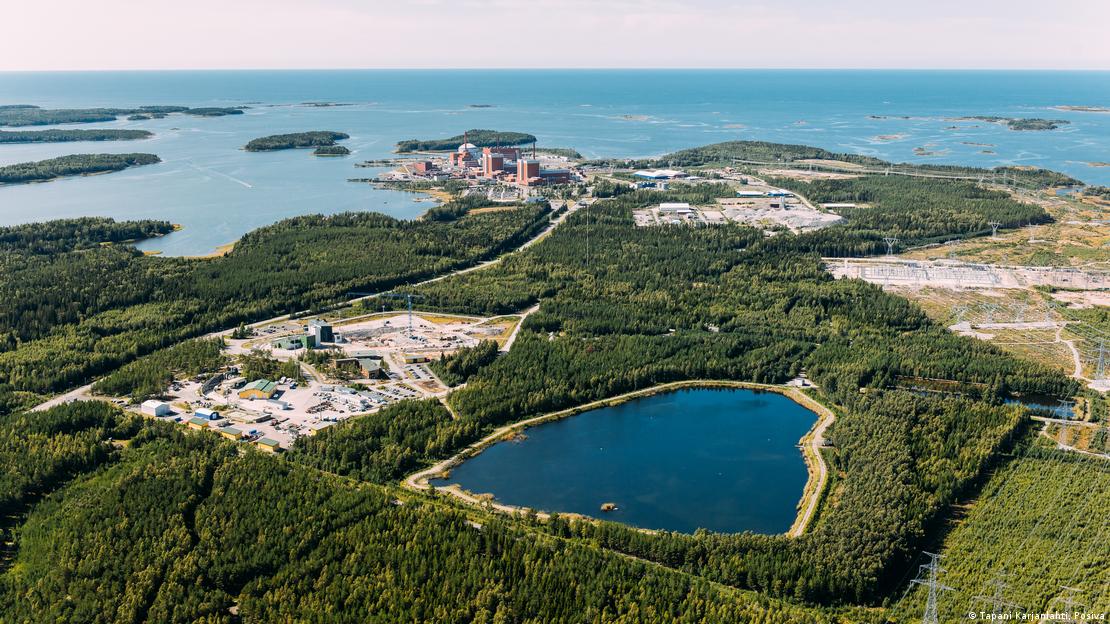
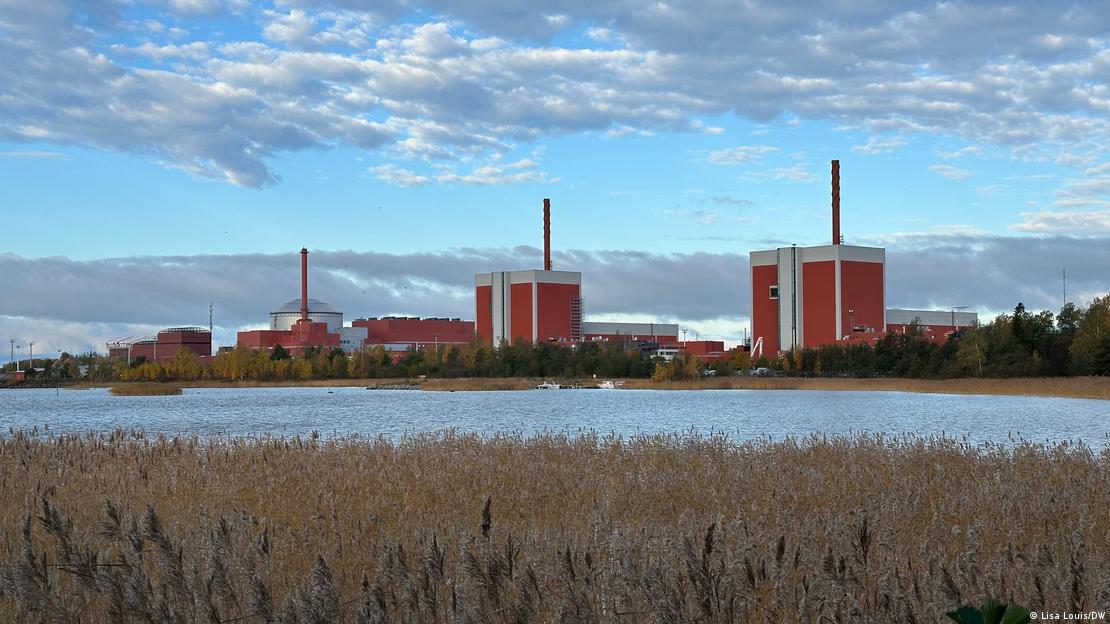
Olkiluoto island on the western coast of Finland used to be just an energy hub for the country bordering Russia. But with the start of Russia's full-scale invasion of Ukraine in February 2022, it became strategically important as Helsinki decided it could no longer rely on Russian energy.

Up until then, the country had been receiving half of its energy imports from the neighboring country, with which it shares a 1,300-kilometer (807-mile) border. They included electricity, oil and natural gas deliveries.

Olkiluoto island has become crucial for ensuring Finland's energy supply
Image: Tapani Karjanlahti, Posiva

"Before 2022, there had been the optimistic hope we had gotten past an era where it's all about enlarging territory and invading sovereign countries and we could live happily in peace having trade," says Sari Multala, Finland's minister of climate and the environment.

"But then, we understood that was not the case and that we had to take care of our own sovereignty, also when it comes to energy. We cannot depend on a hostile partner," she told DW.

Helsinki dropped its formerly neutral stance and announced it would join the Western defense alliance NATO. Moscow cut off electricity supplies to Finland, supposedly because Helsinki refused to pay for them in the Russian currency, the ruble.

Russia's share in Finland's energy import has since gone down to almost zero.

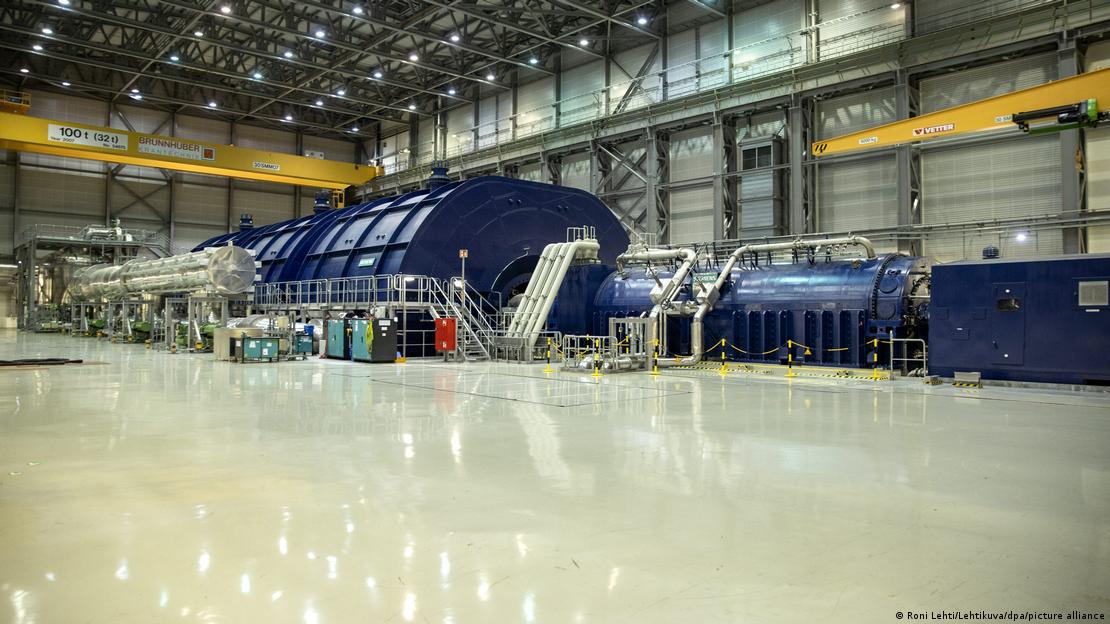
The turbines of the Olkiluoto 3 nuclear reactor were powered up in 2023 and are replacing large parts of the Russian electricity
Image: Roni Lehti/Lehtikuva/dpa/picture alliance

Oil, which made up for 19% of Finland's energy consumption in 2019, is now being imported from Norway, the UK and the US. Natural gas, at the time representing 5% in the country's energy mix, is imported in its liquefied LNG form.

Finland's state-owned company Gasgrid Finland, meanwhile, has commissioned a new floating LNG terminal in the southern port of Inga.

Nuclear energy and renewables are key


Finland's new nuclear reactor, Olkiluoto 3 is one of the biggest in the world with a total capacity of 1,600 mega-watts (MW), and has boosted Finland's nuclear share in electricity production from 28% in 2022 to 39% now.

But that came at a cost. Olkiluoto 3's price tag almost quadrupled to €11 billion ($12.7 billion). Building it took 18 years instead of four as initially planned. The skyrocketing costs had operator TVO cancel plans for a fourth reactor on Olkiluoto island.

"Consumers are benefiting from low electricity prices. And we have created 5,000 direct and indirect jobs," he told DW during a recent press tour of the reactor's premises.

For TVO spokesman Juha Poikola, the huge price tag for Olkiluoto was worthwhile
Image: Lisa Louis/DW

But other electricity sources also contributed to Finland's energy shift, particularly renewables.


In 2024, onshore wind farms made up 24% of the country's electricity production, compared with 14% in 2022.

For Veli-Pekka Tynkkynen, professor at the Finnish Centre for Russian and Eastern European Studies at the University of Helsinki, renewables are the way to go because nuclear, biomass, hydropower and wind energy would make the Finnish model "resilient."

"But it's very expensive to build new nuclear power plants nowadays because of the high safety standards. And we should move away from fossil energy. It's not a good idea to be dependent on autocratic countries — be it Russia, Saudi Arabia or the US," he told DW.

Tynkkynen added, however, that Finland had not managed to achieve complete energy independence from Russia. "Finnish energy company Fortum has tried for the past three years to substitute Russian uranium deliveries, but has not yet been able to do so," he said.

Other European countries have also made a shift

Thijs van de Graf, associate professor for international politics at Ghent University in Belgium and an expert on energy policy, agrees that the right mix is key.

"Most European countries have looked towards other energy sources after the start of Russia's full-scale invasion of Ukraine," he told DW. "The recipe for energy security includes energy efficiency, electrification and renewables."

He added this was particularly the case in countries where there was not as much political appetite for nuclear as in Finland.

According to a May 2025 poll by UK polling institute Verian, 68% of Finns have a positive opinion of nuclear energy, which is why operator TVO wouldn't rule out building additional nuclear reactors.


Finnish public opinion about the 3 nuclear reactors on Olkiluoto island has changed following Russia's full-scale invasion of Ukraine
Image: Lisa Louis/DW

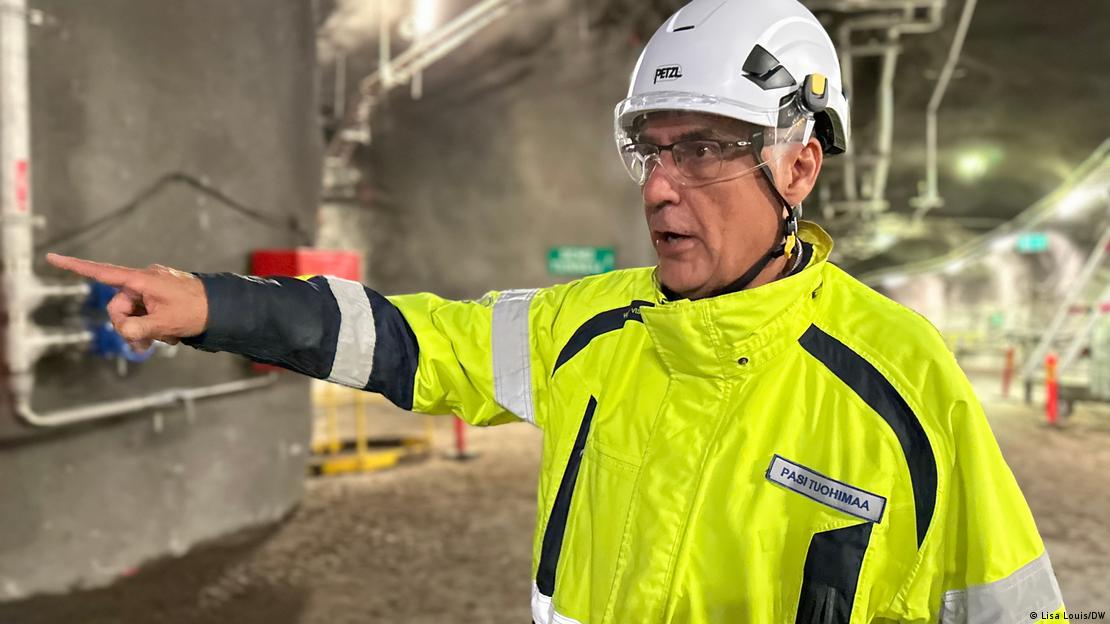
Pasi Tuohimaa is communications manager at Posiva, a company owned by TVO and Fortum and specializing in the final disposal of spent nuclear fuel in the Onkalo storage facility located at the power plant site .

Posiva plays a crucial role in ensuring the safety of nuclear waste management in Finland.

On a recent afternoon, Tuohimaa was leading a group of journalists through the Onkalo project which is to open in the coming months.

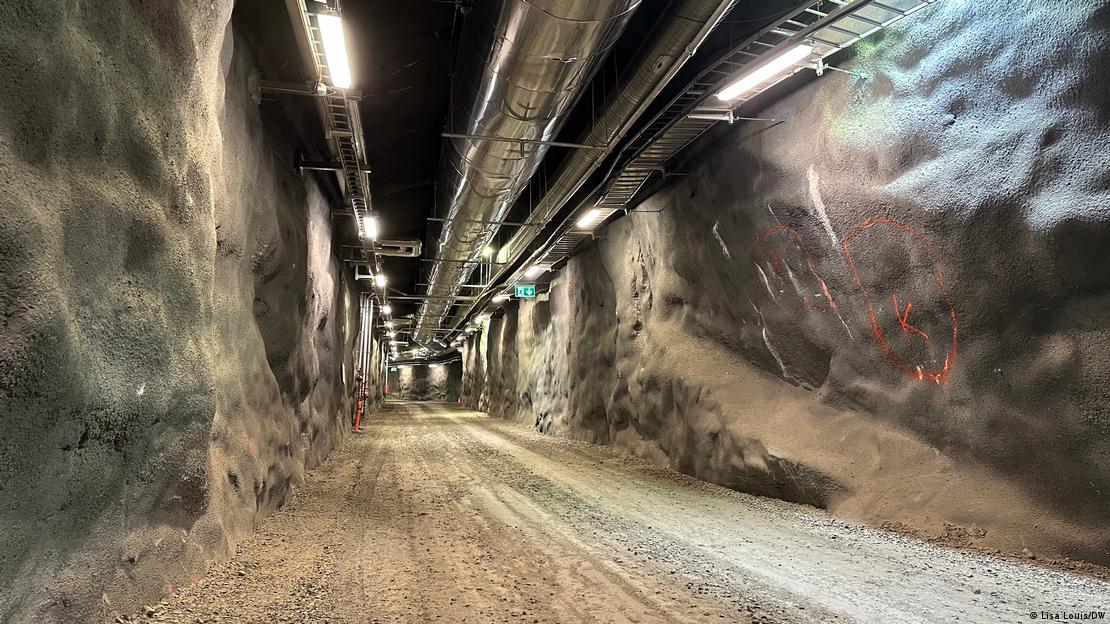
The Onkalo site will be the world's first deep geological repository for spent nuclear fuel
Image: Lisa Louis/DW

The waste of the country's five existing nuclear power plants will be stored there for good in one-ton capsules that are to be stored in chambers in the ground.

Operator Posiva has so far spent between €500 million ($577 million) and €1 billion on the storage facility encompassing 60 kilometers (37.2 miles) of tunnels about 450 meters (1,476 feet) below ground level.

"We have a solution to take care safely of the spent nuclear fuel. Excavating tunnels is not that difficult. Finland is full of bedrock. So there can be other places here and abroad," Tuohima told DW.

Where to put nuclear waste?  07:34


Finland's Climate and Environment Minister Sari Multala says the Nordic country is currently "paving the way for more nuclear power."

Speaking with journalists on the tour of the Posiva site, he said the government was currently "reviewing our nuclear energy legislation to facilitate a faster permitting processes and investigating whether nuclear [power] will need some financial support or risk-sharing mechanisms in the future."

Could wind power be the immediate solution?

But Anni Mikkonen, CEO of industry association Renewables Finland, objects to the current government's pro-nuclear policy arguing that wind farms can be completed much faster.

"There's a really strong project pipeline that you can start building when electricity is needed. We could double onshore capacity within 10 years," she told DW.

She also said that "additional [Finish] power could be used for electric cars or exported to other countries" so that these could also become more independent from Russian energy imports.

Edited by: Uwe Hessler


Trump’s provocations are


 bolstering Latin America’s


 left


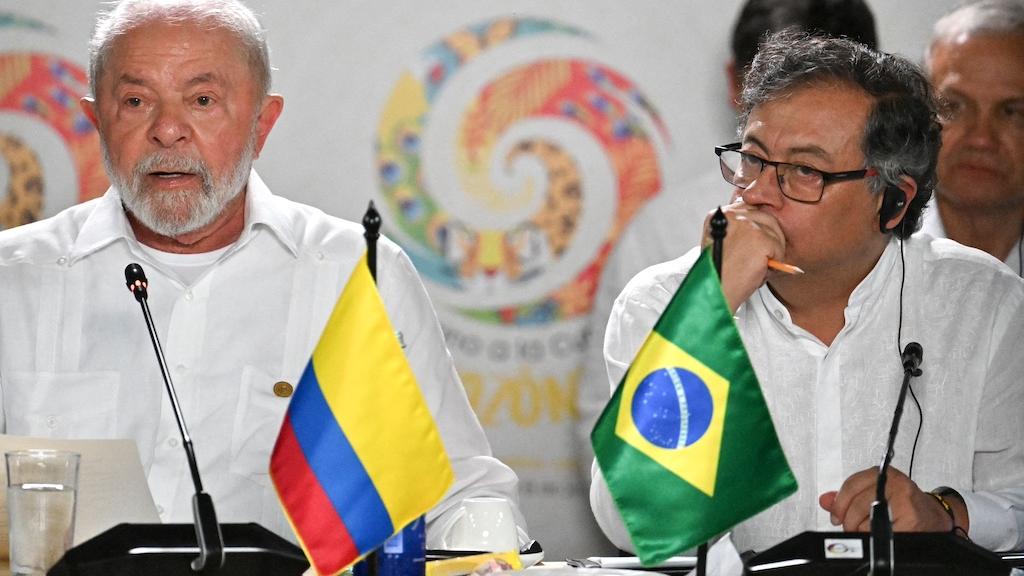
Lula and Petro

First published at Jacobin.

When Donald Trump assumed the presidency in January 2025, the Pink Tide governments in Latin America were losing ground. The approval rating of Brazil’s president, Luiz Inácio Lula da Silva, reached the lowest of his three presidential terms, while that of Colombia’s Gustavo Petro was a mere 34 percent. And in the wake of the fiercely contested results of the July 2024 presidential elections in Venezuela, Nicolás Maduro found himself isolated in the region.

Now, less than a year later, the political landscape has shifted. Trump’s antics — such as his renaming of the Gulf of Mexico, the weaponization of tariffs, and aggressive military actions in the Caribbean and Pacific — have revitalized Pink Tide governments and the Left in general. Latin America has reacted to Trump’s invocation of the Monroe Doctrine with a surge of nationalist sentiment, mass demonstrations, and denunciations from political figures across most of the spectrum, including some on the center right.

While the United States appears more and more like an unreliable and declining hegemon, China is seeking to position itself as a champion of national sovereignty and a voice of reason in matters of international trade and investment. When Trump slapped a 50 percent tariff on most Brazilian imports in July, the Chinese stepped in to help fill the gap for the nation’s all-important soybean exports.

Lula vs. Trump

Different scenarios are playing out in different nations but with similar results: the strengthening of the Left and, in some instances, the weakening of the Right. One type of case is seen in both Brazil and Mexico, where Lula and Mexican president Claudia Sheinbaum have combined firmness with discretion, in contrast to Petro’s more confrontational rhetoric.

In July, Lula responded defiantly to Trump’s attempt to strong-arm Brazil through punitive tariffs designed to secure the release of the US president’s ally, former Brazilian president Jair Bolsonaro, who was jailed for his involvement in coup and assassination plots. Unlike other heads of state, Lula refused to reach out to Trump, saying, “I’m not going to humiliate myself.” Instead, Lula declared that “Brazil would not be tutored by anyone,” at the same time recalling the 1964 Brazilian coup as a previous instance of US intervention.

Different scenarios are playing out in different nations but with similar results: the strengthening of the Left and, in some instances, the weakening of the Right.

The face-off sparked mass pro-government demonstrations throughout the country that far outnumbered those called by the Right demanding the freeing of Bolsonaro. Lula’s supporters blamed the Right for the tariffs, and particularly Bolsonaro’s son Eduardo, who campaigned for them after moving to Washington, DC. Lula called Bolsonaro a “traitor” and said he should face another trial for being responsible for what has come to be called “Bolsonaro’s tax.” In a sign that Trump’s tariffs were a game-changing boost for the Left, the eighty-year-old Lula announced last month that he would run for reelection in October 2026, as his popularity reached the 50 percent mark.

Some analysts faulted Lula for having failed to use his thirty-minute videoconference with Trump on October 6 to condemn Washington’s gunboat diplomacy in the Caribbean. According to this interpretation of the call, Lula displayed naivete and gutlessness by combining “concern and accommodation with US imperialism” and believing that “negotiations will be guided by a ‘win-win logic.’”

In fact, Lula has spoken out against the US military presence as a “factor of tension” in the Caribbean, which he calls a “zone of peace.” Lula, though, undoubtedly could have gone further, as was urged by the Landless Workers’ Movement (MST) — which backed Lula’s last presidential bid — by explicitly declaring solidarity with Venezuela against US attacks.

Still, Lula can hardly be accused of submissiveness in his dealings with Trump. Indeed, Lula and Sheinbaum as well have been adept in their relations with the US president and have ended up getting much of what they wanted. Moreover, at the same time that Trump retreated from his tariff threats against both Brazil and Mexico, he took to praising their respective heads of state.

A united front in the making

In Brazil and elsewhere in the region, a new alignment is emerging, drawing in both right- and left-leaning forces in reaction to Washington’s posture. One notable example was Lula’s appointment of Homeless Workers’ Movement (MTST) activist and former presidential candidate Guilherme Boulos as minister of the presidency in October. Boulos belongs to the Socialism and Liberty Party (PSOL), a leftist split-off from Lula’s Workers’ Party (PT) that endorsed Lula’s 2022 presidential candidacy but had ruled out holding positions in his government.

Boulos, who was instrumental in organizing the recent protests against Washington’s tariff hikes, spoke of the significance of his designation: “Lula gave me the mission to help put the government on the street . . . and [listen] to popular demands.” His appointment signals a leftward turn in which, in the words of the Miami-based CE Noticias Financiera, “Lula showed that he is going into the 2026 election ready for war. A war in his own style, using the social movements.”

Venezuela is another example where political actors across much of the political spectrum are converging on the need for a broad front to oppose US aggression in the region. No other Pink Tide government has faced such a rapid succession of regime change and destabilization attempts as Venezuela under the government of Maduro, Hugo Chávez’s successor. The government’s response to these and other challenges has at times deviated from democratic norms and has included concessions to business interests, drawing harsh criticism from both moderate and more radical sectors of the Left.

In Brazil and elsewhere in the region, a new alignment is emerging, drawing in both right- and left-leaning forces in reaction to Washington’s posture.

One leader in the latter category is Elías Jaua, formerly a member of Chávez’s inner circle, whose leftist positions on economic policy and internal party democracy left him marginalized within the Chavista movement. In the face of the US military threat in the Caribbean, Jaua has closed ranks with Maduro and decried the “psychological war” being waged against the president. He went on to say that, in this critical moment, it is necessary “to place the tranquility of the people above any ideological, political, or ulterior interest,” adding “the Homeland comes first.”

Other long-standing political figures who have supported Maduro’s call for a national dialogue to face the US threat — while continuing to criticize Maduro for alleged undemocratic practices — include some on the center and center right of the political spectrum, including former presidential candidates Henrique Capriles, Manuel Rosales, and Antonio Ecarri.

Others are moderate leftists who held important posts under Chávez and/or belonged to the moderate left party Movimiento al Socialismo (MAS) in the 1990s. One of the latter is Enrique Ochoa Antich, who presented a petition signed by twenty-seven leading anti-Maduro moderates that stated “it is disheartening to see an extremist sector of the opposition” supporting sanctions and other US actions. Ochoa Antich proposed a dialogue with government representatives “over the best way to foment national unity and defend sovereignty.”

In Argentina, Trump came to the aid of the Right in what will likely prove to be a Pyrrhic victory. On the eve of the October 2025 legislative elections, Trump offered to bail out the Argentine economy to the tune of $40 billion but only on the condition that the party of right-wing president Javier Milei emerge victorious, which is precisely what happened. Trump’s blackmail was denounced as such by politicians ranging from Peronist leaders linked to former Pink Tide governments to centrists who had been among their most vocal critics. Facundo Manes, leader of the centrist Radical Civic Union, was an example of the latter, declaring “the extortion advances.” Meanwhile on the streets of Buenos Aires, protest banners denouncing Milei were marked by anti-US slogans “Yankee go home” and “Milei is Trump’s mule,” as well as the burning of a US flag.

This convergence around the need to confront Trump’s threats and actions creates an opportunity for progressives and socialists across the continent to unite. The call for such unity was taken up by the São Paulo Forum, a body that brings together over one hundred Latin American leftist organizations, which Lula helped found in 1990. At the outset of Trump’s first administration in 2017, the forum drafted the document Consensus of Our America as a response to the neoliberal Washington Consensus and the escalation of US interventionism in the hemisphere.

At the same time that it defended the pluralism of progressive movements and avoided the term “socialism,” the consensus document foresaw the drafting of a more concrete set of reforms and goals. The expected next step, however, never materialized. More recently, the Cuban political analyst and strategist Roberto Regalado lamented that, despite the urgent need for unity, “far from consolidating and expanding, the ‘Consensus of Our America’ has languished.”

Trump and the Latin American right

Much of the Latin American right has tied its fortunes to President Trump. The right-wing presidents of Argentina, Ecuador, and Paraguay are Trump followers, as are Bolsonaro, the Chilean presidential candidate José Antonio Kast, and former president Álvaro Uribe in Colombia. In Venezuela, right-wing opposition leader María Corina Machado dedicated her recent Nobel Peace Prize to Trump.

In 2022, Machado’s fellow Venezuelan rightist Leopoldo López cofounded the World Liberty Congress dedicated to regime change in nations that Washington considers adversaries. The idea is in line with the notion of creating an “International of the Right” promoted by Trump strategist Steve Bannon, among others. Bannon founded The Movement in 2016 to unite the European right, but it has been largely snubbed by much of that continent’s right wing.

While in the US, Trump exploits patriotism, in the case of Latin America, nationalist sentiment and support for Trump are oxymorons.

Such “internationalism” on the Right is even less likely to flourish in Latin America. While in the United States, Trump exploits patriotism — or a perverted form of it — in the case of Latin America, nationalist sentiment and support for Trump are oxymorons, specifically when it comes to tariffs, immigration, threats of military invasion, and the brandishing of the Monroe Doctrine. In Venezuela, for instance, Machado’s popularity has declined and her opposition movement has fractured as a result of popular repudiation of Trump’s policies.

In the United States, Trump plays to his fanatic supporters while his popularity steadily declines. In Latin America, the same is occurring, with the difference being that his popularity couldn’t get much lower than it already is. Pew Research Center reports that just 8 percent of Mexicans have “confidence” in Trump.

Trump has contributed to a major shift in Latin America’s political landscape, now marked by political polarization and leftist inroads. In many countries, the Left — which for decades remained on the sidelines — has become a major point of reference, rallying around the banners of national sovereignty, if not anti-imperialism.

In Chile, a Communist, Jeannette Jara, received a surprising 60.5 percent of the vote in the primaries to represent the main anti-rightist bloc in the upcoming presidential elections. While taking a cautious tone, Jara still directly addressed Trump, saying in the wake of his meddling in Argentine elections, “No US soldiers will enter. Chile is to be respected, and so is its sovereignty.”

In Ecuador, despite harsh repression, the followers of ex–Pink Tide president Rafael Correa have come close to winning the last three presidential elections. And in Colombia, Petro has reinvigorated his movement’s base through his forceful denunciations of US military operations and by leading a drive, begun in October, to secure two million signatures for a national constituent assembly.

“Polarization” often refers to a scenario in which the extremes on both sides of the political spectrum gain ascendancy. That is not what is happening in Latin America, at least on the Left. Instead, there is a convergence of progressives of different political stripes, both domestically and among Pink Tide governments, in their opposition to Trump and all that he represents. The challenge now is to translate this convergence into organized forms of unity — through united fronts at the national level as well as in the Community of Latin American and Caribbean States (CELAC) and other regional bodies.
Steve Ellner is an associate managing editor of Latin American Perspectives and a retired professor at the Universidad de Oriente in Venezuela, where he lived for over 40 years. He is the author of Rethinking Venezuelan Politics: Class, Conflict, and the Chávez Phenomenon.n the wake of his meddling in Argentine elections, “No US soldiers will enter. Chile is to be respected, and so is its sovereignty.”

In Ecuador, despite harsh repression, the followers of ex–Pink Tide president Rafael Correa have come close to winning the last three presidential elections. And in Colombia, Petro has reinvigorated his movement’s base through his forceful denunciations of US military operations and by leading a drive, begun in October, to secure two million signatures for a national constituent assembly.

“Polarization” often refers to a scenario in which the extremes on both sides of the political spectrum gain ascendancy. That is not what is happening in Latin America, at least on the Left. Instead, there is a convergence of progressives of different political stripes, both domestically and among Pink Tide governments, in their opposition to Trump and all that he represents. The challenge now is to translate this convergence into organized forms of unity — through united fronts at the national level as well as in the Community of Latin American and Caribbean States (CELAC) and other regional bodies.

Steve Ellner is an associate managing editor of Latin American Perspectives and a retired professor at the Universidad de Oriente in Venezuela, where he lived for over 40 years. He is the author of Rethinking Venezuelan Politics: Class, Conflict, and the Chávez Phenomenon.


The US War on China, Venezuela, and the Global Left

Because of the economic and political alliance between China and Venezuela, it is impossible to understand the growing push for war on Venezuela without also considering the buildup to war with China as well.


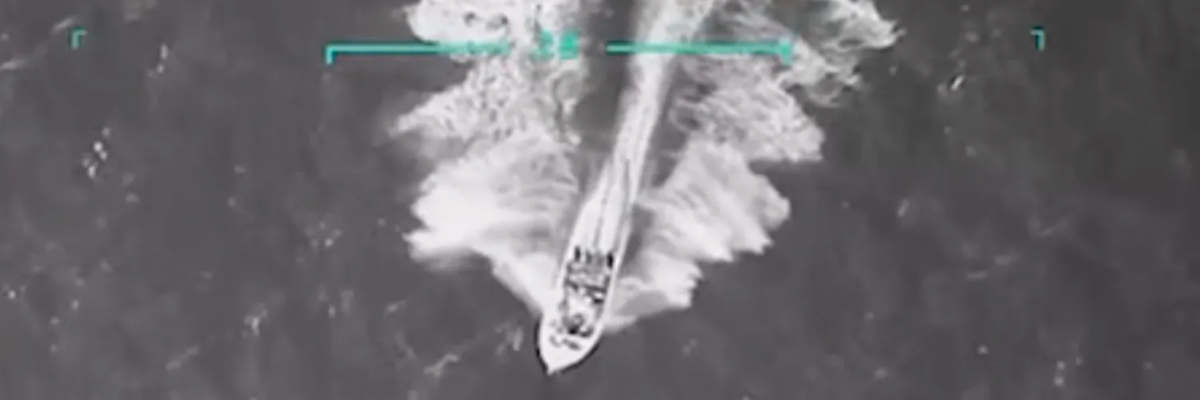
This image was posted on social media by President Donald Trump and shows a boat that was allegedly transporting cocaine off the coast of Venezuela when it was destroyed by US forces on September 2, 2025.
(Photo: President Donald Trump/Truth Social)

Michelle Ellner
Nov 15, 2025
Common Dreams

Resistance movements against US imperialism have sprouted up all over the world in response to its indiscriminate violence and disregard for human life. Together, they form the living front of the international left, a network of people and organizations that seek liberation from the same systems of domination and colonial control. While their forms differ, from student encampments to workers’ strikes, the purpose remains the same: an end to empire and the creation of a new multipolar world rooted in the simple truth of our shared humanity and the equal worth of every nation and people.

The alliance between China and Venezuela is part of this broader project. And the US push for war against both nations is but a violent reaction to the impending truth that US hegemonic status is slipping, and with it, its control on global resources, political power, and the ability to dictate the terms of development and sovereignty for the rest of the world.


Trump Administration Has ‘Made the Decision to Attack Military Installations Inside Venezuela’: Report


Trump’s Escalation Against Venezuela Continues as Hegseth Deploys Aircraft Carrier Strike Group to Latin American Waters

Over the past month, the Trump administration has unleashed a series of strikes on Venezuelan fishing vessels, claiming to be cracking down on drug smugglers. The lie is as unoriginal as it is absurd, and a stark example of the waning facade of the supposed “morality” of liberal internationalism. Truth is often exposed during these periods of turbulence, when agitation overrides calculation; the knowledge of its imminent demise is so dire that the empire is barely trying to hide its true intentions anymore.

What is the truth, then? The truth is that the US war on Venezuela has nothing to do with drugs and everything to do with control. For years, Venezuela has faced relentless pressure, economic warfare, sanctions, and constant threats designed to undermine its sovereignty and keep it under the boot of US empire. As with most nations, US interest in Venezuela is about strategic resources and power. First, Venezuela sits atop the largest proven oil reserves in the world, along with significant deposits of gold, coltan, and other minerals critical to technology and energy production. Control over these strategic resources means control over global markets and energy security. Second, Venezuela’s geographic location within Latin America makes it a pivotal point of leverage within the region.

The lesson is clear: Where there is a US-backed war or intervention, you are likely to find some strategic resource or monetary interest beneath it.

Yet Venezuela’s defiance did not emerge in a vacuum. It followed more than a century of US domination across the hemisphere, from the invasion of Haiti and the occupation of Nicaragua to the coups in GuatemalaChile, and Honduras. What unites these histories is a single message from Washington: No Latin American nation has the right to chart an independent course.

The Bolivarian Revolution, launched with Hugo Chávez’s election in 1998, was a direct challenge to that order. Emerging from the ruins of neoliberal collapse, it confronted Venezuela’s historical condition as a rentier state subordinated to US interests. Chávez redirected oil revenues to social programs, such as mass education and healthcare, while expanding access to political participation through communal councils and cooperatives.

Venezuela’s defiance took continental form 20 years ago, in November 2005, when Latin American leaders gathered in Mar de la Plata, Argentina, for the Summit of the Americas. There, Washington sought to impose the Free Trade Area of the Americas (ALCA)—a hemispheric agreement that would have locked the region into permanent subordination to US capital.

The summit instead became a turning point in modern Latin American history. Before tens of thousands of people chanting “ALCA, ALCA, al carajo!” the governments of Venezuela, Brazil, Argentina, and others rejected the deal. That rejection, led politically by Hugo Chávez and supported by social movements across the continent, signaled the collapse of the neoliberal consensus and the rebirth of Latin American sovereignty. Out of that victory came ALBA and Petrocaribe, mechanisms of regional cooperation that prioritized social development over corporate profit. The US has spent decades trying to reverse it through sanctions, coups, and now, open militarization in the Caribbean.

Today, matters are complicated by the introduction of a new, increasingly powerful actor. China has, over the past few decades, maintained a strong alliance with Venezuela. Starting in the early 2000s, China began providing Venezuela with tens of billions of dollars in loans to be repaid in oil shipments. This has enabled Venezuela to fund social programs and infrastructure while bypassing Western-controlled financial systems like the IMF and World Bank. A US Institute of Peace report states, “China’s industrialization boom in the early 2000s created new opportunities for its resource-rich trade partners in Latin America and Africa. Venezuelan president Hugo Chávez… was enthusiastic about advances from China.”

Since then, China has also helped Venezuela build railways, housing projects, and telecommunications infrastructure as part of its broader Belt and Road Initiative (BRI) to foster development across the Global South. The partnership, unlike those with the US, is not coercive but strictly noninterventionist. China does not advocate for regime change like US leaders, but maintains steadfast diplomatic support, referring to itself as an “apolitical development partner” while criticizing the history of US interference in the internal affairs of Latin American and Caribbean countries. Meanwhile, the US criticizes China’s lack of desire to instigate regime change.

Because of the economic and political alliance between China and Venezuela, it is impossible to understand the growing push for war on Venezuela without also considering the buildup to war with China as well. They are, after all, part of the same battle. As the USIP report writes, “Venezuela will remain a key site for the rapidly expanding strategic rivalry between the United States and China.” US leaders are fully willing to sacrifice the lives of Venezuelan civilians if it means destroying the Venezuelan economy, installing a US puppet government, and destroying the budding solidarity movement between the two nations. As it stands, Venezuela has also provided a source of economic sovereignty to China by helping diversify its energy sources away from the Middle East and US-controlled suppliers, acting as a lifeline against US sanctions and economic isolation.

So though the US certainly has a vested interest in Venezuela itself, the nation is also another battlefront for the US war on China, which under the Trump administration has manifested as an escalating trade battle over strategic resources, a hyper-militarization of Pacific allies around China, and a domestic crackdown on Chinese nationals and Chinese Americans in the US. Of course, China is no existential threat to US citizens themselves. The only threat it poses is to a US-dominated world system and the perpetuation of the international division of labor that keeps a few Western elite wealthy, while the rest of the world struggles.

The US push for war on China is part of an ongoing campaign to hinder China’s rise. While the world hurtles inevitably toward a new multipolarity, US leaders lash out through military posturing, economic coercion, and war propaganda. President Donald Trump’s recent tariffs on China are only one small part of that larger strategy. At the heart of this confrontation lies a struggle over control of the strategic resources and technology that will define the future—rare earth minerals, semiconductors, AI, and more. China currently dominates the global supply of rare earth elements, the essential components in everything from smartphones and wind turbines to missiles and fighter jets. For the US, this is intolerable. It threatens its monopoly over high-tech production and, by extension, its military and economic supremacy. That’s why you’ll see political leaders and media sources perpetuate the narrative that China is weaponizing trade, even though it’s Western countries that have killed millions of people through unilateral sanctions since WWII. But China, as a sovereign nation, has the right to protect its strategic resources, especially when they are being used against it. Rare earth minerals, for example, are used by the US to create advanced weapons systems in preparation for war with China. And if economic warfare fails to hinder China’s rise, which it undoubtedly will if the recent Trump-Xi meetings are anything to go by, then it is increasingly likely that US leaders will force a physical confrontation, and those weapons will be used.

This isn’t the first time the US has waged war over strategic resources while using propaganda to paint a prettier picture. The Gulf War and invasion of Iraq, while justified as “defending democracy” and “protecting the world from weapons of mass destruction” that didn’t actually exist, were ultimately about carving up Iraq’s oil fields for US corporations. The NATO bombing campaign in Libya was in response to Gaddafi’s nationalization of oil and the threat to the US dollar. The continued occupation of Syria is about securing oil and gas fields. The overthrow of Bolivian President Evo Morales was connected to his nationalization of lithium, often referred to as the “new oil,” as well as attempts to thwart competition with Russia and China. The list goes on and on and on.

The lesson is clear: Where there is a US-backed war or intervention, you are likely to find some strategic resource or monetary interest beneath it. This is what it means to be an imperialist power. In order to sustain its dominance, the US must continually extract, control, or deny access to the materials that sustain global industry and technology, such as oil, gas, lithium, and rare earth minerals. And when another nation dares to assert sovereignty over its own resources, it is branded a threat to freedom, sanctioned, bombed, or toppled to keep it dependent, weak, and loyal. China, Venezuela, and all nations seeking sovereignty over their own development in ways contradictory to the capitalist imperial order threaten this, and that is why they are targeted—not for any moral or legal reason. As we’ve so clearly seen from two years of US-funded genocide in Gaza, neither morality nor legality guides US policy.

The struggle against US imperialism is a global struggle. To stand with Venezuela, with China, or with any nation resisting domination is to stand for the possibility of a new internationalism rooted in solidarity across borders. That is our task—to connect these struggles, to see in every act of resistance the reflection of our own, and to build a world of shared humanity and global equality.


Chaos: The Trump Doctrine for Latin America


The US, under Trump, is unapologetically an empire operating without pretense. International law is for losers. A newly minted War Department, deploying the most lethal killing machine in world history, need not hide behind the sham of promoting democracy.

Recall that in 2023, Trump boasted: “When I left, Venezuela was ready to collapse. We would have taken it over; we would have gotten all that oil.” As CEO of the capitalist bloc, Trump’s mission is not about to be restrained by respect for sovereignty. There is only one inviolate global sovereign; all others are subalterns.

Venezuela – with our oil under its soil – is now in the crosshairs of the empire. Not only does Venezuela possess the largest petroleum reserves, but it also has major gold, coltan, bauxite, and nickel deposits. Of course, the world’s hegemon would like to get its hands on all that mineral wealth.

But it would be simplistic to think that it is driven only by narrow economic motives. Leverage over energy flows is central to maintaining global influence. Washington requires control of strategic resources to preserve its position as the global hegemon, guided by its official policy of “full spectrum dominance.”

For Venezuela, revenues derived from these resources enable it to act with some degree of sovereign independence. Most gallingly, Venezuela nationalized its oil, instead of gifting it to private entrepreneurs – and then used it to fund social programs and to assist allies abroad like Cuba. All this is anathema to the hegemon.

Further pushing the envelope is Venezuela’s “all-weather strategic partnership” with China. With Russia, its most consequential defense ally, Venezuela ratified a strategic partnership agreement. Similarly, Venezuela has a strong anti-imperialist alliance with Iran. All three partners have come to Caracas’s defense, along with regional allies such as Colombia, Brazil, and Mexico.

The US has subjected Venezuela’s Bolivarian Revolution to incessant regime-change aggression for its entire quarter-century of existence. In 2015, Barack Obama codified what economist Jeffrey Sachs calls a remarkable “legal fiction.”  His executive order designated Venezuela as an “extraordinary threat” to US national security. Renewed by each succeeding president, the executive order is really an implicit recognition of Venezuela’s Bolivarian Revolution as a counter-hegemonic alternative that challenges Washington’s world order.

The latest US belligerence testifies to the success of the Venezuelan resistance. The effects of asphyxiating US-led sanctions, which had crashed the economy, have been partly reversed with a return to economic growth, leaving the empire with little alternative but to escalate its antagonism through military means.

The AFP reports “tensions between Washington and Caracas have dramatically risen” as if the one-sided aggression were a tit-for-tat. Venezuela seeks peace, but has a gun held to its head.

Reuters blames the victim, claiming that the Venezuelan government “is planning to…sow chaos in the event of a US air or ground attack.” In fact, President Nicolás Maduro has pledged “prolonged resistance” to Washington’s unprovoked assaults rather than meekly conceding defeat.

The death toll from US strikes on alleged small drug boats off Venezuela, in the Pacific off Colombia and Ecuador, and as far north as Mexico now exceeds 75 and continues to rise. But not an ounce of narcotics has been confiscated. In contrast, Venezuela has seized 64 tons of drugs this year without killing anyone, as the Orinoco Tribune observes.

Russian Foreign Ministry’s María Zakharova quipped: “now that the US has suddenly remembered, at this historic moment, that drugs are an evil, perhaps it is worth it for the US to go after the criminals within its own elite.”

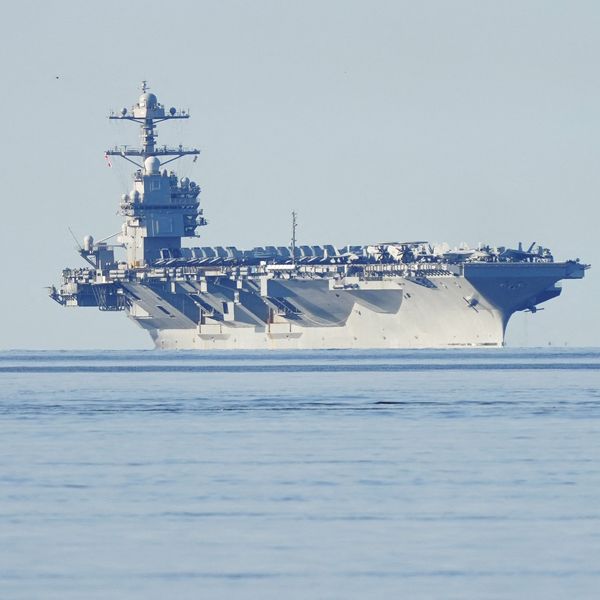
On November 11, the world’s largest aircraft carrier, the USS Gerald R. Ford, and its accompanying warships arrived in the Caribbean. They join an armada of US destroyers, fighter jets, drones, and troops that have been building since August.

In a breathtaking understatement, the Washington Post allowed: “The breadth of firepower…would seem excessive” for drug interdiction in what it glowingly describes as a “stunning military presence.”

Venezuela is now on maximum military alert with a threatening flotilla off its coast and some 15,000 US troops standing by.  Millions of Venezuelans have joined the militia, and international brigades have been welcomed to join the defense. President Maduro issued a decree of “external commotion,” granting special powers in the event of an invasion.

The populace has united around its Chavista leadership. The far-right opposition, which has called for a military invasion of its own country, is more isolated than ever. Only 3% support such a call.

Their US-designated leader, María Corina Machado, has gone bonkers, saying “no doubt” that Maduro rigged the 2020 US election against Trump. According to the rabidly anti-Chavista Caracas Chronicles, the so-called Iron Lady “is not simply betting Venezuela’s future on Trump, she is betting her existence.”

The legal eagles at The Washington Post now find that “the Trump administration’s approach is illegal.” United Nations experts warn that these unprovoked lethal strikes against vessels at sea “amount to international crimes.”

Even high-ranking Democrats “remain unconvinced” by the administration’s legal arguments. They’re miffed about being left out of the administration’s briefings and not getting to see full videos of the extrajudicial murders.

The Democrats unite with the Republicans in demonizing Maduro to achieve regime change in Venezuela, but wish it could be done by legal means. The so-called opposition party unanimously voted to confirm Marco Rubio as secretary of state, fully aware of the program that he now spearheads.

The corporate press has been complicit in regime change in its endless demonization of Maduro. They report that Trump authorized covert CIA operations as if that was a scoop rather than business as usual. What is new is a US administration overtly flaunting supposedly covert machinations. This is part of Washington’s full-press psychological pressure campaign on Venezuela, in which the follow-the-flag media have been its eager handmaiden.

The AP reports that Jack Keane, when he served as a US Army general, instructed staff to “see reporters as a conduit” for the Pentagon. This was cited as a criticism of Trump after a few dozen embedded reporters turned in their Pentagon badges. Trump has called out the Washington press corps as “very disruptive in terms of world peace,” proving the adage that even a blind dog can sometimes find a bone.

The Wall Street Journal opines: “Nobody in the [Trump] administration seems prepared to ask the hard questions about what happens if they do destabilize the [Venezuelan] regime but fail to topple it.” Political analysts Medea Benjamin and Nicolas J. S. Davies suggest the answer is carnage and chaos  – based on Washington’s past performances in Iraq, Serbia, Afghanistan, Haiti, Libya, Syria, and Yemen, to mention a few.

Foreign Policy’s perspective – aligned with the Washington establishment – is that regional fragmentation is at its highest level in the last half-century. Regional organizations have become dysfunctional –  UNASUR has been “destroyed,” CELAC is “useless,” and the OAS canceled its summit. The factionalism, Responsible Statecraft agrees, “marks one of the lowest moments for regional relations in decades.” Bilateral “deals” with the US are replacing regional cohesion.

This is Latin America under the beneficence of Trump’s “Monroe Doctrine.” The alternative vision, represented by Venezuela, is CELAC’s Zone of Peace and ALBA-TCP’s development for mutual benefit.

Roger D. Harris was an international observer for Venezuela’s 2024 presidential election. He is with the US Peace Council and the Task Force on the AmericasRead other articles by Roger.


You Don’t Have to Be a Lefty to Stand with Venezuela


November 14, 2025

Image by Meg Jenson.

Once upon a time, not so long ago, I was a goddamn commie, and I’m not talking Bernie Sanders here. I’m talking hardcore, blood-red, dyed-in-the-wool, revolutionary Marxism. I was a goddamn tankie and while I quoted Lenin and defended Putin, I tended to look to the Third World for inspiration. For a deeply closeted Queer kid outnumbered by pervy Catholic fundamentalists in hick country, there was something scrumptiously satisfying about other post-Papist outlaws taking on Washington’s New Rome just south of the border. I was fascinated with Che Guevara, Salvador Allende and the Castro Brothers, but in the early aughts, Hugo Chavez was my greatest hope.

Everything about that man seemed impossible. He was a trash-talking, pot-bellied, serial David, going off on Goliath over and over and over again and somehow winning every fucking time. While Allende went down in a blaze defending democracy from the pulpit of Marxism and the Castros were forced to reduce Cuba to a floating citadel just to keep the Batista out, Hugo Chavez faced down the guns of American imperialism like Tony Montana and managed to come out of the maelstrom without ever missing an election.

It all should have been over by 2002 when the CIA organized another one of its spectacular Latin American coup d’etats. A phony protest movement was organized, high-ranking military officers had Chavez kidnapped and absconded to an unknown location, some corporate gangster named Pedro Carmena was arbitrarily installed as president, the National Assembly and Supreme Court were dissolved, and then-President George W. Bush recognized the whole farce as democracy. This is usually where the story ends and I’ve read that tragic story more times than I can count, from Augustus Sandino to Jacobo Arbenz. But then the Bolivarian Revolution flipped the script.

Hundreds of thousands of irate Venezuelans poured into the streets like a flash flood, many from the most impoverished favelas in the country, swarming the national palace and demanding their democracy back. When Uncle Sam rented thugs to open fire on these people, the people stood their ground and fired back. The lower ranks of the Venezuelan Army, staffed largely by denizens of those same barrios, were inspired to do the unthinkable. They turned their guns on their commanding officers and brought Chavez back from the dead. And just like that, what had started out as a carefully orchestrated American putsch had resulted in a spontaneous anti-American uprising. Uncle Sam was humiliated, Venezuela was galvanized, and I was officially in love with the Bolivarian Revolution.

Babylon kept on trying but their attempts just kept on backfiring in the most spectacular ways. When Wall Street manufactured an economic crisis by colluding with the fat cats running Venezuela’s various state-owned industries in a lockout that froze oil production for two months straight, the workers toiling beneath them formed democratic councils and brought those resources back closer to the people that lived on top of them than they had ever been. When the National Endowment for Democracy dumped millions of dollars into building up a phony opposition movement, Chavez kicked their asses fair and square in elections that even Jimmy Carter couldn’t bring himself to delegitimize and inspired a wave of other left-wing populist fire breathers across Latin America to do the same.

Soon the CIA had their hands full of democracies to overthrow from Evo Morales in Bolivia to Rafael Correa in Ecuador, from the Kirchners in Argentina to Lula and Dilma in Brazil. It was almost as if Che Guevara and Salvador Allende had birthed two, three, many Vietnams at the ballot box and started a storm too wild for firepower to pacify. Then something truly tragic happened that seemed to turn this entire Pink Tide into a hurricane of disillusionment; Hugo Chavez turned out to be human being after all.

That fantastic human missile crisis died very suddenly and somewhat suspiciously of cancer in 2013 and his successor, then-Vice President Nicholas Maduro, seemed to waste very little time betraying his revolution. He very quickly turned the Bolivarian Republic into a giant bludgeon for him to maintain the power he had practically stumbled into over Hugo’s corpse, starting by dismantling the various workers councils, misiones, comunas and collectives that had created the architecture of direct democracy that had served as the backbone of Hugo’s revolution and then concentrating their power back into a bureaucratic elite while repressing anyone who stood in this pink oligarchy’s way beneath a banner of Dengist-style state socialism.

By 2015, Maduro was ruling the nation largely by decree, by 2017, he was castrating the National Assembly and rewriting the Constitution that Hugo Chavez and millions of other Venezuelans had risked their lives to preserve, and by 2018, the Bolivarian Revolution was dead and I was heartbroken. However, in my disillusioned grief, I was also forced to take a second look at the Revolution altogether, and I was haunted by what I found. While Hugo certainly did appear to do all that he could for the Venezuelan poor, he had also steadfastly relied on many pre-existing state powers to do so and in the process consistently undermined his own revolution’s grass roots civilian infrastructure.

The most blatant and egregious example of this was the way Chavez managed Venezuela’s state oil company, PDUSA, which was actually a relic of the neoliberal oligarchy that he was elected to confront. This humongous corporate behemoth continues to represent 90% of Venezuela’s economy and was largely dependent on Chevron to function before Donald Trump’s escalated embargo pushed Maduro to replace them with Chinese capitalist roadsters who now essentially own the nation’s economy thanks to $62.5 billion dollars in predatory loans.

But it was actually Hugo who betrayed the workers councils who had saved his ass from the economic crisis of 2003 by colluding with their duplicitous bosses. In return for their cooperation, the Bolivarian Republic retained this same bureaucratic management system once the crisis was averted so long as they agreed to finance massive welfare state programs that kept their workers distracted from the fact that they had basically just proven they didn’t even require a state to achieve true economic democracy.

While Chavez publicly rallied support for these autonomous councils, he continued to rely on the exact same top-down system that had long oppressed the Venezuelan people in what appeared to be a foolish attempt to liberate them. Even when this farce managed to temporarily benefit the people it did nothing to change the imbalance of power between them and the elites. At best, this arrangement swapped one raft of oligarchs for another, turning “revolutionary” civil servants into the new bourgeoisie, but mostly it just left a system designed for oppression largely intact and only one strongman away from being turned back into another meat grinder.

Soon, I began to question everything. I looked back at my revisionist history books and began to see this same tragedy repeat itself over and over again, from Lenin shackling the Soviets and building a centralized bureaucratic monstrosity that would ultimately offer Boris Yeltsin the ability to sell the Russian economy off in chunks the size of continents to Chairman Mao laying down the industrial foundation that turned China into the world’s largest sweatshop plantation.

The problem was and has always been the state itself. As long as there is a system in place that offers one class of people a monopoly on the use of force, the government will always be a den for despotism regardless of whether the scam is dressed up in the trappings of socialism, capitalism, democracy or nationalism. Just so long as the sanctity of the state is left intact, the results will always ultimately be the same.

This was the painful revelation that ultimately led a Bolivarian-Guevarist like me to embrace free market anti-capitalism and post-left anarchism, but some things never change, and this includes my solidarity with what’s left of the Bolivarian Revolution as it faces down the barrels of total war at the hands of an empire that it had humiliated one too many times.

America’s war against the Bolivarian Revolution never changed. In fact, if anything, it has only grown crueler with age. After five major coup attempts and a dozen distinct rounds of sanctions, the United States has affectively crippled what had until fairly recently been a fully functioning economy which has in turn triggered an almost unprecedented economic crisis.

In 2014, Venezuela’s GDP stood shoulder to shoulder with Brazil’s at $14,000. By 2024, it was closer to Bangladesh at $3,870. As a result of this medieval style siege accelerated by every single American president from Obama to Trump, 7.7 million Venezuelans have fled for their lives, constituting the single largest displacement in modern history with 25% of the nation’s population now living abroad as refugees. Some might argue such mass sadism constitutes a form of genocide; however, this Latin American Nakba is also primed for some serious blowback.

That’s because the other thing that hasn’t changed for Venezuela is the fire that stokes its poorest citizens to fight back, specifically the lumpenproletariats who make up Maduro’s paramilitary Colectivos. While the Bolivarian oligarchy may have turned these civilian street fighters into a glorified Red Guard, they remain largely autonomous in structure, and they are the true heirs to Hugo Chavez because they were also his revolution’s founding fathers.

The Colectivos began as the armed wing of Venezuela’s Communal Councils, autonomous favela democracies that trace their roots back to the leftist guerrilla movements of the 1960s. These organizations may have been reduced to Maduro’s errand boys in recent years, but the last time America very briefly took control of the streets of Caracas in 2002, it was this same rambunctious squad of Robin Hood gangbangers who took it back with steel pipes and Brazilian off-brand Berettas.

Now, there are dozens of Colectivos operating in 16 of Venezuela’s 23 states with numbers as high as 8,000. If Donald Trump is stupid enough to play Iraq with Venezuela, he won’t be fighting fat thugs like Maduro; that pig will roll quicker than Saddam; he will be fighting a guerrilla war against the true bastard fathers of Hugo’s revolution. The Colectivos will become the Sadrists of the Western Hemisphere, and I will support their fight for the same reason that Murray Rothbard supported the Vietcong. Because sovereignty is sacred and solidarity is bigger than any one ideology.

Nicky Reid is an agoraphobic anarcho-genderqueer gonzo blogger from Central Pennsylvania and assistant editor for Attack the System. You can find her online at Exile in Happy Valley.


Return to bad days of hyperinflation looms in

Venezuela

By AFP
November 14, 2025


The International Monetary Fund projects inflation of 548 percent for Venezuela for 2025 and 629 percent for next year - Copyright AFP Joseph Prezioso


Javier TOVAR

Venezuelans are grappling with political and economic chaos, a mass population exodus and fears of a US military attack. Now, their wallets are ever thinner as a return to hyperinflation looms.

Increasingly, people live hand to mouth, buying a tomato here, a few onions there as they manage to scrape together enough bolivars for just the basics.

“If we earn 20 bolivars, we need 50,” informal merchant Jacinto Moreno, 64, told AFP in downtown Caracas.

To buy a kilogram of tomatoes, a Venezuelan needs the equivalent of one US dollar. But the average salary per month is only a few hundred dollars.

Reliable economic figures are hard to come by and a large portion of incomes are earned under the table in the informal sector.

“Prices go up every day,” lamented Moreno. “Every day.”


– 130,000 percent –


Venezuela has already had the highest inflation rate in the world, more than once.

Memories are still fresh of a record 130,000 year-on-year rise in prices recorded in 2018, according to official figures — the peak of a four-year hyperinflationary period that ended in 2021 and pushed millions to emigrate.

Venezuela’s central bank has not published inflation figures since October 2024, after President Nicolas Maduro claimed victory in what is widely considered his second stolen election in a row.

According to the leader himself, inflation reached 48 percent in 2024.

The International Monetary Fund projects a 548 percent figure for Venezuela for 2025 and 629 percent for 2026.

Norma Guzman, a 66-year-old who works as an office cleaner, told AFP she can no longer afford to buy groceries monthly or weekly.

Leaving a store with nothing but three tomatoes in a bag, she said “I shop daily” as and when she, her husband and their son manage to put aside money for food.

Maduro blames Venezuela’s economic woes squarely on US sanctions.

He also accuses Washington, which has deployed a fleet of warships in the Caribbean in a stated anti-drug operation, of seeking to depose him and seize the formerly rich petrostate’s vast oil deposits.

Maduro has said Venezuela will register GDP growth of over nine percent in 2025. The IMF estimates 0.5 percent.


– Economists detained –


Colombian-based Venezuelan economist Oscar Torrealba is among those who expect inflation to soar above 800 percent — higher than IMF projections.

“This undoubtedly brings us much closer to a hyperinflationary scenario,” he told AFP.

For Torrealba, hyperinflation is official once prices rise by more than 50 percent for three consecutive months.

But definitions vary, and for other experts an annual rate of 500 percent, such as predicted by the IMF, already amounts to hyperinflation.

Few economists still living in Venezuela dare to publicly challenge the official line, especially after several of their peers, including a former finance minister, were detained this year.

The arrests were never officially announced but coincided with a series of police operations against the publication of parallel exchange rates on web pages that were subsequently removed.


– Dollar shortage –


For now, the steep price rises have not resulted in product shortages as they did a few years ago, when people queued for hours to just to buy a small bag of coffee or sugar.

Maduro at the time responded by decriminalizing use of the US dollar — which became Venezuela’s de facto currency — as well as halting money printing and relaxing exchange controls.

Measured in dollar prices, economist Torrealba said Venezuela’s inflation hit 80 percent year-on-year in October.

The country is running low on the greenbacks used for a big portion of purchases, and which many Venezuelans try to save as insurance against bolivar devaluation.

A major source of foreign currency used to be US oil giant Chevron, which continues to operate under a special license despite sanctions but no longer pays royalties in cash. It pays in crude, instead, which the state sells on at a discount.

With fewer dollars in the market, the gap between the official exchange rate and the informal one is now over 60 percent, according to analysts.