Ragebait Governance
How the State Became the Arbiter of Truth
Image information: “Trollface” by Me in ME is licensed under CC BY 2.0.
Oxford University Press’ 2025 Word of the Year is “ragebait.” The term captures a defining feature of today’s information ecosystem: content engineered to provoke anger, boost engagement, and overwhelm our ability to think clearly. Fake news is a potent form of ragebait, and in this week’s Gaslight Gazette, the most troubling examples come not from fringe corners of the internet but from the people who now claim to be combating disinformation. This essay examines how the federal government under President Donald Trump has adopted, and expanded, the very practices it once criticized, turning itself into the nation’s most powerful arbiter of truth while sidelining the press, rewriting narratives, and generating its own brand of institutional ragebait.
The announcement of an arrest in the D.C. pipe-bomb investigation, tied to the events surrounding January 6, saw a proliferation of ragebait. The suspect, Brian Cole, reportedly believed the 2020 election was stolen, a belief shared by many who stormed the Capitol on January 6, 2021.
Yet even the straightforward update about his arrest generated its own bout of rage and fake news. While discussing the case, CNN’s Jake Tapper described the suspect as “white” even though the images on screen clearly showed Cole was Black. No correction was issued in the segment. Conservatives had recently spread their own fake news about the case. The conservative outlet The Blaze, in a spectacular act of defamation, incorrectly named an unrelated woman as the suspect. If Cole is indeed guilty, The Blaze should prepare its legal team for a defamation case.
In another example of the intersection of rage and fake news, there was the chaos at the CDC last week. The conflict emerged over CDC guidelines, when established scientists clashed with activists and appointees installed by Health and Human Services (HHS) Secretary Robert F. Kennedy Jr. After sidelining career experts, the agency reversed long-standing guidance and declined to recommend the Hepatitis B vaccine for young people. Multiple experts say the decision was driven by misinformation rather than evidence. Once again, public institutions tasked with promoting truth are becoming factories of confusion. Ragebait has always been a problem, but the real crisis emerges when the government itself becomes the most prolific producer of ragebait.
Fake News About Fake News: The White House’s Disinformation Spiral
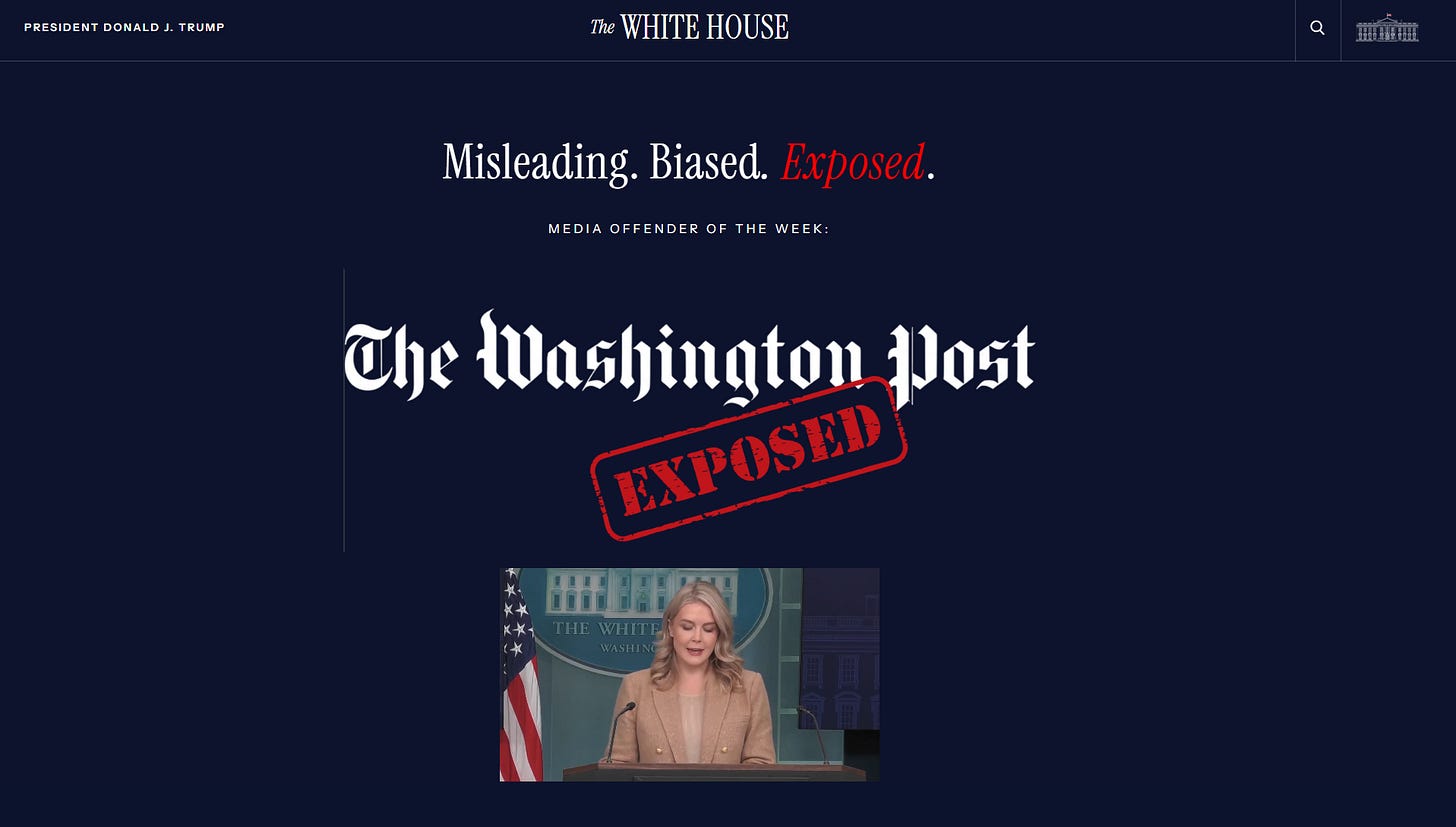
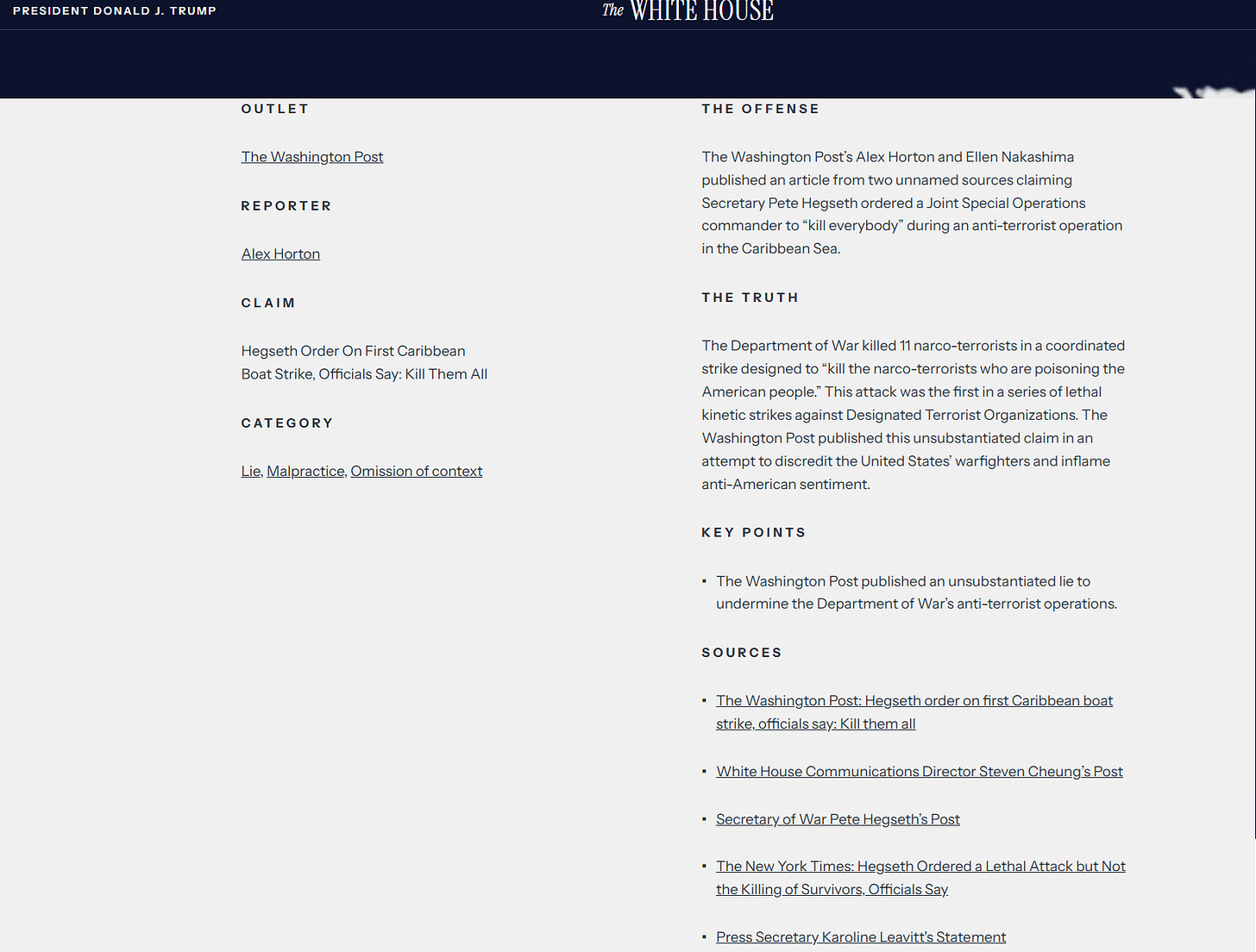
“Misleading. Biased. Exposed. Media Offender of the Week.” This sounds like a tagline from a scrappy media-watchdog newsletter. In fact, it’s an official designation from The White House. The Trump administration has replicated the tactics it once condemned in the Biden era, launching a government-run website that identifies alleged fake news, names specific journalists and outlets, describes their supposed “offense,” and then offers “the truth.”
The problem? Their standards for truth are as arbitrary as they are political. One recent example: Fox News was labeled too “woke,” after the White House misidentified the reporter they were criticizing for “bias.” The administration’s supposedly authoritative sources for debunking stories are equally suspect, relying almost entirely on government accounts, including posts from “Secretary of War Pete Hegseth” and a New York Times article that merely reported what unnamed officials said. In other words, the government cites itself as the final word on reality.
These actions are especially ironic because conservatives erupted in outrage when President Joe Biden attempted something similar with his short-lived Disinformation Governance Board, which was run by Nina Jankowicz, known for her cringe-worthy TikTok videos. The First Amendment exists precisely to prevent governments from monopolizing truth and delegitimizing the press. Yet that’s exactly what is happening under Trump’s administration.
Pledging Silence: The Death of Accountability at the Pentagon
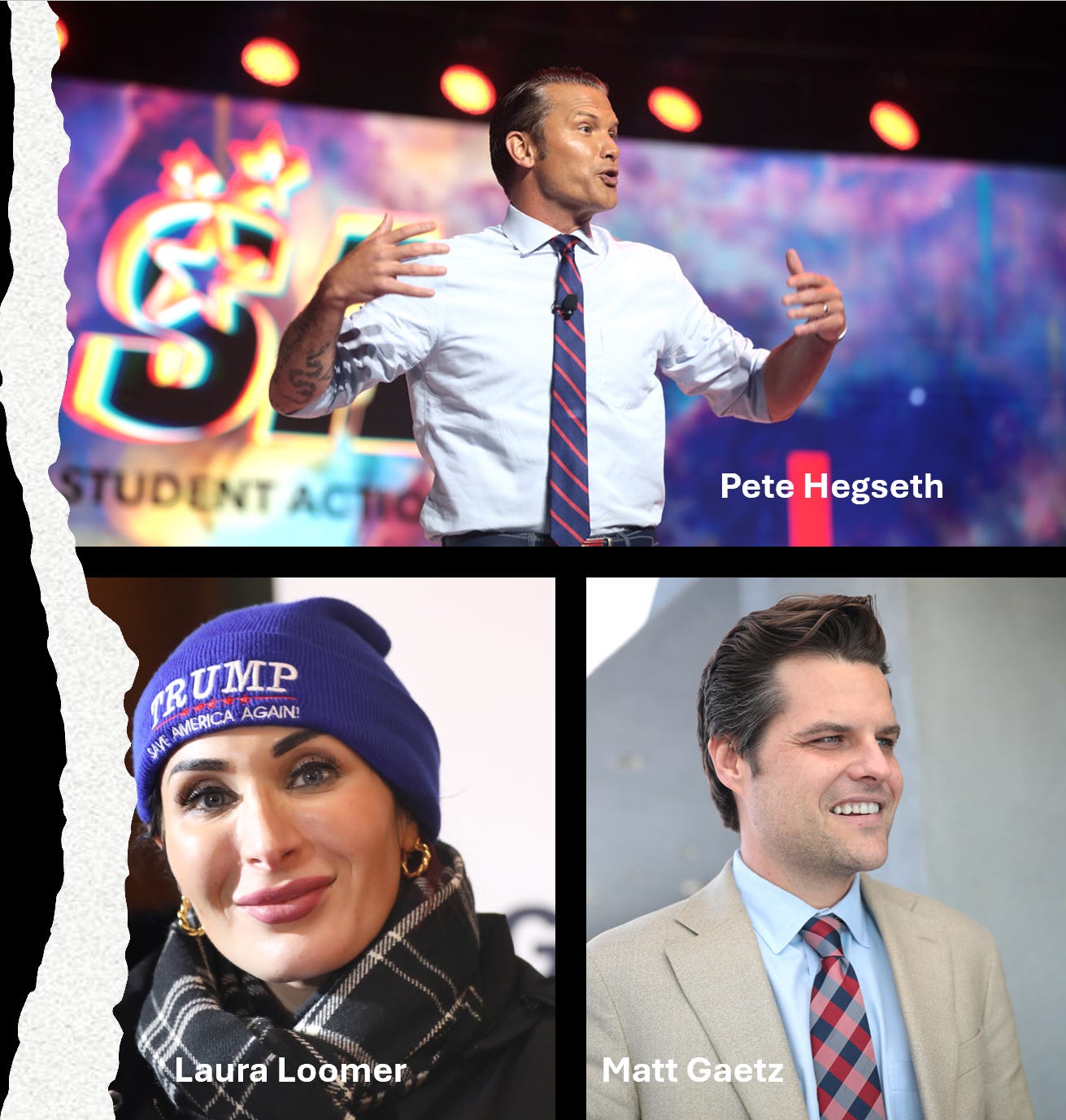
Image Information: (Top)“Pete Hegseth” by Gage Skidmore is licensed under CC BY-SA 2.0; (Left) “Laura Loomer by Gage Skidmore (cropped)” by Gage Skidmore is licensed under CC BY-SA 3.0. (Right) “Matt Gaetz” by Gage Skidmore is licensed under CC BY-SA 2.0.
In October 2025, we witnessed a dangerous escalation in government censorship of the press. That month, the Pentagon announced it was barring legacy journalists from its briefings after they refused to sign a pledge to report only information pre-approved by Pentagon leadership. The New York Times refused to sign the pledge and is now suing the Pentagon on the grounds that the pledge violates the Constitution’s free press protections.
Those who signed, known as pledgers, can no longer credibly call themselves journalists; by agreeing in writing, they have committed to acting as stenographers for the Pentagon. The pledgers now populate the briefing room. They include Laura Loomer, who has a long record of spreading debunked claims, and Matt Gaetz, who left federal office under allegations of sexual misconduct, drug use, and bribery. The pledgers faced online backlash this week after three different pledgers reported that their outlets were occupying the desk formerly held by the Washington Post, whose journalists evacuated the Pentagon after refusing to sign the pledge.
Meanwhile, one of the pledgers revealed they had interviewed Pete Hegseth, the head of the Pentagon and U.S. Secretary of War, describing it as a good interview but stressing that it was off the record, preventing them from sharing any details. Essentially, this means the pledgers mingle with Pentagon leadership yet offer nothing substantive to the public in terms of objective journalism. They act as mere props to give the illusion of a free press while failing to fulfill the true role of journalists.
At the same time, the pledgers sided with the press secretary’s claim that, before the pledge, the press had been acting unethically by persistently knocking on the press secretary’s door. Apparently, reporting objective facts, getting figures like Hegseth on the record, and the press secretary engaging with the media are no longer considered part of journalism, at least according to those who signed the pledge.
The entire situation feels profoundly Orwellian and dangerous. Hegseth is embroiled in a scandal, repeatedly changing his story amid accusations of overseeing war crimes in an unofficial conflict and leaking sensitive information that endangers U.S. military personnel. The stakes are real. This week, a damning government report on “Signalgate” revealed that Hegseth shared information that could have put service members’ lives at risk. He also faces allegations of overseeing war crimes connected to a double-tap strike on Venezuelan drug boats in an unofficial conflict. Recent reports claim the second strike occurred 45 minutes after the initial attack, long after survivors had shown they were no longer a threat, raising serious questions about the operation’s intent and legality.
With the video documenting the alleged war crimes concealed from public view and genuine journalists supplanted by propagandists, both Republicans and Democrats have retreated into entrenched partisan positions, interpreting the unseen footage to advance their own narratives. Despite repeated promises of transparency, the video remains withheld. In the absence of a free and independent press, truth devolves into partisan property, and accountability effectively vanishes.
 Censorship
This section chronicles some of the most pressing examples of censorship from the previous two weeks. Project Censored defines censorship as “the suppression of information, whether purposeful or not, by any method—including bias, omission, underreporting, or self-censorship—that prevents the public from fully knowing what is happening in society.”
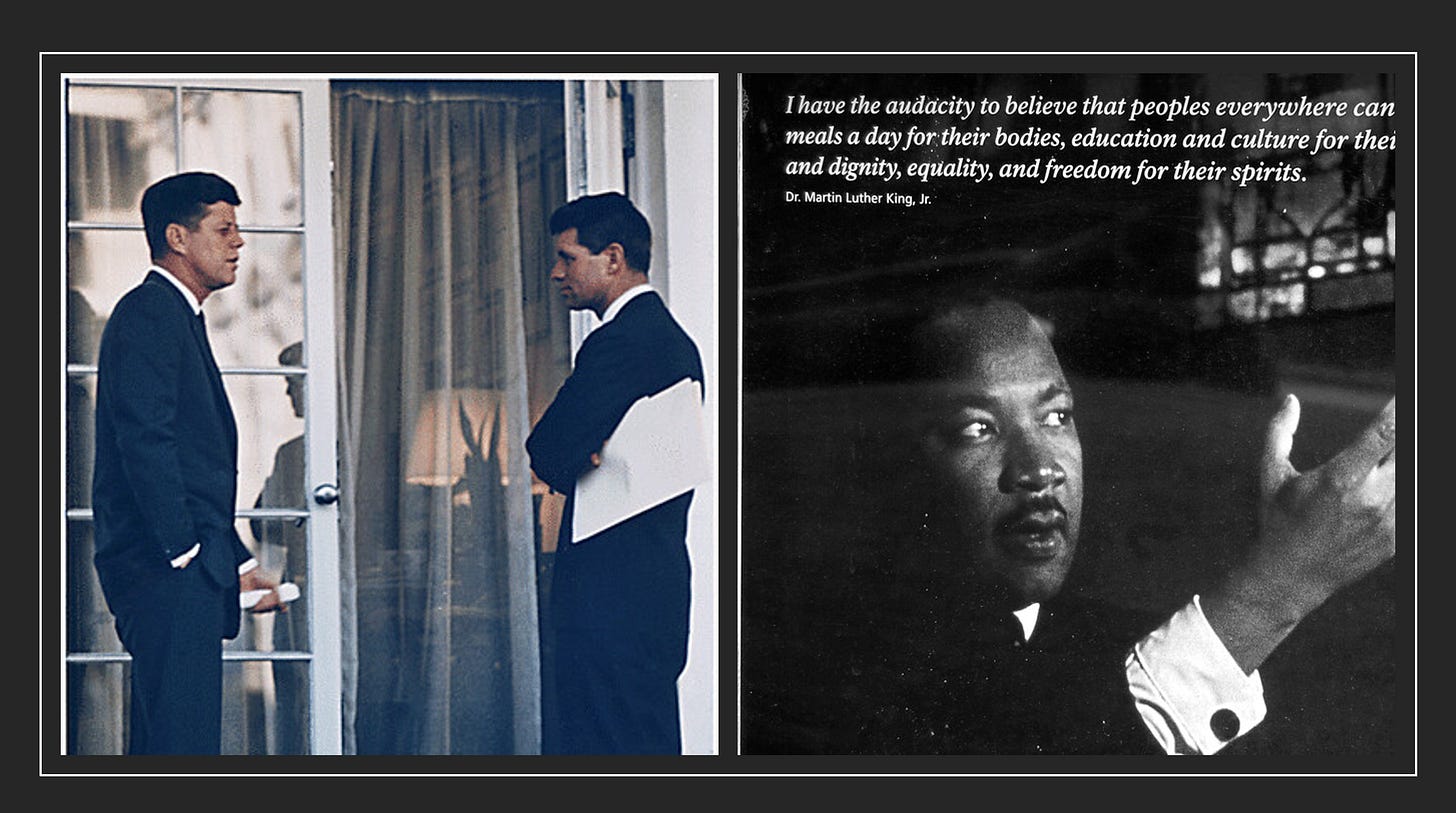
Image information: (Left) “Public Domain: JFK with RFK Outside Oval Office by Robert Knudsen, March 1963 (NARA)“ by pingnews.com is marked with Public Domain Mark 1.0.(Right) “MLK Photo and Quote“ by mattlemmon is licensed under CC BY-SA 2.0.
The Long Shadow of Impunity: The Real Scandal Isn’t Trump, It’s Decades of Looking the Other Way
“Did the Trump administration commit a war crime in its attack on a Venezuelan boat?” read a December 2025 headline from National Public Radio. The headline was one of many in which journalists asked, and pundits debated, whether President Donald Trump’s Department of War had crossed a legal line by bombing Venezuelan boats. Yet what is missing from most of these accounts is the historical context that gives such claims meaning. Trump’s actions, like those of any president, do not exist in isolation. They sit atop decades of presidential abuses that were ignored, minimized, or sanitized by the press and the public. As the anti-censorship organization Project Censored notes, censorship can be either intentional or accidental. Regardless of the cause, it seems that historical context has been erased from our press discourse on contemporary events, including the alleged war crimes committed by the U.S.
The erasure of historical context deprives citizens of the framework needed to understand that many of the actions they oppose are not the result of a single administration or individual, but rather decades of the public failing to hold the powerful accountable. Instead, people divide into partisan camps, only concerned when “the other side does it,” which effectively means that neither side is held accountable. This allows those in power to continually expand their authority, even at the expense of constitutional guardrails.
From Iran-Contra to Gaza: A History of Presidential Lawbreaking Without Consequences
The historically astute surely noticed the connection between the discussion of the Trump administration’s alleged war crimes, and the death of Eugene Haines Hasenfus on December 2, 2025. Hasenfus, a former United States Marine, helped ferry weapons to the Contra rebels in Nicaragua on behalf of the U.S. government in the 1980s. On one of these missions, his plane crashed, and in the process revealed a secret and illegal operation by the Ronald Reagan Administration known as the Iran-Contra Affair.
The scandal revealed how Reagan violated the separation of powers, supported terrorism, enabled drug trafficking, and armed Iran while it was at war with Iraq—which America was also arming. Before the story broke publicly, Reagan warned his cabinet, “If such a story gets out, we’ll all be hanging by our thumbs in front of the White House.” Despite the gravity of these crimes, consequences were negligible. George H. W. Bush, Reagan’s vice president and a knowing participant, succeeded him as president without ever facing accountability.
This troubling pattern of impunity has persisted across administrations: Bill Clinton ordered a controversial strike that destroyed the al-Shifa pharmaceutical factory under questionable justification; George W. Bush oversaw drone strikes and torture programs; Barack Obama expanded the drone campaign, which killed civilians including U.S. citizens; Donald Trump, in his first term, ordered the killing of Iranian commander Qasem Soleimani in violation of international law; and Joe Biden faces global condemnation for aiding Israel’s assault on Gaza, which the United Nations has declared a genocide.
It is against a long history of presidential misconduct without consequence that accusations of war crimes against the Trump administration must be understood. This pattern of impunity has been allowed to persist by the American public. For decades, presidential wrongdoing has rarely been punished. Had earlier leaders been held accountable, their successors might have hesitated before violating national and international law. Instead, the public’s default response remains partisan outrage—a reflex that will undoubtedly surface in the comments on this article—ultimately letting all perpetrators off the hook and normalizing abuses of power up to the present day.
War Abroad, Violence at Home: Tracing the Fallout of U.S. Foreign Policy on American Soil
The importance of historical context extends beyond war crimes to include domestic events as well. On November 26, 2025, Afghanistan refugee Rahmanullah Lakanwal reportedly shot and killed two National Guardsmen. Trump claimed that Biden was at fault because he ended the war in Afghanistan and allowed refugees, including Lakanwal into the country. However, this overlooks important historical context. First, before Biden suggested removing troops from Afghanistan, it was Trump who, during his first term, sought to withdraw U.S. forces after he left office in January 2021. Second, while Biden did oversee the troop withdrawal and allowed Lakanwal to enter the United States, it was the Trump administration that granted him asylum back in April.
Furthermore, Lakanwal’s crimes should be understood within the broader context of the long history of U.S. involvement in weaponizing, collaborating with, and training individuals abroad, actions that have often led to those individuals committing violence on domestic soil. A similar tragedy unfolded in April 2025, when Jamal Wali, a former translator for U.S. forces while they fought the Taliban in Afghanistan, shot police officers in Fairfax, Virginia, before being killed by law enforcement. Moments before opening fire, he was stopped by police and was recorded bemoaning his experience in the U.S. noting “I should have served with f–king Taliban.” This suggests a broader pattern, as Lakanwal’s story is similar but even darker: he served in a CIA-backed Afghan ‘Zero Unit,’ an elite paramilitary force accused of human-rights abuses, including killing civilians and torturing detainees during the war. These histories complicate simple partisan narratives, especially about war, yet they are routinely excluded from mainstream coverage.
When History is Forgotten: How Media Complicity Enables Power to Evade Accountability
New revelations about past censorship reveal how historical erasure distorts the press’s ability to accurately inform the public’s understanding of power today. In November 2025, a whistleblower disclosed that the CIA had once celebrated misleading Congress during the post-1963 investigation into President Kennedy’s (JFK) assassination. Relatedly, that same month it was also revealed that during the 1960s the NYPD conducted far more extensive surveillance of Martin Luther King Jr. (MLK) than previously known. As with the JFK case, those who questioned the government’s version of King’s assassination were often dismissed as baseless conspiracy theorists. While not every counter-claim can be, or ever will be, proven, what is demonstrably true is that the government withheld information from the public in both cases.
That fact alone should prompt greater skepticism from the press regarding government claims about contemporary events. This means abandoning the practice of routinely lumping together two very different groups: those raising informed, evidence-based questions and those drawing unfounded conclusions. For example, while there are many baseless, Alex Jones–style narratives, such as claims that the government is turning frogs gay or that school shootings involve crisis actors, there are also legitimate conspiracies supported by evidence, like Watergate or Iran-Contra. Dismissing all alternative narratives as lunacy only serves the interests of those in power. Reduced skepticism among journalists enables the government to conceal evidence with minimal pushback, while the fear of being labeled a “conspiracy theorist” discourages legitimate inquiry and has contributed to decades of misunderstanding.
This revelation should force journalists to rethink their role, not just getting the story right, but getting it right when it matters. The truth means little to those whose lives were shattered by lies that changed the nation’s course. Worse yet, modern journalism’s economic incentives often reward holding back information until it can be monetized. For example, reporters concealed President Biden’s cognitive decline until it could be released in book form, after the election, and after the period in which the public could have used that information to determine whether a primary challenge was necessary. Repeatedly, the recent scandal involving Journalists Olivia Nuzzi and Ryan Lizza, and Robert F. Kennedy Jr. (RFK Jr.) makes this structural failure unmistakable. Both journalists reported knowing that Kennedy, who reports to be a recovered heroin addict, allegedly used DMT in 2024 but waited nearly a year to disclose it. In fact, they only released this information when Nuzzi could include it in a book and Lizza on his Substack. By the time the reporting surfaced, RFK Jr. had already undergone his confirmation hearing for Secretary of HHS. Surely the public would have wanted to know that beforehand.
Perhaps the starkest illustration of the costs of historical secrecy is the long-delayed release of the Epstein files. I have compiled a continuously updated guide for readers who want documented facts rather than speculation about the deceased sex offender Jeffrey Epstein. Although some files from the Epstein estate and select government records have been released, more are expected on December 19, 2025. Additionally, last week a Florida judge approved a motion to unseal grand jury transcripts related to the Department of Justice’s Epstein investigation. Meanwhile, key materials, including documents held by Epstein’s lawyer and by figures like Michael Wolff and Steve Bannon, as well as unreleased government and banking records, remain hidden. After years of the news media dismissing those who questioned Epstein’s connections to power as conspiracy theorists, the release of emails has brought prominent and powerful individuals under scrutiny including the artist formerly known as Prince Andrew and Larry Summers to Noam Chomsky, Sarah Ferguson, Donald Trump, Alan Dershowitz, and Andrew Farkas.
The revelations expand our understanding of Epstein’s function as a power broker connecting governments, corporations, intelligence agencies, and political operatives. He played a role in facilitating communication between India’s Modi government and Steve Bannon, pursued financing for Israeli cyberweapons, hosted Israeli operatives, promoted the export of Israeli surveillance technology to Côte d’Ivoire, and helped build diplomatic backchannels between Israel and Russia. He even collaborated with Dershowitz in 2006 to undermine early scholarship on the political influence of the Israel lobby. The recently released images and videos of Epstein’s Virgin Islands estate, including a medical-style chair surrounded by masks, a blackboard covered with redacted names, and records of his contacts, suggest how much more remains concealed. Given the historical record, journalists would be wise to avoid dismissing researchers’ claims as baseless conspiracies and instead follow the evidence.
From Revolution to Repression: The Complicated History of Free Speech and Protest at UC Berkeley
History is not only a catalog of abuses of power, but it is also a source of inspiration. The University of California, Berkeley is often remembered as a bastion of protest that ignited the Free Speech Movement and helped catalyze the social movements of the 1960s. But that history is more complicated than the popular myth suggests, and its omissions are worth recalling when considering the university’s current suppression of speech.
Recently, UC Berkeley administrators threatened disciplinary action against student protesters advocating for Palestinian rights, a chilling echo of the very restrictions students once fought to dismantle. Some interpret this as evidence that Berkeley has lost its commitment to free speech, but history tells a different story. The university has long been resistant to student protests, even in the 1960s. It was students, drawing inspiration from movements like the Civil Rights Movement, not university officials who ignited the Free Speech Movement and expanded civil liberties on campus. Those gains were won through confrontation and collective courage, not institutional benevolence. We would all do well to remember that lasting change has never come from waiting for permission; it has always come from insisting on the society we hope to create.

