It’s possible that I shall make an ass of myself. But in that case one can always get out of it with a little dialectic. I have, of course, so worded my proposition as to be right either way (K.Marx, Letter to F.Engels on the Indian Mutiny)
Thursday, May 28, 2026
Canada turns away from U.S. on major defence purchase
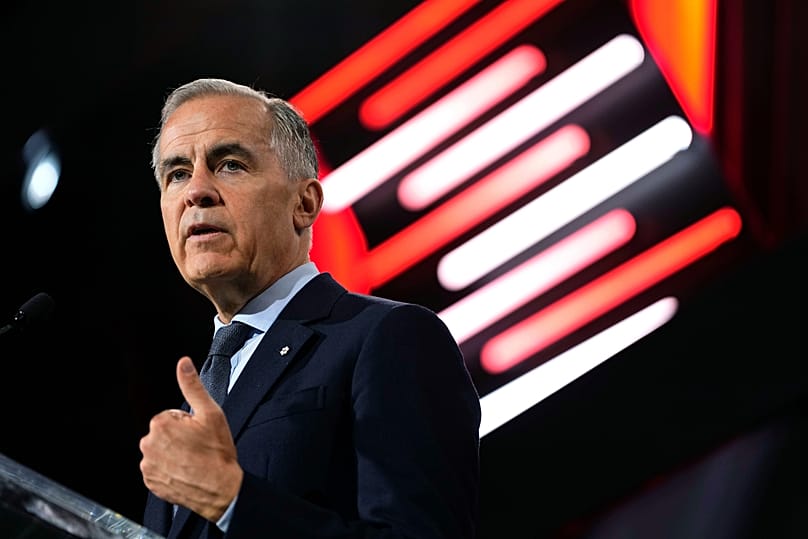
Prime Minister Mark Carney announces that Canada is in negotiations with Sweden for GlobalEye, an advanced aerial surveillance system, Wednesday, May 27, 2026.
OTTAWA – In front of a packed room of Canadian corporate defence and security leaders, Prime Minister Mark Carney announced that Canada has entered negotiations to procure GlobalEye, an advanced aerial surveillance system developed in Sweden that uses Canadian-made jets.
The GlobalEye is an airborne warning and control system (AEW&C) created by Swedish defence and security company Saab. The radar system is integrated into Bombardier’s Global 6500, transforming the corporate jet into a cutting-edge surveillance aircraft.
The federal government is negotiating a deal that would see at least one third of the projected fleet of the GlobalEye aircraft manufactured in Canada over the next 15 years.
Buy Canada Jobs
Once the contracts are signed, sealed and delivered, Bombardier could be manufacturing at least 40 aircraft in its plants in Montreal and Toronto. The projected number also includes orders from Canada’s allies.
Carney outlined the broad strokes in Ottawa, during a keynote speech at CANSEC, the largest defence and security trade conference in Canada.
“It’s a big pipeline, a portion of that pipeline will be built here,” said Saab CEO Micael Johannson in an interview with CTV News. “I want to, as quickly as possible, set up an industrial collaboration with Bombardier and others to have a hub built in Canada, to support the ramp up we need for the GlobalEye.”
In a news release, the government said the deal has the potential to support more than 3,000 jobs in the Canadian aerospace and defence sector from skilled trades to engineering to computing.
Bombardier spokesperson Mark Masluch says there is a possibility the company would have to either expand one of its manufacturing plants or build a new one.
The CBC has reported that the Department of National Defence is interested in purchasing six GlobalEye systems at a cost of more than $5 billion. Once built, the GlobalEye will be a key part of bolstering North American security, by detecting and deterring threats in the Arctic.
The DIS aims to double non-U.S. exports over the next ten years and give Canadian companies a 70 per cent share of defence contacts.
During April’s Liberal convention, Carney was rewarded with rousing applause when he declared that “the days of our military sending 70 cents of every dollar to the United States are over.”
In choosing to negotiate with Saab, Canada is shutting the door on the American option of purchasing the Boeing E-7A Wedgetail surveillance aircraft, which the military was also considering.
“It’s a decision that we’ve made to diversify our military relationships,” said Defence Minister David McGuinty after the announcement. “The way forward is to co-operate with likeminded, mid-sized countries. Pool our talent, pool our technology, pool engineering and know-how, and produce the kind of material that we need.”
Other measures announced
In his breakfast keynote on Wednesday, Carney also announced that the government is implementing a new 90-day approval standard to provide “more predictable decisions.”
He also announced:
Incentivizing foreign contractors to subcontract to Canadian firms and invest in the domestic supply chain.
A new strategic partnership to enable companies to work more closely with government to build sovereign capability.
A Defence Concierge Service to connect small and medium businesses with the right programs, provincial partners and export opportunities.
The creation of a Defence Advisory Forum to ensure government and industry goals remain in synch. The advisory forum will be co-chaired by the ministers of National Defence, Industry, and the Secretary of State for Defence Procurement.
Prime Minister Mark Carney is seen on a screen as he makes an address at the Canadian Association of Defence and Security Industries annual defence industry trade show CANSEC, in Ottawa, on Wednesday, May 27, 2026. THE CANADIAN PRESS/Justin Tang
The advisory board for U.S.-Canada bilateral defence co-operation was established in 1940.
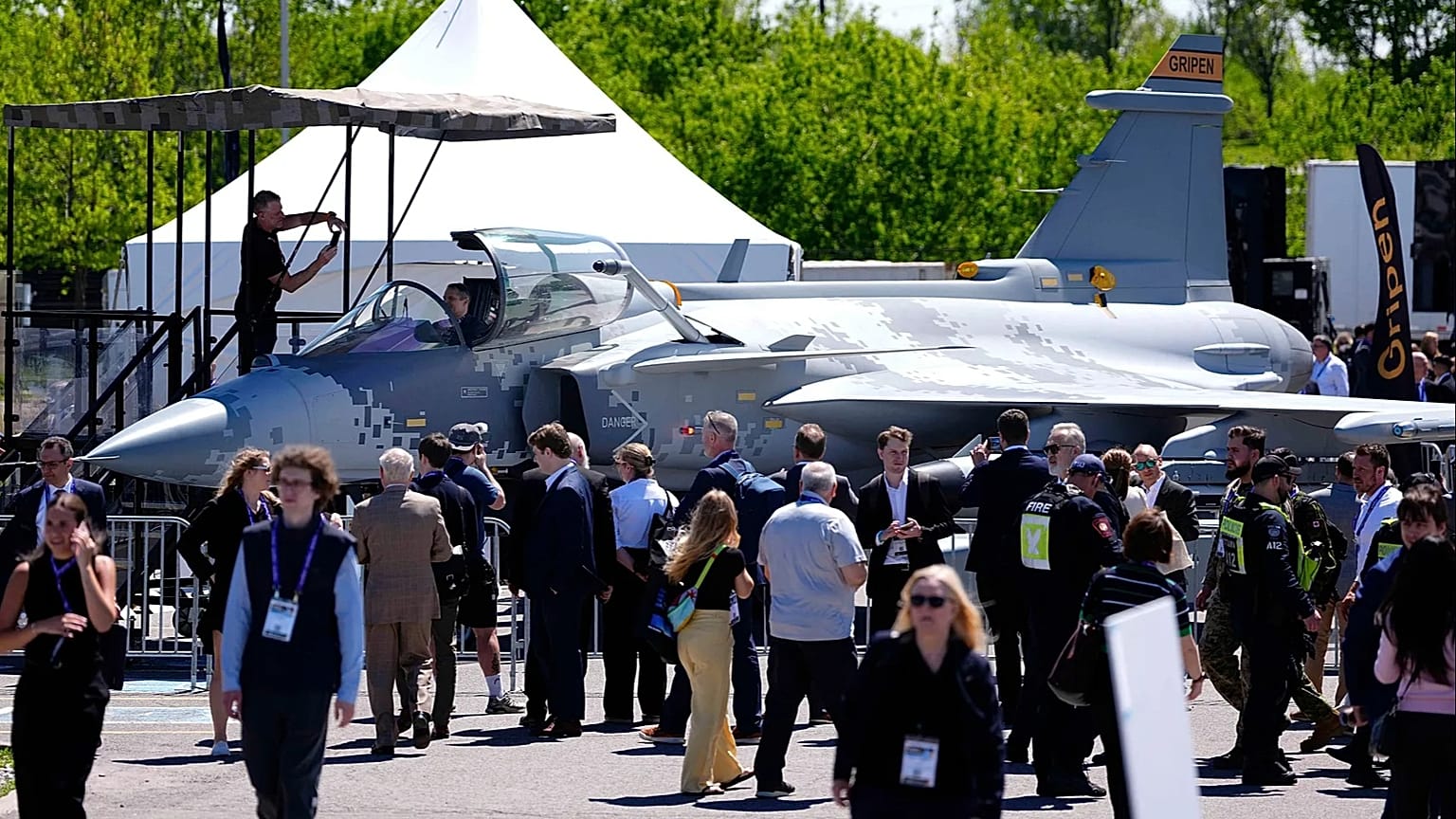
Tensions have also increased over Canada’s decision to review the procurement of F-35s from U.S. based Lockheed Martin, while re-evaluating the merits of the Gripen Fighter, a jet also made by Saab.
Johansson says Saab’s collaboration with Bombardier in its GlobalEye system demonstrates just how important it is to work with “like-minded countries.”
“Sweden is a friend (to Canada). I mean, we are all NATO,” he said. “Our air forces can work together with the Arctic perspective. We share a (similar) threat environment.”
GlobalEye Early Warning and Control solution. SE-RMY aircraft. (Cyan Racing)
Carney says Canada's historically close relationship with the United States has been permanently altered and Ottawa needs to diversify its economic and security relationships.
Canada is moving ahead with the Swedish firm Saab on procuring a new fleet of Arctic surveillance aircraft, Prime Minister Mark Carney announced on Wednesday, choosing the Stockholm-based company over US competitors.
For Carney, the move addresses two key priorities; improving Canada's defence capabilities in the Arctic and reducing the country's economic integration with the United States.
By entering into formal negotiations with Saab on the procurement, Canada has sidelined two US alternatives: the Aeris X by L3Harris and the E-7 Wedgetail by Boeing.
"The GlobalEye procurement will help us secure our North and build our economy at once," Carney said at a defence industry event in Ottawa on Wednesday.
Saab applauded the news and noted plans "to transfer knowledge and technology to Canada that will grow the domestic defence industry," a message also shared by Carney.
Canadian Prime Minister Mark Carney makes an address at the annual defence industry trade show CANSEC in Ottawa, 27 May, 2026 AP Photo
The Canadian premier has listed the Arctic as a strategic priority, warning Canada needs to rapidly improve its defence posture in the region, where geopolitical competition is rising, notably with Russia.
But in choosing a European partner over a US firm, Carney may further anger President Donald Trump's administration, which has already voiced frustration over Ottawa's decision to reconsider a multi-billion-dollar deal for a new fleet of US-made F-35 fighter jets.
When US Undersecretary of Defence Elbridge Colby announced earlier this month that the Pentagon was suspending cooperation on an 86-year-old joint defence advisory board with Canada, he cited the stalled F-35 deal as an aggravating factor.
Carney says Canada's historically close relationship with the United States has been permanently altered and Ottawa needs to diversify its economic and security relationships, insisting bilateral ties will not return to a pre-Trump normal.



No comments:
Post a Comment