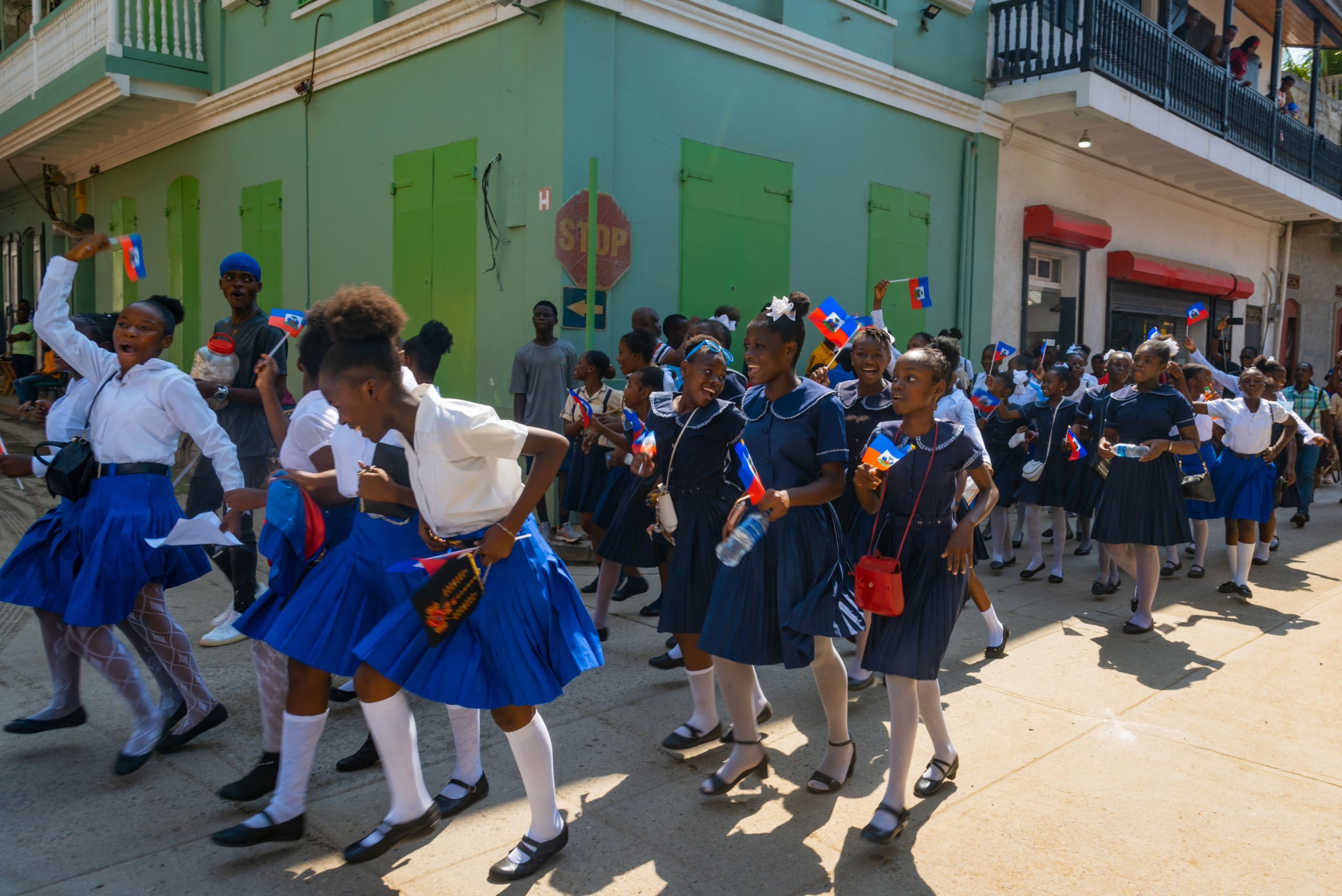
I danced among a sea of my people at a nightclub in Center City, Philadelphia, to celebrate Haitian Independence Day. Earlier, while we were getting dressed, my friends and I debated whether people would take the risk of showing up to a large, loud gathering of Haitians in January 2026. But the club was packed. It’s unclear how many people in the crowd of waving Haitian flags and bodies pressed together might be green card holders or U.S. citizens. How many swaying in the crowd might be among the many Haitians whose immigration statuses have been recently terminated or forced into uncertainty? We obeyed the DJ’s instructions to put our hands up, to jump, to scream. The music made us temporarily uncountable. And as I looked at my own sweaty crew, I understood that we were likely a reflection of the crowd itself: one permanent resident, one U.S. citizen, and one TPS holder, all desperate for this moment.
Haitians all over the United States breathed a collective sigh of relief on Feb. 2, 2026. Just one day before Temporary Protected Status for Haitians was scheduled to expire, Judge Ana C. Reyes blocked its termination. Haitians who fall under this status can continue to be protected from deportation and work legally in the country — for now. The Department of Homeland Security swiftly filed an emergency motion to stay the order. What comes next is the Court of Appeals and eventually the Supreme Court.
TPS is a temporary immigration status that provides protection from deportation and permission to work in the U.S. to people from countries experiencing conditions that make it unsafe to return home. Any national, documented or not, from those countries who has been continuously in the U.S. as of the date of a country’s designation can apply for it. The TPS program began as part of the Immigration Act of 1990; the first country was El Salvador, then in the midst of a civil war. Haiti received a TPS designation under the Obama administration, following the deadly 2010 earthquake. Returning home for many Haitians became virtually impossible. Since then, Haiti’s TPS designation has been renewed in 12- to 18-month increments after periodic reviews of the conditions in Haiti.
TPS has been a lifeline for many Haitians for the past 15 years, but it is only temporary. The first Trump administration’s attempt to terminate TPS prompted multiple lawsuits, including one brought by the NAACP, Haitian Women for Haitian Refugees, and the Haitian Lawyers Association. The 2017 termination was ultimately blocked in federal court in Ramos v. Nielsen. Grassroots groups led by Haitian immigrants then mobilized to extend TPS, among them Haitian Women for Haitian Refugees in Brooklyn, Family Action Network Movement in Florida, and the Haitian Bridge Alliance in California. In June 2024, the Biden administration redesignated TPS for Haiti following an ongoing security crisis caused by elite-backed armed groups that have plagued Port-au-Prince and surrounding towns, extending it through Feb. 3, 2026. An estimated 330,000 Haitians received the status, allowing them and their families to build lives in the U.S. — lives threatened by the Trump administration’s attempt to end their TPS.
But the size of the Haitian crowd in Philadelphia as we shouted call-and-response slogans to rabòday beats tells a much longer story. It reflects peaks in the steady exodus of people from Haiti due to natural disasters, imperialism, political persecution, and poverty over the past half century. Most important, it also reflects the number of families who have secured their status in the U.S. as a result of radical organizing and sustained advocacy by Haitian immigrant organizers over many years. Haitian families who found their footing in the 1970s, ’80s, and ’90s have made it possible for us to find our way and build communities in Northeast Philadelphia, Flatbush, Miami, and other places where we Haitians continue to hold strong to our culture.
Ninaj Raoul, co-founder of Haitian Women for Haitian Refugees and its executive director for 33 years, sees the current upheaval in decades of context. “Haitians have always been under attack,” she said.
Raoul looks to the history of the Haitian Refugee Center in Miami, led by Father Gérard Jean-Juste, and Haitian resistance in the 1970s, during the earliest wave of Haitians’ arriving to the United States by boat, attempting to flee the brutal dictatorship of Jean-Claude Duvalier. Haitians who arrived on U.S. shores were designated as economic refugees, not political ones, making them ineligible for asylum. Activists including Jean-Juste fought this categorization. This struggle “wasn’t new when we started, and it’s not new now for us,” Raoul told me.
As soon as Trump returned to office in 2025 and began his immigration crackdown, Haitians were targeted. When the Trump administration moved to end Haiti’s TPS designation six months early, on Aug. 3, 2025, it gave people just three months to figure out what to do. Although that effort was again blocked in court, the panic it triggered among Haitian families was immediate and widespread.
“I went through moments of despair — just completely distraught,” said a 33-year-old Haitian nonprofit worker who has been able to live and work legally in Flatbush, Brooklyn, because of TPS. Her family’s story is an example of that long work of community building. She says her aunt arrived in the U.S. first, around the mid-1980s. When she got married, she was able to apply for citizenship. Her uncle was next, arriving in the early ’90s to work in the fields. He was one of many Haitians arriving by boat at the time, alongside — and sometimes on the same boats as — Cubans. Unlike their Cuban counterparts at the time, however, Haitians were swiftly deported or detained at Guantánamo.
Those who tested positive for HIV — at least 230 — were quarantined indefinitely in a segregated section of the base known as Camp Bulkeley. Inside the camp, detainees organized themselves, writing letters, documenting abuses, and finding ways to get the word out, leading to a successful legal challenge that eventually allowed them to enter the U.S. Ninaj Raoul and her colleagues accompanied the legal teams to work as interpreters and counselors; as the case dragged on, they began temporarily housing vulnerable detainees in their own homes.
Raoul’s group also fought for years for the Haitian Refugee Immigrant Fairness Act. Enacted in 1998, it granted lawful permanent residency to roughly 50,000 Haitians, including those who had been released from Guantánamo.
“At first we did not jump on the bandwagon,” Raoul said of TPS. “Why would we push for something temporary?” Yet she saw how immigrant organizing, instead of building on the success of the HRIFA, became increasingly deradicalized after 9/11 and the creation of the Department of Homeland Security. “No one wanted to push for anything comprehensive anymore. Nobody wanted to push for green cards anymore,” she said. Raoul told me that the first time she saw a national campaign around immigration was in 2017 with the National TPS Alliance, which advocates for TPS holders nationwide to have a path to permanent residency. Organizing instead focused on smaller compromises and incremental progress instead of ambitious campaigns like the HRIFA, which had secured permanent, long-lasting security for thousands.
As TPS rules have shifted faster than most people can track, with official guidance inaccessible or contradictory, many Haitians rely on informal networks simply to understand whether they should stay, work, or prepare to leave. “The confusion is the most frustrating part,” said a man who arrived in the U.S. in 2024 on humanitarian parole. “One day you wake up and you’re legal. The next day you wake up and you’re illegal. Then you wake up again and maybe there’s a technicality that makes you legal again. It’s hard to keep up.”
And he no longer has a home to return to. “The house I lived in for so many years on Rue de la Réunion was burned down a few weeks after I got to the States,” he told me.
A Haitian immigrant seeking stability in the imperial core faces so many political and emotional dichotomies. Western powers and the Haitian elite prop up corrupt and incompetent regimes that create the instability pushing Haitians from their homes, only for those migrants to be met elsewhere with anti-Haitianism — not only in the U.S. but also in the Dominican Republic, the Bahamas, and other CARICOM member states. Haitians abroad are too often exploited as cheap labor. Countries hostile to Haitian arrivals could focus their diplomacy on strengthening Haiti to stem the tide of migration but have not. The U.S. itself has warned its own citizens not to travel to Haiti due to the armed groups that it has designated as terrorist organizations.
Raoul says that her organization’s focus right now is on community defense workshops. “We don’t like to call it ‘Know Your Rights’ because we feel like there’s not that many rights now,” she says, adding, “We call it community defense because that’s what it is. We’re under attack. Our communities are under attack.” In a December 2025 report, HWHR detailed the impact of these policy shifts — “Haitian refugees, asylum seekers, and migrants in the United States are being subjected to a catastrophe manufactured by the federal government” — and outlined a path forward for organizing and protection. It pointed out that the U.S. government threatened to strip Haitians “away from their families, homes, and communities” and send them to a country where “they face certain, extreme danger — a country this same administration identifies as dangerous and unsafe.”
As Haitians begin to fall out of status and lose their ability to work, many organizations are struggling to meet their needs. Men Anpil (All Hands Together), a community organization that has supported the growing number of Haitian migrants in Philadelphia over the past five years, has typically focused on helping Haitian families establish themselves by providing furniture, rental assistance, and connections to other resources. Now the needs are greater. “People are now mostly concerned about losing their jobs and having to leave the country. I, unfortunately, am at a loss on how to help,” Esaie Pierre, Men Anpil’s co-founder, told me. “We don’t have the resources to support them if they lose their jobs or if they need a lawyer for court appearances or ICE raids.”
Online communities such as InfoMigrants 509 have formed in order to share and explain information for Haitians as the guidance constantly shifts. These are run not by lawyers but by individuals with the time, resources, and literacy to research and summarize complex updates. Via Threads and Community Space sessions on X (formerly known as Twitter), hosts discuss updates directly with people and answer their questions.
A more hands-on example can be found in a small New Jersey office that has become a lifeline for Haitians in the area. At first it offered basic services, such as a public notary and money transfers. “But as the need became apparent,” co-owner Lucie (a pseudonym) said, “I eventually began helping people with their immigration paperwork, and now that is the main service occupying my time.” She said people were desperate for someone they could trust who would be consistently available: “Knowing that my office is open Monday through Saturday at 9:30 a.m. offers folks a sense of security, and I answer the phone no matter where or when my clients call me.” Today, people count on her for everything from listening to family problems to preparing for immigration court hearings. Her office fills the gap between immigration policy as written and immigration policy as lived, offering stability at a time when rules become harder and harder to interpret.
Organizers count on these systems of communication to get the word out. “We know that if we give information to one person, it’s going to get to 50 people every time we do that,” Ninaj Raoul said. She reflected on Haitians who survived the dangerous journey through the Darién Gap, saying, “It’s unspeakable what they have to go through to go through those jungles.” She added, “It makes me think about what our ancestors had to go through for the revolution, just for them to be able to survive that and get here and come here and start new lives” in the U.S., where Haitians shared information on “where to go, where to lay low, where to wait.”
Because the majority of the people HWHR serves have TPS, extending and protecting it became a central focus of the organization’s work. Raoul says that lawyers for the plaintiffs in the lawsuit against ending TPS for Haitians six months early, Haitian Evangelical Clergy Association v. Trump, called on her organization to help fill the courtroom for the May 2025 hearing. After the judge ruled that Department of Homeland Security Secretary Kristi Noem was acting outside her authority, the lawyers told Raoul that they believed the sheer number of supporters who showed up helped tip the decision in their favor.
But DHS announced in November 2025 that TPS for Haiti would instead be terminated after its Feb. 3 expiration. Soon afterward, Trump issued a memo halting all immigration applications from the 19 countries affected by the June 2025 travel ban, including Haiti. That meant no Haitians, including TPS holders, could seek more permanent status. Green card appointments were frozen. Naturalization ceremonies were canceled. Everybody is suspended in limbo.
Judge Reyes’s Feb. 2 decision to momentarily pause the termination of TPS brought much-needed relief, but its extent remains in question while the court case continues. There are still many unknowns, and the next few months will have sweeping consequences for hundreds of thousands of Haitians whose ability to live and work in the United States remains at risk. No matter what, Haitian families and Haitian advocates will need to be ready to act.
“This TPS I have is because my people suffered and died,” the nonprofit worker said. “I don’t want to take their deaths lightly or in vain. I feel like I owe it to them to do something with my status. Even if my status is removed in February, I owe them something. I owe them a fight.”
A catchy Haitian rabòday song called “Nou p ap tounen” (“We Won’t Go Back”) has been circulating on social media. In true rabòday fashion, it features a frantic dance beat, triumphant MIDI horns, and a chorus of jubilant male voices singing “Si n pa ka ret Etazini, n ap lage nou Kanada; si n pa ka ret Kanada, n ap lage kò nou Meksik; si nou pa ka rete Meksik, n ap ale Nikaragwa” (If we can’t stay in the United States, we’ll go to Canada. If we can’t stay in Canada, we’ll go to Mexico. And if we can’t stay in Mexico, we’ll go to Nicaragua). The fear within Haitian communities may be palpable right now, but as the song and the boisterous crowd I danced among for Haitian Independence Day reminds us, so is the defiance.
“We really want people to understand the history of resisting racism as Haitian immigrants in this country,” Raoul said. “A lot of people think TPS fell from the sky, and so we are always reminding people that it’s a fight. And this is what the fight looks like.” The moment we find ourselves in now is simply the latest chapter in a long-held battle.

No comments:
Post a Comment