Organizers are fighting another possible surrender to racism in higher education.
By Danny Katch ,
July 14, 2026
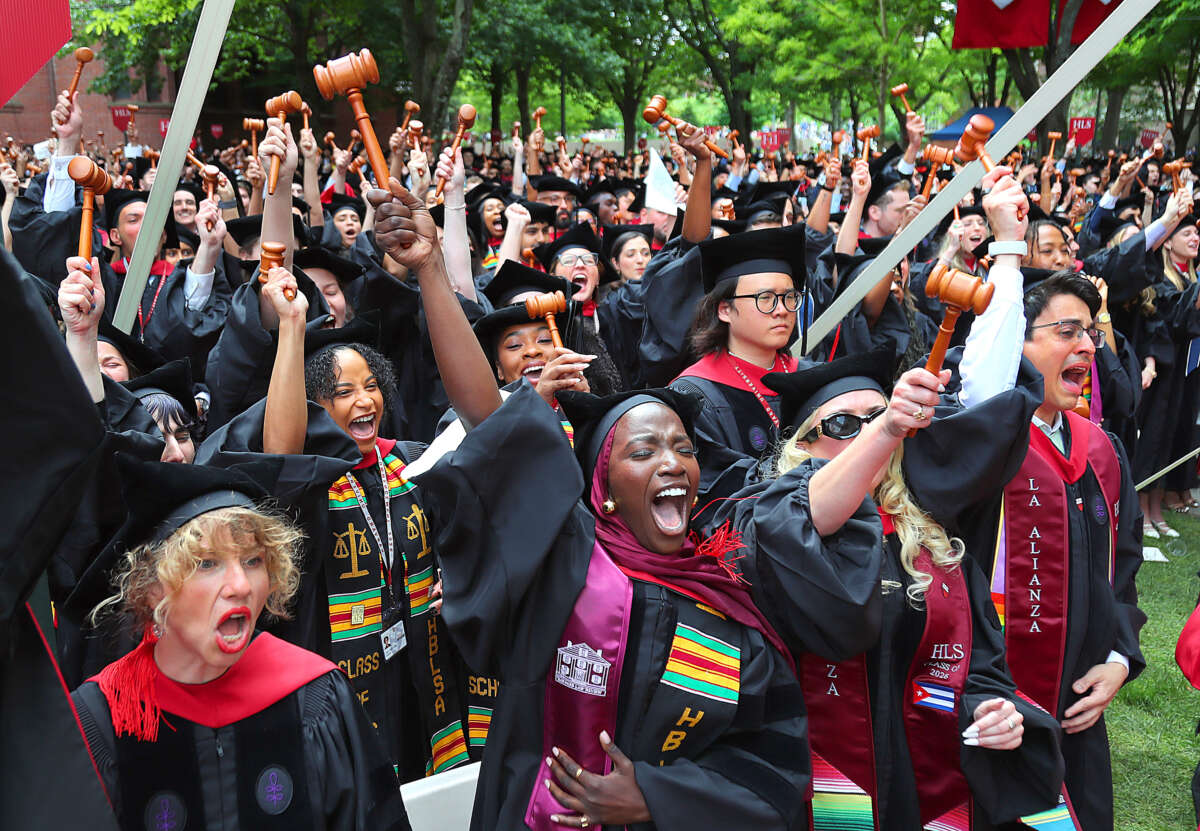
Harvard Law School graduates celebrate at commencement in Cambridge, Massachusetts, on May 28, 2026.John Tlumacki / The Boston Globe via Getty Images
Racial justice organizers in the legal profession are gearing up for an American Bar Association (ABA) House of Delegates meeting this August that will decide whether the ABA will officially drop its commitment to promoting diversity in law schools — and reversing the longstanding exclusion of women and people of color from the legal profession.
“We’re trying to put pressure on the House of Delegates vote,” says Kara Sheli Wallis, an associate professor of law at the City University of New York and board member of the Critical Legal Collective, which has been organizing in defense of Standard 206, which requires law schools to demonstrate “a commitment to diversity and inclusion” by having faculty, staff, and student bodies that are “diverse with respect to gender, race, and ethnicity.”
On May 15, a council of the American Bar Association voted to recommend that the association repeal Standard 206. But for that proposed repeal to be implemented, it must be approved in early August by the annual conference of the ABA House of Delegates.
“There’s still a chance for 206 to survive and say, no we’re not going to backslide to the 1950s South,” Wallis told Truthout.
The fight over a law school accreditation standard might sound like a technical and relatively inconsequential debate, but the repeal of Standard 206 could significantly reverse decades of slow progress toward making the legal profession a more inclusive institution. Fewer lawyers who are not white men would in turn mean worse legal representation for women and people of color, as well as fewer paths to upward mobility.
Racial justice organizers in the legal profession are gearing up for an American Bar Association (ABA) House of Delegates meeting this August that will decide whether the ABA will officially drop its commitment to promoting diversity in law schools — and reversing the longstanding exclusion of women and people of color from the legal profession.
“We’re trying to put pressure on the House of Delegates vote,” says Kara Sheli Wallis, an associate professor of law at the City University of New York and board member of the Critical Legal Collective, which has been organizing in defense of Standard 206, which requires law schools to demonstrate “a commitment to diversity and inclusion” by having faculty, staff, and student bodies that are “diverse with respect to gender, race, and ethnicity.”
On May 15, a council of the American Bar Association voted to recommend that the association repeal Standard 206. But for that proposed repeal to be implemented, it must be approved in early August by the annual conference of the ABA House of Delegates.
“There’s still a chance for 206 to survive and say, no we’re not going to backslide to the 1950s South,” Wallis told Truthout.
The fight over a law school accreditation standard might sound like a technical and relatively inconsequential debate, but the repeal of Standard 206 could significantly reverse decades of slow progress toward making the legal profession a more inclusive institution. Fewer lawyers who are not white men would in turn mean worse legal representation for women and people of color, as well as fewer paths to upward mobility.
American Bar Association Suspends DEI Rules for Law Schools Amid Trump Crackdown
“I’m unsurprised that the ABA jumped at the chance to roll back protections for students,” one legal advocate said. By Zane McNeill , Truthout February 24, 2025
Out of 50 comments received by the American Bar Association Standards Committee, all but two opposed repealing the diversity standard, but the committee still pressed forward with the repeal. One cautiously worded sentence in the committee statement points to the reason:
Recent developments have led the Standards Committee to conclude that this national system of accreditation — and the Council’s role as an accreditor — would be imminently threatened if Standard 206 is not repealed.
Simply put, the American Bar Association is afraid that it will be stripped of its accreditation authority if it doesn’t drop its diversity standard. This is not an idle concern. As the biggest accreditor of law schools in the U.S., the ABA has many standards that law schools must meet or work toward in order to gain or retain the accreditation that enables students to be eligible for everything from federal loans to being able to being accepted by state bar associations, which enables them to legally practice.
The American Bar Association is afraid that it will be stripped of its accreditation authority if it doesn’t drop its diversity standard.
But many in the law school community argue that repealing 206 is not only unprincipled but also naive. “There’s no indication [the Trump administration] is not going to plow through with their own agenda,” says Athena Mutua, a professor at the University at Buffalo School of Law. “Even where people have capitulated, particularly Columbia, the administration just came back with more demands.”
Mutua is president of the Critical Legal Collective, which has been organizing opposition to the American Bar Association decision. In a comment submitted to the ABA Council, the Critical Legal Collective argues that the repeal of Standard 206 is “driven by political pressure and faulty risk assessments rather than a legally sound conclusion that Standard 206 is unconstitutional.”
Even “a Modest Device” Against Discrimination Is Too Much
Standard 206 came about as a result of demands from the feminist and civil rights movements to make law schools more diverse. The first standard, around student diversity, came in 1991. Fifteen years later, the standard was expanded to cover faculty and staff diversity. These measures were long overdue, considering the American Bar Association’s historic reactionary role in the legal profession.
Many in the law school community argue that repealing 206 is not only unprincipled but also naive.
The Critical Legal Collective public comment cites Daria Roithmayr’s scholarship about the organization’s origins as an “alliance between elite law firms and prestigious East Coast law schools in the late 19th and early 20th century” that aimed “to take out educational alternatives that competed with the preserve of white male elites.” As Roithmayr explains:
The ABA was part of a larger movement to eliminate part-time, night-time, and proprietary law schools, which served the rising numbers of immigrants and African Americans who sought to become lawyers. Reinforcing the hierarchy between prestigious law schools and schools that served immigrants and African Americans, Christopher Columbus Langdell and others introduced the case method into elite law schools, which helped to orient legal education toward abstract legal reasoning and away from practical experience.
Over a century later, industry still has a long way to go. Black and Latinx lawyers comprise only 11 percent of the legal profession, less than a third of their share of the U.S. population. Even in its public comment in defense of Standard 206, the Critical Legal Collective soberly calls it “a modest device to move us toward a diverse profession.”
Unsurprisingly, the right wing considered even this moderate progress to be a dire threat. Standard 206 has long been in the crosshairs of conservative and libertarian legal organizations, which complained that American Bar Association’s status as a large accreditor gave it “monopoly” power to impose a draconian liberal agenda and deny law schools the right to determine their own policies.
The Critical Legal Collective argues that the repeal of Standard 206 is “driven by political pressure and faulty risk assessments rather than a legally sound conclusion that Standard 206 is unconstitutional.”
“For people in the Heritage Foundation and all the forces backing the Trump administration,” says Mutua, “I think there is this thought that the only people who should get to be a lawyer are white men.”
In recent years, these formerly fringe arguments have started to become the law of the land.
In 2023, the Supreme Court ruled that race-conscious higher education admissions policies were a violation of the Equal Protection Clause of the 14th Amendment. The conservative movement has had the American Bar Association’s diversity standards in its sights ever since. (To the surprise of nobody, opponents of Standard 206 didn’t have a problem with SCOTUS using its monopoly power to impose universal admissions criteria.)
The Heritage Foundation’s Project 2025 called for new laws to ban accreditors from having diversity requirements. In April 2025, the Trump administration dutifully followed through on this threat, not with legislation but an executive order, in which the American Bar Association was specifically named, calling on the secretary of education to terminate accreditation recognition for organizations that include diversity standards.
These are the “recent developments” cited by the American Bar Association Standards Committee for its decision to recommend the repeal of Standard 206 — against the wishes of 96 percent of comments it received from American Bar Association members.
Building a Record
According to the Critical Legal Collective public comment, American Bar Association Council members have privately defended their vote to end the diversity standard on the grounds that if the organization loses its law school accreditation authority, “whatever might replace the ABA Council is likely to be worse than what currently exists.”
But the comments of ABA Council member David Brennen demonstrate the fallacy of this strategy. Brennen told a reporter that he “personally” supports Standard 206, but “I think it’s appropriate as an accrediting body that we eliminate that standard so we don’t inhibit the diversity of ideas out there in various types of legal education environments.”
This is essentially an application of the old “states’ rights” argument used by defenders of Jim Crow segregation: a national attempt to prevent discrimination would “inhibit the diversity” of those who want to abolish diversity. When organizations like the American Bar Association capitulate to the White House without putting up a fight, they are not practicing harm reduction by preventing an even worse outcome; they are increasing harm by adding their institutional credibility to the assault on basic civil rights.
When organizations like the American Bar Association capitulate to the White House without putting up a fight, they are increasing harm by adding their institutional credibility to the assault on basic civil rights.
The Critical Legal Collective has held protests and helped facilitate public comments before the ABA Standards Council meeting in May. Now organizers are getting ready for the American Bar Association House of Delegates meeting in August, where the final vote on Standard 206’s repeal will take place.
If the American Bar Association reverses course and refuses to relinquish its support of diversity, it could find at least temporary backing in the courts. The Critical Legal Collective notes that there have been successful challenges to the Department of Education’s “Dear Colleague Letter”sent to schools with diversity policies.
But even if these efforts don’t succeed, organizers argue that fighting for law school diversity is worth the risk of losing.
“We just don’t fight because we think we’ll win,” says Mutua. “We see ourselves building a record, because this too will pass. What were the small decisions every day along the way that led to one outcome or another? Who stood, who fell?”
This article is licensed under Creative Commons (CC BY-NC-ND 4.0), and you are free to share and republish under the terms of the license.

Danny Katch
Danny Katch is a socialist, activist, and humor writer. He is the author of Socialism…Seriously: A Brief Guide to Surviving the 21st Century and Why Bad Governments Happen to Good People.

No comments:
Post a Comment