The Fight Against Surveillance Cameras Is a Struggle for Democracy
In a growing movement, over 80 communities have canceled, rejected, or deactivated automated license plate readers.
By Ed Vogel ,
July 15, 2026
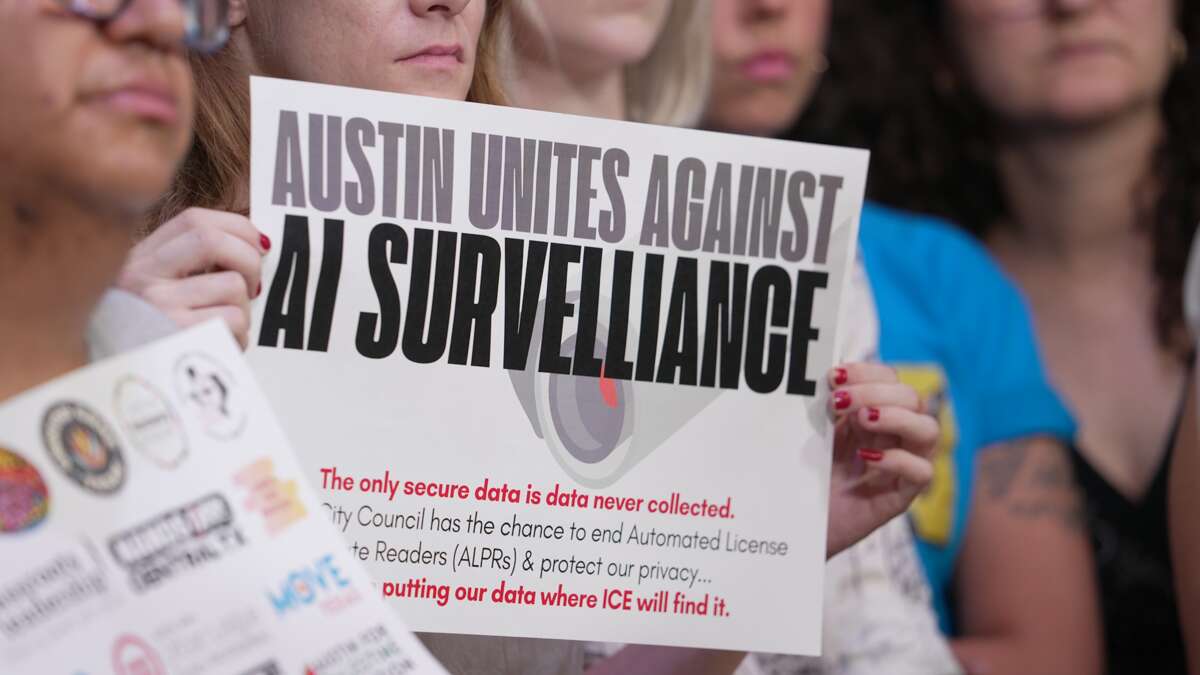
Activists speak out against automated license plate readers during a press conference at city hall on June 4, 2025, in Austin, Texas.Ricardo B. Brazziell / The Austin American-Statesman via Getty Images
When residents of Madison County, North Carolina, sought to speak about the county’s AI surveillance cameras at a recent Madison County Commissioners meeting, commissioner Michael Garrison’s response was simple: “You will not speak on Flock tonight.”
A clip capturing Garrison’s move to prevent public comment soon went viral, resonating with others waging similar battles in their communities. This sort of democratic abuse is not unusual when it comes to the fight against Flock Safety, automated license plate readers more broadly, and other forms of surveillance.
To thousands of people across the country demanding an end to the use of automated license plate readers, it has become abundantly clear that the struggle is deeper than surveillance. At its core, organizing to end the use of automated license plate readers is a fight to imagine and build meaningful practices of democracy.
While companies like Flock Safety, Axon, and Motorola Solutions (among others) sell cameras to cities and police departments across the country under the auspices of improving public safety, these AI surveillance cameras are much more powerful than the companies pushing them suggest, and it is increasingly clear that they actually make us all less safe. These misnamed cameras are always on, collecting data on passing cars at all hours, and do more than just document license plates of driving cars: They can make essentially all information captured in a photo — including the make of a car, color, manufacturer, if the car has dents, bumper stickers, etc. — searchable by police and corporate customers.
This past year has exposed just how dangerous automated license plate readers are as Flock Safety’s products have reportedly been used in immigration enforcement, abortion monitoring, repeated incidents of stalking, and experienced major cybersecurity breaches. But Flock is not alone. Motorola Solutions has long partnered with federal immigration enforcement, while Axon has deep ties to the Department of Homeland Security (DHS) and a history of major ethics violations. Flock has rightfully earned the public’s ire, but these problems are constitutive of the police surveillance industry more broadly.

SCOTUS Ruling Could Be Bad News for Flock — But Won’t Stop Mass Surveillance
Organizers across the country are using every tool in their arsenal against Flock surveillance cameras. By Mike Ludwig , Truthout July 10, 2026
After learning about the use of these AI cameras in their communities, thousands of people across the country have demanded that automated license plate reader cameras be removed. Thus far, more than 80 communities have either canceled, rejected, or deactivated their cameras in the growing challenge to the surveillance apparatus. These fights have also illuminated a deeper structural issue wherever such surveillance technologies are in use: a crisis of democracy. In many of these fights against AI cameras, community members have uncovered the conspicuously quiet processes their police departments or elected officials have employed to approve the use of these tools without anything resembling a democratic process, such as public disclosure, community engagement, public oversight, or any hint of transparency.
This past year has exposed just how dangerous automated license plate readers are as Flock Safety’s products have reportedly been used in immigration enforcement, abortion monitoring, repeated incidents of stalking, and experienced major cybersecurity breaches.
Elected officials in Greenville, South Carolina, have never voted to approve the use of Flock Safety — instead, the local police have used civil asset forfeiture funds to sign a contract. Residents in Saranac Lake in New York called out their police department for moving forward with Flock Safety automated license plate readers and claimed that a potential contract was never discussed at a village board meeting. In San Diego, the police signed a new contract with Flock without engaging the city’s oversight process.
And the lack of disclosure is not limited to the license plate readers. Denver signed a contract with Flock for drones but never disclosed it to Denver’s oversight board. Even in cities with the semblance of a democratic process like Oakland, backdoor dealing moved along an expansion of Flock automated license plate readers after the proposed expansion died in committee.
When pressed, many elected officials have responded negatively to public engagement, exemplified by the incident in Madison County, giving a clear impression that these elected officials do not believe that the public has any role to play in defining public or community safety. Like struggles against other carceral infrastructure and policing, these fights have exposed the expansion of surveillance as a symptom of a deeper structural problem with the practice of democracy in cities across the country.
In response, communities are resisting, using the oftentimes meager democratic tools available to them. In addition to speaking at public meetings, communities are researching these tools using public records requests, engaging in political education, and hosting public events toward building consensus that these AI surveillance cameras need to go. When faced with obstinate elected officials and police departments, communities are ratcheting up pressure and engaging in direct action. While the CEO of Flock Safety calls these groups “terroristic,” communities are utilizing the limited democratic infrastructure available, like zines, to dismantle surveillance systems.
Dismantling the growing surveillance apparatus is one task of many that we must undertake to address this multifold crisis. Groups like the ACLU have attempted to create guardrails and limit the growth of the surveillance apparatus through oversight models, but these policies have often proven inadequate to address the structural problem. To address the core issue, we must not just regulate but fully dismantle the web of surveillance, both public and private, that enables fascism. If we have learned anything from the fights against automated license plate readers, it is that these are authoritarian tools — both a symptom and a material mechanism enabling this political moment.
Democracies should not need to surveil their residents. For many in the U.S., fascism has long been the norm, executed through policing, incarceration, and genocidal policy. For others, authoritarianism has been normalized through the growing use of surveillance in our daily lives since 9/11. And for some, this past year has exposed how the massive data production and collection facilitated by Big Tech and supported by the federal government has undermined all our safety and security.
Whether it’s through the consistent tracking of smartphones, the massive data collection performed by new cars, or the police surveillance apparatus, we’ve been collectively duped by well-executed marketing plans selling us convenience and safety when these tools really produce enormous datasets that reveal intimate aspects of our lives. These datasets are then used against us by corporations and public agencies like DHS — especially against communities already targeted for oppression, criminalization, and other forms of violence.
What many have learned from this past year is how deeply violent these tools are and the certainty that many harms will come if we do not collectively demand an end to surveillance everywhere. We cannot implement tools that create such intense power asymmetries and expect any restraint or regulation to prevent them from being used to intensify repression.
The fights against surveillance (and data centers) have demonstrated a political will and desire for a more radical form of democracy than any of us have ever known. What is encouraging is how the growing movement against automated license plate readers and other surveillance includes people with a wide range of political commitments.
This past year has shown that people with different politics want to work together to address the problems we share. The many groups challenging surveillance understand that the stakes are too high to not work together. People across the country want to shape what safety means in their communities. We collectively recognize that real safety is not a product to be bought and sold.
Meaningful public debates about safety will not be easy to conduct or facilitate, but we don’t have a choice. Either we start to practice democracy, or the surveillance dream built by DHS and the technofascists will reign supreme.
When residents of Madison County, North Carolina, sought to speak about the county’s AI surveillance cameras at a recent Madison County Commissioners meeting, commissioner Michael Garrison’s response was simple: “You will not speak on Flock tonight.”
A clip capturing Garrison’s move to prevent public comment soon went viral, resonating with others waging similar battles in their communities. This sort of democratic abuse is not unusual when it comes to the fight against Flock Safety, automated license plate readers more broadly, and other forms of surveillance.
To thousands of people across the country demanding an end to the use of automated license plate readers, it has become abundantly clear that the struggle is deeper than surveillance. At its core, organizing to end the use of automated license plate readers is a fight to imagine and build meaningful practices of democracy.
While companies like Flock Safety, Axon, and Motorola Solutions (among others) sell cameras to cities and police departments across the country under the auspices of improving public safety, these AI surveillance cameras are much more powerful than the companies pushing them suggest, and it is increasingly clear that they actually make us all less safe. These misnamed cameras are always on, collecting data on passing cars at all hours, and do more than just document license plates of driving cars: They can make essentially all information captured in a photo — including the make of a car, color, manufacturer, if the car has dents, bumper stickers, etc. — searchable by police and corporate customers.
This past year has exposed just how dangerous automated license plate readers are as Flock Safety’s products have reportedly been used in immigration enforcement, abortion monitoring, repeated incidents of stalking, and experienced major cybersecurity breaches. But Flock is not alone. Motorola Solutions has long partnered with federal immigration enforcement, while Axon has deep ties to the Department of Homeland Security (DHS) and a history of major ethics violations. Flock has rightfully earned the public’s ire, but these problems are constitutive of the police surveillance industry more broadly.
SCOTUS Ruling Could Be Bad News for Flock — But Won’t Stop Mass Surveillance
Organizers across the country are using every tool in their arsenal against Flock surveillance cameras. By Mike Ludwig , Truthout July 10, 2026
After learning about the use of these AI cameras in their communities, thousands of people across the country have demanded that automated license plate reader cameras be removed. Thus far, more than 80 communities have either canceled, rejected, or deactivated their cameras in the growing challenge to the surveillance apparatus. These fights have also illuminated a deeper structural issue wherever such surveillance technologies are in use: a crisis of democracy. In many of these fights against AI cameras, community members have uncovered the conspicuously quiet processes their police departments or elected officials have employed to approve the use of these tools without anything resembling a democratic process, such as public disclosure, community engagement, public oversight, or any hint of transparency.
This past year has exposed just how dangerous automated license plate readers are as Flock Safety’s products have reportedly been used in immigration enforcement, abortion monitoring, repeated incidents of stalking, and experienced major cybersecurity breaches.
Elected officials in Greenville, South Carolina, have never voted to approve the use of Flock Safety — instead, the local police have used civil asset forfeiture funds to sign a contract. Residents in Saranac Lake in New York called out their police department for moving forward with Flock Safety automated license plate readers and claimed that a potential contract was never discussed at a village board meeting. In San Diego, the police signed a new contract with Flock without engaging the city’s oversight process.
And the lack of disclosure is not limited to the license plate readers. Denver signed a contract with Flock for drones but never disclosed it to Denver’s oversight board. Even in cities with the semblance of a democratic process like Oakland, backdoor dealing moved along an expansion of Flock automated license plate readers after the proposed expansion died in committee.
When pressed, many elected officials have responded negatively to public engagement, exemplified by the incident in Madison County, giving a clear impression that these elected officials do not believe that the public has any role to play in defining public or community safety. Like struggles against other carceral infrastructure and policing, these fights have exposed the expansion of surveillance as a symptom of a deeper structural problem with the practice of democracy in cities across the country.
In response, communities are resisting, using the oftentimes meager democratic tools available to them. In addition to speaking at public meetings, communities are researching these tools using public records requests, engaging in political education, and hosting public events toward building consensus that these AI surveillance cameras need to go. When faced with obstinate elected officials and police departments, communities are ratcheting up pressure and engaging in direct action. While the CEO of Flock Safety calls these groups “terroristic,” communities are utilizing the limited democratic infrastructure available, like zines, to dismantle surveillance systems.
Dismantling the growing surveillance apparatus is one task of many that we must undertake to address this multifold crisis. Groups like the ACLU have attempted to create guardrails and limit the growth of the surveillance apparatus through oversight models, but these policies have often proven inadequate to address the structural problem. To address the core issue, we must not just regulate but fully dismantle the web of surveillance, both public and private, that enables fascism. If we have learned anything from the fights against automated license plate readers, it is that these are authoritarian tools — both a symptom and a material mechanism enabling this political moment.
Democracies should not need to surveil their residents. For many in the U.S., fascism has long been the norm, executed through policing, incarceration, and genocidal policy. For others, authoritarianism has been normalized through the growing use of surveillance in our daily lives since 9/11. And for some, this past year has exposed how the massive data production and collection facilitated by Big Tech and supported by the federal government has undermined all our safety and security.
Whether it’s through the consistent tracking of smartphones, the massive data collection performed by new cars, or the police surveillance apparatus, we’ve been collectively duped by well-executed marketing plans selling us convenience and safety when these tools really produce enormous datasets that reveal intimate aspects of our lives. These datasets are then used against us by corporations and public agencies like DHS — especially against communities already targeted for oppression, criminalization, and other forms of violence.
What many have learned from this past year is how deeply violent these tools are and the certainty that many harms will come if we do not collectively demand an end to surveillance everywhere. We cannot implement tools that create such intense power asymmetries and expect any restraint or regulation to prevent them from being used to intensify repression.
The fights against surveillance (and data centers) have demonstrated a political will and desire for a more radical form of democracy than any of us have ever known. What is encouraging is how the growing movement against automated license plate readers and other surveillance includes people with a wide range of political commitments.
This past year has shown that people with different politics want to work together to address the problems we share. The many groups challenging surveillance understand that the stakes are too high to not work together. People across the country want to shape what safety means in their communities. We collectively recognize that real safety is not a product to be bought and sold.
Meaningful public debates about safety will not be easy to conduct or facilitate, but we don’t have a choice. Either we start to practice democracy, or the surveillance dream built by DHS and the technofascists will reign supreme.


No comments:
Post a Comment