Tuesday, February 18, 2020

Canaanite Temple Unearthed At Lachish
2/17/2020  

A team of archaeologists led by Professor Yosef Garfinkel at the Hebrew University of Jerusalem’s Institute of Archaeology and Professor Michael Hasel at Southern Adventist University in Tennessee has unearthed a 3,000-year-old Canaanite temple in Tel Lachish National Park.

Aerial view of the newly found temple at Tel Lachish [Credit: Emil Eljem]


In a study published last month in Levant, Garfinkel and his co-authors revealed, for the first time ever, extensive ruins of a Canaanite temple dating to the 12th century BCE that they uncovered in National Park Tel Lachish, a large Bronze Age-era settlement near the present-day Israeli city of Kiryat Gat.


Some of the pottery uncovered in the temple [Credit: C. Amit/IAA]
Lachish was one of the most important Canaanite cities in the Land of Israel during the Middle and late Bronze Ages; its people controlled large parts of the Judean lowlands. The city was built around 1800 BCE and later destroyed by the Egyptians around 1550 BCE. It was rebuilt and destroyed twice more, succumbing for good around 1150 BCE. The settlement is mentioned in both the Bible and in various Egyptian sources and was one of the few Canaanite cities to survive into the 12th century BCE.


Weapons and jewellery found near the temple inner sanctum: beads, earrings, an arrowhead,
a dagger and an axe head [Credit: T. Rogovski]


"This excavation has been breath-taking,” shared Garfinkel. “Only once every 30 or 40 years do we get the chance to excavate a Canaanite temple in Israel. What we found sheds new light on ancient life in the region. It would be hard to overstate the importance of these findings.”


Two ancient figurines found at the temple in Tel Lachish likely represent Baal and Resheph,
deities worshipped by the Canaanites [Credit: T. Rogovski]
The layout of the temple is similar to other Canaanite temples in northern Israel, among them Shechem [Nablus], Megiddo and Hazor. The front of the compound is marked by two columns and two towers leading to a large hall. The inner sanctum has four supporting columns and several unhewn “standing stones” that may have served as representations of temple deities. The Lachish temple is more square in shape and has several side rooms, typical of later temples including Solomon’s Temple.


Bronze cauldron found at Tel Lachish [Credit: T. Rogovski]


In addition to these archaeological ruins, the team unearthed a trove of artifacts including, bronze cauldrons, Hathor-inspired jewellery, daggers and axe-heads adorned with bird images, scarabs, and a gold-plated bottle inscribed with the name Ramses II, one of Egypt’s most powerful pharaohs. Near the temple’s holy of holies, the team found two bronze figurines. Unlike the winged cherubs in Solomon’s Temple, the Lachish figurines were armed “smiting gods”.


An extremely rare find found at Tel Lachish shows a Caananite inscription and the oldest-known
example of the letter “samekh” (highlighted) [Credit: T. Rogovski]
Of particular interest was a pottery sherd engraved with ancient Canaanite script. There, the letter “samek” appears, marked by an elongated vertical line crossed by three perpendicular shorter lines. This makes it the oldest known example of the letter and a unique specimen for the study of ancient alphabets.

Source: Israel Ministry of Foreign Affairs [February 17, 2020]

Over 6,000 bodies found in Burundi's mass graves

Reuters•February 15, 2020


1 / 7

Over 6,000 bodies found in Burundi's mass graves
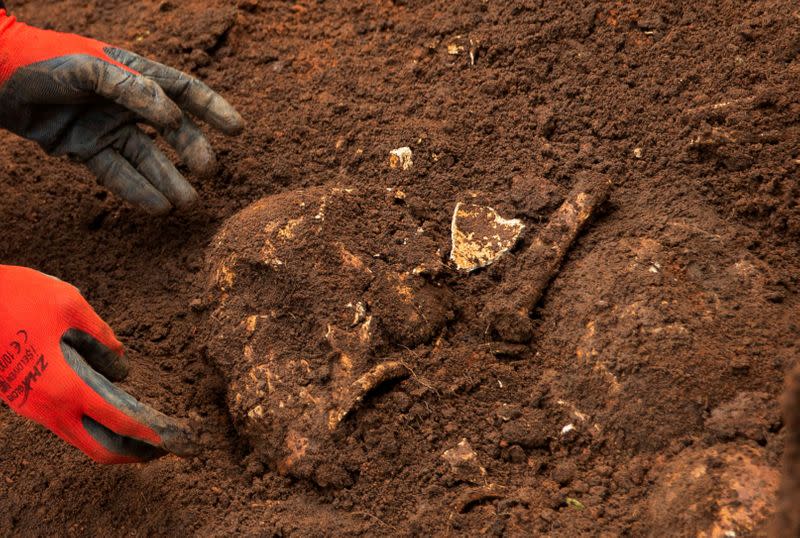
A Burundian worker from the Ttruth and Reconciliation Commission extracts the skull of an unidentified person from a mass grave in the Bukirasazi hill in Karusi Province

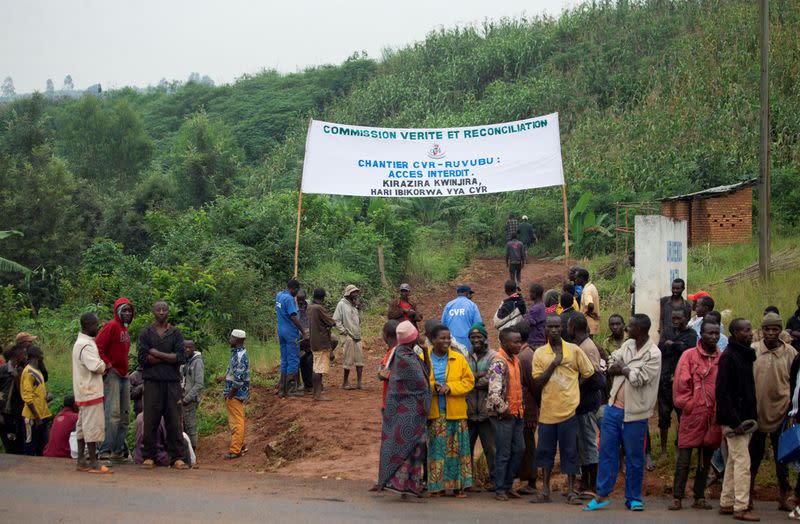
(Reuters) - Burundi’s Truth and Reconciliation Commission has found more than 6,000 bodies in six mass graves in Karusi Province, the largest finding since the government launched a nationwide excavation in January.

The commission chairman Pierre Claver Ndayicariye told journalists on Friday that the remains of 6,032 victims as well as thousands of bullets were recovered. Clothes, glasses and rosaries were used to identify some of the victims.

The tiny East African nation is struggling to come to terms with a violent past, characterized by suffered colonial occupation, civil war and decades of intermittent massacres.

Referring to a massacre which is believed to have targeted people from the Hutu ethnic group, Ndayicariye said families of the victims were able to "break the silence" that was imposed 48 years ago.

Burundi’s population is divided between the Tutsi and Hutu ethnic groups. The civil war - which killed 300,000 people before it ended in 2005 - had ethnic overtones.

The government-run commission was set up in 2014 to investigate atrocities from 1885, when foreigners arrived in Burundi, until 2008, when a stalled peace deal to end the civil war was fully implemented.

So far it has mapped over 4,000 mass graves across the country and identified more than 142,000 victims of violence.

Its mandate does not cover most of the rule of the current president, Pierre Nkurunziza, who took office in 2005.

The United Nations has warned that human rights abuses might increase again ahead of May 2020 elections. Since 2015, when Nkurunziza ran for a third, disputed term in office, hundreds of Burundians have been killed in clashes with security forces.
Young adults support Bernie Sanders because they want to benefit from 'boomer socialism' that older Americans already enjoy

jzeballos@businessinsider.com (Joseph Zeballos-Roig),
Business Insider•February 16, 2020

Bernie Sanders calls out rival Mike Bloomberg
The Democratic presidential candidate Bernie Sanders at a campaign rally at the University of Minnesotas Williams Arena on November 3.

Scott Heins/Getty Images

Sen. Bernie Sanders is drawing strong support among young voters, particularly those ages 18 to 29, as a result of his pledges to enact universal healthcare and wipe out student debt.

But older voters are mostly absent from the Sanders coalition, and many hold unfavorable views of socialism.

One economist has said older Americans benefit from "boomer socialism."

It's led younger adults to seek a greater share of the economic pie and call for the federal government to widen the social safety net for them.

Sen. Bernie Sanders of Vermont is solidifying his standing as the frontrunner of the Democratic presidential race after a victory in the New Hampshire primary and a strong finish in the Iowa caucuses. The self-proclaimed democratic socialist seeks to enact universal healthcare in the US, wipe out student debt, and fight climate change.

Combined with promises to take on the political and financial elite, the ambitious proposals are helping generate a wave of enthusiasm among younger voters that's propelling his unabashedly progressive campaign, similar to 2016.

Business Insider recently reviewed exit polls from the New Hampshire primary on February 11, and they indicated that Sanders drew nearly half of voters ages 18 to 29, more than the other four major Democrats on the ballot combined.

But conspicuously missing from his nascent coalition of voters was older Americans, long a force at the voting booth. Exit polls from New Hampshire indicated that Sanders drew only 15% of voters over age 65.

Put simply, older voters aren't flocking to back Sanders in similar numbers as young voters. A CNN poll last month found the Vermont senator's support from registered voters who leaned Democratic to be 31 percentage points higher among those under the age of 45 than it was among those over 65.

Part of the reason is the unpopularity of socialism, which an October Gallup poll found was viewed negatively by two out of three respondents born before 1975. The same poll found young adults' views of capitalism had soured over the past decade, with 47% of those ages 18 to 34 saying they had a positive view of it, compared with 52% who said they had a positive view of socialism.


The rising price tags of healthcare, education, and homeownership have left many young people feeling marginalized from the economy, leading to calls for drastic reform that levels the playing field for them and curbs widening inequality. Sanders has pledged to deliver transformational change that deals with their deepening anxieties.

"Unless we turn this around, young people are going to be on a lower standard of living than their parents," the Vermont senator told the New York Times editorial board. "That means they are leaving school deeply in debt."

He went on: "The jobs they're getting may not necessarily in real dollars be equivalent to what their parents had. They can't afford housing. This is a generation that is struggling, and we have to address that."

Tuition and fees at colleges and universities have grown faster than wages, helping to leave one in three adults in their 20s to pay off student debt. Healthcare costs are swelling, and millennials have long been found to have lower rates of homeownership than their parents' generations.

Sanders has vowed to remake the economy and redistribute its riches through higher taxes on the wealthy to pay for an array of expansive plans. They add up to over $50 trillion in federal spending and would usher in a profound expansion of the welfare state benefiting millions of people.

But Sanders has long struggled with older voters who tend to link socialism with Soviet communism and distrust his platform.

The economist Ed Glaeser, though, has argued that older Americans already benefit from a group of policies he's called "boomer socialism."

"In many cases, there seems to be a sense in which insiders have managed to stack the deck against outsiders," Glaeser told The Wall Street Journal.

Glaeser pointed out that groups of people — like retirees and homeowners — had locked in benefits for themselves and made it more difficult for newcomers, whether young people or immigrants, to obtain similar chances of prosperity.

Here are three federal programs that mostly benefit older Americans, per The Atlantic's Derek Thompson:


Medicare represents a form of single-payer healthcare for people ages 65 and over, insuring almost 60 million Americans, or one in five people in the US.


Social Security is a program that operates similarly to universal basic income, guaranteeing monthly payments to elderly and disabled Americans.


The mortgage-interest deduction cuts a person's tax bill by the amount of interest paid on a home loan. In other words, it's a tax break for homeowners, who skew older.

Young adults are pressing to widen the reach of government benefits to include them. A key reason is that the traditional stepping stones toward a life of prosperity are no longer easy to secure. Higher education, affordable housing, and quality healthcare are out of reach for many.

As Thompson put it, Sanders seeks to expand the "existing social contract" that older people already enjoy to include a new generation of Americans.

Still, the Vermont senator's call for a progressive revolution appears to have its limits.

In this year's New Hampshire primary, the share of Democratic voters ages 18 to 29 dropped from 2016, The Washington Post reported. Turnout was also lower in the disastrous Iowa caucuses.

Whether that trend continues as the primaries head south and west could be decisive for Sanders, who has pinned his presidential ambitions on turning out young adults in record numbers.
Topless dairy industry protesters crashed the stage at a Bernie Sanders rally
Ellen Cranley,Business Insider•February 16, 2020
 

Protesters calling for Sen. Bernie Sanders to cut his support for the dairy industry crashed his Carson City, Nevada rally on Sunday afternoon. One protester grabbed a microphone to say she was Sanders' "biggest supporter" but pleaded that he "stop pumping up the dairy industry." While she was speaking, three topless women took the stage with "let dairy die" written on their chests. Visit Business Insider's homepage for more stories. Topless protesters crashed the stage at a rally for Sen. Bernie Sanders on Sunday afternoon to protest his involvement with the dairy industry. The Democratic presidential hopeful was taking the microphone from his wife Jane, whom he called "the next first lady," at a rally in Carson City, Nevada. But then protesters took the stage. "Bernie, I'm your biggest supporter, and I'm here to ask you to stop pumping up the dairy industry and to stop pumping up animal agriculture," one protester said. "I believe in you…" she added, before the mic cut out and security appeared to approach her on stage. A tweet with video from the event's livestream tagged activist Priya Sawhney and animal-rights group Direct Action Everywhere. —AJ Jivdaya (@bunnydad_aj) February 16, 2020 Other photos posted online showed at least two topless protesters onstage who appeared to have "LET DAIRY DIE" written on their chests. They also appeared to pour milk on themselves. Sawhney was not arrested, but the three women who were topless were arrested and charged with indecent exposure. They are currently being held on $2,500 bond each, according to a press release from Direct Action Everywhere. "I love Bernie, but we must hold abusive industries accountable, not shield and subsidize them. Animal farming is an industry which gives welfare payments to millionaires," Sawhney said in a statement included in the release. "People are fed up. Like the Sanders campaign itself, animal rights is a burgeoning mass movement." The same release cited their disagreement with Sanders' "decades-long legislative history of protecting the dairy industry," including writing a 2009 amendment providing dairy with $350 million in aid and approving the 2018 Farm Bill, which the group writes "approved over $100 billion in subsidies while rejecting activist requests to prevent handouts to millionaires and billionaires." Sanders didn't seem fazed by the interruption. "This is Nevada, there's always a little bit of excitement at no extra cost," he said, according to the New York Post. Read more:


Protesters calling for Sen. Bernie Sanders to cut his support for the dairy industry crashed his Carson City, Nevada rally on Sunday afternoon.

One protester grabbed a microphone to say she was Sanders' "biggest supporter" but pleaded that he "stop pumping up the dairy industry."

While she was speaking, three topless women took the stage with "let dairy die" written on their chests.

Topless protesters crashed the stage at a rally for Sen. Bernie Sanders on Sunday afternoon to protest his involvement with the dairy industry.

The Democratic presidential hopeful was taking the microphone from his wife Jane, whom he called "the next first lady," at a rally in Carson City, Nevada. But then protesters took the stage.

"Bernie, I'm your biggest supporter, and I'm here to ask you to stop pumping up the dairy industry and to stop pumping up animal agriculture," one protester said. "I believe in you…" she added, before the mic cut out and security appeared to approach her on stage.

A tweet with video from the event's livestream tagged activist Priya Sawhney and animal-rights group Direct Action Everywhere.
—AJ Jivdaya (@bunnydad_aj) February 16, 2020

Other photos posted online showed at least two topless protesters onstage who appeared to have "LET DAIRY DIE" written on their chests. They also appeared to pour milk on themselves.

Sawhney was not arrested, but the three women who were topless were arrested and charged with indecent exposure. They are currently being held on $2,500 bond each, according to a press release from Direct Action Everywhere.

"I love Bernie, but we must hold abusive industries accountable, not shield and subsidize them. Animal farming is an industry which gives welfare payments to millionaires," Sawhney said in a statement included in the release. "People are fed up. Like the Sanders campaign itself, animal rights is a burgeoning mass movement."

The same release cited their disagreement with Sanders' "decades-long legislative history of protecting the dairy industry," including writing a 2009 amendment providing dairy with $350 million in aid and approving the 2018 Farm Bill, which the group writes "approved over $100 billion in subsidies while rejecting activist requests to prevent handouts to millionaires and billionaires."

Sanders didn't seem fazed by the interruption.

"This is Nevada, there's always a little bit of excitement at no extra cost," he said, according to the New York Post.

Snake orgy prompts partial closure of Florida city park
GETTY IMAGES NORTH AMERICA/AFP/File / Richard HEATHCOTEOne resident said he saw around 25 Florida water snakes gather at a park in Lakeland, southwest of Orlando
A city in Florida closed off part of a park after residents spotted dozens of snakes which had apparently gathered for their annual coupling.
"It appears they have congregated for mating," the City of Lakeland Parks and Recreation Department said on Facebook with a photo of one of the serpents seen in the park by Lake Hollingsworth, southwest of Orlando.
Officials on Thursday sealed off an area where the amorous reptiles had gathered for their pre-Valentine's Day tryst with caution tape.
"This is for the protection of the public and the snakes," the department said.
"They are non-venomous and generally not aggressive as long as people do not disturb them. Once the mating is over they should go their separate ways."
The slippery customers were identified as harmless native Florida water snakes.
"They are generally found resting in tree limbs over water or basking on shorelines. They are an important part of the ecosystem and should not be disturbed," the department said.
Resident Tim Newberry, whose Facebook photos of snakes in the park alerted city authorities, told 10News he saw about 25 that day.
Image result for BC COMIC FAT BROAD SNAKE

Death squad disrupters: Filipina patrols help keep drug killings at bay

By Martin Petty and Eloisa Lopez,Reuters•February 16, 2020
File Photo: A banner hangs outside a church in the 
Philippine town of Pateros, Metro Manila, Philippines 
March 15, 2017. REUTERS/Erik De Castro


MANILA, Feb 17 (Reuters) - Late each night, a dozen women chat and share a meal before hitting the narrow streets of a Manila suburb where a death squad once roamed.

They are the "women's patrol", a group of 18 mothers and grandmothers whose nightly walks through the dimly lit alleys of Pateros have been helping to deter shadowy gunmen behind murders of residents linked to illegal drugs.

Not long after Philippine President Rodrigo Duterte declared a war on drugs in 2016 and promised thousands would die, Pateros was being terrorised by attackers in hoods and ski masks, known locally as the "bonnet gang". (https://reut.rs/2H118PK)

With the town of 63,000 paralysed by fear, the women decided to arm themselves with flashlights and patrol their community, keeping up a nightly presence to disrupt the bonnet gang.

"When we started patrols, the enthusiasm came back to our community and the fear disappeared. Back then, people were afraid to go out," said Jenny Helo, 39, who leads the women through the labyrinth of shops, shacks and informal dwellings.

"But when they saw how effective we are, because of how we really go around the community, people regained confidence."

The killers have not been caught.

In the deadliest periods of the crackdown, there were as many as four murders linked to drugs each day in the Philippines, many by gunmen riding pillion on motorcycles.

The total number of drug-related killings since Duterte unleashed his drugs war is unknown.

Police say they killed 5,400 suspects in self-defence during their anti-drugs operations, but deny allegations by activists that elements of the force are involved in the mystery killings that plagued Pateros and other parts of Manila.

In a written response to Reuters, Duterte's spokesman Salvador Panelo called those "inevitable results" when a government was serious about suppressing illegal drugs.

He attributed the deaths to botched drug deals, turf wars between drug syndicates, or informants being silenced.

Pateros is now safer and the gunmen have gone, say those who live there. The women never found out who the bonnet gang were, Helo said, but believe they thwarted them.

"We disrupted them in what they do," she said. "They know we are here to fight what they're doing."

Pateros police chief Colonel Simnar Gran praised the patrollers and said local police had worked closely with them and the mayor to tighten the town's security.

A few officers accompany the women each night, enforcing curfews and smoking bans, and warning people against drugs.

"This can be replicated by other communities," Gran said. "They're doing this voluntarily without compensation. They're just civic-minded people." (Editing by Clarence Fernandez)

An invasion of propaganda: Experts warn that white supremacist messages are seeping into mainstream


Jorge L. Ortiz, USA TODAY•February 16, 2020


VIDEO Tucker Carlson: White supremacy is not a 'real problem'

Colin P. Clarke has been teaching a course on terrorism and insurgency at Carnegie Mellon University in Pittsburgh for four years, and much more of his class these days is devoted to white supremacy than in the past.

So Clarke was not one bit surprised when a new report by the Anti-Defamation League’s Center on Extremism revealed that efforts to spread white supremacy propaganda – often through discriminatory fliers, banners and posters – more than doubled from 2018 to last year.

Moreover, the university is located just a short walk from the Tree of Life synagogue, and Clarke has seen up close the consequences of hateful words turning into violent action.

“It’s concerning because, for all the people who don’t move on to become threats of violence, some will, and some will get their start by seeing pieces of propaganda that will alert them to the fact this group exists,’’ Clarke said.

The ADL report represents a sobering warning about the reach of white supremacist groups, which can take advantage of the efficiency and anonymity provided by social media to disseminate their ideology with little fear of backlash.

Last year the ADL recorded its highest number of propaganda incidents ever with 2,713 cases, compared to 1,214 in 2018. College campuses, full of impressionable young minds open to new ideas, are a favorite target, receiving about one-fourth of the propaganda against minority groups like immigrants, blacks, Jews, Muslims and members of the LGBTQ community.

The report also said all states except Hawaii registered instances of this kind of messaging, which is often cloaked in patriotic themes and serves as a recruiting tool. In addition, the ADL said the use of announced white supremacist rallies has given way to flash demonstrations, which are less likely to draw counter-protests and negative media coverage.
A menorah at a memorial outside the Tree of Life Synagogue, where Robert Bowers killed worshippers in an Oct. 27 shooting, as people prepare for a celebration service at sundown on the first night of Hanukkah in the Squirrel Hill neighborhood of Pittsburgh.More

John Cohen, a former counterterrorism coordinator at the Department of Homeland Security and now an adjunct professor at Georgetown University’s Center for Security Studies, said white supremacists have become more sophisticated in their communication.

“They’ve rebranded themselves,’’ Cohen said. “In the past they were viewed as racist individuals who were on the fringe or outside of mainstream society. Now their thoughts and ideas and messaging have been incorporated into the mainstream political discourse by a growing number of elected officials.’’

Parental guidance: White supremacy in America: Can parents stop online radicalization?

While emphasizing he’s not singling out either party, Cohen warned about the danger of normalizing white supremacist ideology.

In the runup to the 2018 midterm elections, President Donald Trump often railed against the caravans of migrants from Central America making their way to the U.S. to request asylum.

On Oct. 27 of that year, 10 days before the election, accused gunman Robert Bowers burst into the Tree of Life synagogue and killed 11 people in a shooting rampage. In anti-Semitic online comments, Bowers had blamed Jews for aiding caravans of “invaders that kill our people.’’

Less than a year later, on Aug. 3, 2019, a shooter who had posted a hateful manifesto decrying a “Hispanic invasion of Texas’’ gunned down 22 people at an El Paso Walmart. An additional 24 people were injured in the attack, allegedly perpetrated by 21-year-old Patrick Crusius, whose screed warned about foreigners replacing white people in the U.S.
In this file photo taken on August 6, 2019, a makeshift memorial for victims of the shooting that left a total of 22 people dead in a shjooting at a Walmart in El Paso, Texas.

Cohen said political leaders are playing with fire when they promote white supremacist talking points, such as exaggerated claims of the security threat immigrants present and their supposed drain on public resources, to stoke their supporters.

“By mainstreaming those ideologically beliefs for the purposes of inspiring their political base, they have also inspired disaffected, violence-prone individuals to conduct attacks,’’ Cohen said. “That’s one of the reasons we’re seeing an increase in acts of domestic terrorism in the country.’’

Caught and convicted: White supremacist pleads guilty in plot to bomb synagogue, shoot up Las Vegas LGBT bar

Equating immigration with an “invasion,’’ as Bowers and Crusius did, has been a common tactic of Trump’s campaign. According to research by Media Matters, in January and February 2019 alone his Facebook page ran more than 2,000 ads using that term.

The president is far from the only elected leader to make that analogy, but his voice carries the farthest.

“When you have the person with the biggest bullhorn not only in the country but in the world using this language, doesn’t that give cover to other people to use it?’’ said Clarke, who is also a senior research fellow at The Soufan Center, a nonprofit that focuses on global security issues.

Both Cohen and Clarke say educating the public is critical to countering white supremacist propaganda, especially getting the word out about the means those groups use, such as radicalizing teenagers online through messages distributed in the gaming community.

In a report on the rise of transnational white supremacist extremism, The Soufan Center calls for the U.S. to adopt strong laws to combat domestic terrorism.

The evolution of Clarke’s class suggests it’s time to look beyond al-Qaida and the Islamic State as the main sources of terrorism to worry about. He said the more insidious approach taken by white supremacist groups poses a bigger danger in the long term and needs to be acknowledged.

“Nobody hesitates to slap a terrorist label on any kind of act committed by someone who looks brown. Part of that is the 9/11 effect, undoubtedly,’’ Clarke said. “But the other part of it is the fact people still haven’t woken up to the notion that violent white supremacy poses just as much if not a greater threat to this country than Salafi-jihadism.’’

This article originally appeared on USA TODAY: White supremacist ideas seeping into mainstream, leading to violence
India women facing sedition charges over school play get bail

AFP•February 16, 2020


Karnataka Reserve Policemen beat two men on a motorcyle during protests againstIndia's new citizenship law (AFP Photo/STR)More


Two women held for two weeks by Indian police on sedition charges over a school play which allegedly criticised a contentious citizenship law have been granted bail, officials said Sunday.

Teacher Fareeda Begum, 50, and parent Nazbunnisa, 36, were arrested on January 30 for helping the children stage the play at Shaheen Public School in Karnataka state.

The play depicted a worried family talking about how they feared the government would ask millions of Muslims to prove their nationality or be expelled from India.

They were detained under a British colonial-era law after a member of Prime Minister Narendra Modi's party claimed the children insulted the Hindu-nationalist leader in the play.
- ADVERTISEMENT -


India has been gripped by widespread street demonstrations against the law that grants citizenship to religious groups from three neighbouring countries, but excludes Muslims.

Nearly 30 people died in the months-long protests, including two in Karnataka, which is ruled by Modi's Bharatiya Janata Party.

The women were denied bail multiple times before a court set them free late Saturday on a personal bond of $1,400 each.

"The accused have been released on bail but we will continue with our investigations," an officer told AFP.

Officers visited the school at least five times to quiz children about the play and gather evidence against the accused.

Critics accuse the police of misusing the law amid a public outcry and several protests after videos showing officers interrogating the children -- aged between nine and 11 years -- went viral on social media.

The citizenship law, combined with a mooted national register of citizens, has stoked fears that India's 200 million Muslims will be marginalised.

The British-era sedition law enacted in 1860 carries a maximum penalty of life in prison.

Prosecutions are rare but it has frequently been used against critics of the government of the day.

Activists say authorities use it to stifle dissent.

Seattle-area teachers reported fired for being gay; Catholic school says they resigned

Doha Madani, NBC News•February 16, 2020


A Seattle-area Catholic school's claim that two teachers resigned has been disputed by allegations that they were forced out over their same-sex relationships.

King County Council member Dave Upthegrove posted a statement from Kennedy Catholic High School in Burien, south of Seattle, that said two teachers, Paul Danforth and Michelle Beattie, "voluntarily resigned" from their positions. But Upthegrove claimed in his post that the teachers were forced out "solely because they are gay."

"This is a reminder of the blatant discrimination that continues to exist in our community against members of the LGBT community," Upthegrove said.

NBC News tried to contact Danforth and Beattie for comment based on information obtained from public records. Danforth did not immediately respond, and an email address listed for Beattie was no longer working.

Sean Nyberg, Danforth's fiancé, told NBC affiliate KING that the English teacher "is no longer employed specifically because he and I got engaged."

"We entered into an agreement to take our relationship to the next level and enjoy the emotional, spiritual, and legal benefits that marriage provides," Nyberg said in a statement to the station. "However, in our case, Paul no longer is employed because I had asked him to marry me and he said yes."

Nyberg told KING that Beattie also left because of a same-sex relationship.

A fundraising campaign that lists Nyberg as a co-organizer said the teachers were no longer employed because "of their sexual orientation and desire to live authentically (and legally) married to their partners."

Neither the school nor the Archdiocese of Seattle immediately responded to requests for comment.

Download the NBC News app for breaking news

Joe McDermott, another King County Council member, said the school "forced the resignations," sending the message to students "that being LGBTQ is wrong."

McDermott said that he grew up Catholic and that the "damaging messaging" he received from the church was part of why he didn't come out until he was 30 years old.

"Students see their role models lose their jobs for living authentic lives," he said Saturday on Facebook. "Such indoctrination harms young people in their formative years in very detrimental and specific ways."

A private Facebook group titled "KCHS Community & Alumni That Support Paul Danforth & Michelle Beattie," which was created Friday, had more than 3,600 members by Sunday evening.

Supporters planned to protest outside the office of the Archdiocese of Seattle on Tuesday morning, followed by a student walkout in the afternoon in solidarity with the teachers.


'Animals live for man': China's appetite for wildlife likely to survive virus

By Farah Master and Sophie Yu

HONG KONG/BEIJING, Feb 17 (Reuters) - For the past two weeks China's police have been raiding houses, restaurants and makeshift markets across the country, arresting nearly 700 people for breaking the temporary ban on catching, selling or eating wild animals.

The scale of the crackdown, which has netted almost 40,000 animals including squirrels, weasels and boars, suggests that China's taste for eating wildlife and using animal parts for medicinal purposes is not likely to disappear overnight, despite potential links to the new coronavirus.

Traders legally selling donkey, dog, deer, crocodile and other meat told Reuters they plan to get back to business as soon as the markets reopen.

"I'd like to sell once the ban is lifted," said Gong Jian, who runs a wildlife store online and operates shops in China’s autonomous Inner Mongolia region. "People like buying wildlife. They buy for themselves to eat or give as presents because it is very presentable and gives you face."

Gong said he was storing crocodile and deer meat in large freezers but would have to kill all the quails he had been breeding as supermarkets were no longer buying his eggs and they cannot be eaten after freezing.

Scientists suspect, but have not proven, that the new coronavirus passed to humans from bats via pangolins, a small ant-eating mammal whose scales are highly prized in traditional Chinese medicine.

Some of the earliest infections were found in people who had exposure to Wuhan's seafood market, where bats, snakes, civets and other wildlife were sold. China temporarily shut down all such markets in January, warning that eating wild animals posed a threat to public health and safety.

That may not be enough to change tastes or attitudes that are deeply rooted in the country's culture and history.

"In many people's eyes, animals are living for man, not sharing the earth with man,” said Wang Song, a retired researcher of Zoology at the Chinese Academy of Sciences.

ONLINE DEBATE

The outbreak of the new coronavirus, which has killed more than 1,600 people in China, revived a debate in the country about the use of wildlife for food and medicine. It previously came to prominence in 2003 during the spread of SARS (Severe Acute Respiratory Syndrome), which scientists believe was passed to humans from bats, via civets.

Many academics, environmentalists and residents in China have joined international conservation groups in calling for a permanent ban on trade in wildlife and closure of the markets where wild animals are sold.

Online debate within China, likely swayed by younger people, has heavily favoured a permanent ban.

"One bad habit is that we dare to eat anything," said one commenter called Sun on a news discussion forum on Chinese website Sina. "We must stop eating wildlife and those who do should be sentenced to jail."

Nevertheless, a minority of Chinese still like to eat wild animals in the belief it is healthy, providing the demand that sustains wildlife markets like that in Wuhan and a thriving online sales business, much of which is illegal.

One online commenter calling themselves Onlooker Pharaoh said on Chinese news platform Hupu that the risk was worth it: "Giving up wildlife to eat as food is like giving up eating because you might choke."

GOVERNMENT SUPPORT

The breeding and trading of wild animals in China is supported by the government and is a source of profit for many people.

After the SARS outbreak, the National Forestry and Grassland Administration (NFGA) strengthened oversight of the wildlife business, licensing the legal farming and sale of 54 wild animals including civets, turtles and crocodiles, and approved breeding of endangered species including bears, tigers and pangolins for environmental or conservation purposes.

These officially sanctioned wildlife farming operations produce about $20 billion in annual revenue, according to a 2016 government-backed report.

"The state forestry bureau has long been the main force supporting wildlife use," said Peter Li, a China Policy Specialist for the Humane Society International. "It insists on China's right to use wildlife resources for development purposes."

Much of the farming and sale of wildlife takes place in rural or poorer regions under the blessing of local authorities who see trading as a boost for the local economy. State-backed television programmes regularly show people farming animals, including rats, for commercial sale and their own consumption.

However, activists pushing for a ban describe the licensed farms as a cover for illegal wildlife trafficking, where animals are specifically bred to be consumed as food or medicine rather than released into the wild.

"They just use this premise to do illegal trading," Zhou Jinfeng, head of China’s Biodiversity Conservation and Green Development Foundation, told Reuters. "There are no real pangolin farms in China, they just use the permits to do illegal things."

The NFGA did not respond to requests for comment.

BLURRED LINES

Animal products, from bear bile to pangolin scales, are still used in some traditional Chinese medicine, an industry China wants to expand as part of its Belt and Road Initiative.

But the distinction between legal and illegal is blurred. The United Nations estimates the global illegal wildlife trade is worth about $23 billion a year. China is by far the largest market, environmental groups say.

The Environmental Investigation Agency (EIA), an independent organisation based in London which campaigns against what it sees as environmental abuses, said in a report this week the coronavirus outbreak has in fact boosted some illegal wildlife trafficking as traders in China and Laos are selling rhinoceros horn medicines as a treatment to reduce fever.

China's top legislature will toughen laws on wildlife trafficking this year, the official Xinhua news agency reported this week.

"We are in a sun-setting business," said Xiang Chengchuan, a wholesale wildlife store owner in the landlocked eastern Anhui province. "Few people eat dogs now, but it was popular 20 years ago."

Xiang, who sells gift boxes of deer antlers and dog, donkey and peacock meat to wealthy bank clients and others, said he had frozen his meat as he waits to see if the ban will continue.

"I will resume selling once the policy allows us, but now I have no idea how long it (the ban) will last." (Reporting by Farah Master in Hong Kong and Sophie Yu in Beijing Additional reporting by David Stanway in Shanghai Editing by Bill Rigby)