Tuesday, December 16, 2025


Poetry in Motion

The choreography of lifting and moving huge pieces of equipment is something to behold.
Marine Travelift

Published Dec 15, 2025 8:51 PM by Sean Hogue

(Article originally published in Nov/Dec 2024 edition.)


Shipyards are key pieces of the global maritime infrastructure. From newbuilds to refits to scheduled maintenance, every single ship on the sea needs to return home periodically for a little rest and recovery – not to mention needed repairs, realignment, a fresh coat of paint and so on. Shipyards come in all sizes and shapes and can be found anywhere that the land meets the sea. But no matter the size, location or specialty, there's one constant you'll find at every single yard on earth: Cranes.

Nothing gets done without cranes. Equipment needs transferring; supplies need loading, and sometimes even ships themselves need lifting. Besides dock space, the next most flaunted feature that shipyards tout is their crane capacity. They're the single most important tool needed to get the job done. Crane technology has steadily advanced over the years with better operating systems, environmentally friendly designs and innovative solutions. Here are a few of my favorites.

FROM SKYSCRAPERS TO SHIPYARDS

Tower cranes are a familiar sight in the city. You see them at every construction site. They're quickly installed at the side of the road during highway construction, on bridges, and high in the sky on top of skyscrapers. But they haven't been a fixture widely seen in shipyards – until now. Founded in Spain in 1962, Comansa tower cranes have worked on all kinds of projects around the world: bridges, skyscrapers and high-rise buildings, dams, ports, stadiums and power plants, to name a few.

The company has been operating in North America since 2002 from offices in Pineville, North Carolina. Its specialty is producing large-scale tower cranes for big civil projects. This skillset is also a great option for shipyards needing assist cranes. Tower cranes don't require a road network, take up very little space and have an impressive working capacity, hook height and swing radius that are perfectly suited to shipyard work – all at a reasonable cost.

The company recently provided Vigor Shipyard in Seattle, Washington with two of its LCL-560 luffing jib-tower cranes. These are fitted with Comansa's level luffing system, which maintains load height during boom luffing (raising and lowering), and the EFFI Plus system that controls the electrically driven motors. This slows the hoisting speed when bearing a load but increases wire speed when unloaded on the downcycle. The overall cycle time is the same as traditional large motors but saves on power consumption.

Another innovation is Comansa's Crane Mate system. This digital platform allows crane monitoring, tele-diagnosis and fleet management in support of the preventive maintenance program. Thanks to this cutting-edge communications technology, clients can receive in real time technical information, location, alerts and data related to the productivity and maintenance of the crane. Tower cranes require minimal space versus crawler or mobile cranes. Pair this with the cost savings and all-electric motors for limited maintenance, and the advantage to shipyards becomes clear.

LIFT AND TRAVEL

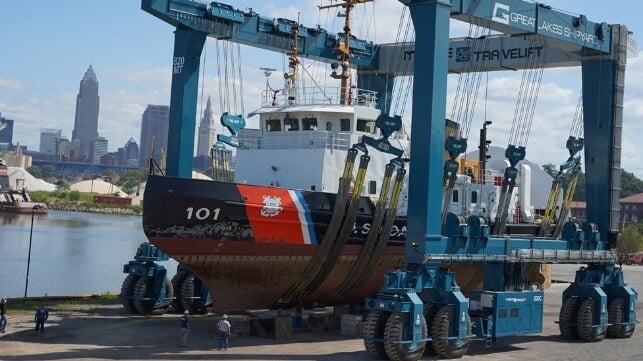
Space is often at a premium in shipyards – especially those that primarily service the pleasure boat market. Since its inception in 1954, Marine Travelift has been known for its innovative boat-handling equipment, designing the very first mobile boat hoist in Sturgeon Bay, Wisconsin back in the 1940s.

Not long after, in the 1950s, Marine Travelift was officially established and has remained an industry leader for the past 70+ years. The company has had many firsts along the way including the first open-end boat lift design for faster handling of sailboats' masts, marina forklifts and breaking the record for largest capacity boat hoist multiple times. In 2022, it introduced a revolutionary variable-width option, available on both the BFMII and C-Series Mobile Boat Hoist machines. The variable-width option helps shipyards save space by stowing vessels more tightly together, enabling them to work on more vessels at the same time. The hydraulically actuated system allows the travel lift's uprights to better conform to the width of the boat being moved rather than requiring a one-size-fits-all approach.

The first Marine Travelift model with the variable width option was a 75BFMII with a 75-metric ton lifting capacity. Delivered to the Marine Group Boat Works in San Jose del Cabo, California, this model offers nine feet of width variability and can seamlessly expand and retract under full load in 60 seconds. "The variable-width option provides the ability to handle a wider variety of hulls and without any major infrastructure changes," explains Kurt Minten, Executive Vice President. "With the ability to vary the boat hoist's width, you can not only lift wide vessels such as catamarans but narrower mono-hulls as well without exceeding recommended sling angles."

A second exciting development was the introduction of a fully electric series of lifts. Fitting a 700-volt, battery-powered system on the 50BFMII boat hoist, which carries a 50-metric ton lift capacity, the power consumption was optimized to ensure the Electric Series meets or exceeds the performance of the standard engine machine. A full charge can be delivered in eight hours with the recommended 30kW high-speed smart charger, and yards can expect to lift anywhere from 10 to 14 vessels a day on a full charge. The Electric Series option is available in all capacity hoists offered. Where possible, going to a boat hoist rather than a drydock allows providers to work on more vessels at once and doesn't create the same delays a drydock might when waiting on parts needed for repairs. This gives yard and marina owners more versatility and allows them to more efficiently move vessels in and out of work areas.

MOVING MORE THAN SHIPS

If you've ever seen an impossibly large structure on top of a platform fitted with dozens of rubber wheels being moved over land, chances are you've seen Cimolai in action. Cimolai Heavy Lift provides the design and execution for the transport and lifting of "exceptional structures in weight and size." This is accomplished by using self-propelled modular transporters or SPMTs.

These hydraulically operated SPMTs are essentially a steel platform fitted with a number of double wheels riding on top of a hydraulic suspension system and powered by a hydraulic power pack on the end. The wheels are able to rotate, which allows the trailer to crab-walk, spin in circles and quickly adjust in any direction. When a weight is loaded on top, the hydraulic suspension serves to keep the platform level, even as the trailer moves across uneven ground. This keeps the load stable, which is critical when moving huge and heavy structures.

The real magic, however, is when you link multiple SPMTs together. The size of the structure to be moved is only limited by the size of the platform available to place it on and the weight-bearing capacity of the wheels. More SPMTs means more wheels and a bigger working surface. When linked, both length-wise and width-wise, all of the wheels respond to the same single operator's inputs. The result is a single unit customized to exactly meet the space requirements of the lift, providing a load capacity of up to 9,500 tons. (Note that the author has participated in many SPMT-powered operations, and they never fail to impress.)

SPACE-SAVING SOLUTIONS

In a world that demands increased efficiencies, space and agility are core considerations, and the need for equipment that is powerful, precise and space-conscious continues to increase. Cranes and heavy-lift technologies are no longer just about brute strength. They're about efficiency, flexibility and sustainability. Whether through the towering reach of Comansa cranes, the adaptability of Marine Travelift hoists or the modular versatility of Cimolai SPMTs, modern solutions are enabling shipyards to handle more complex projects in tighter spaces with reduced environmental impact. The future of shipyard operations will depend on adopting these innovations to remain competitive and deliver the reliability the maritime industry requires.

SEAN HOGUE is Executive Vice President of Baker Marine Solutions.

The opinions expressed herein are the author's and not necessarily those of The Maritime Executive.

 

Metal Shark and Tocaro Blue Collaboration to Advance Maritime Autonomy

Metal Shark

Published Dec 16, 2025 6:54 PM by The Maritime Executive


[By: Metal Shark]

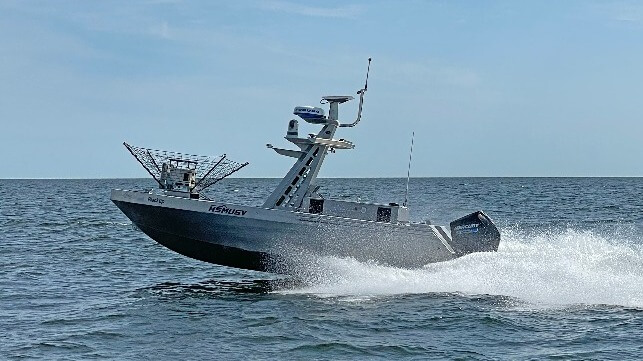
Louisiana-based boat builder Metal Shark, a key supplier for the US Armed Forces and allies, and Tocaro Blue, a leading developer of AI-powered marine sensor processing solutions, have announced a strategic collaboration to embed Tocaro Blue’s ProteusCore™ Radar processing software into Metal Shark’s fleet of High Speed Maneuverable Unmanned Surface Vessels (HSMUSVs).

ProteusCore™ provides operators with advanced radar data fusion, machine learning based object detection and classification, and real-time target tracking, improving ISR and operational safety in maritime environments. The software will be integrated directly into Metal Shark’s SharkTech autonomous technology stack, with the new sensing capabilities available across the HSMUSV fleet. The Metal Shark HSMUSV is a 21-foot unmanned military craft designed to offer the US Armed Forces and allies a low-cost multi-payload USV solution that can be rapidly produced and quickly fielded to meet emergent needs. HSMUSV comes factory-equipped with Metal Shark’s proprietary SharkTech autonomous technology stack, a hardware and software-agnostic system enabling unmanned, human-in-the-loop operation and supporting interface with other COLREGS, ATR, and AI software packages.

“The interoperability of the HSMUSV platform and SharkTech autonomy stack have been thoroughly proven this year through participation in multiple exercises on both sides of the Atlantic,” said Metal Shark CEO Chris Allard. “By incorporating Tocaro Blue’s ProteusCore™ technology, we’re taking another step toward an intelligent vessel ecosystem, enabling our customers to make faster, data-driven decisions in critical situations."

ProteusCore TM automates all aspects of using radar for unmanned and autonomous vessel operations. By embedding ProteusCore™ directly within the SharkTech autonomy stack, operators gain a unified maritime operating picture that enhances decision-making and improves threat awareness across complex environments.

“Tocaro Blue designed ProteusCore™ to unlock mission-critical perception capabilities in commercial off the shelf marine radars,” said John Minor, CEO of Tocaro Blue. We’re excited to team up with an industry leader like Metal Shark to deliver advanced capabilities to our Nation’s unmanned maritime defense assets.”

Metal Shark specializes in the design and construction of welded aluminum vessels from 16’ to over 300’ for military, law enforcement, and commercial operators. Key customers include US and foreign militaries, law enforcement agencies, fire departments, and other clients worldwide. With two fully self-contained boat building facilities in Louisiana USA; a research, design and testing facility in Alabama, USA; plus a dedicated engineering facility in Croatia, Metal Shark’s 400+ employees produce over 200 vessels per year with a proud and proven track record of high quality, on time deliveries.

The products and services herein described in this press release are not endorsed by The Maritime Executive.

WITHOUT BLOWING THEM OUT OF THE WATER

U.S. Coast Guard Delivers $200M in Cocaine to the Pier in San Diego

USCGC Active offload
Courtesy U.S. Coast Guard

Published Dec 15, 2025 10:21 PM by The Maritime Executive


The crew of the Coast Guard cutter USCGC Active has delivered $200 million worth of cocaine to the pier in San Diego, adding to the service's growing tally from an enforcement surge in the Eastern Pacific. 

USCGC Active is a 60-year-old medium endurance cutter (WMEC), and is among the longest-tenured vessels still serving in the U.S. armed forces. Still running on reliable ALCO 251 diesel engines, Active remains a top contributor to the counter-smuggling effort in the Pacific. The WMEC fleet is due for eventual replacement by the future Offshore Patrol Cutter (OPC), currently being constructed by Austal; in the interim, the efforts of crewmembers are essential for maintaining the existing fleet at sea.

"I could not be prouder of this crew," said Cmdr. Earl Potter, commanding officer of the Coast Guard Cutter Active. "Their determination, resilience, and professionalism make it possible to complete these dynamic and dangerous missions at sea. The conditions are tough, hours are long, and demands are high, but this team always maintains focus."

During this port call, Active offloaded 12.5 tonnes of cocaine, enough for about 10 million street doses. The landing is a major contribution to the Coast Guard's tally for "Operation Pacific Viper," its surge effort to provide additional countertrafficking resources off South and Central America. From the start of the operation in August through December 9, the service seized a total of 68 tonnes. 

The offload provides a contrast to the Pentagon's parallel effort, which applies counterterrorism tactics to the problem of drug trafficking. At about the same time that the Coast Guard announced USCGC Active's offload, U.S. Southern Command announced that three more suspected drug boats had been eliminated in airstrikes in the Eastern Pacific, killing eight suspects on board. 


Hong Kong Customs Use ROV to Find Cocaine Hidden in Sea Chest

Hong Kong cocaine seizure
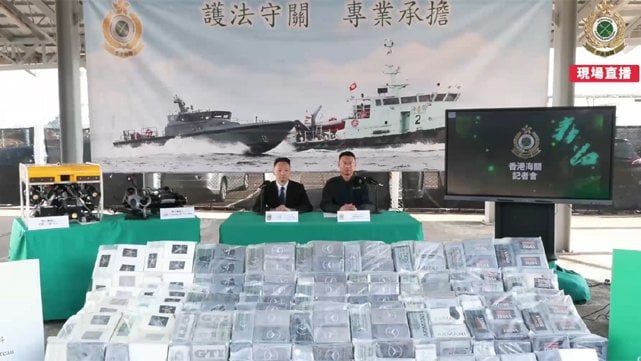
Hong Kong Customs highlighted its use of an ROV in the first discovery of cocaine hidden in a containership's sea chest (HK Customs)

Published Dec 16, 2025 1:45 PM by The Maritime Executive


Hong Kong Customs is highlighting its first use of a new ROV for ship inspections and reports that last month it, for the first time, discovered a large stash of cocaine hidden in the sea chest of a containership. Speaking at a press event on December 16, the officials highlighted that the smugglers are using new techniques in an attempt to avoid detection.

The unnamed containership, only described as being 333 meters (1,092 feet) in length, was targeted using intelligence sharing and monitoring techniques, the customs officials said. The ship had sailed from Brazil and made stops in Singapore and China. They reported the vessel had been placed under 24-hour surveillance before it arrived in Hong Kong waters on November 3. The following day, it was moved to a designated anchorage for clearance and inspection. 

A remotely operated vehicle was deployed for an underwater scan of the containership, which Customs said saves time and manpower for the initial search of ships. During the scan, they detected irregularities in one of the vessel’s sea chests located about 11 meters (36 feet) below the waterline. Customs divers were sent to investigate and discovered large packages that were retrieved and found to contain cocaine wrapped in waterproof materials.

“This drug concealment method is extremely rare,” said a HK Customs official during the briefing. “Given the sea chest lies roughly 11 meters beneath the hull, only professional divers could access this site.”

The officials described it as a “sophisticated maritime smuggling operation.” They recovered a total of 417 kg of cocaine in 11 bags hidden in the sea chest. It had an estimated value of HK$256 million (US$33 million). 

During the subsequent investigation, the police said two individuals were arrested. Some reports are saying they were crew from the vessel.

The police said they had previously found drugs hidden in containers or concealed in other areas on arriving ships. They said this was the first recovery from a sea chest underneath a vessel.

This discovery followed another case in October, where Hong Kong police said they had arrested three men after discovering around 69 kg of suspected cocaine worth HK$42 million (US$5.4 million). The report said the police believed the traffickers had hired divers to retrieve the drugs from the near-shore waters. HK Police said it was the first time they had encountered this tactic, where they believe an arriving ship released the cocaine bundles offshore.

Globally, police have reported similar instances where cocaine is hidden in a vessel’s sea chest or released offshore. The HK police believe the smugglers are adopting these tactics in response to the increased surveillance and interdiction efforts.

HD Hyundai Buys Tiny Welding Robots for Human Shipbuilding Tasks

HD Hyundai
Courtesy Rainbow Robotics

Published Dec 16, 2025 3:44 PM by The Maritime Executive


HD Hyundai Heavy Industries has begun using compact, lightweight welding robots that can be moved around the shipyard to automate complex welding tasks - even inside the interior of a ship under construction. The development brings robotic repeatability and speed to tasks that were previously reachable only by human workers, who are in short supply in Korea's shipbuilding industry. 

The new capability is the product of a joint initiative between welding robot builder JCT and precision-control company Rainbow Robotics. The robotic arm weighs about 24 pounds and fits in a suitcase, and has been designed and tested for shipyard operations - including welding unusual shapes and curvatures. 

The real challenge for this kind of work is not in the hardware - welding robots have been around for decades - but in the controls. Each steel joint location is well-defined in digital drawings of the ship's scantlings, but the task of manually programming each specific arm movement in sequence to carry out each weld would be a challenge every time the robot is picked up and moved. 

Instead, software developed by HD KSOE links the digital drawings of the ship to the robot's control systems, and the robot uses these diagrams to figure out where and how to weld, without time-consuming human guidance.

"RB series collaborative robots can be applied to various welding methods without separate coding, enabling rapid automation even in complex environments such as shipyards," Rainbow Robotics CEO Lee Jung-ho confirmed to Chosun Daily.

Chinese shipyard industry publication EWorldShip reports that HD Hyundai has bought 35 of Rainbow Robotics' devices and HD Hyundai Mipo has purchased another 27, for a total of 62. When including all other announced mobile robot buys across the conglomerate's Korean footprint, EWorldShip estimates that HD Hyundai now has on site (or on order) a total fleet of about 170 units - nearly double the number it had the same time last year. 

The change is driven in part by Korea's demographics. As experienced welders and fitters retire, there are fewer young Korean nationals interested in taking up a shipbuilding career. The Korean "Big Three" shipbuilders actively recruit in international labor markets to bring in guest workers, including trainees from Vietnam and Thailand. This pattern is now expanding across Korea's manufacturing landscape: a recent survey by the Korea Enterprises Federation found that 45 percent of small manufacturers need more foreign workers, mostly because of difficulty in hiring locals. 

In addition, Korea faces fierce shipbuilding competition from China, where heavy state subsidies and government backing have built a globally dominant sector that competes hard on both price and (increasingly) quality. Tech proponents believe that robotic systems provide a direct answer to all of these competitive challenges - labor availability, production cost and consistency - so long as the technical hurdles of integration into the workflow can be solved. 

Korea’s HJ Heavy Industries Wins First U.S. MRO Project

USNS resupply vessel
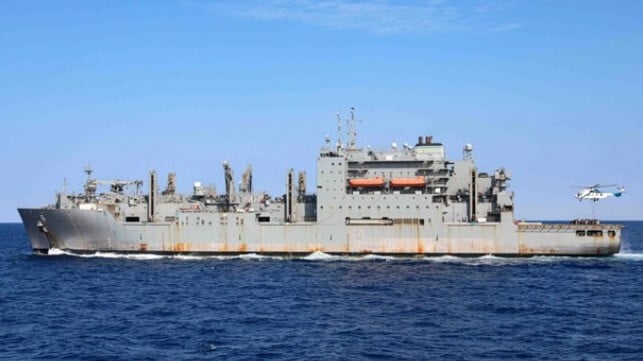
USNS Amelia Earhart will be going to Korea for three months of maintenance and pairs (USNS file photo)

Published Dec 15, 2025 6:26 PM by The Maritime Executive


South Korea’s HJ Heavy Industries has signed its first repair and maintenance contract for a U.S. Navy support vessel. It becomes the first of Korea’s mid-sized shipyards to enter the business, which is seen as a lucrative segment for the companies.

The U.S. has sought to undertake more of the repair and maintenance work overseas, close to the area of deployment, to lessen the downtime for critical support ships.  It is also a strategic relationship-building opportunity for the yards that look to gain more work as part of the Korean Make American Shipbuilding Great Again program.

HJ reports it had been working since 2024 to be certified to bid for the U.S. maintenance, repair, and overhaul (MRO) market, and this year had completed the inspections with visits from the Commander of the U.S. Naval Forces Korea, the U.S. Navy Supply Systems Command Field Inspection Team, and the U.S. Deputy Assistant Secretary of Commerce. It followed HD Hyundai and Hanwha Ocean, which had previously been certified to undertake contracts. Hanwha Ocean has already completed two MRO contracts, and HD Hyundai recently won its first MRO contract.

The yard reports it won the MRO assignment for the USNS Amelia Earhart, a 40,000-ton displacement dry bulk and ammunition carrier. Commissioned in 2008, the vessel is capable of supplying up to 6,000 tons of ammunition, food, and cargo, as well as 2,400 tons of fuel. It is used for at-sea resupply of the U.S. carriers and warships. 

The vessel is due to arrive at the Busan Yeongdo Shipyard in South Korea in January. The project includes maintenance work, inspections, repairs for the hull and major systems, replacement of parts, and painting. The ship is due to be delivered back to the U.S. Military Sealift Command around the end of March.

HJ Heavy Industries, which is the revitalization of the former Hanjin Shipyard, sees this as a turning point with international recognition for the mid-sized shipbuilder. It says this assignment will be its foundation in the MRO market, which is notable for the mid-sized shipbuilder. 

The shipyard notes that it is also a continuation of its long heritage with naval shipping. It was the first Korean shipyard designated as a maritime defense contractor in 1974. In the past 50 years, it notes that it has worked on over 1,200 vessels, including construction and maintenance projects.


Hapag-Lloyd Pursues Strategy to Add Feeders that Improve Efficiency

Hapag-Lloyd containership
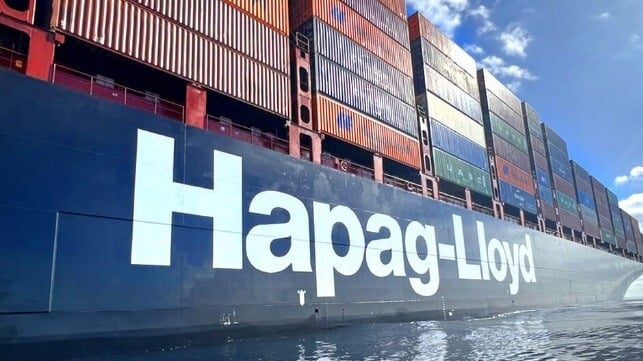
Hapag-Lloyd is pursuing a replacement strategy in the feeder segment (file photo)

Published Dec 16, 2025 6:50 PM by The Maritime Executive


Hapag-Lloyd is moving forward with its corporate strategy to expand its fleet of feeder containerships that will enhance the efficiency and environmental performance of the fleet. Feeders have taken on an increasing importance as the carrier is part of the new Gemini Cooperation with Maersk that is built around a network of feeders and hub ports for the liner service between Asia and Europe.

The carrier announced last week that it had ordered eight 4,500 TEU containerships at an investment of more than $500 million. Further, Hapag said it had decided to add another 14 newbuilds, meaning it would add a total of 22 new vessels, each with a capacity of less than 5,000 TEU. It said it would include four 1,800 TEU and four 4,500 TEU vessels on long-term charters. It will also charter six 3,500 TEU vessels.

Hapag cites that the strategy replaces older tonnage while also reducing its dependency on the charter market. As they are new ships, they will also be more cost-efficient and designed to take advantage of new emission reduction technologies and fuels.

The company’s newbuild order was placed with the Chinese shipyard CIMC Raffles for the eight 4,500 TEU vessels. They will be delivered in 2028 and 2029, and they will be the company’s first newbuilds equipped with dual-fuel methanol engines.

Hapag reports these new ships will be up to 30 percent more efficient than older ships of the same size class. They will be able to save up to 350,000 metric tons of CO2 per year when using methanol propulsion. 

The move into methanol follows an agreement in April 2024 with Seaspan to retrofit in 2026 and 2027 five 10,100 TEU vessels under charter to dual-fuel methanol propulsion. In anticipation, Hapag-Lloyd in November 2024 also entered a supply agreement with China’s Goldwind for 250,000 metric tons of green methanol per year.

MPC Container Ships of Norway announced another order on December 16, saying the vessels would be under a long-term charter, which reports linked to Hapag. It contracted for six 3,700 TEU vessels to be built by China’s Taizhou Sanfu Ship Engineering. The company reports it will invest $292.5 million and over the 10-year charter expects $479 million in revenue and around $288 million in EBITDA. The initial charter is for 10 years with extension options.

The ships, which will start delivery in the second half of 2028, will employ a design that optimizes speed and fuel consumption for regional and feeder trades. They, however, will be flexible to shift between trade lanes as the markets evolve. The ships will be prepared for alternative fuels and advanced emissions-reduction technologies.

Hapag-Lloyd emphasized that the new ships are part of its overall commitment to be a driver of sustainability in container shipping. It highlights that it currently has in service or planned a total of 37 vessels that are dual-fuel LNG powered, which can also operate using biomethane.

These orders are rounding out a record year for containership orders. The sector is leading the drive toward alternative fuels in commercial shipping and employing new technologies. For the first time, the sector’s total orderbook is topping 5 million TEU of capacity, leading to speculation of potential overcapacity and a resulting acceleration in disposing of the oldest, less efficient tonnage.


Odfjell Tankers Launches Green Corridor Between Brazil and Europe

Odfjell chemical tanker
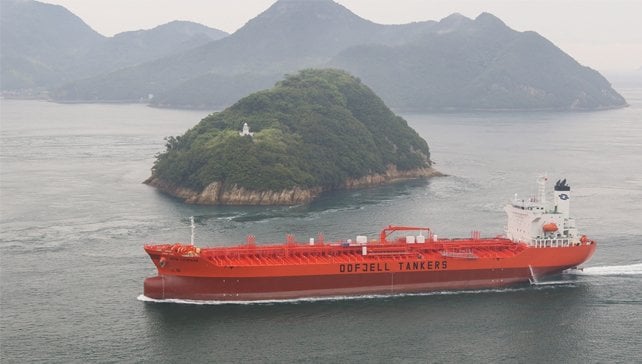
Odfjell's tanker Bow Leopard will be one of the vessels operating the corridor (Odfjell)

Published Dec 15, 2025 7:09 PM by The Maritime Executive


Norwegian shipping major Odfjell reports it has initiated the first green corridor for service between Brazil and Europe. The company emphasizes that this is not a one-off demonstration, but instead, with supply contracts, it becomes a long-term commitment to demonstrating what is possible today.

The company reports it has secured a supply of sustainable biofuel, which will be used as its chemical tankers make the 5,000-nautical-mile journey between Brazil and Europe. The corridor will operate 12 to 15 voyages per year, each lasting about 40 days.

“We do this to demonstrate that certified fuel, technology, and infrastructure are already available,” says Harald Fotland, CEO of Odfjell. “It may not be a perfect corridor yet, but a solid start. Its success depends on collaboration across the value chain, and we are committed to developing it further together with relevant stakeholders. Through this, we show that sustainable biofuel is a viable option for deep-sea shipping today.”

In Brazil, the currently available sustainable biofuel is the so-called certified B24. It is a blend of 24 percent renewable biodiesel derived from waste oil and 76 percent VLSFO (Very Low Sulfur Fuel Oil). The company reports it has established an offtake on the B24 biofuel blend in Rio Grande to secure long-term availability.

It notes that the Ports of Antwerp-Brugge, Rotterdam, and Rio Grande are also working together with the company to advance the green corridor through increased efficiency and optimized port-stay processes. It says the initiative aligns with the IMO’s 2030 targets and the EU’s Fit for 55 ambitions, and builds on the 2024 Norway-Brazil MoU to establish a green, transatlantic shipping corridor, as well as the company’s goal to reduce emissions. Int notes it has already reduced its carbon intensity by more than 54 percent compared to the 2008 benchmark.

Odfjell is self-funding the project and moving ahead without subsidies. The company says it hopes the project will inspire broader industry action while it works with customers and partners to accelerate the transition to low-emission maritime transport.


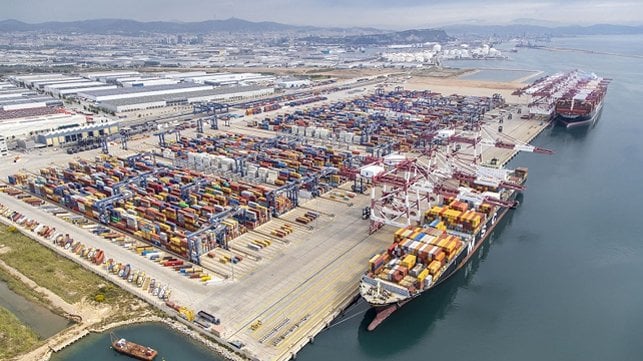
Report: “Intractable Impasse” in Hutchison-BlackRock-MCS Deal Due to China

Barcelona container terminal
China has reportedly increased its demands in the negotiations while the European Commission is concerned over competition in Barcelona (BEST Hutchison)

Published Dec 16, 2025 3:41 PM by The Maritime Executive


A new report indicates that with negotiations dragging on for months, the sale of Hutchison’s international terminal operations to a partnership of BlackRock and MSC’s Terminal Investment Limited (TiL) may have now hit an “intractable impasse.” The Wall Street Journal, in an exclusive report, writes that China has “upped its demands,” possibly sinking a potential agreement.

Earlier reports said that China was demanding an equal share for the state-owned shipping company, COSCO, in the deal alongside BlackRock and MSC’s TiL. The WSJ report says, possibly as a bargaining chip in the broader trade talks with the United States, Chinese officials have now said COSCO must have a majority stake in the acquisition of the terminals in Panama, as well as 40 operations globally. 

WSJ reports that BlackRock, which would have had majority ownership of the two terminals in Panama, and the partnership, which would have also acquired the other international terminals, “had been open to offering COSCO an equity stake.” China was demanding COSCO’s participation in the deal in exchange for its approval. Chinese officials had accused Hong Kong billionaire Li Ka-shing and his family of being unpatriotic and damaging Chinese trade interests in the proposed sale of the terminal portfolio for $22.8 billion.

The new report says China increased its demand in the ongoing negotiations. WSJ says the demand for majority control and veto rights is not acceptable to BlackRock and TiL. Similarly, a spokesperson at the White House told the newspaper it would not accept those conditions. Donald Trump has asserted that China controls the Panama Canal in violation of the U.S.-Panama treaty and threatened to take back the canal.

Panama responded to the pressure from the United States by taking steps to distance itself politically from China and recently set terms for the sale of new terminal concessions at each end of the canal. The Panama Canal Authority invited all the major terminal operators and shipping lines to bid for the terminals and expects that it will complete the bidding by January. Early reports said COSCO was expected to bid, but WSJ reports it is barred from bidding because it is a government entity.

WSJ points out that China has, in the past, moved to block other deals that it said would endanger its trade and shipping interests. In 2014, China blocked a proposed alliance between Maersk, MSC, and CMA CGM.

The Hutchison deal is encountering other problems even before the terms have been finalized. They missed the end of the lock-up period, and now the European Commission said it is investigating the situation in Barcelona. On December 9, the Commission said it would conduct an in-depth investigation of the proposed sale, citing the potential for a lack of competition in Barcelona. MSC, it points out, has significant operations in Barcelona, while Hutchison’s terminal is one of only two, with the other operated by Maersk’s APM.

“The preliminary investigation indicates that the transaction may significantly reduce competition in the market for the provision of container terminal services at the port of Barcelona and potentially lead to higher prices and lower quality of services for container liner shipping companies competing with MSC,” the Commission wrote in its statement. 

The investigation will explore the potential that MSC might gain preferential treatment in Barcelona. They speculate that “Such discriminatory treatment may notably take the form of higher prices, late access to the berth, limited availability of cranes and storage space for MSC's competitors.” Competitors they write could have “limited possibility to switch to the other deep-sea container terminal” in the port of Barcelona.

The European Commission has 90 working days, until April 30, 2026, to reach its decision. However, it could all be moot if the terms of the deal cannot be agreed upon and win the approval of China and the United States.


Severe Weather Disrupts Shipping in the North Atlantic

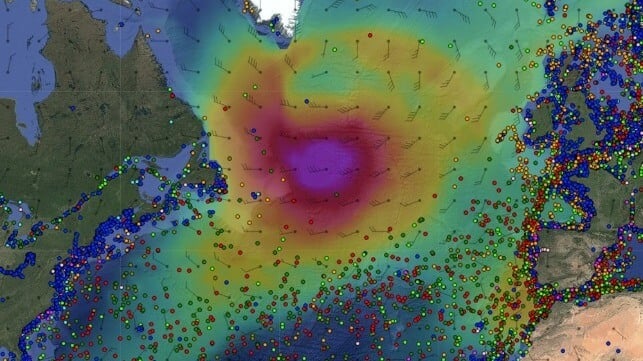
AIS data shows just one ship located near the region of massive 50-foot wave heights (Pole Star Global)

Published Dec 16, 2025 5:25 PM by The Maritime Executive


A severe, rapidly-intensifying storm is forcing ships to divert southwards to avoid serious conditions. A massive low of just 938 millibars is churning south of Greenland, bringing winds of up to 80 knots and "phenomenal" seas of up to 54 feet - genuinely difficult weather, even for large merchant ships. 

AIS data provided by Pole Star Global suggests that almost all transatlantic shipping has diverted well to the south in order to avoid the worst wave heights, which are located in the southeastern and southwestern quadrants of the storm. Just a handful of ships are within the most affected area, located due east of Newfoundland - notably the 60,000 dwt bulker Nord Allegro, currently making about three knots and headed southeast, away from the storm. 

"What makes this storm stand out is the extraordinary pace at which its central pressure is falling. When a large mid-latitude (extratropical) cyclone deepens by more than 24 hPa within 24 hours, it is classified as a bomb cyclone – the result of explosive cyclogenesis, also known as bombogenesis," commented weather consultancy Meteoblue in a statement. "In this case, the pressure is dropping even faster than this threshold, placing the system among the most intense North Atlantic storms observed so far this season."

Disruptive weather

Stormy North Atlantic weather has already caused multiple casualties around the British Isles over the last week. A French-registered trawler, Fastnet, grounded near Dingle, Ireland on Sunday and remains hard aground. The crewmembers were successfully helicoptered off, and salvors are now attempting to access the vessel to assess its condition and begin defueling - but heavy swells are impeding progress. Pollution remains a concern, as the ship could contain up to 10,000 gallons of fuel. 

On the other side of the Irish Sea, a 24-meter guard boat from an offshore wind farm is under monitoring after running aground on the shores of North Pembrokeshire, Wales. 

In the early hours of December 11, the guard boat Resolute grounded on the rocks on the coast near the town of Aber Hywel. Four crewmembers were on board, and they sent a distress call to request rescue. A helicopter aircrew responded to the scene, but the boat was moving too much in the surf to safely extract the survivors. Instead, the Fishguard RNLI inshore life boat - a small rubber-fendered craft - was tasked with approaching in shallows and waves to retrieve the crew. One person went overboard and into the water during the attempt to transfer to the inshore lifeboat, and the coxswain had to maneuver away from the wreck to retrieve the man-overboard. After the survivor in the water was safely brought aboard, the last crewmember was retrieved from the wrecked guard boat and all were transferred ashore. 

Plans are under way to defuel the Resolute for pollution prevention purposes. It remains aground, and has reportedly taken on water. 

Another minor casualty has disrupted food supplies to the Isles of Scilly, off England's far southeastern tip. The small coastal cargo vessel Gry Maritha sustained damage in heavy weather after departing Penzance on Friday evening, and was unable to offload cargo in St. Mary's. Local sources told BBC that the vessel could not berth at the destination port because of heavy swells in the harbor, and had to return to mainland England without offloading. Instead, air freight operators flew four tonnes of goods across the short distance to St. Mary's in order to ensure adequate supplies for residents. 


Cruise Ship Limits Become Effective on the French Riviera

cruise ship anchored off French coast
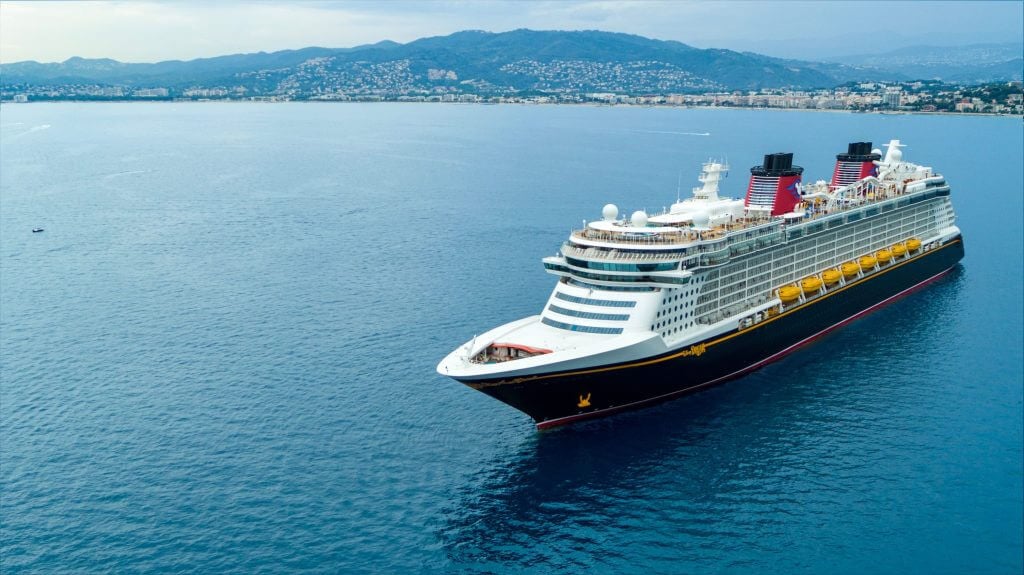
The rules became effective to limit large cruise ships anchoring on the French Rivera (Disney Cruise Line)

Published Dec 16, 2025 7:47 PM by The Maritime Executive


The regional authorities governing the ports along the French Riviera signed the new decree, which makes effective the limitations on the number of cruise passengers at the popular ports, including Nice and Villefranche. It comes after a tumultuous year in which the local authorities attempted to impose their own restrictions on cruise ship calls.

While pressing the efforts at the local level, the local government had said it required the action of the regional prefects to set the policy for cruise ships. The efforts were driven by both concerns for the environment and overtourism, as well as the efforts to maintain an upscale image for the region. The local efforts specifically targeted the large ships in the broad market segment while welcoming the smaller, luxury cruise ships.

The Prefect of the Alpes-Maritime and the Maritime Prefect of the Mediterranean worked together to develop the new regional strategy for managing cruise ships. During the signing ceremony on December 9, they highlighted that the effort sought to reconcile the protection of the environment with the desire to maintain tranquility for the local populations while also recognizing the economic and tourist issues.

In August, the regional authorities highlighted that 52 cruise lines planned calls for at least one port of call on the French coast, including Monaco. They said it represented 2,030 port calls made by 147 cruise ships.

The joint effort by the two authorities included consultations that began in July and a plenary meeting in October. They highlight that a draft code was produced and ultimately received a favorable opinion from the federal government’s department that oversees environmental issues.

The inter-prefectorial degree became effective on December 9. It sets an average annual daily level of 2,000 passengers, but permits up to 3,000 passengers in a single day, provided there is strict compliance with the annual 2,000 passengers per day average. The passenger number is regardless of the number of ships.

There is also a limit of one ship per day per anchorage for ships over a capacity of 1,300 passengers. The limitations do not apply to ships that berth in ports nor the ferries that operate to destinations such as Corsica.

During the peak season from July 1 to August 31, the limitation increases to a total of 15 ships per month with a capacity of over 1,300 passengers. Again, this applies to all the anchorages.

The target of the restrictions remains the larger and mega cruise ships, which the local authorities do not see as keeping with their upscale image and which put too many people ashore at one time.  However, the local rules had been pursuing limits of 900 or 1,000 passengers per ship, which was relaxed in the final rules to ships over 1,300 passengers. One of the goals was to have some of the largest cruise ships, which often have 3,000 or even 6,000 passengers, move to the west, docking instead in the port of Marseille. 

Further seeking to encourage environmental responsibility among the cruise ships visiting the Riviera, the rules give preference for scheduling and port call authorizations to the lines that adhere to the Sustainable Cruise Charter in the Mediterranean. In 2025, they highlighted that 27 companies representing over 1,300 port calls had adopted the charter. It calls for reducing discharges at sea and the recovery of waste, as well as the reduction of noise and light pollution, and reducing greenhouse gas and air pollutants. The companies also commit to raising environmental awareness among their passengers.


Irish Coast Guard Rescues 14 Fishermen From Grounded Trawler

Dingle grounding evacuation
Courtesy Irish Coast Guard

Published Dec 14, 2025 10:24 PM by The Maritime Executive


The Irish Coast Guard has successfully rescued the crew of a French fishing vessel that drifted onto the rocks near Dingle, a small port on the southwestern tip of Ireland. 

On Sunday morning, the trawler Fastnet lost power while outbound from Dingle. Before the crew could recover propulsion, the boat drifted towards the rocky shore near the Dingle lighthouse, just outside the sheltered harbor. With strong winds and heavy swells, there was little time to prevent a grounding. 

At about 1130 hours that morning, the master of the Fastnet made a distress call to the Irish Coast Guard, which dispatched multiple assets to the scene, including a fixed-wing search plane and the helicopter aircrew Rescue 115. The Dingle coast guard unit's response boat, the RNLI lifeboat out of Knightstown and the Irish Navy patrol vessel George Bernard Shaw also got under way. 

The local response boat crew tried to get a line across to establish a tow, but the rough surface conditions and shallow near-shore waters made this impractical. The only possibility was to evacuate the crew by air. Despite rough weather conditions and patchy fog, the helicopter airlifted all 14 crewmembers safely from the Fastnet and delivered them to shore. 

According to Irish media, traces of diesel have been spotted on the surface, suggesting a likely hull breach. The trawler continues to be battered by stormy weather, raising concerns of further pollution if it should break up. 

Fastnet is a 28-meter bottom trawler built in 2000. It is French-registered, Spanish-owned, and based in A Coruña, according to fishing industry media. 


U.S. Coast Guard Rescues Fisherman From Burning Boat Off Florida

Clearwater burning boat
Courtesy USCG

Published Dec 15, 2025 6:02 PM by The Maritime Executive


On Sunday, the U.S. Coast Guard rescued a fisherman from the water after a commercial fishing vessel caught fire about 100 miles to the west of Clearwater, Florida. 

At about 1530 hours on Sunday, Coast Guard Southeast District received an EPIRB alert from a fishing boat at a position off Florida's Gulf coast. Watchstanders dispatched a Jayhawk helicopter aircrew to the scene to investigate. On arrival, the aircrew found a burning vessel and one individual alive and afloat in a life raft. 

At about 1745 hours, in moderate surface conditions, the aircrew deployed their rescue swimmer into the water and retrieved the survivor unharmed. 

“The boater was able to quickly deploy a life raft and abandon their burning vessel,” said Petty Officer 2nd Class Isaiah Andrews, a search & rescue controller at Southeast District command center. “Through quick actions and the utilization of an emergency position indicating radio beacon our aircrew was able to narrow the search area for a timely rescue.” 

The cause of the fire is under investigation. 

It is the second high-profile rescue for the region's Coast Guard units in less than a month. In late November, a helicopter aircrew rescued four people who had survived atop the upturned hull of their boat for 20 hours off Clearwater, including a 90-year-old man.