Sunday, December 14, 2025

 Introducing György Lukács - and why his ideas matter today

Introducing György Lukács – and why his ideas matter today

Stuart Scully outlines the main theories of the Hungarian philosopher, György Lukács, and explains why his ideas are still relevant today.

November 28, 2025

Arguably lesser known, György Lukács is perhaps one of the most important Marxists of the 20th century. A Hungarian philosopher who began writing his work as a literary theoretician, he was radicalised by the first world war and the Russian revolution. It was in 1923 that he wrote his most significant work, History and Class Consciousness, an analysis of Historical Materialism, and his substantial ideas on reification and commodity fetishism. Lukács would later go on to write a lengthy preface in 1967 critiquing his own analysis, believing himself to have made mistakes post his experience of the 20th century and the discovery of Marx’s 1844 manuscripts. Despite this, the book remains a pivotal feature of Marxist philosophy, becoming possibly more relevant now than in 1923 as the ideology of the capitalist order further tightens its hold on the world.

It is the section ‘Reification and the Consciousness of the Proletariat’ where the fundamental ideas that Lukács was grappling with can be found. Here I can only give a broad understanding of Lukács and his work on alienation, reification, totality and working class consciousness. I hope to show how Lukács’ analysis explains how capitalism creates alienation through its dependence on commodification, and the universalising of the capitalist order across the planet. 

Hegel points the way

Lukács drew largely on the German philosopher Hegel to create the foundations for his philosophy. Hegel offered a break with Kantian thought, an influential strain which Lukács would refer to as bourgeois. As against Kant, Hegel refused to view reality as individual to each person, but instead as a shared reality by all beings. The recognition of each other creates the social relations that make society, rather than society being something which happens to us.

This idea is subsequently taken a step further by Marx to say that the fundamental building block of society is human labour, which underpins social relations. Hegel’s method, known as ‘Hegelian dialectics’, aided Marx in developing his own conception of history, a conception fundamentally at odds with other thinkers of his age.

For Hegel, knowledge of one’s own existence comes through recognition of another person. An encounter with another person shows the limits of one’s selfhood. Hence the apparent contradiction that selfhood faces its negation in the presence of another selfhood. The many possibilities that exist within the eyes of another person appears as the “night of the world”. In other words, you see that another person is as complex as yourself, that they are a human being. Within this lies the nub of Hegelian dialectics. The conflict of the contradiction that there is a world outside of yourself, and in order to maintain that you are an individual, a dialectical process (aufheben in German) occurs, whereby something is preserved yet destroyed and consciousness emerges from this at a higher level than it was previously.

There is much more that could be written about Hegel but this understanding was key for Marx. He took this dialectical act but instead of solely centering the recognition of other beings, he placed the actions of a person – their labour –  into a broader process of dialectics. It is not simply the selfhood of a person but their material interaction with the world around them which are included in recognition. This is the next step to which Marx took Hegel’s dialectics, advancing the theory to include the material instead of just the world of ideas. A person is not only understanding their own selfhood, and that of others by seeing other people, but also by witnessing the products and the actions of labour. The world the worker creates allows for the recognition of a person’s existence.

Alienation from the world

As Marx writes about in the 1844 Manuscripts, it is this awareness of a person’s role in creating the world around them which is obscured by capitalism and it is here where the Marxist conception of alienation can be understood. The alienation created by capitalism lies in the inability to understand the product and activity of a worker’s labour in the world and instead to view both as something alien to them.

Lukács expands on this idea of alienation (which he developed before Marx’s 1844 manuscripts were discovered). It is not simply that the worker is alienated but that they view this alienation as a natural aspect of existence due to a process called reification. Reification is treating a concept or social relations as if they were real concrete things, and for Lukács’ it springs directly from Marx’s understanding of the commodity.

In Chapter 1 Section 4 of Capital entitled ‘The Fetishism of Commodities and the Secret Thereof’,  Marx provides a comprehensive  description of the commodity and how it works. “A commodity appears, at first sight, a very trivial thing, and easily understood. Its analysis shows that it is, in reality, a very queer thing . . .” The core of capitalism, and reification, can be found in this description.  A commodity appears as something very normal and natural but once analysed critically, its hidden essence becomes clear. 

Marx describes how the act of a person’s labour can transform something from the material world into something useful to them – whereby a piece of wood becomes a table, to use his example. Yet when the table ‘steps forth as a commodity, it is changed into something else again.’ Under capitalism, objects and products of labour no longer simply appear as useful to us, they appear as commodities with abstract values attached. The transformation of the wood into a table has an obvious use value; a person required a table and used their labour power to transform a piece of wood into a table. However under capitalism, as the table becomes a commodity, it inhabits an exchange value, something beyond the labour power and the use value. It is this alien exchange value that is the source of alienation and reification as it makes a worker’s labour independent from themselves. To put simply, they can no longer witness the need nor their ability to create as the commodities exchange value appears as the inherent value.

Lukács notes that the commodity structure has always existed but in our time under capitalism it has invaded all aspects of life and has masked this intrusion using reification. For Lukács, the commodity form has affected every aspect of human existence in capitalism but while alienation may be felt, the source has been concealed. However, it is not that the worker accepts their subservience or that they are blind to it. Rather, they actually see the order of capitalism and their own alienation as natural and unchanging. As capitalist society is centered around the commodity, all human relations must be done through its logic of exchange and thus the alienation that is felt through this logic is understood as an intrinsic logic of the world. The value of the commodity becomes the value of society and due to reification, becomes understood as the order of reality.  In capitalism, this manifests as the capitalist order appearing as natural and unchanging and centering the commodity to every aspect of the individual’s life. The famous quote attributed to the cultural theorist Frederick Jameson that “It is easier to imagine the end of the world than the end of capitalism” can be read through an understanding of Lukacs to illustrate the all encompassing nature of reification. If it is read with an understanding of reification, rather than reading that life cannot exist without capitalism, it now appears as  a recognition that one cannot conceive of a reality without capitalism. Reification creates the appearance that the capitalist economy works as just an aspect of nature. It appears like the sun or the moon, impossible for life to exist without, an inevitability – not just an economic system but reality itself

Reification everywhere 

One aspect of reification which remains even more prevalent today is that of time. For Lukács, the commodity has come to structure time itself. Reification of space and time occurs as the worker views the hours of a day through their labour time. There is work time and rest time, the morning shift or the evening shift;  all time is understood in its relationship to labour time. The weekend is free time from labour that is limited, annual leave is earned through work and must be justifiably spent to be worth the labour that was put into acquiring it. Retirement is a luxury earned by giving a lifetime of labour time.  The amount of sleep is also conditional to labour time. Reification seeps through every aspect of life in capitalism. Pursuit of art, labour for the sake of enjoyment and even the act of doing nothing become the responsibility of the individual to perform in spite of their time oppression.

One way to think about rent is as the reification of space. The rent value on a property does not align with the endowments that a property has – the fertility of the soil the property stands on or its proximity to natural resources. Rent is the value the landlord places upon property, either through their own desire for money or referring to the abstract reification of “market value”. The reification of space is especially pertinent in modern Ireland. No property even holds the presence of being valued according to location or size – all material, recognisable values have vanished. A property may be riddled with mould and rot, located away from any community or amenities and yet it maintains a reified value, completely apart from the actual existing reality of the space. This is what Lukács means by space time being affected by capital. Space is the material reality inhabiting a value which does not match up to its reality, and capital transforms the free form nature of time into an alien set of restrictions that come to shape reality itself for the worker.

Totality 

Through all these reifications, the masking of the totality of the capitalist order takes form. It controls every facet of human reality, from the movements of states to the interpersonal relationships of people. In controlling every feature of modern life, capitalism is not just an economic system, but a state of being. The foundations and mechanics of capitalism become veiled, annihilating everything pre its creation and replacing all values to that of the commodity.

Reification affects the capitalists themselves. A joke used by the philosopher Slajov Zizek to illustrate this follows as such. A man believes himself to be a kernel of corn and checks himself into a psychiatric facility. After treatment, he no longer believes he is a kernel of corn and leaves the hospital, only to run back in after encountering a chicken on the street. When asked why he is afraid to be eaten when he knows that he is not a kernel of corn anymore, the man replies “yes but does the chicken know that.” Zizek reimagines the joke instead as a capitalist learning of marxist dialectics yet running back to the Marxist after encountering a commodity. “But you know they are reified abstractions that do not hold value” states the Marxist. “Yes but do they know that” replies the capitalist. The joke illustrates that the system appears alien to even those who uphold it. The totality of capitalism means that its origins and limitations have become mystified to both the capitalist and the worker. Even though the entire system is created by human social relations and real people, it takes the form of something outside of the human, acting upon us without our involvement.

A way out

Lukács believes there is a way out of reification and alienation: through the consciousness of workers which arises in the immediacy of revolution. What Lukács means here is that by making the workers themselves a commodity (their labour power being the sole energy that drives capitalism), in fighting back and with mass struggles, they can de-reify the ideology which has kept them from seeing the truth of the system. Returning to Hegel, the worker, alienated by everything around them, finds recognition of their selfhood and the selfhood of the other in another alienated worker. In that revolutionary moment of recognition and solidarity the truth of the reified capitalist order is revealed to them. The unintended consequence of alienating and reifying the life of the worker becomes the trigger to working class consciousness.

Lukács’ hugely influential work was born from his lived experience of participating in revolutions and surviving the Stalinist purges. It gives us an extremely prescient understanding of how capitalism maintains its own existence through ideology and alienation. He shows how alienation and reification are the integral mechanism of capitalist ideology  and can only begin to be overcome with the actuality of revolution, revolutionary movements and concrete struggles against the capitalist order.


MUST READ

... LUKACS. History and Class. Consciousness. Studies in Marxist Dialectics. Translated by Rodney Livingstone. THE MIT PRESS. CAMBRIDGE, MASSACHUSETTS. Page 4. @ ...


KURDISH ECO SOCIALISM

Öztürk: It is possible to reorganize socialism with the concept of eco-economy

Stating that it is possible to reorganize socialism with eco-economy, Hakan Öztürk said, "Even a single good example of a commune or municipality shatters all prejudices about the horizon that eco-economy will try to give and creates a domino effect."


HAKAN OZTURK
ANF
ISTANBUL
Monday, December 15, 2025


The worldwide destruction of capitalist modernity is becoming more and more evident. The blocked system is trying to survive by creating great destruction in the world because it cannot find ways to renew itself. The shortcomings and blockages of the real socialist economy also lead to the gradual spread of this ruthless economic system of capitalist modernity.

The eco-economy model, which Leader Apo has long proposed against capitalist and real socialist economy models, continues to be discussed. Especially with the destruction of real socialist experiences, the eco-economy, which emerged as the theoretical infrastructure of socialist circles to eliminate the deficiencies and create a new life, began to be discussed again.

"The eco-economy approach says that we should stop running towards these disasters that we can foresee," said Hakan Öztürk, Chairman of the Labour Movement Party, explaining the concept and necessity of eco-economy to ANF.

'A VALUE THAT CAN SHAKE THE PHYSICAL STRUCTURE OF THE WORLD IS ACCUMULATING'

Drawing attention to the magnitude of the destruction of capitalist modernity in the world, Öztürk said, "A great value that can shake the physical existence of the world is accumulating in the hands of a group of visionless and virtuous bosses" and continued his words as follows:

"Almost everyone observes that capitalism is not leading the world to a good place. The owners of capital are taking away the surplus value as large as the ocean from the working class day by day. The wages of the working class are being reduced. The working class, which is tested by hunger and poverty, either works a second job, receives assistance or borrows money in order to survive. He resists the resulting physical collapse, moral collapse and the loss of his future.

The owners of capital create unemployment and make workers who have the opportunity to work for very long periods of time. The basic needs of the society such as nutrition, shelter, education, health and transportation cannot be met in any way. A great value that can shake the physical existence of the world is accumulating in the hands of a group of visionless and virtuous bosses.

Despite all this, the issue is not even that the bosses have made an unfair profit. The conflict between capitalist countries humanity; global warming, destruction of nature, economic crisis, regional and nuclear war disasters. This is the deep pain and issue that cannot be spoken. The eco-economy approach says that we need to stop rushing towards these disasters that we can foresee."

'AS ÖCALAN SAID, HUMANITY HAS COME TO THE BRINK OF BEING SWALLOWED BY THE MONSTER IT CREATED'

Stating that sometimes great losses cannot be seen without looking at the society, Öztürk continued his words by referring to the words of Leader Apo:

"They say, 'The devil is in the details,' but at the same time, the devil is hidden in the grand total result. Sometimes the big loss cannot be seen without approaching the end and looking at the total. The understanding, which forgets that it has a metabolic relationship with nature and aims only at capital accumulation, is about to reach all its logical conclusions. When we look at the end of the story and the cumulative total, we see that profits are made, capital accumulation is achieved, but the fertility of the soil disappears.

Production is carried out in the agricultural field. However, cities no longer have any connection with the agricultural area. When agricultural production is consumed in cities, the wastes generated cannot return to the soil with their nutritional qualities such as nitrogen and phosphorus. There is a big abyss, an irreparable disconnection here. This damaging cycle progresses, producing a massive total.

As Abdullah Öcalan stated in his manifesto, 'Today, humanity has reached the limits of being swallowed by the monster it created.' Yes, if we ask 'are there limits?', there are. We are facing an apocalyptic end. The sea is over; the sea, ocean, rivers and drinking water are finished. Production is made, profits are made, competition is made, but the bottom and top of the soil are polluted. Forests are disappearing, animals and plants are becoming extinct, biodiversity is decreasing. The problem is not just not accepting this system as ethical; the life-and-death struggle of nature, living beings and humanity."

Referring to the definition of eco-economy written by Leader Apo in the 'Manifesto for Peace and Democratic Society', Öztürk said that the main source of the problem is stated here, and said, "In the 'eco-economy / eco-industry' section of the manifesto, the subject is discussed as follows: 'Third nature is the subject of overcoming the sovereignist mentality and production methods that alienate nature and cause destruction and crisis to nature; It means finding ways to live in harmony and on the basis of a contract with nature, and to ecologize the production-consumption culture accordingly.'

'IT IS NECESSARY NOT ONLY TO BRING SPEECH, BUT ALSO TO CREATE AN ALTERNATIVE'

Based on this paragraph, we can understand the dimensions that eco-economy indicates. Here, we see that the main source of the problem is determined first. It is stated that there is an alienation from nature. This means the deterioration of harmony and integrity with nature. Production emerges thanks to labor and nature. In conditions where production is confiscated and man's connection with nature is severed, humanity becomes alienated from both its own labor and nature.

Second, the process that led to the problem is explained. Similarly, the 96th article of the manifesto. On its page, 'There is a lot to be said about industrialism. It destroyed the underground, destroyed the earth, filled the air with carbon dioxide, the oceans were filled with garbage. Cities are carcinogenic. No one can stand against it for the deliberate killer to make a profit' and it is determined that the 'goal of making a profit' takes precedence over everything else. It is this process itself that creates both economic crises and destruction in nature. This process is dragging the planet towards the last fifty years, society and nature.

As the third point, we can say that a solution is put forward. The approach that this process should be 'overcome' is stated. Then, the assessment that it is necessary to 'live in harmony with nature' and 'find ways to ecologize the production-consumption culture' is put forward. This struggle for overcoming is not only the understanding of expressing and protesting, but also of creating an alternative. This solution needs to be walked and there is a long way to go.

The manifesto reveals this in another place with the following statement: 'Our perspective for the new period; It is the reconstruction of society on the basis of a democratic nation, eco-economy and communalism. The responsibility of developing the philosophical foundations, ideological dimensions and the conceptual-theoretical framework necessary for this construction to come into being in the detailed social structure stands before us.' In other words, this is a progress that has been started but has not yet ended."

Stating that the eco-economy model can be an alternative for the salvation of humanity, Öztürk said, "Of course it can and this is how it should be. We need an approach that positions itself according to the total and final results of capitalism. We have a duty to create a universal political program to defend nature and society against these catastrophic consequences. The eco-economy approach put forward in the manifesto; It sets out to do this by standing against industrialism, crises, wars and the destruction of nature. Increasing the scale of the struggle to stand against crises and defend nature is an accurate philosophical-political approach. The struggle for socialism is both an attempt to be against exploitation and to save the world in every way. It is necessary to identify the sources, processes and solutions of the destruction of humanity and nature and to create an alternative against it. The perspective in the manifesto also tries to develop this.

Has there been a problem so far? It happened. Is it necessary to develop a solution? Just as the socialist feminism approach is an alternative in the field of inequality towards women; The definition of eco-economy and eco-industry against the destruction of humanity and nature can also be considered in this way. It should not be taken into account that those who have not spoken about any of these problem areas and have not tried to develop a political program find this approach tried to be developed in the Manifesto 'too innovative'."

'THE ISSUE WILL COME TO HOW THE PRODUCTION WILL BE'

Pointing out that the needs in systems are based on the development of an economy, Öztürk continued his words as follows:

"No matter how much we put forward the right principle, the subject will eventually come to the issue of how production will be, and life always rules in this field.

Lenin describes a transition period in 'State and Revolution'; the period after a political power is taken. This is the upper stage in which our real principles operate, not communism. Considering what the conditions are, the power has been taken, but everything else is uncertain. The functioning of the economy here will not be able to remain isolated even if desired. Eventually, some products will be bought and given. Needs require an economy to function no matter what is done. This situation leads to the following in a chain way: The economy works and the area in which the economy operates, that structure cannot remain isolated, small and self-sufficient. This table connects that unit to the world economy no matter what.

Let's think about it this way: Bread and coal will not only be demanded as at the beginning of the 20th century. Wanting even just one 'mobile phone' connects that economic unit to the whole world. Society can have its own economy; but it also becomes related to the world economy in a chain. As a result, there can be no operation completely separate from the general economic functioning. Even the simplest economic rules become decisive in the outcome.

Let's imagine that the government in Russia spends a little more time. First, because it is besieged, those who are besieged will initially compete aggressively economically. In the continuation of this, for example, when we come to the Second World War, this economic competition will turn into a direct war move. This means that no matter what is done, it is not possible to move forward completely separately and on its own. We can see this: We cannot be separated; Corrosive conditions last until the end and last a long time."

'MUNICIPALITIES CAN START PRODUCING WITH THE MEANS THEY HAVE'

Stating that the commune system is important in the eco-economy model and that it is possible to show the society what socialism will look like, especially with the studies to be carried out through the acquired municipalities, Öztürk continued as follows:

"However, the manifesto says that the commune also means a municipal positioning. A municipality can start producing public products and services based on its public property and public facilities. It can use its resources to meet the needs of society, not to make a profit. This cannot have fully 'built tomorrow today', but it reveals the tendencies and projection of the future society.

Is there a need for this? And it is extremely needed. This is how we can evaluate every municipality that has been won and every commune that has been established. As Canadian socialist Sam Gintin put it in a brilliant article, 'We have to say what socialism will look like.'

'IT IS NECESSARY TO SHOW THE SOCIETY WHAT SOCIALISM WILL LOOK LIKE'

We have to say what socialism will look like, we have to discuss what socialism will look like in front of everyone and we have to be right. If there is an opportunity to start with, we can start by producing public products and services in municipalities. This approach will give the message to the world that 'this is how it will be and it will be good'. Because after the defeats we have suffered, we have a problem of persuasion and ensuring that the society is locked on a goal. This is our biggest crisis. We are not walking as undefeated, but as soldiers of a defeated movement."

'COMMUNES HAVE TO TELL EVERYONE WHAT THE ECO-ECONOMY WILL LOOK LIKE'

Stating that communes and municipalities can win the society by giving good examples, Öztürk said, "Even a single good example of a commune or municipality shatters all prejudices about the horizon that the eco-economy will try to give and creates a domino effect. There is no need to wait; even the newly elected New York Mayor Zohran Mamdani is already a candidate to have this effect. Mamdani said the following on the way to the elections: 'Social housing will be built, kindergartens will be opened for children, municipal markets will be established, the minimum wage will be raised, education support will be given to university students, and taxes on the rich and large companies will be increased.'

Our communes and municipalities can also say all of these and all hell breaks loose. Communes that do this can open up an incredible field of action for themselves. He will have said and done what the eco-economy will look like in front of everyone. The formation of a ruling or enriching caste in that commune can be prevented; To put it more precisely, we can resist it.

However, when an economy on a larger scale becomes manageable and it is in question to plan it, it will be necessary to create communes, assemblies or Soviet-style organizations under these conditions. In the coming time, when communes, that is, municipalities, adopt a political program in the style of eco-economy, they will increase their power and sphere of influence a hundred times so far."

Referring to the importance of the concept of eco-economy in terms of socialism, Öztürk referred to the words of Leader Apo and said:

"In the words of the manifesto, an approach that 'tries to find ways to ecologize the production-consumption culture by overcoming the sovereignist mentality and production methods that destroy and crisis nature' is completely correct for socialism. It is an understanding that does not leave the destruction of nature aside, takes into account crises and asserts to overcome the modes of production that create them. As a result, socialism is a change in the mode of production; It is the work of creating a mode of production that is in harmony with nature and eliminates exploitation. The concept of eco-economy, its political program and practice will move towards this by following the logical chain."

'IT IS POSSIBLE TO REORGANIZE SOCIALISM WITH THE CONCEPT OF ECO-ECONOMY'

Stating that it is possible to organize the socialism of the new age through the concept of eco-economy, Öztürk gave an example from the New York elections and said:

"It's possible and it can get off to a great start. There is no need to win a surprise election like New York Mayor Zohran Mamdani. The social structure that will be behind the idea of eco-economy has already reached a power that has been able to win over municipalities for years. What needs to be done is just to change the perspective and move on to practice. There is no power that can prevent the communes from building democracy and making public production. As soon as it is said that I am implementing this program, the whole country will change and turn upside down.

The important thing is the beginning. Only after the October Revolution did a third of the world reach socialism. There was no one who dreamed of this even in Russia. We can do it again. Once the communes and municipalities are successful, they can immediately develop partnerships between them and move on to democratic planning.

Wherever socialism expands its sphere of influence, it will definitely experience a transition period in order to leap to a further stage. Commune experiences can be seen as preparation for this period and as the focus of resistance of this period. History has shown that these transition periods last for a very long time. It is necessary to prepare for such a transition period and to resist such a transition period.

In this sense, there is a great need for communes both in the current conditions, in the transition period and afterwards. Eco-economic communes and municipalities can serve as flares with examples of democracy and public production. As it progresses successfully, it can spread across metropolises and become encompassing. The rest is up to the socialists' ability to get the job done. The eco-economy and communes can perform all kinds of progressive functions up to that stage and beyond."

The Commune and the Kurds

The commune is the organized power of society; it is a common way of life. Communal life emerged in Mesopotamia. The capitalist system and the occupying states have made great efforts to move the society away from the commune spirit in Kurdistan.


SİNAN SAHIN
BEHDÎNAN
Tuesday, December 9, 2025

In the Manifesto for Peace and Democratic Society, Leader Apo draws attention to the correct interpretation of history. Contrary to what Marx described, history is not a war between classes; He says it is a war between the commune and the state. The first place where the war between communal society and statist civilization was witnessed was Mesopotamia, the Zagros and Taurus mountain ranges. The statist civilization has been continuing its own life and existence on society like a tree worm by constantly distorting history.

The state is an institution that makes its own system of power mandatory in society in every process and tries to abolish the commune so that those in power can continue to exist.

When we look at the Proto-Kurds, we see that life is completely one; It is seen that it is overflowing with meaning and miracles. Society is organized in the form of a clan around the woman-mother. There were no chains that bound people's feet; There was no such thing as private property or personal property.

There was only movement, movement. This movement was also taking place freely and autonomously. The entire life of the clan was based on the beauty of women's labor, sensitivity and thought. For this reason, we can see that women have left their mark on many traditions today. The organizations developed by women to protect themselves from attacks have become part of a unique resistance. We can see this resistance in the adventures of Enki and Inanna.

The deliberate killer has taken this system as his goal and tried to separate it from society. How did the deliberate killer system become a culture in society? This started with the woman being held captive in the house. Thus, women were removed from their communal role. Society was oppressed with the property system. The male-dominated role of power and the enslavement of women weakened the communal reality in society. For this reason, Leader Apo attaches importance to the establishment of new ties based on truth and common life in the relations between men and women.

Today, a new life is sprouting in Rojava under the leadership of women. In this context, the leadership draws particular attention to the JINWAR experience that developed in Rojava. In the face of the problems created by the deliberate murderer on women, children and society in general, the Leadership accepts the commune as its new family.

The tribal organization in the Zagros and Taurus mountain ranges has always been in a movement and dynamism against the statist civilization. Tribal organization is not defined only on the basis of blood ties and service. It is a community that defends, grows and produces itself against statist civilization. For this reason, the tribe has the most functional social qualities of society. The old communal life continued to have an impact within the tribe. Despite all the attacks of the statist civilization, the tribes preserved and developed their own communal memory.

THE COMMUNE SYSTEM IS STILL STRONG IN KURDISTAN TODAY

The Mazda faith plays an important role in tribal organization. Mazda belief is based on the duality of darkness and light. It is based on universal dialectics. The Zoroastrian belief is the continuation of the Mazda belief. He rebels against the gods of statist civilization based on the morality of freedom. The Medes confederation established a communal lifestyle based on the Zoroastrian faith. The tribal confederation system is a commune in itself. For example, the Median tribes are confederations; 24 federations unite to form a confederation.

The Medes fought against the deliberate murderer system and the Assyrians, the most ruthless empire of the period, for 300 years and were victorious. The Medes insisted on their own communal system. For this reason, the commune system is still strong in Kurdistan today.

However, when the power passed from the Medes to the Persians, the Kastik killer system became dominant again. The Persian kings took themselves for gods, and a very harsh system was developed in which no one could disobey their word. The Zoroastrian faith did not only include the Kurds; It had a pretty serious impact on the Persians, Pakistanis, Afghans, Indians, and even China. Many aspects of the Buddha and Confucian beliefs are also seen as a continuation of Zoroaster. Although Zoroaster is Kurdish by origin, he has universalized his faith.

At that time, the Zoroastrian faith was based on the idea of the commune. However, due to the change of the Persians and their progress towards statehood, the Zoroastrian belief turned into dogmatism over time and entered the service of the state.

So, what is a commune? The commune is the organized power of society. In order to understand the commune in the best way, it is necessary to consider it in its simplest form; The commune is a common way of life. The most striking example of this is the villages. All the work and necessities of life in villages are organized jointly. Politics, self-management and self-defense, as well as agriculture, animal husbandry, housebuilding, etc., are all shared equally and jointly.

There is no need to theorize the commune at length from the point of view of Kurdish society. Even the word 'kom' itself explains this. Commune comes from the Kurdish 'kombûn'. Communal life emerged in Mesopotamia. The capitalist system and the occupying states have made great efforts to move the society away from the commune spirit in Kurdistan. The burning and destruction of Kurdistan villages is one of these practices.

IT IS NOT RIGHT TO CONSIDER WARS ONLY ON THE BASIS OF CLASS

Why were the villages burned in Baqûr? Because society was governing, organizing, producing and defending itself. For this reason, society did not need the state, society did not bow down to the state. The state had to burn the villages to make the society dependent on itself. Some of the people were forced to migrate and turned into refugees, and some were exiled to metropolises. The state wanted to make the lifestyle it imposed obligatory on society.

The same policy was implemented by Saddam in Bashur. All villages were massacred so that society could not organize, produce and protect itself. Thus, everyone was enabled to turn their direction to the cities.

The capitalist system promotes individualism and segregation. Everyone locks himself in his own house; With the development of technology and the internet, no one needs anyone. However, in the past, villages had their own assemblies and social orders. People lived together, organized and shared together. Life was just and equitable; no one dominated the other.

For this reason, Marx's definition of class war is not wrong, but it is not enough, because when we look at the reality of Kurdistan, the state has made everyone a target. Therefore, it is not correct to consider wars only on a class basis. The occupying states tried to dismantle the social culture and tribal organization in Kurdistan; Because the tribe is essentially a communal structure. There are still tribes today, but most of them have lost their communal character.

For example, there is solidarity in tribes; Everyone protects each other, does everything together. Life is organized. The state has isolated individuals by breaking down this organization and tried to make each of them dependent on itself. Some tribes in the Botan region still preserve their communal characteristics today.

There is no class distinction in tribal culture. The tribal chief is not rich; Every product obtained is shared equally with all members of the tribe. In historical accounts, it is seen that the tribal chief did not own property and was not considered rich. If the tribal chief fails to fulfill his duty, the respected members of the tribe gather and select and appoint a suitable person.

FOR CAPITALISM, THERE IS NO SOCIETY, THERE IS AN INDIVIDUAL

In the commune, there is equal sharing, natural authority and social democracy. As a continuation of the clans, there are still tribes today. The society still protects itself with clan, tribe and tribal organization today. The society defended itself by retreating to the mountains in the face of the attacks of the deliberate killer. It is clear that the center of resistance of the tribes is Kurdistan. Many values belonging to tribal culture have been preserved in the geography of Kurdistan.

The idea of the commune is based on matriarchal culture. We can see the idea of communes in Zoroastrian philosophy in Mesopotamia, Lao Tze in China, Buddhism in India, the emergence of prophets, and the philosophy of Socrates in Greece. In fact, the Leadership states the following in its new interpretations: The commune is at the basis of the history of socialization. The society has survived and protected itself with the commune system. The system against this is called the deliberate killer system.

The democratic nation is based on the formation of communes while building its own system. Democratic-communal life is essential against capitalist modernity and statist socialism. Capitalist modernity, with its understanding of liberalism, separates democracy from its essence and empties it. Therefore, it is necessary to develop a democratic and communal system.

Leader Apo's approach on this issue is as follows: 'We define modernity through the three horsemen of the apocalypse. The first pillar is the democratic nation against the nation-state; the second pillar is eco-industry against industrialism; the third pillar is the democratic/communal society against capitalism. It should be known that the existence of society is shaped on the basis of the commune. Due to the character of capitalism, society today is fragmented.

For capitalism, there is no society; there is only the individual. The basis of the philosophy on which capitalism is based is the denial of society. On the other hand, the commune is the essential quality and character of society.'

Leader Apo attaches great importance to communes in the paradigm and system of democratic modernity. Because the commune is the root of society. Democracy in the commune is one of the basic principles of life. In fact, the democratic commune is democratic socialism itself. Socialism cannot exist without the commune. The communalist system can be effective in solving social problems. The basis of democratic communes is freedom and democracy. This is the alternative to the power of the capitalist system, which is described as the 'three horsemen of the apocalypse'.


The basis of the positive revolution process is the system of communes

The process of positive revolution is the process of liberation of the developing and changing world from the grip of capitalist modernity. It is the expression of a new era not only for the Kurdistan geography but also for the world revolutionary struggle and the first step on the way to the liberation of the peoples.


ANF
NEWS CENTER
Saturday, December 6, 2025


In an analysis of the problems of socialism, Leader Apo insists that there should be a new socialist understanding when talking about the problems of socialism. When he made this assessment, the destruction of real socialism had just happened.

Regarding the problems of socialism, he said, "The important thing is to catch the problems of socialism correctly in their actuality. It is possible to list them as socialism and the state, socialism and development, socialism and morale, socialism and the national question, socialism and culture, socialism and economy, socialism and real socialism, socialism and utopia, socialism and science, socialism and religion, socialism and family, socialism and women, socialism and the right of nations to self-determination, socialism and democracy, socialism and party relations. All these have to be discussed again.

In other words, socialist ideology needs to reconceptualize itself, programmatize after these concepts are clarified, reorganize and put into action after programmatization. Inevitably, development will occur with such periods.

For now, maybe there is not too ambitious and there are some shallow, superficial discussions; but gradually, just like in the First International, in the second and in the third, the fourth and the fifth may develop", we see that the positive revolution and a new international statements he says today do not emerge suddenly.

At the point reached today, Leader Apo has shown that socialism can no longer progress with old and conservative methods, that the hope of revolution can emerge for the peoples again with the renewal of socialist ideology, and that revolution will not be a dream. That is why the age of positive revolution is the age of socialism to enter the agenda of the peoples again, to be hope again and to know that the peoples are not without alternatives.

POSITIVE REVOLUTION IS THE METHOD OF REVOLUTIONARY STRUGGLE

Everything that happens in the Kurdistan Freedom Movement, every word spoken is the continuation of each other, the renewal of their deficiencies by eliminating them. Therefore, the concept of positive revolution should not be considered or interpreted alone. Every definition, every concept stands in a place that binds, develops and eliminates each other's deficiencies in the ideological world of the Kurdistan Freedom Movement and Leader Apo. The name of the method is positive revolution, and the state of administration is democratic integration, deliberative democracy and communes.

We said that the name of the method is positive revolution. So how will this revolutionary process work?

It will be necessary to abandon movements that contain many shortcomings and mistakes of the real socialist understanding. The abandonment of the real socialist forms of government, especially in the Kurdish political movement; Instead of a method in which someone decides and the people apply it, a system in which decisions are made and implemented together with the people should be fully established and its continuity should be ensured. If one moves away from the logic of creating a caste system of oneself, which is one of the biggest shortcomings of the real socialist organization model, the way to organize will be opened.

There was a popular question of a while; a bourgeois was asking, 'Is my vote the same as the shepherd's vote?' One of the greatest gains of the positive revolution process is to answer this question correctly. Yes, everyone's vote is one. Everyone is equal, everyone is equally important, everyone is equally valuable.

The most important way for everyone to be equal is to build the organization of assemblies and communes, which is a horizontal organizational model, on a correct political program and line. The greatest achievement of the positive revolution will be the elimination of inequality between peoples and subordinate-superior approaches.

POSITIVE REVOLUTION WILL DESTROY THE CASTE SYSTEM

The first step in the destruction of the caste system will be the process that Leader Apo defines as "democratic integration". It is possible to break down the gap between peoples who are separated from each other and look at each other as enemies due to the attitudes of the "opponents" who have fascist and colonialist approaches, if the peoples get to know each other and approach each other in the right way. Democratic integration stands before us as the first step that will pave the way for this commonality.

Overcoming the obstacles in front of the peoples stands before us as the duty of those who carry out the struggle. It is the job of the vanguard cadres to destroy all approaches that prevent the commonality of the peoples, to expose them and to fight to condemn them in the eyes of the peoples. After opening that way, the peoples have the power, wisdom and foresight to find their own right path.

Creating the conditions for democratic integration that will eliminate the gap between the peoples against all the attacks of fascism will be one of the most important achievements in the new period of the revolution; Because the disappearance of the gaps between them and the meeting of the peoples means that the propaganda and attacks of fascism will be in vain.

The success of the democratic integration process will bring about the development of deliberative democracy. The next step for the peoples who know each other and begin to understand each other will be to talk about their problems jointly and try to find solutions together. The first step of commonality is to develop and establish a deliberative democracy system.

Deliberative democracy, which is a system in which all segments can have a say and where the peoples can take full part in the authority and decision-making stages, will also be a response to fascism, which holds force as a never-ending power, and sectarian approaches that try to live only by force. Dialogue between peoples who have been persistently separated, alienated and prevented from establishing dialogue will also ensure the development of a culture of reconciliation; This culture of consensus will pave the way for organization.

The first step of partnership is to see the problems, talk about them and come together for solutions. For this, everyone needs to sit down and talk, ask the questions in their minds and get answers. A person who moves away from the individualism of capitalist modernity will become socialized. The first step of socialization is to know, understand and empathize with each other.

Here, it is not possible for one segment to show power or put pressure on the other. Every society with oppression has a totalitarian structure. This includes real socialist practices. Although real socialism was born as an alternative to capitalism, it positioned itself as the system after capitalism from the very first moment, did not see the commons of the early periods of humanity, excluded it by defining it as "primitive", and ultimately turned into a bad, mediocre copy of capitalist modernity.

As we mentioned above, these systems will be dissolved unless the right exits and the right program are developed.

THE MOST BASIC PILLAR OF THE ACHIEVEMENT OF THE POSITIVE REVOLUTION IS THE COMMUNE SYSTEM

The next step of societies that learn to cooperate and come side by side with the deliberative democracy system is to organize. The name of this organizational model is commune. The commune system stands before us as an organizational model that has existed since the first man, has been tried and proven many times throughout world history.

The society organized in communes is now politicized; It will become a departure from the character that capitalist modernity has assigned to it, "unable to make decisions, having to be governed by someone". The existence of a state in a place and the existence of a class of rulers is not an obstacle to the commune. The commune organizes societies; It protects them against the arrogance or mistakes of the ruling class and ensures that they reveal the right thing.

This is an organization created by societies that know each other through the democratic integration process, can come side by side with the deliberative democracy system, and can talk together.

The process of positive revolution emerges precisely from the combination of these. Contrary to the statist understanding of socialism that has existed until today, it reveals the socialism of the peoples. It does not see overthrowing power or taking over the state as an achievement; instead, it prefers to change the lives of the peoples and protect the peoples against the oppressive regime that the government and the state are trying to create for their own interests.

What should happen in the new ideological system created by Leader Apo is for the peoples to come together and organize themselves and say their own words against the attacks of the existing capitalist modernity and the destruction of industrialism.

Leader Apo says the following while defining socialism:

"The struggle for socialism is also the struggle against the great animalization in the imperialist period. Which monster has killed so many people of its generation? This is the biggest beast! There is nothing else to explain about this. This is the most dangerous animalization. If we want to develop social and socialist struggle, we will definitely fight against this kind of individualism, this kind of monstrosity."

The struggle for socialism is a struggle in which daily life is organized; It is a system that defends society against the capitalist system that defends individualism, tries to strengthen and organize society, and to ensure that it participates in the struggle.

In the Manifesto for Peace and Democratic Society, he says the following while drawing the framework of the positive revolution process:

"We are transitioning from nation-state socialism to democratic society socialism. This is a program: the program of Democratic Society Socialism. So, what will be the strategy and basic tactic of this? It is clear that it will not happen with the national liberation war. This new program we will replace it is the program of Democratic Society and Democratic Socialism. We abandoned the national liberation war strategy. We will replace it with the Democratic Politics Strategy. Democratic politics is a strategy, it is indispensable. A democratic society will be linked to a democratic political strategy. Whether in the constitution or in the laws, wherever necessary expression will be gained. Tactics are very much linked to strategy. This strategy will also have a tactic.

With what vehicles will it take place?

It is the law that will realize it. If the strategy is democratic politics, its tactic is the law. This means that whatever remains of the PKK legacy will gain legal character under this new democratic political strategy. As a result of the negotiations with the states, anti-democratic laws will be abolished and legal reforms will be realized. It must take place within a reasonable period of time, without spreading over years. If the legal reforms outlined above are not carried out, then the conflictual environment will inevitably continue from where it left off."

DONE.

The World Wants to Advance to Socialism

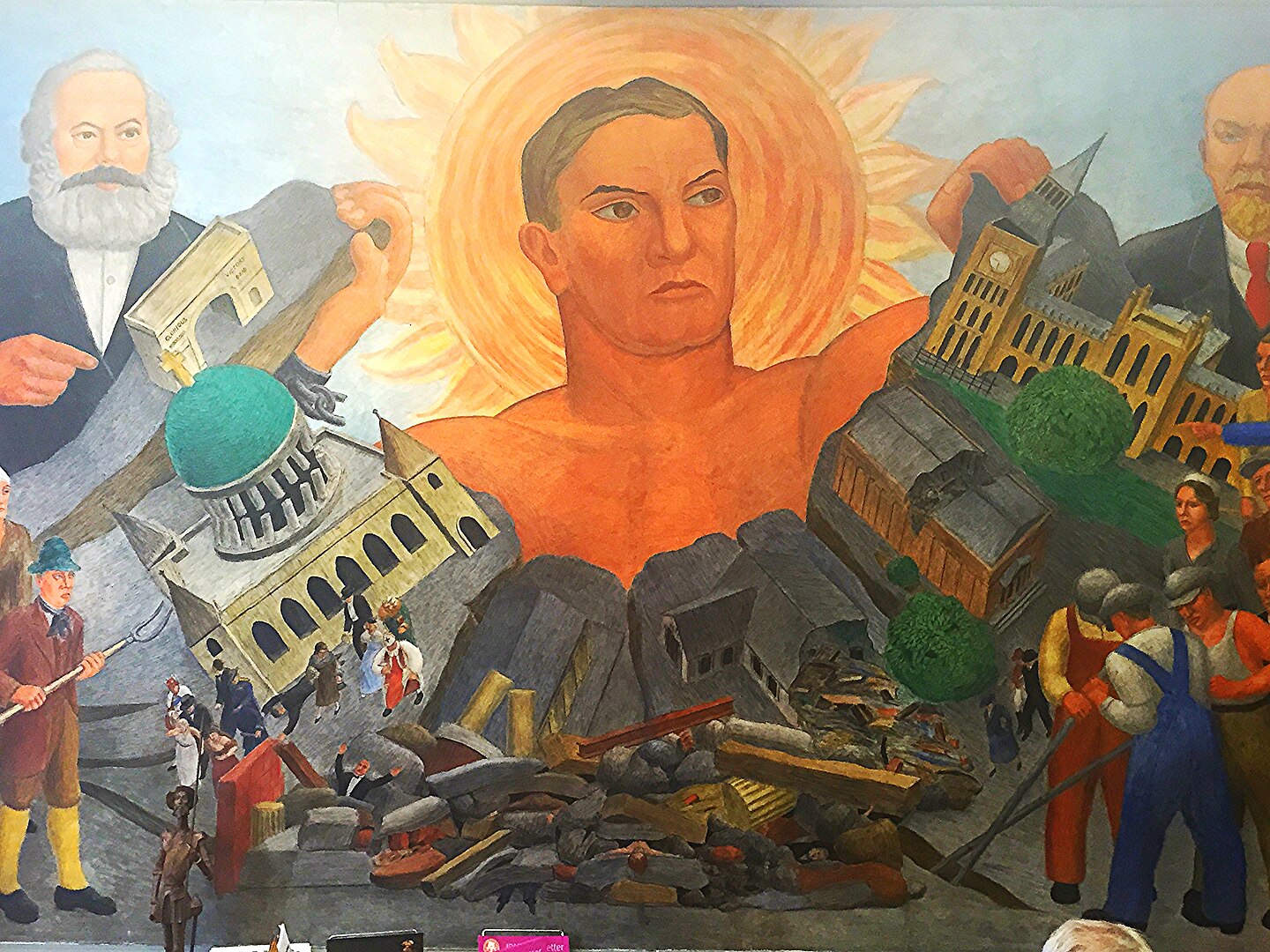
"The Worker of the Future Overthrowing the Chaos of Capitalism,"A mural by Jack Hastings

Image credit: “The Worker of the Future Overthrowing the Chaos of Capitalism” (1935) fresco by Viscount Jack Hastings at the Marx Memorial Library and Workers’ School in London. Photo by Ben Sutherland via Wikipedia CommonsCreative Commons License 2.0.

Vijay Prashad is the director of Tricontinental: Institute for Social Research. Prashad’s latest books are On Cuba (with Noam Chomsky, The New Press, 2024) and The International Monetary Fund Suffocates the World (with Grieve Chelwa, Inkani Books, 2025).

The author is grateful for the immense inputs by Atilio Boron, Atul Chandra, Carlos Ron, Evgeny Morozov, Grieve Chelwa, John Bellamy Foster, Li Bo, Manolo De Los Santos, Michael Brie, Miguel Stedile, Mika Erskog, Shiran Illanperuma, Srujana Bodapati, Stephanie Weatherbee Brito, and Sudhanva Deshpande.

This essay is dedicated to the memory of Aijaz Ahmad (1941–2022), who first referred to the phrase the “intimate embrace” of liberalism and the far right.

The refashioned liberals and social democrats are back. They have positioned themselves as the saviors of the world; they act as Reason to the unreasonableness of neo-fascism. This is possible because their forebearers have collapsed in the puddle of neoliberalism and technocracy, and because their adversaries now present themselves as the howling wolves of the extreme right. The refashioned liberals and social democrats are like zombies, the reanimated corpse of a dead liberalism.1

These refashioned liberals and social democrats have a point. Their immediate predecessors had taken their liberal tradition and exhausted it in the fires of austerity and debt. From the British Labour Party to the Indian Congress Party, the old liberals and social democrats in the West and the anticolonial freedom fronts in the Global South bowed down when the Soviet Union collapsed and began to conform to four realities of their own making:

  1. That capitalism is eternal.
  2. That the neoliberal policy framework (capitalism let loose) is inevitable, even if it creates extreme inequality and does not advance social goals.
  3. That the most that can be done by us is to improve society by ameliorating certain specific social hierarchies (such as those around race, gender, and sexuality).
  4. Finally, following the poorly conceived warnings of Friedrich Hayek in The Road to Serfdom (1944), that pursuing anything more than mere amelioration is folly because it is either bound to fail or inevitably reproduce the “autocracy” and “bureaucracy”‘ of the Soviet Union.2

As the old liberals tied themselves openly to the austerity-debt agenda of neoliberal policy, they refashioned themselves as technocrats and began to style themselves as the sole arbiters of what in popular opinion was acceptable to their technocratic vision. This acceptance by liberals of the gripping pain of austerity and the rejection of its critique allowed the extreme right to cloak itself as the people’s representatives and strike a populist tone through the ugly rhetoric of anti-immigration and “anti-woke,” but marrying it with their incoherent criticisms of the economic system. The extreme right emerged largely on the coattails of liberal surrender to neoliberalism. But the extreme right has not broken with the general outlines of neoliberal policy. It replicates it alongside a harsh social agenda. Despite all the talk of economic nationalism, the extreme right does not have an original economic agenda.

The refashioned liberals and social democrats ignore the surrender of the old liberals to austerity and debt and refuse to do an accounting of the ways in which liberal technocracy laid the foundation stone for the extreme right. To position the return of liberalism as if it could save civilization from the extreme right is misleading, since this refashioned liberalism and social democracy has no different formulation about the way forward than their predecessors. Nothing from the refashioned liberals or the social democrats provides confidence that they are prepared to break the austerity-debt-finance conservatism agenda of neoliberalism. What we have is a left-sounding rhetoric and agitational sensibilities against the system, but incoherence when it comes to how to move beyond the atrocities of capitalism. Specifically, there is nothing in the form of an economic policy that addresses the gross inequality that characterized the neoliberal period. Dig deep into the political agendas and programs of the new social democrats and, amid a festival of identity politics jargon (not even taking seriously the demands for dignity in contexts of social oppression), you will be hard-pressed to find an economic agenda that restores rights or builds power for the masses. At best you will find conservative redistributive policies that attempt to rebuild a middle class that social democracy considers its real base—eschewing any ambition to represent and organize beyond it and into the working class and the peasantry who comprise the vast majority of the world’s people.

A set of slogans—for instance, technofeudalism (Yanis Varoufakis), democratic setbacks (Red Futuro), progressive capitalism (Joseph Stiglitz), rights with responsibilities (Third Way)—breed this disjointedness and offer a nostalgic sense that there was once a democratic system rooted in a perfectly competitive capitalism.3 Such a golden age did not ever exist: capitalist competition is driven toward monopolization, and to the use of state power (often with violence) to exert the will of this or that company, and to reduce the share of wealth that is distributed to society as a whole through wages and taxes, while members of the capitalist class accumulate income and wealth to themselves and amass more capital to continue their dominion.

Further, hearkening back to a “gentler” capitalism of the postwar period ignores that this model depended on the severe exploitation of labor and predatory resource extraction of the Third World—built on the backs of coups d’état and military interventions intended to suffocate the sovereignty of the postcolonial states. While workers in the Global North may have briefly enjoyed marginal stability and relative prosperity during the “Golden Age of Capitalism” (1945–1973), for workers around the globe this was not an age of prosperity. This golden age was built on the neocolonial economic structure of theft that maintained itself through imperialist coups (from Iran in 1953 to Chile in 1973) against any country in the Third World that tried to establish its sovereignty and through the refusal to allow the Third World states to implement the New International Economic Order (1974) formulations voted in by the United Nations General Assembly.4 The neocolonial system financed the golden age, and, through the operations of the International Monetary Fund and the large multinational corporations, it remains the defining system today.5 Capital continues to flow as “tribute” from the Global South to the bank accounts of bond holders in the Global North, most of whom take this liquidity and plough it into a vast financial casino rather than making large-scale industrial investments (although this does not mean that large investments are not being made in actual infrastructure by the billionaire class in areas such as Artificial Intelligence and weapons production).6

A more coherent proposal from the perspective and experience of the Global South would be to rebuild the nationalist economic agendas that were dismantled by U.S. interventionism. This, however, is sorely lacking from the vision advanced by refashioned liberals and social democrats, who have built an analysis derived from wistful nostalgia for European welfare states and the New Deal in the United States. A “return to golden age capitalism” or building a “capitalism with a human face” is an illusion that the world’s people cannot afford.7

A remarkable survey published in 2024 by the Alliance of Democracies called the Democracy Perception Index found that the majority of people questioned about the threats to democracy listed three as the main problems: concentration of income and wealth, corruption, and corporate control over political life.8 Interestingly, 79 percent of the Chinese population say that their country is democratic, much higher than in any Western country. This survey, done by a pro-Western liberal think tank, shows that the Chinese population believes that their government does more for them because it puts the needs of the vast majority ahead of the needs of the capitalists around the world. At a time when there is global interest in socialism, and with the possibilities of finding some lessons from the Chinese experience of breaking the dependency barrier, the return to “progressive capitalism” and social democratic milquetoast ideas seems misplaced. Exhausted ideas of liberal democracy and free market capitalism do not need to be reanimated by a new zombie liberalism.

Karl Marx and the History of Liberalism

The liberal tradition that was born and nourished in the Anglo-American world of ideas was formulated in the context of a struggle against the tyranny of monarchy. Anglo-American writers, such as John Locke (1632–1704), imagined a world without a monarch as sovereign but with propertied interests, referred to as “the people,” as sovereign. Locke argued that the commercial order (capitalism) emerges by the autonomous action of private persons (possessive individualists) without any explicit contract made among them. The task of the state—regardless of its character, with either a king or no king—is to guarantee the basis of private property.

This liberal tradition did not acknowledge its own limitations, such as its racist belief that the only people who could be sovereign were whites and that it was permissible for whites to exterminate the Indigenous peoples of the Americas and to enslave Africans, and its belief that private property was not in contradiction to human freedom. Locke, the ideologue of the Enclosure Movement in England that expropriated the peasantry, wrote, in his Second Treatise of Government (1689), about why the Indigenous peoples of the Americas must lose their land, drawing his justification from the Bible (Genesis, 1.28): “For I ask, whether in the wild woods and uncultivated waste of America, left to nature, without any improvement, tillage, or husbandry, a thousand acres yield the needy and wretched inhabitants as many conveniences of life, as ten acres of equally fertile land do in Devonshire, where they are well cultivated?” Locke, who was the Secretary of the Lords Proprietors of Carolina and Secretary to the Council of Trade and Plantations, made an argument that served his own interests by removing the Indigenous from the lands that he owned and at the same time allowed him the freedom to write about rights that he did not allow for Indigenous people. Not only did Locke justify the expropriation of Indigenous lands, he also was a principal figure in the development of slavery in North America, as an investor in the slave trade through his shares in the Royal African Company and as the principal author of the slave-based Carolina Constitution.9

The republican liberal traditions of the French-speaking peoples that culminated in the French Revolution in 1789 crashed down on the beaches of Haiti with the attempt at preventing the Haitian people from realizing their own republican and liberal ambitions.10 Finally, the German tradition—central to the formulation of liberal principles of law and education, through the work of people such as Immanuel Kant (1724–1804), Wilhelm von Humboldt (1767–1835), and G. W. F. Hegel (1770–1831)—could not overcome the contradictions of the detritus of the Holy Roman Empire, of Napoleon’s confederations, and the rise of Prussia. Hegel thought that Napoleon—”this soul of the world”—would destroy the old German freiherren, and on whose lands would flourish the age of liberty.11 But Napoleon both in victory and defeat failed the Enlightenment liberals, and the Junkers returned with the Hohenzollern dynasty to rule for another century. Reacting to the repressive Carlsbad Decrees of 1819, liberals participated in the continent-wide 1848 uprising, the failure of which to dislodge absolutism led to the liberals’ total disillusionment (many of them—such as Heinrich von Gagern—appealing to Prussia’s Fredrick William IV to wear a constitutional crown in 1849, while in France, Émile Ollivier became Napoleon III’s main liberal ally). Liberal republicanism rapidly faded into constitutional monarchism.

Drawing critically on the limitations of Hegel, the Young Hegelians, and the liberals, all of whom accepted some version of the monarchy, Karl Marx (1818–1883) developed his immanent critique of liberalism, rooting his critique in liberalism’s inability to go beyond the relations of private property that hemmed in its ambitions. What is central to Marx’s early writing on freedom is his acknowledgment that the advances made by the 1789 French Revolution and by liberalism were vital. Political emancipation, he wrote, is “a big step forward. True, it is not the final form of human emancipation in general, but it is the final form of human emancipation within the hitherto existing world order.”12 It is not the ideal that Marx disavows but its carriers, the liberals, who end up being so attached to the defense of private property that they become a motley crew unable to clearly advance socialist goals. Marx’s 1852 characterization of the British Whigs (the liberals who opposed monarchy and church control) is apposite:

It is evident what a distastefully heterogenous mixture the character of the British Whigs must turn out to be: Feudalists, who are at the same time Malthusians, money-mongers with feudal prejudices, aristocrats without point of honour, bourgeois without industrial activity, finality-men with progressive phrases, progressists with fanatical Conservatism, traffickers in homeopathical fractions of reforms, fosterers of family—nepotism, Grand Masters of corruption, hypocrites of religion, Tartuffes of politics.13

Some quick annotation of this remarkably efficient quote that applies to today’s liberal parties and to their social democratic intellectuals: Thomas Malthus was a reverend who believed that population growth (rather than capitalist plunder) increased starvation. Finality-men considered the English Reform Bill of 1832 to be the final step in the development of liberalism and opposed the extension of the vote any further, especially to the mass of the population. Tartuffe was a play by Molière about religious hypocrites.

In his later writings on these same themes, Marx would retain the idea of the “big step forward” and of the need to continue to push the class struggle toward “the final form of human emancipation.” In the Critique of the Gotha Programme (1875), Marx wrote that “Right can never be higher than the economic structure of society and its cultural development conditioned thereby.” A society with productive forces unable to generate sufficient surplus, and therefore with insufficient leisure and cultural institutions, would not be able by itself to constitute human emancipation. Liberal rights to property in a capitalist system, for instance, guarantees every person the “freedom to own property,” which had been restricted under precapitalist social formations, but it does not guarantee the “freedom from property,” in other words, the freedom from the tyranny imposed on the propertyless. It is only “in a higher phase of communist society” that has moved from the realm of necessity to the realm of freedom—with abundance as its characteristic—that one can grasp the social basis for freedom. “Only then,” Marx wrote in 1875, “can the narrow horizon of bourgeois right be crossed in its entirety and society inscribe on its banners: From each according to his ability, to each according to his needs.” The issue of how to describe “needs” (though he described it as a “hierarchy” starting with the fulfillment of basic needs) is not relevant here.14 The important point is that Marx makes at least three decisive breaks with the earlier liberal tradition:

  1. That ideas of freedom and right cannot be disassociated from the material conditions of human life.
  2. That the institution of private property creates a cycle of exploitation and accumulation that transforms the ideas of freedom and equality into their opposites, all without violating the terms of free and equal exchange.
  3. That the realization of the ideas of freedom and right require the transcendence of private property (the social relations of capitalism) and the creation of a new “world order.”

Marx ultimately demonstrated that liberalism could not realize its values. To take these values forward would require a rupture with capitalism and the formation of a socialist society. But liberals, believing in possessive individualism, did not want to make that break.

Liberalism, nonetheless, continues as a political and philosophical tradition, but now alongside a critique that had shown its limitations. The best of liberalism, arising from the nineteenth century, understood that capitalism generated inequalities, and that the highest form of liberal politics would be to ameliorate these inequalities through social welfare programs.

Across Europe, from Otto von Bismarck’s Staatssozialismus to John Maynard Keynes’s welfare state, and then in the United States through the antitrust actions of President Franklin D. Roosevelt, grew various strands that recognized the harshness of capitalism and sought to find ways to humanize its impact on the working class. The entire field of debate and dispute about social welfare remained in a close or distant conversation with Marxism, which haunted liberalism as the clearest critique of capitalism and its social impact. Even the traditions that rejected social welfare policies (such as anti-Communist thought, from the John Birch Society in the United States to the Mont Pelerin Society in Europe) had to engage with Marxism, if only as their foil.

From the 1970s onward, however, much more confident versions of anti-Marxism emerged that abandoned social welfare policies and rejected the centrality of the Marxist critique of capitalism. The collapse of the USSR, the debt crisis in the Third World, and the business unionism of Northern unions (a process largely engineered by Washington) led this seam of thought to congeal into variants of neoconservatism and neoliberalism, two distinctly named strands that shared the break from Marxism’s critique and from the cultural centrality of social welfare.

The arrival of these discourses was helped along by the emergence of post-Marxism, which in the name of liberalism participated in the attack on Marxism and returned theory to pre-Marxism (exemplary here is the 1985 book Hegemony and Socialist Strategy by Ernesto Laclau and Chantal Mouffe, which paved the road from post-Marxism backward to liberalism).15 The rejection of the core elements of Marxism leads directly to incoherence: this form of post-Marxism celebrates struggle for the sake of struggle and offers no strategy or orientation beyond movimentismo and mobilization (as opposed to building organizations and developing a programmatic strategy). Marxism showed that the masses historically cohere around an agenda of building their own strength, and, through organization, use that strength to convert mass struggles into class struggles that focus the power of the people against the capitalists and their state emissaries in order to build a socialist society. All that is sublated by post-Marxism into the unintelligibility of “multiple” and “intersecting” struggles. The message now is do whatever you want to change the world, and something will certainly happen—there is no need to put the question of productive forces or capitalism on the agenda, or indeed for a socialist strategy that includes political parties of a vanguard form. The structural role of capital and labor is obscured by this form of political miscellany.

Revolutions Are Made in the Poorer Nations

Socialism came to us as a possibility. We imagined that the vast wealth produced by social labor could be used by society to enrich each of us. We believed that we could harness new technologies and social wealth to organize production along humane lines, to treat people with dignity and kindness, and to steward the planet rationally. That was our possible history. It remains our possibility. For hundreds of years, sensitive human beings fought to build a world in the image of freedom. Workers and peasants, ordinary people with dirt under their fingernails, threw off the cloak of humiliation put on them by the owners of land and wealth to demand something better. They formed anticolonial movements and socialist movements—movements against the terrorism of hunger and indignity. These were movements: people in motion. They did not accept the present as infinite, their position as static. They were on the move, not only toward the landlord’s house or the factory gates, but toward the future.

These movements produced the revolutions of 1911 (in China, Iran, and Mexico), the revolution of 1917 (against the Tsarist empire), the revolution of 1949 (China), the revolution of 1959 (Cuba), the revolution of 1975 (Vietnam) and many others.16 Each of these revolutions offered a promise: the world need not be organized in the image of the bourgeoisie when it could be developed around the needs of humanity. Why should the majority of the world’s people spend their lives working to build up the wealth of the few, when the purpose of life is so much richer and bolder than that? If the people from China to Cuba were able to overthrow the institutions of humiliation, then anyone could do so. That was the promise of revolutionary change.

The defeat of the German Revolution in 1919 put an end to the possibility that Europe would follow the example of the Bolsheviks and overthrow their martial capitalist regimes. Instead, the revolution prevailed in the Tsarist Empire—a technologically and industrially backward state that had colonized large parts of Asia and Europe. It was then followed by a revolution in Mongolia in 1921, around the same time that various parts of the former Tsarist Empire moved with the revolutionary wave into the Union of Soviet Socialist Republics.

What the October Revolution of 1917 against the Tsar revealed was that ordinary people can set aside the pretense of imperial or democratic liberalism and govern themselves through a socialist-oriented state (the idea of imperial liberalism is illustrated by Prince Dmitri Ivanovich Nekhlyudov in Leo Tolstoy’s 1899 novel Resurrection). But more than anything, the October Revolution—like the revolutions that would follow (Vietnam in 1945, China in 1949, and Cuba in 1959)—proved the axioms of V. I. Lenin (1870–1924) to be correct. These axioms (that liberalism would not be capable of revolutionary change, that colonialism had to be overcome, that revolution could take place where the productive forces had not fully developed) inspired generations of revolutionaries in the colonized world to become Leninists, and then Marxist-Leninists (which included people such as José Carlos Mariátegui, Mao Zedong, Ho Chi Minh, Kwame Nkrumah, E. M. S. Namboodiripad, and Fidel Castro).17 These general axioms of Marxist-Leninism, fundamentally built on the experience of socialist construction in the Third World, can be theorized into the following:

  1. Marxism, as it developed in the Second International (with its primary theorist being Karl Kautsky), believed that the revolutionary forces in the advanced capitalist and imperialist bloc, namely the industrial proletariat, would revolt and move history forward toward socialism. This theory did not come to life. Instead, the revolution failed in the capitalist and imperialist core. This was because of a labor aristocracy, or what Lenin defined as an “upper stratum” of the “workers turned bourgeois” in the capitalist core who allied themselves with the capitalist class. In particular, the “labour leaders,” he argued, benefited from the wages of imperialism and strongly imbibed the ideological culture of imperialist liberalism.18
  2. Instead, the revolutionary breakthroughs occurred in the semicolonies and the colonies, where the workers and peasants formed an alliance to overthrow the colonial rulers and the classes that had grown by their dependence on colonialism. The classes that ruled on behalf of the colonizers had neither the energy nor the program to lead their own society away from colonial domination, or to build a liberal agenda for self-reliance; they could not break with imperialism, only—perhaps—break with direct colonial rule.
  3. The culture in many semicolonies and colonies (particularly in Africa and Asia) had been thwarted by the refusal of the imperial powers to build modern institutions of education, health, and housing for the colonial subjects, and the culture of the colonies had not incubated a sufficient liberal patina around the institutions of the law and politics. For that reason, the worker- and peasant-controlled states did not include liberalism among their inheritance, but had to create their own ideological forms in the new society. Similar situations existed in Central America and in the Caribbean (including Colombia), where colonial forms of rule persisted despite formal independence and liberalism was fundamentally curtailed. In the Southern Cone, thinkers such as Juan Bautista Alberdi (1810–1884) in Argentina and José Victorino Lastarria (1817–1888) in Chile wrote liberal tracts but had nothing to say about the Indigenous people or of the working class and peasantry in their societies (this was, essentially, Locke three hundred years later). Their liberal theories were in direct opposition to the views of Marxists from the next generation such as Peru’s Mariátegui (1894–1930) and Venezuela’s Salvador de la Plaza (1896–1970).19
  4. Imperialism had smothered the growth of modern economic systems, including the construction of modern industry and infrastructure. The colonies had been tasked with the production of raw materials, the export of their wealth, and the import of finished goods. This meant that the new revolutionary states took charge of disarticulated dependent economies with few scientific and technical skills.

Each of the revolutionary states that emerged—from the USSR to the People’s Republic of China to the Republic of Cuba—understood this situation and these limitations perfectly well. This is precisely what most of the refashioned liberals and social democrats with left slogans do not grasp: they want to distance themselves from the actual experience of building socialism that does not occur in the capitalist core but rather in the colonial periphery, and that works to build a socialist culture against enormous odds. It is easy to dismiss the one-party state rule or to sniff at “statism” or even “authoritarianism,” easy to adopt the language of Cold War liberalism, but much harder to offer a diagnosis of why the revolutionary developments occurred in the poorer nations and why these revolutionary developments had to go in a way that does not conform to the best gestures of liberal ideology. The socialist experiments in the poorer nations had to confront immediately a list of important tasks, including the following:

To defend the revolutionary process from internal and external attack. This meant to utilize the armed forces and to arm the people, but it also meant to prevent the organization of internal counterrevolutionary forces into a bloc of resistance, using liberal discourses of “freedom” to mask their desire to return to power and to impose the undemocratic regime of property on the vast masses. These were not theoretical debates: the USSR was attacked in 1918, Cuba was blockaded beginning in 1962, and China now faces a serious imperialist buildup off its shores. Liberal states tried to suffocate them from their birth.

To address the immediate problems of the people. Hunger, poverty, and other everyday humiliations faced by the masses had to be overcome as rapidly as possible. This meant using the limited means in society in a manner that was novel to the cultures of cruelty that existed previously. It meant that the revolutionary regime would have to make decisions from the standpoint of all of society that would require certain sections of the working class to work very hard in a short period to produce sufficient goods to fulfill the needs of all of society.

To build the productive forces of the society. Colonial conditions had meant that the poorer nations had neither the infrastructure (particularly electrification and transport systems) nor the industry to produce the goods and services needed to complete the aspirations of the people. This infrastructure and industry would need science, technology, and capital—all of which had been denied to these countries, and therefore would need to be hastily produced both by international solidarity and by the express development of higher education and using raw material exports to be converted into capital for industrialization.

To create the cultural world for the masses. Building educational and cultural institutions to erase illiteracy and to build the confidence of the workers and peasants to rule their own society is a long-term project, whose difficulties should not be underestimated. In all these revolutionary experiences, the most trying part of constructing a new project is to build the clarity, confidence, and dignity of the masses to become the agents of their own history and take charge of the state project, a multifaceted entity necessary for the highly complex digital economies of our times.

The most immediate task was always the first one, particularly after the Second World War, when the technological means of attack had become more sophisticated. Imperialist coups d’état and direct military invasions had become almost normal, and interventions of one kind or the other had been conducted with impunity.

It is interesting that in a country such as Chile, which experienced a vicious imperialist overthrow of the Popular Unity government in 1973, there is so little empathy within the ranks of the refashioned liberals and social democrats, not only in the Frente Amplio but also in sections of the Communist left, with the plight of, for example, Cuba, which not only gave full-throated solidarity to the Popular Unity government between 1970 and 1973, but helped the resistance against the military coup government, and has all along—especially now—faced an illegal and deleterious blockade led by the United States. It is so easy to adopt the language of Cold War liberalism, taken from epigones of the Cold War such as Hannah Arendt, but much harder to understand the complexities of building a revolution in the poorer nations.20

The Marxist revolutions from Russia to Cuba took place in the realm of necessity, not in the realm of freedom. It was difficult for each of these new states—that ruled over regions of great poverty—to marshal the capital necessary for a leap into socialism.

One of them—Vietnam—had been bombed by the United States, including with chemical weapons, until its soil was irreparably contaminated and its infrastructure was destroyed.21 To expect a country like Vietnam to easily transition to socialism is naïve. Each of these countries had to squeeze themselves to collect resources and they made a great many errors against democracy. But these errors are born of the struggles to build socialism; they are not endemic to it. Socialism cannot be condemned because of the errors in any of these countries. Each of these countries is an experiment in a postcapitalist future. We have much to learn from each of them.

Programs of humanity followed these revolutions—projects to enhance the lives of people through universal education and universal health care, projects to make work cooperative and enriching rather than debilitating. Each of these revolutions experimented in different ways with the palate of human emotions: refusing to allow that state institutions and social life be governed by a narrow interpretation of human instinct (greed, for example, which is the emotion around which capitalism is developed). Could “care” and “solidarity” be part of the emotional landscape? Could “greed” and “hate” be ameliorated?

The Need for Clarity and Class Struggle

The current conjuncture requires a movement between two political concepts: sovereignty and dignity. These are intertwined concepts of our era, with different movements and state projects operating with relative degrees of commitment to each of them.

National sovereignty is a state-level concept referring to state projects that push against the intervention of foreign interests and seek to develop a political and economic set of policies that defend the rights and needs of their own people. For a country that has emerged from colonialism, sovereignty is a mechanism to measure how much the country has been able to exit the pressures of colonial rule and imperialist intervention.

To seek sovereignty is by itself a negative assertion, meaning that it is against imperialist intervention; the category of sovereignty itself does not describe the nature of the class relations within the country, allowing for countries to have nonsocialist paths but nonetheless sovereign paths from imperialism (Iran, for instance, is not a socialist state, but it nonetheless seeks sovereignty from the clutches of imperialism). All socialist state projects decidedly seek national sovereignty, but all sovereign seeking projects are not socialist.

Dignity is a people-level concept that refers to the idea that each person and then the social communities to which they belong as social individuals seek dignity in all aspects of their life, from a dignified everyday life (emancipation from poverty and hunger) to a dignified cultural life (celebration of their own cultural heritage as part of human culture).

The concept of dignity is widely shared across human history, from the traditions of Buddhism (everyone has Buddha nature in them) to Stoicism (dignitas or worthiness shared by all rational beings); the United Nations Declaration of Human Rights (1948) opens with the recognition of the “inherent dignity” of all “members of the human family.” But dignity is not an a priori fact of humanity (as humanism or liberalism argues); it must be produced as we exit the wretchedness of deprivation (poverty, illiteracy) and form dignified lives (as socialism argues). There is, in other words, a material force that must shape our dignity. A politics to produce dignity is a socialist politics, although others might adopt this or that element of the socialist program. There is no evidence in the world that the capitalist system can emancipate all people from a life of indignity: capitalism inherently generates forms of inequality and indignity. Therefore, all undertakings that seek dignity for all are socialist projects.

One of the most complicated aspects of our present state of the world is that while there is chaos in the North Atlantic world, there seems to be a growing sense of stability in parts of southeast and east Asia. The old imperial powers continue to insist on a world of austerity, debt, and war—ugly ideas that bring grief to billions of people, from those Palestinians who face the Israeli genocide to those who starve to death in their homes because their precarious work does not earn them enough to survive.

Meanwhile, particularly from China, the message is clear: we must work toward peace and development in order to create a shared future for humanity.22 This is a call that increasingly seems more attractive to people around the world. This is where the refashioned liberals and social democrats appear to be so cut off from reality: being accustomed to the Cold War-era liberal language of authoritarianism, they are unwilling to properly acknowledge the great gains made against all odds in places such as China and Vietnam to lift their populations out of poverty, to build new, quality productive forces, and to offer technology transfer and economic and technical collaboration for the industrialization of large parts of the Global South that had suffered from the yoke of the neocolonial structure of globalization. China and other Asian countries have not solved the problems of the world; they do not offer an “off the shelf” model for development. But they offer a stance toward the world—peace and development—that is far more attractive than that offered by the old North Atlantic states in the name of liberalism—austerity, debt, and war.

It is not as if refashioned liberals and social democrats are so eager to build mass movements and to abjure state power. They believe that state power can be won through the ballot box in liberal democracies and that this can be done by disassociating themselves fundamentally from the aim of socialism, from the history of socialism, and from the actual experience of socialist state projects. But that would be a hollow state power, because it would mean taking office without power, without building the movements and political organizations that come with a mass base that is gripped with clarity, confidence, and an appetite to realize full human dignity. The class struggle remains the central battlefront to build the dignified protagonists of the future.

The world wants to advance to socialism.

Notes

  1. ↩ The essence of the critique of the far right of a special type and of neoliberalism is drawn from Tricontinental: Institute for Social Research, The False Concept of Populism and the Challenges Facing the Left: A Conjunctural Analysis of Politics in the North Atlantic, Dossier no. 83, December 2024, and Tricontinental, Ten Theses on the Far Right of a Special Type: The Thirty-Third Newsletter (2024), August 15, 2024, thetricontinental.org.
  2. ↩ Friedrich Hayek, The Road to Serfdom (London: Routledge, 1944). On the lingering legacies of Hayek and these ideas, see Quinn Slobadian, Hayek’s Bastards: Race, Gold, IQ, and the Capitalism of the Far Right (Princeton: Princeton University Press, 2025).
  3. ↩ The most insightful critic of the entire tradition of “technofeudalism” is Evgeny Morozov, first in an early essay, “Critique of Techno-Feudal Reason,” New Left Review, no. 133/134 (January–April 2022); and more recently in “What the Techno-Feudalism Prophets Get Wrong,” Le Monde Diplomatique, August 2025, mondediplo.com. The most compelling critique of the “third way” is by Alex Callinicos, Against the Third Way: An Anti-Capitalist Critique (London: Polity, 2001). Susan Watkins cleverly calls the dominion of the “third way” of Labour’s Blairism “weightless hegemony” in “A Weightless Hegemony: New Labour’s Role in the Neo-Liberal Order,” New Left Review, no. 25 (January–February 2004).
  4. ↩ The broader story is in my book: Vijay Prashad, The Darker Nations: A People’s History of the Third World (New York: The New Press, 2007).
  5. ↩ The full story is in Grieve Chelwa and Vijay Prashad, How the International Monetary Fund Suffocates Africa (Johannesburg: Inkani Books, 2025).
  6. ↩ Fernando van der Vlist, Anne Helmond, and Fabian Ferrari, “Big AI: Cloud Infrastructure Dependence and the Industrialisation of Artificial Intelligence,” Big Data and Society 11, no. 1 (January–March 2024).
  7. ↩ Note: This essay focuses attention on attempts to resurrect liberalism and social democracy in the Global North. A future essay will deal more specifically with Global South liberalism and social democracy, which has its own range of views and particularities; in that essay, I will expand on the emergence of unique strands of social democratic politics that derive from old anticolonial political fronts, and specifically to analyze the revitalization of religious welfarism.
  8. ↩ Alliance of Democracies, Democracy Perception Index 2024 (Copenhagen: Lantana, 2024), allianceofdemocracies.org.
  9. ↩ Barbara Arneil, John Locke and America: The Defense of English Colonialism (Oxford: Clarendon Press, 1996); Paul Cochran, “John Locke on Native Right, Colonial Possession, and the Concept of Vacuum domicilium,” The European Legacy: Towards New Paradigms 23, no. 3 (September 2018): 225–50; Peter Olsen, “John Locke’s Liberty Was for Whites Only,” New York Times, December 25, 1984.
  10. ↩ Michel-Rolph Trouillot, Silencing the Past: Power and the Production of History (Boston: Beacon Press, 1995).
  11. ↩ The term “soul of the world” comes from a letter that G. W. F. Hegel wrote to his friend Friedrich Immanuel Niethammer on October 13, 1806.
  12. ↩ Karl Marx and Friedrich Engels, Collected Works (New York: International Publishers, 1975), vol. 3, 155.
  13. ↩ Marx and Engels, Collected Works, vol. 11, 331.
  14. ↩ Karl Marx and Frederick Engels, Selected Works, vol. 3 (Moscow: Progress Publishers, 1973), 19; Karl Marx, Texts on Method (Oxford: Basil Blackwell, 1975), 195.
  15. ↩ Antonio Anzaldi Pablo, Sobre Laclau y Mouffe: Para una Critica de la Razon Progresista (Buenos Aires: Editorial SB, 2023). The original book is Ernesto Laclau and Chantal Mouffe, Hegemony and Socialist Strategy: Towards a Radical Democratic Politics (London: New Left Books, 1985). The term “radical democratic politics” is indicative of the liberal strain that is then elaborated by these authors, such as in Mouffe’s Le politique et ses enjeux: Pour une démocratie plurielle (Paris: La Découverte, 1994) and in Laclau’s edited volume, The Making of Political Identities (London: Verso, 1994)—both texts seeing political identity as “discursive” and “democracy” as being a central category of their political thought. Both eventually wrote books on populism, where they argued the case for movimentismo and manifestations over organization, such as Ernesto Laclau, On Populist Reason (London: Verso, 2005) and Chantal Mouffe, For a Left Populism (London: Verso, 2018).
  16. ↩ Vijay Prashad, Red Star Over the Third World (New Delhi: LeftWord, 2017).
  17. ↩ This entire tradition will be elaborated into a book, October, which I will present in a few years.
  18. ↩ V.I. Lenin, Imperialism, the Highest Stage of Capitalism (New Delhi: LeftWord Books, 2000), 40.
  19. ↩ José Carlos Mariátegui, An Anthology (New York: Monthly Review Press, 2011).
  20. ↩ On Cold War liberalism, see Samuel Moyn, Liberalism Against Itself: Cold War Intellectuals and the Making of Our Times (New Haven: Yale University Press, 2024).
  21. ↩ The United States bombed Korea and Vietnam savagely in the name of liberalism. See Samir Amin, The Liberal Virus: Permanent War and the Americanization of the World (New York: Monthly Review Press, 2004).
  22. ↩ For a general view of the intellectual debates in China, see the regular issues of Wenhua Zongheng produced by Tricontinental: Institute for Social Research, at thetricontinental.org/wenhua-zongheng.