Tuesday, February 18, 2020

Russian intelligence agents reportedly went to Ireland to inspect undersea cables, and it's reigniting fears they could cut them and take entire countries offline


Business Insider•February 17, 2020

Ireland cable map

Submarine Cable Map


Russian agents have been sent to Ireland to inspect its undersea cables, and it's sparking fears they could be tapped or cut in the future, according to The Sunday Times citing Irish police.


Irish security services suspect that Russia's intelligence agency, the GRU, is using their country as a base to gather intelligence on targets in the EU and UK, The Sunday Times reported.


The large number of tech companies that are based in Dublin could be another reason for Russia's suspected monitoring, an expert on transnational crime and Russian security told the newspaper.


There have been longstanding fears that Russian spies could cut transatlantic undersea cables to disrupt communications and financial transactions, and take entire countries offline.


Visit Business Insider's homepage for more stories.

Russian intelligence agents have been sent to Ireland to make the precise locations of undersea cables connecting Europe to North America, and it's raising fears that they plan to tap or even cut them, The Sunday Times reported.

Irish security services believe that the agents were sent by Russia's foreign intelligence agency, the GRU, and are checking the fiber-optic cables for weak points, The Times also reported, citing police and military sources.

They were also seen monitoring Dublin Port, which prompted the country to ramp up security at a number of landing sites along the Irish coast, The Times reported. It's unclear where else the agents have been seen.
- ADVERTISEMENT -


The vast network of transatlantic cables that run under the world's oceans power the internet, texts, calls, and global financial transactions. About 97% of all intercontinental data is transferred through these cables, according to the Asia-Pacific Economic Cooperation forum.

Ireland is an ideal location for these undersea maps, given its proximity to North America and Europe. In 2015, Irish telecommunications company Aqua Comms set up a $300 million cable to connect the US to Dublin, and on to London and European continent, the Irish Examiner reported.
A map showing undersea cables around the world.

Submarine Cable Map

Irish police and military sources suspect the GRU is using Ireland as an operations base to gather intelligence on targets in the EU and the UK, The Times said.

Another reason for the Russians' presence could be Dublin's place as one of Europe's largest tech hubs, as authorities suspect the agents could also be spying on large tech companies, according to The Times. Google, Airbnb, Facebook, and Twitter all have headquarters in the city.

The country also presents itself as an ideal target to the Russians, Mark Galeotti, an expert on transnational crime and Russian security at the Royal United Service Institute think tank, told The Times.

"Ireland doesn't have a counter-intelligence capability. It's a relatively soft target. Ireland is a major node for the global internet. It has a large concentration of tech companies," he said. "This is the new battle space of the future."
A photo of Google's Dublin headquarters in 2013.

Peter Würmli, Camenzind Evolution

News of the Russian agents' arrival in Ireland has prompted concerns that Russia might ramp up its information warfare by cutting or tampering with the cables, which could disrupt global financial transactions or even take entire countries offline.

John Sipher, a retired CIA officer, in Moscow, told The Times that there is a high chance the agents are either spying or planning to cut communications.

"They also may wish to show their capability in order to threaten the West," he told the British newspaper. "Our FBI has caught Russians trying to gain access to underwater cables, including the areas where they come into land."

"They are also seeking to gain physical access to routers and communication nodes," Sipher added.
Undersea cables connecting the US to the rest of the world. Screenshot taken in 2018.

TeleGeography

Western countries have long feared that Russia could cut undersea cables and interfere with the global economy and way of life.

Air Chief Marshal Sir Stuart Peach, the UK's most senior military officer, said in December 2017: "There is a new risk to our way of life, which is the vulnerability of the cables that criss-cross the seabeds."

"Can you imagine a scenario where those cables are cut or disrupted, which would immediately and potentially catastrophically affect both our economy and other ways of living?"

Russian ships were seen in 2018 in the vicinity of vital undersea fiber-optic cables, sparking further speculation that the Kremlin was finding a new way to spy.
What are undersea internet cables?

More than 300 undersea cables, which run a total of 550,000 miles, keep the internet running around the world.

Most lines are owned by private telecommunications companies, including tech companies like Google and Microsoft. Their locations, which have been built up over the decades, can be easily identified on public maps.

Despite their importance, little is being done to guard and protect these deep-sea cables.

Cybersecurity experts told Business Insider's Jim Edwards in 2018 that it's only "a matter of time" before hackers can access these cables and entire countries can be taken offline.


Read more:


Scientists found a new earthquake fault system underwater near the California coast, thanks to a 32-mile network of deep-sea cables


Fiber optic wires, servers, and more than 550,000 miles of underwater cables: Here's what the internet actually looks like


34 billion devices will be connected to the internet by 2020


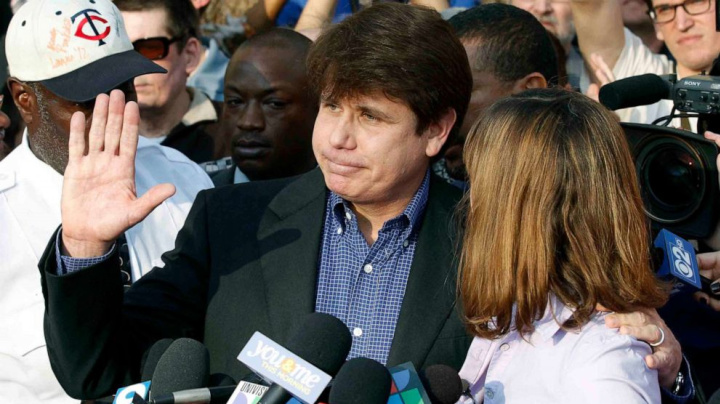
Trump commutes ex-Illinois governor's sentence
President Trump said he has commuted the 14-year prison sentence of former Illinois Gov. Rod Blagojevich, who was convicted of political corruption. 
Image result for kakistocracy

SHE JOINS IVANKA
Paris Hilton said she had a 'wonderful' time visiting Saudi Arabia, which other celebrities have been shunning for its human rights record


acollman@businessinsider.com (Ashley Collman),INSIDER

February 18, 2020

Paris Hilton speaks at a conference in the United Arab Emirates on February 12.

Al Arabiya English

Paris Hilton spoke about her first visit to Saudi Arabia during an interview at a conference in the United Arab Emirates last week.

The American hotel heiress said "everybody was so sweet and welcoming" and that she had "a wonderful time."

Hilton's comments come at a time when other celebrities have been distancing themselves from the Kingdom over its dire human rights record.

In a time when celebrities have been trying to distance themselves from Saudi Arabia over its human rights record, Paris Hilton is embracing the kingdom.

On Wednesday, the hotel heiress spoke about her recent first trip to Saudi Arabia during an interview at a conference in the United Arab Emirates.

"Everybody was so sweet and welcoming," Hilton told Al Arabiya English. "I had a wonderful time. I thought it was beautiful and very lovely people."

Saudi Arabia is one of the most conservative religious countries in the world, yet maintains close business relations with the West.
In recent years, Paris Hilton has become a DJ.
 She's pictured here DJing at the Super Bowl in Miami 
on February 2, 2020.
Eugene Gologursky/Getty Images for MCM

In recent years, Crown Prince Mohammad bin Salman has pledged to modernize the country and relax some of its social norms, including allowing women to drive.

But many have grown skeptical that the crown prince will bring change, especially in light of the assassination of critic Jamal Khashoggi. Last year, the CIA released a report concluding that MBS ordered Khashoggi's murder.

Hilton's words of love for Saudi Arabia come less than a year after Nicki Minaj pulled out of the Jeddah World Fest music festival after learning about the country's treatment of women and the LGBTQ community.

"While I want nothing more than to bring my show to fans in Saudi Arabia, after better educating myself on the issues, I believe it is important for me to make clear my support for the rights of women, the LGBTQ community and freedom of expression," Minaj said in a statement.

Several WWE stars also pulled out of the WWE Crown Jewel wrestling event in Riyadh in November 2018, over Khashoggi's death.

Hilton found herself in hot water in the kingdom about eight years ago, when she opened a handbag store in the holy city of Mecca. Many Saudis took to social media to express their opinion that it was inappropriate for her to have a store in the city where non-Muslims are not welcome. It was Hilton's fifth store in the country.

Hilton became a household name in the the early aughts for her reality show "The Simple Life." In recent years she has become a DJ. She is the great-granddaughter of Conrad Hilton, the founder of the Hilton Hotels chain.


Ivanka Trump lauds Saudi, UAE on women's rights reforms


AYA BATRAWY, Associated Press•February 16, 2020

Ivanka Trump praises Saudi Arabia, UAE on women's rights reforms

“significant reforms” to advance women’s rights, while speaking at a gathering of women entrepreneurs and regional leaders in Dubai

DUBAI, United Arab Emirates (AP) — Ivanka Trump lauded Sunday a handful of Mideast countries, including close U.S. allies Saudi Arabia and the United Arab Emirates, for embarking on “significant reforms” to advance women's rights, while speaking at a gathering of women entrepreneurs and regional leaders in Dubai.

The daughter of U.S. President Donald Trump was delivering the keynote address at the two-day Global Women’s Forum held in an opulent resort overlooking the city's Persian Gulf coastline.

“We know that when women are free to succeed, families thrive, communities flourish and nations are stronger,” Trump said.

Her comments throughout the speech drew applause, particularly when she praised Saudi Arabia. Despite reforms there, women’s rights activists and other campaigners are imprisoned and facing trial on vague charges related to national security.

The theme of the forum in Dubai was “The Power of Influence.” It was an apt theme for Trump, whose loyalty and support for her father's presidency saw her and her husband, Jared Kushner, take up formal roles in the White House as his advisers.

The 38-year-old mother of three has positioned herself as an Oval Office confidante while spearheading initiatives that broadly back women's empowerment. Her husband has become a top adviser on U.S. Mideast policy.

Once the owner of an eponymous fashion line, Ivanka Trump has wielded her proximity to the president to promote policies affecting women and deliver speeches around the world about women's economic empowerment. She meets with world leaders as a key White House official. Some of her efforts even have some bipartisan support in Washington, standing in sharp contrast to the level of controversy and political division surrounding her father's presidency.

In her keynote speech at the women's forum in Dubai on Sunday, Trump touted what she said was the progress of women in the United States.

“Today, American women are leading in every aspect of society. Last year, there were more women than men in the United States workforce, with women securing over 70% of new jobs,” she said in her address.

Trump made no mention, however, of legislative obstacles in the U.S. around paid family leave, which she and the U.S president support. Currently, just a few U.S. states offer paid leave.

During her speech in Dubai, Trump congratulated Saudi Arabia for recent changes in the law that allow women to travel abroad and obtain a passport without the permission of a male relative. In 2018, a ban on women driving cars was lifted. The changes are part of a wide-ranging push to transform the Saudi economy, attract greater foreign investment and ease international criticism.

Trump pointed to changes in other Mideast countries, as well. She said Bahrain had introduced legislation against discrimination in the workplace; Jordan had eliminated legal restrictions on women's ability to work at night; Morocco had expanded women's land rights; and Tunisia had introduced laws to combat domestic violence.

She said, though, more work needed to be done. She noted that across the region, women on average still have only half the legal rights of men.

The audience for her speech in the UAE included Dubai ruler Sheikh Mohammed bin Rashid Al Maktoum, Dubai Crown Prince Hamdan bin Mohammed Al Maktoum, World Bank President David Malpass and International Monetary Fund chief Kristalina Georgieva.

The Dubai ruler is wildly popular at home and is seen as a modernizing force. He has, however, faced some criticism abroad concerning women's rights following reports that one of his daughters tried to flee the country and was forcibly returned. In previous years, Jordanian Princess Haya, with whom Sheikh Mohammed has two children, would have attended a forum of this kind by his side, but she too has reportedly fled the country and is seeking custody of their children in a British court.

The UAE and Saudi Arabia have worked to cultivate close ties with the Trump administration and were early supporters of the Women's Empowerment Fund, a World Bank initiative to help female entrepreneurs that Ivanka Trump strongly backs. During the first trip abroad of her father's presidency to Saudi Arabia, the two Gulf countries pledged $100 million to the fund.

In her speech at Sunday's forum, Trump commended Emirati leaders for “removing barriers to women joining the workforce and developing a national strategy that recognizes that women are central to sustainable growth.”

She noted that although 70% of Emirati university graduates are women, only 10% of the UAE's total national income is derived from women.

“We know that this going to grow and flourish in the years ahead,” she said.

During her two-day visit to the UAE, Trump met with women entrepreneurs and discussed a U.S. government project she's leading that's aimed at helping women in developing countries. The Women’s Global Development and Prosperity Initiative was launched last year with backing by her father.

On Saturday, she toured Abu Dhabi's grand mosque, visited Abu Dhabi's branch of the Louvre Museum, and met privately with the country's day-to-day ruler, Abu Dhabi Crown Prince Mohammed bin Zayed.


Yemen rebels: Death toll from strikes at 35, mostly children

AHMED AL-HAJ, Associated Press•February 18, 2020

SANAA, Yemen (AP) — At least three dozen people, including 26 children and six women, were killed in airstrikes by Saudi-led forces in Yemen over the weekend, Yemen's Houthi rebels said, raising the death toll.

The Iranian-backed rebels have said the Saudi-led coalition carried out retaliatory airstrikes early on Saturday in the mountainous northern province of Jawf, after their fighters shot down a coalition warplane there the previous day.

The coalition said it was investigating “possible collateral damage” following an operation to rescue the Tornado fighter jet's two-man crew. It said that the whereabouts of the two pilots remains unknown.

The Saudi-led coalition of mostly Arab states has been fighting the rebels since early 2015, wehn it intervened to restore the collapsing authority of the internationally recognized government headed by Yemeni President Abed Rabbo Mansour Hadi.

A statement by the Houthi-run health ministry on Monday said the airstrikes hit civilian houses in al-Maslub district. The attack killed at least 35 people and wounded 23 others, including 18 children and a women.

The Saudi-led coalition has said some of the injured have been transported to Saudi Arabia for medical treatment.

Local residents said the coalition was targeting Houthi fighters, who had taken cover in a residential area near the crash site.

At least three houses were destroyed in the coalition airstrikes, killing all people inside, they said.

The Associated Press could not confirm if there were Houthi fighters among the casualties. The local residents spoke on condition of anonymity for fear of reprisals.

Col. Turki al-Maliki, a spokesman for the coalition, said Saturday that the pilots managed to eject safely before the crash. He said the Houthi rebels were responsible for the pilots' “life and safety.”

The weekend crash and airstrikes came amid heavy clashes between Yemeni government forces and Houthis in the provinces of Marib, Jawf and Sanaa. Hundreds of people, mostly fighters, were killed in the recent clashes that have also forced at least 4,700 families to flee, according to the U.N.

In a relentless campaign, Saudi-led airstrikes have hit schools, hospitals and wedding parties and killed thousands of Yemeni civilians. The Houthis have used drones and missiles to attack Saudi Arabia.

The war has killed over 100,000 people, including fighters and civilians, according to the Armed Conflict Location & Event Data Project, which tracks violence reports in Yemen. The war also created the world’s worst humanitarian crisis, leaving millions suffering from food and medical shortages.

Houthis accuse Saudi-coalition of killing civilians
The Democratic National Committee Is Changing the Rules for Michael Bloomberg

Hunter DeRensis,  The National Interest•February 18, 2020


Former New York City Mayor Michael Bloomberg has become the last candidate to qualify for tomorrow’s Democratic presidential hosted by NBC and MSNBC in partnership with The Nevada Independent. On stage he’ll be joined by Vermont Senator Bernie Sanders, former Mayor of South Bend, Indiana Pete Buttigieg, Massachusetts Senator Elizabeth Warren, Minnesota Senator Amy Klobuchar, and former Vice President Joe Biden.

Bloomberg, since he began his campaign with a late announcement in November, has met the polling requirements for the two previous debates. However, he was not included due to the fundraising requirement which obligated campaigns to reach a certain number of individual donors. Bloomberg has demurred donations in lieu of self-funding his campaign. The multi-billionaire has already spent over $300 million in three months.

The Democratic National Committee removed the fundraising requirement going forward, allowing Bloomberg the possibility to participate. This late change to the rules, which will only benefit one candidate, has been criticized as favoritism by the Democratic establishment. “The fact that a billionaire can come in and have that kind of influence to change rules of the DNC—all of a sudden, not coincidentally, to be able to benefit Michael Bloomberg…They are picking winners and losers before voters have the opportunity to do so,” said Rep. Tulsi Gabbard, who has been excluded from the Democratic debates since December.

The poll that brought Bloomberg over the threshold was conducted by NPR, PBS Newshour, and Marist. The 78-year-old oligarch came in second place with 19%, the highest percentage he’s yet received in a national poll. In first place, with 31%, was frontrunner Sanders, still fresh from his victory in the New Hampshire primary. In third place was the former frontrunner, Joe Biden, whose campaign has lost confidence after poor showings in Iowa and New Hampshire. These three are followed by Warren at 12%, Klobuchar at 9%, Buttigieg at 8%, and billionaire Tom Steyer at 2%. Gabbard received less than 1%.

Following the collapse of Biden’s support, and the inability of Buttigieg and Klobuchar to make inroads with people of color, many moderates have put their hopes in the ability of Bloomberg to prevent Sanders, a democratic socialist, from winning the nomination. State director for the Bloomberg campaign Dan Kanninen told reporters today that the campaign was “down to a race where there are three people left—Bernie Sanders, Mike Bloomberg and Donald Trump.”

Sanders has not been afraid to criticize his wealthy competitor. In response, Bloomberg’s campaign manager Kevin Sheekey released a statement saying, “It’s a shameful turn of events to see Bernie Sanders and Donald Trump deploy the very same attacks and tactics against Mike, but the reason is clear.” The subject line read “BERNIE’S NEW BRO…DONALD TRUMP.”

Sanders responded with a photo of Bloomberg and Trump, two longtime associates, together on a golf course.
Kent State 'gun girl' who walked campus with AR confronted by protesters at Ohio University

Adrianna Rodriguez, USA TODAY•February 18, 2020

Kent State gun girl says students at Ohio University threw beverages at her during unexpected trip

Corrections & Clarifications: An earlier version of this article misstated the location of where the embedded video was taken.

Gun rights activist and Kent State graduate Kaitlin Bennett was greeted by a crowd of screaming protesters Monday when she visited Ohio University.

Bennett came to internet fame for taking a celebratory stroll around campus carrying a semi-automatic rifle after her graduation from Kent State University in 2018.

A video she posted on Twitter, referring to it as a “riot,” showed a crowd of students yelling and throwing drinks at her car as they drove slowly through the campus.

“This is what happens when a Trump supporter goes to a college campus,” she said. “I think @realDonaldTrump should strip funding from universities like this that harbor terrorists.”

Ohio University Police said in a statement they posted on Twitter that Bennett never notified police of her visit.

“Although such notice is not required, the lack of it deprived the department of the ability to plan staffing levels,” the statement read.

They also rejected Bennett’s claim that the crowd had risen to the level of a “riot” and assured that officers were present throughout the entire incident to “protect everyone’s rights and safety.”

2020 candidates on the issues: A voter's guide to where they stand on health care, gun control and more

According to The Athens News, the social media personality visited the campus with staff from her libertarian group “Liberty Hangout” to film a video asking students trivia questions about Presidents Day.

Students at other schools also posted their own TikTok videos of Bennett visiting their campus, including a man who played drums in front of her cameraman as she was filming at the University of Akron.


this guy playing the drums to drone kaitlin bennett out is my hero pic.twitter.com/p8jc9MlBwn

— arianna ◡̈ (@styIesradiance) February 12, 2020

Gun sanctuaries: How a college student, a felon and 90K followers turned Kentucky into a gun sanctuary

Bennett, who was a gun-rights organizer during her time as a student, went to the Kent State campus and shared photos of herself walking around with an AR-10 across her back and a graduation cap reading, “come and take it.” As a student, Bennett was prohibited from carrying a firearm on campus, but after graduating, she was considered a visitor and legally permitted to carry the rifle.

A couple of months later, she challenged Parkland shooting survivor David Hogg to an arm-wrestling match to determine the fate of the Second Amendment. He never responded to her post.


Kent State 'gun girl' claims students started a riot over her - police say they did not

Graig Graziosi, The Independent•February 18, 2020

A supporter of Michigan's Open Carry law attends a rally and march April 27, 2014 in Romulus, Michigan: Photo by Bill Pugliano/Getty Images

A campus protest against the “Kent State gun girl” Kaitlin Bennett was not “a riot,” according to Ohio University police.

Ms Bennett, who helps run a conservative website called Liberty Hangout and who often appears on Alex Jones’ InfoWars programs, was driven off the campus of Ohio University in Athens, Ohio on Monday by a student protest according to the Athens News.

She said the students “started a riot” and claims the police “let it happen.”

“This is what happens when a Trump supporter goes to a college campus,” she tweeted. “Leftists at @Ohiou started a riot when @joelpatrick1776 and I showed up, and the @oupolice let it happen. I think @realDonaldTrump should strip funding from universities like this that harbor terrorists.”

Ms Bennett is best known for open-carrying an AR-10 rifle during her graduation from Kent State University.

This is what happens when a Trump supporter goes to a college campus. Leftists at @ohiou started a riot when @Joelpatrick1776 and I showed up, and the @oupolice let it happen. I think @realDonaldTrump should strip funding from universities like this that harbor terrorists. pic.twitter.com/5TMlfdto9O

— Kaitlin Bennett (@KaitMarieox)

February 17, 2020

Ohio University police rejected Ms Bennett’s claim in a statement issued Monday.

“Early this afternoon an activist appeared unexpectedly on the Ohio University campus in Athens and engaged in Constitutionally protected activity. She drew a large crowd of people, many with opposing viewpoints, who also chose to exercise their first amendment rights,” the statement read. “Ohio University police officers were present throughout the incident to protect everyone’s rights and safety; other than keeping streets and other public rights of way clear, no police officers asked anyone to leave at any point.”

The statement continued:

“Contrary to allegations circulating on social media, the incident did not rise to the level of a riot. There was strong language, and allegations that some unknown person(s) in the crowd splashed water, but there were no reported injuries or violence, and no one was arrested during the event.”

Ms Bennett said she would return to campus with “an army of gun owners for an open carry walk.”

She went on to complain that the protesters had “thrown projectiles and poured hot coffee on us.”

Ms Bennett was met on Twitter with the usual pushback from liberal and leftist accounts, but she was also condemned by the Libertarian Party for calling the college students who protested her “terrorists.”

Ms. Bennett, you have a right to your opinion, and a right to voice it.

These college students do as well.

Calling them "terrorists" because they utilized their right to assembly and speech is both dishonest and shameful.


— Libertarian Party (@LPNational)
February 18, 2020

UPDATED
Leaked data shows China's Uighurs detained due to religion

DAKE KANG, Associated Press•February 17, 2020
This Sunday, Feb. 16, 2020 photo shows details from a print of a leaked database obtained by The Associated Press. Text reads, "Family circle: Total relatives 11, 2 imprisoned, 1 sent to training, Father: Memtimin Emer... sentenced to 12 years, is now in the training center at the old vocational school." The database offers the fullest and most personal view yet into how Chinese officials decided who to put into and let out of detention camps, as part of a massive crackdown that has locked away more than a million ethnic minorities, most of them Muslim. (AP Photo)
This Monday, Feb. 17, 2020 photo shows prints of information from a database in Beijing, China. The database obtained by The Associated Press offers the fullest and most personal view yet into how Chinese officials decided who to put into and let out of detention camps, as part of a massive crackdown that has locked away more than a million ethnic minorities, most of them Muslim. (AP Photo)

2 / 5
China Forbidding Faith
This Sunday, Feb. 16, 2020 photo shows details from a print of a leaked database obtained by The Associated Press. Text reads, "Family circle: Total relatives 11, 2 imprisoned, 1 sent to training, Father: Memtimin Emer... sentenced to 12 years, is now in the training center at the old vocational school." The database offers the fullest and most personal view yet into how Chinese officials decided who to put into and let out of detention camps, as part of a massive crackdown that has locked away more than a million ethnic minorities, most of them Muslim. (AP Photo)

BEIJING (AP) — When a Chinese government mass detention campaign engulfed Memtimin Emer's native Xinjiang region three years ago, the elderly Uighur imam was swept up and locked away, along with three of his sons.

Now, a leaked database exposes in extraordinary detail the main reasons for the detentions of Emer, his three sons, and hundreds of others in their neighborhood: Their religion and their family ties.

The database profiles the internment of 311 individuals with relatives abroad in Karakax County, and lists information on more than 2,000 of their relatives, neighbors and friends. Each entry includes the detainee’s name, address, national identity number, detention date and location, along with a dossier on their family, religious and community background, the reason for detention, and a decision on whether to release them.

Taken as a whole, the database offers the fullest view yet into how Chinese officials decided who to put into and let out of detention camps, as part of a crackdown that has locked away more than a million ethnic minorities, most of them Muslims.

The database shows that the state focused on religion as a reason for detention — not just political extremism, as authorities claim, but ordinary activities such as praying or attending a mosque. It shows that people with detained relatives are themselves more likely to end up in a camp, criminalizing entire families like Emer’s in the process.

“It’s very clear that religious practice is being targeted,” said Darren Byler, a University of Colorado researcher studying Xinjiang. “They want to fragment society, to pull the families apart and make them much more vulnerable to retraining and reeducation.”

The Xinjiang regional government did not respond to faxes requesting comment. Asked whether Xinjiang is targeting religious people and their families, foreign ministry spokesman Geng Shuang said “this kind of nonsense is not worth commenting on.”

The Chinese government has said in the past that the detention centers are for voluntary job training, and that it does not discriminate based on religion.

China has struggled for decades to control Xinjiang, where the native, predominantly Muslim Uighurs have long resented Beijing’s rule. After militants set off bombs at a train station in Xinjiang's capital in 2014, President Xi Jinping launched a so-called “People’s War on Terror”, turning Xinjiang into a digital police state.

The leak of the database follows the release in November of a classified blueprint. Obtained by the International Consortium of Investigative Journalists, which includes the AP, the blueprint shows the camps are in fact forced ideological and behavioral re-education centers run in secret.

The database comes from sources in the Uighur exile community, and does not spell out which government department issued it or for whom. The detainees listed come from Karakax County, a traditional settlement on the edge of Xinjiang’s Taklamakan desert where more than 97 percent of its roughly 650,000 residents are Uighur. The list was corroborated through interviews with former Karakax residents, identity verification tools, and other lists and documents.

The database shows that cadres compile dossiers on detainees called the “three circles”, encompassing their relatives, community, and religious background.

The detainees and their families are then classified by rigid categories. Households are designated as “trustworthy” or “not trustworthy”. Families have “light” or “heavy” religious atmospheres, and the database keeps count of how many relatives of each detainee are locked in prison or sent to a “training center”.

Officials used these categories to determine how suspicious a person was – even if they hadn’t committed any crimes.

Reasons listed for internment include “minor religious infection,” “disturbs other persons by visiting them without reasons,” “relatives abroad,” or “thinking is hard to grasp.”

Former student Abdullah Muhammad described Emer as one of the most respected imams in the region. He fed the hungry, bought coal for the poor, and treated the sick with free medicine.

But though Emer gave Party-approved sermons, he refused to preach Communist propaganda, Muhammad said, eventually running into trouble with authorities. He was stripped of his position as an imam in 1997.

Though he stopped attending religious gatherings, in 2017 authorities detained Emer, now in his eighties, and sentenced him to prison. The database cites four charges in various entries: “stirring up terrorism”, acting as an unauthorized “wild” imam, following the strict Saudi Wahhabi sect and conducting illegal religious teachings.

Muhammad called the charges false. Emer stopped his preaching, practiced a moderate sect of Islam and never dreamed of hurting others, let alone stirring up “terrorism,” Muhammad said.

Emer's three sons, too, were all thrown in camps for religious reasons, though they weren’t charged with crimes. It shows their relation to Emer and their religious background caused officials to believe they were too dangerous to let out.

“His family’s religious atmosphere is thick. We recommend he (Emer) continue training,” notes an entry for his youngest son, Emer Memtimin.

But it wasn’t just the religious who were detained. Pharmacist Tohti Himit was detained in a camp for having gone multiple times to one of 26 “key”, mostly Muslim countries, the database said. A former employee said Himit was secular, keeping his face well-shaved.

“He wasn’t very pious, he didn’t go to the mosque,” said Habibullah, who declined to give his first name out of fear of retribution against family still in China. “I was shocked by how absurd the reasons for detention were.”

The database says Himit had gone to a mosque three times in 2008, once to attend his grandfather's funeral. In 2014 he had gone to another province to get a passport and go abroad.

That, the government concluded, showed Himit was “dangerous” and needed to “continue training.”

Emer is now under house arrest due to health issues, Muhammad has heard. It's unclear where Emer's sons are. Though deprived of his mosque and his right to teach, Emer had quietly defied the authorities for two decades by staying true to his faith.

“He never bowed down to them — and that’s why they wanted to eliminate him,” Muhammad said.


  China’s Uighur Muslims detained for growing beards and having too many babies, leaked document reveals
Official papers reveal ‘overwhelming’ surveillance of over 3,000 people in just one county

Peter Stubley Tuesday 18 February 2020 

Chinese authorities are monitoring the Uighur population’s everyday movements and behaviour and sending people to internment camps over facial hair and having too many babies, leaked documents have revealed.

In one case, authorities sent a Uighur man to a “re-education camp” and monitored 15 of his relatives after he grew a long beard.

Officials concluded that the man’s facial hair and his wife’s use of a veil indicated they had been “infected with religious and extremist ideas”, it is claimed.

One of the couple’s teenage sons was also detained in a camp in China’s northwestern Xinjiang.

It was only after closely watching the behaviour of the man’s relatives that officials recommended that the man be sent back to his community for “further surveillance”.

The 137-page document handed to German news channel DW and the BBC is said to list 311 people who were sent off for “re-education” in the county of Karakax in 2017 and 2018.

Reasons given for detention include fasting, growing a beard, applying for a passport and breaching official birth policy by having too many children.

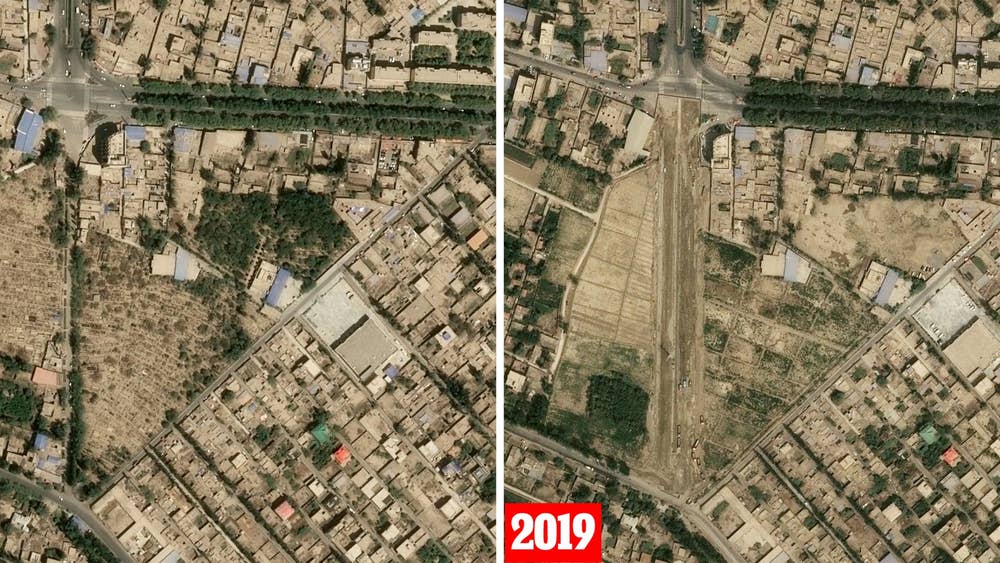
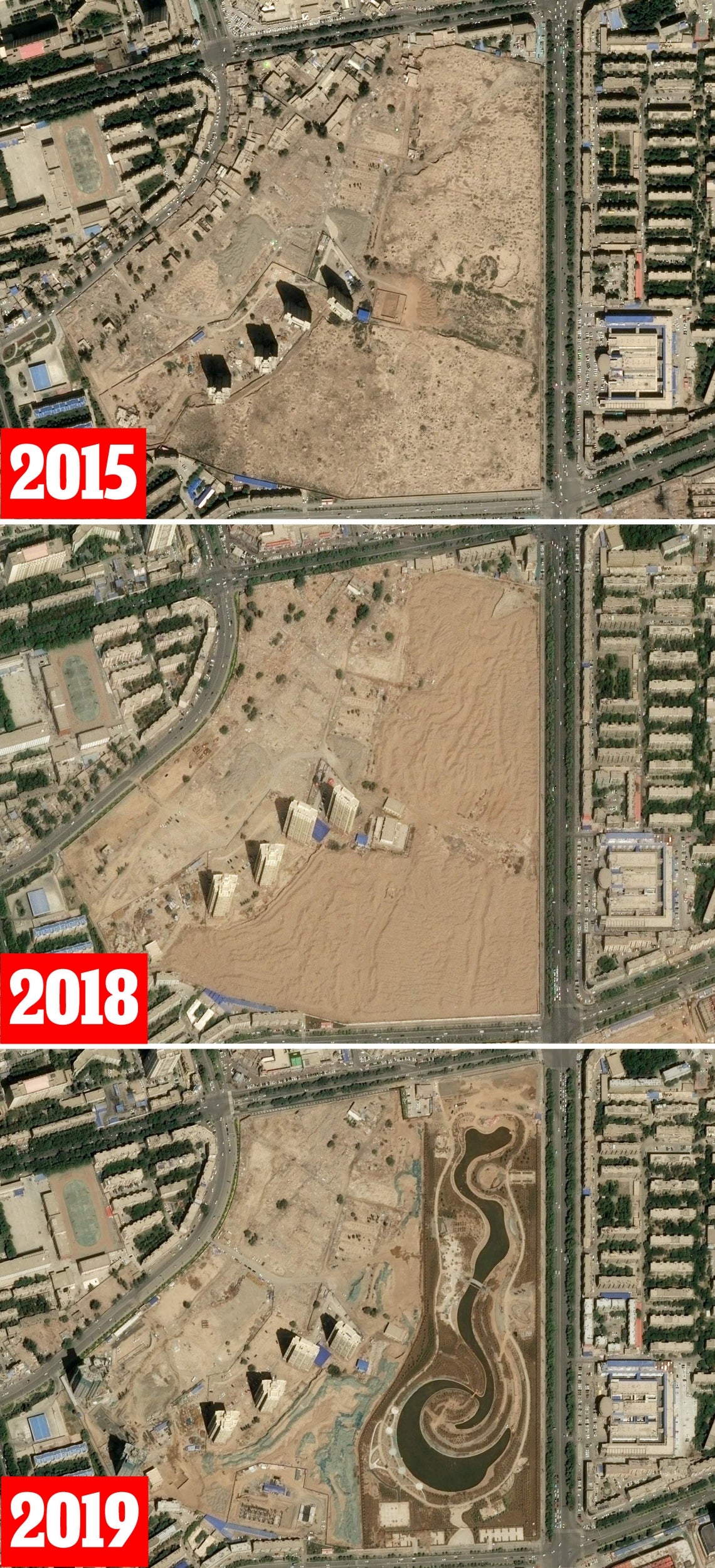
China destroying Uighur burial grounds
Show all 6


It lists personal details of more than 3,000 individuals from the far western region of Xinjiang, including the full names and identification numbers of more than 1,800 family members, neighbours and friends connected to the 311 sent to the Karakax camp.

Children are also said to feature on the list.

It provides details of downloaded videos and internet chat messages, high-tech surveillance with facial recognition cameras and the widespread use of spies, house visits and interrogations.

Read more
China’s brainwashing of Uighur Muslims revealed by leaked documents

“The level of detail is overwhelming,” Rian Thum, an expert at the University of Nottingham, told DW. “I think it is interesting to imagine that these things exist across Xinjiang. The data that is out there must be staggering.”

While most of the detainees were later approved for release - albeit under constant surveillance – dozens were forced to work in factories, according to the documents.

Up to two million Uighur Muslims and other ethnic minorities have been detained in camps as part of a supposed counterterrorism campaign since 2014.

China has insisted it is running what it calls “vocational training” centres to combat extremism in the region. However, former detainees have alleged inmates are subjected to torture, medical experiments and gang rape

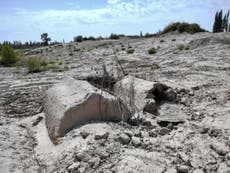
Last month it emerged that more than 100 Uighur graveyards had been demolished by the authorities in what human rights groups described as an escalation of the communist regime’s campaign to destroy the Muslim minority’s culture.


DW INVESTIGATES
Exclusive: China's systematic tracking, arrests of Uighurs exposed in new Xinjiang leak


An official list of detainees shows how Beijing is tracking every face, every family and every movement of the Muslim minority Uighurs. People have been arrested for growing beards and having "too many" children.

Chinese Uighurs – imprisoned for their faith and culture

In May 2017, a Uighur man was taken away to a "re-education camp" in China's northwestern Xinjiang region. As an observant Muslim, the man prayed at home after meals, and sometimes attended Friday prayers at his local mosque. The reasons for his forced internment: His wife had covered her face with a veil and the couple had "too many" children. There was never a trial.

According to a newly leaked document from Xinjiang, the man underwent a "great ideological transformation" in the camp and "realized his mistakes and showed good repentance." The family's four boys and two girls back at home all demonstrated "good behavior."

In June 2017, however, their mother was sent to prison for six years. She was charged with participating in an "illegal religious activity."

This family's story is similar to hundreds of cases, which are listed in unprecedented detail.

The leak provides information on why people are detained, while revealing that Chinese authorities are using high-tech surveillance and sheer manpower to keep track of identities, locations and habits of individual Uighur Muslims.

The list of detainees records the fate of 311 people who were sent off to "re-education" for the most innocuous things: growing a beard, fasting, or applying for a passport.

All of them were put in internment camps in 2017 and 2018. The document also lists hundreds of other people connected to them, including children.

DW, together with German broadcasters NDR and WDR and the newspaper Süddeutsche Zeitung, spent weeks translating the document and analyzing the data.


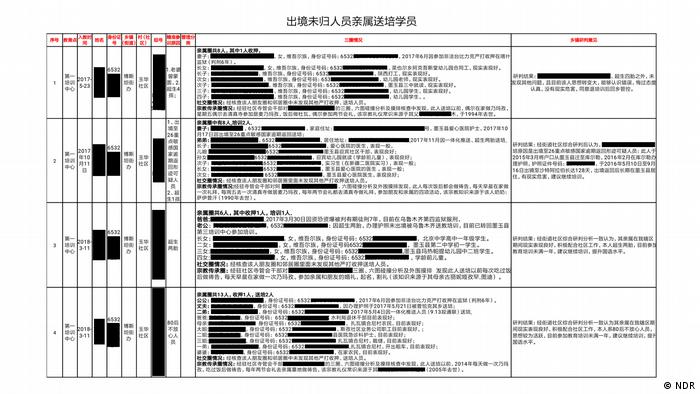
The first of the 137-page Chinese document leaked to DW and German media partners

China's Xinjiang crackdown goes under the microscope

After a suicide bombing struck Xinjiang's capital city in May 2014, Chinese authorities installed a system of surveillance and mass-detention centers. The Chinese Communist Party officially calls them voluntary "Vocational Education Training Centers." According to estimates, at least 1 million of the roughly 10 million Uighurs living in Xinjiang have disappeared into these centers.

In a confidential report compiled in December 2019 by the German Foreign Office, the centers are referred to as being "effectively re-education camps" with "draconian ideological training courses."

China claims that "the training centers" are an effective tool in a fight against Islamist terrorism.

However, contrary to the official line from Beijing, there is almost no indication in this latest document leak that Chinese authorities in Xinjiang are targeting potential terrorists.

Although three listed people are suspected to be members of an Islamist organization, above all, the document shows that any expression of Islamic religious piety potentially amounts to a crime.


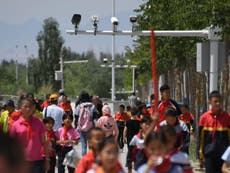
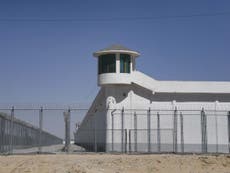
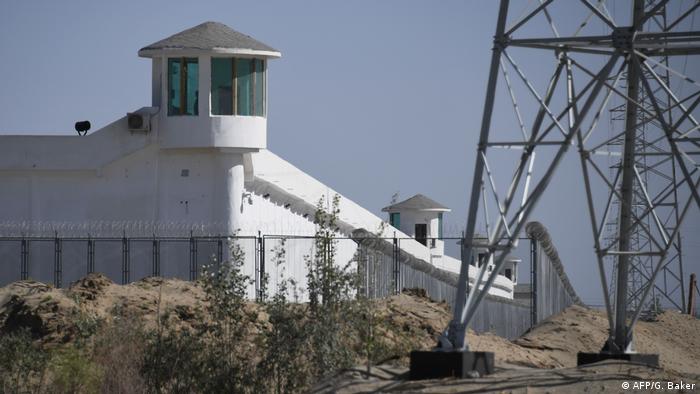
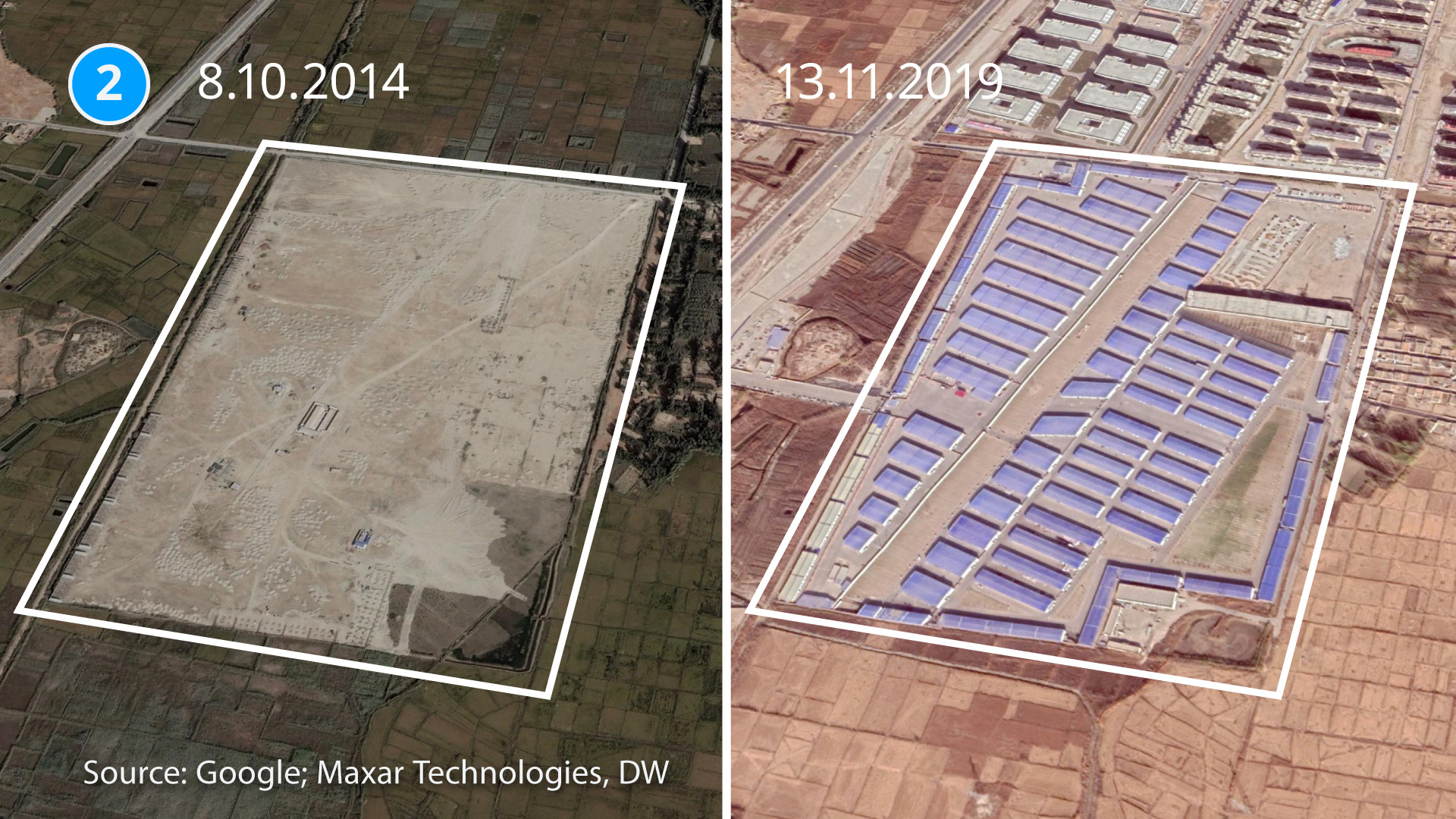
A 'Vocational Education Training Center' in Xinjiang, China with watchtowers, walls, fences and barbed wire

The analysis of the document by DW and its partners paints a picture of what many international human rights observers fear is a systematic campaign of ethnic profiling and arbitrary imprisonment outside the rule of law.

The list is 137 pages long and keeps track of minor details, such as videos someone downloaded some six years ago or WeChat messages that were exchanged with friends abroad.

Analysis shows how Uighurs are subjected to draconian methods of tracking and arrest. Facial recognition is carried out with high-tech surveillance cameras. Individual Uighur families are constantly monitored through a network of spies, repeated house visits and collective interrogations.

The document lists the full names, identification numbers and social behavior of more than 1,800 family members, neighbors and friends connected to the 311 main detainees. Hundreds more are listed in lesser detail. The Chinese state employs large numbers of staff to collect detailed data about each Uighur household.

Verifying the Karakax list

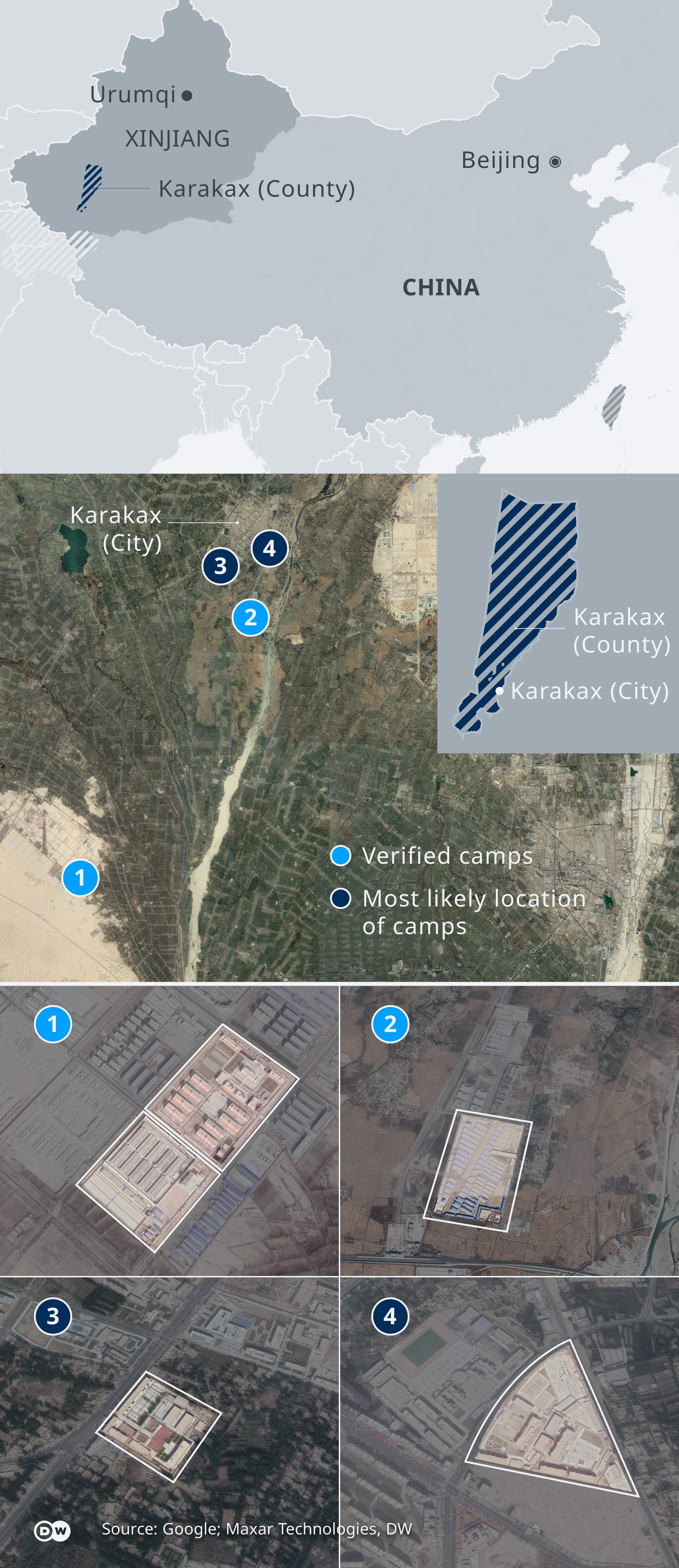
The cases listed are all centered on one region: Karakax County, in Xinjiang's southwestern Hotan prefecture bordering India and Tibet. There are at least five official "vocational training centers" in Karakax County for a population of less than 650,000 people.

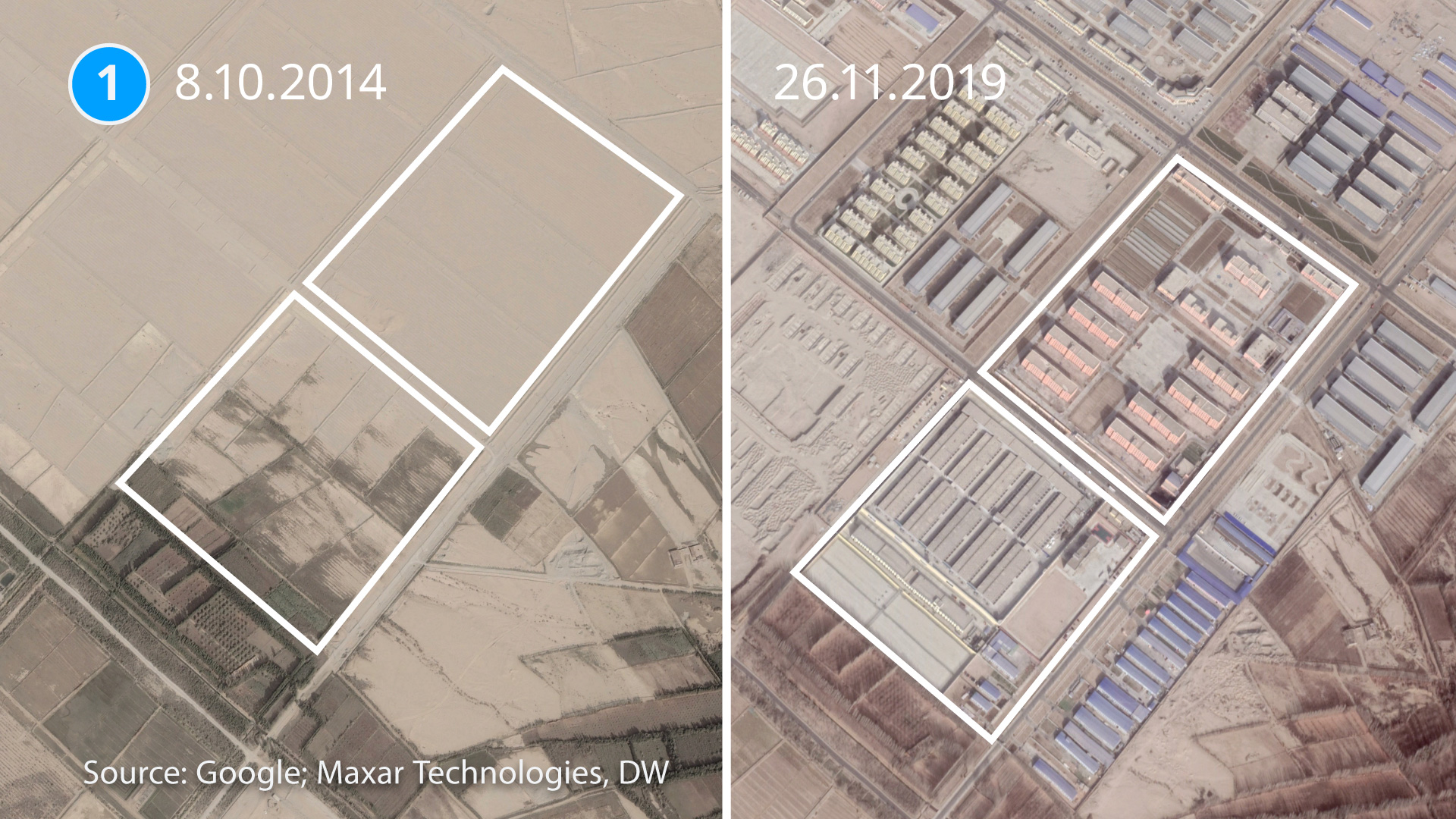
The list of detainees mentions four of them. DW was able to verify and locate two of these internment camps using satellite images and government documents. DW was also able to track the likely location of two other camps, using the same methodology.


DW was tipped off about the new document in November 2019 by whistleblower Abduweli Ayup, an exiled Uighur academic currently living in Norway.

Ayup received the PDF spreadsheet from a source whose identity and whereabouts have to remain anonymous for security reasons.

The new leak doesn't have an official stamp or signature. But its language is similar to other leaks from last year. In November 2019, the "Xinjiang Papers" were published by The New York Times, and the "China Cables" were published by the International Consortium of Investigative Journalists.

Read more: HRW says China poses 'dire' threat to human rights

Both reports revealed the overall scale of Beijing's stranglehold on the Uighur community in northwestern China. This new document specifically outlines the reasons for internment and provides a closer look at Uighurs' day-to-day reality of living under systematic surveillance.

DW was able to contact family members of detained Uighurs and consulted experts to verify the information in the document. A woman DW met in Istanbul, Rozinisa Memet Tohti, learned through the list that her youngest sister had also been sent to a camp.


A satellite image of the first of four camps mentioned in the list from Karakax

"I was really sad. I couldn't eat or sleep for many days and nights," she said.

Adrian Zenz, a leading Xinjiang expert from Germany, and the senior fellow at the conservative think tank "Victims of Communism Memorial Foundation" in Washington, has been decoding the new leak since it came to light.

By referencing ID numbers mentioned in the list with publicly available data and other leaked documents, Zenz was able to match hundreds of identities.

"When considering that it contains personal information for over 2,000 people with a considerable degree of complexity, the Karakax List shows a high degree of internal consistency and data validity," he concluded.

A glimpse of a massive surveillance operation

One case outlined in the new leak is of a man who grew "a long beard," and whose wife had "covered her face with a veil."

Based on this profile, Chinese authorities concluded, without much elaboration, that the couple had been "infected with religious and extremist ideas." The man was sent to a camp. And so was one of his teenage sons.


A satellite image of the second of four camps mentioned in the list from Karakax

The case details show that 15 relatives are closely monitored. However, they are described as "behaving nicely," and all are "actively participating" in daily community service. Therefore, the official recommendation is that the man be sent back to his community for "further surveillance."

Rian Thum, an expert on China's Uighur policy at the University of Nottingham, told DW that the monitoring of people's private lives "is overwhelming" in its level of detail. "I think it is interesting to imagine that these things exist across Xinjiang. The data that is out there must be staggering."

Read more: China launches compulsory face scans for new phone users

Forced labor in factories

The fate of Uighurs in the camps also depend on the actions of those on the outside. In some cases, the conduct of family members is used as a direct reference on whether an interned Uighur can be "released."

About two-thirds of the detainees listed were earmarked for release, only to be kept under continuous surveillance, with their freedom of movement strictly curtailed.

In dozens of cases, DW has found reference to a system of forced labor in factories.

One such case of prolonged internment at a factory involves a man detained in May 2018 for contacting his brother, who had fled to Turkey.

According to the document, the detainee therefore "poses a certain level of danger to society." The recommendation by the "community" is for him to "remain in a factory in the re-education camps."

'Illegal' babies

However, the top cause for arrest of Uighurs from Karakax County was violating China's official birth control policy by having too many babies.

According to family planning law, Uighurs and other minorities in urban areas are allowed two children, whereas Uighurs in rural areas are allowed three.

And the numbers clearly show that considerably more men than women were interned for violating this family planning law.

The disparity could indicate that the Chinese government considers Uighur men as the primary threat to its control over Xinjiang.

"I think in terms of Islamophobia, men in general, especially young men, are always the targets and seen as potential terrorists," Xinjiang expert Darren Byler of the University of Colorado told DW.

"My feeling is that the government wants to weaken or diminish the Uighur population as a way of reducing the threat perception."

DW's analysis also shows that the Chinese state specifically targets the younger generation. In the document, the term "worrisome person" or "untrustworthy person" is used for people born between 1980 and 2000.

More than 60% of internees are between 20 and 40 years old. "This has major implications for demographics and the birth rate," said analyst Thum from the University of Nottingham. "If you take a portion — or even the entirety — of a village's youth, you basically put a pause" on the community's growth.


The locations of Chinese camps in the northwest of the country

'Criminal' contacts abroad

Dozens of people listed in the document were arrested for being friends with "a suspicious figure living overseas," or for going on an Islamic pilgrimage, like the Hajj to Mecca.

In roughly 40 cases, people were also arrested after they applied for a passport.

Chinese authorities have officially deemed 26 countries as "sensitive." Almost all of them are Muslim-majority, such as Algeria, Pakistan and Saudi Arabia. Any contact with these places is grounds for detention if you are Uighur in Xinjiang.

This list of "sensitive countries" also includes China's central Asian neighbors like Kazakhstan, where many Uighurs have family and friends, along with cultural and ethnic ties.

"If the Chinese Communist Party is able to completely eliminate the influence of Islam from all elements of Uighur life, then Uighur culture will certainly be hollowed out," said Timothy Grose, a Xinjiang scholar at the Rose Hulman Institute of Technology in the US.

This is exemplified by the destruction of mosques and Muslim cemeteries in the region


Is Islam 'illegal' in China?

Experts believe that Beijing's endgame is to uproot Uighurs and other Muslim minorities in Xinjiang from their religion and cultural heritage. Muslims are prohibited from practicing any normal forms of Islam to force them to assimilate into "mainstream" Chinese society.

In one case, a young man was detained because he did not keep his restaurant open "at normal times" during the fasting period of Ramadan, the holiest time of the year in Islamic culture.

The document originally described this detainee as a person who "is easily influenced by extremist thoughts."

The young man has since been released and was put under surveillance at home. According to local authorities, he currently "does not take part in illegal religious activities" and actively participates in community work. His "attitude has changed considerably" and he is "able to see his mistakes and sincerely repents."

In a recent interview with DW and its partners during a visit to Berlin, China's Foreign Minister Wang Yi said that any reports about any kind of "concentration camps" for Uighurs are "completely fake news" designed to harm China's development. He added that "there is no persecution in Xinjiang."

DW's Naomi Conrad, Cherie Chan, Julia Bayer, Mathias Stamm and Wesley Rahn contributed to this report.


DW RECOMMENDS
China's police targeting 'lawful' behavior to detain Muslims: report
Authorities are collecting data on legal behavior in order to investigate Muslims, says Human Rights Watch. Activists believe that 1 million Uighurs and other Muslims have been forced into camps across China. (02.05.2019)

AUDIOS AND VIDEOS ON THE TOPIC

Chinese Uighurs – imprisoned for their faith and culture


Fleeing China – Uighurs in Turkish exile


Date 17.02.2020
Author William Yang, Sandra Petersmann
Permalink https://p.dw.com/p/3Xr4C

RELATED CONTENT

Chinese Uighurs – imprisoned for their faith and culture 17.02.2020

An official list of detainees shows in detail how Beijing is tracking every face, every family and every movement of Uighurs. The leaked list has been analyzed by Deutsche Welle and its German media partners NDR, WDR and Süddeutsche Zeitung.


China asylum claims to Germany more than double 16.02.2020

Asylum applications from China to Germany have more than doubled in just one year. Increasingly, people from the oppressed Uighur minority have been looking to Germany to escape Chinese oppression.


German report spells out China human rights abuses against Uighur Muslims 31.01.2020

A confidential document has indicated that the German government is aware of human rights violations in China's Xinjiang region, and warns that Uighurs deported back to China may disappear "indefinitely."


Date 17.02.2020
Author William Yang, Sandra Petersmann
Permalink https://p.dw.com/p/3Xr4C
USA
'Education deserts' are a 'staggering' problem, and for-profit colleges are taking advantage


Aarthi Swaminathan Reporter,Yahoo Finance•February 18, 2020

Here's how much can you afford to borrow for college


It’s one thing to not be able to afford a college education. It’s an entirely different issue altogether when you don’t even have a college around you.

A recent report from Jain Family Institute (JFI) reveals that access to college isn’t just about the cost of college. Physical access to public higher education institutions across America has also been highly unequal.

Specifically, as detailed by JFI’s interactive map, regions in America’s West have little-to-no access to an institution of higher education, compared to the East Coast.

“One of the major takeaways when you're looking at the map is the staggering amount of populated areas that are considered highly concentrated,” Laura Beamer, higher education finance project lead at JFI and one of the two authors of the study, told Yahoo Finance. “We figured out that roughly 2.4 million prospective students have access to most one public option nearby … Though financial access is extremely important, geographic access is also a very important piece of this dialogue and should be talked about more.”

The concentration of higher education institutions across the U.S., based on whether they were accessible within 30 mins, if one was driving. Red indicates that they were few or no schools within that range, green indicates the opposite. (Graphic: Jain Family Foundation)More

The Rocky Mountain region “is the worst off,” the report added, “followed closely by the Plains region.”

The JFI report — which drew on various points of data from the 2016-17 Integrated Postsecondary Education Data System, enrollment data from 2017, the 2016 5-year population, and median income estimates from the American Community Survey, driving durations to higher ed institutions in the area, zip codes, and more — created a “School Concentration Index” which measures the variation across the higher education market across different types of schools in the U.S. and U.S. territories.

Four states — Idaho, Montana, North Dakota, and Wyoming — were found to have higher education institution monopolies or close to it, meaning that there is only one institution or very few schools to choose from.
Graduates toss their caps in the air after receiving their diplomas at Silver Creek High School in Idaho. (Photo: Matt Jonas/Digital First Media/Boulder Daily Camera via Getty Images)

‘Prime hunting ground for for-profit institutions’

The authors found that a highly concentrated zip code (in red) means that there are few — or in some cases zero — higher education institutions in the area. A low concentration implies that there are a wide variety of options available for prospective students.

In the U.S., 38% of the population lives in highly concentrated zip codes, where they have access to very few or no higher education institutions, according to Beamer and her co-author Marshall Steinbaum, who is also an assistant professor of economics at the University of Utah. If a student from these areas wanted to attend a college or university, their commute would be at least 45 minutes.

The unequal access has wide-ranging implications for prospective students, most of them negative.

Parts of the U.S. where there’s “little to no access” to a higher ed institution “are prime hunting ground for for-profit institutions, just as they are known to draw disproportionately from populations historically excluded from traditional higher ed on the basis of race and class,” the authors argued.

The for-profit higher education sector saw tremendous growth since the financial crisis. In 2016, the New York Fed noted that enrollment at these schools had “skyrocketed” as the country emerged out of the Great Recession. For-profit colleges have also been known to saddle graduates with high levels of student debt, and in some cases, provide low-quality education with false promises of job placement.

The Obama administration’s crackdown on for-profit colleges led to several closures, and recent action by the Federal Trade Commission (FTC) pushed the University of Phoenix to put a stop to deceptive advertising of lucrative job opportunities.

Despite government action, for-profits persist due to these gaps in availability.

A security guard inside Everest College keeps away a member of the media and a former student Gary Montano after the embattled for-profit Santa Ana school was shut down along with 28 others on Monday. (Photo: Mindy Schauer/Digital First Media/Orange County Register via Getty Images)

‘A school could ... possibly practice price discrimination’

So why are schools so unequally distributed across the U.S. in the first place?

“It comes down to the structure that that states have put in place and just haven't been able to update over the last few decades,” Beamer said. “There is a rural versus urban dynamic as well … schools are going to open in places where there's a labor market and where there's a large population of students.”

The biggest problem arising is a neglect of the West, the researchers argue, where “a school could determine prices and access unilaterally and possibly practice price discrimination.”

More broadly, the issues raises a more philosophical question about what higher education represents.

“We have this idea that higher education as a societal institution is egalitarian … there's also a lot of reasons why it isn't,” said Steinbaum. “This is one tiny piece of evidence among a broad painting of the fact that the higher education system is extremely stratified.”
‘They're screwed on the front end’ as well as ‘the other end’

Another problem of “education deserts” trickles down below higher education.

“Folks in these certain geographic areas which more often tend to be rural, have fewer options,” Ryan Wells, associate professor of higher education at the University of Massachusetts Amherst, told Yahoo Finance.

Rural students not only had fewer options for college, he explained, but they also had fewer resources to prepare them for college in the first place when compared to their suburban or urban counterparts.

“It's kind of like — to put it crassly — they're screwed on the front end with what they have with their preparation and their resources and things to be ready for college,” Wells said, “and then fewer options on the other end as well.”
Students walk across campus between classes at the University of Wyoming, on April 30, 2018 in Laramie, Wyoming. (Photo: Melanie Stetson Freeman/The Christian Science Monitor via Getty Images)

Responsible colleges offer a way out

Fortunately, there are some good actors that restore faith in the system.

The University of Wyoming — despite having “monopoly” status — takes its job to offer accessible higher education seriously.

“We are quite a blue-collar state,” University of Wyoming spokesperson Chad Baldwin told Yahoo Finance. “Only about 24% of our adults have a bachelor's degree or higher [so] one of our goals is to try to lift the educational attainment level.”


Baldwin noted that the university has a broad open admissions standard: “Our acceptance rate is something in the order of 97%.” Furthermore, according to Baldwin, more than half of the university’s graduates who started as first-time students didn’t graduate with any student loan debt, thanks to low tuition and fees, and a state scholarship program.

“The tuition for a Wyoming resident undergraduate for a year is about $6,300,” he added.

Factoring in living costs and so on, that comes up to about $13,000 per year, based on data from the Department of Education’s College Scorecard.


Aarthi is a writer for Yahoo Finance. She can be reached at aarthi@yahoofinance.com. Follow her on Twitter @aarthiswami.

Read more:

'I have a chance now to have a life': Navy vet who won watershed student loan ruling tells his story

‘I’m working until I’m 75’: Factory worker describes family’s student debt nightmare

'I can't afford that': Woman in student loan limbo since 1997 decries a muddy system

Read the latest financial and business news from Yahoo Finance
Pope Francis sides with traditionalists on priest celibacy
AND SO THE CHILD RAPE AND COVER UP WILL CONTINUE TO DEFEND THIS FAILED DOGMA OF THE CHURCH

Catherine MARCIANO, Alexandria SAGE,AFP•February 14, 2020


Pope Francis balked at allowing married local men in the Amazon to become priests, cheering traditionalists and disappointing reformers (AFP Photo/Tiziana FABI )More

Vatican City (AFP) - In quashing the idea of married priests in the Amazon, Pope Francis has appeased traditionalists while disappointing progressives who had hoped for a historic turning point in the Catholic church.

In his "apostolic exhortation" on the Amazon basin published Wednesday, Francis slammed the door on a progressive proposal offered by the region's bishops during a synod on the region in October.

The synod had suggested that the way to solve a shortage of priests in the remote and inaccessible area was to allow married indigenous men to become priests.

Without even mentioning that proposal, Francis instead argued for more missionary priests in the Amazon and for women and lay people to take on larger roles, falling short of another synod idea to ordain women as deacons in the region.

The Argentine pontiff's thoughts, coming after months of speculation and hand-wringing within the Vatican, were welcomed by some, including a vocal opponent of Francis, German Cardinal Gerhard Mueller.

For five years Mueller was in charge of church dogma, holding the key Vatican post of Prefect of the Congregation for the Doctrine of the Faith until 2017 -- when he was not reappointed by Francis.

Mueller saluted the document's potential for "reducing internal Church factions."

Conservatives within the Church were outraged by the regional synod's proposal, even were it to be an exception limited to the Amazon, seeing it as potentially paving the way to the abolition of priest celibacy globally.

US Cardinal Raymond Burke, a staunch traditionalist, suggested last year that Francis would be heading into a "schism" were he to give his stamp of approval to the synod's proposals.

- Failing to reform? -

But to others, the text lacked the audacity that has marked the papacy of the first Jesuit pope.

Francis' document marked a "failure in the reforming impulse of the pontificate," according to longtime Vatican analyst Marco Politi.

The pope, "abruptly slowed down" by a strong and multifaceted opposition, also disappointed those local Amazon bishops whom he had called on to offer up new ideas to help guide the Church, Politi said.

"Francis finds himself more alone today, having caused disillusionment among a notable mass of his supporters," Politi said.

Key among them are Catholic feminist organisations, some of whom have been fighting for women's access to the priesthood.

In his text, Francis cited the contributions of women and argued that their roles be increased, but dismissed the idea of their ordination.

Women's Ordination Worldwide (WOW) said Francis had "dropped the ball" for women within the Church.

"Francis has opted to perpetuate the shameful elitist men's club that, as he so brazenly points out in the document, is held up by the second class status of women who do most of the work with none of the recognition," the group said in a statement.

Still, the issues of women's ordination, and married priests, are not dead, some say.

The German Church, which contains a strong progressive branch, has just launched a two-year debate on top controversial issues, including the end of priestly celibacy and a greater place for women.

Meanwhile, Brazilian Cardinal Claudio Hummes, a proponent of priestly marriage, sees the question as still open, telling the publication Estadao: "It will be taken up again."
HOUSING IS A RIGHT 
'Housing is not the end': Former homeless struggle to adapt

Alicia Victoria Lozano, NBC News•February 16, 2020


LOS ANGELES — Christina Ruiz travels between two competing realities every day.

At the University of Southern California, she studies public policy alongside some of the most privileged students in the world. At home in South Los Angeles, Ruiz, 25, struggles to adapt.

"I go to school with a very elite level of community and then I ride my bike a mile away ... and I'm back in the 'hood," she said. "This is the everyday reality of living in instability."

Ruiz has experienced homelessness for much of her life, cycling first through the foster care system in Los Angeles, then the criminal justice system. By the time she was 18, she had attended more than 16 schools.

She now lives in stable housing for the first time in at least a dozen years. But along with four walls and a ceiling comes anxiety.

"Housing is not the end," she said. "There needs to be continued support."

More than 150,000 people experience homelessness across California, according to a 2019 count. The crisis is especially acute in Los Angeles, where an affordable housing shortage contributed to 59,000 residents' living on the street last year. As local and state officials tackle the issue, service providers caution that solutions must be sustainable for years to come.

But the pathway out of homelessness is fraught with vulnerability and insecurity. People who once lived on the street must relearn basic skills, such as cooking, budgeting and even sleeping in a bed. Finding a home is not the end of their struggle.

To ease this transition, a new model emerged over the last two decades that pairs homeless people with additional services to sustain long-term housing. The model, called permanent supportive housing, targets people with chronic illnesses or disabilities who have experienced long-term and repeated homelessness.

Permanent supportive housing grew from the housing-first approach popularized in the early 1990s by the New York City service provider Pathways to Housing. The model, still used today, prioritizes finding stable shelter before connecting people with other resources.

But experts warn that in the absence of ongoing support, people could fall back into homelessness.

"Housing without support sets up people to fail," said Tod Lipka, president and CEO of Step Up on Second, a housing and service provider in Santa Monica, California. "It has to be a transformative experience."

The challenges formerly homeless people face manifest in various ways, he said. Some continue to pile their belongings in a corner, a habit born out of the need to keep their possessions safe. Others, accustomed to sleeping in shelters, wake up at 6 a.m. to vacate their apartments, forgetting that those rules don't apply to private accommodations.

Lipka recalls one client at Step Up on Second who screamed loudly every morning around 3 o'clock. It was a trick the man learned while living on the streets to protect himself by keeping others away.

"When you're homeless, you're literally spending all your energy on surviving. It's a constant struggle," he said. "Once people are housed, they are no longer expending all that energy on surviving. They can start thinking about what they want their life to be now."

Ruiz, a single mother of a 5-year-old son, knows exactly how she wants her life to unfold. She will finish her bachelor's degree at USC's Sol Price School of Public Policy in May, and she is already working toward an accelerated master's degree in the field. She advocates in behalf of incarcerated and homeless youth through her nonprofit, Christina's Pathways to Success, and with the homelessness authority.

"I know I am the exception," she said. "If it's hard for me, what about the people who don't have these resources?"

For Amanda Walker, 27, finding a permanent home was just the beginning of her journey. Like Ruiz, Walker spent her youth in foster care. She often ran away from placements rather than live in abusive or toxic environments. But the streets were unwelcoming, and she developed a substance abuse dependency.

One day about seven years ago, Walker met an outreach team member from Step Up on Second and was intrigued by the services it offered. Yet her thinking was clouded by distrust.

"I was on drugs and all out of whack," she said. "It took me a minute to finally see that Step Up was exactly what I was looking for. It was complicated to trust people who were trying to help me."

Building trust is just the first part of securing stable housing. Many people who have experienced homelessness protect themselves by refusing to believe their situations can change, Lipka said.

"Most of these individuals never think they can get housing again," he said. "You harden yourself against the hope and disappointment."

Once people accept help, they must tackle bureaucracy. Case managers work with people to secure documentation, such as IDs or Social Security cards, needed to apply for financial assistance. After the paperwork is sorted, people receive housing vouchers.

Walker spent a year living in a hotel room before finding a permanent apartment through Step Up on Second. She said the time indoors was crucial.

"I didn't really have any home training," she said.

That included cooking and even shopping for food, Walker said. At one point, she asked her case manager about how to handle fish. Walker wasn't sure whether it should be refrigerated or how long it would last. She learned the hard way.

"My whole apartment stunk," she said, laughing at the memory.

For case managers, no task is too small. Edward James oversees a team of what he calls "house stabilizers" at L.A. Family Housing, a residential and service provider. His staff members accompany tenants to doctor's appointments and teach them how to get money orders for rent. To combat the inevitable loneliness that comes with new surroundings, James and his staff encourage formerly homeless tenants to meet one another and form a community. They also perform wellness checks and even bring in a chef to provide cooking lessons.

"It's little things like that, the little touches, that helps them transition," he said.

In the decade James has worked at L.A. Family Housing, none of his tenants has returned to homelessness, he said.

Across Los Angeles County, the retention rate after one year of permanent supportive housing is 90 percent, according to United Way of Greater Los Angeles. Data is not available beyond one year.

Step Up on Second's success rate is closer to 96 percent, Lipka said. He considers Walker one of his many success stories. She is five years sober and thinking about getting a puppy. Walker also sits on the board of directors for Step Up on Second, a position that allows her to give back to the organization that helped provide a fresh start.

"The more you trust people, the more they can help you," she said.


Image: Christina Ruiz
Image: Christina Ruiz and her son, Robbie