Thursday, March 12, 2020

Industriall logo
inv.gif
#387
inv.gif
headlines-logo.gif
COVID-19: Urgent Economic Stimulus and Workplace Measures Requiredinv.gifCOVID-19: Urgent Economic Stimulus and Workplace Measures Required
inv.gif
Council of Global Unions Joint Statement
inv.gif
The rapid and wide spread of the SARS-CoV-2 virus and the COVID-19 disease that it causes require an urgent global response to protect health and stimulate the economy. Governments and employers must act to protect workers and tackle transmission in workplaces.
inv.gif
news-rm-arrow.gif Read morenews-fb.gif news-twitter.gif
inv.gif
Workers in Cambodia and Myanmar hit hard by Coronavirus fall-outinv.gifWorkers in Cambodia and Myanmar hit hard by Coronavirus fall-out
inv.gif
The global outbreak of the Coronavirus is slowing down the economy and eliminating thousands of jobs in the global supply chain in South East Asia. Cambodia and Myanmar are among the most affected countries in the region.
inv.gif
news-rm-arrow.gif Read morenews-fb.gif news-twitter.gif
Historic march in Chile on International Women's Dayinv.gifHistoric march in Chile on International Women's Day
inv.gif
Unions, feminist and migrant groups in Chile marked this year’s International Women’s Day with a mass march in Santiago, raising awareness of inequality, gender based violence and pushing for a gender equality agenda.
inv.gif
news-rm-arrow.gif Read morenews-fb.gif news-twitter.gif
South Africa: 378 trapped mineworkers safely rescuedinv.gifSouth Africa: 378 trapped mineworkers safely rescued
inv.gif
378 mineworkers were rescued on 10 March after being trapped underground for nine hours. The workers were trapped when a UV 72 machine used to transport workers and materials underground caught fire at Sibanye Stillwater Simunye Shaft in Rustenburg.
inv.gif
news-rm-arrow.gif Read morenews-fb.gif news-twitter.gif
Fighting gender inequality and violence in Madagascarinv.gifFighting gender inequality and violence in Madagascar
inv.gif
In Antananarivo the International Women’s Day (IWD) demonstration of Malagasy unions was the culmination of a week of training and capacity building on gender equality and gender-based violence (GBV).
inv.gif
news-rm-arrow.gif Read morenews-fb.gif news-twitter.gif
Connect to IndustriALL on Facebook, Twitter, Instagram and Flickr:
news-footer-facebook.gif news-footer-twitter.gif news-footer-instagram.gif news-footer-youtube.gif

A TOILET PAPER HOARDER


https://www.democraticunderground.org/11983804

The universe may have been filled with supermassive black holes at the dawn of time

By Rafi Letzter - Staff Writer 14 hours ago

It existed just 900 million years after the Big Bang.


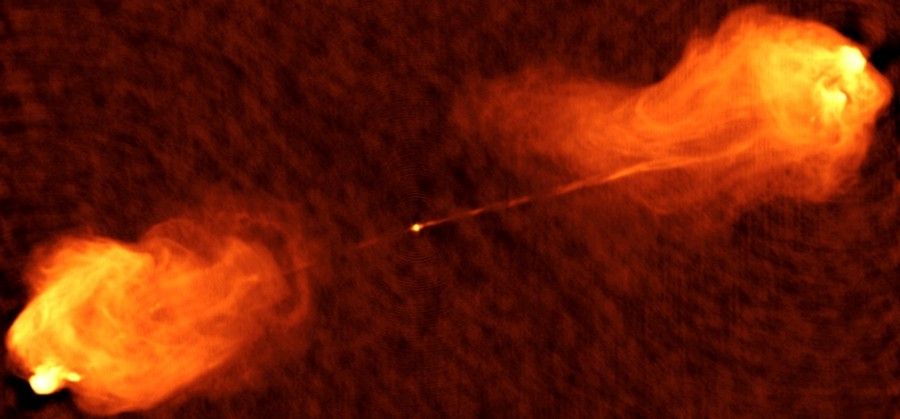
This radio image shows two jets shooting out of the center of Cygnus A, a galaxy not too far from our own. A new paper reports discovering a similar object in a much more distant, ancient galaxy. That galaxy has a bright, relatavistic jet emanating from its central supermassive black hole pointed at Earth, making it a blazar.
(Image: © NRAO)

Nine hundred million years after the Big Bang, in the epoch of our universe's earliest galaxies, there was already a black hole 1 billion times the size of our sun. That black hole sucked in huge quantities of ionized gas, forming a galactic engine — known as a blazar — that blasted a superhot jet of bright matter into space. On Earth, we can still detect the light from that explosion more than 12 billion years later.

Astronomers had previously discovered evidence of primeval supermassive black holes in slightly younger "radio-loud active galactic nuclei," or RL AGNs. RL AGNs are galaxies with cores that look extra-bright to radio telescopes, which is considered evidence that they contain supermassive black holes. Blazars are a unique type of RL AGN that spit out two narrow jets of "relativistic" (near-light-speed) matter in opposite directions. Those jets emit narrow beams of light at many different wavelengths and have to be pointed right at Earth for us to detect them across such vast distances. This new blazar discovery moves the date of the oldest confirmed supermassive black hole to within the first billion years of the universe's history and suggests there were other, similar black holes in that era that we haven't detected.

"Thanks to our discovery, we are able to say that in the first billion years of life of the universe, there existed a large number of very massive black holes emitting powerful relativistic jets," Silvia Belladitta, a doctoral student at the Italian National Institute for Astrophysics (INAF) in Milan and co-author of a new paper on the blazar, said in a statement.

More:
https://www.livescience.com/early-universe-black-hole-blazar-galaxy-discovey.html
Student discovers 5,000-year-old sword hidden in Venetian monastery

By Tom Metcalfe - Live Science Contributor a day ago

It's one of the oldest swords ever found.

The sword was mistakenly thought to be medieval. It is now thought to come from eastern Anatolia and to be about 5000 years-old – one of the oldest swords ever found.
(Image: © Ca' Foscari University of Venice/Andrea Avezzù)

A keen-eyed archaeology student made the find of a lifetime when she spotted one of the oldest swords on record, mistakenly grouped with medieval artifacts in a secluded Italian museum.

The ancient sword was thought to be medieval in origin and maybe a few hundred years old at most — but studies have shown that it dates back about 5,000 years, to what is now eastern Turkey, where swords are thought to have been invented, in the early Bronze Age.

The weapon was spotted in November 2017 by Vittoria Dall'Armellina, who was then a doctoral student in archaeology at Ca' Foscari University of Venice. She had made a day trip to the monastery on San Lazzaro degli Armeni, a tiny island on the edge of the Venetian lagoon.

https://www.livescience.com/ancient-anatolian-sword-in-venetian-monastery.html?utm_source=notification

Ecuador: State must urgently adopt public policy to protect human rights defenders facing grave risk

Ecuador: State must urgently adopt public policy to protect human rights defenders facing grave risks
12 March 2020, 14:00 UTC

Today, at the end of Amnesty International’s visit to Ecuador, the organization expressed concern about the lack of concrete measures taken by the state to guarantee the effective protection of human rights defenders, as well as highlighting the authorities’ persistent inability to carry out appropriate and effective investigations into attacks and threats against members of the Mujeres Amazónicas (Amazonian Women) collective. The organization also expressed concern at impunity for human rights violations committed during the October 2019 protests and the state’s failure to assess the impact of austerity measures on human rights.

“For any policy for the protection of human rights defenders to be effective, the authorities must first publicly recognize the legitimacy of human rights defenders' work and foster an environment that enables them to carry out this work in safe conditions,” said María José Veramendi, Amnesty International researcher for South America.

One year after the publication of the report “They will not stop us”, which exposed the flaws in the response of the Attorney General's Office to a series of attacks and death threats against Patricia Gualinga, Nema Grefa, Salomé Aranda and Margoth Escobar, all members of Mujeres Amazónicas, Amnesty International's research shows that investigations into these attacks have not made any significant progress.

For any policy for the protection of human rights defenders to be effective, the authorities must first publicly recognize the legitimacy of human rights defenders' work and foster an environment that enables them to carry out this work in safe conditions

María José Veramendi, Amnesty International researcher for South America

More:
https://www.amnesty.org/en/latest/news/2020/03/ecuador-personas-defensoras-urgente-adopcion-politica-publica-para-proteccion/