Thursday, May 20, 2021

UK
The Tories are renationalising chunks of the railways. Sound familiar?

Jeremy Corbyn was mocked for claiming he "won the argument" in 2019. 
Was he that far wrong?

 by Henry Goodwin
May 20, 2021
in Politics


The government has announced a major shake-up of the UK’s rail network, bringing vast swathes of the country’s railways into state control.

A new state-owned body, Great British Railways (GBR), will set timetables and prices, sell tickets in England and manage infrastructure – with Grant Shapps, the transport secretary, vowing that it will offer more punctual services and cheaper tickets.

However the industry will remain substantially privatised, with franchises replaced by contracts to incentivise private firms on punctuality and efficiency as opposed to raising revenue.


The transport secretary, Grant Shapps, said passengers had been failed by “years of fragmentation, confusion and overcomplicating” – and that GBR would “become a single familiar brand with a bold new vision for passengers – of punctual services, simpler tickets and a modern and green railway that meets the needs of the nation”.

#CorbynWasRight trends after Tories unveil new railway plans

Jon Trickett calls for wealth tax after superyacht sales and food bank use simultaneously rocket

Train in vain


Despite a few caveats, the policy is not radically different in substance to one first proposed by Jeremy Corbyn who, in one of his first acts as leader in 2015, outlined plans to bring rail franchises back into public hands.

A programme of nationalisation was at the heart of Labour’s manifesto in 2019, with the party proposing to bring the Royal Mail, energy supply networks, water and sewerage companies as well as the rail network into public ownership.

According to Confederation of British Industry estimates at the time, that plan would have cost at least £196 billion – a price-tag used by Boris Johnson to criticise Corbyn’s proposals, which he called a “£196bn programme taking money away from companies”.

Yet, announcing the sweeping reforms on Thursday, the prime minister said he was “a great believer in rail”, adding: “For too long passengers have not had the level of service they deserve.”

Taxes, taxes, taxes


It’s not the first time that the Conservative government has cribbed ideas from previous Labour manifestos.

In March, as Rishi Sunak unveiled his latest Budget, eagle-eyed observers pointed out that a slew of the chancellor’s initiatives seemed to be drawn from Labour’s playbook in 2017 and 2019, prompting James Meadway – a one-time adviser to John McDonnell – to tweet that Corbyn’s shadow chancellor “really did forge a new economic consensus.

The big one is corporation tax, which Sunak revealed he would raise from 19 per cent to 25 per cent by the end of the 2024 parliament. Labour’s 2019 manifesto vowed to increase the headline rate to 26 per cent.

Back in November 2019, Boris Johnson – vowing to slash corporation tax – derided Corbyn for wanting to hike the tax to “the highest levels in Europe”. He was wrong – corporation tax was as 34.4 per cent in France and 31.5 per cent in Portugal at the time.

‘Levelling up’

Another fĂȘted announcement was the creation of ‘Treasury North’, a new economic campus in the north of England. It will be located, conveniently, in Darlington – a ‘red wall’ seat won from Corbyn’s Labour in 2019 which Johnson and Sunk are eager to hold on to.

Sunak announced Treasury North in his first Budget, last year, when McDonnell – still in situ – pointed out that he had proposed something very similar a year earlier.

“We’re going to break up No 11. Part of No 11 is going to the north,” McDonnell told the Manchester Evening News in July 2019. “If they’re going to plagiarise they could have the decency of properly attributing the idea to Labour,” McDonnell quipped last March.

The creation of a national infrastructure bank, based in Leeds, also made headlines. Both McDonnell and Ed Miliband’s Labour proposed creating a national investment bank which would break London’s hegemony over investment.

“We will end the Treasury bias against investing in the regions and nations,” McDonnell said in his 2018 conference speech. “And we’ll make sure it assesses spending decisions against the need to tackle climate change, protect our environment, drive up productivity and meet the investment challenges of the fourth industrial revolution.”


Bus it up


Corbyn’s footprint is visible elsewhere, too. Having been derided by political commentators for repeatedly raising the issue of local buses at PMQs during his tenure at the despatch box, Johnson – after seeing off Labour in the 2019 election – announced a “transformative” slate of investment in local transport.


“Improving connectivity by overhauling bus services and making cycling easier than ever is such an important step forward, to make sure every community has the foundations it needs to thrive,” the prime minister said.

The former Labour leader was widely – and somewhat understandably – mocked for claiming to have “won the argument” after his shellacking in 2019. But the current iteration of the Conservative party are proving that statement to be more true than most thought at the time.

Politically, that’s a huge problem for Corbyn’s successor, Keir Starmer. Gripes about plagiarism aside, the emergence of what Meadway has dubbed a “Red-Green Tory prospectus” – high tax, high spend, tough on crime and immigration – seems to be a winning formula.

That was especially clear in March, in Starmer’s lukewarm response to the Budget. The Labour leader seemed keen to stress that, soon enough, Sunak will return to “business as usual”, cutting spending and ushering in a new age of austerity. But what if he doesn’t? The Chancellor is playing football firmly in Labour’s half – and, for now at least, they don’t seem to know how to win the ball back.

Related: Large parts of British rail to be nationalised as part of sweeping Tory reforms
Britain throws weight behind Israel’s bombardment of Gaza

James Cleverly condemned Hamas and said Israel has a "legitimate right to defend itself".

SO DO THE PALESTINIANS


The British government has thrown its weight behind Israel’s bombardment of Gaza, stating the country has a “legitimate right to defend itself”.

Speaking in the House of Commons on Wednesday, James Cleverly – the Middle East minister – briefly urged Israel to make sure “all actions are appropriate”, choosing instead to focus his condemnation on “acts of terrorism by Hamas”.

“The UK unequivocally condemns the firing of rockets at Jerusalem and other locations within Israel,” Cleverly said.

“We strongly condemn these acts of terrorism by Hamas and other terrorist groups who must permanently end their incitement and rocket fire against Israel. There is no justification for the targeting of civilians.

“Israel has a legitimate right to self-defence and to defend its citizens from attack. In doing so, it is vital that all actions are proportionate, in line with international humanitarian law and make every effort to avoid civilian casualties.”

Israel has unleashed a fresh wave of air strikes across the Gaza Strip, killing at least one Palestinian and wounding several others.

The latest strikes came after Prime Minister Benjamin Netanyahu pushed back against US pressure to wind down the offensive against Gaza’s militant Hamas rulers, who have fired thousands of rockets at Israel.

Explosions shook Gaza City and orange flares lit up the night sky, with air strikes also reported in the central town of Deir al-Balah and the southern town of Khan Younis.

At least 227 Palestinians have been killed, including 64 children and 38 women, with 1,620 people wounded, according to the Gaza Health Ministry, which does not break the numbers down into fighters and civilians.

Twelve people in Israel, including a five-year-old boy, a 16-year-old girl and a soldier, have been killed.

Liberal Democrat foreign affairs spokesperson Layla Moran, who is of British-Palestinian heritage, said her “heart was broken before, it’s shattered now”.

“We need a ceasefire and the UK shouldn’t have left it to France to be the main sponsor of a UN resolution calling for it,” she said. “This government is shirking its historic responsibility and it’s time to step up.”

Labour MP Richard Burgon added: “How many Palestinian children have to be killed, how many more Palestinian homes have to be reduced to rubble, how many more Palestinian schools and hospitals have to be bombed before the British government takes the action necessary to finally force the Israeli government to stop its war on the Palestinian people?

“Surely now is the time for all UK weapons sales to Israel to be stopped. Surely now is the time for sanctions on the Israeli government for its repeated violations of international law. Surely now is the time – this House voted for it back in 2014 – to recognise the state of Palestine because Palestine has the right to exist.”


But Cleverly said Burgon had misunderstood the “sequencing” of the latest conflict, suggesting “Israel’s actions were in response to indiscriminate rocket attacks from an internationally recognised terrorist organisation” – despite violence breaking out after Israeli security forces attacked worshippers at the al-Aqsa mosque in Jerusalem.

Jeremy Corbyn, the former Labour leader, questioned the nature of “Britain’s military relationship with Israel” in a contribution in parliament.

“Can he tell the House if any weapons sold by Britain or munitions sold by Britain to Israel have been used to bomb places in Gaza or if any drone equipment supplied or bought by Britain has been used as a surveillance method on either the West Bank or Gaza that has been followed up by destruction of civilian life and the death of many people?” he said.


Cleverly replied: “The UK has a robust arms export licensing regime and all export licences are assessed in accordance with it.”
After black fungus, white fungus cases reported in India - Know how it is more dangerous for women and children

The disease occurs in the newborn in the form of diaper candidiasis in which cream-coloured white spots appear.


, File Photo


WRITTEN BY
DNA Web Team
DNA webdesk
Updated: May 20, 2021


Amid the second surge of COVID-19 in India and the increasing number of patients of black fungus, now four cases of white fungus infection, which is considered more dangerous than Black Fungus, have been reported from Patna, Bihar.

According to the doctors, COVID-19 positive patients who are on oxygen support are more likely to get gripped by the white fungus which can infect their lungs. The white fungus is considered dangerous as it infects children and women and according to doctors it is the main reason for Leucorrhoea.

The disease occurs in the newborn in the form of diaper candidiasis in which cream-coloured white spots appear and in young children it causes oral thrust. Cancer patients also need to be careful of the fungus.

ALSO READ
Now, white fungus, which is more dangerous than black fungus, hit India - Who are more at risk?

Doctors have said that white fungus also infects the lungs and an infection similar to COVID-19 is detected when HRCT is performed on the infected patient.

According to Chief of Microbiology at PMCH, Dr S N Singh, all four persons infected by white fungus showed coronavirus-type symptoms but they were not COVID-19 positive. Singh added that but their lungs were found infected and after tests when they were given anti-fungal medicines then they recovered.

ALSO READ
After black fungus, white fungus infection cases reported in India - Know why it is more dangerous

Dr Singh noted that just like black fungus, the white fungus is also more dangerous for those who have weak immunity. Diabetes patients and those who are taking steroids for a long period of time are more at risk of getting infected with white fungus.

Dr Singh said that it is easy to prevent white fungus infection by sanitising the oxygen or ventilator properly.


Horizon Technologies gets funding for maritime surveillance satellites

by  — 

IOD-3, Horizon Technologies's first satellite, will be deployed from the International Space Station after an August resupply mission. Credit: Horizon Technologies

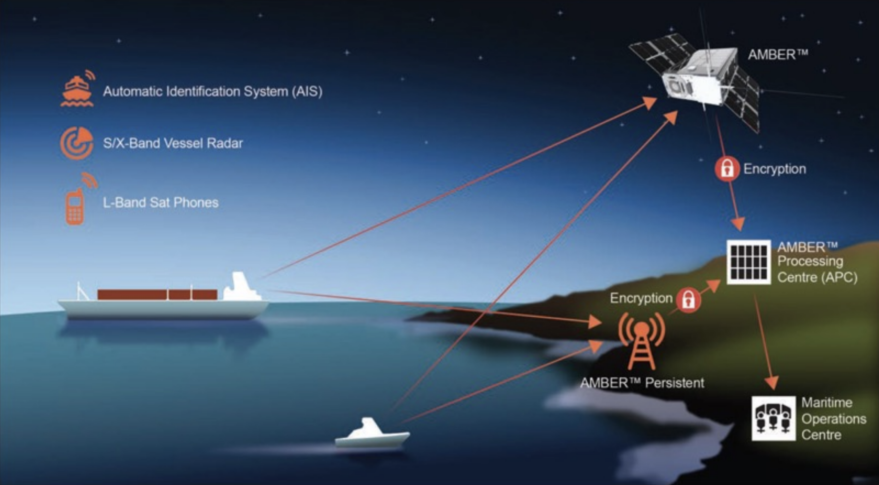
TAMPA, Fla. — A British company that equips spy planes and drones to track satellite telephones has raised capital to launch a handful of tiny surveillance spacecraft to listen for signals from ships operating clandestinely. 

Horizon Space Technologies, a recently established subsidiary of Berkshire, England-based Horizon Technologies, is prime contractor for the U.K. government’s cubesat signals intelligence program called IOD-3 Amber. 

Amber IOD-3, its first satellite, is part of the In-Orbit Demonstration (IOD) program run by government-backed nonprofit Satellite Applications Catapult.

With funding from the U.K. government’s innovation agency, the Amber IOD-3 cubesat is being built by AAC Clyde Space to provide data for the country’s National Maritime Information Centre (NMIC). L3Harris Technologies is assisting with the payload’s development.

The satellite is slated to launch aboard a SpaceX Cargo Dragon mission in August for deployment from the International Space Station shortly after arrival. Houston-based NanoRacks arranged for the cubesat’s deployment from the ISS.

More satellites incoming

Horizon Technologies CEO John Beckner told SpaceNews the company has secured funds to launch two more Amber satellites next year, amid plans for an initial constellation of six satellites. 

Beckner declined to discuss the size of Horizon’s Series A funding round, which was led by private equity firm Maven Capital Partners. An industry source said it is in the “single-digit millions of dollars.”

Virgin Group founder Richard Branson’s financial services firm Virgin Money participated in the round through its Clydesdale Bank lender. Virgin Orbit, Branson’s air-launch rocket startup, has been investing in other space ventures in return for launch agreements. 

The British government aims to use Horizon’s data to counter activities ranging from illegal fishing to human trafficking across its coastal waters.

“The Amber program to date has been an excellent example of a successful public/private partnership,” Beckner said.

“We are thrilled to have received so much support from the U.K. government, and this includes the [innovation accelerator] Catapult, Department for International Trade (DIT) and Defence & Security Organisation (DSO). Their help has simply been invaluable.”

Tracking the untracked

All passenger ships and most ocean-going vessels above a certain tonnage are required by law to be fitted with Automatic Identification Systems (AIS) transponders, enabling them to be tracked by coastal stations and satellites equipped with AIS receivers. However, ships can deactivate AIS transponders to avoid detection.

Horizon’s satellites will supplement AIS data by picking up faint electronic signals from navigation radars and satellite phones, enabling the tracking of vessels even if they turn off AIS.

The company will buy AIS data from third parties that will feed into its ground station. Becker said its satellites will have AIS receivers to double-check measurements, but it does not plan to sell this service.

The market for radio-frequency mapping (RFM) networks has been expanding in recent years, with venture capital investors helping to expand the number of players and satellites in orbit.

U.S.-based HawkEye 360 currently provides RFM services with six in-orbit satellites, saying in April that it raised an extra $55 million to complete its constellation with nine additional satellites.

Horizon’s technology builds off an L-band satellite-phone detection system called FlyingFish, which the company already sells to governments that operate it from crewed and uncrewed aircraft.

The company recently split into two business segments, hardware-based Horizon Aerospace Technologies and data-based Horizon Space Technologies, after FlyingFish helped it report more than 4.5 million British pounds ($6.4 million) in sales for 2020.

As well as launching satellites, Beckner said Horizon’s Series A funding enables it to hire new personnel and cover research and development for expanded features, supporting software payload upgrades for Amber IOD-3 and beyond.

He said the signals it picks up are demodulated to provide government end-users with intelligence data, ranging from radar “fingerprints” to satellite phones’ GPS locations.

Six satellites will enable worldwide coverage with latency under one hour.

Rapidly expanding market

Three other companies, all founded in the last six years, have been raising capital to deploy commercial RFM networks. These are U.S.-based Aurora Insight, Luxembourg’s Kleos Space and Unseenlabs of France.

“Demand for radio frequency sensing and monitoring by U.S. and international government organizations has continued to grow rapidly in recent years, with no signs of slowing down,” said Nicolo Dona dalle Rose, engagement director in boutique management consulting firm Avascent’s space practice.

“Defense and intelligence agencies will likely remain the core consumers of this data for the near future. However, appetite is rapidly expanding among commercial customers as well. Early movers in this space have an opportunity to shape the way in which data is consumed and the service is delivered.”

Unseenlabs said April 27 it raised a 20 million euro ($25 million) Series B round for its radio-frequency geolocation constellation.

The venture launched its first satellite in August 2019, and aims to deploy between 20 and 25 of them by 2025 to expand its services.

BRO-1, its first satellite, was still operational in November when Unseenlabs announced the launch of two more spacecraft: BRO-2 and BRO-3.

It plans to enable full coverage of the globe and a half-hour revisit time by growing its constellation.

Kleos Space raised $13.8 million following the Nov. 7 launch of its first cluster of four radio-frequency mapping satellites, providing daily coverage of the Earth.

The venture, which says on its website that revisit times are dependent on the specific area of interest, is funded to launch four more satellites toward the end of 2021. It is planning ten four-satellite clusters in total.

Beckner was coy about future plans but confirmed Horizon’s Amber constellation would be growing in the future.

He said work would begin soon on securing additional funding as Horizon accelerates its deployment of cubesats.

The company has also started looking for partners to combine its space-based data with tower-based systems, providing 24/7 coverage of critical maritime choke points, as well as UAVs for full-motion video to support legal proceedings.


NASA seeking more than $10 billion in infrastructure bill

by  — 

WASHINGTON — NASA Administrator Bill Nelson told House appropriators May 19 that the agency is requesting more than $11 billion in an upcoming infrastructure bill that would go for the agency’s Human Landing System program and upgrading center facilities.

Nelson, testifying in a virtual hearing by the House Appropriations Committee’s commerce, justice and science subcommittee about NASA’s fiscal year 2022 budget proposal, said the agency has submitted to Congress requests for funding to be included in legislation to enact what the White House calls the American Jobs Plan, which has a total value of $2.3 trillion over 10 years.

He told members that NASA was seeking $5.4 billion for the Human Landing System to fund competition for future lander missions beyond the “Option A” award the agency made to SpaceX April 16. That award covers development of a lander based on SpaceX’s Starship vehicle and a single crewed landing. NASA plans to conduct a separate solicitation for future missions, which will be open to both SpaceX and other companies.

“You, the appropriators, as a partner, you’ve got the opportunity to put over about $5 billion in the jobs bill,” he told members. “Specifically, we named about $5.4 billion on the Human Landing System.”

Several members of the subcommittee said they were concerned about NASA’s decision to make only a single Option A award after agency officials previously stated they would seek to make up to two awards. Nelson said the shortfall in funding for the HLS program, which received $850 million — a quarter its original request — in fiscal year 2021, led to the decision to select only one company. “They just simply didn’t have enough to keep going forward on more than one lander,” he said.

He declined to go into specifics about the HLS award selection process, referring to a “blackout period” as the Government Accountability Office reviews protests filed by the two losing bidders, Blue Origin and Dynetics. If the GAO sustains the protests, “then everything starts over” with the program, he said. If the GAO denies the protests, he said NASA will go forward with a competition for later landing missions.

Among the critics of the HLS award was the committee’s ranking member, Rep. Robert Aderholt (R-Ala.), who said it was “unacceptable for the fate of the U.S. access to cislunar space to be in the hands of only one company.”

Aderholt later asked if NASA could provide funding to all three companies that received HLS base period contracts in 2020 through this August. Nelson said procurement law prevented him from doing so because of the blackout period caused by the protests. He said the agency has obligated $410 million so far this fiscal year on the HLS program, but has spent no money on the Option A award to SpaceX because of the protest.

Nelson said that NASA would also request in the infrastructure bill another $5.4 billion to upgrade facilities at NASA centers. “There’s aging infrastructure that is dilapidated” at centers like the Ames Research Center and Armstrong Flight Research Center in California, he told Rep. Mike Garcia (R-Calif.)

He also cited an administration building at the Marshall Space Flight Center that needs to be demolished and the need for repairs of the Michoud Assembly Facility in New Orleans. “They’ve got holes in the roof where they’re putting together the core of the SLS,” he said. “You all can really, really help us.”

Nelson said NASA would also seek in the infrastructure bill $200 million to fund development of new spacesuits for the Artemis program and $585 million for nuclear thermal propulsion technology for later missions to Mars. “That would have not only extraordinary R&D benefits, but ultimately producing, because of the development of new technology, new things that produce new jobs,” he told Rep. Ben Cline (R-Va.), who asked about nuclear thermal propulsion work at NASA.

The funding in the infrastructure bill, which would likely be spent over several years, would be in addition to the agency’s overall budget request. The White House released an outline of its fiscal year 2022 budget proposal April 9, including $24.7 billion for NASA, a 6% increase over 2021. However, full details about the budget won’t be released until May 27.

That limited the level of detail that appropriators could ask Nelson about the budget, but many said they were pleased at least with the broad outlines of the proposal. “The president’s so-called ‘skinny’ budget sets a good tone, proposing $24.7 billion for fiscal year 2022,” said Rep. Matt Cartwright (D-Pa.), chairman of the subcommittee.

Aderholt, late in the two-hour hearing, probed Nelson for details about proposed funding for the upgraded SLS Block 1B vehicle, which uses the Exploration Upper Stage under development. “I don’t have the budget request because the president hasn’t put it out,” Nelson responded. “But, a little birdie told me that he thinks you’ll be happy with the budget request.”

Private sector seeks bigger role in NASA Earth science program

by  — 

WASHINGTON — Companies and organizations used a House hearing May 18 to advocate for a larger role in NASA’s Earth science programs, arguing their capabilities can complement NASA spacecraft.

The hearing by the House space subcommittee on NASA’s Earth science programs devoted much of its attention to how commercial Earth imaging spacecraft could supplement NASA missions to study climate change, a growing priority for both the agency and the Biden administration.

“As NASA is creating its next flagship missions, including the Landsat Next program, NASA should incorporate the planned, viable commercial capabilities into their procurement strategies and seek commercial capabilities as a forethought, rather than an afterthought,” said Robbie Schingler, co-founder and chief strategy officer of Planet.

NASA and the U.S. Geological Survey (USGS) are, under Landsat Next, studying architectures for future Earth science satellites to follow Landsat 9. The agencies have said they are open to approaches far different from the traditional designs of single large spacecraft, but Schingler said in his written testimony that the government has offered mixed messages in recent requests for information “that favor a more traditional and expensive architecture toward large satellite designs.”

He said NASA should be thinking about how to fill data gaps in a “system of systems” that includes both its own spacecraft and Europe’s Copernicus series of Earth observation missions, something that he said could be done with commercial spacecraft. “At this early stage of a procurement strategy, we do urge this committee, and NASA and USGS, to open up the aperture and to consider more novel and innovative approaches toward the next-generation Landsat Next program.”

An example of a novel and innovative approach highlighted at the hearing is Carbon Mapper, a public-private partnership that includes Planet, NASA’s Jet Propulsion Laboratory and the state of California. The project, announced April 15, will place a series of satellites in orbit to track emissions of greenhouse gases.

Riley Duren, a research scientist at the University of Arizona and chief executive of Carbon Mapper Inc., the nonprofit organization leading the project, said at the hearing that the project will provide data to identify “superemitters” of methane and carbon dioxide, such as pipeline or tank leaks.

“This suggests low-hanging fruit, if you will, for near-term progress,” he said. “The idea here is that a high-fidelity constellation of satellites could offer daily facility-scale methane monitoring over key regions globally to alert operators and regulators of leaks in the most timely and cost-effective way.”

He noted that, like NASA missions, Carbon Mapper will make data freely available, leveraging the project’s philanthropic support. Planet, though, will be able to commercialize other applications of the data the project’s satellites collect, sharing revenue with Carbon Mapper. “It’s part of what’s innovative about this,” he said. “It will help address one of the challenges we face with federal programs, and that is continuity: how do you keep these observations going once you start them?”

Schingler also asked Congress to support NASA’s Commercial Smallsat Data Acquisition Program. Under that program, NASA purchases imagery and other data from commercial spacecraft for use by scientists. “My main recommendation for this committee in particular is to put into statute the Commercial Smallsat Data Acquisition Program and to robustly fund it,” he said.

That program is not formally authorized, and it is not included in a NASA authorization bill that the Senate Commerce Committee attached to a National Science Foundation bill May 12. That bill, now called the U.S. Innovation and Competition Act, is being debated by the full Senate this week.

Rep. Don Beyer (D-Va.), chairman of the space subcommittee, appeared open to including it, stating at the hearing that he hopes to take up a NASA authorization bill later this year.

Karen St. Germain, director of NASA’s Earth sciences division, said she supported greater partnerships with commercial providers. The agency has been working to negotiate, as part of commercial smallsat data purchases, licensing terms that will allow it to distribute the data not just to the agency’s own researchers but others as well.

“I couldn’t be more excited by the possibilities enabled by all of the growth in commercial Earth observation,” she said. “They absolutely complement our government systems and they expand the scope of the science that we can do.”

 RED SCARE 2.0 COMMIES ON MARS

Nelson uses Chinese Mars landing as a warning to Congress

by  — 

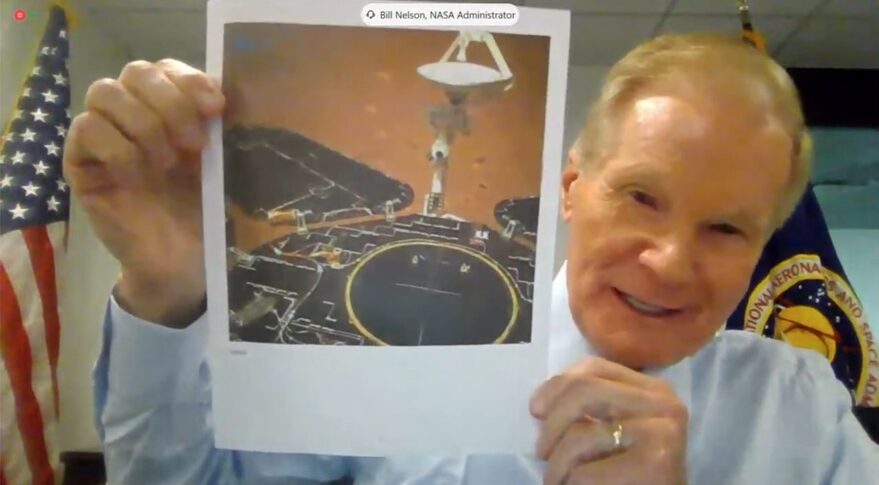
NASA Administrator Bill Nelson shows an image taken by China’s Zhurong Mars rover, which he used as evidence of China’s growing capabilities in space exploration during a May 19 House appropriations hearing. Credit: House Appropriations Committee webcast


 Washington-NASA Administrator Bill Nelson congratulated China for successfully landing a rover on Mars, but also used the milestone to warn Congress of China’s competitive threat to American leadership in human spaceflight.

In a statement May 19, hours after the China National Space Administration (CNSA) released the first images taken by the Zhurong rover since its May 14 landing on Mars, Nelson congratulated China for being only the second country, after the United States, to land a spacecraft on Mars and operate it there for more than a brief period.

“As the international scientific community of robotic explorers on Mars grows, the United States and the world look forward to the discoveries Zhurong will make to advance humanity’s knowledge of the Red Planet,” Nelson said in the statement. “I look forward to future international discoveries, which will help inform and develop the capabilities needed to land human boots on Mars.”

NASA distributed the press release at the same time that Nelson was testifying before the House Appropriations Committee’s commerce, justice and science subcommittee. During that hearing, he used the Zhurong landing as a warning against American complacency in space exploration.

“I want you to see this photograph,” he said, brandishing one of the Zhurong images. He argued that the landing was evidence that China was serious about sending spacecraft to both the Moon and Mars, including, eventually, human missions. “I think that’s now adding a new element as to whether or not we want to get serious and get a lot of activity going in landing humans back on the surface of the moon.”

Nelson revisited the issue near the end of the two-hour hearing, again showing the Zhurong image. “It is a very aggressive competitor,” he said of China. “They’re going to be landing humans on the moon. That should tell us something about our need to get off our duff and get our Human Landing System program going vigorously.”

While Zhurong is on Mars, Nelson focused his concern on the moon. He said China is planning three “big landers” that will go to the south pole of the moon. He cited unnamed reports that claim that China is planning “a flyby and a lunar lander in the decade of the 2020s.” The implication, not explicitly stated by Nelson, is that the flyby and lander missions would be crewed.

In a presentation during a Royal Aeronautical Society conference May 19, Yao Jianting, deputy general secretary of CNSA, said China was planning a second lunar sample return mission, Chang’e-6, in 2024 or 2025. Two other lander missions to the lunar poles, Chang’e-7 and 8, are scheduled for between 2024 and 2028. That would be followed by an international lunar research station between 2030 and 2035, in cooperation with nations such as Russia.

However, Yao did not mention the crewed lunar flyby or lunar landing mission concepts that Nelson brought up at the hearing. Yao’s brief discussion of China human spaceflight programs focused on development of a space station over the next two years.

“This needs to be taken note of by the committee,” Nelson said of the Chinese lunar exploration plans he outlined at the hearing. He called on Congress to provide funding for the HLS program through a proposed $2.3 trillion infrastructure and jobs bill.

“NASA can’t do it alone. You all are our partners,” he told the committee, citing recommendations he made earlier in the hearing for additional funding. “We want a vigorous competition, but we’ve got to have the money in order to be able to do that.”

HEY TESLA BEAT IT
Ford launches ‘truck of the future’
 F-150 Lightning – and it’s a beast

By Axel Metz 

Power and practicality
(Image credit: Ford)

Ford has announced an all-electric version of North America’s best-selling vehicle, the F-Series pick-up truck.


The Ford F-150 Lightning will arrive in 2022 for the US and Canada, and marks “a defining moment” for the American car industry, according to chairman Jim Ford.

The announcement comes as Ford plans to dramatically increase its EV sales in the US, with the F-150 Lightning primed to rival the likes of the Tesla Cybertruck when it goes on sale early next year.

Electric Ford Mustang Mach-E GT packs the horsepower to rival Audi

The Lightning borrows its name from a previous performance-focused iteration of the F-Series and boasts similarly impressive on-the-road specs. Thanks to a 555bhp four-wheel-drive powertrain, the electric truck can sprint from 0-60mph in just 4 seconds and offers 775 lb ft of torque – the most yet on an F-150. 

It will be available in two battery capacities, offering official ranges of up to 230 and 300 miles, respectively. Ford will also throw in an at-home charging station as standard, which the company says will be capable of 150kW DC fast-charging, allowing the Lightning to gain 15-80% charge in just 41 minutes.

The truck also offers a power-at-home function, which gives owners the option to use 9.6kW of its battery charge to – you guessed it – power a home during a power outage. Impressively, Ford says the Lightning is capable of powering the average home for up to 10 days, and can also provide charge to electrical equipment.


Naturally, the Lightning is a pretty strong machine, too. The standard, 18-inch wheel variant boasts a maximum payload of 907kg, along with a towing capacity of up to 4536kg. To add some perspective, that means the Lightning could comfortably tow an adult Hippopotamus behind it – or two-thirds of a T-Rex, if you can find one.
Bells and whistles

The Ford F-150 Lightning is no slouch when it comes to interior design, either.

Inside, the truck will pack a 15.5-inch touchscreen display alongside a 12-inch digital instrument cluster – not dissimilar to the configuration we’ve seen in the GMC Hummer EV – both of which will utilise Ford's new SYNC 4A infotainment system. The Lightning’s main display is portrait, mind, while the Hummer’s is landscape.

That new system employs natural voice control, cloud-connected navigation and wireless access to popular in-car services – specifically Apple CarPlay, Android Auto, integrated Amazon Alexa and SYNC AppLink apps.

The Lightning will also utilize BlueCruise as part of Ford’s Co-Pilot 360 technology, allowing true hands-free driving on more than 100,000 miles of pre-qualified divided highways in the US and Canada. Ford says more hands-free ‘Blue Zones’ are on the way in the future, too.


“It really is the smartest F-150 we’ve ever made,” said Darren Palmer, general manager of Battery Electric Vehicles at Ford.

The F-150 Lightning will launch in the US and Canada between March and May next year, with a starting price of $39,974 – which puts it alongside its combustion engine counterparts, price-wise.

It won't be offered in the UK, though, so no Hippopotamus-towing for the Brits.

Yes, the fully-electric Hummer SUV can also walk like a crab
COLD WAR 2.0 RED SCARE REDUX

NEW REPORT: Hong Kong Watch ‘Red Capital’ report warns democratic governments to learn from China’s strategy of ‘economic coercion’ in Hong Kong


On 3 March, Hong Kong Watch publish a new report entitled: ‘Red Capital in Hong Kong: The Invisible Hand transforming the city’s politics.’ The report provides a warning to democratic governments about the way that Beijing has used ‘economic coercion’ as a key strategy of control in Hong Kong.

The report underlines the way that an influx of mainland money and assets - red capital - changed the power dynamics in the city’s politics. With mainland chambers of commerce now major players, able to dictate which media companies get advertising and how their employees vote, the reservations of the international business lobby about the effect of the extradition bill on the rule of law were batted aside. Beijing has been subsequently able to issue an ultimatum to international business: endorse the national security law or face the treatment of Cathay Pacific – finding that China is a no-fly zone.

Johnny Patterson, Policy Director of Hong Kong Watch says: “20 years ago, Hong Kong’s success relied on international business. The rise of red capital has turned the tables, and recent trends have exposed the level of dependency that many of these international firms have on China. The business community’s acquiescence to the new normal, or in HSBC’s case active enforcement of the Hong Kong government’s priorities, should alarm international policy makers. HSBC’s position has undoubtedly undermined the strength of the UK government’s position on the Sino-British Joint Declaration.”

In its conclusions, the report considers the fact that despite geopolitical tension, capital flows between the West and China have increased in recent years, arguing this should be a cause of concern. Despite the situation in Hong Kong, the coronavirus, and the US-China Trade War driving a growing fissure between China and the West, ties between China and Global Finance are growing, and the total value of China’s stock market has hit record highs. Over the first eight months of 2020, the amount of Chinese onshore bonds held by foreign institutional investors increased more than 20 per cent year on year to Rmb2.8tn ($421bn), according to Fitch Ratings.

The report concludes that steps should be taken to question and stall major institutional investment into firms with ties to the Chinese military-industrial complex or complicit in gross human rights abuses. It underlines that scrutiny should be placed on the component members of passive index funds which track major investment indices such as the MSCI Emerging Markets index.

Patterson continues: “It is time to wake up. We need to be looking at where Western institutional investment is going and where China is targeting its investments. If we allow another ten years of Beijing’s strategic investment of red capital across Africa and Europe, Latin America and Asia to take place unchallenged, we should not be surprised if – when inevitably there are geopolitical flashpoints – we see a rerun of Beijing’s domination of Hong Kong in other strategic geo-political battlegrounds or indeed on our own doorstep. Hong Kong is a canary in the coalmine. It shows why Western researchers need to take red capital seriously, and policy makers need to find solutions.”
European Parliament 'freezes' EU-China investment deal

On 20 May 2021, the European Parliament announced that it was freezing all consideration of the EU-China Comprehensive Agreement on Investment Agreement until the sanctions on European Parliamentarians are lifted.

The resolution passed with 599 votes in favour states that: “any consideration of CAI & any discussion on ratification by the Parliament have justifiably been frozen because of Chinese sanctions; demands that China lift the sanctions before dealing with CAI, without prejudice to the final outcome of the ratification process.”

It continues to underline that the Parliament will “take the situation in China, incl. in Hong Kong, into account when asked to endorse CAI.”

The Parliament also called for the revocation of European extradition treaties with mainland China and for the European Commission to adopt a package of measures in response to the crisis in Hong Kong.

In the drafting process of the resolution, Hong Kong Watch were pleased to work with parliamentary allies to feed into the drafting process. We strongly welcome this resolution, but now call for CAI to be dropped in its entirety. It is a bad deal which is geopolitically ill-timed, promises more economically than it can possibly deliver, and would send a message that the EU is willing to sell-out its human rights commitments for the sake of trade.