Monday, August 30, 2021


Nikolai Bukharin 1915

Toward a Theory of the Imperialist State

 THE IMPERIALIST STATE AND FINANCE CAPITALISM

1) Reinforcing the role of state power. 2) The state and the production of products (the domain lands, forestry, state factories, state monopolies, “mixed enterprises,” state control and mobilization of industry). 3) The state and the process of circulation (the state and the means of circulation: railways, telegraph, telephone, underwater cables; commercial monopolies, state banks and banking concerns; the organization of credit; state loans; state control in the sphere of distribution, etc.). 4) Foreign economic policy and state power. 5) The centralization process within a state-capitalist trust. 6) Militarism and militarization of the economy; the so-called war socialism.

Even the most superficial glance at socio-economic life demonstrates the colossal growth in the economic significance of the state. In particular, this growth can be seen in the expansion of the state budget. The complicated apparatus of a modern state organization demands monstrous expenditures, which increase with shocking rapidity. Here are the data:

Germany
(millions of marks)
France
(millions of francs)
Great Britain
(pounds)
The United States
(dollars)
Italy
(millions of lira)
Russia [28]
1891-95 – 1,553.01893 – 3,359.71900 – 143,687,0681900 – 487,713,7921898-99 – 812
1901-05 – 2,253.11907 – 3,882.3231910 – 157,944,6111910 – 659,705,3911906-07 – 1,945.9
1907 – 2,809.81908 – 4,020.51911 – 171,995,6671911 – 654,137,9981909-10 – 2,602.1
1908 – 2,784.8 [21]1909 – 4,186.01912 – 178,545,1001912 – 654,553,9631910-11 – 2,833.1
1911 – 2,897.41910 – 4,321.91913 – 188,624,9301913 – 682,770,7051911-12 – 2,949.0
1912 – 2,893.31911 – 4,547.91914 – 197,492,969[25]1914 – 700,254,489[26]1912-13 – 3,252.027
1913 – 3,520.9 [22]1912 – 4,742.7[24]

Since the 1890s, therefore, Germany has increased its budgetary expenditures by 126%; France, by 41%. In Great Britain and the United States the increase since 1900 has been 37% (England) and 44% (the USA). The budget of Italy has grown since the end of the ‘90s by 67%. And then there is Russia.

Just how large the volume of state expenditures is relative to those of the population can be seen from the following table (compiled on the basis of income-tax statistics for Prussia):[29]

 Millions of marksPercent
State expenditures2,32313
Community expenditures (more than 10,000 inhabitants)9185
Community expenditures for productive purposes1,85611
Personal expenditures by the bourgeoisie2,78416
Expenditures by the popular masses9,61655

The state and the largest municipalities accounted for approximately 20%, or one-fifth, of all expenditures.

As one aspect of imperialist policy, which in turn results from the specific structure of finance capitalism, militarism plays an enormous role in such budgetary increases. But we are not speaking simply of militarism in the narrow sense of the word. A further cause is the growing interference of the power of the state in every realm of social life, beginning with production and ending with the highest forms of ideological creativity. The pre-imperialist period was that of liberalism, which was the political expression of industrial capitalism and was characterized by non-intervention on the part of state power. The formula of laissez-faire was a symbol of faith within the leading circles of the bourgeoisie, who left everything to the “free play of economic forces.” Our own time, by contrast, is characterized by exactly the opposite tendency, the logical limit of which is state capitalism, or the inclusion of absolutely everything within the sphere of state regulation.

In order to ascertain the most general sources of this statification we must keep in mind the tendencies of finance-capitalist development. The organizational process, which embraces more and mere branches of the “national economy” through the creation of combined enterprises and through the organizational role of the banks, has led to the conversion of each developed “national system” of capitalism into a “state-capitalist trust.”[30]

On the other hand, the process of development of the productive forces of the world economy drives these “national” systems into the most acute conflicts in their competitive struggle for the world market. These two basic facts of contemporary capitalist reality provide us with the key to understanding the “state” tendencies of contemporary finance capitalism. Why was the bourgeoisie really so individualistic in the past? Principally because the basic category of economic life was the private-economic unit, which confronts all the others as a competitor. The interrelation of people, or the internal structure of the bourgeoisie as a class, was analogous to this interrelation among enterprises. As a class the bourgeoisie came out against the proletariat. But internally, within the limits of the class itself, each member stood opposed to the other as a competitor: Homo homini lupus est. Each hoped to unseat his opponent by relying upon his own forces, the interplay between them being positive for the “whole.” But it was not only separate enterprises and individual people who emerged as the bearers of individualism. The division of the ruling classes into different groups also played an analogous role: above all the division into a landed and an industrial bourgeoisie, followed by lesser divisions between the representatives of raw material production and manufacturers, commercial and usurer capital, etc. The epoch of finance capital puts an end to this state of affairs. Above all else, the individual private enterprise disappears as the cell of the capitalist organism and the basis of capitalist individualism. Moreover, the contradiction between different subgroups of the ruling classes also largely disappears. By collaborating with one another, almost every category of the bourgeoisie is transformed into the recipients of dividends, the category of interest becoming the general form of expression for all so-called “nonlabor incomes.” The holy of holies for every bourgeois (and landlord) becomes the bank to which he and his kind are tied by a thousand threads.

Thus, a system of collective capitalism is created, which to a certain extent is opposed to the entire structure of capitalism in its earlier forms. The separate capitalist disappears: he becomes a Verbandskapitalist,[31] a member of an organization; he no longer competes, but instead cooperates with his “compatriots”; for the center of gravity in the competitive struggle is carried over into the world market, whereas within the country competition dies out. Such a structure of the ruling classes is accompanied by a corresponding change in the “state machine”: the state power becomes the supreme organization of the finance-capitalist bourgeoisie, who constitute a homogeneous group. The financial oligarchy rules the trusts; the financial oligarchy rules the country. This is simply another organization of one and the same clique. It is understandable that in these circumstances the earlier opposition to the idea of “state socialism” (i.e., state capitalism) should vanish. By transferring management of the state-capitalist trust to a formally independent state (we have in mind economic regulation) in exchange for a guaranteed income, finance capital changes nothing essential. But it can expect certain advantages. These advantages are tied directly to the imperialist policy. We have already noticed that external competition begins to play an enormous role. The instruments of such competition are not only dumping and purely economic pressure but also the pressure of armed force – of war, in the final analysis. Hence the question of military might. Contemporary warfare differs completely from the wars of previous times: from an economic viewpoint the issue is no longer just where to acquire the money, but one of financial and industrial mobilization – a question of converting a “peacetime economy” into a “war economy” (Friedenswirtschaft und Kriegswirtschaft). “In economic terms war used to be a problem of state finances. But now the state is omnipotent. Thus, its operation does not appear outwardly in the form of an enterprise (Unternehmung), and it no longer faces a financial-economic problem, or a problem of money; instead the natural substance of the entire national economy is mobilized for war.”[32] The question of mobilizing the entire “natural-economic substance” is one of an organization directly subordinated to the control of the state power. The more organized the state-capitalist trust, the greater the intervention of state power, the larger the share of output by the state’s own enterprises, and the more powerful the role of state banks, which regulate the circulation of money and credit, the more battle-worthy is this gigantic unit and the greater are the profits expected by the fortunate citizens of the glorious fatherland. “Per Sozialismus gehort zu den Mitteln der ‘Kriegsfuhrung’” (“Socialism in an instrument for the conduct of war”), exclaims the socialist renegade Edmund Fisher, taking the extreme form of state intervention to represent socialism.[33]

Such are the most general causes of the “change of attitude” among the leading representatives of bourgeois “public opinion.” The remaining opposition to “statification” comes from the ranks of commercial capital, a branch of activity whose importance is declining and whose functions become redundant given direct control by the state.

The war has caused state-capitalist relations of production to mature rapidly. War is accompanied not only by tremendous destruction of productive forces: in addition, it provides an extraordinary reinforcement and intensification of capitalism’s immanent developmental tendencies. There is no doubt that the war has caused an entire “industrial revolution” and has revolutionized (in this conditional sense) the economic foundation, destroying with colossal speed those capitalist relations that had already become outdated. Of course, many of these changes were due to the specific needs and tasks of the war, and will die out as soon as the protracted, superhuman massacre comes to an end. But many will also remain, for in the form of state-capitalist trusts and under threat of its own destruction, capitalism must inevitably approach an epoch of one war after another.[34]

Let us begin with changes in the basic sphere of economic life, that of production.

From the early epoch of capitalism and continuing right through the stage of industrial capitalism certain rudimentary forms have persisted that can now be absorbed as living cells of the state economy. We have in mind the domain lands, the forest industry, and state factories. Compared with the sphere lying beyond the possessions of the state, these forms are numerically insignificant. But the state forest industry is of considerable importance. Take the German data as an illustration. In 1900 timber was distributed among the different categories of ownership as follows:

Crown timberState timberTimber owned
jointly by the
state and others
Municipalities
257,3024,430,09029,7932,258,090
InstitutionsAssociationsPrivateTotal [35]
211,015306,2146,503,36513,995,869

The mining industry should also be noted, for here, too, the state has retained a certain position.

Much more important, however, are the ever-multiplying attempts to establish state monopolies in the realm of production. There can be no doubt that this type of state intervention has the most “brilliant” future. To the general considerations we have already mentioned another must be added, having acquired particular significance during the war. We have in mind the need for an enormous increase in state revenues. The costs of the war are so enormous (including payment of state debts, interest payments on state loans, assistance to the wounded and orphans, etc., reconstruction of the depleted military apparatus on an expanded scale, etc.) that to cover them over a period of several years will require, and is already requiring, a total reconstruction of the state budget. At a minimum the income of the warring states must be increased twofold, possibly more. The immediate problem of state finances therefore assumes colossal and unprecedented dimensions. As a rule, state revenues can be classified according to the following categories: revenues from the state’s own enterprises (e.g., the forest industry, mining, state factories, railways, etc.), direct taxes, indirect taxes (including tariffs), and state monopolies. Revenues from the state’s own enterprises are relatively small; direct taxes are objectionable to the bourgeoisie; and an increase in indirect taxes (and tariffs), which all governments practice con amore, meets with the stubborn resistance of the proletariat.[36] Nothing remains but recourse to the introduction of state monopolies over the production of a number of products: the tobacco monopoly, monopoly in the production of cigars and cigarettes, monopolies in alcoholic beverages, kerosene, matches, electrical energy, coal and iron, potassium, gas for lighting, certain metals, etc. These are the branches of production in which monopolization encounters the least difficulties and has already occurred in several states.

Monopolization is also to be expected in war industry, that is, the industries working for the army and the navy (building battleships, cannon, etc.). Unproductive from the viewpoint of social development, this branch of production will grow in importance. Far from the “ultra-imperialist” idyll of Kautsky, we face a period of more acute competition on the part of state-capitalist trusts.[37] The transitional form between the “private capitalist enterprise” (or trust) and the pure type of state enterprise is the so-called “mixed enterprise” (“gemischte Betriebe”). Recently this form has begun to appear with growing frequency, and there is every likelihood that it will spread rapidly. Essentially the state cooperates here with a private capitalist enterprise or, more often, with a capitalist organization (a trust, syndicate, cartel, etc.). The merger is achieved through “share holding” (or “participation”): the state purchases a portion of the shares of the enterprise in question, the balance being held by the usual trust. Thus, the state and an entrepreneurial economic organization become co-owners of one and the same productive unit. Over the course of time this intermediate type will understandably give way to the pure form of state enterprise. The mechanism for this process is very simple: either the state becomes the owner of a growing portion of the shares, or else the shareholders are converted into mere recipients of a certain fixed income, being prevented from interfering directly in the production process, which is left to the control of the enlightened and appropriately trained imperialist bureaucracy.[38]

These are the basic and most established forms of state intervention in the sphere of production. There is a multiplicity of other measures that, to a greater or lesser degree, curtail the “free disposal” of private property. Although these measures by no means cause a loss in all cases for the aforesaid property owners, they do place production under control of the all-seeing eyes of the state. In the case of every belligerent country, those enterprises working for so-called “national defense” have been subjected to such control. In Germany, where the English blockade has increased the tendency toward regulation of the economy to an extreme , this control has been extended to several other production branches.[39] If, for example, a special ‘’Reichsverteilungstelle’’ not only distributes the finished product – sugar, shall we say – but also determines precisely how much sugar must be produced, by what date, and where to deliver it, then, under these conditions, the arbitrariness of the private entrepreneur or syndicate gives way to “state discretion.” We have, in consequence, a limitation on production and sales. Occasionally the state goes further and joins the different production groups together in a single complex for the sake of greater production planning (as was the case, for instance, in the German coal industry).[40] Finally, there is an infinite number of rules that regulate the production process itself (requiring a certain method of production, the use of specified raw materials, etc.). “All of these measures” – to quote Professor Hatchek – “convert the producer and the seller into social functionaries” (the worthy professor neglects only to mention the indecent “compensation” these syndicated “social functionaries” receive).

In these ways state power absorbs virtually every branch of production. Not only does it preserve the general conditions of the exploitative process but, in addition, the state increasingly becomes a direct exploiter, organizing and directing production as a collective, joint capitalist.

A similar process can be observed in the sphere of circulation.

Let us begin by considering the technical-material framework of the circulation process: the railways, telegraph, telephone, underwater cables, and the postal organization as a whole.

Here “statification” occurred earlier than in other areas. The reasons for statification of the railways were typical. Beside the economic reasons (the enormity of the capital to be advanced, the low rate of profit at the outset, etc.), both fiscal and military-strategic motives were operative. Although much later than other countries, England brought the railways under the Treasury, owing to the influence of the “great war.” As with protectionism, the creation of a standing army, the curtailment of individual freedoms, and so forth, the transition was also made to a state railway industry. The relative “weight” of state railways as a percentage of total track length is as follows: Belgium, 90.8%; Germany, 92.5%; Denmark, 55.6%; Italy, 77.8%; the Netherlands, 56.3%; Norway, 84.2%; Austria, 80.4%; European Russia, 65.5%; Switzerland, 71.9%; etc. France, Portugal, and Sweden have railways of the “mixed” type. As for the telegraph, only in America does a private telegraph play a major role, state telegraphs being the norm elsewhere. The cable network is mainly in the hands of private companies, but the state’s share is growing. There can be no doubt that the influence of the war is very forceful in this respect: in the name of “national defense,” and so forth, an energetic policy of statification is being implemented in all of these branches.

The skeleton of the circulatory process is therefore largely in the hands of the state. But the very process of circulation is itself passing more and more into state hands. Consider, for example, state trade monopolies. Generally speaking, these monopolies were introduced for the same reasons as those in the sphere of production: from a negative viewpoint, the growing “collectivist” character of capitalist relations; more positively, the financial and strategic considerations that compel the bourgeoisie to centralize economic relations at the level of the “fatherland.” In cases in which a production monopoly is difficult to establish, for one reason or another, the state assumes the exclusive right to sell the particular product and to set its own prices.

There is no doubt that trade monopolies represent a step toward further intrusion of state control into the realm of production. The only difference is that in this case intervention begins, so to speak, at the other end.

The joint-stock form of enterprise adds the possibility in this sphere as well of creating “mixed” enterprises, whose shareholders are public-law institutions (the state, municipalities), on the one side, and commercial-industrial organizations, on the other. In time of war a similar role is being played in Germany by the numerous “Kriegsrohstoffgesellschaften” (“war material societies”), which have complete authority (under the control of state power) to centralize all available supplies of different types of goods and to distribute them in accordance with definite regulations, established either by the state (e.g., rubber, benzine, metals, leather, etc.) or by “Reichsverteilungsstellen” (“imperial allocation offices”), which handle the allocation of commodities throughout the empire. Numerous organizations are obliged to supply commodities; others are obliged to accept them; and prices are fixed by the state. Finally, an extreme form of state intervention is the system of confiscation (consider, for instance, the activity of the German government in supplying the population with food products and the so-called “food dictatorship”). Here, too, several syndicate organizations cooperate with the organs of state and local government. As a result, the anarchic commodity market is largely replaced by organized distribution of the product, the ultimate authority again being state power.

Of course, many of these forms must also die out with the advent of normal conditions for the economic process. The dreams of certain ideologists of imperialism (dreams of so-called “Magasinierung,” or the establishment of gigantic state warehouses of different kinds of products with the simultaneous near-isolation of the state economy – in short, dreams of economic “autarky”) are absolutely Utopian.[41] But the general tendency of growing intervention by the state remains, even though its theoretical limits are impossible to establish.

If we turn now from the circulation of commodities to the circulation of money and the sphere of credit, we find the exact same process. The need for the state to regulate the entire process of monetary circulation is also made dramatically evident in time of war. Financial mobilization presupposes the colossal might of state central banks, which gather up virtually the entire gold supply of the country. The concrete constellation of monetary circulation depends primarily on the policy of the state bank, the quantity of notes it puts into circulation, etc. The same is true of credit relations. In Germany the state bank has also been supported by the “loan offices” (Darlehenskassen), which are subordinate to the bank and were specially created for the war. Besides accepting all manner of paper securities, these state institutions are also designed to grant credit, commodities[42] being accepted as security. Thus, something in the nature of a mutual guarantee, or an ever-expanding “community of interests,” arises between the state power and different circles of the bourgeoisie, as the representatives of economic life. Within the same sphere this mutual guarantee might take many different forms. The role of state loans is especially important. (The “success” of internal loans is highly dependent on one condition, namely, that capital cannot find areas for investment because the productive base has been narrowed owing to the war. Analysis of the sources of the payments makes it clear that the “popular” character of this success is pure fantasy.) If the capitalists give up their capital to the state, they also become shareholders in the whole aggregate of state enterprises, in the broad sense of the word; for the fixed rate of interest they receive represents a portion of the state’s general revenues. The more extensive the internal loan operations are, the more closely are all the branches of production tied economically to the state power. This tie originates and is accomplished in the sphere of circulation. The supreme regulator is the state bank.

It is interesting that the structure of the latter institution is not the same in all countries. In some cases there is a purely state institution; in others, an enterprise of the “mixed type.” The German Imperial Bank is one of a mixed nature. As a joint-stock society it is directed by state officials, who are appointed by the Emperor on the advice of the Bundesrat.[43] The “nature” of this bank has even given rise to several theoretical discussions on the theme of whether it is a state institution – that is, whether it is an institution of a public-law nature or a simple joint-stock company of a private-law nature.

In this connection we should also remember the so-called regulation of consumption. In fact, this sphere belongs entirely to circulation. It is a process of distributing goods, not of consuming them, for the latter lies beyond the limits of any economic investigation. We have in mind as well the numerous ration cards and other measures: cards for bread, butter, meat, etc.

In certain countries the intervention of state power has assumed enormous dimensions. In Germany it has led to regulated distribution of all food products and to “communist” mass meals (“Massenspeisungen”). This type of state intervention, however, is the least stable; and there is no doubt that it will disappear with the end of the war and overcoming Germany’s economic isolation.

It remains for us to look at the state’s foreign economic policy. Under this heading belong, first and foremost, all possible types of prohibitions and limitations on imports and exports, including the entire system of tariff policy, trade agreements, support for “national industries” abroad, premiums of all sorts, the search for concessions and profitable lending opportunities, etc., plus direct plunder, or seizing the territory of someone else’s “fatherland” for monopolistic exploitation by one’s “own” finance capital, which is the essence of an imperialist policy.

Now let us summarize. In total contrast to the state in the epoch of industrial capitalism, the imperialist state is characterized by an extraordinary increase in the complexity of its functions and by an impetuous incursion into the economic life of society. It reveals a tendency to take over the whole productive sphere and the whole sphere of commodity circulation. Intermediate types of mixed enterprises will be replaced by pure state regulation, for in this way the centralization process can advance further. All the members of the ruling classes (or, more accurately, of the ruling class, for finance capitalism gradually eliminates the different subgroups of the ruling classes, uniting them in a single finance-capitalist clique) become shareholders, or partners in a gigantic state-enterprise.[44] From being the preserver and defender of exploitation, the state is transformed into a single, centralized, exploiting organization that is confronted directly by the proletariat, the object of exploitation. In the same way as market prices are determined by the state, the workers are assigned a ration sufficient for the preservation of labor power. A hierarchically constructed bureaucracy fulfils the organizing functions in complete accord with the military authorities, whose significance and power steadily grow. The national economy is absorbed into the state, which is constructed in a military fashion and has at its disposal an enormous, disciplined army and navy. In their struggle the workers must confront all the might of this monstrous apparatus, for their every advance will be aimed directly against the state: the economic and the political struggle cease to be two categories, and the revolt against exploitation will signify a direct revolt against the state organization of the bourgeoisie.

All of these developments lie in the near future, unless a social catastrophe occurs before the pure type of economic relations we have been describing can take shape.

It is easy to qualify in socio-economic terms the mode of production whose undeveloped form is represented by the contemporary Kriegssozialismus, i.e., the militarization of almost every branch of industry. Many bourgeois theorists speak of state socialism. Professor Krahmann, for example, whom we have cited previously, writes:

The powerful influence of all the means currently employed to support the state and defend the Fatherland, means that have been adopted by the state out of military considerations, will be to move us . .. much nearer to state socialism. But this change will not occur in the way which some have dreaded and for which others have hoped. This is not a loose international, but a nationally consolidated, socialism that we are approaching. It is not a democratic communism; still less is it an aristocratic class government: it is a nationalism that reconciles classes [45]

And the revisionist E. Fisher, in addition to claiming that “Socialism is essentially nothing but the carrying over of the state idea (Staatsgedankens) into the national economy and social life in general,” tries his utmost to find socialism, referring to monopolization of the various branches of production with such strange names as “electrical socialism,” “water socialism,” and so forth.[46] These misleading phrases obscure the reality of the matter, namely, that in “war socialism” class contradictions not only persist but reach their maximum intensity. In the ideal type of imperialist state the process of exploitation is not hidden by any secondary forms: the mask of a supraclass institution that looks after everyone alike is torn away from the state. This is the basic fact, and it thoroughly demolishes the arguments of the renegades. For socialism is regulated production, regulated by society, not by the state (state socialism is about as useful as leaky boots); it is the elimination of class contradictions, not their intensification. On its own, the regulation of production is far from signifying socialism: it occurs in every familial economy, among every slave-owning natural-economic group. What we in fact expect in the near future is state capitalism. A single protest might be raised against such a designation, namely, that the logical extreme and pure type of the relations now emerging would entail the elimination of hired labor. The worker would receive rations, “aliments,” not a monetary equivalent of the value of labor power. Just as market prices are replaced by regulated distribution of the product, so the wage form would disappear and along with it hired labor as such. The worker would become a slave. And since hired labor represents one of the most characteristic features of capitalism, it is impossible to use the term capitalism to designate relations that involve the elimination of hired labor. Nevertheless, we would accept this complaint as being correct and would introduce some new designation for the type of relations now being formed only in one event – that is, if a single world economy were in existence. Insofar as this is not the case (for reasons we have discussed in Kommunist, a single world economy represents an impossible hope), and insofar as the anarchy of the world market remains, the categories of value and wages are also preserved – with the single difference that now the position of the separate enterprise has been taken by the state enterprise. The labor market will become the world market for labor, and the movement of workers from one state to another will gather momentum. Likewise, we must not think that the state will be able to establish whatever prices it dreams up, or that the law of labor value loses its significance, for it would be absurd to imagine a closed state and economic autarky. The pressure of the world market remains.

Thus, state capitalism is the completed form of a state-capitalist trust. The process of organization gradually removes the anarchy of separate components of the “national-economic” mechanism, placing the whole of economic life under the iron heel of the militaristic state.

READ ON

Toward a Theory of the Imperialist State by Nikolai Bukharin 1915 (marxists.org)

In India, growing clamour to criminalise rape within marriage

By Geeta Pandey
BBC News, Deli
IMAGE SOURCEGETTY IMAGES


In India, a society rooted in patriarchal traditions, marriages are sacrosanct and it is not a crime for a man to rape his wife.


But in recent weeks, courts have given conflicting rulings on marital rape, leading to renewed calls from campaigners to criminalise rape within marriage.


On Thursday, Justice NK Chandravanshi of the Chhattisgarh high court ruled that "sexual intercourse or any sexual act by a husband with his wife cannot be rape even if it was by force or against her wish".


The woman had accused her husband of "unnatural sex" and raping her with objects.


The judge said the man could be tried for unnatural sex, but cleared him of the much more serious offence of rape since Indian law does not recognise marital rape.


The ruling met with outrage on social media, including from gender researcher Kota Neelima who asked "when will courts consider the woman's side of the story?"


The BBC is not responsible for the content of external sites.View original tweet on Twitter


Many responded to her tweet saying the archaic rape laws must be amended - but there were many contrary voices too.


One wondered "what sort of a wife would complain of marital rape?"; another suggested "there must be something wrong with her character"; while a third said "only a wife who doesn't understand her duties would make such a claim".


It's not just social media, the contentious topic of marital rape also appears to have divided judiciary.


Just a few weeks back, the high court in the southern state of Kerala ruled that marital rape was "a good ground" to seek divorce.


"The husband's licentious disposition disregarding the autonomy of the wife is marital rape, albeit such conduct cannot be penalised, it falls in the frame of physical and mental cruelty," Justices A Muhamed Mustaque and Kauser Edappagath said in their 6 August order.


They explained that marital rape occurred when the husband believed that he owned his wife's body and added that "such a notion has no place in modern social jurisprudence".


In India, marriages are considered sacrosanct


The law that Justice Chandravanshi invoked is Section 375 of the Indian Penal Code.


The British colonial-era law, which has been in existence in India since 1860, mentions several "exemptions" - situations in which sex is not rape - and one of them is "by a man with his own wife" who's not a minor.


The idea is rooted in the belief that consent for sex is "implied" in marriage and that a wife cannot retract it later.


But it has increasingly been challenged across the world and over the years, more than 100 countries have outlawed marital rape. Britain too outlawed it in 1991, saying the "implied consent" could not be "seriously maintained" nowadays.


But despite a long and sustained campaign to criminalise it, India remains among 36 countries where the law remains in the statue book, leaving millions of women trapped in violent marriages.


According to a government survey, 31% of married women - almost one in three - have faced physical, sexual and emotional violence from their husbands.


"In my opinion," says Professor Upendra Baxi, emeritus professor of law at University of Warwick and Delhi, "this law must be struck down."


Over the years, he says, India has made some progress in addressing violence against women by bringing in laws against domestic violence and sexual harassment, but has done nothing about marital rape.

The Indian kitchen serving an unpalatable truth
India marital rape victims' lonely battle for justice
India 'fails' victims of abuse


In the 1980s, Prof Baxi was part of a group of eminent lawyers who had made several recommendations on amending rape laws to a committee of MPs.


"They accepted all our suggestions except the one on outlawing marital rape," he told the BBC.


Their subsequent attempts to get the authorities to criminalise marital rape also remained unsuccessful.


"We were told the time was not right," Prof Baxi said. "But there has to be equality in marriage and one side cannot be allowed to dominate the other. You cannot demand sexual service from your spouse."


The government has consistently argued that criminalising marital law could "destabilise" the institution of marriage and that it could be used by women to harass men.


But in recent years, many unhappy wives and lawyers have petitioned courts calling for the "offending law" to be struck down.


United Nations, Human Rights Watch and Amnesty International have also raised concerns about India's refusal to do so.


Many judges too have admitted that they are hobbled by an archaic law that has no place in a modern society and called for the parliament to criminalise marital rape.

India is among 36 countries where marital rape is not illegal

The law is "a clear violation" of women's rights, and the immunity it provides to men is "unnatural" and the main reason behind the growing number of court cases, Ms Neelima says.


"India has a facade of being very modern, but scratch the surface and you see the real face. The woman remains the property of her husband. Rape is criminalised in India not because a woman's violated, but because she's the property of another man."


Ms Neelima says "one half of India that is male became free when India became an independent country in 1947, the other - female - half is yet to be free. Our hope lies in the judiciary".


It's encouraging that some courts have "admitted the unnaturalness of this immunity", she says. But these are "small wins, overrun by other contrary legal verdicts".


"This needs intervention, and it must change in our lifetime. The barriers are extra tall when it comes to marital rape," she says.


"This should have been sorted out way back. We are not fighting for the future generations, we are still fighting the wrongs of history. And this fight is critical."


Read more from Geeta Pandey on patriarchy within homes:

The women eating with their families for the first time
Calling your husband by name for the first time
The Indian women saying no to forced tattoos
DRC reviewing $6bn mining deal with Chinese investors

Reuters | August 27, 2021 | 

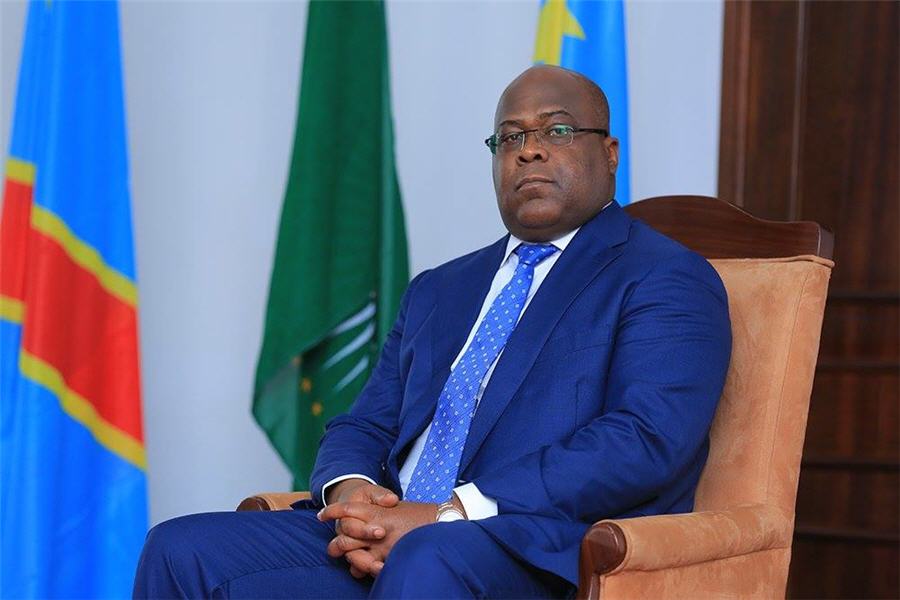
Felix Tshisekedi became DRC’s new president in January 2019. 
Image courtesy of Wikimedia Commons.

The Democratic Republic of Congo’s (DRC’s) government is reviewing its $6-billion “infrastructure-for-minerals” deal with Chinese investors as part of a broader examination of mining contracts, Finance Minister Nicolas Kazadi told Reuters.


President Felix Tshisekedi said in May that some mining contracts could be reviewed because of concerns they are not sufficiently benefiting Congo, which is the world’s largest producer of cobalt and Africa’s leading miner of copper.

His government announced this month it had formed a commission to reassess the reserves and resources at China Molybdenum’s massive Tenke Fungurume copper and cobalt mine in order to “fairly lay claim to (its) rights”.

CHINESE INVESTORS CONTROL ABOUT 70% OF CONGO’S MINING SECTOR


Kazadi said in an interview that the 2007 deal agreed with Chinese State-owned firms Sinohydro Corp and China Railway Group Limited was also being reviewed to ensure it is “fair” and “effective”.

Sinohydro and China Railway did not immediately respond to a request for comment. Elie Tshinguli, deputy director-general of the Sicomines copper and cobalt joint venture in Congo, majority-owned by Sinohydro and China Railway, did not respond to a request for comment.

Under the deal struck with the government of Tshisekedi’s predecessor, Joseph Kabila, Sinohydro and China Railway agreed to build roads and hospitals in exchange for a 68% stake in the Sicomines venture.

The deal formed a key part for Kabila’s development plan for the country, but critics say few of the promised infrastructure projects have been fully realized and have complained about a lack of transparency in the deal.

“We saw that there were some governance issues in the past,” said Kazadi. “We needed more clarity on the contract, the kind of finance that is behind (the) investment.”

He said the reviews were “not a matter of threatening any investors” and that the government was conducting the review “in close partnership with the Chinese themselves”.

Chinese investors control about 70% of Congo’s mining sector, according to Congo’s chamber of mines, after snapping up lucrative projects from Western companies in recent years.

After Tshisekedi announced the reviews in May, a move attributed by some analysts to Western pressure to go after Chinese companies, China’s ambassador to Congo warned the country “must not be a battlefield between major powers”.
IMF deal

Kazadi also said he expected the International Monetary Fund’s review next month of the $1.5-billion three-year programme that received final approval in July to confirm all the conditions had been met.

“There is no doubt that the review should be successful and will lead to a new disbursement in December,” he said, adding the next disbursement of just over $200 million would be used to bolster foreign currency reserves.

Meanwhile, the government plans to use half of the 1021.7 million Special Drawing Rights ($1.45 billion) – the IMF’s own currency – allocated to Congo to further shore up reserves, he said.

A big chunk of the remainder will be used to launch an investment fund aimed at diversifying Congo’s economy, he said. “It will implement new projects in new kinds of areas, like agriculture or energy production,” said Kazadi.

  1. Toward a Theory of the Imperialist State by Nikolai Bukharin

    https://www.marxists.org/archive/bukharin/works/1915/state.htm

    THE IMPERIALIST STATE AND FINANCE CAPITALISM 1) Reinforcing the role of state power. 2) The state and the production of products (the domain lands, forestry, state factories, state monopolies, “mixed enterprises,” state 


Tesla needs to perform delicate balancing act when it comes to lithium mining – expert

Valentina Ruiz Leotaud | August 29, 2021 

Elon Musk. (Image by Steve Jurvetson, Flickr).

Tesla’s promise to slash battery costs by 50% has led the carmaker to dabble into a whole new field of making its own battery cells and, therefore, looking into manufacturing cathodes and extracting associated raw materials.


But the risks linked to this new line of work mean that Tesla has to perform a delicate balancing act where it tends the increasing demand for electric vehicles and the fact that activists, car buyers, and investors want every step of the process of making an EV to be respectful towards the environment and affected communities.


“Tesla will need to demonstrate that its new approach to lithium mining does in fact have a lower environmental impact than other methods. Transparency — providing plenty of information in a timely and accurate way — will be critical to winning support,” Robin Bolton, executive head of sustainability at IsoMetrix, told MINING.COM.


AFTER SECURING ACCESS TO 10,000 ACRES OF LITHIUM-RICH CLAY DEPOSITS IN NEVADA A YEAR AGO, ELON MUSK’S COMPANY FILED THIS YEAR A NEW PATENT FOR THE “SELECTIVE EXTRACTION OF LITHIUM FROM CLAY MINERALS.”


After securing access to 10,000 acres of lithium-rich clay deposits in Nevada a year ago, Elon Musk’s company filed this year a new patent for the “selective extraction of lithium from clay minerals.”

The patent states that extracting lithium from ore using sodium chloride is an environmentally friendlier way to obtain the metal, compared to currently used techniques such as acid leaching. According to Tesla, it also allows for higher recoveries.

In parallel to these developments, the company signed a five-year raw materials pact with Piedmont Lithium (ASX: PLL), which should start supplying spodumene concentrate sometime between July 2022 and July 2023 from a North Carolina lithium mine and processing facilities under development. Tesla is to transform the chemical into lithium hydroxide – a key building block for EV batteries – at a plant it is building in Texas.
Manage, educate, get buy-in

But all these mining-related developments mean that Tesla needs to manage, educate, and get buy-in from all the stakeholders while broadening the scope of what is considered efficient and environmentally friendly in mining by looking at its entire supply chain.

For Robin Bolton, such a global yet detailed view at each stage of its production process is particularly important taking into account that one mining operation in Nevada – Lithium America’s Thacker Pass project – is already experiencing opposition due to environmental concerns.

“While this is a separate mining operation with a different technology than Tesla is talking about using, it’s important for Tesla to recognize that it faces the same risks,” Bolton said. “All mining operations should take the appropriate measures to ensure transparency from the start and engage communities and stakeholders throughout the process.”


IN BOLTON’S VIEW, THE MAIN ESG ISSUES FOR LITHIUM MINES HAVE TO DO WITH COLLECTING, MANAGING, AND REPORTING INFORMATION ABOUT ENVIRONMENTAL IMPACTS


In the executive’s view, the main ESG issues for lithium mines have to do with collecting, managing, and reporting information about environmental impacts. This means that if local communities, environmental action groups, and local legislators are not persuaded that the mining operation is a responsible one, their objections can easily shut down the project.

“Other considerations include community relations: identifying local stakeholders and engaging them in conversation,” Bolton said. “Building a process for providing transparency and accountability. Creating a central management system where data about ESG issues can be stored securely, accessed and actioned easily is very important. Being willing to listen to and engage with various stakeholder concerns and expectations will also help to build trust.”

Given that Musk is also securing access to raw materials outside the US – for example, through a deal with the Goro mine in New Caledonia -, Bolton says that it is important that Tesla adapts the details of its ESG strategy to the reality of each area where it has interests.

“Local communities have different priorities and demographics, and depending on the type of mining being done, they will be affected in different ways. It’s critical for Tesla’s approach to be tailored to the local, regional, and national conditions where each of its mines are located,” IsoMetrix’s head of sustainability said. “ESG software solutions often have seamless integrations with regulatory content databases that will highlight the relevant mining regulations in each applicable region to help companies like Tesla ensure their mines are operating in compliance with local laws.”

For Bolton, however, the best universal strategy to build confidence in any mining operation is to build a process for providing transparency and accountability for internal and external stakeholders, adhering to global international best practices.
ANOTHER BRE-X
How Afghanistan’s $1 trillion mining wealth sold the war

Frik Els | August 27, 2021 |

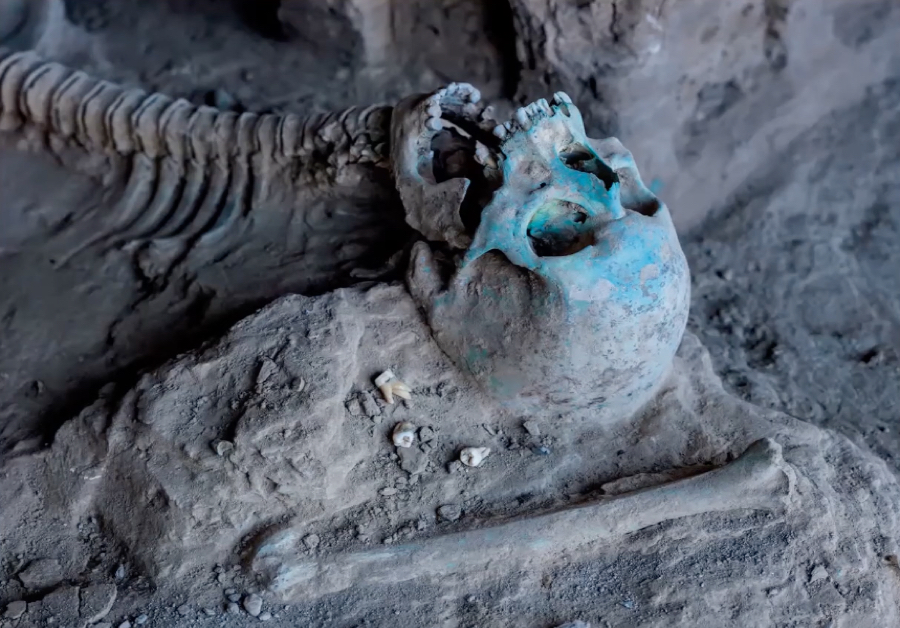
Skeleton with copper patina excavated from Mes Aynak archeological site.
 Image: Saving Mes Aynak (www.savingmesaynak.com)

After the fall of Kabul, US media regurgitates a 2010 New York Times frontpage story on Afghanistan’s mineral riches based on a secret Pentagon memo and a 1977 Soviet geologic map.


Search for Afghanistan minerals and you get dozens of articles written in the last few days quoting a magical $1 trillion number including gems like The Taliban are sitting on $1 trillion worth of minerals the world desperately needs (CNN), Afghanistan: Taliban to reap $1 trillion mineral wealth (Deutsche Welle), Biden Just Handed Afghanistan’s Mineral Wealth to China (Newsweek), China Eyes Afghanistan’s $1 Trillion of Minerals With Risky Bet on Taliban (Bloomberg) and so on.

All the one trillion dollar articles are derived from a breathless June 2010 New York Times front-page story and interview with General David H Petraeus during which the commander of US forces in Afghanistan referenced a US Dept of Defense “internal memo”.

The story of how “the vast scale of Afghanistan’s mineral wealth was discovered by a small team of Pentagon officials and American geologists” by the Pulitzer prize-winning journalist James Risen’s opens with a bang (emphasis added):

“The United States has discovered nearly $1 trillion in untapped mineral deposits in Afghanistan, far beyond any previously known reserves and enough to fundamentally alter the Afghan economy and perhaps the Afghan war itself, according to senior American government officials.”

“​​The previously unknown deposits including huge veins of iron, copper, cobalt, gold and critical industrial metals like lithium are so big and include so many minerals that are essential to modern industry that Afghanistan could eventually be transformed into one of the most important mining centers in the world, the United States officials believe.”

The tale of the $1 trillion treasure trove – which has more than a whiff of Indiana Jones about it as told by the New York Times – begins three years after the US invaded Afghanistan:

“In 2004, American geologists, sent to Afghanistan as part of a broader reconstruction effort, stumbled across an intriguing series of old charts and data at the library of the Afghan [sic] Geological Survey in Kabul that hinted at major mineral deposits in the country.”

“Technoexport”


At first the American geologists only found hints of these huge big veins, but “they soon learned that the data had been collected by Soviet mining experts during the Soviet occupation in the 1980s.”


How soon did the American geologists learn it was a Soviet study? Perhaps when they looked at the author page of the intriguing charts and data and saw this:

Abdullah, Sh., Chmyriov, V.M., Stazhilo-Alekseev, K.F, Dronov, V.I., Gannon, P.J., Lubemov, B.K., Kafarskiy, A.Kh. and Malyarov, E.P., 1977, Mineral resources of Afghanistan (2 ed.) 419 p. and Abdullah, Sh., Chmyriov, V.M. Map of mineral resources of Afghanistan V/O “Technoexport” USSR, scale: 1:500,000.

Contrary to the article, it was two years before the Soviet army invaded (hmm… what did Breshnev know about Afghan minerals and when did he know it?) and it was done under the auspices of the United Nations Development Programme (AFG/74/12).

Details. Let’s not get sidetracked.


Risen, also the recipient of the 2015 Ridenhour Courage Prize, continues:

“Armed with the old Russian charts, the United States Geological Survey began a series of aerial surveys of Afghanistan’s mineral resources in 2006 using advanced gravity and magnetic measuring equipment attached to an old Navy Orion P-3 aircraft that flew over about 70 percent of the country.”
The legend

If you have such advanced tech (Shuttle Radar Topography Mission, SRTM, digital elevation model, DEM) why would you need Mineral resources of Afghanistan 2nd ed., and Technoexport?

The reason is printed on the legend of the map the USGS produced after the SRTM DEM survey:

“The geologic and mineral resource information shown on this map is derived from digitization of the original data from Abdullah and Chmyriov (1977) and Abdullah and others (1977).

“The classification of mineral deposit types is based on the authors’ interpretation of existing descriptive information (Abdullah and others, 1977) […] and on limited field investigations by the authors.”

Promising before, astonishing ASTER


“The data from those flights was so promising that in 2007, the geologists returned for an even more sophisticated study” the article continues:

“The handful of American geologists who pored over the new data said the results were astonishing.”

This even more sophisticated study used Advanced Spaceborne Thermal Emission and Reflection Radiometer (ASTER) data from Nasa’s flagship Terra satellite and the astonishing results are summarized in the USGS-Afghanistan Ministry of Mines Joint Mineral Resource Assessment Team Preliminary Assessment of Non-Fuel Mineral Resources of Afghanistan prepared in cooperation with the Afghanistan Geological Survey under the auspices of the US Agency for International Development, October 2007. (Download here)

One can understand that the New York Times would not want to confuse readers with mining jargon but what the paper calls “untapped mineral deposits far beyond any previously known reserves” the USGS report defines as “mean expected values of quantitative probabilistic estimates of undiscovered deposits”.

Close enough, it’s the New York Times.
Abdullah et al


That said, there were some pretty mean expected values gleaned from the ASTER and SRTM DEM non-discoveries and the report (the full 810 page study – Open-File Report 2007–1214 available on 1 CD-ROM and 1 DVD – appears now to be off limits to the public) outlines 34 orebodies across 27 metals and minerals.

However, of the 34 deposits outlined in the three-page summary, only four were newly identified: mercury, potash, asbestos and rare earth.

A further four were revised (upwards).

That is, revised from Abdullah, Sh., Chmyriov and others. Mineral resources of Afghanistan (2 ed.) 1977.

The 26 deposit estimates from the Soviet scientists were simply copied over and “further study recommended”.

Astonished but ignored

At this point in the article Risen injects some tension into the story:

“The results gathered dust for two more years, ignored by officials in both the American and Afghan governments.”

But the story doesn’t end in a dusty library in Kabul or the CD-ROM/DVD storeroom of the USGS:

“In 2009, a Pentagon task force that had created business development programs in Iraq was transferred to Afghanistan, and came upon the geological data.”

“Until then, no one besides the geologists had bothered to look at the information and no one had sought to translate the technical data to measure the potential economic value of the mineral deposits.”

“Soon, the Pentagon business development task force brought in teams of American mining experts to validate the survey’s findings, and then briefed Defense Secretary Robert M. Gates and Mr. Karzai.”

In these three truly stupefying paragraphs Risen makes it sound that if it was not for the task force coming upon the data after they were transferred (no access to the USGS website from Iraq?) and more importantly, bothered, the world would never have found out about the value of Afghanistan’s mineral wealth.

Send in the Excel cavalry


The only reason the geologists – on who The New York Times heaps so much responsibility to give the article a patina of science – did not bother is because that’s not how mining works.

Not that it’s much of a bother to multiply tonnes and ounces of “probabilistic estimates of undiscovered deposits” with prices.

To the Abdullah et al copper deposits, the USGS report added 32 million contained tonnes (nice!) to bring overall Cu resources in the country to 60 million tonnes. That’s $453 billion right there at the average price for copper of $7,562/tonne in 2010.

Some 600,000 tonnes of cobalt ($27 billion at 2010 prices) and 724,000 tonnes of molybdenum ($18 billion) were also put in the copper basket and the 27 million tonnes of potash would’ve fetched just under $10 billion at 2010’s average price.
Rare earth as seen from space

The global trade in rare earths was before the WTO for arbitration in 2010 and not only were prices volatile (dysprosium went up 12-fold between 2008 and 2011), the 17 elements also trade at very different price points – samarium could be had for $3.40/kg in 2009 but europium would set you back $492/kg that year.

That would have made it more difficult to assign a dollar value to the 1.4 million tonnes of rare earths as seen from space. Although the Pentagon task force probably found a way.

The sulfur tonnage was upwardly adjusted to 5.5 million tonnes, but at a ruling price of some $50 a tonne it doesn’t really smell like money. Neither does the newly non-discovered graphite deposit – not too flaky at 1.05 million tonnes but worth only a billion in 2010.

SRTM DEM and ASTER also zoomed in on 13.4 million tonnes of Afghan asbestos. Asbestos fibre remains a thriving global trade and if you need to get to 12 zeros you can’t just leave it in the ground. At ruling prices of around $1,500 a tonne, that’s $20 billion someone other than the Afghans would have to cough up.

The world in a grain of sand

Only 2.7 tonnes or 86,743 troy ounces of gold were identified in 1977. The USGS recommended further study of the primary gold deposits but did associate 682 tonnes gold ($26.8 billion at the average 2010 gold price of $1,226 per troy ounce) and 9,067 tonnes of silver ($5.9 billion) with the igneous copper deposits.

If the gold non-discoveries seem like an underestimation consider that neither SRTM or ASTER added to the 36 million cubic metres of sand in the Soviet data. Sand is the world’s number one mining endeavour as per Yale School of the Environment and prices have long been on an upward trajectory.

Who knows? The task force probably found more sand, but the Pentagon would’ve realized the jokes write themselves if the New York Times article proclaimed that the US military – ten years into the occupation – discovered vast reserves of sand in Afghanistan.

Don’t be fooled by the rocks that I got


Afghanistan’s endowment of lead, zinc, tin, tungsten, barite, talc, lazurite, fluorite, halite and celestite et cetera were not estimated by the USGS, and since the task force data is secret, only the Pentagon could put a price on those. Whether the task force incorporated the 32,000 tonnes of hot spring mercury in the $1 trillion would also remain a mystery.

Not that those treasures are needed – with iron ore 12 zeroes is more than doable.

The 2007 study did not add rocks to the 2.438 billion tonnes Abdullah et al found thirty years earlier, it didn’t have to – 62% Fe ore was trading at $120 in 2010 putting a price of $292 billion on Afghan steelmaking stuff.
Lithium nirvana

The task force did find ways to warm up the Soviet studies, which likely ignored lithium because commercialisation of the lithium-ion battery only happened more than a decade later. The 2007 USGS report also glossed over the world’s softest metal.

But the Pentagon and the New York Times saw an opportunity to show Afghanistan’s potential in the age of the smart phone and the laptop computer:

“An internal Pentagon memo, for example, states that Afghanistan could become the “Saudi Arabia of lithium,” a key raw material in the manufacture of batteries for laptops and BlackBerrys.” (Blackberrys… chuckle – Ed.)

And the work was ongoing, according to the article:

“Just this month [June 2010], American geologists working with the Pentagon team have been conducting ground surveys on dry salt lakes in western Afghanistan where they believe there are large deposits of lithium.

“Pentagon officials said that their initial analysis at one location in Ghazni Province showed the potential for lithium deposits as large of [sic] those of Bolivia, which now has the world’s largest known lithium reserves.”

Finding lithium (15th most abundant element, although scarcer than rare earth) in a dry salt lake as large as those of Bolivia which measures 10,000 square kilometres? Maybe the Pentagon team just got lucky.

Besides if you calculate the value of lithium reserves the way the task force did – and how Elon Musk does it – Nevada also has as much of the battery metal as Afghanistan and Bolivia.

Round up to the nearest trillion

The transcript of a Pentagon press briefing a few days later is not accessible due to website maintenance, but contemporaneous reporting suggests the call did not add much besides clarifying that the $1 trillion was actually $908 billion, but then adding that “a lot of people think that is a conservative number”.

Officials also assured reporters that the task force (Task Force for Business and Stability Operations to give its full name which was never mentioned in the article) just used the USGS as a reference point to conduct more “detailed field work” or as The New York Times described it:

“For the geologists who are now scouring some of the most remote stretches of Afghanistan to complete the technical studies necessary before the international bidding process is begun, there is a growing sense that they are in the midst of one of the great discoveries of their careers.”

What the detailed field work and scouring entailed is never stated. And whatever technical studies were completed were never considered in any international bidding process and the “growing sense” of career making discoveries Risen thought he detected among the geologists is, not to put too fine a point on it, growing nonsense.

Scientific boots on the ground


The most well known copper deposit in Afghanistan is Mes Aynak, which translates to “little source of copper” in Pashto/Persian. Copper workings at Mes Aynak date back to the bronze age.

The scientists at the American Association for the Advancement of Science in Science magazine in 2014 in an article titled “Mother of all lodes” wrote that after the USGS and the Pentagon “put scientific boots on the ground“ in Afghanistan they found a “vivid panoply of nonferrous mineral formations”.

Of these, Mes Aynak is surely the vividest.

Could Mes Aynak – which did go through a real world tender process – prove that the Pentagon was right all along and $1 trillion – a sum even quoted by the World Bank, responsible for drafting Afghanistan’s mining laws – is on the money?

After a bidding process that included Phelps Dodge (now part of Freeport McMoRan) and Canada’s Hunter Dickinson, state-owned Metallurgical Corporation of China and its minority partner Jiangxi Copper struck a $2.83 billion deal in 2007 for a 30-year lease at Mes Aynak. (Only $997,170,000,000 to go – Ed.)

A stretch


The nine bidders, selected in November 2006, had to rely on a dusty copy of Akocdzhanyan et al., 1974 V/O “Technoexport” Contract 55-184/17500 translated from the Russian.

In the tender information package about Mes Aynak compiled by the Afghanistan and British Geological Survey, the “systematic exploration” of the Soviet Geological Mission “Technoexport” is praised as “exceedingly thorough and well documented”. (Soviet geologist please let us know why it is called Technoexport – Ed.)

The work “included the drilling of several hundred exploration, geotechnical and hydrogeological boreholes, nine underground adits, 70 trenches, and geophysical and topographic surveys.” It was also carried out over 13 years and the geologists only pulled out when the Soviet army did in 1989.

That’s in contrast to the work of “a small team of Pentagon officials and American geologists”, who, according to New York Times’ timeline, were busy for only about a year before the article, and were working in the fields of 24 deposits scattered across the entire country.

Whether the task force scouring the “remote stretches” of Afghanistan (Mes Aynak is only 30km (19mi) south of Kabul, btw) also included drillholes, trenches and adits is impossible to say. Rather than attracting international bidders and making careers, the Pentagon technical reports remain buried secrets.
Non-refundable deposit

The Mes Anyak deal was billed as the largest foreign investment in Afghanistan in its modern history.

Perplexingly, this May 2008 press release from Jiangxi Copper put the figure paid to the Afghan government for the mining rights not at $2.83 billion but $808 million, a figure not quoted in any media story.

There were also allegations that the then mines minister Mohammed Ibrahim Adel took some $30 million in bribes related to the tender. (It’s Afghanistan. Don’t get so hung up about missing dollars – Ed.)

The copper project, also the site of an ancient buddhist city, never got off the ground (neither has Hajigak iron ore, the only other deposit which had any prospect of becoming a mine).

MCC blamed the costs of building a smelter, power plant and railway and the steep royalties for halting work. Mention of Mes Aynak disappeared from Jiangxi’s annual reports after 2013 wherein the company blamed the “relocation of historical relics” as the reason for the delay in the project.

Now that the Taliban are in charge that could change – they do not exactly care for Buddhist statues.

Sitting around in pajamas


There was some criticism of the New York Times frontpage story at the time saying that it wasn’t the scoop it was made out to be because of Abdullah and others’ work in the 1970s the 2007 USGS study. Some questioned the timing of the article when the war was going badly in Afghanistan.

Risen was irked by the skepticism telling Yahoo News “bloggers” who are “sitting around in their pajamas” instead of doing real reporting — shouldn’t “deconstruct other people’s stories.” (Go put some pants on – Ed.)

Dean Baquet, who edited the piece and was the Washington bureau chief for the New York Times then (now executive editor) said Risen “is the last person the government would try to get to carry their water,” attributed the criticism to sour grapes for not getting the story first, and that the Pentagon holding a briefing was proof of the article’s newsworthiness.

Task Force for BS Ops


The Task Force for Business and Stability Operations (Task Force for BS Ops) also came under scrutiny – albeit only in 2016 – in a 136 page report by the RAND Corporation titled Lessons from the Task Force for Business and Stability Operations in Afghanistan.

To their credit (and I don’t know how much credit, I only know that the US military, air force and Secretary of Defense stuffed $147.1 million in RAND’s coffers in 2020) RAND said the $908 billion “is notional only; it does not reflect the value of commercially exploitable deposits. Therefore, it is misleading.” (p.22)

It also fell to the think tank to address the biggest elephant in the room full of elephants that was the New York Times story and Pentagon briefing:

“Challenges impede the extraction of this natural wealth. Security concerns aside, most of the mineral rich provinces lack road, rail, or electric power infrastructure, and the nascent mining industry would have to compete with agriculture, an economic mainstay, and municipalities for limited water supplies.”

Let x = x


The manner in which the task force and its teams of mining experts calculated (tonnes x price = x,xxx,xxx,xxx,xxx) the $1 trillion value – or $3 trillion as successive mines & petroleum ministers, and President Karzai was fond of quoting – is not the biggest problem with the New York Times story.

While the number has no real world meaning, it certainly attracts attention – by the paper’s own reporting it led to greater violence in Afghanistan.

To focus only on non-fuel resources in the article also smacks of marketing. Afghanistan also has vast oil and reserves but “No war for oil” protesters had grown in ranks seven years into the Iraq occupation and trotting out a crude message would likely have misfired.

$34,482.76

That all US and most international media outlets continue to parrot the $1 trillion tale a decade later also makes its propaganda value clear.

How easily the Western armchair media swallowed the story is inexcusable, but the way Afghans were duped into believing in their country’s mineral wealth seems cruel.

The New York Times followed up the big scoop a few days later with a piece headlined Afghan Officials Elated by Minerals Report:

“As they waited to hear Mr. Karzai’s spokesman, some Afghan reporters excitedly calculated among themselves how much each Afghan would theoretically get if the mineral treasure trove were divided equally.

“Assuming the $1 trillion valuation and Afghanistan’s population of 29 million, that would give each Afghan man, woman and child $34,482.76.”

If not in scope then in tenor, U.S. Identifies Vast Mineral Riches in Afghanistan was not dissimilar to the paper’s weapons of mass destruction coverage of a few years earlier.

At least the New York Times has taken some responsibility for boosting the case for the Iraq invasion.

But there’s been no such soul searching by the paper for cheerleading the extension of the US occupation of Afghanistan.