Friday, October 08, 2021

 GREENWASHING 

US DOE funds hydrogen production from nuclear power

08 October 2021


A project to demonstrate the production of clean hydrogen energy from nuclear power at the Palo Verde nuclear power plant in Arizona is to receive USD20 million in federal funding as part of US Department of Energy (DOE) efforts to reduce the cost of clean hydrogen to USD1 per kilogram. The announcement comes as DOE marks Hydrogen and Fuel Cell Day.

(Image: DOE)

The Arizona project, which is led by PNW Hydrogen LLC, will progress DOE's H2@Scale multi-sector clean hydrogen initiative and help it to reach its Hydrogen Shot goal to reduce the cost of clean hydrogen by 80% to USD1 per kilogram within a decade, the department said yesterday. Hydrogen Shot is the first of the DOE's Energy Earthshots initiative, launched in June this year.

"Developing and deploying clean hydrogen can be a crucial part of the path to achieving a net-zero carbon future and combatting climate change," Deputy Secretary of Energy David Turk said. "Using nuclear power to create hydrogen energy is an illustration of DOE's commitment to funding a full range of innovative pathways to create affordable, clean hydrogen, to meet DOE's Hydrogen Shot goal, and to advance our transition to a carbon-free future."

PNW Hydrogen will be the primary recipient of the award, which is made up of USD12 million from the DOE Hydrogen and Fuel Cell Technologies Office (HFTO) and USD8 million from the Office of Nuclear Energy. The project will involve producing hydrogen at Palo Verde. Six tonnes of this will be stored and used to produce about 200 MWh of electricity during times of high demand, and may be also used to make chemicals and other fuels. This will provide insights into integrating nuclear energy with hydrogen production technologies and inform future clean hydrogen deployments at scale, DOE said.

PNW Hydrogen will collaborate with multiple stakeholders in research, academia, industry and state-level government including Idaho National Laboratory (INL), National Energy Technology Laboratory, National Renewable Energy Laboratory, OxEon, Electric Power Research Institute, Arizona State University, University of California Irvine, Siemens, Xcel Energy, Energy Harbor and the Los Angeles Department of Water and Power.

Palo Verde is a three-unit pressurised water reactor plant, operated by Arizona Public Service and located near Phoenix. The plant was selected in 2019 to partner with INL in a project to investigate the potential use of hydrogen generated in the nuclear plant as energy storage.

Hydrogen Day


According to the HFTO, Hydrogen and Fuel Cell Day - 8 October - "marks a symbolic opportunity every year to celebrate hydrogen and to talk about the role it can play as we transition to a cleaner and more equitable energy future."
 
The HFTO coordinates hydrogen activities across DOE including the Hydrogen Shot.

Researched and written by World Nuclear News

GLOW GREEN

SMRs 'ideal fit' for Australian market, report finds

06 October 2021

With Australia moving to decarbonise, it is time to seriously consider a role for advanced nuclear technologies like small modular reactors (SMRs), the head of the Minerals Council of Australia (MCA) said today.

The new report, authored by Ben Heard (Image: MCA)

CEO Tania Constable's remarks accompanied the MCA's launch of Small Modular Reactors in the Australian Context, a discussion paper authored by Australian nuclear expert Ben Heard which provides an overview of SMRs, their potential role in Australia and likely operating costs. The 33-page document considers three of the "most advanced" SMR designs that are currently undergoing regulatory approval - NuScale's Power Module, GE-Hitachi's BWRX-300 and Terrestrial Energy's Integral Molten Salt Reactor - and their potential use in Australia. By 2030 and beyond, the levelised costs of electricity for those three SMR designs are estimated to be between AUD64 and AUD77 (USD46 and USD56) per MWh.

SMRs are an "ideal fit" for the Australian energy market, the report finds, citing their enhanced safety, lower cost than large-scale nuclear reactors or equivalent energy production methods, configurability, and lower waste production than current reactors. Furthermore, SMR modules have a similar capacity to many of the existing generator units that make up Australia's coal and gas-fired power plants so could easily replace ageing coal or gas-powered turbines without the need for additional grid investment, it says.

"Even with conservative assumptions that include higher than expected construction costs, SMRs could be Australia's lowest cost 24/7 zero emission power source that underpins reliable and secure electricity supplies," Constable said.

"The MCA has long advocated that Australia needs to consider zero emission nuclear energy, along with carbon capture use and storage, and renewable energy, as the country moves to decarbonise the economy.

"Changes in the economic, trade, security, policy and technology environments in which Australia operates means that all options for low-carbon energy sources must be considered. SMRs offer part of the solution to addressing this necessary requirement."

With one third of the world's uranium reserves, Australia's "significant" uranium mining sector supplies about 10% of global demand, Constable said. This would be enough uranium to power "almost the entire output of the national electricity market" with low cost zero emission power, she added.

"Despite this, outdated federal and state bans on nuclear power have seen Australia fall behind as the only G-20 country without access to nuclear energy or plans to develop it," she said. "Australia should take advantage of growing international interest in nuclear energy and look to expand its already significant uranium sector."

Although the Australian Nuclear Science and Technology Organisation (ANSTO) has operated nuclear reactors for research and isotope production since the 1950s and currently operates the OPAL reactor, the use of nuclear power in the country is currently prohibited by federal and state-level regulations. A parliamentary committee in 2019 recommended that the government should consider a partial lifting of the current moratorium on nuclear energy to allow the deployment of new and emerging technologies. It is embarking on the process to acquire nuclear submarines under the tripartite AUKUS partnership with the UK and the USA, although Prime Minister Scott Morrison at last month's AUKUS launch said Australia is not seeking to acquire nuclear weapons or establish a civil nuclear capability.


UK needs new nuclear, says Prime Minister

04 October 2021


The UK government is in discussions regarding proposals for a new nuclear power plant at Wylfa on Anglesey, British Prime Minister Boris Johnson confirmed on 2 October in an interview with BBC Wales. He said previous governments in the country "have refused to take the tough decisions on nuclear for too long." Meanwhile, EDF Energy has called for the government to make prompt decisions regarding the Sizewell C project.

The existing Wylfa nuclear power plant, which is being decommissioned (Image: Magnox Ltd)

Johnson said the cost of energy can be held down "if we make the big long-term investments that we need to do now in clean power generation. So, whether that's wind - where we're going up to 40 GW by 2030, we can do even more - or nuclear."

He added, "We do need to go forward with more nuclear power. I do think it should be part of our baseload, a big part. And that's why yes, of course, we're looking at Wylfa and lots of other projects."

Reacting to the Prime Minister's comments, Tom Greatrex, Chief Executive of the Nuclear Industry Association, said: "The PM is right to back long-term investments in nuclear and to take the big decisions. We need new nuclear to secure our energy future with clean, reliable, British power. We look forward to the government bringing forward legislation to do just that this autumn."

Proposed projects


In January this year, Horizon Nuclear Power - the UK project developer owned by Japan's Hitachi - withdrew its application for planning consent for the construction of two UK Advanced Boiling Water Reactor units at Wylfa.

On 23 September, the Welsh Affairs Committee held a one-off evidence session hearing the latest on a new nuclear power plant at Wylfa Newydd in Anglesey, following the failure of the Horizon project. MPs examined the support needed by the sector to develop new power stations and the likelihood of a new developer delivering a nuclear power station at Wylfa Newydd.

The committee heard from representatives of the USA's Bechtel and Westinghouse - who are proposing to construct AP1000 reactors at Wylfa - and UK-based Shearwater Energy, who is proposing to develop a wind-small modular reactor and hydrogen production hybrid energy project at the site.

Sizewell C decisions


EDF Energy has said it is "urgent" the UK government makes key decisions on its proposed Sizewell C nuclear power plant.

In an interview with the Financial Times, the company's CEO Simone Rossi said EDF Energy wants to make a final investment decision on the project by the end of 2022. He said the government must first clarify which partners will be permitted to participate in the project and the preferred funding model.

Sizewell C will be a near replica of Hinkley Point C (HPC), which EDF Energy is building in Somerset and, like HPC, it will be able to supply 7% of the UK's electricity once it enters commercial operation. EDF and China General Nuclear (CGN) respectively own 80% and 20% of the Sizewell C project. However, UK ministers are reportedly considering ways to remove CGN from UK nuclear projects.

The government is considering a regulated asset based model for Sizewell C that EDF Energy says would reduce the cost of new nuclear power plant projects by having consumers pay upfront through their energy bills.

Researched and written by World Nuclear News

EXPROPRIATE BIG OIL


Exclusive-Oil companies ask Canada to pay for 75% of carbon capture facilities

WATCH (Aug. 31): As the world moves away from fossil fuels, the oil and gas industry is looking to get greener. One method is to scale up carbon capture efforts. Heather Yourex-West explains how Canada's five biggest oil producers want taxpayers to help make it happen – Aug 31, 2021

By Rod Nickel - Yesterday 

WINNIPEG, Manitoba (Reuters) -Oil and gas companies have asked the Canadian government to design a tax credit to pay for 75% of the cost to build carbon capture facilities that will curb greenhouse gas emissions, the country's main energy industry group said on Thursday.

The Canadian Association of Petroleum Producers (CAPP) made the request in August to the Department of Finance just before the federal election campaign, setting the tax credit at a level high enough to provide an economic return, Ben Brunnen, CAPP's Vice-President of Oil Sands, told Reuters.

Carbon capture facilities are expected to be a key part of global efforts to contain emissions from fossil fuels production. Canada is the world's fourth-largest oil producer and has a set a goal of generating net-zero emissions by 2050.

The carbon captured from oil and gas operations is less concentrated than that of some other large emitters, such as fertilizer plants. That means that capture costs are higher on a per tonne basis for oil companies, Brunnen said.

"Because of that, this (credit) needs to be designed to drive a balance and reflect the economic realities," he said. "The government role should be providing the playing field to enable companies to make these investments."

Prime Minister Justin Trudeau's Liberal government began industry consultations in June on the make-up of its proposed carbon capture investment tax credit, before the national election last month. Trudeau won a third term and discussions are expected to resume before the government finalizes the credit next year.

Carbon capture hasn’t won over critics despite 2M tonnes milestone – Mar 12, 2018


SEE

LA REVUE GAUCHE - Left Comment: Search results for CCS (plawiuk.blogspot.com)

LA REVUE GAUCHE - Left Comment: Search results for CARBON CAPTURE (plawiuk.blogspot.com)


A spokesperson for Finance could not be immediately reached.

Trudeau's government has not said what level of tax credit it is considering. At 75%, the Canadian credit would be comparable to support offered in the United States, once lawmakers sweeten the American tax credit, Brunnen said.

Many environmental groups oppose reliance on carbon capture to address global warming, calling it expensive and a means of prolonging fossil fuels production.

"We're talking about an industry that created this problem, that also made billions of dollars over the last 40 years knowing that climate change is a problem," said Cam Fenton, Canada team leader for 350.org.

Although the government calls its proposed carbon capture support a tax credit, CAPP wants it to function more as a grant, with Ottawa reimbursing carbon capture proponents a percentage of their costs as they build the facilities, Brunnen said.

Canada aims to provide incentives for at least two massive carbon capture hubs 
 by 2030 and sequester at least 15 million tonnes of carbon annually in total by that year.
Realistically, Canada might advance two projects in the next three years with combined capacity for 3 million tonnes of carbon sequestration per year, costing about C$3 billion, Brunnen said.

Several companies have stepped forward with proposals for carbon capture hubs in Alberta, including Royal Dutch Shell, TC Energy and a consortium of the five biggest Canadian oil producers.

(Reporting by Rod Nickel in WinnipegEditing by Nick Zieminski and Aurora Ellis)

   
Could decarbonization be Canada’s path to reach climate goals? – May 28, 2021
'No Place for Science Denial': Google, YouTube Ban Monetization of Climate Misinformation

"Deniers can find someplace else to spread their lies," said one digital rights activist.


Extinction Rebellion activists protesting outside Google's London offices on October 16, 2019 demand social media companies do more to fight climate change denial. (Photo: Ollie Millington/Getty Images)

BRETT WILKINS
October 7, 2021

Digital rights advocates on Thursday welcomed a report that Google and its YouTube video platform are prohibiting the monetization of climate misinformation.

Google advertisers and publishers and YouTube creators will be banned from receiving advertising revenue that contradicts "well-established scientific consensus around the existence and causes of climate change," company officials said in a statement reported by Axios.

"This includes content referring to climate change as a hoax or a scam, claims denying that long-term trends show the global climate is warming, and claims denying that greenhouse gas emissions or human activity contribute to climate change," the statement explained.


"Advertisers simply don't want their ads to appear next to this content. And publishers and creators don't want ads promoting these claims to appear on their pages or videos," the statement added.

Last year, a study by the advocacy group Avaaz concluded that YouTube's recommendation algorithm was "driving millions of people to watch climate misinformation videos" and that the company was incentivizing such content through its monetization program.

"Some of the largest household brands in the world, including Samsung, L'Oréal, Warner Bros, Carrefour, and Danone, as well as two of the largest environmental groups in the world, Greenpeace International and World Wildlife Fund, have advertisements running on these climate misinformation videos," Avaaz said.

Other social media platforms are also rife with climate lies. Last month, Common Dreams reported that the environmental group Friends of the Earth found that Facebook allows 99% of all climate disinformation to go unchecked. A 2020 InfluenceMap study found that in the first six months of last year, at least eight million people in the U.S. saw 51 Facebook ads containing false climate claims.

Google's move to quash climate misinformation profiteers comes one week after YouTube announced it was banning the accounts of several prominent anti-vaccine personalities.

"There is no place for science denial—whether it's climate, Covid, or anything else—on such influential platforms," Vahid Razavi, founder of the digital rights group Ethics in Tech, told Common Dreams. "Deniers can find someplace else to spread their lies."

Our work is licensed under Creative Commons (CC BY-NC-ND 3.0). Feel free to republish and share widely.
Can an employer reduce an employee's pay   if they're permanently working remotely?

Brooklyn Neustaeter
CTVNews.ca Writer
Published Thursday, October 7, 2021 

TORONTO -- With many companies making remote work a permanent aspect of certain jobs, experts say employers cannot reduce a current employee's salary without consent and face legal risks if they do.

However, employers can hire new, remote employees at lower wages, if they so desire.

Stephen Wolpert, a partner at Canadian employment law firm Whitten & Lublin, told CTVNews.ca an employer can change an employee's pay if both parties agree to the reduction.

"If they're both onside with the changes … there's no real hurdle to that. The harder question is when an employer is sort of imposing it on an employee unilaterally, without the employee having agreed or without the employee having acknowledged that working remotely is a benefit to them," Wolpert said in a telephone interview Thursday.

In those cases, Wolpert said, an employer can still reduce wages without an employee having agreed, but it comes with a "real risk" that the reduction will qualify as a constructive dismissal of that worker's employment, which can entitle them to severance.

Constructive dismissal, Wolpert said, is when an employer makes a substantial change to the terms of an employee’s employment without consent, resulting in the employee having the option of treating their employment as having been terminated.

However, what the courts deem as constructive dismissal is "relative," he said.

"If it's a one-per-cent reduction in wages, that might not be seen as a constructive dismissal. If it's a 20-per-cent reduction in wages, that probably would be," Wolpert said. "The courts would look at all kinds of different things to decide how big a pay cut could be tolerated before it's a constructive dismissal."

While imposing a pay cut to existing employees poses a legal risk to employers, Wolpert said they do have the option to "red circle" someone's salary.

"In other words, you don't reduce it, but you make an internal decision that you're not going to increase it for some period of time," he said. "And that's usually permissible, because most employees aren't entitled to wage increases.'

Howard Levitt, an employment lawyer at Levitt LLP, said employers also have the option to hire new employees at lower rates if they are planning to have them work from home full-time.

"They can hire 10 employees at 10 different rates for the same jobs quite legally," Levitt said in a telephone interview with CTVNews.ca on Thursday.

However, he said employers have to give current employees the option of returning to the office at full pay.

"If [companies] want to have a policy that people working at home will earn less, they can have that policy as long as they give the people who were previously at the higher salary the option of keeping their higher salary," Levitt said

While working remotely eliminated the costs of commuting and running an office space, Christopher Achkar, principal and employment lawyer at Toronto-based firm Achkar Law, told CTVNews.ca that employers have to take into account the new costs facing an employee working from home, such as increased electricity bills, as well as personal phone and internet usage.

"These are things that now that employee will have to bear the cost on those, and the employer is getting a windfall essentially," Achkar said in a telephone interview Thursday.

If an employer does try to reduce a current employee's wages, Achkar said the employee should "make it clear" that they are refusing the change if a mutual agreement has not been met.

He added that if the employer comes back and says, "too bad, take it or leave it," that is grounds for constructive dismissal and the worker should speak with an employment lawyer about compensation.

"What the employee should not do is not say anything about the decrease in pay and think that later on they can bring it up again," Achkar said. "Once you accept a change in employment, like pay, then it will be hard to go back on it."


A woman works remotely in this stock image. (Pexels)

1342 ACROSS THE OCEAN BLUE

Italian sailors knew of America 150 years before Christopher Columbus, new analysis of ancient documents suggests

RESCUING TEMPLARS IS WHAT WE DO
columbus
Credit: Pixabay/CC0 Public Domain

New analysis of ancient writings suggests that sailors from the Italian hometown of Christopher Columbus knew of America 150 years before its renowned 'discovery'.

Transcribing and detailing a, circa, 1345 document by a Milanese friar, Galvaneus Flamma, Medieval Latin literature expert Professor Paolo Chiesa has made an "astonishing" discovery of an "exceptional" passage referring to an area we know today as North America.

According to Chiesa, the ancient essay—first discovered in 2013—suggests that sailors from Genoa were already aware of this land, recognizable as 'Markland'/ 'Marckalada' – mentioned by some Icelandic sources and identified by scholars as part of the Atlantic coast of North America (usually assumed to be Labrador or Newfoundland).

Published in the peer-reviewed journal Terrae Incognitae, the discovery comes ahead of Columbus Day 2021, alternatively celebrated as Indigenous Peoples' Day across many states in the US. The findings add more fuel to the fire for the continuing question of 'what, exactly, did Columbus expect to find when he set out across the ocean?' and come following a period in which his statues have been beheaded, covered with red paint, lassoed around the head and pulled down, set on fire and thrown into a lake.

"We are in the presence of the first reference to the American continent, albeit in an embryonic form, in the Mediterranean area," states Professor Chiesa, from the Department of Literary Studies, Philology and Linguistics at the University of Milan.

Galvaneus was a Dominican friar who lived in Milan and was connected to a family which held at the lordship of the city.

He wrote several literary works in Latin, mainly on historical subjects. His testimony is valuable for information on Milanese contemporary facts, about which he has first-hand knowledge.

Cronica universalis, which is analyzed here by Chiesa, is thought to be one of his later works—perhaps the last one—and was left unfinished and unperfected. It aims to detail the history of the whole world, from 'Creation' to when it was published.

In translating and analyzing the document, Professor Chiesa demonstrates how Genoa would have been a "gateway" for news, and how Galvaneus appears to hear, informally, of seafarers' rumors about lands to the extreme north-west for eventual commercial benefit—as well as information about Greenland, which he details accurately (for knowledge of the time).

"These rumors were too vague to find consistency in cartographic or scholarly representations," the professor states, as he explains why Marckalada wasn't classified as a new land at the time.

Regardless though, Chiesa states, Cronica universalis "brings unprecedented evidence to the speculation that news about the American continent, derived from Nordic sources, circulated in Italy one and half centuries before Columbus."

He adds: "What makes the passage (about Marckalada) exceptional is its geographical provenance: not the Nordic area, as in the case of the other mentions, but northern Italy.

"The Marckalada described by Galvaneus is 'rich in trees', not unlike the wooded Markland of the Grœnlendinga Saga, and animals live there.

"These details could be standard, as distinctive of any good land; but they are not trivial, because the common feature of northern regions is to be bleak and barren, as actually Greenland is in Galvaneus's account, or as Iceland is described by Adam of Bremen."

Overall, Professor Chiesa says, we should "trust" Cronica universalis as throughout the document Galvaneus declares where he has heard of oral stories, and backs his claims with elements drawn from accounts (legendary or real) belonging to previous traditions on different lands, blended together and reassigned to a specific place.

"I do not see any reason to disbelieve him," states Professor Chiesa, who adds, "it has long been noticed that the fourteenth-century portolan (nautical) charts drawn in Genoa and in Catalonia offer a more advanced geographical representation of the north, which could be achieved through direct contacts with those regions.

"These notions about the north-west are likely to have come to Genoa through the shipping routes to the British Isles and to the continental coasts of the North Sea.

"We have no evidence that Italian or Catalan seafarers ever reached Iceland or Greenland at that time, but they were certainly able to acquire from northern European merchant goods of that origin to be transported to the Mediterranean area.

"The marinarii mentioned by Galvaneus can fit into this dynamic: the Genoese might have brought back to their city scattered news about these lands, some real and some fanciful, that they heard in the northern harbors from Scottish, British, Danish, Norwegian sailors with whom they were trading."

Cronica universalis, written in Latin, is still unpublished; however, an edition is planned, in the context of a scholarly and educational program promoted by the University of Milan.

Countdown begins to discover where Columbus came from

More information: Paolo Chiesa, Marckalada: The First Mention of America in the Mediterranean Area (c. 1340), Terrae Incognitae (2021). DOI: 10.1080/00822884.2021.1943792
Provided by Taylor & Francis 


New, environmentally friendly method to extract and separate rare earth elements

New, environmentally friendly method to extract and separate rare earth elements
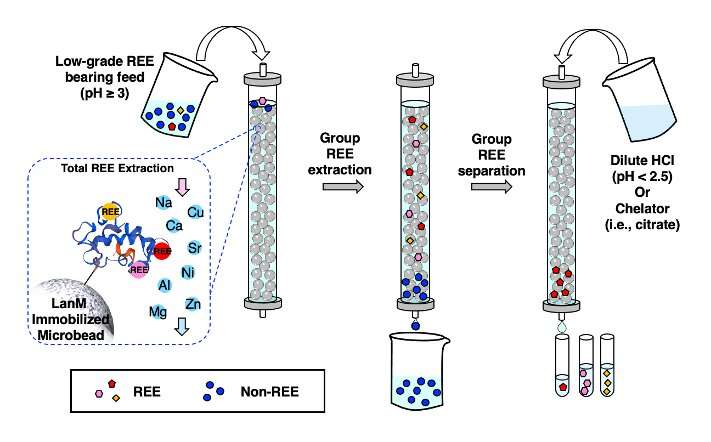
Low-grade sources of rare earth elements (REE), for example from industrial waste, typically contain many rare earth elements and other metals mixed together. A new extraction and separation method relies on a protein called lanmodulin (LanM) that first binds to all the rare earth elements in the source. Then other metals are drained and removed. By changing the conditions of the sample, for example by changing the acidity or adding ingredients called chelators, individual types of rare earth elements become unbound and can be collected. Even when a sample has very low levels of rare earth elements, this new procedure successfully extracts and separates heavy rare earth elements with high purity. Credit: Dong et al. 2021, ACS Central Science

A new method improves the extraction and separation of rare earth elements—a group of 17 elements critical for technologies such as smart phones and electric car batteries—from unconventional sources. New research led by scientists at Penn State and the Lawrence Livermore National Laboratory (LLNL) demonstrates how a protein isolated from bacteria can provide a more environmentally friendly way to extract these metals and to separate them from other metals and from each other. The method could eventually be scaled up to help develop a domestic supply of rare earth metals from industrial waste and electronics due to be recycled. 

"In order to meet the increasing demand for rare earth elements for use in emerging clean energy technologies, we need to address several challenges in the supply chain," said Joseph Cotruvo Jr., assistant professor and Louis Martarano Career Development Professor of Chemistry at Penn State, a member of Penn State's Center for Critical Minerals, and co-corresponding authors of the study. "This includes improving the efficiency and alleviating the environmental burden of the extraction and separation processes for these metals. In this study, we demonstrate a promising new method using a natural protein that could be scaled up to extract and separate rare earth elements from low-grade sources, including industrial wastes."

Because the U.S. currently imports most of the rare earth elements it needs, a new focus has been placed on establishing a domestic supply from unconventional sources, including  from burning coal and mining other metals as well as electronic waste from cell phones and many other materials. These sources are vast but considered "low grade," because the  are mixed with many other metals and the amount of rare earths present is too low for traditional processes to work well. Furthermore, current methods for extraction and separation rely on harsh chemicals, are labor intensive, sometimes involve hundreds of steps, produce a high volume of waste, and are high cost.

The new method takes advantage of a bacterial protein called lanmodulin, previously discovered by the research team, that is almost a billion times better at binding to rare earth elements than to other metals. A paper describing the process appears online Oct. 8 in the journal ACS Central Science.

The protein is first immobilized onto tiny beads within a column—a vertical tube commonly used in industrial processes—to which the liquid source material is added. The protein then binds to the rare earth elements in the sample, which allows only the rare earths to be retained in the column and the remaining liquid drained off. Then, by changing the conditions, for example by changing the acidity or adding additional ingredients, the metals unbind from the protein and can be drained and collected. By carefully changing the conditions in sequence, individual rare earth elements could be separated. 

"We first demonstrated that the method is exceptionally good at separating the rare earth elements from other metals, which is essential when dealing with low grade sources that are a hodgepodge of metals to start with," said Cotruvo. "Even in a very complex solution where less than 0.1% of the metals are rare earths—an exceedingly low amount—we successfully extracted and then separated a grouping of the lighter rare earths from a grouping of the heavier rare earths in one step. This separation is an essential simplifying step because the rare earths have to be separated into individual elements to be incorporated into technologies."

The research team separated yttrium (Y) from neodymium (Nd)—both abundant in primary rare earth deposits and coal byproducts—with greater than 99% purity. They also separated neodymium from dysprosium (Dy)—a crucial pairing that is common in electronic waste—with greater than 99.9% purity in just one or two cycles, depending on the initial  composition.

"The high-purity of the recovered neodymium and dysprosium is comparable to other separation methods and was accomplished in as many or fewer steps without using harsh organic solvents," said Ziye Dong, a postdoctoral researcher at LLNL and first author of the study. "Because the protein is able to be used for many cycles, it offers an attractive eco-friendly alternative to the methods currently used."

The researchers do not think their method will necessarily supplant the current liquid-liquid extraction process that is commonly used for high-volume production of lighter rare earth elements from high-grade sources. Instead, it will allow for efficient use of low-grade sources and especially for extraction and separation of the rarer and generally far more valuable heavy rare earths.

"Other recent methods are capable of extracting rare earth elements from low-grade sources, but they typically stop at a 'total' product that has all the rare earths lumped together, which has relatively little value and then needs to be funneled into more conventional schemes for further purification of individual rare  elements," said Dan Park, staff scientist at LLNL and co-corresponding author of the study. "The value is really in the production of individual rare earths and especially the heavier elements."

"Our process is particularly convenient because these high-value metals can be purified off the column first," added Cotruvo.

The researchers plan to optimize the method so fewer cycles are required to obtain the highest-purity products and so it can be scaled up for industrial use.

"If we can engineer derivatives of the lanmodulin protein with greater selectivity for specific elements, we could recover and separate all 17  in a relatively small number of steps, even from the most complex mixtures, and without any organic solvents or toxic chemicals, which would be a very big deal," said Cotruvo. "Our work shows that this goal should be achievable."New sensor detects valuable rare earth element terbium from non-traditional sources


More information: Ziye Dong et al, Bridging Hydrometallurgy and Biochemistry: A Protein-based Process for Recovery and Separation of Rare Earth Elements, ACS Central Science (2021). DOI: 10.1021/acscentsci.1c00724
Journal information: ACS Central Science 

 CANADIAN AND AMERICAN PRAIRIE BIRD

Studies find mixed results from sage grouse hunting restrictions

Studies find mixed results from sage grouse hunting restrictions
Female sage grouse move as a group at a site in northwest Colorado. New research 
examines the impact of hunting restrictions on the iconic bird across the West. 
Credit: Jeff Beck

A thorough review of the history of sage grouse hunting and populations across the Intermountain West shows that declines in the bird's numbers have prompted significant reductions in hunting opportunities in recent decades—with mixed results for grouse populations.

Research led by University of Wyoming Professor Jeff Beck and Oregon State University Assistant Professor Jonathan Dinkins, a former UW postdoctoral researcher, examined the history of grouse hunting regulations in 11 U.S. states and two Canadian provinces—and the impact of hunting restrictions on growth rates of the iconic Western species in recent decades.

The scientists' findings are detailed in two articles published in PLOS ONE.

"We found that wildlife agencies throughout western North America have set increasingly more conservative harvest regulations over the past 25 years to conserve ," Beck says. "Regarding the effect of hunting season regulations on  growth rates, we found mixed results."

Sage grouse once numbered in the millions across the Intermountain West, but rapidly dwindling numbers prompted state wildlife agencies to impose hunting restrictions in the 1930s and 1940s. In the past 50-plus years, loss and fragmentation of the bird's sagebrush habitat have been the primary causes of declining grouse numbers, which also are affected by  such as drought and spring snowfall, as well as disease such as West Nile Virus.

As the  has considered several petitions to protect sage grouse under the Endangered Species Act, state wildlife agencies have responded by reducing hunter bag and possession limits, and hunting season lengths—and by setting season start dates later in September to avoid concentrating hunters on females with young broods. In some cases, such as for Gunnison sage grouse in Utah and Colorado and greater sage grouse in Canada and Washington state, they've eliminated grouse hunting altogether—although that action is less common.

"It appears that, overall, agencies are doing well with adjusting the timing of hunting seasons, reducing  lengths and maintaining later hunting seasons as supported by previous research," Dinkins says. "Also, by retaining hunting seasons but lowering bag and possession limits, agencies continue to bring in important funding for conservation from hunting permits while ensuring hunter take is limited to sustain populations."

To determine the impact of hunting restrictions on grouse populations, the researchers compared counts of the birds from 22 distinct population segments on spring breeding grounds, or leks, in nine U.S. states and two Canadian provinces. They also assessed the impact of weather conditions; human activity such as oil and gas development; and habitat loss due to fire.

While there were no overall trends in the impact of  restrictions on grouse numbers, the researchers' findings did align with previous studies on the impact of human activity, habitat loss, fire and precipitation.

"Our results suggest that discontinuing harvest in the largest population (in central Idaho) resulted in greater population growth rates; however, this was not consistently the case for smaller populations," the researchers wrote. "To no surprise, not all sage grouse populations were influenced by the same environmental change or human disturbance factors."

The researchers say their population trend models will help management agencies better understand patterns and focus conservation efforts on factors that may lead to increasing adult female survival, nest success and chick survival.

Fires prompt sage grouse hunting ban in part of Nevada

More information: Jonathan B. Dinkins et al, Influence of environmental change, harvest exposure, and human disturbance on population trends of greater sage-grouse, PLOS ONE (2021). DOI: 10.1371/journal.pone.0257198

Jonathan B. Dinkins et al, Changes in hunting season regulations (1870s–2019) reduce harvest exposure on greater and Gunnison sage-grouse, PLOS ONE (2021). DOI: 10.1371/journal.pone.0253635

Journal information: PLoS ONE 

Smart robots do all the work at Nissan's 'intelligent' plant

Smart robots do all the work at Nissan's 'intelligent' plant
Robotic arms put in the electric vehicle powertrain into the Ariya model in the
 assembly line at Nissan's Tochigi plant in Kaminokawa town, Tochigi 
prefecture, Japan, Friday, Oct. 8, 2021. Nissan's "intelligent factory" hardly 
has any human workers. The robots do the work, including welding and
 mounting. They do the paint jobs and inspect their own paint jobs.
 Credit: AP Photo/Yuri Kageyama

Nissan's "intelligent factory" hardly has any human workers. The robots do the work, including welding and mounting. They do the paint jobs and inspect their own paint jobs.

"Up to now, people had to make production adjustments through experience, but now robots with artificial intelligence, analyzing collected data, are able to do it. The technology has developed to that level," Nissan Executive Vice President Hideyuki Sakamoto said during a tour of the production line for the Ariya sport-utility vehicle at its Tochigi plant Friday.

The factory, on the outskirts of Tokyo, is set to be up and running sometime before April, according to Nissan Motor Co.

Its assembly line is designed so that all three types of models—electric; e-Power, which has both a motor and an engine, and those powered by regular combustion engine—can be built on the same line. Each vehicle is equipped with the right powertrain as it moves along the line.

The workers at the factory can focus on more skilled work such as analyzing data collected by the robots, and on maintaining the equipment.

All automakers are working on robotic technology that can increase adaptability and enable them to respond quickly to market demand.

Smart robots do all the work at Nissan's 'intelligent' plant

During the tour, giant mechanical arms equipped with large displays shone light from the displays on to the car's surfaces from various angles so that cameras could detect the tiniest flaws.

A mechanism quickly wound wires around a metal object that looked like a giant spool, a motor part that Nissan is using to replace magnets now used in . The company says the innovation eliminates the need for rare earth materials, cutting costs.

Nissan said the innovations being tested in Tochigi will be gradually rolled out at its other global plants, including French alliance partner Renault's factories.

Sakamoto said it was difficult to estimate exactly how much the fully automated assembly line will save.

But he said manufacturing needs to adapt to labor shortages, to the coronavirus pandemic and to lower  to help mitigate .

Smart robots do all the work at Nissan's 'intelligent' plant

Nissan says that by 2050 it hopes to achieve carbon neutrality across its operations and the life cycle of its products, which includes raw material extraction, manufacturing, use and recycling.

A new kind of paint that enables vehicles' bodies and bumpers to be simultaneously painted and baked reduces  by 25%, the company says.

Before, vehicle bodies, which are aluminum, and plastic bumpers had to be painted separately at different temperatures.

Nissan is expecting to regain profitability in this fiscal year, but like other automakers, it is contending with parts shortages caused by the pandemic. Its brand took a hit from a scandal centered on its former chairman, Carlos Ghosn, who was arrested in Japan on financial misconduct charges in 2018.

Nissan invests in production to prepare for electric age

© 2021 The Associated Press. All rights reserved. This material may not be published, broadcast, rewritten or redistributed without permission.