Saturday, October 16, 2021

GREEN CAPITALI$M

A Complete Visual Guide to Carbon Markets


VISUAL CAPITALIST
on October 14, 2021
By Sponsored Content
Article/Editing:
Dorothy Neufeld

The following content is sponsored by Carbon Streaming Corporation.


A Complete Visual Guide to Carbon Markets

Carbon markets enable the trading of carbon credits, also referred to as carbon offsets.

One carbon credit is equivalent to one metric ton of greenhouse gas (GHG) emissions. Going further, carbon markets help companies offset their emissions and work towards their climate goals. But how exactly do carbon markets work?

In this infographic from Carbon Streaming Corporation, we look at the fundamentals of carbon markets and why they show significant growth potential.

What Are Carbon Markets?

For many companies, such as Microsoft, Delta, Shell and Gucci, carbon markets play an important role in offsetting their impact on the environment and meeting climate targets.

Companies buy a carbon credit, which funds a GHG reduction project such as reforestation. This allows the company to offset their GHG emissions. There are two main types of carbon markets, based on whether emission reductions are mandatory, or voluntary:

Compliance Markets:
Mandatory systems regulated by government organizations to cap emissions for specific industries.

Voluntary Carbon Markets:
Where carbon credits can be purchased by those that voluntarily want to offset their emissions.

As demand to cut emissions intensifies, voluntary carbon market volume has grown five-fold in less than five years.
Drivers of Carbon Market Demand

What factors are behind this surge in volume?
Paris Agreement: Companies seeking alignment with these goals.
Technological Gaps: Companies are limited by technologies that are available at scale and not cost-prohibitive.
Time Gaps: Companies do not have the means to eliminate all emissions today.
Shareholder Pressure: Companies are facing pressure from shareholders to address their emissions.

For these reasons, carbon markets are a useful tool in decarbonizing the global economy.
Voluntary Markets 101

To start, there are four key participants in voluntary carbon markets:
Project Developers: Teams who design and implement carbon offset projects that generate carbon credits.
Standards Bodies: Organizations that certify and set the criteria for carbon offsets e.g. Verra and the Gold Standard.
Brokers: Intermediaries facilitating carbon credit transactions between buyers and project developers.
End Buyers: Entities such as individuals or corporations looking to offset their carbon emissions through purchasing carbon credits.

Secondly, carbon offset projects fall within one of two main categories.

Avoidance / reduction projects prevent or reduce the release of carbon into the atmosphere. These may include avoided deforestation or projects that preserve biomass.

Removal / sequestration projects, on the other hand, remove carbon from the atmosphere, where projects may focus on reforestation or direct air capture.

In addition, carbon offset projects may offer co-benefits, which provide advantages that go beyond carbon reduction.
What are Co-Benefits?

When a carbon project offers co-benefits, it means that they provide features on top of carbon credits, such as environmental or economic characteristics, that may align with UN Sustainable Development Goals (SDGs).

Here are some examples of co-benefits a project may offer:
Biodiversity: Protecting local wildlife that would otherwise be endangered through deforestation.
Social: Promoting gender equality through supporting women in management positions and local business development.
Economic: Creating job opportunities in local communities.
Educational: Providing educational awareness of carbon mitigation within local areas, such as primary and secondary schools.

Often, companies are looking to buy carbon credits that make the greatest sustainable impact. Co-benefits can offer additional value that simultaneously address broader climate challenges.

Why Market Values Are Increasing


In 2021, market values in voluntary carbon markets are set to exceed $1 billion.
YearTraded Volume of Carbon Offsets (MtCO₂e)Voluntary Market Transaction Value2017 46 $146M
2018 98 $296M
2019 104 $320M
2020 188 $473M
2021* 239 $748M


*As of Aug. 31, 2021
Source: Ecosystem Marketplace (Sep 2021)

Today, oil majors, banks, and airlines are active players in the market. As corporate climate targets multiply, future demand for carbon credits is projected to jump 15-fold by 2030 according to the Task Force on Scaling Voluntary Carbon Markets.
What Qualifies as a High-Quality Carbon Offset?

Here are five key criteria for examining the quality of a carbon offset:
Additionality: Projects are unable to exist without revenue derived from carbon credits.
Verification: Monitored, reported, and verified by a credible third-party.
Permanence: Carbon reduction or removal will not be reversed.
Measurability: Calculated according to scientific data through a recognized methodology.
Avoid Leakage: An increase in emissions should not occur elsewhere, or account for any that do occur.

In fact, the road to net-zero requires a 23 gigatonne (GT) annual reduction in CO₂ emissions relative to current levels. High quality offsets can help meet this goal.
Fighting Climate Change

As the urgency to tackle global emissions accelerates, demand for carbon credits is poised to increase substantially—bringing much needed capital to innovative projects.

Not only do carbon credits fund nature-based projects, they also finance technological advancements and new innovations in carbon removal and reduction. For companies looking to reach their climate ambitions, carbon markets will continue to play a more concrete role.


Ex-SpaceX Engineers Are Building a Cheap, Portable Nuclear Reactor

Technology designed for future Mars colonies is 'making nuclear power portable' on Earth.

                                                           A concept image of Radiant's microreactor.


Nuclear power is going portable in the form of relatively lightweight, cost-effective microreactors. A team of former SpaceX engineers is developing the "world's first portable, zero-emissions power source" that can bring power to remote areas and also allows for quick installation of new units in populated areas, a press statement revealed.

Last year, the team secured $1.2 million in funding from angel investors for their startup Radiant to help develop its portable nuclear microreactors, which are aimed at both commercial and military applications.  

Space tech adapted for Earth colonies

We've previously reported on floating nuclear power stations, such as those produced by Danish firm Seaborg Technologies. However, Radiant's in-development technology brings a whole new dimension of portability to the nuclear reactor. 

Their microreactor, which is still in the prototype phase, outputs more than 1MW, which Radiant says is enough to power approximately 1,000 homes for up to eight years. It can be easily transported by air, sea, and road, meaning it will bring affordable energy to communities without easy access to renewable energy, allowing them to reduce their reliance on fossil fuels.

Radiant founder and CEO Doug Bernauer is a former SpaceX engineer who worked on developing energy sources for a future Mars colony during his time at the private space enterprise. During his research into microreactors for Mars, he saw an opportunity for developing a flexible, affordable power source here on Earth, leading to him founding Radiant with two other SpaceX engineers. In an interview with Power, Bernauer said "a lot of the microreactors being developed are fixed location. Nobody has a [commercial] system yet, so there’s kind of a race to be the first."

Nuclear power hits the road

Radiant announced last year that it had received two provisional patents for its portable nuclear reactor technology. One of these was for a technology that reduces the cost and the time needed to refuel their reactor, while the other improves efficiency in heat transference from the reactor core. The microreactor will use an advanced particle fuel that does not melt down and is capable of withstanding higher temperatures than traditional nuclear fuels. Helium coolant, meanwhile, reduces the corrosion and contamination risks associated with traditional water coolant. Radiant has signed a contract with Battelle Energy Alliance to test its portable microreactor technology at its Idaho National Laboratory (INL).

"In some areas of the world, reliance on diesel fuel is untenable, and solar and wind power are either unavailable or impractical," said Jess Gehin, Ph.D., Chief Scientist, Nuclear Science & Technology Directorate at INL. "Clean, safe nuclear microreactors are emerging as the best alternative for these environments." 

Radiant's microreactor can be used in remote locations, such as arctic villages and isolated military encampments that would otherwise typically rely on fossil fuel-powered generators. Not only is the portable microreactor better for the environment, but it is also more practical as it doesn't rely on constant shipments of fuel. Instead, the clean fuel used for Radiant's microreactors can last more than 4 years. If all goes well with Radiant's test campaign, nuclear power might soon hit the road. In doing so it will help to power countless remote communities, and will further bolster the resurgence of nuclear power in a world that needs clean energy solutions more than ever.


Exploring Earth's oceans to reach Europa

Exploring Earth’s oceans to reach Europa
Icefin is a small robotic oceanographer that allows researchers to study ice and water 
around and beneath ice shelves – and develop the technology to explore other oceans
 in our solar system. Credit: Cornell University

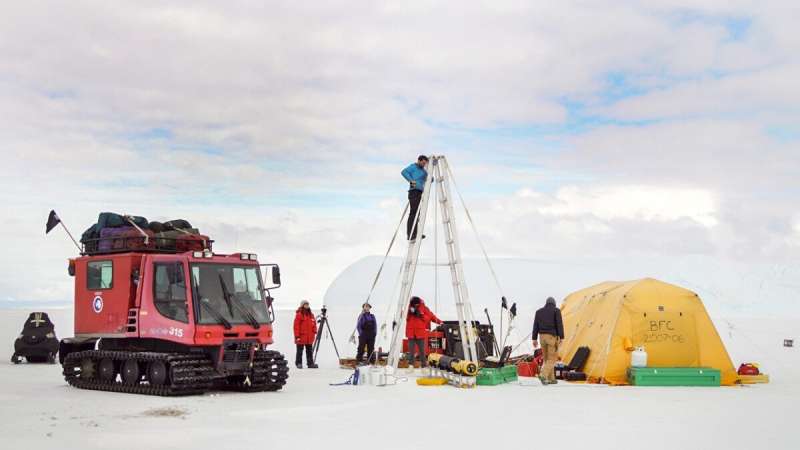
Geographically and logistically, Antarctica is about as far away from anywhere as you can get on this planet. Yet in the scope of our solar system, Earth's southernmost continent is right in our own backyard.

Britney Schmidt is in Antarctica through February 2022 with a small team of researchers to explore the confluence of glaciers, floating  and ocean using a submarine robot called Icefin—the  of its kind. But the whole time, she'll also be thinking about worlds beyond Earth.

"My team and I focus on how ice and oceans work across the solar system, including Earth. Particularly, we focus on Europa, the innermost icy moon of Jupiter," Schmidt says.

Europa is the best place beyond Earth to look for life in the solar system, Schmidt says. To prepare for immanent missions to Europa and other ocean worlds, she's leading teams studying polar ice and climate here on Earth.

"We're trying to explore underwater, under ice, the hardest environment you can imagine—the most like Europa," Schmidt said. "If we want to explore Europa with an underwater probe someday, we've got to do it here first."

The members of her Planetary Habitability and Technology lab, which is transitioning with Schmidt from Georgia Tech to Cornell, are working to better understand how oceans work both on Earth and beyond, and to develop tools for further exploration.

Credit: Cornell University

This mission assembles a diverse team of geologists, biologists, physicists, astronomers and chemists on the science side, and engineers from aerospace, mechanical and electrical disciplines, as well as computer science. Scientists and engineers on her team work "in the same loop, in the same room," Schmidt says. "The interdisciplinarity that Cornell seems to embrace and enable is exciting."

Schmidt's arrival at Cornell in July strengthened those cross-disciplinary ties between colleges, specifically in the area of robotics and autonomy, a high-priority research theme across the university. With joint appointments as an associate professor in the Department of Astronomy in the College of Arts and Sciences and the Department of Earth and Atmospheric Sciences in the College of Engineering, Schmidt will be a key asset in expanding Cornell's robotics program into the area of planetary exploration.

For example, Schmidt is on the ice-penetrating radar team of NASA's Europa Clipper mission, which will launch in the mid-2020s to explore the outer solar system. Department of Astronomy (A&S) faculty members Jonathan Lunine and Alexander Hayes are also involved in this mission, as is Principal Research Scientist Michael Mellon. Altogether Cornell scientists are on five of Clipper's 10 instruments and will play a major role in mission planning and analysis of data.

For now, Schmidt and four colleagues from her team are working with colleagues from across New Zealand to deepen understanding of ocean worlds and to develop and test new tools. Icefin, their underwater, under-ice robotic oceanographer, will allow the team to access areas beneath the Ross Ice Shelf from previously unexplored angles.

Exploring Earth’s oceans to reach Europa
Britney Schmidt, associate professor of astronomy and of earth and atmospheric sciences,
 and her team set up their field site in Antarctica in 2018. They’re currently in Antarctica 
through February 2022. Credit: Cornell University

Icefin—shaped like a torpedo, 13 feet long and 10 inches wide—carries cameras, sonar equipment, speed sensors, water column measuring tools and other devices. The team slips it into open water through a hole drilled in thick ice on the surface.

"We developed this tool to get into environments that have never been observed directly," Schmidt says. "It allows us to make transects under the ice, and measure the ocean directly where it's interacting with the ice."

In the Ross Ice Shelf and Europa Underwater Probe (RISE UP) project, Schmidt and collaborators are using Icefin to learn the limits of life on Earth and to gain an understanding of the evolution of Jupiter's icy moon Europa. Field work for this project is being conducted in McMurdo Station in Antarctica and in the nearby seas, and receives funding from NASA and support from Antarctica New Zealand and the National Science Foundation (NSF). In late 2019, Icefin explored under the Ross Ice Shelf (RIS) near its grounding line—the place where glacier, land and ocean all meet, the most dynamic part of a glacier system.

In austral summer 2019–20, the Antarctic team traveled even farther away from the U.S. base at McMurdo for a similar project: to explore the Thwaites Glacier grounding line using Icefin, for the Thwaites Melt project, funded by NSF and the National Environment Research Council.

Exploring Earth’s oceans to reach Europa
The Icefin underwater vehicle has sonar, chemical and biological sensors that help research
ers characterize sub-ice environments.  Credit: Cornell University

The team is now deploying a brand-new sensor onboard Icefin under the sea ice near New Zealand's Scott Base, along with a University of Otago team. This new sensor will make it possible to understand ice shelf melting and sea ice physics in new ways.

From there, the team will fly with Icefin to a new location with New Zealand's Antarctic Science Platform program. There, the robot will explore a subglacial channel that connects lakes and streams underneath the Antarctic Ice sheet with the open ocean underneath the RIS.

"We're going to drop the robot straight into the channel where there's water rushing out from beneath the ice sheet. That's never been done before," Schmidt said. "It allows us to see what's happening with the entire hydrology of Antarctica, in situ. It's exciting, looking at the interactions between the water beneath the ice and the oceanRobotic submarine snaps first-ever images at foundation of notorious Antarctic glacier

Provided by Cornell University 

BC
Vaughn Palmer: Horgan calls on celebs to back up call to save old-growth forest with cold, hard cash

Opinion: Province is working on protections for ancient trees, but needs about $500 million to supply options for forest-dependent communities, premier says

Author of the article: Vaughn Palmer
Publishing date: Oct 14, 2021 • 
Star Trek fan and premier, John Horgan, flashes the Vulcan salute.
 PHOTO BY JONATHAN HAYWARD /THE CANADIAN PRESS
Article content

VICTORIA — John Horgan pushed back this week against a celebrity-led call for him to curb old-growth logging, never mind that one of the leaders was a legend for Star Trek fans like the premier.

Actor William Shatner, Captain Kirk to fans of the TV series, was one of 200 celebrities, scientists, politicians and Indigenous leaders who recently signed an open letter against further logging of old growth in B.C.

“Premier Horgan, these forests should live long and prosper,” declared Shatner, invoking one of the catchphrases of the venerable TV series, albeit one associated with his co-star Leonard Nimoy in the role of science officer Mr. Spock.

Piling on were environmentalists unable to resist tweaking a premier whose Trekkie proclivities include a pair of Mr. Spock socks and a failed tryout for a part as an extra in a Vancouver-based Star Trek production.

“Horgan should listen to one of his apparent heroes and go where no premier has gone before,” said Torrance Coste, a campaigner for the Wilderness Committee, riffing on another Star Trek catchphrase with reporter Rochelle Baker of the National Observer.

Actually, Horgan’s favourite Star Trek captain is Kathryn Janeway of the USS Voyager, not James T. Kirk of the USS Enterprise. He is also on the record as a big fan of George Takei, Mr. Sulu in the original series, who has been engaged in a decades-long feud with Shatner.

Still, the premier began with a grace note Wednesday, when asked about Shatner’s old-growth crusade on the day that the 90-year old actor blasted briefly into space on the Blue Origin rocket.

“First I want to just commend William Shatner to have gone where no 90-year-old has gone before,” Horgan told broadcaster Al Ferraby on CFAX radio in Victoria. “Regardless of your politics or your passions about the issues of the day, everybody’s got to be excited about a good Canadian kid going up to space, albeit just for a few minutes.”

Star Trek actor William Shatner experiences weightlessness with three other passengers during the apogee of the Blue Origin New Shepard mission NS-18 suborbital flight over Texas. PHOTO BY BLUE ORIGIN /REUTERS

Turning to old growth, Horgan proceeded to set the record straight, as he sees it, regarding last year’s strategic review.

“We put in place a committee to review this, two prominent foresters, independent, they gave us recommendations. We accepted the recommendations and for the past year we’ve been working on that,” he continued.

“The particular watershed that seems to capture attention here in the South Island — Fairy Creek in Pacheedaht territory — has been deferred from logging at the request of the First Nation, which was part of the recommendations we received.

“So I believe we’re doing everything we can to implement the spirit and intent of the recommendations in a way that’s fair to those who have rights — not rights that I granted them or you granted them, Al — but that were granted decades ago by previous governments.”

Then came the shot at Shatner and the other signatories.

“It’s all well and good for 200 celebrities to put an ad in the Globe and Mail,” said Horgan, referring to this week’s publication of the letter. “But I would prefer they put down a couple million bucks each so that we can defer that logging without disrupting people’s lives, giving the Indigenous communities, whose lands these forests are on, other opportunities.

“It’s pretty easy to say yeah, put my name in the paper. It’s a little bit harder to write a cheque.

“So I’m hopeful that some of the more well-financed people who believe that an ad in the paper is the way to affect policy change will put some money on the table and help the people that will be affected by the decisions we’re going to be making in the next couple of weeks.”

RCMP officers make their way around two protesters chained to a tree stump at an anti-logging protest in Caycuse, B.C. on Tuesday, May 18, 2021
PHOTO BY THE CANADIAN PRESS/JEN OSBORNE /The Canadian Press

The comment expands on something else the premier said recently when asked about the $50-million Old Growth Nature Fund, touted by the federal Liberals in their bid for re-election.

“That would be a very small amount of money relative to the consequences to the forest industry, to communities and to workers,” explained Horgan.

“I’m hopeful that the federal government will up their game a little bit so that we can have a real, meaningful discussion and get the conclusions that I know all British Columbians want to see — protection of our special places, continuing to have a foundational industry, not just now, but well into the future.”

What would it take in terms of a dollar commitment?

“Add a zero to that” — the $50 million — “and we’re in the ballpark,” said the premier, suggesting the federal government needed to put up $500 million as its share of a comprehensive drive to phase out old-growth logging.

Nor would that likely be the end of it.

One of the authors of the strategic review of old growth, professional forester Garry Merkel, has warned about the high costs associated with an immediate and total ban on old growth logging in B.C.

“You’d be talking about quite a few billion dollars because some of the industry is still dependent on some old growth (and) some is very dependent,” he told CBC host Gregor Craigie earlier this year.

Hence Horgan’s “where’s the money?” pushback on Shatner and his fellow signatories.

He’s likely thinking of what his own briefing notes must be telling him about the cost of buying timber cutting rights, compensating First Nations, and absorbing a major hit to jobs and the forest economy.

vpalmer@postmedia.com

Plastic production is a fossil fuel problem

Managing the climate crisis means diminishing our reliance on both.


BY ERICA CIRINO | PUBLISHED OCT 14, 2021

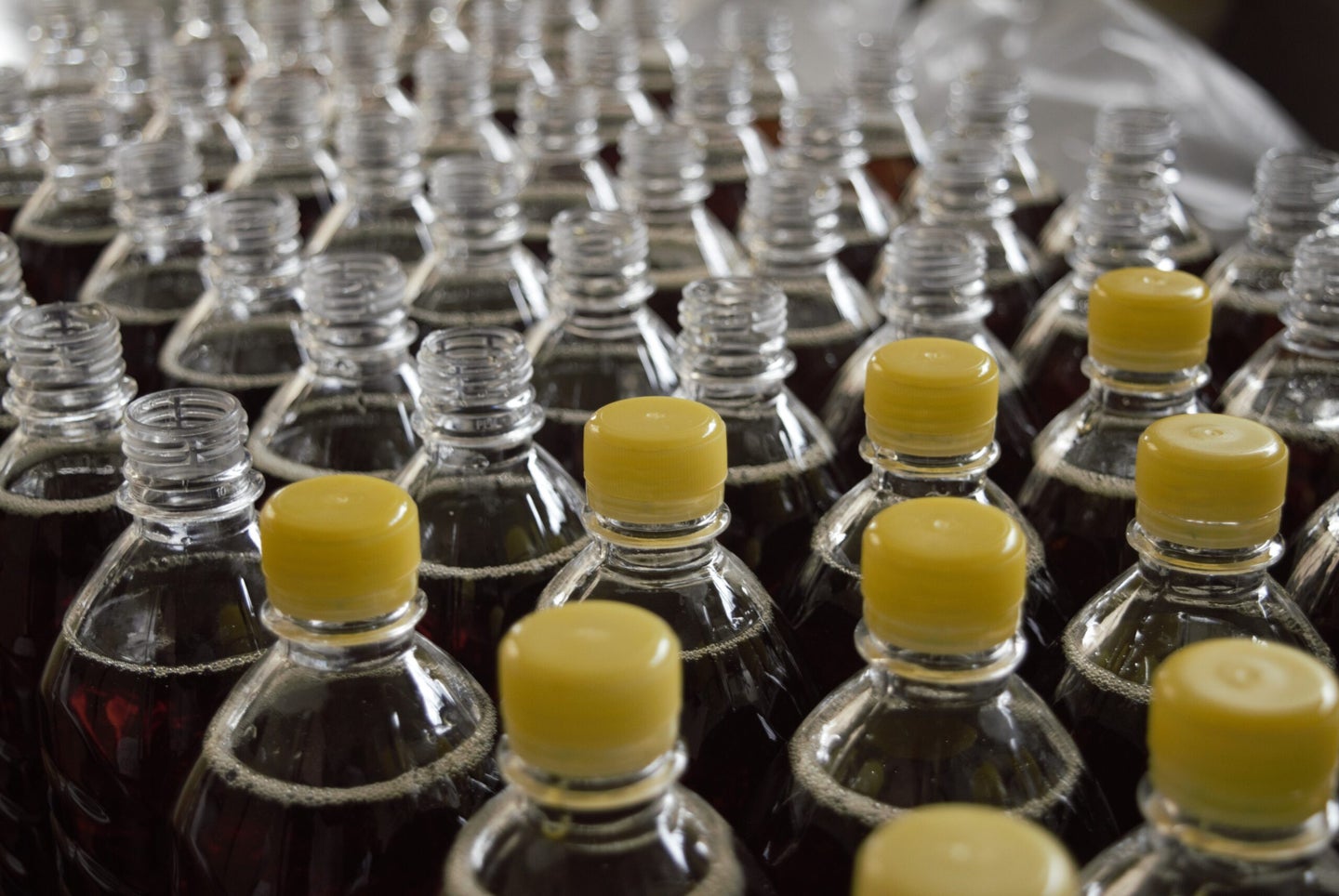
The making of plastic, not just the recycling, is an environmental problem. 
Arshad Pooloo on Unsplash

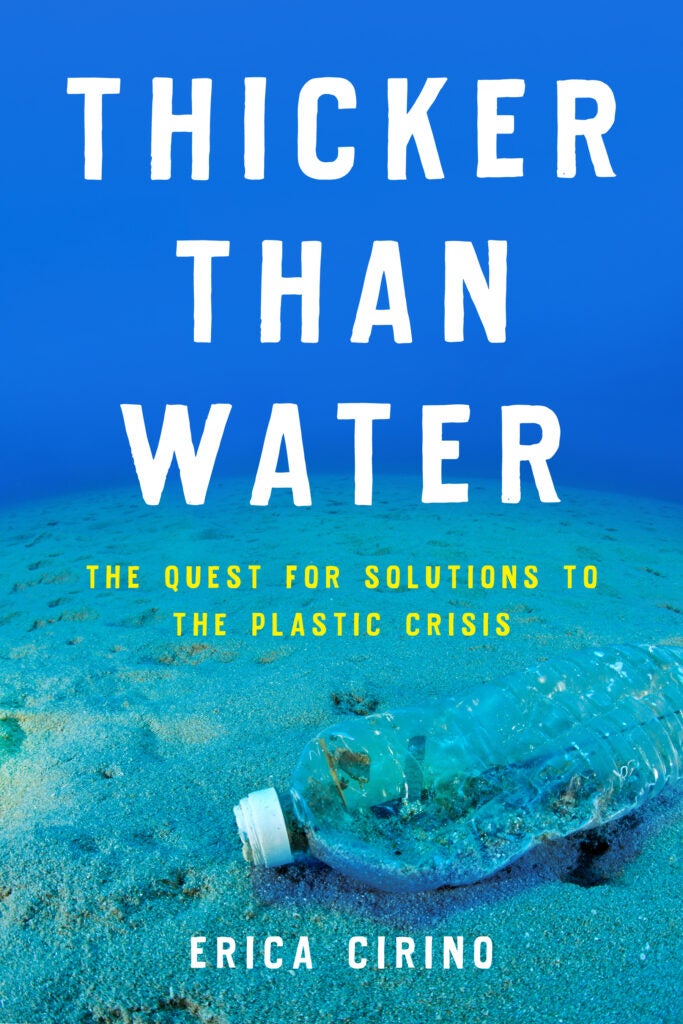
The following is an excerpt from Thicker Than Water: The Quest for Solutions to the Plastic Crisis by Erica Cirino.


Cancer Alley snakes 85 miles along both banks of the Mississippi, forming a patchwork of sugarcane plantations and petrochemical complexes, the former with a legacy of slavery and soil degradation and the latter with a legacy of spills, explosions, and widespread pollution. As industry has closed in, breathing room has been hard to come by. Many people who live on the industrial fenceline are fearful for their lives.


At one fenceline, in Welcome, St. James Parish, Louisiana, I met Sharon Lavigne, who recently won a Goldman Environmental Prize for her environmental justice activism. Lavigne founded a Christian faith–based activist organization, called RISE St. James, in 2018 to stand against a $1.25 billion plastic plant proposed by Chinese chemical company Wanhua. RISE spoke out. The plant was never constructed.

Most recently, Lavigne has spoken out against the planned construction of a $9.4 billion plastic and petrochemical complex in Welcome, a predominantly African American community. So far, she and RISE have succeeded in staving off the completion of this latest industrial development—owned by FG LA LLC, a company related to major Taiwanese manufacturing conglomerate Formosa Plastics—to buy up land in St. James Parish, through an assortment of justice-seeking community actions and other campaigns. Formosa Plastics is the world’s fourth-largest producer of petrochemicals and plastic.

Earlier this year, United Nations human rights experts called for an end to racism in Cancer Alley, a place where communities of color bear disproportionate risk to industrial hazards. This month, a new report on Formosa Plastics runs through the company’s messy environmental, economic, and legal track records. One of experts’ top recommendations: rescind Formosa’s permits in St. James, Louisiana; get the company out.

Some may believe that, in a region already replete with chemicals, stopping Formosa—one plastic plant—would provide only trivial benefits to public health. In reality, such a victory would not only spare the residents of St. James from additional exposure to pollutants but would also be a win in the fight against climate change—another massive crisis we are now facing.

Scientists agree we must now wean ourselves off substances that contribute to climate change when extracted, processed, and burned—namely, oil shales, bitumens, tar sands, coal, petroleum, natural gas, and heavy oils—and we must stop continued industrial development.

[Related: Will we ever be able to recycle all our plastic?]


As Peggy Shepard, co-founder and executive director of WE ACT for Environmental Justice in New York and newly appointed co-chair of the White House’s first environmental justice advisory council told me: “It is essential to dismantle these institutions, because they are not going to concede power on their own. We must transition away from an economy based on fossil fuels, and that includes plastics. Our future depends on that.”

And as we build up a new, renewable-powered world, “We need to ensure that it serves everyone—not just those currently in positions of power,” Shepard added. Focusing on equity, rather than equality, she said, and prioritizing underserved communities’ transition from fossil fuels and plastic production to renewable energy sources and materials is a good place to start. “Decades of disinvestment driven by racism has put communities of color at a massive disadvantage. This is our opportunity to fix that.”

Our collective attention to climate change continues to grow as its deleterious effects—warmer air and seas, widespread wildfires, more intense and frequent storms, and species extinction, among them— become more apparent to us all. But humanity has collectively struggled to take the necessary step of shutting down the fossil fuel and plastic industries, because we have become entirely reliant on fossil fuels to navigate our hyperconnected, super-fast modern human society.


Recently, we got a glimpse of what leaning less heavily on fossil fuels could mean for us—and the industries we must disassemble: those dealing in oil, gas, petrochemicals, and plastic.

By April 2020, the coronavirus pandemic ground daily life to a halt for many people around the world. During the pandemic’s peak, our carbon footprints were smaller than they’d been in a long time. Lockdowns, travel bans, business shutdowns, quarantines, and curfews forced people to stay local and make do. As a result, the world’s collective carbon dioxide emissions dropped by 17 percent from 2019 levels.

This is a not-insignificant number when you consider that the world’s top climate scientists say global emissions must fall by at least 7.6 percent annually until 2030 in order for humanity to even slightly reduce the disastrous, rapidly accelerating consequences of climate change.


Consequently, as the pandemic hit and demand for and values of oil and gas dropped precipitously, some smaller petrochemical companies were forced to shutter while a few larger companies issued temporary plant shutdowns and employee furloughs.


Island Press

Meanwhile, residents of some of the world’s largest cities—at least, those not living in wildfire zones—collectively reported that the air they breathed seemed cleaner than usual, even in some notoriously smoggy urban centers.

As soon as regulations implemented to quell the pandemic were eased later that spring, global emissions began rising and air quality plummeted again, especially in industrial areas. By June 2020, lifting and uneven restrictions on travel and work pushed the world’s greenhouse gas emissions back up to a measly 5 percent below 2019 levels, according to a report by the World Meteorological Organization.


Although the slowdown in emissions caused by the COVID-19 pandemic was temporary, some experts, including climate activist Bill McKibben—author of The End of Nature, the first popular book written on global warming, published in 1989—have posited that petrochemical companies are finally losing some of their political and economic clout. “It’s not a spent force by any means, but, even in the past few weeks, events have shown it to be waning where for a century and a half it has waxed,” McKibben wrote in The New Yorker in 2020. In his article, he cites grassroots efforts protesting petrochemical development, university divestment campaigns, and the development of affordable renewable energy as major contributors to the fossil fuel industry’s downshift in power.

But the fossil fuel corporations have a last ditch plan to counteract diminishing demand: make more plastic. “It’s no surprise to see that fossil fuel corporations have turned to plastics as a lifeline as climate change concerns reduce the demand for fuel,” John Hocevar, Greenpeace’s Ocean Campaigns director, told me.

Indeed, sensing a global shift in climate change policy, and reacting to new emissions agreements, Big Oil and Gas is banking on turning ancient carbon stocks—particularly shale gas—into plastic, instead of continuing to produce fossil fuels primarily to be burned for energy. In the US alone, major petrochemical companies like ExxonMobil, Saudi Aramco, and Shell have put more than $200 billion into several hundred natural gas plastic and chemical facilities since 2010, according to the American Chemistry Council.


[Related: To prevent catastrophic global warming, we need to leave fossils fuels in the ground.]

Plastic production reached 311 million metric tons globally in 2014. That number is expected to double before 2030 and quadruple by 2050. Sales of petrochemicals, including those used to make plastic, regularly earn the world’s top fossil-fuel dealers annual revenues in the tens of billions of dollars. These super wealthy corporations continue to target their development in underserved communities. In the US, plastic production is ramping up along the Louisiana and Texas Gulf Coast and in Cancer Alley, where so much petrochemical infrastructure already exists in communities of color. It’s also expanding in the rural Ohio River Valley and Appalachia, where fracking wells brimming with natural gas are polluting thousands of low income neighborhoods.

Plastic can be made from either oil or gas, and so are most of its additives. Plastic’s main ingredients are pulled from freshly extracted fossil fuels in oil refineries and gas processing plants: naphtha, a crude oil–based substance; and ethane, a liquid natural gas.


Extracting fossil fuels from the earth and turning them into plastic requires not only massive amounts of petrochemicals but also energy—and currently, this energy comes from burning more fossil fuels. Petrochemicals—including those used to make plastic—are set to become the biggest driver of growth for the global oil industry by 2050. And petrochemicals are expected to become a significant driver of gas industry growth: By 2030, global production of petrochemicals will require an additional 56 billion cubic meters of gas—approximately half of all of Canada’s present level of natural gas consumption. Greenhouse gas emissions linked to plastic production now hover around 900 million metric tons of carbon dioxide per year. That number is expected to surpass 1.3 billion metric tons, the equivalent annual carbon output of nearly three hundred coal fired power plants, by 2030. Those numbers exclude greenhouse gas emissions emitted during recycling and incineration, which also require energy, as well as landfills, which emit high levels of potent greenhouse gases, and from plastic itself.

Many of the people worst affected by the climate crisis are also affected by environmental racism. Like Sharon Lavigne and her neighbors in St. James. Southern Louisiana has proven among the regions hardest-hit by severe weather such as high temperatures and humidity, and rising and warming seas. Katrina, Rita, Harvey, Laura, Delta, Ida…. The storms are rolling in faster, harder, more devastatingly each time.

It’s clear: The more plastic people choose to put on the planet, the more forcefully humanity condemns itself to life on a dangerously warming planet—unfairly burdening some more than others.


Excerpted from Thicker Than Water: The Quest for Solutions to the Plastic Crisis by Erica Cirino; Copyright © 2021 by the author. Reproduced by permission of Island Press, Washington, D.C.
A RIGHT WING DISTRACTION #VOTENO
Equalization referendum debate heats up in Alberta as Kenney's approval further plummets


Equalization vote crucial for Kenney

Equalization explained ahead of Alberta referendum


Mark Villani
CTV News Calgary 
Video Journalist
Oct. 13, 2021 

CALGARY -

Alberta Premier Jason Kenney insists the province’s referendum on equalization has nothing to do with his leadership, despite his approval rating ranking as the lowest among Canada's provincial leaders.

“This is an opportunity for Albertans to say yes to a fair deal, it's not about partisan politics, there will be a provincial election in the spring of 2023, this is about whether or not Alberta should push hard to get a fair deal,” Kenney said.

“I always say that we Albertans are generous, we are proud to be able to share some of our good fortune with other parts of Canada when times are good here and bad elsewhere. But we insist on having the ability to develop our resources, and the prosperity that ends up being shared through programs like equalization that's what this vote is about.”

According to poll numbers released Wednesday by Angus Reid, just one-in-five (22 per cent) of Albertans approve of Kenney, who saw his rating drop another nine per cent since June in what is now the lowest point in his two-year stint as premier.

The low number is largely the result of Kenney's handling, or mishandling, of the fourth wave of the COVID-19 pandemic, which has seen hospitals in the province overwhelmed with patients, said Mount Royal University political scientist Lori Williams.

"The central problem here is that Jason Kenney is incapable of learning from his mistakes, and there's nothing more central to life, never mind political life, than to be able to learn from your mistakes," she said.

"And he refuses to bring anybody around him who will give the kind of advice he needs."

The survey comes as Alberta is set to fulfill an election promise Kenney made to hold a referendum on equalization and rewriting part of Canada’s constitution, even though Alberta has absolutely no power to implement it. The vote is purely symbolic and designed to send Ottawa a message.

The ‘yes’ or ‘no’ question on the Oct. 18 municipal election ballot is straightforward: “Should Section 36(2) of the Constitution Act, 1982 – Parliament and the Government of Canada’s commitment to the principle of making equalization payments be removed from the Constitution?"

This refers to the section of the constitution that says the Canadian government supports the idea of ensuring “provincial governments have sufficient revenues to reasonably comparable levels of public services at reasonably comparable levels of taxation.”

In a nutshell, it means the federal government provides additional support to governments of poorer provinces such as Quebec or the Maritimes where their average consumer spending is lower and it’s harder to raise revenue for healthcare or education.

UNFAIR, UNAFFORDABLE, AND UNACCEPTABLE

Bill Bewick, the executive director of Fairness Alberta and a political science professor at Athabasca University, argues against equalization, adding that it is unfair, unaffordable and unacceptable.

“Albertans have been sending about $20 billion a year to the rest of Canada via Ottawa through our taxes, and that's been going on for over a decade,” Bewick said.

“For a while, you know, we didn't want to make a big fuss out of it, things were going pretty good here, it seemed like the federal government was supporting us, but since the energy downturn in 2015 that has all changed.”

Bewick adds this referendum will not succeed in completely eliminating equalization, but Albertans should demand significant changes and a positive vote could help in giving the province leverage over the federal government in the future.

“We would still be sharing billions and billions and billions of dollars with the rest of Canada through things like the health transfer through our various programs," he said.

"So this is about not stopping sharing, it's about making it more fair and saying whoa this is too much, we need to scale it back."

Berwick says Alberta’s federal taxes are twice as high as provincial taxes while provincial services are relied upon the most by Albertans, noting that equalization payments are continuing to climb while the province’s economic situation sees little improvement.

“They are going up, they've gone up $5 billion in the last five years and they're going up another $4 billion in the next four years. It's just really frustrating to see that much money continuing to go in increasing amounts at a time when it's less needed than ever, and less affordable than ever.”

A COSTLY DISTRACTION

University of Calgary economist Trevor Tombe suggests that voting ‘No’ to the equalization question on Oct. 18 is important because it risks long-term damage to our federation and could be a costly distraction from Alberta’s real challenges

Tombe notes that at every point in Canadian history, federal transfers have been unevenly distributed across provinces to reflect that some have a more difficult time than others, but eliminating equalization is not a solid option.

He says that if it were not for programs like equalization, there would be intense pressure for the federal government to take a more active role and delivery of core areas of public service.

“If you think about Prince Edward Island (PEI), if they didn't have equalization they would need an HST rate of 30 per cent (five per cent federal 25 per cent provincial),” Tombe said.

“So programs like this are necessary for lower income provinces to avoid those tough choices. PEI for example needs their entire personal income tax system, plus a 10 per cent sales tax to just fund health care, whereas in Alberta, we have much easier time raising revenue than if we had the PEI personal income tax system.”

Tombe says that despite concerns, he views the referendum as more of an outlet to express frustration instead of the legitimate disagreement behind equalization.

Think about the policy issues, and just even a little bit understand that Alberta doesn't pay a thing into equalization, there is no such thing as an equalization pot or an equalization pool of dollars, this is just entirely a federal program,” Tombe said.

“Equalization flows at a general revenue just like their office supply budget does so Alberta doesn't contribute a thing. Canadian taxpayers who live everywhere, including here in Alberta, pay Canadian taxes to the federal government and that's what funds it.”

With files from CTV Calgary's Dave Dormer


ALBERTA
Oil and gas well cleanup efforts hampered by labour shortage

By Staff The Canadian Press
Posted October 15, 2021 


Public funds for oil well cleanup may not have been well spent, according to a report from the Parkland Institute, a research group headquartered at the University of Alberta, and Oxfam Canada. Kim Smith spoke with Megan Egler, author of the report – Jul 18, 2021


A shortage of rig workers could delay progress when it comes to cleaning up Alberta’s tens of thousands of inactive oil and gas wells.

The Canadian Association of Energy Contractors says drilling and service companies are struggling to find enough workers as oil and gas companies ramp up production in response to surging commodity prices.

READ MORE: Shortage of rig workers could slow Canadian oilpatch recovery, industry warns

Many of the same companies that provide rigs for new drilling programs are also involved in industry cleanup efforts.

The Alberta government announced last year it would require companies to spend a minimum amount of money every year toward cleanup of inactive wells. The federal government has also made $1-billion available to Alberta for industry contractors working on well cleanup.
1:46Alberta will start paying out $1B in federal oilfield cleanup grants May 1Alberta will start paying out $1B in federal oilfield cleanup grants May 1 – Apr 24, 2020


The government programs were in part meant to help create jobs for unemployed rig workers at the outset of the pandemic. Oil prices crashed in early 2020 and many rigs were idled.

READ MORE: Easing rules on transfer of unreclaimed oil wells could speed cleanup, study finds

Alberta Energy spokeswoman Jennifer Henshaw says the government is in talks with industry about the labour shortage. She said worker shortages could delay efforts in the short-term, but well cleanup remains a priority.
'MAYBE' TECH
GREEN ENERGY
Upper Nicola Indian Band continues innovative trend with partnership in $1.3 billion carbon capture plant


A carbon capture plant in Upper Nicola, north of Merritt, will look similar to Carbon Engineering's plant in Squamish, B.C. (Image Credit: Carbon Engineering)

By Chad Klassen
Oct 14, 2021 | 5:22 PM

KAMLOOPS — Carbon Engineering has been working on helping the climate for the last decade, developing technologies to capture carbon from the atmosphere.

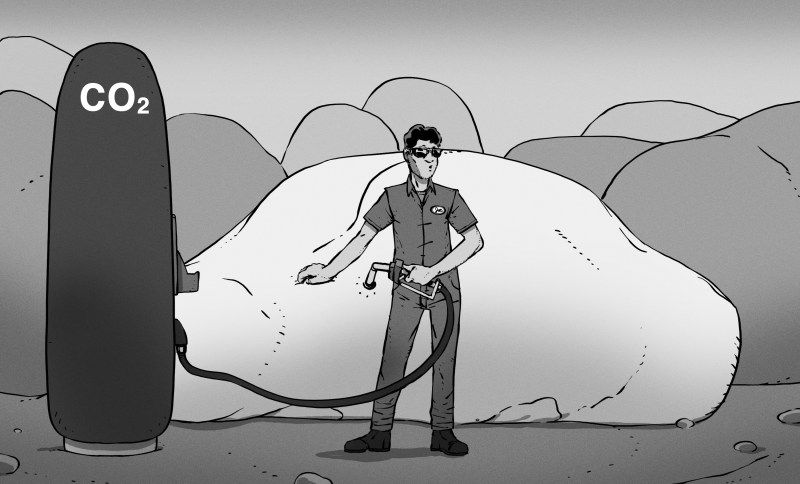
In 2015, the company first collected carbon from its pilot carbon capture plant in Squamish. It has plants across North America, but never has Carbon Engineering built a plant that produces synthetic fuel that can used in cars. That will all change in a few years with the development of a plant on the Upper Nicola Indian Band.

“We’re combining hydrogen and carbon collected from the atmosphere to make a clean fuel,” said Carbon Engineering CEO Steve Oldman told CFJC Today. “That’s the first. It’s the first plant to use our technology to do that in the world.”

The Upper Nicola Indian Band has been one of the more innovative bands in B.C. It’s in the process of developing a solar farm to produce electricity for the First Nation, and now the carbon capture plant.

“Climate change is a huge issue, not only in this country but around the world,” said Kukpi7 Harvey McLeod from the Upper Nicola Indian Band. “And we do a lot of talking about it. ‘We’ve got to do something. We’ve got to do something,’ but what do we do.”

Altogether, the project will cost $1.3 billion to build. There is a partnership between Carbon Engineering, Huron Clean Energy, the Province of B.C. and the Upper Nicola Indian Band. The First Nation will have about 10 per cent share in the project, benefitting not only Mother Nature but also band members.

“Helping us stand up,” said McLeod. “Helping us pay for the things we need in our community — build our homes, provide more education, provide more social services so that we as people can really stand up and be included as citizens of this country. That’s what’s so exciting about it.”

B.C. energy minister Bruce Raltson added, “The chief [Harvey McLeod] talked very eloquently at the opening about the opportunity to participate directly in the economy. There are other projects the Upper Nicola [Indian Band] have in the hopper, including a solar project, but this is one where they see a lot of promise, not only a revenue stream but an opportunity to work on one of the great challenges of our time, if not the greatest challenge, that of climate change.”

Carbon Engineering is in the design phase of the plant, which will take about two years, then another couple years for construction. The plant is expected to open in 2026. The goal is to produce 100 million litres of low-carbon fuel annually.

“You produce the fuel there [at Upper Nicola] and then you take the fuel and you send it to a refinery or you send it direct to a fuel distributor,” said Oldman.

The synthetic fuel would be completely compatible with your car. The synthetic fuel would be transported to gas stations the same way gasoline is now.

The company is using the Upper Nicola project as a blueprint for other such plants around the world.

“We can replicate this design and build many plants worldwide. The climate problem is really large, so we need large-scale solutions that we can deploy to many places,” noted Oldman.

Carbon Engineering feels we are a few years aware from a full transition to a green economy, and this synthetic fuel that doesn’t emit carbon can help reduce the amount of carbon going into the atmosphere.

“If you can’t electrify, then replacing the fuel so the fuel is carbon neutral is interesting, and the fact that the fuel allows you to be carbon-neutralize your current vehicle, without changing, we also think that’s a powerful capability,” said Oldman.

The B.C. government is hoping more such projects come forward to fulfill the province’s goal of reducing carbon emissions.


THE REALITY IS THAT CCS IS NOT GREEN NOR CLEAN IT IS GOING TO BE USED TO FRACK OLD DRY WELLS SUCH AS IN THE BAKAN SHIELD IN SASKATCHEWAN
https://plawiuk.blogspot.com/2014/10/the-myth-of-carbon-capture-and-storage.html

ALSO SEE https://plawiuk.blogspot.com/search?q=CCS
Is Joe Manchin Aware That His Favorite Climate Technology Is a Total Bust?

The conservative Democrat is insisting that Biden’s Build Back Better Act include funding for carbon capture projects. 

But even the fossil fuel industry admits the tech is a nonfactor in fighting global warming.


WIN MCNAMEE/GETTY IMAGES

NEW REPUBLIC
Geoff Dembicki/October 14, 2021

Senator Joe Manchin has insisted for months that he won’t support President Biden’s Build Back Better Act unless it subsidizes a largely unproven and expensive climate technology. Democrats are now bending to the conservative Democrat from West Virginia: The multitrillion-dollar reconciliation bill being debated in the Senate is likely to include generous tax credits for coal, oil, gas, and other industrial companies to capture their massive greenhouse gas emissions and bury them underground.

But carbon capture and storage, or CCS, is light years away from doing anything to help climate change. That’s the conclusion of a new report written not by a climate group but rather by some of the technology’s biggest corporate defenders.

The 43-page report, released earlier this week by the Global CCS Institute, reveals that even with substantial financial support from governments and thousands of advertisements from oil companies touting the potential of CCS, the actual climate-fighting capacity of such projects in operation or in various stages of planning worldwide is slightly lower than it was a decade ago. “Despite unprecedented growth in the CCS project pipeline for the last 12 months, there remains a massive gap between today’s CCS fleet and what is required to reduce global anthropogenic emissions to net zero,” explains the institute, whose members include Chevron, Exxon, General Electric, Occidental Petroleum, Southern Company, and dozens of other top industrial climate polluters.

The report says that CCS projects would need to be capturing the equivalent of 5,600 million tons of carbon dioxide in order to keep global temperatures below two degrees Celsius (3.6 degrees Fahrenheit), the threshold beyond which scientists warn our climate system could spin dangerously out of control. Today, however, the technology is capturing 40 million tons. That’s a climate rounding error when you consider that atmosphere-altering emissions from Exxon’s oil and gas products alone were 1,300 million tons in 2019.

“The technology works great,” Matt Bright, a spokesperson for the Global CCS Institute, wrote in an email to The New Republic. “Yes, it’s feasible, it’s just difficult. Going to the moon wasn’t feasible in 1960. Then JFK said ‘We’re going to the moon in this decade,’ made it feasible, and we got there in 1969.”

Climate advocates have a much different interpretation of the report. “The world is finally having a reality check on CCS,” climate activist Tzeporah Berman tweeted in response. “No progress in a decade despite billions in investment.”

Even the most advanced carbon capture facilities are failing to deliver. Chevron acknowledged this summer that its $54 billion Gorgon gas project in Australia, considered to be the largest use of CCS technology in the world, was only capturing and burying 30 percent of the operation’s emissions. It was supposed to be 80 percent. Exxon is proposing an even bigger CCS project near Houston that would cost $100 billion, with much of the funding coming from U.S. taxpayers.

Manchin has acknowledged disappointment in CCS’s progress (or lack thereof). “I’d love to have carbon capture, but we don’t have the technology because we really haven’t gotten to that point. And it’s so darn expensive that it makes it almost impossible,” he said earlier this month. But he is nonetheless adamant that carbon capture play a starring role in the Build Back Better Act. In a July memo made public in September, the senator proposed cutting the package from $3.5 trillion to $1.5 trillion, which necessarily would require major cuts to the bill’s climate spending. But at the same time, he insisted the bill be “fuel neutral” and that carbon capture on coal and natural gas “can feasibly qualify” for a portion of the remaining money.

Manchin seems to be betting that even if Biden is successful in shifting 80 percent of the power grid to clean energy within the next decade, coal and natural gas will still be required to provide the remainder. If those fossil fuel plants are able to bury their emissions, they could potentially stay open for decades. “For someone whose biggest priority is keeping coal plants open, this offers a longer-term lifeline than just the status quo,” one person close to the talks told E&E News. (Manchin’s office didn’t respond to a request for comment from TNR.)

“We’re deeply concerned that a scaled-back climate portion of the package will be funding false solutions like carbon capture instead of actual solutions like building more wind and solar and eliminating fossil fuel subsidies,” Mitch Jones, policy director for the environmental group Food & Water Watch, told me.

But Democrats don’t have much choice other than to negotiate with Manchin. Either they get his vote in a Senate with the slimmest possible Democratic majority, or there’s no climate spending package at all. In that sense, some federal support for carbon capture could be worthwhile, said Michael Oppenheimer, a professor of geosciences and international affairs at Princeton University. “They could usefully spend some money on demonstration projects to show that maybe it can be done right,” he said. “But really, it’s a political decision to keep Joe Manchin happy and the people he represents.”


Geoff Dembicki @GeoffDembicki is a climate reporter. He is the author of Are We Screwed? How a New Generation Is Fighting to Survive Climate Change


THE REALITY IS THAT CCS IS NOT GREEN NOR CLEAN IT IS GOING TO BE USED TO FRACK OLD DRY WELLS SUCH AS IN THE BAKAN SHIELD IN SASKATCHEWAN
https://plawiuk.blogspot.com/2014/10/the-myth-of-carbon-capture-and-storage.html

ALSO SEE https://plawiuk.blogspot.com/search?q=CCS

CARBON SEQUESTRATION AS A SERVICE DOESN’T QUITE ADD UP

by: Lewin Day
October 15, 2021


Burning fossil fuels releases carbon dioxide into the atmosphere. While most attempts to reduce greenhouse-gas emissions focus on reducing the amount of CO2 output, there are other alternatives. Carbon capture and sequestration has been an active area of research for quite some time. Being able to take carbon dioxide straight out of the air and store it in a stable manner would allow us to reduce levels in the atmosphere and could make a big difference when it comes to climate change.

A recent project by a company called Climeworks is claiming to be doing just that, and are running it as a subscription service. The company has just opened up its latest plant in Iceland, and hopes to literally suck greenhouses gases out of the air. Today, we’ll examine whether or not this technology is a viable tool in the fight against climate change.


HOW IT WORKS

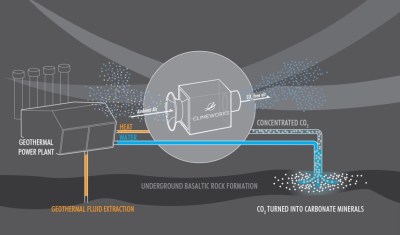
A diagram of the method of operation. Image credit: Climeworks

The basic theory is to capture carbon dioxide from the air, and then pump it below ground where it can be stored in a safe, stable fashion. This starts with direct-air capture: fans suck in air, and carbon dioxide is chemically trapped in a filter. Climeworks appears to use an adsorption-type filter for capturing the CO2, but details on the company’s website are sparse.

Once at capacity, the filter can then be heated to release its captured CO2 so it can be stored. The gas is mixed with water and pumped deep underground into a basaltic rock formation. Over time, the CO2 reacts with minerals to form stable carbonates.

Scientific papers have covered the concept before, with a trial in Iceland exploring the idea. In practice, 95% of the injected CO2 was successfully mineralized and stored in less than 2 years.

IS IT PRACTICAL?

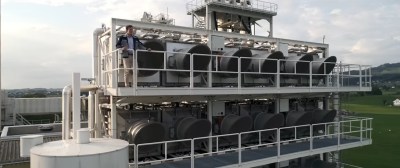
The Climeworks facility in Switzerland. Image source: Climeworks

As with any carbon storage technology, it’s important to look at the hard data to determine whether this is a viable solution for climate change. This involves looking at not only the amount of greenhouse gas that can be stored, but also the energy required to achieve this.

In 2017, Climeworks operated a plant in Sweden (machine translation). This installation was capable of removing 900 tonnes of CO2 from the atmosphere per year, using the output to feed a greenhouse. The process required between 1,800 kwh and 2,500 kwh of thermal energy per ton of CO2 captured from the air. While the energy requirements may appear high, the group noted that waste heat from other industrial processes normally suffices for the energy input required.

The storage part of the equation would not necessarily be as difficult; current data suggests 7000 billion tonnes of carbon dioxide could be stored off the coast of Iceland, with plenty of other geologically suitable options around the world too.

At the time, the team set a goal of removing 1% of the world’s CO2 emissions annually by 2025. Global CO2 output was estimated to be 36.81 billion tons in 2019. To remove 1% of this would take on the order of 409,000 plants operating at 900 tonnes per year. The group have been quoted that around 250,000 plants would be required by their own modelling, which presumably takes into account potentially higher emissions in 2025 and larger sequestration plants in future.

These figures are steep, and huge sums of money and land would be required to implement such facilities. As a guide, McDonalds operates just under 40,000 restaurants worldwide. It seems unlikely that, in the short space of a few years, we’ll see anywhere near 250,000 sequestration plants pop up around the world. Governments are still moving slowly on even simpler measures to reduce outputs. Similarly, many nations have delayed or simply ignored targets from international agreements made in years past.

SEQUESTRATION AS A SERVICE

Regardless, Climeworks has pressed on. Working in partnership with Icelandic company Carbfix, the company has just opened its largest facility yet in Iceland. The plant known as ‘Orca’ is intended to remove up to 4,000 tonnes of CO2 from the atmosphere every year. That’s roughly equivalent to emissions from 870 passenger cars based on EPA figures.

The plant cost on the order of $10-15 million US dollars to build. The company claims that the project is a stepping stone on the way to “megaton” removal capability in the second half of the decade. With facilities of this capacity, the company could hit its 1% emissions target with 92,000 plants. It’s still a ridiculous number; one that seems improbably large given the limited impact it would have on global emissions.

Assuming enough land could be found across the world, establishing the plants at those rates would cost $920 billion dollars. It’s a hefty price to pay to eliminate 1% of global emissions.

So who is going to pay for this? The Climeworks business model raises a few eyebrows, essentially offering Sequestration as a Service. It allows members of the public to offset their own carbon output, with users asked to sign up and pay a monthly subscription fee. Depending on the level chosen, the user pays a set amount to offset a certain mass of CO2 per year.

For 49 Euros a month (~$57 USD), one can pay for the capture of 600 kg of carbon dioxide per annum. Or, alternatively, the same service can be bought from reseller Tomorrow’s Air, marked up to $75 USD. As a guide, one round-trip flight from London to New York emits around 968 kg of CO2 per passenger. Shorten that to London to Rome and back, and you’re looking at around 234 kg per passenger. Climeworks boasts 8662 subscribers spread across 56 countries around the world, and claims to presently operate 15 air capture facilities at this time.

The USGS has surveyed the country to find potential areas that could store CO2. However, the hard part is capturing it in the first place.

On the face of it, the subscription method appears to be an attempt to generate income for a sequestration operation from environmentally conscious individuals. It bears noting that in the company’s own FAQ, it states that the CO2 removal that subscribers have paid for will be executed “within 5 years or earlier following the subscription date.” The company provides yearly certificates to subscribers, however these only state “the amount of carbon dioxide that has been ordered for removal in [the subscriber’s] name.” However, the company does claim to be seeking third-party certification to give its operations credibility.

Overall, there aren’t huge question marks around the technology itself. Carbon dioxide can be captured from the air with adsorption filters, and it can similarly be stored using the mineralization process. The real question is whether or not it’s a viable solution to climate change in the short to medium term. Based on the present figures, it seems more likely that bigger gains could be possible from investing in other areas. For example, spending huge sums on renewable energy and grid storage would eliminate a large amount of carbon emissions in the first place, entirely avoiding the need to pull that CO2 out of the air later on.

While carbon capture and sequestration is a great idea in theory, in practice it’s simply not there yet. Capturing CO2 directly out of the atmosphere (as opposed to at the source like scrubbers at power plants) simply isn’t efficient enough or able to be executed on a large enough scale to make much of a dent in the problem. Research on the technology should continue, but don’t expect it to be the silver bullet that saves the world in the next few years.


THE REALITY IS THAT CCS IS NOT GREEN NOR CLEAN IT IS GOING TO BE USED TO FRACK OLD DRY WELLS SUCH AS IN THE BAKAN SHIELD IN SASKATCHEWAN
https://plawiuk.blogspot.com/2014/10/the-myth-of-carbon-capture-and-storage.html

ALSO SEE https://plawiuk.blogspot.com/search?q=CCS