Monday, December 13, 2021

The Secret Military Fortresses Hidden in the Swiss Alps


Chloe Berge
Fri, December 10, 2021

Courtesy of Sasso San Gottardo

Unlike most train rides in Switzerland, there is no postcard view of the snow-dusted Alps on the Metro del Sasso. Cold, damp air cuts through the underground funicular as it chugs uphill in near darkness, deep in the Gotthard mountains in the country’s southernmost canton of Ticino. Disembarking at the top, instead of a sweeping bucolic landscape, passengers arrive at a military command center.

Only declassified in 2001, Sasso da Pigna was one in a chain of secret fortresses constructed in the Swiss Alps during World War II. After France fell to the Axis powers in 1940, Switzerland lost a powerful ally, and army general Henri Guisan knew trying to continue to defend the country’s borders against indomitable Germany was futile. Instead, the Swiss National Redoubt was born. The military strategy drew troops away from the front lines, concentrating manpower in impenetrable mountain bunkers.

Fortresses like Sasso da Pigna, built in 1941–45, and two other key citadels at Saint-Maurice and Sargans served as strongholds in a network that stretched across the Alps. They housed troops and artillery, while others acted as hangars for fighter planes. Sasso da Pigna’s location at the Gotthard Pass was a particularly important one. The pass marks the main route through the mountains from north to south and has served as a major trade route through the Alps since the Middle Ages, modernized in the late 19th century with the creation of the Gotthard railway line.


When the fortress was finally declassified, its transformation began into Sasso San Gottardo, a museum that pays tribute to the area’s storied past. “This is where Switzerland started, at the foot of this pass,” says Sepp Huber, a former mountain infantry commander who now leads tours through the historic fortress. Visitors enter through a towering doorway carved into the rockface, big enough to allow tanks to pass through. Overhead, the red, blue, and yellow flags of Switzerland and the cantons of Ticino and Uri—whose border lies half a mile north of the fortress—snap and flicker in the icy alpine wind.

Inside the tunnels of the historic fortress, Sasso da Pigna
Courtesy of Sasso San Gottardo

The garrison-turned-museum tunnels two miles into the mountain, and on the first floor, visitors are greeted by contemporary exhibitions on the region’s natural history and culture. In a darkened gallery, quartz crystals the size of small trees—for which the area is world renowned—shimmer under a spotlight. Past exhibitions have been dedicated to themes such as the area’s renewable energy projects, and next year, the museum will launch a program focused on the work of Goethe. The 18th-century German poet was enchanted with the Gotthard Pass, making three pilgrimages there and writing extensively on this part of the Alps.

Past these rooms, a ride on the Metro del Sasso brings museum-goers to the historic heart of the military operation. Spartan barracks house wood bunk beds dressed in stiff khaki-colored sheets. The walls of a command center are hung with strategy maps bookended by radio transmitters on shelves, and an artillery room leads out to a newly-built terrace, where there’s a view of serpentine roads skirting green mountains veined with snow.

Today, Sasso San Gottardo is open to the public during its short season from May to October, when the pass isn’t sealed off by glittering ice and numbing winds. But during World War II and through to the end of the Cold War, the National Redoubt’s fortresses were shrouded in mystery.

“I’ve often looked out of train windows and seen a steel door in the cliffside, and thought to myself, there might be airplanes behind that,” says Clive Church, a Swiss history expert and professor emeritus at the University of Kent. Civilians knew of the redoubt, but no one knew exactly what was inside, and neither did Germany or Italy, which was part of the strategy to deter their encroachment. “The fortress only housed 400 men, but the Swiss would tell the Germans 4,000,” says Huber.

Historic army barracks at Sasso da Pigna
Courtesy of Sasso San Gottardo

“The Swiss knew that German and Italian spies were concentrated at the fortress construction sites in the central Alps, so they fed exaggerated information into channels they thought might be informing Germany,” adds museum director Damian Zingg. This strategy was part of the country’s longstanding policy of armed neutrality, which dates back to the Congress of Vienna in 1815. European powers collectively decided that keeping the country neutral would help the entire region remain stable, creating a buffer between France and Austria. “The redoubt was there if they were attacked, but it was also there as a dissuasive,” says Church. “The more you created this mythos of an impenetrable fortress that would have to be fought inch by inch up a very steep incline, the less it was something the Nazis thought they were able to do,” adds Church.

The creation of the redoubt was also a way for the Swiss to reassure other powers that they were not covertly assisting the Axis. “For most Swiss [the redoubt] is a symbol; it’s not just the concrete bunkers and the guns,” says Church. “It’s part of their resistance to Nazism.” The Swiss haven’t actually seen combat since the early 1500s but just how neutral Switzerland actually was during the war is contentious. It’s now known that the redoubt was only part of the defense strategy, and that Switzerland continued to trade with Germany and grant them access to the Gotthard railway.

“Switzerland needed raw materials and building supplies from Germany [to construct the fortresses], which it received in exchange for its exports and arms supplies,” says Jakob Tanner, a professor emeritus in Swiss history at the University of Zurich. According to most Swiss historians, these economic relations were, like the redoubt, aimed at deterring Germany from attacking, proving too much was at stake to invade the country.


Airolo, Passstrasse
The Swiss National Redoubt spanned the Alps, hidden in the rockface.
Andre Meier

Although the methods of warfare used in the redoubt became increasingly obsolete after the war, their symbolic nature kept the fortresses in operation. “Neutrality also had a domestic, internal function,” says Tanner. “While the army left the redoubt immediately after the end of the war, the population remained in the mental redoubt, which led to a boom in ‘spiritual national defense’ and anti-communism,” explains Tanner. To that end, the fortresses were used during the Cold War, although information on exactly how and why they were utilized remains restricted. By the 1990s, political stability in Western Europe and the steep maintenance costs associated with keeping the fortresses operational meant that most of them were declassified and sold to private buyers.

Like Sasso da Pigna, the fortress at Saint-Maurice was also converted into a museum. And less than a mile away from Sasso da Pigna at the top of the Gotthard Pass is an artillery bunker, San Carlo, that has been turned into the hotel La Claustra. Opened in 2004, the cavernous refuge was the work of Swiss architect Jean Odermatt and offers 17 rustic rooms surrounded by a lake and miles of hiking trails.

In 11 former bunkers in Stansstad, the company Gotthard-Pilze grows organic mushrooms, and in the region of Giswil, a military fortress called Pfedli is owned by the Swiss cheesemaker Seiler Kaserei AG. Once used for storing ammunition, spare parts for fighter jets, as well as guided missiles, the company now ripens over 90,000 wheels of raclette cheese in the bunker’s two 100-metre-long tunnels, where humidity levels and a temperature of 52 degrees Fahrenheit make an ideal environment for the ageing process.

While the National Redoubt fortresses live out their reincarnations as museums and food production facilities, the threat of the Axis powers seems an almost unimaginable chapter in Switzerland’s past. But it was very real for the thousands of Swiss men and women that served in World War II who filled the dark, subterranean world of the redoubt with their echoing footfall.

Under Switzerland’s emerald hills and the chorus of cow bells, beneath the fairytale chalets and icing sugar mountain peaks, exists a grittier history worth remembering. Long veiled in secrecy, the stories of the redoubt have worked to reinforce the mythic place of the mountains in the Swiss consciousness. “The mountains are the home of Switzerland, they always offer protection to the country,” says Tanner.
Faith in numbers: Fox News is must-watch for white evangelicals, a turnoff for atheists...and Hindus, Muslims really like CNN


Ryan Burge, Assistant Professor of Political Science, Eastern Illinois University
Sat, December 11, 2021,

Fox News has a faithful audience. AP Photo/Richard Drew

Fox News possesses an “outsized influence” on the American public, especially among religious viewers.

That was the conclusion of the nonprofit Public Religion Research Institute in a report released just after the 2020 presidential election. It noted that 15% of Americans cited Fox News as the most trusted source – around the same as NBC, ABC and CBS combined, and four percentage points above rival network CNN. The survey of more than 2,500 American adults also suggested that Fox News viewers trend religious, especially among Republicans watching the show. Just 5% of Republican viewers of the channel identified as being “religiously unaffiliated” – compared to 15% of Republicans who do not watch Fox News and 25% of the wider American public.

To further explore the relationship between different faiths and the TV news they associate with as part of my research on religion data, I analyzed the result of another survey, the Cooperative Election Survey.


The annual survey, which was fielded just before the November 2020 election, with the results released in March, polled a total of 61,000 Americans over a number of topics. One question was on their news consumption habits. It asked what television news networks respondents had watched in the prior 24 hours.

Percentage of respondents who saw TV news in past 24 hours

Ryan Burge/CES

Some very interesting patterns emerged across religious traditions – and the nonreligious – and the type of media being consumed. For instance, of the the big three legacy news operations – ABC, CBS and NBC – there was no strong base of viewership in any tradition.

In most cases, about a third of people from each religious tradition said that they watched one of those legacy networks in the last 24 hours. PBS scored very low among every tradition. In most cases fewer than 15% of respondents reported watching PBS in the time frame.

However, the numbers for the three major cable news networks – CNN, Fox News and MSNBC – were much higher across the board. In eight of the 16 religious and nonreligious traditions categorized in the poll, CNN viewership was at least 50% of the sample. This was led by 71% of Hindus who watched CNN and 63% of Muslims.

The least likely group to watch CNN was clearly white evangelicals, at just 23%. In comparison, MSNBC scored lower nearly across the board. In fact, in none of the 16 classification groups was viewership of MSNBC greater than it was for CNN.

Fox News viewership was higher than that of MSNBC, but was not as widely dispersed as it is for CNN. It’s no surprise, given its reputation as a conservative news outlet, that 61% of white evangelicals say that they watch Fox News – in the last election, around 80% of white evangelicals voted for Republican candidate Donald Trump. The other three traditions where viewership was at least 50% are white Catholics, Mormons and members of the Eastern Orthodox Church. It should come as no surprise, as those are three groups that consistently vote for the Republican Party. Just 14% of atheists watched Fox, which is just about in line with the share of white evangelicals who watch MSNBC.
Fracturing right-wing media

But with the fracturing of conservative media sources seeing more competitors vying for viewers among the right, Fox News could see a drop in viewership from the religious right.

In the wake of the 2020 presidential election, Fox News viewership plunged as many Trump supporters believed that the network was not being loyal to their standard-bearer of the GOP.

Given the vast number of news options that people of faith have and the increase in political polarization in the United States, the pressure for networks to deliver the news that people want to hear will only increase as time passes.

This article is republished from The Conversation, a nonprofit news site dedicated to sharing ideas from academic experts. It was written by: Ryan Burge, Eastern Illinois University.


Read more:

Why young Nigerians are returning to masquerade rituals, even in a Christian community

How theater can help communities heal from the losses and trauma of the pandemic

When it comes to media reporting on Israel-Palestine, there is nowhere to hide

Pope cites new book on nun abuse in warning to superiors


Nuns wave as Pope Francis delivers his blessing from the window of his studio overlooking St.Peter's Square, at the Vatican, on June 7, 2020. Pope Francis on Saturday, Dec. 11, 2021 drew attention to a taboo problem that the Vatican has long ignored or downplayed: the abuses of power by mother superiors against nuns who, because of their vows of obedience, have little recourse but to obey.
 (AP Photo/Andrew Medichini)


NICOLE WINFIELD
Sat, December 11, 2021, 10:11 AM·2 min read

ROME (AP) — Pope Francis on Saturday drew attention to a problem that the Vatican has long sought to downplay: the abuses of power by mother superiors against nuns who, because of their vows of obedience, have little recourse but to obey.

During an audience with members of the Vatican’s congregation for religious orders, Francis cited a new investigative expose of the problem written by a reporter for the Holy See’s media, Salvatore Cernuzio.

Francis noted that the book, “Veil of Silence: Abuse, Violence, Frustrations in Female Religious Life,” doesn’t detail “striking” cases of violence and abuse “but rather the everyday abuses that harm the strength of the vocation.”

The book, published in Italy last month, contains 11 cases of current or former religious sisters who suffered abuses at the hands of their superiors. Most were psychological and spiritual abuses and often resulted in the women leaving or being thrown out of their communities and questioning their faith in God and the church. Some ended up on the streets, others found refuge in a home for abused women.

The book follows an article on the same topic by the Vatican-approved Jesuit journal La Civilta Cattolica in 2020 and earlier reports in the Vatican’s women’s magazine about the sexual abuse of nuns by priests and exploitation of them by the male church hierarchy for free domestic labor.

The new book peels back another layer of the more insidious forms of psychological abuses committed by superiors against their own nuns, which have long been covered up by a veil of secrecy. It contains a devastatingly essay by one of the highest-ranking women at the Vatican, Sister Natalie Becquart, who said the cases must force the church to look at the sometimes toxic reality of life in religious orders, tend to the victims and prevent future abuses from occuring.

She said it also reinforces the need for the Catholic hierarchy to ensure that priests and nuns are trained in the correct way to exercise obedience and authority, saying the erroneous application of both had led to the problem.

Francis has tried to crack down on the near-absolute power enjoyed by religious and lay superiors as well as the proliferation of new religious movements, some of which have seen horrific cases of sexual, spiritual and other forms of abuse committed by their charismatic founders. The Vatican has recently imposed term limits for leaders and is applying a more rigorous process for new groups to be approved in the church.

The Jesuit pope, who knows well the dynamic of religious community life, told the members of the Vatican congregation Saturday that there is always the threat that founders of religious orders or new religious movements will assume too much power and exercise it improperly.

The risk, he warned, is that they claim to be the only ones who can interpret the particular spirit of the movement “as if they were above the church.”

Catholic women urge Vatican to sign Europe rights convention

Vatican Pope Air ForcePope Francis delivers his speech during an audience with members of the Italian Air Force, in St. Peter's Basilica at the Vatican, Friday, Dec. 10, 2021. 
(Vincenzo Pinto/Pool photo via AP)More

NICOLE WINFIELD
Sat, December 11, 2021, 5:10 AM·2 min read

ROME (AP) — A consortium of Catholic women’s groups is calling on the Holy See to join the Council of Europe and to sign the European Convention on Human Rights, arguing that the Vatican should show consistency by expressing its firm commitment to protecting human rights.

In a petition marking the Human Rights Day declared by the United Nations, the groups said the Holy See is recognized internationally as a sovereign state and presents itself as a firm promotor of human rights and dignity. Yet they noted the Vatican hasn’t followed up by adhering to the European Convention, regarded as the gold standard for rights protections around the world.

“For years, the Holy See has acted like a state in its own right. This gives rise to rights, but also to duties,” wrote the signatories, which are European members of the Catholic Women's Council, an international umbrella group, .

The Holy See enjoys observer status at the United Nations and the Council of Europe, and has ratified a host of U.N. and Council of Europe conventions. They include the U.N. Convention on the Rights of the Child, the U.N. Convention against Torture, the Nuclear Non-Proliferation Treaty and other weapons conventions.

But it has never signed the European Convention on Human Rights, which to date has been ratified by 47 European states.

The convention obliges signatories to respect human rights, including the right to life, liberty, security, freedom of expression, assembly, religion and conscience. It prohibits torture, slavery, forced labor and discrimination based on race, religion, gender or political beliefs.

Signatories must also ensure that defendants receive fair trials before independent and unbiased judges. The convention provides recourse to the European Court of Human Rights for ultimate appeals after national appeals are exhausted.

The Vatican is an absolute monarchy in which the pope wields supreme legislative, executive, and judicial power. It would be loath to allow European commissions to evaluate its policies forbidding the ordination of women, for example, or to subject decisions of the Vatican’s criminal or ecclesial tribunals to appeals at the Strasbourg-based European Court of Human Rights.

Yet the pope frequently lectures European leaders on protecting human rights and human dignity, most recently during a visit this month to Cyprus and Greece where he chided Europe for its failure to welcome migrants.

During that trip, Francis lamented that authoritarian rule was on the rise in Europe as democracy wanes.

The women's groups that participated in the petition include Catholic Women Speak in Britain; We Are Church in Ireland, Germany and Austria; Women for the Church in Italy; Voices of Faith in Rome and Liechtenstein, as well as similar progressive Catholic groups in Spain, France, Croatia and Switzerland.
THE SECOND AMENDMENT IS THE PROBLEM
Guns aren't the problem. People like Rep. Lauren Boebert and the NRA are.

Carli Pierson, USA TODAY
Sun, December 12, 2021, 

GOP Reps. Lauren Boebert of Colorado, Matt Gaetz of Florida and Marjorie Taylor Greene of Georgia on Oct. 12, 2021.

Rep. Lauren Boebert, R-Colo., and I have a few things in common.

We are both white women. We are both mothers. We have both lived in Florida and Colorado (she is from the former; I am from the latter). But that is where the similarities end.

When I saw one of my state's representatives in Congress post a Christmas card from hell with a picture of her and the kids around the tree and clutching their military-style weapons after a deadly school shooting in Michigan – I had to say something.


To be clear: Boebert's brand of outrage is nothing new; she's a wannabee Donald Trump in a dress. Her heartlessness isn't even really worth writing an opinion column about except to point out that people like Boebert and Rep. Thomas Massie, R-Ky., who don't give a damn about the gun violence and trauma we are constantly cycling through as a nation, are the problem.

Mass shootings are a ubiquitous part of American life. But we don't have to accept that as the status quo. Similarly, we must not accept that our representatives in government threaten other members of Congress and taunt traumatized families with their armed tyranny.

These displays of wanton disregard for peace and security must have consequences.
Founding Fathers

Now, I'm not about to tell you that the Second Amendment doesn't say you can't have guns, because it clearly does, and the U.S. Supreme Court agrees. That question has been asked and answered.

But in our failure to adequately teach American history and civics, we forget that the Second Amendment has an important context that should accompany its interpretation. Specifically, the Founding Fathers were absolutely terrified of standing armies – and gun ownership was common for a variety of practical reasons that didn't always have to do with self-defense.
The American crisis

Where did America go wrong? The problem isn't the guns. The problem is us. Our taste for gun violence is a uniquely American crisis. And I say that as someone who has lived in Switzerland, a country armed to the teeth but with zero school shootings, annually.

A mother and daughter are reunited after a shooting April, 20, 1999, at Columbine High School in Littleton, Colo. Two students killed 12 others and a teacher before dying by suicide.

James Madison tried to save us, from us, back in the late 18th century. He anticipated that the project of American democracy would fail if left entirely in the hands of the people.

It is the sense of exceptionalism our nation is known for, and the reckless interpretation of those 27 words in the Second Amendment by gun lobbyists, the NRA and their supporters that have, since the late 1990s, had a devastating effect on American life. I mention the '90s because it was in 1999, at Columbine High School in Colorado, when two students went on a gun rampage, killing 13 other people.

Every time a Republican posts a picture of themselves and their families snuggled up to the muzzle of a semiautomatic rifle immediately after a mass shooting, I wonder what the Founding Fathers would think if they knew that this was what was to become of the Second Amendment.

Surely they would find it infinitely sad, infinitely pathetic that we have not made necessary changes.
Common sense


Carli Pierson

We are the source of our own tyranny. We are also the solution. We must look to our God-given common sense to solve this uniquely American crisis.

And common sense begs us to do better in electing our representatives and getting rid of them when they cross the line.

Carli Pierson is an attorney and an opinion writer at USA TODAY. Follow her on Twitter: @CarliPiersonEsq
Haiti's Moise was probing officials linked to drug trade when he was killed: NYT


 Haitians protest increase in fuel prices, in Port-au-Prince


Sun, December 12, 2021

(Reuters) - Haitian President Jovenel Moise was compiling a list of officials and businessmen linked to the drug trade before he was assassinated in July, the New York Times reported on Sunday, adding he planned to give the names to the U.S. government.

Moise was murdered in a late-night raid on his home by a group of armed men that included former Colombian soldiers. Haitian authorities have arrested 45 people but have not yet charged anyone with the crime.

Some of those who were captured confessed that retrieving the list with names of suspected drug traffickers was a top priority, the Times reported, citing three senior Haitian officials with knowledge of the investigation.


"The document was part of a broader series of clashes Mr. Moise had with powerful political and business figures, some suspected of narcotics and arms trafficking," the Times wrote.

A spokesman for the office of Prime Minister Ariel Henry did not immediately respond to a request for comment.

Moise's murder left Haiti in a political vacuum with no elected president, and further fueled a wave of kidnappings by gangs that now control much of the Caribbean nation's territory.

The government has promised to serve justice in the case, but judicial officials have also reported intimidation and death threats.

(Reporting by Brian Ellsworth; Editing by Daniel Wallis)

Sunday, December 12, 2021

Two more quakes rattle central Kansas just days after a larger tremor hit the area


Mitchell Willetts
Sun, December 12, 2021

Two earthquakes shook central Kansas overnight, according to the U.S. Geological Survey, and Kansans could certainly feel it.

A magnitude 3.8 earthquake was detected shortly after 8 p.m. Saturday, Dec. 11, about 4 miles west-southwest of Gypsum, and 13 miles south-southeast of Salina, according to the USGS. At least 98 people reported feeling the earthquake to the USGS.

A milder earthquake, magnitude 2.5, shook the area about one hour earlier, data shows.

Both quakes came just days after a 4.3 tremor rocked Gypsum the morning of Dec. 8, McClatchy News reported. More than 250 people reported feeling it at the time, with one Twitter user saying it shook their house and knocked things over.

While earthquakes with a magnitude of 2.5 or greater are “often felt,” it takes a magnitude of at least 5.5 to cause damage to buildings, according to Michigan Tech.


Fracking in Kansas

The Kansas Corporation Commission is responsible for regulating fracking in Kansas. The commission enforces regulations on the following: Monitoring of potential seismic effects of fluid injection The reporting and disclosure of the types of fluids used in fracking, at what volume, and a description of each chemical additive used in fracking
https://ballotpedia.org/Fracking_in_Kansas

Areas of Activity

As of May 2017, there were 1,039 horizontal wells that were hydraulically fractured. In 2016, Kansas had 93,464 producing oil and gas wells. According to the Kansas Geological Survey, approximately 244,000 oil and gas wells were drilled in Kansas from 1947 to 2011. Of that total, approximately 57,000 wells—23.4 percent of all wells—were hydraulically fractured. The map to the left shows known oil and gas fields in Kansas as of May 2017. The map to the right shows the location of hydraulically fractured horizontal wellsas of January 2015. Read more


Gas field tremor terror haunts Dutch villages


Although the Dutch are almost done with Europe's biggest natural gas field, the Groningen site is not yet done with residents (AFP/JOHN THYS)

Jan HENNOP
Sat, December 11, 2021

Teacher Daan Schoolland was asleep with his partner when the earthquake struck the northern Dutch hamlet of Garrelsweer in the middle of the night.

"It was like a wave, we could feel it coming towards us," the burly father-of-three recalled. "When I woke up, the whole room was still shaking and my kids were crying in terror."

The 3.2-magnitude earthquake in November was the largest for more than two years in this flat, agricultural region bordering Europe's biggest natural gas field.

And it was the latest reminder that, although the Dutch are almost done with it, the Groningen field is not yet done with residents.

The area had been plagued since 1986 by increasingly strong earthquakes caused by air pockets collapsing after the gas has been pumped out.

Two years ago, Schoolland cheered with other locals as the government announced it would shut off the taps at the field by 2030.

Schoolland felt even more relieved when the timeframe was then shortened to the end of 2022. The Dutch government set up two commissions, one to deal with compensation and another to help residents fortify their homes against future quakes.

But his relief was short-lived.

Shortly after last month's earthquake, the government's top mining official issued a disturbing warning that tremors would continue.

"Even if we stopped right now extracting every molecule of gas, earthquakes will still continue to happen," said Theodor Kockelkoren, the Dutch inspector-general of mines.

"Our estimation is that it will actually still take a couple of decades" for the soft earth below Groningen to finally settle, he told AFP.

- 'Insane' -


That's more bad news for residents like Schoolland, who is locked in a legal battle with one of the government's commissions for compensation to fix damage to his home that he blames on the quakes.

"Look, here you can see how this studio apartment is pulling away from the rest of the house," Schoolland told AFP, pointing to a crack in his home, originally built as a school in 1952 and later converted into a house.

"It's really silly that a judge now needs to say, 'pay these people for the damage the mining company has caused.' It's insane."

Schoolland is not alone.

Locals were "happy" with the announcement that extraction would end, "but in its place came something that became legally and technically far too complex", said Coert Fossen, deputy chairman of the Groningen Bodem Beweging (GBB), the civic group fighting for residents' compensation.

"People sometimes have damage to their homes running up to 100,000 euros ($113,000)," Fossen told AFP. "Yet, they have to fight for the last 100 euros. The process has become very juridical."

Compounding the issue, with Europe battling surging energy prices as it heads into the winter, the Dutch government has warned extraction may temporarily rise in 2022, just as the field was meant to close.

"However, I will only take this step if there is really no other option," Economic Affairs Minister Stef Blok said.

- 'Lost my faith' -


For residents shaken by thousands of tremors, the government's promises ring hollow.

Prime Minister Mark Rutte's administration announced last month that some 27,000 homes need to be inspected, but so far only eight percent have been completed, according to the GBB.

"The Dutch government is struggling to ensure that the strengthening of houses and the repair to damages is done in a very expedient and efficient way," said Kockelkoren.

An economic affairs and climate policy ministry spokesman told AFP "the results of earthquakes in Groningen are complex" and admitted that fortifying buildings "isn't going well".

But Jules van de Ven said the government had made 1.15 billion euros available for new ways of testing whether buildings are quake-proof, and 1.5 billion euros more for cultural, educational and social projects.

Residents also now benefited from a "reverse burden of proof" legal system, which presumes that damage is caused by quakes and it is up to experts to prove otherwise, he added.

The government had also taken over the process of claiming damages from the NAM mining company, so now "people don't need to fight with the company. We do it for them."

But for Schoolland, that's small consolation.

"I have lost my faith in the government," he said. "It's gone."

jhe/dk/imm/rl
Green finance: Sustainability-linked bonds boom as investors demand companies commit to fighting climate change


Sun, December 12, 2021

Financial instruments linked to sustainability will form the next phase in the evolution of green fundraising in Asia, as investors demand companies show their commitment to fighting climate change, according to Swiss bank UBS.

Whereas green bonds designed to fund projects that are environmentally friendly are a "test of the waters" for firms in the sustainable finance space, the more ambitious companies will be looking at issuing sustainability-linked products, said Tasos Zavitsanakis, executive director of the sustainable finance office in Greater China for UBS in an interview.

Borrowers of sustainability-linked instruments need to set predetermined sustainability performance targets that are both relevant and important. If the targets are not met, the debtors will have to bear a penalty in the form of a higher coupon or interest rate.

"It's about them demonstrating their commitment, to an extent that it's an incentive for them to meet their targets. If you don't meet your targets, you're going to have to pay a higher coupon or to buy carbon credits," said Zavitsanakis.

Once companies start putting in place a "credible" transition plan for their business to fight climate change, "naturally [they] can link that to a sustainability-linked commitment. It becomes an evolution," he said.

Since the first sustainability-linked bond (SLB) was issued in 2019, issuance had reached US$8.2 billion globally last year, according to financial data provider Refinitiv. It has ballooned over 11 times to US$92.9 billion this year.

The issuance of SLBs in the Asia-Pacific region excluding Japan had reached US$11.2 billion as of December 6 this year, with those from China accounting for US$2.8 billion and those from Hong Kong amounting to US$546 million, according to Refinitiv. This type of bond was only launched in the region this year.


Amy Lo, co-head of Wealth Management, Asia-Pacific, and Tasos Zavitsanakis, executive director, sustainable finance, Greater China, of UBS. Photo: K. Y. Cheng alt=Amy Lo, co-head of Wealth Management, Asia-Pacific, and Tasos Zavitsanakis, executive director, sustainable finance, Greater China, of UBS. Photo: K. Y. Cheng>

In January, Hong Kong's New World Development became the first developer globally to issue a US dollar sustainability-linked bond, committing to use 100 per cent renewable energy by 2026 for its rental properties in the Greater Bay Area. If it fails to do so, it will pay a penalty worth 0.25 per cent of the bond per year that would go toward carbon offset schemes.

The sustainability-linked features are appealing to institutional and family office investors that are "really serious about allocating assets into sustainable kinds of investing", said Amy Lo, co-head of UBS Wealth Management, Asia-Pacific, in the same interview.

"It's actually tougher for the issuer to issue the sustainability-linked bond ... you have to meet the targets, otherwise you get a penalty.

"We have some investors who are really buying into it, because they feel the company is more serious about delivering what they pitch they are."

Under the SLB principles published by the International Capital Market Association in June 2020, issuers are expected to set performance targets that are ambitious, comparable, verifiable, consistent with their overall sustainability strategy, and go beyond a "business as usual" trajectory.

"Investors with a sustainable focus ... not only look at whether they would get higher returns for those instruments, but also whether their money is really encouraging and incentivising the issuer to do a better sustainable performance," said Gan Luying, head of sustainable bonds in HSBC's Asia-Pacific debt capital markets team. She was speaking at Fitch Ratings' ESG Outlook Conference Asia-Pacific last Wednesday.

Sustainability-linked loans (SLL) with penalties are also gaining traction in Asia, showing that companies are more confident in setting and reaching their climate ambitions, according to Tracy Wong Harris, Standard Chartered's head of sustainable finance for Greater China and North Asia at a media round table late last month. Common penalties included tiered interest rates, purchase of carbon credits or donations to charities that serve environmental or social causes.

The transaction volume of SLLs for Standard Chartered in Hong Kong grew by over three times in the first nine months of the year, compared to the whole of 2020, according to Wong Harris.

Copyright (c) 2021. South China Morning Post Publishers Ltd. All rights reserved.

Smashed cars, burnt trees, soggy insulation: Post-disaster cleanup is expensive, time-consuming and wasteful

Sybil Derrible, Associate Professor of Sustainable Infrastructure Systems, University of Illinois at Chicago, 
Nazli Yesiller, Director, Global Waste Research Institute, California Polytechnic State University, 
Juyeong Choi, Assistant Professor, Florida A&M University-Florida State University College of Engineering, Florida State University

Sun, December 12, 2021

A collapsed building in Mayfield, Ky., after a tornado hit the town on Dec. 11, 2021. Brett Carlsen/Getty Images

Communities across the U.S. Southeast and Midwest will be assessing damage from the deadly and widespread tornado outbreak on Dec. 10-11, 2021 for some time. But it’s clear that the cleanups will take months, and possibly years.

Dealing with enormous quantities of debris and waste materials is one of the most significant challenges for communities in the wake of natural disasters. Often this task overwhelms local waste managers, leaving waste untouched for weeks, months or even years.

The most destructive and costliest wildfire in California’s history, the Camp Fire, killed 85 people and destroyed nearly 19,000 structures in November 2018. A year later, crews were still collecting and carrying away piles of wood, metals, appliances, contaminated soil, toxic household chemicals, and other debris and waste totaling more than 3.2 million metric tons – roughly the weight of 2 million cars.

Hurricane Michael, which hit Florida in October 2018, left about 13 million cubic meters of debris. To visualize what that looks like, picture a pile of 13 million boxes, each the size of a washer and dryer. More than a year later, crews were still removing the waste.

As researchers who study urban engineering, disaster management and planning, and waste management, we see this as a critical and under-studied problem. Disasters will continue to happen and the losses they cause will continue to grow as a result of climate change, population growth, urbanization, deforestation and aging infrastructures. Societies urgently need better strategies for dealing with the wastes these events leave behind.

In the aftermath of Hurricane Ida, Amy Voisin cleans up a heavily damaged bowling alley in Houma, La. on Aug. 31, 2021. AP Photo/David J. Phillip

Trails of wreckage

Climate-related disasters like floods, landslides, storms, wildfires, and extreme hot and cold waves afflict millions of people around the world. These events have been increasing over time, particularly over the past several decades, and so have the losses they cause.

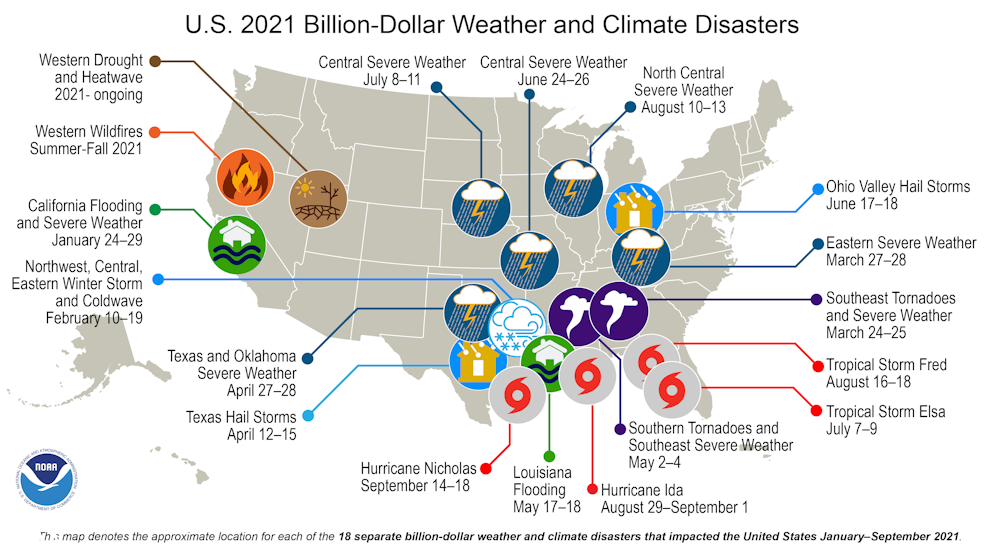
In 2020, the U.S. experienced a record-setting 22 natural disasters that each caused at least a billion dollars in damages. For 2021, the count stood at 18 such events through early October. The mid-December tornado outbreak doubtlessly will add to it.

Map showing locations of major storms, flooding and wildfires across the US.

Disasters commonly produce thousands to millions of tons of debris in a single event. For example, waste from hurricanes includes vegetation, such as trees and shrubs; municipal solid waste, such as household garbage; construction and demolition materials; vehicles; and household hazardous materials, including paints, cleaning agents, pesticides and pool chemicals.

Debris from wildfires largely consists of ash, contaminated soils, metal and concrete, along with other structural debris and household hazardous items such as paints, cleaners, solvents, oils, batteries, herbicides and pesticides.
Dangerous and in the way

Debris collection and cleanup following a disaster is a slow, expensive and dangerous process. First, crews clear out debris from roads used for rescue efforts. They then move the material to temporary storage areas. No one has yet invented a way to easily sort or contain hazardous materials, so they remain mixed into the debris mass. This poses major challenges for reusing and recycling post-disaster waste.

Beyond direct health and safety risks, debris also threatens the environment. It can emit air pollutants and contaminate groundwater, surface waters and soil. Uncollected debris and waste can hamper rescue and recovery efforts and slow down rebuilding efforts.

As an example, when Hurricane Katrina flooded New Orleans in 2005, it left behind an estimated 75 million cubic meters of waste that interfered with and slowed down recovery efforts. The debris included close to 900,000 white goods, such as refrigerators, 350,000 cars and more than 16,000 metric tons of rotten meat. Cleanup costs were estimated at roughly US billion.

Toward reusing disaster waste

At an expert workshop that we organized in 2019, we identified steps for sustainably managing disaster debris and waste. As we see it, the key tasks are to (1) identify what is contained in these wastes; (2) find better approaches to recycling and reuse; (3) design new technologies to identify hazardous components and sort the different types of waste; and (4) develop markets to promote reuse and recycling.

Today public officials and planners know little about the amount and types of materials generated during disasters – what they contain, in what proportions, whether they are large and sortable versus fine and mixed, and how much can be reused or recycled. Developing new technologies and management approaches that can assist debris characterization, reuse and recycling should be a top priority.


For example, drones and autonomous sensing technologies can be combined with artificial intelligence to estimate amounts and quality of debris, the types of materials it contains and how it can be repurposed rapidly. Technologies that allow for fast sorting and separation of mixed materials can also speed up debris management operations

Turning the problem around, creating new sustainable construction materials – especially in disaster-prone areas – will make it easier to repurpose debris after disasters.

Finally, new business models can help generate demand for and access to waste and recycled products. With proper sorting, some disaster materials can be used to make new products or materials. For example, downed whole trees can become timber resources for furniture makers. Today, opportunities to match materials with markets are wasted – pun intended.


This article is republished from The Conversation, a nonprofit news site dedicated to sharing ideas from academic experts. It was written by: Sybil Derrible, University of Illinois at Chicago; Juyeong Choi, Florida State University, and Nazli Yesiller, California Polytechnic State University.

Read more:

After a record 22 ‘billion dollar disasters’ in 2020, it’s time to overhaul US disaster policy – here’s how


Biloxi’s 15-year recovery from Hurricane Katrina offers lessons for other coastal cities


Coal ash spill highlights key role of environmental regulations in disasters

Sybil Derrible receives funding from the National Science Foundation and the Illinois Department of Transportation. In Fall 2019, he was a Visiting Professor at the University of Transport Technology in Hanoi (Vietnam),

Juyeong Choi receives funding from the National Science Foundation, Natural Hazards Center, and the Florida Department of Transportation. He is an Assistant Professor in Civil and Environmental Engineering, FAMU-FSU College of Engineering.

Nazli Yesiller receives funding from the National Science Foundation, California Air Resources Board, California Department of Resources Recycling and Recovery, and W.M. Keck Foundation.
Officials underestimating 'forever chemicals' lurking in US food: scientists

Sun, December 12, 2021


The American food supply is likely riddled with far more dangerous toxins than the average consumer would anticipate, and scientists say they lack sufficient, streamlined data about the "forever chemicals" lurking in food packaging and farmlands.

While state and federal agencies have improved data collection for PFAS - perfluoroalkyl and polyfluoroalkyl substances - in drinking water, only "anecdotal evidence" exists for other exposure sources, such as ingestion of food, inhalation of dust and dermal uptake, Elsie Sunderland, an environmental chemistry professor at Harvard University, told the Subcommittees on Environment and Research and Technology earlier this week.

"While we've made progress in understanding the contribution of drinking water as an exposure source, the relative importance of these other sources is basically not understood," Sunderland said in a Friday interview with The Hill.

PFAS include thousands of toxic compounds linked to kidney, liver, immunological, developmental and reproductive issues. While these substances are most known for contaminating groundwater via firefighting foam, they are also key ingredients in food packaging and household products like nonstick pans, toys, makeup and waterproof apparel.

Sunderland recalled how she and a student were running samples from a contaminated groundwater site, when they decided to test PFAS levels in the compostable food packaging they had with them. They found that the levels were "higher than all the contaminated groundwater."

Scientists say that PFAS-coated packaging is not just problematic for the consumer of that particular meal.

"When you go to throw your compostable food packaging in the compost pile, you're contaminating your compost, which you then send to these big places to be composted," Abigail Hendershott, executive director of the Michigan PFAS Action Response Team (MPART), told The Hill.

The E.U. has deemed the dietary intake of PFAS so problematic that several countries have banned it in food packaging, Sunderland said in her testimony. By contrast, data on PFAS exposures in the U.S. food supply are minimal and analytical methods in research are limited - likely leading to an underestimation of exposures.

"Europe is just a little bit ahead and they have more of a precautionary approach," Sunderland told The Hill. "Here we're really into quantitative risk assessment and demonstrating that something causes an appreciable harm before we regulate."

But that type of "reactive management strategy" doesn't work well when targeting chemicals like PFAS, since scientists cannot "catch up" with the thousands of chemicals in the class, according to Sunderland.

The Food and Drug Administration recently undertook a "Total Diet Study" that looked at PFAS content in nationally distributed processed foods, finding that 164 of the 167 foods tested had no detectable levels of PFAS. The FDA's acting commissioner, Janet Woodcock, said in a statement that the administration would work to understand PFAS concentrations in foods, aiming "to ensure the U.S. food supply continues to be among the safest in the world."

Sunderland said she found this study problematic due to its small size and lack of specific information about the samples. The sample size was not representative of the U.S. population, she continued, noting that if the findings were multiplied by the amount of food that people eat, the results not meet the safety levels established by the European Food Safety Authority.

"I also think there's a bit of a mixed mandate that FDA has because they sell food, but they also are charged with food safety," Sunderland said.

The murkiness regarding levels of PFAS in the nation's food supply is not limited to packaging. In many states, like Maine and Michigan, high levels of PFAS have also been found on farmlands, where mixtures of biosolids and industrial sludge have been used as fertilizer, according to Sunderland's testimony.

"Michigan has a rich history of manufacturing and farming, and when those two exist together, there's a concern about the potential for PFAS to enter the food supply," added Hendershott, from Michigan's MPART initiative, in her subcommittee testimony.

MPART was established in 2017 as a body to protect drinking water standards and investigate sources of PFAS in Michigan, including in food chain staples like fish.

"What Michigan's really been doing is a multifaceted approach to evaluating PFAS occurrence in our state," Hendershott told The Hill. "And it all ties into food safety."

Hendershott said that greater federal support is necessary to understand how PFAS enters the food cycle, like when cattle encounter PFAS by grazing on PFAS-contaminated fields, according to her testimony.

"This is the foundation of food supply, going straight to our farmers and ensuring our farmers have good, safe drinking water, they have fields and crops that are not contaminated with PFAS," Hendershott told The Hill.

In addition to a lack of data on PFAS in U.S. food supplies, there are limitations to current analytical methods. Sunderland said that officials, therefore, "are systematically underestimating exposures to these compounds," according to her testimony.

Sunderland stressed the need for new analytical tools to detect PFAS precursors - compounds that break down into PFAS but are difficult to detect - as well as simpler measurement techniques for routine monitoring across communities.

She also called for the Environmental Protection Agency and the National Institute of Standards and Technology to standardize methods and laboratory intercomparisons, to ensure that data generated across multiple labs is comparable. Doing so, her testimony explained, could help "address the chemical whack-a-mole situation we are now experiencing."

"The 'whack-a-mole' situation is basically - we phase out one PFAS, and then industry introduces a new one that's chemically slightly different and tells everybody it's safe," Sunderland said. "It takes 20-30 years before we really understand, using human cohort data, that this is the problem. And by that time, there's already a new compound."

In his opening statement, however, Rep. Michael Waltz (R-Fla.) maintained that "scientific research is determining not all PFAS chemicals entail the same risks."

Waltz added that "more research is needed to better understand the individual properties and characteristics of PFAS."

"We don't need these chemicals in most of the consumer products, in my opinion and the opinion of most of my colleagues," Sunderland countered, in her conversation with The Hill.

At a congressional level, Sunderland said she would like to see more support for ongoing research at the National Institutes of Health, the Centers for Disease Control, the EPA and the U.S. Geological Survey - looking at exposure pathways for diverse demographic groups in a statistically representative manner.

Hendershott, meanwhile, called for "better predictive models for PFAS behavior," stressing in her testimony that measurement techniques have outpaced risk assessment abilities.

Hendershott added she would like to see more studies on which crops have the least PFAS uptake and whether there are any types of PFAS-resistant crops that could be grown. But such research, she agreed, requires standardization so that methodologies and results are comparable among laboratories.

"There needs to be a lot more study and research on dietary exposure - how that happens," Hendershott said. "Food packaging obviously could be a source. But there are a lot of other potential sources that need to be researched. So it is kind of a black box at this point that needs a lot more study."