Friday, February 25, 2022

DON'T GO! IT'S A TRAP!
Russia To Open Talks With Ukraine In Belarus

Kremlin spokesman, Dmitry Peskov, noted this in response to the request of the Ukrainian President, Volodymyr Zelensky, CNN reports.

BY SAHARAREPORTERS, 
NEW YORK
FEB 25, 2022

Russia is reportedly ready to send representatives to the Belarusian capital of Minsk to open talks with Ukraine.

Kremlin spokesman, Dmitry Peskov, noted this in response to the request of the Ukrainian President, Volodymyr Zelensky, CNN reports.

“Following Zelensky’s proposal to discuss the neutral status of Ukraine, Putin can send representatives of the Ministry of Defence, the Foreign Ministry and his administration to negotiations with the Ukrainian delegation,” the readout said.

The readout added that Minsk was chosen as the venue for the proposed talk.

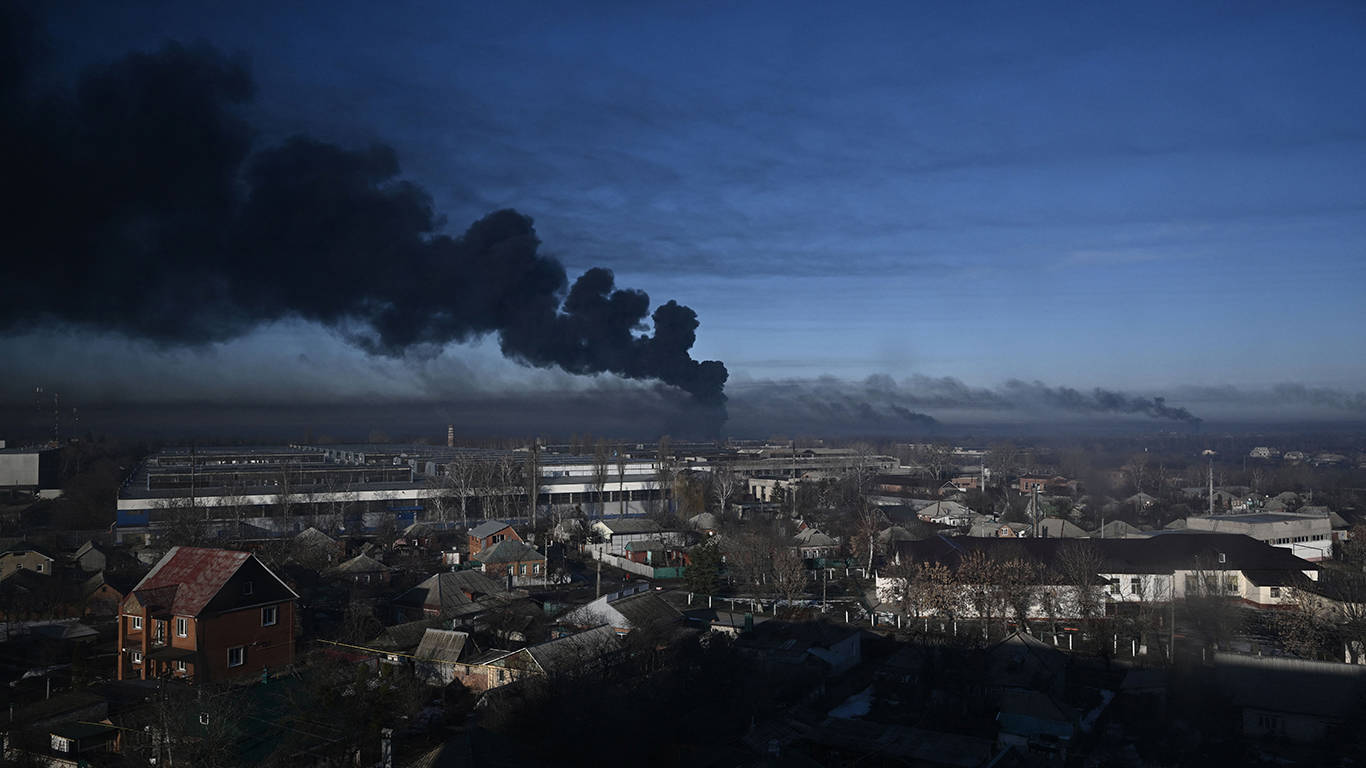
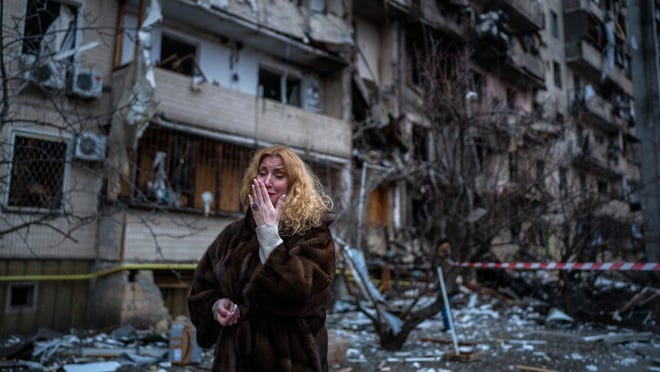
It has been earlier reported that the Russian forces have entered the Obolon district in the north of the city, just a few miles from its centre. The forces appeared to be closing in on Kyiv which put Ukraine under significant pressure.

Meanwhile, the Ukrainian forces have reportedly pushed the Russian forces back, having blown up the city bridge to stop their advancement.


Russia's readiness for talks with demand Ukraine put down arms first is a 'farce,' experts say

Mike Snider
USA TODAY


The Kremlin said Friday it is ready to hold talks with Ukrainian officials, but only if the Ukrainian forces stand down – an offer that experts derided as a "farce" and came as Russian troops were bearing down on Ukraine's capital, Kyiv.

Kremlin spokesman Dmitry Peskov said Russian President Vladimir Putin is ready to send a delegation to Belarus to meet with Ukrainian officials. This came after Ukraine President Volodymyr Zelenskyy said he is willing to discuss a non-aligned status for the country, which could mean dropping his country's long-held bid to join NATO.

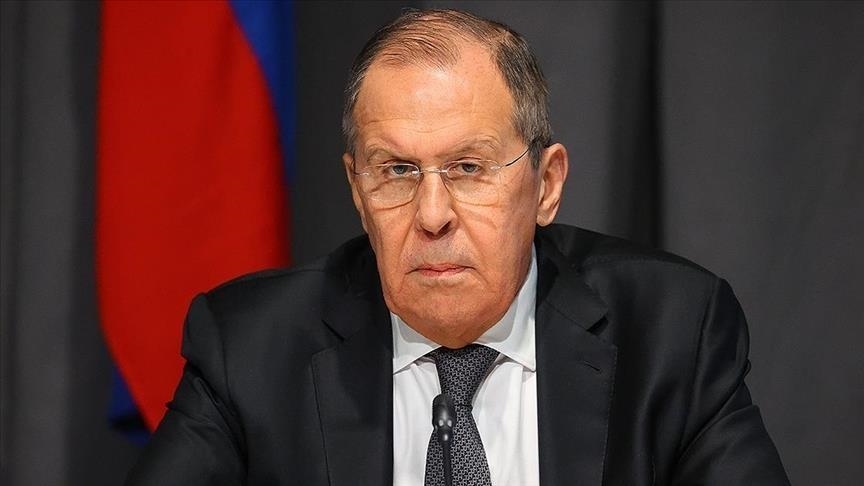
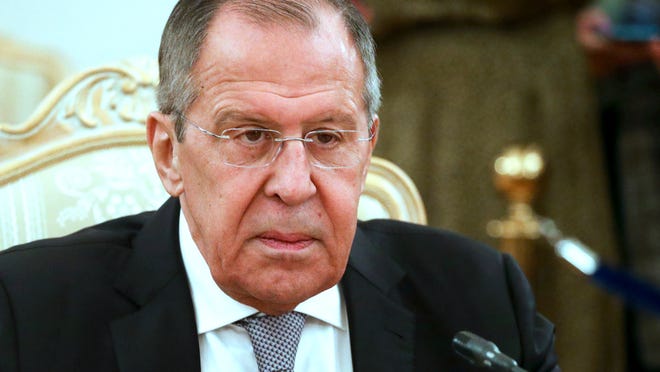
However, Russian Foreign Minister Sergey Lavrov said Ukraine must put down its arms before any talks happen, according to Russia's state-controlled TASS News Agency.

"We are ready to hold talks at any moment, once the Ukrainian Armed Forces respond to our president’s call, end their resistance and lay down their arms," Lavrov said.

"This is a farce," Mattia Nelles, a Ukraine and Russia expert with the Wilson Center, a Washington-based think tank, wrote in a tweet. He noted the Ukraine is unlikely to accept such conditions.

Alexander Lanoszka, an expert on European security at the University of Waterloo in Canada, said Moscow's proposal seemed preposterous.

“I am not sure why Kyiv would ever agree to send a delegation to enemy territory when Russia plausibly wants to decapitate Ukraine's leadership and impose regime change,” he tweeted.

Russia strikes Kyiv in 'horrific' attack:Pope Francis makes unprecedented visit - live updates

Ukraine:Reports: Country bans all male citizens aged 18 to 60 from leaving the country

Chinese President Xi Jinping said he had spoken with Putin Friday and the Russian president "expressed Russia’s willingness to have high-level negotiation with Ukraine," according to a statement on the Chinese Foreign Ministry's website.

Russian military forces on Friday continued the second day of its invasion of Ukraine, as forces approached the capital city of Kyiv.

Putin on Thursday said Russia was launching its special military operation after declaring two breakaway districts in Ukraine as sovereign. He accused the Ukrainian government of being neo-Nazis who threatened those districts and Russia's own defense. “They left us no choice," he said.

Sergei Naryshkin, the head of Russia's foreign intelligence agency, echoed that on Russian state television Friday, The New York Times reported. “Russia cannot allow Ukraine to become a dagger raised above us in the hands of Washington,” he said. “The special military operation will restore peace in Ukraine within a short amount of time and prevent a potential larger conflict in Europe.”

Meanwhile, Zelenskyy sought talks and support from Western countries. "When bombs fall on Kyiv, it happens in Europe, not just in Ukraine," he said. "When missiles kill our people, they kill all Europeans."

 Thich Nhat Hanh and "socially engaged Buddhism"

Ken Knabb knabb@bopsecrets.org


Millions of people around the world are mourning the recent death of
Thich Nhat Hanh, the Vietnamese Buddhist teacher and author who was
a major pioneer of "socially engaged Buddhism."

I share their love and admiration of him. I also have enough respect for
him, and for those whose radical efforts he has inspired and influenced,
to feel that they merit the clearest possible critiques:

"Strong Lessons for Engaged Buddhists"
http://www.bopsecrets.org/PS/buddhists.htm

"Evading the Transformation of Reality: Engaged Buddhism at an Impasse"
http://www.bopsecrets.org/recent/buddhists.htm

__________________________________________________

The BPS website features Ken Knabb's writings, his translations from
Guy Debord and the Situationist International, and a large archive of
writings by Kenneth Rexroth. 
________________________________________________________

BUREAU OF PUBLIC SECRETS
P.O. Box 1044, Berkeley CA 94701, USA
http://www.bopsecrets.org

"Making petrified conditions dance by singing them their own tune."

How Egypt’s Heritage Became a Political Battle

Islamic, Pharaonic or both? That's the dilemma facing Egyptians as they look to the past for a new sense of national identity

Magdi Abdelhadi

Magdi Abdelhadi is an Egyptian-born writer and broadcaster

February 25, 2022

How Egypt’s Heritage Became a Political Battle
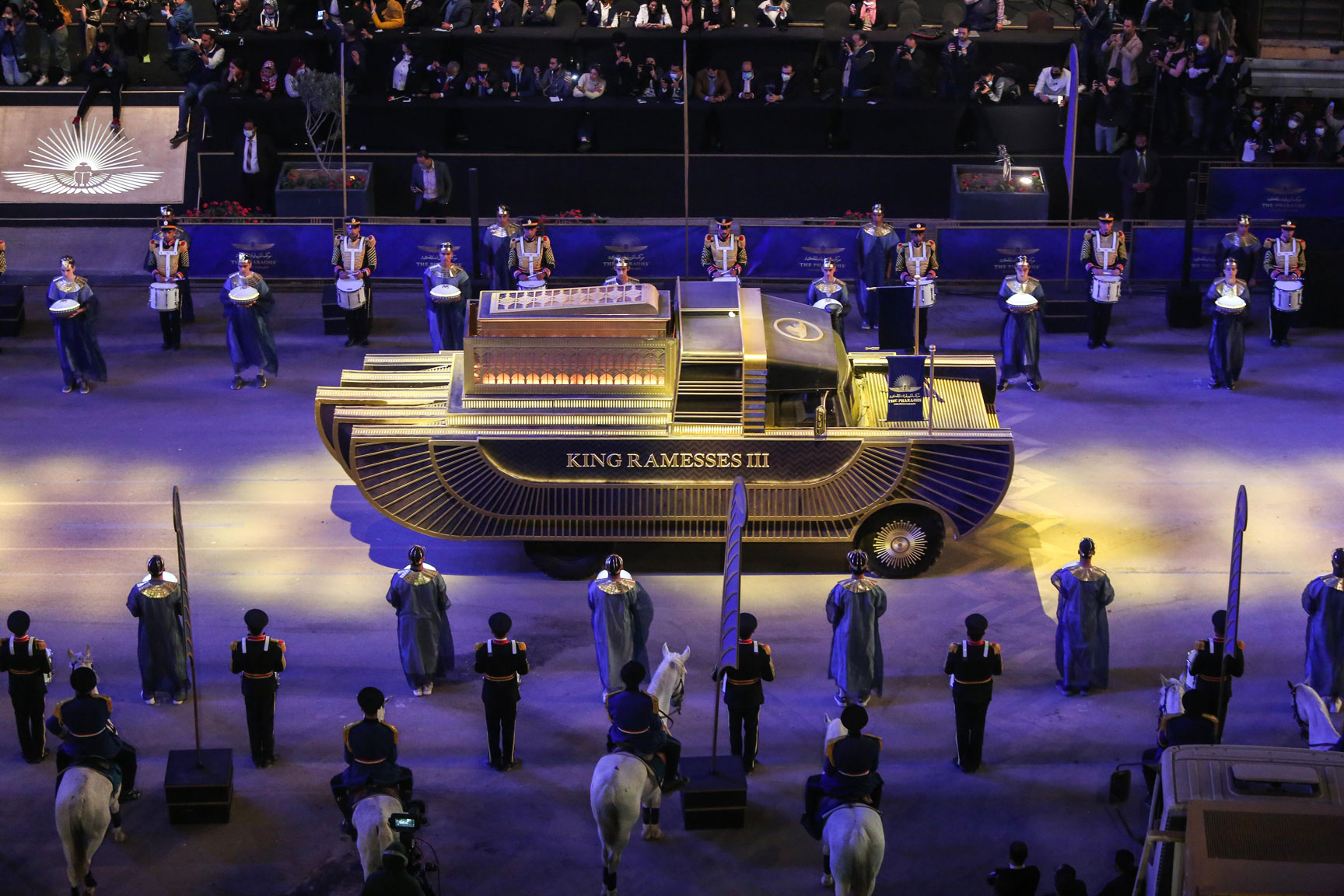
In Cairo in April 2021, as part of a convoy called the Pharaohs’ Golden Parade that included 22 royal mummies, a specially designed vehicle carried the mummy of Ramesses III from the Egyptian Museum in Tahrir Square to the new National Museum of Egyptian Civilization / Islam Safwat / Getty Images

Pick up any Egyptian banknote, look at both sides of it, and you will see two competing strands of the country’s heritage. The design on one side evokes Islam, while the other evokes the Pharaohs. Both have a central place in the nation’s history but, 2,000 years since the end of the Ptolemaic dynasty and almost 1,400 years after the arrival of Islam, Egyptians still argue about their respective contributions to national identity.

It’s a dispute that the passage of time has failed to resolve, and it has come to the fore again as the Sisi regime attempts to claim some of the ancient glory for itself.

The nub of the issue is simple enough, though its ramifications are far-reaching. There’s no denying that Egypt, under the Pharaohs, had one of the greatest civilizations of the ancient world and yet — according to Islamic teaching — it was a place of “jahiliyya” (ignorance and darkness) until the Arab-Islamic conquest brought enlightenment.

Efforts to resolve this uncomfortable paradox have spawned a vast culture of apologetics over the years. For many pious Egyptians it starts with a basic question: Will the Pharaohs go to hell because they were not Muslims? On that point the answer from clerics is usually reassuring: Anyone who died before the Qur’an was revealed to the Prophet Muhammad will not be punished for nonbelief, because they had no opportunity to hear the divine message.

But that’s not all. The Qur’an itself incorporates several well-known biblical narratives casting the ancient Egyptians as the bad guys. First, there’s the story of Moses and Pharaoh, then Joseph and the lustful wife of Potiphar. In both tales, the Egyptians come off badly. They are portrayed as gross, tyrannical and violent — in contrast to the wisdom and mercy shown by chaste and righteous young Hebrews.

When I mentioned that to a friend recently, he quickly rebuffed me, saying that the negative stories in scripture apply only to the Pharaoh, not the entire Egyptian people. That overlooks the fact that the Pharaohs were an integral part of the ancient culture, but my friend is in good company: none other than Zahi Hawwas, the former antiquities chief, told an Egyptian publication recently that the Qur’anic narrative “does not hurt Egypt.” There was one tyrant king there who disobeyed the order of his lord and received the punishment he deserved, Hawass said. “Egypt was ruled before him and after him by hundreds of great kings who built a human civilization whose merits can only be denied by a hateful or an ignorant person.”

Numerous writers have noted the piety of ancient Egyptians, quoting at length from ancient sacred texts such as the “Book of the Dead.” But the fact that they need to point this out, and argue the case with supporting evidence, is testimony of how deeply the Christian/Muslim/Jewish view of the ancient Egyptians has penetrated into modern Egyptian consciousness.

Another line of argument — popular with nationalists — is that ancient Egypt’s bad reputation was generated by her historic enemies and handed down through scripture. Thus, when Christianity came to Egypt, followed later by Islam, Egyptians internalized these negative portrayals and lost sight of their great past. In the nationalists’ view, that was the ultimate defeat, and the only way to become a great nation again is for Egyptians to reclaim their ancient past. While this is not currently the predominant view, it’s one that has been gaining ground in the past few years.

In contrast to the maligned history of the Pharaohs, the Arab-Islamic conquest in the seventh century A.D. is often viewed more favorably (by Muslims, if not by Egypt’s large Christian minority). The official narrative, as reflected in school textbooks, is that the Arabs liberated Egypt from Byzantine oppression and in doing so were motivated by religious zeal and lofty principles. Historians know that is not quite true. Egypt was Christian when the Arabs invaded and there were repeated revolts against the “jizya” tax imposed by the new masters on the non-Muslim population. The textbooks don’t mention how the revolts were brutally suppressed and, not surprisingly, Egyptian Christians and others sometimes complain about the terminology used to describe the conquest. The usual Arabic term — “fath” — has positive connotations, implying that the Arabs “opened” rather than subjugated Egypt.

During the struggle for independence in the first half of the 20th century, there were broadly two currents. One, which viewed Egypt primarily as a Muslim nation, sought to free it from British tutelage and return to the Ottoman sphere. The other current sought independence for Egypt as a modern nation state — which brought the country’s Coptic minority on board by prioritizing national cohesion over religious identity. Incidentally, the historical leader of this second trend, Saad Zaghloul (1858-1927) of the Wafd party, lies today in a Pharaonic-style mausoleum in central Cairo.

Since the 1950s the Arab strand of Egyptian identity has become indelibly linked to Gamal Abdel Nasser — the first real Egyptian to rule the country in well over 2,000 years. From the fourth century B.C. until the 1952 coup that brought Nasser and his fellow army officers to power, it had effectively been in the hands of foreign dynasties. Nasser almost single-handedly steered Egypt away from the European sphere and thrust it into the heart of Arab politics. It became officially known as the Arab Republic of Egypt.

Buoyed by his political triumph in the Suez Crisis of 1956, Nasser quickly assumed the mantle as the Arabs’ leader, standing up to the old colonial powers and pursuing the dream of pan-Arab unity. But that dream came quickly crashing down after the short-lived — and by all accounts disastrous — union with Syria (1958-1961). Worse disasters were to follow.

Nasser’s foray exposed the flaws of the basic idea of uniting all Arab states, from the Atlantic to the Euphrates. The sheer grandiosity and impracticality of the project should have killed off the idea once and for all. But far from it: The dream of pan-Arabism is still alive and kicking.

Nasser died in 1970, with a chunk of his country (the Sinai Peninsula) occupied by Israel. Every year on the anniversary of his death or his coup a dispute breaks out over his legacy. Critics say he was a disaster — that his brand of socialism and pan-Arabism destroyed a once-prosperous country. But he still has a big following both in Egypt and beyond, and the politics he championed still pervades the public discourse to a remarkable extent. This annual tussle is not just about economic policy and the nature of the political system Nasser created, but in a fundamental way it’s about national identity. It was Nasser who made Egypt officially “Arab.”

Today, half a century after Nasser, the Egyptian constitution has enshrined the two pillars of Egypt’s supposedly Arab-Muslim identity: Arabic is the official language and Islam is the state religion. It even pays lip service to the ideological aims of pan-Arabism as part of the constitution: “The Egyptian people are part of the Arab nation and work toward its unity.”

More visibly, though, Egypt’s architecture often tells a different story. There are Pharaonic motifs in all kinds of buildings — public and private — and some of the most conspicuous ones have been erected by the state. There are the constitutional court, built in 2001 on the eastern bank of the Nile, which resembles an ancient temple, and the monument of the unknown soldier, shaped like a hollowed-out pyramid. Constructed in 1975 during the presidency of Anwar Sadat, the monument is adjacent to the spot where Sadat was assassinated six years later. It also became his burial place.

Aside from the monument’s design, its site links ancient and modern Egypt in an uncanny but telling way. Sadat was gunned down by Islamist militants among his own soldiers, with one of them — chief assassin Khaled el-Islambouli — reportedly shouting “Death to the Pharoah!” as he pulled the trigger.

This reported phrase made the tragic moment reverberate back and forth between pre-Islamic Egypt and modern jihadism. According to testimony during the investigation, the assassins killed Sadat because two years earlier he had made peace with the Jews, i.e. the state of Israel.

The moral standing of ancient Egypt vis-à-vis the Torah or the Qur’an is not an arcane theological or archaeological topic for modern Egyptians. Far from it. It’s still debated and argued over vigorously, not least because it strikes at the heart of questions about the nature of Egypt today — its own perception of itself, its national identity. As such, the issue has serious political and cultural implications.

Attempting to reconcile the two strands of national heritage — the purely Egyptian and the Arabized/Islamized Egyptian — has the potential benefit of defusing religious tension between the majority Muslim communities and Coptic Christian minority. At times they coexist peacefully but at others less so.

Diverse arguments have been marshaled over the years in an effort to reach some accommodation. One of modern Egypt’s outstanding intellectuals, the late Professor Gamal Himdan, wrote extensively on the interface between geography, history and culture. In his much-quoted work, “The Genius of Place,” he sought to offer a rational economic explanation for the enormous centralisation of power around the Pharaohs. As any school textbook would tell you, without the Nile, there would be no Egypt. Its water was a vital resource, and a strong central power was needed to manage it.

Others have sought to rehabilitate ancient Egypt in the eyes of pious Egyptians with the self-congratulatory claim — officially promoted by the state itself — that Egypt was “the cradle of monotheism.” This refers to the short-lived cult of Akhenaten, also known as Amenhotep IV, the Pharaoh who sought to replace ancient deities with one god (Aten, the sun disc), in the 14th century B.C. There are even some who peddle the theory that Akhenaten was none other than Moses himself.

The aim of this is to rehabilitate ancient Egypt as a place of “one god” rather than “shirk” — the term used in Islam to describe idolatry or polytheism. The truth or otherwise of the claim matters less than the idea, which seems to offer some form of redress to ancient Egypt, and comfort to contemporary Egyptian Muslims, for whom shirk is the ultimate depravity and the fastest way to hell.

One of the most bizarre examples of this apologetic trend came when Sheikh Khaled el-Guindy, a senior Islamic scholar and a member of the Supreme Council of Islamic Affairs, stated in a religious talk show: “The Pharaohs are our fathers, and there were Muslims among them.” This was a radical departure from the orthodox view embraced by al-Azhar, Egypt’s pre-eminent seat of Sunni Islamic scholarship.

Another highly controversial attempt to put ancient Egypt on an equal footing with its Abrahamic detractors involves the mysterious “muqatta’at” — disjointed sets of Arabic letters that appear at the start of 29 chapters in the Qur’an. Their significance has never been conclusively explained but one theory (among many) can be found in a book titled “Hieroglyphs Explain the Quran,” in which its author, Saad Abdel-Muttalib, tries to establish that the letter combinations are in fact ancient Egyptian phrases with spiritual and religious meanings relevant to the Qur’anic chapter. Another unsolved mystery is how the author received approval from the Egyptian censor and the religious authorities at al-Azhar to publish such a contentious book.

It’s against this backdrop of a tortuous and contentious striving for national identity that the recent spectacular displays of ancient Egyptian culture organized by the state ought to be seen. Twice last year, the Egyptian government staged huge events — one in Cairo and the second in Luxor — to celebrate ancient Egypt in ways never seen before in the country.

The first of these, in April, was an elaborate ceremony to transfer the mummies of some 20 ancient kings and queens from the old Egyptian Museum in central Cairo to a new museum on the outskirts of the city. It was a carefully choreographed show accompanied by operatic music and dancers on the city’s streets. The occasion for the second spectacle, in November, was the opening of the ancient (and newly restored) “Avenue of Sphinxes” linking the monumental temples of Karnak and Luxor.

It was not only the grand scale of the celebrations that made these events stand out but also the pageantry, which included hymns sung in the old language, understood today only by Egyptologists. Egyptians themselves had never heard their ancient language before, and Arabic subtitles had to be provided for the TV broadcasts.

Obviously, one purpose of this was to promote tourism, which provides the state coffers with much-needed hard currency and employs millions of Egyptians, but at the opening ceremony in Luxor antiquities minister Khaled el-Enany made clear that its other aim was to “grow a sense of belonging” among the Egyptians. “We have all seen in our homes and among our friends how the children reacted to the caravan of the royal mummies, how they felt proud and felt that there was something that binds us all together, that they haven’t seen before,” the minister said.

It was a political message that many Egyptians greeted with genuine pride and growing curiosity about their distant past. On social media, which is a good barometer of opinion in Egypt, pages dedicated to ancient Egypt proliferated and people changed their Twitter handles and Facebook profiles to show related images. Artists joined the trend, too. One launched a program to teach ancient Egyptian design to schoolchildren. A young opera singer offered her own interpretation of an ancient Egyptian love song, and the government announced plans to teach hieroglyphs in primary schools — which would be a first.

For the regime, the return to ancient Egypt had its own attraction, because the long-dominant themes of Arabism and Islam have outlived their usefulness. Arabism embroiled Egypt in pan-Arab conflicts with devastating effect — whether this was the wars with Israel or the disastrous intervention of the Egyptian army in the Yemeni civil war during the 1960s. Nasserist intelligentsia and the state media on autopilot may still trumpet the pan-Arab rhetoric, but in practical terms it amounts to nothing. When Egypt signed the peace deal with Israel in 1979, it effectively turned its back on Arabism and became focused on its own problems.

Meanwhile, the twin brother of Arabism — political Islam or Islamism — has been declared the official enemy of the Egyptian state. Its foremost proponent, the Muslim Brotherhood, has been outlawed and designated a terrorist organization. Although the movement came to power through the ballot box after the overthrow of Mubarak in 2011, its failure to build a broad consensus with other political forces quickly brought all its enemies together to oust the Brotherhood’s president in 2013. The turmoil of the past decade has polarized Egypt, and there are still huge disagreements on how best to describe what happened: an uprising, a revolution, a coup, a foreign conspiracy or perhaps all of them together.

Having declared war on political Islam and bereft of Arabism as a guiding ideology, the Egyptian regime had to develop a new narrative of legitimacy — and what better way than to project the power and glory of a distant past?

The patriotic slogan adopted by President Abdel Fattah al-Sisi is “Tahiya Masr” — roughly equivalent to “Long Live Egypt.” Resurrecting a great and glorious past always works, especially in dictatorship or authoritarian states. Further, the promotion of ancient Egypt as a national identity that binds Egyptians together has the advantage of undermining the divisive narrative of political Islam which sees Egyptians in exclusively Islamic terms.

Resurrecting Egyptian (as opposed to Arab) nationalism taps into the pride that many genuinely feel about their ancient history, especially those who see themselves excluded from the discourse of Arabism and Islamism — such as Egypt’s sizable Coptic minority and the liberal or secular constituencies.

Naturally, not everyone was pleased by the recent Pharaonic spectacles. To some, they looked more like a coronation, reinforcing fears that Sisi has no intention of relaxing his iron grip. He was central to both events. In the first show, he was seen walking alone surrounded by glittering lights in long corridors before receiving the royal mummies in their new resting place. Yet again, there was a long sequence of him walking alone, surrounded by the massive columns of the Karnak temple.

If that’s what resurrecting ancient Egyptian identity means, critics say they want none of it: The last thing Egypt needs today is another Pharaoh. Sadly, for those still nursing the hope of freedom and democracy of the 2011 uprising, Sisi is a dictator in all but name, much like all his predecessors and arguably even worse.

Others, though, saw the prominent role played by women anchors, dancers and singers in the two spectacles as a cause for celebration. It was decidedly un-Islamic and a far cry from the image of headscarfed women promoted by the Muslim Brotherhood in what they claimed was an “Islamic Awakening.”

Countering the Brotherhood, veteran journalist Ibrahim Issa dubbed the Pharaonic spectacles an “Egyptian Awakening” on his talk show. Novelist Hamdi Abu Golayyel observed: “Egypt’s salvation lies in being close to its Egyptianness. I am not against the Arabs. But Egypt is different from the Arabs and older than the Arabs. Attaching Egypt to that Arab entity as if she was part of it has been extremely damaging.”

It was a remarkable statement from a writer who is avowedly Arab of Bedouin stock and who has built his literary career on classical Arabic — not the Egyptian vernacular, the everyday language of the Egyptians. The conflict between the two is yet another twist of the unfolding drama of national identity in Egypt. Not a year goes by without calls in Parliament to protect the purity and dominance of Arabic against the encroachment of the vernacular or foreign languages.

Arabic is the official language of Egypt, but in reality the Egyptians live with two languages: classical Arabic and the Egyptian vernacular, which is a hybrid of Arabic and the kind of Egyptian spoken when the Arabs conquered Egypt in the seventh century. The first is the language of writing — official documents, preaching, literature and news reports. But the vernacular has over the centuries become the language of everything else. It is the language of popular culture — films, drama, soaps and songs — and more recently it has become the language of populist Muslim “televangelists.” The vernacular has a rich tradition of poetry, but not novels. Yet that is beginning to change too.

The recent translation to the Egyptian vernacular of the French classic “L’Etranger,” by Albert Camus, which had been available in classical Arabic for decades, has provoked a very angry and predictable reaction from all and sundry. The new translation was a decidedly defiant statement about cultural identity, a challenge to those who look down upon the spoken language, viewing it as incapable of reaching the literary heights of Tolstoy, Balzac or T.S. Eliot. Challenging that bias is self-evidently a frightening prospect for the guardians of Arab identity.

The young translator Hector Fahmy had to endure a barrage of vitriol that ranged from contemptuous ridicule of the Egyptian vernacular to predictable claims that his translation was part of a foreign plot to undermine “Arab unity” — since the Arabic language is one of the foundations of the pan-Arab ideology.

In response to these insults Fahmy wrote on his Facebook page: “We are Egyptians, we have the right to write and translate to our Egyptian language, just as we think and dream and live in that language. I will continue to defend that right. Those who want to hurl abuse at me can continue to do so, and I will [continue to] translate.”

Developing a distinct awareness of Egyptian identity may help curtail the pervasive influence of Islamism and pan-Arabism on the public discourse. The idea of an “Egyptian Awakening” will undoubtedly make many people happy and inspire artists and intellectuals to find new forms of expression.

But can a return to ancient Egypt provide what the dominant ideologies of pan-Arabism and political Islam have so far failed to deliver: a confident and prosperous nation free from want or fear of voicing dissent? For that to happen it will take much more than glamorous pageantry — and certainly not worship of an infallible leader. It will have to translate into some palpable value for the majority of Egyptians, some 30 percent of whom live under the poverty line. Otherwise, lofty ideas about a great past will remain just that.
Six Months After the Fall of Kabul — with Fazelminallah Qazizai, Pashtana Durrani and Emran Feroz
New Lines Podcast
February 25, 2022
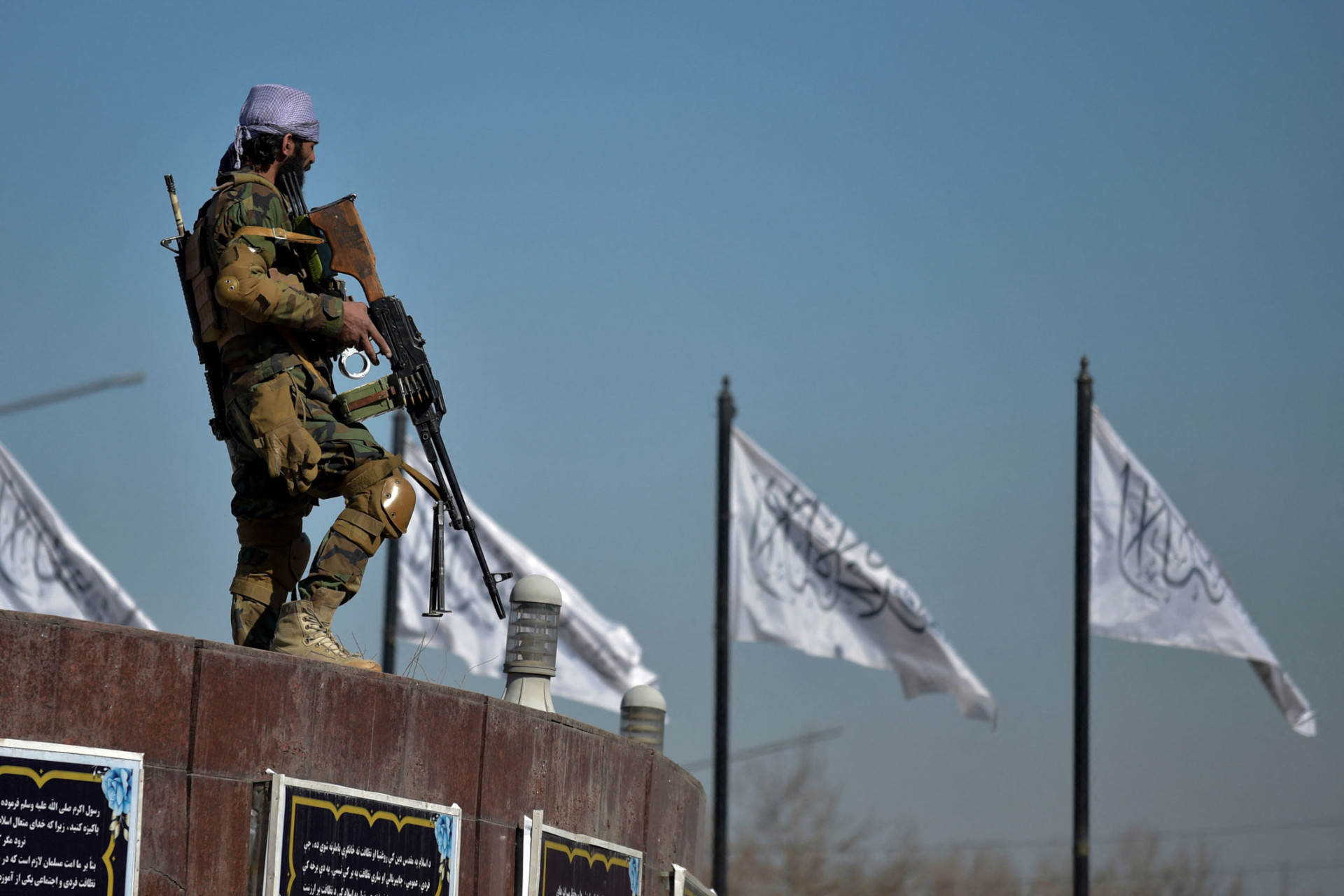
A Taliban fighter stands guard last month before a women’s protest at Ahmad Shah Massoud Square in Kabul / Wakil Kohsar / AFP via Getty Images

There is no work and there is no money. And this is a great challenge for the country that won’t allow Afghans to enjoy the peace that they gained after 20 years of war.

The war in Afghanistan may be over, but a humanitarian crisis threatens to be even deadlier than the 20 years of fighting. In a follow-up to our podcast episode from September, New Lines’ Faisal Al Yafai talks to Fazelminallah Qazizai, Pashtana Durrani and Emran Feroz to explore how the country’s situation has changed over six months of Taliban rule. They discuss how U.S. sanctions have left Afghans without money or food, how the Taliban govern and what will happen to their regime if the crisis continues into the spring.

At least 23 FARC dissidents killed in Colombia military operation

by Agence France-Presse
February 25, 2022


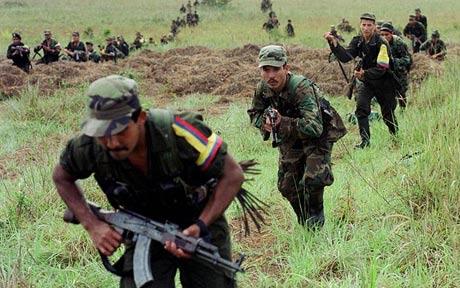
At least 23 dissidents of the former FARC guerrilla group were killed during an operation by the Colombian armed forces along the Venezuelan border, the Defense Ministry said Thursday.

The dissidents “died during military operations” carried out in the northern border department of Arauca, a narcotrafficking corridor that has seen fierce fighting between armed groups since the beginning of the year, a source in the ministry told AFP.

Among the dead was a former leader of the Revolutionary Armed Forces of Colombia (FARC), known as “Arturo.”

Five dissidents were additionally injured, the source said.

“This operation forcefully dismantles the FARC dissident structure,” said Colombian Defense Minister Diego Molano, in a video published to social media.

Colombia signed a peace agreement in 2016 with the FARC to end a decades-long battle, but some dissident members of the group have chosen not to recognize it.

The defense minister said Arturo “took refuge in Venezuela and from there sought to reactivate the dissident groups to continue committing crimes.”

Former FARC dissidents, as well as members of Columbia’s last active guerilla group known as the ELN, have set up bases in Venezuela, where Colombian authorities say they receive government backing — an accusation Caracas denies.

Another rebel group leader known as “Ernesto” was also killed in the operation, which adds to a recent string of successful military offensives.

Last month, the president announced the “neutralization” of the rebel group leader known as “Jhonier,” while in October of last year the drug kingpin known as “Otoniel” was captured.

He is now awaiting extradition to the United States.
Kurdistan People's Democratic Movement calls for delisting of PKK

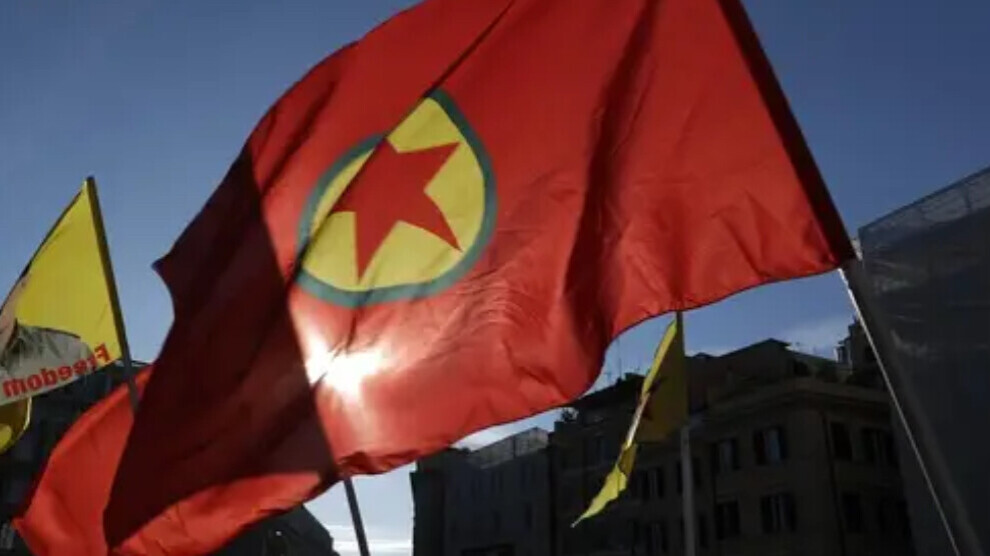
Necad Eli Qadir, a member of the Kurdistan People's Democratic Movement, demanded that the PKK be removed from the EU's list of terrorist organizations.


RÊBAZ HESEN-WEYSÎ TALLÎ
SULAYMANIYAH
Friday, 25 Feb 2022

The international initiative Justice for the Kurds called on internationally renowned figures from 30 countries to join the campaign to remove the PKK from the EU list of terrorist organizations. 1003 people joined the call and started the "PKK removed from terrorist lists" campaign on 13 December 2021.

One leg of the campaign carried out in many parts of the world is South Kurdistan.

On 29 January, many people, including intellectuals, politicians and artists from South Kurdistan, launched a campaign for the same purpose in Sulaymaniyah and Kirkuk.

Support for the campaign came also from the People's Democratic Movement of Kurdistan. Movement member Necad Eli Qadir said: “Removing the PKK from this list means that the PKK's effort and desire for freedom will pave the way for peace, freedom and democracy. To be peaceful, you must be a fierce and brave fighter. Today, the PKK is a fighter struggling for peace and freedom in Kurdistan and Turkey.”

Qadir said that the success achieved in each part of Kurdistan should see the struggle as "its own success".

Calling for the PKK to be removed from the list of terrorist organizations, Qadir said: "On behalf of the People's Democratic Movement of Kurdistan, I express my support to the campaign. We demand that this freedom movement be removed from the list of terrorist organisations immediately."

HPG Commander: We will liberate Öcalan

A commander of the People’s Defence Forces (HPG), Hawar Suruç, said that guerrilla forces will put up the greatest resistance to make Kurdish leader Abdullah Öcalan free. “We are ready for this militarily and ideologically,” Suruç added.


ANF
BEHDINAN
Tuesday, 22 Feb 2022, 14:17

HPG’s Qandil State Commander Suruç Hawar spoke to ANF about the international conspiracy against Kurdish leader Öcalan, which marked its 23rd year, as well as the guerrilla resistance and objectives for 2022.

Suruç remarked that the resistance of the Kurdistan freedom guerrillas in 2021 was based on completely frustrating the International Conspiracy and added that the Turkish state is very likely to attack in 2022. “We are ready for possible attacks this year.”

Suruç commemorated the martyrs who set their bodies on fire for Öcalan under the motto “You cannot darken our sun” following the international conspiracy on February 15, 1999. “For every single year that Öcalan has been kept in prison for the last 23 years, we should do a self-criticism. As the guerrilla forces and PKK militants, we bear the responsibility to ensure the physical freedom of Leader Öcalan. This is our duty. Therefore, it is not enough to condemn the conspiratorial forces, the important thing is to raise the resistance against these forces and physically liberate Öcalan,” the HPG commander said.

'INTERNATIONAL CONSPIRACY IS COMPREHENSIVE AND FAR-REACHING'

Suruç reminded that leaders have faced conspiracies various times in the history of Kurdistan. “For this reason, the conspiracy against Öcalan is in fact directed at the Kurdish people, it is neither the first nor will it be the last one. However, the conspiracy against Öcalan is unprecedented in our history. Because previously, it was mainly about foreign powers not keeping their promises and suppressing serhildans (Kurdish uprisings). In this regard, the conspiracy against the Kurdish leader is more comprehensive and far-reaching. The Turkish state had tried to eliminate Öcalan through conspiracies and assassinations several times before, but these were frustrated owing to his prudence.”

The HPG commander pointed out that the states led by the USA, Israel, Russia and Greece were involved in the international conspiracy on February 15, 1999, stating, “We should not forget the support given by the reactionary Kurdish forces. Moreover, some betrayers and confessors, such as Şemdi Sakık, who fled our movement, targeted Öcalan. These confessors told the Turkish state that our movement would not be eliminated without eliminating Öcalan first.”

'ÖCALAN IS A RED LINE FOR GUERILLAS'


Suruç stated that even though the international conspiracy resulted in the physical captivity of Öcalan, the conspiratorial forces could not achieve their objectives. “In fact, Turkey itself was not ready for the imprisonment of Öcalan, and Ecevit, the then Prime Minister, admitted it. Therefore, this conspiracy was also directed against the peoples of Turkey. The imperialist powers knew that Öcalan was a red line for the Kurdish people and wanted to use him to cause strife between the Turkish and Kurdish people. However, Öcalan frustrated the conspiracy and prevented wars and conflicts between peoples.”

Suruç reminded that Öcalan paved the way for democratic politics and the ceasefires, adding, “At that time, all HPG guerrillas volunteered for actions of self-sacrifice, but they were stopped at the request of Öcalan. Öcalan represents a red line for the guerrilla forces, just like the Kurdish people. He prevented larger and more effective actions since he had deeper foresight and prudence.”

'ISOLATION OF ÖCALAN


Suruç also spoke about the ongoing imprisonment of the Kurdish leader for 23 years now, saying, “When it is a matter between the oppressors and the oppressed, there is no such thing as law. Everyone turns a blind eye to what the Kurdish people are going through in the person of Öcalan. It seems that they have decided to terminate the Kurdish people in the person of Öcalan, and the conspiracy is still continuing in the same manner.”

Suruç remarked that the international conspiracy is still not completely over, even though it has not achieved its goals and objectives. Pointing to the guerrilla resistance in 2021, he continued, “The resistance mounted by the guerrilla forces, especially in Werxelê, Metîna, Zendura, Girê Sor and Şehit Serdar Hill, was actually to frustrate the conspiracy against Öcalan. We should not forget that our fighters became martyrs in 2021 for this objective, because those who are not aware of the truth of history and the people, and those who are not loyal to Öcalan, cannot resist. The resistance spirit that Öcalan gave shape within the HPG guerrillas has remained pervasive. They thought that the guerrillas would not be able to resist if Öcalan were subjected to aggravated isolation and separated from the guerrilla forces and his people, but they were wrong about that. Even if they keep Öcalan under severe isolation, he is in our minds and souls. The Turkish state and the public should recognize this reality.”

Suruç argued that the Turkish state is likely to attack in 2022. “We are ready for possible attacks this year. Even if they attack us with all their tanks, artillery, planes and even chemical weapons, they cannot break us from our faith and our goal, and they cannot weaken our loyalty to Öcalan. If you are ready to resist attacks mentally, psychologically, militarily and ideologically, no power can defeat you.”

'GUERILLAS ARE ALSO FIGHTING AGAINST CONSPIRATORIAL POWERS'

Suruç emphasized that those who support the Turkish state by providing all kinds of weapons, specifically chemical weapons, are the very same forces that were involved in the international conspiracy. “In this respect, we are actually fighting these forces which favour the sovereign and colonialist mentality. The oppressed peoples have thus come together around the ideas of Öcalan. Scientists and world-leading experts also endorse Öcalan’s cause. This shows the level the resistance of the freedom guerrillas has reached.”

Suruç stated that the forces that do not fight and cannot resist to cope with the problems of the 21st century do not have the right to speak about their demands. "The PKK has proven itself in this matter as well,” he added.

“On the 24th year of the conspiracy, the guerrilla forces will make any sacrifice so that Öcalan is not held captive anymore. We are ready militarily and ideologically, and our people are also ready for it. We see that the oppressed peoples are also ready. We have everything, ideas and ideology for victory,” the HPG commander concluded.


War in Ukraine and Turkey’s Bayraktar TB-2 drones

Russia's military operation against Ukraine concerns Turkey as well. Why is it so?


ANF
NEWS DESK
Friday, 25 Feb 2022, 13:27

The military operation launched by Russia on February 24 is a particular concern to the Turkish state, both historically and currently. This war will affect Turkey in terms of arms sales, tourism revenues and energy supply. Turkey's arms agreement with Ukraine has already been affected.

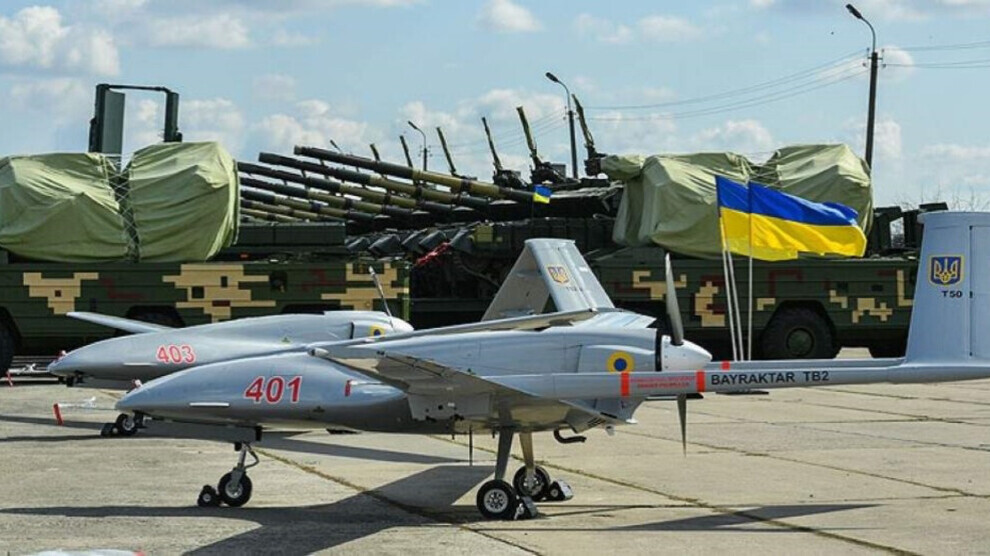
The Russian army announced that they had destroyed 74 military facilities, 11 of which were aerial domains, on the first day of the war. Defence Ministry spokesman General Igor Konashenkov also announced that the Russian forces destroyed three command centres, a naval base, 18 S-300 and Buk-M1 air defence radar systems, an attack helicopter and 4 Bayraktar TB-2 Turkish-made lethal drones.

Military forces of Luhansk People’s Republic, backed by Russia, also announced that they shot down two Ukrainian planes and two Bayraktar TB2s.

Ukrainian companies were supplying different sophisticated drone engines to Turkey. Bayraktar TB-2 drones have been produced in Kiev since the end of 2021. Moreover, the Baykar company, which produces TB-2, purchased land and started to build a factory in Ukraine in December. Last year, Ukrainian officials announced that they had bought 12 TB-2s and were planning to purchase 24 more.

The Moscow administration has repeatedly expressed its discomfort with the Turkish drone sale to Ukraine. Turkish drones were used especially against the rebel forces in the Donbass region, who declared a republic unilaterally.

Turkish drones, which are used effectively against forces that do not have air defence systems and aircraft, have become one of the main instruments of war crimes committed in many parts of the world, particularly in Rojava. There are international reports of war crimes committed by Turkish drones in Ethiopia and Libya. These killer robots are used for extrajudicial executions with complete impunity.

Turkey sells drones to African countries such as Morocco, Algeria, Rwanda, Nigeria and Ethiopia.

However, these drones have proved to be ineffective against a much more advanced military power such as Russia. The Ukrainian war has shown that Turkish drones have remained impotent against Russian military power.

While the war in Ukraine played havoc with the military cooperation of the Turkish state, it also triggered long-term fears of the Turkish state.

HISTORICAL AND CURRENT FEARS

The Ottomans reigned in the Crimea for a long time. Located in current Ukraine and annexed to Russia in 2014, Crimea was one of the first Ottoman strongholds to be captured by the Russians in 1783. In the century following the fall of the Crimea, the Russian empire seized western parts of Ukraine and, in 1878, Russian forces came very close to Istanbul. The Ottomans lost their Balkan provinces under the pressure of Moscow and new states were established. In the east, following a bloody war and massacres in the Caucasus, the Russian empire advanced towards Artvin and other cities in North Kurdistan such as Kars and Ardahan.

Ukraine has long been considered as a buffer zone to prevent Russian influence in the region. Ukraine’s fall is likely to lead to serious consequences for the Turkish state. However, it remains unclear how Turkey will pay for the consequences. Just like NATO, Ankara seems worried. It is argued that Ankara will avoid confrontation with Russia regardless of its economic interests, because the Turkish economy is expected to be affected much more heavily by the recent war.

The Turkish state benefited from the Ukrainian gas crisis in 2014. In order to continue the gas sales to Europe, Russia picked an alternative route to the Ukraine territory and introduced the Turkish Stream gas pipeline project. Thus, Turkey became one of the countries through which Russian gas would pass. Both the gas pipeline project and Turkey’s dependence on Russia in its hostility towards the Kurds in Syria and Rojava leave Ankara vulnerable.

Turkey to close straits to warships if it acknowledges Ukraine in state of war – Çavuşoğlu


Feb 25 2022 

If Turkey legally acknowledges the situation in Ukraine constitutes a state of war, then it will shut its two straits to warships under the terms of the Montreaux Convention, Foreign Minister Mevlüt Çavuşoğlu said.

But even if Turkey does close the straits, Russia still has the right to use them, Çavuşoğlu told Hürriyet newspaper columnist Fatih Çekirge on Friday.

“If there is a demand for the ships of the warring countries to return to their bases, then it must be allowed, according to the convention,” Çavuşoğlu said.

Following the launch of a Russian military operation against Ukraine on Thursday, Kyiv, which views the presence of Russian warships in the Black Sea as a threat, made an official request to Turkey to close its Çanakkale (Dardanelles) and Istanbul (Bosphorus) Straits, to Russian warships.

Kyiv also asked Turkey to close its airspace to Russia, Vasyl Bodnar, Ukraine’s ambassador to Ankara, said.

The provisions of the Montreux Convention are very clear and precise, and until today, Turkey has implemented the treaty without hesitation, Çavuşoğlu said.

Turkey can stop the passage of warships through the straits in a state of war.

“Our experts are working on the situation (to determine) if there is a state of war,” Çavuşoğlu said.

Six Russian warships and a submarine passed through the Bosporus and Dardanelles straits on Feb. 8, Tass reported at the time, for naval drills near Ukraine.

Turkey has control over which military vessels are allowed passage through its straits in wartime, under the 1936 treaty.

“We are against the annexation or a war,” Çavuşoğlu said, reiterating Turkey’s support for Ukraine’s territorial integrity.

“We will continue to maintain our principled stance that is balanced but in favour of fairness and international law. We will do our best to end this military operation as soon as possible,” he added.

Çavuşoğlu also said on Thursday that Turkey had finalised all preparations to evacuate its citizens from Ukraine, Turkey’s state-run Anadolu Agency reported.

“We have been working on the evacuations of our citizens from the very beginning,” he said. “We are ready, but the airspace is currently closed.”

“Marine traffic is also closed at the moment,” he said, adding that Turkey can evacuate citizens by sea when it reopens.

That leaves the option of evacuating Turkish nationals overland.

“When the situation calms down, we will be able to take our citizens to Moldova, Romania and Poland by land,” he said, adding that agreements have been made with bus companies in Ukraine for this contingency.
Putin's Imperial Delirium

When the history of this period is written, Russian President Vladimir Putin will be seen as an unwitting creator of the Ukrainian nation that he wanted so much to destroy. Whether in exile or at home, Ukrainian nationalism is likely to grow even stronger in the long run as a result of Putin's effort to extinguish it.

Feb 25, 2022

STOCKHOLM – War has erupted in Europe again, and responsibility rests squarely with one man: Russian President Vladimir Putin.

The martial drumbeat had been growing louder for months. But on February 21, Putin staged a remarkable puppet show in the Kremlin. Forcing his entire security council into submission, he delivered a rambling, hour-long televised speech in which he showed himself to be a man consumed by nationalist myths and imperial nostalgia, bent on extinguishing an independent Ukraine. Three days later, Putin launched a full-scale, predawn invasion.

Europe hasn’t seen anything like this since Adolf Hitler attacked and invaded Poland in September 1939. But that is the brutal reality. To see how we got here and what Putin wants, we need to revisit the build-up to his war.
MYTH AND REALITY

The February 21 speech wasn’t the first time Putin had questioned Ukraine’s right to exist independently of Russia – though he did carry this thesis to new heights of delusion. (Clearly, his extreme self-isolation during the COVID years has taken its toll.)

Putin often returns to the fact that Christianity was brought to the Eastern Slavic world with the baptism of Prince Valdemar in the spring of 989, in the city of Chersonesus, the ruins of which can be seen in the outskirts of Sevastopol, in Crimea. That historic event illustrates the complexity of the matter at hand today.


The likely impact of Russia's invasion of Ukraine should not be underestimated. The world is now undergoing a geopolitical regime shift that will have profound economic and financial consequences, most of which will be difficult to contain with existing policy tools.0Add to Bookmarks

The prince who is called Vladimir in Russian is called Volodymyr in Ukrainian; but in his childhood, he would probably have answered to Valdemar. He was born of a Scandinavian Viking clan that had come to rule over the cities of Novgorod and Kyiv, along the littoral trading route between the Baltic and Black Seas. By that time, Chersonesus had been a Greek city for about a millennium.

Not until centuries after the Kievan Rus state had been established did the state of Muscovy begin to emerge, with Moscow at its center. For centuries, the area that would become Russia was under the tutelage of the Mongols, and the area that would become Ukraine was largely dominated by Poland and Lithuania, with the open steppes to the south being the domain of the roaming Tatars and Cossacks.

Hence, when Putin, in his rambling speech, referred repeatedly to “historic Russian lands,” he was being not just ahistorical but downright fanciful. To be sure, in later centuries, these lands were conquered by Imperial Russia and included in its domains. But this was not always a harmonious period, because even by then, a Ukrainian national consciousness had begun to emerge, reflecting the area’s unique historical background. Though Ivan Mazepa was eventually defeated by Peter the Great in the early eighteenth century, his memory lived on as a Ukrainian national hero.

THE PRISON OF NATIONS

Imperial Russia, which seems to figure prominently in Putin’s fevered dreams, was often known as the “prison of nations.” Ruled by the czar and dominated by the Russians, it included numerous nationalities that secretly or openly longed to shape their own futures. And when the empire collapsed, and Russia sank into a brutal civil war, most of them, including Ukraine, declared their independence.

But the Bolsheviks eventually emerged victorious and went on to set up their Soviet state, basing it on the fiction of a union of national republics with various degrees of autonomy. Some non-Russian nations managed to preserve the independence they had declared, and some did not. Ukraine fell into the latter category.

Putin now sees the old Soviet structure as a cardinal sin. By establishing a Ukrainian Soviet Socialist Republic, the Bolsheviks de facto recognized the existence of a Ukrainian nation. Putin thus has attacked Vladimir Lenin for committing a profound error in creating the Ukrainian administrative entity. In Putin’s opinion, it was better when the czar was the source of all power (a tradition reprised by Stalin when he brutally ended any illusion of distributed powers).

When the Soviet state collapsed seven decades later, history repeated itself, with all those captive nations that had not managed to preserve their sovereignty declaring independence once again. In a referendum on December 1, 1991, 90% of Ukrainians – and a majority in every single region of the country – voted for independence. Even in Crimea, where support was lowest, 57% voted for an independent Ukraine. A few weeks later, the Soviet Union dissolved itself.

CATASTROPHES AND FAILURES


Putin, who famously described the collapse of the Soviet Union as a “major geopolitical disaster of the twentieth century,” does not think Ukraine and the other captive nations should have been allowed to become independent. That they were merely reflected the weakness of the Russian state at that time.

Ukrainian independence certainly brought difficult issues to the fore. Nationalists in Russia wanted control of Crimea; there were numerous issues of industrial integration to sort out; and there was the fact that one-third of the old Soviet nuclear arsenal was housed on Ukrainian territory. Most of these problems were resolved through the Budapest Memorandum of 1994, in which Russia pledged to respect Ukraine’s territorial integrity in exchange for Ukraine relinquishing the entire nuclear arsenal. One side kept its word; the other did not.

The second act of the drama came in 2004, when Ukrainians elected a president with a distinctly pro-Western orientation. Moscow’s preferred candidate, Viktor Yanukovych – who later did become president – was initially declared the winner and congratulated by Putin. But after evidence of massive electoral fraud was uncovered, large popular protests erupted. When a free and fair election was held, Viktor Yushchenko emerged as the winner. Putin had misjudged Ukraine, and his strategy ultimately alienated many Ukrainians, undercutting his own influence.


The same basic scenario was repeated on an even larger scale a decade later. By then, Yanukovych had been elected president in a free and fair election, and Ukraine had been eagerly knocking on the European Union’s door. In 2014, the EU and Ukraine had concluded an Association Agreement, including a Deep and Comprehensive Free Trade Area. This was not to Putin’s liking. Determined to have Ukraine inside the semi-imperialist Eurasian Union that he intended to create, he pursued a series of measures to pressure Yanukovych not to sign the agreement. But when Yanukovych did as he was told, major popular protests erupted again.

The regime met this uprising with extreme violence, leaving a hundred people dead in the streets of Kyiv. On February 21, 2014, with the help of the German, Polish, and French foreign ministers – but also with a Russian presidential representative as part of the talks – a deal was reached to end the crisis. Under the agreement, the next presidential election would be brought forward, the constitution would assume a more parliamentary orientation, a new coalition government would be set up, and those responsible for the killings would be held accountable.

The crisis seemed to be over. But instead of staying to carry out the agreement, Yanukovych suddenly left Kyiv, and later was smuggled into Russia. In the absence of a president, the Ukrainian parliament proceeded to implement the agreement to the letter. Even a clear majority of Yanukovych’s own party voted to see the measures through. The new coalition government was set up, and another presidential election was called.

Later, the Kremlin would repeatedly describe these events as a coup. It was nothing of the sort. After days of massive protests and brutal killings by the authorities, calm immediately returned to the streets of Kyiv.

But while there was no coup in Kyiv, there was obviously a crisis in the Kremlin. As Putin later admitted, this was when he made the decision to seize Crimea. A week later, a Russian special forces unit took over the regional parliament in Simferopol, and installed a local thug who had garnered only limited support in the previous election. Once this was done, Russia followed through with its annexation of the peninsula.

Not content with this seizure of territory, Putin also continued with an attempt to destabilize, and eventually take over, most of southern Ukraine, establishing an entity called Novorossiya. But once again, he misjudged Ukraine. The Ukrainian army and the police were in shambles, but still they managed to repel Russia’s “little green men” (soldiers with no military insignia). Putin thus was left with no choice but to send in regular Russian army battalions to salvage what he could of the failed effort. In the meantime, Ukraine had elected a new president in an election that international observers deemed free and fair.

It was alongside this earlier Russian invasion that the breakaway “people’s republics” of Donetsk and Luhansk were created in eastern Ukraine’s Donbas region. Their governance has been opaque in the extreme, with leaders appointed and demoted (or simply killed) as a consequence of factional fights in Moscow. As for the “people,” the tragic fact is that the majority of them are no longer there, having fled primarily to Ukrainian territories.

Despite annexing Crimea and establishing a pair of vassal statelets, Putin essentially failed in 2014. Ukraine’s democracy survived. It went forward with the EU Association Agreement and started to revive its economy. Ukrainians’ hostility toward Russia deepened only further as small-scale warfare with the gangster republics in the east dragged, leaving some 14,000 dead.

Around the same time, NATO countries recognized that they needed to start increasing their defense spending, and the alliance deployed non-national forces to its eastern member states for the first time. There had been no NATO military presence there before, because the alliance’s attention had been directed elsewhere, on faraway countries like Afghanistan. In fact, in 2013, the US had withdrawn its last tank from Europe.

Through his own aggressive behavior, Putin has almost single-handedly revived NATO. Historians will debate why he launched this fourth, deeply tragic act in the drama between the Kremlin and Ukraine. Perhaps the less-than-glorious US withdrawal from Afghanistan gave him the impression that the US was in retreat and could be pressed to make concessions that could then be imposed on Ukraine and other reluctant Europeans. (Putin’s security adviser, Nikolai Patrushev, hinted as much in statements after the Kabul debacle.)

In any case, Putin threw down the gauntlet against the West with a battery of extreme demands, issued with the threat of a massive military mobilization. Not since the erratic Nikita Khrushchev was in charge in the early 1960s has a Kremlin leader acted in this way. From the beginning, it was obvious that Putin would either have to back down substantially or pursue his aims with military force.
END DAYS

Putin’s objective in Ukraine was never limited to Donbas, or even to blocking NATO membership. Rather, the issue for him has always been Ukraine’s existence as a sovereign country. Putin made his strategic intent clear in a remarkable essay published last July – a document that immediately became required reading for the Russian armed forces. Following his policy debacles in 2004 and 2014, he probably realized that Ukraine would continue turning toward the West, strengthening its democracy and slipping further out of the Kremlin’s reach.

He was right. He was on a losing track, owing to his own mistakes, and he couldn’t stand it. So, he convinced himself that there was an opportunity to turn it all around. And with the West refusing to capitulate, there could be no diplomatic solution. Though it wasn’t wrong to try diplomacy, some of the rhetoric surrounding these attempts seems somewhat naive in retrospect. Putin probably made up his mind months ago.


Either way, the illusion has been dispelled. Putin is now trying to conquer Ukraine and decapitate its government, removing its current leaders by whatever means and installing a puppet regime. With that, Ukrainian independence will be extinguished, as Putin has desired all along.

But Putin cannot extinguish the Ukrainian nation. Whether in exile or at home, Ukraine is likely to grow even stronger in the long run. And when the history of this period is written, Putin will be seen as an unwitting creator of the Ukrainian nation that he wanted so much to destroy. He has united Ukrainians in hatred for the Russia that he represents.

History hasn’t ended. It has entered a new, dangerous phase, in which the future of the current regime in the Kremlin also will be at stake.


CARL BILDT
Writing for PS since 2009
98 Commentaries
Carl Bildt was Sweden’s foreign minister from 2006 to 2014 and prime minister from 1991 to 1994, when he negotiated Sweden’s EU accession. A renowned international diplomat, he served as EU Special Envoy to the Former Yugoslavia, High Representative for Bosnia and Herzegovina, UN Special Envoy to the Balkans, and Co-Chairman of the Dayton Peace Conference. He is Co-Chair of the European Council on Foreign Relations.

THUMBNAIL ARIS MESSINISAFP via Getty Images
HUBRIS & TANKS
Russia will return to negotiations after Ukraine's surrender: Lavrov

Russian foreign minister says: 'Ukrainian people must be independent, must have government representing all its diversity, free of external management'

Elena Teslova |25.02.2022


MOSCOW

Russia will return to negotiations with Ukraine as soon as the Ukrainian armed forces surrender and lay down their weapons, Foreign Minister Sergey Lavrov said on Friday, day two of Russia's military intervention in its smaller western neighbor.

Russia's goal is to free Ukraine of "external management" carried out by the US and "Nazis," Lavrov told a news conference in Moscow, echoing President Vladimir Putin’s earlier statement saying the attack aimed at the “denazification” of Ukraine.

"We’re ready for negotiations at any moment as soon as the armed forces of Ukraine respond to our proposal, stop resisting, lay down their weapons, -- nobody is going to abuse them, nobody is going to oppress them – let's return to our families and allow the Ukrainian people to decide their fate themselves," he said.

Explaining Russia's motives, Lavrov said Moscow had tried for eight years to address the Ukrainian crisis peacefully, through promoting implementation of the 2014 Minsk agreement while, in his words, Kyiv "sabotaged the process with the support of the West."

Lavrov said nobody even verbally called on Kyiv to fulfill the Minsk agreement but instead put pressure on Russia, and "motivated the Ukrainian government to persecute everything Russian in Ukraine."

"If the English language was prohibited in Ireland or the French language in Belgium, what would be the reaction?" he asked, accusing the West of double standards over what Moscow has called Ukraine’s persecution of local ethnic Russians.

"The Ukrainian people must be independent, must have a government representing all its diversity, free of external management, and in addition free of such a management that encourages genocide, and uses Ukraine as a tool to contain Russia," he stressed.


Asked if Ukrainian President Volodymyr Zelenskyy had sought talks and security guarantees, Lavrov said Zelenskyy only requested meetings in the Normandy Four format and security guarantees from NATO.

"The chance to negotiate was on the table until the last, (and) Russia will return to the negotiations after the military operation," he said.

Lavrov said Russia does not recognize Zelenskyy's government as Ukraine's legitimate authority.

In Moscow’s eyes, he said, it is "a regime under two external mechanisms of control, the US and Nazis."

Lavrov argued that "nobody is going to occupy Ukraine," insisting that Russia's goal is "to demilitarize" and free the country of the "Nazi ideology that flourished in Ukraine in recent years."

"Nobody is going to attack the Ukrainian people or treat in a humiliating way the Ukrainian military ... No strikes are being carried out on civil infrastructure or personnel of the armed forces of Ukraine," he claimed.

Donbas crisis and Russia’s military intervention


The February 2014 “Maidan revolution” in Ukraine led to former President Viktor Yanukovych fleeing the country and a pro-Western government coming to power.

This was followed by Russia illegally annexing the Crimea region and separatists declaring independence in the Donetsk and Luhansk regions of Donbas in eastern Ukraine, both of which have large ethnic Russian populations.

As clashes erupted between Russian-backed separatist forces and the Ukrainian army, the 2014 and 2015 Minsk agreements were signed in Moscow after the intervention of Western powers.

The conflict, however, simmered for years with persistent cease-fire violations. As of February 2022, some 14,000 people have been killed in the conflict in eastern Ukraine.

Tensions started escalating late last year when Ukraine, the US and its allies accused Russia of amassing tens of thousands of troops on the border with Ukraine.

They claimed Russia was preparing to invade its western neighbor, claims consistently rejected by Moscow.

Defying threats of sanctions by the West, Moscow earlier this week officially recognized Donetsk and Luhansk as independent states, followed by the start of a military operation in Ukraine on Thursday.

Putin said the operation aims to protect people “subjected to genocide” by Kyiv and to “demilitarize and denazify” Ukraine, while calling on the Ukrainian army to lay down its arms.