It’s possible that I shall make an ass of myself. But in that case one can always get out of it with a little dialectic. I have, of course, so worded my proposition as to be right either way (K.Marx, Letter to F.Engels on the Indian Mutiny)
Thursday, May 26, 2022
CRIMINAL CAPITAL$M
US Regulators slam Twitter with $150M fine over using consumer security data for advertising
Twitter on Wednesday agreed to pay a $150 million dollar civil penalty and follow new data privacy practices in order to settle allegations that the company used data collected for account-security purposes for advertising without customer awareness.
A complaint the Justice Department filed this week on behalf of the Federal Trade Commission alleges that Twitter failed to inform more than 140 million users that their phone numbers or emails provided for account security could also be used for targeted advertising. The practice started sometime around 2014 and ended in 2019 when Twitter publicly admitted the “error.” Twitter disclosed the FTC’s investigation in 2020.
The practice violates federal law and the terms of a 2011 settlement with the FTC over Twitter’s failure to safeguard user data, which led to two breaches.
While the fine is just a small fraction of the billion-dollar company’s revenue, it’s the second-largest privacy-related fine from the FTC to date, topped only by a massive $5 billion settlement with Facebook in 2019. Facebook’s settlement also accused the company of using security data for advertising.
“The Department of Justice is committed to protecting the privacy of consumers’ sensitive data,” said Associate Attorney General Vanita Gupta. “The $150 million penalty reflects the seriousness of the allegations against Twitter, and the substantial new compliance measures to be imposed as a result of today’s proposed settlement will help prevent further misleading tactics that threaten users’ privacy.”
As a part of the order, Twitter agreed to allow users to enable multi-factor authentication apps that don’t require a phone number and limit employee access to personal data. In 2020 the Justice Department indicted two Twitter employees for using their employee access to spy on Saudi dissidents.
The FTC isn’t the only regulator to slam Twitter’s security measures. New York financial regulators faulted Twitter’s security practices for a 2020 hacking campaign that took over high-profile accounts to promote cryptocurrency scams.
“Keeping data secure and respecting privacy is something we take extremely seriously, and we have cooperated with the FTC every step of the way,” Twitter’s chief privacy officer Damien Kieran wrote in a blog Wednesday. “In reaching this settlement, we have paid a $150M USD penalty, and we have aligned with the agency on operational updates and program enhancements to ensure that people’s personal data remains secure and their privacy protected.”
Blue Jays' Ryu Hyun-jin holds MVP-winning sluggers hitless in win
May 27, 2022 By Yoo Jee-ho
YONHAP, KOREA
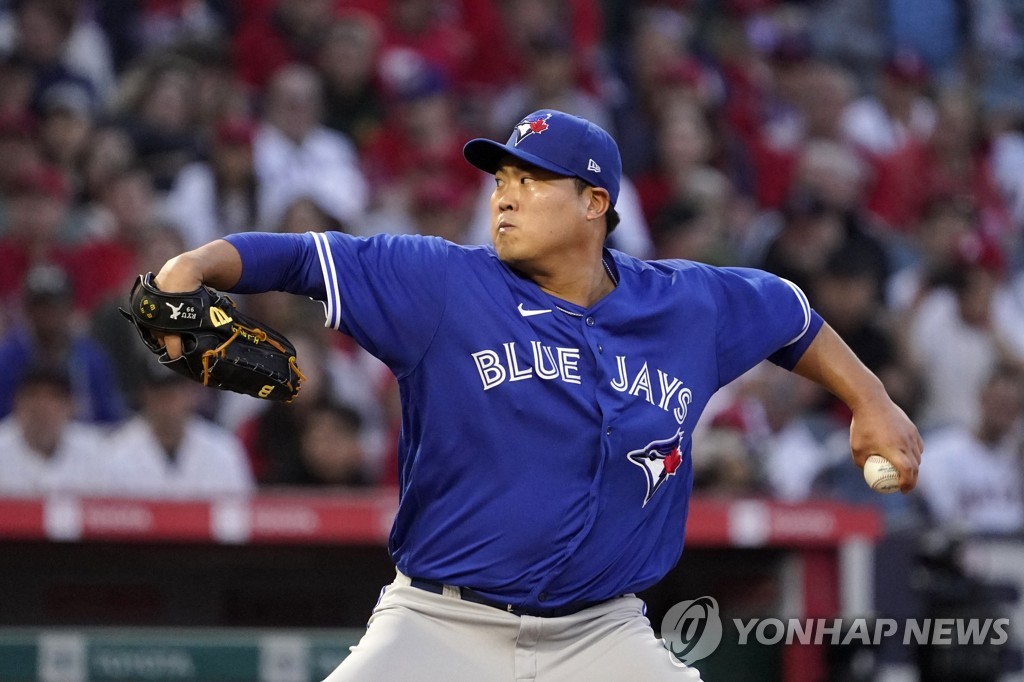
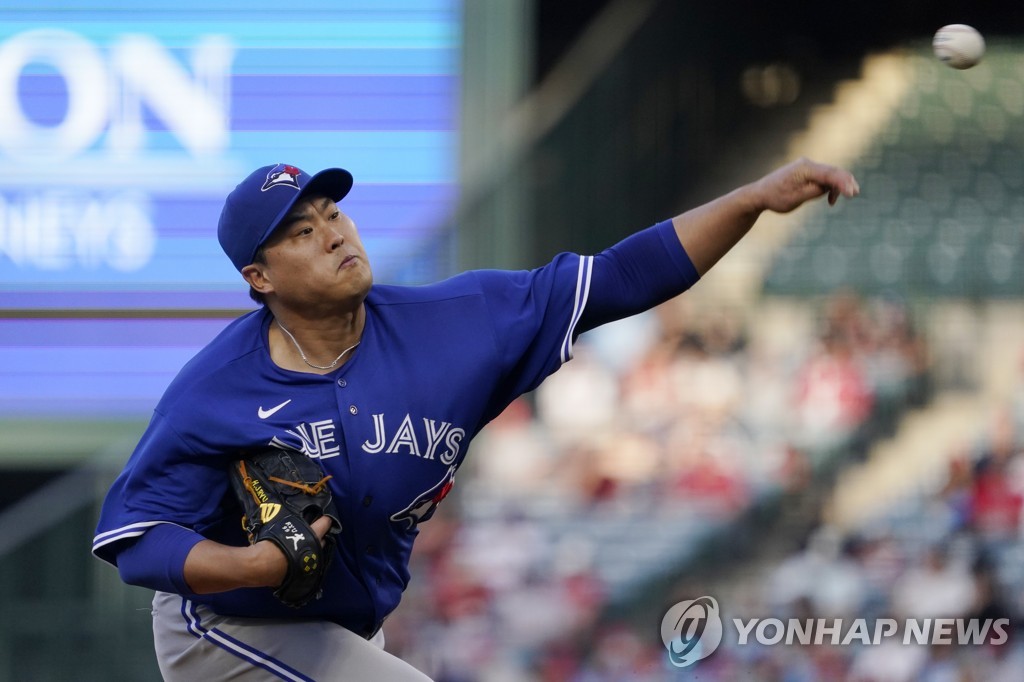
SEOUL, May 27 (Yonhap) -- In beating the Los Angeles Angels for his second win of 2022, Toronto Blue Jays starter Ryu Hyun-jin scattered six hits across five innings, but none to two of the most dangerous hitters -- not just in the Angels' lineup, but in all of baseball.
Ryu gave up two runs on those half-dozen hits in a 6-3 win at Angel Stadium in Anaheim, California, on Thursday (local time). But Mike Trout, a three-time American League (AL) MVP in the midst of another MVP-worthy campaign, went 0-for-3 against the South Korean left-hander. And Shohei Ohtani, the reigning MVP who was also the Angels' starting pitcher opposite Ryu, was 0-for-2 with a walk at the plate.
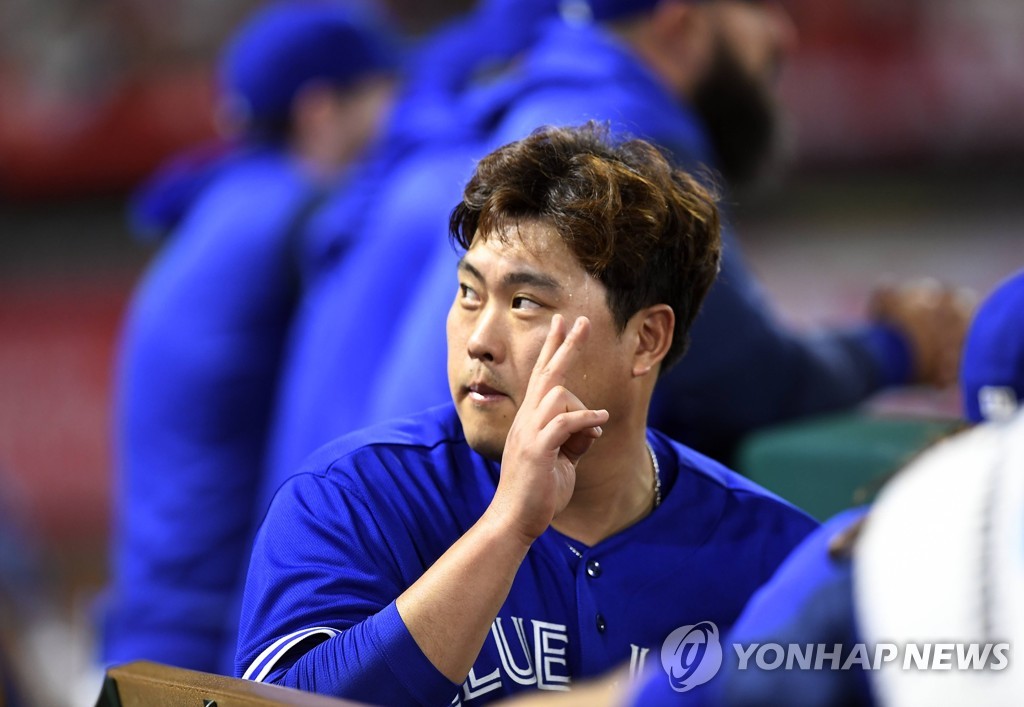
In this Getty Images photo, Ryu Hyun-jin of the Toronto Blue Jays gestures to family members in the stands after completing the bottom of the fifth inning of a Major League Baseball regular season game against the Los Angeles Angels at Angel Stadium in Anaheim, California, on May 26, 2022. (Yonhap)
Ryu's continued dominance against Trout, a generational talent and a surefire future Hall of Famer, is quite remarkable. After another fruitless day, Trout has now gone 0-for-13 with four strikeouts against Ryu and has hit only three balls out of the infield. Among all major league pitchers who have had at least 10 at-bats against Trout, Ryu is the only one to have held him without a hit.
Batting second, Trout flied out to right field in the first inning, though Ryu left an 88.6-mile per hour fastball over the plate.
Trout grounded into a fielder's choice in the third inning, unable to make good contact on a down-and-away changeup. Then in the fifth, Trout went down 0-2 in the count before taking three straight balls, but ended up popping out to first base after getting jammed on a cutter.
Ohtani, a two-way threat who can throw a 97-mph fastball on the mound and hit a 450-foot homer from the plate, was the only strikeout victim against Ryu. In the bottom fifth, Ryu got Ohtani to fan on a changeup for the final out. It was also Ryu's last pitch of the day.
Ryu generated just two whiffs all game.
Ohtani, who batted third, drew a six-pitch walk in the first inning without taking a swing. In the third inning, Ohtani helped his own cause with an RBI forceout but otherwise didn't do any damage at the plate against Ryu.
This was Ryu's first win when starting opposite a Japanese pitcher in his fifth try.
Ryu also outpitched Ohtani on the mound. Ryu is now 2-0 with a 5.48 ERA, and sports a 1.72 ERA in three starts this month since returning from left forearm injury.
Ohtani surrendered his season-high two home runs while allowing five runs on six hits to fall to 3-3 for the year.
George Springer greeted Ohtani with a leadoff homer in the first. Then in the sixth, Vladimir Guerrero Jr., runner-up to Ohtani in last year's MVP voting, drilled a hanging curveball off the left field foul pole for a solo shot.
CALGARY — Connor McDavid and Leon Draisaitl dominated the first playoff Battle of Alberta in 31 years.
It was fitting Edmonton's dynamic duo combined to end it.
McDavid scored off a slick Draisaitl setup at 5:03 of overtime Thursday as the Oilers defeated the Calgary Flames 5-4 to win their second-round series 4-1.
"Hard to put into words what that one meant to me," McDavid said. "The guys did a great job of hanging in there all night. Definitely wasn't our best effort, but we stuck in there. Got great performances from a bunch of different guys.
"Just happy to contribute on a night where I maybe didn't have my best."
Edmonton's captain fired his seventh goal of the post-season past Jacob Markstrom and off the post to spark a wild celebration as the Oilers moved onto the Western Conference final for the first time since 2006.
McDavid grabbed hold of Edmonton's first-round series against the Los Angeles Kings with the Oilers down 3-2, and raised the bar even higher against Calgary.
"He's everything to us," Draisaitl said. "He's our leader, he's our go-to guy, he's the guy that everyone looks up to when you need him. He's done it all season, he's done it all his career. He's been amazing for us. Eventually you run out of words."
"I just tried to get my legs going," McDavid said of the winner. "They weren't moving all that well all night — just trying to focus on skating and got in on the forecheck and got the puck to Leo.
"Usually when the puck goes to Leo something good's gonna happen."
That was certainly the case in a series where Draisaitl finished with 17 points (two goals, 15 assists) in five games while dealing with what's believed to be a lower-body injury suffered late in the opening round.
"He was amazing," McDavid said of his linemate. "Dominated from start to finish."
McDavid, who had two goals and 10 assists against Calgary, and Draisaitl both have 26 points through 12 post-season games this spring — the sixth and seventh times in NHL history a player has reached that level.
"With what Connor's done, Leon's performance has gone under the radar a little bit," said Oilers interim head coach Jay Woodcroft, who replaced the fired Dave Tippett on Feb. 10 and now has Edmonton eight wins from the Stanley Cup. "He's the best passer in the National Hockey League — the best passer in the world. And the amount of plays that he makes for our team is unbelievable. To do that with what he's going through, he's an absolute warrior.
"When I walked into that room (in) February, I was bullish on our players because I saw a sincere desire to win. Not just the desire to win, but I saw people willing to pay the price to win."
Zach Hyman, with a goal and two assists, Darnell Nurse, Jesse Puljujarvi and Evan Bouchard also scored for the Oilers. Mike Smith made 32 saves.
Draisaitl added four assists — his fifth straight contest registering three-plus points to build on the NHL playoff record he set in Game 4.
The Oilers will face either the Colorado Avalanche or St. Louis Blues in the third round. Colorado leads that series 3-2, with Game 6 set for Friday in St. Louis.
Mikael Backlund, with a goal and an assist, Johnny Gaudreau, Calle Jarnkrok and Andrew Mangiapane replied for Calgary. Blake Coleman chipped in with two assists, while Markstrom made 30 saves.
The Flames won a wild Game 1 by a 9-6 scoreline, but were unable to ever really find another level after topping the Pacific Division in the regular season.
"The series was about Games 2, Games 4 and Games 5 ... they were all tied in the third period halfway through," Calgary head coach Darryl Sutter said. "Edmonton scored the big goal."
Coleman, who won the Cup the last two seasons with the Tampa Bay Lightning, appeared to snap a 4-4 tie with just under six minutes left in regulation when Backlund took the puck hard to Edmonton's net. But the goal was waved off following a video review after it was ruled the winger kicked the puck over Smith's goal line as he battled with Oilers defenceman Cody Ceci.
"I don't think I understand the rule," Coleman said. "My understanding is you can direct the puck, but you just can't kick it. I didn't feel that I kicked it.
"Unfortunate that was such a big part of the game and happened to influence the way it all went down."
With his team trailing 1-0 after a tentative first period, Woodcroft replaced Evander Kane with Hyman on the top line alongside Draisaitl and McDavid early in the second, and it nearly paid off on a couple of good opportunities.
But the Flames, who bested the Oilers by seven points in the regular-season standings, went up 2-0 at 5:41 when Backlund scored his fifth on a deflection.
The Oilers got on the board at 7:40 after Draisaitl found Nurse in the slot for him to fire his second past a screened Markstrom.
Edmonton tied it up just 2:26 later on a 3-on-1 rush when the Calgary goaltender, who was shaky most of the series, could only get a piece of Hyman's shot before Puljujarvi swept home his second as the Oilers erased another multi-goal deficit on the road.
The offensive floodgates then really opened over a wild stretch that would see four pucks find the back of the net in 71 seconds.
Hyman scored his sixth goal of the series, and eighth of the post-season, on a power play at 14:57 before Gaudreau tied things again at 15:12 with his third.
Jarnkrok then scored his first as a member of the Flames since coming over in a trade with the Seattle Kraken at 15:28 to make it 4-3.
But the Oilers responded again at 16:08 when Bouchard's blast beat Markstrom for his second as the teams set an NHL record for the fastest four goals in playoff history — 22 seconds short of the previous mark set by the Philadelphia Flyers and Toronto Maple Leafs in 1976.
"It was crazy," said Draisaitl. "I've never seen anything like it."
Following a tepid start for both teams inside a nervous Scotiabank Saddledome, the Flames nudged in front at 10:13 of the first when Mangiapane took a terrific pass from Coleman to bury his third.
The winger's first point of the series gave his team its first lead since late in the second period of Game 2 — a stretch of exactly 155 minutes — that started a run of three straight losses to push Calgary to the brink of elimination.
And after a wild second period and McDavid's heroics, the Oilers now are moving onto the third round for the first time in a generation.
"To do this against your arch rival and close them out in their building in the fashion that we did, we will enjoy it," Woodcroft said. "We're going to rest up and recuperate.
"Whoever comes out of that other series is going to be a really good opponent."
This report by The Canadian Press was first published May 26, 2022.
___
Follow @JClipperton_CP on Twitter.
Joshua Clipperton, The Canadian Press
Edmonton Oilers eliminate Calgary Flames in 5 games to advance to Western Conference finals
ByKristen Shilton via
May 26, 2022, 10:59 PM
The Edmonton Oilers will be making their first Western Conference finals appearance since 2006 after defeating the Calgary Flames5-4 on Connor McDavid's overtime winner in Game 5 in their second-round Stanley Cup playoff series on Thursday.
Edmonton will next face the winner of the Colorado Avalanche- St. Louis Blues series; the Avalanche lead that series 3-2, with Game 6 on Friday.
The Oilers punched their ticket on the heels of a dramatic final contest in Calgary that included a record-breaking span of goal-scoring in the second period, and a controversial overturned goal for the Flames' Blake Coleman in the third.
Needing a win to extend the series, Calgary built a 2-0 lead over Edmonton by early in the second period, off goals by Andrew Mangiapane and Mikael Backlund.
Leon Draisaitl responded by teeing up Darnell Nurse to put Edmonton on the board. By night's end, Draisaitl would collect four points, and his 17 in the series would be the most ever scored in a playoff matchup between Edmonton and Calgary.
Messy rebound control from Flames netminder Jacob Markstrom provided an easy tap-in for Jesse Puljujarvi shortly after, and the Oilers had evened the score at 2.
At the midway point of the second, Calgary and Edmonton would reach a mind-boggling new height.
Over the span of 1:11, they combined for the fastest four goals ever scored in a playoff game:
Zach Hyman's power-play marker started the landslide, giving Edmonton its first lead of the night at 3-2.
Johnny Gaudreau responded with an equalizer for the Flames, followed 12 seconds later by Calle Jarnkrok's go-ahead goal.
In another 40 seconds, Evan Bouchard had Edmonton tied again, 4-4.
Calgary thought it broke that stalemate late in the third, but it was not to be.
Coleman appeared to score the Flames' fifth goal, but it was called back after an official review determined the puck was kicked in by Coleman as he fell to the ice. Calgary argued that the puck was going in regardless, and Coleman didn't have any effect on its trajectory.
The NHL's Situation Room ruled Coleman had reached out with his skate to guide the puck. And so, the game went on to overtime.
McDavid needed just over five minutes in the extra period to end the game, and send Edmonton home with a victory.
UN SECURITY COUNCIL IS PAST DUE DATE UN Security Council split spells end of an era for US-led sanctions on North Korea
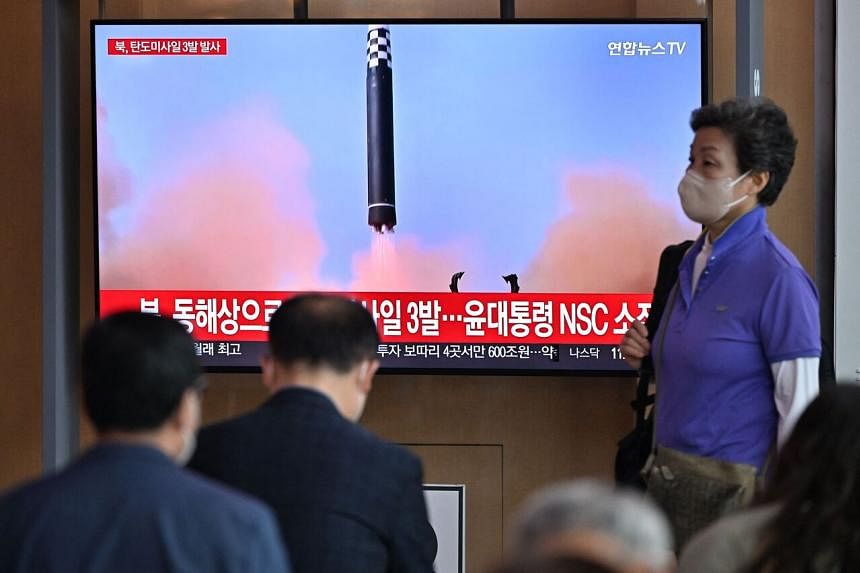
The US assessed that North Korea had tested six intercontinental ballistic missiles this year.
The two countries on Thursday (May 26) vetoed a US-led push to impose more UN sanctions on North Korea over its renewed ballistic missile launches, publicly splitting the UN Security Council for the first time since it started punishing Pyongyang in 2006.
US officials slammed it as a "sharp departure from the Council's track record of collective action on this issue."
"Today's vote means North Korea will feel more free to take further escalatory actions," Mr Jeffrey Prescott, deputy to the US Ambassador to the UN, said on Twitter. "But we can't resign ourselves to this fate - that would be far too dangerous."
Russia's UN ambassador called the resolution "a path to a dead end," while China's envoy said it would only lead to more"negative effects and escalation of confrontation."
Analysts and some diplomats said Washington may have miscalculated in its rush to impose consequences for North Korea's missile tests.
"I think it was a big mistake for the US to push for what was sure to fail rather than showing unified opposition to North Korea's actions," said Ms Jenny Town, director of the US-based 38 North programme, which monitors North Korea.
"In the current political environment, the idea that China and Russia could agree with the US on anything would have sent a strong signal to Pyongyang."
One European diplomat said that their country supported the US resolution but that they were less appreciative of the timing and thought that Washington should have waited until North Korea carried out a new nuclear test.
The United States assessed that North Korea had tested six intercontinental ballistic missiles (ICBMs) this year and was"actively preparing to conduct a nuclear test," which would be the country's first since 2017. Over the past 16 years the Security Council has steadily, and unanimously, stepped up sanctions to cut off funding for Pyongyang's nuclear weapons and ballistic missile programmes. It last tightened sanctions on Pyongyang in 2017.
Washington increasingly criticised China and Russia for what it saw as lax enforcement, even before the latest political rift.
China and Russia have called for sanctions to be eased to prevent humanitarian suffering in the North, and to jumpstart stalled denuclearisation talks. Professor Artyom Lukin from the Far Eastern Federal University in Vladivostok said it seemed like the United States wanted to provoke and produce this split in the Security Council, knowing that China and Russia would not support the resolution.
Moscow and Beijing appear somewhat tolerant of North Korea's resuming long-range missile launches, but it is far from clear that Pyongyang has Russia's and China's consent, tacit or otherwise, for a nuclear test, he added.
"Nuclear testing is seen by Beijing, and especially Moscow, as a far more serious matter, compared to missile testing," Prof Lukin said.
Nevertheless, Russia sees the Ukraine crisis as a proxy war with the United States, and the war is now bleeding into the situation around North Korea, he said.
"Even though Moscow and Washington have a real shared interest in the denuclearisation of North Korea, it has now become extremely difficult, if not impossible, for them to collaborate," Prof Lukin said.
China's ambassador to the UN, Mr Zhang Jun, suggested that the United States may see the Korean issue as "a chessman on the chessboard for their so-called Indo-Pacific strategy."
The Chinese and Russian veto is a telling sign of the deterioration of their overall relationship with the United States and its allies, said Beijing-based security scholar Zhao Tong of the Carnegie Endowment for International Peace. "Beijing could have abstained, but it used the veto to publicly signal its growing disagreement with and resentment toward Washington," he said. "Everyone knew that the veto would send a wrong and dangerous message to North Korea, but Russia and China believe they face higher stakes in pushing back against their perceived hostility from the Western countries."
Beijing and Moscow also genuinely see North Korea's nuclear and missile developments as driven by threats from Washington and cannot be fully blamed on Pyongyang, Mr Zhao said. "We have a perception gap problem among the major powers," he said. "North Korea is only exploiting and benefiting from it."
“The lives of working class Americans are expendable to the ruling class”—US workers speak on Texas school massacre
Workers in the United States have reacted with horror and anger over the massacre at Robb Elementary School in Uvalde, Texas on Tuesday, which took the lives of 19 students and two teachers. On Thursday, Joe Garcia, the husband of one of the two teachers, Irma Garcia, died of a heart attack after visting a makeshift memorial for his wife at the school.
The mass killing by 18-year-old high school student Salvador Ramos was the deadliest school shooting in Texas history and third in the US, surpassing Parkland and Columbine. It was the 19th school shooting so far this year.
The empty platitudes by President Biden and other politicians, along with commentary in the news media, studiously avoid any examination, let alone criticism, of the social, political and cultural conditions in America behind the repeated eruption of homicidal violence.
Flowers and candles are placed outside Robb Elementary School in Uvalde, Texas, on May 25, 2022 to honor the victims killed in Tuesday's shooting. [AP Photo/Jae C. Hong]
In comments to the World Socialist Web Site, health care, education, manufacturing and other workers expressed their outrage over the Texas school shooting and grappled with broader issues behind these atrocities.
A pre-school worker from Virginia said, “As someone who works as an educator, I am both horrified and heartbroken about the shooting in Texas. It reminds me of the time I was on a lunch break and an office administrator came up to me and said I need to return to my classroom. She told me that they were going to announce an evacuation soon and I had to prepare to get my students out of the building safely. ‘This is not a drill.’ The words echoed around my head as I tried to remain calm and get back to my students. I was not afraid. I slowly became enraged as I began to put together that the reason we had to evacuate was because of a bomb threat. I could not imagine a scenario where someone would want to blow up a school with children aged 6 weeks through fifth grade. After the anger subsided, I began to question why? Why is this happening? I have read several articles surrounding the Texas incident and they all talk about gun control.
“Guns are here, and they aren’t going anywhere. I feel we need to move past that and go back to the real root of the issue. Why are people frustrated and angry to the point of feeling their only option is to kill people? What is causing this phenomena? How do we prevent people from getting to that point?”
Dennis, a retired school bus driver and currently working as a musician in Santa Barbara, California, said, “I feel the shootings can’t be viewed as separate from US empire, the most violent and destructive empire in the world. A nation that seeks world domination through force and violence sets violence as an example for how to deal with problems on an individual level. Add to this the refusal to monitor gun ownership and the sorry state of health care, especially mental health care, and these horrible events become inevitable. At the root of these problems is a profit-driven society, profit for the ‘defense’ industry, medical care and the gun industry.”
Beth, an Iowa school bus driver, said, “The school shootings and violence are epidemic. Last year, two teenagers bludgeoned a high school Spanish teacher to death in Fairfield, Iowa. I drive kids to school every day, and at times I can feel their resentment and hopelessness. Sometimes, I think one of these kids could be violent too, and all I think about is getting them home safely.
“I could speak all day on the terrible social conditions these kids face. I drive little children who don’t have clean clothes to wear. I talk to kids whose parents are fighting at home. I know one perfectly beautiful high school student who says she’s suffering from depression and is considering suicide. There are some kids from foster homes or broken homes. Growing up like that they don’t learn to treat each other respectfully and understand that there is more to the world than just you.”
Beth said these social problems were the result of deliberate government policies. “We have a governor in Iowa who cut people off unemployment benefits even when they were struggling. When workers walked out of the meatpacking plants because of COVID, she sent them back to work. At the same time, she handed a $26 million no-bid contract to a private company for COVID tests that didn’t even work.”
Pointing to the endless wars and military violence, which further poison American society, she said, “We just got out of Afghanistan, and now we’re involved in a war with Russia. We need to look at the broader causes of these school shootings. This can’t be legislated by the oligarchs from the outside, it has to be changed by the working class from the inside.”
Elizabeth, an RN in Los Angeles County, California, said, “As a working class registered nurse, I have come to realize that the lives of working class Americans are expendable to the ruling class. I’m broken hearted, as are my Texas family members right now, seeing a mass shooting in the city of Uvalde, which is the closest city to Del Río, Texas where my family is from. Some of my family members lived in Uvalde at one time, and I visited this small city on many occasions while visiting my family in Del Río.
“Uvalde is a rural community with a population of approximately 15,000 working class people with many living below the poverty. I imagine employment is scarce in that city because it’s a very rural area. The closest major city is San Antonio, and Laughlin Air Force Base is located in Del Río, which is approximately 70 miles south of Uvalde.
“Health care workers in the US have experienced intolerable working conditions and witnessed mass death and illness from an uncontrolled pandemic that the government has allowed to run rampant for 2-1/2 years and kill 1 million Americans. Now we face another war with a nuclear power, Russia, that could end the human race. We face runaway climate change, high inflation, poverty and inequality, while profits for the rich reach obscene highs.
“It’s no surprise to see increased incidents of violence and mass shootings like the horrific shooting in Uvalde. I see it as a mirror of the violence that capitalism commits against the working class here and internationally. The only way to effect change will be through a working class struggle because it has been made quite clear by the capitalist parties that they will not do anything to change the collision course we are on. I believe we must unite with our international working class brothers and sisters and fight for a socialist revolution!!”
Julian, a senior at University of Florida, said, “The thought that sticks with me is about the gun control concept. A resolution to this problem centered on the NRA and arms manufacturers still leaves us in a country where people work, learn and interact in the presence of individuals who relish the thought of killing them and many other people. Making it harder to do may have a material impact, but it doesn’t get us out of this disquieting scenario. The widespread contemporary alienation that I myself am familiar with should be considered a significant threat to people’s safety, given the desperate outbursts it can cause, which range from self-harm to outward hostility and even to organized belligerence.”
A Dana auto parts manufacturing worker in Pennsylvania said, “Sure, in a week there have been three mass shootings that could’ve been avoided if there were stricter gun laws in America, but instead the Texas shooting has been the second deadliest school shooting on record. The president needs to pass something now and take action.
“I mean the pandemic wasn’t taken seriously by either president, in the same way as mental health. We keep seeing these shooters having a history of mental issues that either were never addressed or just not taken seriously, and it results in these tragic events. But it’s the same cycle because it keeps continuing, and there has yet to be some kind of plan for gun control or mental health, and we’re right back here grieving.”
A worker from the Ford Dearborn truck plant in Michigan said, “This is a sick society! How are you going to fix that? The government has a left wing and a right wing, and they are both attached to the same bird. They have nothing to do with the working class. The problem is the working class is going to have to learn the hard way.
“The pandemic has shown that they really want us to die. The way they see it, ‘There are too many of you all anyway. You can drop dead for all we care.’
“People are already stressed out. You cannot get a decent job. Gasoline is $5 a gallon, and diesel is $6. They want everybody to work for free. I can see a social explosion happening, and soon.
“I’ve been working in the plant almost 30 years, and I feel like I’ve been wasting my time. It’s even hard to get real food. They have to make a profit on everything, and society cannot work like that. We have to take action ASAP!”
A worker from the Faurecia auto parts manufacturing plant in Saline, Michigan said, “Some of these young people are going berserk. The guy was only 18 years old. He walked into a classroom and said, ‘You’re all going to die.’ What is this world coming to? You have one mass killing after another.
“This is a country that is turning to violence. Trump was organizing these gangs to overthrow the government on January 6 last year, and then Biden did not do anything about it. People get angry because they can’t get a job or don’t have a future. All they see is war and violence all around them. They go crazy because they cannot live.
“And look at (Michigan Governor Gretchen) Whitmer. When everybody was on lockdown, she was steadily trying to get us to go back to work. All she cares about is money for the companies. Who benefited from that?! Not me.
“The UAW didn’t doing anything to protect us, either.
“The world is coming to a social explosion. Just one day after the school shooting a student was arrested at a Texas high school with a pistol and a rifle in his car at the school. Apparently that teenager that did the shooting was having a violent argument with his mother just two weeks before. He was losing it then. And nobody did anything to help him.”
Bill, a Mack Truck worker from Pennsylvania, said, “The government has admitted to letting over 1 million people die from COVID. You really can’t lose sight of how many human lives that is, 1 million. As tragic as this shooting was, and it was horrific, it was allowed by a government that does not care if we, or our children, die by means that are preventable, violent or both. The ENTIRE government has been sending weapons of death all over the world for decades, the SMALLEST of which are worse than the kind of rifle this shooter used. How politicians can even open their mouths to feign sympathy, when they are promoting mass death domestically and abroad, whether it is death by COVID or bullets, is beyond me. We need to act to protect ourselves. Lives will continue to be lost needlessly if we wait for politicians for help.”
Yemenis dream of peace and open roads as truce continues to hold
In Taiz, local workers tell MEE they think the current ceasefire may result in the return of vital services Vehicles are pictured at a heavily damaged road, the only travel route between Yemen's cities of Taiz and Aden, on 23 September 2020 (AFP)
Before war came to Yemen in late 2014, it would take Ahmed about ten minutes to drive from the centre of Taiz city to the nearby area of al-Hawban.
By 2015, the main road out of the city was closed and the drive now took five hours through dangerous mountain passes.
'I can see my house from Taiz city but I can’t reach it because the road is blocked'
- Ahmed, restaurant worker
“I can see my house from Taiz city but I can’t reach it because the road is blocked and if I want to visit my family I travel for five hours through mountains,” Ahmed, who preferred not to provide his full name, told Middle East Eye.
Ahmed lives in al-Hawban, which is part of the Taiz governorate. But he works at a restaurant in Taiz city.
Unable to afford to rent a room in the city following the closure of the main road, Ahmed sleeps in the restaurant with his fellow workers. Every two weeks he takes the mountain roads back from the city to see his family.
“Moreover, the soldiers at the checkpoints stop us every time to investigate our destination and what we are working on,” Ahmed said of his fortnightly trips along the dangerous mountain roads.
Hope for Ahmed and many others across Yemen came on 2 April, when the country’s warring parties signed a two-month ceasefire led by the United Nations.
The truce holds (for now)
It’s the first truce to have been agreed since 2016 and so far, it’s holding up.
The agreement was brokered in the midst of a fuel crisis in areas controlled by the Iran-aligned Houthi group, with the Saudi-led coalition not allowing fuel tankers to come into Hodeidah port.
The parties accepted a halt to all offensive military air, ground and maritime operations inside Yemen and across its borders.
An agreement was struck to allow fuel tankers to enter Hodeidah port and for commercial flights to once again fly in and out of Sanaa airport to predetermined destinations in the region. Yemen: First commercial flight in six years leaves rebel-held SanaaRead More »
Also part of the agreement: a meeting was held under the auspices of the UN envoy to Yemen to arrange the opening of roads in Taiz and other provinces across Yemen.
Since the truce, the ceasefire has more or less held in Yemen, with almost no air strikes and no missiles fired across the country’s borders.
Fuel tankers have been arriving in Hodeidah regularly and Sanaa’s airport was opened for commercial flights on 16 May.
“This truce made me optimistic about opening roads to Taiz city,” Ahmed said.
“I hope they extend the truce so I can stay in my house and go to work every day from my home. This seems to be a dream but now I feel it can be achieved… If the special envoy to Yemen goes through this road he will prioritise opening roads to Taiz.”
In the past, Ahmed heard rumours about roads reopening in Taiz, but didn’t believe them. This time feels different.
“We used to hear rumours about opening roads to Taiz amid fighting, which was impossible. But now Taiz is safe, there is no fighting and it is possible to agree on opening roads,” he said.
'Peace is the demand'
Like Ahmed, Mu'ath Jaber, a resident of Sanaa, is focused on peace.
“Peace is the demand of all Yemenis, no one wants war. If peace is there, other things can come after,” he told MEE. “We really feel the great impact of this truce, since the first day of the truce we have heard no warplanes hovering over us and that means the beginning of the peace.”
Jaber confirmed that the end of the fuel crisis played a major role in reducing the cost of transportation, electricity and many other basic commodities.
'When I watched the first flight arrive at Sanaa airport, I couldn’t hold back the tears of happiness'
- Mu'ath Jaber, Sanaa resident
“Before this truce, the fuel crisis was about to kill us, as everything was expensive, but now we enjoy peace and better life.”
Problems remain, Jaber acknowledged. Public employees are still not being paid. Some basic services are not being provided. But he described the situation now as better than it was in the months leading up to the truce.
The reopening of Sanaa airport is a potent symbol of that. Jaber did not previously travel abroad and he does not plan to leave Yemen, but it still meant a lot to him.
“When I watched the first flight arrive at Sanaa airport, I couldn’t hold back the tears of happiness,” he said. “Reopening Sanaa airport reminds us of regular life. It is a sign of peace.”
Jaber knows that the truce will end on 2 June, but he hopes the warring sides will agree to extend it and take further steps towards bringing the war to an end.
Back in Taiz, Murad Abdulhakim, 29, a local resident, told MEE: “We are happy to see Sanaa airport is open again for commercial flights and we will be happier if roads to Taiz are opened too, so we can travel to visit our families and relatives in Sanaa and other provinces.”
Hopes for family visits
Hospitals are not good in Taiz, Abdulhakim said, pointing out that patients used to travel to Sanaa for better healthcare, something that is no longer possible because of the difficulty of the journey.
“Sanaa is the capital of Yemen. By opening the roads, Sanaa will be linked again to Taiz, so people in Sanaa can visit their families in Taiz and people in Taiz can seek services in Sanaa,” he said.
On Sunday, the Houthis announced that they had named their representatives for a joint committee that will work to reopen roads in Taiz and other provinces.
Ahmed, at least, is hoping the days of five-hour mountain drives just to go home might finally be at an end.
New wave of protests and strikes shake Iran
Government cuts mean price rises for basic foods. Now people are back on the streets in a protest that threatens the regime of Ebrahim Raisi Ebrahim Raisi supporters campaigning in Tehran for 2017 presidential election. A new wave of protests in Iran is shaking his regime.
Picture: Tasnim News Agency/Wikipedia
Thousands of people have protested and struck in towns, cities and villages across Iran after the government hiked basic food prices. Iranian security forces attacked some protests with teargas and live ammunition—reportedly killing six people.
Protests began after Iran’s government announced last month that it would cut and end subsidies for wheat and flower, calling it “necessary economic surgery.” The move caused prices to rise by up to 300 percent for some flour based food staples such as bread and pasta, in a country where half of the 85 million population lives in poverty.
The government blamed the global wheat crisis sparked by the war in Ukraine. It’s the latest blow against ordinary people in Iran’s long-running economic crisis caused by US-imposed economic sanctions, and free market policies imposed by successive governments.
Ahmed Reza, a taxi driver who works ten hour days, told the Middle East Eye website, “This is not an economic surgery—it is called choking people. What kind of surgery is this that people can’t even have cheap food? Surgery usually makes people survive and feel great again. But the government’s economic surgery is killing us.”
And Soroush, a delivery worker, said he had begun cutting out certain foods four years ago, after then-US president Donald Trump imposed sanctions. “I have to eat lunch outside at noon because of my job. Until four years ago I was able to buy chicken or kebabs,” he said. But the sanctions “made me ignore chicken or kebab and purchase pasta or even cookies instead. “Right now I can’t even have these as both pasta and cookie prices have skyrocketed. I don’t know what the hell I should do.”
Thousands of people have taken part in protests for more than two weeks, in mostly western and central provinces. Protesters aimed their anger at the government led by conservative “hardliner” Ebrahim Raisi. They chanted, “Raisi should be ashamed and leave the country alone,” and “Down with rising food prices.”
Bus drivers also struck in the capital Tehran for several days from 15 May, demanding a 57 percent increase in salaries. They also demanded the city’s mayor resign. There have been a number of protest movements and strikes in Iran over poverty and the rising cost of living since 2018. Then, huge protests took on the government over poverty, unemployment and government corruption.
Now the government is worried there could be yet another major wave of resistance.
An unnamed Iranian sociologist told Middle East Eye, “People have no way except to rise up because they do not have enough income or savings. These protests are driven by economic hardship rather than political opposition. The protesters are hungry.
“If we don’t listen to the loud voice of the people now, and think that we can end these protests by imprisoning and detaining a few people, I must say it will be the fire under the ashes, and it will be ignited in another place and another situation. When a society reaches the phase of explosion, no one will be able to control it.
SOCIALIST WORKER
A Free Market at All Costs? The renaissance of economic security and its application in Japan
The economic dimension of national security is not a new concept, yet it was generally neglected in the West for a long time, especially in the post-Cold War era, a unipolar moment in the international order, when the United States held the uncontested lead and it seemed as if neoliberalism had triumphed. Since the 2000s, new geopolitical tensions have brought economic security back to the fore. As authoritarian and dictatorial regimes began extensively reaching for methods of hybrid and economic warfare, an urgent need for a protective policy response emerged on the other side.
The purpose of this paper is to reflect on the evolution of the concept of economic security and to review recent relevant initiatives adopted in Japan by the new Kishida government, which might serve as an inspiration for policy development in Europe and elsewhere.
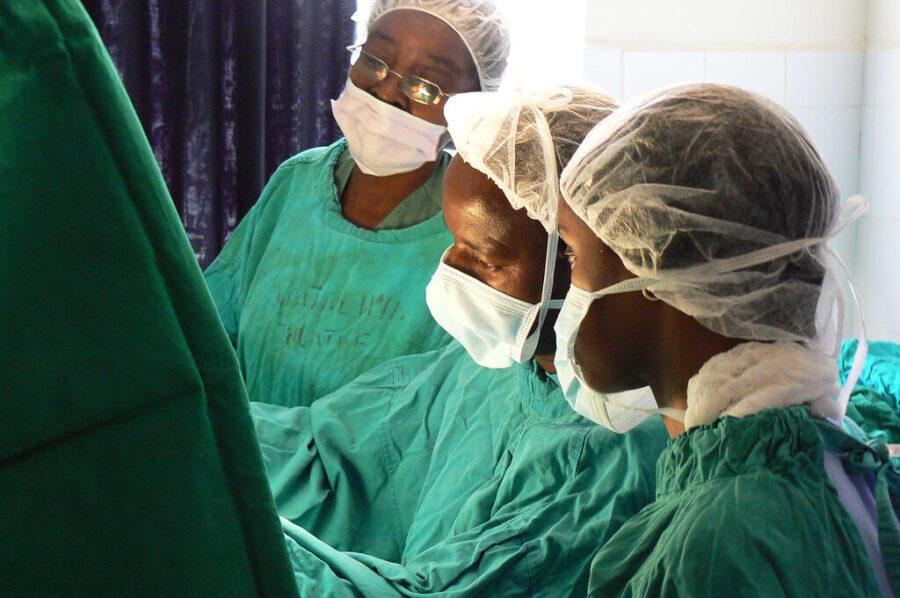
In most African countries, quality surgery is only for the rich.
Doctors perform obstetric fistula surgery in Eldoret, Kenya. Credit: Heidi Breeze-Harris/One By One.
For decades, global health donors have understandably prioritised infectious diseases like malaria, tuberculosis, and HIV/AIDS in their efforts to save lives and improve health. However, new evidence suggests that about 30% of the global disease burden (death and disability from major diseases and injuries) could be addressed surgically – including in Africa. This includes conditions such as obstructed labour, trauma from road traffic accidents, cataracts, cancers, and congenital anomalies.
In fact, surprising new data shows that poor quality surgical care or lack of access to such care now accounts for more annual global deaths than HIV/AIDS, malaria and tuberculosis combined.
Globally, about two-thirds of the world’s population (five billion people) lack access to safe, timely, and affordable surgery. In sub-Saharan Africa, 93% of people lack access to surgical care, compared to 3.6% in high income countries. The solution is not just more surgery but higher quality of surgery.
In Africa, the impact of poor access to quality surgical care is particularly dismal. Take maternity services. African governments and global decision makers have committed to reducing maternal mortality and ensuring that no woman dies in pregnancy or childbirth. Yet African mothers are 50 times more likely to die after giving birth by caesarean section than women in high-income countries. The drivers of this shockingly high statistic are heavy bleeding after giving birth (peripartum haemorrhage) and anaesthesia complications, both of which can be addressed by improved patient assessments and training.
Unlike high-income countries where surgical patients tend to be older, surgical patients in Africa are generally younger and have fewer health conditions that might complicate their care. Yet they are still more likely to develop infections after surgery than patients in higher income settings.
Sadly, I know this from personal experience. One year ago, I broke my thigh bone in a terrible car accident on the busiest highway in Cameroon. After thoroughly researching the safest and most skilled place to have a bone fracture reduction, I decided on a private clinic in the capital Yaoundé. I paid thousands of dollars for the surgical care I received. Unfortunately, almost three months later, I discovered that I had developed a bone infection, most likely because of poor sterilisation during the surgery. The operation had to be redone, followed by months of gruelling and expensive antibiotic treatment and physiotherapy.
I thought to myself: if this is the best quality care that I, a relatively privileged young man, can receive in Yaoundé, what is the situation for the majority who live below the poverty line? And with road accident rates rising across Africa, the demand for trauma surgery is only going to increase.
Safe, timely and affordable surgical services are an essential element of any system that professes to provide universal health care, according to Tedros Ghebreyesus, Director General of the World Health Organisation. However, in most African countries, quality surgery is, in reality, only for the rich.
We all know that when top government officials and business elites in Africa need surgery, they fly to Dubai, the US, or Europe. The majority of the population that doesn’t have the luxury of being airlifted to fancy foreign hospitals are left to suffer substandard care, if they have access to treatment at all. Children born with congenital conditions like cleft lip and palates either die of malnutrition or are stigmatised and hidden. Thousands of men and women perish from cancers that are easily treated with surgery elsewhere. Millions are further impoverished as they are forced to borrow or sacrifice their livelihoods to pay for surgical care for their loved ones.
Action, not idle plans
Some governments and donors have begun to recognise the need to improve access to quality surgical care, especially c-sections for pregnant women. Ministries of Health in Tanzania, Zambia, Ethiopia, Rwanda, Nigeria, and Madagascar have all developed national surgical, obstetrics and anaesthesia plans with the support of foreign consultants and academic institutions. Yet these plans have failed to achieve their goals, primarily because governments and donors have not allocated resources needed to implement them. The plans just sit on a shelf.
Despite the 2001 Abuja Declaration that saw African heads of state commit to spending at least 15% of government budgets on health, many governments fall far short of this target. Health care priorities also continue to be heavily influenced by foreign donors, who remain the major source of healthcare spending in most African countries.
If we are to prevent women dying from obstructed labour and African youth being decimated by road injuries, we need more than commitments, resolutions, and plans. We need action. African elites must put themselves in the shoes of ordinary citizens. Governments that have signed national surgical, obstetric and anaesthesia plans need to finance those plans and implement them – ideally from the national tax base but also by urging foreign donors to invest in their priorities.
Safe surgery is not a luxury. It is a critical part of the right to health for all.
Hungarian writer known for antisemitic remarks addresses CPAC conference
Conservative CPAC conference features Hungarian journalist the Holocaust Memorial Museum condemned for comments on Hungarian Jews.
Ron Kampeas, JTA 24.05.22
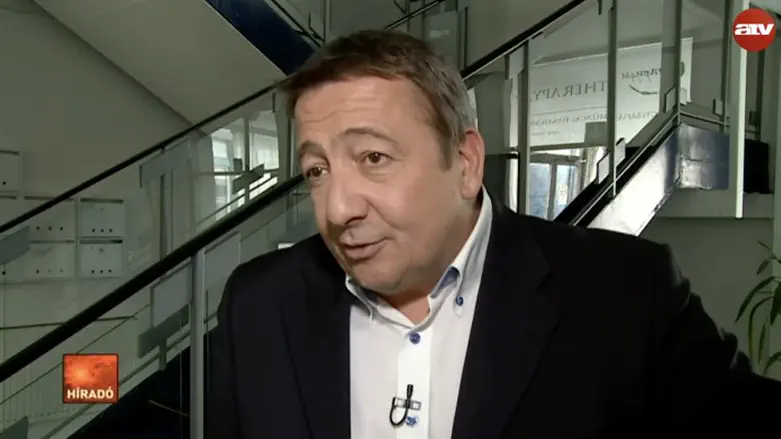
Zsolt BayerScreenshot
Zsolt Bayer, a Hungarian journalist condemned by the U.S. Holocaust Memorial Museum for calling Jewish critics of Hungary “excrement,” spoke to an influential American conservative conference that also was addressed by former President Donald Trump.
Bayer, Trump and Hungarian Prime Minister Viktor Orban all appeared this weekend at the annual Conservative Political Action Committee conference, held this year in Budapest. CPAC, a leading U.S. conservative attraction, where potential Republican presidential candidates often appear to assess their chances, chose Hungary for a rare conference abroad in part because Orban is seen as a bulwark against the progressive left.
As Bayer’s presence made headlines, CPAC, which is run by the American Conservative Union, in a statement on its website condemned the “left-wing media” and “globalists” for “a coordinated smear campaign on conservative leaders on both sides of the Atlantic.”
Its director, Matt Schlapp, on Twitter said criticism of Bayer’s presence was “delusional.” “We had a Rabbi open up @CPAC Hungary in prayer w[ith] Christian leaders,” Schlapp said. ” We have representatives here from Israel.”
In 2011, furious at criticism of Orban’s newly imposed restrictions on media, Bayer singled out three Jewish critics — Andras Schiff, the noted Hungarian pianist, Nick Cohen, a British journalist, and Daniel Cohn-Bendit, a French politician — as “stinking excrement” and suggested it was “unfortunate” that more Jews were not killed in a 1919 massacre of Hungarian communists.
That broadside was the basis in part for the Holocaust Museum’s rebuke of Hungary’s government in 2016 when Bayer, who co-founded Orban’s Fidesz party, was awarded Hungary’s Order of Merit.
“Bayer has a long record of racist speech and has written highly provocative antisemitic and anti-Roma articles in the Hungarian media,” the museum said at the time. Bayer, who is close to Orban, has said Roma are “not fit to live among human beings.”
A number of figures who had received the Order of Merit returned it, including a Hungarian Jewish leader. Bayer’s broadsides continued unabated; last year he attacked Antony Blinken, the U.S. Jewish secretary of state, as “rootless,” an antisemitic euphemism for Jews.
Orban at the conference embraced his role as the vanguard of the international right wing and called for conservatives to “take back” institutions in Washington and Brussels. Orban’s government has been cited by the Anti-Defamation League and other groups as trafficking in antisemitic tropes.
Bayer, the Guardian reported, appeared at a session in which he unfavorably compared the physical appearance of a black model to a white model. Bayer has in the past also used pejoratives to describe blacks.
Trump in a video address to the conference praised Orban. “He is a great leader, a great gentleman, and he just had a very big election result,” he said, referring to Orban’s recent fourth consecutive elections victory.
Also speaking were Mark Meadows — Trump’s final chief of staff as president — and Tucker Carlson, a Fox News host.