Wednesday, July 13, 2022

Details the James Webb Space Telescope revealed, thanks to its infrared cameras.NASA, ESA, CSA, STScI/Insider

NASA released the first full-color pictures from its new James Webb Space Telescope (JWST) this week.

The telescope, which launched last December, is already making discoveries in deep space. It's 100 times stronger than its predecessor, the Hubble Space Telescope. JWST's infrared cameras detect light in the far-red part of the spectrum, allowing its view to cut through dust clouds and see stars, galaxies, and other cosmic objects that were invisible to previous observatories.

"The first thing that everyone did was compare with Hubble, and you could see instantly so much more detail," Aayush Saxena, an extragalactic astronomer at University College London, told Insider.

"It was absolutely mind-boggling," he said.

Here is what JWST revealed in the four pictures released this week, according to Saxena:

Infrared cuts through dust and shows very old objects
galaxies stars in infrared jwst
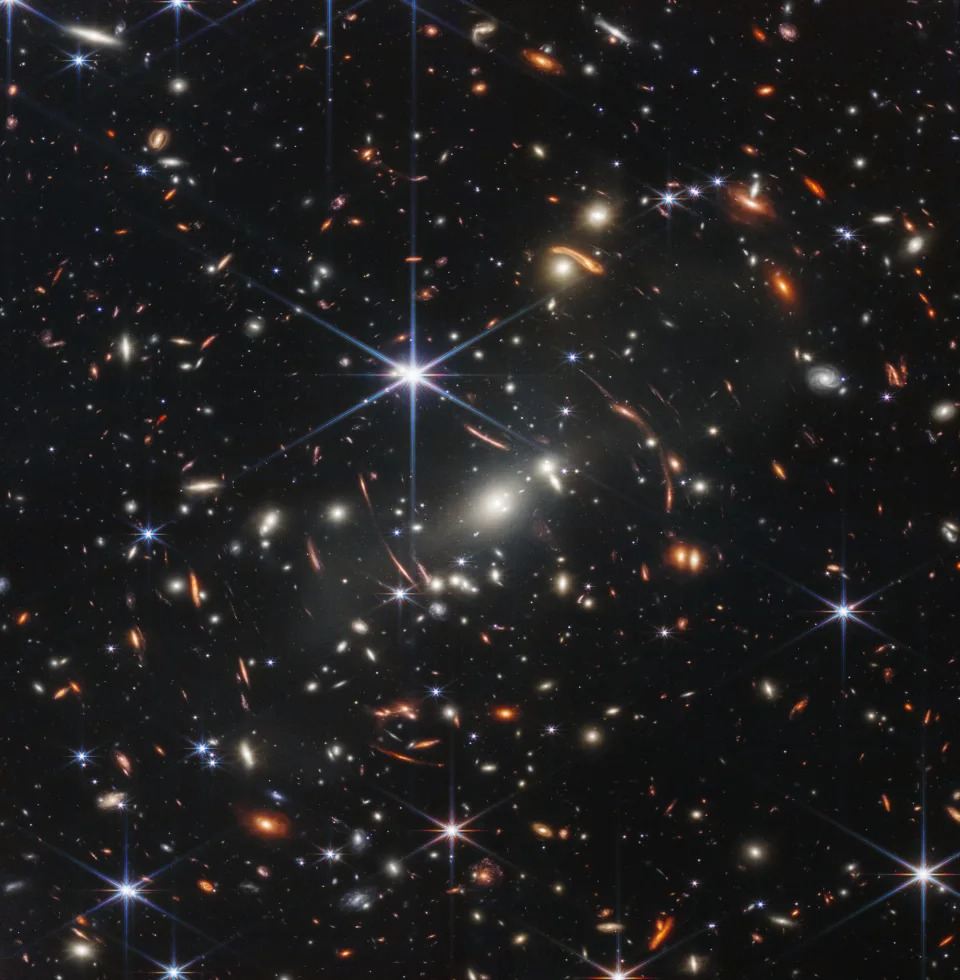
The James Webb Space Telescope's first deep field infrared image, released on July 11, 2022.NASA, ESA, CSA, and STScI

Hubble captured groundbreaking images of deep space, but it had little ability to image in the infrared spectrum. Its instruments were mostly focused on picking up visible and ultraviolet light.

But older objects tend to let off light that is closer to the red side of the color spectrum, a phenomenon called red-shifting.

As the universe expands, galaxies are moving away from Earth very quickly. "It's kind of like an ambulance: When it's approaching us, the sound gets shriller, but then as it moves away, the sound wavelength sort of gets longer and longer," Saxena said.

In the same way, the light gets stretched and redshifted.

While visible light is absorbed by space dust that can cluster around interesting objects, blocking them from view, infrared light can cut through dust.
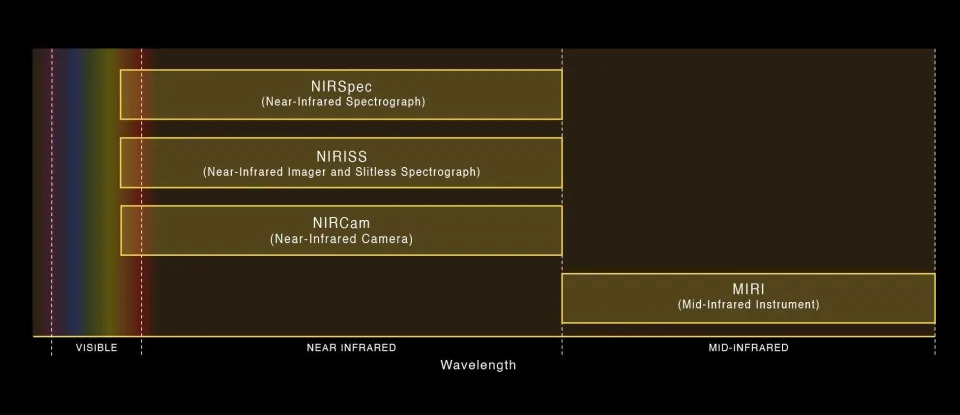
The spectrum of the instruments on board the James Webb space telescope are shown here.
Wavelengths of light picked up by the James Webb Space Telescope.NASA

This is why instruments aboard JWST that can pick up infrared, like the mid- and near-infrared cameras (MIRI and NIRCam), are so valuable to science.

James Webb Space Telescope looked deep into our galaxy to see the birth of stars

star forming clouds side by side images
A portion of the Carina Nebula, imaged by Hubble (left) and JWST (right).NASA/ESA/The Hubble Heritage Team (STScI/AURA)/CSA

JWST peered through the Milky Way to capture this image of cliff-like formations of gas and dust on the edge of the Carina Nebula, which is 7,600 light-years away from Earth.

In clouds like this, gas and dust are compressed and collapse into new stars. That's why astronomers often refer to nebulas as "stellar nurseries." JWST's infrared powers allow it to pierce through the dust and see the baby stars deep within the clouds.

"It is really cool to be able to see this, because without MIRI and NIRCam, I don't think we would be able to witness the birth of new stars," Saxena said.
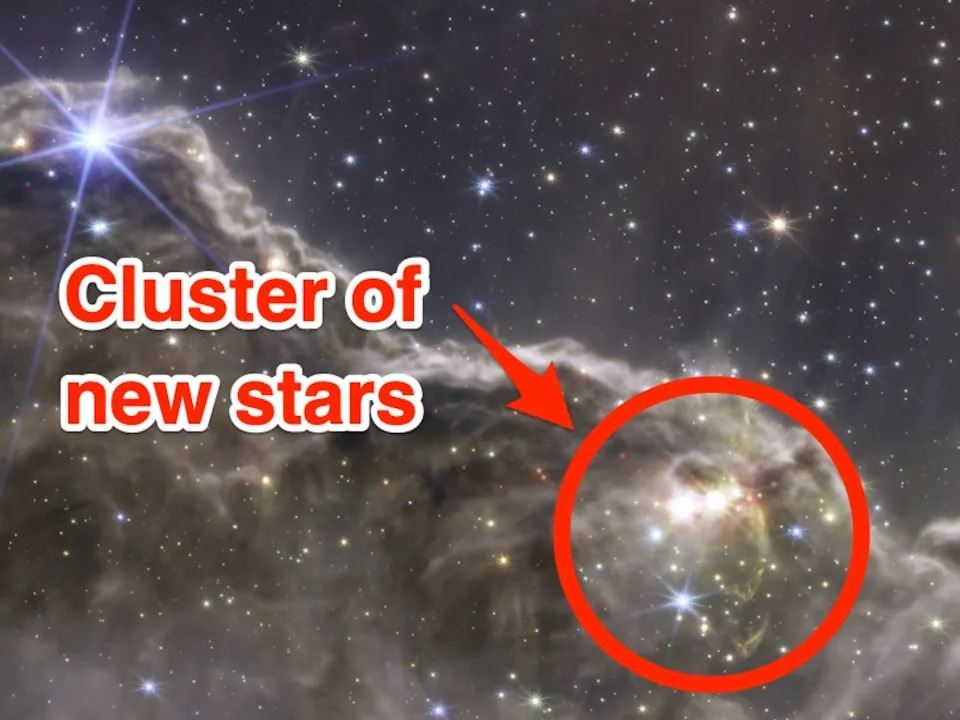
MIRIcam imaging reveals a cluster of new stars forming in the dust of the Carina Nebula taken by the James Webb Telescope.
A cluster of new stars appears inside the Carina Nebula, imaged by JWST.NASA, ESA, CSA, STScI/Insider

Nebulas form when a massive star, or a cluster of massive stars, goes supernova, expelling their outer gas layers, Saxena said. Gravity can pull that material back together to make new stars and even fuse new elements. By spotting these stars, JWST is capturing the process that created everything in our world.

"All of the chemical elements — the carbon, the oxygen — have formed as a result of multiple generations of stars forming and dying. The first generation of stars were only made of hydrogen and helium, because those are the elements that the Big Bang gave us," Saxena said.

"We say that we are all made of star stuff, and it's kind of true," Saxena said.

The Southern Ring Nebula's second star was only a theory before these pictures
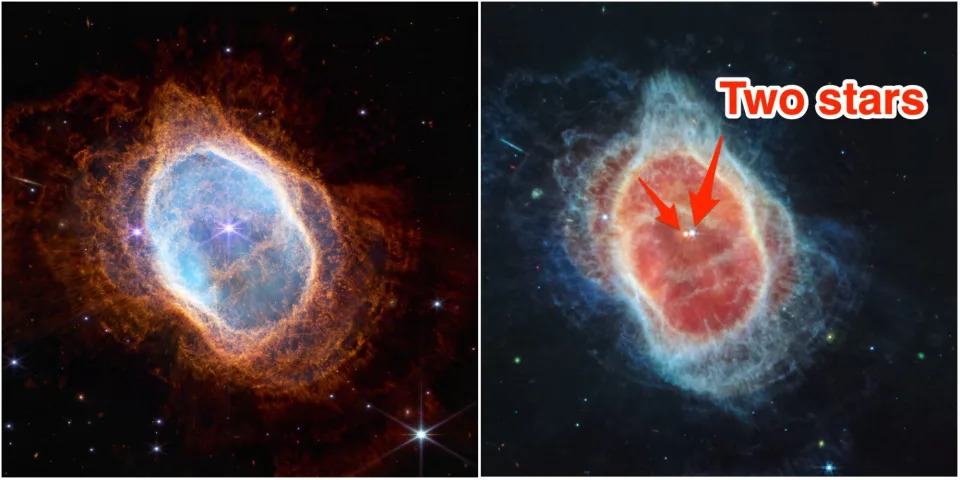
A collage of pictures taken by the James Webb Space telescope shows the NIRCam and MIRI cam pictures side by side. Annotations point to the two stars on the Nebula.
The James Webb Space Telescope's images of the Southern Ring Nebula are in near-infrared (NIRCam, left) and mid-infrared (MIRI, right).NASA, ESA, CSA, STScI

MIRI revealed a second star at the center of the Southern Ring Nebula, about 2,000 light-years away.

"This had been theorized, but were never observed," Saxena said.

The star was outshined by its neighbor, until infrared revealed it — a red dot alongside a blue-white star. The red star is old, dying, and sending out shockwaves of gas and dust, which create the ring-like nebula around it.

A Galaxy caught on the outskirts of the Southern ring nebula is shown here.
A sideways galaxy is shown on the outskirts of the Southern Belt Nebula in NIRCam.NASA, ESA, CSA, STScI/Insider

The picture revealed another surprise: a galaxy in the background, which was previously not clear enough to identify, since we're looking at it from the side.

"You can see the spiral structure and a little bulge in the middle, which is a tell sign that this is actually a galaxy," Saxena said, adding, "This is only possible because of a very high resolution from these images."

Stephan's Quintet could tell us how many stars are in a galaxy
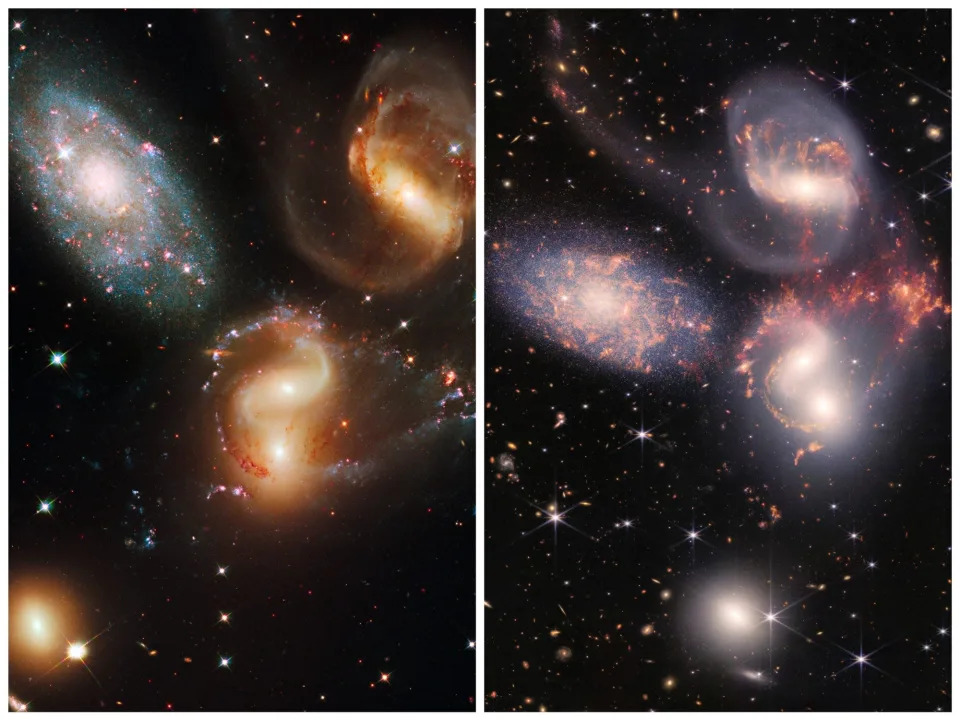
side by side images of cluster of five galaxies
The galaxy cluster of Stephan's Quintet, as imaged by Hubble (left) and JWST (right).Hubble SM4 ERO Team/NASA/ESA/CSA/STScI

Stephan's Quintet is a group of five galaxies, four of which are interacting with each other, 290 million light-years away. The fifth, at the bottom, is much closer, about 40 million light-years from Earth.

"You can see that the level of detail that we uncovered in infrared wavelength is so much higher compared to the ultraviolet and optical, purely because these are all possibly star-forming regions that are obscured by dust," Saxena said.

The galaxy on the left offers unprecedented insight into how stars form, he added.

A picture of one of the galaxies taken by the James Webb telescope shows the Stephan's Quarter.
This galaxy is part of Stephan's Quintet, as imaged by the James Webb Space Telescope.NASA, ESA, CSA, STScI

"We can really pick out the individual star-forming clumps," Saxena said.

This "helps to quantify how many stars actually exist in galaxies, and how many stars are being formed within the galaxy at any given time," he added.
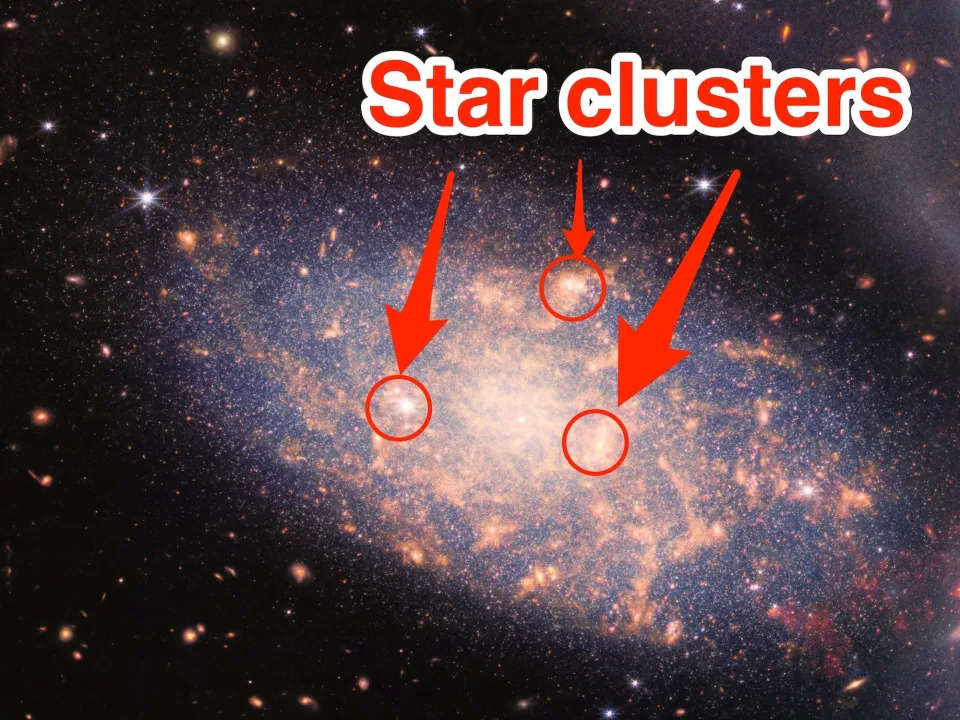
An annotated version of one of the galaxies taken by the James Webb telescope shows the Stephan's Quarter.
Clusters of stars appear clearly in this picture taken by the James Webb Space Telescope.NASA, ESA, CSA, STScI/Insider

JWST also revealed the delicate dance between galaxies that pull on each other as they move through space. The dust and gas visible between the galaxies suggest they've come close to colliding, Saxena said.
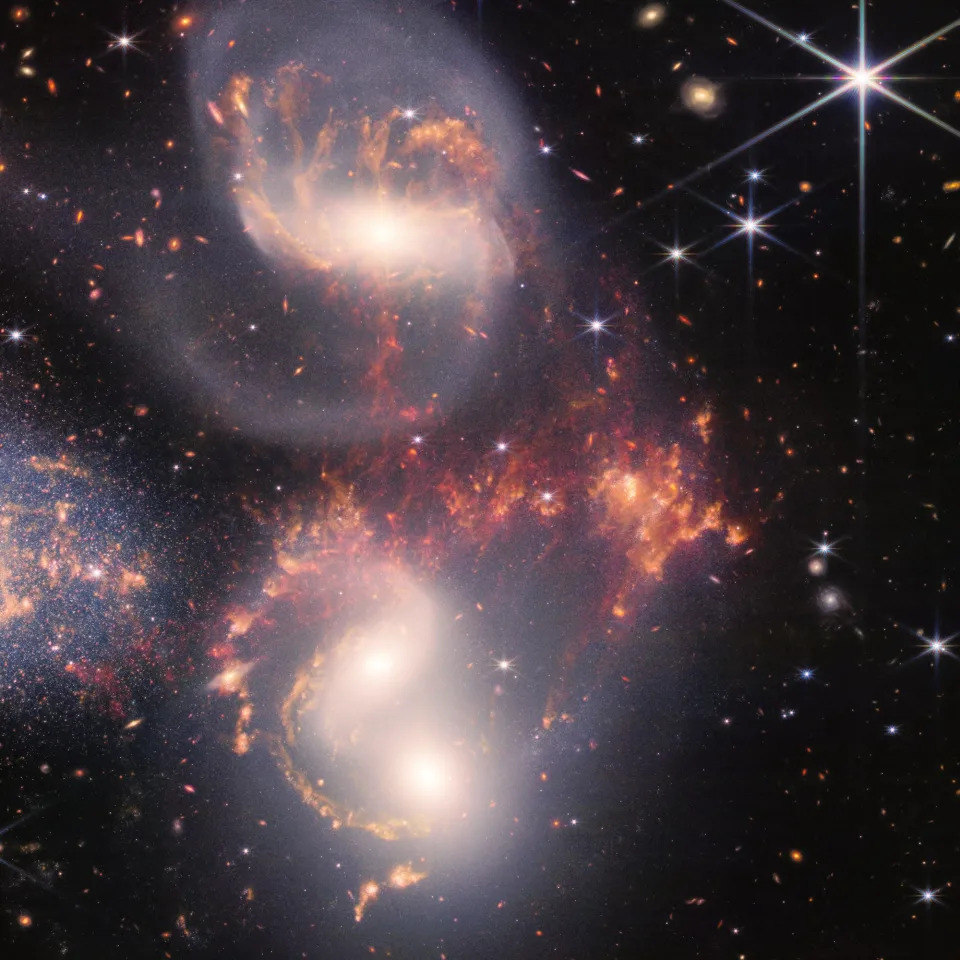
Three of the galaxies taken by the James Webb telescope shows the Stephan's Quarter.
Gas clouds appear clearly in this picture taken by the James Webb Space Telescope.NASA, ESA, CSA, STScI

"I think they've had a close encounter at some point in the past, which is why there's some sort of material flowing between these two, forming this bridge structure," he said.
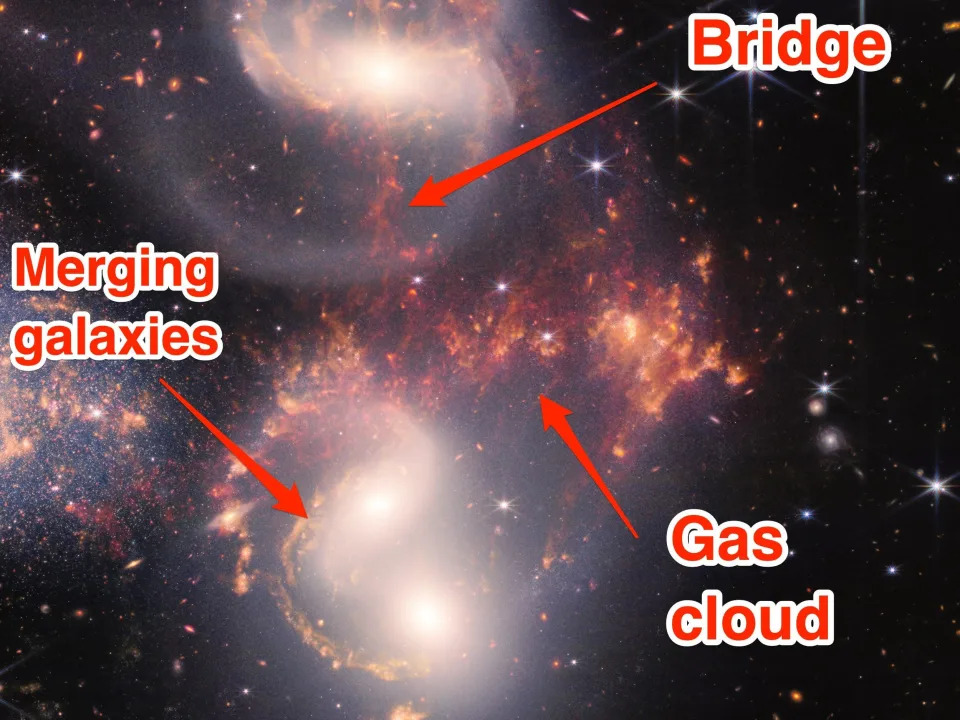
An annotated picture of three galaxies seen on the James Webb space telescope of the Stephan's quarter is shown.
The gas clouds tell us about the direction of the galaxies.NASA, ESA, CSA, STScI

The area between the galaxies is filled with ionized gas. When a galaxy goes through the gas, it can become very hot and ionized and emit a lot of light, said Saxena.

The gas cloud between the three galaxies is a shock front, which tells us that the galaxies are merging, Saxena said.

There are more galactic marvels throughout the background of the image of Stephan's Quintet.

A zoom of the space around the galaxies taken by James Webb telescope picture which shows the Stephan's Quarter.
A close-up of the sky around the galaxies in the Stephan Quintet reveal more galaxies, which are farther away.NASA, ESA, CSA, STScI

"Every pixel full of galaxies, wherever you look," Saxena said, adding, "You can really see the beautiful spiral arms and the bulge and everything."

JWST's deep field image reveals one of the oldest galaxies ever observed

A side by side collage of the same area taken by the Hubble and the James Webb space telescopes.
A side-by-side collage of the same area taken by Hubble and the James Webb Space Telescope.NASA/STScI; NASA/ESA/CSA/STScI

JWST also turned its attention to a cluster of galaxies about 4.24 billion light-years away, called SMACS 0723.

This cluster allows us to see galaxies that are much farther away, through an effect called gravitational lensing.

"It's kind of like looking through a wine glass. If you see something through the bottom of the wine glass, it appears ring-like and stretched, which is called lensing," Saxena said, adding, "Following Einstein's general theory of relativity, if there's a massive object between us and a background object, the light from the background object bends around it and stretches."

The gravitational pull from the cluster of galaxies is so strong that it mirrors and stretches light from galaxies far behind it, as seen in the image below.
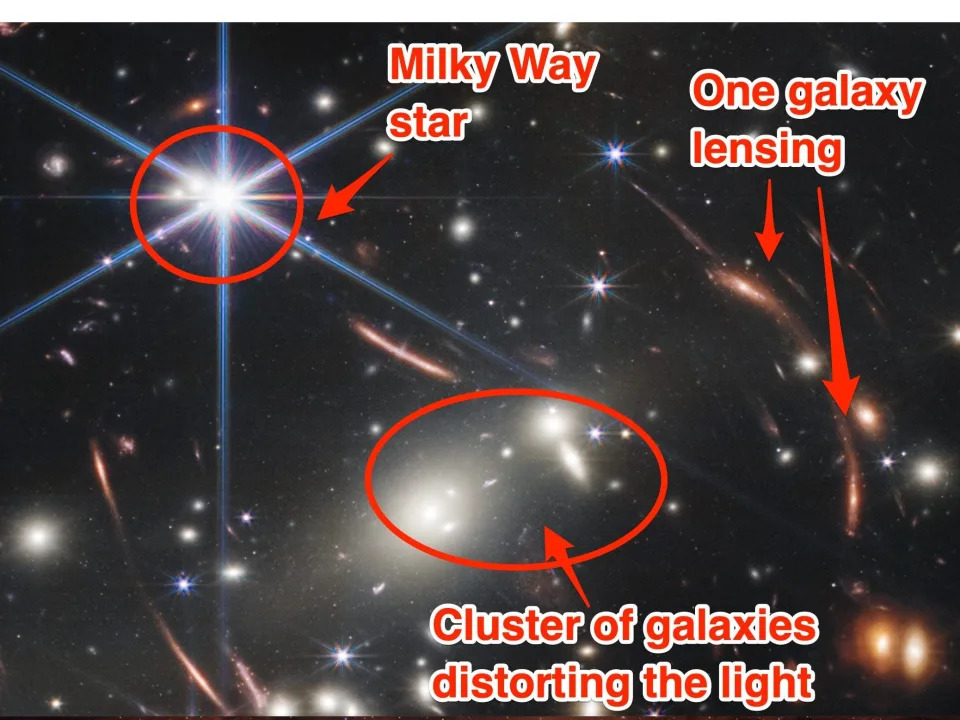
Light from faraway galaxies is distorted through lensing by a cluster of galaxies in the SMACs region.
This galaxy appears as two spots, but it's actually one galaxy mirroring itself, its light being lensed by the cluster of galaxies in the middle.NASA, ESA, CSA, STScI/Insider

For Saxena, it's the tiny red dots in the picture, rather than the galaxies, that are most interesting.
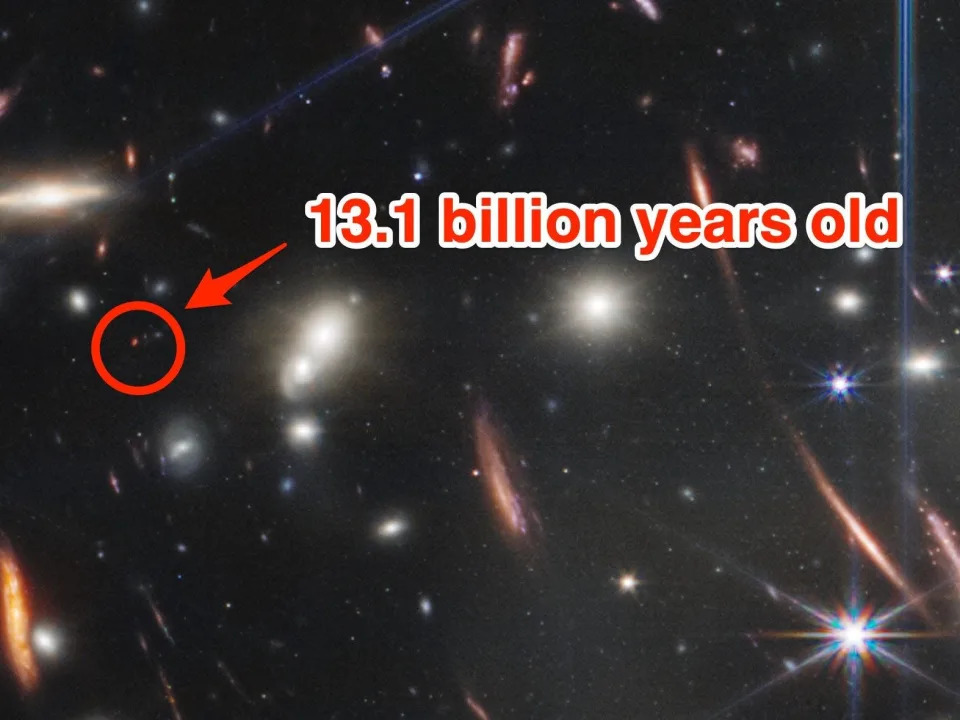
A tiny red dot is annotated as being "13.1 billion years old" on a picture of SMACS 0723 taken by the James Webb space telescope.
This tiny red dot is one of the oldest galaxies ever spotted.NASA, ESA, CSA, STScI/Insider

The farther away a galaxy is, the redder and more compact its light will be. NASA determined that this red dot is 13.1 billion years old, one of the oldest galaxies ever spotted.

"Once you bump up the contrast, I'm sure more and more such red dots will appear. Inevitably, one of them might just turn out to be one of the most distant galaxies that you might end up finding," said Saxena.


Hungarian workers block roads to protest new tax law

Wed, July 13, 2022


BUDAPEST, Hungary (AP) — Protesters in Hungary's capital blocked main traffic arteries for the second day in a row Wednesday in opposition to a tax overhaul pushed through this week by the country's right-wing governing party.

Several thousand demonstrators, many of them independent entrepreneurs affected by the new changes, gathered in a main square beside Hungary's parliament to protest a law passed Tuesday that many fear will result in significant tax hikes. Following the protest, most marched through central Budapest during peak rush-hour traffic.

Hungary's ruling Fidesz party, led by nationalist Prime Minister Viktor Orban, used its parliamentary supermajority to pass the new law, which targets a popular tax scheme allowing small businesses and individual contractors like hairdressers to pay a low flat tax rate.

Protester Tibor Tarcsay, 33, said his livelihood as a freelance translator is jeopardized by the changes, and he's not sure how he'll make ends meet once it takes effect in September.

“I might move abroad,” he said. "In two months, crowds of people are going to be standing in line at charity organizations to get a can of lentils.”

Estimates suggest up to half a million workers in Hungary use the tax scheme known as KATA.

But Hungary's government says many companies have abused the system by having workers on contracts rather than employing them, thus depriving the country's budget of between 250 and 300 billion Hungarian forints ($614 million to $736 million) in tax revenues annually.

The protest, which followed the occupation of two bridges Tuesday over the Danube River, was the first sign of popular discontent in Hungary since Orban and his Fidesz party were reelected in a landslide in April.

Hungary has been facing record weakness of its currency against the euro and the dollar, as well as the highest inflation in nearly 25 years. The government is keen to fill gaps in its budget left by major handouts to voters before the election.

Critics of the new tax law say it was passed without consulting affected workers, and pushed through Hungary's parliament in only a single day.

Balazs Zoltan Biro, 37, works for a food delivery company in Budapest as a bicycle courier. Blocking traffic with other demonstrators at one of Budapest’s busiest intersections, he said he believed civil disobedience was the last resort for opponents of Hungary's government.

“That they made a decision with the stroke of a pen, without negotiating with those whom it really affects, is not democratic at all,” he said.

Another demonstrator, book editor Marta Nagy, said she was likely to lose all of her clients.

“The worst would be if I have to give up my rented apartment and move home,” she said. “What will I live on?”

Justin Spike, The Associated Press

Economist on pessimistic consumer sentiment: ‘I’ve never really seen anything like it’


Moody’s Analytics Chief Economist Mark Zandi joins Yahoo Finance Live to discuss the June CPI data, inflation, the housing market, and the Fed's interest rate hike cycles.

Video Transcript

SEANA SMITH: Inflation is soaring, surging to a new 40-year peak, with rising rents, higher gas, and food prices making everyday life even more expensive. For more on this, we want to bring in Moody's Analytics chief economist Mark Zandi. Mark, it's great to have you. That 9.1% print that we got this morning, I have to, I guess, think that this might have been a little bit hotter than what you were expecting. What's your takeaway from that report that we got?

MARK ZANDI: Ug. It was pretty ugly. For the typical American family, they're now having to shell out almost $500 more a month to buy the same goods and services that they were purchasing a year ago because of the higher inflation. And just for context, the typical American family makes about 60k a year. So if you do the arithmetic, you get a pretty clear sense of the financial pain and suffering that's resulting. So, yeah, a pretty ugly report.

RACHELLE AKUFFO: And obviously, a lot of that bringing up concerns about recession. You can usually consider those two consecutive quarters of falling GDP growth, but you said that this isn't-- it doesn't actually work for this current trend that we're in. Why is that?

MARK ZANDI: Well, the two quarters of negative GDP, that's a rule of thumb, which has roughly worked historically. But the arbiter of recessions, at least here in the United States, is, the business cycle dating committee, which is a group of academic economists of the National Bureau of Economic Research. And they look at a plethora of data. And GDP's on the list of things they look at, but it's probably down on the list. I think the thing that is most important is employment, jobs.

And we saw last week that the economy created 400,000 jobs in the month of June and close to a half million jobs on a monthly basis over the past year. Unemployment is low. Layoffs are incredibly low. They may be record low. That's not consistent with a recession. The thing I'd just quickly say-- and I won't go into any detail because probably, everybody's eyes will glaze over. But I think there's all kinds of measurement issues, data problems. And ultimately, if you ask me back five years from now, when we look at this data, I wouldn't be surprised if these declines got revised away.

DAVE BRIGGS: Our eyes are not glazed over, sir. Do you think we're headed into a recession? Can the consumer stave it off?

MARK ZANDI: Well, you know, obviously, recession risks are very high. At this-- with this kind of inflation and the Fed on the warpath and jacking up interest rates, recession risks are very, very uncomfortably high. Sentiment is very weak. I've never really seen anything like it. Consumers, business, investors all very pessimistic. It seems like everyone's forecasting for a recession, which is just unprecedented. You can see, by my hairline, I've seen a lot of recessions over the years. I've never seen anything like it.

So, you know, obviously, risks are high. I will say, though, with a little bit of luck on the pandemic, let's just hope it continues to fade away. And a little luck on the Russian invasion-- let's just hope that the economic fallout is-- the worst of the fallout is behind us. Then I think we should be able to navigate through. I think the Fed should be able to thread the needle and land-- I'm going to mix all kinds of metaphors here, but land that economic play on the tarmac without crashing it.

And I think the American consumer, as you point out, is key to all this. There's a firewall between a economy that's growing and one that's in recession. And the firewall, it's definitely on fire. I mean, the high inflation is cutting into purchasing power. But if you look at excess saving and debt service and net worth, the only things you might look at to gauge the health of the American consumer, they look pretty good.

SEANA SMITH: Mark, what about housing? Because we know that that's a very important sector when we talk about a recession, where exactly that falls. We've seen some cooling at least in the latest data when it comes to housing, but what are you expecting to see play out over the next couple of months there?

MARK ZANDI: Well, that's going to weaken. That is the-- housing is the most interest rate sensitive sector of the economy. So the Fed is raising interest rates to slow growth. And that's going to work first and foremost through a weaker housing market. And it's already pretty clear that's happening. The higher mortgage rates were now just south of 6% on the 30-year fixed. That's twice what it was just a year ago, when rates were at their record lows.

You take that higher mortgage rate, you multiply by these high house prices, and people can't afford these homes. The monthly payment for typical first-time homebuyers jumped by $500, $600 a month. That's just prohibitive. So first-time buyers are locked out. Trade-up buyers, they're locked in, right? Because they have a mortgage sitting at 3 and 1/2, 4, because they've refinanced down into those lower rates.

Now, if they sell that home, buy another, need another mortgage at 6, their mortgage payment is going to jump, so they're not going to do that. So home sales are already falling very rapidly. And the number of homes in inventory, they're starting to rise. So that means we will start to see some house price weakness. My sense is, if we don't go into recession, nationwide house prices will effectively go flat here for the next couple three years.

But that means big parts of the country are going to experience meaningful price declines, particularly it's going to be in those parts of the country that have seen the most significant increase in price because-- like Southeast, Florida, and Atlanta, Charlotte, and in the Mountain West, you know, Boise-- just learned how to pronounce Boise-- Boise, down to Phoenix. Those prices have jumped a lot. And again, you mix in those higher rates, affordability becomes a real problem. And that's where we're going to see the most significant weakness. If we go into recession, then nationwide, I expect to see some price declines.

RACHELLE AKUFFO: So then in terms of signals ahead, keeping an eye on what's been happening with the Treasury yield curve there, what is that signaling to you right now?

MARK ZANDI: Yeah, that makes me nervous. You know, I had been hanging on the yield curve, 10-year, two-years, as evidence that the economy can navigate through. Now, it's only been, I think, four or five trading days that that curve is inverted, meaning two-year Treasury yields have risen above 10. And today, obviously, it inverted meaningfully. I think the difference today is about 20 basis points, or 2/10 of a percentage point. That's consequential.

So if the yield curve stays inverted like that for another two, three, four weeks, then I may have to give up my optimism about the economy navigating through. It's going to-- the shape of the yield curve, at the very least, is strongly arguing that growth is going to slow very dramatically here. And if it stays as inverted as it is, it will start, in my view, signal a recession. So hopefully that doesn't continue in the trading days ahead.

DAVE BRIGGS: Mark, the president called the numbers, the CPI number, unacceptably high, but also out of date, based on the fact that gas prices have begun to come down for several straight weeks. Are you willing to proclaim that inflation has finally peaked? And apologies for the double. Are we headed for a 100-point basis point hike?

MARK ZANDI: Yeah, well, you know, I say it with great trepidation, but I think the president is right. You know, gasoline-- oil prices are way down from where they were last month. Gas, diesel, jet fuel prices are coming in. That's really critical. That's the first step in getting inflation down. And it feels like we just-- we are now taking that first step. And if you ask me back a month from now, and we have this conversation around the July CPI report, it's going to look a lot better than the June report.

So I think that's right. I mean, obviously, I'm hesitating because there's so many uncertainties, unknowns around what's going to happen with Russia and Ukraine and EU sanctions, and what are the Saudis going to do. And it's not even just oil. It's refining capacity, right? We have no refining capacity, so if a Cat 5 hurricane blows through the Gulf, hits the Gulf, hits the Texas coast and takes out a refinery for a few weeks, we've got a problem. So we're really on an edge here. But I think it's fair to say that we've seen the peak, and we're moving in the right direction.

On the 100 basis point hike, in my view, I think the Fed should do whatever the market says they should do. So, if the market says, hey, I think you're going to raise rates 100 basis points, I would take that opportunity to raise 100 bips because markets should then not react to that, right? I mean, it's already embedded in equity prices and credit spreads and the value of the dollar and the mortgage rate, so. And we all know that they have to get rates up as fast as possible.

But if the market is saying 75 basis points, 3/4 of a point, I'd go with that. I mean, that's good enough. You know, you're getting rates up fast enough. So it's really about what market expectations are at this point. And that, I think, will determine whether it's 100 basis points or 75.

SEANA SMITH: Mark, if we do get that 100 basis point hike at the end of the month, what does that mean then for the fall in September? Will we see the Fed quickly start to scale back?

MARK ZANDI: Yeah, I mean, I think with these rate hikes, we're going to see much slower growth. Job growth is going to slow meaningfully here. And other indicators are going to show the economy is really starting to throttle back. And hopefully, I'm right about inflation. And we'll see inflation moving in the right direction here. And the combination of those things-- two things will allow the Fed-- they'll continue to raise rates, but at a much slower pace.

And so instead of 75, 100 basis points, it'll be 25 basis points, maybe 50. And then they'll get the funds rate target up to-- they're now targeting something between 3 and 1/2% and 4%. And that sounds about right to me. I think that feels like where they're headed. It's just a question of when we get there. At the very latest, it will be this time next year. But I do think growth will slow, inflation will moderate. And that will allow the Fed to keep stepping on the brakes, but maybe not quite as hard as they're doing right now.

DAVE BRIGGS: All right, got to leave it there. Moody's Analytics chief economist, Mark Zandi. Good to see you, sir. Thanks.


Scientific Games’ lottery playbook succeeded, then spread


Wed, July 13, 2022 


The growth of the lottery business nationwide was inspired in large part by the lobbying innovations of a single multinational gambling company, Scientific Games Holdings LP.

A 1986 memo from Scientific Games co-founder and then-Chairman John R. Koza described a “draft version of our new model state lottery law which we distribute widely each year to state legislators and government officials in non-lottery states.”


“We are seriously considering the possibility of supporting an initiative petition effort in Oklahoma and/or Arkansas to establish a state-operated lottery there in the November 1986 elections,” Koza wrote in a letter to Gaming Business Magazine.

Historian Jonathan D. Cohen found that Scientific Games’ political activities were key to the creation of state lotteries, primarily in the early 1980s, via ballot initiatives in Arizona, Washington, D.C., Colorado, Oregon, and finally the “bonanza” in California. The California lottery “was entirely the product of Scientific Games,” said I. Nelson Rose, a law professor, author of “Gambling and the Law” and a widely cited expert in the field of gambling law.

For other states, the process took longer. Oklahoma enacted a lottery in 2004, after Scientific Games proposed draft legislation in 1986 and contributed money to a pro-lottery effort in that state. In the end, Scientific Games was named primary contractor.

“There’s never been a grassroots movement for this,” said Les Bernal, national director of Stop Predatory Gambling, of lottery expansion. “It’s being driven by a handful of cynical public officials from both political parties (in conjunction with) powerful gambling interest groups that stand to benefit.”


Today, 45 states and Washington, D.C., have lotteries, as do dozens of countries across the globe. “While Scientific Games was not responsible for the creation of any new lotteries after 1984,” Cohen wrote, “its campaigns set the stage for the massive spread of legalized gambling across the Midwest, West, and Upper South in the late 1980s and early 1990s.”

Scientific Games spokesperson Therese Minella declined to answer questions and instead directed a reporter to the company’s website. Minella wrote that a Howard Center for Investigative Journalism question about the company’s lobbying and influence “is inaccurate as a premise,” and didn’t respond to emails or a telephone message seeking elaboration.

Scientific Games’ lottery business was purchased for $6 billion in April by Brookfield Business Partners LP, a private equity firm based in Canada. The remaining part of Scientific Games was renamed Light & Wonder Inc. and retained Las Vegas as its headquarters.

Adam McLaren, a vice president and senior analyst at Moody’s Investors Service Inc. who follows the lottery business, doesn’t necessarily see Scientific Games as the main driver of lottery expansion. Instead, it was states – looking for new revenue – which joined the lottery bandwagon after other states established them.

“Scientific Games played a big part in the start, but it’s hard to say they were the ones who spread the growth,” McLaren said.

According to interviews and court documents, the Scientific Games strategy to win public acceptance of lotteries has proven so effective that state governments have since become their biggest cheerleaders. The Howard Center found that state lotteries drive a multibillion-dollar wealth transfer to lottery contractors from players concentrated in low-income, high-poverty communities with lower levels of education and larger Black and Hispanic populations.

Some states go to unusual lengths to protect their lotteries. The Wyoming Lottery Corporation, for example, filed a lawsuit against a prominent critic after he wrote to national lottery organizations with complaints about the company’s handling of compulsive gambling. Edward Atchison, the former director of the Wyoming Council on Problem Gambling, accused the Wyoming Lottery of preying on people with compulsive gambling addictions.

Atchison’s lawyer, Tim Kingston, said it “amazed” him that a quasi-governmental entity like the lottery would pursue legal action against a private citizen. “He’s a citizen and has the right to speak out about a public issue,” Kingston said. “They’re just trying to shut him up.”

Atchison died in May 2016, before the case could proceed, and it ultimately was dismissed.


The Scientific Games playbook


State lotteries’ origin stories follow a general pattern: a shortfall of state tax revenues and a growing need to build schools, fix potholes and pay for other government services drives officials to look for new revenue sources. States needed private contractors to handle the ticket printing, game design, database management and other operations. Scientific Games saw a great opportunity.

Lobbyists at the behest of Scientific Games formed groups with names like Arizonans for Tax Reduction or Californians for Better Education which were “just total fronts for the company and its advertising efforts,” Cohen said in an interview. Scientific Games executives employed these firms to disguise their interests as genuine grassroots activism, Cohen and Bernal said.

The pro-lottery forces made sure to specify how lottery proceeds would be used for schools or other popular services rather than having funds mixed with the “black hole” of state general funds when knocking on doors for petition signatures, Cohen described in his book, “For a Dollar and a Dream: State Lotteries in Modern America.”


Scientific Games wrote some of the bills that would ultimately be ratified. Cohen compared lottery language in ballot initiatives in California and Oregon to the generic version Koza shared. The state versions were so similar that Cohen called significant parts of them “word for word.”

Scientific Games’ efforts to bring a lottery to Oklahoma surfaced in 1986, when the company contributed $25,000 to pro-lottery organizations when legislation to enact a lottery was being debated in the Oklahoma House of Representatives, according to an article in The Oklahoman from that year. Ultimately, the lottery bill incubated for almost 20 years before 64% of voters approved it through referendum in 2005.

The initiatives, once passed, were essentially tailored so that only Scientific Games could serve as the instant ticket vendor, according to Rose and Cohen. Language in the California initiative required detailed financial disclosures from all of the executives, Rose said, knowing “their competitors at the time weren’t going to reveal all this confidential financial information about their executives.”

Scientific Games largely exited the political arena of lottery legislation after all five of its pet-project ballot initiatives passed, Cohen said, but it remained on the scene with a reduced footprint.

Scientific Games, by its own admission, had a forceful expansion strategy in the 1980s. Then-President and CEO William G. Malloy described in a 1993 interview the company’s shift in business strategy from the prior decade. “We aim for a constructive aggressiveness, but not aggressiveness in terms of what we saw in the early days of Scientific Games,” Malloy told Gaming and Wagering Business magazine. “We recognize that lottery executives are pretty knowledgeable these days and wouldn’t go along with it.”

A 1983 internal company study offered a sense of Scientific Games’ expansionary ambitions in that era. The company conducted extensive market research to argue that lotteries would not eat into the betting at horse races, known as parimutuel wagering.

“All available evidence indicates that the lottery player and the parimutuel wagerer are different, that the introduction of a lottery does not negatively impact parimutuel revenues” and can, by contrast, “help the parimutuel industry,” the study said.

Scientific Games’ expansion and success drew criticism, even from officials in states where they were operating. California Superintendent of Public Instruction Bill Honig said ″education was used to get the lottery passed, but education hasn’t benefited from it.” Arizona state Sen. Ray Rottas, a Phoenix Republican, lamented that he had “misgivings about them receiving the contract because this is the first time in the state of Arizona that an initiative has been bought and paid for.”

State governments have become the lottery’s biggest advocates in recent years. One vivid example of this advocacy involved a 2019 lawsuit by the New Hampshire Lottery Commission and other state lotteries that sought to preserve sales of lottery tickets online, which were threatened by a 2019 Justice Department legal ruling. In January 2019, the Justice Department reinterpreted the 1961 Wire Act to apply to iLottery tickets, which would prohibit iLotteries nationwide. Bernal said there was an immediate “uproar” from the states.

“Lotteries which are not making the games available on the internet within the next 10 years will lose an entire generation of players,” Charles “Charlie” McIntyre, director of the New Hampshire Lottery and former president of the North American Association of State and Provincial Lotteries, told Public Gaming magazine.

In Michigan, for example, iLottery sales increased by almost 1,300% from 2015 to 2021 while traditional lottery sales continued to rise. Michigan Attorney General Dana Nessel argued in a court filing that the Justice Department ruling would put vital state-level public services at risk of shrinking or disappearing.

A federal appeals court sided with the states, preserving this new online lottery venture. New Hampshire Gov. Chris Sununu celebrated a victory that would “protect public education in our state.”

___

Jillian Diamond, Jamie Pinzon, Spencer Friedman, Rob Wells and Constance Mitchell Ford of the University of Maryland contributed to this report.

The Howard Center at the University of Maryland is funded by a grant from the Scripps Howard Foundation in honor of newspaper pioneer Roy W. Howard.

Jon Meltzer, Lauren Mowry, Victoria Ifatusin And Michael Purdie / Howard Center For Investigative Journalism, The Associated Press


Groundbreaking judge will oversee Twitter's lawsuit against Musk

FILE PHOTO: People holding mobile phones are silhouetted against a backdrop projected with the Twitter logo in Warsaw

By Tom Hals

Wed, July 13, 2022 

WILMINGTON, Del. (Reuters) - The first female chief judge on Delaware's nationally known business court will oversee Twitter Inc's lawsuit that seeks to hold Elon Musk to his agreement to buy the social media platform for $44 billion, according to court records.

Kathaleen McCormick took over the role of chancellor, or chief judge, last year after the retirement of Andre Bouchard on the Court of Chancery, a favored venue for large corporate disputes.

Among McCormick's first decisions will be a request by Twitter to hold a four-day trial in September, an incredibly tight time frame for such a complicated case.

McCormick's final ruling on the merger can be appealed to the Delaware Supreme Court.

Twitter accused Musk of a long list of violations of the merger agreement in the lawsuit it filed on Tuesday. It said the world's richest man wanted to back out in part because of a downturn in the stock of Tesla Inc, the electric vehicle maker where he is chief executive.

Musk accused Twitter of breaching the merger agreement because it refused to share information on spam accounts, made misrepresentations and strayed from its normal course of business by firing executives.

McCormick is also overseeing a case by shareholders of Tesla who are seeking to void Musk's $56 billion compensation package from the automaker. She scheduled an October trial in that case.

Jim Jordan
Rep. Jim Jordan, a Republican from Ohio Kevin Dietsch/Getty Images
  • Jordan deleted a tweet calling a story about a 10-year-old girl who was raped in Ohio a "lie."

  • The Ohio Republican deleted the message after a man was charged with rape in connection to the case.

  • The girl's case has drawn national prominence since it was first reported.

Republican Rep. Jim Jordan deleted a tweet on Wednesday in which he called the story of a 10-year-old Ohio girl receiving an abortion after being raped "another lie" following the arrest of a man in connection with the case.

"Another lie. Anyone surprised?" Jordan, an Ohio Republican, wrote on Twitter in a message on his official account that quoted a story about Ohio Attorney General Dave Yost's office initially saying it had not found any evidence to support the rape charge.

The case received national attention and President Joe Biden mentioned it during a major speech about abortion policy in the wake of the Supreme Court overturning Roe v. Wade.

While some news outlets initially had difficulty confirming the story, Yost, Jordan, and a host of conservative commentators questioned the account — some even claimed that it was simply made up.

On Wednesday, authorities charged Gershon Fuentes, 27, with rape, news that was first reported by The Columbus Post Dispatch. Law enforcement said that Fuentes admitted to raping the child on two occasions. DNA from the aborted fetus is also being tested to confirm if Fuentes forcibly impregnated the girl. The girl reportedly traveled to Indiana to receive the abortion at six weeks of pregnancy because of Ohio's new abortion laws.

A spokesperson for Jordan declined to comment, but pointed to a new tweet in which the lawmaker called for Fuentes to "be prosecuted to the fullest extent of the law. The deletion of the tweet was confirmed by ProPublica's Politwoops, which archives politicians' deleted tweets.

Yost celebrated the news of the arrest after previously going on Fox News to question the Indianapolis Star's early reporting on the case.

"We rejoice anytime a child rapist is taken off the streets," Yost told the Post Dispatch. He previously told Fox that there had not been a "whisper" about such a rape occurring.

The case received significant attention following Roe's reversal and Ohio's ban on nearly all abortions after roughly six weeks of pregnancy went into effect. The Star was reporting on the growing number of Ohioians who were venturing across state lines to obtain abortions.

An eight-term congressman, Jordan is the top Republican on the powerful House Judiciary Committee. If Republicans retake the chamber in November, he is in line to chair a powerful panel.

Ohio's attorney general dismissed the story of a 10-year-old child who sought an abortion after being raped. Days later, he celebrated a suspect's arrest in the case.

abortion ohio
An abortion rights protester speaks through a megaphone at a rally in Columbus, Ohio, after the United States Supreme Court ruled in the Dobbs v Women's Health Organization abortion case, overturning the landmark Roe v Wade abortion decision, June 24, 2022.REUTERS/Megan Jelinger
  • An Ohio man was arrested on charges of raping a 10-year-old girl who later needed an abortion.

  • Ohio's Republican attorney general, David Yost, had dismissed the story as a likely "fabrication."

  • Following the alleged rapist's arraignment Wednesday, Yost celebrated the arrest.

An Ohio man was arrested Tuesday after confessing to raping a 10-year-old girl on at least two occasions, according to Columbus police, which led to the girl becoming impregnated and traveling to another state for an abortion.

The arrest and rape charges against the man, 27-year-old Gershon Fuentes, were first reported by the Columbus Dispatch.

The story of the 10-year-old traveling to Indiana for an abortion drew widespread attention earlier this month as an example of the effects of Ohio's strict abortion laws.

Following the Supreme Court's decision in June that revoked the nationwide right to an abortion, an Ohio law banning abortion past six weeks took effect. The law does not have an exception for rape. Dr. Caitlin Bernard told the Indianapolis Star that the girl was six weeks and three days pregnant when she took her on as a patient and performed the abortion.

But some Republican officials and conservative commentators cast doubt earlier this month that the story was true at all.

On Twitter, South Dakota Governor Kristi Noem said the story was "fake to begin with." The Wall Street Journal's editorial board described it as "fanciful." Ohio Attorney General Dave Yost told Fox News his office had not heard a "whisper" about the situation despite media reports.

In a later interview with USA Today, he said there was "not a damn scintilla of evidence" about the case and that it was a likely "fabrication."

But on Wednesday, following Fuentes's arraignment, Yost celebrated the arrest.

"We rejoice anytime a child rapist is taken off the streets," he told the Columbus Dispatch.

According to the Columbus Dispatch, the girl's mother informed Franklin County Children Services about the pregnancy, and the agency informed Columbus police. The abortion was performed on June 30, according to police testimony at the Wednesday arraignment hearing.

A judge set Fuentes's bond at $2 million, according to the Columbus Dispatch.

Indiana has received an influx of abortion patients after Ohio and Kentucky passed restrictions on the procedure, according to the Indianapolis Star. The state's Republican-dominated legislature has scheduled a session for later in July to discuss passing new abortion laws.

Read the original article on Business Insider

Rape of 10-year-old jolts US abortion debate

Published July 14, 2022

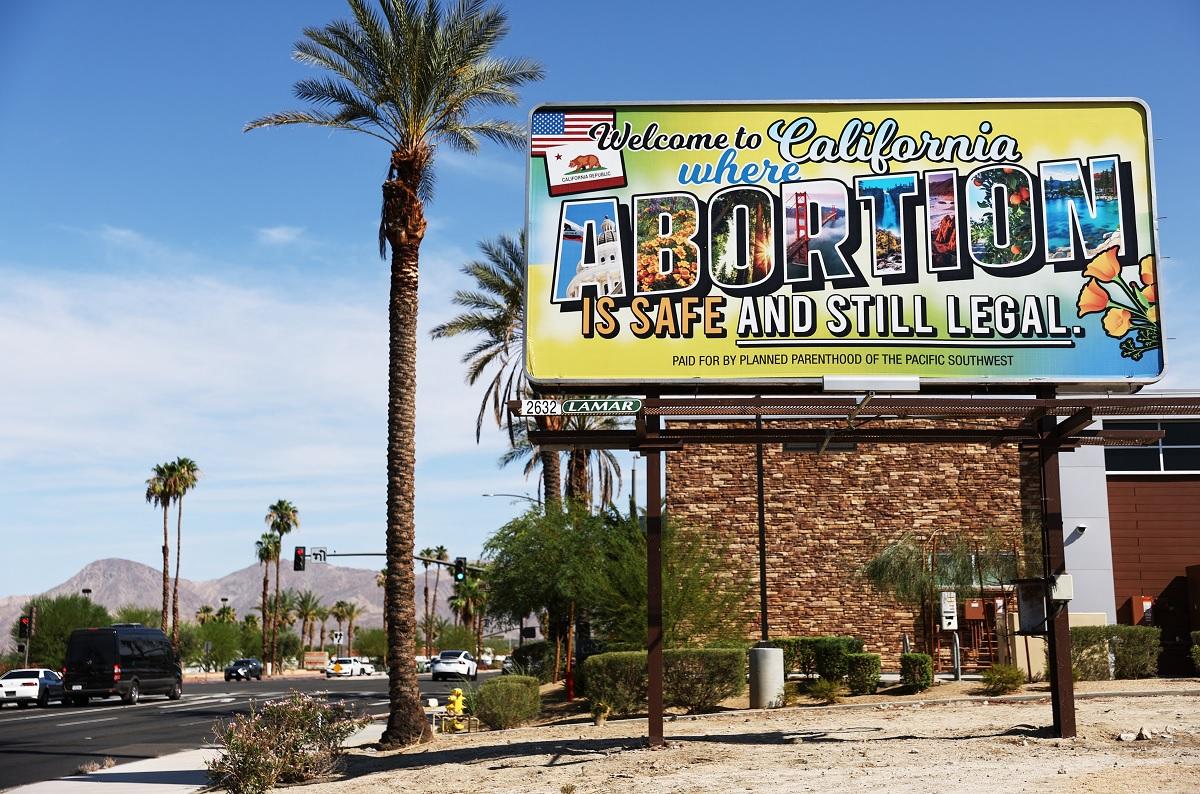
RANCHO MIRAGE, CALIFORNIA - JULY 12: A billboard reads, 'Welcome to California where abortion is safe and still legal' on July 12, 2022 in Rancho Mirage, California. The billboard was paid for by Planned Parenthood of the Pacific Southwest. The number of patients from outside states increased 900 percent at Planned Parenthood clinics in San Bernardino and Orange counties the week following the Supreme Court's decision in the Dobbs v Jackson Women's Health case. The decision overturned the landmark 50-year-old Roe v Wade case and erased a federal right to an abortion. 

Mario Tama/Getty Images

Ohio police have confirmed a 10-year-old rape victim crossed state lines to terminate her pregnancy, local media reported Wednesday, in a case drawing broad attention after the US Supreme Court overturned a federal right to abortion.

The girl's ordeal of travelling to neighboring Indiana for the medical procedure was highlighted by President Joe Biden recently as he signed legislation aimed at helping women seeking abortions.

A trigger law banning all abortions after six weeks, with no exceptions for rape or incest, came into force in Ohio last month after the nation's high court ended decades of constitutional protection for the right to end a pregnancy.

The shocking case was questioned by conservative-leaning media outlets and Ohio's attorney general, who cast doubt on the story's veracity.

But Columbus, Ohio police detective Jeffrey Huhn testified in court early Wednesday that the unidentified girl underwent an abortion in Indianapolis on June 30, the Columbus Dispatch reported.

According to the paper, Huhn was testifying at the arraignment of a man arrested Tuesday by police who say he confessed to raping the child.

Huhn also told the court that DNA samples obtained from the Indiana clinic were being tested against the 27-year-old suspect, the Dispatch said.


Franklin County, Ohio court documents confirm that a Gerson Fuentes, 27, was arraigned Wednesday on charges of rape of a person under 13.

The disturbing story, first reported by the Indianapolis Star, has drawn international scrutiny and become a flashpoint in the deeply divisive issue of abortion rights in America.

Biden spoke of the Ohio rape victim during a July 8 ceremony where he signed reproductive right protections into law and urged Congress to codify Row v Wade, the 1973 ruling that established the nationwide right to abortion.

"Just last week it was reported that a 10-year-old girl was a rape victim in Ohio -- 10 years old -- and she was forced to have to travel out of the state, to Indiana, to seek to terminate the pregnancy," Biden said, noting the girl was six weeks pregnant.

"Just imagine being that little girl."

Reversing course


The Wall Street Journal's editorial board criticized Biden Tuesday for giving his "presidential seal of approval on an unlikely story from a biased source that neatly fits the progressive narrative but can't be confirmed."

On Wednesday it added an editorial note to the piece noting that the Columbus Dispatch had confirmed the story -- but did not immediately change the article or its headline, which was "An Abortion Story Too Good To Confirm."

Ohio Attorney General Dave Yost, a Republican, strongly suggested to Fox News late Monday that the case was a fabrication, and there was "not a whisper" of evidence to back up the claims that a 10-year-old rape victim had left Ohio to have an abortion.

On Wednesday he reversed course, saying in a statement after the arrest that he praised the Columbus Police Department for "securing a confession and getting a rapist off the street."

Thirteen states have already passed trigger laws to ban abortion, in some states even in the case of rape or incest.

Biden, a Democrat and staunch Catholic turned abortion rights proponent, has not contained his anger, calling the abortion bans in the case of rape or incest "extreme."

A majority of Americans -- 56 percent, according to an NPR/Marist poll -- oppose the overturning of Roe v Wade. —Agence France-Presse


'Eat The Rich' Bezos, Musk Billionaire Popsicles Sold by Art Collective | TMZ 
An ice cream truck is hitting the road and giving people a dish best served cold ... by selling popsicles modeled after everyone's favorite -- or least favorite -- billionaires.

We spoke with an employee for MSCHF, a Brooklyn-based art collective, Tuesday in Santa Monica -- they've got their truck parked near the beach and selling their "Eat The Rich" billionaire popsicles.


Brooklyn art collective unveils ‘Eat the Rich’ popsicles to the public

‘Eat the Rich’ popsicles were unveiled on Tuesday and gives people a chance to try flavors like Gobble Gates, Munch Musk, Suck Zuck, Snack on Jack, and Bite Bezos.


Central Banks Rush to Quell Inflation Crisis They Helped Create


Christopher Anstey
Wed, July 13, 2022 a


(Bloomberg) -- Central banks across the globe are speeding up interest-rate hikes, seeking to crush an inflation surge partly of their own making.

Wednesday saw Canada’s central bank hike a greater-than-expected full percentage point following two half-point moves, South Korea raise by a half point after several quarter-point moves, and New Zealand increase by a half point for a third straight meeting.

In the US, another searing inflation report led to bets that the Federal Reserve would hike by a full point later this month following a 75 basis-point move in June. Investors say the Bank of England may deliver a 50 basis-point shift at its next meeting, double the previous pace, after the UK economy proved surprisingly robust in May.

Lulled by two decades of subdued consumer prices, central bankers by their own admission assumed that cost pressures emerging in 2021 would soon dissipate. But supply-chain snarls proved more lasting -- and now the surge in energy and commodity prices after Russia’s invasion of Ukraine has decisively removed any case for gradualism in combating inflation.

It’s a pace that none of the central banks had penciled in just a few months ago, and it will likely deliver a growth shock that increases the risk of recessions. Fed Chair Jerome Powell made clear last month that failing to get inflation under control would be a bigger mistake than overdoing the monetary tightening, in a sentiment echoed by his UK and euro-region counterparts.

“Central banks will be minded to look through evidence of slowing growth until they are confident the inflation genie is being forced back into the bottle,” Rabobank rates strategists Richard McGuire and Lyn Graham-Taylor wrote in a note Wednesday. “We continue to believe that policy makers are willing to countenance triggering a recession if that is the extent to which they need to shift the demand curve in order to meet this aim.”

In a world where many central banks are picking up the pace, those that lag behind are getting punished by weaker exchange rates -- a dynamic that only worsens inflation, by making imports costlier.

The European Central Bank has yet to start boosting its benchmark rate, and the euro on Wednesday slid below 1 per dollar for the first time since 2002. That was in the wake of a report showing US inflation jumped to 9.1% in June -- spurring bets that the Fed will hike by at least 75 basis points at its July 26-27 meeting.

The euro then rebounded after an ECB spokesperson said the central bank is attentive to the impact of the exchange rate on inflation -- an illustration of the competitive pressures that some have termed reverse currency wars.

Refusing to go along with the trend is the Bank of Japan, with Governor Haruhiko Kuroda dismissing a pickup in inflation in his country as being mainly driven by commodities -- not the kind of stable price increases he’s been seeking.

What Bloomberg Economics Says...

“In the end, monetary policy makers will get prices under control. That won’t happen soon enough to save households from a major blow to their budgets, or central banks from a major blow to their credibility.”

--Tom Orlik, chief economist

The yen has reflected the BOJ’s gap with its peers, sinking 16% against the dollar so far this year -- stoking concern in the Kishida administration, if not so much in the halls of the BOJ.

In the US, Powell and his colleagues have continually had to rip up their plans for what started out late last year as a “normalization” in policy after pandemic-era stimulus but is now the most aggressive tightening campaign in decades.

Getting its call on inflation being “transitory” quite wrong, the Fed late last year brought forward the end of quantitative easing.

It began hiking rates earlier than it had once anticipated, then in May doubled the pace of tightening to 50 basis points. By last month, policy makers concluded they needed to move even faster, with the first 75-point increase since 1994.

Entrenched Concern

Traders are now pricing in roughly a 50-50 chance of a 100 basis-point hike this month. Tiff Macklem, the Bank of Canada governor, delivered an increase of exactly that magnitude on Wednesday.

“This decision does reflect concern” about inflation becoming entrenched, Macklem said at a press briefing.

The hope is that faster rate hikes now can ensure that high inflation doesn’t become embedded for the long haul. Gauges of long-term inflation expectations in the bond market suggest that investors expect central bankers will achieve that task.

So-called breakeven rates suggest 10-year inflation expectations around 2.35% in the US, with Germany at 2.08% and Canada at 1.98%. The UK 10-year breakeven rate is 3.68%.

But the cost may be economic downturns, sooner than previously thought.

Read next: Bank of America Economists Forecast Mild US Recession This Year