Thursday, July 14, 2022

Sri Lanka: President Rajapaksa emails overdue resignation

Protesters were withdrawing from government buildings as they awaited the president's formal resignation. Gotabaya Rajapaksa had promised to step down by Wednesday.


Issued on: 14/07/2022
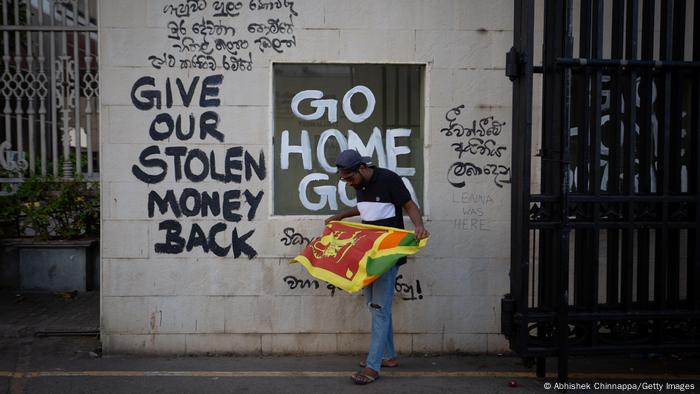
Colombo was relatively calm on Thursday, a day after exiled President Gotabaya Rajapaksa had promised to step down

Sri Lanka's embattled President Gotabaya Rajapaksa sent his letter of resignation to parliament via email on Thursday — a day after the Wednesday deadline he had repeatedly given himself to leave office.

Rajapaksa and his wife fled to the nearby Maldives on Wednesday aboard an air force jet. Rajapaska landed in Singapore Thursday where authorities there said he was on a "private visit" and had neither requested nor been granted asylum.

Reports earlier on Thursday said he was on his way to Singapore before possibly continuing on to Saudi Arabia.

"The authenticity and the legality of the e-mail will have to be checked out" before being formally accepted, parliament speaker spokesperson Indunil Yapa told the AFP news agency, adding that a formal announcement was expected on Friday. 

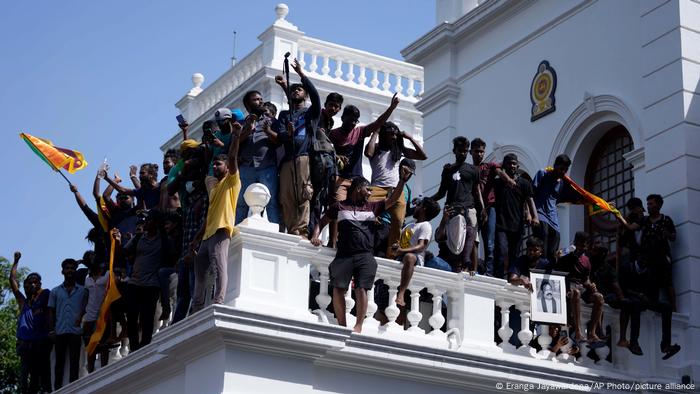
Over the weekend, protesters had stormed Rajapaksa's presidential palace, and on Wednesday, they also occupied the office of Prime Minister Ranil Wickremesinghe, who had quickly taken over as acting president and now is bearing the brunt of the protesters' anger.

Wickremesinghe responded with a nationwide curfew, adding: "We can't allow fascists to take over."

After months of protests, the streets of Colombo were calm on Thursday morning after protesters appeared to broker a truce with authorities.
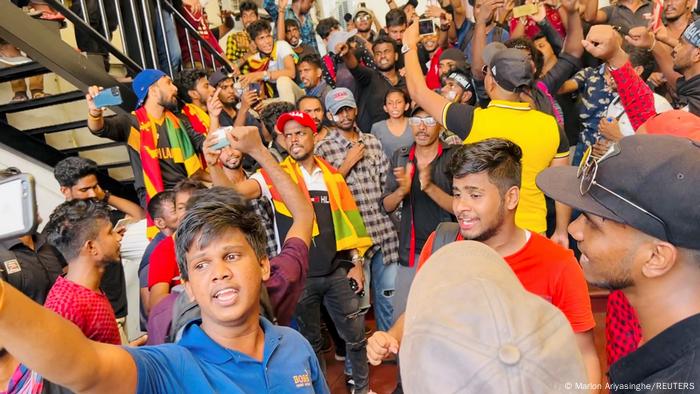
Protesters occupied Prime Minister Ranil Wickremesinghe's office on Wednesday, but agreed to withdraw on Thursday

Protesters ready to stand down

"We are peacefully withdrawing from the presidential palace, the presidential secretariat and the prime minister's office with immediate effect but will continue our struggle," a spokesperson for the demonstrators said on Thursday morning.

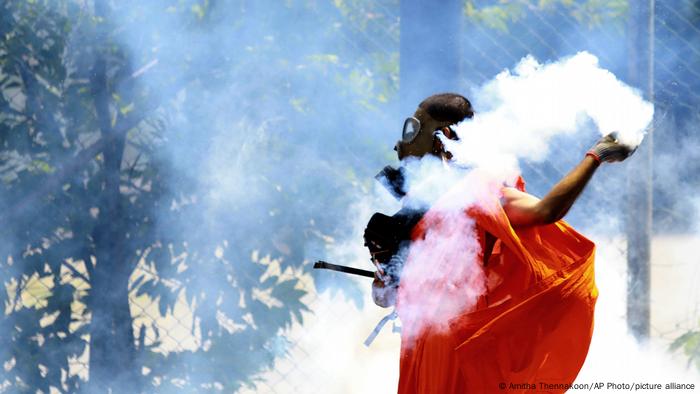
The negotiations to vacate the occupied buildings follow clashes between protesters and police on Wednesday night outside parliament that saw one killed and 84 injured.

"This building is a national treasure and it should be protected," Omalpe Sobitha, a senior Buddhist monk who supported the protest movement, told reporters. "There must be a proper audit and the property given back to the state."
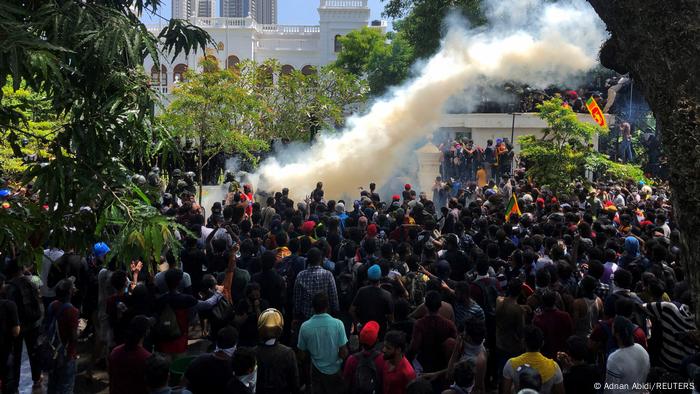
Sri Lankans are cautiously waiting for President Gotabaya Rajapaksa to formally resign

The road ahead

Sri Lankan lawmakers have agreed to elect a new president on July 20 to serve for the remainder of Rajapaksa's term, which ends in 2024. The new president could in theory appoint a new prime minister, pending the approval of parliament.

Whoever takes the reins from the Rajapaksa political dynasty will be tasked with bringing Sri Lanka's economy back from collapse. Food, fuel and medicine remain in extremely short supply.

As one 24-year-old university student told the Associated Press: "Gotabaya resigning is one problem solved, but there are so many more."

Street party draws curtain on Sri Lanka's Rajapaksa era

Sean GLEESON and Maryke VERMAAK
Thu, July 14, 2022 


Exhausted and drained after nearly 100 days of protests, a small crowd gathered its remaining strength Thursday to celebrate the resignation of Sri Lanka's leader at the seaside headquarters of their campaign to oust him.

A stone's throw from what had days earlier been the office of President Gotabaya Rajapaksa, people smiled wearily at their compatriots as they danced, handed out sweets, embraced each other or waved the national flag.

For more than three months, the seafront boulevard has been home to a cluster of tents used as a staging post for protesters demanding the despised leader step down for his role in driving Sri Lanka's battered economy to ruin.


But only a few hundred people gathered to mark a major milestone in months of agitation, when Rajapaksa emailed his resignation from a safe haven in Singapore after fleeing the country to escape public wrath.

Many veterans of the protest movement were exhausted after enduring tear gas barrages and tense confrontations with security forces in the preceding days.

For others, the moment was marred by word that a legal technicality may delay formal recognition that Rajapaksa had indeed stepped down.

"I certainly feel, I think the crowd here definitely does feel, quite happy about it," activist Vraie Balthaazar told AFP.

"But at the same time, I think there's also until we see the letter, there's always a sense of apprehension."


Part of the small crowd drawn to the protest camp on Thursday evening danced to an improvised call-and-response song by performers on a wooden stage, chanting through a scratchy public address system, as a bemused pair of Buddhist monks looked on.

Elsewhere, the camp continued its function as a safety net for residents of the capital immiserated by the country's economic crisis, with a group of needy citizens queuing up at a soup kitchen.

Nearly all of those present had left by midnight, in the face of evening rains, Sri Lanka's chronic petrol shortages and a government curfew imposed to contain unrest.
- 'People's power' -

The subdued celebration was a far cry from the high-octane confrontations on the streets of Colombo at the weekend, when huge throngs of people elbowed their way past troops to seize Rajapaksa's home and office.

Soldiers had fired in the air to clear a passage for the president's escape, mirroring the ignominious exit of his brother Mahinda, the ex-premier, from his own residence two months earlier.


Their departures, along with the resignation of sibling finance minister Basil Rajapaksa in April, have wounded -- perhaps terminally -- a clan that dominated the country's politics for much of the past two decades.

"We feel really amazing. We have shown the people's power," university student Anjana Banadrawatta told AFP.

Under Sri Lanka's constitution, Prime Minister Ranil Wickremesinghe will automatically become acting president until parliament can appoint a successor.

But protesters are also demanding Wickremesinghe's resignation, accusing him of helping to prop up a political order that has allowed corruption and authoritarianism to flourish.

Banadrawatta said he and others would continue their struggle in the morning.

"We are starting a new fight tomorrow with new hope," said the 22-year-old.

But before then, he added, "of course we are going to have fun and celebrate."

gle-mav/slb/to


How has Sri Lanka's economic crisis impacted its Tamil minority?

Amid the economic and political turmoil in Sri Lanka, experts say the country's Tamil minority, who paid a heavy price during the civil war, feel victimized all over again. Some are fleeing to Tamil Nadu in India.

14/07/2022

Analysts say it's harder for Sri Lankan Tamils to protest because they would have to deal with the military

Sri Lanka's economic and political crisis has reached a breaking point in recent weeks, with the island nation facing severe shortages of essential supplies and fuel.

Thousands of Sri Lankans took to the streets in the capital Colombo, demanding that President Gotabaya Rajapaksa and Prime Minister Ranil Wickremesinghe step down.

But protesting is a luxury many Sri Lankan Tamils do not enjoy, and scarcities induced by the economic crisis are also not new to them, says Nilanthan, a political analyst based in the northern Sri Lankan city of Jaffna.

Sri Lankan Tamils, the country's largest ethnic minority, account for nearly 12% of a population of 22 million, and are mainly concentrated in the northern and eastern provinces.

The ethnic minority shares deep social, cultural and linguistic ties with people in the southern Indian state of Tamil Nadu, and has been struggling to recover from decades of a civil war that lasted until 2009 and claimed around 100,000 lives.

'We are being victimized again'


In the island's latest economic and political crisis, Nilanthan says Sri Lankans "are all equally affected across different ethnicities and social backgrounds."

"There is no fuel and essential commodities everywhere. But it is an additional burden for Sri Lankan Tamils, as we are being victimized again. We are victims of war and now we are also victims of the economic crisis, '' Nilanthan told DW.

Packiyanathan Ahilan, a senior lecturer at the University of Jaffna, says economic suffering is something Tamils in the northern and eastern provinces are all too familiar with, having endured shortages for many years during the civil war.

''Tamils were already trained to survive without fuel, gas and electricity and less. So somehow, they can manage the ongoing issue based on their many years of experience being a Tamil in Sri Lanka. But it is difficult to live and run a day-to-day life for them too," Ahilan told DW.

Tamils 'cannot protest'

Sri Lanka's northern and eastern provinces have hardly seen protests like the ones which took place in other parts of the country.

"Sri Lankan Tamils living in these regions cannot protest," said Nilanthan. ''Apart from isolated incidents of altercations between protestors and police officials, the protestors [in other regions] have largely remained unharmed… If Singhalese [largest ethnic group in Sri Lanka] agitate, they deal with the police. But here, we would have to deal with the military, '' Nilanthan added.

Thangamuthu Jayasingam, a Batticaloa-based attorney and director of the National Peace Council, says Sri Lankan Tamils who have come out to protest for other issues have suffered for it.

''Hence, they are cautious about actively protesting… But Sri Lankan Tamils support the protests heart to heart. They never voted for the Rajapakshas,'' Jayasingam said.

Civil protests have placed a spotlight on misgovernance and the divisional tactics of politicians based on religion and ethnicity.

Ahilan says protesters are calling for the removal of the politically powerful Rajapaksha family because of corruption. "Tamils want justice for war crimes."

The Rajapaksha family played a major role in Sri Lanka's civil war and their victory in the war was also one of the reasons they came to power.

Some Sri Lankan Tamils are also demanding structural changes, including more autonomy and demilitarization.

"If Sri Lanka does not sort out its minority issue, it will pull them down in the international stage too,'' said Jayasingam.

Escape to Tamil Nadu

At least 100 refugees, mostly Sri Lankan Tamils from the Northern and Eastern provinces, have arrived in India's Tamil Nadu in the past months. Many of them sold their homes and lands to pay for their boat trips to escape Sri Lanka's economic crisis.

"They think that Tamil Nadu is safe and whenever there is danger they flee there," said Nilanthan, adding that Sri Lankan Tamils are culturally and linguistically connected to Tamil Nadu.

According to Jayasingam, India is "a friendly country" for Sri Lankan Tamils. "Whoever has means to go there are trying to go. It is within reach for them. If things get worse, there will be more refugees in the future.''

With a significant Sri Lankan Tamil diaspora abroad, the remittance economy has also helped keep some Tamils afloat. But Tamils from lower income groups do not have access to this. ''They are only trying to enter India as refugees,'' said Ahilan.

All Sri Lankans are trying the best they can to manage their economic situation with limited resources, said Nilanthan. ''Sri Lankan Tamils are survivors of a genocide, and we will try to survive this too. ''

Edited by: Sou-Jie van Brunnersum


'Things are changing every hour': Sri Lankans' fury turns on PM after president flees

Issued on: 13/07/2022
01:50
Ranil Wickremesinghe, who was named acting president of Sri Lanka on Wednesday as its political and economic crisis deepened, is tantalisingly close to the pinnacle of power but may not get much time to enjoy it. FRANCE 24's Navodita Kumari tells us more on this tense day in Sri Lanka.


Opinion: No progress in Sri Lanka without total overhaul of political system

Without a complete transformation of the political system, Sri Lanka won't be able to eliminate the abuse of power and corruption that landed the nation in such dire straits, writes journalist Amirthanayagam Nixon.
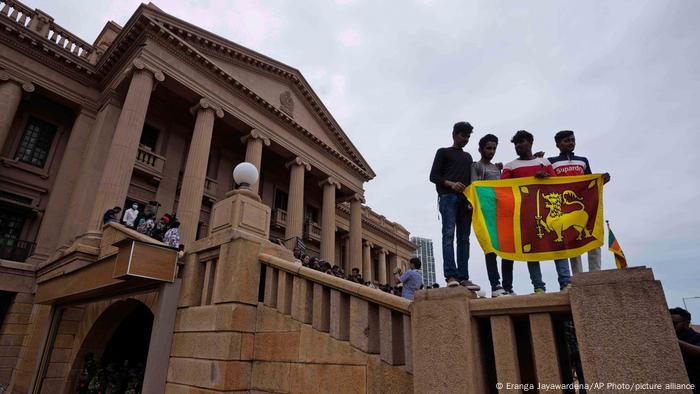
12/07/2022


Public anger is running high amid Sri Lanka's worst economic crisis in decades

These are turbulent times in Sri Lanka, with the country plunged into full-fledged economic and political turmoil.

Despite the dramatic circumstances, the political class has not risen to the challenge. No politician seems to be in a position to come up with concrete solutions and put an end to the crisis.

Ever since news emerged that President Gotabaya Rajapaksa would step down on Wednesday as a result of the popular uprising against his government, there has been a race to decide who the next president will be.

The country's Sinhala ethnic-majority dominated political parties are also wrangling over who will become the new prime minister.
Political bickering over who should take over

Ranil Wickremesinghe, the leader of the United National Party, who took over as prime minister after the president's elder brother Mahinda Rajapaksa stepped down in May following violent protests, tried hard to resolve the economic problems.



Sri Lankan journalist Amirthanayagam Nixon

Wickremesinghe, who served as PM multiple times before his latest stint, has the political experience and the necessary connections internationally to secure foreign financial aid for Sri Lanka and get the country out of its economic hardship.

According to the Sri Lankan constitution, if the president resigns, the prime minister becomes the acting president, until parliament convenes and selects a new president.

So if Gotabaya steps down as promised, Wickremesinghe will automatically become interim president until parliament elects an MP to serve out the presidential term, which ends in November 2024.

But Samagi Jana Balawegaya, the main opposition party, is demanding that its leader Sajith Premadasa be made president.

The Sri Lanka Podujana Peramuna party, dominated by the Rajapaksa family, continues to enjoy a majority in parliament and wants the next president to come from within its ranks.

Another opposition party, Janatha Vimukthi Peramuna, is seeking the prime minister's post.

While political parties are bickering, the general public, who are hit hard by soaring inflation and shortages of essential items, including food, fuel and medicine, are angry and dismayed by politicians' self-serving rhetoric and actions.

IN PICTURES: SRI LANKA UNRAVELS INTO POLITICAL TURMOIL
Sri Lanka spirals into political crisis
Sri Lanka's legislature has announced that President Gotabaya Rajapaksa will step down next week after widespread protests calling for him to take responsibility for the nation's worst economic crisis in recent memory.
12345678

Ethnic conflict and military budget

Meanwhile, industrial production has plummeted, export earnings have dried up and government coffers are empty. The country is bankrupt and has nearly exhausted its already scarce supplies of fuel.

The reasons for Sri Lanka's current economic turmoil date back to the nation's almost three-decade-long civil war. This was a clash between the Sinhalese-dominated Sri Lankan government and the Liberation Tigers of Tamil Eelam insurgent group, which had hoped to establish a separate state for the ethnic Tamil minority, who make up about 15% of the nation's 22 million people.

Even though the conflict, which began in 1983, ended in 2009, successive governments continued to allocate more and more resources for the military at the expense of other development projects.

Despite the economic problems, Colombo earmarked 373 billion Sri Lankan rupees ($1.86 billion, €1.8 billion) for the 2022 defense budget, a 14% increase over the allocation in 2021.

In the 13 years since the end of the conflict, the Ministry of Defense has been the recipient of the highest share of government spending.

Ethnic tensions have hindered the country from developing its Tamil-populated northern and eastern regions, which are rich in marine resources. The development of those regions could boost the economy, particularly seafood exports, generating wealth and foreign income.

Likewise, the Kankesanthurai natural harbor in Jaffna, in the Northern Province, remains underdeveloped while the Trincomalee harbor on the east coast is used solely by the Sri Lankan navy for military purposes.

This imposes a huge economic cost on Sri Lanka as ships carrying goods from India have to sail all the way to the Colombo port, on the southern coast, incurring huge costs.

Total overhaul needed


Ethnic polarization, discrimination and a lack of meaningful power sharing with minority Tamil and Muslim communities are the root cause of the current political and economic turmoil.

To prevent such crises in future, there will have to be a total eradication of ethnic tensions, corruption and abuse of power. That will require a complete overhaul of the Sri Lankan state and power structure.

But the Sinhalese-majority dominated political parties and the Buddhist clergy are not ready for such changes, yet.

There are now steps being taken to pass the 21st amendment to the nation's constitution aimed at empowering the parliament and curbing the unfettered powers of the president.

But simply passing such an amendment without a complete transformation of the political system won't eliminate the abuse of power and corruption that landed Sri Lanka in such dire straits.

Edited by: Srinivas Mazumdaru

CHEAP LABOR, DEPRESSED ECONOMY

Why investors take a shine to eastern Germany

Foreign and domestic companies are increasingly looking to eastern Germany when seeking sound investment opportunities. There are a number of reasons for this trend as Hardy Graupner found out in the town of Guben.

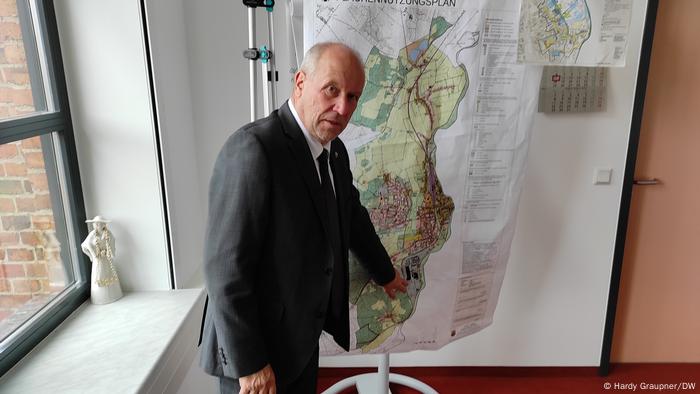
Guben's mayor, Fred Mahro, points to where Rock Tech Lithium will hopefully build its facility to produce lithium hydroxide

From a window on the second floor of the town hall, mayor Fred Mahro overlooks the green spaces in the center of Guben. The eastern German town, located some 100 kilometers (62 miles) southeast of Berlin and close to the border with Poland, does not make it into the headlines very often.

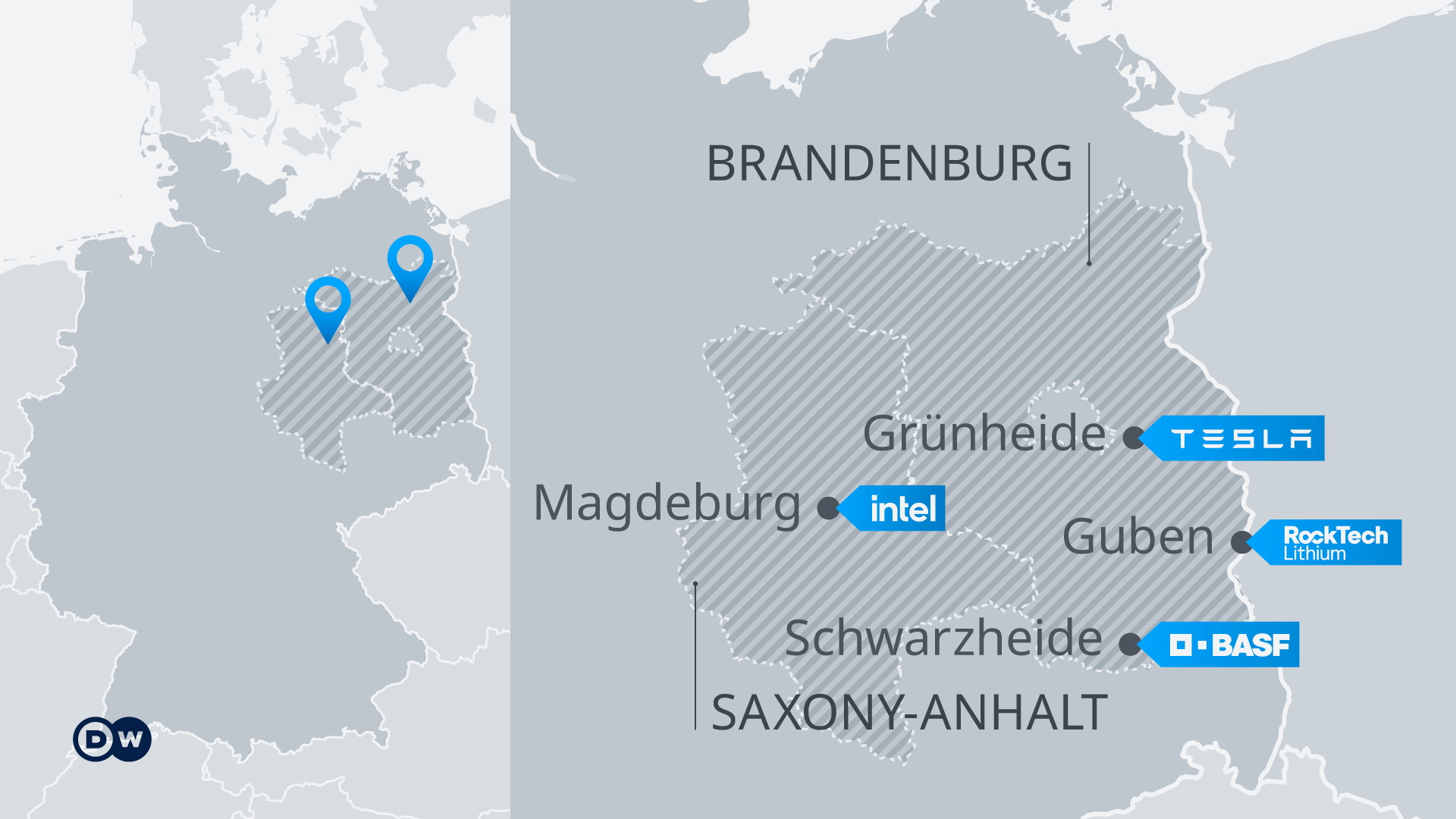
But right now, says Mahro, Guben stands for the eastern German state of Brandenburg's increasing ability to attract crucial investments from home and abroad in future-oriented industries.

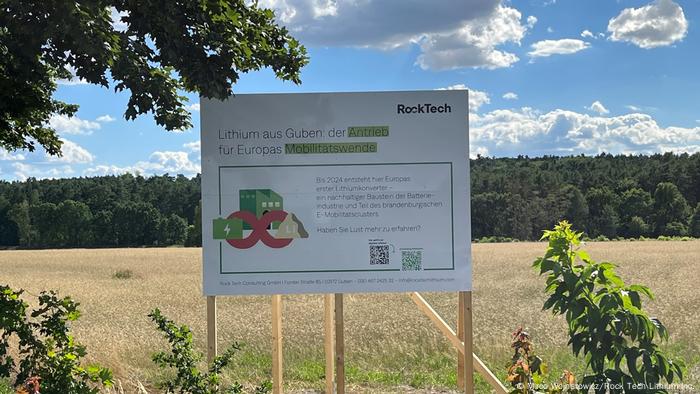
German-Canadian company Rock Tech Lithium is planning to build Europe's first lithium converter in Guben, which would be a pivotal element in the region's e-mobility drive. If everything goes to plan, the firm would produce 24,000 metric tons of lithium hydroxide annually — a crucial battery ingredient and enough to equip half a million electric vehicles with lithium-ion batteries.

Rock Tech Lithium has big plans for its building site in Guben — construction work is scheduled to start in autumn

Complete shift of focus

Like most areas in the former communist East Germany, Guben had to almost completely reinvent itself after German reunification in 1990. At that time most of its old industries broke away and the town's population shrank by half. The restructuring process has never really stopped, and when German lawmakers decided in 2020 to completely phase out coal, the lignite open-cast mining area around Guben was in shock again.

"When the debate about a possible exit from our lignite coal in the region started here some five years ago, we stuck our heads together in the town hall and discussed what it would take to create alternative jobs," Fred Mahro told DW. "It was clear that we needed to attract new businesses and that they would need suitable locations— so we didn't lose any time and secured permission from the authorities to build new plants in our huge industrial park."

Rock Tech Lithium is investing some €470 million ($473 million) in its future Guben location. It appreciated the fact that the groundwork was already prepared. The company had no doubt it wanted a European location for its converter as the continent takes the lead in electromobility and aspires to boost its self-reliance in critical industries. This is especially true now that the European Union is on its way to ban the sale of combustion-engine cars and passenger vans as of 2035. With these massive changes coming, the German-Canadian enterprise can count on rising demand for batteries for electric vehicles in the years ahead.

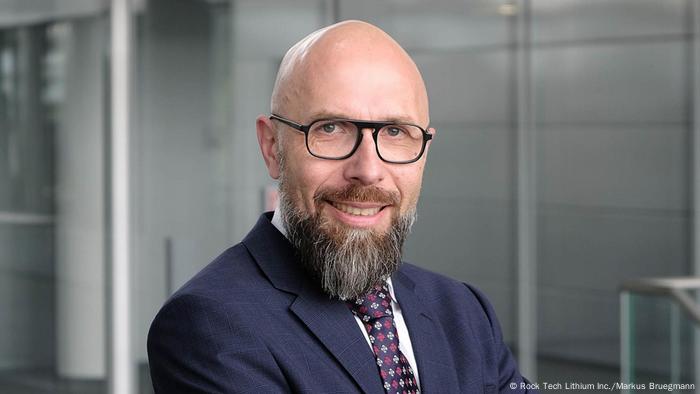
"We had looked all across Europe for a suitable production site, but in the end we prioritized Guben as our focus is not just on producing lithium hydroxide, but on sustainability," the CEO of Rock Tech Lithium, Markus Brügmann, told DW. "Guben had already been developed as an industrial site and it has an on-site rail connection which will allow us to avoid truck transportation."

Rock Tech Lithium CEO Markus Brügmann says opting for Guben was a strategic decision

The missing link in the value chain

The chief executive added that a location in the eastern German state of Brandenburg had almost become a must, considering the latest industrial activities in the area surrounding Berlin.

"Just look at what has been happening in Brandenburg in terms of the electric battery value and supply chain. We're just closing a gap," Brügmann explained. "You have everything here from the production of electric cars to battery manufacturing, but you don't have the production of lithium hydroxide yet, that's where we come in. So, strategically, we're at the right place in Guben with potential customers all nearby."

With negotiations about its Guben investment ongoing, Rock Tech Lithium doesn't want to disclose who its future customers may be. Suffice it to say that Brandenburg is also home to a Tesla Gigafactory and a large BASF plant where cathode active materials will be produced that are also needed for lithium-ion batteries.

Brügmann says that as early as 2030, about half of the materials to be used by Rock Tech Lithium in Guben will come from recycled batteries.

"There's no doubt that the big shift to electromobility has helped recent investment activities in eastern Germany," Claus Doll, project manager at the Fraunhofer Institute for Systems and Innovation Research (Fraunhofer ISI), told DW. "Had Germany continued to push combustion engine technology, it would have been a lot harder for them to secure a greater share of the pie, but now traditional structures are being dismantled as new technologies that didn't exist before are making inroads."

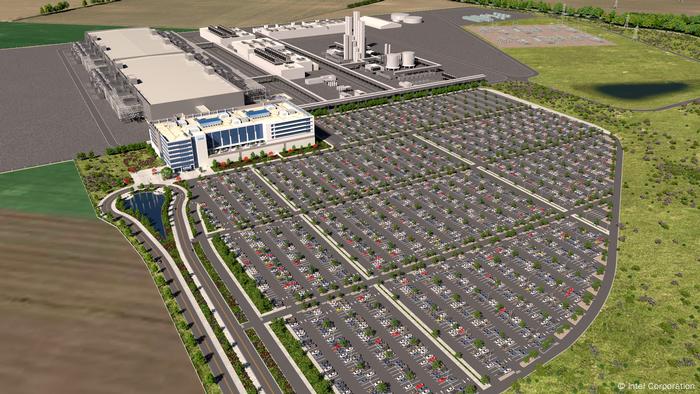
US chipmaker Intel plans to build several semiconductor plants in Magdeburg

Space is of the essence

What has played into the hands of authorities in eastern Germany is that the mostly rural and less densely populated states like Brandenburg and Saxony-Anhalt offer better greenfield investment opportunities than the traditional core industrial regions in the west and southwest of Germany.

"One big advantage that eastern Germany has is there's no lack of space for big projects — space that's so much harder to find in western Germany," said Doll. "And there's a profound interest in new technologies and industry in general. Communities there also come up with a lot of incentives to attract businesses and projects, which are quite often implemented faster in the east because of less red tape and a more practical approach."

The availability of vast spaces for new projects has indeed turned out to be a big plus, be it for Tesla's huge electric car factory in Grünheide, Brandenburg, or chipmaker Intel's plan to build several semiconductor factories for €17 billion in Magdeburg, Saxony-Anhalt.

"Space may not be relevant for all projects, but it certainly is for the big ones like the investments of Tesla and Intel where we're talking about at least 100 hectares each," Robert Hermann, co-CEO of the Germany Trade & Invest agency, agreed. "And such big available areas are definitely easier to find in eastern Germany," he told DW.


R&D: A lot of catching-up to do

A large proportion of the overall investment in eastern Germany has been going into production and not so much into innovation or research and development (R&D) where higher-paying jobs can be found.

"Research and development is primarily taking place in the traditional western hubs of the German auto industry," said Fraunhofer ISI's Claus Doll. "But there's hope that the new production sites in eastern Germany will gradually attract more research clusters. We need better storage technology for renewables, and a lot of research on that is already underway in eastern Germany."

Germany Trade & Invest, which is responsible for marketing Germany as a business location and attracting companies, agrees that a shift toward more R&D in eastern Germany is already well underway.

"The big investment projects by the likes of CATL [China's biggest producer of lithium-ion batteries] in Thuringia, Rock Tech Lithium in Brandenburg or Intel in Saxony-Anhalt, all of them in eastern Germany, will no doubt contribute to attracting more R&D and innovation to the region," GTAI's Robert Hermann argued. "Tesla for instance has already announced that part of its battery cell research will happen in Brandenburg and Berlin."

Emerging energy dilemma a spoilsport?

No matter which company puts down roots in eastern Germany, it will need a steady energy supply for production.

"Renewables cover about 95% of eastern Germany's electricity needs, and that's crucial for many investors," Hermann said. "It often influences their decision on where to put their money as they want to produce sustainably and flag this sustainability to their customers."

Though a lot of eastern Germany's electricity comes from renewable sources, it can be unreliable at times. Many industries need additional sources of power like oil or gas to run their facilities.

Russia's war in Ukraine and the ensuing Western sanctions have changed everything, with supplies from Russia no longer guaranteed and both German households and businesses preparing for an energy crisis in the winter months.

That's certainly a big headache for Guben's mayor.

"Investors might get cold feet given the energy problems ahead," Fred Mahro conceded. "The question is just when we will be able to almost entirely do without gas — that's something I cannot imagine right now for many industries, including those in Guben."

Rock Tech Lithium's chief executive is confident that a solution can eventually be found. "We don't see this as the end of any investment here," Markus Brügmann emphasized.

"There will hopefully be alternative natural gas from other sources; we also have a plan to use hydrogen that might eventually replace natural gas — but in the beginning, we will need natural gas, liquefied natural gas, and we're confident to secure the amount of LNG that we'll need as of 2024 when production is scheduled to kick off."

Opinion: Germany's Ahr Valley flood disaster management is the next tragedy

One year after the flood disaster in two German states, those affected are still struggling with the trauma and the consequences of political failure, writes Christoph Strack.

A year after the floods many of those affected are still dealing with the trauma and the authorities' inaction

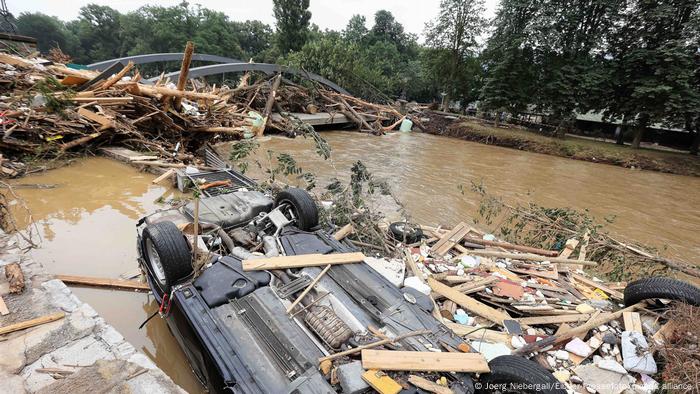
The images of that night have left an indelible impression. They remain traumatic for the people who experienced and survived the flood disaster in western Germany on the night of July 14-15, 2021. People who feared for their lives, who are mourning the loss of loved ones, who lost everything.

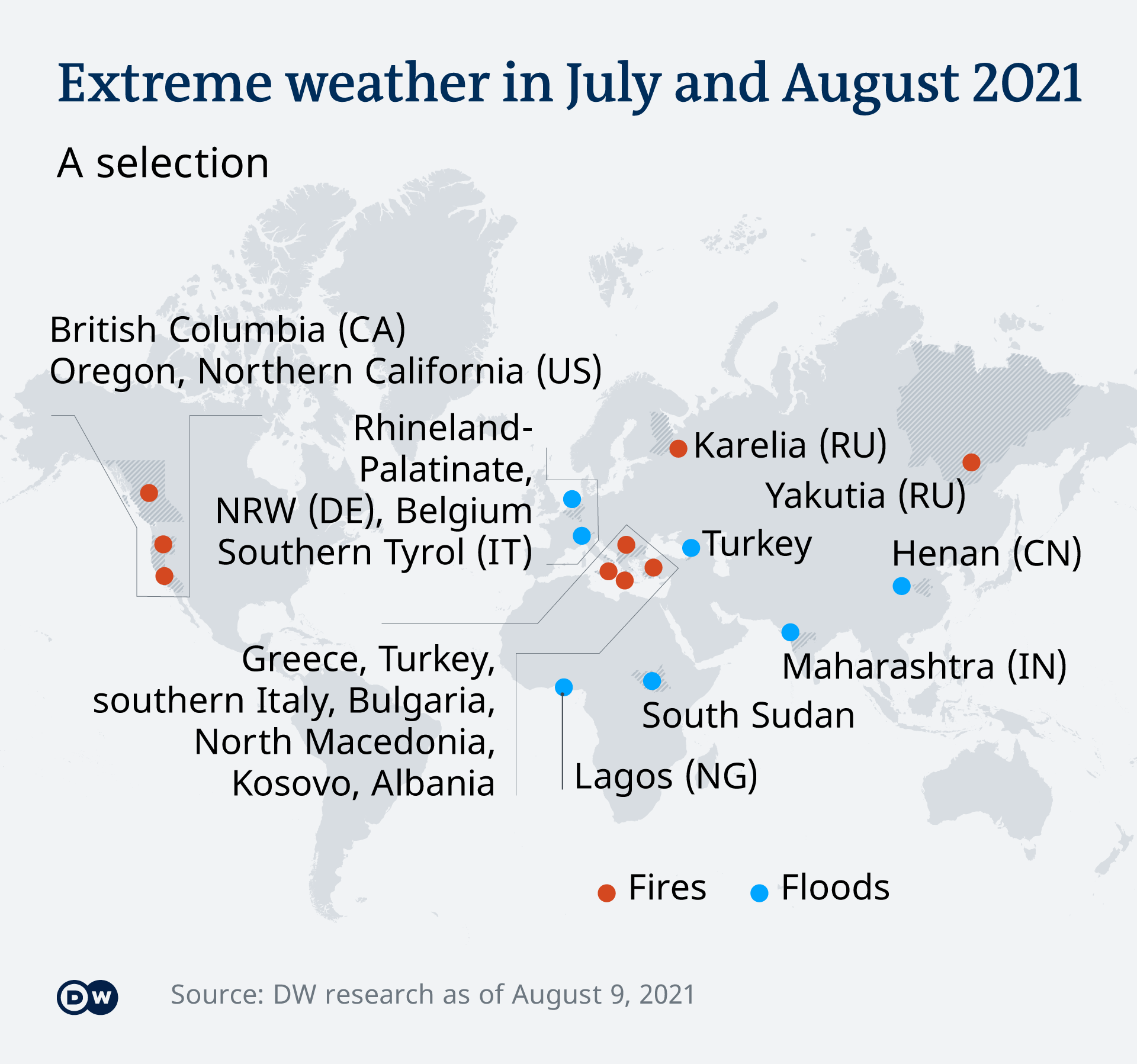
These images also made it clear to everyone in Germany and Central Europe that life from now on would probably become even more unpredictable due to extreme weather events. That's another reason why those shocking images have left their mark.

Some of the scenes we witnessed from the affected regions became iconic within days. They were like a portent, shaking people awake, unsettling them, frightening them. At least 184 people died in Rhineland-Palatinate and North Rhine-Westphalia when nature unleashed its almost unimaginable forces.

The last victims are still missing to this day in the idyllic Ahr Valley, where 134 people died. The lives of tens of thousands have been affected and many have had to start over from scratch. People will have to struggle with trauma and anxiety attacks for a long time to come.

Heroic stories and a political culture of failure

In the ensuing days, there were many stories of suffering and also impressive tales of heroic acts and stories of hope. They deserve to be told and listened to.

DW editor Christoph Strack

DW editor Christoph Strack

At the opposite end of the spectrum, there are stories of failure. German authorities and politicians like to portray themselves as acting in the best interests of their citizens, and to imply that this rich country is the navel of progress and digitization.

And then there are the failures inherent in systems and political decision-makers, which have so far only been insufficiently named and dealt with. Alarm chains did not work; regulations turned into obstacles; rescue helicopters lacked technical recovery equipment, and necessary communication was technically impossible. Lives were saved in many cases thanks to personal heroism. And lest we forget: Experts say the catastrophe was foreseeable days before.

Since the flood, people in Germany have donated more than €650 million ($651 million). The affected states and the federal government provided aid and set up reconstruction funds. And yet there are numerous reports from the flooded regions that people have been waiting and waiting, that there has been little progress. This is a disgrace and cannot continue.

Extreme weather events are becoming the norm

It should be clear to everyone by now that things will never be the same again — that's not really the point. You can't tell people that they should not build their house down by the river  without providing them with timely and concrete prospects.

This is all the more pertinent given that humankind will have to prepare for more extreme weather events in future. To cite just one example: Just days ago, we saw shocking photos and videos of glacier collapses of almost unimaginable proportions occurring in the high mountain regions in Italy and Kyrgyzstan. Just imagine the damage if there had been a dam somewhere along the line of such a glacier.

German viewers are used to seeing TV pictures of floods in Bangladesh or India, of drought in Australia or the Sahel, of burning forests in the Amazon — almost in passing just ahead of the sports results or the weather report, and too far away to concern us. But the images today come from even more places, from the Ahr or Italy, from the US or Greece, from Siberia or Oceania. It's serious.


Taking responsible action is a priority

The floods on the Ahr and Wupper rivers also became part of Germany's federal election campaign in September 2021. All eyes were on the climate crisis and the environment. But then the coronavirus reared its ugly head again, followed by Russia's attack on Ukraine. A society fixated on breaking news and outrage is dangerously quick to forget its long-term commitments. In doing so, it jeopardizes its resilience in crisis situations.

At the same time, the consequences of climate change and global warming will never leave us neither here in Germany nor across the globe. The Ahr Valley floods have shown that there is no such thing as a safe terrain any longer.

Understanding that makes it all the more important to help and to act, and to be able to do both responsibly. The stories from the Ahr Valley recounting death and suffering, hope and help and frustration, compel us to act together. And never to simply stop listening.

This piece was originally written in German.


https://www.marxists.org/archive/bordiga/works/1951/murder.htm

To exploit living labour, capital must destroy dead labour which is still useful. Loving to suck warm young blood, it kills corpses. So while the maintenance of ...

What a sinking euro means for consumers in Europe and US

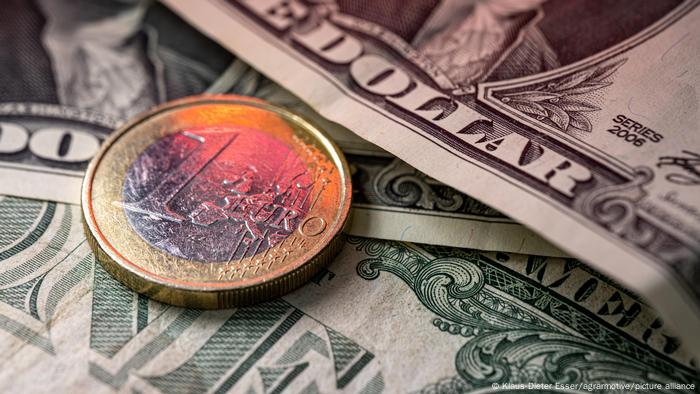
As the euro slumps to parity with the US dollar, currency traders say the slide is unlikely to stop there. While a weakened euro should worry European consumers, US travelers visiting Europe could benefit.

A weak euro will further drive up inflation in the eurozone

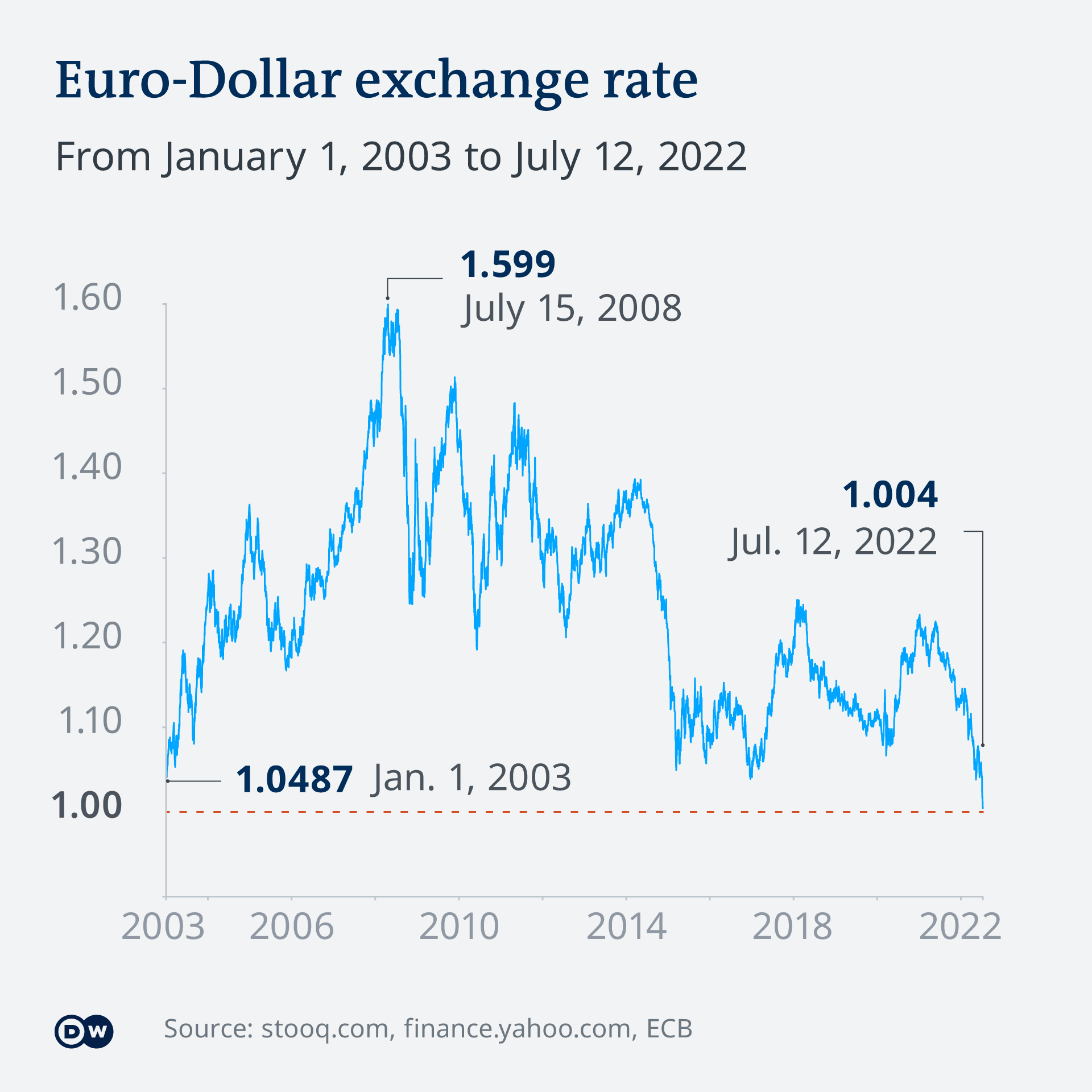
The euro has taken a major beating against its US peer since Russia's invasion of Ukraine in February, falling to its lowest level in 20 years as surging gas prices and uncertainty around the Russian energy supply stoke recession fears in the eurozone.

The shared European currency fell to as low as $0.9998 on Wednesday — a swift slide from the $1.15 level before Russia launched the war in Ukraine. The sharp drop means the euro has hit parity against the US dollar for the first time since late 2002.

Why is the euro falling?

The general worsening of the eurozone's outlook amid soaring gas prices and fears of Russia cutting off natural gas supplies is dragging down the shared currency. The oversized reliance of major economies such as Germany and Italy on Russian gas has left investors unnerved, with economists forecasting a much quicker and more painful recession in the euro area than in the US.

Added to that is the difference in interest rate levels in the US and the eurozone. The US Federal Reserve has been raising interest rates aggressively to bring down inflation, while the European Central Bank (ECB) has so far resisted steep hikes.

"The interest rate in the US is expected to go up to 3% versus 1% in Europe. So, the money would go to the place with a higher yield," Carsten Brzeski, chief economist for Germany and Austria at ING, told DW.

The US dollar is also benefiting from its safe-haven appeal. Amid all the gloom and doom and uncertainty around the global economy, investors are taking comfort in the relative safety the dollar offers being less exposed to some of the big global risks right now.

What is dollar parity and why is it a big deal for the euro?

Parity basically means that $1 buys €1. It is nothing more than a psychological threshold for market participants who are well-known for their fondness for round figures.

"Financial markets always love to find some kind of symbolic meaning," Brzeski said.

Viraj Patel, a foreign exchange strategist at Vanda Research, said the parity level could be a point at which the euro bulls and bears lock horns to determine which way the currency goes from there.

"More recently, we've started to see investors betting on the euro falling below parity. But you can equally imagine that more investors will start buying euros as we get closer to that level," he told DW. 

How does a weaker euro impact consumers?

A sliding euro will add to the burden on European households and businesses already reeling from record-high inflation. A weaker currency would make imports, which are mostly denominated in dollars, more expensive. When those items are raw materials or intermediate goods, their higher costs can further drive up local prices.

In normal times, a weak currency is viewed as good news for exporters and export-heavy economies such as Germany, because it boosts exports by making them cheaper in dollar terms. But then these are hardly normal times thanks to global supply chain frictions, sanctions and the war in Ukraine.

"In the current situation with geopolitical tensions, I think the benefits from a weak currency are smaller than the disadvantages," Brzeski said.

For US travelers heading to Europe this summer though, a weak euro is a blessing. For example, at the parity level, theoretically they would be able to exchange their $1,000 for €1,000 instead of less than €900 in February. In other words, their dollar would be worth a lot more. For businesses importing European goods, things would be cheaper in dollar terms.

Where is the euro's bottom?

Bets that the euro would continue its fall below parity have increased in recent days as the energy crisis in Europe worsens.

"The euro is trading as if a crisis in Europe is on the doorstep. So, you need to see more bad news now in terms of that whole narrative around gas supplies and potentially geopolitics for the euro to weaken beyond parity," Patel said.

Nomura International strategists forecast that the euro could fall to as low as $0.95. Deutsche Bank's head of foreign exchange research, George Saravelos, has a similar prediction. A "move down to $0.95-$0.97 would match the all-time extremes seen in exchange rates since the end of Bretton Woods in 1971," he wrote in a July 6 note to clients.

What does a weaker euro mean for the ECB?

A weak euro and the additional inflation that it brings adds to the challenges of the ECB, which is already under scrutiny for being slow off the blocks in its fight against inflation.

To make matters worse for the central bank that has the mandate to tame inflation, the euro hasn't just weakened against the dollar but also against other currencies like the Swiss franc and the Japanese yen.

"This is now starting to become a bit more broad-based euro weakness and therefore it becomes more of an inflation problem for the ECB," Patel said.

The ECB intends to raise its benchmark interest rates by 25 basis points next week, its first increase in over 10 years.

"A weaker euro supports the view of a more aggressive rate hike," Brzeski said. "The argument behind it would be that if we go for a 50 basis points hike next week rather than 25, that could immediately stop the fall of the euro because it would surprise financial markets."

However, some experts say an economic downturn will put the bank in a bind, holding it back from any aggressive monetary policy tightening. That in turn would ensure that interest rates in the eurozone remain suppressed vis-a-vis the US. Such an expectation is already playing a role in the euro's fall.   

Edited by: Tim Rooks

DW RECOMMENDS

Record-breaking heat waves show we need to adapt to the climate crisis now

High temperatures have caused deaths in eastern China. In Europe, a scorching heat wave has sparked wildfires. As extreme heat becomes more frequent around the world, how can affected areas adapt to remain livable?


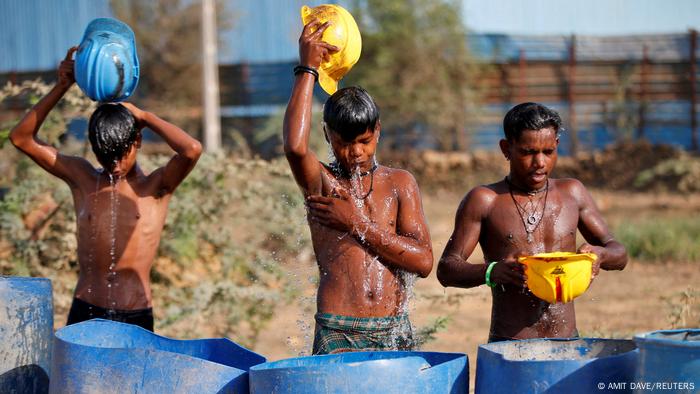
Workers use their helmets to pour water to cool themselves off near a construction site on a hot summer day on the outskirts of Ahmedabad, India

Flooding and extremely high temperatures have caused multiple deaths in eastern China, where record-high temperatures of above 42 degrees Celsius (107 degrees Fahrenheit) were recorded. Firefighters across Portugal and western Spain battled wildfires amid a heat wave that pushed temperatures above 45 degrees Celsius.

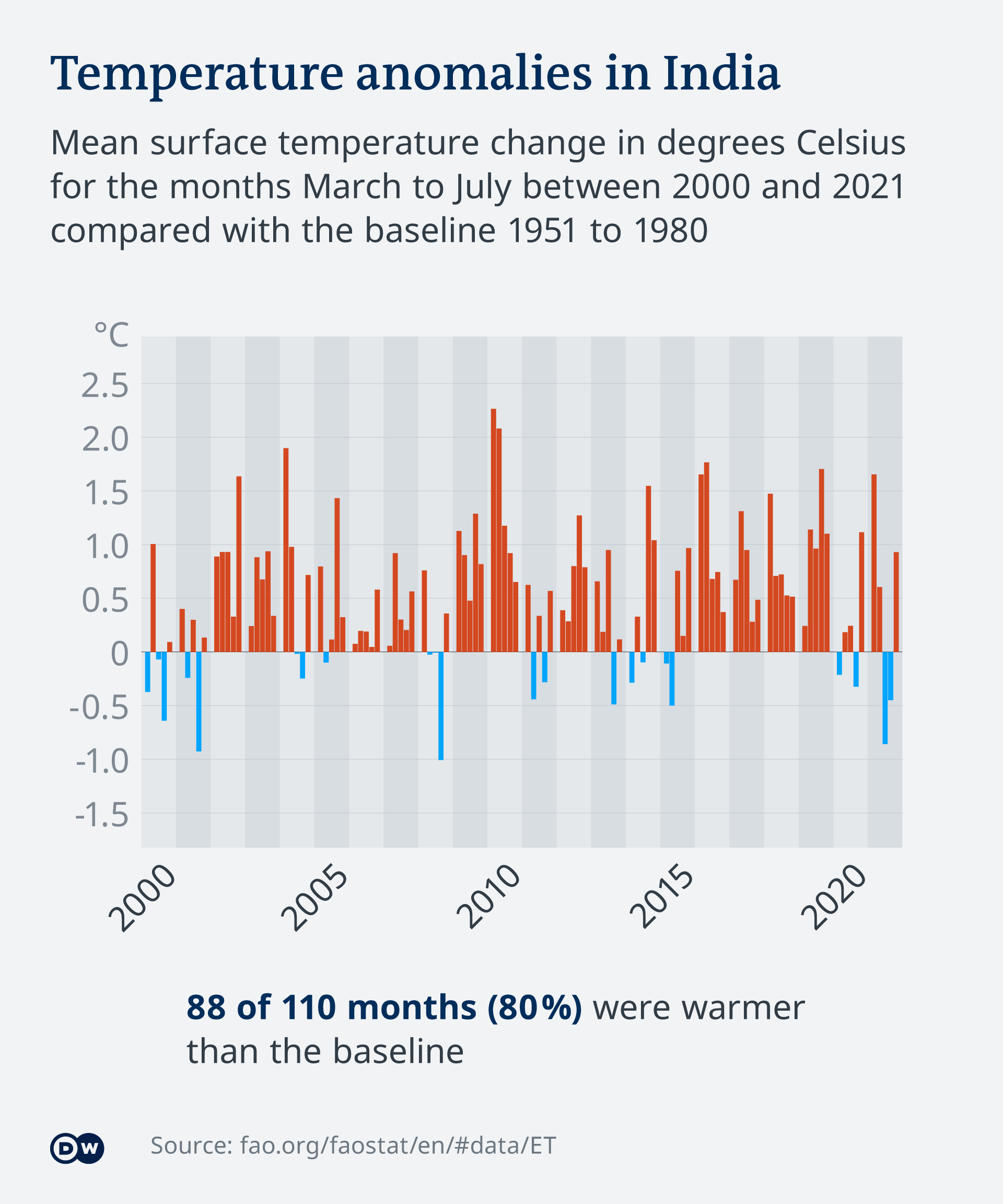
Earlier this spring, the effects of India's heat wave, one of dozens just this year, were all-encompassing. Temperatures topping 40 degrees Celsius across the country put millions at risk for heat-related illnesses, decimated wheat crops, intensified a power crisis and interrupted schooling.

India is not alone. Neighboring Pakistan was also battling scorching temperatures before summer has even begun. And earlier this year, central South America was the hottest place on the planet before Western Australia claimed the title.

As the climate crisis exacerbates heat waves around the world and temperatures increasingly soar unseasonably early, countries are faced with the question of how to remain livable.
It comes down to wealth and preparedness

Ramping up electricity bills with air conditioning, cooling down with fans, working indoors — these options are only available to a privileged few.

"The story of climate change is one of high inequality and we're seeing that playing out already in the poorest and hottest regions of the world," said Tamma Carleton, assistant professor of economics at UC Santa Barbara's Bren School of Environmental Science and Management.

Carleton co-authored a 2022 study that distilled a city's ability to minimize deaths during extreme temperatures to two main factors: affluence and the number of hot days it experiences.

Money decides which technologies a city can afford to shield its most vulnerable. And when these adaptation costs aren't covered by the state, the burden falls on individuals to finance their own protection, says Carleton. A situation that leaves the poorest high and dry.

But even wealthy cities can suffer if they are caught off guard without an action plan. That happened in the Pacific Northwest of the US, a wealthy region known for its temperate climate, where more than 100 people were killed in last year's heat wave.

"We tend to see in our projections of climate change into the future that poorer places are going to be facing a really large increase in death risk and wealthier places are going to see an increase in adaptation costs," said Carleton.


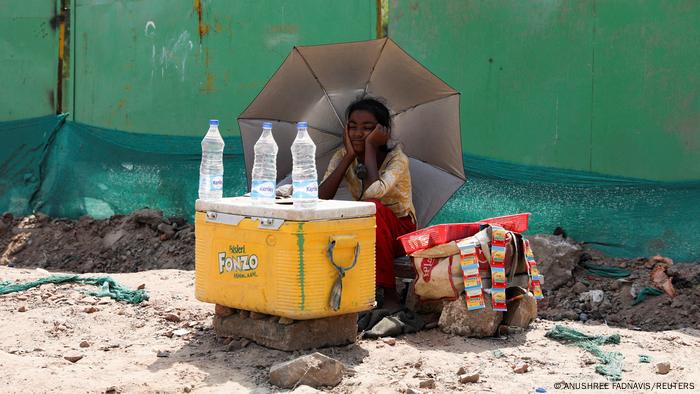
Outdoor workers are especially vulnerable to heat waves
Spurring into heat action

Just how high this death risk is in developing countries became clear when Ahmedabad, a city in western India's Gujarat state, lost more than 1,344 people as thermometers hit 47 Celsius in 2010.

The toll spurred the city into action. In 2013, it rolled out a plan that has prevented about 1,100 heat induced deaths each year since, according to a study.

The first heat action plan in South Asia, it includes an early warning system, community outreach to vulnerable populations and education for health staff about possible signs of heat exposure. It also organizes cooling centers in buildings such as temples and malls as well as reduced or staggered working times for outdoor laborers, among other things.

As India's temperatures consistently surpass the baseline in spring and summer months, the Ahmedabad heat plan has since served as a template for similar models in 23 of the country's 28 states.


But as high temperatures persist, these models undergo regular updates, according to Polash Mukherjee, who heads Air Pollution and Climate Resilience at the Natural Resources Defense Council's India program. The non-profit helped develop Ahmedabad's heat action plan.

"The focus has shifted significantly in the last couple of years from merely protecting human health and mortality against extreme heat to more proactive measures," said Mukherjee. "These include changing building by-laws so that new constructions are better insulated, and the cool roofs program."

A low-cost solution to reduce indoor temperatures, the cool roofs program primarily targets badly insulated houses in slums where informal workers and other vulnerable groups reside. When a roof is coated with materials like lime-based whitewash or white tarp, it becomes more reflective and absorbs less heat.
Cool pavements and green passages

Ideas like these are budding around the world. The Japanese capital Tokyo has introduced cool pavements, which work with thermal-barrier coating, for example. Medellin in Colombia has planted "green corridors," vegetated passages that offer more shade in public spaces, while the city of Toronto, Canada, offers grants for people to install green or cool roofs.

Some cities have introduced heat officers, whose task it is to coordinate the response to rising temperatures.

Eugenia Kargbo became Africa's first heat officer when she took the post in Freetown, Sierra Leone. A goal of hers is to provide reflective market shade covers that protect women selling produce outdoors. To make the capital more livable, she has also introduced a tree planting program, in which planters can collect micro-payments on an app.

"This is the future I envision for my children and all the children in Freetown: A safe environment not limited by the risk of extreme heat," she told DW's EcoAfrica.

Focus on the climate crisis


Even as some regions find ways to alleviate some of the effects of scorching heat waves, many scientists emphasize that governments shouldn't forget the root cause of the rising temperatures: the climate crisis.

Aditi Mukherji, who co-authored the water chapter in the IPCC's assessment on "Impacts, Adaptation and Vulnerability," says the onus to come up with solutions shouldn't be on the most affected, who historically have emitted the least amount of CO2.

"I feel that when it comes to these kinds of heat extremes, the only solution is that the high emitting countries stop emissions immediately and stop burning fossil fuels," she said.

Edited by: Tamsin Walker


IN PICTURES: INDIA SWELTERS AS SEVERE HEAT WAVE SWEEPS REGION
Skyrocketing temperatures sweep country
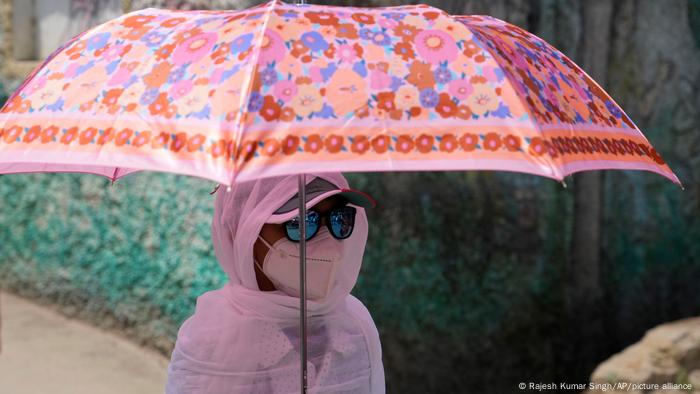
A girl uses sunglasses, a mask, a long cloth and an umbrella to protect herself from the sun on her way to school in Prayagraj, Uttar Pradesh. In April, northwest and central India recorded average maximum temperatures of 35.9 and 37.78 Celsius (96.6 and 100 Fahrenheit) respectively, the highest since the Indian Meteorological Department began keeping records 122 years ago.
1234567

This article was orginally published on May 3 and was updated on July 14.


‘Out of control’ wildfires raging in southwestern France amid intense heatwave • 
Jul 14, 2022

FRANCE 24 English

About 1,000 firefighters, supported by six water-bomber aircraft, were battling on Thursday to bring under control two wildfires in southwestern France that have already burnt almost 4,000 hectares. "The fires are still not under control, no casualties were have been reported", said the local authority for the Gironde department, where the blazes, which started on Tuesday, were raging.

Webb begins hunt for the first stars and habitable worlds

Issam Ahmed and Lucie Aubourg
Thu, July 14, 2022 


The first stunning images from the James Webb Space Telescope were revealed this week, but its journey of cosmic discovery has only just begun.

Here is a look at two early projects that will take advantage of the orbiting observatory's powerful instruments.

- The first stars and galaxies -


One of the great promises of the telescope is its ability to study the earliest phase of cosmic history, shortly after the Big Bang 13.8 billion years ago.

The more distant objects are from us, the longer it takes for their light to reach us, and so to gaze back into the distant universe is to look back in the deep past.
- ADVERTISEMENT -


"We're going to look back into that earliest time to see the first galaxies that formed in the history of the universe," explained Space Telescope Science Institute astronomer Dan Coe, who specializes in the early universe.

Astronomers have so far gone back 97 percent of the way back to the Big Bang, but "we just see these tiny red specks when we look at these galaxies that are so far away."

"With Webb, we'll finally be able to see inside these galaxies and see what they're made of."

While today's galaxies are shaped like spirals or ellipticals, the earliest building blocks were "clumpy and irregular," and Webb should reveal older redder stars in them, more like our Sun, that were invisible to the Hubble Space Telescope.

Coe has two Webb projects coming up -- observing one of the most distant galaxies known, MACS0647-JD, which he found in 2013, and Earendel, the most distant star ever detected, which was found in March of this year.

While the public has been enticed by Webb's stunning pictures, which are shot in infrared because light from the far cosmos has stretched into these wavelengths as the universe expanded, scientists are equally keen on spectroscopy.

Analyzing the light spectrum of an object reveals its properties, including temperature, mass, and chemical composition -- effectively, forensic science for astronomy.

Science doesn't yet know what the earliest stars, which probably started forming 100 million years after the Big Bang, will look like.

"We might see things that are very different," said Coe -- so-called "Population III" stars that are theorized to have been much more massive than our own Sun, and "pristine," meaning they were made up solely of hydrogen and helium.

These eventually exploded in supernovae, contributing to the cosmic chemical enrichment that created the stars and planets we see today.

Some are doubtful these pristine Population III stars will ever be found -- but that won't stop the astronomical community from trying.

- Anyone out there? -


Astronomers won time on Webb based on a competitive selection process, open to all regardless of how advanced they are in their careers.

Olivia Lim, a doctoral student at the University of Montreal, is only 25 years old. "I was not even born when people started talking about this telescope," she told AFP.

Her goal: to observe the roughly Earth-sized rocky planets revolving around a star named Trappist-1. They are so close to each other that from the surface of one, you could see the others appearing clearly in the sky.

"The Trappist-1 system is unique," explains Lim. "Almost all of the conditions there are favorable for the search for life outside our solar system."

In addition, three of Trappist-1's seven planets are in the Goldilocks "habitable zone," neither too close nor too far from their star, permitting the right temperatures for liquid water to exist on their surface.

The system is "only" 39 light year away -- and we can see the planets transit in front of their star.

This makes it possible to observe the drop in luminosity that crossing the star produces, and use spectroscopy to infer planetary properties.

It's not yet known if these planets have an atmosphere, but that's what Lim is looking to find out. If so, the light passing through these atmospheres will be "filtered" through the molecules it contains, leaving signatures for Webb.

The jackpot for her would be to detect the presence of water vapor, carbon dioxide and ozone.

Trappist-1 is such a prime target that several other science teams have also been granted time to observe them.

Finding traces of life there, if they exist, will still take time, according to Lim. But "everything we're doing this year are really important steps to get to that ultimate goal."

ia/dw

Why the new James Webb Space Telescope images are so important for science

The first images from the Webb Telescope have wowed the world with their beauty. But what do they mean for the future of astronomy?


The James Webb Space Telescope images are much more than just pretty pictures.

Planet Earth had its head in the sky when the James Webb Space Telescope's first images of the cosmos were revealed.

Five stunning images showcased the telescope's capabilities, capturing views of stars being born and a group of galaxies locked in a cosmic dance. The pictures are the deepest and sharpest color images of the universe so far.

While celebrating the beauty of the images, scientists have been keen to point out the scientific significance of the international project, which is a collaboration between NASA, the European Space Agency (ESA) and the Canadian Space Agency (CSA).

"These images show us that Webb works incredibly well. Webb will help us to study our universe in much more detail," said Kai Noeske, an astronomer and communications officer at the European Space Operations Centre (ESOC).


INSIDE THE COSMOS: JAMES WEBB SPACE TELESCOPE'S FIRST IMAGES
The invisible made visible
What might look like a glittering moutainous landscape is actually the edge of a young star-forming region called NGC 3324 in the Carina Nebula. The Webb Telescope image reveals for the first time areas of star birth that were previously invisible.
12345


Looking back in time


Webb's first image was a deep field image of a tiny spec of the vast universe, showing distant galaxy clusters. Some of these galaxies are more than 13 billion years old and were created when the universe was in its infancy.

"It is light from the early universe, in its first 500 million years, which is reaching us today," Noeske told DW.


Light from these galaxies is up to 13 billion years old, only reaching Webb in the last weeks

The curious effect of looking back in time is caused by the speed of light and how long light takes to reach us. Light travels at 300,000 kilometers every second (about 670 million miles per hour). This is extremely fast. But space is really big, so it can still take a long time for light to travel.

For example, the sun is about 150 million kilometers (93 million miles) from Earth, and it takes around eight minutes for light to reach us from our sun.

The objects in Webb's images are many billions of light-years away. One light-year is the distance traveled by light in one year, which is about 9.5 trillion kilometers.

This means the light has traveled through space and time to reach us over billions of years. We would have to wait another 13 billion years to see these galaxies as they are today.

The scale of these distances is difficult to imagine, but it certainly makes a walk to the store feel rather short by comparison.
Making the invisible visible

In the kaleidoscopic images of the Carina Nebula and Stephan's Quintet, Webb shows us emerging stellar nurseries where stars are being born and developing. Scientists have never been able to observe galaxies interacting in this much detail.


The five galaxies of Stephan’s Quintet in a cosmic dance

It's thanks to Webb's infrared cameras that we're able to see the stars in all their glory.

"Infrared gives us a lot more information on the young universe than was possible before. The light from these galaxies was stretched as it traveled to us. Webb lets us see that," says Noeske.

The colors in the Cosmic Cliffs were artificially added to the original image by Webb’s science team. However, that's not to say the colors are not there. In fact, the light emitted from stars contains information far richer than we can see with the human eye.

Researchers use data about light emitted from stars to understand how galaxies form, grow, and merge with each other, and in some cases why they stop forming stars altogether.

For example, blue galaxies contain stars but very little dust. The red objects are enshrouded in thick layers of dust, while green galaxies are populated with hydrocarbons and other chemical compounds.

"Webb will address some of the great, open questions of modern astrophysics: What determines the number of stars that form in a certain region? Why do stars form with a certain mass?" NASA said in a press release on Tuesday.
Richer information about the universe

It will take weeks and months to analyze the first images and demonstrate more of what Webb is capable of doing in the future.

Each photo we see is a composite of many hours of imaging. Study teams will "slice and dice" the information into many images for detailed study, much like clinicians do with magnetic resonance imaging (MRI).

"It was a big step forward from what Hubble showed us. The sharpness and level of detail made it clear how much potential Webb has for scientific research. Webb not only looks further back in time, but also in higher detail," Noeske told DW.

Webb will help scientists to answer questions about how planets, stars, galaxies, and ultimately the universe itself, are formed.
Finding Earth 2.0?

While less beautiful than the Cosmic Cliffs, Webb's spectrographic analysis of the exoplanet WASP-96 b's atmosphere is an example of perhaps more exciting information to come in the future.

WASP-96 b is a type of gas giant around 1,150 light-years away that bears little similarity to the planets in our solar system. Webb's team has analyzed the planet's transmission spectrum, measuring starlight filtered through the planet's atmosphere like a barcode.


Analysis of light emitted through the atmosphere of WASP-96 b shows it contains water

"This is an amazing trick that astronomers use. The planet passes in front of its star — a bit of light passes through the planet's atmosphere, and that light shining contains the chemical signature of the atmosphere imprinted into it like a barcode," said Noeske.

The analysis showed the planet has an atmosphere that contains water, along with clouds and haze. But WASP-96b won't be supporting life as we know it any time soon, as the planet is made of gas and orbits its star extremely closely, making it an extremely hot and hostile environment.

The analysis of WASP-96 b provides a hint of what Webb has in store for exoplanet research. Exactly what will happen is yet to be determined.

The telescope is open to proposals from worldwide scientific communities about which exoplanets to study in the future.

Edited by: Louisa Wright