Saturday, July 16, 2022

MYOB
Washington DC Mayor Praised For Squashing An Awkward Question About Her Sexuality

Tomas Kassahun
Fri, July 15, 2022 


Washington, D.C., Mayor Muriel Bowser is receiving praise from social media after gracefully shutting down an awkward question during a ribbon-cutting ceremony for a new LGBTQ+ shelter.

The unidentified person, who posed the question, first praised the mayor for her work in the LGBTQ+ community. The person then proceeded to question the mayor about her sexuality.

“Mayor, I’m a little concerned because there is this word that you’re lesbian and you are in the closet. Why is that the case?” he said.

The mayor briefly chuckled before responding.

“Well, I’m not in the closet,” she said with a gracious smile while the crowd followed up with laughter and applause.

The unwavering mayor then asked the man if he had anything else to say.

“What’s the question?” Bowser asked.

The mayor received the bizarre question while speaking with reporters Thursday after opening an LGBTQ+ shelter. According to a statement from the mayor’s office, the new shelter is “focused on providing housing and services to District residents who are experiencing homelessness and identify as LGBTQ+.”

“The building previously served as a family shelter, but as the District continues to drive down family homelessness and with new family shelters open citywide, [it] was converted into a shelter dedicated to LGBTQ+ residents — a population of residents who are disproportionately affected by homelessness,” the mayor stated.

While the unidentified man is being dragged on social media, the mayor continues to be applauded.

 

Taliban founder's Toyota Corolla dug up after spending 21 years buried

It's headed to a museum

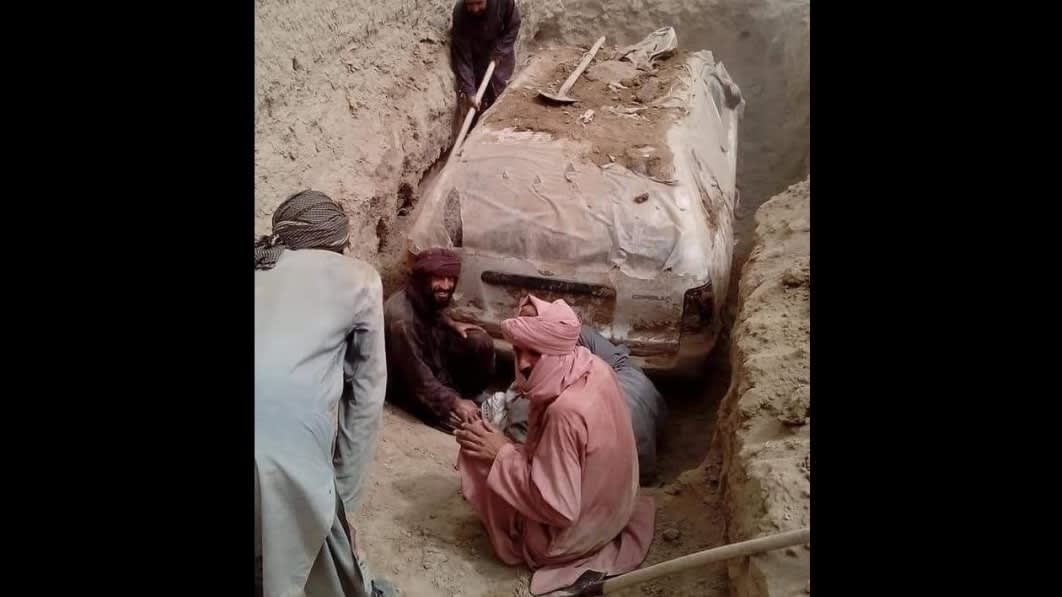
Afghanistan's National Museum will soon welcome an unusual new exhibit: an E100-generation Toyota Corolla station wagon that has been buried since 2001. The wagon was used by Mullah Mohammad Omar, the Taliban's founding leader, to escape American troops in 2001.

Omar relied on his humble Corolla to flee the city of Kandahar and escape to the province of Zabul shortly after the United States sent troops into Afghanistan in the aftermath of the September 2001 terrorist attacks, according to NBC. While parking the wagon in a garage would have been easier than digging a car-sized hole, the Taliban leader was worried that American soldiers would know where to find him if they located his car. He consequently wrapped it in plastic and buried it next to a mud wall in a location that was kept secret until recently.

Taliban forces decided to exhume the Corolla in July 2022, about 10 years after Omar's death, as a way to show their strength following the withdrawal of American troops from Afghanistan. Photos published on Facebook by Pakistan-based page Karachi Track suggest that the Corolla has fared surprisingly well. It's still wrapped in plastic and "mostly undamaged," according to a social media post, though one of the exterior mirrors is broken. Crews are working on cleaning the Corolla, and it will ultimately be displayed in the Afghanistan National Museum.

Not every car that ends up buried (for any reason) remains as intact as Omar's Corolla. In 2020, a British man discovered a 1950s Ford Popular 103E buried in his yard while building a deck. It was put there as a time capsule in 1964 after a mechanic wrote it off, and spending nearly 60 years underground left it in terrible condition. We don't know what happened to it, but it doesn't sound like it went to a museum.


Across the US, towns warn of toxic PFAS chemicals in drinking water. Here's what to know.


Kyle Bagenstose, USA TODAY
Sat, July 16, 2022

The U.S. Environmental Protection Agency in June issued nationwide health advisories for four PFAS chemicals commonly found in drinking water. Short for per- and polyfluoroalkyl substances, the quartet are part of a larger class sometimes referred to as “forever chemicals,” due to their strength and failure to degrade in the environment.

The EPA's new advisories startled many observers because the safety levels for two of the chemicals -- perfluorooctanoic acid (PFOA) and perfluorooctane sulfonate (PFOS) -- are extremely low. Thousands of drinking water utilities across the country likely have PFOA or PFOS in their system above the EPA's new advisories. Studies have linked the chemicals to serious health effects like cancer, low birthweight babies and immune system effects.

In the wake of EPA's action, cities such as Mobile, Alabama, sent notices to their customers confirming the presence of PFAS in drinking water and alarming many residents.


Radhika Fox, assistant administrator for the U.S. Environmental Protection Agency, announces new health advisories for four PFAS chemicals on June 15, 2022 at the National PFAS Conference being held in Wilmington.

If you're concerned about PFAS in your drinking water, here's what to know:

How dangerous are PFAS?

There are thousands of PFAS chemicals, hundreds of which are used in the U.S. for things like nonstick coatings and waterproofing in products such as kitchenware, clothing, furniture and food packaging.

The chemical industry argues that it has phased out the varieties of PFAS known to be hazardous, such as PFOS and PFOA, and replaced them with safer alternatives. But environmental groups and some scientists say the common characteristics of PFAS make them all dangerous.


The potentially toxic effects of most PFAS chemicals have not received robust research. But large studies have found links between PFOA and PFOS and a variety of health effects, including high cholesterol, ulcerative colitis, thyroid disease, testicular cancer, kidney cancer and pregnancy-induced hypertension. Many researchers also worry about reproductive and developmental harms, such as low birthweight and decreased immune response.

Exactly how much PFOA or PFOS it takes to harm someone is unknown. PFAS chemicals do not cause sudden illnesses like a poison would. Instead, they accumulate in the body over time, where scientists say they can begin to impact systems. The EPA says its new advisories are designed to protect even pregnant women, young children, and the elderly over a lifetime of constant exposure.

“This means that these advisory levels are very conservative, or protective, of your health,” the EPA told USA TODAY in an email.


Tim Hartley, who drinks four pots of coffee a day, has to use bottled water because his well has been contaminated with PFAS. He is shown Wednesday, February 10, 2021 at his home on French Island near the airport in La Crosse, Wis. At least 40 wells that provide drinking water for residents on a North Side island in La Crosse were found to be contaminated with PFAS that are above recommended standards.

How do I know if I or my family are in danger?

Scientists say there is little anyone can do to assess individual risk. In highly contaminated communities, people have had blood tests to determine how much PFAS they've been exposed to, which can then be compared with national averages. But blood tests are expensive, can be difficult to obtain, and will not definitively tell someone what danger they face, health experts say.

Instead, many scientists assess the potential health impacts of PFAS at a population-level. Most recently, researchers estimated that exposure to some PFAS may have played a role in about 6.5 million deaths in the U.S. from 1999-2018, primarily those caused by cancer and heart disease. Annually, that's about the same mortality rate as COVID-19.


But virtually all Americans have some level of PFAS in their bodies, and the blood levels of the most problematic chemicals, PFOS and PFOA, have declined ever since an industrywide phaseout over the past two decades. In one way, that means the EPA advisories for PFOS and PFOA are part of an effort to further drive down a risk that has already been decreasing for many Americans.
How do I know if PFAS is in my drinking water?

At present, there is no national rule to test for PFAS in public drinking water, and many water utilities do not. Some, like Mobile, have tested and notified the public even when PFOA and PFOS are found in small amounts, just above the level that can be detected by advanced equipment.

Other states have tested water utilities across their jurisdiction. A Chicago Tribune investigation published this week reviewed state data that showed PFAS in water utilities across the state, with at least one PFAS chemical detected in water supplies collectively serving 8 million people, about 62% of the state's population.

Private testing in North Carolina has found PFOA and PFOS in the water sources for dozens of utilities across the state. Officials in Raleigh, Durham and Chapel Hill confirmed the presence of the chemicals above the EPA's new standards, adding that they are studying the problem, the Raleigh News & Observer reports.

While the EPA is planning on sampling thousands of water authorities across the country for PFAS in the years ahead, there is no official, central database where the public can check every system.

Residents can inquire with their water supplier or state environmental agency about whether testing has been performed on their system. The Environmental Working Group, a national environmental nonprofit that advocates for strict limits on PFAS, maintains a map of all known locations where PFAS have been found in drinking water.

A water tower is seen on Monday, February 21, 2022, along Riverview Expressway in Wisconsin Rapids, Wis. In the wake of Wausau learning that all of its water wells have unsafe levels of PFAS chemicals, Wisconsin Rapids is testing its own wells again. Tork Mason/USA TODAY NETWORK-Wisconsin

The American Water Works Association, a nonprofit representing water utilities nationwide, told USA TODAY its members “want to make the right decisions to quickly and efficiently reduce potential exposure to PFAS through water and protect their communities.”

But the association said members questioned the “scientific underpinnings” of the new advisories and the timing of their release and worry they create pressure for water utilities to make the “wrong investments.” They also want regulators to do more to find PFAS polluters and halt the contamination of water sources.

Regardless, the group said it is urging transparency among members.

“We encourage our members to speak openly and honestly with their communities about PFAS, discussing both what they know and do not know," said Steve Via, director of federal relations for the association. “Although there’s a great deal of uncertainty out there, the act of having that conversation can be helpful in strengthening public trust.”
What is being done about this?

The EPA's new advisories are not formal regulations. The agency says it plans to announce draft regulations.

Environmental Protection Agency administrator Michael Regan speaks during a press briefing May 12, 2021, at the White House in Washington. The Biden administration is launching a wide-ranging strategy to regulate toxic industrial compounds associated with serious health conditions that are used in products ranging from cookware to carpets and firefighting foams. Regan said the agency is taking a series of actions to limit pollution from a cluster of long-lasting chemicals known as PFAS that are increasingly turning up in public drinking water systems, private wells and even food.

Until then, action will continue to vary from community to community and state to state. In some places, such as highly contaminated towns in southeast Pennsylvania, officials adopted “zero tolerance” plans in which they installed carbon filtration systems to remove PFAS entirely from drinking water. But such plans can cost tens of millions of dollars for a typical water utility to implement.

Other cities have adopted a wait and see approach, reluctant to make such investments before seeing what the EPA's regulations might be.

Individuals can install filters in their homes, which can protect an entire house or can go under the kitchen sink to remove most PFAS from water used to cook and drink. Scientists say PFAS do not readily pass through the skin, making showering and bathing safe.

The Environmental Working Group says individuals can also lower their exposure to PFAS by purchasing commercial products that are PFAS-free.

The EPA offers a guide on reducing exposure to PFAS and recommends that those with concerns or questions about PFAS in commercial products contact the Consumer Product Safety Commission. The agency also promotes its own Q&A page around the new health advisories and says it has released the first $1 billion of $5 billion in funding to help water utilities address PFAS contamination.

Kyle Bagenstose covers climate change, chemicals, water and other environmental topics for USA TODAY. He can be reached at kbagenstose@gannett.com or on Twitter @kylebagenstose.

This article originally appeared on USA TODAY: EPA warnings on toxic PFAS raise questions on drinking water safety

The skyrocketing price of one critical metal could put a stop to new solar projects worldwide

Will Daniel
Thu, July 14, 2022 

Commodity prices have begun to cool lately, even as inflation continues to rage at a 40-year high. But one critical metal is heading in the opposite direction—polysilicon.

The price of the ultra-conductive metal that is crucial to the production of solar panels soared 2.3% on Wednesday to $38.05 per kilogram. Since January 2021, polysilicon prices have jumped more than 190% to their highest level in a decade, according to a Wednesday research note from Solarbe, a Chinese solar industry analysis firm.

As a result, contract prices for solar from large-scale projects are up more than 25% from a year ago, Reuters reported on Thursday.

Solarbe analysts argue that if the polysilicon price hikes continue, it could make major solar projects around the world uneconomical, slowing the pace of clean energy adoption.

“If polysilicon prices continue at a high level, all ground utility-scale projects will be stalled,” they said.

Backing up that claim, Morgan Stanley analysts said in a note last week that the Chinese firm Longi Green Energy Technology, the world’s largest solar developer, believes the industry is nearing a point where price levels no longer make sense for developers of large-scale solar projects, Bloomberg reported this week.
How we got here

The incredible rise in polysilicon prices began with a surge in demand for solar power in 2021 from both corporations and governments worldwide.

China, for example, installed a record 54.88 gigawatts of solar capacity last year. And in 2022, Chinese officials expect to double that figure, installing 108 gigawatts of solar power nationwide.

Corporations worldwide also purchased a record 31 gigawatts worth of clean energy through long-term projects in 2021, with two-thirds of the spending going toward solar.

All of that additional demand has led to skyrocketing prices for the raw materials used in solar panel production, including polysilicon. And an explosion at a polysilicon manufacturing plant in Xinjiang, China, in June has only added to the problem.
China’s solar dominance

Over the past decade, solar power has become the cheapest source of green energy worldwide, largely owing to China’s “instrumental” role in the manufacturing of low-cost solar panels, International Energy Agency (IEA) officials said in a recent report.

The only issue is that the world is now almost “completely” dependent on China to supply the base metals used in solar panel production, and the IEA expects that will remain the case through 2025. That could be a problem if solar demand continues, and China’s polysilicon manufacturers aren’t willing or able to sufficiently increase production.

“This level of concentration in any global supply chain would represent a considerable vulnerability, [and] solar PV [photovoltaics] is no exception,” IEA officials said.
Relief in sight

The good news is that there should be some relief for the solar industry in August.

China’s Silicon Industry Association said in a July 6 report that it expects polysilicon prices to decline slightly next month owing to increasing domestic production.

Polysilicon is made using metallurgical grade silicon, which is then refined through a chemical purification process called the Siemens process. China’s Silicon Industry Association says the factories that use this process have ramped up production recently to help match rising domestic and Western demand.

The Biden administration also announced last month that it wouldn’t impose any new tariffs on solar-related imports for two years in order to reduce U.S. energy prices. And President Biden authorized the use of the Defense Production Act to help encourage U.S. production of solar panels and counter China’s market dominance.

This reduction in industry costs and increase in solar panel supply should help polysilicon prices come back to earth in the coming years.

This story was originally featured on Fortune.com
Was the 'contagion' effect of the Uvalde, Texas, shooting behind recent Hamilton school threats?

CBC, Thu, July 14, 2022 

Hamilton schools faced 23 shooting or bombing threats from May 30 to June 17. A month since the last reported threat, behavioural experts say the May 24 Texas, Uvalde, school shooting may have had a 'contagion' effect. (Bobby Hristova/CBC - image credit)

Hamilton schools faced 23 shooting or bombing threats between late May and mid-June, leading to several charges. But was it a coincidence the incidents in Ontario happened not long after the deadly school shooting in Uvalde, Texas?

Some experts say high-profile cases like the May 24 Uvalde shooting can create a "contagion effect" that triggers other scary acts, and in this case, the rise in school shooting threats in Hamilton.

Sgt. Jason Tadeson, youth services co-ordinator for Hamilton Police Services, said officers charged five people, warned two people and identified three others linked to the school threats in the Ontario city. As well, 13 threats are still under investigation.

Those who have aggressive tendencies tend to look for aggressive cues. - Wendy Craig, Queen's University psychology professor

Tadeson said each case has been investigated separately and there's no concern for public safety at this point.

While he said it's hard to pinpoint what may have caused the string of threats in Hamilton, he pointed to the Uvalde shooting, which left 19 children and two teachers dead, as a potential trigger.

It's unclear if past school shootings have led to similar levels of threats, but Tadeson said: "When there are worldwide events that occur, there is that behavioural contagion."

In Hamilton, there didn't seem to be a pattern to the threats that targeted 19 schools. One school temporarily closed due to the threats. Unrelated shooting threats were also reported in the Greater Toronto Area and Windsor.

'Community of aggressive individuals'

Wendy Craig, a psychology professor at Queen's University in Kingston, Ont., said the contagion effect is when a violent event like the Uvalde school shooting provides a "road map" for others.

"There's a lot of press around it ... those who have aggressive tendencies tend to look for aggressive cues," she said.

"Those who are aggressive are more likely to take on these behaviours."

Steve Joordens, a psychology professor at the University of Toronto's Scarborough campus, said people involved in threat incidents may likely have been experiencing social isolation and bullying.

He said some can end up connecting online, which can lead them down a dark path.


Submitted by Steve Joordens

"The internet has really allowed a community for almost anything that you can think of, including people who have these sorts of notions in their mind," he said.

"Often they're drawn to this because of a feeling they may have from being socially isolated; less successful than they would like to in life, they may already feel a bit victimized."

Craig said the string of threats in Hamilton and other Ontario schools after the Texas shooting could indicate there's "a community of aggressive individuals who want to see the impact they can make."

"I don't think it's random," she said.

Joordens said even if it the threats toward the Ontario schools were some kind of prank, it's concerning.

"Maybe this could trigger something like, 'Hey here's a way to get out of our exams,' but man, is that detached from the seriousness of what they're doing," he said.

Tadeson said there's no "cookie-cutter" explanation behind the reason for each threat. There may even have been multiple factors behind each one, he said.

Schools need to review culture: psychologist

Craig said the fact schools faced the threats to begin with may signal they need to pay more attention to the students.

"They need to look at the school climate. Do students feel like they belong? Do they feel like they're cared for? Do they feel like they're included in the environment?" she said.

"This is not going to happen in schools where you feel connected and valued."

Hamilton's public school board said it's always reviewing its approach to safe schools and is "reflecting on ways we can continue to support families."

Hamilton's Catholic school board said it has been "very clear that threats have consequences," and schools will keep communicating to families about the danger of making threats.

Both boards also said they work with police to ensure everyone's safety.

Craig said while it's important to intervene and take action on any threats, one way to address them is to make the students feel included rather than just having them expelled.

"What do we need to put in place to prevent this from happening in our community, and the second thing, how do we react in a way that also supports developing youth who might already feel marginalized?"
WAR CRIME
Smiling and carefree: Little Ukrainian girl's last moments before Russian missile strike

Liza Dmitrieva's short life brought to a brutal end by a Russian missile, 
PHOTO: REUTERS

PUBLISHED
JUL 16, 2022

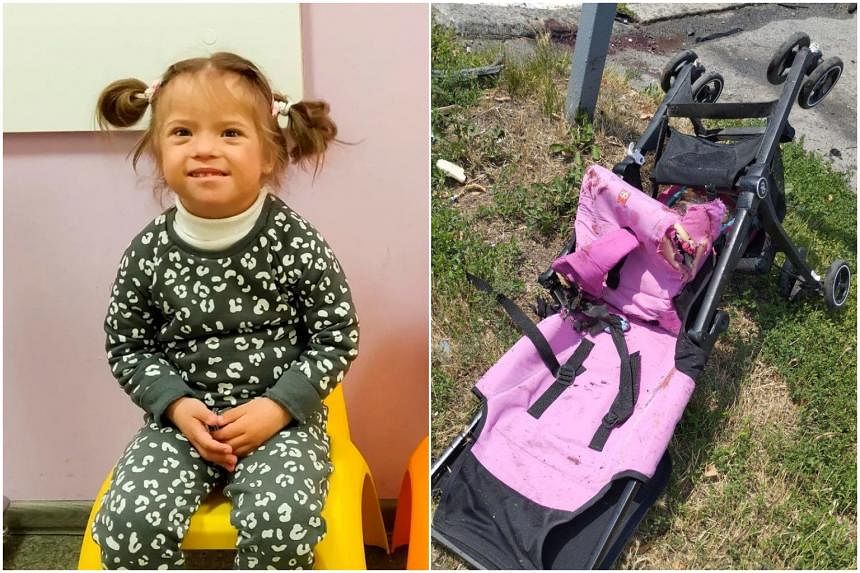
KYIV (AFP) - A happy, spirited four-year-old beams proudly as she pushes her own pram in a video recorded by her mother to chronicle their day out together in central Ukraine.

An hour or so later she was dead, her short life brought to a brutal end by a Russian missile, the pink buggy overturned in the street and mottled with the little girl's blood, next to her lifeless body.

Liza Dmitrieva, who had Down's syndrome, was being taken by her mother Iryna on Thursday (July 14) to a therapy centre in Vinnytsia, a city of around 370,000 people, 250 kilometres southwest of the capital Kyiv.

In the footage, which Iryna posted on social media at 9.38am, Liza can be seen bouncing along the pavement in white leggings and a sky-blue top with what appears to be a daisy stitched onto the shoulder.

Beyond the tribulations of living in a country at war, neither had any special cause to be afraid. They were hundreds of kilometres from the nearest frontline.

"Where are we going, sweetheart?" the woman asks her daughter on camera.

"Alla!" the four-year-old replies, shaking loose strands of wispy blonde hair that had been tied back with a white clip in the shape of a butterfly.

Alla is a common female first name in Ukraine.

"To see Alla?" the mother queries.

"Alla!" the youngster chirps again, an impish grin playing across her face.

Social media starlet


Around 80 minutes later, a barrage of rockets launched from a Russian submarine in the Black Sea hit Vinnytsia, devastating the city centre and killing 23 people, including two other children.

Liza's mother Iryna lost a leg in the attack and was initially reported to have later died in hospital, but the head of state police said on Friday she was still fighting for her life.


Iryna regularly posted pictures and news of her daughter's exploits and many challenges online, where the little girl had become something of a social media starlet.
An Instagram account set up by Iryna and dedicated to Liza amassed nearly 20,000 followers, although that had grown to 80,000 by Friday morning as the horror of the attack sent shockwaves around the world.

"Look how she spins. She loves dresses!" Iryna says in one post, alongside a video of the little girl in a field of lavender, playfully twirling round in her lilac dress.

"I am so glad to be the main example for my child. She copies absolutely everything - dances, movements, posing in front of a mirror, everyday life stuff," Iryna reveals in another post.

"If I do sports, she does too. I paint, she copies."


'Open act of terrorism'

First Lady Olena Zelenska said in the early hours of Friday she was "horrified" by images of the overturned pushchair released by local authorities - only to learn that it belonged to Liza, whom she had met.

"Reading the news, I realised that I know this girl. Knew... I will not write down all the words I would like to say to those who killed her," she wrote on Instagram.

Ms Zelenska explained that she had met Liza while recording a video celebrating the Christmas holidays.

"The little girl managed to paint dye not only on herself and her dress but also all the other children, me, the cameramen and the director in just half an hour."

The first lady posted the video with her message, imploring her Instagram followers: "Look at her alive please. I'm crying with her loved ones."

MORE ON THIS TOPIC

UN concerned for 100,000 children in Ukraine institutions, boarding schools

Russia invaded on Feb 24. The conflict has killed thousands of people, destroyed cities and forced millions to flee their homes.

Officials said Vinnytsia had sustained widespread damage in what Ukrainian President Volodymyr Zelensky later described as "an open act of terrorism".

Images distributed by officials showed the burnt skeletons of several upturned cars next to a gutted building held up by charred metal frames, with brown smoke billowing from the impact site.

Mr Sergiy Borzov, the head of the regional government said on Friday that 13 victims, including the two other children, had yet to be identified.

WAR CRIME
Ukraine – British citizen Paul Urey dies under arrest by pro-Russian forces in Donetsk

Newsroom - Yesterday 
Authorities in the Russia-friendly self-proclaimed Donetsk People's Republic announced Friday the death in custody of British citizen Paul Urey of natural causes, the first foreigner to die in the custody of pro-Russian separatists since the start of the war in Ukraine.

Urey, identified by Donetsk authorities as a "mercenary," died on July 10 from "chronic illness and a depressed psychological state," Donetsk Ombudsman Daria Morozova said on her Telegram channel.

However, DPR Foreign Minister Natalia Nikonorova later detailed to Russia24 channel microphones that the official information is that Urey died of "acute coronary insufficiency, complicated by pulmonary and cerebral edema."

According to the Ombudsman, Urey was taken prisoner in April while trying to break through a checkpoint controlled by DPR troops. According to Morozova, he was a professional soldier who participated in conflicts in Afghanistan, Iraq, Libya and Ukraine, led military operations and was also involved in recruiting and training mercenaries for Ukrainian armed formations.

In contrast, Dominik Byrne, co-founder and chief operating officer of Presidium Network, assured 'The Guardian' that Urey, 45, was working independently in Ukraine as a humanitarian aid volunteer.

Morozova has also confirmed that Urey was being held in a DPR penitentiary institution at the time of his death. On admission he was diagnosed with insulin-dependent diabetes, damage to the respiratory system, kidneys and a number of diseases of the cardiovascular system.

In addition, the Ombudsman stated that Urey had been suffering from depression for some time "due to the indifference of the British authorities" to his fate in captivity.

"The British representatives ignored even the possibility of negotiating his return as part of the prisoner exchange procedure, nor did they provide the necessary medical supplies through the ICRC," Morozova added.

UNITED KINGDOM SEEKS ANSWERS 

After learning of the information of Urey's death, the British government has assured that it has launched an "urgent" investigation into the news and took the opportunity to convey its condolences to those close to him, according to a statement picked up by Sky News.

Likewise, the British Foreign Office has issued a statement informing that it has summoned the Russian ambassador in London, Andrei Kelin, to express Downing Street's concern about what has happened.

"I am appalled by reports of the death of British aid worker Paul Urey, who was being held captive by Russian guards in Ukraine," said British Foreign Secretary Liz Truss, who said that "Russia must be held fully accountable for this".

Urey's daughters told the aforementioned British channel that they were already "preparing for the worst" after learning that he had been arrested in April and confirmed that they did not know he was in Ukraine until they learned of his capture.

Two other British citizens, Shaun Pinner and Aiden Aslin, are currently under sentence of death after being accused of collaborating with Ukrainian forces, and two more, Dylan Healy and Andrew Hill, have been charged.
Fiona Hill says Trump's election lies have created a 'recipe for communal violence' that could foster 'civil conflict' in the US

John Haltiwanger
Thu, July 14, 2022 

Fiona Hill, testifies before the Commission on Security
 and Cooperation in Europe in Washington, DC on February 2, 2022.
Alex Wong/Getty Images

In this article:

Fiona Hill told Insider that Trump's elections lies have created a "recipe for communal violence."

Echoing other experts, Hill warned that the US could ultimately end up in "civil conflict."

"We may have just become ungovernable," Hill said. "We're in a mess.
"

America is historically divided. Trust in key institutions has tanked. Millions of people still don't believe President Joe Biden won the 2020 election fair and square. And former President Donald Trump and his Republican allies continue to push false claims on 2020, as they simultaneously vie to whitewash the deadly riot at the Capitol on January 6, 2021.

"We're in a mess," Russia expert Fiona Hill said in a conversation with Insider on Wednesday that focused heavily on the state of US democracy.

Hill, who served as the top Russia advisor on the National Security Council under the Trump administration, warned that the distrust in the electoral process fomented by Trump and those close to him has created a "recipe for communal violence." The US could ultimately "end up in a civil conflict," she added.

"Some people have said that might have been our last fair election in 2020. And it's disastrous because that means that a portion of the population will always believe that whoever got elected is illegitimate," Hill said.

The US has reached a point where "trust in the different communities and authorities" has broken down "to such an extent that people just start fighting with each other," Hill said.

Some academics have contended that the US is already experiencing a slow-moving civil war or is heading toward insurgency — the 21st century version of civil war. When asked if she agreed, Hill said, "I've said that myself at times and I've dialed it back a bit. We've got a lot of communal violence. So, we're already kind of in that. But we may have just become ungovernable by many of the things that have happened here."

"I don't think we'd end up in the kind of conflict that we had between the states — the Union and the Confederacy — back in the day," Hill said. "But people's sense of the civil and civic ways of resolving disputes are out the window."

When people are storming the US Capitol, staging armed protests at state capitols, plotting to take governors hostage, and engaging in targeted, mass violence — including racially motivated violence like the recent shooting at a grocery store in Buffalo, New York — it's a sign that your country is in "really big trouble," Hill said.

"However you define it, you're in big trouble" when there's "this whole atmosphere where everyone's on edge and feeling that they need to resolve the disputes themselves," she added.

The GOP is 'hellbent on undermining democracy'


Pro-Trump protesters gather in front of the U.S. Capitol Building on January 6, 2021 in Washington, DC.
Jon Cherry/Getty Images

Hill, who wrote a book on Russian President Vladimir Putin, is seriously concerned that the US could be moving toward autocracy. She saw firsthand how Trump sought to emulate autocratic leaders like Putin.

In her 2021 memoir, "There Is Nothing for You Here: Finding Opportunity in the Twenty-First Century," Hill wrote that Trump "may have paved the way for another, less personally insecure and more capable populist president — someone who actually did his or her homework and was skilled in project management — to pull a Putin in America."

Hill said the Russian president "took the constitution's presidential powers and ran with them" and also "enhanced them to the point of extending his own term in office essentially indefinitely," warning that it could also happen in the US.

Asked if she was still worried that someone could "pull a Putin" in the US and move it toward autocracy, Hill told Insider, "I'm very concerned about it."

Many Republicans continue to run for office "on the back of the lie that the January 6th committee has really tried very hard to refute," or the false notion that the election was stolen from Trump, Hill said.

Some of the people who will run for the GOP nomination in 2024, including those who could potentially beat Trump, if he chooses to make another bid for the White House, have "not refuted what he's said and never recognized Biden as a legitimate president," she said.

It would be "disastrous" if Trump runs and wins again "on that basis," and equally as bad if another Republican candidate who "helped enable this or perpetuate it and is tapping into it" wins, Hill warned.

The GOP today is not the Republican party of old, Hill said, stating that it has all the "hallmarks" of authoritarianism.

"I am not a partisan person, but it's a little bit hard to take a neutral stance," Hill said, noting that people in the UK have described the Republican party to her as "a charismatic satanic death cult."

The Democratic party is not unworthy of criticism, Hill said, but it's also not "trying to undermine the overall democratic system."

"Right now it has to be said that the Republican party, the congressional Republican party, so it seems, so it would appear, is hellbent on undermining democracy to exert minority rule," she added.

Hill, who was pushed into the national spotlight as a key witness during the House impeachment inquiry into Trump's dealings with Ukraine, said she's been closely following the hearings held by the House select committee investigating January 6. She said the committee has made a compelling case so far.

"But it doesn't mean that everybody else is watching and is being persuaded," Hill said, adding, "We've become so polarized and partisan."

To reverse course, Hill said, everybody needs to stand up and work at strengthening America's democracy.

"Everybody's individually got to think about what can they do in this moment, and really look at things long and hard about the kind of country that they want to live in," Hill said.

IT ONLY COST $393

Pennsylvania Democrat John Fetterman trolls Dr. Oz with message from Snooki amid flap over Oz's ties to the state: 'Jersey will not forget you'

Dr. Mehmet Oz and "Snooki"
A composite image of Pennsylvania Republican Senate candidate Mehmet Oz and "Jersey Shore" star "Snooki" LaValle.Getty Images
  • Pennsylvania Lt. Gov. John Fetterman continues to troll Dr. Mehmet Oz over his New Jersey ties.

  • This time, Fetterman enlisted "Jersey Shore" reality show star "Snooki."

  • "Jersey will never forget you," Snooki says to Oz in a video posted by Fetterman's campaign.

Pennslyvania Lt. Gov. John Fetterman's campaign enlisted "Jersey Shore" alum Snooki in its ongoing effort to troll Republican Senate candidate Dr. Mehmet Oz over his longstanding ties to New Jersey.

"Hey, Mehmet, this is Nicole "Snooki," one of the stars of the MTV reality show says in the video that appears to be from the online service Cameo. She adds that she heard Oz left New Jersey to "look for a new job."

"Personally, I don't why anyone would want to leave New Jersey because we are all hot messes, but I want to say best of luck to you," said Snooki, whose real name is Nicole LaValle. "I know you're away from home and you're in a new place but Jersey will never forget you."

It's unclear if LaValle knew that her video would be used as a political attack.


Spurred on by former President Donald Trump's endorsement, Oz narrowly won the Republican Party's nomination in June. Fetterman and Oz will now face off in November in a race to determine who will replace retiring Republican Sen. Pat Toomey. Republicans appear to be entering the midterms on the offensive, but the Pennsylvania contest will be one of the marquee races come November.

Fetterman and his campaign have for weeks assailed Oz over his ties to New Jersey and minimal ties to Pennsylvania. According to the Philadelphia Inquirer, Oz lived in North Jersey for more than three decades. He has said that he moved to Pennslyvania in 2020 and lived at his in-law's home. But Oz's social media posts still showed him frequently in New Jersey.

It doesn't help matters that the political neophyte has made some missteps such as when his campaign misspelled the name of his town on an official campaign form or when it appeared that he filmed a campaign video in his New Jersey mansion. 

Fetterman has been off the trail recovering from a near-fatal stroke he suffered in May. In the meantime, his campaign has pushed the Oz-New Jersey story through a litany of social media posts. Last weekend, it also paid for a plane to fly over the Jersey shore with a message saying, "HEY DR. OZ, WELCOME HOME TO NJ! ♥ JOHN."

Ironically, Jersey shore itself was dogged by criticism about where some of its stars lived. The reality TV show, which ran from 2009-2012, was about eight housemates. Only two of them were New Jersey natives. Snooki was not one of them.

Representatives for Fetterman and Oz's respective campaigns did not immediately respond to a request for comment.


REST IN POWER
Eugenio Scalfari, revolutionized Italy's journalism, dies


Thu, July 14, 2022 


ROME (AP) — Eugenio Scalfari, who helped revolutionize Italian journalism with the creation of La Repubblica, a liberal daily that boldly challenged traditional newspapers, died Thursday, the Senate president announced. Scalfari was 98.

Senate President Maria Elisabetta Alberti Casellati led lawmakers who were debating a bill in a minute of silence to honor one of the deans of Italian journalism.

The Rome-based La Repubblica broke ground when it burst onto already crowded newsstands in 1976, grabbing readers’ attention with punchy headlines and a tabloid format. Its sassy style of writing that had little in common with the austere prose then used by Italy’s leading paper, Corriere della Sera, headquartered in Milan.

His novel recipe proved a success, and La Repubblica became Italy’s No. 2 daily newspaper.

Italian Premier Mari Draghi praised Scalfari on Thursday for ”the clarity of his prose, the depth of his analyses, the courage of his ideas," and said the journalist's death “leaves an unfillable void in the public life of our country."

Scalfari’s editorials "were fundamental reading for whoever wanted to understand politics, the economy,” Draghi said in a statement.

Scalfari used the pages of La Repubblica to fight a number of battles, and his was the first mainstream Italian paper to urge Italians to reevaluate Italy’s Communist party, which successive Christian Democratic-led coalitions had deftly kept out of power by allying with an array of much smaller coalition partners.

He used his weekly columns to campaign relentlessly against Silvio Berlusconi after the television mogul went into politics in the mid-1990s, leading a center-right bloc that would eventually form three governments. La Repubblica hammered away at Berlusconi repeatedly accusing the then-premier of jumping into politics to safeguard his business interests.

Along with his media empire, Berlusconi also had extensive real estate holdings, advertising companies and a soccer team. Conflict of interest accusations dogged him throughout his political career.

One of the first tributes following the news of Scalfari's death nonetheless came from Berlusconi, who still heads the center-right Forza Italia party he created three decades ago.

“Eugenio Scalfari was a figure of reference for my adversaries in politics,'' he tweeted. ”Today, however, I cannot but recognize that he was a great publisher and journalist, who I always appreciated for his dedication and passion for his work."

In arguing for a new reading of Italy's Communist Party, which had been the largest in the West, Scalfari contended it had broken with its Soviet roots. Many former Communists joined new, leftist parties, which ultimately went on to became coalition partners in several Italian governments.

The appeal of La Repubblica among left-leaning readers became so broad that it increasingly wore away at the readership of the then widely-read Communist- and post-Communist - paper l’Unita.

During a career that spanned more than 50 years, Scalfari was called everything from the “Lider Maximo of Italian Journalism,'' a reference to a nickname of the late Cuban leader Fidel Castro, to an ideological opportunist.


It was a testament to his enduring influence that even after retiring from his position as editor of La Repubblica in 1996, his weekly columns continued to ruffle feathers.

Scalfari’s life was marked by conspicuous triumphs. Besides La Repubblica, he was the co-founder of the successful L’Espresso weekly newsmagazine.

For years, he participated in Italian political life, first with the Italian Radical Party, as a founding member, serving as its national vice secretary between 1958 and 1963, then with the Italian Socialist Party. Scalfari also served a term in Parliament, starting in 1968.

Under his direction, both L’Espresso and La Repubblica adopted tough investigative approaches, exposing some of the many scandals that marked a particularly tumultuous period of postwar Italian history.

Most notably, in 1967, L’Espresso blew the lid off an attempted 1964 coup by an Italian general.

Born in Civitavecchia, a port city near Rome, on April 6. 1924, Scalfari studied law before turning to journalism. He began writing in 1950 for Il Mondo and L’Europeo, two top magazines, leaving in 1955 for the L’Espresso venture.

He served as editor-in-chief of the popular newsmagazine between 1963 to 1968, and then as the managing director of L’ Espresso publishing company between 1970 to 1975, helping to establish it as one of Italy’s most influential publishing groups.

Scalfari was married to Simonetta De Benedetti, and the couple had two daughters, Enrica and Donata.

___

Former AP staffer Victor L. Simpson contributed biographical material to this story.

Frances D'emilio, The Associated Press