Tuesday, September 20, 2022

Climate change plus a third straight La Niña is not a good thing

Jonathan Overpeck, Ph.D., opinion contributor - 


There’s a saying that climate is what you expect, and the weather is what you get. In an era of climate change, we can now expect hotter more extreme weather, and more often than not, that is what we get. Interestingly, aspects of how the Earth’s climate varies naturally around average conditions can sometimes improve our regional predictive skill even more.


Climate change plus a third straight La Niña is not a good thing© Provided by The Hill

Scientists and non-scientists alike recognize that climate has varied widely long before humans started overwhelming the planet with fossil-fuel-driven climate change. Ice ages came and went for well-understood reasons, just as we know why the time of the dinosaurs was a good deal warmer and more inhospitable than today.

Over 100 million years ago, natural processes led to higher levels of atmospheric CO2, just as the burning of fossil fuels is doing now. Higher CO2 levels during warm periods, and lower during ice ages tell us that greenhouse gases are a fundamental control knob on the Earth’s temperature.

Climate varies naturally over all time scales, from seasons to decades to millions of years, and climate scientists spend a lot of time trying to understand exactly how and why. This is critical to understanding what might come next because what we get, season to season, year to year, or decade to decade, will result from natural climate variability interacting with human-caused climate change. Of course, even natural climate variability is now being altered by climate change, and that makes climate prediction trickier.

The year 2022 has been unusually disastrous in terms of extreme climate and weather: Australia endured major flooding early in the year, while India and Pakistan were hit by extreme heat, followed in Pakistan by unprecedented flooding. China and Europe both struggled with unprecedented heat and drought all summer, just as the Horn of Africa is being pushed toward a major humanitarian crisis by its own hot drought. Yet, another disaster has unfolded as Hurricane Fiona slammed Puerto Rico and the Dominican Republic. Through it all, the mainland United States has experienced multiple extreme heatwaves and the unending 22-year megadrought that is now stoking both wildfire and water crises in the Southwest. One of the reasons for all the climate and weather mayhem is obviously climate change. Without climate change, this year’s climate extremes would have been less severe, and the extreme heatwaves less frequent.

Related video: WION Climate Tracker | Climate change threatens survival of Urban trees
Duration 2:16   View on Watch


Climate Change Intensifies Diseases, New Study Finds

The fingerprints of human-caused climate change are all over each of this year’s major climate disasters, but in each case, climate variability played a role, too. Climate change has supercharged extremes that in earlier times would have been less disastrous. Importantly, one major pattern of climate variability seems to be the primary culprit for why we got the climate extremes where we did this year: a tropical phenomenon called La Niña.

La Niña events are not rare — they happen every few years. They are defined by a pattern of ocean and atmospheric conditions in the tropical Pacific, including colder than usual surface ocean temperatures in the eastern and central tropical Pacific. Some are weak or moderate, and some are more pronounced. The stronger the La Niña is, the more likely it will influence the pattern of climate and weather around much of the planet in a recognizable way. The same holds true for La Niña’s counterpart, El Niño, during which the tropical Pacific warms. When a strong El Niño happens in the tropical Pacific, it can generate a pattern of extreme climate and weather around the globe that is roughly the opposite of what a strong La Niña will generate.

Our scientific understanding of how El Niño and La Niña variability works is a valuable tool in predicting what might happen in many parts of the globe months in advance. For example, El Niño events are known not just for a global pattern of extremes that are roughly opposite La Niña, they are also known for pumping large quantities of accumulated heat from the ocean into the atmosphere. The ocean is absorbing most of the heat trapped by the increasing greenhouse gas concentrations in the atmosphere, so we can expect the next strong El Niño to help propel atmospheric global temperatures to record heights.

Over the last two years, however, it’s been the La Niña pattern of natural variability that has helped produce many of our climate extremes, only to have climate change supercharge these extremes with devastating impact. Two La Nina years in a row is not so unusual, but right now, based on current conditions and sophisticated models, we appear to be on the cusp of a rare “three-peat” — a third straight La Nina year — that will probably last through our Northern Hemisphere winter.

The persistent La Niña conditions raise the odds of continued heat waves and drought all the way from Europe and North Africa through the Middle East, the northern reaches of South Asia, and into China. Parts of East Africa will also likely continue to bake and dry out. In other words, the climate disasters that struck each of these places in 2022 could worsen into 2023. And, when it does rain, climate change increases the chances that the rainfall could be extremely intense.

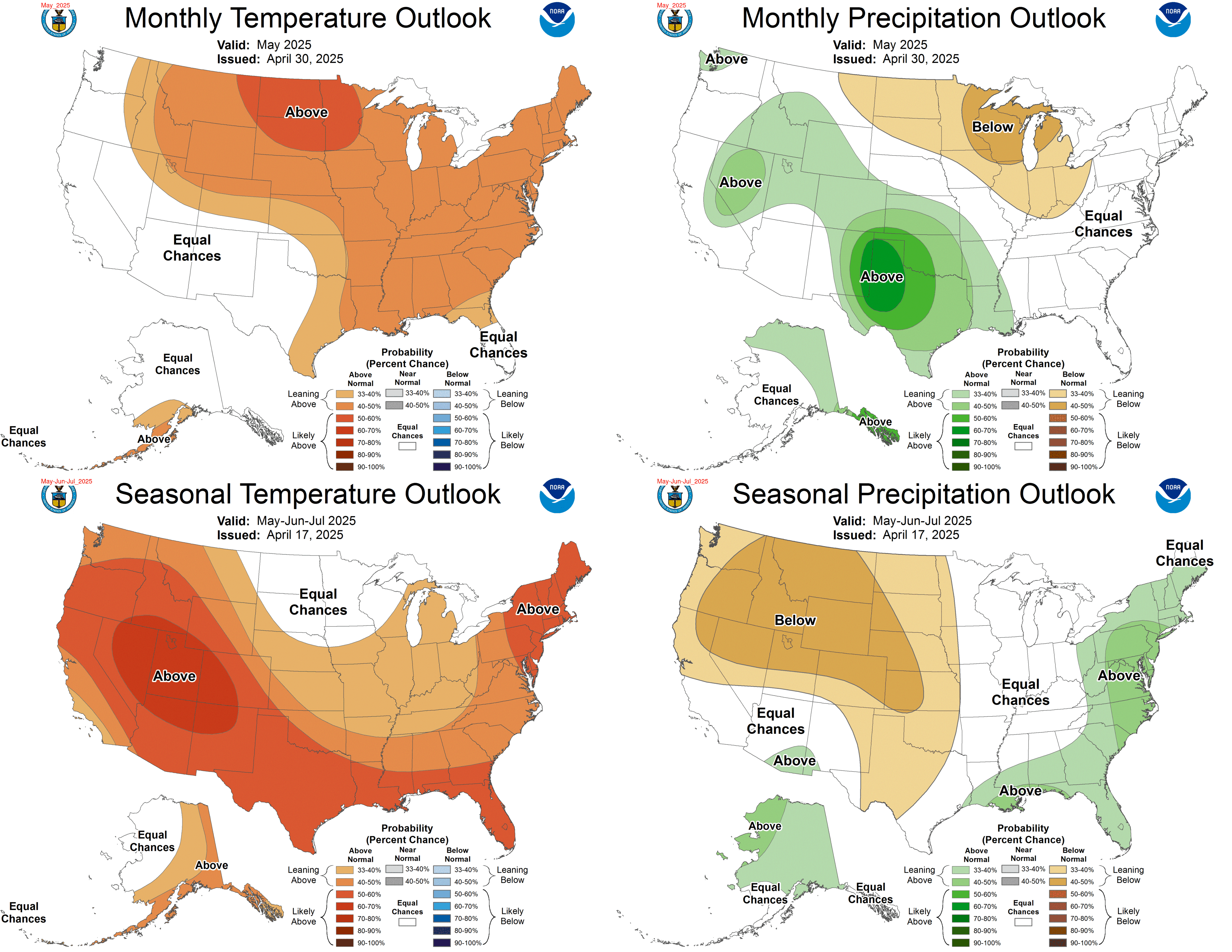
Closer to home, the implications of continued La Niña conditions are also bad news. We can expect the odds will favor hot and dry weather from southern California across the southern tier of the United States to the Southeast. This is typical of past La Nina events and predicted by climate models. Despite a relatively wet summer monsoon across parts of the Southwest, we can expect the region’s 22-year-long hot megadrought to intensify again into its 23rd year. With yet another La Niña on the horizon, this is not the year to expect relief.

We can’t stop natural climate variability and the extreme weather La Niña can bring, so we must instead accelerate our efforts to stop the human-driven climate change that is relentlessly turning so many climate extremes into unprecedented disaster and suffering.

Jonathan Overpeck, Ph.D., is a climate scientist, professor and dean of the School for Environment and Sustainability at the University of Michigan. He has researched drought, climate variability and climate change on five continents. Follow him on Twitter: @GreatLakesPeck

Canadian inflation eases again in August, smaller rate hikes eyed


The price of apples at the Northmart grocery store in Iqaluit

Tue, September 20, 2022
By Julie Gordon

OTTAWA (Reuters) -Canada's annual inflation rate eased more than expected in August even as food prices rose at their fastest pace in 41 years, data showed on Tuesday, with economists saying now smaller rate hikes may be best.

The country's annual inflation rate slowed to 7.0% in August, below analyst forecasts of 7.3% and down from 7.6% in July. The deceleration was largely due to lower gasoline prices and slower gains in the shelter index, Statistics Canada said.

On the month, the consumer price index fell 0.3%, the largest decline since early in the COVID-19 pandemic. On the other hand, the price of food purchased from grocery stores gained 10.8% on the year, the most since August 1981.

All three core measures of inflation, which taken together are seen as a better indicator of underlying price pressures, eased slightly in August, with the average edging down to 5.2% from an upwardly revised 5.4% in July.

While inflation appears to be easing off peak levels, it remains far above the Bank of Canada's 2% target. The central bank has hiked its policy rate by 300 basis points in just six months to tackle surging prices.

The data shows those rate increases are starting to work, but the central bank's job is not yet done, said Michael Greenberg, SVP and portfolio manager at Franklin Templeton Investment Solutions.

"It has maybe taken down some of the risk of a supersized rate hike in Canada in October, but clearly there is still more wood to chop," he added.

Money markets bets on a 50-bp hike to 3.75% at the October rate decision eased slightly following the data, though the larger move was still favored over a standard 25-bp increase.

Economist are split on how high rates will go this cycle and on when the bank will pause, though some said cooler inflation numbers suggest a lower peak rate for Canada than for the United States, where inflation remains stubbornly hot.

"Today’s numbers reinforce our view that the Bank of Canada might only have one 50-bp rate hike left, whereas the Fed could very well continue raising rates for longer and to higher levels," said Royce Mendes, head of macro strategy at Desjardins Group, in a note.

Still, economists said much will come down to whether consumer and business expectations on price increases have become further unmoored, with that data due in two surveys to be released by the central bank next month.

"Ultimately the really important thing will be the evolution of inflation expectations," said Andrew Kelvin, chief Canada strategist at TD Securities.

Kelvin added that while the central bank could revert back to traditional 25-bp increases at this point, its hands may be tied if the market continues to demand at larger move.

The Bank of Canada hiked its policy rate by 75 bp to 3.25% this month and left the door open to another oversized increase, saying it continues to see front-loading as the best way to battle fast-rising prices.

Deputy Governor Paul Beaudry will give a speech today, with his remarks due out at 3:30 p.m. ET (1930 GMT).

The Canadian dollar weakened as much as 0.8% to touch its lowest level since November 2020 at 1.3053 to the U.S. dollar, or 74.89 U.S. cents.

(Reporting by Julie Gordon in Ottawa; Additional reporting by Dale Smith and Steve Scherer in Ottawa and Fergal Smith in Toronto; Editing by Chizu Nomiyama and Andrea Ricci)

Inflation has likely slowed, but economists warn we're not out of the woods yet

Stephanie Hughes - Yesterday 

Canada's inflation rate is expected to cool in data coming out Tuesday.© Provided by Financial Post


Economists at Canada’s biggest banks believe the country’s inflation rate cooled for the second month in a row in August, with consensus expectations from Bloomberg surveys for Sept. 20’s CPI announcement running at 7.3 per cent, down from the 7.6 per cent annualized pace reported in July.

The anticipated decline comes as global supply chain disruptions are beginning to ease and lower commodity prices are working to cool the consumer price index, the economy’s main gauge on the growth of the cost of goods. Those easing pressures have led the Royal Bank of Canada’s economics team to conclude that the recent burst of inflation likely topped out at 8.1 per cent in June.

But the same team warned that, beneath the headline figure, some core prices are still bubbling up and will not likely peak until later this year.

“Food price growth likely accelerated again,” wrote economists Nathan Janzen and Claire Fan in a Sept. 16 RBC Economics note . “And we look for the rate excluding food and energy products to hold steady at 5.5 per cent. Alongside this, the Bank of Canada’s preferred core inflation measures also likely remained elevated.”

The Bank of Montreal’s chief economist, Douglas Porter, echoed this sentiment, though warned that like the U.S., which had recently reported a hotter than expected annualized rate of 8.3 per cent in August and saw core price pressures rise, Canada should “beware the core trends.”

“A weaker currency could further fuel consumer goods and imported food prices,” Porter wrote in a note to clients late last week. “To this stage, Canadian grocery prices have actually been less fiery than their U.S. counterparts (9.9 per cent year-over-year compared to 13.5 per cent year-over-year).”

Comparing Canada to its neighbour south of the border, Canadian Imperial Bank of Commerce chief economist Avery Shenfeld noted that the difference in how shelter costs are treated in Canadian inflation figures should have cost pressures, excluding food and energy, falling faster than the U.S.

However, Shenfeld also expects that since the price of goods excluding food and energy is driven upward by some supply chain issues and domestically driven services inflation is likely to peak in the second quarter of next year, core inflation won’t dip below the three per cent mark until the second half of next year.

Despite the common refrain among economists that high inflation is not here to stay, there remain risks on the horizon. In his note, Shenfeld raised concerns of a wage-price spiral, a trend where workers seek higher wages to keep up with rising living costs, a pattern that can cause high inflation to become entrenched. Shenfeld specifically pointed to the recent success U.S. railway unions had in negotiating new deals and averting a strike as an example of such upward pressure on wages. Though the gains may not send unit labour costs soaring as they have in the past, Shenfeld said they still pose an inflation risk that economists and central banks are keeping an eye on .

“Still, the concerns are that this is a five-year package averaging close to five per cent per year in wage hikes, partly backdated, but with a couple of years to run,” Shenfeld wrote. “That raises concerns that businesses are starting to assume that inflation will persist at elevated levels, baking in cost increases ahead that will make it tougher to winnow inflation down.”

Bank of Canada governor Tiff Macklem raised similar concerns during a July 14 video session hosted by the Canadian Federation of Independent Business. Macklem told the small business community not to plan for continued high inflation or to “build that into longer-term contracts” or labour deals.

The comments sparked backlash against the head of the central bank, with some union groups arguing that Macklem should “stay in his own lane.” But Shenfeld wrote that he believed Macklem was not telling workers to avoid asking for raises.

“What he likely meant to say was that employers shouldn’t simply assume that we’ll have elevated inflation beyond the next few quarters,” Shenfeld wrote. “They should therefore be careful about locking themselves into pay gains, particularly in multi-year contracts, under the assumption that they will be able to pass them on in large price hikes.”
'All but set in stone': More economists join chorus predicting a Canadian recession
Food inflation may have peaked, says head of Canadian grocery giant

While the conversation has largely focused on how wages could lift inflation, Shenfeld said it was more likely that the flip side was occurring: high inflation prompts workers to ask for higher wages or to seek higher-paying jobs to stay ahead of rising costs.

“So the key to avoiding a self-sustaining price-wage-price spiral starts with cooling the economy, getting inflation down and then letting that lower inflation environment influence wage gains,” Shenfeld wrote. “It’s not about telling workers that they shouldn’t try to keep up with the cost of living.”

Statistics Canada is expected to release August CPI data on Tuesday at 8:30 a.m. EST.


IKEA's restaurants has more than halved food waste since 2017


Tue, September 20, 2022 

Shoppers push carts past a logo of IKEA outside IKEA's new store in Bengaluru


STOCKHOLM (Reuters) - IKEA, which as well as being the largest furniture brand also runs one of the world's biggest restaurant chains, has slashed its food waste by 54% since 2017 to save money and reduce its environmental footprint.

Global food waste accounts for between 8% and 10% of total greenhouse gas emissions, according to the United Nations' Food and Agriculture Organisation.

Ingka Group, which owns most IKEA stores, in 2017 announced a target to halve food waste with the help of an artificial intelligence tool that allows it to better tailor amounts cooked to demand.

At the time, daily food waste per outlet, known for the trademark meatballs, averaged some 150 kg (330 pounds), translating to some 43,000 tonnes annually in total.


Ingka said in a statement on Tuesday the reduction meant it had saved more than 20 million meals and avoided 36,000 tonnes of carbon dioxide equivalents. The total saving in terms of money was 37 million euros ($37 million), a spokesperson added.

"Although this achievement represents a relatively small proportion of our overall climate footprint, (0.1%), it is nevertheless an important step that we are proud of," it said.

The entire IKEA value chain - from raw material production to customers' disposal of products - in the 12 months through August 2021 emitted 26.2 million tonnes of CO2 equivalent.

"We’re continuing to explore, test and develop ways to prevent and reduce food waste in our operations as well as to inspire our customers and the many people to do the same," Ingka said.

The restaurants serve around 560 million visitors a year.

($1 = 1.0014 euros)

(Reporting by Anna Ringstrom; editing by Jonathan Oatis)
Factbox-The Challenges Automakers, And Now Tesla, Face With Humanoid Robots

By Hyunjoo Jin
09/20/22 
A "Tesla Bot" humanoid robot prototype is seen in this undated handout image.
 Tesla Inc/Handout via REUTERS

Tesla's CEO Elon Musk is set to unveil its prototype humanoid robots at an event on Sept. 30, hoping to expand beyond self-driving cars that have not yet become reality despite his repeated promises.


While robots are widely used for specialist tasks at factories, other companies have struggled to create commercially viable human-like robots, despite decades-long development efforts.

"This market is very, very challenging market because you buy this big expensive robot, but it actually cannot do much," Heni Ben Amor, a robotics professor at Arizona State University, said.

TESLA

Tesla's humanoid robots, Optimus, will be initially used in manufacturing and logistics for boring and repetitive work, thus addressing a labor shortage.

For the longer term, Musk said the robot could be used in homes, even becoming a "buddy" or a "catgirl" sex partner.

HONDA

Japanese automaker Honda Motor Co's Asimo bipedal robot had served as a face for the company but was not commercialized after more than two decades of development. Honda is now focusing on disaster relief robots and "Avatar" robots for tasks like remote surgery.

Honda aims to demonstrate the Avatar robot before early 2024 and deploy the machines in the 2030s.

GM-NASA

From 2007 to 2012, General Motors and NASA joined hands to develop humanoid robots, R2, for assembly and space exploration.

NASA said that they are not under development anymore. NASA said its current focus is the development of next-generati
on humanoid robots that can be used on the lunar surface and eventually on Mars.


HYUNDAI MOTOR-BOSTON DYNAMICS

Boston Dynamics created internet buzz with videos of its humanoid robots running, jumping, backflipping and dancing. But the loss-making U.S. company changed hands several times, with Alphabet Inc's Google, SoftBank and then Hyundai Motor Co becoming the company's owner.

Hyundai and Boston Dynamics said in August that they will initially invest more than $400 million in a "research-first organization" on AI and robotics.

FORD-AGILITY ROBOTICS

IBT Fast Start - Let the best of International News come to you
Sign up and stay up to date with our daily newsletter.
You can unsubscribe at any time. By signing up you are agreeing to our Terms of Service and Privacy Policy.

In 2020, Ford bought two humanoid robots, Digit, from Agility Robotics, to test the delivery of a package to doorstop from a delivery vehicle.

Oregon-based startup Agility Robotics is also working to deploy human-like robots that can pick up and move items at warehouses.

SOFTBANK, OTHERS

SoftBank's wide-eyed Pepper robot, which helped burnish Chief Executive Masayoshi Son's image as a forward-looking tech entrepreneur, saw production halted.

Several robot startups like Rethink Robotics also went out of business, as they failed to commercialize their products.

A humanoid robot developed by Tesla, known as Tesla Bot or Optimus, is shown in a frame grab from the live video of Tesla's AI Day streamed on August 20, 2022. 
Tesla/Handout via REUTERS

FOCUS-Elon Musk faces skeptics as Tesla gets ready to unveil 'Optimus' robot


Tue, September 20, 2022 
By Hyunjoo Jin

SAN FRANCISCO, Sept 20 (Reuters) - Tesla Chief Executive Elon Musk blamed overreliance on factory robots for sending the electric carmaker to "production hell" four years ago, saying humans were better at certain jobs.

My, how times have changed.

Musk's Texas company now is floating ambitious plans to deploy thousands of humanoid robots, known as Tesla Bot or Optimus, within its factories, expanding eventually to millions around the world, according to job postings. Buzz is building within the company as Tesla is having more internal meetings on robots, a person familiar with the matter said.

Longer term, Musk said at a TED Talk robots could be used in homes, making dinner, mowing the lawn and caring for the elderly people, and even becoming a "buddy" or a "catgirl" sex partner.

The robot business eventually may be worth more than Tesla's car revenue, according to Musk, who is now touting a vision for the company that goes well beyond making self-driving electric vehicles.

At its "AI Day" on Sept. 30, Tesla will unveil a prototype from its project Optimus, an allusion to the powerful and benevolent leader of the Autobots in the Transformers series. Production could start next year, Musk said.

Tesla faces skepticism that it can show technological advances that would justify the expense of "general purpose" robots in factories, homes and elsewhere, according to robotics experts, investors and analysts interviewed by Reuters.

Tesla already employs hundreds of robots designed for specific jobs for production of its cars.

Humanoid robots have been in development for decades by Honda Motor Co and Hyundai Motor Co's Boston Dynamics unit. Like self-driving cars, the robots have trouble with unpredictable situations.

"Self-driving cars weren't really proved to be as easy as anyone thought. And it's the same way with humanoid robots to some extent," the lead of NASA's Dexterous Robotics Team, Shaun Azimi, told Reuters.

"If something unexpected happens, being flexible and robust to those kinds of changes is very difficult."

At an "Autonomy" event in 2019, Musk promised 1 million robotaxis by 2020 but has yet to deliver such a car.

Musk's robots may be able to demonstrate basic capabilities at the event, but it would be hard for them to impress public expectations of robots that are as capable as humans, experts say.

To succeed, Tesla will need to show robots doing multiple, unscripted actions, said Nancy Cooke, a professor in human systems engineering at Arizona State University. Such proof could provide a boost to Tesla stock, which is down 25% from its 2021 peak.

"If he just gets the robot to walk around, or he gets the robots to dance, that's already been done. That's not that impressive," she said.

Tesla did not respond to Reuters' request for comments, but Musk in the past proved skeptics wrong, jump-starting the electric car market and building a rocket company, SpaceX, although some product launches were behind schedule.

IN-HOUSE EXPERTISE

Initially, Optimus will perform boring or dangerous jobs, including moving parts around its factories, according to Musk.

Musk acknowledged that humanoid robots do not have enough intelligence to navigate the real world without being explicitly instructed.

But he said Tesla can leverage its expertise in AI and key components to develop and produce smart, yet less expensive, humanoid robots at scale.

He tweeted https://twitter.com/elonmusk/status/1572090491050799107 on Monday that its Autopilot team is also working on its Optimus robot, when asked about fixes of what it calls Full Self-Driving beta - a test version of its new automated driving software.

Tesla is on hiring spree for people to work on humanoid bi-pedal robots, with about 20 job postings on "Tesla Bot" including jobs for designing key robot parts like "actuators".

"The code you will write will at term run in millions of humanoid robots across the world, and will therefore be held to high quality standards," one of the job postings said.

Tesla has over 2 million vehicles on the road.

Jonathan Hurst, chief technology officer at Agility Robotics, a humanoid robot firm founded in 2015 said the technology "is right now starting to turn the corner."

"Certainly, an important measure of success is do they make money from it," he told Reuters, referring to Tesla's humanoid robot efforts.

HUMAN HELP?


Analysts see more pageant than product. "It's all part of distracting people and giving them the next shiny object to chase after," Guidehouse Insights analyst Sam Abuelsamid said.

"Investors are not excited about Optimus," said Gene Munster, managing partner at venture capital firm Loup Ventures, which holds Tesla stocks. "It's just such a low probability that it works at scale," he said, saying it is "infinitely harder than self-driving cars."

And then there is Musk's own experience with robots in the factory.

During the 2018 production hell, Musk specifically noted the problems of the "fluff bot," an assembly robot that failed to perform simple tasks that human hands can do - picking up pieces of "fluff" and placing them on batteries.

He said the cost of having technicians maintain the complicated robot far exceeded that of hiring someone to do the assembly.

The fluff bot is "a funny example but drives home the point that autonomy often doesn't generalize well, and so handling soft fluffy material that isn't as predictable as a rigid part was causing a huge problem," Aaron Johnson, a mechanical engineering professor at Carnegie Mellon University, said.

"Human hands are way better at doing that," Musk said.

(Reporting by Hyunjoo Jin; Editing by Peter Henderson, Ben Klayman and Lisa Shumaker)

FTC seeks more data on Amazon's $1.7-billion deal for vacuum maker iRobot

(Reuters) - The U.S. Federal Trade Commission (FTC) has asked Amazon.com Inc and iRobot Corp for more information on the e-commerce giant's $1.7-billion buyout of the Roomba vacuum maker.

In a filing on Tuesday, iRobot said the FTC had on Sept. 19 requested more details on the deal that was announced last month and would expand Amazon's stable of smart home devices.

A group of about 20 pro-privacy and worker organizations have urged U.S. antitrust enforcers to stop the deal, citing concerns about privacy and Amazon's already powerful position in the smart home devices market.

The FTC probe began earlier this month and covers both head-to-head competition and whether the deal would illegally boost the e-commerce company's market share in the connected device market as well as the overall retail market, according to a report from Politico.

(Reporting by Tiyashi Datta in Bengaluru; Editing by Vinay Dwivedi)

Hertz to order up to 175K GM electric vehicles over 5 years

This May 23, 2020, photo shows rental vehicles parked outside a closed Hertz car rental office in south Denver. Rental car company Hertz plans to order up to 175,000 Chevrolet, Buick, GMC, Cadillac and BrightDrop electric vehicles from General Motors over the next five years. The deal includes electric vehicle deliveries through 2027 and will span a variety of vehicles such as SUVs, pickups and luxury automobiles. (AP Photo/David Zalubowski, file)

Hertz plans to order up to 175,000 electric vehicles from General Motors over the next five years.

The agreement announced Tuesday includes electric vehicle deliveries through 2027 and will include SUVs, pickups and luxury automobiles from Chevrolet, Buick, GMC, Cadillac and BrightDrop. The companies expect deliveries of the Chevrolet Bolt EV and Bolt EUV will start in the first quarter of next year.

“We are thrilled to partner with GM on this initiative, which will dramatically expand our EV offering to Hertz customers, including leisure and business travelers, rideshare drivers and corporates,” Hertz CEO Stephen Scherr said in a prepared statement.

Hertz’s current goal is for one-quarter of its fleet to be electric by the end of 2024.

GM Chair and CEO Mary Barra believes the partnership will help create new electric vehicle customers.

“With the vehicle choice, technology and driving range we’re delivering, I’m confident that each rental experience will further increase purchase consideration for our products and drive growth for our company,” she said.

GM said last year that it plans to go fully electric by 2035
Amazon to Bring Low Carbon Electrofuels to its Trucking Fleet

Tue, September 20, 2022

Agreement with Infinium will help Amazon reduce carbon emissions for roughly 5 million miles of travel per year

SEATTLE, September 20, 2022--(BUSINESS WIRE)--Amazon (NASDAQ: AMZN) has signed an agreement with renewable fuels technology company Infinium to begin powering Amazon’s transportation fleet with ultra-low carbon electrofuels beginning in 2023. Infinium is expected to initially supply enough electrofuels, which are a fossil-based fuel alternative created with carbon waste and renewable power, to begin powering Amazon trucks in lieu of diesel fuel for approximately 5 million miles of travel per year.

The agreement is another step forward in Amazon’s commitment to transition its transportation network away from fossil fuels and deliver packages to customers in more sustainable ways. Amazon plans to initially use the electrofuels in trucks in its middle mile fleet in Southern California, where the trucks are expected to help serve millions of customers. Amazon’s middle mile fleet is responsible for moving customer orders from its vendors and fulfillment centers to its network of sortation and delivery stations.

According to the United Nations, the transportation sector currently accounts for approximately 25% of all carbon emissions globally, and Infinium is working to change that by developing ultra-low carbon fuels that can easily be used to power cargo trucks, airplanes, and marine freight without engine modifications.

To start, Infinium plans to build one of the world’s first electrofuels-production facilities in Texas. The facility will use renewable-power-generated green hydrogen and approximately 18,000 tons of recycled carbon waste per year—which would otherwise be released into the atmosphere—to create the electrofuels.

Amazon previously invested in Infinium through The Climate Pledge Fund, Amazon’s $2 billion venture investment program that specifically invests in companies building technologies, products, and services that can help Amazon and others accelerate the path toward net-zero carbon future. Amazon has announced investments in a total of 18 companies through The Climate Pledge Fund to date.

"Infinium’s electrofuels can help Amazon reduce carbon emissions across our transportation fleet, which is important to both us and our customers, and will help us move closer to our goal of net-zero carbon by 2040," said Kara Hurst, vice president of Worldwide Sustainability at Amazon. "We’ve supported Infinium’s technology through our Climate Pledge Fund, and it’s exciting to see our investment turning into usable fuel that will help us, and others across the industry, decarbonize transportation in the long run."

"Our agreement with Amazon to provide Infinium electrofuels for use in the company’s transportation network is a significant moment for all of us," said Infinium CEO Robert Schuetzle. "We’ve been developing this technology for the better part of a decade, and we expect our electrofuels to reduce greenhouse gas (GHG) emissions by approximately 95 percent over traditional fossil fuels. We’re thrilled to have the first fleet of Amazon trucks powered by electrofuels starting next year, which will mark the beginning of a major shift for the entire transportation sector."

Amazon is committed to reaching net-zero carbon by 2040 as part of its commitment to The Climate Pledge, and will continue to take real business action to decarbonize its operations. Infinium is an example of how Amazon invested in new climate innovation, and the company will soon leverage its technology to help it reduce carbon emissions.

In addition to partnering with Infinium, Amazon has taken other significant steps toward net-zero carbon:

Amazon signed an agreement with Plug Power to supply 10,950 tons per year of green hydrogen for its transportation and building operations starting in 2025. Amazon will start to use green hydrogen to replace grey hydrogen, diesel, and other fossil fuels as it works to decarbonize its operations, and this green hydrogen supply contract will provide enough annual power for 30,000 forklifts or 800 heavy-duty trucks used in long-haul transportation.


Through The Climate Pledge Fund, Amazon invested in Electric Hydrogen and Sunfire, two of the most promising developers of electrolyzers, a key technology that makes emissions-free green hydrogen for use in heavy duty transportation.


Amazon has also ordered 100,000 electric delivery vehicles from Rivian, marking the largest order ever of electric delivery vehicles. Amazon’s custom electric delivery vehicles from Rivian started to hit the road this summer in the U.S., with thousands expected to be making deliveries in more than 100 major U.S. cities by the end of this year.

Learn more about Amazon’s sustainability efforts.

About Amazon

Amazon is guided by four principles: customer obsession rather than competitor focus, passion for invention, commitment to operational excellence, and long-term thinking. Amazon strives to be Earth’s Most Customer-Centric Company, Earth’s Best Employer, and Earth’s Safest Place to Work. Customer reviews, 1-Click shopping, personalized recommendations, Prime, Fulfillment by Amazon, AWS, Kindle Direct Publishing, Kindle, Career Choice, Fire tablets, Fire TV, Amazon Echo, Alexa, Just Walk Out technology, Amazon Studios, and The Climate Pledge are some of the things pioneered by Amazon. For more information, visit amazon.com/about and follow @AmazonNews.

View source version on businesswire.com: https://www.businesswire.com/news/home/20220920005359/en/

Amazon will start testing ultra-low carbon electrofuels for deliveries in 2023


Steve Dent
·Contributing Reporter
Tue, September 20, 2022 


PATRICK T. FALLON via Getty Images


Amazon is partnering with Infinium to test the use of so-called electrofuels (e-fuels) in its middle-mile diesel fleet, it announced. The company invested in Infinium last year as part of its goal to reach net-zero carbon by 2040. "We’ve been developing this technology for the better part of a decade, and we expect our electrofuels to reduce greenhouse gas (GHG) emissions by approximately 95 percent over traditional fossil fuel," said Infinium CEO Robert Schuetzle in a statement.

As part of this, Infinium plans to build one of the first-ever electrofuel production facilities in Texas, using renewable-generated hydrogen and around 18,000 tons of recycled carbon waste per year.


A quarter of greenhouse gas emissions are created by the transportation industry, Amazon notes. Infinium's e-fuels supposedly help combat that by combining green hydrogen (from electrolysis) with captured CO2 that would otherwise be emitted by industrial plants. The CO2 and hydrogen are combined into "syngas," which is then converted to liquid fuels via catalysts. The resulting "drop-in" fuel can be used directly in existing, unmodified diesel vans.


Infinium Amazon electrofuels for delivery vans

The vans still emit carbon emissions, but those would have been produced anyway by the industrial plants, so it's supposedly a net-zero operation. The electrofuels are about twice as expensive as traditional fuels, Infinium has explained.

There are clearly some issues that come to mind — the first being that the renewable power used to create hydrogen would be put to much better use in battery-electric vehicles. And neither Amazon nor Infinium explained where they got the 95 percent reduction figure, so I'd take that with a large grain of salt. Finally, despite the 2040 net-zero pledge, Amazon's emissions increased dramatically last year — and that's likely a drastic undercount.

Still, it could serve as an intermediate step. Infinium has previously noted that Amazon will "need liquid fuels for a long time" for ground, marine and air travel. Amazon is also taking other measures, like using green hydrogen (rather than grey hydrogen derived from fossil fuels or other fossil fuels) to power 30,000 forklifts and 800 heavy-duty trucks. It's also investing in companies that develop more efficient hydrogen electrolyzers and has ordered 100,000 electric delivery vehicles from Rivian.

How Amazon Became the Largest Buyer of Renewable Energy in the World

Andrew Blum
TIME
Thu, September 15, 2022

Solar panels line the 526 acre plot at Hawtree Creek in North Carolina, recently acquired by Amazon. Credit - Will Warasila for TIME


When Richard and Carson Harkrader first heard that 696 acres of North Carolina farmland had come up for sale, in 2016, one feature of the rolling landscape particularly caught their attention: the power lines that sliced across it as though someone had dog-eared its map. Hard up against the Virginia border, it was a pretty spot—pretty enough that a home builder would eventually take a quarter of the acres for a lakefront subdivision. But for the Harkraders, father-and-daughter operators of Carolina Solar Energy, an independent developer of solar-energy projects, the prettiest thing of all were those heavy-duty transmission lines that arced to the northwest, lacing into the PJM Interconnection, the giant electric grid that dominates the mid-Atlantic.

“It was kind of a gold rush,” the elder Harkrader says one morning this summer, standing amid the hundreds of thousands of glistening black panels, now known as Hawtree Creek Solar Farm, that follow the curve of the hills and tower over our heads. By midmorning the panels are sending 34 megawatts out to the grid, about the same as 10,000 backyard generators buzzing at once. By noon, it’s 65 megawatts—the maximum the grid will take. “I still think it’s magic,” Harkrader says. “Take sunlight and … boom!” Except the only noise is the occasional creaking of their steel frames, as small motors tilt the panels to follow the arc of the sun across the Carolina sky.

About 200 miles north, in Virginia, are the eager buyers of that electric gold: the mega-technology companies, like Amazon, Microsoft, and Google, that operate giant data centers essential to our daily lives, whether we’re ordering on Prime or backing up family photos. Under pressure from customers, employees, and shareholders—and, arguably, out of their own eagerness to reduce emissions—they have been increasingly determined to run these data centers on renewable energy. Once the Harkraders had secured the new solar farm’s preliminary permits and permissions—making a plan to accommodate local deer and joining the crowded “interconnection queue” to plug into the grid—they leased the land to Engie, a French energy giant that builds and operates more than 4,500 megawatts of solar power around the world. And then, before the panels had even arrived on site for installation, Engie in turn struck a deal to sell all the site’s power to a single company: Amazon.

That financial and legal arrangement, known as a PPA (power purchase agreement), has been a crucial force in the U.S.’s transition to clean energy. Of the approximately 235 gigawatts of wind and solar capacity now installed on the nation’s grid, nearly one quarter (more than 52 gigawatts) has been contracted by corporations, mostly over the past decade. That vigorous—and notably voluntary—corporate action has boosted a web of wind and solar manufacturers, developers, and operators. It has made renewables cost-competitive and helped grid operators learn to manage systems with more variability.

As the modern mortgage made the suburbs, the PPA has made the renewables industry. It bridges the economic needs of renewable–energy developers with the climate goals of corporate executives and shareholders. Solar panels and wind turbines are expensive to build but cheap to operate, given that their fuel—sunlight and fresh air—are free. By guaranteeing the electricity will be sold long before it’s been generated, a PPA gives banks confidence to front the money for construction—especially when there’s a giant corporation guaranteeing the deal. In the way that power grids work, all that electricity isn’t wired directly to these companies’ facilities, but adds more juice to each region as a whole. But the way that PPAs work means the companies can legitimately argue that these giant renewable projects wouldn’t have happened without them. PPAs stitch together developers like the Harkraders, energy operators like Engie, electric grids like PJM, and—above all—the large companies hungry for power from renewable sources.


Amazon delivery trucks line up to enter the Amazon DAX3 delivery station on Jan. 12, 2022 in Chatsworth, California.
ROGER KISBY—REDUX

They also set up the biggest corporate power purchase of all: Amazon has leveraged that ecosystem to go on the largest ever solar and wind shopping spree, buying 15.7 gigawatts globally over the past three years, nearly equal to the prodigious energy demands of the $1.4-trillion company. Like an early shopper on Black Friday, Amazon’s fervor has been felt across the industry—while also giving a glimpse of the incredible growth still to come, with the arrival of $369 billion in federal funds provided by the Inflation Reduction Act (IRA). Understanding this key driver of the past decade of solar and wind development helps us see what is likely to happen next: an unprecedented boom in renewable energy that could form a significant wedge in the broader effort to reduce carbon emissions and limit the warming of the atmosphere.

“If it was a market that only waited till something was built—and then you went out and tried to sell the -electricity—these projects wouldn’t get done,” says Harkrader. “People like Amazon, or Microsoft, Walmart, Target—on and on—are standing up and making this market possible. And it’s exploding.”

These days, Amazon is the hungriest of all. The behemoth was not the first to buy renewable power for its operations, but it is now buying the most. The plans it has announced, globally, amount to the equivalent of around 250 more Hawtree Creeks, and more or less equal to all the solar generation built in the U.S. last year. The buying spree is part of Amazon’s broader effort to reach “net-zero carbon” by 2040—meaning it will eliminate or offset the carbon emissions from all its operations, including trucks, planes, and manufacturing. That won’t be easy. An estimated two-thirds of American households are Amazon Prime members; it is almost impossible to use the internet without accessing an Amazon data center. Since it announced its climate goal in 2019, Amazon’s emissions have grown 40%—as its sales have grown more than 50%. “The path to achieving some of our goals will be long and complex,” acknowledges Kara Hurst, who leads Amazon’s sustainability efforts. But clean electricity is Amazon’s climate bright spot. With today’s technology—and a fat checkbook—the company has nearly eliminated its use of dirty energy, prioritizing the hard realities of glass and steel over tree planting or tricky accounting, building at a scale that rivals that of many countries. Amazon has catapulted itself to the front ranks of corporate buyers, contracting last year for more than double its nearest competitor, Microsoft.

Read More: The Future Is Being Written By Climate Devastation and Green Investment

For the past decade, in the absence of major climate legislation and in the face of a complex patchwork of regulations that limited the ability of utility companies to build renewable power, PPAs have done the job. But the IRA—the most substantial piece of climate-focused legislation the U.S. has seen—takes that progress and adds billions of dollars in federal incentives. “It supercharges both the role and the potential for customers to drive even more of this,” says Brynn Baker, senior director at the Clean Energy Buyers Association. The latest predictions are gargantuan. Solar developers expect to install more than 215 gigawatts of capacity over the next five years—40% more than was expected before the IRA, according to a report from the Solar Energy Industries Association and Wood Mackenzie.

But electricity is only one segment of carbon emissions, meaning that alone will not be enough to meet the climate goals set by the Paris Agreement. The hope is that the paths established by renewable energy can be applied to harder-to-decarbonize segments, like electric vehicles and manufacturing. Amazon, for example, has announced plans for 100,000 electric delivery vehicles by 2030. “I think we could see even faster progress on transportation than we’ve seen with clean energy on the grid,” says Bill Weihl, executive director of Climate Voice and a former director of sustainability at Facebook. In corporate renewable power purchasing, we can see the narrow path that will need to be expanded into a highway over the next decade.

For the Harkraders, Hawtree Creek required years of close attention to bring to fruition: attending county planning meetings, mapping wetlands, and exploring an old cemetery that, in the end, couldn’t be moved (the solar panels wrap around it). But for Charlie Daitch, who spearheads Amazon’s renewable-power purchasing, Hawtree was one row on a very tall spreadsheet. “I have a pretty good map in my head of the portfolio—where are we distributed, maybe not each individual project,” Daitch says from the passenger seat of a rented SUV, barreling across North Carolina, on his first visit to the site. “It’s gotten bigger than that.”


Amazon delivery electric vans (EV), built by Rivian Automotive, at charging stations parked outside the Amazon Logistics warehouse in Chicago, Illinois on Thursday, July 21, 2022. Amazon Inc. is starting delivery of packages to US customers using the first of as many as 100,000 electric vans built by Rivian Automotive Inc., which aims to hand over thousands of the vehicles this year.
JAMIE KELTER DAVIS—BLOOMBERG/GETTY IMAGESMore

When Amazon announced the “Climate Pledge” in 2019, it set its own target for reaching net-zero carbon emissions by 2040, 10 years ahead of the Paris Agreement. Included in that was an earlier goal: to use 100% renewable energy by 2030. For a company like Amazon, which has a sprawling -infrastructure for moving goods around the world, eliminating emissions is a challenge that stretches across the business. Sustainable aviation fuel and heavy-duty electric trucks are still years, if not decades, away from broad adoption. But wind and solar power are ready now. “Renewables is a place we identified where we could go fast to decarbonize our electricity stack,” adds Daitch, a mechanical engineer by training.

Compared with its competitors, Amazon came late to that realization. Walmart announced the first-ever “utility scale” PPA in 2008, with a 153-megawatt wind farm in Texas. At the time, it was a controversial move. “Those early companies that made these commitments did not do so because customers were asking for it,” says Miranda Ballentine, who led Walmart’s sustainability efforts at the time and is now CEO of the Clean Energy Buyers Association. The corporate winds shifted in 2010. That March, Greenpeace called out the technology companies for their energy use. Their report was perfectly timed, coming just days before the first iPad was released—a device that self-evidently depended on the internet behind it. The tech companies went on the defensive. “There is no such thing as a coal-powered data center,” insisted Facebook in a statement. “Every data center plugs into the grid offered by their utility or power provider.” Dirty energy, in other words, wasn’t their problem—it was the grid’s problem.

That half-shrug emoji of an argument didn’t last long. The next year, in a joint statement with Greenpeace, Facebook announced a new “preference” for “clean and renewable” energy. Over the next several years, the other tech giants lined up to follow suit. Putting solar panels on the roof or wind turbines in the parking lot was never going to be enough; data centers require too much energy for that, often hundreds of megawatts each. Power purchase agreements give large corporations a way to use renewable energy without having to wait for utilities. “Large off-site power purchase agreements remain the tool that allows you to move more quickly,” says Erin Decker, a consultant at Schneider Electric, one of the leading clean-energy advisers. Big Tech firms are happy to make long-term deals—especially if they can send out a press release. According to the logic of corporate climate action, if a solar farm is built in the desert, it needs to make a sound.

“When we think about our renewable-energy strategy, we’re like, ‘Well, how can we tell the most credible story to our customers about what we’re doing?’” says Amazon’s Nat Sahlstrom. “We don’t want to be greenwashing. We don’t want to be chasing investments that aren’t really having an impact.”

Most of Amazon’s competitors have already completed the deals that lock them into a decade or more of renewable power. Facebook, now known as Meta, long ago “unfriended coal” and has 7.5 gigawatts of renewables under contract. Google reached 100% renewable electricity in 2017, with over 7 gigawatts procured; its next effort is ensuring its data centers run “24/7” carbon-free, meaning all of its energy all the time comes from renewable sources, rather than, for example, buying excess solar during the day to make up for coal power it needs at night. Apple announced that it had sourced 100% renewable energy for its operations in 2018, with 87% of that in the form of PPAs; the next, far more challenging step is helping its suppliers and manufacturers do the same—a goal it has set for 2030. And Microsoft has nearly 8 gigawatts, 5.8 of which it bought in 2021.

Outside of tech, large companies have more catching up to do. “It’s not just Big Tech companies,” says Tyler Espinoza at 3Degrees, a climate-action consultancy. “You have a broad swath of massive corporations that are willing to put their money behind it.” In 2021, Pfizer announced a 15-year contract for 310 megawatts of electricity from a Texas wind farm, enough to power 100% of its North American operations—a gigantic leap from the mere 6% of its global usage previously met by renewables. In August, Ford announced an agreement with a Michigan-based utility for 650 megawatts of solar.

But small and medium-sized businesses struggle with the level of complexity, and commitment, that PPAs require. “The power purchase agreement is a wonderful tool for large, fairly sophisticated, high–creditworthy companies to be able to procure clean energy,” says Ballentine, of the Clean Energy Buyers Association. “It is not as easy of a tool for smaller companies.” As long as there are still large corporations eager to sweep up the available inventory of projects, that hasn’t been a great concern. In the first half of 2022, corporations contracted for 9.8 gigawatts of renewable power in the U.S.—a third of which was Amazon’s.

But across the board, the challenge is coming to terms with how significant the impact of this renewable-energy purchasing can be on the broader effort to counter climate change. Ballentine, who was in the trenches for Walmart’s early actions, sees a single-mindedness in these corporate actions. “The big ‘why’ is very simple,” she says. “It’s about solving the climate crisis. There is no other reason that a company would set a voluntary zero-carbon energy procurement goal or renewable-energy goal.”

Even on a global scale, Amazon’s efforts stand out. The company’s initial Climate Pledge called for 100% renewable energy by 2030. But early in the pandemic, that pace shifted, when Daitch and his colleagues realized they could move much faster than they already were. Yet other aspects of Amazon’s business—like all those trucks and planes—were not going to decarbonize anytime soon.


Solar panels on the 526 acre plot at Hawtree Creek in North Carolina.Will Warasila for TIME

At the time Amazon had about 1 gigawatt of renewable energy procured. Daitch, who got his start at a traditional energy utility in the Pacific Northwest, working on distribution planning, increased the intensity of his team’s search. Their criteria varied. Wind might work better in Kansas, while solar was preferable in Ohio. Some regions relied heavily on coal power, heightening the impact of any new renewables. But others had crowded—or dysfunctional—processes for connecting new projects to the grid. Generally, Hawtree Creek is emblematic of how the process often works: a local developer who really knows the geography of the state, its electric-transmission network, and the local politics of its counties might respond to Amazon’s solicitation. But once things are under way, they hand the project off to a large energy operator, like Engie.

At the end of 2021, Amazon announced a blockbuster purchase: 18 new projects around the world, bringing its total to 12 gigawatts and making Amazon the largest corporate buyer of renewable energy in the world. In April, it added 3.5 more gigawatts. Amazon’s projects dot the map. In Kansas, two wind farms, both finished in 2021, produce more than 500 megawatts of power. In Halifax County, Virginia, 65 miles west of Hawtree Creek, are four more similarly sized solar farms, totaling 261 megawatts of additional energy. In Ohio, more than 2,000 megawatts have been completed or are coming soon—and on, across 134 utility-scale projects in 15 countries. “There’s a flywheel,” says Daitch. “Our commitment, and signal to the market that we are moving at scale, then gets developers ramped up developing more projects. It gets solar manufacturers investing in more plants and production. So there’s that feedback loop.”

The past year has tested that presumption as the renewables industry struggled with rising prices and constrained supplies. Making matters worse, in April 2022 solar development ground to nearly a complete halt when the Commerce Department announced an investigation into Chinese companies violating tariffs—raising the threat of retroactive import taxes on even the modules that were already in the U.S. Then in June, the situation reversed, when the Biden Administration invoked the Defense Production Act to increase solar production. By the time industry analysts finished calculating the impact of the investment introduced by the IRA, a sense of giddiness settled in among climate activists. According to analysts at Wood Mackenzie, total investment in renewable energy will reach $1.2 trillion by 2035. In a look at the manufacturing of solar polysilicon, the key component in new panels, Bloomberg-NEF found that by 2025 global capacity will be enough to manufacture 940 gigawatts of panels annually—almost as much as the total 971 gigawatts of solar currently installed around the world.

For both corporations and individuals, all this comes back to the broadest goal of reducing emissions sufficiently to counter the effects of climate change. According to an analysis by the International Energy Agency, that means—at least—reaching global net-zero emissions by 2050, on a path that is “narrow but still achievable.” For the past decade, that has looked, frankly, improbable—at least at the pace corporations were going. With the IRA, the U.S. now has a chance.

Blum is the author of Tubes and The Weather Machine

Samsung climate inertia is by-product of Seoul's

Robyn Mak Reuters
PUBLISHEDSEP 19, 2022 

HONG KONG (Reuters Breakingviews) - Seoul's foot-dragging on climate change is holding back Korea Inc. Last week the country's top conglomerate, Samsung Electronics, unveiled an underwhelming net-zero carbon emissions target. Blame South Korea's power-market monopoly and regressive renewables policies.

The world's largest chip and mobile-phone maker lags on decarbonisation. Apple, both a rival and a customer, intends to achieve carbon neutrality for its supply chain and products by 2030; Japan's Sony and TSMC in Taiwan recently committed to the same goal by 2040 and 2050 respectively. The $274 billion South Korean group is only targeting emissions from its own operations - and by 2050, a decade later than Intel's similar pledge.

It's not entirely Samsung's fault. Its semiconductor and components business accounted for 90% of the company’s 17.4 million tonnes of greenhouse gases emitted last year. Most of that is probably from electricity for factories in South Korea, where renewable power is scarce. Solar and wind generated just 26.9 terawatt hours of electricity in 2021, a paltry 4.7% of the total and roughly equivalent to Samsung’s needs.

One culprit is government-backed Korea Electric Power Corporation, or Kepco, which dominates power generation, transmission and distribution. Despite years of shareholder pressure, the $9 billion utility remains addicted to fossil fuels, which made up over 70% of its total capacity as of June. Some of its power-generating units are even slashing renewable investments, the Korea Times reports, as first-half losses at Kepco balloon to a whopping $7.7 billion.

The government this year started allowing firms to buy from renewable-energy producers via direct power purchase agreements. Cutting out Kepco is a good step, but companies still must pay the utility incidental and network costs; these can total as much as 45% of current electricity prices, according to environmental group Solutions for Our Climate. Red tape around securing renewable project approvals has also pushed up prices.

As the country's top exporter, Samsung should be in strong position to lobby for change. The company warned that if it does not meet its corporate customers' demands of using 100% renewable energy, some 25.8 trillion won ($18.5 billion), or a fifth of business-to-business sales, based on 2020 results, are at risk. Yet President Yoon Suk-yeol's administration plans to lower its renewable-energy target for 2030, favouring nuclear power instead. Samsung's corporate heft will be put to test.

South Korea's Samsung Electronics on Sept. 15 announced a new environmental strategy that includes a commitment to achieve net-zero carbon emissions in its own operations by 2050. As part of the initiative, it will invest over 7 trillion won ($5 billion) by 2030 in technology that it hopes, for example, will filter out greenhouse gases and capture carbon dioxide generated during chip production.

The company has also joined RE100, a group of global corporations including Apple, Intel and TSMC that are committed to using 100% renewable energy across their own operations.

Separately, South Korea's government wants to lower its renewable energy target for 2030, according to a draft electricity demand and supply plan from the Ministry of Trade, Industry and Energy on Aug. 30. Renewable energy will account for 21.5% of generation capacity by 2030, down from the previous target of 30.2%.


(Editing by Antony Currie and Katrina Hamlin)
Mars is littered with 15,694 pounds of human trash from 50 years of robotic exploration

Cagri Kilic, Postdoctoral Research Fellow in Robotics, West Virginia University
 - 11h ago
THE CONVERSATION

People have been exploring the surface of Mars for over 50 years. According to the United Nations Office for Outer Space Affairs, nations have sent 18 human-made objects to Mars over 14 separate missions. Many of these missions are still ongoing, but over the decades of Martian exploration, humankind has left behind many pieces of debris on the planet’s surface.


Rovers on Mars frequently come across debris – like this heat shield and spring – from their own or other missions.© NASA/JPL-Caltech

I am a postdoctoral research fellow who studies ways to track Mars and Moon rovers. In mid-August 2022, NASA confirmed that the Mars rover Perseverance had spotted a piece of trash jettisoned during its landing, this time a tangled mess of netting. And this is not the first time scientists have found trash on Mars. That’s because there is a lot there.


All spacecraft that land on Mars eject equipment – like this protective shell – on their way to the Martian surface.© NASA/JPL-Caltech
Where does the debris come from?

Debris on Mars comes from three main sources: discarded hardware, inactive spacecraft and crashed spacecraft.

Every mission to the Martian surface requires a module that protects the spacecraft. This module includes a heat shield for when the craft passes through the planet’s atmosphere and a parachute and landing hardware so that it can land softly.

The craft discards pieces of the module as it descends, and these pieces can land in different locations on the planet’s surface – there may be a lower heat shield in one place and a parachute in another. When this debris crashes to the ground, it can break into smaller pieces, as happened during the Perseverance rover landing in 2021. These small pieces can then get blown around because of Martian winds.


The Perseverance rover came across this piece of netting on July 12, 2022, more than a year after landing on Mars.© NASA/JPL-Caltech

A lot of small, windblown trash has been found over the years – like the netting material found recently. Earlier in the year, on June 13, 2022, Perseverance rover spotted a large, shiny thermal blanket wedged in some rocks 1.25 miles (2 km) from where the rover landed. Both Curiosity in 2012 and Opportunity in 2005 also came across debris from their landing vehicles.


Related video: NASA’s Mars rover, Perseverance collects 'amazing diversity of samples' to be tested on Earth

The European Space Agency’s Schiaparelli lander crashed onto the surface of Mars in 2016, as seen in these photos of the crash site captured by NASA’s Mars Reconnaissance Orbiter.© NASA/JPL-Caltech/Univ. of Arizona

Dead and crashed spacecraft


The nine inactive spacecraft on the surface of Mars make up the next type of debris. These craft are the Mars 3 lander, Mars 6 lander, Viking 1 lander, Viking 2 lander, the Sojourner rover, the formerly lost Beagle 2 lander, the Phoenix lander, the Spirit rover and the most recently deceased spacecraft, the Opportunity rover. Mostly intact, these might be better considered historical relics than trash.

Wear and tear take their toll on everything on the Martian surface. Some parts of Curiosity’s aluminum wheels have broken off and are presumably scattered along the rover’s track. Some of the litter is purposeful, with Perseverance having dropped a drill bit onto the surface in July 2021, allowing it to swap in a new, pristine bit so that it could keep collecting samples.


The wheels of the Curiosity rover have taken damage over the years, leaving behind small bits of aluminum.© NASA/JPL-Caltech

Crashed spacecraft and their pieces are another significant source of trash. At least two spacecraft have crashed, and an additional four have lost contact before or just after landing. Safely descending to the planet’s surface is the hardest part of any Mars landing mission – and it doesn’t always end well.

When you add up the mass of all spacecraft that have ever been sent to Mars, you get about 22,000 pounds (9979 kilograms). Subtract the weight of the currently operational craft on the surface – 6,306 pounds (2,860 kilograms) – and you are left with 15,694 pounds (7,119 kilograms) of human debris on Mars.

Why does trash matter?

Today, the main concern scientists have about trash on Mars is the risk it poses to current and future missions. The Perseverance teams are documenting all debris they find and checking to see if any of it could contaminate the samples the rover is collecting. NASA engineers have also considered whether Perseverance could get tangled in debris from the landing but have concluded the risk is low.

The real reason debris on Mars is important is because of its place in history. The spacecraft and their pieces are the early milestones for human planetary exploration.

This article is republished from The Conversation, a nonprofit news site dedicated to sharing ideas from academic experts.

Read more:
Perseverance’s first major successes on Mars – an update from mission scientists
China to Latin America: All your fish belong to us

Ben Kritz - Yesterday 


AS if communist China was not already doing enough to degrade the rest of the world's quality of life for its own gain, recent news from South and Central America further reinforces the impression that its rapaciousness knows no bounds. China's Southeast Asian neighbors, particularly the Philippines, are already familiar with the Red Menace's greediness when it comes to marine resources, but on the other side of the world, a massive, well-organized, industrial-scale effort to carry out illegal fishing on both sides of Latin America is threatening to wipe out fish stocks for a dozen countries.


An Argentine navy patrol intercepts a Chinese ship on its way to fish in Argentina’s exclusive economic zone. ARGENTINE NAVY PHOTO© Provided by The Manila Times

In a news report by Inter-Press Service (IPS) last month, 631 Chinese-flagged fishing vessels were reported to have entered Peruvian and Ecuadorian waters so far this year. Over the past two years, Chinese fishing in the territorial waters or the exclusive economic zones (EEZ) of the South American countries bordering the Eastern Pacific has skyrocketed. This year's number of vessels already exceeds the 584 logged in all of 2021, which was in turn a sharp increase from the 350 ships in 2020.

The typical season for the Chinese fleet begins in April or May, when they arrive in the Eastern Pacific off Central America and northern South America. The fleet then gradually works its way southward, eventually passing through the Strait of Magellan into the South Atlantic to fish the waters off Argentina, Uruguay and Brazil.

Most alarmingly, Ecuadorian authorities have accused the Chinese of fishing with impunity in the Galapagos Islands, the world's most biodiverse region, and which is surrounded by a 193,000-square kilometer marine protected area. Under Ecuadorian regulations, only "artisanal" fishing by a limited number of local fishermen is permitted in the Galapagos as part of the country's resource management program for the marine protected area.

Farther south, fishermen in Peru have sounded the alarm about Chinese overfishing of giant squid, which is the country's second-biggest marine resource after anchovies. Squid fishing ordinarily provides about $800 million in revenue and thousands of jobs for Peruvians, but the industry is on the verge of being wiped out by the unwelcome competition from the Chinese. Moreover, the Chinese presence has completely derailed Peru's carefully managed program to impose harvest limits to ensure sustainability of the squid population.

Other fish being harvested by the Chinese in massive quantities include several species of tuna, hake, prawns, shortfin squid and sharks. Shark fishing is uniformly banned throughout Central and South America, but huge demand for it in China — particularly in Hong Kong, apparently — induces the Chinese ships to ignore the bans, hiding the illegal catch by transferring it between ships to evade the different countries' naval or coast guard patrols.

For some Latin American fishermen, the money to be made from sharks and other illegal species along with the loss of their regular harvest to the Chinese has enticed them to engage in illegal fishing as well, aggravating the problem. Authorities in Mexico, Chile and Brazil have reported intercepting and arresting dozens of fishermen from their own countries for illegal fishing.

The United Nations Food and Agriculture Organization (FAO) has also sounded the alarm, but noted that unchecked Chinese fishing is not limited to Latin American waters. In a statement, FAO regional fisheries officer Alicia Mosteiro Cabanelas said that "illegal, unreported and unregulated fishing is a global problem that compromises the conservation and sustainable use of fishery resources. Overfishing always has a direct impact on the sustainability of resources, generating a decrease in income for the fishing sector and in the availability of fishery products for local communities and consumers in general. Latin America is no exception. It also harms fishers' livelihoods and related activities, and aggravates malnutrition, poverty and food insecurity."

China has the world's largest fishing fleet, estimated at 17,000 vessels harvesting about 15 million tons of marine products per year. Not all of that is illegally caught, of course, but the amount that is — either protected or regulated species, or harvested in other countries' territorial waters — is estimated to be at least 20 percent, or about 3 million tons per year.

For its part, China avows that it does not approve of illegal fishing, and has on paper, at least, formally banned its fleet from operating in prohibited waters and warned ship captains that it will withdraw licenses from those who violate the rules. Chinese President Xi Jinping reportedly gave assurances to that effect to his Ecuadorian counterpart Guillermo Lasso when the latter visited Beijing in February of this year. So far, however, that seems to have been typical Chinese government lip service; the fleet continues to operate with impunity across the globe, and no cases of any Chinese ship owner or captain being penalized by his own government are known.

Not surprisingly, the Chinese effort to depopulate the world's oceans has become another front in the new cold war of China versus almost everyone else. At a summit of the Quadrilateral Security Dialogue (QSD) bloc in Tokyo in May, Australian Prime Minister Anthony Albanese, US President Joe Biden, Prime Minister Narendra Modi of India and Japanese Prime Minister Fumio Kishida agreed on "new surveillance mechanisms" for the Chinese fishing fleet. In addition, the US government has decided to dust off the Monroe Doctrine, and is currently working on security agreements with countries such as Colombia, Costa Rica, Ecuador, Mexico and Panama to improve monitoring and law enforcement efforts against the Chinese fleet.

ben.kritz@manilatimes.net

Twitter: @benkritz