Friday, February 17, 2023

GOP opens another in­ves­ti­gation of Afghanistan with­drawal


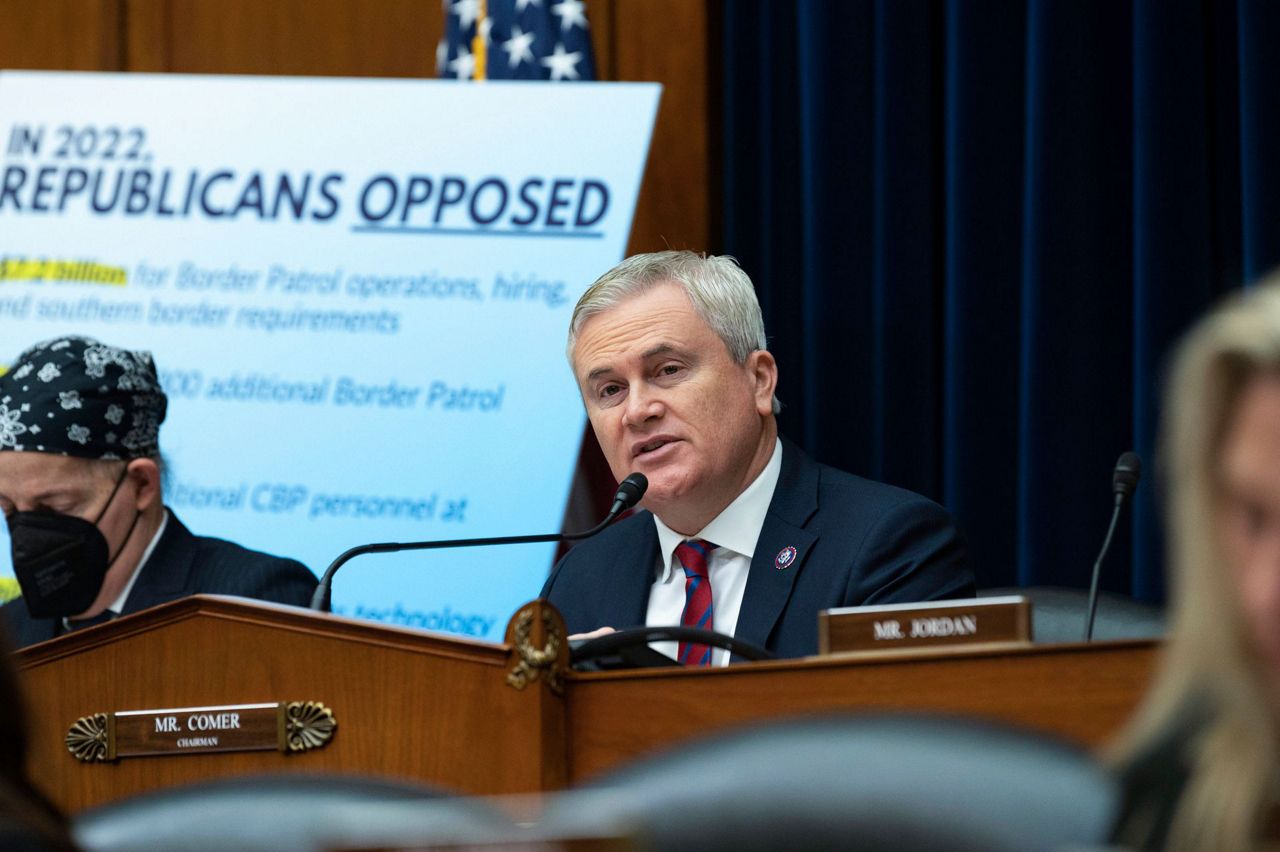
 House Oversight Chairman Rep. James Comer, R-Ky., opens a House Committee on Oversight and Accountability hearing on the border, Tuesday, Feb. 7, 2023, in Washington. Several Biden Cabinet members, including the chairman of the Joint Chiefs of Staff, received a letter Friday, Feb. 17, from House Republicans as they launched the second investigation into the chaotic U.S. withdrawal from Afghanistan. Comer sent a series of letters to senior leadership at the White House, Department of Defense, State Department and others requesting a tranche of documents related to the end of America's longest war. (AP Photo/Kevin Wolf, File)

BY ASSOCIATED PRESS WASHINGTON
PUBLISHED FEB. 17, 2023

WASHINGTON (AP) — Several Biden Cabinet members, including the chairman of the Joint Chiefs of Staff, received a letter Friday from House Republicans as they launched the second investigation into the chaotic U.S. withdrawal from Afghanistan.

Rep. James Comer, R-Ky., the chairman of the House Oversight Committee, sent a series of letters to senior leadership at the White House, Department of Defense, State Department and others requesting a tranche of documents related to the end of America's longest war.

“The Biden Administration was tragically unprepared for the Afghanistan withdrawal and their decisions in the region directly resulted in a national security and humanitarian catastrophe,” Comer said in a statement. “Every relevant department and agency should be prepared to cooperate and provide all requested information.”

Republicans have been vowing to press President Joe Biden’s administration on what went wrong as the Taliban swept to power in Afghanistan in August 2021 and the U.S. left scores of Americans and thousands of Afghans who helped them over the years in grave danger. Now with the power of the gavel, GOP lawmakers are elevating that criticism into aggressive congressional oversight, and on a topic that has been met with bipartisan support in the past.

In a statement, the State Department said that while it does not comment on congressional correspondence, the agency is committed to working with congressional committees.

“As of November 2022, the Department has provided more than 150 briefings to bipartisan Members and staff on Afghanistan policy since the withdrawal of U.S. forces from Afghanistan,” the statement continued. The White House did not immediately respond to a request for comment.

The letters Friday come nearly one month after Rep. Mike McCaul, the chairman of the House Foreign Affairs Committee, opened his own investigation into the deadly withdrawal, requesting documents from Secretary of State Antony Blinken.

McCaul’s letter outlined a request for all communications around the lead-up to pulling U.S. troops out of Afghanistan. He also made it clear that his committee, which has jurisdiction over the matter, also plans to investigate the after-effects of the withdrawal, including on the hundreds of thousands of Afghan allies left behind.

The Trump administration agreed late in its term to withdraw U.S. forces from Afghanistan in May 2021, with the former president saying in 2020, “Now it’s time for somebody else to do that work.” But Republicans are intent on reminding Americans that it was Biden who was in charge when the Taliban took over.

And the criticism over the issue began in a bipartisan manner, with several Democrat-led committees pledging to investigate what went wrong in the days and weeks after the withdrawal.

U.S. officials have said they were surprised by the quick collapse of the military and the government, prompting sharp congressional criticism of the intelligence community for failing to foresee it.

In a congressional hearing last spring, senators questioned whether there is a need to reform how intelligence agencies assess a foreign military’s will to fight. Lawmakers pointed to two key examples: U.S. intelligence believed that the Kabul government would hold on for months against the Taliban, and more recently believed that Ukraine’s forces would quickly fall to Russia’s invasion. Both were wrong.

Military and defense leaders have said the Afghanistan collapse was built on years of missteps, as the U.S. struggled to find a successful way to train and equip Afghan forces.

Last year, a watchdog group concluded it was decisions by Trump and Biden to pull all U.S. troops out of Afghanistan that were key factors in the collapse of that nation’s military.

The report by the Special Inspector General for Afghanistan Reconstruction, or SIGAR, mirrors assertions made by senior Pentagon and military leaders in the aftermath of the withdrawal. Military leaders have made it clear that their recommendation was to leave about 2,500 U.S. troops in the country, but that plan was not approved.

In February 2020, the Trump administration signed an agreement with the Taliban in Doha, Qatar, in which the U.S. promised to fully withdraw its troops by May 2021. The Taliban committed to several conditions, including stopping attacks on American and coalition forces. The stated objective was to promote a peace negotiation between the Taliban and the Afghan government, but that diplomatic effort never gained traction before Biden took office in January 2022.

___

Associated Press reporter Matthew Lee contributed to this report.


GOP officially launches probe into chaotic Afghanistan withdrawal

BY BRAD DRESS - 01/13/23
Staff Sgt. Victor Mancilla/U.S. Marine Corps via AP
In this Aug. 21, 2021,file photo provided by the U.S. Marines, U.S. Marines with Special Purpose Marine Air-Ground Task Force – Crisis Response – Central Command, provide assistance at an evacuation control checkpoint during an evacuation at Hamid Karzai International Airport in Kabul, Afghanistan.

A top House Republican has officially launched a probe into the Biden administration’s chaotic withdrawal from Afghanistan in August 2021, sending a letter to Secretary of State Antony Blinken requesting a wide array of information on the matter.

Rep. Michael McCaul (R-Texas), the chairman of the House Foreign Affairs Committee who served as its ranking member previously, said the Biden administration has so far refused to hand over documents but that he is now formally requesting compliance as chair of the panel.

“It is absurd and disgraceful that the Biden administration has repeatedly denied our longstanding oversight requests and continues to withhold information related to the withdrawal,” McCaul said in a statement. “In the event of continued noncompliance, the Committee will use the authorities available to it to enforce these requests as necessary, including through a compulsory process.”

McCaul is seeking intelligence assessments, internal agency documents and communications with the Taliban and Afghan government, among a long list of other inquiries in the letter Thursday.

He requested the information from the Biden administration by Jan. 26.

A spokesperson for the State Department said they were committed to working with the congressional committee and have already provided more than 150 briefings to bipartisan members of Congress since the withdrawal.

“Additionally, senior Department representatives have appeared in public hearings and answered questions on Afghanistan policy, and the Department has responded to thousands of requests for information and letters from members and their staffs related to Afghanistan policy,” the spokesperson said.

Republicans have long hinted at the Afghanistan investigation, one of a number of probes the party planned to launch after seizing the House in the November midterm elections.

In October, McCaul demanded the State Department preserve records related to the U.S. troop pullout from Afghanistan, promising he would investigate messy evacuations, the quick Taliban takeover of Kabul and the death of 13 American troops in a terrorist attack.

The chaos surrounding the Afghanistan withdrawal was the focus of bipartisan scrutiny in 2021 as the U.S. exit was highly publicized, with photos and videos showing refugees scrambling to leave the country.

Last year, Republicans on the Foreign Affairs Committee released a report as minority members of the panel slamming the White House for sloppy planning, understaffing at Afghanistan’s largest airport and failing to anticipate the wave of refugees.

The White House responded that the report was “riddled” with inaccuracies.

Republicans are also expected to issue subpoenas to compel U.S. officials to sit for depositions in the probe led by McCaul.Final pieces of Chinese spy balloon recovered off Atlantic CoastFamily of Tyre Nichols promises to be at every court date of five former officers

McCaul on Thursday said he takes the obligation of investigating the withdrawal “very seriously” and will “pursue this investigation until all our questions are answered and all parties responsible are held accountable.”

“We owe this to the American people, especially our service members and veterans,” the lawmaker said in his statement.

The House GOP’s many, many investigations, explained

House Republicans are ready to investigate everything under the sun.

By Li Zhouli@vox.com Feb 11, 2023,
Rep. Jim Jordan (R-OH), chairman of the House Judiciary Committee, strikes the gavel to start a hearing on US southern border security on Capitol Hill, February 1, 2023, in Washington, DC. Drew Angerer/Getty Images
Li Zhou is a politics reporter at Vox, where she covers Congress and elections. Previously, she was a tech policy reporter at Politico and an editorial fellow at the Atlantic.

If there’s anything House Republicans have promised to deliver on this term, it’s investigations — lots of them.

After retaking the House majority this year, the GOP is using its platform to do all it can to scrutinize the Biden administration. Already, lawmakers have held hearings on border security, Twitter’s handling of a story related to Hunter Biden’s laptop, and alleged biases that the federal government has against conservatives.

Many of these inquiries are dedicated to damaging the president, a strategy that’s tried and true. In a study of 53 years of congressional investigations, political scientists Douglas Kriner and Eric Schickler found that the more time Congress spent on hearings into potential executive branch misconduct, the lower the president’s approval rating became. Per their study, if lawmakers spent 20 days per month on investigative hearings, the president’s approval rating would see a commensurate decline of 2.5 percent in that timeframe.

Kriner notes that this trend is historical; it may not hold as the public has gotten more polarized in recent years and media ecosystems more siloed. But if a similar dynamic emerged ahead of 2024, Republican investigations might hurt Biden’s already-low approval ratings.

As members of the House majority, Republicans have gained key powers and a bigger platform to make their case. Now, GOP lawmakers are able to subpoena witnesses and documents, as well as hold public hearings in the hopes of generating news coverage and viral moments that cast Biden and his policies in a critical light. In the process, however, Republicans also run the risk of backlash from moderate members and voters if they go too far with their rhetoric.

GOP leaders, for their part, have said the intention of these investigations is to bring awareness to the administration’s policies and serve out their responsibility of checking the White House. “I think accountability is the most important point, but first you’ve got to get the facts out,” House Majority Leader Steve Scalise told Fox News about the need to investigate border policy.

Democrats, obviously, see things differently. “It’s a phony operation from beginning to end designed to further their partisan political interests,” Virginia Rep. Gerry Connolly, a Democrat on the House Oversight Committee, told Vox.

When the White House’s party loses the House, investigations follow

After a “blue wave” midterm elections in 2018, House Democrats set up multiple inquiries to look into President Donald Trump, including reviewing his family separation policy, potential ties between his campaign and Russia, and whistleblower allegations about how he sought to influence Ukrainian President Volodymyr Zelenskyy. Democrats emphasize, however, that Trump and his businesses have faced multiple investigations over other possible crimes, and argue that the impetus for their inquiries is not comparable to Republicans’ rationale for investigating Biden.

During the Obama administration, House Republicans also launched multiple investigations, including one that dove into the White House’s response to the Benghazi consulate terrorist attack. That review ultimately opened up potent lines of attack on Democrats’ 2016 presidential nominee, Obama’s Secretary of State Hillary Clinton. Despite concluding that there was no new evidence of wrongdoing by Clinton, the panel discovered that Clinton had used a private email server while secretary of state, a finding that spurred another investigation by the FBI, which became a central issue Republicans used against her in the 2016 election.

“All of that was designed to bring Hillary Clinton’s approval ratings down because Hillary Clinton, as secretary of state, was in the high 60s, and they were terrified of that knowing she was going to run for president,” says Connolly.

In the past, presidential family members like President Jimmy Carter’s brother Billy Carter have been the subject of congressional investigations, but the House Republicans’ focus on Hunter Biden, Biden’s son, is rarer in recent memory, according to Claire Leavitt, a Smith College government professor who previously worked as a fellow under Democrats on the House Oversight Committee. Leavitt added that the approach Republicans take to the public hearings could also set the tone for how substantive they are and how the public receives them.

“Having bomb-throwers like [Marjorie Taylor] Greene and [Lauren] Boebert on the House Oversight Committee will almost certainly make the hearings appear more overtly politicized — that is, investigations will appear more like inappropriate attacks on the president’s family than as serving a legitimate investigative purpose — than they otherwise would be,” says Leavitt.

What House Republicans are investigating

Hunter Biden: Republicans have sought to find information suggesting that the president was involved in his son’s business enterprises and that he’s been influenced by them, neither of which they have found any evidence of.

Despite this, House Oversight Committee Chair James Comer (R-KY) has noted that he’s committed to exploring whether Biden’s family’s business deals “occurred at the expense of American interests” and if they could pose a “national security threat.”

Specific concerns that Republicans have raised include work that Hunter Biden has done involving a deal with a Chinese energy company and his role sitting on the board of Burisma, a Ukrainian energy company. They argue that Hunter used his father’s name to secure business deals but have thus far not tied the president to these arrangements. The alleged contents of Hunter Biden’s laptop, which were broadly disclosed by conservatives after he left it at a Delaware repair shop and which purportedly address some of these business ventures, are set to be examined as well.

Republican efforts in this investigation are just getting underway. In early February, Comer called on Hunter Biden to submit records of communications with the president about his financial dealings as well as additional documents like bank statements. The Oversight Committee has also requested documents from the president’s brother James Biden, who has worked with Hunter Biden in the past, and Eric Schwerin, who is Hunter Biden’s business partner. Hunter Biden’s attorney, Abbe Lowell, has questioned the “legitimate legislative purpose” that the committee has to ask for these records, and noted that he would sit down with the committee to see what relevant information they can provide, if any.

Comer said the investigation could help the committee develop federal ethics policy, in an attempt to give it a clearer legislative purpose. One of the panel’s earliest hearings examined whether Twitter mishandled a New York Post story about the contents of Hunter Biden’s laptop and tried to censor its distribution. Former executives at the company testified that they had made a mistake by restricting the sharing of the story, but said that they had not been told by government officials to do so.

Border security: The first hearing from the House Judiciary committee centered on border security, an issue that Republicans have long sought to go after Democrats on because they argue that the White House’s immigration policies have been ineffective.

This panel and others intend to press the administration on the increase in migrants entering the country at the southern border and the trafficking of fentanyl, which has contributed to a high number of fatalities in the US. Republicans are eager to return to harsher Trump-era policies, including the construction of a border wall, which they describe as focused on deterrence.

A segment of Republicans has also said they’d like to push for the impeachment of DHS Secretary Alejandro Mayorkas on the grounds that he has failed to effectively address the border policy, a suggestion that’s drawn pushback from Democrats.

Given how central messaging on immigration has been to Republican campaigns in the past, these committees give them another venue to criticize Biden’s stances on the issue and try to make it a key vulnerability for the president in 2024.

“Weaponization of the federal government”: This newly created panel is aimed at reviewing long-held Republican concerns that government agencies like the Justice Department and FBI are biased against them, claims which federal officials have rebutted.

“This special subcommittee is going to deal with issues that date back before this administration, but have been clearly recognized,” Rep. Darrell Issa (R-CA), a top Republican on the panel, told Vox.

These anxieties have been spurred by issues like the FBI’s raid of Mar-a-Lago for classified documents that Trump had declined to turn over to the National Archives and what Republicans have described as the FBI’s targeting of January 6 rioters. The panel is an opportunity to discuss how conservatives have been unfairly treated, Republicans argue, though Democrats have argued that it’s simply another chance for them to use their perch to elevate conspiracy theories and unfounded allegations.

Biden documents: The recent discovery of classified documents at Biden’s Wilmington, Delaware, home and the Penn Biden Center, a think tank where he worked after the vice presidency, are another avenue that Republicans hope to explore. Notably, Biden’s approach to the classified documents has been very different from Trump’s in that he has fully cooperated and turned documents over to the National Archives and DOJ that have been found.

Since the discovery of the documents, the DOJ has also appointed special counsel Robert Hur to look into the matter. The Oversight Committee has requested the records of visitors at Biden’s home in Wilmington, something which the White House has said it’s unable to provide because such logs weren’t kept.

The discovery of the classified documents in Biden’s possession offers a way for Republicans to try to deflect the focus on Trump’s decision to hang onto classified documents while also painting the current president as careless with his own files.

Afghanistan: The House Foreign Affairs Committee is working on a review of the administration’s exit from Afghanistan in 2021, a move that garnered major criticism for the rushed and messy evacuation of US allies and refugees.

The panel has begun by requesting documents from the State Department about the lead-up to the withdrawal, how the administration addressed it, and what the outcome has been in Afghanistan since. “America’s adversaries have been emboldened and the country has once again become a safe haven for terrorists,” Rep. Michael McCaul (R-TX), the Foreign Affairs Committee chair, has argued, regarding the White House’s approach to the withdrawal.

The Afghanistan withdrawal received bipartisan criticism when it took place, although it’s not yet apparent that Republican oversight is dedicated to fully reviewing these concerns or simply seeding doubts about Biden’s approach to foreign policy and national security.

Covid-19: The origins of Covid-19, and how the Biden administration responded during the pandemic, are another subject that Republicans intend to scrutinize with testimony from health policy officials and scientists in the coming weeks. A select committee on the “coronavirus crisis” will be dedicated to this effort.

“The panel is ... expected to focus on claims, unsupported by evidence, that a laboratory in Wuhan, China, either bioengineered or accidentally released SARS-CoV-2 obtained from bats,” Science reports. In a recent hearing, acting NIH director Lawrence Tabak stressed that US-funded research at a Wuhan lab did not cause the pandemic.

Republicans have frequently attacked the Biden administration’s response to the pandemic and actively opposed policies it supported, including masking and vaccines. This committee is set to be another opportunity for the GOP to advance such rhetoric and to paint Democrats as opposed to “personal liberty.”

US-China policy: A new Select Committee on China is aimed at evaluating “strategic competition” between the two countries as lawmakers examine how the US can invest in its supply chain and research, and be less reliant on manufacturing and other services done abroad.

Lawmakers have cautioned that panels like this shouldn’t be used to advance xenophobia and racial profiling in the US, issues that have been byproducts of the Justice Department’s “China Initiative,” which has accused Chinese American scientists of espionage.

“This committee should not be used as an open invitation to engage in blatantly xenophobic anti-China rhetoric … and to promote policies that result in the racial profiling of our communities,” said Rep. Judy Chu (D–CA), chair of the Congressional Asian Pacific American Caucus.

The discovery and shooting down of a Chinese balloon hovering high over the United States has also renewed tensions between the two countries, which is likely to be a focus of the panel as well. Already, Republicans have used the balloon incident to allege that Biden is too “soft on China,” allowing the country to gain manufacturing, technological, diplomatic, and economic advantages over the US, a critique they could well use this panel to levy again this term.

Fraud in pandemic relief funds: Republicans have said they are intent on evaluating how pandemic relief funding was doled out, and how billions of dollars may not have reached the small businesses they were intended to help. Experts have estimated that $80 billion in programs like the Paycheck Protection Program were taken by fraudsters, according to NBC News.

This investigation is among those in which there is interest from both parties in addressing these problems, which affected initiatives that were set up under both the Trump and Biden administrations.

The GOP, however, has argued that Democrats haven’t done enough to root out the fraud in these programs, leading them to cast Biden and his party as being unconcerned with government spending. There is currently bipartisan support in trying to figure out how to prevent these gaps from being exploited again.

Pakistan’s Plans to Rebuild After the Floods Are Flawed. This 82-Year-Old is Trying to Fix Them

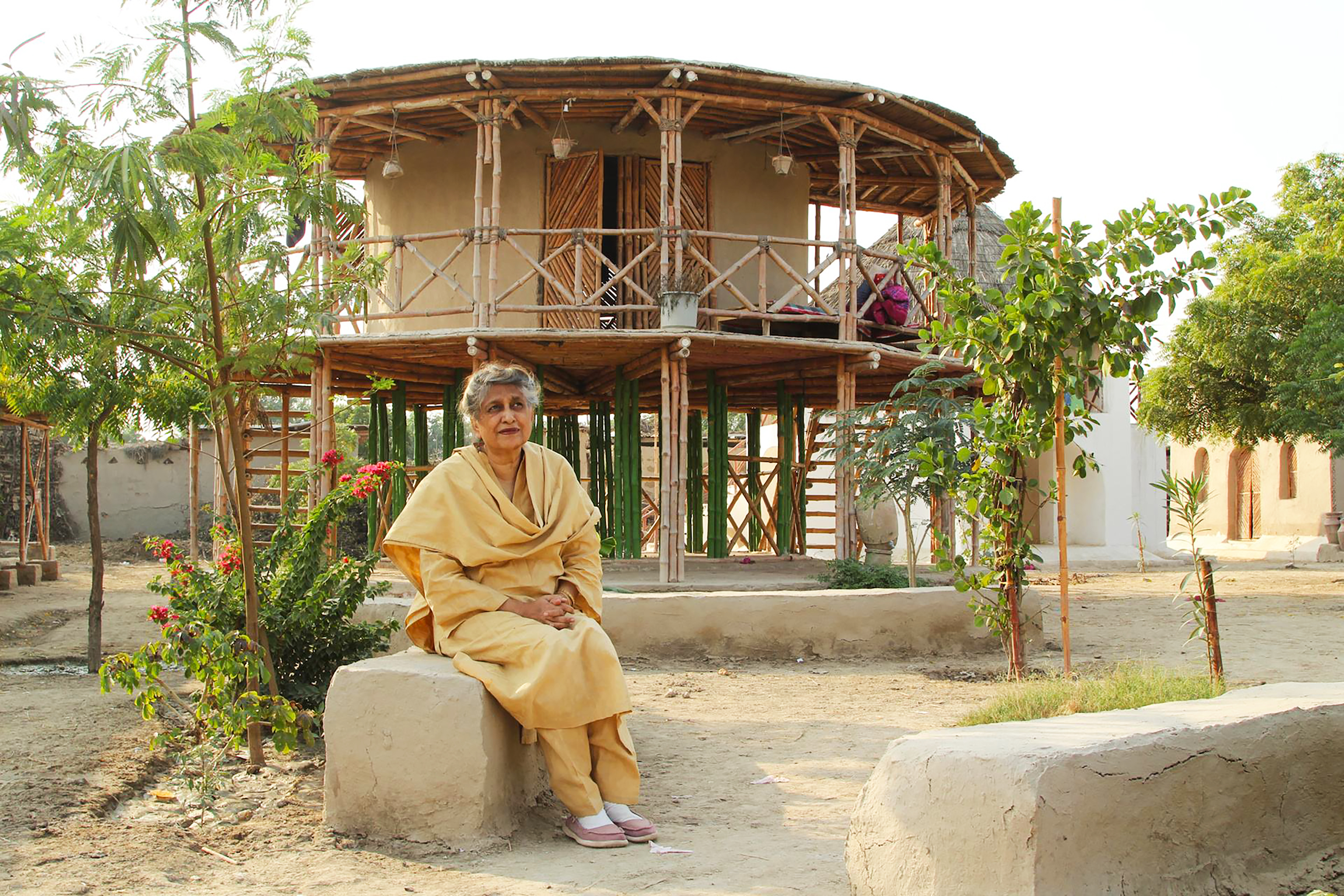
Yasmeen Lari, founder of the Heritage Foundation of Pakistan, wants Pakistan to abandon its growing reliance on concrete.

BY CIARA NUGENT
FEBRUARY 17, 2023 

Pakistan is home to one of the ancient world’s most impressive examples of flood-resilient design. The ruins of Mohenjo-Daro, a bronze age city in the southeastern province of Sindh, sit on raised platforms with sophisticated drainage systems that protected them from annual monsoon rains. Those features have helped the remains of these earthen buildings survive for 4,500 years—and weather the devastating floods that have repeatedly struck Pakistan over the last decade, most recently submerging a third of the country in August 2022.

And yet, according to Pakistani architect Yasmeeen Lari, those tasked with rebuilding the country from the floods tend to look not to Mohenjo-Daro, but to the West. “I call it the international colonial charity model: international NGOs and UN agencies say, ‘let’s bring in concrete, let’s bring burnt brick’,” she says. “Well, those are alien materials for people in these areas.”

Lari, a slight, energetic 82-year-old who was Pakistan’s first certified female architect, is on a mission to transform how her country rebuilds from natural disasters. In the past, when floods or earthquakes have destroyed homes, aid agencies have rushed to replace them with expensive concrete or burnt brick structures, believing, per the International Organization for Migration, that they were the only durable option. But these are not miracle materials. They are not immune to collapsing under the increasingly heavy rains Pakistan faces, as thousands of buildings did during the most recent floods, and when they do they can crush residents. Concrete also absorbs a lot of heat, making life inside homes tough during Pakistan’s summers, and it’s hard for poorer villagers to maintain or expand on them once construction crews have departed. And, because manufacturing concrete and burnt brick is extremely carbon-intensive, these materials worsen the greenhouse effect that is driving more catastrophic floods in the first place. (The manufacture of building materials makes up 11% of global greenhouse emissions, with the lion’s share coming from concrete.)

A better solution for Pakistan’s climate woes, Lari says, lies in its local architectural traditions. “There is no reason for us not to follow what is already there,” she says, sitting in a cafe at the U.K.’s Cambridge University, where she is lecturing for the year. “You have to design according to the conditions where you are.”

The Heritage Foundation of Pakistan, founded by Lari in 1980, is training villagers in Sindh province to build their own flood-resilient homes from cheap, locally available, low-carbon materials. Lari’s designs use bamboo panels, which are reinforced with earth and lime, and sit on raised platforms—small twists on traditional mud huts that make them waterproof. Once they have the skills, residents can expand their villages and train others. Between mid-September and the end of 2022, the foundation helped build 3,500 homes in 60 villages. Now, Lari is trying to persuade NGOs, banks, and foreign donors to directly fund her trained artisans and local communities, with the aim of building one million homes by 2024.


A woman sits on the front step of her home, built to Lari's bamboo, earth and lime designs.   
Heritage Foundation of Pakistan

The timing is urgent. Pakistan is about to launch into one of its most intense periods of rebuilding in its history. Authorities say at least two million people are in need of shelter. And money is on the way: in January, a group of banks and countries pledged some $9 billion in recovery funds.

If those resources are channeled into millions of concrete homes, built without the participation of the people who will live in them, Lari says, Pakistan will only continue in its cycle of crisis. “We have to be talking about: How will you deal with the next disaster? How do we train people to be able to defend themselves?

Read More: Pakistan Flooding Raises Tough Questions About Who Should Pay For Catastrophic Climate Impacts

Lari was not always a champion of Pakistan’s vernacular architecture. When she began her career in Karachi in the 1960s, elites in a newly independent Pakistan were still deeply influenced by British colonialism. Lari had just graduated from the U.K.’s Oxford Brookes University, and her father had been a civil servant in the colonial government. “We grew up thinking that whatever was in the West was something that we all had to emulate,” she says.

Lari spent her first four decades as an architect designing in the western-influenced, globalized palate of concrete, steel, and glass. And she was good at it. Her striking brutalist homes and hotels and other structures won a slew of national and international awards. Her most famous building is probably the headquarters for Pakistan’s state-owned oil company, a sleek, imposing, carbon-intensive behemoth that opened in downtown Karachi in 1991. “The 1980s were a very wasteful time—you could get any material in the world that you wanted,” she says. “And as a designer you do enjoy that freedom.”

She gave up that kind of freedom in 2005. That year, a magnitude 7.6 earthquake struck Pakistan-administered Kashmir, killing a staggering 79,000 people in the region. The quake also collapsed 32,000 buildings and displaced 400,000 people. Lari, who was by then working in heritage conservation, went to help rebuild. Struck by the incredible volume of debris, she determined to use recycled materials wherever possible in her shelters.

Since then, once-in-a-generation natural disasters have struck Pakistan every few years. In 2010, glacier melt combined with heavy monsoon rains swept through towns and villages along the entire length of the country, leaving 14 million without homes. Similar floods happened again the following year, and the year after that.

That cycle is only likely to get worse thanks to climate change. That’s why, Lari says, Pakistan should strive to limit the carbon footprint of its buildings—even though the country bears far less responsibility for rising global temperatures than wealthier countries. (Pakistan is home to 2.8% of the world’s population, but has contributed just 0.3% of global carbon dioxide emissions since the Industrial Revolution.) “In 2005, we built 400,000 units, mostly with concrete blocks, and then it was only five years later that we had the glaciers melting,” Lari says. “So maybe in the global emissions table, we are not that high. But I think we did hurt our own selves in some way.”

Local materials and designs are likely to be more popular in this round of rebuilding than after the 2010 floods, says Shafqat Munir, director of resilient development at Islamabad’s Sustainable Development Policy Institute. That’s in part because of who is leading the programs. Following a 2013 law change, hundreds of international NGOs that were operating in Pakistan a decade ago have departed, leaving Pakistani charities and local initiatives to take a bigger role. “Local charities will tend to use local materials, simply because concrete is too costly.”

But Munir cautions that vernacular traditions need to be adapted to Pakistan’s new climate, in which flood waters linger for much longer than in the past. That means the use of raised platforms—like those found in Mohenjo-Daro—should be greatly expanded, he says, and new technologies, like heat-resistant roofing materials, should be incorporated where available. Guidance from skilled designers like Lari will help: to water-proof earth buildings, Lari adapted a method of slaking lime that is popular in conservation work to make materials more portable.


The Heritage Foundation of Pakistan training center in the village of Pono Markaz, Sindh province.  
Heritage Foundation of Pakistan

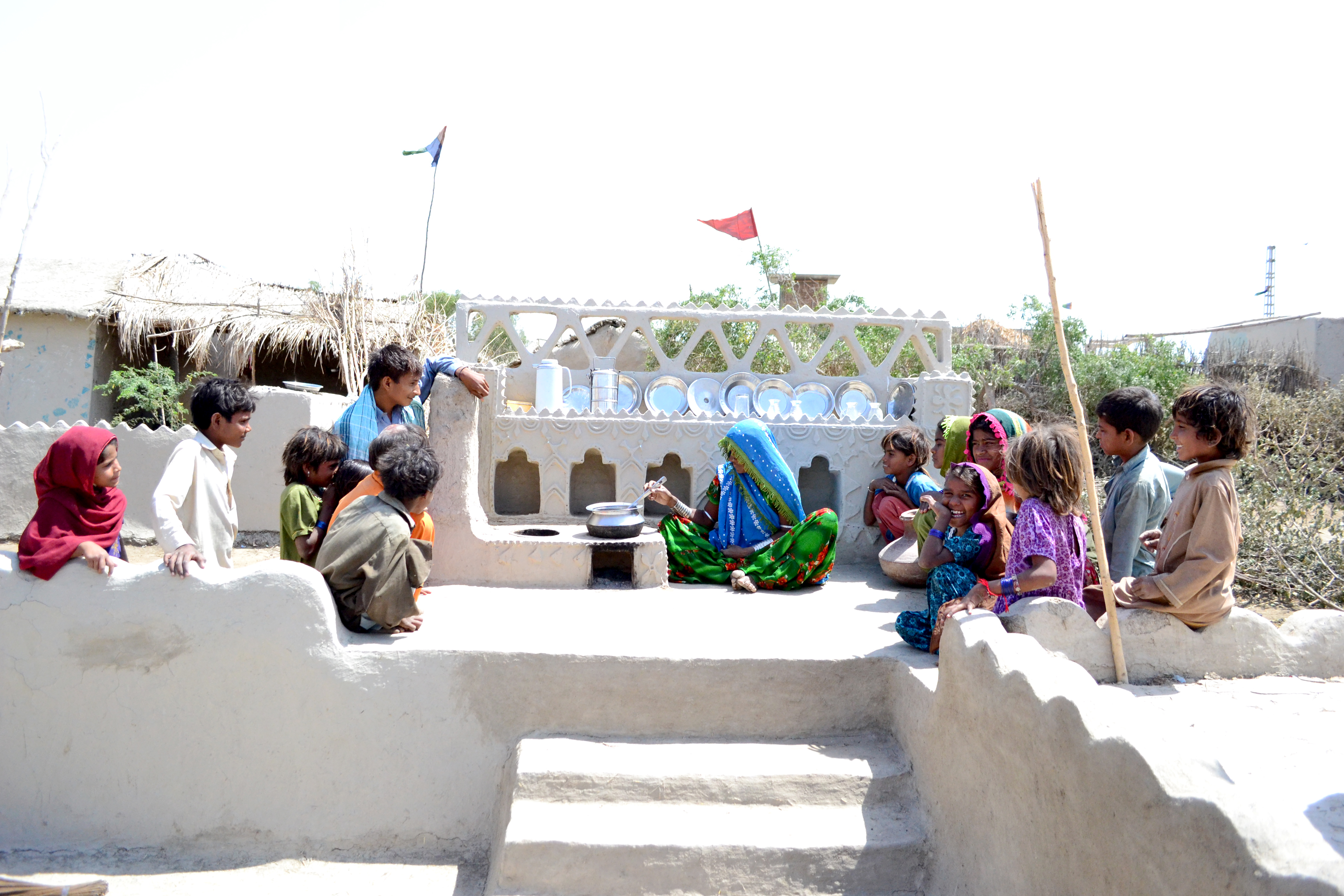
Lari doesn’t just want to change the building materials people use, but the entire post-disaster charity system. At the Heritage Foundation of Pakistan’s two training centers in Sindh—one near Makli, an archaeological site, and one in the village of Pono Markaz—a team of 10 certified artisans teaches laborers to reinforce earth, build bamboo panels, assemble them into octagon-shaped shelters, and add a roof. Those artisans then travel to villages to teach residents how to build in three-day sessions. Once residents can build a one-room bamboo shelter, they can use earth and lime to turn them into permanent homes, personalize them with outerwall decorations, and learn to build larger versions of the structure for schools or meeting places. Then, Lari says, villages can connect with other nearby communities to train them to build the shelters too. The Heritage Foundation also arranges training sessions for villagers to learn how to make cooking stoves, terracotta tiles, woven matts, and more, with the aim of giving people skills and products to trade with nearby communities. “It is all about knowledge sharing,” Lari says. “Then it can spread massively.”

Prior to last summer’s floods, Lari’s team had helped build 950 homes in Sindh, using prefab bamboo panels assembled onsite, as well as other larger structures at Pono Markaz village. She says the Heritage Foundation surveyed the structures, some of which were left in standing water for two months following the floods, and found no structural damage.

Villagers use a stove on a raised platform, designed by Lari
Heritage Foundation of Pakistan

Lari says it costs the foundation less than $200 to build each shelter, with the money going to buy materials and pay the trainers for their work. It also provides funds for villages to set up committees, led by local women, to invest in their micro-industries. (That is compared to about $1,000 to $1,600 for the average burnt brick shelter, and even more for concrete.)

Going forward, Lari wants the foundation’s role to be purely training-based, and for donors to send their money directly to village committees. Such a system, she argues, empowers people to take ownership of the rebuilding process. It would be more efficient and less vulnerable to corruption—a problem that many in the sector are concerned about following a series of massive graft scandals at Pakistani NGOs following the 2010 floods.

It’s unclear, however, if those funding Pakistan’s rebuilding will be receptive to that local-led approach. An initial flurry of interest from donors when Lari proposed her target of one million shelters by 2024 died down, she says, after the World Bank and other development banks announced a large set of grants and loans in January. “There is no longer emphasis on self reliance or empowerment, the emphasis is only on building a shelter,” she says. “If past trends are to be relied upon, the World Bank will be pushing for concrete structures.”

Still, several international development organizations, including U.N. Habitat, Rotary International, Rizq Foundation, and Islamic Relief, are in talks with the Heritage Foundation about how to apply Lari’s model. And smaller local NGOs, as Munir says, may well favor cheaper local materials.


Lari hopes their work will convince others to rethink rebuilding—both in Pakistan and in many other developing countries now facing unrelenting climate disasters. “I really believe that this is the moment to bring about a whole change in the social system,” she says. ”Climate change shouldn’t be taken only as a threat. If we start doing the right thing, it can really transform lives.”

WRITE TO CIARA NUGENT AT CIARA.NUGENT@TIME.COM. hopes their work will convince others to rethink rebuilding—both in Pakistan and in many other developing countries now facing unrelenting climate disasters. “I really believe that this is the moment to bring about a whole change in the social system,” she says. ”Climate change shouldn’t be taken only as a threat. If we start doing the right thing, it can really transform lives.”

WRITE TO CIARA NUGENT AT CIARA.NUGENT@TIME.COM.


ELIMINATE THE SECOND AMENDMENT

Addressing social isolation may be key in preventing mass shootings, study finds

Addressing social isolation may be key in preventing mass shootings, study finds
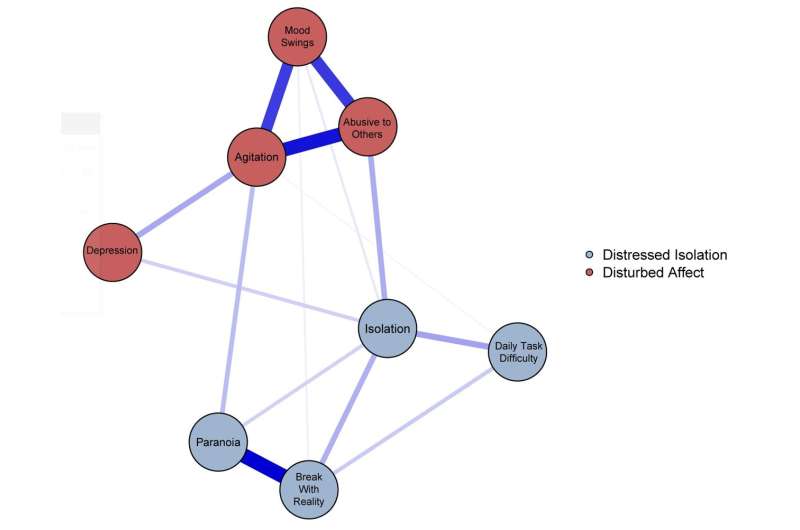
The shooter crisis network. Nodes represent cross-sectional variables. Edge width and depth of color reflects the associative strength between any pair of nodes. Credit: PsyArXiv (2022). DOI: 10.31234/osf.io/63xyt

An analysis of the psychological crises exhibited by 177 mass shooters has identified social isolation as the most important external indicator leading up to the attacks. The finding, which is based on research conducted at Virginia Commonwealth University, suggests that social isolation is an ideal candidate for acquaintances and communities of would-be shooters to intervene.

"When we are isolated from our social circles, we lose that functional component of our loved ones being frank with us when our behavior might become inappropriate," said Samuel West, Ph.D., an assistant professor of psychology at Virginia State University who led the study while he was a postdoctoral researcher at the Injury and Violence Prevention Research Lab at VCU Health.

The study also found that the "mood swings" crisis indicator was one of the strongest predictors of a  shooting's severity. However, the authors concluded that social isolation was the most important because it acted as a "crisis multiplier" in that it allowed crises to increase the risk of other crises. For example, mood swings also increased the likelihood of paranoia, breaks with reality, and difficulties with daily tasks due to its connection with isolation.

"It is easy to see how this perfect storm of multiple crises in someone who has isolated themselves could coalesce into more harmful thoughts and ultimately actions without the perspectives of others to act as a protective factor," said West, who received his doctorate from the Department of Psychology in the College of Humanities and Sciences at Virginia Commonwealth University.

West and co-author Nicholas Thomson, Ph.D., director of research and a forensic psychologist at the Injury and Violence Prevention Program, analyzed the data using psychometric network analysis, a new machine learning-based approach to exploring and visualizing complex relationships. They approached the study by focusing on psychological crises that nonexpert third parties—such as friends, family and co-workers—could observe and subsequently intervene.

"Research on  is scarce, which limits our ability to develop targeted risk assessments and prevention strategies for mass shootings," said Thomson, an associate professor in the Department of Surgery in the School of Medicine and the Department of Psychology in the College of Humanities and Sciences. "What Dr. West has achieved with the data is a step in the right direction for understanding the warning signs of people who commit mass shootings."

The study is novel in that the data collected is based on others' perceptions of a mass shooter, Thomson said.

"In many ways, this is the data that we need because others' perceptions are integral to identifying and reporting at-risk individuals, and the community is critical to preventing violence," he said. "Equipped with the right knowledge we can develop risk awareness strategies that can prevent mass shootings from occurring. Of course, this is only one piece of the puzzle, but it is an important piece."

The researchers see  as an ideal target for intervention because it can be addressed both at the individual level and the societal level.

"Although most people who experience isolation do not go on to commit such acts of violence, intervening on that isolation only holds benefits for the individual," West said.

"This can be as simple as a friend stopping by in person to say hello and catch up—something that we could all benefit from. Although this seems like it may not have such an impact, prior research makes clear that isolation is a necessary component of planning and carrying out a mass shooting as many of the behaviors involved (e.g., stockpiling guns and ammunition) are readily observable."

At the societal level, interventions could focus on building social ties and addressing isolation in communities.

"One example could be to require students at public high schools to participate in civic events and organizations as part of their compulsory education," West said. "On the other side of this coin, we also must consider that many of these individuals end up isolated for other reasons initially (i.e., social rejection). As such, working on the inclusivity of others overall while continuing to address bullying behavior in young people could be a fruitful avenue to improve the mental and social health of students and society at large."

Social isolation is also a good target for intervention because it was typically noticed significantly sooner, such as months or years before an attack, than other psychological crises, which tended to be observed days to weeks before an attack.

"Although scientifically validated interventions for isolation exist, they have all been developed to address  in those who are seeking relief," West said. "Such interventions would necessarily look different with would-be mass shooters as it is likely they would not willfully seek out such help on their own. Our work doesn't speak to causality or any specific intervention that could be applied in this context."

The work is available on the PsyArXiv preprint server and will be published in Psychology of Violence.

More information: Samuel James West et al, Exploring Personal Crises Observed in Mass Shooters as Targets for Detection and Intervention Using Psychometric Network Analysis, PsyArXiv (2022). DOI: 10.31234/osf.io/63xyt

Magnesium – a promising candidate for rechargeable batteries

Staff Writer | February 16, 2023 |

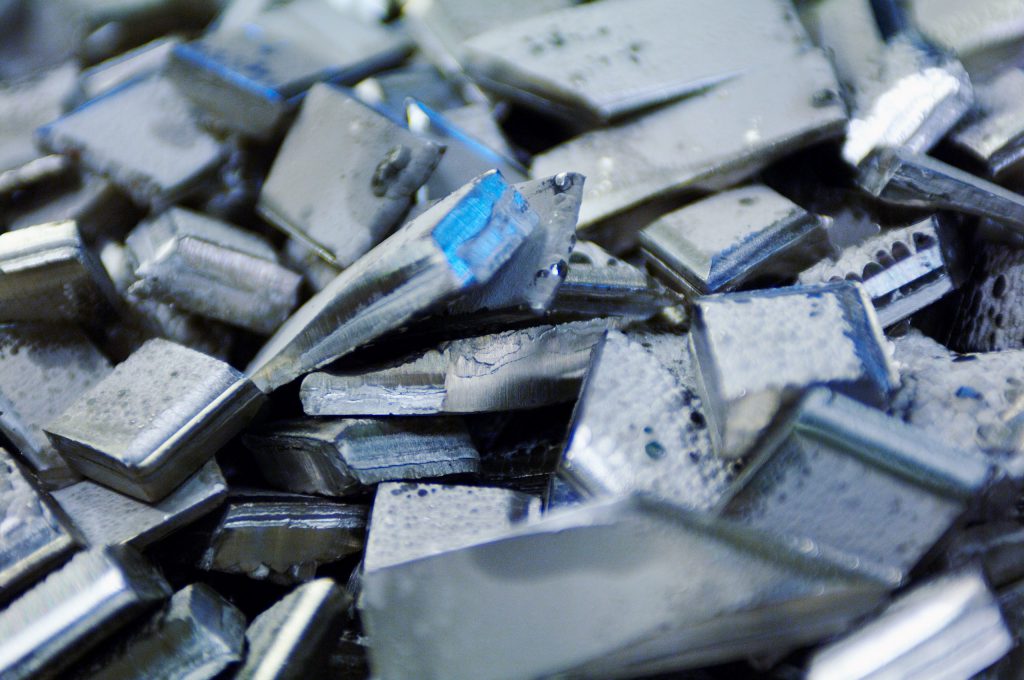
Crystalized magnesium. (Reference image by CSIRO, Wikimedia Commons).

A research team at the Tokyo University of Science has achieved some success in its search for new cathode materials for magnesium batteries.


In particular, the researchers are focusing on ways to improve the performance of cathode materials based on the magnesium-vanadium system.

In a paper published in the Journal of Electroanalytical Chemistry, the group explains that they worked with the Mg1.33V1.67O4 system but substituted some amount of vanadium with manganese, obtaining materials with the formula Mg1.33V1.67−xMnxO4, where x goes from 0.1 to 0.4. While this system offered high theoretical capacity, more details about its structure, cyclability, and cathode performance needed to be analyzed to understand its practical utility.

Accordingly, the researchers studied the composition, crystal structure, electron distribution, and particle morphologies of Mg1.33V1.67−xMnxO4 compounds using X-ray diffraction and absorption, as well as transmission electron microscopy. The analyses showed that Mg1.33V1.67−xMnxO4 has a spinel structure with a remarkably uniform composition.

Next, they conducted a series of electrochemical measurements to evaluate the battery performance of Mg1.33V1.67−xMnxO4, using different electrolytes and testing the resulting charge/discharge properties at various temperatures.

The team observed a high discharge capacity for these cathode materials—especially Mg1.33V1.57Mn0.1O4—but it also varied significantly depending on the cycle number. To understand why this happened, they analyzed the local structure near the vanadium atoms in the material.

“It appears that the particularly stable crystal structure along with a large amount of charge compensation by vanadium leads to the superior charge/discharge properties we observed for Mg1.33V1.57Mn0.1O4,” lead researcher Yasushi Idemoto said in a media statement. “Taken together, our results indicate that Mg1.33V1.57Mn0.1O4 could be a good candidate cathode material for magnesium rechargeable batteries.”

Idemoto said that through future research and development, magnesium batteries could surpass lithium-ion batteries thanks to the former’s higher energy density.

The scientist pointed out that, in addition to the potential to realize higher battery capacities, magnesium is considered a promising candidate for rechargeable batteries because the metal is safer for battery chemistries than lithium and is more abundant.

Thus, his research aims to address the low voltage window that Mg ions provide, as well as the unreliable cycling performance observed in Mg battery materials.

South32 sees China manganese demand up as half-year profit falls

Reuters | February 16, 2023 

Construction site in China (Stock Image)

Diversified miner South32 Ltd pointed on Thursday to signs of rising Chinese demand for steel-making material manganese, while reporting a 44% drop in first-half underlying earnings driven by inflation and falls in prices for its key commodities.


The result slightly beat analyst’s expectations.

The company, the world’s biggest producer of manganese, said the steel market in China had just begun to warm up following the end of pandemic controls there late last year. A pick-up in property-related steel demand from China would underpin higher manganese prices in coming months, chief executive Graham Kerr told Reuters.

“Real estate is probably still the sluggish market at the moment. That hasn’t quite taken off yet compared to the industrial side,” he said.

However, fresh buying of steel from that sector should erode stockpiles and help lift manganese prices to around $6.20 per dry metric tonne over the next three months from around $5.90 currently, he said. As more supply from South Africa appeared, prices would fall back towards $5.20 to $5.30, he said.

Headquartered in Perth, South32 was spun off from mining giant BHP Group in 2015. It also produces aluminum, lead, zinc, nickel and coking coal and copper.

Underlying earnings for the six months ended Dec. 31 were $560 million, compared with $1 billion a year earlier and ahead of a Visible Alpha consensus of $550 million.

South32 logged $127 million in cost rises linked to general inflation across its Australian, South African and Columbian operations.

Kerr said inflation was particularly acute in Australia’s labour market, where competition for highly paid workers such as jumbo drill operators was fierce. Lithium developments in Western Australia and mine-sustaining projects by iron ore majors were driving up demand for such workers.

Also, he said, some people no longer wanted fly-in, fly-out (FIFO) jobs, in which workers live at a mine for perhaps two weeks then go home for a week.

“That’s a function of a number of things: people coming out of Covid and making decisions around lifestyle. Some don’t want to do FIFO anymore,” he said.

“We are also losing some of our jumbo operators to places like Africa because they are chasing the dollars, so that’s the inflation driver.”

Kerr expects Australia’s labour market to stay tight for another 12 to 18 months.

The company expanded its capital management programme for the second half of its financial year by $50 million to $2.3 billion, leaving $158 million to be returned to shareholders by Sept. 1. It declared an interim dividend of 4.9 cents per share, down from 8.7 cents in the prior year and slightly below Citi’s expectation of 5.7 cents.

The shares closed 0.9% higher at A$4.66.

South32 separately said its vice-president of finance, Sandy Sibenaler, would become chief financial officer.

The company left its full-year 2023 production guidance unchanged.

(By Melanie Burton and Archishma Iyer; Editing by Shailesh Kuber and Bradley Perrett)
Mitsubishi Materials targets more mines to triple copper output by 2030
Reuters | February 16, 2023 | 

The Zafranal porphyry copper-gold deposit in southern Peru owned by Teck Resources, AQM Copper and Mitsubishi Materials Corp. Credit: AQM Copper

Japan’s Mitsubishi Materials Corp aims to more than triple its copper concentrate output through equity holdings by 2030, possibly through buying stakes in early and mid-stage mining development projects, its president said on Thursday.


“We will be targeting projects that have considerably progressed in terms of the development stage, and those that are in the early stage,” President Naoki Ono told a news conference, when asked about investment plans for copper mines.

Under a mid-term business plan unveiled last Friday, the company plans to invest 250 billion yen ($1.9 billion) by 2030 in the resource recycling business which include copper mining and smelting.

Mitsubishi Materials, which owns stakes in several copper mines including Los Pelambres and Mantoverde in Chile, aims to boost its copper concentrate production to 500,000 tonnes a year by fiscal 2030 from 150,000 tonnes now.

Japan’s third-biggest copper smelter also plans to expand its smelting capacity in Japan by about 30% by 2030, Ono said.

“We will also consider mergers and acquisitions in rare earth and lithium-ion battery recycling,” he said.

($1 = 133.9200 yen)

(By Yuka Obayashi; Editing by Jason Neely)
CRIMINAL CAPITALI$M
Trafigura nickel fraud would not happen at Glencore, CEO says
Bloomberg News | February 16, 2023 |

Refined nickel at Glencore’s Nikkelverk refinery in Norway. 
Credit: Glencore

Glencore Plc has no exposure to the Indian businessman accused by rival Trafigura Group of perpetrating a nickel fraud of more than half a billion dollars.


Gupta and his companies are “not a counterparty of our company,” Glencore Chief Executive Officer Gary Nagle told journalists on Wednesday. “So we do not have any exposure to that group.”

Trafigura last week accused Prateek Gupta and companies connected to him of perpetrating a “systematic fraud” against it, after finding that nickel cargoes it had bought from him in fact contained no nickel.

In a dig at Glencore’s longstanding rival, Nagle said that his company’s controls meant that he could be sure it would not be hit by a similar situation.

“We have very strong controls and systems in the company, and we are very confident that an incident like that would not be able to happen at Glencore,” he said.

Court filings showed that shortcomings in Trafigura’s controls meant it paid Gupta’s companies hundreds of millions of dollars for cargoes of nickel without always having insisted on certificates verifying the contents, Bloomberg reported earlier this week. The trading house believes it’s likely that none of the 1,104 containers it bought from Gupta actually has any nickel inside.

Gupta and his companies have not responded to requests for comment.

(By Jack Farchy)

Related article: Trafigura faces $577 million loss on alleged nickel fraud
Newcrest to trial 4G LTE, 5G technologies underground at Cadia Valley

Staff Writer | February 16, 2023 | 

Newcrest’s Cadia Valley Operations is the largest underground mine in Australia. 
Credit: PHE Pty Ltd.

Newcrest (ASX: NCM) (TSX: NCM) will trial advanced 4G Long-Term Evolution (LTE) and 5G mobile technologies to assess the potential of cellular delivery of data and video to support a smarter, safer and more sustainable underground mine operation.


The trial will take place at its Cadia Valley Operations (CVO), located bout 20 km from the regional city of Orange, New South Wales, Australia. Cadia is home to one of Australia’s largest gold mining operations, comprising the Cadia East underground panel cave mine and the Ridgeway underground mine (currently in care and maintenance).

In partnership with Ericsson and Telstra Purple, Newcrest will deploy a private 4G LTE and 5G trial network in its underground operations at Cadia in the coming months.

This announcement follows previous engagements where the trio worked to improve communications coverage, performance and safety with private 4G LTE at the Lihir mine in Papua New Guinea, and more recently for surface operations at Cadia Valley.

Speaking at the Sweden-Australia Sustainable Mining Summit in Sydney earlier this week, CVO general manager Aaron Brannigan said modern mining is a data-driven business, with technology and digitalization creating new levels of productivity and safety, greater efficiency and reduced environmental impact.

“In the ongoing quest for productivity, efficiency and safety, Newcrest must use every tool at our disposal to boost performance at site while continuing to ensure that everyone at our mines gets home safely at the end of the day,” Brannigan said.

“With 4G and 5G mobile technologies potentially offering better performance and capabilities than Wi-Fi, this trial will help Newcrest to assess its viability for greater coverage, capacity and functionality to support advanced underground automation, our Connected Worker strategy and future growth at Cadia,” he added.

The underground trial will utilize Ericsson’s Private 5G (EP5G) solution for Industry 4.0 enterprises to assess different cellular approaches for coverage and capacity needs and deployment economics. It will include the use of various 4G and 5G radio types, massive- and multi-user MIMO (multiple-input-multiple-output) advanced antenna systems for high-density and high-capacity connectivity requirements, and Uplink Booster technology derived from custom-made Ericsson Silicon system-on-a-chip 5G processors to increase uplink signal strength and data throughput.

“5G connectivity will be instrumental in enabling advanced teleremote and autonomous technologies, which are integral to industries such as mining. We’re delighted to be working with Newcrest and Telstra Purple to trial Ericsson’s 4G LTE and 5G solutions, and enable Newcrest to develop know-how on how to best deploy them underground,” said Emilio Romeo, Ericsson’s head of Australia and New Zealand.
Congo demands $17bn more in infrastructure investments from China deal

Reuters | February 16, 2023 

State mining company Gecamines headquarters. (Image courtesy of Gecamines).

Congo’s state auditor has demanded an additional $17 billion of investments from a 2008 infrastructure-for-minerals deal with Chinese investors that is currently being renegotiated, documents seen by Reuters on Thursday showed.


President Felix Tshisekedi’s government has been revisiting the deal struck by his predecessor Joseph Kabila under which Sinohydro Corp and China Railway Group Limited agreed to build roads and hospitals in exchange for a 68% stake in Sicomines, a cobalt and copper joint venture with Congo’s state mining company Gecamines.

Under the Sicomines deal, the Chinese investors committed to spending $3 billion on infrastructure projects, but the state auditor – Inspection Generale des Finances (IGF) – demanded that commitment be increased to $20 billion, to reflect the value of the mining concessions that Gecamines contributed to the deal.


A Sicomines official did not immediately reply to a request for comment. He has previously defended the deal, saying it had driven development for Congo’s people and that Sicomines would invest more as production increased.

So far, Sicomines has only spent $822 million on infrastructure investments, according to the IGF report seen by Reuters. The auditor also called for an “immediate” $1 billion investment from Sicomines, and a commitment to 50% of the workforce on infrastructure projects being Congolese.

Among a list of 16 demands, the IGF called for the “renegotiation of the Convention to adjust and balance the duties and benefits of both parties and bring them into line with the value of their respective contributions”.

The auditor also demanded that Gecamines be given a bigger stake in Sicomines. It currently has a 32% holding.

Congo’s finance minister Nicolas Kazadi told Reuters last month that the government expects to reach an agreement on the Sicomines deal this year.

(By Stanis Bujakera, Sonia Rolley and Helen Reid; Editing by Mark Potter)
De Beers confident talks will deliver a Botswana diamond deal

Reuters | February 16, 2023 

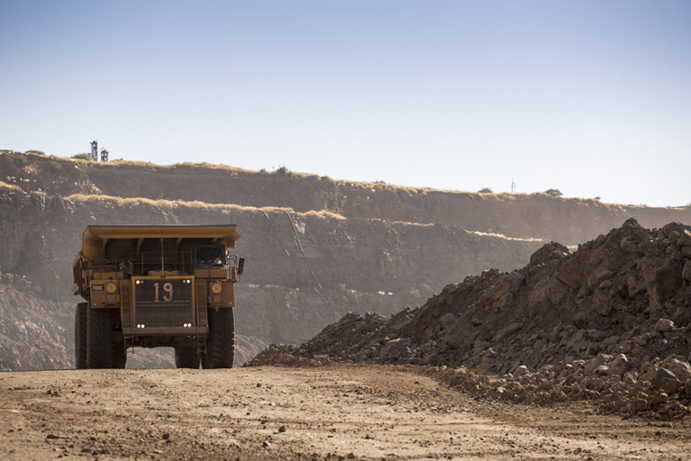
De Beers’ Damtshaa mine in Botswana. Image source: De Beers Group

De Beers is confident of maintaining its long-standing partnership with Botswana, a company official told Reuters on Thursday, but said some of the negotiations to agree new terms were complex.


Botswana President Mokgweetsi Masisi on Sunday threatened to walk away from talks on the extension of De Beers’ mining rights in the country unless it got a larger share of revenues.

De Beers’ Vice President-Corporate Affairs (Global Sightholder Sales) Otsile Mabeo told Reuters by email the company was “confident that our successful partnership will continue” and said that “the arrangement must make economic and strategic sense for both parties”.

Anglo American Plc’s De Beers is in talks with the Botswana government to extend mining rights that expire in 2029, as well as a 2011 diamond sales agreement that expires in June this year.

“It’s important to note that our negotiations span more than just the sales agreement, they also include the future mining rights for Debswana, which are more complex and require more time to land on the finer details,” Mabeo said.

Under the current deal, Debswana – a 54 year-old joint venture between De Beers and the Botswana government – sells 75% of its output to De Beers, while 25% goes to the state-owned Okavango Diamond Company. Botswana supplies 70% of De Beers’ rough diamonds.

Last year, Debswana’s diamond sales hit a record $4.588 billion, compared to $3.466 billion in 2021. Diamond sales, almost entirely from Debswana, account for two-thirds of Botswana’s foreign currency receipts and a fifth of its gross domestic product.

Botswana government officials were not immediately available to comment, but Lefoko Moagi, Botswana’s mines minister, told Reuters earlier this month he hoped a deal would be reached before the June deadline.

“A lot has been done, and what is left is material, but it is not insurmountable, it is in our best interests that we resolve that by the deadline,” Moagi said on the sidelines of last week’s Cape Town indaba mining conference.

(By Brian Benza; Editing by Nelson Banya and Barbara Lewis)