Wednesday, June 14, 2023

Amnesty: Possible war crimes in recent Israel-Gaza fighting
  • PublishedShare
IMAGE SOURCE,REUTERS
Image caption,
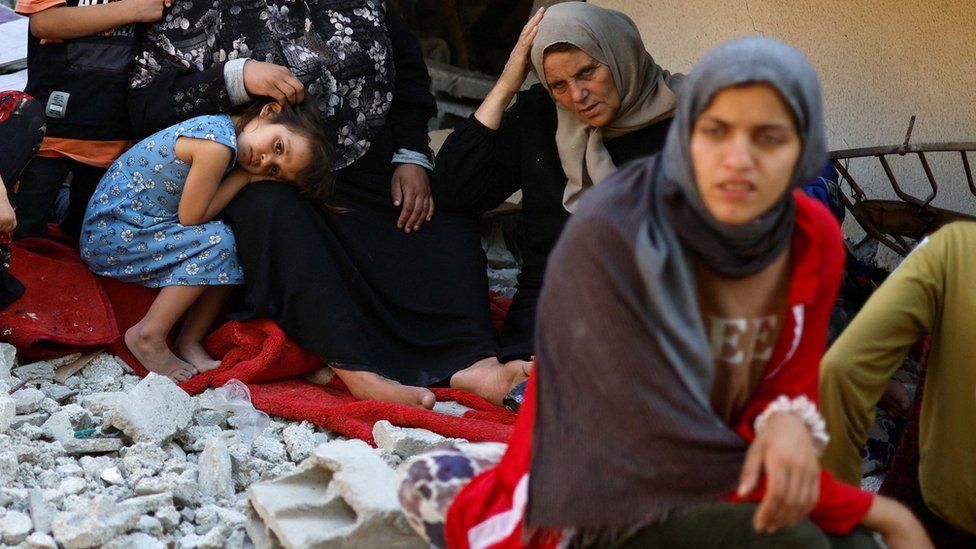
A four-storey building where 42 people from the extended Nabhan family 
was destroyed in an Israeli strike on 13 May

War crimes were possibly committed during last month's fighting between Israel and Palestinian militants in the Gaza Strip, Amnesty International says.

A report by the human rights group concludes that Israeli forces conducted apparently disproportionate air strikes which killed Palestinian civilians.

It also says indiscriminate Palestinian Islamic Jihad (PIJ) rocket fire killed both Israeli and Palestinian civilians.

Amnesty is calling on the International Criminal Court to investigate.

A spokesman for PIJ said the group welcomed the report, while there was no immediate response from the Israel Defense Forces (IDF).

Thirty-four Palestinians and one Israeli were killed in the latest round of cross-border fighting, which erupted on 9 May and ended five days later with an Egyptian-brokered ceasefire.

It began when Israeli warplanes carried out overnight air strikes that killed three senior commanders of PIJ's military wing in their homes as well as 10 civilians, including relatives and neighbours of the men.

Amnesty International said the dropping of precision-guided bombs on densely-populated areas when families were sleeping suggested "that those who planned and authorised the attacks anticipated - and likely disregarded - the disproportionate harm to civilians"."Intentionally launching disproportionate attacks... is a war crime," it warned.

The IDF said that during the fighting which followed, its aircraft struck more than 400 military targets belonging to PIJ and killed three other senior commanders of its military wing, which it blamed for the firing of dozens of rockets and mortars at Israel the previous week.

Amnesty investigated nine strikes, including those that targeted the three PIJ commanders in their homes.

IMAGE SOURCE,REUTERS
Image caption,
A 9 May strike on an apartment in Gaza City killed Palestinian Islamic Jihad commander
 Tareq Ezzedine and five civilians

Amnesty also said it "identified a pattern of extensive destruction of property" in Gaza as a result of the Israeli strikes that "failed to meet the exceptions under which attacking homes and other civilian objects would be justified".

It cited the targeting on 13 May of a four-storey building in the Jabaliya refugee camp that was home to 42 people from the extended Nabhan family.

Amnesty found no evidence that the building had been used to store weapons or any other military equipment, or that rockets had been launched nearby.

"In our investigation, we heard vivid accounts of bombs obliterating homes, of fathers digging their little girls out from under rubble, of a teenager fatally injured as she lay in bed holding a teddy bear," said Amnesty's Middle East director Heba Morayef.

"More frightening than any of this is the near certainty that, unless perpetrators are held to account, these horrifying scenes will be repeated."

PIJ responded to the Israeli strikes by firing more than 1,400 rockets towards Israel, forcing tens of thousands of civilians to take cover in bomb shelters.

The IDF says 1,139 crossed into Israeli territory in total and that about 430 headed for populated areas were intercepted by its missile defence systems.

An Israeli woman and a Palestinian labourer from Gaza were killed by rockets that hit an apartment in Rehovot and a building site in Shokeda respectively.

IMAGE SOURCE,REUTERS
Image caption,
Israel's Iron Dome anti-missile system intercepted hundreds of rockets launched from the Gaza Strip

Amnesty says rockets that fell short in Gaza also appear to have killed three Palestinian civilians, including two children.

The report cites relatives of the children as saying they died when a rocket hit al-Sahaba street in Gaza City on the afternoon of 10 May.

PIJ denied at the time that a rocket hit the area and blamed Israeli strikes, but witnesses told a researcher that individuals associated with the group removed remnants of a rocket in the immediate aftermath of the incident.

"Known for their inherent inaccuracy, rocket attacks by Palestinian armed groups are indiscriminate; these attacks must be investigated as war crimes and victims be granted prompt and adequate redress," Ms Morayef said.

PIJ spokesman Tariq Salmi did not comment on that allegation.

But he told the BBC that Amnesty's report "proves that the occupation [Israel] was the one that began the aggression by committing grave crimes".

"The enemy uses the weapons it has to kill Palestinian civilians and we are doing our part to defend ourselves against the crimes committed by Israel against the Palestinian people," he added.

Israel has said it takes extensive measures to try to avoid harming civilians.

Israel 'informed US on plan to build thousands of new settlement homes'

Israel has vowed to continue expanding its illegal settlements despite US concerns and condemnation from elsewhere in the international community.

The New Arab Staff
13 June, 2023

Israeli settlements in the West Bank are illegal under international law [Getty]

Israel has told the United States that it plans to build new homes in illegal settlements at the end of June, an Israeli official reportedly said on Monday.

The official told The Times of Israel that the housing units "would be in the thousands".

News website Axios initially reported that Israel had told the US of plans for new settlement homes, and said soon-to-be announced plans would include at least 4,000 homes.

The US has voiced concerns over the project, saying it could negatively affect talks with the Palestinians.

The US "has been clear that advancing settlements is an obstacle to peace and the achievement of a two-state solution," Reuters on Monday reported a White House National Security Council spokesperson as saying.

Reports last week said Israel's Civil Administration was to discuss the launch of the E1 settlement project which, if implemented, would effectively cut the occupied West Bank in half.

The highly controversial and illegal E1 settlement scheme envisions the construction of thousands of housing units for Israeli settlers which will link Jerusalem to the Ma'ale Adumim settlement northeast of the city.

It would be the last link in a chain of Israeli settlements separating East Jerusalem from the rest of the West Bank.

But it was put on hold after pressure from Washington.

President Joe Biden’s administration worked for weeks to delay the E1 project, The Times of Israel reported, quoting US officials.

Prime Minister Benjamin Netanyahu’s far-right government has vowed to continue settlement building despite condemnation from the international community.

The Israeli group Peace Now said Netanyahu was taking these steps to appease settler leaders in the West Bank who are allies of Finance Minister Bezalel Smotrich, leader of the extreme-right Religious Zionism Party.

Last month, Israel allowed settlers to move back into the Homesh outpost near the town of Nablus in the West Bank.

Homesh, which sits atop the Burqa hill, was evacuated in 2005.

In March, the Knesset passed a law repealing the 2005 ban on Israelis residing in Homesh and three other settlements in the northern West Bank, and a military order was issued implementing the legislation.
Emirati astronaut Al Neyadi tracks tropical cyclone in the Arabian Sea from space


The eye of the storm is visible from the ISS

Yamama Badwan, Staff Reporter

Sultan Al Neyadi, the Emirati astronaut, documented the tropical cyclone in the Arabian Sea from the International Station.

The Emirati astronaut shared the video on Twitter and wrote, “Watch as a tropical cyclone forms over the Arabian Sea from these views I captured.

The ISS provides a unique perspective on several natural phenomena, which can assist experts on Earth in weather monitoring.🌩️🌀

Stay safe, everyone!”

Al Neyadi reviewed his passage over the Arabian Peninsula, specifically the United Arab Emirates from west to east, as well as the city of Al Ain and Jebel Hafeet, then over the Hajar Mountains to the Sultanate of Oman and the Arabian Sea.

He said that he is trying to cover the weather from space, and to photograph the tropical storm that appears on the horizon, as well as the eye of the hurricane — that is, its center — where he directed the camera downward and began to take many pictures of the hurricane, but he described the scene as terrifying due to the presence of heavy cloud and thunderstorms.

The eye of the hurricane is an area characterized by calm weather in general in the midst of strong tropical cyclones, and it is a semi-circular area with a diameter that usually ranges from 30 to 65 km.

It is also surrounded by the eye wall, which is a ring of high-altitude thunderstorms with severe weather.
London court orders UK-registered firm to pay nearly $1 mln to Beirut blast victims
June 13, 2023
A demonstrator holds a black and white Lebanese flag during a protest for Families of the victims of the 2020 Beirut port explosion against Lebanon's top public prosecutor who charged the judge investigating the Beirut port blast and ordered the release of those detained in connection with the explosion in front of the Justice Palace in Beirut, Lebanon January 26, 2023
REUTERS/Aziz Taher/File Photo

BEIRUT, June 13 (Reuters) - A London court has ordered a British-registered company to pay more than 800,000 pounds ($1 million) in damages to victims of the 2020 blast at Beirut's port, a lawyers group in Lebanon said on Monday, in the first such verdict over the explosion.

More than 220 people were killed in the Aug. 4, 2020, blast when a huge shipment of ammonium nitrate fertiliser that had been sold by British-registered firm Savaro Ltd exploded.

On Jan. 31, the High Court in London found Savaro Ltd liable for death, personal injury and property damage in a case brought by the Beirut Bar Association on behalf of blast victims.

On Monday, the court ordered Savaro to pay 100,000 pounds plus interest each to three relatives of deceased victims, and slightly over 500,000 pounds to a wounded woman, according to a statement by the Association.

Reuters was unable to find contact details for Savaro or for its listed director.

"It's the first time that any court anywhere renders decisions as to liability and damages in the Beirut port explosion after approximately three years," said Camille Abou Sleiman, a lawyer from legal firm Dechert who was overseeing the case for victims and their families for free.

"It's the first ray of hope in the long march to justice and closure for the victims," Abou Sleiman told Reuters.

But the question of who exactly will pay remains unclear. The woman listed as Savaro's owner and sole director at Britain's Companies House, Marina Psyllou, told Reuters in 2021 that she was acting on behalf of another beneficial owner whose identity she declined to disclose.

Psyllou submitted a request in 2021 to Companies House to wind up Savaro. The Beirut Bar Association asked British authorities to halt that voluntary liquidation.

Lebanon's own probe into the blast has sputtered out. Earlier this year, investigating judge Tarek Bitar was charged with usurping powers after he filed his own charges against top security and political officials over the explosion.

"Everything that is moving forward is outside of the country," said Paul Naggear, whose daughter Alexandra was killed by the blast and who was one of the claimants.

"It shows you how much they've obstructed things in Lebanon. It was really good to hear this news, because it's progress."

($1 = 0.7948 pounds)

Reporting by Maya Gebeily Editing by Mark Potter

SEE
AI SNAFU

Jordan: 'Faulty algorithm' denying welfare support to people in need

Arbitrary factors such as water consumption and the age of cars restrict access to a World Bank-financed cash programme, according to HRW


Jordanian youths use a hand cart in Amman's Wahdat district on 10 January 2021
(AFP)

By Rayhan Uddin
Published date: 13 June 2023 

Jordanians in need are not receiving vital financial support due to a World Bank-financed cash transfer programme that relies on unreliable data and a "faulty algorithm" to allocate funds, according to a new report.

While the scheme is intended to tackle poverty it is in fact fuelling social tensions by using arbitrary factors - such as water consumption and the age of family cars - to determine whether people have a right to social security, Human Rights Watch (HRW) said in a 74-page report published on Tuesday.

Jordan's cash transfer programme, Takaful, applies an algorithm that uses 57 socio-economic indicators to estimate people's income and wealth and then distributes funds to the households this deems to be the poorest.

The report said the programme is "undermined by errors, discriminatory policies, and stereotypes about poverty".

"The World Bank should phase out its financing of poverty-targeting algorithms and prioritise projects that advance universal social protection," Amos Toh, senior technology and human rights researcher at HRW, told Middle East Eye.

"That is, programmes that ensure everyone receives income support at key moments throughout their lives, such as old age, unemployment, or sickness."

Under the current system, factors such as owning a car less than five years old, or a business worth over 3,000 dinars ($4,200) automatically disqualify a household from funds.

Families who consume large amounts of water and electricity can also be less likely to qualify for support.

For the report, HRW interviewed 36 individuals or families who had applied to use Takaful and other assistance programmes, as well as government officials, and civil society groups.

One of the residents interviewed in the report, from the town of Tafilah in southern Jordan, said her family's ownership of a car played a role in the denial of funds.

“The car destroyed us,” she said. “We use it to transport water and for other needs. But sometimes we don’t have the money to fill it up with diesel.”

'Not reaching enough people'

The owner of a tailoring shop in downtown Amman said his business could be the reason why he did not receive support, despite the fact that the Covid-19 pandemic had forced him to take out 12,000 dinars ($16,900) in loans to cover his basic needs.

In addition, the algorithm favours larger households for funds but assesses this based on the number of Jordanian citizens in the family.

This could discriminate against Jordanian women married to non-Jordanian men, as they are unable to pass on their citizenship to their spouse or children, says HRW.

The ways in which the government collects financial data have also been prone to errors, the report added. For example, the programme did not allow people to declare living expenses that exceeded their income, interviewees said.

In response to the report, the World Bank said the poverty targeting methods it uses helped to facilitate the delivery of funds but were "not substitutions" for interactions between people and institutions.

"[Takaful] has proven to be amongst the most redistributive and cost-effective poverty reduction programs currently active in Jordan," it added.

But Toh questioned the programme's ability to reach those most in need.

"Takaful only distributes regular cash transfers to about 20 percent of households living under the poverty line most recently announced by the government," he said.

"Both the [International Labour Organization] and the [International Monetary Fund] have raised concerns that Takaful is not reaching nearly enough people and families that are struggling with poverty."

Jordan is currently facing a cost of living crisis and rising youth unemployment.

In December, the country was hit by rare protests triggered by taxi and truck drivers striking over rising fuel prices.


In the financial year 2021-2022, the average annual income in Jordan - which is considered a middle-income country - ranged from $4,096 to $12,695.

The poverty in the country rate rose to 24 percent in 2021 due to the pandemic, according to the World Bank.


OPINION

The 'BlackRock exemption' has no place in the EU's due diligence directive

  • Protesters at the Youth Led Climate Strike. (Photo: Peg Hunter)

Thursday (8 June) marks the start of the trilogues to finalise the European Corporate Sustainability Due Diligence Directive (CSDDD).

The CSDDD is Europe's attempt to compel EU-based companies to prevent, address and remedy environmental or human rights risks and adverse impacts in their global value chains. The stakes are high, as the negotiations between officials from the European Commission, the Council, and the Parliament kick off.

One of the most contentious issues up for debate is whether and how the law will cover asset managers and institutional investors.

The parliament's negotiation mandate includes these investors, as defined in Article 2 (e-f) in the Shareholders Rights Directive (SRD II), while the council and the commission afford investors significant derogations from key provisions.

These derogations have become known by insiders as the 'BlackRock exemption', after reports of heavy lobbying by the world's largest asset manager to be exempted from the CSDDD obligations.

However, letting the influential asset management industry, estimated to manage €28 trillion in Europe, off the hook would have severe consequences on the overall effectiveness of how other companies implement their due diligence under the CSDDD to avoid adverse impacts on human rights and the environment, a thorny issue in global value chains.

Influential actors

Asset managers and institutional investors exercise considerable influence over investee companies' strategy, actions, and financing of due diligence and sustainability efforts through various avenues.

Large asset managers and institutional investors are often the top shareholders in publicly-traded companies. They are the primary beneficiary of the dividends and share buybacks of these companies.

Research has exposed how an increasing part of corporate income and profits is transferred to shareholders through dividends and share buybacks, often at the expense of fair remuneration of workers (in the supply chain), research and development, climate transition plans (see Shell example below), and spending on due diligence to avoid negative impacts on people and planet.

This results from asset managers and institutional investors using their significant shareholder voting power to pressure investee companies to focus on maximising short-term shareholder value rather than on the longer-term interests of other stakeholders, which the commission itself has identified as problematic.

In addition to flexing their voting muscle at shareholder meetings, large asset managers and institutional investors influence company strategies and actions by engaging with the investee company's management behind closed doors. While they should be transparent about whether they integrate a long-term perspective in their engagement, according to SRD II, the EC did not yet report whether that is the case, as required by 10 June 2022.

Asset managers also have voting and engagement power by creating various investment funds that combine shares of up to hundreds of companies. An increasing part of these "passive investment" funds simply track the shares' stock market value without any due diligence, blindly following earnings without taking into account the impact they are having on people and the planet.

Asset managers have attracted enormous amounts of investment to their passive investment funds from retail investors who are not interested or informed about how fund managers vote on their behalf at companies' AGMs, resulting in lack of scrutiny and due diligence in the invested companies.

Such lack of scrutiny also happens for 'fixed income funds' that combine corporate bonds. The EU regulates most investment funds via the Directive on Undertakings in Collective Investments in Transferable Securities (UCITS), which the European Parliament proposes to exclude from coverage by the CSDDD, leaving a legal loophole that must be addressed.

Large asset managers like BlackRock also invest and manage assets on behalf of pension funds and smaller institutional investors, who often do not scrutinise how their asset manager is voting or using their assets to finance companies through bonds.

In addition, BlackRock's vast high-tech platform, Aladdin, to manage risks, advise on portfolio holdings and link investors to the world's financial markets, is estimated to cover at least 10% of globally traded shares and bonds. Whether or not Aladdin is legally obligated to integrate environmental and social impacts of companies will have an enormous influence on how investors behave.

Undermining the energy transition

Investor influence can be illustrated by what is happening in the oil industry. In February 2023, BP's share value rose by 10% following its announcement to reduce its climate ambitions. Since, Shell's management declared that renewables are not profitable enough. It blatantly stated at Shell's 2023 AGM that more oil and gas investments were needed to provide more "competitive" shareholder value. Shell's CEO Sawan's primary concern is that the total value of Shell's shares traded on stock exchanges is almost half of that of its US rivals Exxon and Chevron, notwithstanding having returned US$ 26 billion to its shareholders in 2022.

During their engagement before the AGM, a "growing number of major investors" reportedly pressed Shell to focus on higher financial returns "rather than energy transition plans".

BlackRock (10.6%) and Vanguard (3.4%) are Shell's largest shareholders. 80% of the shareholders voted in favour of Shell's current minimal actions to advance the energy transition and against a shareholder resolution urging for swifter actions.

This will influence Shell's future strategy and investment plans, including not implementing a Dutch court ruling that ordered it to reduce its climate-harming emissions by 45% by 2030 compared to 2019.

Long 'value' chains not sufficiently defined

Most asset managers and institutional investors own less than 1% of the shares of the many listed companies in which they invest as a standard strategy to reduce the risk of financial losses. These investors seldom do self-scrutiny and due diligence regarding AGM voting, preferring to rely on advisory firms instead. The proxy vote advisory business is dominated by two US firms: Institutional Shareholder Services (ISS) and Glass-Lewis. The proxy vote advisory firms can ultimately have a huge influence on companies' behaviour but are not explicitly covered by CSDDD.

The 'value' chain continues, with asset managers satisfying their shareholders with high dividends and share buy-backs. BlackRock returned US$4.9 billion to its shareholders in 2022, including $1.9 billion in share buybacks. And the largest shareholders of BlackRock are…big reveal…Vanguard (9%) and BlackRock (7%) itself.

BlackRock recommended its own shareholders to vote against resolutions to disclose whether BlackRock can engineer decarbonisation and its investment has social and environmental impacts. Asset managers have vehemently opposed the CSDDD to avoid lost profits from the costs of finally undertaking due diligence related to the myriad of companies whose shares and bonds they manage or advise on.

An opportunity that shouldn't be missed

With the CSDDD, there is an opportunity to harness the power of investment for truly sustainable activities. But to do this, the CSDDD must not allow the "BlackRock exemption" and instead cover institutional investors and asset managers to avoid that their various channels of influence drive company decisions in the other direction.

It is only by obliging all financial and non-financial companies to invest in due diligence that prevents, avoids and remediates negative social and environmental impacts that the CSDDD can be effective.

AUTHOR BIO

Myriam Vander Stichele is a senior researcher at SOMO and an expert on the financial sector.

Joseph Wilde-Ramsing is director of advocacy at SOMO and an expert on due diligence.