Tuesday, August 01, 2023

The UK once vowed to be a global climate leader. Now Rishi Sunak is stoking a culture war on green policies

Story by Analysis by Rob Picheta, CNN • 

Less than two years ago, Britain was championing itself as a global leader in the fight against the climate crisis.

At the pivotal COP26 climate conference in Glasgow, then-Prime Minister Boris Johnson rallied world leaders to find agreement on a historic resolution acknowledging the role of fossil fuels in the climate crisis, and the late Queen Elizabeth II said in a landmark speech that “time for words has now moved to the time for action.”

Things feel very different now. As Rishi Sunak’s beleaguered government limps towards an election it is widely expected to lose, determination has seemingly been swapped for division.

And after a decade of cross-party consensus on tackling the climate crisis, experts fear that Sunak has identified green policies as a new wedge issue that could help reverse his party’s sagging fortunes.

Sunak said Monday he wants to “max out” oil and gas developments in Britain’s North Sea, announcing an expansion in drilling for the fossil fuels that environmental groups have condemned.

The move followed a proclamation from Sunak to Britain’s drivers, in the Telegraph newspaper, that he was “on their side,” as he ordered a review of “anti-motorist” low-traffic neighborhoods created to improve urban air quality.
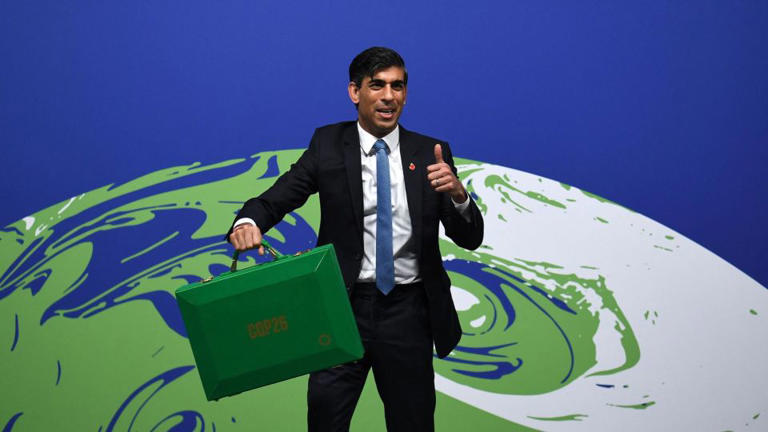


Sunak poses during COP26. Since becoming prime minister, critics say he has diminished the UK's standing as a leader on the climate. - DANIEL LEAL/AFP/Getty Images© Provided by CNN

Jibes towards climate activists have meanwhile become a common feature at the despatch box in parliament. And in combative interview exchanges on Monday, Sunak defended his frequent use of a jet or helicopter to attend events around the UK – a habit that opposition politicians have often criticized.

“What the government seems to be doing is using the climate to divide the public,” Luke Murphy, the associate director for energy, climate, housing and infrastructure at the progressive IPPR think tank, told CNN. “There does seem to be a degree of political opportunism around what they’ve been doing.”

Few expect the new push to be an election-winner. But Murphy, like many climate experts, fears there are wider ramifications for Britain’s global standing.

“For all the faults of the Boris Johnson government, what you can say is there appeared to be a genuine commitment to net zero and to the climate agenda,” he said.

“Since then we’ve gone backwards. We’ve stalled in many policy areas,” Murphy added. “I don’t think many people would actually now consider the UK to be a global leader (on the climate).”

A populist approach to the climate

Since coming into power, Sunak has been scrambling for wedge issues that could resonate with Britons and turn around his party’s woeful standing with the public. Small boat crossings of asylum-seekers, transgender protections and other so-called “culture war” battles have all been eagerly waged by a prime minister who vowed during his first leadership campaign last year to stop “woke nonsense.”

But amid a deepening cost of living crisis and the decline in Britain’s public services, Sunak has failed to shake the increasingly sticky label applied to him – that he is a caretaker of the managed decline of the Conservative Party, which has ruled for 13 years and is running low on ideas.

A glimmer of hope arrived for Sunak, however, in an unexpected and narrow victory in the by-election to replace Boris Johnson as an MP for Uxbridge, a region on the western fringe of London. The vote was dominated by local opposition to the expansion of London’s world-first low-emissions zone, which gave local Conservatives a rare issue on which they could go on the offensive.

“This campaign is a referendum on ULEZ,” the area’s new MP Steve Tuckwell told CNN in the days leading up to the vote. “We know it’s going to devastate local businesses,” said Tuckwell, who omitted virtually any mention of his party from leaflets and instead branded himself the “anti-ULEZ candidate.”

In the days since that vote, and despite losing a significant share of the votes in the region, leading Conservatives have gleefully picked up the anti-green baton. Ministers have increasingly conflated emissions-slashing agendas with the activist fringes of the climate movement, trying to draw links between the opposition Labour Party and Just Stop Oil, the divisive group known for interrupting national events with guerilla protests.



A Just Stop Oil protester disrupts a match at July's Wimbledon Championships. Sunak's ministers have been attempting to link the group to the Labour Party, which is on course to win the next election. - Hannah Mckay/Reuters© Provided by CNN

Announcing the North Sea drilling expansion on Monday, Energy Secretary Grant Shapps claimed that the opposition Labour Party are the “political wing” of Just Stop Oil, despite the party’s leader Keir Starmer criticizing the group’s tactics. In June, Sunak claimed that “eco-zealots” are writing Labour’s energy policy.

“What you are seeing is a much more populist way of handling (the climate),” Tim Bale, a professor of politics at Queen Mary University in London and the author of books on the Conservatives, told CNN.

“Uxbridge has encouraged the party to feel – in the absence of many other policies that are going well for them – that it’s a move that has some traction with a certain section of voters,” Bale said. More than three-quarters of British households have a car, and the rate of carless households has fallen steadily in recent years.

Making enemies

It is a difficult path for Sunak to tread. Even voters opposed to schemes like ULEZ do not necessarily lack concern about the climate; the topic has become increasingly prevalent in recent years, with nearly two-thirds of Britons consistently ranking it among the most important issues facing the country, according to data from the Office for National Statistics.

London’s Mayor Sadiq Khan has forcefully defended his city’s programs, including ULEZ, which last week survived a legal challenge brought by five Conservative councils. On Sunday, Khan nodded to recent heatwaves and wildfires in Europe, writing: “The world is on fire – and this is all the leadership we’re getting from Rishi Sunak.”

And Sunak’s approach to the climate is increasingly earning him enemies within his own party.

Foreign Office minister Zac Goldsmith resigned in June, lambasting Sunak’s climate policies. “The problem is not that the government is hostile to the environment, it is that you, our prime minister, are simply uninterested,” he wrote in his resignation letter.



A North Sea oil rig off the coast of Scotland. Sunak's decision to expand drilling in the North Sea was criticized by climate experts. - 
WPA Pool/Getty Images Europe/Getty Images© Provided by CNN

And on Monday Chris Skidmore, a Conservative former energy minister who is now on the backbenches, said Sunak’s expansion of North Sea drilling puts him on “the wrong side of history.”

Skidmore called the move “the wrong decision at precisely the wrong time, when the rest of the world is experiencing record heat waves.”

But with Britain agitating for a change in leadership and with little else to champion, Uxbridge has apparently given Sunak a blueprint for next year’s election – and waging battles with detractors may help him elevate his pitch.

“There aren’t many obvious other avenues for this government to go down,” Bale, the politics professor, said. “This, like the small boats issue, perhaps provides a bit of a distraction for people.”

“You can see a very obvious parallel with what’s going on with migration,” he added. “That is a typically populist attack line – making a distinction between people on the one hand, and elites on the other.”

For more CNN news and newsletters create an account at CNN.com
QUEEN CITY
Murray Mandryk: Homeless eviction defies our supposed welcoming nature

Opinion by Murray Mandryk • Leader Post

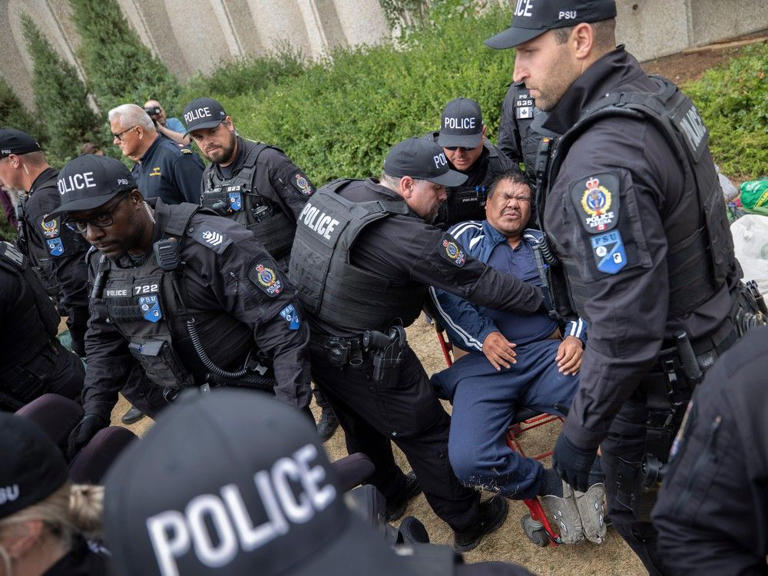
Sending in the police to remove the poor, homeless and drug addicted is not a solution for a city and province that prides itself on being welcoming.

Just beyond the chain-link fencing encircling Regina City Hall with no less than 24 “No Trespassing” signs, you can still visit the courtyard monuments telling us what a welcoming place this is.

Gone are the tents that housed the houseless. And gone are the people who lived in those tents … although some may not have gone very far.

Monday morning, people milled about across the street from city hall near the YWCA on McIntyre Street, just behind the Fresh and Sweet coffee house.

After Regina police tore down the homeless encampment on Friday. half a dozen were sent out of town to hotels in Balgonie for the weekend.

The rest? We don’t know. Perhaps they sought refuge in parts unknown. Out of sight, out of mind?

As explained by city manager Niki Anderson, the issue for these people nobody seems to care much about is public safety.

“Elected officials who claim they should have been consulted about today’s response are, in fact, placing the public at greater risk by inappropriately challenging public safety experts and eroding confidence in my administration’s ability to protect the residents of the City of Regina,” Anderson wrote in a news release.

Of course, we are still a welcoming place … or so the monuments in the city hall courtyard suggest.

You can still go there and peruse those signs. A couple of uniformed private security personnel may give you the once-over, but if you’re a frumpy looking, 60ish white guy, you needn’t worry.

“Dominion of Canada. Tawaw,” reads one monument. Tawaw means “it is open” in Cree. Ironically, the Cree translation also means “it has a hole in it.” That one seems more apropos, given the past few days.

“Open Door Policy. Open Door Society. Open Hearts. Open Minds,” states the Regina City Hall monument from where the homeless were evicted.

“Who dreams shall live,” further states the monument a few feet away from where camp resident Leitsha Bigknife died two weeks ago.

Perhaps we’re no different than anywhere else that similarly prides itself on being welcoming and can’t see when we aren’t.

A few decades back, then-Calgary mayor and later premier Ralph Klein made it known that “Eastern creeps and bums” weren’t welcome. Vancouver, which purports to be the loveliest city in Canada, cleaned out its east end before the 2010 Olympics, so the world could see just how lovely it was.

Toronto? Montreal? Winnipeg? Ottawa? Are they really any different than Saskatchewan, where the solution was to give out-of-province welfare recipients a one-way bus ticket to Vancouver … until we sold the bus company?

With deaths and fires at the Regina City Hall homeless camp, there’s no denying dangers were mounting. City fire and police officials are being vilified, but this is first about keeping the public (including those in the camp) safe.

Finally, issues of mental health and the scourge of serious drug abuse surely must leave those in charge feeling helpless. One might even sympathize with the Saskatchewan Party government, were it not hiding behind the politics.

Asked for simple followup information Monday and an interview with the minister, officials with Gene Makowsky’s Social Services Ministry told the Leader-Post they have “strict rules engaging with the Regina media” because there’s byelections going on.

Beyond this being simply nonsense, this is the same government putting up billboards outside the city slamming teachers. And this same government that won’t meet with municipalities to talk about changes to its Saskatchewan Income Support (SIS) program now clearly adding to the homeless crisis.

Meanwhile, there are 700 vacant Saskatchewan Housing Corp. units. The provincial government is sitting on its second year of a billion-dollar surplus, holding back that money to either cut cheques or cut sales tax sometime before next year’s election.

There again, why the hell should provincial politicians meet with those running the City of Regina when they won’t even talk to each other?

We chose multis e gentibus vires as our provincial motto because we wanted to say we welcomed everyone. Well, we clearly don’t.

Forget the mottos and monuments. If you are in distress, the signs say you need to go elsewhere.

Mandryk is the political columnist for the Regina Leader-Post and the Saskatoon StarPhoenix.

 PHENOMENAL


#TheMoment the northern lights and lightning converged over Saskatchewan

Tristan Wingert has been chasing auroras for over six years — but he'd never seen anything like this before: a stunning time-lapse of a powerful thunderstorm and the northern lights together in the night sky
Conflict over horseshoe crab blood harvesting

 (31 Jul 2023) The biomedical industry is adopting new standards to protect horseshoe crabs, vital in the production of vital medicines. But conservationists say that doesn't go far enough to protect food for a declining bird species.

(AP Video by Rodrique Ngowi)

New Alberta study examines drug poisoning cases involving fentanyl and benzodiazepines

Story by Madeleine Cummings • 

An Alberta doctor who specializes in addiction says a forthcoming study based on data from the Office of the Chief Medical Examiner (OCME) is "eye-opening" and underscores the role fentanyl is playing in the province's illicit drug supply.

The study, which will appear in the journal Forensic Science International's September issue and was published online in July, looked at concentrations of fentanyl and benzodiazepine drugs in the blood of people who died of fentanyl toxicity over the last three years.

Advocates and experts have been sounding the alarm about the combination of fentanyl and benzodiazepines, known as "benzo-dope." Health Canada says mixing benzodiazepines with other depressants like alcohol or opioids can be dangerous and increase the risk of overdose.

The combination has become increasingly prevalent in Alberta and other provinces in recent years. The study says that between 2020 to 2022, the OCME reported 2,812 fentanyl cases, of which approximately 45 per cent had at least one benzodiazepine drug.

The study found that the concentration of fentanyl in benzo-dope cases was considerably higher than in cases where no benzodiazepine drug was detected. The study suggests fentanyl toxicity is the primary cause of death in most benzo-dope cases, not the combination of those drugs.

"The concerns of the increased dangers associated with the local drug supply in Alberta may be related to an increase in fentanyl concentration, rather than the addition of the benzodiazepine," the paper says.

Dr. Monty Ghosh, an assistant professor at the University of Alberta and the University of Calgary and an addiction medicine physician, said the study is "eye-opening."

"We always thought that the mix of benzos with the illicit drug supply was making it harder for us to reverse these overdoses," he said.


Dr. Monty Ghosh is an assistant professor and addiction specialist who works in Edmonton and Calgary. (Monty Gosh)© Provided by cbc.ca

He said this data shows that the concentration of benzodiazepines seemed to be too low to have caused respiratory depression (slower breathing).

He said people who are using benzodiazepines may be requiring higher amounts of fentanyl to feel the same euphoria.

"There are a lot of people who are now addicted and suffering withdrawal from benzodiazepines and therefore are at a higher risk of being in a situation where they have to consume drugs more quickly, less carefully, with maybe less stringency around their supply," said Euan Thomson, an independent researcher who writes the Drug Data Decoded newsletter.

Thomson advocates for regulating the supply of drugs, so people know what's in the substances they are using.

Dr. Craig Chatterton, chief toxicologist at the chief medical examiner's office and the lead author of the study, said the research was intended to provide scientific information for people in the toxicology and medical examiner communities.

"I would not expect the public to draw conclusions, scientific or otherwise, from this study," he said in an email to CBC News.

Thomson said the information, though limited, is useful for people working on the front lines and he would like to see it included in the province's substance use surveillance dashboard.

The current platform shows drug-poisoning deaths in which benzodiazepine was listed as causing death on the death certificate.

"Those numbers don't represent the reality of how many people are dying with benzodiazepines in their system, which is critical to understand," Thomson said.

Ghosh said people who respond to drug poisonings should probably have more more naloxone doses on hand, given how high fentanyl concentrations are.

"This may shift our strategy in terms of how much Narcan we may need to use," he said.
Indigenous communities need resources for emergency preparedness and prevention. NDP wants the feds to do more

Story by The Canadian Press • Yesterday 

Cellphone service is something many Canadians take for granted. But some Indigenous and remote communities, like Bloodvein First Nation in Manitoba, are forced to flee wildfires without this lifeline. Leaving home in a rush with no sense of when you can return, unable to call or text loved ones to plan your escape or check on them in the event of a sudden emergency is a reality for so many Indigenous communities, said NDP MP Niki Ashton — but it doesn’t have to be.

The NDP is calling on the federal government to invest in emergency preparedness for Indigenous communities in the midst of a devastating wildfire season. This is a continuation of the federal NDP’s efforts to shine a spotlight on the climate crisis and emergency preparedness last week.

On July 27, Nunavut MP Lori Idlout and Manitoba MP Ashton sent a letter to Minister of Indigenous Services Patty Hajdu pointing out the federal government’s chronic underfunding of emergency preparedness services in First Nations communities. A 2022 report by the auditor general found Indigenous Services Canada did not provide the support First Nations communities needed to manage emergencies like increasingly frequent and intense wildfires and floods.

“There's been so many First Nations communities that have been neglected for so long,” Idlout told Canada’s National Observer in a phone interview. “It's the First Nations, Métis, Inuit communities that know their areas, and they are the ones that know what the solutions are, and even when they provide their solutions, they're not being heard.”

This wildfire season has been the worst in Canada’s history: more than 12.5 million hectares of land have burned. On the date the letter was sent, a little more than 1,000 fires were burning across the country, according to the Canadian Interagency Forest Fire Centre website. Of those, 619 were classified as out of control. The increasing frequency and severity of wildfires can be attributed in part to climate change driven by human activity, mainly the burning of fossil fuels like coal, oil and gas.

“While Conservatives continue to deny the realities of climate change, we have seen unprecedented wildfires and flooding in recent months,” Hajdu said in an emailed statement to Canada’s National Observer. “These emergencies have taken a horrific toll on First Nations communities that have been disproportionately impacted.”

Emergency management must be led by and for First Nations consistent with principles of self-determination, the statement reads. It also pointed out that after the auditor general released their report, the federal government reformed the Emergency Management Assistance Program to “be more flexible and respond to emergencies in a way that is best for individual communities.”

First Nations communities are 18 times more likely to be evacuated because of an emergency event compared to non-First Nations communities, according to the Assembly of First Nations’ emergency response sector, Idlout and Ashton’s letter pointed out.

“For instance, communities like Leaf Rapids, Cross Lake, Pukatawagan, Little Grand Rapids, Paungassi, and Bloodvein were evacuated in the last couple of years due to wildfires,” the letter reads.

Fires are not the only threat Canadians are facing this summer. Nova Scotia experienced historic rainfall and catastrophic flooding last weekend, causing the province to declare a state of emergency that was lifted on July 26. Communities like the Kashechewan First Nation regularly face serious flooding, and this year, the Cree community in northern Ontario had to evacuate more than 450 people when annual floods hit in April.

“The reality is that these evacuations can be very traumatic for communities that are already on the margins,” Ashton told Canada’s National Observer in a phone interview. She pointed to the northern Manitoba community Cross Lake, which evacuated more than 7,000 people in May when a wildfire threatened the community.

“It was a very, very difficult operation for the community,” said Ashton, who represents northern Manitoba. “And many have said that … while the community was safe from wildfires, that the interaction was deeply traumatic.”

She recounted the story of one family with an elderly grandmother who was “already ill and frail” who passed away a couple days after being evacuated.

When people from the town of Leaf Rapids, about 1,000 kilometres north of Winnipeg, were evacuated, the province provided cheques of varying amounts so they could purchase necessities. Ashton noted that Leaf Rapids is not a First Nation but said the town has a large Indigenous population.

However, Ashton said, “because many of them didn't have … access to identification, they weren't able to cash them in and many of these families live in and around the poverty line.

“What we're doing is not working for these communities, and what many are calling for is resources to be able to keep their community safe and resilient in the face of climate change.”

The letter to Hajdu says the government isn’t doing enough to fund projects that prevent or lessen the impacts of extreme weather events. “Communities need flood protection, increased cellphone coverage, funding and training of local wildfire firefighting crews and investment in infrastructure, including all-weather roads,” the two NDP MPs write.

For example, Idlout says the community of Cambridge Bay, Nunavut, is a “regional hub” for many communities. However, some airlines won’t fly to its airport because the runway is not paved.

“I think as an emergency preparedness measure, that airport in Cambridge Bay needs to be paved so that during search and rescues or other emergencies, Cambridge Bay can serve the other communities, including its own residents,” said Idlout.

The letter said the federal government turned down Bloodvein First Nation's request for a fire truck.

“The climate emergency is upon us, and we know that Indigenous communities are facing it with the least amount of resources and are being dealt the greatest impacts,” said Ashton.

Better emergency response is important, “but by far the most important piece needs to be prevention,” said Ashton, noting that prevention — like investments in infrastructure and programs — falls under the purview of Indigenous Services Canada.

On July 31 at 6 p.m. this story was updated to include written comment from Minister of Indigenous Services Patty Hajdu, sent after publication.

Natasha Bulowski, Local Journalism Initiative Reporter, Canada's National Observer
Federal cabinet shuffle brings in first ever Filipina-Canadian minister
Rechie Valdez has been sworn in as Canada's first Filipina federal minister. The former bakery owner is now the minister of small business. 


Miller moved out of Crown-Indigenous Relations

Story by The Canadian Press • Yesterday 

A federal cabinet shuffle has seen Marc Miller switched out of his post as minister of Crown-Indigenous Relations and Northern Affairs Canada (CIRNAC).

Miller, whose frequent visits to Kahnawake and efforts to learn Kanien’kéha have endeared him to many in the community, will now head up the immigration ministry.

“I think that Miller was doing a phenomenal job in his role as the Indigenous Affairs minister, so that one really surprised me,” said Mohawk Council of Kahnawake (MCK) grand chief Kahsennenhawe Sky-Deer.

“It’s been kind of the MO of the federal government that when things start to get good momentum, they tend to change people, and that, to me, is the disheartening part.”

Miller’s interest in the community predates his rise in the Liberal government, said Sky-Deer. “He’s always been a friend to Kahnawake,” she said, noting that Miller has attended local Remembrance Day events, the Echoes of a Proud Nation Pow-Wow, and last month’s Pride parade. At this year’s powwow, Miller was asked to carry the Canadian flag during the Grand Entry.

“It’s not often you see ministers taking that much of an interest, an active role in building a relationship with the community and the Council. So we’re definitely going to be sad to see him go,” Sky-Deer said.

Miller has been a minister working on issues pertaining to Indigenous communities since 2019, when he was named minister of Indigenous Services Canada (ISC). He was moved to CIRNAC in 2021.

While his new role is more general, the immigration ministry does work on issues of relevance to Kahnawake, meaning there are ongoing opportunities for collaboration, according to Sky-Deer, such as the Jay Treaty and other border issues.


Related video: Crown-Indigenous Relations minister says Ottawa can't go it alone on search of Manitoba landfill (The Canadian Press) Duration 2:00  View on Watch


“I am sad,” said Miller at a press scrum Wednesday. “It doesn’t mean my relationships I’ve built with Indigenous leaders and just members of communities are going away.” He said he intends to carry on with commitments he has made, such as learning Kanien’kéha.

“Anyone who is in my job who isn’t taking this personally probably isn’t doing it well.”

He made the case that if someone like him can come to understand what is at stake for Indigenous Peoples, other Canadians can too, saying his comprehension has grown over the four years he has been heading up files relating to Indigenous issues.

Gary Anandasangaree, Liberal member of parliament for Scarborough-Rouge Park, is the new minister of CIRNAC.

“What I think I bring to the table is a unique understanding of the rights-based issue that is internationally-grounded,” said Anandasangaree.

“I think what we need to do in Canada is to build on the work that our government has done, not just in respect of the laws that are important, but also to continue to rebuild that relationship, one that will ensure there is self-determination at the core of every relationship that we have.”

Sky-Deer hopes Anandasangaree will hit the ground running.

Other ministers MCK deals with were also shuffled, including former Public Safety minister Marco Mendicino, who came to Kahnawake to discuss gun control legislation, and former Justice minister David Lametti, who was dropped from cabinet, and whom MCK had been engaging with on the gaming file.

gmbankuti@gmail.com

Marcus Bankuti, Local Journalism Initiative Reporter, The Eastern Door
All governments must hold Calgary Stampede accountable after sex abuse settlement: MP

Story by The Canadian Press • Yesterday 

All governments must hold Calgary Stampede accountable after sex abuse settlement: MP
© Provided by The Canadian Press

CALGARY — All levels of government must hold management of the Calgary Stampede to account over how it handled years of sexual abuse at a performance school it runs, says one of the city's 10 members of Parliament.

"All levels of government have role to play to ensure that if any taxpayers dollars are (being granted), we ensure safeguards are in place," George Chahal, a Liberal MP for Calgary Skyview, said in an interview Monday.

Neither municipal nor provincial governments have indicated there will financial implications for the world-famous rodeo and midway. The federal government has not provided ongoing funding to the Stampede, although during the COVID-19 pandemic in 2021 and 2022 it did provide $14 million in grants.

Last week, a partial settlement was reached in a class-action lawsuit alleging the Stampede allowed a staffer at its Young Canadians School of Performing Arts to groom and abuse boys. Phillip Heerema is serving a 10-year sentence for luring six boys into sexual relationships when he worked for the school.

The abuse dates back to at least 1992. Joel Cowley, Calgary Stampede chief executive officer, has said the organization should have learned about and acted on allegations much earlier than it did.


Chahal said the Stampede's expressions of remorse, while they may be sincere, are inadequate. The public deserves to know what happened and someone needs to be held accountable, he said.

"I'm focused on continuing to ensure that accountability is provided to the public and that this organization is being transparent, but also on reconciliation with the victims."

The lawsuit is still before the courts. Damages are to be worked out later this summer, pending the approval of the settlement from a judge at an upcoming court date on Sept. 25.

Chahal is the only Alberta politician so far to directly call for financial consequences for the Stampede.

Ron Liepert, the only one of nine Calgary Conservative MPs to respond to a query from The Canadian Press on Monday, said Chahal is grandstanding.

"(Chahal) knows how unpopular the Trudeau Liberals are in Alberta. He can’t defend their record so is looking for other issues to try and change the channel."

Liepert said he has no evidence that the Stampede board has lost public trust.

On Friday, Alberta Premier Danielle Smith said Stampede funding from the province's United Conservative government would continue. Tanya Fir, Alberta's minister of arts, culture and Status of Women, said she would meet with the Stampede to discuss the safety of youth involved with the festival.


The province grants the Stampede about $6 million a year.


In a statement, provincial New Democrat Opposition Leader Rachel Notley said: "The Calgary Stampede has enjoyed tremendous support from multiple levels of government and from all Calgarians.

"A full and clear accountability for the Stampede’s role in this abuse and resulting trauma is needed."

Also Friday, Calgary Mayor Jyoti Gondek said it was a "tragedy" the board didn't act on the issue when it learned of it.


"I am happy that accountability has been accepted by the Calgary Stampede," she told reporters.

She said council will look "very carefully" at whatever measures the Stampede puts in place to ensure such abusenever happens again.

Heritage Canada did not respond to requests for comment.

This report by The Canadian Press was first published July 31, 2023.

— By Bob Weber in Edmonton

The Canadian Press


ECOCIDE
Pipeline operators to pay $12.5M after crude oil spills in Montana, North Dakota


BISMARCK, N.D. (AP) — Two pipeline operators have agreed to pay a $12.5 million civil penalty related to crude oil spills in Montana and North Dakota.

The U.S. Environmental Protection Agency on Monday announced the settlement in a 2022 federal court lawsuit. Belle Fourche Pipeline Company and Bridger Pipeline LLC will pay the $12.5 million to resolve the claims made under the Clean Water Act and Pipeline Safety Laws, the EPA said. The affiliated companies own and operate oil pipelines in Montana, North Dakota and Wyoming.

In 2015, Bridger's Poplar Pipeline broke and spilled more than 50,000 gallons (about 190,000 liters) of crude into the Yellowstone River near Glendive, Montana. Bridger has completed cleanup of the site, and in 2021 settled a lawsuit with federal and Montana authorities for $2 million. Montana's Department of Environmental Quality previously fined Bridger $1 million in the case.

In 2016, Belle Fourche's Bicentennial Pipeline in Billings County, North Dakota, broke due to a landslide and spilled over 600,000 gallons (about 2.3 million liters) of oil, impacting an unnamed tributary, Ash Coulee Creek and the Little Missouri River. Belle Fourche's cleanup is ongoing with oversight from North Dakota's Department of Environmental Quality, according to the EPA.

The agreement announced Monday does not resolve all issues with the Ash Coulee spill and reserves the government’s right to bring future legal claims.

The $12.5 million civil penalty includes a nearly $4.6 million portion for North Dakota's Department of Environmental Quality. Belle Fourche also will pay the state's past response costs, totaling over $98,000, according to court documents filed Monday.

“Oil pipeline spills can cause enormous and long-lasting damage to the environment,” Principal Deputy Assistant Administrator Larry Starfield of the EPA’s Office of Enforcement and Compliance Assurance said in a statement. “This settlement holds Belle Fourche and Bridger Pipeline accountable for their significant oil spills and requires them to take meaningful measures to prevent future spills from their oil pipelines.”

The operators also are required to implement specified compliance measures, in addition to the civil penalty.

Belle Fourche and Bridger are owned by Wyoming-based True Companies.

Bridger spokesman Bill Salvin said the operators have completed all remediation actions “to date” required by North Dakota's Department of Environmental Quality and “will work closely” with the department if further action is required. Future soil testing remains, Salvin said.

He said the operators have made upgrades to their pipeline network to enhance safety, including a new control center at their Casper, Wyoming, headquarters and a new leak detection system powered by artificial intelligence.

Jack Dura, The Associated Press

BU commentary: Including sexual and gender minority populations in medical research guarantees the health and well-being of all


Peer-Reviewed Publication

BOSTON UNIVERSITY SCHOOL OF MEDICINE


(Boston)—In the face of ongoing political threats to the rights and well-being of sexual and gender minority (SGM) populations, public health and health care institutions and practitioners must explicitly address the needs of marginalized populations while ensuring that those with multiple marginalized identities are well represented in research, according to a commentary in JAMA Network Open

“If we continue to exclude SGM in research, we will remain oblivious to the troubles they face in achieving health and well-being,” said lead author Carl G. Streed, Jr., MD, MPH, FACP, FAHA, an assistant professor of medicine at Boston University Chobanian & Avedisian School of Medicine.

Streed believes current population data does not give an accurate accounting of SGM populations in the U.S. and globally. This oversight persists despite numerous surveys and surveillance systems designed to understand the well-being of this group. He points out that a step forward in addressing this gap is the National Institutes of Health “All of Us” program.

Started in 2015, the “All of Us Research Program” is a national, community-engaged program that aims to improve health and health care practices by partnering with one million volunteer participants, mostly from communities historically underrepresented in biomedical research across the US. “By including self-reported information, such as sexual orientation, gender identity and sex assigned at birth from all participants, researchers can explore, with objective measures of health, the current state of SGM communities,” explains Streed, who also is the research lead for the GenderCare Center at Boston Medical Center.


In an article (“Prevalence of 12 Common Health Conditions in Sexual and Gender Minority Participants in the All of Us Research Program”) published in JAMA Network Open, Tran et al use data from “All of Us,” to describe  the sociodemographic and health conditions of 30,812 SGM adults compared to 316,056 non-SGM persons. They found that SGM adults experience a higher prevalence of anxiety, depression, and HIV diagnosis. Even when accounting for age, income, employment, enrollment year and U.S. census division, SGM groups remained at higher odds of having anxiety, depression, HIV diagnosis, and tobacco use disorder. “These conditions are consistently linked to the experience of minority stress. Although all persons experience individual and social stress, groups of persons who are marginalized in society experience a unique type of stress directly correlated to their minoritized status,” says Streed.


Streed points out that much of the work in the SGM literature has been based on convenience samples or probability samples with poor representation and sampling methodology. “All of Us” affords the opportunity to triangulate the findings from these additional data sources and provide vital comparisons in the expanding field of SGM population health,” he said.

Note to editor:

Streed reports consulting fees from EverlyWell (2020-present), L’Oreal (2023-present), and The Texas Health Institute (2022-present).

Restar is supported by The Research Education Institute for Diverse Scholars (REIDS) Program at Yale University School of Public Health, funded by the National Institute of Mental Health (R25MH087217), and amfAR, the Foundation for AIDS Research. Restar is also an inaugural participant of the PrideNet Researcher Basecamp for the Pride Study.