Thursday, August 24, 2023

Evacuation defiance threatens B.C. wildfire fight, minister says, as rain raises hope

Story by The Canadian Press •22h


British Columbia's emergency management minister is calling for unity in the fight against the province's wildfires, as she decried people defying evacuation orders to try to defend their properties.

Doing so puts at risk the "unified strategy" for battling the worst wildfire season in the province's history, Bowinn Ma said Wednesday.

"I know that some people want to stay and fight," she said at a news conference. "I understand that, but it is also my duty to be clear about the risks to people and emergency crews. Let me be clear, our collective fight is with the wildfire. But in order to do this, our efforts need to be united."

The dispute around the handling of the fires in the Shuswap came amid progress on other fronts of B.C.'s fire fight that has forced the evacuation of more than 25,000 people.

Fire chiefs in the embattled Okanagan said Wednesday that overnight rain helped soak wildfires in West Kelowna, Kelowna and the Lake Country, raising optimism even as a clearer picture emerged of the destruction over recent days. Drenching rain was also forecast for other hard-hit areas, with up to 80 millimetres expected in some places.


But the divisions to the north in the Columbia Shuswap Regional District in the B.C. Interior were weighing on officials Wednesday.

Some residents there have been refusing to leave their properties in the face of the 410-square-kilometre Bush Creek East wildfire, which has ravaged the Shuswap, destroying buildings including the firehall at Scotch Creek.

The BC Wildfire Service said 120 wildland firefighters and 105 structural firefighters are deployed to the blaze, with helicopters flying throughout the area.

Some 11,000 people are under evacuation order in the Shuswap, including North Shuswap resident Kyle Boppre.

But Boppre said he wasn't going anywhere. He said he and others in his community have defied an evacuation order because they believed provincial wildfire crews weren’t coming to save them.

He said he used scuba diving equipment he usually uses in Shuswap Lake to help him survive as he drove near his home.

“Both sides of the road were burning and the smoke was so bad,” said Boppre. “Don't get me wrong, it was scary as hell.”

He said waiting for firefighters wasn’t an option with his home and marine business at stake, so banding together with others who stayed to fight the fires was the only option.

“It was basically, I guess what they call a firestorm," Boppre said. "We had like a fire tornado roll through our little area there on Garland Road."

Ma said the BC Wildfire Service had "opened a dialogue" to understand why some are defying the orders, but the directives carry legal weight and defiance of them must end.

She said some local residents with skills to help battle fires are being recruited now to join the wildfire fight, but others must leave.

"We have to be working together on this," said Ma. "People can't be doing their own thing. Areas under evacuation order are not safe places and when you are asked to leave you must leave immediately."

BC Wildfire Service officials, Premier David Eby and Ma have said firefighting equipment, including sprinklers and hoses, have been moved or tampered with.


Related video: Video Shows Kelowna Wildfires Burning In British Columbia (Newsweek)  Duration 0:21   View on Watch

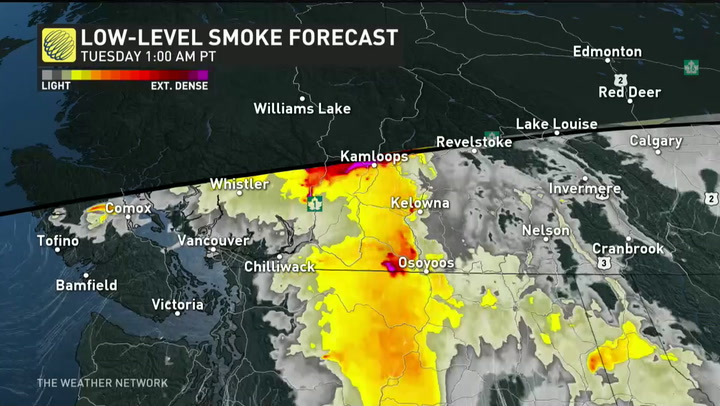
Ma said that much of southern B.C. had been "lucky to receive some rain," but "we are still in a hazardous situation for wildfires throughout B.C."

"I'm happy to report in the north we've received rain, and a lot of it," said Chief Ross Kotscherofski of the North Westside fire rescue department at a different briefing on Wednesday. "This, with lower temperatures, is going to really help with mopping up this fire."

Brad Litke, a BC Wildfire Service senior operations officer, said the rain was a boon to the more than 500 firefighters battling the blazes around Lake Okanagan.

"The rain is clearly helpful," he said. "What that tends to do is help extinguish some minor spot fires. It really makes an impact on the fine fuels, that's the surface litter. That's the primary driver for spot fires."

Wednesday's forecast for the Interior included warnings of potential localized flooding and "debris flows" as rains hit the scorched landscape.

Environment Canada issued a severe thunderstorm watch late Tuesday for the Shuswap and there was heavy rain in the region Tuesday night, with Salmon Arm recording 12 millimetres of rain yesterday -- the biggest single-day total all year in the drought-parched area.

Rainfall warnings have gone into effect for the South Peace River and Upper Fraser regions, with the forests ministry saying in a high streamflow advisory that rivers are expected to "respond rapidly" and rise quickly.

It said wildfire activity "may exacerbate localized run-off" and increase the risk of debris flows in areas burned by fires, although widespread flooding isn't expected.

West Kelowna Fire Chief Jason Brolund said Wednesday that a total of 84 properties were partially or totally damaged in West Kelowna and the Westbank First Nation.

Kotscherofski said 90 properties in his firefighting region were damaged or destroyed, although some, including the Lake Okanagan Resort, consist of multiple structures.

The total of 174 is in the ballpark of Tuesday's estimate of up to 200 properties. Wednesday's tally did not include the handful of homes thought to have been damaged or destroyed in Kelowna.

"I'm feeling some optimism based on the weather," said Brolund. "My priority now becomes returning people to their homes. I ask for your continued patience."

He said that with the clearing of smoke over Lake Okanagan, a clearer picture of the destruction in West Kelowna has become visible.

"It does look pretty shocking,” he said.

He said overnight firefighting was "sporadic and spotty" and no more properties were damaged.

A website was due to be launched Wednesday to let homeowners in West Kelowna, Westbank First Nation and the Central Okanagan Regional District learn if their properties have been damaged or destroyed, municipal officials said at the briefing.

"In a perfect world our preference, without question, would be to personally call every single homeowner and be with them when they receive what is probably the worst news they have ever received," said Sally Ginter, Central Okanagan Regional District chief administrative officer.

"But today we live in a day of social media and photos and information that is flying around faster than we can ever begin to think we can manage," she said.

The Columbia Shuswap Regional District has meanwhile been warning of misinformation being spread online.

It said Tuesday it had been made aware of emails and social media posts that said people do not need a permit to go into evacuation order areas, but clarified that this information is "completely false" and a permit is required.

This comes after federal and provincial officials publicly urged social media company Meta to reinstate access to Canadian news on its platforms, including Facebook and Instagram, so residents have easy access to accurate and up-to-date information amid the province's ongoing wildfire crisis.

The BC Wildfire Service website said there are 379 fires burning across the province, including 155 that are out of control and 14 "wildfires of note" that are highly visible or pose a threat to people or property. It says seven new fires were detected in the past 24 hours.

Ma said there are now 25,000 people under evacuation order in B.C. and 37,000 people on evacuation alert.

— with files from Darryl Greer

This report by The Canadian Press was first published Aug. 23, 2023.

Dirk Meissner, The Canadian Press
Top science publisher withdraws flawed climate study

Roland LLOYD PARRY
Thu, August 24, 2023 

Experts point to widespread concerns about peer-review standards in the lucrative academic publishing industry. (NASA)

Top science publisher Springer Nature said it has withdrawn a study that presented misleading conclusions on climate change impacts after an investigation prompted by an AFP inquiry.

AFP reported in September 2022 on concerns over the peer-reviewed study by four Italian scientists that appeared earlier that year in the European Physical Journal Plus, published by Springer Nature.

The study had drawn positive attention from climate-sceptic media.

The paper, titled "A critical assessment of extreme events trends in times of global warming", purported to review data on possible changes in the frequency or intensity of rainfall, cyclones, tornadoes, droughts and other extreme weather events.

Several climate scientists contacted by AFP said the study manipulated data, cherry picked facts and ignored others that would contradict their assertions, prompting the publisher to launch an internal review.

"The Editors and publishers concluded that they no longer had confidence in the results and conclusions of the article," Springer Nature told AFP in an email late Wednesday.

The journal's editors published an online note stating that the paper was retracted due to concerns over "the selection of the data, the analysis and the resulting conclusions".

- Peer-review standards -

It said the paper had been freshly reviewed by experts and the authors invited to submit an addendum in response to the criticisms.

But a review found this "not suitable for publication and that the conclusions of the article were not supported by available evidence or data provided by the authors".

Springer Nature said in its email that the investigation was conducted by its Research Integrity Group in line with guidelines of the Committee on Publication Ethics (COPE).

The paper's authors were identified in order as Gianluca Alimonti, a physicist at a nuclear physics institute; Luigi Mariani, an agricultural meteorologist, and physicists Franco Prodi and Renato Angelo Ricci.

The latter two were named as signatories of the World Climate Declaration, a text that repeated various debunked claims about climate change, an AFP fact check article found.

Their study was "not published in a climate journal," Stefan Rahmstorf, Head of Earth Systems at the Potsdam Institute for Climate Impact Research, told AFP at the time.

"This is a common avenue taken by 'climate sceptics' in order to avoid peer review by real experts in the field."

Recent studies have indicated that climate misinformation has flourished online as governments push reforms to curb use of the fossil fuels that cause planet-warming carbon emissions.

A further investigation published by AFP in April 2023 showed that sceptics opposed to the scientific consensus on human-caused climate change had got other misleading studies published in peer-reviewed journals.

Experts pointed to widespread concerns about peer-review standards in the lucrative academic publishing industry.

Retraction Watch, a blog that tracks withdrawals of academic papers, counted 5,000 such cases in 2022 -- about a tenth of a percent of the total number of studies published, its co-founder Ivan Oransky told AFP.

rlp/mh/ach

NASA's TEMPO sends first North American pollution data maps

Doug Cunningham
Thu, August 24, 2023 at 2:00 PM MDT·2 min read


NASA released the first pollution data maps from its TEMPO instrument orbiting 22,000 miles over the equator. This combined pair of images shows nitrogen dioxide levels over the Washington, D.C./Philadelphia/New York region at 12:14 and 4:24 p.m. on August 2, as measured by TEMPO.
 Photo by Kel Elkins, Trent Schindler, and Cindy Starr/NASA's Scientific Visualization Studio


Aug. 24 (UPI) -- The first data maps from a NASA pollution-monitoring instrument were released Thursday. NASA's TEMPO device creates visual representations of pollution and air quality over North America from 22,000 miles above the equator.

"Neighborhoods and communities across the country will benefit from TEMPO's game-changing data for decades to come," NASA Administrator Bill Nelson said in a statement. "This summer, millions of Americans felt firsthand the effect of smoke from forest fires on our health. NASA and the Biden-Harris Administration are committed to making it easier for everyday Americans and decision makers to access and use TEMPO data to monitor and improve the quality of the air we breathe, benefitting life here on Earth."

According to NASA, the TEMPO instrument will greatly improve studies of pollution caused by rush-hour traffic, the movement of smoke and ash from forest fires and volcanoes and even the effect of fertilizer application on farmlands.

TEMPO stands for Tropospheric Emissions: Monitoring of Pollution.

NASA said it will help scientists evaluate health impacts of pollutants and help with creating air pollution maps at the neighborhood scale.


This pair of images shows nitrogen dioxide levels over Southern California at 12:14 and 4:24 p.m. on August 2, as measured by TEMPO. 
Photo by Kel Elkins, Trent Schindler, and Cindy Starr/NASA's Scientific Visualization Studio

TEMPO was launched April 6 aboard a SpaceX Falcon 9 rocket and it makes hourly daytime scans of the lower atmosphere over North America from coast to coast and from roughly Mexico City to Canada.

It measures ozone, nitrogen dioxide, formaldehyde, aerosols, water vapor and several trace gases.

"We are excited to see the initial data from the TEMPO instrument and that the performance is as good as we could have imagined now that it is operating in space," said NASA TEMPO project manager Kevin Daugherty in a statement. "We look forward to completing commissioning of the instrument and then starting science research."

US Corn Harvest Is in Trouble

Tarso Veloso, Millie Munshi and Michael Hirtzer
Thu, August 24, 2023


(Bloomberg) -- Sagging ears just short of maturity, cobs half bare of kernels as if nibbled, earth so dry that deep cracks criss-cross the fields: The US corn harvest is in trouble.

The signs were already there in South Dakota. Scouts surveying fields there this week found what farmers call tip back, when corn kernels aren’t filled all the way to the top of the cob as a result of dryness and poor pollination. It leaves them looking half eaten.

As participants on the crop tour moved deeper into the growing belt, things got worse. In Ohio, scouts found immature ears of grain, indicating that the crop still has weeks left in the growing season. That leaves plants vulnerable to this week’s heat wave.

Temperatures topping 100F (38C) are descending on the Midwest. Conditions are changing so fast that even some results from the tour — seen as more timely and less conservative than government estimates — are already out of date.

“Things are changing right in front of our eyes,” said Thayne Larson, who has grown alfalfa, hay, corn in Kansas for 50 years. “It’s so disappointing when you have what you thought could be a healthy crop, and then the conditions just become extremely, extremely challenging.”

Crops Go ‘Backwards’


With food security already under threat from Europe to Asia, the world has been counting on a big corn harvest to help keep food inflation at bay. A disappointing US harvest could have ripple effects on markets across the globe.

Much will come down to Iowa, the No. 1 US corn grower and where sixth-generation farmer Ben Riensche is for the first-time ever watching his crop go “backwards” because of the heat.

His corn stalks went from bright and green to slightly gray. Instead of sitting tight against the plant, the corn ears are flopping down, the husk has turned brown and the bottom of the stalk — where the plants connects to the roots that go deep underground — looks like it’s been burned. It means that the plant is dead.

“We’re at the point of no return in Iowa,” Riensche, who farms 15,000 acres in the state, said while he was tending to livestock, making sure they had enough water, food and shade to survive the heat. It was 101F as he spoke late Wednesday afternoon. “I’ve never seen a crop go backwards like this — literally get killed by the hot, dry weather.”


Tour Results

Early results from the Pro Farmer Midwest Crop Tour are raising concerns that the crop will fall short of the US Department of Agriculture’s production outlook. Data collected in the first three days of the tour — which don’t fully capture real-time heat damages — show yields are trailing USDA estimates in Ohio, Nebraska, Indiana and Illinois. Only South Dakota looked better-than-forecast.

On Thursday evening, the final tour results will be released.

The heat is hurting soybeans even more as the crop is earlier in its growing season than corn. Pods were falling off plants as the scouts counted them, said Brent Judisch, who’s part of this week’s crop tour.

“This heat is doing more stress than we thought, because it is 100F outside, but as you walk into the fields you feel the temperature rising,” Judisch said. “This is my 11th crop tour, and I don’t remember a heat like this. We have never experienced this in Iowa.”

For many regions of the US crop belt, this season has been marked by turbulence. High temperatures are hitting Midwest fields just when rains in July seemed to have undone the damages of a hot, dry June.

‘Absolutely Devastated’

This season is the “most stressful” Larson of Kansas has ever had when it comes to challenges from Mother Nature. Drought, strong winds, storms and hail have all hit crops this summer. But it’s this week’s bout of extreme heat that’s really sealed the fate for his yields. The plants on his fields are shrinking. They going into “protection mode,” he said.

“You look at what’s going on in Kansas right now, we had a beautiful crop that in a week has been absolutely devastated,” said Gregg Doud, chief economist at Aimpoint Research and former chief agriculture negotiator under the Trump administration.

To be sure, the variability of this year’s crop — largely a result of spotty rainfall — suggests that there are bountiful areas that can help to make up for losses in others.

Early measurements in Iowa on Wednesday showed that corn yields can vary from almost 200 bushels an acre at the higher end, to the worst fields in some counties that have yields below 100.

“We were really surprised with the high yield variation that we are seeing,” said Brian Grete, leader of the eastern leg of the crop tour and editor of the Pro Farmer newsletter.

For Riensche in Iowa, the damage from the current high temperatures “is unprecedented,” he said.

“Our crop is literally dying right now,” Riensche said. “Corn was not meant to be grown in the desert.”

--With assistance from Isis Almeida and Gerson Freitas Jr..

Most Read from Bloomberg Businessweek
Mystery of octopus garden in ocean’s midnight zone solved by scientists

Katie Hunt, CNN
Thu, August 24, 2023 

Deep-sea octopuses are typically solitary creatures that inhabit frigid waters in one of Earth’s most challenging environments.

The 2018 discovery of thousands of the eight-legged cephalopods about 2 miles below the ocean’s surface flummoxed and fascinated marine scientists in equal measure. The consortium of octopuses clustered around a hydrothermal vent — an opening in the seafloor where warm, chemical-rich fluids flow out — about 10,500 feet (3,200 meters) down in what’s known as the midnight zone, a place of perpetual darkness.

The octopus garden — found on a small hill near the base of Davidson Seamount, an extinct underwater volcano 80 miles (128.7 kilometers) southwest of Monterey, California — was full of a species called Muusoctopus robustus, nicknamed the pearl octopus by the research team because of the way they look while upside down protecting their eggs.

The find is the largest known aggregation of octopuses on the planet — researchers counted more than 6,000 octopuses in just one segment of the site.

“We think there may be 20,000 octopus there. And the question is, well, why are they there? And why are they aggregating? It looks like the warm waters that are emanating from these springs is a key to why these animals are breeding there,” said Jim Barry, a senior scientist at the Monterey Bay Aquarium Research Institute.

Researchers believe the octopuses migrate to the deep-sea thermal springs in such numbers to mate and nest, according to a new study published Wednesday in the journal Science Advances. After laying eggs, expectant octopus moms keep the eggs clean and guard them from predators. The warmer temperatures speed up the creatures’ embryonic development.

“Very long brooding periods increase the likelihood that a mother’s eggs won’t survive. By nesting at hydrothermal springs, octopus moms give their offspring a leg up,” explained Barry, who was the lead author of the study.

The ambient water temperature at 10,500 feet is 35 degrees Fahrenheit (1.6 degrees Celsius). However, the water temperature in cracks and crevices at the octopus garden reaches about 51 degrees Fahrenheit (11 degrees Celsius).

State-of-the-art underwater technology allowed researchers to understand the octopus garden. - MBARI


Underwater technology

The researchers at Monterey Bay Aquarium Research Institute and their colleagues at other institutions used state-of-the-art underwater technology to understand the octopus garden.

The institute’s ROV Don Ricketts went on 14 day-long follow-up dives to the site between 2019 and 2022, taking high-definition video of the octopuses and mapping the octopus garden at a meter-scale resolution.

The remotely operated submersible also left a time-lapse camera and sensors to measure temperature and oxygen levels for long-term observations of the octopuses’ behavior. The camera recorded an image every 20 minutes, taking about 12,200 images from March 2022 to August 2022.

Researchers found that the octopuses' eggs hatched in less than two years — much more quickly than the team had expected. - MBARI

Faster brood times in the octopus garden


With this information, scientists pieced together why the octopus are attracted to the site. Scars and other distinguishing features allowed the scientists to monitor individual octopuses and the development of their broods.

The presence of adult male and female octopuses, developing eggs and octopus hatchlings indicated that the site is used exclusively as a breeding ground and nursery. The team did not observe any intermediate-size individuals or any evidence of feeding.

“We see hatchlings swimming away. We’ve never seen any small animals that suggests that they live right here. So they swim off somewhere and they start their life,” Barry said.

The study found that the eggs hatched in less than two years — much more quickly than the team had expected. One deep-sea octopus species broods its eggs for four and a half years. Away from the hydrothermal vents in the near-freezing temperatures of the deep sea, egg-brooding periods are thought to last for several years.

“Although it’s risky to brood in this warm water — you may be cooking your eggs, you may have abnormalities — the shorter brood period is where the advantage comes in and that seems to play out perfectly for them because we see what looks to be fairly high hatch rates,” he said.


Scientists believe the site off the coast of Monterey, California, is used exclusively as a breeding ground and nursery. - MBARI

Unraveling mysteries of the octopus life cycle

The researchers believe warmth from thermal springs increased the metabolism of female octopuses and their eggs, reducing the time required for incubation and making it less likely that the eggs are eaten by predators. However, it’s not clear whether this warmth is absolutely necessary for this species to reproduce and nest or something they simply like to seek out.

The researchers will continue to study the site at Davidson Mount and want to look for places with similar geology that could host other octopus gardens, although deep-sea exploration is very expensive, Barry said.

Octopuses are famously self-sacrificial parents — after laying a clutch of eggs, they quit eating and waste away, typically dying by the time the eggs hatch. Dead octopus and vulnerable hatchlings provide a feast for invertebrates such as sea anemones and sea stars that live side by side with the brooding octopuses.

Researchers have documented a total of four deep-sea octopus gardens to date — two off the coast of Central California on the Davidson Mount and two off the coast of Costa Rica.


Putin breaks silence on plane crash that purportedly killed Wagner chief

CBSNews
Updated Thu, August 24, 2023 

Russian President Vladimir Putin on Thursday expressed his "condolences" over a plane crash that purportedly killed Wagner chief Yevgeny Prigozhin, describing him as a man who made mistakes but achieved "results."

An investigation is underway into what caused Wednesday's crash, which came exactly two months after Wagner's short-lived rebellion against Moscow's military leadership.

"First of all I want to express words of sincere condolences to the families of all the victims," Putin said in a televised meeting, calling the incident a "tragedy."

"I knew Prigozhin for a very long time, since the early '90s. He was a man of complicated fate, and he made serious mistakes in his life, but he achieved the right results," Putin added.

He mentioned Prigozhin's work in Africa — where Prigozhin claimed to be earlier in the week and where the Wagner group maintains a significant military presence.

"As far as I know, he just returned from Africa yesterday and met with some officials there," Putin said.

He said the investigation into the crash "will take some time."

"It will be conducted in full and brought to a conclusion. There is no doubt about that," Putin said, in footage showing a meeting with the Russian-installed head of the Donetsk region Denis Pushilin.

Yevgeny Prigozhin, left, with Russian President Vladimir Putin 
/ Credit: Alexei Druzhinin/Sputnik/Kremlin Pool Photo via AP

The circumstances of the crash, which reportedly claimed the lives of some of Prigozhin's close entourage, have prompted furious speculation about a possible assassination.

An initial U.S. assessment of the situation found that Prigozhin was likely killed in the crash, Air Force Brig. Gen. Pat Ryder, the Pentagon press secretary, told reporters.

The assessment was made "based on a variety of factors," Ryder said during a news briefing Thursday. He didn't provide specific details.

"We're continuing to assess the situation," Ryder said.

A U.S. official told CBS News that it appears "very unlikely" that Prigozhin's plane was shot down by a surface-to-air missile and that the most likely cause appears to be an explosion aboard the aircraft. What caused the explosion is not known, although a bomb is one possibility, the official said.

On Wednesday, President Biden was asked if he believed Putin was behind the crash. He replied: "There's not much that happens in Russia that Putin's not behind, but I don't know enough to know the answer to that."

Prigozhin was branded a "traitor" by Putin after Wagner launched its rebellion in June, in what was seen as Putin's biggest challenge to authority since he came to power.

Among those killed in the crash was Dmitry Utkin, a shadowy figure who managed Wagner's operations and allegedly served in Russian military intelligence.

Putin said the Wagner members who died in the crash made a "significant contribution" to Moscow's offensive in Ukraine and shared a "common cause."

"We remember that, we know that, and we will not forget that," Putin said.

Earlier this week, Prigozhin appeared in his first video since leading a failed mutiny against Russian commanders in June. He could be seen standing in arid desert land, dressed in camouflage with a rifle in his hand, and hinting he's somewhere in Africa. He said Wagner was making Russia great on all continents, and making Africa "more free."

CBS News had not verified Prigozhin's location or when the video was taken. But it appeared to be a recruitment drive on the African continent, where the Wagner group has been active. Some nations have turned to the private army to fill security gaps or prop up dictatorial regimes.

In some countries, like the Central African Republic, Wagner exchanges services for almost unfettered access to natural resources. A CBS News investigation found that Wagner was plundering the country's mineral resources in exchange for protecting the president against a coup.


Mercenary chief Prigozhin is presumed to have died in a plane crash seen as the Kremlin's revenge

The Associated Press
Updated Thu, August 24, 2023


Russian mercenary chief Yevgeny Prigozhin and some of his top lieutenants were presumed dead in a plane crash — widely seen Thursday as an assassination to avenge a mutiny that challenged President Vladimir Putin’s authority.

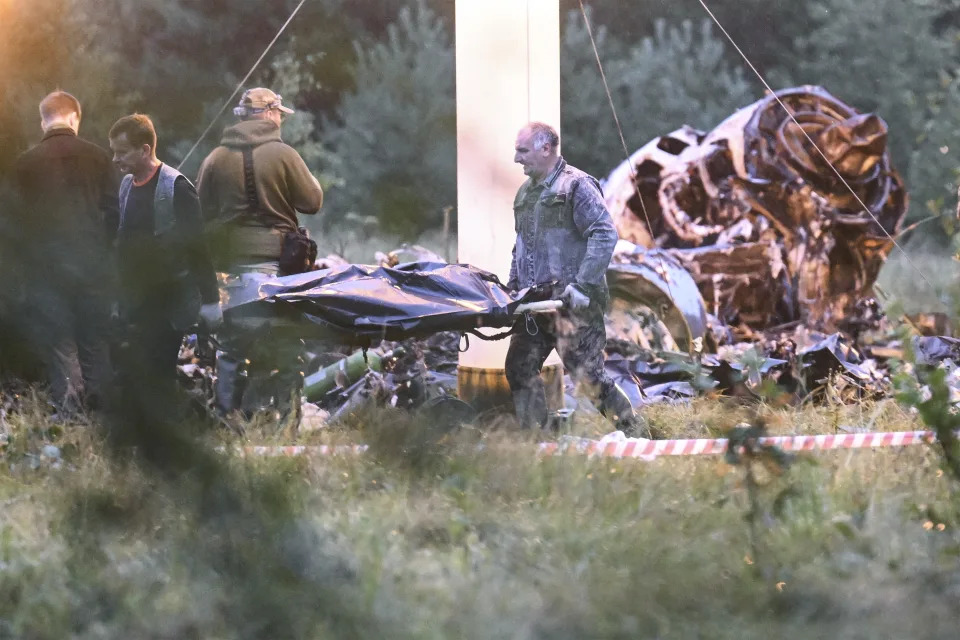
The founder of the Wagner military company and six other passengers were on a private jet that crashed Wednesday, soon after taking off from Moscow with a crew of three, according to Russia's civil aviation authority. Rescuers found 10 bodies, and Russian media cited anonymous sources in Wagner who said Prigozhin was dead. But there has been no official confirmation.

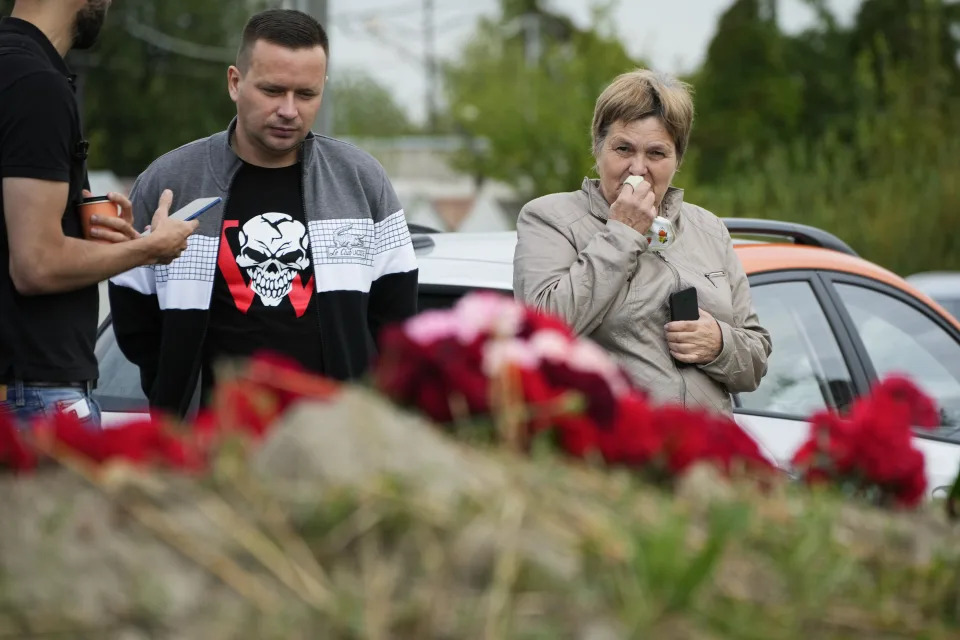
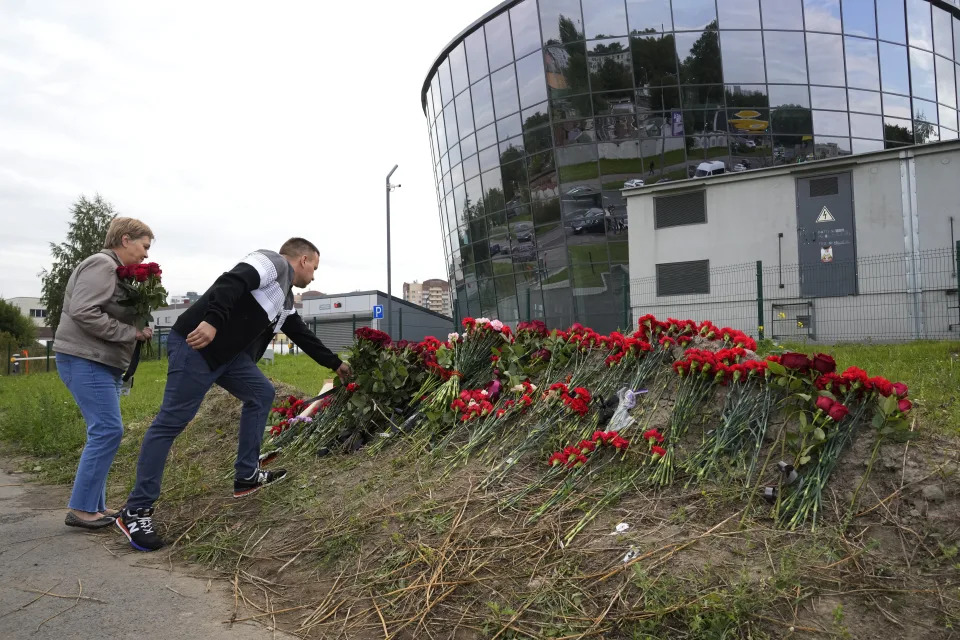
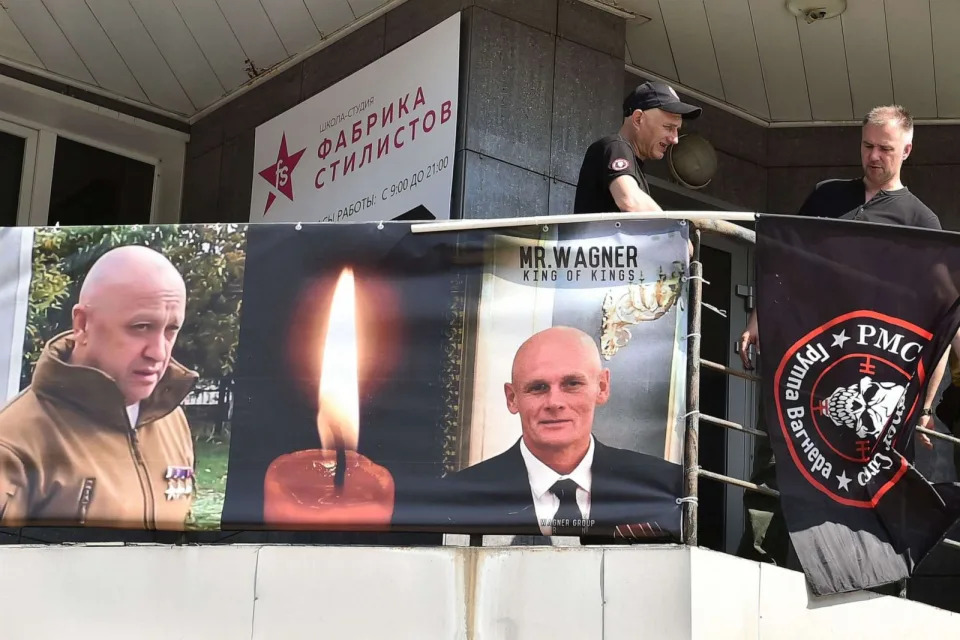
At Wagner’s headquarters in St. Petersburg, lights were turned on in the shape of a large cross, and Prigozhin supporters built a makeshift memorial, piling red and white flowers outside the building Thursday, along with company flags and candles.

Putin remained silent as speculation swirled, addressing the BRICS summit in Johannesburg via videolink without mentioning the crash. Russian state media also have not covered it extensively, instead focusing on the summit and Russia’s invasion of Ukraine.

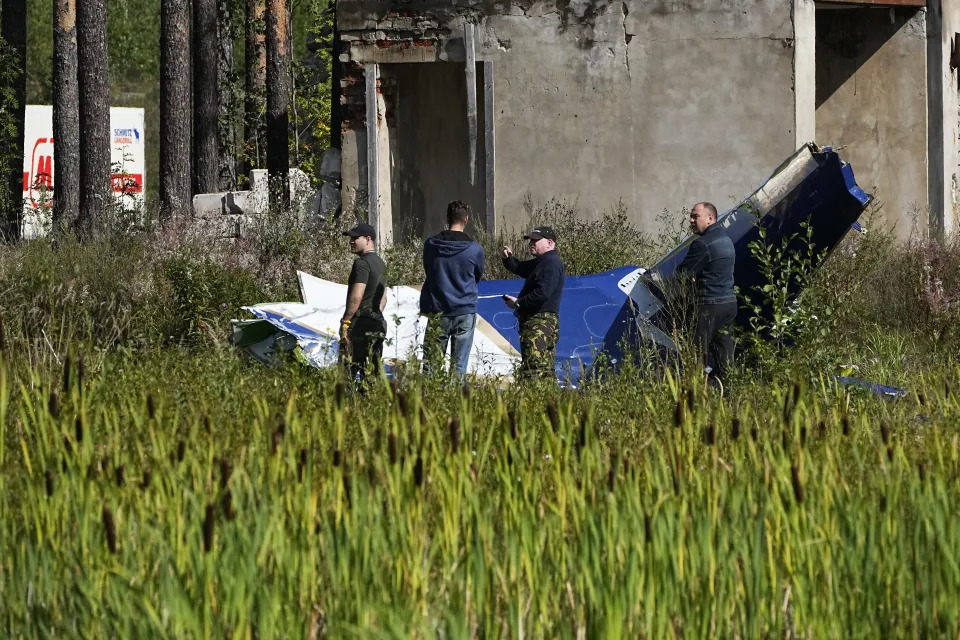
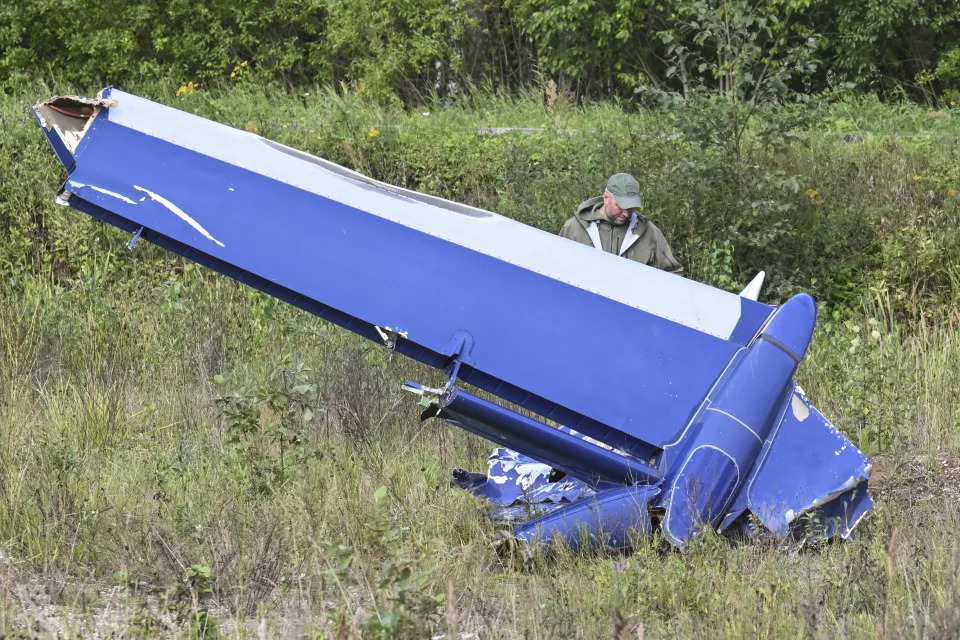
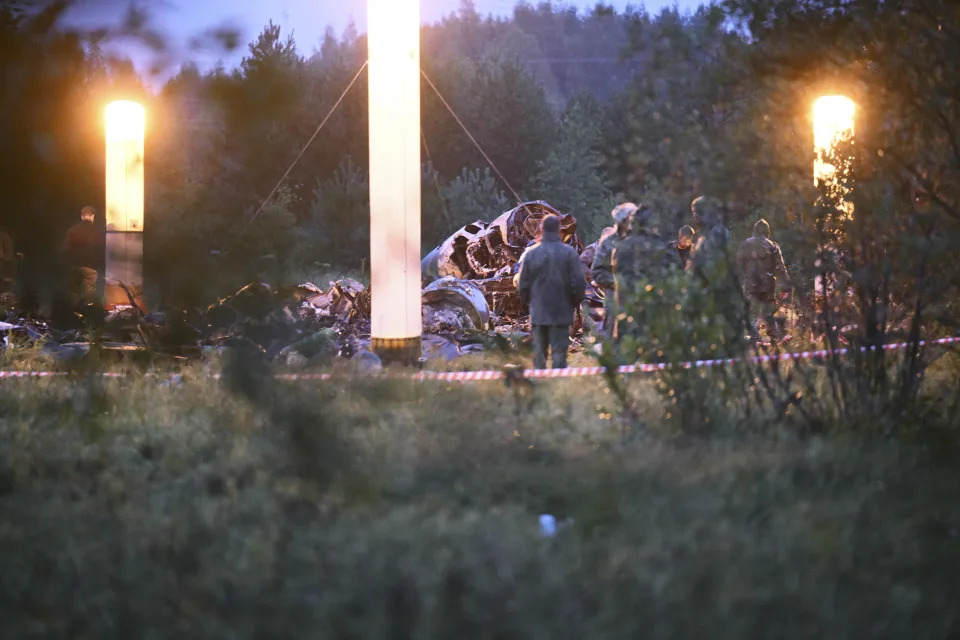
Police, meanwhile, cordoned off the field where the plane went down in Kuzhenkino, about 300 kilometers (185 miles) northwest of Moscow, as investigators studied its wreckage. Vehicles took away the bodies.

Several Russian social media channels reported that the bodies were burned or disfigured beyond recognition and would need to be identified by DNA. The reports were picked up by independent Russian media, but the Associated Press was not able to independently confirm them.

Prigozhin supporters claimed on pro-Wagner messaging app channels that the plane was deliberately downed, including suggesting it could have been hit by an air defense missile or targeted by a bomb on board. Those claims could not be independently verified.

Russian authorities have said the cause of the crash is under investigation.

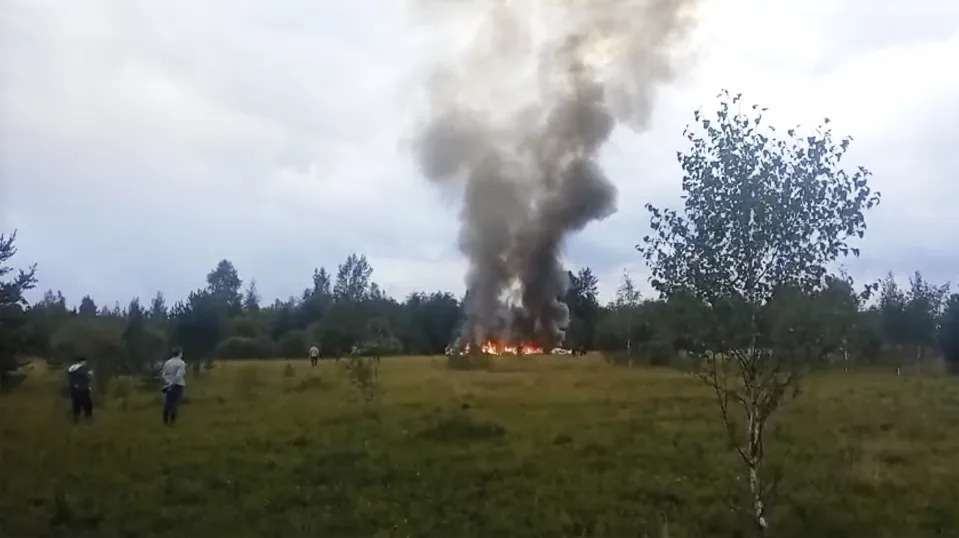
Kuzhenkino resident Anastasia Bukharova, 27, said she was walking with her children Wednesday when she saw the jet, “and then — boom! — it exploded in the sky and began to fall down.” She said she was scared it would hit houses in the village and ran with the children, but it ended up crashing into a field.

“Something sort of was torn from it in the air, and it began to go down and down,” she added.

Numerous opponents and critics of Putin have been killed or gravely sickened in apparent assassination attempts, and U.S. and other Western officials long expected the Russian leader to go after Prigozhin, despite promising to drop charges in a deal that ended the June 23-24 mutiny.

"It is no coincidence that the whole world immediately looks at the Kremlin when a disgraced ex-confidant of Putin suddenly falls from the sky, two months after he attempted an uprising,” said German Foreign Minister Annalena Baerbock, while acknowledging that the facts were still unclear.

“We know this pattern … in Putin’s Russia — deaths and dubious suicides, falls from windows that all ultimately remain unexplained,” she added.

Ukrainian President Volodymyr Zelenskyy also pointed the finger. “We have nothing to do with this. Everyone understands who does,” he said.

Further fueling speculation that the plane crash was a strike at the heart of Wagner, among those aboard was a top Prigozhin associate, Dmitry Utkin, according to the civil aviation authority. Utkin's call sign was Wagner, which became the company’s name.

The crash also came the same week that Russian media reported that Gen. Sergei Surovikin, a former top commander in Ukraine who was reportedly linked to Prigozhin, was dismissed from his post as commander of Russia’s air force.

Prigozhin was long outspoken and critical of how Russian generals were waging the war in Ukraine, where his mercenaries were some of the fiercest fighters for the Kremlin. For a long time, Putin appeared content to allow such infighting — and Prigozhin seemed to have unusual latitude to speak his mind.

But Prigozhin's brief revolt raised the ante. His mercenaries swept through the southern Russian city of Rostov-on-Don and captured the military headquarters there without firing a shot. They then drove to within about 200 kilometers (125 miles) of Moscow and downed several military aircraft, killing more than a dozen Russian pilots.

Putin first denounced the rebellion — the most serious challenge to his authority of his 23-year rule — as “treason” and a “stab in the back.” He vowed to punish its perpetrators — and the world waited for Putin's move, particularly since Prigozhin had publicly questioned the Russian leader's justifications for the war in Ukraine, seen as a red line.

But instead Putin made a deal that saw an end to the mutiny in exchange for an amnesty for Prigozhin and his mercenaries and permission for them to move to Belarus.

Now many are suggesting the punishment has finally come.

“The downing of the plane was certainly no mere coincidence,” Janis Sarts, director of NATO’s Strategic Communications Centre of Excellence, told Latvian television.

Even if confirmed, Prigozhin’s death is unlikely to have an effect on Russia’s war in Ukraine. His forces fought some of the bloodiest battles over the last 18 months, but pulled back from the frontline after capturing the eastern city of Bakhmut in late May. After the rebellion, Russian officials said his fighters would only be able to return to Ukraine as part of the regular army.

The Institute for the Study of War argued that Russian authorities likely moved against Prigozhin and his top associates as “the final step to eliminate Wagner as an independent organization.”

Flight tracking data reviewed by The Associated Press showed a private jet that Prigozhin had used previously took off from Moscow on Wednesday evening, and its transponder signal disappeared minutes later.

Videos shared by the pro-Wagner Telegram channel Grey Zone showed a plane dropping like a stone from a large cloud of smoke, twisting wildly as it fell, one of its wings apparently missing. A freefall like that typically occurs when an aircraft sustains severe damage, and a frame-by-frame AP analysis of two videos was consistent with some sort of explosion mid-flight.


People lay flowers at an informal memorial next to the former 'PMC Wagner Centre' in St. Petersburg, Russia, Thursday, Aug. 24, 2023. Russian mercenary leader Yevgeny Prigozhin, the founder of the Wagner Group, reportedly died when a private jet he was said to be on crashed on Aug. 23, 2023, killing all 10 people on board. 

(AP Photo/Dmitri Lovetsky)

Wagner leader Prigozhin 'likely' killed in Russian plane crash, US says

JON HAWORTH, LUIS MARTINEZ and PATRICIO CHILE
Thu, August 24, 2023 

Wagner Group leader Yevgeny Prigozhin was "likely" killed in a plane crash along with 9 others near Kuzhenkino, Russia, on Wednesday, the Pentagon said, but there is no indication a surface-to-air missile was the cause of the crash.

"We don't have any information to indicate right now ... there was some type of surface to air missile that took down the plane, that we assessed that information to be inaccurate," Pentagon press secretary Brig. Gen. Pat Ryder said.

He added, "But beyond that, I'm really just not going to have any further information. What was it, something that came internal from inside the plane? Again, I don't have any additional insight to provide on that."

Earlier, Russian President Vladimir Putin offered his first comments on the mysterious plane crash that presumably killed Prigozhin and the private military company's co-founder Dmitry Utkin.

His comments were made hours after the bodies of the crash victims were moved to the Tver Regional Bureau of Forensic Medical Examination, ABC News learned.

"As for the aviation tragedy, first of all, I want to express my sincerest condolences to the families of all the victims," Putin said in an on-camera address, adding that Wagner Group made a "significant contribution to our common cause of fighting the neo-Nazi regime in Ukraine."

"I knew (Yevgeny) Prigozhin for a very long time, since the early 1990s. He was a man with a complex destiny, and he made serious mistakes in life," Putin said. "He achieved the results he needed both for himself and, when I asked him, for the common cause, as in these last months."

He added on the investigation, "But what is absolutely clear - the head of the Investigative Committee reported to me this morning, they have already launched a preliminary investigation into this incident. And it will be carried out in full and to the end. There is no doubt about that here. Let's see what the investigators say in the near future. Tests -- technical and genetic tests -- are being carried out now. This takes some time."


PHOTO: People hang out portraits of Yevgeny Prigozhin and Dmitry Utkin as they pay tribute to them at the makeshift memorial in front of the PMC Wagner office in Novosibirsk, on August 24, 2023. (Vladimir Nikolayev/AFP via Getty Images)

Earlier Thursday, Putin addressed the BRICS summit of leaders meeting in Johannesburg remotely, but made no mention of the crash in his remarks.

Meanwhile, in St. Petersburg -- Prigozhin’s home town -- dozens of people have been arriving to light candles and drop flowers at a pop-up memorial.

The jet manufacturer that Prigozhin and Utkin were reportedly on has an impeccable record and it was the first recorded crash in the history of the Embraer Legacy 600.

Elsewhere, Ukrainian President Volodymyr Zelenskyy made remarks commemorating marking Ukrainian Independence Day and handed out medals to Ukrainian solders.

MORE: Russian rebellion timeline: How the Wagner uprising against Putin unfolded and where Prigozhin is now

Among the 10 dead were three crew members and seven passengers, Russian officials said. The seven passengers identified on a flight list were Sergey Propustin, Evgeniy Makaryan, Aleksandr Totmin, Valeriy Chekalov, Dmitriy Utkin, Nikolay Matuseev and Prigozhin. The crew was identified as Cmdr. Aleksei Levshin, co-pilot Rustam Karimov and flight attendant Kristina Raspopova.

The Federal Air Transport Agency said the plane was en route from Moscow to St. Petersburg when it went down near Kuzhenkino.

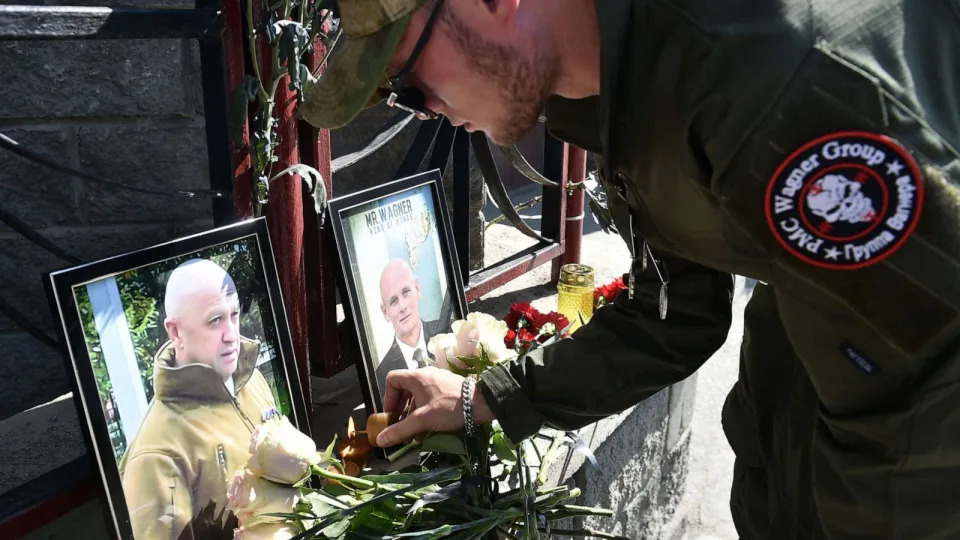
A member of private mercenary group Wagner pays tribute to Yevgeny Prigozhin (L) and Dmitry Utkin at the makeshift memorial in front of the PMC Wagner office in Novosibirsk, on August 24, 2023.
 (Vladimir Nikolayev/AFP via Getty Images)

White House National Security Council spokesperson Adrienne Watson said in a statement on Wednesday that officials were watching the reports of the plane crash.

"If confirmed, no one should be surprised. The disastrous war in Ukraine led to a private army marching on Moscow, and now -- it would seem -- to this," she said.

Prigozhin was the head of the private paramilitary organization Wagner Group, which played a key role in Russia's invasion of Ukraine before briefly launching an insurrection against the Russian military in June. Forces loyal to Prigozhin marched toward Moscow, before turning back after several days.

ABC News' Joe Simonetti, Will Gretsky, Mark Osborne, Ivan Pereira and Tanya Stukalova contributed to this report.


A top Russian general linked to the head of a rebellious mercenary group is reportedly dismissed
AIR SUPPORT FOR WAGNER REVOLT

The Associated Press
Updated Wed, August 23, 2023


In this handout photo released by Russian Defense Ministry Press Service on Saturday, June 24, 2023, the top Russian military commander in Ukraine, Gen. Sergei Surovikin records his appeal to armed rebellion at the unknown location. Gen. Surovikin, a former commander of Russia's forces in Ukraine who was linked to the leader of an armed rebellion, has been dismissed from his job as chief of the air force, according to Russian state media. The report Wednesday, Aug. 23, 2023, came after weeks of uncertainty about his fate following the short-lived uprising.
(Russian Defense Ministry Press Service)


Gen. Sergei Surovikin, a former commander of Russia's forces in Ukraine who was linked to the leader of a brief armed rebellion, has been dismissed as chief of the air force, Russian state media reported Wednesday after weeks of uncertainty about his fate.

Surovikin has not been seen in public since June 23-24, when Yevgeny Prigozhin, head of the Wagner mercenary group, sent his men to march toward Moscow. In a video released during the uprising, Surovikin — who was believed to have close ties to Prigozhin — had urged him to pull the mercenaries back.

The Wagner uprising posed the most serious challenge to President Vladimir Putin’s 23-year rule and reports circulated that Surovikin had known about it in advance. Prigozhin called off the rebellion short of reaching Moscow after he said he wanted to avoid bloodshed.

Surovikin's absence has been one of several enduring mysteries surrounding the rebellion. During his absence, Russian media have speculated about Surovikin’s whereabouts, with some claiming he had been detained, but his daughter told the Russian social media channel Baza in late June that her father had not been arrested.

Russian state news agency RIA Novosti, citing an anonymous source, reported that Surovikin has been replaced as commander of the Russian Aerospace Forces by Col. Gen. Viktor Afzalov, who heads the main staff of the air force.

The agency frequently represents the official position of the Kremlin through reports citing anonymous officials in Russia’s defense and security establishment.

The Russian government has not commented on the report, and The Associated Press was not able to confirm it independently.

The Russian daily newspaper RBC reported that Surovikin is being transferred to a new job and is now on vacation.

Alexei Venediktov, the former head of the closed radio station Ekho Moskvy, and Ksenia Sobchak, the daughter of a Putin-linked politician, both wrote on social media Tuesday that Surovikin had been dismissed.

Sobchak said Surovikin was removed from his post Aug. 18, “by a closed decree. The family still has no contact with him.”

Surovikin was dubbed “General Armageddon” for his brutal military campaign in Syria and led Russia’s operations in Ukraine between October 2022 and January 2023. Under his command, Russian forces unleashed regular missile barrages on Ukrainian cities, significantly damaging civilian infrastructure and disrupting heating, electricity and water supplies.

Both Surovikin and Prigozhin were both active in Syria, where Russian forces have fought to shore up President Bashar Assad’s government since 2015.

Surovikin was replaced as commander in Ukraine by Chief of General Staff Gen. Valery Gerasimov following Russia’s withdrawal from the southern city of Kherson amid a swift counteroffensive by Kyiv's troops, but the air force general continued to serve under Gerasimov as a deputy commander.

Prigozhin had spoken positively of Surovikin while criticizing Russia’s military brass, and suggested he should be appointed General Staff chief to replace Gerasimov.

While the reports circulated about actions against Surovikin, Prigozhin, appears to be still in charge of the mercenary group, which won a key battle to capture the Ukrainian city of Bakhmut earlier this year. Prigozhin said he launched the rebellion to oust Defense Minister Sergei Shoigu and other military leaders who he accused of mismanaging the war in Ukraine.

Shortly after the rebellion, the Kremlin confirmed Putin had a three-hour meeting with Prigozhin and Wagner commanders shortly before they apparently agreed to depart for exile in Belarus. In July, Prigozhin was seen on the sidelines of a Russia-Africa summit in the Russian city of St. Petersburg, and this week he posted his first video address since the mutiny, saying he was seeking “bogatyrs” — courageous and strong men — to work for Wagner in Africa.


3 small Palestinian villages emptied out this summer. Residents blame Israeli settler attacks


JULIA FRANKEL
Wed, August 23, 2023


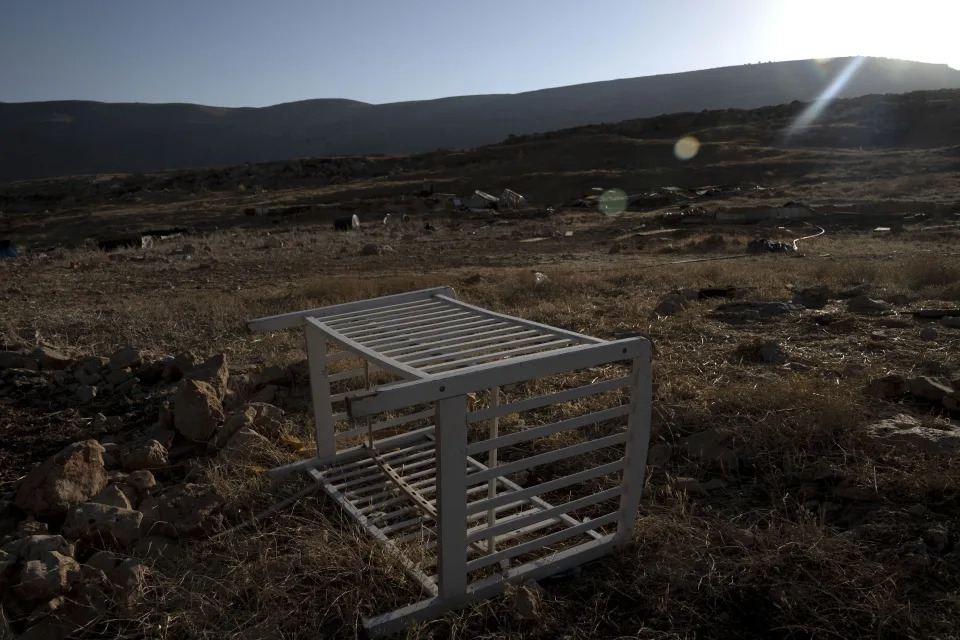
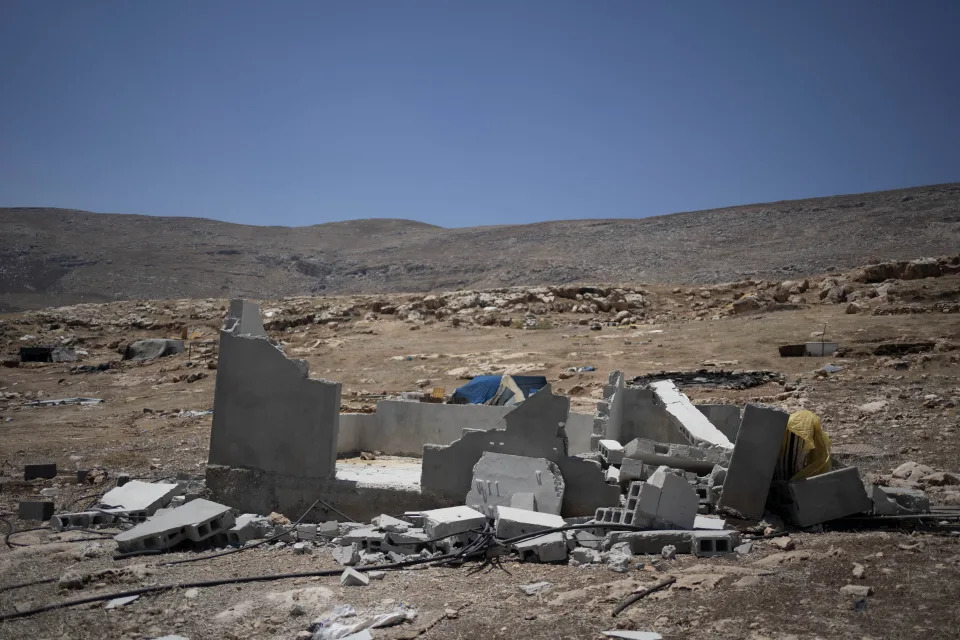
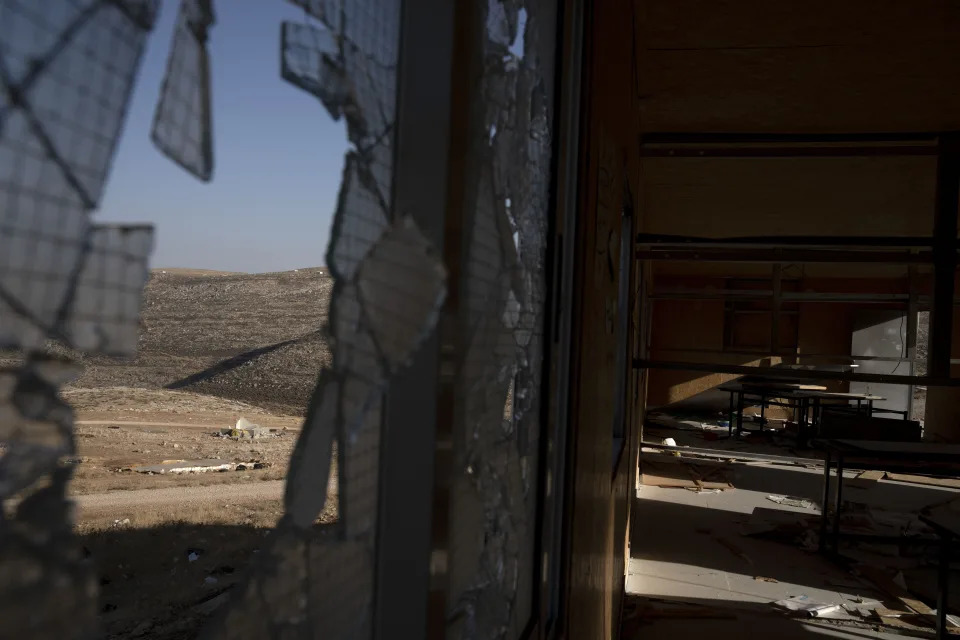
AL-QABUN, West Bank (AP) — The Palestinian hamlet of al-Qabun in the central occupied West Bank was silent this week — the grazing fields for sheep deserted, the empty schoolhouse locked, the makeshift homes left as steel carcasses.

The last families living there packed up two weeks ago, driven from their homes of nearly three decades by what they said was a year of intensified attacks and harassment by armed Jewish settlers living in unauthorized outposts on neighboring hilltops.

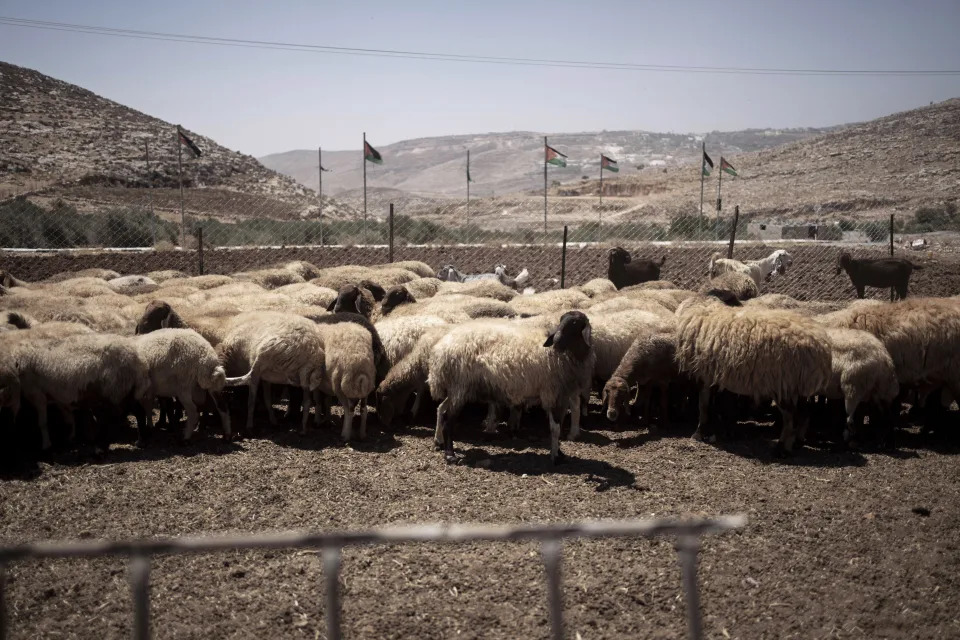
“I feel like I’m a refugee here, and settlers are the owners of our land,” said Ali Abu Kbash, a shepherd who fled al-Qabun with his four children and 60 sheep for the rocky slopes of a neighboring village. He said life had become unbearable as settlers tried to take over his fields with their sheep, tampered with the village’s water supply, and routinely burst into his village to harass residents.

The exodus from al-Qabun, a small Bedouin village northeast of the city of Ramallah that numbered 89 people before the evacuation, represents the third case over four months in which a Palestinian community emptied out, according to data from U.N. monitors. Residents blame mounting settler violence.

For Palestinians, the recent wave of departures from Area C — the 60% of the West Bank that has remained under Israeli military control since interim peace accords from the 1990s — is emblematic of a new stage in the Israeli-Palestinian conflict, as Jewish settlers double down on shepherding as a tool to seize land. United Nations officials warn the trend is changing the map of the West Bank, entrenching unauthorized outposts.

Some 500,000 Israelis have settled in the West Bank — specifically in Area C — since Israel captured the territory, along with east Jerusalem and the Gaza Strip, in the 1967 Mideast war. Their presence is viewed by most of the international community as a major obstacle to peace.

Settlement expansion has been promoted by successive Israeli governments over nearly six decades, but Netanyahu’s far-right government has made it a top priority. Settler firebrand and powerful Finance Minister Bezalel Smotrich plans to ask the government to allocate $180 million for West Bank projects that could advance his goal of eliminating any differences between life in the settlements and life within Israel’s internationally recognized borders.

"The displacement of Palestinians amid increasing settler violence is of a magnitude that we have not previously documented,” said Andrea De Domenico, head of the U.N. Office for the Coordination of Humanitarian Affairs in the occupied Palestinian territory. Settler attacks have displaced nearly 500 Palestinians, including 261 children, in the past year and a half, the office estimates.

A spokesperson for settlers in the region denied accusations of violence or aggression against Palestinian communities. “No one forced them out,” said Eliana Passentin. “They chose to leave.”

While Bedouin are traditionally nomadic, the recent departures are not voluntary seasonal migrations, residents and researchers said. Instead of moving to nearby hamlets before returning, Bedouin are fleeing the open areas of the West Bank for populous towns under Palestinian Authority administrative control.

Most of the displaced villagers said they would like to go home one day but would not unless the outposts disappeared.

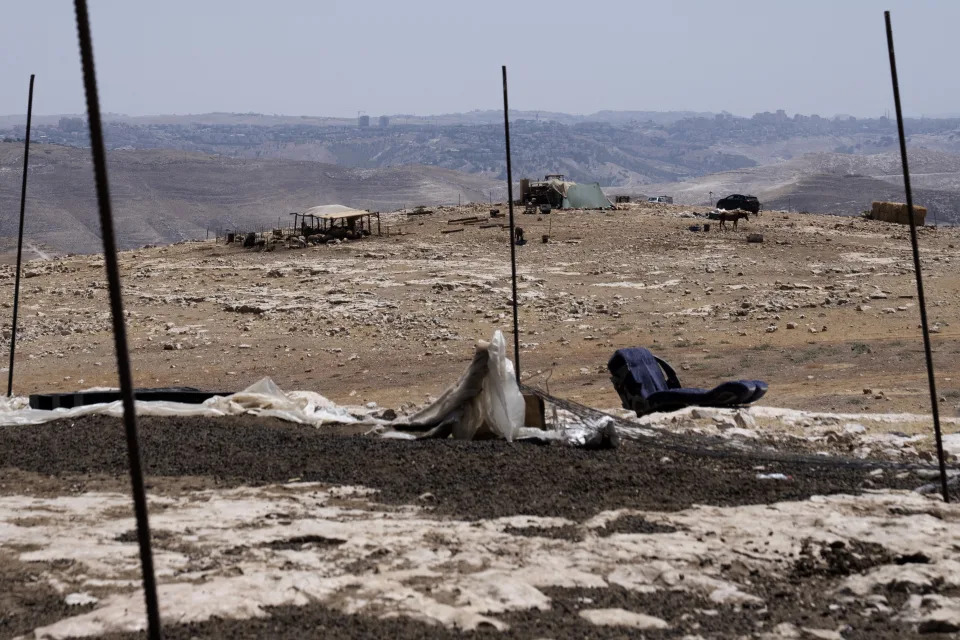
Out of 36 people who fled the Palestinian hamlet of al-Baqa, east of Ramallah, in early July, just one six-person family has returned after settlers from a newly established outpost wreaked havoc on the village, setting their sheep loose on Palestinian grazing fields and torching a home with people inside.

“The rest of my village is too scared to return,” said Mustafa Arara, a 24-year-old resident who recently went back.

Palestinian rights groups describe the uptick in settler incursions as part of a state-backed strategy. For decades, the settler movement has sought to clear sections of the West Bank around the Israeli-built Route 90 road that runs through the Jordan Valley. If Israel were to develop the areas, it would bolster the contiguity of settlements and further weaken the already faint possibility of a partition deal leading to Palestinian statehood.

Many Bedouin communities in Area C have been slated for expulsion because they could not secure permission to build. According to anti-settlement watchdog group Peace Now, over 95% of Palestinian building permits are rejected. The military routinely issues demolition orders for homes of corrugated tin and scrap wood. Last week, authorities leveled a European Union-funded schoolhouse in the Bedouin hamlet of Ein Samiya, which 150 residents recently fled — virtually guaranteeing they would not return soon.

But the government hasn’t carried out mass evictions for decades. In some cases, Israel's Supreme Court delays the expulsion of Bedouin communities by questioning whether authorities have suitable relocation plans.

Now, rights groups say radical Jewish settlers and their sheep are doing what Israeli authorities have not — driving scores of Bedouin from land that they’ve inhabited for decades. Most settled in the area after fleeing or being forced from the Negev desert in the 1948 war surrounding Israel’s creation.

“I don’t think there was a meeting in a smoky room between the army and government and settlers,” said Michael Sfard, a prominent Israeli lawyer who often represents Palestinians. “But in a more general way, Israel is directly pushing the Palestinian community away from open lanes of Area C and into more populous enclaves.”

Amana, a group that supports and funds unauthorized settlements, described the shepherd outposts as a way for Israelis to take over the most land with the least effort at a conference in 2021.

“Construction takes up little ground and is expensive, and it doesn’t allow you to bring in large amounts of people in a short period of time,” Amana’s secretary-general, Ze’ev Hever, said at the conference.

Israeli shepherd settlers now control some 60,000 acres — just under 7% of Area C, said Dror Etkes, an Israeli anti-settlement researcher. A quarter of that land was seized after Palestinian residents evacuated. When al-Qabun emptied, some 3,000 additional acres fell under Israeli control, Etkes said.

Violence from both Israelis and Palestinians has long been routine in the territory. But under Netanyahu's new government, the number of attacks against Palestinians has skyrocketed, according to U.N. monitors.

In the governorate of Ramallah — where four small Palestinian villages have emptied out since last July — the U.N. has recorded 150 Palestinians injured and four killed by either Israeli settlers or Israeli forces in settler-related incidents between January and early August this year. That’s nearly double the number of injuries recorded in all of 2022.

Israel’s military said it does not allow or support acts of settler violence. It said the security forces deal with “cases in which a report of violence in the area” is received.

After evacuating earlier this month, some residents from al-Qabun returned — to set fire to what remained of their homes. They’d rather burn down the place themselves than let Israeli settlers do it, they said.

The violent settlers who drove them to leave, they said, came from a nearby outpost known as Malachei Hashalom — Hebrew for “Angels of Peace."

Founded in 2015, Malachei Hashalom describes itself as a “special shepherding farm ... where Jewish presence is critical to the security and integrity of the country.”

Earlier this year, Netanyahu’s government pledged to legalize the outpost.


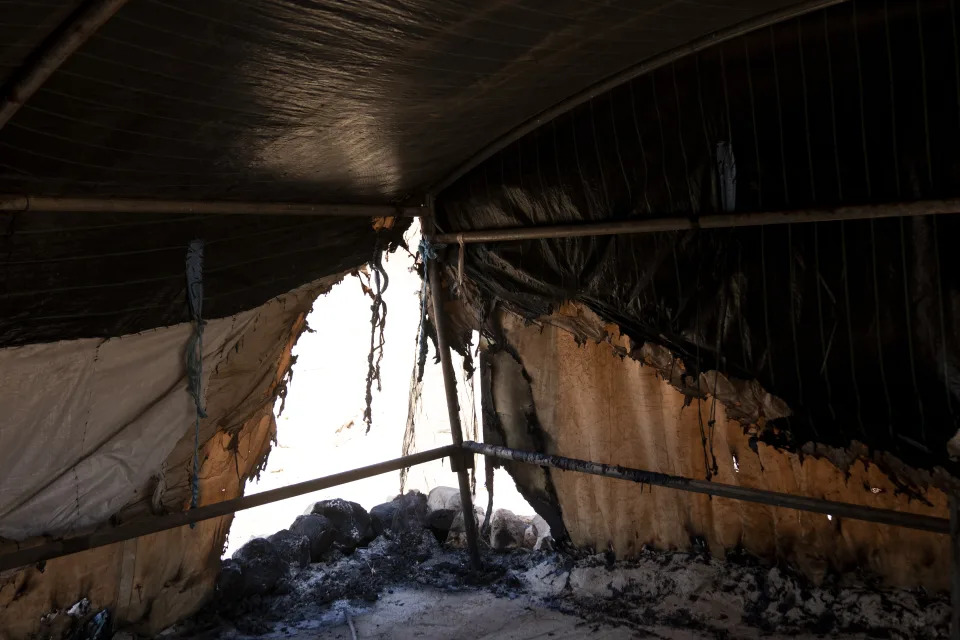
Israel Palestinians Village ExodusThe supports for a Palestinian family's tent after they fled the West Bank herding village al-Baqa, foreground, frame an encampment by Israeli settlers, Wednesday, Aug. 9, 2023. Out of 33 people who fled this Palestinian Bedouin hamlet of east of Ramallah in early July, just one six-person family has returned after settlers from a newly established outpost wreaked havoc on the village, setting their sheep loose on Palestinian grazing fields and torching a home. 
(AP Photo/Maya Alleruzzo)