Saturday, November 18, 2023


Russian artist Alexandra Skochilenko addresses the court in Saint Petersburg at her trial over anti-war messages

The text reads: ‘Sasha Skochilenko was sentenced to 7 years in jail.’ Screenshot from the YouTube video from the Dozhd TV channel. Fair use.

When the Russian invasion of Ukraine had just started in February 2022, Alexandra Skochilenko, an artist from Saint Petersburg, Russia, on March 31, 2022, changed several price tags in a grocery store, Perekrestok, to notes with anti-war statements. She was kept in custody for over a year, and has now been sentenced to seven years in prison by a Russian court for “knowingly spreading false information about the Russian army.” Global Voices translated and edited for clarity her speech before the court hearings on November 16, 2023.  The original speech was published by Novaya Gazeta 

Your Honor, dear court,

My criminal case is so unusual and absurd that it was opened exactly on April 1. Sometimes, I feel like I'll enter the courtroom, and suddenly, confetti will rain down, and everyone will stand and shout, “It's a prank!” The staff at pre-trial detention center No. 5 are amazed, questioning if this is really what people are jailed for now. Even supporters of the SVO [“special military operation,” as the war on Ukraine is officially called in Russia] don't think I deserve prison for my actions.

My case led my investigator to quit before it closed. In a private talk with my lawyer, he confessed he didn't join the investigative committee for cases like mine, Sasha Skochilenko's.

Audio recording of Skochilenko's speech (in Russian), on the YouTube channel Nastoyaschee Vremya

He left my case, which could have boosted his career, and, instead, he left for a job at a store. I deeply respect his decision; we both acted according to our consciences.

Thanks to my investigators and prosecutors, the information I shared reached thousands worldwide. If not for my arrest, only a few individuals, like a grandmother, a cashier, and a security guard at Perekrestok, would have known it.

According to my case files, the so-called price tags hardly affected two of these three individuals.

If these five papers are so dangerous, why start this trial, repeating these statements, alleged by the prosecutor to threaten public safety? Did they cause an earth-shattering event, a revolution, or peace at the front? No, none of this happened. What, then, is the issue?

The state prosecutor repeatedly claimed my act was a grave danger to society and the state.

Does our prosecutor have such little faith in our nation that he believes five pieces of paper can destroy our society and state?

When someone starts a military rebellion, causing huge damage, their case is opened and closed in a day [She refers to the military coup by Evgenii Prigozhin in June 2023]. My actions hurt no one, yet I've been jailed for over a year among murderers and other serious criminals. Is the supposed harm I caused comparable to these crimes?

Every verdict sends a message. You might agree that I showed bravery and honesty, acting according to my moral compass. In investigator lingo, jailing someone is “taking a prisoner.” I didn't give in or break under threat or suffering.

What message does my conviction send to our people? Does it say to give up, be dishonest, admit to false guilt, or ignore empathy for our soldiers? Does it say our society can crumble due to five pieces of paper? Is this the message in times of crisis and stress?

My trial, widely followed in Russia and globally, will make history, regardless of the verdict. You're not judging a terrorist, extremist, or even a political activist. You're judging a pacifist.

I am a pacifist, valuing life above all, believing in peaceful conflict resolution. I can't harm a spider, let alone a person.

Peace is brought by pacifists, not warriors. Jailing pacifists only delays peace.

Life is sacred. It's resilient, astounding, and the essence of our existence. From small cells to great whales, life thrives in every corner of Earth, its most complex form being humans — conscious, mortal beings. Yet, human life is fleeting, a brief moment we all wish to extend.

Ask someone who's survived cancer about life's value. Our loved ones lost to COVID-19 remind us of life's fragility. Now, young lives are lost again, bringing more death, grief, and pain.

Label my beliefs as you wish, but I'll stand by them.

The state prosecutor has his beliefs, different from mine. Yet, I wouldn't jail him for his views.

I apologize if my actions offended anyone. My jail time, among diverse people, showed me everyone has their truth, including views on the SVO. The tragedy is our failure to accept differing truths, dividing society, breaking families, and distancing us from peace. Every person here ultimately seeks peace.

Why fight when we're all each other has in a troubled world? No wealth can rescue a loved one from death.

We're all we have. My loved ones, who don't want me jailed, await me — my elderly mother, sister, and cancer-stricken girlfriend. The state prosecutor might not truly want my imprisonment either. He likely joined his office to tackle real criminals, not someone like me, but the system demands otherwise.

He cares for his career and his family's future. But what will he say about jailing a sick woman for five papers? He reassures himself he's just doing his job, but what about when things change?

History shows shifts in political tides. Strangely, I empathize with you.

Despite my incarceration, I'm freer, able to express myself and make choices. I don't fear poverty or lack of a career. I'm not scared to be different.

Maybe that's why the state fears me and others like me, caging us as dangerous persons.

But we're not each other's enemies. Anger is easy; love and understanding are harder. We must learn to love and resolve conflicts through words, escaping our moral crisis.

Your Honor, your verdict can exemplify conflict resolution through compassion and dialogue, a step towards societal healing.

I realize this trial might seem routine to you, but remember, you hold immense power over human destinies. My fate, health, life, and my loved ones’ happiness are in your hands. I trust you'll use this power wisely.

The judge then gave Alexandra Skochilenko a prison sentence of seven years. As Reuters reported, in court, her supporters repeatedly shouted, “Disgrace, Disgrace!” and Skochilenko, smiling, made a heart shape with her hands as she stood in the courtroom cage. She was later seen wiping tears from her face.


When Palestinians ‘die’ and Israelis get ‘killed’ in the same war

Federal Building, San Francisco, October 20, 2023. Hundreds of people from many backgrounds came together outside Senator Nancy Pelosi's office, to paint a giant street mural. The message: BIDEN, PELOSI: DON'T AID AND ABET WAR CRIMES, and calling for a CEASEFIRE! With Jewish Voice for Peace Bay Area, The Peace Poets, Climate Justice Street Mural Arts Project. Photo by . Flickr. (CC BY-NC 2.0 DEED).

Amidst the chaos of Israel's war on Gaza, truth becomes a casualty in the battleground of information, entangled in a maze of misinformation and biased narratives, eclipsing the reality of the crisis unfolding in Gaza.

In news reporting, every semantic choice, nuanced omissionprioritization, and bias holds the power to shape how readers interpret and absorb information. Systemic issues and marginalized voices are obscured beyond headlines. Cognitive and algorithmic biases manipulate information access, notably in the “fog of war,” as seen in Gaza.

The complex information landscape is shaped by not only misinformation but also by the different narratives employing defamation and dehumanization, mirroring pattern in main stream media coverage of Palestinians and other Black, Indigenous, and People of Color.

Palestinians don’t just die, they get killed

The choice between “died” and “killed” in describing fatalities in Israel’s war on Gaza reflects a subtle yet impactful semantic difference because it shapes how information is perceived.

Merriem-Webster defines “to die” as an intransitive verb, implying an indirect action, potentially linking fatality to natural causes, like old age. Conversely, “to kill” is a transitive verb, suggesting a more direct action, often tied to an unnatural or violent manner of death, such as an airstrike, for instance.

In 2022, Laura Albast wrote in an opinion article in The Washington Post, “This is a pattern we have seen over and over again in media coverage of Palestine. Palestinians are not killed; we simply die.”

This sentiment was echoed recently by journalist Yara Eid when she responded to a Sky News presenter, “I think language is really important to use because, as a journalist, you have the moral responsibility to report on what is happening. Palestinians don’t just die, they get killed.”

Journalist Yara Eid, explains the importance of the use of language when talking about the Israeli war on Gaza. Screenshot from eid_yara Instagram video. Fair use.

News media actively make choices about using passive or active voice, demonstrating a hierarchy in terminology beyond the die/kill dichotomy. Examining language within a news piece exposes framing that reveals inherent bias or perspective.

In one particularly confusing example, a CNN news anchor ambiguously described Palestinian fatalities by saying: “One hospital in Gaza says it received 22 bodies during the intense overnight bombardment along with hundreds of people injured.” There was no further clarification provided about whether those bodies were deceased, who was responsible, and from whom they were received.

The New York Times headline on the November 5 Israeli airstrike hitting the Al Maghazi refugee camp used indirect language, stating, “Explosion Gazans Say Was Airstrike Leaves Many Casualties in Dense Neighborhood.” This phrasing, such as “leaves many casualties” and “dense neighborhood” instead of specifying “a refugee camp,” was ambiguous.

Furthermore, the language used casts doubt about information sources, stating “Gazans say,” without explicitly attributing the airstrikes to Israelis. In the context of Israel’s month-long bombardment on Gaza, such ambiguity seems unnecessary. Notably, this strike was one of three airstrikes hitting refugee camps in Gaza within a 26-hour window.

In a CBS News article, the authors used intense language to describe Hamas’ attack on Israelis as a “murderous rampage.” However, when referring to Palestinian fatalities over the first nine days of the war, they employed comparatively lighter terms like “killed” and “death toll.”

This created a notable hierarchy in the portrayal of violence, which may diminish the impact or severity of the suffering of Palestinians. This discrepancy in language can influence readers’ impressions and create an imbalance in how violence is perceived.

Revealing a systemic issue in newsrooms

Bristol Friends of Gaza protest on the front lawn of BBC Bristol's headquarters on Whiteladies Road about biased reporting of the 2014 Israel-Gaza warPhoto by Rwendland, July 23, 2014. Wikimedia Commons (CC BY-SA 4.0).

Revealing a systemic issue in newsrooms, this hierarchy of terms and narrative shaping is not unique to Palestinians. The U.S. news media has long faced criticism for racism, particularly in its coverage of police violence against Black Americans, exemplified in the murder of Breonna Taylor.

Author and editor Adeshina Emmanuel pointed out, “Newsrooms often fixate on the moment of death, leaning heavily on police narratives, and — as those narratives often do — assassinate the characters of police violence victims.” This implies a narrow focus on the immediate and often dramatic events rather than the broader context.

The media’s coverage of the war in Ukraine has also raised concerns about racism. Scholar H.A. Hellyer highlighted the racist language used by reporters, emphasizing the dehumanization of non-White populations and its impact on their right to live in dignity. Beyond overtly racist coverage, other major humanitarian catastrophes, such as the war in Sudan, receive minimal attention from mainstream media.

Political influence and pressures on newsrooms significantly influence media narrative-shaping. In May 2023, it is unsurprising that a majority of US journalists expressed concerns about press freedoms. These concerns are supported by instances where numerous journalists were dismissed for expressing pro-Palestinian remarks, a trend that has intensified in recent weeks.

Amid the ongoing Israeli war on Gaza, U.S. Secretary of State Tony Blinken requested the Qatari Prime Minister “to tone down Al Jazeera's rhetoric” regarding Israel’s action in Gaza. This sentiment was reflected in other newsrooms, as reported by The Intercept: “Leadership at Upday, a subsidiary of the Germany-based publishing giant Axel Springer, gave instructions to prioritize the Israeli perspective and minimize Palestinian civilian deaths in coverage, according to the employees.”

A group of Jewish writers drafted an open letter condemning the notion that criticism of Israel is inherently anti-semitic and noted the pro-Palestine suppressions: 

“Now, this insidious gagging of free speech is being used to justify Israel’s ongoing military bombardment of Gaza and to silence criticism from the international community. […] Israeli journalists fear consequences for criticizing their government. […] We refuse the false choice between Jewish safety and Palestinian freedom; between Jewish identity and ending the oppression of Palestinians. In fact, we believe the rights of Jews and Palestinians go hand-in-hand.”

Global calls of solidarity

People in their tens of thousands rally in Melbourne, Australia, in support of Palestine and in solidarity with the Palestinian people. October 15, 2023. Photo by Matt HrkacWikimedia Commons (CC BY-SA 3.0).

Despite the biased coverage by mainstream news media, the public has become aware of the genocide faced by civilians in Gaza, largely due to on-the-ground journalists providing coverage in English on social media platforms. Journalists such as Motaz AzaizaPlestia Alaqad, and Bisan Owda, to name a few, have played a significant role in disseminating information.

Since Israel’s war on Gaza began, hundreds of thousands of protestors across major cities, including LondonNew YorkSão PauloCape Town, and Kuala Lumpur, have regularly voiced solidarity with Palestinians. They have stepped in to address the failure of mainstream news media to raise awareness about Israel’s war crimes and disproportionate attacks on Palestinians.

These demonstrations align with a growing rift between the Global south and the West, exemplified by a chorus of accusations of hypocrisy from the global south directed at the West. The criticism underscores contrasting policy and media response, highlighting the West's condemnation of an illegal occupation in Ukraine while staunchly supporting Israel's occupation of the West Bank and Gaza Strip.

As awareness of media biases grows, people around the world are driven to scrutinize information, demanding a more equitable representation of diverse perspectives. This collective effort signifies a pivotal shift where an informed public actively challenges biases, fostering a space where truth prevails, and marginalized voices resonate.

Digital Blackout: Systematic censorship of Palestinian voices 

Since the start of Operation Al-Aqsa Flood in October 2023, social media giants have actively suppressed pro-Palestinian narratives. They utilized several tactics, including suspending journalists’ and key media outlets’ accounts without prior notice or clear explanation.

On October 13, tech giant Meta, owner of Facebook, Instagram, and WhatsApp, announced actions aimed at removing “praise and substantive support” of Palestinian Resistance Movement (Hamas), the political and military organization that governs Gaza.

Similarly, X (formerly Twitter) deleted several accounts it claimed were “Hamas-affiliated” to curb “violent and hateful” online content.

TikTok also announced the removal of 24 million global accounts since October 7, for violating their policies on violence, hate speech, misinformation, and terrorism.

On November 2, Israeli officials confirmed that Facebook, Instagram, and TikTok have responded to 92 percent of their requests to remove content about Palestine.

Yet, numerous social media users on Facebook and Instagram reported censorship of their pro-Palestine content, even if it doesn’t support Hamas.

One such instance involves Motaz Azaiza, a Palestinian photojournalist, has been documenting real-time images and videos of the Israeli carpet bombing from the frontlines in Gaza since October 7.

Meta suspended his account after he posted a video on October 12 depicting the aftermath of an Israeli bombardment in his neighborhood — the Deir al-Balah refugee camp, which tragically killed at least 15 of his family members, predominantly women and children.

In the video, Azaiza initially directed the camera towards himself, visibly distressed, before revealing a harrowing scene: a demolished building, a bloodstain, and a neighbor holding the lifeless body of a child.

Following user backlash, Instagram reinstated Azaiza's account one day later.

Eye on Palestine, an Instagram account boasting over 7 million followers, reports daily on Israel’s abuses in the occupied West Bank and Gaza. Despite its crucial role in reporting Israel's aggression in Gaza, the account faced stringent censorship, impairing its ability to cover war crimes, human rights violations, and the destructionintense bombardment and targeting of Gaza's civilians.

Posts from Eye on Palestine are widely circulated and reposted by thousands on Instagram, highlighting the extensive impact of censorship. In a statement, the account's owner explained that the page was temporarily closed due to both ongoing reports and technical issues. Meta initially cited ‘security concerns related to a possible hacking attempt‘ but later reinstated the account following communication with the owners, and a backlash from activists.

Blaming glitches to conceal biased moderation and policy over-enforcement

Over the three weeks since the war began, there's been a surge in shadow-banning,  a form of censorship restricting  the visibility of Palestinian-supporting content without notifying users.

Instagram users reported a significant drop in views and likes on pro-Palestinian posts and stories.

Screenshot of a post by yallaletstalk. Fair use.

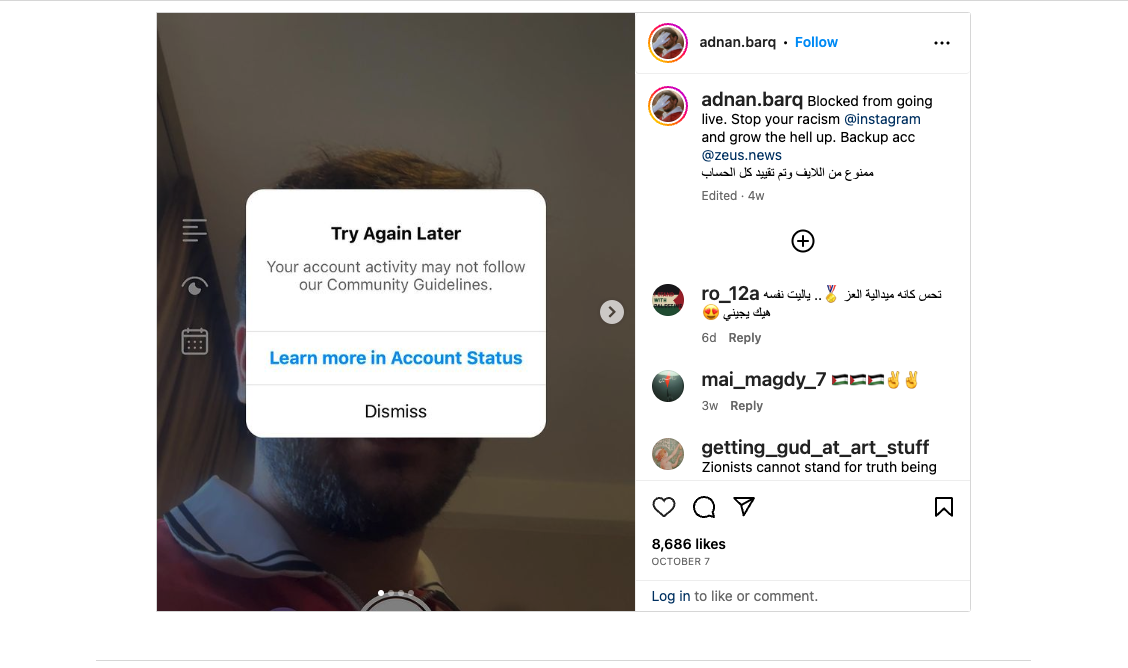
Some users face challenges hosting live videos. Posts containing hashtags like “FreePalestine” and “IStandWithPalestine” are often hidden or removed, under the pretext of violating the platform's content policies.

Screenshot of a post by adnan.barq. Fair use.

To add insult to injury, Instagram recently added the term “terrorist” to the bios of several Palestinian users. This action sparked concerns about discriminatory and algorithmic bias against Palestinians and Arabic content.

Users with multilingual profiles, featuring ‘Palestinian’ in English, a Palestinian flag emoji, or the Arabic term ‘alhamdulillah’ (meaning ‘Praise to God’), reported an issue. Clicking ‘see translations’ rendered ‘alhamdulillah’ along the Palestinian flag as ‘praise to God, Palestinian terrorists are fighting for their freedom,’ causing confusion.

Meta, once again, attributed the problem to a “glitch” and claimed to have resolved it.

A Guardian report on November 3 uncovered a persistent bias within the platform’s AI algorithms. WhatsApp image generation, a feature that uses AI prompts to convert user thoughts into personalized, animated stickers, featured a gun or a boy holding a gun upon entering the term “Palestine” or “Palestinians.” In contrast, “Israeli boy” generated friendly cartoons, and “Israeli army” depicted gun-free soldiers.

Continuously dismissing these incidents as glitches in pro-Palestine content no longer convinces social media users and digital rights advocates, given the platform's track record in silencing Palestinian voices. This was evident during systematic censorship of Palestinian accounts on Instagram during the Sheikh Jarrah protests in 2021, and the Israeli army's deadly raids on Jenin in the West Bank in 2023.

Alarmingly, Meta overlooked hate speech and incitement to violence targeting Palestinians.

In this context, Amnesty International reported substantial posts glorifying Israel's attacks on Gaza, supporting its destruction, and advocating violence against Palestinians. These posts often used dehumanizing and racist language echoing Israeli authorities’ rhetoric.

Moreover, since October 7, Palestinian digital rights organization The Arab Centre for Advancement of Social Media (7amleh) has documented 699,958 cases of hate speech and inciting content in Hebrew. At least 30 percent of the hate content included fake news, promoting violence or incitement. Unfortunately, Meta dismissed these reports. This highlights the double standards in how social media platforms enforce their policies on Arabic vs Hebrew content in times of war.

Meta's Dangerous Organizations and Individuals policy maintains a secret blacklist primarily targeting Muslim, Middle Eastern, and South Asian entities. This contributes significantly excessive enforcement against Palestinians and content in Arabic.

Tech giants’ role in Gaza's isolation amid total blackout

Amid the relentless bombardment of Gaza, Palestinians face a deepening communication blackout, stifling access to vital information. Simultaneously, a humanitarian crisis escalates as Israel cuts off water, electricity, fuel, medical supplies, and food, exacerbating the dire situation in Gaza.

For 36 hours starting on October 27, telecommunication networks, including fixed, cellular, and internet services, were down, isolating 2.3 million Palestinians and essential emergency services. The International Telecommunication Union, the UN's internet governance body, condemned the communication blackout in Gaza, urging the restoration of network access. To date, Gaza has experienced three total telecommunication blackouts since October 7.

Social media platforms’ disproportionate, biased, and restrictive content moderation deliberately silences Palestinians, restricting their ability to freely express themselves, document violations, and connect within and outside Gaza. This worsens the situation in Gaza, contrasting with the platforms’ claimed role of connecting people, particularly during times of war.

Ignoring these concerns risks platforms’ complicity in grave human rights violations and breaches of international law, including war crimes — leading to an unparalleled toll on civilian lives and a dire humanitarian crisis in Gaza.