Thursday, March 21, 2024

AstraZeneca acquires Hamilton-based pharmaceutical company Fusion

A Canadian pharmaceutical company that focuses on developing next-generation therapies for prostate cancer has announced a definitive agreement to be acquired by U.K.-based AstraZeneca for approximately US$2.4 billion.

With the deal announced on Tuesday, Hamilton-based Fusion Pharmaceuticals Inc. will become a wholly-owned subsidiary of AstraZeneca, with operations continuing in Canada.

Fusion specializes in radioconjugates (RCs), an emerging modality in cancer treatment that precisely targets cancer cells with radioactive isotopes. The approach differs from traditional forms of cancer treatment, such as chemotherapy and radiotherapy, which can ultimately damage healthy cells.

“The whole premise was, instead of using external beam radiation, in which you try to shine radiation from outside the body on tumour cells, to actually use things that could bring radiation directly to the cancer cells themselves,” said John Valliant, CEO of Fusion Pharmaceuticals, in an interview with BNN Bloomberg on Tuesday.

In a Fusion Pharmaceuticals press release, the company said this technology can allow oncologists to access tumours that would not be reachable through external beam radiation.

“We’ve been pioneering that technology over a number of years and entered into a partnership with AstraZeneca who is one of the world leaders in developing cancer therapies,” Valliant told BNN Bloomberg.

“So it was a great match between our approach and their approach and we’ve been working together for quite some time. Obviously this is sort of the culmination and the bringing together of two strong groups.”

Valliant mentioned that the field of radiopharmaceuticals has been around for quite some time “but now it’s really hitting its stride.”

“There are a number of large companies, small companies, that are working to bring this technology to bear on a number of different cancer types,” he explained.

Susan Galbraith, executive vice president of oncology and R&D at AstraZeneca, says the partnership can accelerate the goal of helping more patients by delivering more precise therapies.

"Between thirty and fifty per cent of patients with cancer today receive radiotherapy at some point during treatment, and the acquisition of Fusion furthers our ambition to transform this aspect of care with next-generation radioconjugates,” she said in the press release.

Valliant said the acquisition indicates that “big pharma has recognized the potential” of this new technology.

“We’re very fortunate to work with AstraZeneca, one of the leaders in the space, to really bring this therapy to more patients,” he said.

To watch the rest of Valliant’s interview with BNN Bloomberg

WORKERS CAPITAL

Real-return bonds reap gains for Ontario health-care pension

Canadian inflation-protected securities known as real-return bonds are reaping gains for one of the country’s largest pension funds during a turbulent period for fixed-income markets.

Healthcare of Ontario Pension Plan (Hoopp) became an “aggressive” buyer of the inflation-linked bonds when interest rates started climbing in 2022, Chief Investment Officer Michael Wissell said in an interview. By December, the notes represented roughly half of the fund’s target portfolio allocation to bonds, he said. 

“Right now, one of the most compelling things is real-return bonds,” Wissell said. “This is the ‘Get out of Jail Free Card’ here. These notes, which were for years at minus 100 basis points — even more negative in some jurisdictions — are now offering a real rate of return.”

Canada stopped issuing the bonds in 2022, making them harder to buy in larger quantities.

Hoopp said Wednesday that it posted a 9.4 per cent return last year, booking gains in fixed income, stocks, private equity and private credit. The Toronto-based pension fund — which serves about 460,000 active, deferred and retired health-care workers in Canada’s most populous province — increased exposure to bonds after yields rose in the summer and into the fall, helping net assets grow to $112.6 billion.

“We used the volatility in the fixed-income market, which, by all accounts, was pretty substantial, to continue to add real-return bonds, which are more difficult to accumulate,” Wissell said. “It is very unlikely that you will see us selling them anytime soon.”

The returns for Hoopp’s asset categories are as follows:

  • Fund’s fixed-income portfolio advanced 4.3 per cent
  • Public equities jumped 15.7 per cent
  • Credit grew 4.6 per cent
  • Private equity climbed 15.9 per cent
  • Private credit gained 9.3 per cent
  • Infrastructure advanced 8.2 per cent
  • Real estate investments lost 6.5 per cent

“The dispersion that exists within real estate assets is hard to understand,” Wissell said. “We’re diversified across segments, and I’m not sure that I’m smart enough to know which of those segments are going to be the winners going forward because we’re seeing big price adjustments across these different sectors.”


Real estate, infrastructure losses sap Ontario Teachers' returns

Ontario Teachers’ Pension Plan gained 1.9 per cent last year, underperforming its benchmark by a wide margin, as it lowered valuations on real estate and infrastructure investments hit by higher interest rates.

The write-downs also stemmed from “asset-specific events that negatively impacted select investments,” the pension plan said in a statement Tuesday, without specifying more. The falling valuations cut into gains from holdings including credit and stocks.   

Equities rose 20 per cent, but the fund has just 10 per cent of its assets in public equities on a gross basis.

“We did not generate investment results to desired levels,” Chief Executive Officer Jo Taylor said in an interview. “Our outlook for 2023 was pretty cautious, that’s why we have the low listed equity exposure. We thought there’s probably a reasonable chance of markets correcting, which clearly didn’t happen, particularly in the US.”

Looking forward, the pension fund positioned itself “to move forward with caution, but some more optimism in terms of the prognosis for recovery internationally,” Taylor said.

The real estate portfolio declined 5.9 per cent, compared with a 2 per cent gain for its benchmark. Infrastructure assets lost 2.8 per cent.

Real assets

Overall, Ontario Teachers’ return trailed its internal benchmark by nearly 7 percentage points. Some of the other top Canadian pension funds have also reported losses on real estate assets. But infrastructure assets have generally been resilient and continued to generate gains.

At Ontario Teachers’, real assets, which combines infrastructure and real estate, account for about 28 per cent of the portfolio. In real estate, on top of being heavily exposed to retail and offices, Ontario Teachers’ was pretty early in making cap rate change adjustments to its portfolio, Taylor said. In 2022, the pension fund increased its cap rates by about 100 basis points, and further adjusted it up 25 basis points last year, he said.

“That took a reasonable chunk out of the performance valuation of those assets just on their own,” he said. “And we’re trying to diversify away from those two sectors into other things that give us both a bit of a better balance and hopefully the ability to see different rates of return.”

'Another tough year'

Last year, the pension fund announced it would move its real estate investing team in-house, from subsidiary Cadillac Fairview Corp., and named Pierre Cherki to head the new team.

“What we want that team to do is to be really thoughtful and careful about what we add to the portfolio to try and diversify our returns and our performance,” Taylor said. “How is it going forward? I think it’s gonna be another tough year in real estate in 2024, the returns available will be marginally positive.”

Total assets managed by Ontario Teachers, which oversee pensions for about 340,000 members in Ontario, remained virtually flat at $247.5 billion at the end of 2023. Over 10 years, the pension fund had an average return of 7.6 per cent. The plan started this year fully funded, with a preliminary surplus of $19.1 billion.

On infrastructure, Ontario Teachers’ adjusted its discount rate assumptions it uses in calculating values going forward.

“We raised that by about 60 basis points to reflect higher interest rates. I don’t think many people have done that yet, but we felt we needed to do that to be a bit more realistic,” Taylor said.

Last year, Ontario Teachers’ made a bigger bet on bonds and credit and added leverage to pay for it and Taylor still sees value in these assets. It is also betting on technology through its growth equity team, Taylor said.

“The other thing we will continue to do is back good private equity businesses where we see them operating in sectors and geographies that we like,” Taylor said. “We’ve put more capital into India, for example, and into Australasia last year. We’ve been active in Europe as well. So we’re trying to get a balance between our North American activities.


Ottawa should keep its 'hands off' pension funds, says former OTPP head


SO SHOULD ALBERTA

The former head of one of Canada’s largest pension plans says the federal government should avoid telling Canadian pension funds where to direct capital, despite recent calls encouraging them to invest more at home.

Jim Leech, former president and CEO of the Ontario Teachers' Pension Plan, told BNN Bloomberg in a Tuesday interview that pension funds must remain independent of government to guarantee the best returns for Canadians.

“Hands off,” Leech said when asked what his message to Ottawa would be regarding potential changes to the current pension model.

“Canada has got the gold standard in pension plans – they are independent of government, they're not being interfered with, and they have great financial returns… don't mess with it.”

Open letter to Freeland

Leech’s comments come after dozens of high-profile business leaders signed an open letter to Finance Minister Chrystia Freeland and her provincial counterparts earlier this month, urging them to “amend the rules governing pension funds to encourage them to invest in Canada.”

Montreal-based investment management firm Letko Brosseau spearheaded the letter, which was signed by nearly 100 business leaders, including Rogers CEO Tony Staffieri and Canaccord Genuity Group CEO Dan Daviau.

Days after the letter was published, Letko Brosseau co-founder and partner Peter Letko told BNN Bloomberg that unless Canada’s pension plans start investing more domestically, the country’s financial markets and exchanges will continue to suffer.

Leech disagreed with that sentiment, saying he’s yet to hear of any major Canadian companies or projects that have had trouble securing capital when attempting to raise funds.

He also said that despite concerns around Canadian pension plans not having enough invested in Canada, most funds still have a sizeable domestic bias.

“Of the big Maple-8 funds, the least is about 15 per cent invested in Canada, and the most is around 60 per cent,” Leech said.

“I think they average out at around 40 per cent of their assets invested in Canada, so there's a huge bias. It's ten times the capital markets of Canada versus the rest of the world.”

Pension plans were once in 'serious trouble'

Leech said the main reason he opposes further government intervention in pensions is because he remembers a time roughly 30 years ago when many of Canada’s biggest funds were struggling and in need of reform.

“The Canada Pension Plan, which was in serious trouble, went through a number of reforms and came out the other end as the Canada Pension Plan Investment Board to give separate governance and separate investment,” he said.

“What's being talked about now is kind of returning back to those earlier days when, in fact, the pension plans were not independent, didn't have separate governance, and were in big trouble.”

Leech said that the government’s role should instead be to ensure Canada remains an attractive place to invest, both for Canadian and international investors.

“They have a number of levers that they can pull to try and increase the productivity of our economy,” he said.

“One of them is not forcing pension plans to artificially direct funds towards Canadian companies just because they're Canadian.”

With files from Bloomberg News

TMX COMPLETED (ALMOST)

China's Sinochem takes first oil cargo from Canadian pipeline

China’s Sinochem Group has purchased one of the first crude cargoes shipped through a new pipeline in Canada, which is designed to move oil from landlocked Alberta to the Pacific Coast for export.

Sinochem bought a 550,000-barrel cargo from Suncor Energy Inc., which will load from the Trans Mountain Expansion pipeline in May-June, said traders who asked not to be identified. The oil is a heavy crude quality, they added.

The Trans Mountain Expansion is the country’s biggest new pipeline in over a decade and will nearly triple the capacity of the system, allowing Canadian companies to sell more crude to Asia and the U.S. West Coast. The oil purchased by Sinochem is of similar quality to Iraqi Basrah crude and will likely be refined in coker units, traders said.

Sinochem and Suncor didn’t immediately respond for comment.

The pipeline was initially slated to start in 2017 but faced repeated delays, cost overruns, construction mishaps and regulatory hurdles. Canadian Prime Minister Justin Trudeau’s government bought Trans Mountain in 2018 from Kinder Morgan Inc. to save the project from cancellation.


Canadian provinces to borrow 22% more this year as deficits rise

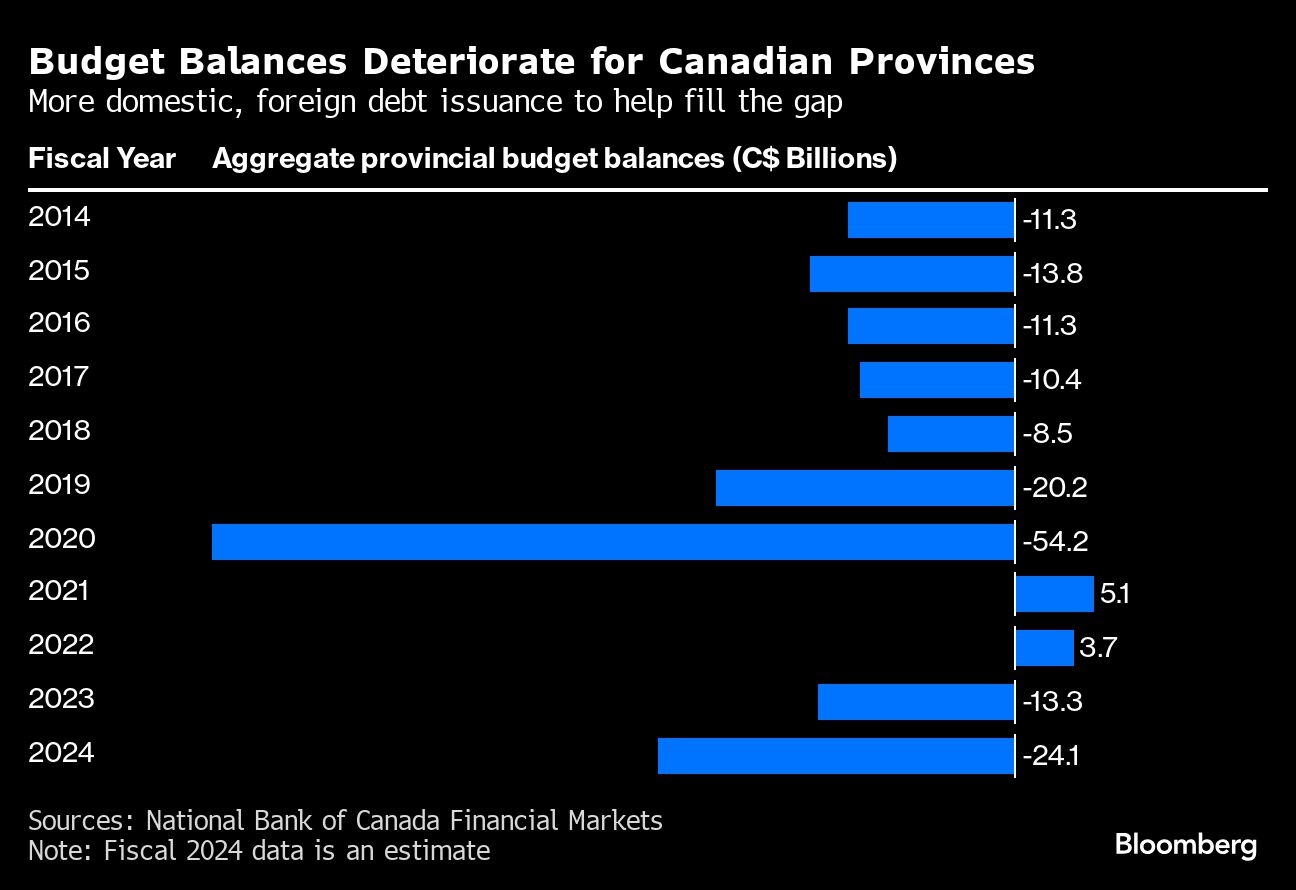
Canadian provinces are set to issue more debt than they did last year as they look to plug budget shortfalls, according to National Bank of Canada’s financial markets unit.

Borrowing needs from provinces facing growing deficits and maturing debt are estimated to be $130 billion for the fiscal year starting April 1, the highest in four years, data compiled by the division showed. That’s a 21.5 per cent jump from $107 billion for the prior fiscal year.

The growing financing requirements come as borrowing costs have stayed elevated because of persistent inflation. While that doesn’t bode well for issuers, it could be a boon for investors looking to lock in higher yields before central banks in Canada and across the world cut interest rates. On Tuesday, traders upped their bets on a June rate cut by the Bank of Canada as inflation slowed in February.

“A fairly sizable aggregate borrowing requirement and a still uncertain economic and financial backdrop means the provinces are going to be motivated to get funding in the door when they have an opportunity to do so,” said Warren Lovely, chief rates and public sector strategist at the National Bank of Canada Financial Markets.


There has been already been flurry of issuance from Canadian provinces. Quebec, Canada’s second-largest province, borrowed €2.25 billion of bonds due in 10 years, on top of issuing three Canada dollar-bonds totaling $1.95 billion. It expects a budget shortfall of $11 billion in the fiscal year that begins April 1 — $8 billion more than it previously forecast — and anticipates issuing $36.5 billion in new debt in the 2024-2025 fiscal year. 

Among other provinces, British Columbia tapped the Canadian bond Tuesday and Manitoba borrowed $300 million last week. 

The heightened borrowing needs across provinces won’t necessarily flood Canada’s bond market as international markets will also be utilized, said Lovely. Provinces also tend to issue more longer-dated debt than the federal government, which limits certain risks, said Marc Desormeaux, principal economist, Canadian Economics at Desjardins Group. 

That said, bigger-than-anticipated deficits make the road ahead more challenging for prospective issuers.

“Governments running bigger deficits will be under more pressure to demonstrate fiscal responsibility to their creditors, leaving less room to support the economy in the event of a downturn,” said Desormeaux.


Saskatchewan pre-election budget pitches record spending, $273M deficit

The Saskatchewan government is promising big-ticket spending on health, education and communities along with no tax hikes and a $273-million deficit.

Finance Minister Donna Harpauer introduced the 2024-25 budget Wednesday, saying that with a growing population and a strong export-focused resource sector, now is the time to invest.

"I would have loved to have ended my last budget as balanced and able to do a tax reduction,” Harpauer told reporters before introducing the document in the house.

"However, it is the budget I am comfortable with, because I do think the premier decided to prioritize in substantive increases."

This is Harpauer’s last year in politics before she retires and the last budget from Premier Scott Moe’s Saskatchewan Party government before a fall election.

The budget promises more than $1 billion in additional spending in core areas, including to address classroom sizes and supports for learning, to shorten surgical wait lists and to boost its revenue-sharing program with municipalities.

Total spending for the budget is pegged at just over $20 billion, and the debt is expected to rise to $34 billion by spring 2025.

Along with the deficit in the 2024-25 budget, there is also more red ink in the current budget.

The projected deficit for the fiscal year ending in March is expected to almost double to $483 million. 

Harpauer defended the deficit budgeting. 

She said Saskatchewan has the second lowest net-debt-to-GDP ratio in the country, and the province needs to keep pace with a growing economy and rising population.

The Opposition NDP said the budget is another exercise in bungled money management and missed opportunities from a government that can’t be trusted to keep its word.

NDP Leader Carla Beck said the Saskatchewan Party made promises before the 2016 election, then made cuts.

She said the budget offers no fuel tax relief for commuters and doesn’t bring forward innovation to transform the health-care system.

"This province used to be a nation leader in health care," Beck said. "If there was ever a time to pop the hood on our health system and repair it from the ground up, this budget would have been it."

Budget day came with an added twist of labour disruption.

Teachers across Saskatchewan walked off the job for the day to draw attention to an impasse in contract bargaining with the province.

Teachers held rallies, with some outside the legislature shouting, “Support education!” 

The teachers want issues including classroom sizes and additional supports to be part of the next collective agreement, but Moe’s government has refused.

Instead, the government has promised millions of dollars in additional spending to tackle those issues outside the collective agreement.

The budget hikes education spending by $248 million to $3.3 billion. There is also $46 million more for classroom supports.

The Saskatchewan Teachers' Federation said the increases don't meet the needs of enrolment growth.

“They are about $250 million short to fill the gap in education and it is simply not enough,” said federation president Samantha Becotte.

Jaimie Smith-Windsor, president of the Saskatchewan School Boards Association, said the funding offers a path to stability.

"We're treating this as the floor, not the ceiling, and we've had assurances that is the case," she said.

On the health-care front, funding is to rise by $584 million to $7.6 billion, including more money for the Saskatchewan Health Authority.

The money is aimed at increasing capacity in the acute-care system and reducing surgical wait-lists. There is also more money to hire paramedics and do more medical imaging tests. And there is $3.5 million more for breast cancer care and screening procedures.

Bashir Jalloh, president of the Canadian Union of Public Employees local 5430 health union in Regina, said he appreciates the promise to spend more but the province must follow through.

"In the past, they have talked about an increase in health care and an increase to focus on recruitment, but we have yet to see that,” said Jalloh.

The province is boosting the money in its revenue-sharing deal with municipalities by $42 million for a total of $340 million. 

Randy Goulden, head of the Saskatchewan Urban Municipalities Association, said she's pleased but worries about reductions to the northern transportation system, which includes highways, ice roads and airports. 

On the capital spending side, there is $4.4 billion mainly for the main areas of schools, health care and communities.

The government is not introducing any new taxes or boosting existing levies.

The Saskatchewan United Party, which has one member in the legislature, said in a news release the province lacks fiscal responsibility with its spending and deficits.

This report by The Canadian Press was first published March 20, 2024.


Manulife faces 40% decline in U.S. office investments from peak

Manulife Financial Corp. is facing a divided global office market, with the value of its U.S. office investments having plummeted by as much as 40 per cent from a pre-pandemic peak, according to Chief Financial Officer Colin Simpson. 

The North American market has been deeply impacted by the shift to remote work, with U.S. office vacancy rates surging to a record 19.7 per cent at the end of last year. This stands in contrast to Asia, where office buildings are relatively full, Simpson said in an interview.

“I like to think our property portfolio is of reasonably high quality and quite resilient, but the structural forces of higher interest rates and trends around return-to-office make it a difficult market,” he said.

The worst may be over for the downturn in office property values, said Simpson. But he warned that advancements in artificial intelligence may erode white-collar employment, stifling any potential rebound in demand for desks.

The Toronto-based life insurer reported a 12 per cent year-over-year decrease in the value of its income-producing commercial office properties globally, which totaled $4.83 billion (US$3.56 billion) as of Dec. 31. Including minority-ownership in certain real estate funds, Manulife had $6.3 billion in global office holdings last year, about a quarter of which are in the U.S. 

North American office investments represented about 40 per cent of Manulife’s portfolio of alternative long-duration assets a decade ago, Chief Investment Officer Scott Hartz said during a February earnings call. That figure has now dwindled to about 10 per cent, owing to the growth of other investments and the divestment of some office properties. 

Manulife doesn’t anticipate significant sales of its office properties amid the market slump, Simpson said. “Would we look to increase the exposure at this point in time? Absolutely not,” Simpson said. “Is there a vibrant liquid market we could sell into and realize a lot of value? No.” 

As a life insurer, Manulife has a rare luxury among investors of being able to retain its holdings without the pressure to refinance at unfavorable rates or incur big losses on buildings sales, thanks to the absence of mortgages on virtually all of its properties.

However, the company faces inherent conflicts as both a major North American employer of white-collar professionals and an owner of commercial office spaces. 

Manulife sells insurance and retirement products in the U.S. through its John Hancock unit and owns that company’s iconic headquarters in Boston. That property has declined in value, in part because John Hancock itself needed fewer floors after the pandemic, Simpson said.


Manitoba premier says he's considering extending tax holiday on fuel

Manitoba Premier Wab Kinew said Tuesday he is considering extending his government's fuel-tax holiday, which is set to expire at the end of June.

The NDP government fulfilled a campaign promise when it suspended, for six months, the 14-cent-a-litre provincial fuel tax on Jan. 1. The move was aimed at helping people deal with inflation.

The government left the door open to a possible extension at the time, and Kinew said Tuesday he is considering it, although he was not prepared to make an announcement immediately.

He referred to the recent closure of an Imperial Oil pipeline that brings gasoline, diesel and jet fuel to Winnipeg from Gretna, Man. The closure is expected to last three months.

"The situation with the pipeline is something that we're learning to live with over the next few months and we're going to be there to help keep life affordable in Manitoba," Kinew said.

When asked whether he would announce a decision before the budget set for April 2, Kinew was coy.

"Where's the showmanship in telling you that now?" he joked with reporters.

The Opposition Progressive Conservatives called on the government in the legislature to extend the tax holiday, in anticipation of a potential spike in prices caused by the pipeline disruption.

"Any prolonged fuel shortage in Winnipeg over the next three months may lead to increased prices," Tory Greg Nesbitt said.

Provincial and Winnipeg city officials have said they are not expecting major disruptions in supply because trucks and trains will be used to replace the pipeline supply while repairs are done.

"Today, I've confirmed that fuel trucks are already on their way to Winnipeg from Gretna," Natural Resources Minister Jamie Moses told the legislature.

This report by The Canadian Press was first published March 19, 2024.

GLOBALIZATION LIVES!

TD signs deal with Indian bank HDFC to attract students looking to study in Canada

TD Bank Group has signed an agreement with an Indian bank in a bid to attract international students as new customers and make it easier for them to comply with visa requirements.

As part of the Canada's requirements to apply for an expedited study permit, students are required to provide proof of financial support, which is accomplished with a guaranteed investment certificate.

Under the program, HDFC Bank will refer students planning to study in Canada to TD's international student GIC program.

TD is offering students the ability to use an online application process to obtain a GIC without an application fee.

The program also includes a student chequing account and a fee rebate to cover their first wire payment into their TD account. 

TD has been HDFC Bank's main correspondent banking partner for Canadian dollar clearing since 2015.

This report by The Canadian Press was first published March 20, 2024.


Oilsands producers to file for carbon capture permits this week

(Bloomberg) -- A group of major oil-sands producers will submit applications for a $12 billion carbon capture project to Canada’s energy regulator this week with an aim of making a final investment decision next year, according to an executive leading the process. 

The project will be ready by 2030 if permits are approved within a year, said Kendall Dilling, chief executive officer of the Pathways Alliance, a group of six oil-sands producers. It’s a “significant milestone” in a project that’s been in the works for years, he said in an interview at the CERAWeek by S&P Global Conference in Houston on Wednesday.

The project — which would be the biggest of its kind in the world — plans to capture 12 million tons of carbon dioxide a year in its first phase, reducing Canada’s oil sands emissions by about 15%. But without Canadian federal and provincial fiscal incentives. it may never be built, Wood Mackenzie warned earlier this year. 

Both the government and industry are making good progress on securing financial backing for the project, which is key for Canada to achieve its goal of becoming net zero by 2050, Dilling said. The passing of the Inflation Reduction Act in the US and green subsidies in Europe have provided momentum in Canada.

“We’re close,” he said. “I wouldn’t say we’re 100% of the way there but I can see light at the end of the tunnel. I think we’ve got a shared view now of the economics of these projects and what support is required.”

The project involves removing emissions from about a dozen facilities across Canada’s oil-sands sector, then transporting them through a 400-kilometer (249-mile) pipeline before burying them underground. 

“I’m optimistic we’re going to get there,” Dilling said. “There’s a collective sense that we just have to. This is too important to the country, too important to the industry.”

©2024 Bloomberg L.P.

CANADA

Income needed to buy a home rises in most major markets: analysis

A new analysis found that the level of income required to own a home rose in 12 out of 13 major markets across Canada from January to February. 

In a report Wednesday, Ratehub.ca calculated the minimum annual income levels required to purchase a house in a number of Canada’s major cities based on real estate data. The report found that slight reductions in mortgage rates have occurred alongside rises in home prices. 

“The two key variables, which are home values and interest rates, have moved in opposite directions since January; interest rates are down and home values are up in 12 out of 13 cities,” James Laird, the co-CEO of Ratehub.ca and president of CanWise mortgage lender, said in a statement Wednesday. 

“The increase in home values was enough such that affordability decreased in 11 of 13 cities despite the rate drop.” 

Across the major markets, Toronto saw the most significant increase in income needed to purchase a home, rising by $3,800 from January to February, reaching $214,100. 

Victoria and St. John’s were the only major markets to see reductions in income required to purchase a home. In St. John’s, the income level needed to buy a home fell by $1,000 to $74,750. In Victoria, the income needed fell by $1,060 to $169,300. 

Methodology: 

Data for the analysis used average home price figures from the CREA MLS Home Price Index and mortgage rates were derived from the average of the Big Five Bank’s five-year fixed rates in January and February. The analysis assumed a mortgage with a 20 per cent down payment, 25-year amortization with $4,000 in yearly property taxes and $150 in heating costs.