Thursday, March 21, 2024

Glencore sets 25% emissions cut goal by 2030 in new climate plan

Cecilia Jamasmie | March 20, 2024 | 

Glencore currently operates 26 mines in 21 thermal and coking coal mining complexes across Australia, Colombia and South Africa. (Image courtesy of Glencore.)

Mining and commodities trader Glencore (LON: GLEN) said on Wednesday it is on track to reduce carbon dioxide equivalent emissions for its industrial assets by 25% by the end of 2030.


In its 2024-2026 Climate Action Transition Plan (CATP), the Swiss company outlined the work it is doing to achieve emissions reduction targets of 15% and 50% by the end of 2026 and 2035, respectively.


The company’s revised climate plan is much like a previous plan it released — but this time includes the interim 2030 target.

“[The new plan] reflects a wide range of inputs, including analysis of the evolving market landscape, new regulatory requirements, mining and energy peer approaches, the IEA’s latest modelling, stakeholder inputs, and emerging insights from the most recent United Nations Framework Convention on Climate Change (UNFCCC) dialogue,” chief executive officer Gary Nagle said in a statement.

“We have also undertaken extensive engagement with our shareholders and appreciate their time and support as we have developed this CATP,” Nagle noted.

Glencore, like most of the world’s biggest listed companies, published its first climate action plans in 2020 in a bid to help with reaching the 2015 Paris Agreement goal of capping temperatures within 1.5 degrees Celsius.

The Baar, Switzerland-based firm, one of the top global thermal coal exporters, has faced backlash for being one of the few top miners still involved in the extraction of the fossil fuel used to generate electricity.

After facing pressure from major investors and shareholders, Glencore committed to run down its coal mines by the mid-2040s, closing at least 12 by 2035.

“We recognize the different roles of thermal coal and steelmaking coal – and the different transition pathways for both,” Nagle said while presenting the new strategy.
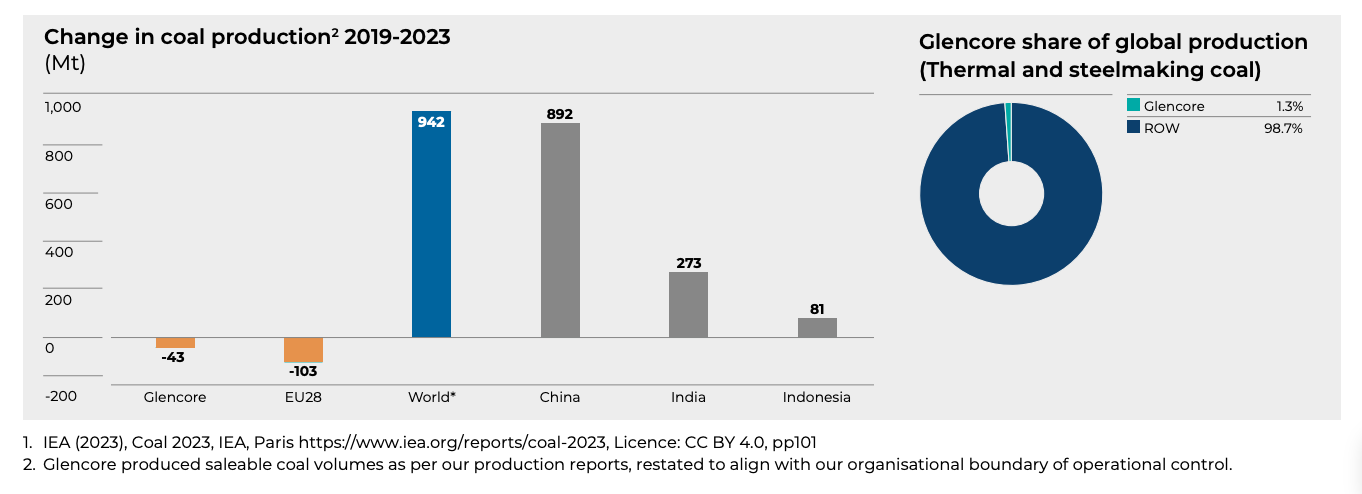
Source: Glencore’s 2024-2026 Climate Action Transition Plan. (Click to see full size)

The executive noted the company “remains committed” to the responsible phase-down of its coal portfolio and is not progressing any greenfield thermal coal investments.

The company continues to produce and recycle commodities considered key for today’s cleaner transition technologies. Nagle said the speed and direction of Glencore’s decarbonization efforts are significantly shaped by geopolitics, policy decisions, and technological advancements.
Tackling Scope 3 emissions

Glencore plans to cut “Scope 3” emissions — those produced when customers burn or process a company’s raw materials — by 30% by 2035 and achieving net zero Scope 3 emissions by 2050.

The company did not include its marketing activities in the these goals. It justified the decision by saying that, by trading in the third party volumes, its activities do not generate additional Scope 3 emissions, “which in the ordinary course are associated with the transformation or use of the product by third parties”.

Glencore recently acquired a 77% interest in Teck’s (TSX: TECK.A, TECK.B)(NYSE: TECK) steelmaking coal business, Elk Valley Resources (EVR). The transaction remains subject to mandatory regulatory approvals and is expected to close by no later than Q3 2024.


Glencore-backed Peru zinc miner Volcan halts three mines over permits

Reuters | March 19, 2024 | 
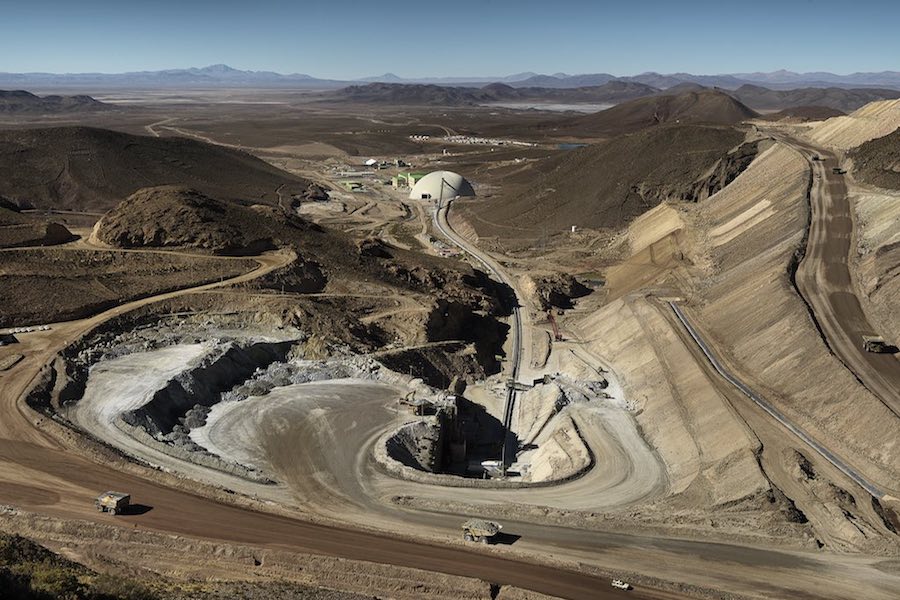
San Cristobal mine is ranked among the world’s biggest producers of zinc, lead and silver. (Image courtesy of Minera San Cristobal)

Peruvian zinc, lead and silver miner Volcan, backed by global commodities giant Glencore Plc, will halt activity at three of its mines in the country from Tuesday as it works on updating an operating permit for its Rumichaca tailings dam.


The Peruvian firm said in a statement, posted to the local regulator, that it would suspend its operations in the San Cristobal, Carahuacra and Ticlio mines in the center of the country for up to 30 days.

Peru is the world’s second largest producer of copper, silver and zinc, which are key to its economy. Sales of the metals are equivalent to 60% of all the country’s exports.

The mines are part of the Yauli mining unit, located in the department of Junin, 170 kilometers (105.63 miles) from capital Lima, which produces zinc, lead, silver and copper. The Rumichaca tailings dam is in the same area.

The company did not specify what impact the suspension of activities would have on production, but said that during the shutdown period “all the necessary care and maintenance work will be carried out to restart operations as soon as possible.”

(By Juana Casas; Editing by Deepa Babington)


Unplanned shutdown of Imperial pipeline affects delivery of fuel to Winnipeg

The Manitoba government says it's taking measures to mitigate potential impact to the province's economy after Imperial Oil Ltd. announced it has temporarily shut down a pipeline that supplies gasoline, diesel and jet fuel to Winnipeg and the surrounding area.

The province says in a news release that the line runs between Gretna, Man., at the U.S. border, and Winnipeg, and it says the decision by Imperial to shut it for repairs followed "proactive pipeline inspections" that identified "integrity concerns" in a section of pipe just south of St. Adolphe, Man.

The news release says the line was not compromised and no materials were spilled into the environment.

Imperial says in a separate news release that "unplanned maintenance" work includes replacing a section of the pipeline that runs under the Red River south of Winnipeg. 

It says that as a result of the work, the line will be out of service for approximately three months.

The province says it has convened a "supplier table" comprised of Manitoba’s largest fuel suppliers to help support the management of the fuel supply being brought into the province.

"These industry partners are leveraging extensive supply networks and actively working to minimize customer and end-user impacts by maintaining Manitoba’s fuel supply through other means including rail and truck," the province's release late Sunday afternoon stated.

It also noted the government will oversee the repair work "to ensure all precautions are taken to protect the surrounding environment."

In addition to utilizing truck and rail, Imperial said it is also identifying alternative terminal locations where customers can pick up their products, including at the terminal in Gretna, which it said remains connected to pipeline supply.

"We sincerely regret the inconvenience this may cause and appreciate the patience and understanding of our customers and the community," Imperial's news release stated.

"Our priorities are the integrity of this pipeline and ensuring the continued protection of people and the environment, while minimizing disruption to our customers and the local economy."

This report by The Canadian Press was first published March 17, 2024.


Businesses want outstanding 'green' investment tax credits fast-tracked: KPMG poll

KPMG offices in Berlin, Germany.

A survey by KPMG in Canada says business leaders want Ottawa to fast-track all outstanding "green" or "clean" economy business investment tax credits.

The online survey of 534 small- and medium-sized businesses done in February says 90 per cent of those questioned supported speeding up the delivery of the promised incentives.

KPMG's Lucy Iacovelli says meeting the climate challenges and retooling the economy requires significant business investment to decarbonize and build the net-zero industries and technologies.

To deliver, Iacovelli says Ottawa needs to make it fast and easy for companies to access the clean energy investment tax credits or they risk falling further behind U.S. and other major economies.

The survey found 83 per cent of the businesses say they require more assistance and incentives to decarbonize.

Eighty per cent of those surveyed also supported federal green-related investments or incentives to attract foreign companies to locate in Canada.

This report by The Canadian Press was first published March 18, 2024.


Canada to join German-backed effort to create hydrogen market

Canada and Germany agreed measures to kickstart the trade of hydrogen, which is seen as a clean-energy alternative to dirtier fossil fuels.

Both nations will contribute €200 million (US$217 million) in funding for bilateral hydrogen auctions, German Economy Minister Robert Habeck told reporters in Hamburg after meeting with his Canadian counterpart. The auctions will fall under a platform known as H2Global, which Germany launched together with the Netherlands.

While hydrogen is at the core of Europe’s plans to eventually wean itself off fossil fuels, there are currently few buyers for the gas as it’s expensive to produce and requires infrastructure investments to make its use more viable. The idea behind H2Global is to buy quantities of hydrogen and resell them at a lower price to European buyers via auctions, in the hopes that more competitive costs will incentivize industry to invest in systems for the use of hydrogen.

Canada already has an agreement to supply Germany with hydrogen by next year, though there is currently no global market for the gas. 

The aim is “to best address premiums as we move to scale the production of hydrogen over a 10-year period,” Canada’s Energy and Natural Resources Minister Jonathan Wilkinson said in an interview. His country may still send it first shipment of hydrogen from ammonia to Germany by the end of next year, though it could take until 2026, he said.

Both sides plan to launch aligned supply and demand side auctions “as early as possible, and preferably before the conclusion of 2024,” according to their memorandum of understanding. 

During the visit, German energy company Mabanaft GmbH & Co KG also signed a letter of intent to receive up to 150,000 tons of ammonia annually from U.S.-based Pattern Energy, starting in 2027. The ammonia would be produced using wind energy and hydroelectricity generated in Canada, and could later be converted to hydrogen for use in German industries.


Inflation has more young Canadians priced out of car ownership: survey


As interest rates have priced many prospective homebuyers out of the housing market, a new survey suggests inflation is hurting the chances of young Canadians owning a car.

The Car Ownership Index from car-sharing service Turo, released Monday, found 56 per cent of young millennials are less likely to buy or lease a car due to inflation, compared to 46 per cent of the general population.

Last year, just 39 per cent of Canadians indicated inflation would hurt their likelihood of buying or leasing a vehicle, the survey found.

Meanwhile, 17 per cent of millennials are planning to stop owning or leasing a car in the future, 52 per cent of whom are financially concerned with owning a vehicle. 

“As the cost of living continues to rise, Canadians are reconsidering the traditional car ownership model, which can place a high financial burden on the owner,” Cedric Mathieu, senior vice-president and head of Turo Canada, said in a news release. “Vehicles depreciate in value and have ongoing expenses, which persist even when unused.

EV ownership

Costs are also a factor driving some Canadians away from electric vehicles.

The survey found 29 per cent of Canadians who don’t plan to buy or lease an EV won’t consider them because of the costs, though 53 per cent of Canadians are considering a hybrid or EV for their next car purchase.

Among those looking to buy, saving on gas is the top motivation for 40 per cent of them.

Half of Canadians would also feel more comfortable making an EV purchase if they had a chance to test one out for a few days, the survey found. 

“The Index reveals a gap between Canadians' interest in EVs and their limited firsthand knowledge,” Christian Bourque, executive vice-president and senior partner at Leger, said in the release. “Half of those surveyed would be more comfortable purchasing an EV if they had the option to complete an extended test drive, indicating its potential as an educational tool for fostering adoption.”

METHODOLOGY

The survey was conducted by Leger for Turo in Canada, from December 11th to 18th, 2023. It consisted of a representative sample of 1,500 English and/or French-speaking Canadians 25 years of age or older. Only the official analysis report, from which this press release is inspired, is endorsed by Leger.

 CANADA

'Tone deaf': MPs grill telecom CEOs about wireless prices at committee

The chief executives of Canada's three largest telecom companies stressed that phone and internet prices are coming down during an appearance before MPs on Monday, noting that increased data usage and high spectrum costs may be some reasons Canadians feel otherwise.

The three CEOs — Rogers Communications Inc.'s Tony Staffieri, BCE Inc.'s Mirko Bibic and Telus Corp.'s Darren Entwistle — appeared virtually at the House of Commons' industry committee meeting.

Committee members voted unanimously last month to summon the trio to testify after a previous invitation to the chief executives resulted in other corporate representatives showing up instead.

The committee is studying the accessibility and affordability of wireless and broadband services — an issue that came to the forefront in January when Rogers confirmed it was raising prices by an average of $5 for some wireless customers not on contract.

Staffieri was pressed on the matter Monday, with Liberal MP Francesco Sorbara suggesting the move was "tone deaf."

"Would you not admit that the timing was not great?" he asked.

Staffieri replied that the price hike only affected customers on legacy plans.

"It was important to us to make sure that these customers had choice," he said.

"With two clicks, they could get onto a plan that was in market and give them the best value for money for their circumstance."

Conservative MP Ryan Williams questioned Bibic and Entwistle on whether Bell and Telus would raise their prices in response to Rogers' move.

Bibic would not say whether Bell plans to follow suit, insisting the company's focus is on lowering costs, while Entwistle said he remained confident Canadians would see price declines but was "not going to talk about price setting in a forum with my two competitors sitting right here."

Some members of the committee have said they are concerned about cellphone and internet prices in Canada, arguing Canadians pay too much for those services.

But the CEOs cited recent Statistics Canada data showing wireless prices have declined 16 per cent in the past year and 47 per cent over the past five years.

"If you just compare in Canada, 2019 to 2024 alone, we're offering in some cases 10 times more data for $40 less a month," said Bibic.

"You can see the massive drop."

Entwistle said that "massive increase in data consumption" partly explains why some Canadians may hold the perception that their telecom service prices have gone up. He said Canadians are "amongst the highest data consumers in the world," which is why the major companies are offering them bigger plans than before.

"If you mathematically cut the cost in half, but the user uses twice as much data as what they did, historically, the cost is going to look the same to the user," he said.

Entwistle added the "missing" element of the conversation pertains to the cost of the physical cellphone itself, which he said can make up nearly half of an overall mobile bill.

"That's an area where we do not control the economics," he said.

"At the end of the day, those economics are determined by the device manufacturers."

The three chief executives also each told the committee that the cost they pay in Canada for wireless spectrum — the electromagnetic frequencies that enable smartphone communications — are among the highest in the world and make it more expensive to operate.

Last November, Canadian wireless companies collectively spent about $2.1 billion on chunks of 5G bandwidth in the federal government’s most recent spectrum auction. At the time, experts said the cost of spectrum incurred by the carriers could lead to higher mobile prices as companies recoup their investments.

Entwistle said that in 2021, spectrum fees accounted for $100 on the annual wireless phone bill of every Canadian.

"That fee reflects the fact that Canadian wireless operators have historically paid the highest prices for spectrum through successive spectrum auctions in the world," he said.

"That is a significant part of our cost base and I would argue it's inconsistent with a policy of trying to improve affordability."

Bibic added that if government-imposed spectrum prices in Canada followed the global average, "every Canadian's wireless bill would be $5 per month lower."

But Conservative MP Rick Perkins suggested the blame also falls on the companies themselves. He said Rogers' quarterly earnings reports frequently "brag about your average revenue per user going up every year."

"That's why Canadians feel they're paying more, because you're charging them more," he said during an exchange with Staffieri.

"Average revenue per user does not equal price," Staffieri replied, noting it is "an accounting metric ... and it includes services that the customer can choose to add on."

"And yours has gone up from $50.75 in 2020, to almost $60 now, in only four years," said Perkins.

This report by The Canadian Press was first published March 18, 2024.

BNN Bloomberg is owned by Bell Media, which is a division of BCE.


Major Quebec nurses union reaches agreement with province for five-year-contract

Federation interprofessionnelle de la sante du Quebec

After 15 months of negotiations a major nurses union has reached an agreement with the Quebec government for a five-year collective agreement.

The proposed deal needs to be put to the 80,000 members of the Fédération interprofessionnelle de la santé du Québec, known as the FIQ, which also represents respiratory therapists and clinical perfusionists.

The union and Quebec Treasury Board President Sonia LeBel both said today they won't discuss specifics before members have a chance to hear the details.

The FIQ was one of three public sector unions that had still not reached a deal with the province, and negotiations with the two others are ongoing.

Earlier this year, unions representing 420,000 public sector workers in the health and education sectors ratified new collective agreements.

A separate teachers union with roughly 66,000 members also ratified a collective agreement this year.

This report by The Canadian Press was first published March 19, 2024.

Unilever to separate ice cream unit and cut 7,500 jobs

A tub of Ben and Jerry's ice cream.

The new boss of Unilever Plc wants to reverse years of lacklustre performance with an ambitious plan to separate the conglomerate’s ice cream arm and remove layers of middle management.

About nine months since taking charge of the Anglo-Dutch company, Hein Schumacher moved to offload a division worth as much as US$18 billion, according to Barclays analysts. It’s home to brands including Ben & Jerry’s and Magnum — which a previous Unilever chief, Paul Polman, dubbed “one of the greatest-ever success stories in the consumer goods market.”

It’s just one part of Schumacher’s wider plan to drive growth and boost profits at Unilever and unpick a legacy of overexpansion, missed opportunities and failed M&A. The new CEO, who was appointed after activist investor Nelson Peltz took a stake in the company and joined its board, also plans to cut 7,500 jobs — almost 6 per cent of the Dove soap maker’s total of 128,000.

“Our overall idea is to do fewer things better, and with greater impact,” Schumacher said on a call with reporters. “Ice cream is truly a different business. It is already managed separately than our other activities.”

The ice cream division had sales of €7.9 billion (US$8.6 billion) in 2023, but its profit margin is less than half that of the company’s personal care unit, according to data compiled by Bloomberg. It’s also a seasonal, capital-intensive business requiring more complex cold-chain logistics. 

Shares surge

The company said a demerger that creates a new listed entity is the most likely option for separating the unit, though it has previously sold other slow-growing businesses to private equity firms.

Unilever rose 3 per cent in London trading, leaving the shares down 3 per cent for the past year.

The restructuring shows how Schumacher is making his mark on the company after taking over from Alan Jope, who had angered shareholders with a botched effort to buy GSK Plc’s consumer health division. The new chief executive officer is aiming for €800 million in cost savings over the next three years as Unilever responds to a period of slow growth when consumer spending was constrained by high inflation and many shoppers switched from branded goods to private labels.

The restructuring will leave the company focused on four businesses: beauty and wellbeing, personal care, home care and nutrition. Rival Nestle SA previously separated its ice cream business by setting up a joint venture with private equity firm PAI Partners.

Shedding the unit will also remove a headache for Unilever, which has had to deal with controversies over political stances taken by Ben & Jerry’s. In December 2022, Unilever settled a court battle with the ice cream label’s independent board after the brand objected to its products being sold in the Israeli-occupied West Bank.

In a separate incident earlier that year, Unilever criticized Ben & Jerry’s after it said in a social media post that US President Joe Biden was fanning “the flames of war” by sending troops to Europe, weeks before Russia invaded Ukraine.

Big food companies have also been trying to adjust their portfolios as new weight-loss drugs from Novo Nordisk A/S and Eli Lilly & Co. gain popularity. Ice cream no longer sits well alongside other Unilever brands like Knorr stock cubes and Domestos cleaners, analysts said.

‘Makes sense’

“We believe a separation of ice cream makes sense given its slower profile and lack of cost synergies due to its cold supply chain,” said James Edwardes Jones at RBC Capital Markets.

If the proposed cost savings boost profits, the company will be able to reinvest in research and development and marketing, he said. 

After the separation of the ice cream business, which also includes the Cornetto brand, Unilever said it’s aiming for mid-single digit growth in underlying sales, with a “modest margin improvement.”

What Bloomberg Intelligence says:

“Unilever’s plan to separate out its Ice Cream arm for probable divestiture makes sense, removing seasonality from growth and a low-margin drag. Yet the end-2025 separation date suggests there’s a long and bumpy road ahead, combined with disruption from a new productivity program.” -- Deborah Aitken, senior analyst

The separation of the ice cream business is the latest of a number of moves by Unilever to streamline its portfolio since it fended off an unsolicited takeover bid from Kraft Heinz Co. in 2017. Later that year it sold its margarine and spreads business to KKR & Co. Four years later it agreed to sell its tea unit to CVC Capital Partners.

Schumacher joined Unilever from dairy cooperative Royal FrieslandCampina. Under Jope and his predecessor, Polman, the company had made the social “purpose” of its brands a key priority, drawing criticism from some investors who wanted the company to focus more on its bottom line. 

If the ice cream business is spun off with a separate listing, the destination will be decided in the next 18 months, Schumacher said on the call. The food and ice cream divisions are currently based in the Netherlands, and the ice cream business is in the process of moving its headquarters to Amsterdam from Rotterdam, he said. 

Unilever was formed from a fusion of British and Dutch companies. About four years ago it decided to consolidate its overall headquarters in London after maintaining dual nationality for decades. Schumacher said Unilever as a whole is committed to staying in London. 

With assistance from Joel Leon.


‘Passed like a baton’: Advocates, Air Canada CEO clash on accessible travel

Advocates and Air Canada's CEO served up opposing views of on-board accessibility for passengers on Tuesday, though both sides agree that consistency remains a problem.

Michael Rousseau, who heads Canada's largest airline, told a House of Commons transport committee an overwhelming majority of the 1.3 million passengers who requested special assistance last year had a positive experience. About 19,500 — or 0.15 per cent — filed complaints.

"This is not to minimize the number of incidents nor the serious impacts the disruptions have on the individuals involved. But it is important context that indicates, first, we do a good job and, second, more importantly, we need and we will continue to get better," Rousseau said.

"We have concluded the chief issue was inconsistency," he added, citing training as the remedy.

Complaint statistics fail to reflect the travel experience of many people living with disabilities, who sometimes wait unassisted for hours or have to instruct employees on how to guide them, said disability rights advocate David Lepofsky.

“I personally have spent four hours parked at a gate waiting for a flight," said Heather Walkus, who heads the Council of Canadians with Disabilities.

"No one's come to see me. There's no way to contact anyone. I'm having to go to the washroom. I can't get something to eat," she said.

"We're moved like luggage from one end to the other."

Rousseau acknowledged that the issues are "probably underreported."

Lepofsky pushed back.

“To be able to say you're doing a good job and these are the numbers is to be shockingly out of touch with our experience," he told the transport committee.

"We heard from Air Canada today that ... the problems are few or infrequent and that really all they need is more education or training for their staff. Every single one of those statements is wrong," claimed Lepofsky, who heads the Accessibility for Ontarians with Disabilities Act Alliance.

"As a blind person, I dread entering Canadian airspace."

Lepofsky called for an easily reachable hotline for travellers with disabilities at each airline, regulator-deployed "secret shoppers" who pose as passengers to assess customer service practices and curb-to-gate assistance by a single employee — rather than being "passed like a baton" by up to five workers.

Canada needs stricter rules and tougher enforcement to ensure consistency and accountability, the advocates said.

Multiple incidents surfaced at Canadian airlines over the past year, prompting the committee hearings.

A B.C. man with spastic cerebral palsy was forced to drag himself off of an Air Canada plane in Las Vegas. Canada’s chief accessibility officer Stephanie Cadieux arrived in Toronto to find the airline had left her wheelchair behind in Vancouver. Former Paralympian Sarah Morris-Probert hauled herself up WestJet aircraft stairs rather than being able to board using her wheelchair.

Under a three-year plan, Air Canada has pledged to roll out measures that range from establishing a customer accessibility director — now in place — to requiring annual training for its 10,000 front-line staff.

Earlier this year, the carrier formed an advisory committee made up of customers with disabilities and launched the "sunflower program" where a lanyard worn by travellers indicates to staff they may need assistance — the first airline in North America to do so.

It also now allows customers to track their checked mobility aids in real time with an app.

This report by The Canadian Press was first published March 19, 2024.

CANADA

Business insolvencies climb 41% and could get worse, report suggests

Mar 19, 2024

A new report found business insolvencies climbed more than 40 per cent in the fourth quarter of 2023 and could go even higher as many businesses are now stuck repaying pandemic loans.

Equifax’s Quarterly Business Credit Trends Report, released on Tuesday, found business insolvencies climbed 41.4 per cent in the fourth quarter of 2023 compared to 2022, while the number of businesses to miss a credit payment hiked 14.3 per cent in the quarter.

"The sharp rise in insolvencies, representing a 30.3 per cent surge since 2019, underscores the financial pressures faced by businesses,” Jeff Brown, head of commercial solutions for Equifax Canada, said in a news release. “There is a need to manage debt and adapt to changing market conditions through strategic financial planning and proactive measures.” 

The data echoes a recent report from the Canadian Federation of Independent Business, which found that business insolvencies climbed 129.3 per cent in January compared to a year prior, as businesses fight labour shortages, higher costs and high-interest rates.

CEBA loans add stress

Equifax points to the repayment of Canada Emergency Business Account (CEBA) loans for the added pressure businesses now face.

CEBA offered pandemic-impacted businesses loans of up to $60,000 to keep them afloat during lockdowns. Under the terms of the loan, businesses had to repay it by Jan. 19, 2024, for it to be interest-free with a $20,000 forgivable portion. However, those who missed the repayment deadline would see their loans turned into a three-year term loan with a five per cent interest rate.

"Canadian businesses are facing a perfect storm of economic pressures,” Brown said. "The end of the initial grace period for CEBA loans, combined with high input costs, labour expenses, a slowdown in consumer spending and high-interest rates, is creating a challenging environment."

In January, Small Business Minister Rechie Valdez and Finance Minister Chrystia Freeland reported that 25 per cent of the nearly 900,000 CEBA recipients missed the deadline.

Simon Gaudreault, the CFIB’s chief economist and vice-president of research, previously called the CEBA loan repayment deadline the “straw that broke the camel’s back” for many Canadian businesses.

“The math just doesn’t add up anymore,” he told The Canadian Press earlier this month.

With files from The Canadian Press