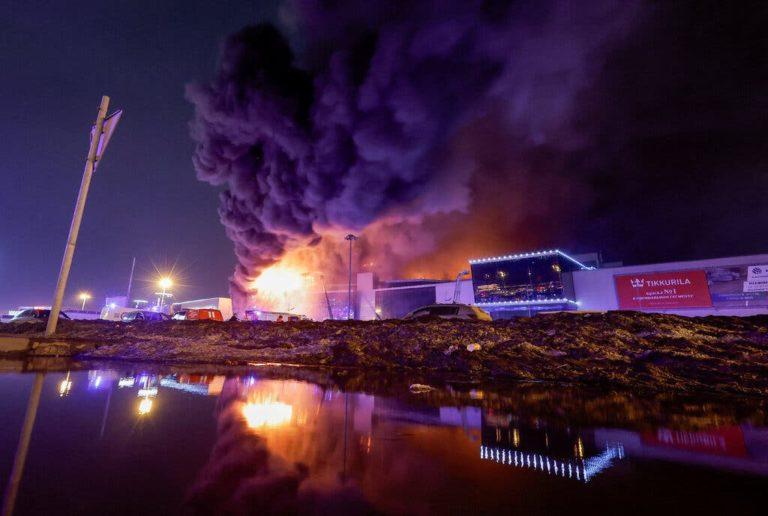
Last July’s attack in Bajaur, January’s attack in Iran and the recent one in Moscow show that ability of the group’s franchises to stage spectacular acts of destruction worldwide remains.
Ejaz Haider Published April 7, 2024
Ejaz Haider Published April 7, 2024
LONG READ
PROLOGUE
On April 23, 2015, Colonel Gulmurod Khalimov, head of Tajikistan’s Interior Ministry’s elite special forces unit (a counter-terrorism unit), failed to show up for a meeting with the interior minister.
No one had seen him for three days. His phone was switched off. His wife was contacted. She claimed that, for some time, Khalimov had been living with his second wife. When his second wife was contacted, she said that Khalimov had told her he was going off on a mission for a few days. She told the officials that was all she knew.
The news quickly spread. The head of the special forces, a high-ranking officer, a man close to President Emomali Rahmon’s family, had disappeared. Rumours abounded. Had Khalimov joined the political opposition and taken refuge in the mountains? Had he fallen out with Rahmon’s son and been eliminated. Yes, that’s possible in Tajikistan, a family autocracy that is highly repressive.
Independent journalists began to investigate. Abdusalim Khalimov, the father of Gulmurod, living in their village in the Varzob district, said he had no idea where his son was, saying, “It’s been a month. I don’t know what happened. A soldier came and asked me questions. I don’t know anything about it.” Weeks went by without any news. Finally, the news broke.
On May 28, Central Asia TV network revealed that Khalimov had been found. He was in Syria, with the Islamic State of Iraq and Syria (ISIS). The channel ran a video clip by Khalimov. The message was recorded in Russian and addressed all Muslims in Russia and the former Soviet republics. “Brothers are waiting to enter Tajikistan and Russia and establish shariah,” the message said.
Many wrote off the threat from the so-called ‘Islamic State’ after its comprehensive defeats in Iraq and Syria. But as last July’s attack in Bajaur, January’s attack in Iran and the recent terror attack in Moscow show, the ability of the group’s franchises to stage spectacular acts of destruction worldwide remains. What is the nature of this beast and should we be worried?
Later reports indicated that Khalimov had fled with 10 others to Turkey via Russia and then entered Syria from Turkey. Tajik authorities refused to comment on Khalimov’s desertion. Arkady Dubnov, a Russian expert on Central Asia with the Carnegie Endowment for International Peace, said Khalimov’s video was authentic.
On September 8, 2017, a little over two years after Khalimov joined ISIS, Russian channels reported that he had been killed in an airstrike near Deir ez Zour. By then, Khalimov had risen rapidly through the ISIS ranks and had become the group’s minister for war. As a former officer, he had been trained both by Russia’s elite Spetsnaz and, later, by the American military contractor company, the infamous Blackwater.
Khalimov’s death has never been confirmed by Tajikistan. The country’s most wanted list still contains Khalimov’s name and photograph. During his absence from Tajikistan, two of his brothers, a nephew and a neighbour were killed by Tajik security forces, some 30 kilometres from the Tajik-Afghan border. The security forces claimed that they were part of an ISIS cell and were planning to cross over into Afghanistan. Khalimov’s elder son from his first wife was also arrested on terrorism charges and later killed during a prison riot. He was 20.
How is ISIS relevant anymore, especially after being evicted from the territories it once controlled in Syria and Iraq? This question can be answered depending on what lens one is using and what is considered as constituting an ISIS threat.
The core group’s military capability to capture territory has been badly dented in Syria and Iraq, at much human and material cost. It is unlikely that the group will regain a territorial foothold anywhere anytime soon. That’s good news.
The bad news is that, having lost its self-styled caliphate in Syria and Iraq, it has splintered into various franchises, its activities have been driven underground and it now relies on classic terrorist attacks to remain relevant in a competitive jihadi ecosystem. Those tactics and the so-called Islamic State’s (IS) continued quest to find ungoverned spaces within weak states mean, however, that the group and its ideology remain a threat.

“‘Listen up — there’s no war that will end all wars,’ Crow tells me. ‘War breeds war. Lapping up the blood shed by violence, feeding on wounded flesh. War is a perfect, self-contained being. You need to know that.’“ — Kafka on the Shore by Haruki Murakami
PROLOGUE
On April 23, 2015, Colonel Gulmurod Khalimov, head of Tajikistan’s Interior Ministry’s elite special forces unit (a counter-terrorism unit), failed to show up for a meeting with the interior minister.
No one had seen him for three days. His phone was switched off. His wife was contacted. She claimed that, for some time, Khalimov had been living with his second wife. When his second wife was contacted, she said that Khalimov had told her he was going off on a mission for a few days. She told the officials that was all she knew.
The news quickly spread. The head of the special forces, a high-ranking officer, a man close to President Emomali Rahmon’s family, had disappeared. Rumours abounded. Had Khalimov joined the political opposition and taken refuge in the mountains? Had he fallen out with Rahmon’s son and been eliminated. Yes, that’s possible in Tajikistan, a family autocracy that is highly repressive.
Independent journalists began to investigate. Abdusalim Khalimov, the father of Gulmurod, living in their village in the Varzob district, said he had no idea where his son was, saying, “It’s been a month. I don’t know what happened. A soldier came and asked me questions. I don’t know anything about it.” Weeks went by without any news. Finally, the news broke.
On May 28, Central Asia TV network revealed that Khalimov had been found. He was in Syria, with the Islamic State of Iraq and Syria (ISIS). The channel ran a video clip by Khalimov. The message was recorded in Russian and addressed all Muslims in Russia and the former Soviet republics. “Brothers are waiting to enter Tajikistan and Russia and establish shariah,” the message said.
Many wrote off the threat from the so-called ‘Islamic State’ after its comprehensive defeats in Iraq and Syria. But as last July’s attack in Bajaur, January’s attack in Iran and the recent terror attack in Moscow show, the ability of the group’s franchises to stage spectacular acts of destruction worldwide remains. What is the nature of this beast and should we be worried?
Later reports indicated that Khalimov had fled with 10 others to Turkey via Russia and then entered Syria from Turkey. Tajik authorities refused to comment on Khalimov’s desertion. Arkady Dubnov, a Russian expert on Central Asia with the Carnegie Endowment for International Peace, said Khalimov’s video was authentic.
On September 8, 2017, a little over two years after Khalimov joined ISIS, Russian channels reported that he had been killed in an airstrike near Deir ez Zour. By then, Khalimov had risen rapidly through the ISIS ranks and had become the group’s minister for war. As a former officer, he had been trained both by Russia’s elite Spetsnaz and, later, by the American military contractor company, the infamous Blackwater.
Khalimov’s death has never been confirmed by Tajikistan. The country’s most wanted list still contains Khalimov’s name and photograph. During his absence from Tajikistan, two of his brothers, a nephew and a neighbour were killed by Tajik security forces, some 30 kilometres from the Tajik-Afghan border. The security forces claimed that they were part of an ISIS cell and were planning to cross over into Afghanistan. Khalimov’s elder son from his first wife was also arrested on terrorism charges and later killed during a prison riot. He was 20.
How is ISIS relevant anymore, especially after being evicted from the territories it once controlled in Syria and Iraq? This question can be answered depending on what lens one is using and what is considered as constituting an ISIS threat.
The core group’s military capability to capture territory has been badly dented in Syria and Iraq, at much human and material cost. It is unlikely that the group will regain a territorial foothold anywhere anytime soon. That’s good news.
The bad news is that, having lost its self-styled caliphate in Syria and Iraq, it has splintered into various franchises, its activities have been driven underground and it now relies on classic terrorist attacks to remain relevant in a competitive jihadi ecosystem. Those tactics and the so-called Islamic State’s (IS) continued quest to find ungoverned spaces within weak states mean, however, that the group and its ideology remain a threat.
The ISKP has carried out several targeted attacks against the JUI-F, such as the one pictured above, which took place in Mastung on September 14, 2023 | Pakistan Press International
MOSCOW ATTACK: WHY RUSSIA?
On March 22, 2024 a group of four or five terrorists attacked the Crocus City Hall outside Moscow. Armed with AK assault rifles, the attackers kept firing into the crowd, stopping only to reload. At some point, one or two of them also poured gasoline in one part of the building and set it on fire.
The attack, the rampage and the fire, which collapsed part of the hall, left 140 Muscovites dead and nearly 80 injured. While IS’s Middle East core took responsibility for the attack, US intelligence reports indicate the attack was planned and executed by the so-called Islamic State’s ‘Khorasan Province’ franchise, ISKP.
Russia has been in the jihadi crosshairs since Soviet times. The war in Afghanistan catalysed the break-up of the Soviet Union and also introduced the jihadi struggle into long-repressed Muslim Soviet Republics of the Soviet Union. The Central Asian Republics, especially Tajikistan and Uzbekistan, have been troubled by Islamist groups since the early ’90s.
Having lost its self-styled caliphate in Syria and Iraq, ISIS has splintered into various franchises, its activities have been driven underground and it now relies on classic terrorist attacks to remain relevant in a competitive jihadi ecosystem. Those tactics and the so-called Islamic State’s (IS) continued quest to find ungoverned spaces within weak states mean, however, that the group and its ideology remain a threat.
The area of the Ferghana Valley, shared by Tajikistan, Uzbekistan and Kyrgyzstan, has been particularly susceptible to such influences. That’s where Juma Namangani, a former Uzbek Soviet paratrooper who had fought in Afghanistan, created the Islamic Movement of Uzbekistan, along with Tahir Yaldashev. Namangani had also fought in Tajikistan’s civil war. He was killed in an airstrike in November 2001, during the US-led invasion of Afghanistan, while Yaldashev was killed in a US Predator drone strike in 2009 in Zhob, Balochistan.
The situation in the ‘90s was given a fillip by Russia’s two wars in Chechnya, especially the second Russo-Chechen War of 1999. The wars also exposed Russia to Chechen and Dagestani militant attacks. The Chechen insurgency itself split into nationalists and global jihadis. Chechen women, shahidkas (Black Widows), introduced suicide bombing, starting in the noughties. They staged many high-profile attacks, including eight of the 10 suicide bombings in the Russian capital.
Russia’s military and diplomatic help to Bashar al-Assad’s regime in Syria has also been a reason for reprisal attacks by IS. On September 6, 2022, an ISKP suicide bomber blew himself up outside the Russian embassy in Kabul. The attack killed six people, including two members of Russian embassy staff.
Russia has also taken a forward-leaning security posture since the US withdrawal from Afghanistan, including through military presence in Tajikistan, where it also holds joint counter-terrorism and military exercises with Tajikistan.
The Syria war informs IS’s memory, especially the defeat and the group’s dislodging from the territory. IS attacks inside Iran are seen as revenge for Tehran and its proxies’ anti-ISIS role in Syria and Iraq. This explains the ISKP attack in January this year in Kerman, Iran, at the anniversary commemoration of Maj Gen Qasem Soleimani, who was instrumental in Iran’s operations in Syria and Iraq. The attack killed over 90 people and left over a hundred injured.
Prior to both attacks, the US had warned Iran and Russia of imminent extremist attacks. Russian President Vladimir Putin is reported to have dismissed the warning, accusing the US of sowing fear. Putin has since been pushing the line about Ukraine’s involvement in the attack, a charge that has been rejected by Kyiv.
In the meantime, Russian security agencies have also arrested four Tajik nationals. When produced before the court, they showed visible signs of torture. Many experts believe Russia may not have the right perpetrators of the attack.
WHY IS TAJIKISTAN VULNERABLE?
Radicalisation among some Muslim communities in Central Asia dates back to the early ’90s. With the break-up of the Soviet Union, nearly a century of repressed religious sentiment rose among societies that, in many cases, had remained traditional and backward.
The Afghanistan jihad also played a major role in galvanising the new Islamist spirit. The post-Soviet Central Asian Republics also failed to deliver democratic governance and economic progress, most having been captured by former communists, who converted party rule into dynastic rule.
The twin processes of radicalisation and repression are particularly acute in Tajikistan, the region’s poorest country. One report quoted the country’s president, Rahmon, as saying that, “In the last three years, 24 Tajiks have committed or planned terrorist attacks in 10 countries.” There are reasons for this radicalisation.
Immediately after independence, Tajikistan was plunged into a civil war (1992–1997), leaving nearly 100,000 dead. Rahmon has ruled the country since 1994 and, once he is gone, the presidential office will pass on to Rustam Emomoli, his son.
The social and economic situation in Tajikistan is the worst in Central Asia, with the country ranking 162 in the world by GDP per capita index, according to International Monetary Fund estimates. Nearly 70 percent of Tajiks live in rural areas and the communities practise child marriage and polygamy. Ethnic Russians, who comprised about 7.5 percent of the population in 1989, have mostly emigrated, with only about 30,000 remaining in Tajikistan. That has also brought down the female employment ratio. Female unemployment, in any case, is common in the country.
By most accounts, while poverty and inequality remain rampant, digitisation and digital networks have served to exacerbate the sense of injustice. It also exposes the population to extremist views.
The Rahmon family and the ruling clique of his lieutenants are fabulously rich, a sharp contrast to the state of the country’s economy. Politically, Rahmon has done everything to destroy all opposition, to the point where the people have no legal-constitutional means to fight excesses and injustices. Radicalisation, as expat Tajik experts point out, is the only path open to many.
As one report put it, “International terrorist groups have long looked on Tajikistan as a fertile recruiting ground. Media outlets affiliated with [ISKP] produce content in the Tajik language. They publish religious material and political tracts criticising Rahmon for being too close to Russia, for his authoritarianism, and for not being religious enough. [ISKP] also runs Tajik-language Telegram channels and TikTok accounts.”

MOSCOW ATTACK: WHY RUSSIA?
On March 22, 2024 a group of four or five terrorists attacked the Crocus City Hall outside Moscow. Armed with AK assault rifles, the attackers kept firing into the crowd, stopping only to reload. At some point, one or two of them also poured gasoline in one part of the building and set it on fire.
The attack, the rampage and the fire, which collapsed part of the hall, left 140 Muscovites dead and nearly 80 injured. While IS’s Middle East core took responsibility for the attack, US intelligence reports indicate the attack was planned and executed by the so-called Islamic State’s ‘Khorasan Province’ franchise, ISKP.
Russia has been in the jihadi crosshairs since Soviet times. The war in Afghanistan catalysed the break-up of the Soviet Union and also introduced the jihadi struggle into long-repressed Muslim Soviet Republics of the Soviet Union. The Central Asian Republics, especially Tajikistan and Uzbekistan, have been troubled by Islamist groups since the early ’90s.
Having lost its self-styled caliphate in Syria and Iraq, ISIS has splintered into various franchises, its activities have been driven underground and it now relies on classic terrorist attacks to remain relevant in a competitive jihadi ecosystem. Those tactics and the so-called Islamic State’s (IS) continued quest to find ungoverned spaces within weak states mean, however, that the group and its ideology remain a threat.
The area of the Ferghana Valley, shared by Tajikistan, Uzbekistan and Kyrgyzstan, has been particularly susceptible to such influences. That’s where Juma Namangani, a former Uzbek Soviet paratrooper who had fought in Afghanistan, created the Islamic Movement of Uzbekistan, along with Tahir Yaldashev. Namangani had also fought in Tajikistan’s civil war. He was killed in an airstrike in November 2001, during the US-led invasion of Afghanistan, while Yaldashev was killed in a US Predator drone strike in 2009 in Zhob, Balochistan.
The situation in the ‘90s was given a fillip by Russia’s two wars in Chechnya, especially the second Russo-Chechen War of 1999. The wars also exposed Russia to Chechen and Dagestani militant attacks. The Chechen insurgency itself split into nationalists and global jihadis. Chechen women, shahidkas (Black Widows), introduced suicide bombing, starting in the noughties. They staged many high-profile attacks, including eight of the 10 suicide bombings in the Russian capital.
Russia’s military and diplomatic help to Bashar al-Assad’s regime in Syria has also been a reason for reprisal attacks by IS. On September 6, 2022, an ISKP suicide bomber blew himself up outside the Russian embassy in Kabul. The attack killed six people, including two members of Russian embassy staff.
Russia has also taken a forward-leaning security posture since the US withdrawal from Afghanistan, including through military presence in Tajikistan, where it also holds joint counter-terrorism and military exercises with Tajikistan.
The Syria war informs IS’s memory, especially the defeat and the group’s dislodging from the territory. IS attacks inside Iran are seen as revenge for Tehran and its proxies’ anti-ISIS role in Syria and Iraq. This explains the ISKP attack in January this year in Kerman, Iran, at the anniversary commemoration of Maj Gen Qasem Soleimani, who was instrumental in Iran’s operations in Syria and Iraq. The attack killed over 90 people and left over a hundred injured.
Prior to both attacks, the US had warned Iran and Russia of imminent extremist attacks. Russian President Vladimir Putin is reported to have dismissed the warning, accusing the US of sowing fear. Putin has since been pushing the line about Ukraine’s involvement in the attack, a charge that has been rejected by Kyiv.
In the meantime, Russian security agencies have also arrested four Tajik nationals. When produced before the court, they showed visible signs of torture. Many experts believe Russia may not have the right perpetrators of the attack.
WHY IS TAJIKISTAN VULNERABLE?
Radicalisation among some Muslim communities in Central Asia dates back to the early ’90s. With the break-up of the Soviet Union, nearly a century of repressed religious sentiment rose among societies that, in many cases, had remained traditional and backward.
The Afghanistan jihad also played a major role in galvanising the new Islamist spirit. The post-Soviet Central Asian Republics also failed to deliver democratic governance and economic progress, most having been captured by former communists, who converted party rule into dynastic rule.
The twin processes of radicalisation and repression are particularly acute in Tajikistan, the region’s poorest country. One report quoted the country’s president, Rahmon, as saying that, “In the last three years, 24 Tajiks have committed or planned terrorist attacks in 10 countries.” There are reasons for this radicalisation.
Immediately after independence, Tajikistan was plunged into a civil war (1992–1997), leaving nearly 100,000 dead. Rahmon has ruled the country since 1994 and, once he is gone, the presidential office will pass on to Rustam Emomoli, his son.
The social and economic situation in Tajikistan is the worst in Central Asia, with the country ranking 162 in the world by GDP per capita index, according to International Monetary Fund estimates. Nearly 70 percent of Tajiks live in rural areas and the communities practise child marriage and polygamy. Ethnic Russians, who comprised about 7.5 percent of the population in 1989, have mostly emigrated, with only about 30,000 remaining in Tajikistan. That has also brought down the female employment ratio. Female unemployment, in any case, is common in the country.
By most accounts, while poverty and inequality remain rampant, digitisation and digital networks have served to exacerbate the sense of injustice. It also exposes the population to extremist views.
The Rahmon family and the ruling clique of his lieutenants are fabulously rich, a sharp contrast to the state of the country’s economy. Politically, Rahmon has done everything to destroy all opposition, to the point where the people have no legal-constitutional means to fight excesses and injustices. Radicalisation, as expat Tajik experts point out, is the only path open to many.
As one report put it, “International terrorist groups have long looked on Tajikistan as a fertile recruiting ground. Media outlets affiliated with [ISKP] produce content in the Tajik language. They publish religious material and political tracts criticising Rahmon for being too close to Russia, for his authoritarianism, and for not being religious enough. [ISKP] also runs Tajik-language Telegram channels and TikTok accounts.”
Members of IS pictured following their surrender to the Afghan government on November 17, 2019: by 2019, the ISKP had begun to lose territory to the Afghan army and the Taliban — but the group has proved to be resilient and has been able to mount a number of operations inside Afghanistan since | AFP
DID ISIS END IN IRAQ AND SYRIA?
From roughly 2014 to 2017, the Islamic State in Iraq and Syria — also known as ISIL or Daesh — held about a third of the territory of Syria and 40 percent of Iraq’s. By December 2017, it had lost 95 percent of its territory, including its two biggest properties, Mosul, Iraq’s second largest city, and the Northern Syrian city of Raqqa, its nominal capital.
Unlike Al Qaeda and its affiliated groups, ISIS did nothing to hide itself and its activities. Not only did it believe in capturing territory and establishing a caliphate, it presented its exploits to the world through social media messages and video clips. Nor did it hide its recruitment drive. Its tactics were grounded in the theories expounded in the book Management of Savagery by an author who called himself Abu Bakr Naji.
At one point, Naji writes: “The great ‘power’ and that which causes the enemy to reflect one thousand times [is] a result of the ‘powers’ of the groups, whether they are groups of ‘vexation’ or groups of administration in the regions of savagery. The tie of religious loyalty between all of these groups is embodied in a covenant written in blood. The most important clause (of this covenant) is: ‘Blood for blood and destruction for destruction.’ Attaining a great ‘power’ makes the enemy unable to oppose it.”
As should be clear, this passage explains how IS responds to any attack by treating it as an attack against a unified group and body, the unified body being IS itself, whose struggle must continue unceasingly against infidels, both Muslims (those who oppose its exegetical worldview) and non-Muslims. The text remains central to IS operations and continues to inform its exceptional brutality.
While multiple state and non-state actors managed to defeat ISIS in Syria and Iraq, after the final battle in Syria — fought in February 2019 at the town of Baghuz Fawqani near Deir ez Zaur, where Kurdish Syrian Democratic Forces managed to dislodge ISIS fighters through a series of ground assaults supported by the US-led coalition — hundreds of ISIS fighters managed to flee the Iraq-Syria theatre. Experts believe many went underground and have spread out. Dozens of them are also said to have reached Afghanistan.
ISKP AND THE TALIBAN
Islamic State Khorasan Province is one of the most important branches of IS. Its reference to Khorasan comes from what, in Islamic eschatology, is called ‘The Hadith of Black Flag’ — a hadith that is much debated and equally controversial, both in its provenance and its interpretation.
ISKP’s formation was announced in January 2015 by the then-Islamic State spokesman Abu Muhammad al-Adnani. According to sources and reports at the time, the group was formed after months of negotiations between the IS leadership and terrorist factions in Afghanistan and Pakistan’s outlawed Taliban factions. Splinter factions of the Tehreek-i-Taliban Pakistan (TTP) were active in ISKP and its first leader, Hafiz Saeed Orakzai, was a former TTP commander.
At the time of its formation, the group was based in the eastern Afghan province of Nangarhar. It operated on multiple fronts: against the US-supported Afghan government’s coalition troops, against the Afghan Taliban and against Shia populations in Afghanistan and Pakistan. Gradually, the ISKP spread out into other areas: Kunar, Herat, Samangan, Kunduz, Jawzjan and Kabul. Notably, it also attacked and killed scholars and clerics who it considered to be against its creed.
By 2019, ISKP had begun to lose territory to the Afghan army and the Taliban. The US-supported defunct Afghan government even claimed, in late 2019, of having decimated the group. A similar claim was made by the Afghan Taliban in 2020. But the group has proved to be resilient and, despite counter-terrorism operations by the Afghan Taliban since the US withdrawal, it has been able to mount a number of operations inside Afghanistan and also Pakistan.
Following the Taliban takeover of Afghanistan, and despite the Tehreek-i-Taliban Afghanistan (TTA) operations against the ISKP, the latter has continued to expand its activities. During this period, intelligence sources indicate that the ISKP has also begun to target Tajikistan and Uzbekistan, in terms of attacks and recruitment.
As one report put it, “Following rocket strikes on Uzbekistan in April 2022, ISKP’s Voice of Khorasan magazine capitalised on the momentum, threatening to smash Afghanistan’s northern borders ‘as witnessed by the world when the Islamic State broke down the borders between Iraq and Sham [Syria] while crushing the Sykes-Picot [Agreement] under our feet.’”
As part of its strategy, the ISKP also appeals to jihadi sentiments by presenting the TTA as a Pashtun nationalist movement rather than a religious-jihadi force. To this end, they refer to the TTA’s negotiations with the Americans and their diplomatic outreach to the US, Russia, China, the Central Asian republics and others, accusing the TTA of wanting to subordinate Afghanistan to the interests of foreign powers, instead of working towards establishing a caliphate.
It is no coincidence that most jihadi texts refer to the secret 1916 Sykes-Picot Agreement that carved out the Ottoman Middle East and Northern Africa (MENA) territories into British and French mandates (spheres of influence).
The TTA is aware of this propaganda approach and is also wary of this. For instance, in Pakistan’s talks with TTA leaders on the thorny issue of the TTP, TTA leaders have, on more than one occasion, expressed the fear that, if they were to press the TTP beyond a certain point, they (TTA) run the risk of driving TTP factions into ISKP’s arms.
This fear is not entirely unfounded, since the ISKP originally comprised many fighters from the TTP’s splinter factions. However, it could well be a ruse, because the rift between the TTP and the ISKP has also been deepening, especially since the return to power of the TTA.
The TTP had publicly condemned the ISKP suicide attack in Bajaur on July 30, 2023, which targeted a political rally by the Deobandi Jamiat-i-Ulema-i-Islam party of Maulana Fazlur Rehman (JUI-F). In fact, to retain their own Islamist credentials and undermine the Pakistani state’s counter-terrorism operations against itself, the TTP has been trying to brand the ISKP as a group supported by Pakistani intelligence agencies, a charge that is both perfidious and utterly bogus.
At the same time, just like the TTA, the TTP also downplays the threat from the ISKP, partly to offset external pressure, but mostly to present the TTA as the legitimate government of Afghanistan, which effectively controls the territory of that country.
THE ‘ISLAMIC STATE’ STRATEGY
As the world’s primary attention has moved on to emerging interstate rivalries and conflicts, the problem of IS and other such groups — including criminal gangs like in Haiti and Nigeria — continues to simmer. For IS, the most important strategy, after having lost territory in Iraq and Syria, is to find opportunities for high profile attacks, including but not confined to, Western capitals.
The Moscow attack has to be seen in that light. This strategy not only allows IS to stay relevant, but also makes it a tough competitor for other non-state actors and groups. The changing world ecosystem helps it find spaces, especially ungoverned ones, where it can thrive and from where it can operate.
While the frequency of ISKP attacks inside Pakistan have come down, even as attacks by the TTP and Baloch terrorist groups have spiked, the ISKP threat has not gone away. The ISKP would, whenever a possibility arises, target security forces, civilians — especially Shia and non-Muslim Pakistanis — as well as religious scholars that it considers to be “heretical”.
GLOBAL CHALLENGES AND GEOPOLITICS
In his 2017 award-winning book The Allure of Battle: A History of How Wars Have Been Won and Lost, military historian Cathal J Nolan writes, “The allure of battle would matter little had not the long wars it led to altered the course of world history in conflicts of prolonged destruction and suffering, in wars… that lasted many years or even many decades.”
Humans seek clarity. The desire for a decisive battle to end violence and achieve security — what the Germans called Entscheidungsschlacht — is therefore understandable. When dealing with complexity, we try to parse and find that one factor that can solve the puzzle for us.
On September 14, 2001, then-US President George W Bush signed off on America’s National Security Strategy, detailing the conduct of what was then called the ‘Global War on Terror’. While the strategy conceded that “the struggle against global terrorism is different from any other war in our history”, it nonetheless expressed the confidence that “progress will come through the persistent accumulation of successes.”
Since then, much has changed but has also remained unchanged. The ability of terrorist groups to target the US has diminished, but the periphery remains unstable. These groups have continued to spawn regional franchises that continue to keep states in West and Central Asia, the Middle East and North Africa, the Horn of Africa and the Sahel destabilised.
The situation is exacerbated by civil wars in Iraq, Syria, Libya, Yemen, Sudan etc. Other states, such as Afghanistan, Tajikistan and Kyrgyzstan, remain weak for a number of reasons, providing ideal ecosystems for the resurgence of terrorist groups.
Four Strategic Challenges
The post-Cold War era and the American unipolar moment are over. A global competition is underway between the United States and China and, to a lesser extent, between Russia and the US. The Russo-Ukraine War will continue to keep Ukraine and, with it, Europe destabilised. The ongoing genocide in Gaza and the Occupied Palestinian Territories is fast driving a wedge between America and what has come to be loosely described as the Global South.
Democracies, even in the developed world, are witnessing the rise of majoritarianism, along religious and ethno-racial faultlines. These developments, especially in regions with historical conflicts, are likely to spill over.
Emerging technologies, especially artificial intelligence and its military applications, present another challenge. So far, there are no international legal mechanisms to govern and regulate research and development in these technologies. Combined with the unintended consequences of what these technologies might entail, the world faces a number of security, legal and moral-ethical challenges and dilemmas.
Multiple reports by top scientists across the world have made it clear that states and societies face an impending climate disaster. This necessitates global cooperation which, given various factors, is hard to come by. Climate change would lead to water shortages, food insecurity, rise of communicable diseases and energy shortages. Conflicts will further increase the severity of the situation and result in disruptions of global supply chains and increases in international commodity prices.
This will result in a dispiriting cycle of geopolitics impacting these shared challenges and these challenges, in turn, impacting geopolitics negatively. These shared challenges are not marginal issues secondary to geopolitics. They are at the very core of national and international security and must be addressed with great urgency.
Unfortunately, we will have to tackle these challenges within a competitive international environment, where heightened geopolitical competition, nationalism and populism render this cooperation even more difficult and will require us to think and act in new ways.
The writer is a journalist interested in security and foreign policies. X: @ejazhaider
Published in Dawn, EOS, April 7th, 2024
DID ISIS END IN IRAQ AND SYRIA?
From roughly 2014 to 2017, the Islamic State in Iraq and Syria — also known as ISIL or Daesh — held about a third of the territory of Syria and 40 percent of Iraq’s. By December 2017, it had lost 95 percent of its territory, including its two biggest properties, Mosul, Iraq’s second largest city, and the Northern Syrian city of Raqqa, its nominal capital.
Unlike Al Qaeda and its affiliated groups, ISIS did nothing to hide itself and its activities. Not only did it believe in capturing territory and establishing a caliphate, it presented its exploits to the world through social media messages and video clips. Nor did it hide its recruitment drive. Its tactics were grounded in the theories expounded in the book Management of Savagery by an author who called himself Abu Bakr Naji.
At one point, Naji writes: “The great ‘power’ and that which causes the enemy to reflect one thousand times [is] a result of the ‘powers’ of the groups, whether they are groups of ‘vexation’ or groups of administration in the regions of savagery. The tie of religious loyalty between all of these groups is embodied in a covenant written in blood. The most important clause (of this covenant) is: ‘Blood for blood and destruction for destruction.’ Attaining a great ‘power’ makes the enemy unable to oppose it.”
As should be clear, this passage explains how IS responds to any attack by treating it as an attack against a unified group and body, the unified body being IS itself, whose struggle must continue unceasingly against infidels, both Muslims (those who oppose its exegetical worldview) and non-Muslims. The text remains central to IS operations and continues to inform its exceptional brutality.
While multiple state and non-state actors managed to defeat ISIS in Syria and Iraq, after the final battle in Syria — fought in February 2019 at the town of Baghuz Fawqani near Deir ez Zaur, where Kurdish Syrian Democratic Forces managed to dislodge ISIS fighters through a series of ground assaults supported by the US-led coalition — hundreds of ISIS fighters managed to flee the Iraq-Syria theatre. Experts believe many went underground and have spread out. Dozens of them are also said to have reached Afghanistan.
ISKP AND THE TALIBAN
Islamic State Khorasan Province is one of the most important branches of IS. Its reference to Khorasan comes from what, in Islamic eschatology, is called ‘The Hadith of Black Flag’ — a hadith that is much debated and equally controversial, both in its provenance and its interpretation.
ISKP’s formation was announced in January 2015 by the then-Islamic State spokesman Abu Muhammad al-Adnani. According to sources and reports at the time, the group was formed after months of negotiations between the IS leadership and terrorist factions in Afghanistan and Pakistan’s outlawed Taliban factions. Splinter factions of the Tehreek-i-Taliban Pakistan (TTP) were active in ISKP and its first leader, Hafiz Saeed Orakzai, was a former TTP commander.
At the time of its formation, the group was based in the eastern Afghan province of Nangarhar. It operated on multiple fronts: against the US-supported Afghan government’s coalition troops, against the Afghan Taliban and against Shia populations in Afghanistan and Pakistan. Gradually, the ISKP spread out into other areas: Kunar, Herat, Samangan, Kunduz, Jawzjan and Kabul. Notably, it also attacked and killed scholars and clerics who it considered to be against its creed.
By 2019, ISKP had begun to lose territory to the Afghan army and the Taliban. The US-supported defunct Afghan government even claimed, in late 2019, of having decimated the group. A similar claim was made by the Afghan Taliban in 2020. But the group has proved to be resilient and, despite counter-terrorism operations by the Afghan Taliban since the US withdrawal, it has been able to mount a number of operations inside Afghanistan and also Pakistan.
Following the Taliban takeover of Afghanistan, and despite the Tehreek-i-Taliban Afghanistan (TTA) operations against the ISKP, the latter has continued to expand its activities. During this period, intelligence sources indicate that the ISKP has also begun to target Tajikistan and Uzbekistan, in terms of attacks and recruitment.
As one report put it, “Following rocket strikes on Uzbekistan in April 2022, ISKP’s Voice of Khorasan magazine capitalised on the momentum, threatening to smash Afghanistan’s northern borders ‘as witnessed by the world when the Islamic State broke down the borders between Iraq and Sham [Syria] while crushing the Sykes-Picot [Agreement] under our feet.’”
As part of its strategy, the ISKP also appeals to jihadi sentiments by presenting the TTA as a Pashtun nationalist movement rather than a religious-jihadi force. To this end, they refer to the TTA’s negotiations with the Americans and their diplomatic outreach to the US, Russia, China, the Central Asian republics and others, accusing the TTA of wanting to subordinate Afghanistan to the interests of foreign powers, instead of working towards establishing a caliphate.
It is no coincidence that most jihadi texts refer to the secret 1916 Sykes-Picot Agreement that carved out the Ottoman Middle East and Northern Africa (MENA) territories into British and French mandates (spheres of influence).
The TTA is aware of this propaganda approach and is also wary of this. For instance, in Pakistan’s talks with TTA leaders on the thorny issue of the TTP, TTA leaders have, on more than one occasion, expressed the fear that, if they were to press the TTP beyond a certain point, they (TTA) run the risk of driving TTP factions into ISKP’s arms.
This fear is not entirely unfounded, since the ISKP originally comprised many fighters from the TTP’s splinter factions. However, it could well be a ruse, because the rift between the TTP and the ISKP has also been deepening, especially since the return to power of the TTA.
The TTP had publicly condemned the ISKP suicide attack in Bajaur on July 30, 2023, which targeted a political rally by the Deobandi Jamiat-i-Ulema-i-Islam party of Maulana Fazlur Rehman (JUI-F). In fact, to retain their own Islamist credentials and undermine the Pakistani state’s counter-terrorism operations against itself, the TTP has been trying to brand the ISKP as a group supported by Pakistani intelligence agencies, a charge that is both perfidious and utterly bogus.
At the same time, just like the TTA, the TTP also downplays the threat from the ISKP, partly to offset external pressure, but mostly to present the TTA as the legitimate government of Afghanistan, which effectively controls the territory of that country.
THE ‘ISLAMIC STATE’ STRATEGY
As the world’s primary attention has moved on to emerging interstate rivalries and conflicts, the problem of IS and other such groups — including criminal gangs like in Haiti and Nigeria — continues to simmer. For IS, the most important strategy, after having lost territory in Iraq and Syria, is to find opportunities for high profile attacks, including but not confined to, Western capitals.
The Moscow attack has to be seen in that light. This strategy not only allows IS to stay relevant, but also makes it a tough competitor for other non-state actors and groups. The changing world ecosystem helps it find spaces, especially ungoverned ones, where it can thrive and from where it can operate.
While the frequency of ISKP attacks inside Pakistan have come down, even as attacks by the TTP and Baloch terrorist groups have spiked, the ISKP threat has not gone away. The ISKP would, whenever a possibility arises, target security forces, civilians — especially Shia and non-Muslim Pakistanis — as well as religious scholars that it considers to be “heretical”.
GLOBAL CHALLENGES AND GEOPOLITICS
In his 2017 award-winning book The Allure of Battle: A History of How Wars Have Been Won and Lost, military historian Cathal J Nolan writes, “The allure of battle would matter little had not the long wars it led to altered the course of world history in conflicts of prolonged destruction and suffering, in wars… that lasted many years or even many decades.”
Humans seek clarity. The desire for a decisive battle to end violence and achieve security — what the Germans called Entscheidungsschlacht — is therefore understandable. When dealing with complexity, we try to parse and find that one factor that can solve the puzzle for us.
On September 14, 2001, then-US President George W Bush signed off on America’s National Security Strategy, detailing the conduct of what was then called the ‘Global War on Terror’. While the strategy conceded that “the struggle against global terrorism is different from any other war in our history”, it nonetheless expressed the confidence that “progress will come through the persistent accumulation of successes.”
Since then, much has changed but has also remained unchanged. The ability of terrorist groups to target the US has diminished, but the periphery remains unstable. These groups have continued to spawn regional franchises that continue to keep states in West and Central Asia, the Middle East and North Africa, the Horn of Africa and the Sahel destabilised.
The situation is exacerbated by civil wars in Iraq, Syria, Libya, Yemen, Sudan etc. Other states, such as Afghanistan, Tajikistan and Kyrgyzstan, remain weak for a number of reasons, providing ideal ecosystems for the resurgence of terrorist groups.
Four Strategic Challenges
The post-Cold War era and the American unipolar moment are over. A global competition is underway between the United States and China and, to a lesser extent, between Russia and the US. The Russo-Ukraine War will continue to keep Ukraine and, with it, Europe destabilised. The ongoing genocide in Gaza and the Occupied Palestinian Territories is fast driving a wedge between America and what has come to be loosely described as the Global South.
Democracies, even in the developed world, are witnessing the rise of majoritarianism, along religious and ethno-racial faultlines. These developments, especially in regions with historical conflicts, are likely to spill over.
Emerging technologies, especially artificial intelligence and its military applications, present another challenge. So far, there are no international legal mechanisms to govern and regulate research and development in these technologies. Combined with the unintended consequences of what these technologies might entail, the world faces a number of security, legal and moral-ethical challenges and dilemmas.
Multiple reports by top scientists across the world have made it clear that states and societies face an impending climate disaster. This necessitates global cooperation which, given various factors, is hard to come by. Climate change would lead to water shortages, food insecurity, rise of communicable diseases and energy shortages. Conflicts will further increase the severity of the situation and result in disruptions of global supply chains and increases in international commodity prices.
This will result in a dispiriting cycle of geopolitics impacting these shared challenges and these challenges, in turn, impacting geopolitics negatively. These shared challenges are not marginal issues secondary to geopolitics. They are at the very core of national and international security and must be addressed with great urgency.
Unfortunately, we will have to tackle these challenges within a competitive international environment, where heightened geopolitical competition, nationalism and populism render this cooperation even more difficult and will require us to think and act in new ways.
The writer is a journalist interested in security and foreign policies. X: @ejazhaider
Published in Dawn, EOS, April 7th, 2024