Sunday, April 07, 2024

Remote care approach improved therapy adherence and uptake in patients with type 2 diabetes


Mass General Brigham study found earlier and greater uptake of medication when a remote care team delivered simultaneous education and medication management compared to a period of education before medication management


BRIGHAM AND WOMEN'S HOSPITAL


KEY TAKEAWAYS

  • Researchers at Mass General Brigham tested a remote patient education and navigation program with 200 patients who had type 2 diabetes and elevated cardiovascular/kidney risk.
  • Patients who received education simultaneously with treatment were more likely to begin and adhere to treatment while a period of education prior to therapy initiation was inferior for prescription acceptance and therapy uptake.
  • The study highlights the importance of “striking while the iron is hot” and the potential for remote, team-based care to bridge healthcare gaps and enhance patient outcomes.

A new study by investigators from Mass General Brigham  demonstrated that a remote team focused on identifying, educating and prescribing therapy can improve guideline-directed-medical-therapy (GDMT) adherence in patients with type 2 diabetes and high cardiovascular and/or kidney risk. The research team observed that patients who received education simultaneously with medication management demonstrated a higher rate of medication uptake and initiated treatment earlier compared to patients who received education over two months prior to medication management. Their results were presented at the 2024 American College of Cardiology’s Annual Scientific Session and simultaneously published in Circulation.

“Our results suggest that patients are more inclined to adhere to therapy when approached with education and treatment simultaneously and immediately,” said corresponding author Alexander J. Blood, MD, MSc, who presented the results. Blood serves as an attending physician in the Division of Cardiovascular Medicine as well as the Heart and Vascular Center at Brigham and Women’s Hospital, a founding member of the Mass General Brigham healthcare system. “Providers should ‘strike while the iron is hot.’ If a patient is already interested in investing in their health and willing to meet with you, that’s the time to initiate treatment while providing educational resources.”

Type 2 diabetes, which increases an individual’s risk of cardiovascular and kidney events, affects millions of adults in the United States. Medications such as SGLT2 inhibitors and GLP-1 receptor agonists can improve cardiovascular and kidney outcomes in patients with type 2 diabetes, but data from clinical trials and society recommendations have not led to widespread adoption and utilization of these therapies.

To investigate the impact of patient education on prescription acceptance and therapy uptake, the research team conducted a parallel, randomized, open label clinical trial. The study was funded by the Novo Nordisk Foundation. They enrolled 200 adult patients with type 2 diabetes at Mass General Brigham, who were at elevated risk of cardiac and/or kidney complications. Patients were randomly assigned to one of two groups. The “education-first” group received a dedicated two-month period of education, consisting of curated patient-centric videos on disease management and medication, prior to treatment initiation via an online portal. The second “simultaneous” group had access to the educational videos but received patient education concurrently with the initiation of their treatment.

Both groups received treatment through a research and clinical care management platform designed and created by the Accelerator for Clinical Transformation at Brigham and Women’s Hospital and Mass General Brigham, which facilitated care coordination among patient navigators, pharmacists, nurse practitioners and physicians. These healthcare professionals guided patients through every step of their engagement with health care and streamlined communication. The platform is part of Mass General Brigham’s larger efforts to transform healthcare delivery by helping patients access services and monitor health from home, especially at a time when hospitals are regularly operating over capacity.

Patients were followed for six months from enrollment or one month after medication initiation, whichever duration was longer.

While patients in both groups experienced benefits such as weight loss and reductions in blood glucose levels by the end of the study, those who received simultaneous education demonstrated a higher retention rate. Specifically, 60 percent of patients in this group were confirmed to have taken their prescribed therapy, compared to 44 percent in the “education-first” group. Additionally, contrary to initial predictions, patients in the “education-first” group did not engage more with the educational platform than those in the simultaneous group.

While the findings suggest that a pre-treatment education period may not be the solution to medication adherence issues, they underscore the potential of remote, team-based care delivery. This approach holds promise in facilitating the implementation of new therapies, bridging care quality disparities, and enhancing healthcare outcomes across diverse populations. The authors describe how the flexibility inherent in remote treatment may extend access to care, particularly benefiting traditionally underserved populations or individuals with busy schedules. Moreover, the inclusion of a patient navigation team fosters ongoing patient-provider communication, providing the personalized support necessary for sustained patient engagement in their care.

"We strongly believe that remote care programs that leverage non-licensed navigators, clinical pharmacists, and team-based care, together with a care delivery platform, will improve operational efficiencies and communication and thereby address many of the persistent problems in health care," said Benjamin M. Scirica, MD, MPH, principal investigator of the DRIVE study and director of the Accelerator for Clinical Transformation. "On a broader scale, programs like this enhance access, elevate patient outcomes, reduce physician burden, and promote the appropriate utilization of guideline-recommended medications."

Authorship: Mass General Brigham authors of the study include Alexander J. Blood, Lee-Shing Chang, Shahzad Hassan, Jacqueline Chasse, Gretchen Stern, Daniel Gabovitch, David Zelle, Caitlin Colling, Samuel J. Aronson, Christian Figueroa, Emma Collins, Ryan Ruggiero, Jorge Plutzky, Thomas A. Gaziano, Christopher P. Cannon, Deborah J. Wexler, and Benjamin M. Scirica.

Additional authors include Emily Zacherle, Joshua Noone, and Carey Robar.

Disclosures: Zacherle, Noone, and Robar are employees of Novo Nordisk. Blood, Chang, Hassan, Chasse, Aronson, Cannon, and Scirica have received grants from Novo Nordisk. Blood and Plutzky have consulted for Nov Nordisk. Wexler serves on Data Monitoring Committees for Novo Nordisk. Additional disclosures can be found in the paper and presentation.

Funding: This project was funded by Novo Nordisk, Inc.

Paper cited: Blood, A et al. “The Diabetes Remote Intervention to improVe use of Evidence-based medications (DRIVE) Study:  A randomized evaluation of a team-based remote education and medication management program to reduce CV and kidney risk” Circulation DOI: 10.1161/CIRCULATIONAHA.124.069494

For More Information:

###

PLAGUE PANIC
Over 90 killed after fishing boat sinks off Mozambique coast

AFP |
Apr 08, 2024


"There are 91 people who lost their lives," said Jaime Neto, secretary of state for the northern province of Nampula.

More than 90 people died when an overcrowded makeshift ferry sank off the north coast of Mozambique, local authorities said on Sunday.

The boat was carrying about 130 people(Rep image )

The converted fishing boat, carrying about 130 people, ran into trouble as it tried to reach an island off Nampula province, officials said.

"Because the boat was overcrowded and unsuited to carry passengers it ended up sinking ... There are 91 people who lost their lives," said Nampula's secretary of state Jaime Neto.

Many children were among the victims, he added

Rescuers had found five survivors and were searching for more, but sea conditions were making the operation difficult.

Most passengers were trying to escape the mainland because of a panic caused by disinformation about cholera, Neto said.

The southern African country, one of the world's poorest, has recorded almost 15,000 cases of the waterborne disease and 32 deaths since October, according to government data.

Nampula is the worst affected region, accounting for a third of all cases.

An investigative team had was working to find out the causes of the boat disaster, the official said.

INDIA

Climate crisis impacts citizens’ right to life: Supreme Court

ByAbraham Thomas, New Delhi
Apr 08, 2024 

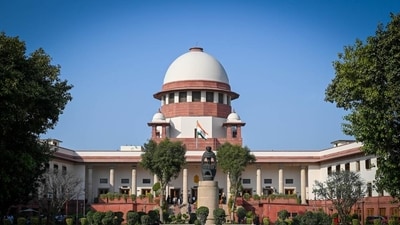
Climate change impacts the constitutional guarantee of right to life, the Supreme Court said in a recent judgment

Climate change impacts the constitutional guarantee of right to life, the Supreme Court said in a recent judgment, emphasising that India must prioritise clean energy initiatives such as solar power as citizens have a right to be free from the adverse effects of the climate emergency.

The judgment came on a petition by wildlife activist MK Ranjitsinh and others to protect the Great Indian Bustard (GIB), a critically endangered bird found only in Rajasthan and Gujarat. (HT Archive)

The judgment came on a petition by wildlife activist MK Ranjitsinh and others to protect the Great Indian Bustard (GIB), a critically endangered bird found only in Rajasthan and Gujarat. The court recalled an earlier order of April 2021 that required undergrounding of overhead transmission lines across an area of over 80,000 sq km in the two states after the Union government pointed out concerns on feasibility of implementing the order.

Unlock exclusive access to the story of India's general elections, only on the HT App. Download Now!

Read here: UN launches 'Weather Kids' campaign to encourage climate action

Moreover, since the major solar and wind energy producing installations of the country fall in the same area, the Centre claimed the court’s directions will harm India’s global commitments to reduce the carbon footprint by increasing dependence on renewable energy sources.

By the present order, passed on March 21, but uploaded recently, the bench formed an expert committee comprising independent experts, members of the National Board of Wildlife, representatives of power companies, and former and serving bureaucrats drawn from departments of environment and forests and ministry of new and renewable energy (MNRE) to suggest ways to balance two objectives – the conservation of the bird and India’s sustainable development goals. The committee’s first report is expected by July 31.

Accepting the concerns expressed by Centre, the bench headed by chief justice of India Dhananjaya Y Chandrachud said, “Without a clean environment which is stable and unimpacted by the vagaries of climate change, the right to life is not fully realised. The right to health (which is a part of the right to life under Article 21) is impacted due to factors such as air pollution, shifts in vector-borne diseases, rising temperatures, droughts, shortages in food supplies due to crop failure, storms, and flooding... From these, it emerges that there is a right to be free from the adverse effects of climate change.”

Discussing how tribals in Andaman and Nicobar Islands and such other indigenous communities that depend on nature, the court said, “The relationship that indigenous communities have with nature may be tied to their culture or religion. The destruction of their lands and forests or their displacement from their homes may result in a permanent loss of their unique culture. In these ways too, climate change may impact the constitutional guarantee of the right to equality.”

“If climate change and environmental degradation lead to acute food and water shortages in a particular area, poorer communities will suffer more than richer ones...The inability of underserved communities to adapt to climate change or cope with its effects violates the right to life as well as the right to equality,” said the bench, also comprising justices JB Pardiwala and Manoj Misra.

The Centre had told the court that India’s goal to achieve 500 GW of non-fossil-based electricity generation capacity by 2030 aligns with its efforts to be net zero by 2070. In 2023-24, out of the total generation capacity of 9,943 MW added, 8,269 was from non-fossil fuel sources. According to the Renewable Energy Statistics 2023 released by the International Renewable Energy Agency, India has the 4th largest installed capacity of renewables.

“Beyond mere adherence to international agreements, India’s pursuit of sustainable development reflects the complex interplay between environmental conservation, social equity, economic prosperity and climate change,” the court held.

“Clean energy aligns with the human right to a healthy environment,” the judgment said, pointing out specific concerns of “unequal energy access” for developing countries like India, where women spend an average of 1.4 hours a day collecting firewood and an average four hours cooking.

“Unequal energy access disproportionately affects women and girls due to their gender roles and responsibilities such as through time spent on domestic chores and unpaid care work... The importance of prioritizing clean energy initiatives to ensure environmental sustainability and uphold human rights obligations cannot be understated,” the court said.

Stating that solar energy stands out as a “pivotal solution” in the global transition towards cleaner energy sources, the judgment said, “It is imperative for states like India, to uphold their obligations under international law, including their responsibilities to mitigate greenhouse gas emissions, adapt to climate impacts, and protect the fundamental rights of all individuals to live in a healthy and sustainable environment.”

Transitioning to renewable energy is not just an environmental imperative but also a strategic investment in India’s future prosperity, resilience and sustainability, the court said. “The promotion of renewable energy sources plays a crucial role in promoting social equity by ensuring access to clean and affordable energy for all segments of society, especially in rural and underserved areas. This contributes to poverty alleviation, enhances quality of life, and fosters inclusive growth and development across the nation,” it added.

Of late, the court noted that globally courts are confronted with issues of climate change and human rights. Though India has a governmental policy and rules and regulations to combat the adverse effects of the climate crisis, the bench observed, “There is no single or umbrella legislation in India which relates to climate change and the attendant concerns...this does not mean that the people of India do not have a right against the adverse effects of climate change.”

It is imperative for India to not only find alternatives to coal-based fuels but also secure its energy demands in a sustainable manner as the court noted that India has pressing reasons to urgently shift to solar power. “India is likely to account for 25% of global energy demand growth over the next two decades; rampant air pollution emphasizes the need for cleaner energy sources; and declining groundwater levels and decreasing annual rainfall underscore the importance of diversifying energy sources,” it said.

The vast expanse of arid desert terrain and an abundance of sunlight in Gujarat and Rajasthan serves as prime areas for solar power generation. “By harnessing this natural advantage, India can significantly reduce its reliance on fossil fuels and transition towards cleaner energy sources,” the judgment said.

While asking the committee to determine the scope, feasibility and extent of overhead and underground electric lines in the area identified as priority GIB areas and propose steps for long-term conservation and protection of the GIB, the court noted the dilemma of protecting against climate change and preserving the critically endangered bird.

Read here: The link between climate crisis and your clock

“It is not a binary choice between conservation and development but rather a dynamic interplay between protecting a critically endangered species and addressing the pressing global challenge of climate change... If this Court were to direct that the power transmission lines be undergrounded in the entire area delineated above, many other parts of the environment would be adversely impacted,” it said.

For the long-term survival of the bird, the Court’s April 2021 order also required bird diverters to be installed along power lines. The court asked the committee to assess the efficacy of bird diverters and lay down specifications for it besides identifying and adding suitable areas for extending protection to the endangered bird.

A Wildlife Institute of India report, which formed the basis for passing the April 2021 direction, identified 13,663 sq km as “priority area”, 80,680 sq km as “potential areas”; and 6,654 sq km as “additional important areas” for the GIB.

The GIB is listed as critically endangered by the International Union for Conservation of Nature. They are protected under the Wildlife (Protection) Act, 1972. The GIB population in India was said to be 150 at the time when the April 2021 direction was passed. Since then, efforts are on to increase their population through captive breeding.

Attack on Ukraine nuclear plant highly increases accident risk: IAEA head


AP |
Apr 08, 2024 

The IAEA confirmed physical impact of drone attacks at the plant, including at one of its six reactors.

The head of the U.N.’s atomic watchdog agency said Sunday a drone attack on one of six nuclear reactors at the Russian-controlled Zaporizhzhia Nuclear Power Plant “significantly increase the risk of a major nuclear accident.

A photo shows a view of the Russian-controlled Zaporizhzhia nuclear power plant in southern Ukraine (AFP)

In a statement on the social media platform X, Rafael Mariano Grossi confirmed at least three direct hits against ZNPP main reactor containment structures took place. “This cannot happen,” he said.
Unlock exclusive access to the story of India's general elections, only on the HT App. Download Now!


He said it was the first such attack since November 2022, when he set out five basic principles to avoid a serious nuclear accident with radiological consequences.

In a separate statement, the IAEA confirmed physical impact of drone attacks at the plant, including at one of its six reactors. One casualty was reported, it said.

"Damage at unit 6 has not compromised nuclear safety, but this is a serious incident with potential to undermine integrity of the reactor’s containment system” it added.

Officials at the Russian-controlled Zaporizhzhia Nuclear Power Plant said that the site was attacked Sunday by Ukrainian military drones, including a strike on the dome of the plant’s sixth power unit.

According to the plant authorities, there was no critical damage or casualties and radiation levels at the plant were normal after the strikes. Later on Sunday, however, Russian state-owned nuclear agency Rosatom said that three people were wounded in the “unprecedented series of drone attacks," specifically when a drone hit an area close to the site's canteen.

The International Atomic Energy Agency said Sunday that its experts had been informed of the drone strike and that “such detonation is consistent with IAEA observations.”

Without apportioning blame, the head of the U.N.’s atomic watchdog agency, Rafael Mariano Grossi, warned of the safety risks of such attacks.

“I urge refraining from actions that contradict the 5 IAEA principles and jeopardize nuclear safety,” he said on the social media site X.

The power plant has been caught in the crossfire since Moscow sent troops into Ukraine in 2022 and seized the facility shortly after. The IAEA has repeatedly expressed alarm about the nuclear power plant, Europe’s largest, amid fears of a potential nuclear catastrophe. Both Ukraine and Russia have regularly accused the other of attacking the plant, which is still close to the front lines.

The plant’s six reactors have been shut down for months, but it still needs power and qualified staff to operate crucial cooling systems and other safety features.

Also on Sunday, three people were killed when their house was hit by a Russian projectile in the front-line town of Huliaipole in Ukraine’s partly occupied southeastern Zaporizhzhia region, regional Gov. Ivan Fedorov said. Later on Sunday, two people were wounded in another shelling of Huliaipole.

Separately, three people were wounded in Russian shelling in Ukraine’s northeast Kharkiv region, according to regional Gov. Oleh Syniehubov.

In Russia, a girl died and four other people were wounded when the debris of a downed Ukrainian drone fell on a car carrying a family of six people in Russia’s Belgorod region bordering Ukraine, regional Gov. Vyacheslav Gladkov said.


Unbecoming American: THE Option for the Poor


Many years ago, in the previous century, an old controversy in the Latin Church was resuscitated, that of Christian poverty. Anyone who pursues the history of the Latin Church and the papal empire will find periodic disputes over the meaning of such dicta as “the poor shall inherit the Earth” or innumerable other citations attributed to the biblical Jesus of Nazareth. At the apex of its power the Holy Roman and Universal Inquisition included those who insisted that poverty was a fundamental principle of Christian life (meaning for all the clergy, too). Franciscans and others were burned for professing this conviction. With the lapse of centuries, especially after the secularizations imposed by the 1789 revolution in France, the heresy was no longer punished by public combustion. The apparent supremacy of the secular state meant that such debates about opulence and penury were transferred to another sphere. Clergy might debate theological merits. However they had no direct influence on State policy.

All that changed in the wake of the Second Vatican Council. The accelerating movement toward what was hopefully awaited as the end of colonialism in all its forms also pushed regular and secular clergy as well as laity toward nationalism, the demands for self-determination and national development. The first wave of independence struggles, associated with Simon Bolivar, had been driven by anti-clerical, Enlightenment secularizers. This attitude persisted well into the 20th century. The Mexican Revolution of 1910 was distinctly, even violently anti-clerical. In fact, the seminal independence war in the Western hemisphere, the American War of Independence of 1776, was an exception. The United States was formed with an explicit prohibition of religious establishment. However this prohibition was only a rejection of the British substitution for Latin supremacy by creation of the Church of England to perform the same role, not of clerical status per se. In fact the United States would evolve into a kind of secular church where not only the invocation of the Christian (later also others) deity was standard, the nation itself was transformed into an instrument of divine salvation. Irving Berlin’s God Bless America, made famous by contralto Kate Smith, became one of the great popular expressions of worship in the North American Empire, where religious tolerance actually meant an obsession with religion.

Despite a strong anti-Latin prejudice among much of the US population (with the exception of numerous Irish and Italian immigrants) including the widely-held belief that a Latin POTUS would inevitably render the US a vassal of the Roman pontificate, this secular church preferred Latin America under church domination to anything Left. Since the Latin Church had retained control over most of the educational system in countries south of the United Mexican States, the class of people who had finished secondary and tertiary schooling were heavily influenced by Church education. Even those who did not become priests or religious shared years of Christian indoctrination with their classmates. Hence it should have been no surprise that the radicalization following Vatican II would shape the attitudes of young, educated clerics as well as those who had pursued other professions. Even today the Second Vatican Council is a highly contentious moment in the history of the Latin Church. Traditionalists continue to fight for reversal of the liturgical and ecclesiastical forms subsequently adopted. Significantly this era provoked the hierarchy with a resuscitation of the Fraticelli heresy reformulated as the “preferential option for the poor”.

Instead of asserting that the Church and especially the hierarchy abandon its status, the “preferential option for the poor” was derived from the Council’s resolutions and the so-called “social teaching” beginning when Leo XIII promulgated the encyclical Rerum Novarum in 1891. This new generation of priests and laity argued that the Church had a duty to prefer the poor and serve them rather than ministering to the ruling elites. Along with the dogma of papal infallibility promulgated after the First Vatican Council, the Papacy was engaged in a vigorous attempt to counter what economist Michael Hudson identified as the factive march toward socialism throughout the West. It should be understood that the liberal debunking of Marxist determinism is based on ignorance or refusal to comprehend the fundamentals of Marx’s analysis. The Church on the other hand comprehended that it would need a social doctrine to respond to socialism’s emergence in the West.

The conservatives in this initially broad movement—focussed mainly in Central and South America—agreed the necessity of pacifying the poor with attention. The French Revolution had been inspired by misinterpretation of the UDI struggle in British North America. In turn the 1789 revolution inspired the overthrow of slavery in Saint Dominique, France’s richest colony. That revolution, although infamously compromised by the slaveholder republic to the North, catalyzed the wave of Bolivarian independence wars that drove Spain out of the Western hemisphere — except Cuba until the end of the 19th century. The Church had always been on the side of the colonizers and later the post-colonial elite. Although the conservatives remained loyal to that ruling class, they saw the historical wave and wanted to ride rather than sink beneath it. After 1945, the conservatives warned that the hierarchy had served the cities but utterly neglected the countryside. The radicals complained that the hierarchy was a collaborator and beneficiary in the prevailing oppressive systems. For conservatives, the preferential option meant sending priests to neglected parishes and strengthening religious-patriotic organizations in the rural areas. Radicals wanted the Church to lead fundamental social and economic reform. The most radical felt that Christian teaching obliged them to support armed insurrection if that was necessary to liberate the poor from oppression.

This return to the traditional concern for the oppressed, i.e. those forced to live in poverty deprived of the most basic needs for human survival and the means to improve their lives beyond bare subsistence, was also a return to the fundamental heresy that the Church must not only serve the poor but renounce enrichment. While the Universal Inquisition had nearly disappeared from political life by the end of the 19th century, the hierarchy had not substantially altered its claims to worldly wealth, honor and power. Under Benito Mussolini the Roman pontiff was recognized as a sovereign over the territory of the Vatican, thus restoring the political authority of the Latin Church. The Weimar Constitution recognized both the Latin Church and the Protestant (Lutheran and Calvinist) Church as quasi-sovereigns on whose behalf church tax was introduced, a levy on the wages of all citizens who did not explicitly renounce confessional membership. Later a concordat, i.e. a treaty between the German Reich and the Papacy, gave formal rights and privileges to the Church and protected its property. The extensive secularization of Church properties in the course of the 19th century were and still are compensated by taxpayers through rates collected at municipal level. In other words, the Latin Church, as arguably one of the largest landowners in the western peninsula of Eurasia, may not have the power to anoint heads of state or ban them and the states over which they preside. However it is a major business actor and property owner and hence part of the corporate cartel that dominates the bourgeois political system, cosmetically called democracy.

Hence it should not have been surprising to find that the pontiff appointed with the exceptional influence of Anglo-American covert action, John Paul II, should appoint a cardinal-bishop raised under the NSDAP regime to head the Holy Office. Joseph Ratzinger, who later managed to promote himself to the pontificate (like GHW Bush went to the CIA before finally becoming POTUS), joined the forces of the Anglo-American Empire to crush the religious-clerical support for the last wave of independence and anti-colonial struggle in Central and South America. Although there were also activists and promoters of what was now called “liberation theology” on other continents, Africa was only place they had achieved something of a mass base. The Republic of South Africa was dominated by Protestant denominations. Thus radicals like Archbishop Hurley (who like his brother in Christ Dom Helder Camara began as a conservative) were able to benefit from episcopal privileges but remained minority voices. Even the more famous Anglican bishop and Nobel laureate Desmond Tutu was far more marginal in country than his reputation outside South Africa suggested. In the Asia-Pacific region, only the Philippines had a substantial Latin congregation. The peculiarities (better said the perversions) of the US-dominated archipelago prevented a critical mass from developing there. While the Boff brothers (Leonardo, a Franciscan and Clodovis, a Servite) in Brazil and Gutiérrez in Peru (Dominican) became notorious. Another Dominican, Albert Nolan, managed to avoid the persecution. (Perhaps because the Latin Church was relatively weak in South Africa and liberation theology opposed apartheid which the Holy Office could not openly defend.) Gutiérrez and Leonardo Boff as well as the Nicaraguan Ernesto Cardenal were all punished for supposedly politicizing their offices. The archbishop of Recifé and Olinda Dom Helder Camara and the cardinal archbishop of Sao Paulo, Paulo Evaristo Arns, were not deposed but had their jurisdictions diluted to reduce the authority they could exercise. In other words like in the Middle Ages, the hierarchy punished dissident clergy for taking the “option for the poor” too literally.

The US, both directly through prejudicial policies and covert action and indirectly through foundations and evangelical-pentacostal ministries, had been working to prevent an increasingly radicalized Latin base, organized for example in the CEBs (basic ecclesiastical communities) from developing the capacity to mobilize the countryside. The cooperation of the Ratzinger’s Holy Office was needed to give ideological cover for the assassinations, kidnapping and destruction delivered by US armed propaganda teams and secret units of national armed forces, like those that murdered Bishop Oscar Romero while he was saying mass in Salvador. Evangelical missions not only promoted the US “free enterprise” ideology and its charismatic style, they also competed actively to undermine historically Latin parishes and dioceses. The more extreme of these sects even saw the Latin Church as an evil competing with communism—both of which had to be met with force. Institutional religion has always been a technology for social transformation. The more hierarchically it is structured the more amenable it is to political hierarchies, like those of monarchy and aristocracy. However corporate oligarchies are governed by religious ideologies as well. Thus it should be no surprise that officeholders in one hierarchy can serve in another almost effortlessly. The papacy merged the rabbinical with the Latin imperial forms. Modern business corporations essentially mimic those original power structures, with CEOs elected dictators or temporary princes. Liberation theology and the derived CEBs began to fill a vacuum created by the concentration of clerical and political authority in the urban centers. Basic ecclesiastical communities were established in places that had rarely, if ever, even seen a priest. The theory asserted that the primitive church, before the imposition of the rabbinical-episcopal hierarchy, was self-constituted and thus also endowed with the grace needed to perform the sacraments. In the established Church, the sacraments were a major source of income and part of the vast financial derivative system through which the Papacy drained the Faithful from cradle to grave. Therefore it was not only the potential for political radicalism that Ratzinger and John Paul II feared. They also saw this as a model of the Latin faith which would deprive the global corporation of Christ of rural income extraction. In fact had it proceeded it might have challenged many more financial and ideological institutions with which the Papacy was necessarily aligned.

The persecution of liberation theology and all its practical elements was more than a theological campaign. Just as the universal inquisition had delivered those it convicted of heresy or other crimes to the “secular arm”, the Holy Office legitimated the Anglo-American Empire’s counter-insurgency campaign. Denied the institutional protection of religious freedom, both clergy and laity became outlaws in the medieval sense, where the Inquisition could declare its victims beyond the protection afforded even the lowliest peasant. While the State pursued Communists, real or imagined, the Latin hierarchy and the Pentacostal sects campaigned against primitive Christians. Thus by the end of the 1980s the pincer movement of Church and State had largely neutralized all the Western organizations for base struggle against oppression—creating an ideological wasteland thoroughly contaminated by possessive individualism and malignant narcissism. This ideological wasteland was saturated with “depleted identity product” and the technology of economic cannibalism.

The Latin hierarchy has always responded to the heresy of Jesus’s “preference for the poor” by insisting that Jesus meant the “spiritually poor” and not the oppressed. By definition every human was “spiritually poor” because of the doctrine of original sin and the principles underlying auricular confession. In the view of the Papacy and episcopate, to prefer the real, materially poor over the “spiritually poor” would itself be sinful. It would violate the diversity, inclusion, and equity principles of the Gospel as taught by the Holy Church. It would distract people from concern for their salvation were they to fight for potable water and safe homes. Instead the Gospel supported the economic and social models which gave the real poor the opportunity for salvation ONLY if they shared in the communion of those who enriched themselves at their expense. Individual salvation was the best thing for which one could pray and pay.

When the last breaths of the post-war liberation movements were being suffocated by overt and covert armed action by the residue of Euro-American imperialism, the survivors were placed on respirators. If they would only submit to artificial resuscitation as atomized, stateless, faithless (and eventually useless) labor, then their souls would be transubstantiated into consumers of digital, synthetic identities. Virtual nutrition and liberation would render struggle unnecessary—and organized, collective struggle impossible.

As many observers draw attention to the deterioration in the quality of real life, it has become clear that the resources available to the populations are devoted to virtual life. Whether it be digital communications technology, so-called virtual reality or that obscenity “artificial intelligence”, the lived world is being dissolved and with it the humans we had been accustomed to see in that world. This is a material and spiritual transformation. However it is dissolution not creation. It is both derivative and synthetic, like opioids. Whether one calls it finance capitalism, the New World Order, or by some other advertising slogan and label, we are witnessing not the destruction of the planet—which will be here long after we are extinct—but the annihilation of humanity as the union of heart and mind, soul, intelligence and corporeality. That is surely what the Latin pontiff and his corporate cartel colleagues have always understood as “salvation”—not deliverance of the poor but deliverance from them, from the useless billions for whom heaven was designed: so that the rich actually inherit the Earth.FacebookTwitterRedditEmail

Dr T.P. Wilkinson writes, teaches History and English, directs theatre and coaches cricket between the cradles of Heine and Saramago. He is also the author of Church Clothes, Land, Mission and the End of Apartheid in South AfricaRead other articles by T.P..

China Blasts Israel at the UN


Israel Rips Heart Out of Gaza’s Health System by Destroying Al-Shifa Hospital


Ana Vračar 


Through its latest vicious set of attacks against healthcare in Gaza, Israel leaves no doubts that it is set to destroy all remaining health infrastructure in the Strip.
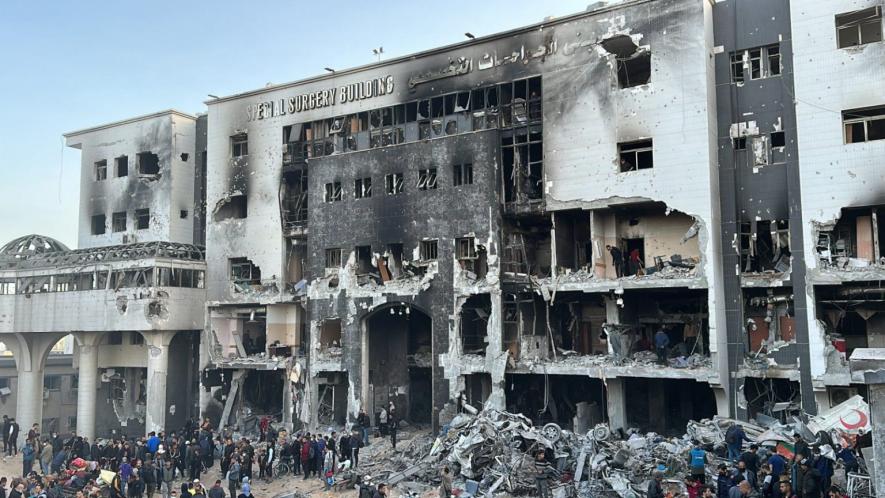
Al Shifa Hospital after the latest two-week Israeli siege.


Al Shifa Hospital after the latest two-week Israeli siege.

The World Health Organization (WHO) stated that by destroying Al-Shifa Hospital in Gaza, Israeli armed forces ripped the heart out of Gaza’s healthcare system. On April 1, Israeli soldiers left the Strip’s once-largest hospital complex after a two-week siege, during which they terrorized patients and health workers, destroyed equipment, and killed hundreds of people.

Al-Shifa was built with the intention of being a “house of healing”, yet it has turned into a “house of death” following the attacks of the Israeli Occupying Forces (IOF), said Mads Gilbert, a physician and solidarity worker, in a post on X. What was done to Al-Shifa stands as “a massive symbol of the heartless, cynical Israeli politics of colonial occupation with the goal of eliminating the Palestinian people, their social institutions, and their lives,” he stated.

Among those killed in Al-Shifa over the past weeks, whose bodies were discovered after the departure of the IOF, were even more health workers. One of them, plastic surgeon Ahmad Maqadmeh, worked in an area of healthcare crucial for the types of trauma injuries Palestinians suffer from following Israeli attacks. Maqadmeh and his mother were executed as they tried to leave Al-Shifa, surgeon Ghassan Abu-Sitta said in an interview with Democracy Now!.

The targeting of health workers has been a cruel leitmotif of the most recent Israeli war on Gaza. Close to 400 health workers have been killed, and hundreds more detained or arrested since October 7. The IOF’s practice of selecting health workers among besieged groups and exposing them to humiliation and torture is well known to both staff and patients.

Reports from international health workers who recently returned from medical missions in Gaza describe health workers “changing out of their scrubs or being told by civilians to change out of their scrubs when they’re fleeing,” said pediatrician Tanya Haj-Hassan. “We’ve had civilians give healthcare workers their own clothes so that they’re not seen wearing scrubs because we know that healthcare workers have been systematically targeted in this particular war.”

In parallel to the physical violence to which the IOF subjected people at Al-Shifa, health workers, and patients alike, the siege also worsened the nutrition and sanitation status for thousands of people. At one point, health workers were forced to move admitted patients to a room without access to food and a toilet. The patients were forced to share a single bottle of water among 15 of them, according to the WHO.

The effects of the chronic lack of food caused by Israeli blockades on humanitarian missions are growing by the day. The fear of famine setting into Gaza is no longer just a concern but something that has already begun, according to recent statements by UNICEF officials.

Babies born with an uncertain future

Children continue to die from malnutrition, especially in the northern areas. The WHO warned that the few hospitals still able to continue with partial provision of healthcare are reporting increasing numbers of babies born with very low birth weight, with many of them dying as a result. The children’s nutrition status is closely interlinked with that of their mothers, who had very high rates of anemia even before the beginning of the latest attacks, as well as to the lack of infant formula.

Amber Alayyan, a pediatrician and Palestine program manager with Doctors Without Borders (MSF), previously explained the interlinkage between young children’s malnutrition, mothers’ nutrition status, and the Israeli aid blockades. “Those children need to be breastfed. If they can’t be breastfed, they need formula. To have formula, you need clean water. None of these things are possible.”

Right now, families are resorting to feeding infants with the only alternatives available to them, including squeezing dates into handkerchiefs. Not only does this carry short-term risks of children dying of hunger directly, but it will certainly undermine the health status of children in the long-term. They will be more at risk of developing diabetes and high blood pressure, but also emotional and psychological consequences, Dr. Alayyan said at the time.

A war on children

As has been well documented since the beginning of October, the latest Israeli war on Gaza has clearly been a war on children. In addition to dying from hunger, children across the Gaza Strip have also been disproportionately suffering from physical trauma. According to estimates provided by Dr. Abu-Sittah, between 4,000 and 5,000 more children are now living with disabilities caused by Israeli attacks. “This is a lifelong trajectory of surgery and of disability and of mental health scarring as a result of the deformity,” Abu-Sittah warned.

“I remember one incident where we received a young boy whose face had been partially blown off, and we were providing care for him while providing care for his sister in the adjacent bed. His sister had 96% of her body burned. Their parents and all of their other siblings had been killed in the same attack,” Tanya Haj-Hassan said to Democracy Now!.

Even if a ceasefire was implemented today, the impact of Israeli attacks on children’s health would be unprecedented. Considering that any chance of stopping the attacks continues to be blocked by Israeli authorities, the extent of these consequences is certain to grow even further.

People’s Health Dispatch is a fortnightly bulletin published by the People’s Health Movement and Peoples Dispatch. For more articles and to subscribe to People’s Health Dispatch, click here.

Art is Political: Phil Garip on Censorship of Pro-Palestine Art


Neon artist Phil Garip had his artwork censored and excluded fro
m an organization he is a part of, for using the phrase “from the river to the sea”.


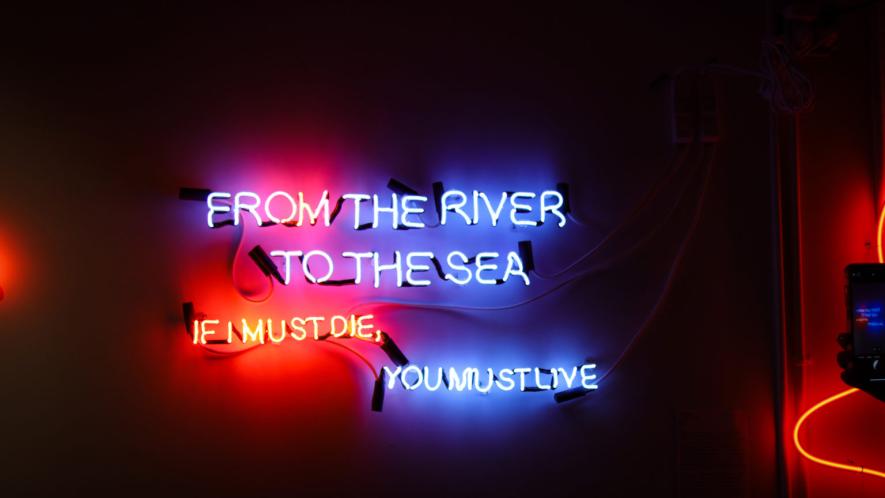
Palestinian-American artist Phil Garip's piece was pulled out of an UrbanGlass exhibit for the use of the slogan "from the river to the sea" 
(Photo via the People's Forum)


Natalia Marques | 22 Mar 2024


On March 6, the People’s Forum in New York City opened the exhibition of “Fundamental Particles,” showcasing artworks by 17 artists who had their works pulled from their original exhibition at UrbanGlass, a leading glass-blowing facility in Brooklyn, as a result of one of the featured works’ themes in solidarity with Palestine—a piece by Palestinian-American artist Phil Garip.

16 artists had pulled their works from the UrbanGlass exhibition after a neon piece by Garip was excluded. This piece features the well-known slogan for Palestinian liberation “FROM THE RIVER TO THE SEA” and a line from martyr Refaat Alareer’s last poem before he was assassinated by Israel: “IF I MUST DIE, YOU MUST LIVE”.

Garip was called in to a meeting with the executive director and a member of the curatorial staff of UrbanGlass, who asked Garip to remove the phrase “from the river to the sea,” associating the popular slogan with the Palestinian resistance group Hamas. “That was sort of the only context with which they were engaging with the phrase. And that’s obviously incredibly frustrating,” Garip told Peoples Dispatch.


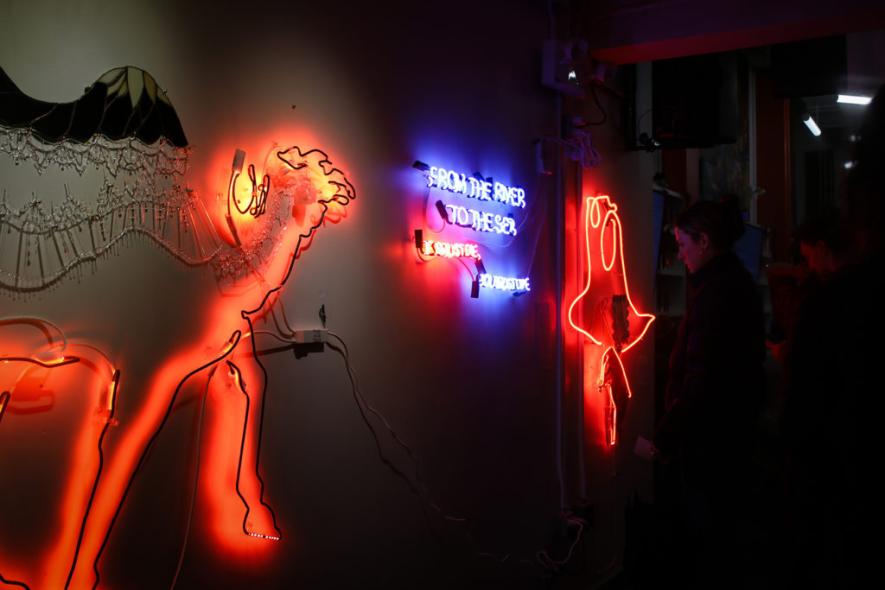
Garip’s piece as exhibited at the People’s Forum in New York Cit
y
 (Photo via the People’s Forum)

Garip was asked to remove that phrase from his piece, which he refused to do. Following a decision by the executive committee of UrbanGlass, the piece was removed from the exhibit.

Garip took to social media to express his frustration with the blatant act of censorship. “Despite sending a mockup ahead of the work ever being made, and sharing an artist statement that explained my intent, I was never invited to speak on the board… No one who took issue with the piece approached me directly.” Garip wrote in an Instagram post on March 2, a few days after he was informed that the executive committee had voted to exclude his piece. “The widespread suppression of [from the river to the sea] in western media echoes a greater suppression of Palestinian liberation efforts as a whole.”

Garip then asked his fellow artists in the exhibit to remove their artworks in solidarity, which the vast majority of them did. The exhibit was then rehoused at the People’s Forum, a left-wing movement space in Manhattan.

Peoples Dispatch spoke to Garip about the significance of artists making art about the Palestinian struggle:

Peoples Dispatch: What was it like to see your fellow artists pull out of the UrbanGlass exhibition in solidarity?

Phil Garip: It was really touching. I was just really grateful that they were on my team. And I wasn’t surprised either. That’s the hard truth about this whole situation is that the people who are going to who are putting the most on the line by doing things like this are the ones who get paid the least and work the most for the organization [UrbanGlass], who I work with every day. And they’ve been supportive the whole time.

PD: What moved you to center your piece around the Palestinian struggle for land, and Refaat Alareer in particular?

PG: I wanted to marry those two things as at least insofar as Alareer’s poem is calling for Palestinian stories to continue being told. I found that to be a very moving sentiment, especially as we’re seeing so many Palestinian stories being erased and ignored and disregarded.

I thought his story in general was pretty emblematic of the Palestinian experience. The experience, at least in my view, that the voice matter doesn’t matter enough to save the life.

I had this platform presented to me by the show and I couldn’t think of another thing that I wanted to use that platform for other than Palestinian life.

As an artist, my work has not engaged with Palestine. As a Palestinian, I’ve been engaged with Palestine. Previously, I couldn’t figure out a way to engage with the conflict and with everything going on there in a way that was appropriate for me, as I’m also an American. I grew up in New Jersey. My father was born here, so I didn’t know, until this moment, I didn’t see a lane for me. I regret that a little bit. I think there are always plenty of ways to engage. But yeah, the time for this work was years ago and it came to me now.

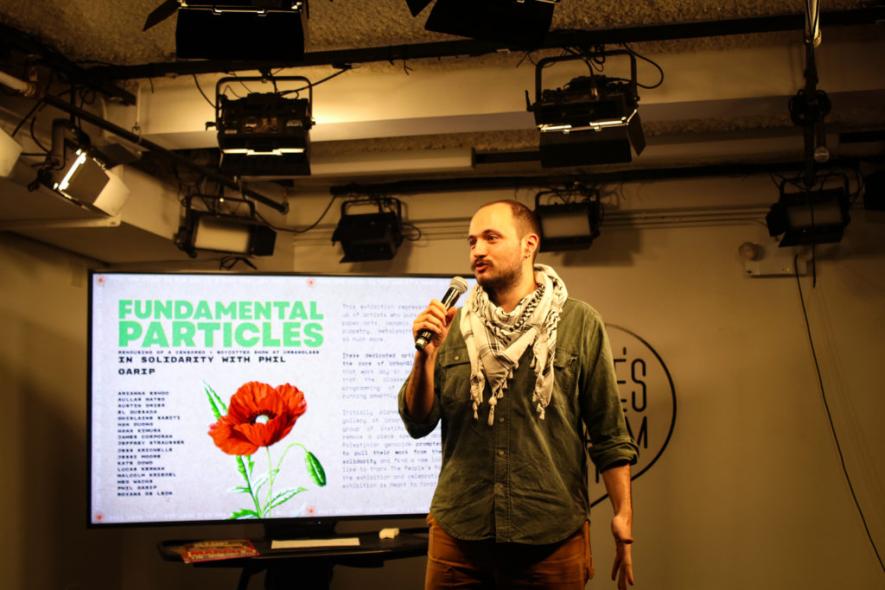
Phil Garip gives a talk at the People’s Forum
 (Photo: the People’s Forum)

I want to make sure that we’re centering the conflict and the loss of life there before anything else because it’s so devastating. It’s just horrible. I think as artists, we have a responsibility to engage politically and especially in moments like this, when the situation can seem so lost or dire, like there’s no option.

I’ve been reading a lot of Edward Said, and he speaks a lot about how art is political, whether it’s engaged with or not. And I, I just don’t think we have a choice at this moment, but to engage.

PD: How do you believe other artists must continue to show solidarity with Palestine? What sort of solidarity would you like to see from other artists?

PG: The glass community has really shown up in this way, but as far as what artists can do, I think there’s a huge opportunity now to challenge the institutions that were part of and and investigate where those loyalties lie.

If you have a platform, I think you have a responsibility to use it to speak politically, especially for those people who can’t do it themselves. I’d like to see that, if it feels safe for artists to do so in their respective mediums, in their respective institutions, to make political work and make work that is going to be “controversial” because what else can we do?

Art can feel frivolous. And I think this is a moment when it’s not.
World Central Kitchen founder questions Israeli report on deadly strike on aid convoy in Gaza


AFP Published April 7, 2024 

A Palestinian man rides a bicycle past a damaged vehicle where employees from the World Central Kitchen (WCK), including foreigners, were killed in an Israeli airstrike, in Deir Al-Balah, in the central Gaza, Strip on April 2. 
— Reuters/File

World Central Kitchen founder Jose Andres raised questions on Sunday over the Israeli probe into a strike that killed seven of his staff in Gaza, and warned that the conflict had become a “war against humanity itself”.

“I want to thank, obviously, the Israeli Defence Forces (IDF), for doing such a quick investigation,” the head of the US-based charity told ABC’s “This Week.”

“At the same time, I would say with something so complicated, the investigation should be much more deeper,” he said.

“And I would say that the perpetrator cannot be investigating himself,” he added.

The IDF have insisted that their killing on Monday of the World Central Kitchen workers in Gaza was a “tragic mistake.”

Three Britons, a US-Canadian dual national, a Pole, an Australian and a Palestinian were killed when their convoy, whose route was cleared with the IDF, was repeatedly struck.

In its investigation, the Israeli military said an armed man climbed on the roof of one of the trucks and “started firing his weapon,” leading to suspicions that the “convoy had been hijacked by Hamas.”

When asked about the Israeli report, Andres questioned the narrative, adding that “this is not anymore about the seven men and women of World Central Kitchen that perished in this unfortunate event.”

He charged that Israel was targeting anything that “seems” to move, and has been doing so “for too long.”

“This doesn’t seem like a war against terror. This doesn’t seem anymore like a war about defending Israel,” he said.

“It really, at this point, seems like a war against humanity itself. “