It’s possible that I shall make an ass of myself. But in that case one can always get out of it with a little dialectic. I have, of course, so worded my proposition as to be right either way (K.Marx, Letter to F.Engels on the Indian Mutiny)
Sunday, May 19, 2024
A.I.
Researchers in Portugal develop an image analysis AI platform to boost worldwide research
DL4MicEverywhere empowers life scientists to harness cutting-edge deep learning techniques for biomedical research
INSTITUTO GULBENKIAN DE CIENCIA
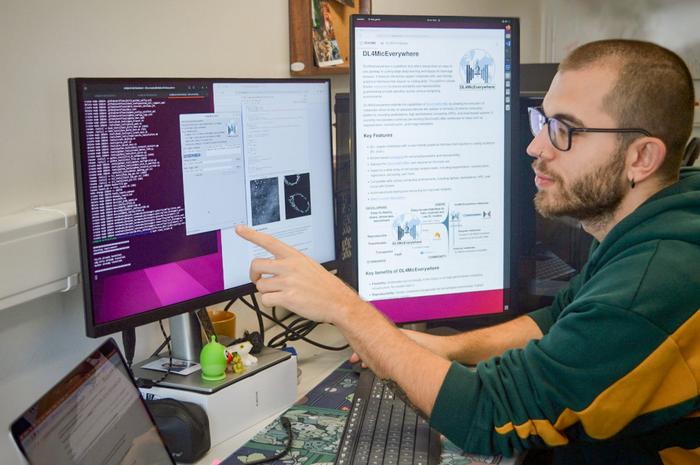
IMAGE:
FIRST AUTHOR, IVAN HIDALGO-CENAMOR, DISCUSSING THE PLATFORM
A team of researchers from the Instituto Gulbenkian de Ciência (IGC) in Portugal, together with Åbo Akademi University in Finland, the AI4Life consortium, and other collaborators, have developed an innovative open-source platform called DL4MicEverywhere published today in the journal Nature Methods*. This platform provides life scientists with easy access to advanced artificial intelligence (AI) for the analysis of microscopy images. Itenables other researchers, regardless of their computational expertise, to easily train and use deep learning models on their own data.
Deep learning, a subfield of AI, has revolutionised the analysis of large and complex microscopy datasets, allowing scientists to automatically identify, track and analyse cells and subcellular structures. However, the lack of computing resources and AI expertise prevents some researchers in life-sciences from taking advantage of these powerful techniques in their own work. DL4MicEverywhere addresses these challenges by providing an intuitive interface for researchers to use deep learning models on any experiment that requires image analysis and in diverse computing infrastructures, from simple laptops to high-performance clusters.
"Our platform establishes a bridge between AI technological advances and biomedical research", said Ivan Hidalgo-Cenamor, first author of the study and researcher at IGC. “With it, regardless of their expertise in AI, researchers gain access to cutting-edge microscopymethods, enabling them to automatically analyse their results and potentially discover new biological insights”.
The DL4MicEverywhere platform builds upon the team's previous work, ZeroCostDL4Mic, to allow the training and use of models across various computational environments. The platform also includes a user-friendly interface and expands the collection of available methodologies that users can apply to common microscopy image analysis tasks.
"DL4MicEverywhere aims to democratise AI for microscopy by promoting community contributions and adhering to FAIR principles for scientific research software - making resources findable, accessible, interoperable and reusable", explained Dr. Estibaliz Gómez-de-Mariscal, co-lead of the study and researcher at IGC. "We hope this platform will empower researchers worldwide to harness these powerful techniques in their work, regardless of their resources or expertise".
The development of DL4MicEverywhere is a great example of the collaborative environment in science. First, it was developed with the purpose of allowing any researcher worldwide to take advantage of the most advanced technologies in microscopy, contributing to accelerate scientific discoveries. Second, it was made possible only through an international collaboration of experts in computer science, image analysis, and microscopy, with key contributions from the AI4Life consortium. The project was co-led by Ricardo Henriques at IGC and Guillaume Jacquemet at Åbo Akademi University.
"This work represents an important milestone in making AI more accessible and reusable for the microscopy community", said Professor Jacquemet. "By enabling researchers to share their models and analysis pipelines easily, we can accelerate discoveries and enhance reproducibility in biomedical research".
"DL4MicEverywhere has the potential to be transformative for the life sciences," added Professor Henriques. "It aligns with our vision in AI4Life to develop sustainable AI solutions that empower researchers and drive innovation in healthcare and beyond".
The DL4MicEverywhere platform is freely available as an open-source resource, reflecting the teams' commitment to open science and reproducibility. The researchers believe that by lowering the barriers to advanced microscopy image analysis, DL4MicEverywhere will enable breakthrough discoveries in fields ranging from basic cell biology to drug discovery and personalised medicine.
*Iván Hidalgo-Cenalmor, Joanna W Pylvänäinen, Mariana G Ferreira, Craig T Russell, Ignacio Arganda-Carreras, AI4Life Consortium, Guillaume Jacquemet, Ricardo Henriques, Estibaliz Gómez-de-Mariscal (2024) DL4MicEverywhere: Deep learning for microscopy made flexible, shareable, and reproducible. Nature Methods. DOI: 10.1038/s41592-024-02295-6
By now, the challenges posed by generative AI are no secret. Models like OpenAI’s ChatGPT, Anthropic’s Claude and Meta’s Llama have been known to “hallucinate,” inventing potentially misleading responses, as well as divulge sensitive information, like copyrighted materials.
One potential solution to some of these issues is “model disgorgement,” a set of techniques that force models to purge themselves of content that leads to copyright infringement or biased responses.
In a recent paper in Proceedings of the National Academy of Sciences (PNAS), Michael Kearns, National Center Professor of Management & Technology in Computer and Information Science (CIS), and three fellow researchers at Amazon share their perspective on the potential for model disgorgement to solve some of the issues facing AI models today.
In the following Q&A, Kearns discusses the paper and its implications for improving AI.
What is model disgorgement?
Model disgorgement is the name for a broad set of techniques and the problems that those techniques are trying to solve. The goal is to mitigate or eradicate the effects of particular pieces of training data from the behavior of a trained model.
You expect individual pieces of training data or collections of training data to influence the behavior of the model. But this can lead to privacy leaks, copyright violations and other issues that aren’t covered by the law yet.
How is model disgorgement different from efforts to ensure data privacy, like Europe’s General Data Protection Regulation?
These are different but related concerns. If I ask Facebook to delete all of my stored Facebook activity from their servers, the GDPR requires that to be done on request.
Laws like the GDPR are less clear about what happens before your data is deleted. Your data was used to train a predictive model, and that predictive model is still out there, operating in the world. That model will still have been trained on your data even after your data is deleted from Facebook’s servers. This can lead to a number of problems.
For one, if your data was private, a third-party adversary might be able to reverse-engineer sensitive aspects of your private data. This is certainly an instance where you would want model disgorgement techniques to remove that sensitive data from the model.
In addition, there are also issues with copyright, as we’re seeing in The New York Times’ lawsuit against OpenAI. ChatGPT can regurgitate verbatim copyrighted articles from the Times. It’s pretty clear that OpenAI used those articles in training ChatGPT.
To be clear, the paper doesn’t want those articles to be private; it wants the articles to be accessible to the public. But the Times also wants to control the articles’ use and reproduction.
Finally, there’s another issue that I might call ‘stylistic infringement,’ where a user can say, ‘Give me a painting in the style of Andy Warhol of a cat skateboarding in Rittenhouse Square.” The model is able to do a good job because it’s been trained on the entire output of Andy Warhol’s career. If you’re the executor of Andy Warhol’s estate, you might take issue with this.
Even though these are very different issues, the technical ways of addressing them are quite similar, and involve model disgorgement techniques. In other words, it’s not that model disgorgement is different from efforts to ensure data privacy, it’s more that model disgorgement techniques can be used in certain situations where current approaches to privacy like the GDPR fall short.
The Ethical Algorithm, which you co-wrote with Aaron Roth, Henry Salvatori Professor of Computer & Cognitive Science in CIS, and which you recently referenced in the context of AI, describes how to embed ethical considerations into algorithm design. Would that approach be feasible with AI models?
When we wrote the book, generative AI didn’t exist, at least not like it does today. Our book focused on traditional machine learning, which involves more targeted predictions—like taking the information on a loan application and coming up with an assessment of the risk that a particular person would default if given a loan.
When an application is that targeted, it becomes much more feasible to bake into the training process defenses against various harms that you’re concerned about, like demographic bias in the performance of the model or leaking the private training data.
For now, we’ve lost that ability in training generative models because of the extreme open-ended nature of their outputs.
Would it be possible to filter the training data for AI models to reduce the likelihood of biased or copyright-breaching responses?
That’s hard for a few reasons.
The way you train a competitive large language model is by scraping the entire internet—literally. That’s table stakes. You also need a lot of other more proprietary data sources. When that is the starting point, there’s so much you don’t know about your training data.
In principle, we know how to train huge neural networks in a way that will avoid all of these problems. You can train a neural network under the constraint of differential privacy, a method of intentionally corrupting data to shield private information, for instance, and fewer of these problems will occur.
Nobody’s tried. I think the general feeling is that the degradation in performance you would get by training a large language model under the constraint of differential privacy would kind of obviate the point in the first place.
In other words, the quality would be so bad that you’d start generating nonsensical, nongrammatical outputs. The amount of noise that you would need to add to the training process, which is how differential privacy works—it just wouldn’t work at scale.
Can you provide a few examples of model disgorgement techniques? How do they work?
One conceptually straightforward solution is retraining from scratch. This is clearly infeasible given the scale and size of these networks and the compute time and resources it takes to train them. At the same time, retraining is kind of a gold standard—what you would like to achieve in a more efficient, scalable way.
Then there are “algorithmic” solutions. One of these is machine “unlearning.” Instead of retraining the whole network, we could just modify it in some way that mitigates or reduces the effects of your data on the training process.
Another algorithmic approach is training under the constraint of differential privacy: adding noise to the training process in a way that minimizes the effects of any particular piece of training data, while still letting you use the aggregate properties of the data set.
Then there are what I might call system-level techniques. One of these is “sharding.” If I divided my training data into 100 “shards,” I could train a different model on each of those 100 shards and then produce an overall model by averaging those 100 models.
If we’re lucky enough that your data was only in one of those 100 shards, and you wanted to remove your data, we could just remove that model entirely from the average. Or we could retrain just that model, which used only one percent of the overall data.
Your data’s contribution to something like ChatGPT is quite minuscule. If you did a sharding approach, your data would likely fall entirely within one, maybe at most two, of these 100 shards.
The bigger concern is for really large data sets. How do you make sure that every organization whose data you’re using is kind of only in one of the 100 shards?
To arrange this, you have to know what the organizations are in advance—and this gets back to my earlier point that often you don’t know what’s in your training data.
If my training data is some massive file, which is a crawl of the entire internet, and I break it into 100 pieces, I have no idea where Getty Images’ data might be distributed amongst those hundred pieces.
If we could go back in time and change the way the internet was designed, could we make sure that every piece of data online was tagged or identified with different levels of protection so that scraping the internet would yield metadata to inform what AI models can and can’t use in training?
My gut reaction is that this approach might help solve the problems that we’re discussing here, but would have possibly resulted in very different challenges elsewhere.
One of the great successes of the consumer internet was its openness and the lack of structure and rules for how data is organized and how data can cross reference other data. You could imagine setting up the rules differently. But you can also imagine the internet maybe never happening because it would just be too onerous to build on it.
The great success story of the internet has come from basically the lack of rules. You pay for the lack of rules, in the areas that we’re discussing here today.
Most people who think seriously about privacy and security would probably agree with me that a lot of the biggest problems in those topics come from the lack of rules, the design of the internet, but that’s also what made it so accessible and successful.
In short, it’s hard to avoid these trade-offs.
In your recent PNAS paper, you and your co-authors organize the model disgorgement methods discussed above into a taxonomy, classifying them according to when they take action and how they work. What do you hope the paper offers future researchers and industry professionals?
It’s a non-technical paper in many ways, and it’s meant for a broader audience. We hope that the paper will help frame thinking about these issues—in particular, the trade-offs among the different technical methods for model disgorgement. This felt like a topic that was important enough societally and nascent enough scientifically that it was a good time to kind of step up and survey the landscape.
Automated news video production is better with a human touch
LUDWIG-MAXIMILIANS-UNIVERSITÄT MÜNCHEN
AI-generated videos for short messages are only as well received as manually created ones if they are edited by humans.
News organizations—including Bloomberg, Reuters, and The Economist—have been using AI powered video services to meet growing audience demand for audio-visual material. A study recently published in the journal Journalism now shows that the automated production of news videos is better with human supervision.
Technology providers like Wochit and Moovly are allowing publishers to mass produce videos at scale. But what do audiences think of the results? Researchers led by LMU communication scientist Professor Neil Thurman have found that only automated videos which have been post-edited by humans were as well liked as fully human-made videos.
“Our research shows that, on average, news consumers liked short-form, automated news videos as much as manually made ones, as long as the automation process involved human supervision”, says Neil Thurman, from LMU’s Department of Media and Communication.
Together with Dr. Sally Stares (London School of Economic) and Dr. Michael Koliska (Georgetown University), Thurman evaluated the reactions of 4,200 UK news consumers to human-made, highly-automated, and partly-automated videos that covered a variety of topics including Christiano Ronaldo, Donald Trump, and the Wimbledon tennis championships. The partly-automated videos were post-edited by humans after the initial automation process.
The results show that there were no significant differences in how much news audiences liked the human-made and partly-automated videos overall. By contrast, highly-automated videos were liked significantly less. In other words, the results show that news video automation is better with human supervision.
According to Thurman, "one key takeaway of the study is that video automation output may be best when it comes in a hybrid form, meaning a human-machine collaboration. Such hybridity involves more human supervision, ensuring that automated video production maintains quality standards while taking advantage of computers’ strengths, such as speed and scale.”
Audience evaluations of news videos made with various levels of automation: A population-based survey experiment
ARTICLE PUBLICATION DATE
8-May-2024
NUS researchers and industry partners demonstrate cutting-edge chip technology for ultra-low power AI connected devices
Dramatic improvements in chip energy efficiency will turbocharge Singapore’s AI and semiconductor industry with new capabilities in always-on AI devices
NATIONAL UNIVERSITY OF SINGAPORE
Researchers from NUS, together with industry partners Soitec and NXP Semiconductors, have demonstrated a new class of silicon systems that promises to enhance the energy efficiency of AI connected devices by leaps and bounds. These technological breakthroughs will significantly advance the capabilities of the semiconductor industry in Singapore and beyond.
This innovation has been demonstrated in fully-depleted silicon-on-insulator (FD-SOI) technology, and can be applied to the design and fabrication of advanced semiconductor components for AI applications. The new chip technology has the potential to extend the battery life of wearables and smart objects by a factor of 10, support intense computational workloads for use in Internet of Things applications, and halve the power consumption associated with wireless communications with the cloud.
The new suite of disruptive chip technologies will be promoted through the FD-SOI & IoT Industry Consortium to accelerate industry adoption by lowering the design barrier to entry in FD-SOI chips. An industry workshop titled “Next-gen energy-efficient FD-SOI systems" was held on 3 May 2024 for participants from the industry and research community to share and discuss the latest developments in FD-SOI technologies, and showcase the new capabilities with state-of-the-art demonstrations.
“IoT devices often operate on a very limited power budget, and hence require extremely low average power to efficiently perform regular tasks such as physical signal monitoring. At the same time, high peak performance is demanded to process occasional signal events with computationally-intensive AI algorithms. Our research uniquely allows us to simultaneously reduce the average power and improve the peak performance,” said Professor Massimo Alioto, who is from the NUS College of Design and Engineering’sDepartment of Electrical and Computer Engineering and is also the Director of the FD-fAbrICS (FD-SOI Always-on Intelligent & Connected Systems) joint lab where the new suite of technologies was engineered.
“The applications are wide-ranging and include smart cities, smart buildings, Industry 4.0, wearables and smart logistics. The remarkable energy improvements obtained in the FD-fAbrICS program are a game changer in the area of battery-powered AI devices, as they ultimately allow us to move intelligence from conventional cloud to smart miniaturised devices,” said Prof Alioto, who also heads the Green IC group (www.green-ic.org) at the Department of Electrical and Computer Engineering.
Powering AI devices with ultra-energy efficient chips
Research conducted by the NUS FD-fAbrICS joint lab showed that their FD-SOI chip technology can be deployed at scale with enhanced design and system integration productivity for lower cost, faster market reach, and rapid industry adoption.
“This innovation has the potential to accelerate the time to market for key players in Singapore’s semiconductor ecosystem,” said Prof Alioto. “We hope to facilitate the adoption and deployment of our design technologies at scale through the FD-SOI & IoT Industry Consortium. This is a significant contribution to the AI and semiconductor industry in Singapore, as it enables a competitive advantage while reducing the overall development cost of FD-SOI systems.”
The research breakthroughs from the NUS FD-fAbrICS joint lab leverage the combined NUS expertise and capabilities from different domains, such as digital circuits (Prof Massimo Alioto), wireless communications (Assoc Prof Heng Chun Huat), system architectures (Asst Prof Trevor Carlson), and AI models (Prof Li Haizhou). Industry leaders such as Soitec, NXP and Dolphin Design contributed to the research efforts at the joint lab, which is also supported by the Agency for Science, Technology and Research.
The NUS research team is now looking into developing new classes of intelligent and connected silicon systems that could support larger AI model sizes (“large models”) for generative AI applications. The resulting decentralisation of AI computation from cloud to distributed devices will simultaneously preserve privacy, keep latency at a minimum, and avoid wireless data deluge under the simultaneous presence of a plethora of devices.
Accelerating industry adoption of FD-SOI technologies
The industry workshop, which delved into the cutting-edge advancements and applications of FD-SOI technology, aimed to foster an environment of knowledge sharing as well as catalyse collaborations within, and between, the FD-SOI research community and the semiconductor industry in Singapore working on intelligent and connected silicon systems.
Another objective of the workshop was to facilitate rapid FD-SOI adoption and lower the design barrier to entry, by sharing the research outcomes from the FD-fAbrICS joint lab. Speakers from Soitec, GlobalFoundries, NXP, and the NUS FD-fAbrICS research team shared their perspectives on the current development of related technologies – for example, in manufacturing and microchip design – and future disruptive technologies for next-generation ultra-low power AI systems.
FD-SOI & IoT Industry Consortium
The FD-SOI & IoT Consortium was established to extend the impact of the NUS FD-fAbrICS joint lab on the semiconductor ecosystem in Singapore. Soitec and NXP are founding members of the Consortium.
Consortium members will have access to innovative FD-SOI design IP and methodologies, which will help to accelerate their next-generation prototyping and development cycle with highly energy efficient processes, especially in the fast-growing area of AI-connected chips.
The FD-SOI & IoT Consortium will support the near-term needs of industry for rapid technology road mapping and accelerated innovation cycle. At the same time, to assure sustained scalability and differentiation across the Consortium members in the longer term, the technologies developed in synergy with the FD-fAbrICS industry partners will be further expanded by some of the Consortium members.
ARTICLE TITLE
NUS researchers and industry partners demonstrate cutting-edge chip technology for ultra-low power AI connected devices
ARTICLE PUBLICATION DATE
17-May-2024
AI-powered headphones filter only unwanted noise #ASA186
Neural network categorizes ambient sounds, giving users the power to choose what to hear
ACOUSTICAL SOCIETY OF AMERICA
IMAGE:
RESEARCHERS AUGMENTED NOISE-CANCELING HEADPHONES WITH A SMARTPHONE-BASED NEURAL NETWORK TO IDENTIFY AMBIENT SOUNDS AND PRESERVE THEM WHILE FILTERING OUT EVERYTHING ELSE.
OTTAWA, Ontario, May 16, 2024 – Noise-canceling headphones are a godsend for living and working in loud environments. They automatically identify background sounds and cancel them out for much-needed peace and quiet. However, typical noise-canceling fails to distinguish between unwanted background sounds and crucial information, leaving headphone users unaware of their surroundings.
Shyam Gollakota, from the University of Washington, is an expert in using AI tools for real-time audio processing. His team created a system for targeted speech hearing in noisy environments and developed AI-based headphones that selectively filter out specific sounds while preserving others. He will present his work Thursday, May 16, at 1:20 p.m. EDT as part of a joint meeting of the Acoustical Society of America and the Canadian Acoustical Association, running May 13-17 at the Shaw Centre located in downtown Ottawa, Ontario, Canada.
“Imagine you are in a park, admiring the sounds of chirping birds, but then you have the loud chatter of a nearby group of people who just can’t stop talking,” said Gollakota. “Now imagine if your headphones could grant you the ability to focus on the sounds of the birds while the rest of the noise just goes away. That is exactly what we set out to achieve with our system.”
Gollakota and his team combined noise-canceling technology with a smartphone-based neural network trained to identify 20 different environmental sound categories. These include alarm clocks, crying babies, sirens, car horns, and birdsong. When a user selects one or more of these categories, the software identifies and plays those sounds through the headphones in real time while filtering out everything else.
Making this system work seamlessly was not an easy task, however.
“To achieve what we want, we first needed a high-level intelligence to identify all the different sounds in an environment,” said Gollakota. “Then, we needed to separate the target sounds from all the interfering noises. If this is not hard enough, whatever sounds we extracted needed to sync with the user’s visual senses, since they cannot be hearing someone two seconds too late. This means the neural network algorithms must process sounds in real time in under a hundredth of a second, which is what we achieved.”
The team employed this AI-powered approach to focus on human speech. Relying on similar content-aware techniques, their algorithm can identify a speaker and isolate their voice from ambient noise in real time for clearer conversations.
Gollakota is excited to be at the forefront of the next generation of audio devices.
“We have a very unique opportunity to create the future of intelligent hearables that can enhance human hearing capability and augment intelligence to make lives better,” said Gollakota.
###
----------------------- MORE MEETING INFORMATION -----------------------
In the coming weeks, ASA's Press Room will be updated with newsworthy stories and the press conference schedule at https://acoustics.org/asa-press-room/.
LAY LANGUAGE PAPERS
ASA will also share dozens of lay language papers about topics covered at the conference. Lay language papers are summaries (300-500 words) of presentations written by scientists for a general audience. They will be accompanied by photos, audio, and video. Learn more at https://acoustics.org/lay-language-papers/.
PRESS REGISTRATION
ASA will grant free registration to credentialed and professional freelance journalists. If you are a reporter and would like to attend the hybrid / in-person meeting or virtual press conferences, contact AIP Media Services at media@aip.org. For urgent requests, AIP staff can also help with setting up interviews and obtaining images, sound clips, or background information.
ABOUT THE ACOUSTICAL SOCIETY OF AMERICA
The Acoustical Society of America is the premier international scientific society in acoustics devoted to the science and technology of sound. Its 7,000 members worldwide represent a broad spectrum of the study of acoustics. ASA publications include The Journal of the Acoustical Society of America (the world's leading journal on acoustics), JASA Express Letters, Proceedings of Meetings on Acoustics, Acoustics Today magazine, books, and standards on acoustics. The society also holds two major scientific meetings each year. See https://acousticalsociety.org/.
ABOUT THE CANADIAN ACOUSTICAL ASSOCIATION/ASSOCIATION CANADIENNE D’ACOUSTIQUE
• fosters communication among people working in all areas of acoustics in Canada • promotes the growth and practical application of knowledge in acoustics • encourages education, research, protection of the environment, and employment in acoustics • is an umbrella organization through which general issues in education, employment and research can be addressed at a national and multidisciplinary level
The CAA is a member society of the International Institute of Noise Control Engineering (I-INCE) and the International Commission for Acoustics (ICA) and is an affiliate society of the International Institute of Acoustics and Vibration (IIAV). Visit https://caa-aca.ca/.
###
ROBOTICS
Virginia Tech physicists propose path to faster, more flexible robots
Virginia Tech physicists revealed a microscopic phenomenon that could greatly improve the performance of soft devices, such as agile flexible robots or microscopic capsules for drug delivery
VIRGINIA TECH PHYSICIST C. NADIR KAPLAN (AT LEFT) AND DOCTORAL CANDIDATE CHINMAY KATKE (RIGHT) DISCOVERED A MICROSCOPIC PHENOMENON THAT COULD GREATLY IMPROVE THE PERFORMANCE OF SOFT DEVICES, SUCH AS AGILE FLEXIBLE ROBOTS OR MICROSCOPIC CAPSULES FOR DRUG DELIVERY. PHOTO BY SPENCER COPPAGE FOR VIRGINIA TECH.
CREDIT: PHOTO BY SPENCER COPPAGE FOR VIRGINIA TECH.
In a May 15 paper released in the journal Physical Review Letters, Virginia Tech physicists revealed a microscopic phenomenon that could greatly improve the performance of soft devices, such as agile flexible robots or microscopic capsules for drug delivery.
The paper, written by doctoral candidate Chinmay Katke, assistant professor C. Nadir Kaplan, and co-author Peter A. Korevaar from Radboud University in the Netherlands, proposes a new physical mechanism that could speed up the expansion and contraction of hydrogels. For one thing, this opens up the possibility for hydrogels to replace rubber-based materials used to make flexible robots—enabling these fabricated materials to perhaps move with a speed and dexterity close to that of human hands.
Soft robots are already being used in manufacturing, where a hand-like device is programmed to grab an item from a conveyer belt—picture a hot dog or piece of soap—and place it in a container to be packaged. But the ones in use now lean on hydraulics or pneumatics to change the shape of the “hand” to pick up the item.
Akin to our own body, hydrogels mostly contain water and are everywhere around us, e.g., food jelly and shaving gel. Katke, Korevaar, and Kaplan’s research appears to have found a method that allows hydrogels to swell and contract much more quickly, which would improve their flexibility and capability to function in different settings.
What did the Virginia Tech scientists do?
Living organisms use osmosis for such activities as bursting seed dispersing fruits in plants or absorbing water in the intestine. Normally, we think of osmosis as a flow of water moving through a membrane, with bigger molecules like polymers unable to move through. Such membranes are called semi-permeable membranes and were thought to be necessary to trigger osmosis.
Previously, Korevaar and Kaplan had done experiments by using a thin layer of hydrogel film comprised of polyacrylic acid. They had observed that even though the hydrogel film allows both water and ions to pass through and is not selective, the hydrogel rapidly swells due to osmosis when ions are released inside the hydrogel and shrinks back again.
Katke, Korevaar, and Kaplan developed a new theory to explain the above observation. This theory tells that microscopic interactions between ions and polyacrylic acid can make hydrogel swell when the released ions inside the hydrogel are unevenly spread out. They called this “diffusio-phoretic swelling of the hydrogels.” Furthermore, this newly discovered mechanism allows hydrogels to swell much faster than what has been previously possible.
Why is that change important?
Kaplan explained: Soft agile robots are currently made with rubber, which “does the job but their shapes are changed hydraulically or pneumatically. This is not desired because it is difficult to imprint a network of tubes into these robots to deliver air or fluid into them.”
Imagine, Kaplan said, how many different things you can do with your hand and how fast you can do them owing to your neural network and the motion of ions under your skin. Because the rubber and hydraulics are not as versatile as your biological tissues, which is a hydrogel, state-of-the-art soft robots can only do a limited number of movements.”
How could this improve our lives?
Katke explained that the process they have researched allows the hydrogels to change shape then change back to their original form “significantly faster this way” in soft robots that are larger than ever before.
At present, only microscopic-sized hydrogel robots can respond to a chemical signal quickly enough to be useful and larger ones require hours to change shape, Katke said. By using the new diffusio-phoresis method, soft robots as large as a centimeter may be able to transform in just a few seconds, which is subject to further studies.
Larger agile soft robots that could respond quickly could improve assistive devices in healthcare, “pick-and-place” functions in manufacturing, search and rescue operations, cosmetics used for skincare, and contact lenses.
CREDIT: TARTU UNIVERSITY ITALIAN INSTITUTE OF TECHNOLOGY
Scientists made a soft robot that mimics a spider's leg
Researchers Indrek Must and Kadri-Ann Valdur of the Institute of Technology of the University of Tartu have created a robot leg modelled after the leg of a cucumber spider. A soft robot created in cooperation with the Italian Institute of Technology could in the future move where humans cannot.
In organisms, fluid is what binds the organs, the blood vessels and the musculoskeletal system as a whole. For example, hemolymph, a blood-like fluid in a spider's body, enables muscle activation and exoskeleton flexibility. It was the cucumber spider inhabiting Estonia that inspired scientists to create a complex soft robot, where soft and rigid parts are made to work together and are connected by a liquid.
According to Indrek Must, Associate Professor of Soft Robotics, the designed soft robot is based on real reason. "Broadly speaking, our goal is to build systems from both natural and artificial materials that are as effective as in wildlife. The robotic leg could touch delicate objects and move in the same complex environments as a living spider," he explains.
In a new research paper published in the journal Advanced Functional Materials, the researchers show how a robotic foot touches a primrose stamen, spider web, and pollen grain. This demonstrates the soft robot's ability to interact with very small and delicate structures without damaging them.
The manufactured leg is the size of a little fingernail and consists of a light-curing resin exoskeleton and an artificial muscle made of polypyrrole. Similar to a natural muscle, a soft robot is activated by an electrical signal. The entire exoskeleton contains an electrolyte solution that surrounds both a stiffer tendon made of resin and an electroactive polymer artificial muscle. The solution behaves like the hemolymph in spiders and affects the properties of the exoskeleton as well as the movement – the liquid makes the exoskeleton more flexible and the leg starts to move due to the change in the shape of the polymer.
Soft robotics is inspired by wildlife. In the future, robots will be able to operate in places where humans cannot or cannot go, for example moving inside a person as a nanorobot during surgery or searching for survivors in a disaster area.
A spiders legs inspired mm-scale soft exosceleton touching plants anthers
A Spider Leg-Inspired mm-Scale Soft Exoskeleton Enabled by Liquid via Hydration and Charge Transport
Healthy diets for people and the planet
A study by researchers at the University of Bonn examines the ecological sustainability of children’s and young people’s diets
UNIVERSITY OF BONN
Our diet puts a strain on planetary resources. Shifting to a sustainable diet that benefits both our health and that of the planet is therefore assuming increasing importance. Researchers at the University of Bonn have analyzed the diets of children and adolescents in terms of their contribution to the ecological sustainability indicators of greenhouse gas emissions, land use and water use. The study shows that there is both the potential and a need to make the diet of younger generations more sustainable. The study will be published in the American Journal of Clinical Nutrition; it is already available online.
“We sought to analyze age and temporal trends over the past 20 years,” explains Professor Ute Nöthlings from the Institute for Nutritional and Food Science (IEL) at the University of Bonn. Her team drew on data from the DONALD study. The Dortmund Nutritional and Anthropometric Longitudinally Designed cohort study has been collecting detailed data on a range of factors including the diet, metabolism, development and health status of children and adolescents at regular intervals since 1985.
The team analyzed data from 856 schoolchildren aged between six and 17. The children recorded their diet between 2000 and 2021 in a total of over 5,000 3-day-weighed dietary records. The researchers calculated the environmental sustainability of the recorded diets in terms of greenhouse gas emissions, land use and water use using existing databases.
Potential to reduce greenhouse gas emissions through changing eating habits
“Studying the period from 2000 to 2010, we observed that the values for greenhouse gas emissions increased for both girls and boys, but have also decreased since then,” summarizes the study’s first author Karen van de Locht from the IEL, who is also a member of the Transdisciplinary Research Area (TRA) “Sustainable Futures“ at the University of Bonn. “We have concluded that there is potential to reduce greenhouse gas emissions by changing dietary intakes. Nevertheless, more needs to be done,” adds Ute Nöthlings, who is the speaker of the TRA “Sustainable Futures” and a member of the TRA “Life and Health”. "We were able to show that as expected, the consumption of animal-based foods is most responsible for greenhouse gas emissions.”
In a further step, the study also analyzed the nutrient adequacy of the diets of the participants and found that on average, it was not optimal. “The average values for calcium and iron in particular were below the levels recommended in Germany; this is also reflected in the results of other studies,” says van de Locht. The analyses performed by the study showed that a diet with a higher nutrient adequacy were not associated with reduced environmental impact. “We conclude that nutritionally favorable food choices are especially important when reducing the consumption of animal-based foods in this age group,” interprets Nöthlings.
The researchers argue in favor of context-related nutritional recommendations. Children and adolescents have special nutritional needs due to their growth, but they are often underrepresented in nutritional research. “More studies will help foster the improvement of recommendations issued to achieve an ecologically sustainable diet that is also healthy for children and young people,” concludes Nöthlings.
Funding
The project was funded by the German Research Foundation (DFG); the DONALD study was funded by the Ministry of Culture and Science of NRW.
Environmental sustainability of diets among children and adolescents in the German DONALD cohort study: Age and time trends, and nutrient adequacy
‘Forever chemicals’ found to rain down on all five Great Lakes
AMERICAN CHEMICAL SOCIETY
Perfluoroalkyl and polyfluoroalkyl substances, also known as PFAS or “forever chemicals,” have become persistent pollutants in the air, water and soil. Because they are so stable, they can be transported throughout the water cycle, making their way into drinking water sources and precipitation. According to findings published in ACS’ Environmental Science & Technology, precipitation introduces similar amounts of PFAS into each of the Great Lakes; however, the lakes eliminate the chemicals at different rates.
Consuming PFAS has been linked to negative health outcomes. And in April 2024, the U.S. Environmental Protection Agency (EPA) designated two forever chemicals — PFOS and PFOA — as hazardous substances, placing limits on their concentrations in drinking water. The Great Lakes are a major freshwater source for both the U.S. and Canada, and the EPA reports that the surrounding basin area is home to roughly 10% and 30% of each country’s population, respectively. Previous studies demonstrated that these lakes contain PFAS. But Marta Venier at Indiana University and colleagues from the U.S. and Canada wanted to understand where the compounds come from and where they go.
Between 2021 and 2022, 207 precipitation samples and 60 air samples were taken from five sites surrounding the Great Lakes in the U.S.: Chicago; Cleveland; Sturgeon Point, N.Y.; Eagle Harbor, Mich.; and Sleeping Bear Dunes, Mich. During the same period, 87 different water samples were collected from the five Great Lakes. The team analyzed all the samples for 41 types of PFAS and found:
In precipitation samples, PFAS concentrations largely remained the same across sites, suggesting that the compounds are present at similar levels regardless of population density.
In air samples, Cleveland had the highest median concentration of PFAS and Sleeping Bear Dunes the lowest, suggesting a strong connection between population density and airborne PFAS.
In the lake water samples, the highest concentration of PFAS were in Lake Ontario, followed by Lake Michigan, Lake Erie, Lake Huron and Lake Superior.
The concentration of PFOS and PFOA in lake water decreased compared to data from previous studies as far back as 2005, but the concentration of a replacement PFAS known as PFBA remained high, suggesting that further regulation efforts may be needed.
The team calculated that airborne deposition from precipitation is primarily how PFAS get into the lakes, while they’re removed by sedimentation, attaching to particles as they settle to the lakebed or flowing out through connecting channels. Overall, their calculations showed that the northernmost lakes (Superior, Michigan and Huron) are generally accumulating PFAS. Further south, Lake Ontario is generally eliminating the compounds and levels in Lake Erie remain at a steady state. The researchers say that this work could help inform future actions and policies aimed at mitigating PFAS’ presence in the Great Lakes.
The authors acknowledge funding from the Great Lakes Restoration Initiativefrom the U.S. Environmental Protection Agency’s Great Lakes National Program Office.
###
The American Chemical Society (ACS) is a nonprofit organization chartered by the U.S. Congress. ACS’ mission is to advance the broader chemistry enterprise and its practitioners for the benefit of Earth and all its people. The Society is a global leader in promoting excellence in science education and providing access to chemistry-related information and research through its multiple research solutions, peer-reviewed journals, scientific conferences, eBooks and weekly news periodical Chemical & Engineering News. ACS journals are among the most cited, most trusted and most read within the scientific literature; however, ACS itself does not conduct chemical research. As a leader in scientific information solutions, its CAS division partners with global innovators to accelerate breakthroughs by curating, connecting and analyzing the world’s scientific knowledge. ACS’ main offices are in Washington, D.C., and Columbus, Ohio.
To automatically receive news releases from the American Chemical Society, contact newsroom@acs.org.
Note: ACS does not conduct research, but publishes and publicizes peer-reviewed scientific studies.
“The Ins and Outs of Per- and Polyfluoroalkyl Substances in the Great Lakes: The Role of Atmospheric Deposition”
ARTICLE PUBLICATION DATE
16-May-2024
To sound like a hockey player, speak like a Canadian #ASA186
American athletes tend to signal their identity as hockey players through Canadian English-like accents.
ACOUSTICAL SOCIETY OF AMERICA
IMAGE:
ANDREW BRAY, FORMER UGA ICE DAWG, WILL PRESENT AN INVESTIGATION INTO AMERICAN HOCKEY PLAYERS’ USE OF CANADIAN ENGLISH ACCENTS AT THE 186TH MEETING OF THE ACOUSTICAL SOCIETY OF AMERICA. HERE THE UNIVERSITY OF GEORGIA TAKES ON THE UNIVERSITY OF FLORIDA IN THE 2016 SAVANNAH TIRE HOCKEY CLASSIC.
OTTAWA, Ontario, May 16, 2024 – As a hockey player, Andrew Bray was familiar with the slang thrown around the “barn” (hockey arena). As a linguist, he wanted to understand how sport-specific jargon evolved and permeated across teams, regions, and countries. In pursuit of the sociolinguistic “biscuit” (puck), he faced an unexpected question.
“It was while conducting this initial study that I was asked a question that has since shaped the direction of my subsequent research,” said Bray. “‘Are you trying to figure out why the Americans sound like fake Canadians?’”
Canadian English dialects are stereotypically represented by the vowel pronunciation, or articulation, in words like “out” and “about,” borrowed British terms like “zed,” and the affinity for the tag question “eh?” Bray, from the University of Rochester, will present an investigation into American hockey players’ use of Canadian English accents Thursday, May 16, at 8:25 a.m. EDT as part of a joint meeting of the Acoustical Society of America and the Canadian Acoustical Association, running May 13-17 at the Shaw Centre located in downtown Ottawa, Ontario, Canada.
Studying how hockey players talk required listening to them talk about hockey. To analyze unique vowel articulation and the vast collection of sport-specific slang terminology that players incorporated into their speech, Bray visited different professional teams to interview their American-born players.
“In these interviews, I would ask players to discuss their career trajectories, including when and why they began playing hockey, the teams that they played for throughout their childhood, why they decided to pursue collegiate or major junior hockey, and their current lives as professionals,” said Bray. “The interview sought to get players talking about hockey for as long as possible.”
Bray found that American athletes borrow features of the Canadian English accents, especially for hockey-specific terms and jargon, but do not follow the underlying rules behind the pronunciation, which could explain why the accent might sound “fake” to a Canadian.
“It is important to note that American hockey players are not trying to shift their speech to sound more Canadian,” said Bray. "Rather, they are trying to sound more like a hockey player.”
Players from Canada and northern American states with similar accents have historically dominated the sport. Adopting features of this dialect is a way hockey players can outwardly portray their identity through speech, called a linguistic persona. Many factors influence this persona, like age, gender expression, social category, and as Bray demonstrated, a sport.
Going forward, Bray plans to combine his recent work with his original quest to investigate if Canadian English pronunciation and the hockey linguistic persona are introduced to American players through the sport’s signature slang.
###
----------------------- MORE MEETING INFORMATION -----------------------
In the coming weeks, ASA's Press Room will be updated with newsworthy stories and the press conference schedule at https://acoustics.org/asa-press-room/.
LAY LANGUAGE PAPERS
ASA will also share dozens of lay language papers about topics covered at the conference. Lay language papers are summaries (300-500 words) of presentations written by scientists for a general audience. They will be accompanied by photos, audio, and video. Learn more at https://acoustics.org/lay-language-papers/.
PRESS REGISTRATION
ASA will grant free registration to credentialed and professional freelance journalists. If you are a reporter and would like to attend the hybrid / in-person meeting or virtual press conferences, contact AIP Media Services at media@aip.org. For urgent requests, AIP staff can also help with setting up interviews and obtaining images, sound clips, or background information.
ABOUT THE ACOUSTICAL SOCIETY OF AMERICA
The Acoustical Society of America is the premier international scientific society in acoustics devoted to the science and technology of sound. Its 7,000 members worldwide represent a broad spectrum of the study of acoustics. ASA publications include The Journal of the Acoustical Society of America (the world's leading journal on acoustics), JASA Express Letters, Proceedings of Meetings on Acoustics, Acoustics Today magazine, books, and standards on acoustics. The society also holds two major scientific meetings each year. See https://acousticalsociety.org/.
ABOUT THE CANADIAN ACOUSTICAL ASSOCIATION/ASSOCIATION CANADIENNE D’ACOUSTIQUE
• fosters communication among people working in all areas of acoustics in Canada • promotes the growth and practical application of knowledge in acoustics • encourages education, research, protection of the environment, and employment in acoustics • is an umbrella organization through which general issues in education, employment and research can be addressed at a national and multidisciplinary level
The CAA is a member society of the International Institute of Noise Control Engineering (I-INCE) and the International Commission for Acoustics (ICA) and is an affiliate society of the International Institute of Acoustics and Vibration (IIAV). Visit https://caa-aca.ca/.