Saturday, September 21, 2024

New U.S-Greece LNG Deal Will Boost Europe’s Energy Security

  • Venture Global, a U.S. LNG producer secured regasification capacity at an LNG terminal in Greece.

  • The new South-North Vertical Corridor will shore up Europe’s energy security.

  • Russian gas supplies to the EU have largely been replaced by U.S. and Norwegian gas.

Venture Global, a U.S. producer of liquefied natural gas (LNG) sourced from North American basins, has secured ~1 million tonnes per annum (mtpa) of LNG regasification capacity at Greece’s new Alexandroupolis LNG receiving terminal for five years, starting in 2025, Reuters reports, noting that the new South-North Vertical Corridor will shore up Europe’s energy security by allowing alternative supplies of natural gas to be imported into the region. 

“This move further integrates our business by growing our assets across the LNG supply chain including LNG production, shipping and regasification. As a major point of entry for LNG into Central and Eastern Europe, this strategically important infrastructure will be a game changer for the region’s ability to diversify their energy and access a secure and reliable energy supply. Venture Global is proud to support these efforts as a strategic partner with volumes from both Plaquemines LNG and the future CP2 LNG," Venture Global CEO Mike Sabel said in a press release

Renewable Energy Displacing Gas In Europe

Norway and the U.S. have replaced Russia as Europe’s biggest gas supplier: last year, Norway supplied 87.8 bcm (billion cubic meters) of gas to Europe, good for 30.3% of total imports while the U.S. supplied 56.2 bcm, accounting for 19.4% of total. However, the U.S. is the biggest LNG supplier to Europe: last year, the U.S. accounted for nearly half of total LNG imports by the continent, marking the third consecutive year in which the United States supplied more LNG to Europe than any other country

What’s interesting here is how fast this has happened: the U.S. supplied 27%, or 2.4 billion cubic feet per day (Bcf/d), of total European LNG imports in 2021; 44% (6.5 Bcf/d) in 2022; and 48% (7.1 Bcf/d) in 2023. Obviously, Russia’s war in Ukraine has played a big part in growing Europe’s appetite for U.S. gas. Meanwhile, Europe’s capacity to accept LNG is increasing. Europe’s LNG import, or regasification, capacity is on track to expand to 29.3 Bcf/d in 2024, a 33% increase compared with 2021. Currently, Germany is adding the most LNG regasification capacity in Europe, with developers in the country having added 1.8 Bcf/d in 2023 and on track to add another 1.6 Bcf/d in 2024. 

On a global scale, the United States shipped a record 56.9 million metric tons of LNG during the first eight months of 2024, surpassing 54.3 million tons from Australia and 53.7 million tons from Qatar during that period. That marks the second straight year that U.S. exporters have topped global export rankings. 

Unfortunately, Europe has bought considerably less LNG from the U.S. in the current year, with shipments from January through August dropping by 22% Y/Y. The slowdown has largely been triggered by a sharp climb in European power generation from renewable energy sources, which remain a priority for Europe's power utilities. Solar and wind power's share of electricity generation in Europe jumped from around 16.4% in 2022 to 20.5% so far in 2024 while fossil fuel generation's share dropped from around 44.6% in 2022 to 36.6% so far this year. As you might expect, coal-fired power has taken the biggest hit in Europe’s energy mix, although natural gas generation's share has also declined, from around 26% in 2022 to 22% so far this year.

The latest Europe natural gas rally has lost momentum, with natural gas futures dropping below €35 per megawatt-hour, the lowest in seven weeks, thanks to warmer weather forecasts and ample gas inventories. Europe’s gas inventories are 0.1 bcm higher than the corresponding time a year ago however and 8.6 bcm above the five-year average.  Storage capacity utilization for the entire continent stands at 93.4%;  95.6% in Germany, 94.9% in Italy and 91.4% in the Netherlands. 

U.S. gas producers are currently going through hard times, with a 25% Y/Y drop in average LNG export prices during the first half of 2024 cutting revenues by $4 billion from the opening half of 2023 to $13.2 billion. That was the lowest half-year revenue total since the first half of 2021, and marks a more than $12 billion fall from the second half of 2022 when U.S. export earnings from LNG peaked. 

By Alex Kimani for Oilprice.com

How Renewables Could Slash Oil and Gas Production Emissions by 80%

  • Electrifying upstream oil and gas production can reduce emissions by over 80%, offering a significant pathway to decarbonize the industry.

  • Norway's success in utilizing renewable energy for upstream operations demonstrates the potential for widespread adoption.

  • Flaring reduction and a focus on Premium Energy Basins are crucial strategies for achieving substantial emissions cuts in the oil and gas sector.

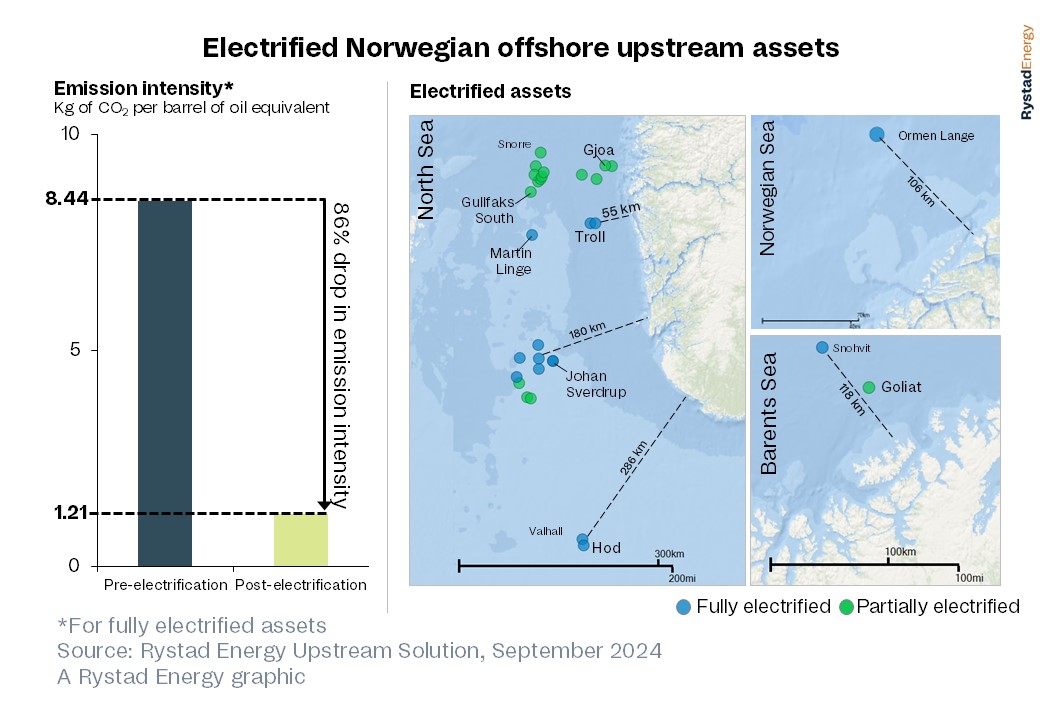
Converting upstream oil and gas production facilities to run on electricity powered by renewables or natural gas that would otherwise be flared could cut more than 80% of associated emissions, according to new research from Rystad Energy. Fully electrified rigs and other assets on the Norwegian Continental Shelf emit 1.2 kilograms of carbon dioxide per barrel of oil equivalent (kg of CO2 per boe) produced, an 86% drop from the 8.4 kg of CO2 per boe emitted by the same assets before electrification.

Norway is in a prime position that is almost unique among major oil and gas producers – it can tap into its abundant renewable energy resources, particularly hydroelectric power, to significantly reduce greenhouse gas emissions from upstream production. The country was an early mover in refitting its assets to run on clean power, and now has plans to cut emissions from the continental shelf by 70% by 2040. Most of the country’s key production sites are strategically located near potential renewable energy sources, facilitating the transition away from fossil fuels. Other producing countries may face logistical hurdles when converting assets, including significant distances from the mainland, a lack of power grid infrastructure and limited renewable power capacity.

However, even a partial electrification will significantly cut emissions. Premium energy basins (PEB) – a term coined by Rystad Energy to describe oil and gas basins with ample hydrocarbon reserves and the potential to incorporate environmentally friendly practices – could hold the key. We have identified 30 such basins worldwide, which collectively contribute more than 80% of the world’s oil and gas this year and will continue to do so until 2050. If PEB assets electrify and reduce emissions by 50%, a total of 5.5 gigatonnes of carbon dioxide (Gt of CO2) would be avoided by 2050. Based on the accepted industry standard calculation, this CO2 reduction would equate to about 0.025 degrees Celsius of global warming avoided during the same period.*

As the world confronts the pressing issue of climate change, the oil and gas industry is under increasing pressure to minimize its carbon footprint and align its practices with global sustainability objectives. Where it’s possible and economically viable, electrification has great potential to lower the industry's emissions while maintaining production output. says Palzor Shenga, vice president of upstream research with Rystad Energy.

Palzor Shenga, Vice President, Upstream Research

*This calculation only includes upstream extraction emissions. It assumes that 222 GtCO2 emitted leads to 0.1°C warming, ref IPCC AR6 SPM D.1.1: "best estimate for TCRE is 0.45 degree per 1000 Gt CO2". Methane emissions are disregarded.

Learn more with Rystad Energy’s Upstream Solution.

Electrification requires careful planning, including the selection of optimal technologies, assessment of total costs and strategies to ensure a continuous energy supply, particularly in remote locations with limited grid access. Economic and financial viability must also be prioritized. A proactive approach to electrification can enhance operational efficiency and open new revenue streams through the sale of excess renewable energy.

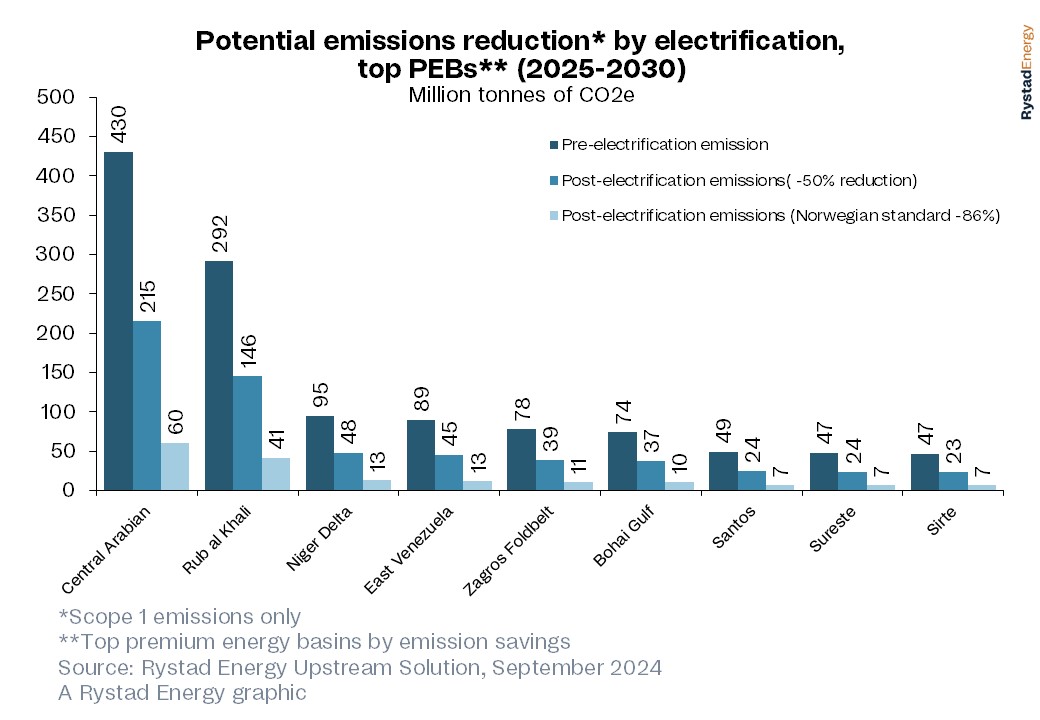
To understand the impact of electrification on upstream emissions, we examined the potential for emission reduction in top PEBs. The 28 PEBs identified in the report offer estimated total emission savings of about 1.3 billion tonnes of CO2 between 2025 and 2030. The top 10 PEBs (by emissions savings) alone account for over 80% of these savings (Figure 3), with the Middle Eastern Rub al Khali (370 million tonnes of carbon dioxide equivalent [CO2e]) and Central Arabian (251 million tonnes of CO2e) leading the charts. Electrification in these predominantly onshore basins, if adopted more widely, would largely be driven by drawing power from a clean onshore grid.

Flaring, the practice of burning off excess natural gas that cannot be processed or sold, not only wastes a valuable resource but also emits substantial amounts of CO2 and methane into the environment. Flaring plays a major role in global emissions primarily due to the lack of economic incentives, regulatory frameworks or technical capabilities to develop gas markets and infrastructure. About 140 billion cubic meters per annum of gas has been flared globally in the last 10 years, equaling about 290 million tonnes of CO2e emissions annually. These volumes are primarily driven by major producers in North America, the Middle East and Africa. Hence, flaring avoidance can be an effective way of reducing upstream emissions for both electrified assets and assets with limited electrification potential.

Renewable Energy's Rise Creates Challenges for Traditional Power Utilities

  • The increasing prevalence of renewable energy sources, particularly solar power, is disrupting the traditional power industry and creating challenges for utilities.

  • To remain competitive, energy companies must adopt holistic thinking, diversify their portfolios, and embrace customer-centric strategies.

  • The integration of data analytics, software, and smart systems will be crucial for optimizing market performance and navigating the evolving energy landscape.

Renewable energy generation in Europe has surged over 280% since 2000 and now accounts for more than 50% of the continent’s total power generation. Solar power has seen particularly strong growth in recent years due to significant cost declines. However, the rise of renewables has also led to challenges for the power industry, as the sector’s underlying profitability declines and an increasingly competitive energy landscape emerges. 

Apart from hydropower, the operational performance of most renewable power assets is determined by a combination of weather and consumption patterns, meaning they cannot be ‘market optimized’ to generate when prices are high in the way that gas power assets can, for instance. This especially hits solar power plants, as these typically generate power in the middle of the day when, although cooling systems run full throttle during summertime in Europe, demand is not sufficient of offtake generation, which leads to low realized prices. In addition, solar panels do not generate any power at night, when prices often are higher. An increasingly popular solution for asset owners is to pair intermittent renewables with power storage capabilities, such as batteries. However, these only offset the shortcoming in part. As a result, capture rates (the prices attained compared to average market prices over time) for solar power are plummeting along with increased deployment of the technology.  

While initially masked by the power price response in the wake of Russia’s invasion of Ukraine and Europe’s ensuing shift away from Russian gas, wholesale power prices across Europe are increasingly under pressure from hybrid renewable projects with close-to-zero marginal costs, which in turn is undercutting the revenue potential of the region’s power market. 

Meanwhile, governmental support for renewable energy is also changing. Renewable projects are underwritten through governmental support mechanisms such as contracts for difference (CfDs) and feed-in tariffs, which guarantee predictable revenue streams for renewable energy producers. However, as the cost of renewable energy technologies have decreased, these support schemes may gradually be scaled back. 

Compounding this is the evolving nature of the energy landscape which has intensified competition within the sector. Europe’s power sector was previously dominated by dedicated renewable developers and utilities, but is now seeing new entrants such as oil and gas companies, power traders and innovative power demand management players. Similarly, new types of demand is emerging such as data center players requiring consistent, high-volume, 24-hour power supply.  

The solution to the current challenges lies in diversification and innovation, driving balanced portfolio generation profiles and enabling market optimization. Beyond building and leveraging the full flexibility of a diversified portfolio of solar, wind, storage, and thermal generation, more customer-centric strategies are emerging. Octopus Energy is a British software and power trading company that works to balance power supply and demand through demand-side smart devices such as electric vehicle (EV) chargers, lighting systems, and heat pumps. Similarly, integrated oil and gas players such as TotalEnergies are using the knowledge attained in business-to-consumer markets through the gasoline and retail end of the business to enter the demand-side power market, mimicking their success in oil and gas.  

The integration and interconnection of systems across the entire power market value chain, along with the efficient processing of large datasets and the automation of energy dispatch, are becoming essential for modern energy companies. Software and smart systems will be key to this, emphasizing advanced technical capabilities and data analytics over the traditional supply-to-market business model that utilities have traditionally subscribed to. By embracing these changes, energy companies can better position themselves for success in a rapidly changing power industry. 

By Rystad Energy


Geothermal Energy Could Outperform Nuclear Power

GEOTHERMAL IS FRACKING


  • Enhanced geothermal systems, utilizing fracking technology, could unlock vast geothermal resources and make geothermal energy widely accessible.

  • Geothermal energy offers a reliable, base-load power source with zero carbon emissions, and has the potential to outperform nuclear energy.

  • With strong bipartisan support and public-private investment, geothermal energy is poised for rapid growth and could play a crucial role in meeting future energy demands and combating climate change.

Geothermal is about to have its moment in the sun. Heat from the Earth’s core could provide a clean, steady, and limitless source of renewable energy to humans. The trick is finding the right technology to harness that heat. 

Until very recently, geothermal energy for commercial use has only been feasible in places where that heat naturally reaches the surface of the Earth, such as geysers and hot springs. For example, Iceland gets a quarter of its energy from geothermal energy. But Iceland is a geological anomaly. Globally, geothermal energy accounts for just 0.5% of renewable energy. But now, the application of fracking technology borrowed from the oil and gas sector could totally revolutionize geothermal energy availability, and possibly even bring it to your own backyard.

Geothermal energy can be tapped anywhere and everywhere, if you have the will and the way to dig deep enough. And this could soon be possible at an economically viable scale through a method known as ‘enhanced geothermal systems’ which can tap into heat far, far below the ground. According to a 2023 report from Esquire, this technology, adapted from hydraulic fracturing used in the oil and gas industry, will “allow us to exploit the energy underfoot across the country, all with a carbon impact that is vanishingly small compared to most sources we depend on now.” These deep wells would pump out hot water, which can be used in turn to produce energy through various methods, before injecting that water back into the ground.

The potential for enhanced geothermal is massive – the Economist even projects that it could outperform nuclear energy output, while offering similar benefits. Like nuclear, geothermal operates with proven technologies, offers base-load, on-demand energy, and produces zero carbon emissions. The United States Department of Energy (DoE) has posited that geothermal energy could power up to 260 million homes nationwide by 2050. 

It also has major bipartisan appeal, a huge boon to any new technologies hoping to get sizable and continued funding from government entities and private interests alike. The DoE projects that as little as  $25 billion in public-private investment (less than the cost of the Vogtle nuclear power plant alone) by 2030 would allow the domestic geothermal sector to “reach liftoff” and set the industry up to reach a commercial scale by mid-century. Already, the federal government is funding research proving early-stage geothermal technology and setting the stage for the privatized acceleration of research and development. 

Just this month, representatives from major oil companies and tech startups, as well as scientists and climate groups, met in Houston to kick off a $10 million series of summits focused on harnessing experience and technology gleaned from oil and gas to “build a new stalwart of the American power sector.” A bustling geothermal startup scene has cropped up in Texas as the stars align for geothermal’s meteoric rise in the United States energy mix.

Despite the groundswell of support for enhanced geothermal technologies and a bullish attitude from the private and public sectors alike, the geothermal sector still has a long way to go to achieve its potential. “As things currently stand, the geothermal sector has struggled with the common problems of emerging industries: the difficulty of raising sufficient money for projects that, however promising, have yet to prove themselves,” The Hill recently reported. 

But if successful, commercial-scale geothermal energy's potential applications and impacts are nearly limitless. It would introduce a critical new source of dependable, zero-carbon power to the energy mix and provide a potential solution to some of our most pressing energy security issues. Already, pundits are positing that geothermal could feed the insatiable energy demands of Artificial Intelligence, as well as providing an avenue to cheaply produce green hydrogen, which could be essential in decarbonizing hard-to-abate sectors such as heavy-duty trucking, shipping, aviation, iron and steel, and chemicals and petrochemicals.

By Haley Zaremba for Oilprice.com 


TotalEnergies Starts Natural Gas Production From Argentinian Offshore Field

French supermajor TotalEnergies announced on Friday the start of natural gas production from the Fenix gas field offshore in southern Argentina.

The Fenix field has been developed to have a production capacity of 10 million cubic meters per day, or 70,000 barrels of oil equivalent per day, (boe/d). The field, 60 km (37 miles) off the coast of Tierra del Fuego in Southern Argentina, consists of a new unmanned platform and is connected to the existing facilities at the Cuenca Marina Austral 1 (CMA-1) concession, which TotalEnergies operates.

The natural gas produced at Fenix is sent through a subsea pipeline to the TotalEnergies-operated Véga Pléyade platform and is subsequently treated onshore at the Río Cullen and Cañadon Alfa facilities, which are also operated by the French company.

According to TotalEnergies, Fenix is a low-cost, low-emissions development, with a carbon intensity of 9 kg CO2e/boe, which uses existing infrastructure.“Fenix will contribute to maintaining our gas production plateau in Tierra del Fuego and ensure a reliable supply to the Argentinean gas market,” said Javier Rielo, Senior Vice President Americas, Exploration & Production at TotalEnergies.

“With its low break-even and low carbon intensity, Fenix perfectly matches the Company's low-cost and low-emission strategy,” Rielo added.

TotalEnergies has been operating in Argentina since 1978, and has interests offshore, onshore, and in the Neuquen province, home to the Vaca Muertra shale.

Argentina plans to raise oil and gas output and exports from Vaca Muerta in the coming years.

Supertankers could begin docking in Argentina to load oil from the country’s shale patch after a pipeline is set to connect Vaca Muerta with a terminal at Punta Colorada port capable of handling the so-called very large crude carriers (VLCCs).

Argentina is also moving a step closer to exporting LNG and monetizing its huge resource in Vaca Muerta after maritime LNG infrastructure firm Golar LNG signed a 20-year deal with Pan American Energy (PAE) for the deployment of a Floating Liquefied Natural Gas (FLNG) vessel in Argentina.

By Tsvetana Paraskova for Oilprice.com


TotalEnergies Set to Develop $9 Billion Suriname Oil Resources

French supermajor TotalEnergies has started to scour the market for deepwater rigs and support vessels to begin development of massive resources discovered offshore Suriname, anonymous sources with knowledge of the tenders told Bloomberg on Friday.

Exploration and resource development in the Atlantic Basin is now alive more than ever, following the huge developments offshore Guyana led by ExxonMobil and the plans of TotalEnergies to tap the discovered resources in Guyana’s neighbor, Suriname.

TotalEnergies, which partners with APA Corp offshore Suriname, has already made several discoveries in the area. The companies are expected to make as early as next month the final investment decision (FID) to develop part of the resources, according to Bloomberg’s sources.

TotalEnergies has reportedly ordered a hull for a 200,000-bpd production vessel, the clearest sign yet that the French supermajor would be moving to develop the project.

“They have reserved this hull,” Annand Jagesar, managing director of Suriname’s state oil company, Staatsolie, told Bloomberg.

“You’re not going to pay a lot of money for that to have it sitting around,” Jagesar added.

TotalEnergies and APA plan to make the final investment decision on the Block 58 project by the end of 2024, targeting first oil in 2028.

Crude oil discoveries in Suriname have opened access to some 2.4 billion barrels in reserves, Wood Mackenzie analysts have estimated. The consultancy also reported the South American nation holds some 12.5 trillion cubic feet in natural gas reserves.

A total of nine offshore discoveries have been made in Suriname in the last six years but commercial development of any of them is still in the future. 

Suriname is often seen as a candidate for a repeat of Guyana’s oil boom since the two neighboring countries share one hydrocarbon basin. However, exploration efforts have taken longer in Suriname and the colossal success of Exxon with the Stabroek Block and its dozen discoveries has yet to be replicated in Guyana’s neighbor.

By Charles Kennedy for Oilprice.com


 HEWERS OF WOOD, DRAWERS OF WATER

Canada’s Role in Global Energy Supply Critical for U.S., Says RBC Chief

RBC CEO Dave McKay believes Canada plays a critical role in the energy security of the United States, especially when it comes to supplying oil and gas to Asia. Speaking in Toronto, McKay highlighted that while the U.S. focuses on "Buy American," they rely on Canadian energy to meet global demands.

The United States needs Canada’s energy resources—particularly oil and LNG—to support Asia, which allows the U.S. to divert its energy supplies to Europe, according to McKay. Canada’s Trans Mountain pipeline expansion and upcoming LNG exports will be keyplayers in this dynamic.

Asia’s demand for cleaner energy, especially natural gas, is growing rapidly. The U.S. Energy Information Administration (EIA) projects a significant rise in Asian oil and gas demand through 2050, with Canada in a prime position to capitalize.

However, McKay warned that federal policies, such as the proposed oil and gas emissions cap, could limit Canada's production, undermining its ability to meet growing demand. He emphasized the need for Canada to continue leveraging its vast energy resources while pursuing a balanced approach to clean tech and emission reductions.

Canada must strike a balance between traditional energy exports and cleaner energy solutions, especially as the world faces increasing energy demands and climate challenges, McKay said.

The exponential growth of artificial intelligence is posing a challenge for energy that is expected to account for 3.5% of global electricity consumption by 2030. In the United States, data centers could reach 9% of electricity generation by the end of the decade—double their current levels. To meet this demand, more renewables and simply more energy production in general will be needed to avoid crippling energy shortages.

By Julianne Geiger for Oilprice.com