Sunday, September 22, 2024

UN adopts pact to tackle volatile future for mankind

By AFP
September 22, 2024

Secretary-General Antonio Guterres, who organized the 'Summit of the Future,' had billed it as a 'once-in-a-generation opportunity' to reshape human history - 
Copyright AFP ANGELA WEISS


Amélie BOTTOLLIER-DEPOIS and Issam AHMED

UN members adopted a blueprint for the future Sunday to tackle the myriad wars, environmental threats and technological challenges facing humanity that was hailed by the organization as “groundbreaking” but panned by critics as unambitious.

Secretary-General Antonio Guterres, who championed the “Pact for The Future” and its components, billed them as “landmark agreements — a step-change towards more effective, inclusive, networked multilateralism.”

As an opener for the annual high-level week of the UN General Assembly, which begins Tuesday, dozens of heads of state and government gathered for the adoption, which faced last-minute opposition from Russia and its allies.

Leaders pledged to bolster the multilateral system to “keep pace with a changing world” and to “protect the needs and interests of current and future generations” facing “persistent crisis.”

“We believe there is a path to a brighter future for all of humanity,” the document says.

The pact outlines 56 “actions,” including commitments to multilateralism, upholding the UN Charter and peacekeeping.

– Russian objections –


It also calls for reforms to international financial institutions and the UN Security Council, along with renewed efforts to combat climate change, promote disarmament, and guide the development of artificial intelligence.

The adoption of the text faced a brief delay when Russia’s deputy minister of foreign affairs, Sergey Vershinin, introduced an amendment emphasizing the “principle of non-interference in the internal affairs of states” and urging the UN to avoid duplicating efforts.

Russia’s objections were backed by allies Belarus, North Korea, Iran, Nicaragua and Syria, but its amendment was overwhelmingly dismissed in a motion to take no action.

“It was somewhat irritating that, in the end, Russia once again tried to stop the whole process and did not want to go down the path that the whole world had taken,” said German Chancellor Olaf Scholz, co-sponsor of the text, after the adoption.

– ‘I challenge you’ –


Passage of the text was never a guarantee, and sources said Guterres had prepared three separate versions of his speech for the potential outcomes of the vote.

During the negotiations phase, the UN Secretary-General had urged nations to show “vision” and “courage,” calling for “maximum ambition” to strengthen international institutions that struggle to respond effectively to today’s threats.

But while there are some “good ideas,” the text “is not the sort of revolutionary document reforming the whole of multilateralism that Antonio Guterres had originally called for,” Richard Gowan of the International Crisis Group told AFP.

“Ideally, you would hope for new ideas,” said one diplomat.

The fight against global warming was one of the sticking points in the negotiations, with references to the “transition” away from fossil fuels having disappeared from the draft text weeks ago, before being re-inserted.

“The real test will be the delivery of these” goals, said environmental campaign group 350.org.

Despite criticism of the pact, it is still “an opportunity to affirm our collective commitment to multilateralism, even in the difficult current geopolitical context,” one diplomat said, emphasizing the need to rebuild trust between the Global North and South.

“This pact gives us hope and inspiration for a better future,” said Sierra Leone’s President Julius Maada Bio, who has been a keen advocate for the Global South at the UN through his country’s membership of the Security Council.

Developing countries have been particularly vocal in demanding concrete commitments on the reform of international financial institutions, aiming to secure easier access to preferential financing, especially considering the impacts of climate change.

The text does indeed include “important commitments on economic justice and reforming the international financial architecture,” Human Rights Watch (HRW) commented, while also praising “the centrality of human rights.”

Regardless of its content, the pact and its annexes — a Global Digital Compact and a Declaration on Future Generations — are non-binding, raising concerns about implementation, especially as some principles such as the protection of civilians in conflict are violated daily.

“Now it is our common responsibility to walk through it. That demands not just agreement, but action. I challenge you to take that action,” Guterres said following the adoption.

UN nations endorse a 'Pact of the Future,' and the body's leader says it must be more than talk

The U.N. General Assembly has approved a blueprint to bring the world’s increasingly divided nations together to tackle 21st-century challenges


ByEDITH M. LEDERER
 Associated Press
September 22, 2024,


UNITED NATIONS -- The U.N. General Assembly approved a blueprint Sunday to bring the world’s increasingly divided nations together to tackle 21st-century challenges from climate change and artificial intelligence to escalating conflicts and increasing inequality and poverty.

The 42-page “Pact of the Future” challenges leaders of the 193 U.N. member nations to turn promises into real actions that make a difference to the lives of the world’s more than 8 billion people.

The pact was adopted at the opening of the two-day “Summit of the Future” called by U.N. Secretary-General Antonio Guterres, who thanked leaders and diplomats for taking the first steps and unlocking “the door” to a better future.

“We are here to bring multilateralism back from the brink,” he said. “Now it is our common destiny to walk through it. That demands not just agreement, but action.”

The U.N. chief challenged the leaders: Implement the pact. Prioritize dialogue and negotiations. End “wars tearing our world apart” from the Middle East to Ukraine and Sudan. Reform the powerful U.N. Security Council. Accelerate reforms of the international financial system. Ramp up a transition from fossil fuels. Listen to young people and include them in decision-making.

The pact’s fate was in question until the last moment. There was so much suspense that Guterres had three prepared speeches, one for approval, one for rejection, and one if things weren’t clear, U.N. spokesman Stephane Dujarric said.

“No one is happy with this pact," said Russia's deputy foreign minister, Sergey Vershinin.,

The summit opened with him proposing amendments that would have significantly watered down the pact. Speaking on behalf of Africa’s 54 nations — which opposed Russia’s amendments — the Republic of Congo countered with a motion not to vote on the amendments. That motion was approved to applause. Russia only got support from Iran, Belarus, North Korea, Nicaragua, Sudan and Syria.

Assembly President Philémon Yang then put the pact to a vote and banged his gavel, signifying the consensus of all 193 U.N. member nations that was required for approval.

Russia has made significant inroads in Africa -- in countries like Mali, Burkina Faso, Niger and Central African Republic -- and the continent’s rejection of its amendments along with Mexico, a major Latin American power, was seen as a blow to Moscow by some diplomats and observers.


Yang announced ahead of speeches by world leaders that they would be muted after five minutes — a rare occurrence at the United Nations, where words are the backbone. Among those who kept talking after their mics were silenced: Brazilian President Luiz Inacio Lula da Silva, Kuwait's Crown Prince Sheikh Sabah Khalid Al Sabah and Irish President Michael Higgins.

The Pact of the Future says world leaders are gathering “at a time of profound global transformation,” and it warns of “rising catastrophic and existential risks” that could tip people everywhere “into a future of persistent crisis and breakdown.”

Yet, it says, leaders are coming to the U.N. at a time of hope and opportunity “to protect the needs and interests of present and future generations through actions in the Pact for the Future.”

The pact includes 56 actions on issues including eradicating poverty, mitigating climate change, achieving gender equality, promoting peace and protecting civilians, and reinvigorating the multilateral system to “seize the opportunities of today and tomorrow.”

Secretary-General Guterres singled out a number of key provisions in the Pact of the Future and two accompanying annexes, a Global Digital Compact and Declaration on Future Generations.

The pact commits world leaders to reform the 15-member Security Council, to make it more reflective of today’s world and “redress the historical injustice against Africa,” which has no permanent seat, and to address the under-representation of the Asia-Pacific region and Latin America.

It also “represents the first agreed multilateral support for nuclear disarmament in more than a decade,” Guterres said, and it commits “to steps to prevent an arms race in outer space and to govern the use of lethal autonomous weapons.”

The Global Digital Compact “includes the first truly universal agreement on the international governance of artificial intelligence,” the U.N. chief said.

The compact commits leaders to establish an Independent International Scientific Panel in the United Nations to promote scientific understanding of AI, and its risks and opportunities. It also commits the U.N. to initiate a global dialogue on AI governance with all key players.

The pact’s actions also include measures “to mount an immediate and coordinated response to complex shocks” including pandemics, Guterres said. And it includes “a groundbreaking commitment by governments to listen to young people and include them in decision-making.”

As for human rights, Guterres said, “In the face of a surge in misogyny and a rollback of women’s reproductive rights, governments have explicitly committed to removing the legal, social and economic barriers that prevent women and girls from fulfilling their potential in every sphere.”

___

This story corrects in the 11th paragrpah the speaker from Kuwait from the Emir to the Crown Prince.


Tunisians resume protests against president ahead of Oct. 6 election

Tunisians are accusing the country's president of stifling political competition only 

The New Arab Staff & Agencies
22 September, 2024

Protesters, for a second week, marched along Tunis' main avenue against Saied [Getty]

Hundreds of Tunisians protested on Sunday against President Kais Saied, accusing him of deepening authoritarian rule and stifling political competition two weeks before a presidential election.

Amid a heavy police presence, protesters for a second week marched along Tunis' main avenue, a focal point of 2011 "Arab Spring" revolution, chanting slogans including "The people want the fall of the regime" and "Out with dictator Saied".

The protest came after lawmakers proposed a bill to strip the administrative court of its authority to adjudicate electoral disputes, a move that the opposition says would discredit the October 6 election, and pave the way for Saied to secure a second term.

"Saied's steps show that he is no longer popular and he fears losing the election", Nabil Hajji, the leader of the opposition Attayar party, told Reuters.

"Tunisians now have only one choice, which is the streets to defend our democracy," he said.

Political tensions in the North African country have risen since an electoral commission named by Saied disqualified three prominent presidential candidates, Mondher Znaidi, Abdellatif Mekki and Imed Daimi.

The commission defied the administrative court, the highest judicial body in election-related disputes, and allowed only two candidates to run against Saied.

One of them, Ayachi Zammel, is in jail after being sentenced on Wednesday to 20 months in prison for falsifying signatures on election paperwork in what he calls a politically motivated case.

Critics say Saied is using the electoral commission and judiciary to secure victory by stifling competition and intimidating candidates. The president denies the accusations, saying he is fighting traitors, mercenaries and the corrupt.

Saied, who was democratically elected in 2019, has tightened his grip on power and began ruling by decree in 2021 in a move the opposition has described as a coup.

 THE LAST COLONY   VIVE INDPENDENCE

Martinique’s authorities ban demonstrations after violent protests

September 21, 2024 -

PARIS (Reuters) – Authorities in Martinique are banning demonstrations in four municipalities after violent protests over rising living costs led to the imposition of a curfew earlier this week, according to a statement issued on Saturday.

Martinique’s prefect, the local representative of France’s central government in the overseas territory, said in the statement that all protests were forbidden until Monday in the municipalities of Fort-de-France, Le Lamentin, Ducos and Le Robert.

“The aim of this measure is to put an end to the violence and damage committed at gatherings, as well as the many obstacles to daily life and freedom of movement that affect the entire population, particularly at weekends,” the prefect said.

The prefect had earlier imposed a nighttime curfew to limit movement in certain districts of Fort-de-France and Lamentin, also expiring on Monday.

Protests are also taking place on the neighbouring island of Guadeloupe, where a strike by workers at French energy utility EDF caused power outages for the population during the week, according to previous statements by the local prefect.

The protests in France’s overseas territories, including the killing of two men during an overnight operation by police in New Caledonia, are a test for new Prime Minister Michel Barnier, who is due to present his cabinet to President Emmanuel Macron after two weeks of political bargaining.

Martinique bans protests in 4 communes amid unrest

Demonstrations have been rising since the beginning of September due to the surging cost of living.

By Al Mayadeen English
Source: Agencies

Authorities in France's Martinique have banned protests in the port city of Fort-de-France and three other communes until Monday amid unrest, triggered by the rising cost of living.

"The prefect of Martinique today issued an order prohibiting protests and gatherings on public roads and private roads open to public traffic in the municipalities of Fort-de-France, Le Lamentin, Ducos and Le Robert," the issued decree stated Friday.

A nighttime curfew was imposed in part of Fort-de-France starting Thursday after days of demonstrations against the surging food prices. The port is the entry point for the majority of imports to the French territory.

Violent protests erupt in Martinique amid rising living costs

Reports indicate that at least 14 people, including 11 police officers, have been injured since the beginning of September, some from gunfire, as alarming scenes of burning vehicles and destroyed buildings, with heavily armed riot police moving in, went viral on social media.

The office of the France-appointed prefect, Jean-Christophe Bouvier, announced that the 9 pm to 5 am curfew, lasting until September 23, aims to safeguard the public and businesses and restore order.

Protesters assert they have been compelled to demonstrate due to a lack of response from authorities and businesses regarding their petitions for reduced living costs. French national statistics reveal significant disparities in living expenses, with residents of Martinique facing food prices estimated to be 30% to 42% higher than those in mainland France.

Long-forbidden French anti-riot force sent to Martinique as thousands defy bans on protests


By The Associated Press
Updated September 22, 2024 

MEXICO CITY — France has sent a group of special anti-riot police that's been banned for 65 years to the French Caribbean island of Martinique, where protesters have gathered despite the government barring demonstrations in parts of the island.

The force arrived this weekend after the local representative of France’s central government in its overseas territory said in a statement that protests were forbidden in the municipalities of Fort-de-France, Le Lamentin, Ducos and Le Robert until Monday. The government also issued a curfew.

The restrictions came after violent protests broke out on the island last week over the high cost of living, with gunfire injuring at least six police officers and one civilian. Police launched tear gas and government officials said several stores were also looted.

Officials said the bans were meant "to put an end to the violence and damage committed at gatherings, as well as to the numerous obstacles to daily life and freedom of movement that penalize the entire population, particularly at weekends.”

But the measure was met by defiance by many on the island, with massive peaceful protests breaking out Saturday night. Videos from local media show crowds of thousands peacefully walking along highways overnight banging on drums and waiving flags.

As protests wound on without violence, the force of French anti-riot police arrived on the island, and were staying at a hotel in Fort-de-France on Sunday. It wasn't immediately clear how many were sent.

The elite riot police, known as the Companies for Republican Security, were banned in the French territory following bloody riots in December 1959. The unit had been accused of using disproportionate force against protesters, ending in the deaths of a number of young demonstrators. The force is rarely deployed in French territories in the Caribbean, but was called on during riots and strikes in Guadeloupe in 2009.

Martinique's leaders requested the forces amid the recent protests in an historic shift for the island, and one met with a sharp rejection by some in the territory.

Béatrice Bellay, a representative of the socialist party on the island, blasted the move, saying: “Martinique is not in a civil war, it is a social war." She called for an “open and transparent dialogue” between protesters and the government.

“This measure ... only serves to aggravate tensions and distract attention from the legitimate demands of the people of Martinique,” she wrote in a statement Sunday.


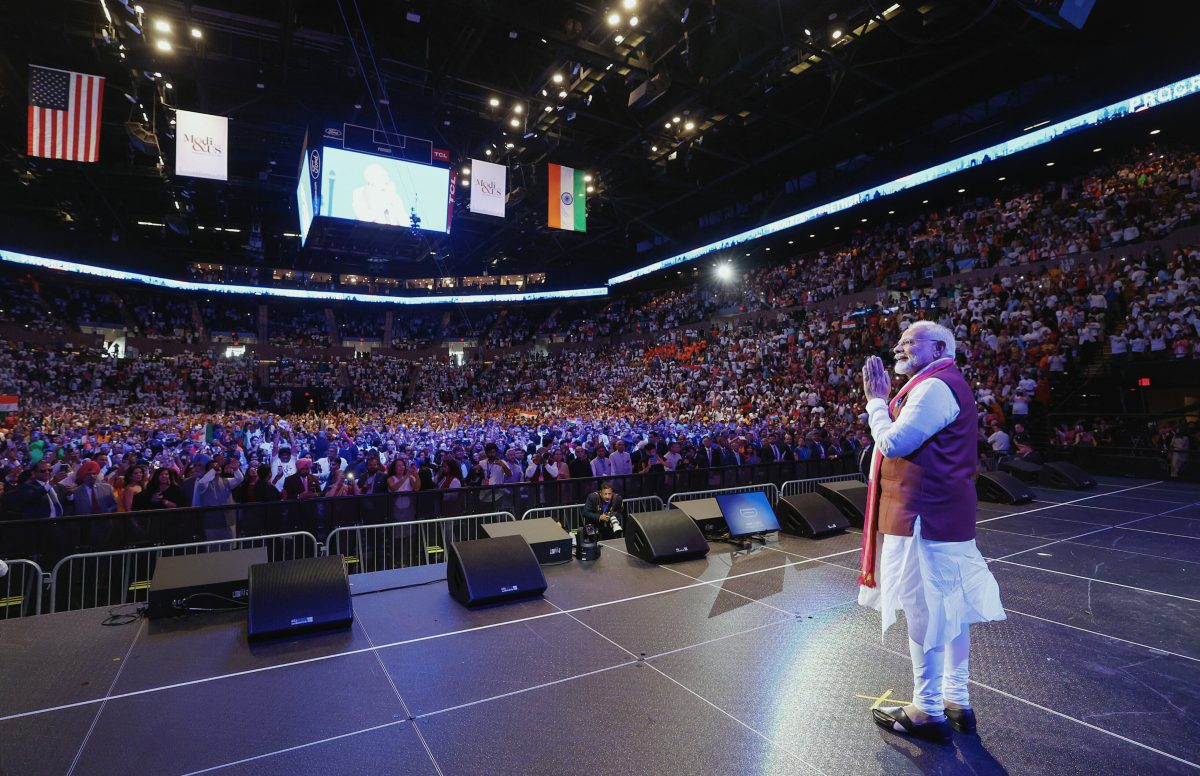
PM Modi arrives at Nassau Coliseum to address Indian diaspora in historic event

Prime Minister Narendra Modi has arrived at the Nassau Coliseum in Long Island, New York, where he will address 15,000 members of the Indian diaspora gathered from 42 states in a highly anticipated event. The “Modi and US” program has drawn immense excitement, with the venue resembling a grand Diwali celebration.

Jagdish Sewhani, a member of the event’s organizing committee, highlighted the significance of the moment, saying, “It is a historical event at Nassau Coliseum. This is the first time ever that an Indian Prime Minister has come to Long Island in 75 years. The mayor of Nassau County is eager to welcome PM Modi, whom he described as one of the most popular leaders in the world.”

Over 500 artists are set to perform as part of the cultural celebrations preceding PM Modi’s speech. Traditional performances include ‘Yakshagana,’ a folk dance from Karnataka and Kerala, and ‘Parai,’ a traditional musical instrument from Tamil Nadu.

Outside the venue, a group showcased ‘Mallakhamb,’ an acrobatic sport originating in Maharashtra. Jaydev Anata of the Mallakhamb Federation US expressed hopes of promoting the sport globally, with aspirations of getting it into the Olympics.

Earlier, PM Modi took to social media, posting pictures of his interactions with the Indian diaspora and expressing his eagerness to participate in the community program. The prime minister’s visit to New York also includes chairing key bilateral meetings, participating in a CEO Roundtable, and addressing the Summit of the Future on September 23.

(Inputs from ANI)


Modi’s Global Agenda: India’s Rise In US Politics – OpEd

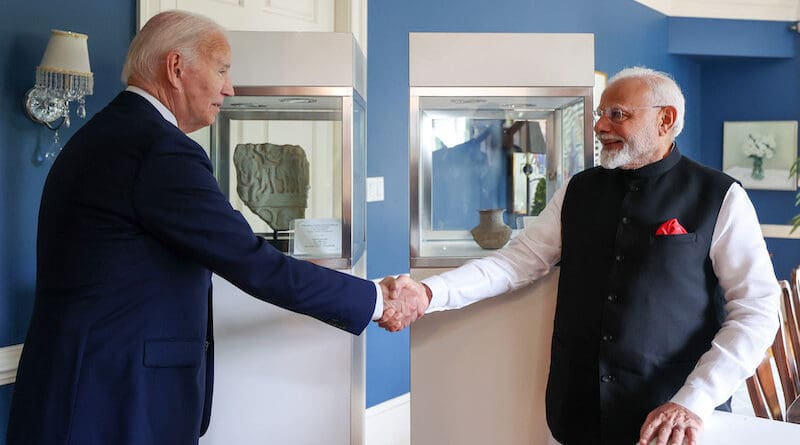
US President Joe Biden with India's Prime Minister Narendra Modi. Photo Credit: PM India Office


By 

The Rise of Hindu Nationalism in the West Hindutva, the Hindu nationalist ideology closely associated with Indian Prime Minister Narendra Modi, is no longer confined to India’s borders.


Through the Indian diaspora, particularly in the United States, Hindutva is influencing political decisions and shaping Western policies to align with India’s strategic interests. The Indian-American community, dominated by upper-caste Hindus, has become a powerful political and economic force in the U.S., with significant influence in sectors such as technology and politics. This influence is now being used to promote Modi’s nationalist agenda on a global scale, often at the expense of addressing human rights abuses and caste discrimination.

Both the Democratic and Republican parties have recognized the growing importance of the Hindu-American voting bloc, particularly in swing states. This has led to a concerted effort to court Indian-American donors, many of whom are aligned with Modi’s Hindutva ideology. The political influence of the Indian diaspora has reached a point where it can affect key decisions, such as Governor Newsom’s recent veto of a bill aimed at banning caste-based discrimination. The bill, which was intended to address the issue of caste discrimination within Indian-American communities, faced strong opposition from upper-caste Hindus who used their political and economic power to pressure the governor.

This incident highlights the broader trend of political manipulation within the Indian-American community, where influential figures use their power to suppress criticism of caste-based discrimination and human rights abuses in India. By aligning with Hindutva, the diaspora is not only promoting Modi’s nationalist agenda but also protecting discriminatory practices from scrutiny, both in India and abroad.

A Hidden Issue Despite the progressive values espoused by Western societies, caste-based discrimination remains a hidden issue within Indian-American communities. In Silicon Valley, where many Indian-Americans hold leadership positions, reports of caste-based discrimination have surfaced, particularly against Dalit workers. These reports reflect how India’s social hierarchy is being replicated in the U.S., undermining the principles of equality and justice that are central to American society.

While caste-based discrimination is illegal in India, it remains deeply ingrained in the country’s social fabric, and the diaspora has carried these practices with them to the West. The refusal to confront caste-based inequality, particularly within the tech industry, perpetuates a system of oppression that marginalizes lower-caste individuals and allows upper-caste Hindus to maintain their privileged status. This mirrors the situation in India, where efforts to address caste-based discrimination are often met with resistance from powerful upper-caste groups.


Hindutva’s influence on U.S. politics goes beyond caste-based discrimination. Supporters of Modi’s government within the Indian diaspora have actively lobbied Western governments to ignore India’s human rights abuses, particularly in Kashmir. The Indian-American community has successfully positioned itself as a key player in shaping U.S. foreign policy, ensuring that India’s strategic interests are prioritized over concerns about its treatment of Muslims and lower-caste Hindus.

This influence has become especially evident in discussions surrounding Kashmir, where India’s oppressive policies have drawn widespread condemnation from human rights organizations. Despite this, the Indian diaspora has lobbied U.S. policymakers to turn a blind eye to the situation, framing India’s actions as necessary for national security. This mirrors the role of the Jewish lobby in shaping U.S. policies toward Israel, with the Indian diaspora similarly positioning itself to control U.S. politics in India’s favor.

The global reach of Hindutva is not just about political influence; it is also about solidifying Modi’s power on the world stage. By promoting Hindutva both in India and abroad, the Indian diaspora is helping to strengthen Modi’s position as a global leader. This is particularly evident in the tech industry, where Indian elites are using their economic power to shape foreign policy discussions and advance India’s geopolitical goals.

The Indian diaspora’s penetration into key sectors like technology and politics is part of a larger strategy to influence Western policies in India’s favor. This includes ensuring that discussions on human rights abuses, caste discrimination, and the marginalization of Muslims and Dalits in India are sidelined in favor of promoting a positive image of the country. By controlling the narrative, the Indian diaspora is helping to project a false image of India as a progressive, inclusive democracy, while hiding the reality of oppression under Modi’s rule.

Hindutva’s Impact on Global Politics The global reach of Hindutva, supported by the Indian diaspora, is reshaping Western policies in ways that prioritize India’s interests over human rights and equality. Caste discrimination, anti-Muslim policies, and human rights abuses in India are being overlooked in the name of geopolitical alliances. The Indian-American community’s growing influence in U.S. politics serves as a warning of how nationalist ideologies can infiltrate even the most progressive societies, threatening the values of equality and justice that are central to Western democracy.


Mohan Malawya

Mohan Malawya is currently pursuing a degree in Social Sciences from Jawaharlal Nehru University (JNU), and writes on India's domestic politics, foreign policy and India-Pakistan relations.


India’s ‘Namaste’ has become multinational: PM Modi tells diaspora in New York

In a landmark address to the Indian diaspora at Nassau Coliseum in Long Island, Prime Minister Narendra Modi highlighted the growing global significance of India’s traditional greeting, ‘Namaste’, saying that what was once a local expression has now become a multinational symbol of unity.

“‘Namaste’ has gone multinational; it has transitioned from local to global,” PM Modi said, expressing gratitude to the diaspora for their unwavering support. “Your love is my good fortune,” he added.

During his speech, PM Modi emphasized the significant contributions of the Indian community around the world. “Many languages, but one common feeling—that feeling is for Bharat Mata and Bhartiyta. This is India’s biggest strength,” he said, highlighting the unity of Indians regardless of their geographical location.

“We look to do good; we contribute the most no matter where we are,” he added, reinforcing the idea of global citizenship among Indians.

The Prime Minister’s visit to the US from September 21-23 has drawn a large crowd, with approximately 15,000 members of the Indian diaspora gathering from 42 states to welcome him. As he entered the Nassau Coliseum, PM Modi greeted the audience with the chant, “Bharat Mata ki Jai,” receiving a standing ovation.

The atmosphere was vibrant, with talented artists from the Indian community performing traditional music to set the tone for Modi’s address.

Earlier, in a post on X, PM Modi shared his excitement about engaging with the diaspora, saying, “After programmes in Delaware, landed in New York. Eager to be among the diaspora at the community programme in the city and to take part in other programmes.”

Following this historic event, PM Modi is scheduled to chair key bilateral meetings and attend a CEO Roundtable in New York. He will also address the Summit of the Future on September 23.

(With ANI inputs)


AMERIKA

Evidence tells us voters might be convinced to accept short-term pain for long-term gain—but it will be a hard sell


voters
Credit: Unsplash/CC0 Public Domain

In the build-up to his government's first budget, Prime Minister Keir Starmer has been setting expectations low. It will be "painful," he has warned, and a "difficult trade-off" will have to be made because of the economic inheritance left by the last government.

The UK will have to "accept short-term pain for long-term good." In practice, this means cutting back on state support, holding off on  and potentially raising taxes (albeit, Starmer promises us, not income tax, VAT, or national insurance) in order to "fix the foundations" of the nation.

It is somewhat uncommon to hear politicians talk this way. That's because, as recent research has shown, those politicians often believe voters care much more about the near  than the far future. Asking people to sacrifice their short-term interests in pursuit of some long-term goal is, apparently, not much of a vote winner.

That assumption can have significant consequences. Researchers have demonstrated, for example, that governments under-invest in natural disaster preparedness because voters do not seem to reward such prospective spending at the ballot box. The impact of future catastrophes such as earthquakes, hurricanes, and floods is worsened as a result. The same is true, as we now know only too well, for pandemics.

My latest research confirms that voters do prefer policies that reap benefits in the immediate future rather than waiting for a promised bright future. However, we should not see this preference for near-term outcomes as an all-consuming, selfish short-termism.

I found that voters in the UK are significantly more likely to endorse a policy measure that is expected to reap rewards sooner rather than later.

Presented with choices between hypothetical policy proposals that also vary in their total cost, total expected benefit, and policy area, people are consistently more likely to opt for policies that are expected to pay off in the relatively near term.

This project builds on similar studies conducted in Japan, the US, and Finland. The results are consistent: when we present people with hypothetical choices between different policies, they are much more likely to opt for those expected to benefit society soon.

These findings suggest that asking voters to endure "short-term pain for long-term gain" is likely to be a hard sell. All else being equal, voters clearly prefer  to produce good outcomes sooner rather than later.

It's not me, it's you

What is striking, however, is that this preference for near-term results does not seem to be driven by selfish motives. My findings demonstrate that people don't especially care whether a policy will benefit society within their own lifetime rather than after they've departed this world.

It appears that aversion to long-term promises is more likely to do with uncertainty about whether future benefits will ever materialize as promised. This is a valuable insight for anyone hoping to convince voters to tolerate difficulty now in the hope of a better future.

Political scientists observe that long-term policy interventions have "extended and intricate causal chains." The path to the final reward is long and complex, and relies on politicians not only keeping their own promises but often even keeping the promises made by others. This uncertain path makes voters less likely to accept short-term pain.

So in Starmer's case, voters would need to feel sure that his long-term plans for public ownership and a fairer economic settlement are really going to happen if they are to stick with him at the next election.

The bigger the better

Finally, my study found that how far into the future a policy is expected to pay off matters a lot less to UK voters than how big that payoff will be. The sooner the better, but much more so, the bigger the better.

As my study randomly varies both the size of the expected benefits of the hypothetical policy proposals and the timing of those benefits, the effects of these factors are directly comparable. What's more, I can also assess how these factors interact: do people prefer policies with small effects in the short term, or with big effects in the long term?

My results show that Britons are even willing to forgo relatively small short-term policy benefits in favor of much larger long-term benefits.

Another important question for UK voters, then, is whether the long-run benefits are worth the short-run cost. Are the prime minister's promises of "an NHS fit for the future," "streets that everyone feels safe in," and "hard work rewarded a dozen times over" great enough to sacrifice some prosperity in the immediate future?

If the government can convince the public that the forthcoming "difficult" and "painful" budget will certainly reap rewards—and that those rewards are significant, then voters can be brought on board. From this perspective, the government is wise to be taking this action so soon after taking office, giving itself time to produce the good outcomes it is promising before voters get to formally pass their verdict in four or five years' time at the next election.

Provided by The Conversation 

This article is republished from The Conversation under a Creative Commons license. Read the original article.The Conversation

GERMANY

'It looks like the Social Democratic party has actually won in Brandenburg'


Issued on: 22/09/2024 -

'It looks like the Social Democratic party has actually won in Brandenburg", said FRANCE 24's correspondent in Germany, Nick Holdsworth. "Exit polls have come out showing either 32 or 31% for the SPD (that's the Socialists) and either 29% or 30% for AFD (the far-right party) which has been labeled "extremist" by some of the states in Germany," said Holdsworth.


Another warning from Germany: AfD fascists almost win Brandenburg election

It comes after the AfD won 33 percent in the Thuringia and about 31 percent in Saxony at the beginning of this month

By Yuri Prasad
Sunday 22 September 2024
SOCIALIST WORKER  Issue


A protest against the AfD in front of the Brandenburg Gate in Berlin in January (Picture: Wikimedia/Creative Commons)

The far right Alternative for Germany (AfD) party almost won another state election on Sunday.

It lost the Brandenburg election in east Germany by the narrowest of margins. The party polled 29.2 percent to the Labour-type SPD’s 31.8 percent in an election where 2.5 million people were eligible to vote and turnout was high.

The AfD was desperate to win the state which surrounds the capital Berlin—and its vote rose by 6.4 percentage points.

The SPD has controlled Brandenburg since German reunification in 1990. SPD chancellor Olaf Scholz lives in the state, as does his Green Party foreign minister Annalena Baerbock. If the SPD had lost, as many predicted it would, it would have created a crisis in the ruling coalition.

The fascists hoped to add the state to Thuringia, which they captured in regional elections at the beginning of this month. The AfD also narrowly failed to win in Saxony at the same time.

The mainstream will doubtless draw a huge sigh of relief—but this is no time for its backslapping.

The AfD is a vicious, racist party that demands that the state deports “criminal” migrants and those descended from them.

That means it wants even those “migrants” who are German citizens shipped out of the country if they are convicted of a crime.

The party is capitalising on the economic crisis and the racist crisis around immigration that all mainstream parties are fuelling.

At the core of the AfD lie organised Nazis that want to recreate the politics of Adolf Hitler’s Third Reich.

AfD senior figures met with open Nazis and members of the far right Identitarian movement last year. They discussed removing people “with a foreign background”. Immediately afterwards hundreds of thousands of anti-fascists joined demonstrations.

But the Nazis find that mainstream parties are quick to embrace their racist policies.

Hans-Christoph Berndt was the party’s lead candidate in Brandenburg. At a far right demonstration in 2016, he said, “What woman can still move freely when a group of dark-haired, young men appears or could appear in the distance?”

Back then “official politicians” expressed their outrage at Berndt’s racism. But today they echo many of his “concerns” about immigration. Conservative CDU head Friedrich Merz—leader of the country’s main opposition party—has called for a freeze on the admission of refugees from Syria and Afghanistan.

In this election, the SPD managed to use the threat of the Nazis to corral its vote, which rose 5 percentage points on the last election.

But its Green party partners only narrowly scraped into the state parliament with just 5 percent of the vote, down by 2.6 percentage points.

Die Linke, the left party, saw its vote drop from 7.6 percent to just 3.1 percent.


‘We must not normalise the AfD’—interview with German anti-fascist

But the Sahra Wagenknecht Alliance (BSW), which combines left wing economic policies with right wing and racist dogma, took 12 percent.

Wagenknecht is a former leader of the Die Linke party, who broke from it last year. She said it had abandoned its traditional voters and instead focused on supporting the identity politics of “bizarre minorities”.

She says that voters’ worries about immigration are “legitimate”, and her party will champion them.

BSW policies include raising the minimum wage and pensions—but also stopping net zero climate protection measures and toughening asylum laws.

Wagenknecht also tapped into growing weariness at Germany’s leading role in the West’s proxy war with Russia in Ukraine. She wants to end the flow of German arms to the conflict. The contradictory politics of the BSW can only benefit the Nazis.

Echoing and reinforcing myths about migrants is the AfD’s main selling point. The more parties line up to agree with its policies, the further the debate shifts to the right.

Germany has in recent months seen major eruptions of anti-racism, with big demonstrations in most towns and cities.

It is vital that this movement now rises to the growing challenge of both the racist far right—and the mainstream parties so eager to adopt its policies.
Death toll from explosion at Iran coal mine rises over 50

According to a report leak of methane gas led to the blast in two blocks of the Tabas mine in eastern Iran, which is owned by private Iranian firm Madanjoo.


Iran's new President Pezeshkian said an investigation into the incident has begun. 
/ Photo: AP


A blast caused by a gas leak at an Iranian coal mine has killed at least 51 people, state media said, in one of the country's deadliest work accidents in years.

"The number of dead workers increased to 51 in the explosion at the Tabas mine in eastern Iran, the official IRNA news agency reported on Sunday, revising an earlier death toll of 30.

It added that 20 other people were injured.

Earlier on Sunday, state media reported at least 30 people were dead and 17 others injured. Another 24 miners were believed to be trapped inside at the time.

The explosion occurred at around 9:00 pm (1730 GMT) on Saturday, when around 70 workers were present at the site in South Khorasan province, IRNA said.

According to the report, a leak of methane gas led to the blast in two blocks of the mine, which is owned by private Iranian firm Madanjoo.

State TV broadcast footage of ambulances and helicopters arriving at Tabas to transport the injured to hospital.

Online footage carried by IRNA showed bodies of some of the victims, wearing their work uniform, carried out of the site on mining carts.


Investigation underway


Iran's new President Masoud Pezeshkian, preparing to travel to New York for the United Nations General Assembly, said he ordered all efforts be made to rescue those trapped and aid their families.

Pezeshkian also said an investigation into the incident had begun.

South Khorasan governor Javad Ghenaat told state TV that rescue teams were working to recover the remaining bodies.

An apparent "gas condensation" in the mine is believed to be the cause of the explosion, said Iranian Interior Minister Eskandar Momeni, who was headed to Tabas.

In addition, authorities have announced three days of public mourning in the eastern province, according to local media.

CLIMATE CRISIS
Flooding in Japan: 'Rain is the heaviest we have ever experienced'


At least one person is dead and six others are missing in Japan as parts of that country deal with the record rainfall and the resulting catastrophic flooding, officials warned on Saturday. Photo by Jiji Press Agency/EPA-EFE

Sept. 21 (UPI) -- At least one person is dead and six others are missing in Japan as parts of that country deal with record rainfall and the resulting catastrophic flooding, officials warned on Saturday.

"The rain is the heaviest we have ever experienced," the Japan Meteorological Agency said in its latest update, issued Saturday.

The agency issued its highest-possible alert for areas on the Ishikawa Prefecture on the Japanese island of Honshu, where flooding has caused cliffs to give way and rivers to overflow.

At one point Saturday morning, forecasters recorded more than 4.7 inches of rain per hour in the city of Wajima. One person was declared dead after their house was overrun by a landslide, while at least two others were buried by mud and declared missing.

Officials also lost contact with four workers in an underground tunnel in Wajima, where 13.8 inches fell over a 24-hour period, representing the heaviest rainfall there since 1976.

"In particular, in areas where flooding is expected, it is highly likely that some kind of disaster has already occurred, and this corresponds to alert level 5," the JPA said in its update. "The danger to life is imminent, so you must immediately ensure your safety. In addition, strict vigilance is required in landslide warning areas."

The agency advised that If evacuating to a designated evacuation site is dangerous, people should shelter in buildings as far away from cliffs or streams as possible, or to a high place that is less likely to be flooded.

"In addition, even in places where disasters are not usually thought to occur, maximum vigilance is required," it cautioned.

Ishikawa Prefecture is still recovering from a massive 7.6 magnitude New Year's Day earthquake that left several people dead and hundreds more homeless. The tunnel workers in Wajima were attempting to repair damage inflicted during the earthquake.

The Japan Ministry of Defense is deploying soldiers to the area to assist.

The area has yet to fully recover, making risks from Saturday's flooding more acute.

"In the future, there is a possibility that more municipalities will issue heavy rain special warnings. It will be too late to evacuate after the special warning is issued," the JPA said in its update.

"In order to protect your own life and the lives of your loved ones, please immediately follow the evacuation information already issued by your local municipality and ensure your safety without waiting for the special warning to be issued."
Feds conduct 'authorized search' of Dali's sister ship in Baltimore

By Mike Heuer


Federal authorities boarded the Maersk Saltoro, sister ship of the Maersk Dali that caused the Baltimore bridge collapse on March 26 that killed six, 15 minutes after the Saltoro entered the Port of Baltimore at 5:45 a.m. Saturday. 
File Photo by Julia Nikhinson/UPI | License Photo


Sept. 21 (UPI) -- Federal authorities on Saturday morning boarded a sister ship of the Maersk Dali, which caused the Francis Scott Key Bridge collapse that killed six on March 26.

Investigators with the FBI, Environmental Protection Agency's Criminal Investigation Division and the Coast Guard's Investigative Services boarded the Maersk Saltoro in the Port of Baltimore while "conducting authorized law enforcement activity," the FBI told NPR and WBAL TV.

The Singapore-based Synergy Marine Group manages the Saltoro and the Dali, which share the same design and were built by South Korea's Hyundai Heavy Industries in 2015. Each vessel measures 984 feet in length.

Synergy spokesman Darrell Wilson confirmed the Coast Guard and FBI boarded the Saltoro and referred any questions to those agencies, the Washington Post reported.

Related
Container ship Dali, crew leave Baltimore for first time since bridge collapse
Port of Baltimore shipping channel fully reopens after bridge collapse in March
NTSB: Ship that crashed into Baltimore bridge lost power twice before leaving port

The vessel entered the Port of Baltimore at 5:45 a.m., and the federal authorities boarded the Saltoro 15 minutes later.

The boarding occurred after the Department of Justice on Wednesday filed a $100 million federal lawsuit against the owner and operator of the Dali in the Maryland U.S. District Court in Baltimore.

The $100 million demand reflects the cost incurred while cleaning up the collapsed bridge.

The defendants "sent an ill-prepared crew on an abjectly unseaworthy vessel to navigate the United States' waterways," the DOJ wrote in the lawsuit.

Singapore-based Grace Ocean Private owns the Dali, which is operated by Synergy and was chartered by the Danish shipping company AP Moller-Maersk when the March tragedy occurred.

The debris was cleared and the shipping channel opened in June but vehicle traffic likely will be cut off until 2028 when a new bridge is built.