Sunday, September 22, 2024

Former British Minister’s Bizarre Warning Of Russian Attack Is Admission Of Britain’s Nefarious Role In Kursk – OpEd


By 

When former British military chief Ben Wallace wrote his bizarre op-ed last month warning that “Putin will soon turn his war machine on Britain”, it may have come across as the usual Russophobic scaremongering.


The ex-minister of defense wrote in the Daily Telegraph that “Britain’s in Putin’s crosshairs… Make no mistake Putin is coming for us.”

He painted the Russian leader and its top generals as unhinged madmen who were driven by revenge for old scores like the Crimean War in the 1850s.

Wallace, who served as a British army captain and was the minister of defense under three Conservative prime ministers between 2019 and 2023, is known for his hawkish anti-Russia views. He previously told the Times newspaper that Britain must be prepared to fight wars alone without the help of the U.S. He has compared Putin to Hitler, and he once claimed that the Scots Guards – the regiment in which he served – “kicked Russian asses” in the Crimean War and could do so again.

But, in hindsight, his Telegraph op-ed was not so much the usual belligerent rant to whip up Russophobia. This was not a mere paranoid warning of Russia’s alleged malign intent, but rather it was more an admission of British guilt in recklessly escalating the proxy war in Ukraine.

Wallace claimed, somewhat curiously, that Britain would be the primary target for any Russian military attack, not the United States. What made him say that? After all, the U.S. is by far the biggest military backer of the Kiev regime.


Pointedly, Wallace emphatically denied in his article published on August 26 that Britain had played any role in Ukraine’s offensive on Russia’s Kursk region. That offensive was launched on August 6. The incursion appears now to have been a military disaster for the Kiev regime with nearly 15,000 of its troops killed and hundreds of NATO-supplied armored vehicles destroyed.

As the offensive in Kursk flounders and Russia pushes on with rapid gains in the Donbass region of formerly eastern Ukraine, it is becoming more clear that Britain took a leading role among the NATO sponsors of the Kiev regime in promoting the Kursk offensive.

Captured Ukrainian troops have told how British marines trained and directed them to take on audacious missions. The military purpose of the missions was not precise or pragmatic. Their main objective was to create propaganda victories by raising Ukrainian flags on Russian territory.

This week, another British military insider, Sean Bell, who was the former air vice marshall of the RAF, urged the NATO-backed Ukrainian regime to “inflict maximum pain” on Russia. The former RAF commander was referring to the Kursk offensive and an expansion of air strikes on Russian territory.

This comes as Britain’s new Labour prime minister Keir Starmer is consulting with U.S. president Joe Biden on granting Ukraine permission to use long-range missiles to hit deep inside Russia. Starmer and his new defense minister John Healey have been keen to demonstrate that their government is every bit as gung-ho as the Conservative predecessors in supporting Ukraine militarily.

It also comes as the Russian state security service, FSB, claims that leaked documents it has obtained show that Britain is taking a leading role among Western adversaries in ramping up military and political tensions with Moscow.

When the Kursk offensive kicked off last month, NATO leaders were adamant that they were not involved in the planning. By contrast, the Kiev regime hinted that NATO was.

Despite the official denials, sections of the British media couldn’t contain their excitement in what appeared in the initial stage to be a lightning punch in the nose for Putin.

It was reported that Ukrainian troops had been trained in Britain prior to the incursion. While the Daily Mail blared that British Challenger tanks were “leading Ukraine’s advance into Russia’s Kursk and Belgorod regions”.

The Times reported smugly that “British equipment, including drones, has played a central role in Ukraine’s new offensive and British personnel have been closely advising the Ukrainian military.”

Since the NATO proxy war against Russia erupted in Ukraine in February 2022, the British have been intensely involved in training commandos to carry out raids on Russian territory, according to Britain’s Royal Navy publicity.

Despite Ben Wallace’s assertion that Britain had no planning involvement in the Kursk offensive, it seems clear that his denial is a lie. Britain was and presumably still is heavily involved. It is known that mercenaries from other NATO states are on the ground in Kursk. But the British role is prominent in leading the charge (from behind, that is).

That charge has now run into a dead-end with heavy losses among Ukrainian troops. For the British planners, however, the military losses are of little importance. The Ukrainians were merely cannon fodder in a PR stunt to embarrass Putin and to whip up another round of military aid.

Britain has a sordid historical role in starting wars in Europe. Ben Wallace in his Telegraph op-ed mocked Putin for blaming Britain for being behind the Crimean War and the rise of Nazi Germany. On both counts, it is accurate to condemn Britain. What was it doing anyway sending troops to Crimea in the 1850s? And the covert role of Britain in financing, arming, and giving Hitler a free hand to attack the Soviet Union during the 1930s was a major contributor to fomenting World War Two, a war in which up to 30 million Soviet people were killed.

Today, Perfidious Albion is stoking the proxy war against Russia, which could lead to a nuclear Third World War. Its sinister fingerprints are all over the Kursk provocation. The has-been empire is trying to inflate its geopolitical importance among Western partners through machinations and manipulation. Even at the risk of inciting an all-out world war.

Ben Wallace’s bizarre op-ed about Russia “coming for us” can be better understood as an admission of Britain’s guilt and not simply another absurd Russophobic rant. The old Tory warmonger was projecting the reality of Britain’s nefarious role in escalating the proxy war. The British establishment knows that if Russia goes on to take reprisal, it has it coming. Its pretense of innocence is classic British dissembling.



Finian Cunningham

Finian Cunningham has written extensively on international affairs, with articles published in several languages. He is a Master’s graduate in Agricultural Chemistry and worked as a scientific editor for the Royal Society of Chemistry, Cambridge, England, before pursuing a career in newspaper journalism.
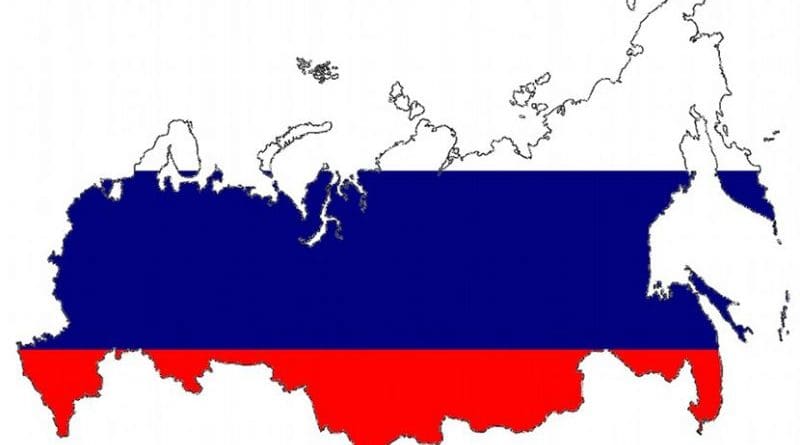
 russia flag map

Wanting To Keep Russia In One Piece Not The Same Thing As Wanting To Keep Putin In Power – OpEd

By 

There are legitimate reasons for believing that the Russian Federation should come apart but there are also legitimate reasons for believing that it would be better for it to remain in one piece, Vladimir Pastukhov says. But there is one aspect of this debate that is not legitimate.


And that is this, the London-based Russian analyst says. Far from all those who believe Russia should remain in one piece want Putin to remain in power (t.me/v_pastukhov/1248 reposted at echofm.online/opinions/stremlenie-sohranit-rossiyu-ne-tozhdestvenno-stremleniyu-sohranit-putinskij-rezhim).

The debate between those who favor disintegration and those who oppose it has reached “the boiling point” and threatens to become a serious headache for Russia’s political class, he continues. It isn’t helped by suggesting that support for the territorial integrity of Russia is all about supporting Putin   

It is time to lower the temperature, Pastukhov says. The arguments of those favoring disintegration ultimately rest on “the idea that such a vast territory cannot be governed except with the help of a hyper-centralized machine of violence that will sooner or later start a war with its neighbors in the interest of self-preservation. 

“There are, of course, also purely decolonizing motivations, but they are not of a specific nature, and the logic of those favoring independence for the Basque country is unlikely to differ from that of backers of independence for Sakha. Sometimes, however, additional “toys” are hung on this “Christmas tree” in the form of accusations that Russians are innately aggressive.

But, Pastukhov argues, “I would not focus on Russians alone here, because in similar situations the same thing was written about other peoples experiencing a cultural default such as the Germans in the last century. And over time this goes away. That is, the dispute about the influence of the territory on culture, political system and foreign policy is fundamental.”


“Who and under what circumstances will argue on this topic? If they win, Putin or his successors will obviously not “dissolve Russia” themselves. In the event of Russia’s defeat in any nuclear war, the subject of dispute will most likely disappear. And if something does remain, the occupation authorities will divide the ruins without asking anyone.”

Pastukhov continues: There “thus remains only the chance that some victorious revolutionary party will independently divide Russia into parts after coming to power. But I have some doubts that a party which openly writes on its banners that its goal is the dismemberment of Russia has a real chance of victory in the coming Russian revolution.”

And that reduces to a theoretical discussion any debate about this issue among Russians, the commentator suggests. 
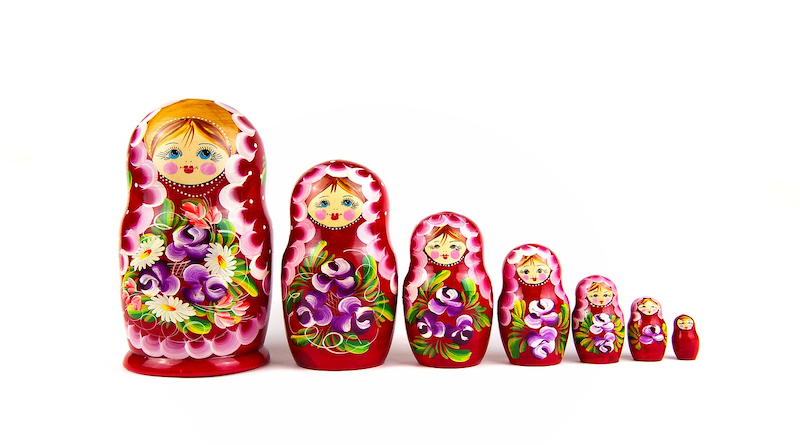
Matryoshka Wooden The Culture Symbol Retro Toy Russian doll

Russia-Ukraine: Tension, Inability Of Western Allies To Understand Mystery Of Russian Soul – OpEd


By 

There is nothing more difficult and yet more gratifying in our world today than living with sincerity and acting from a place of large-heartedness towards humanity’s growth and betterment. Politics or no politics, Geopolitics or no geopolitics, the truth is that Russians are very pleasant people and the common features of the Russian character are generosity, resilience, and strength. Russians are people of humanity. Humanitarian assistance is embedded in their culture and ways of life. Russians believe in the oneness of all human beings. They believe in the strong helping the weak and giving without expecting. Russians are inventive people with a huge capacity to endure and overcome big difficulties with a strong spirit. The Russian person is often a mystery because of many extremes tied together in his soul. Russians are modest and patient and can endure for a long time, but when they eventually rise, they go to the end. Courage and sacrifice for the sake of the motherland and nation is a very Russian trait. Cold planning and calculations as it is in the West are not for the Russians. They are pushed by brilliant insights and unconventional thinking.


They stopped Napoleon and saved the world, got no enough gratitude from the world, and still felt all right with that. They stopped Hitler and saved the world from fascism, got no enough gratitude from the world, and also felt all right with that. However, Russians have a sense of history. They have not forgotten and will never forget how in the process of saving the world from fascism lost about 27 million of its citizens, entire families beheaded, babies burned, mothers bayoneted, and little kids short in the back.

Patriotism holds an important place in Russian culture. They are proud of their history and contributions to the world. Russian Federation is the largest nation in the world, spanning 11 time zones and many different geographical environments. Russia contains an incredible diversity of people, beliefs, values, and lifestyles. Russia is a particularistic and collectivistic society. Russia does not like uncertainty and highly values stability and security. The expansion of NATO close to Russian borders is a serious source of concern, uncertainty, instability, and insecurity. The thought of Ukraine becoming a member of NATO which is the cause of present tension between Russia and the West is a dark red line for Russia. They will never allow it no matter the circumstances. The mystery of the Russian soul shows that they have risen and they are prepared to go to the end. My humble advice is that the West should look at the demands and enter into serious negotiations with RussiaThey should reconsider the idea of Ukraine becoming a member of NATO. I think Russia will never allow it to happen and Ukrainian leadership should know this too well and must be very careful in navigating this difficult period of their history. 

There is a popular aphorism in the former Soviet Union which says that whenever Ukrainian is born the Jews cries. The Ukraine people are intelligent people and they need that their intelligence to avoid the impending doom and catastrophe that is about to befall on their nation. Geographically, they are neighbor to Russia and with  common boarder. And an attempt to join NATO is not the best way to be a good neighbor to your big neighbor which is Russia. The tie between Russia and Ukraine is so deep and historical. It dates back to at least the 9th century with the founding of Kyivian Rus, the first East Slavic state. They are close relatives and at the beginning of the 20th century, the Russians formed the largest ethnic group in almost all the large cities within Ukraine’s modern borders including Kyiv, Kharkiv, Odesa, Mykolaiv, Donetsk, Luhansk, Mariupol, Ekaterinoslav, Kropyvnytskyi, Sevastopol, Kerch, Yalta and Simferopol. This shows a widespread presence of Russian-speaking individuals in urban centers across Ukraine. The Russian-speaking population in Ukraine has been a significant demographic factor, especially in the eastern and southern regions, and has played a crucial role in the linguistic and cultural landscape of the country. According to the 2001 Ukraine census, individuals who identify themselves as ethnic Russians accounted for 17.3% of the population of Ukraine. In the western and central regions, Ukrainian has been the predominant language in these regions, and there has been a historical emphasis on Ukraine’s national identity and independence. Russia has swallowed a bitter pill of NATO admitting former member-nations of Soviet Union and Warsaw pact into its fold over the years and some of these countries are even becoming hyperkinetic aggressive towards Russia under the NATO umbrella. 

The golden rule says you do unto others what you will like others to do to you but unfortunately, in today’s world there are tiny group of individuals who decides what happens in it. This tiny group of people are sometimes called global decision makers or international decision makers. This golden rule is not for them and it is unimaginable the level of insanity this tiny group of people are willing to exhibit in order to protect their so-called interest. The world should know that any conflict between Russia and Ukraine as result of an attempt by Ukraine to become a member of NATO will encompass a range of issues including threat of nuclear war with its broader implication to global security. In the request by Russia on NATO to hold talks with its on-security guarantees, Russia made it loud and clear that admission of Ukraine into NATO is a dark red line that must not to be crossed. It gave reasons that the implication of having NATO bases in Ukraine would neutralize its own nuclear deterrence since it would not have enough time to react to any missile fired from Kiev that takes few minutes to reach Moscow. Russia even went as far as submitting a framework proposal to negotiate upon that would guarantee that Ukraine will remain neutral and never be admitted into NATO. 

At this juncture it is important for us to refresh our memories to the Cuban crisis of the 1960s, in which the American President late President Kennedy faced the risk of a nuclear war with the Soviet Union by taking action to block the deployment of nuclear missiles in Cuba which the USA considered as its neighbor. That crisis was quietly resolved by NATO agreeing to remove the nuclear missiles deployed in Turkey which Soviet Union considered as a threat to it security and Soviet Union agreeing to withdraw the deployment of nuclear missiles in Cuba which Washington considered as a threat to its own security. USA will never tolerate deployment of Russian weapons in any of its border region such asCanada or Mexico. Why then do NATO thinks Russia will tolerate it. Sanctions will not deter Russia if they decide to invade Ukraine. Russians are prepared to do anything humanly possible in order to prevent Ukraine from slipping out of their orbit of influence or joining NATO. 


Russia is such a huge and important country to the world that any attempt to seriously sanction Russia will have a devastating effect to the word economy and might not achieve the goal of the sanction. The structure of the Russian imports from the west are mainly consumable goods and services which Russia could easily find an alternatives sources of supply while the export of Russia to west are mainly products of energy and energy intensive industries which the alternatives sources are limited in nature and might not be easily replaced. Besides, Russian economy is huge and it is tied to the wellbeing of the economy of many countries and when the push comes to shove many countries will put their economic interest first and will sabotage if not outright refusal to join the sanctions against Russia.

The stage has been set and it is provocative, inflammatory and incendiary. Russia will be pushed beyond limit. It will be extremely difficult but not impossible for Russia to overcome the provocation by not invading Ukraine. I think that Russia has a deep understanding that the game being watched is not the game being played. The game being played is to bring two Slavic brotherly countries to fight each other thereby creating permanent enmity between the two countries and to use Ukraine as an instrument to weaken Russia militarily, economically, geopolitically and otherwise.

My prayers and heart go out to the Ukrainian people who have become victims in the big game of geopolitics. The people of Ukraine should pray and work hard for a political and diplomatic solution to the current crisis because the alternative will be disaster and calamity of unimaginable proportions to the Ukrainians people. The accusation that Russia wants to expand and recreate the Soviet Union has nothing to do with reality. It is mere speculation and assumption.  Russian plans are not to expand Russia geographically but to protect Russian security interests from NATO expansion towards its borders.

The world is standing on many pillars but the four major and important pillars are Russia, China, Europe and United States of America. In the interest of the world peace, prosperity and development, these four pillars need to work together and not against each other. The relationship between Russia and USA is complex and multifaceted. The two nations have a long history that includes periods of both collaborations and conflict. The cold war era is often cited as a time of significant tension between these two great countries. In recent years, geopolitical events have led to strain relations. However, while there are certainly challenges in the relations between Russia and USA, it is important to recognize that the dynamics are not purely adversarial. Russia is a victim of American internal politics, American military industrial complex and American media. America needs an enemy and Russia fits that role. The American military-industrial complex needs to justify the huge defense budget. To keep the billions of defense dollars flowing, they need Russia as an enemy. The actual threat to America’s number one position economically and militarily in the world if any could be China and American internal politics. Making Russia an enemy thereby driving Russia into the hands of the Chinese is not a good foreign policy strategy. The drum of war is beating and it is beating louder and louder. During a news conference in Berlin with his German counterpart, Secretary of State Anthony Blinken warns that any invasion and act of aggression will be met with a swift, severe, and united response. As a matter of urgency, there is a need to tone down the rhetoric of war. There is an urgent need for de-escalation from all sides involved. One miscalculation or one misjudgment could trigger a disastrous war.

  • This article was first published on February 6, 2022 in The Nation media. The Russia-Ukraine conflict began on February 24, 2022.


Professor Maurice Okoli

Professor Maurice Okoli is a fellow at the Institute for African Studies and the Institute of World Economy and International Relations, Russian Academy of Sciences. He is also a fellow at the North-Eastern Federal University of Russia. He is an expert at the Roscongress Foundation and the Valdai Discussion Club. As an academic researcher and economist with keen interest in current geopolitical changes and the emerging world order, Maurice Okoli frequently contributes articles for publication in reputable media portals on different aspects of the interconnection between developing and developed countries, particularly in Asia, Africa and Europe. With comments and suggestions, he can be reached via email: markolconsult@gmail.com
‘Convergence’ growing on global plastics treaty: UN environment chief


ByAFP
September 22, 2024

UN environment chief Inger Andersen said she was hopeful final negotiations on a plastic pollution treaty in November would be successful - Copyright AFP SIMON MAINA
Hashem Osseiran

The UN environment chief said Sunday she was beginning to see convergence on the world’s first binding treaty on plastic pollution despite differences on production caps and a tax-like plastic fee.

Inger Andersen, director of the UN Environment Program, said her team was “getting ready” for final negotiations in late November in South Korea’s Busan.

There, countries are hoping to seal a potentially groundbreaking deal to tackle the gargantuan problem of plastic pollution.

“There are certain areas where I think we’re beginning to see convergence,” Andersen said from New York ahead of an annual gathering of world leaders at the United Nations.

Speaking during a briefing, Andersen said she was hopeful that member states would be able to agree on “some degree of global obligations or guidelines for plastic products.”

She noted growing convergence on the need for a scientific body and “some degree of text that will deal with waste, waste management, recycling.”

“There’s also clear understanding that we need to have some sort of text that will deal with legacy or existing pollution, that which will wash up on our shores even after we’ve turned off the proverbial plastic tap,” Andersen added.

“And there’s also clear understanding we need to have some sort of reporting framework”.


– Sticking points –


Negotiators have already met several times to discuss a deal that could include production caps, unified rules on recyclability, and even bans on certain plastics or chemical components.

But significant gaps remain, including on the issue of production caps, Andersen said.

“We want to see a reduction in the production of raw polymer for that which is single use and short lived,” she said, explaining that the cap would mainly target polluting products.

“I don’t see car parts and plane wings and things like that swimming around in the ocean,” she said.

“We have to have a more refined conversation than just cap, no cap, because it’s not an intelligent conversation.”

Another flashpoint is around a “global plastic fee,” according to the UNEP head.

“So whether or not we will get some sort of plastic fee tax is still in discussion. But it might take a little longer. Maybe we will land the idea of something and then discuss later the nitty gritty, because the nitty gritty will take time.”

Plastic production has doubled in 20 years and at current rates it could triple by 2060, according to the Organization for Economic Cooperation and Development (OECD).

Yet over 90 percent of plastic is not recycled, with much of it dumped in nature or buried in landfills.


Pacific nations gear up for a fight over shipping emissions at critical UN meeting

By Harry Pearl, BenarNews

A cargo ship sails through the Panama Canal, in Panama City, Thursday, June 13, 2024.

A cargo ship sails through the Panama Canal, in Panama City, 13 June 2024. Photo: AP

Pacific nations are preparing for a pivotal week of negotiations in London on how to cut planet-warming greenhouse gas emissions in the global shipping industry.

Countries will gather later this month to lay out specific plans to slash shipping emissions by at least 40 percent by 2030 and reach net-zero "by or around" 2050.

The International Maritime Organisation, the UN body that oversees global shipping, set the target in July last year, but deciding on exactly how to get there will be fiercely debated at the latest round of talks known as MEPC 82.

The 6PAC+ Alliance, led by Pacific Island nations with the backing of some Caribbean states, is arguing for a mandatory levy on all ships starting at US$150 per tonne of emissions.

The bloc says it is the best method for a fair transition from fossil fuels for all countries, while ensuring that small island developing states are adequately compensated for climate impacts that disproportionately affect them.

"The revenues are to help transition the sector but also to help communities that continue to face the impacts of climate change build their resilience and through adaptation and mitigation," Albon Ishoda, the Marshall Islands special envoy for maritime decarbonisation, said at a webinar on Wednesday night.

Ralph Regenvanu, Vanuatu's special envoy for climate change and the environment, said Pacific Island nations would go into the talks knowing the science was on their side.

"We have to be there lobbying for the highest ambition because we cannot afford not to be there. Our nations and our people are at stake and we are fighting for that," he said at the event organised by the Micronesian Center for Sustainable Transport.

Albon Ishoda, left, and Ralph Regenvanu at the IMO Headquarters in London. 4 July 2023

Albon Ishoda, left, the Marshall Islands special envoy for maritime decarbonisation, and Ralph Regenvanu, Vanuatu's special envoy for climate change and the environment, at the IMO headquarters in London. 4 July 2024 Photo: RNZ Pacific / Kelvin Anthony

Shipping, which carries more than 80 percent of world trade, accounts for about 3 percent of global greenhouse gas emissions - a level comparable to that of major industrial nations.

Under the 6PAC+ submission to the IMO, the levy would be paired with a simple global fuel standard, limiting the amount of emissions from marine fuels with increasing stringency over time. Ships that are non-compliant will pay a penalty, while those that overperform will be rewarded with limited subsidies.

Most revenues raised by the levy would be spent on climate action in low-income and small island states.

'Beacon of hope'

The IMO, which takes decisions by consensus, is responsible for reducing emissions in the shipping industry, rather than individual countries, because it was not covered in the Paris climate agreement.

While most nations support some version of a fuel standard, agreeing on economic measures to incentivize decarbonization are far more contentious.

Countries such as China, Russia and several from Latin America say an emissions levy will act as a handbrake on trade and damage economic growth.

The BRICS group of major emerging economies - Brazil, Russia, India, China and South Africa - plus Norway are advocating for a more complex market-based trading scheme, where ships that comply with a fuel standard will be provided with credits that can be bought and sold.

Australia - one of the world's largest exporters of coal - New Zealand and the Cook Islands, which has a fast growing ship registry, have also pushed back against a levy.

Regenvanu said it was frustrating that the 6PAC+ proposal had not received full support from across the region.

"With Australia it's not surprising, they generally don't align with the Pacific states on climate change ambition. New Zealand recently with the new government is tending not to align that much anymore," he said, adding more discussions were needed with the Cook Islands.

Research, including modeling commissioned by the IMO, shows decarbonising the shipping sector will have a cost for all countries, but without a fair policy in place, the negative economic impact will be felt most keenly by lower income nations and small island states.

Pacific nations, which have some of the largest maritime territories in the world, are heavily reliant on fossil-fuel powered shipping to sustain their import-dependent economies. Some like the Marshall Islands draw huge revenues from their shipping registries.

However, faced with increasing vulnerability to rising sea levels and extreme weather events, they have emerged as the leading voice on climate action within the IMO over the past decade.

Ishoda said Pacific nations lacked the financial resources of larger countries to lobby for support, but they would bring a human face to negotiations.

"We need to continue to be the beacon of hope," he said. "We have to understand that we bring the moral argument to a space where everything is abstract."

-This article was first published by BenarNews.

Seismologists warns of possible volcano eruption in Philippines


ANN/THE STAR – The Philippine state seismology agency issued a warning yesterday morning regarding a possible eruption of Mount Kanlaon in central Philippines.

The volcano has emitted about 10,449 tonnes of sulfur dioxide and recorded 55 volcanic earthquakes in the past 24 hours, it said.

The Philippine Institute of Volcanology and Seismology (PHIVOLCS) said that a heightened alert remains in effect for Mount Kanlaon, with an elevation of 2,465 metres.

Located on Negros, the fourth most populous island in the Philippines, Mount Kanlaon is one of the country’s 24 seismically active volcanoes.

The state seismic agency advised that sudden steam or phreatic explosions are possible at any time.

A phretic eruption, or steam-blast eruption, occurs when magma heats ground water or surface water resulting in an explosion of steam, ash, rock and volcanic bombs.

The public is advised that entry to the four-kilometre Permanent Danger Zone (PDZ) is prohibited due to the dangers of an eruption.

All types of aircraft are prohibited from flying near the volcano.


Myanmar’s Junta: Failed Governance In The Face Of Nature’s Wrath – OpEd


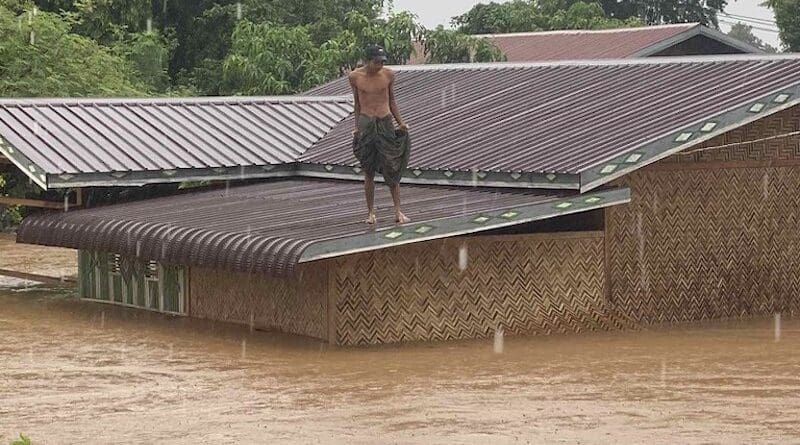
A man stands on a home surrounded by floodwaters in Kyoet Kone village in Tatkon township in Naypyidaw on Sept. 11, 2024. (RFA, Citizen Photo)

September 23, 2024 
By James Shwe

As the floodwaters of Typhoon Yagi recede in Myanmar, they reveal more than just physical devastation. They underscore an ancient belief ingrained in Chinese and Southeast Asian Buddhist-Hindu traditions: poor governance invites nature’s wrath.

For millennia, these cultures have held that unjust rulers bring about droughts, famines, and disasters. Central to this belief is the Chinese concept of the “Mandate of Heaven” (天命, Tiānmìng), which holds that rulers are granted divine authority only as long as they govern justly. Heaven withdraws its mandate when rulers fail, often manifesting displeasure through natural disasters.

The term “tian zai” (天災), meaning “heavenly disaster,” embodies this belief—that calamities are divine retribution for failed governance.

In the wake of Typhoon Yagi, with over 300 dead, hundreds missing, and more than 630,000 affected, this ancient wisdom feels eerily prophetic. Over 2,000 houses have been destroyed, thousands more damaged, and 1,000 schools and 370 religious buildings lie in ruins. The agricultural sector, a lifeline for millions, has been particularly devastated, with over 640,000 acres of farmland destroyed.

The military junta’s mismanagement of Yagi echoes its disastrous responses to Cyclones Nargis in 2008 and Mocha in 2023. Once again, the regime has turned a natural disaster into a man-made catastrophe by obstructing aid, delaying visas for relief workers, and prioritizing political control over human lives. The junta’s failures as stewards of the land and its people are glaring, and the preventable nature of these disasters should serve as a wake-up call for change.

But their guilt runs deeper than disaster response. For decades, the military’s greed and corruption have laid waste to Myanmar’s environment. Forests once covering 70% of the country have been decimated by military-backed illegal logging operations, leading to environmental degradation and making the land vulnerable to flooding and erosion. These are not merely natural disasters but the consequences of a regime’s reckless exploitation of the land.

The junta’s economic policies, focused on self-enrichment, have stunted national development, leaving infrastructure woefully unprepared for disasters. While neighboring countries invested in flood control, early warning systems, and resilient infrastructure, Myanmar’s progress has stalled. Poverty, which had dropped to 25% in 2017, doubled by 2022, a direct consequence of the junta’s mismanagement. The country’s economy has contracted by 10% since 2019, and this year, it is forecast to grow at a dismal 1%, with nearly half the population living in poverty. These figures tell the story of a nation struggling under political instability, economic hardship, and environmental catastrophe.

Typhoon Yagi only compounds this dire situation. Inadequate urban drainage worsened the flooding, while the junta’s underinvestment in emergency services crippled rescue efforts. The regime’s obsession with control led to blocked communications during the disaster, further isolating affected communities from help. These actions reveal a state more concerned with maintaining power than saving lives.

Meanwhile, resistance forces and civil society networks have risen to the occasion. For instance, the United League of Arakan (ULA) evacuated communities ahead of Cyclone Mocha and has played a crucial role in the current relief efforts. These grassroots organizations embody the ideals of responsible governance that contrast with the junta’s disregard for its people. During Yagi, the junta failed even to issue storm warnings or coordinate rescue efforts, exacerbating the disaster by opening dam floodgates without warning.

Paradoxically, the junta has appealed for international assistance while simultaneously blocking its delivery, particularly in resistance-held areas like Kayah and southern Shan states. Disturbingly, the regime continues to bomb and shell rebel-held towns in Northern Shan state, using its aircraft for attacks rather than rescue missions.

The international community has responded with aid pledges, and Singapore and India have already made air delivery, but the junta’s restrictions render much of it ineffective. While some aid has reached junta-controlled areas, many regions remain isolated due to communication blackouts. The junta’s politicization of humanitarian assistance is not only morally reprehensible but also a violation of international humanitarian law.

This situation demands a radical rethinking of how aid is delivered to Myanmar. Neighboring countries should consider cross-border operations to assist directly to resistance-held areas. International actors must bypass the junta wherever possible, coordinating with local resistance authorities and civil society networks that have proven more capable and trustworthy. Additionally, sustained pressure must be applied to the regime to lift aid and communication restrictions. The lives of millions are at stake.

The aftermath of Typhoon Yagi is a clarion call for immediate humanitarian intervention and long-term strategies to address Myanmar’s environmental and developmental crises. However, these solutions cannot be realized under a regime that prioritizes self-preservation over the welfare of its people. The junta’s contradictory stance—requesting aid while obstructing its delivery—reveals its fundamental illegitimacy and inability to govern.

As the waters of Yagi recede, they leave behind a stark reminder of the urgent need for political change. The international community must recognize that providing aid through the junta risks legitimizing a regime that has consistently prioritized military enrichment over ecological and human development. The compounding crises of conflict, poverty, environmental destruction, and natural disasters call for a new approach to aid—one that supports local actors who embody principles of responsible governance and environmental stewardship.

In both traditional belief and modern reality, the junta has lost its mandate to govern. It is time for the international community to act accordingly, to empower the people of Myanmar, and to hold the regime accountable for the suffering it has caused.


James Shwe
James Shwe is a Burmese American Engineer residing in Los Angeles, California, USA. He was born in Yangon, Myanmar in 1954 and has been residing in the US since 1984. He is a Registered Professional Mechanical Engineer in California. He owns and operates a consulting engineering firm in Los Angeles.


No Limits To The Lawlessness Of Myanmar’s Predatory Military Regime – Analysis


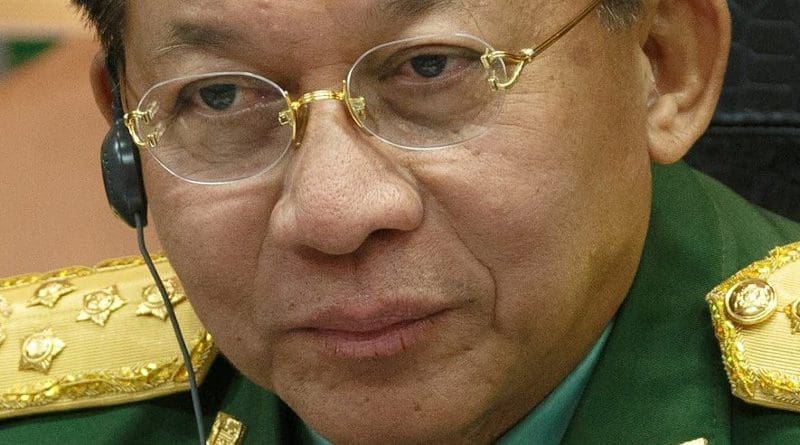
Myanmar's military junta leader, General Min Aung Hlaing. Photo Credit: Mil.ru

September 23, 2024 
By RFA
By Zachary Abuza

Having illegally seized power and overthrown a democratically elected government, Myanmar’s military was never expected to hold itself up to the rule of law.

But given their losses since a trio of rebel armies launched Operation 1027 nearly a year ago, the military has acted with an even greater degree of desperate and callous criminality.

The U.N. The High Commissioner for Human Rights released a new report that recorded a 50% increase in civilian deaths from April 2023 to June 2024, year on year.

In addition to the more than 2414 civilians killed, the report detailed the deaths of 1,326 people, including 88 children and 125 women who died in military custody since the February 2021 coup.

The report documented executions, egregious sexual violence, and routine torture. Those who survived government custody described harrowing conditions in prisons and military detention facilities.


Now there are leaked reports on pro-regime Telegram channels that the military government is preparing to execute five anti-regime activists as early as next week.

That would follow the shocking executions of four, including Kyaw Min Yu (Ko Jimmy) and Phyo Zeya Thaw, in July 2022.

There are at least 112 people who have been put on death row since the coup. And the regime wants to send a signal through the executions, both to domestic and foreign audiences, that it is still firmly in control, despite losses on the battlefield.
War crimes are the strategy

The world has become inured to the intentional bombing of civilians, the execution of POWs, and the mass arrests of citizens as a form of collective punishment. Over 27,000 people have been arrested since the coup.

Junta troops torched more than 1,050 houses in retaliatory arson attacks in Sagaing, Magway and Mandalay regions in the first half of 2024 alone.

Radio Free Asia has documented a stepped up aerial bombing campaign leading to increased civilian casualties.

This should come as no surprise. The military’s counterinsurgency doctrine, known as the “Four Cuts” – stopping food, funds, information and recruitment to insurgents – is predicated on the intentional targeting of civilians as a deterrent for lending support to anti-regime forces.

War crimes have always been the milirary’s strategy, and troops are indoctrinated and encouraged to commit them, including rape.

The military is fighting across six distinct battle grounds, and has suffered losses in all of them. It has lost control over 60% of the towns in northern Shan state alone.

Opposition forces now control key roads and riparian ports, making the movement and resupply of troops difficult. The only way that the military can retaliate is through aerial bombardment and long-range artillery strikes.

If they can’t kill the opposition forces, they will kill the populations that support them.
Preying on their own

The military’s forces have committed such egregious human rights abuses that it’s hard to feel sorry for them. But their predatory behavior starts with plundering the income of their own troops.

Despite their paltry salaries, troops are compelled to make monthly contributions to the sprawling military-owned conglomerate Myanma Economic Holdings Ltd (MEHL). The amount differs based on rank, but all must pay.

At the end of the year, MEHL is supposed to pay troops a dividend. Yet nothing has been paid since the coup, a result of nationwide boycotts of military-produced products and services.

The military insurance plan is even more egregious.

Established in late 2012, by Min Aung Hlaing’s son, Aung Pyae Sone, by 2015 the Aung Myint Moh Insurance company had secured a monopoly on selling life insurance to the military, supplanting the state-owned Myanma Insurance. It has an unclear degree of military ownership through MEHL.

Even the lowest ranked soldiers are pressured to buy a minimum two-year policy costing some 500,000 kyats – $238 at the official, artificially low exchange rate – in addition to a monthly premium of 8,400 kyats.

Amid recent battlefield losses, including a large number of the hastily trained five classes of conscripts since, the company has had to pay out more than it’s taking in.

Its own capital reserves are thought to have flatlined in the overall poor economic climate and investment conditions.

As one can expect from Min Aung Hlaing’s rapacious clan, the insurance company is cheating. The firm has labeled many dead soldiers as “missing in action”.

In other cases, it has found loopholes in paperwork and nonpayment of monthly fees as justification for not honoring claims. The firm has pocketed the payments of the estimated 20,000 troops who have defected to the opposition.

The junta is flat out stealing from the soldiers that they conscript just to line their own pockets.
A well-armed extortion racket

The abject criminality of the military is getting worse.

Due to the military’s own economic incompetence, the economy has cratered. And with that has been a sharp decline in revenue needed to conduct the war.

The opposition National Unity Government’s digital Spring Lottery has significantly cut into government sweepstakes income. The loss of territory on the battlefield has cut off revenue streams.

Recent losses include four MOGE oil fields, coal, tin, lead and ruby mines. Intense fighting is underway in Hpakant in northern Kachin State for control of lucrative jadeite and rare earth mines.

Two hydroelectric dams are now in opposition hands, while others have recently fallen into United Wa State Army control.

While the capture of towns and cities along the Chinese border has led to the shutdown of many internet scam centers and the rendition of thousands of Chinese nationals, the military regime continues to rely on transnational criminal syndicates as a source for funds.

Many have moved from Laukkaing to Yangon. Others along the Thai border remain operational and under the control of pro-regime border guards forces.

Short on funds, the military has taken to shaking down local businesses. A once functioning state revenue collection system has turned into an extortion racket.

But unlike taxes that are paid on a regular basis and have a modicum of social services provided in return, the military levies are predatory and further undermine economic growth, making capital flight a rational choice for many in Myanmar.

As the country reels from Typhoon Yagi, the junta continues to blockinternational humanitarian aid workers, demanding that all donations go through the military itself.

Fearful that aid will go to opposition groups, the military is – once again – willing to deny vital food and medicines from reaching the most in need.

The war crimes are well documented, even if they have not moved the needle on international condemnation.

International actors, from China to India to ASEAN, still believe that military interests must be respected, and that the military deserves a seat at the table in any future government.

While the regime is preparing for elections under Chinese pressure as a political offramp, allowing the junta a future role is absolutely unacceptable.

For nearly four years, the military has systematically targeted its own population, engaged in egregious human rights abuses, impoverished its citizens, and transformed a once functioning state into a predatory and thoroughly corrupted crime syndicate. Zachary Abuza is a professor at the National War College in Washington and an adjunct at Georgetown University. The views expressed here are his own and do not reflect the position of the U.S. Department of Defense, the National War College, Georgetown University or Radio Free Asia.


RFA
Radio Free Asia’s mission is to provide accurate and timely news and information to Asian countries whose governments prohibit access to a free press. Content used with the permission of Radio Free Asia, 2025 M St. NW, Suite 300, Washington DC 20036.