Saturday, October 05, 2024


Anniversary of Gaza war draws thousands of pro-Palestinian protesters around the world

Reuters
Sat 5 October 2024 at 10:49 am GMT-6·3-min read


Anniversary of Gaza war draws thousands of pro-Palestinian protesters around the world


PARIS (Reuters) - Thousands of protesters took to the streets in several major cities around the world on Saturday to demand an end to bloodshed in Gaza, as the conflict in the Palestinian enclave approaches its first anniversary and spreads in the wider region.

About 40,000 pro-Palestinian demonstrators marched through central London while thousands also gathered in Paris, Rome, Manila and Cape Town.

The war was triggered when militant Palestinian group Hamas attacked southern Israel on Oct. 7, 2023 in a raid that killed 1,200 people and in which about 250 were taken as hostages, according to Israeli tallies.

Israel's subsequent assault on Gaza has killed nearly 42,000 Palestinians, according to Gaza's health ministry, and displaced nearly all of the enclave's population of 2.3 million.

"Unfortunately, in spite of all our good will, the Israeli government does not take any notice, and they just go ahead and continue their atrocities in Gaza, now also in Lebanon and in Yemen, and also probably in Iran," said protestor Agnes Kory in London.

"And our government, our British government, unfortunately is just paying lip service and carries on supplying weapons to Israel," she added.

In Berlin, Israel supporters protested against rising antisemitism and scuffles broke out between police and pro-Palestinian counter-protestors.

Over the past year, the scale of the killing and destruction in Gaza has drawn some of the biggest global protests in years, in a wave of anger that defenders of Israel say has created an antisemitic climate in which protestors question Israel's right to exist as a nation.

The war in Gaza has spread to the region, drawing in Iran-backed groups in Lebanon, Yemen and Iraq. Israel has sharply escalated a campaign against Iran-backed Lebanese group Hezbollah in recent weeks and Iran launched a barrage of missiles against Israel this week.

In Paris, Lebanese-French protestor Houssam Houssein said:

"We fear a regional war, because there are tensions with Iran at the moment, and perhaps with Iraq and Yemen".

"We really need to stop the war because it’s now become unbearable," he added.

In Rome, around 6,000 protestors waved Palestinian and Lebanese flags, defying a ban to march in the city centre ahead of the Oct. 7 anniversary.

While its allies such as the United States support Israel's right to defend itself, Israel has faced wide international condemnation over its actions in Gaza, and now over its bombarding of Lebanon. Prime Minister Benjamin Netanyahu has resisted criticism and argued his government is acting to defend the country from a repeat of the Oct. 7 assault by Hamas.

International diplomacy led by the United States has so far failed to clinch a ceasefire deal in Gaza. Hamas wants an agreement that ends the war while Israel says fighting can end only when Hamas is eradicated.

In Manila, activists clashed with anti-riot police after they were blocked from holding a demonstration in front of the U.S. embassy in the Philippine capital in protest at the United States supplying Israel with weapons.

Demonstrations to mark the first anniversary were due to take place later on Saturday in other cities across the world, including the United States and Chile. Some demonstrations in support of Israel are also planned over the weekend. (This story has been corrected to fix the name to Agnes Kory, not Agmes Koury, in paragraph 5)

(Reporting by Reuters bureaus; Writing by Leigh Thomas; Editing by Frances Kerry)

Thousands march for Palestinians ahead of Oct 7 anniversary

Akshata Kapoor with AFP bureaus
Sat 5 October 2024 
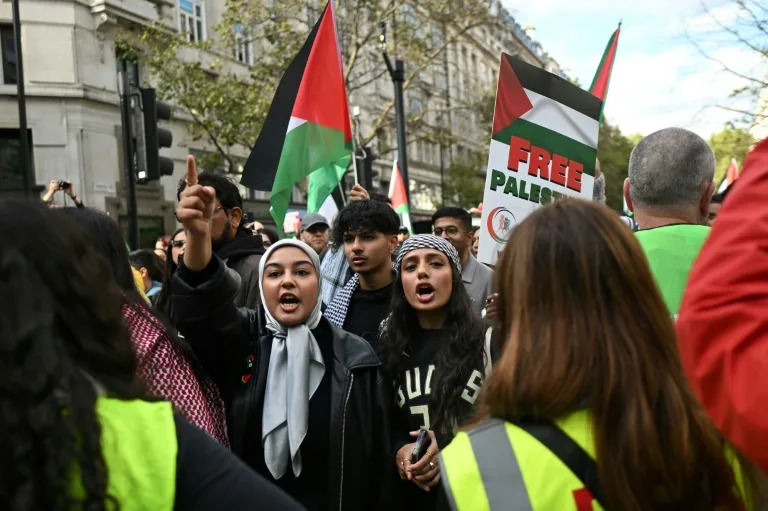
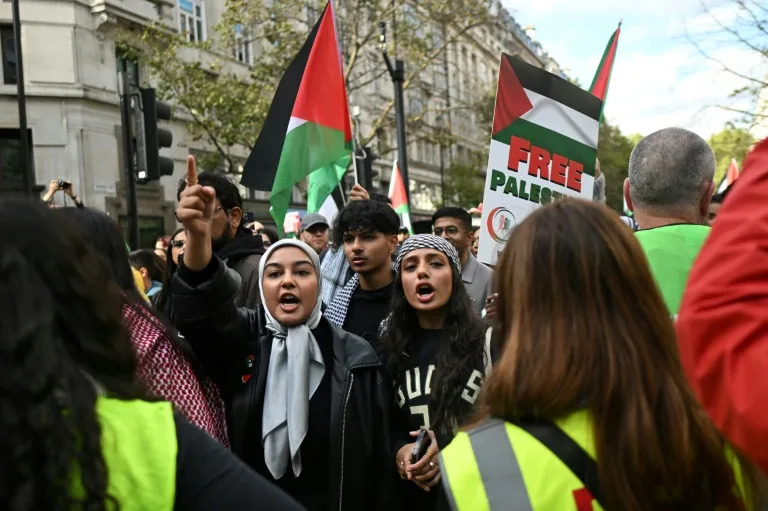
Pro-ceasefire supporters from across the UK marched from Russell Square to Downing Street (JUSTIN TALLIS) (JUSTIN TALLIS/AFP/AFP)

Thousands of protesters marched in London and other cities on Saturday calling for a ceasefire in Gaza and Lebanon as the war in the Palestinian territory neared the one-year mark.

At the start of a planned wave of protests worldwide, pro-Palestinian supporters gathered in cities in the UK, France, South Africa, Ireland and Switzerland to demand an end to the conflict, which has killed nearly 42,000 people in Gaza.

Dozens of protests and commemorations are set to take place ahead of the anniversary Monday of Hamas's attack on Israel which resulted in the deaths of 1,205 people, mostly civilians, according to an AFP tally based on Israeli official figures.


Israel's retaliatory military offensive has killed at least 41,825 people in Gaza, most of them civilians, according to figures provided by the territory's health ministry and described as reliable by the United Nations.

At the "National March for Palestine" in London, familiar chants -- "ceasefire now", "stop bombing hospitals, stop bombing civilians" and "from the river to the sea, Palestine will be free" -- were joined by shouts of "hands off Lebanon".

- Global marches -

Zackerea Bakir, 28, said he has attended dozens of marches around the UK.

Large numbers continue to turn up because "everyone wants a change", Bakir told AFP.

"It's continuing to just get worse and worse, and yet nothing seems to be changing... I think it's tiring that we have to continue to come out," said Bakir, joined at the rally by his mother and brother.

In Cape Town in South Africa, hundreds walked to parliament, chanting: "Israel is a racist state" and "We are all Palestinian."

Pro-Gaza marches were also planned Saturday in Johannesburg and Durban.

In France, hundreds of people marched in Paris, Lyon, Toulouse and Strasbourg to express solidarity with the Palestinians, AFP journalists saw.

Several thousand people came together in the Swiss city of Basel for a pro-Palestinian demonstration, with marchers calling for a ceasefire, economic sanctions on Israel and an end to Swiss scientific collaboration with Israel, the Keystone-ATS news agency reported.

Other pro-Palestinian protests were planned over the weekend and on Monday in cities including New York, Sydney, Buenos Aires, Madrid, Manila, and Karachi.

- 'Not good enough' -

In the British capital, several protesters criticised the new Labour government, carrying posters reading: "Starmer has blood on his hands".

Prime Minister Keir Starmer has called for a ceasefire in Gaza and the release of hostages held by Hamas, as well as suspending some arms licences to Israel.

However, many at the rally said it was not enough.

Sophia Thomson, 27, found Starmer's stance "hypocritical".

According to Thomson, the size of the protests "goes to show the government doesn't speak for the people".

"As you can see here today, this is the true essence of what the sentiments of the UK are", she added.

"It's not good enough," said protester Zackerea Bakir, calling for the government to "stop giving a carte blanche of support to the Israeli government".

- Heavy policing -

London's Metropolitan police put in place a "significant" policing operation ahead of planned protests and memorial events.

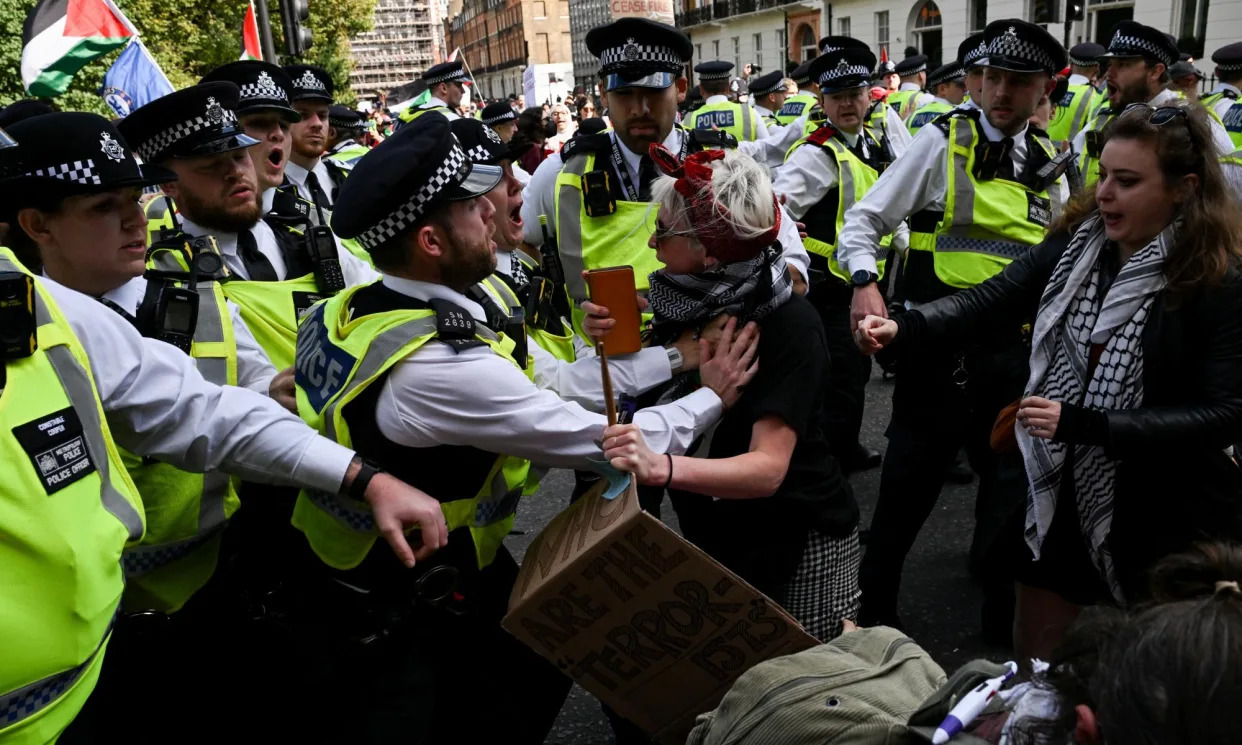
While the rally in London was largely peaceful, at least 15 people were arrested, including three on suspicion of assaulting an emergency worker and one on suspicion of supporting a proscribed organisation.

Commemorations for victims of the October 7 attack are also scheduled internationally, including ceremonies in London, Washington, Paris, Geneva, Athens and Berlin.

An official anniversary ceremony will be held in Jerusalem on Monday.

Israeli President Isaac Herzog will lead a memorial service at Sderot, one of the cities hardest hit during the onslaught by Palestinian militants.

aks/rlp


How Gaza sparked the biggest UK protest movement in recent history – and a headache for the police

Lizzie Dearden
THE GUARDIAN
Sat 5 October 2024 

Police officers intervene amid clashes during a demonstration in support of Palestinians in Gaza, ahead of the October 7 attack anniversary.Photograph: Chris J Ratcliffe/Reuters

When the Palestine Solidarity Campaign organised its first protest against Israel’s bombing campaign in Gaza, days after Hamas’ deadly terror attacks on 7 October 2023, leaders expected the conflict to be over within weeks.

“I remember saying to my staff ‘we are probably going to need to be responding to this through marches until potentially Christmas’,” recalls director Ben Jamal. “I didn’t see beyond that.”

His calculations were based on previous conflicts in the Gaza Strip. In 2021’s crisis, Israeli bombing and Hamas rocket fire lasted for 11 days, while the 2014 war continued for seven weeks, and 2012 saw eight days of bloodshed before a ceasefire was reached.


But after a year, the current war shows no sign of stopping and is instead spreading to Lebanon and threatening to escalate further following Iran’s ballistic missile attack on Israel.

Protests in Britain look set to expand in response: the Palestine Solidarity Campaign (PSC) march on 5 October in London incorporated the slogans “hands off Lebanon” and “no Middle East war”. It was attended by tens of thousands of people.

The Metropolitan police said it appeared to have a higher turnout than recent demonstrations demanding a ceasefire in Gaza, which have become smaller and less frequent since a peak last November.

But with thousands of people still attending PSC marches roughly every three weeks, both the campaign group and Scotland Yard agree that it is the biggest protest movement seen in recent British history – outstripping the historic 2010 student protests and 2003 anti-Iraq war demonstrations.

The Met assistant commissioner Matt Twist says the past year has been “the busiest period in terms of protests that we’ve ever had”, with major demonstrations “happening at a much higher tempo than we’ve ever seen before”.

Related: Tens of thousands join pro-Palestinian protest in London

“As well as the [pro-Palestinian] marches, we now see counter protests, and then we’ve had the growth in what I would call cultural nationalists, or some people characterise as the right wing, which have also been presenting an additional resourcing demand,” he adds.

“We’re concerned about the widening and deepening of the conflict and what the implications are for this country, and for London in particular, across a range of issues. Our planning assumption is that these protests will continue.”

The Met has organised its response to all protests related to the Israel-Gaza war under the codename “Operation Brocks”, which has so far cost £46.8m and involved 60,000 shifts by local officers and 9,600 by those loaned from forces outside London.

The bulk of resources have gone into the 20 national marches so far called by the PSC, although numerous smaller demonstrations have taken place across London, organised by a range of groups and figures supporting opposing sides in the conflict.

“The cost has been enormous,” Twist says. “The financial cost is one thing, but the opportunity cost for London is another, because those officers are pulled from local policing in the main – so it means they’re not doing other things.”

Police have counted more than 2,600 protests nationally linked to the Israel-Gaza war, and the National Police Chiefs’ Council called its response “one of the longest and most resource-intensive policing operations in recent history”.

In London, 404 arrests had been made at protests by the end of June but only 14% had resulted in a charge, analysis by the Observer shows, with 45% of cases remaining under investigation, while over a third resulted in no further action.

The largest number of arrests made in a single day was on 11 November 2023, when disorder broke out among far-right protesters claiming to protect war memorials against a regular PSC protest that fell on Armistice Day.

The majority of crimes recorded by police under Operation Brocks as a whole have been breach of the peace and public order offences, but there have also been numerous alleged assaults on officers and seven arrests on suspicion of inviting support for a terrorist group.

In February, two women were convicted of terror offences for wearing images of Hamas militants entering Israel on paragliders on 7 October during the PSC protest a week later.

By the end of June, more than 50 arrests had also been made for hate crimes at protests, including religiously aggravated public order offences and stirring up racial hatred.

Suella Braverman, then the Home Secretary, characterised the PSC’s protests as “hate marches” and was sacked by Rishi Sunak after writing an article accusing the Met of applying a “double standard”, claiming right-wing protesters were “rightly met with a stern response”, while “pro-Palestinian mobs” were “largely ignored”.

Twist rejects claims of two-tier policing as “nonsense”, adding: “It’s become a useful soundbite for those who seek to criticise and undermine without adding constructively to the debate. We police without fear or favour, according to the law as it is – not as people might wish it to be.”

He says the legal threshold for banning marches, which is serious disorder, has never been met and the Met is not pushing for any new laws or increased powers.
But he adds that while “the overwhelming majority of people who attend [PSC protests] do so peacefully and in a good-natured way, it is also true to say that the marches place the Jewish community in fear”.

“We have seen an unusually high incidence of offences linked to the Terrorism Act, in terms of supporting a proscribed organisation, and we have made arrests at almost every march linked to racial or religious hatred,” Twist says.

Jamal accuses critics of disproportionate focus on a “handful of placards” and “unacceptable” chants by small groups of people in thousands-strong crowds.
“The number of people being arrested on these demonstrations is very, very low,” he adds.

“With the individuals, of course we look at if we are seeing any patterns or something problematic. But what we get is a handful of things that happen that do not speak to the vast majority.”

The PSC has rejected criticism of contested slogans, such as “from the river to the sea”, and denies that its marches are making the Jewish community less safe.
“Every single march we’ve had hundreds, sometimes thousands, of Jewish people marching in an organised Jewish block to say ‘we do not agree with what the state of Israel is doing’,” Jamal says. “They have always been warmly welcomed.”

But Jewish safety charity the Community Security Trust, which has been monitoring an increase in antisemitic incidents since the start of the Israel-Gaza war, believes the number of arrests for hate crimes and terror offences indicate a “problematic pattern of behaviour”.

Dave Rich, the charity’s director of policy, says protests have been causing central London synagogues to cancel events and made Jewish people fear visiting the capital.
“If [Jewish] people want to go on these marches that’s fine, but the vast majority of Jewish people don’t fancy coming out of a synagogue and watch 10,000 people marching past calling Israel genocidal baby-killers,” he adds.

The charity is now concerned that as the conflict continues, protests could “spin off into smaller, hardline, direct action” that would be harder for police to control and “has more violent potential”.

While the CST has been advocating for greater restrictions on the timing and route of PSC demonstrations, Jamal says police have been imposing “torturous” conditions under the Public Order Act.

Meanwhile, Twist believes police are “getting it about right” to minimise disruption and balance competing rights.

“One side will say we’re doing too much, and the other side might say we’re not doing enough,” he adds. “It’s a difficult balance and it’s hotly contested. The protest picture has become more febrile, the world seems to be more polarised.”

Watch: Pro-Palestine supporters march through London to mark one year of Israel-Hamas conflict

Holly Patrick
Sat 5 October 2024

Watch live as pro-Palestine supporters marched through central London on Saturday, 5 October, to mark one year of the Israel-Hamas conflict that began with the October 7 attack in 2023.

A demonstration organised by the Palestine Solidarity Campaign and other groups gathered at Russell Square to march to Whitehall where there will be speeches.

A counter-protest, organised by Stop The Hate, also took place.


On Sunday afternoon, a memorial event will be held in Hyde Park, organised by the Board of Deputies of British Jews, the Jewish Leadership Council and other groups.

The Metropolitan Police said it was unaware of any significant public events taking place on Monday, the anniversary of the attacks.


Thousands march in London in support of Palestinians, 1 year after Oct 7

AFP
Sat 5 October 2024 

Pro-ceasefire supporters from across the UK marched from Russell Square to Downing Street 
 (JUSTIN TALLIS/AFP/AFP)

Thousands of protesters marched through central London on Saturday calling for a ceasefire in Gaza and Lebanon as the war in the Palestinian territory neared the one-year mark.

Pro-Palestinian supporters from across the country began the march from Russell Square to Downing Street demanding an end to the conflict, which has killed nearly 42,000 people in Gaza;

At Saturday's 20th "National March for Palestine" in London, familiar chants -- "ceasefire now", "stop bombing hospitals, stop bombing civilians" and "from the river to the sea, Palestine will be free" -- were joined by shouts of "hands off Lebanon".

The rally came ahead of the one-year anniversary of the October 7 attack in Israel by fighters from Palestinian group Hamas which resulted in the deaths of 1,205 people, mostly civilians, according to an AFP tally based on Israeli official figures.

Israel's retaliatory military offensive has killed at least 41,825 people in Gaza, most of them civilians, according to figures provided by the territory's health ministry and described as reliable by the United Nations.

Zackerea Bakir, 28, said he has attended dozens of marches around the Uk.

Large numbers continue to turn up because "everyone wants a change", Bakir told AFP.

"It's continuing to just get worse and worse, and yet nothing seems to be changing... I think it's tiring that we have to continue to come out," said Bakir, joined at the rally by his mother and brother.

- Policing operation -

Several protesters carried posters reading "Starmer has blood on his hands".

UK Prime Minister Keir Starmer has called for a ceasefire in Gaza and the release of hostages held by Hamas, as well as suspended some arms licences to Israel.

However, many at the rally said it was not enough.

Sophia Thomson, 27, found the Labour government's stance "hypocritical".

According to Thomson, the size of the protests "goes to show the government doesn't speak for the people".

"It's not good enough. It's not good enough," added Bakir, calling for the government to "stop giving a carte blanche of support to the Israeli government".

London's Metropolitan police put in place a "significant" policing operation ahead of planned protests and memorial events.

While the rally was largely peaceful, two were arrested for assaulting an emergency worker, according to the Met.

Three others were arrested as tensions rose between the main march and a counter protest.

While exact numbers at the demonstration were unclear, "it appears to be greater than other recent protests", the Met said on X.

Another rally also took place simultaneously in the Irish capital, Dublin.

A memorial for the October 7 attack will be held in London on Sunday.

aks/gil

Thousands attend pro-Palestine demonstration in Edinburgh

Sarah Ward, PA Scotland
Sat 5 October 2024 

Thousands of people have joined a pro-Palestine demonstration in Edinburgh ahead of the anniversary of the October 7 attacks in Israel.

The event was organised by Scottish Friends of Palestine and the Gaza Genocide Emergency Committee, with a silent march planned to commemorate all civilians killed.

Organisers called for a ceasefire and for the UK and Scottish governments to impose sanctions on Israel after a recent Oxfam report said 11,000 children have been killed in Gaza – more than any conflict in 18 years, based on UN data.

Activists showed support for one million people who fled southern Lebanon following an Israeli invasion and air strikes, according to Oxfam statistics.

Former first minister Humza Yousaf attended the rally.


The event was organised by Scottish Friends of Palestine and the Gaza Genocide Emergency Committee (Lesley Martin/PA)

Gerry Coutts, 60, a teacher from Glasgow, helped to organise the protest for Scottish Friends of Palestine and said he had never seen as many families attending as in the past year.

Mr Coutts said: “The number of children killed has been higher than any conflict in two decades according to Oxfam, with 6,000 women and 11,000 children killed in Gaza by the Israel Defence Force (IDF).

“Gaza is around the same size as the greater Glasgow area. The report doesn’t mention the number of children who have lost a limb, but about 25,000 children have been orphaned or lost a parent.

“The worrying thing is that the pattern the Israeli military has used in Gaza is now unfolding in Lebanon.

“Many of the civilians are Syrian refugees and Palestinian refugees born in Lebanon who do not have citizenship. Palestinians are not even second-class citizens, they do not have citizenship anywhere.

“Statistically, homes in Gaza are being bombed every four hours on average, tents are being bombed every 17 hours on average, schools and hospitals bombed every four days on average, and aid distribution points targeted.

“It is not a normal conflict. We don’t teach that there were ‘two sides’ to apartheid – we look at international law. With apartheid, we didn’t want the destruction of white people – we wanted a just society, for everybody.”

He said younger people were increasingly turning out to demonstrate.

A silent march was held to commemorate all civilians killed (Lesley Martin/PA)

Mr Coutts said: “I think young people are saying to their parents ‘I want to go’ – that’s been a new thing this year. You can see children are being bombed.

“Social media has changed it a lot – it’s the first time we’ve seen a genocide livestreamed. We are seeing it carried out by a sophisticated military with sophisticated weapons, and livestreamed.

“Even Bush and Regan, when Israel stepped over the line, stopped them – the same with the UK. Not any more.

“We all condemn all attacks on civilians.”

Maree Shepherd, of Show Israel the Red Card, called for the country to be “suspended from world forums” including world sport, and for hostages to be released.

Co-organiser David Myles, from Scottish Friends of Palestine, said: “Political leaders cannot claim to be working towards peace while they arm Israel, accused by the International Court of Justice of plausible genocide.

“Pro-Palestinian protests have continued to grow and show no sign of slowing down, because governments are out of step with the demands of the public.

“While we call for a ceasefire, governments have responded with increased funding and support for Israel and its military action. This must stop.”


300,000 rage against Israel’s genocide and warmongering in London

As the front of the march reached Downing Street, the back was still near the assembly point


Defiance on the London Palestine march (Picture: Guy Smallman)

By Socialist Worker journalists
Saturday 05 October 2024

At least 300,000 protesters streamed through central London on Saturday on the 20th national demonstration for Palestine in the past 12 months. Palestinian and Lebanese flags and chants filled the air as protesters raged at Israel’s ongoing genocide in Palestine and warmongering across the Middle East.

Israel has killed nearly 2,000 people in Lebanon over the past year. Mustapha from Lebanon said, “I’ve been protesting about this for decades since 2006 when Israel invaded Lebanon before.

“It’s been 76 years of occupation in Palestine but we can’t give up hope. The British government is the reason Israel exists and I want them to stop sending arms.”

Sheryl from Cardiff said, “If you look at it, of course the US is in the middle of it all. If anyone else other than Israel did the pagers attacks on Hezbollah and Lebanese citizens, there would be hell to pay. But not for Israel.

“The United States says that Iran shouldn’t escalate, but what about Binyamin Netanyahu? What about Israel, which started this whole conflict? Iran isn’t escalating—it’s retaliating,” she added.

“Israel is going into Lebanon to grab more land. In Lebanon, Hezbollah was doing such a good job at standing up to Israel. But the West labelled them as terrorists, and now people are standing up for Israel—it’s disgraceful.”

Sheryl stressed, “If you enclose someone and abuse them, then they have to resist. I’m pro-resistance.”

The demonstration came two days ahead of the anniversary of 7 October, marking one year of Israeli’s genocide, Palestinian resistance and international solidarity. Majid from Palestine said, “We have been on most of the protests—I’m here because I have family in Gaza.”

Ellie added, “We won’t stop until the genocide stops. We just want to say enough is enough. Stop killing children.

“We want the world to know what is going on. I don’t know that Israel is unstoppable—I think they are overreaching now.”

After a year of Israel’s genocide, some protesters had been consistently marching in solidarity with Palestine. Mary from Kent said that “the anniversary is important because we have to let people know history didn’t start on 7 October”.

“This has been happening for decades, and the encroachment into the West Bank is just the next phase,” she said.

“The movement in Britain is important because the United States is the main culprit, but we sell them arms too. I’m shocked that they only suspended 30 out of 350 arms contracts.

“I think Israel is ideologically defeated. It has proven it’s a terror state, and its reputation has been so harmed there’s no going back.”

Mary added that she had previously supported a “two state solution”, which would keep an Israeli settler colonial state in tact. “But now I think it doesn’t make sense,” she said. “I think there should be one secular state for everyone. Palestinians have the right to return and get their land back.”

Idris from Stoke has come to every national demonstration. “Every single time we have raised our voices to demand the government stops arming Israel,” he said. “Labour is the same as the Conservatives. Governments change, but the foreign policy stays the same.”

He added, “The war is spreading now, it’s all over the region—we have to keep up the pressure.”

Protester Kerry said, “I’ve been on a lot of protests and I’ve been to Hebron in Palestine and seen what it’s like.

“I keep marching, writing to my MP and going to talks to educate myself but I feel powerless. What can be done until the US stops arming Israel? Anything the British government does will only be symbolic.”


Palestine: one year on
Read More

Al from Romford in east London urged the movement to keep going, saying, “I can’t believe we are still marching after a year. But what else can we do but keep marching?”

Israel’s genocide and warmongering in the Middle East brought new people to the demonstration. One protester said, “I’ve never been on a demonstration before. I didn’t even really know what to do.

“I’ve always been political but never active. But with what Israel is doing, now is the time to do something. This movement is important and anyone who thinks what Israel is doing is wrong needs to get out to demonstrations.”


‘There’s no future for Zionism in our region’—interview with Ghada Karmi
Read More

Jorge from the United States said, “This is the first of these protests I’ve been on. I wanted to come here to support my friend who is from Lebanon. It’s scary. It looks like what is happening in the Middle East could break out into a proper war.”

There was a strong trade union presence on the London Palestine march. Chad Croom from the CWU communication workers’ union said, “This is a working class issue. If trade unionists can’t come out and raise their voice against injustice then we can’t communicate the same message to our members.

“We have to show we are on the same side as people facing injustice around the world. We need to put pressure on our governments to stop arming Israel.

“This also makes it a workers issue as trade unionists represent the workers making those arms.”

The demonstration rallied outside Downing Street to target the Labour government.

From the stage, Lindsey German from Stop The War said, “It is obscene that Joe Biden is discussing with Netanyahu whether to bomb nuclear facilities or oil refineries in Iran. They don’t care about Palestinian lives.”

She urged protesters to attend the 26 October Stand Up To Racism demonstration in London against fascist Tommy Robinson.

Former Scottish first minister Humza Yousaf said, “We’ve had 365 days of bloodshed. 365 days of children being killed. 365 days of babies deprived of hospital care. 365 days of the complete failure of the international community to uphold international law.

“Keir Starmer addressed the nation when Israel was attacked—where was the address for the children of Gaza? Where was the address for the people of Lebanon? Some say these double standards are hypocrisy. But it’s worse—it’s racism.”

Palestinian ambassador Husam Zomlot said, “I have a message for Israel. When you bomb a country, you lose. When you invade a country, you lose. Every time you attack a country, you lose.

“Israel has one strategy—violence. The message from Gaza, from Rafah, from Nablus, from Jenin and from Beirut is that we are not defeated. No bombs and assassinations can kill people’s desire to be free.”

Leanne Mohammed—who almost defeated Labour’s Wes Streeting in the general election—said, “Labour, Conservative, Democrat, Republican, they all support the military industrial complex.

“To those in the US—in the heart of the evil empire—I say vote for a third party. Send a message to Kamala Harris—don’t let them scare you into rubber stamping their support for genocide.”

The demonstration shows the immense vitality of the Palestine movement—and its determination to break the British government’s complicity with Israel’s genocide.

The next stop is the workplace day of action on Thursday, 10 October, to demand a ceasefire. The call was backed by the TUC union federation’s congress last month.

Everyone has to keep driving its roots deeper into the working class movement. Let’s keep up action on the streets, workplaces and campuses against Israel’s genocide and warmongering—and against its Western imperialist backers.
How many Palestine demonstrations have people been on?

Socialist Worker carried out a mass survey asking people how many national demonstrations they have been on:

1st demonstration: 9 percent

2nd demonstration: 7 percent

3rd demonstration: 6 percent

4th demonstration: 8 percent

5th demonstration: 7 percent

6th demonstration: 4 percent

7th demonstration: 4 percent

8th demonstration: 5 percent

9th demonstration: 4 percent

10th demonstration: 5 percent

11th demonstration: 3 percent

12th demonstration: 4 percent

13th demonstration: 3 percent

14th demonstration: 3 percent

15th demonstration: 5 percent

16th demonstration: 5 percent

17th demonstration: 4 percent

18th demonstration: 3 percent

19th demonstration: 4 percent

20th demonstration: 7 percent
Palestine: one year on

We are publishing analysis and interviews with Palestinians and people in the solidarity movement every day in the run-up to the one-year anniversary of 7 October: How Israel’s war on Gaza showed the West’s weakness Far from revealing superiority, the West’s backing for Israel’s genocidal war reflects its declining power and its loss of moral authority
‘Condemn Israel, not the Palestinians’: Ibitsam from Gaza
‘My back felt broken, I was buried under rubble’ Palestinian journalist Alaa Salamah spoke to two young people in Gaza
‘A new generation understands what Israel is’—interview with Tariq Ali
Don’t forget that Palestinians ‘humbled Israel’ Ramsis Kilani, a Palestinian activist and revolutionary socialist in Germany, on resistance in the Middle East—and the challenges facing the solidarity movement in Germany
‘We’ll keep marching as long as Israel’s genocide continues’ An interview with Lindsey German, convenor of the Stop The War Coalition, one of the organisers of the mass demonstrations for Palestine.
‘We can learn from South African struggle’—interview with Andrew Feinstein He spoke about his independent campaign against Keir Starmer in the general election and where next for the Palestine movement
Palestine: A history of horror and resistance Palestinians have maintained steadfast opposition to violence and repression for over a hundred years. Phil Marfleet tells their inspiring story
‘There’s no future for Zionism in our region’—interview with Ghada Karmi

Andok: Conspirators fail to prevent Öcalan from reaching millions

Xebat Andok said that "many forces fighting against the system and demanding freedom, justice, and democracy see Öcalan as their leader."


ANF
BEHDINAN
Saturday, 5 October 2024, 07:50


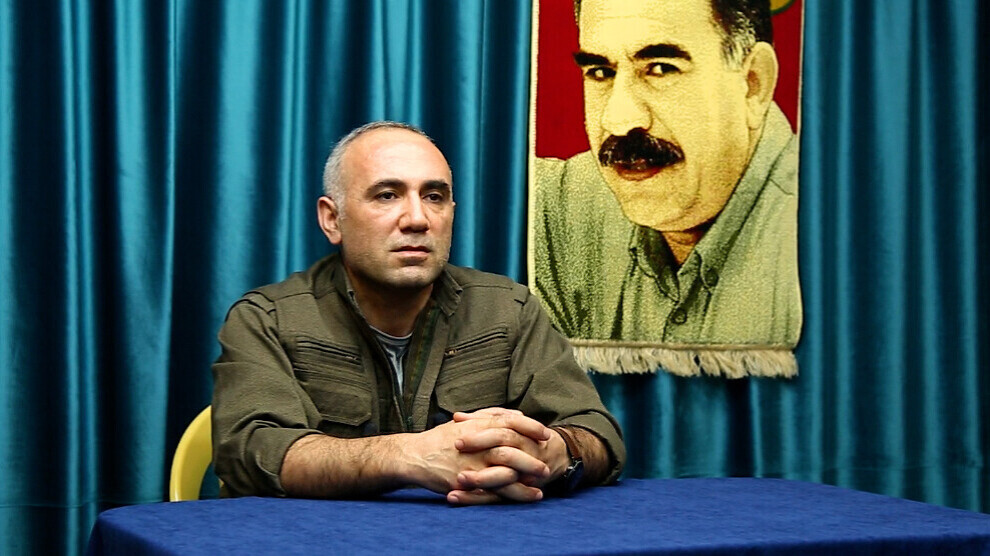
Xebat Andok, member of the KCK Executive Council, spoke about the anniversary of the global campaign ‘Freedom for Abdullah Öcalan, a Political Solution to the Kurdish Question’ as well as the anniversary of the beginning of the international conspiracy on 9 October 1998.

Andok pointed out: "Again, many forces fighting against the system and demanding freedom, justice, and democracy see Rêber Apo [Abdullah Öcalan] as their leader. In the past, Rêber Apo was a free man only for Kurdish women, but now he is a free man for all women who struggle for freedom."

The Kurdish people’s leader, Abdullah Ocalan, discussed in a broad manner and exposed the aims of those responsible for the international conspiracy of 9 October 1998, which was directed against him. He made great efforts to ensure that the conspiracy was researched and understood in depth. How do you evaluate the current situation in general?

I greet Rêber Apo with love, respect and longing. Also, I commemorate with gratitude and respect all the martyrs of the revolution, particularly those who gave their lives following the true meaning of the slogan “You cannot darken our sun!”. We reiterate our promise to the martyrs once again; we will definitely continue their path, and we will realize the goal of our martyrs.

As you mentioned, Rêber Apo is the one who analyzed the conspiracy the most, revealed its details, and assessed it in every sense. There are many evaluations of Rêber Apo that show us how to understand the conspiracy well; one can find them both in the prison writings and in the notes that were taken by those who had gone to Imrali. Those who are curious about the details of the conspiracy can read and learn from these evaluations of Rêber Apo. It has been 26 years since the conspiracy. Since then, the conspiracy has been constantly discussed. Why this conspiracy took place, against whom it was carried out, what the conjuncture was, how exactly it took place – all these questions are interconnected.

The conspiracy targeted our leader. Rêber Apo was the leader of the PKK when the conspiracy took place, which means that the conspiracy also targets the PKK. The Kurdish people see Rêber Apo as their leader, which means that the conspiracy also targets the free Kurds in the person of Rêber. Rêber Apo also represents the oppressed peoples. He is waging a socialist struggle based on democratic and communal values. This struggle is seen as hope for humanity. So, undoubtedly, this conspiracy was directed against democratic and communal values, against the ideology of socialism, and against all forces that oppose the system of capitalist modernity in general. All this reveals who the conspiracy was carried out against in a broad framework. Those who developed this conspiracy are the forces of capitalist modernity.

Rêber Apo has called it the great conspiracy of Gladio. Gladio is the core force of NATO – a force that wants to dominate societies. NATO is the military and political power of capitalist modernity. The conspiracy was carried out by the forces of capitalist modernity. In fact, Bulent Ecevit, the Turkish Prime Minister of that period, while evaluating the conspiracy, said, “We don’t understand why they gave Abdullah Ocalan to us.” Those who developed the conspiracy and handed over Rêber Apo to the Turkish state were, of course, the capitalist forces.

But why did the forces of capitalist modernity carry out such a conspiracy? Under which circumstances did this conspiracy take place? After the First World War, the capitalist powers deliberately created the Kurdish question and aimed to intervene in the Middle East through the Kurdish question when the time came. After the 1990s, these forces, led by America, Britain and Israel, wanted to intervene in the Middle East again. The Third World War has been going on in the Middle East ever since. It has been going on in the Middle East, centered in Kurdistan, after the collapse of the Soviet Union almost 35 years ago. When the forces of capitalist modernity saw that Rêber Apo and the PKK would not fit in their system, they decided to liquidate them.

When they intervened in the Middle East, they aimed to prevent those who struggled on behalf of the peoples, on behalf of society, and especially on behalf of the Kurdish people, from benefiting from this new process. Rêber Apo analyzed this period well, recognized the power vacuums, and knew how to utilize them. When it came to a new intervention in the Middle East, capitalist forces had to clear these obstacles out of the way. There were also some Kurds in Kurdistan who cooperated with them. It is the Barzani clan that supports and paves the way for what the forces of capitalist modernity want to do in Kurdistan. For the Kurdish people, this line drawn by the Barzani clan stands for collaboration, betrayal.

When the capitalist powers wanted to intervene in the Middle East, they paved the way for those who would serve their interests. The parliament in southern Kurdistan was also created on this basis, as was the power union there. The union they formed in the so-called South Kurdistan went to America in 1998 and signed the Washington Treaty against the PKK and Rêber Apo. They wanted to design a Kurdistan according to their own desire with this treaty. While we are fighting against Turkey, they also want to redesign this country according to their own desire. When they intervened in the Middle East, they realized that they could not do it if the PKK and Rêber Apo were in a very strong position. That’s why they also intervened in Turkey. What did they do? For example, after the abduction of Rêber Apo in 1999, they immediately took Fethullah Gulen to America. After a while, they paved the way for Erdogan and brought the AKP to power in order to realize the goals they aimed for through the conspiracy. In this way, they made a general intervention. The forces of capitalist modernity saw the PKK and Rêber Apo as an obstacle to their plans in the Middle East, so they developed the international ionspiracy. One of the aims of the conspiracy was the physical destruction of Rêber Apo. It was part of the so-called Greater Middle East Project. The bearers of this project are the forces of capitalist modernity.

Rêber Apo’s stance against the conspiracy is absolutely essential. He showed his difference by taking a stance that no one expected. In fact, Rêber Apo intervened against those who wanted to interfere with him through the conspiracy. How do you evaluate Rêber Apo’s stance?

When we look at it today, we must say that no one expected anything alike. I mean, it is easy to say that now, but considering the conditions at that time, no one knew how it would turn out. Everyone who saw Rêber Apo and the PKK as a hope was the target of the conspiracy. At the beginning, no one knew what to do. Everyone evaluated the conspiracy in their own way. But there were also Rêber Apo’s evaluations. And as you pointed out, they were very different. Both the Kurdish people, including us, the international friends of the Kurdish people, and the enemy were very surprised by these evaluations.

When the conspiracy developed, they put enormous pressure on the Syrian government to force Rêber Apo out of there. They filled the Mediterranean with warships; America put all its weight there. If Rêber Apo had not left Syria, they would have attacked and occupied Syria. Rêber Apo saw this at that time and left Syria, frustrating their plan. In this way, he prevented the conspirators from starting a regional war, invading Syria and paving the way for great suffering in the Middle East. So, Rêber Apo chose to leave Syria.

The conspirators were aiming to deepen the war in the Middle East. This would have happened if Rêber Apo had turned to the mountains, but he did not prefer that either, knowing that the war had reached a certain stage and that it had played his role. He wanted different paths to develop. On this basis, he turned to Europe. Because Europe sees itself as the cradle of democracy, claiming that it defends democratic values, law, and justice. Rêber Apo stated that Europe created this problem and that it was them who developed these massacre policies in Kurdistan. He basically told them: “If you talk about democracy, law, and justice all the time, then let’s take a look at the Kurdish people. Let’s solve this.” In this way, Rêber Apo revealed the true face of Europe. He unmasked them all. This was a different step. One that the capitalist powers didn’t expect to happen.

The forces of capitalist modernity abducted Rêber Apo on February 15, 1999. They wanted to physically destroy him. With his destruction, they aimed to create an endless war between Kurds and Turks. Because it was clear how the PKK and the Kurdish people would react. Our entire movement would have followed comrade Zilan. Because comrade Zilan set an example as early as 1996. She showed what kind of stance PKK militants would take when there was an attack on Rêber Apo. She determined the level of revolutionism, and this was valid for all the fedais and militants of the PKK. On this basis, all members of the party were ready to carry out sacrifices. The Kurdish people, with all their generations, were already on their feet. It was not clear what kind of action they would take. They were going to make the destruction of the leadership the cause of an unending Kurdish-Turkish war. Because Rêber Apo was aware of this, he frustrated this plan with his change of strategy and stance against the conspiracy in order to prevent a war between Kurds and Turks.

The capitalist powers failed here too. They wanted to provoke a regional war and through this occupy the region, but this did not happen. They thought that maybe Rêber Apo would head to the mountains and the war would deepen in this way, but Rêber Apo frustrated their plans and expectations. They wanted the physical destruction of the leadership, and on this basis they wanted to pave the way for a Kurdish-Turkish war. Rêber Apo prevented this goal of the capitalist forces by putting honorable peace on the agenda, especially with the stance he took in Imrali. At that time, Rêber Apo was sentenced to death, but as a result of the stance of the leadership, society, especially the Kurdish people, taking this stance as a basis and a joint struggle, the death penalty was removed from Turkish law in 2002. With the death penalty removed from the constitution, the goals of the conspirators were again not realized. On his own, Rêber Apo dealt with this conspiracy in a broad manner, revealing the aims, goals, and true faces of the conspirators. He struggled and resisted in the line of freedom and frustrated the aims of the conspirators by abolishing the death penalty in 2002.

It is obvious that Rêber Apo put up relentless resistance in Imrali. With his resistance, he developed a whole new paradigm. Rêber Apo describes the process of change in Imrali as a rebirth of him and the Kurdish people. How can this be understood?

As I said, the conspiracy was at a different stage until 2002. Within the first stage of the conspiracy, the physical destruction of the leader was the main goal; the second stage was to ideologically debunk, render meaningless, and neutralize him if he could not be physically destroyed. It wasn’t just about the physical destruction of someone, because there was a leader there, and if he didn’t play his role, if he didn’t lead, if he didn’t become a hope, and if he couldn’t liberate society, he would fall from his position as a leader. That is why they wanted to put Rêber Apo in such a situation under such conditions in Imrali. When he entered Imrali, he was the leader of a party, a people, but when we look at Imrali now, is he only the leader of the PKK, only the leader of the Kurdish people? No. When we look at it today, many peoples have recognized Rêber Apo and see him as their leader. Again, many forces fighting against the system and demanding freedom, justice, and democracy see Rêber Apo as their leader. In the past, Rêber Apo was a free man only for Kurdish women, but now he is a free man for all women who struggle for freedom. This means that the ideological stance of Rêber Apo in Imrali was deepened and broadened so much that it transcended the borders of the PKK and Kurdistan and became universal. This happened with a paradigm shift.

The biggest achievement in Imrali is the development of the democratic, ecological, and women’s libertarian paradigm by Rêber Apo. All those who struggle for democracy, freedom, free coexistence, and against the male-dominated system can achieve their goals with this paradigm. Until the new paradigm, the goals and objectives of the oppressed forces were correct, but their practices were not exactly in line with their goals. In other words, the paths and methods they preferred and took as a basis did not fully serve their goals. They strived for democracy, freedom, justice, and free coexistence; they were fighting for it, but they were not achieving any results. This is where the importance of the new paradigm emerges. The new paradigm determines the way and method according to the liberation of the oppressed. It creates a way and method outside the state. The solution to this is democratic autonomy. Society is multi-colored. Each color must be autonomous. No color should dominate over other colors. Rêber Apo presented such a paradigm to all the oppressed and showed them the ways and methods to achieve their goals. The oppressed peoples saw their salvation in this paradigm.

What kind of situation, precisely the rebirth described, has arisen through Rêber Apo’s efforts in Imrali? What is the significance, what is the extent of this process?

For example, thousands of people have been imprisoned in Kurdistan and Turkey. Rêber Apo says that if he had not come to Imrali, he would not have been able to achieve this deepening. One might wonder if it is the prison or the personality of Rêber Apo. If the prison had deepened, liberated, and empowered everyone like this, then everyone who was imprisoned would have deepened, empowered, liberated, and solved the problems of society. The trick is not in being in prison; the trick is in the personality of Rêber Apo. He is the same inside as he was outside. The difference in the prison is that outside, he was carrying out all the practical works of the PKK; he was following everything. Rêber Apo took care of all the cadres’ problems. He was preparing thousands of cadres. Rêber Apo was carrying out social and ideological work. Therefore, the opportunity to realize mental depth in the prison was greater for him than outside.

Obviously, when you are in the enemy’s house and don’t take a strong stance, the enemy will destroy you. That is to say, Rêber Apo took such a strong stance that it turned the enemy’s headquarters into a place that deepened and liberated himself and strengthened the PKK, women, and society. Rêber Apo has been under great attack since he was put in Imrali. He is frustrating these attacks with his resistance. Under these attacks, he created the new paradigm. Rêber Apo wrote a lot of prison writings and put forward the new paradigm. When he wrote the Sociology of Freedom, they put him in solitary confinement and increased the pressure even more. They didn’t give him pens or notebooks; they didn’t give him books at all. He prepared most of the prison writings under such difficult conditions. Tuncer Kilinc, the spokesperson of the Turkish National Security Council (MGK), said about Rêber Apo that they were creating an environment in which he would gradually deaden and die off, bit by bit, until he and his importance and influence would disappear. They wanted to make even breathing torture for him. But Rêber Apo managed to turn all this around and even use it to his advantage.

That is why his struggle in Imrali is so historic, great, and successful. When great people do great things, their enemies launch great attacks. But what matters is the result. Rêber Apo enlightened the Kurdish people with his struggle; the PKK, which the enemy back then gave a life expectancy of six months, still exists today, but those who gave it this life expectancy have disappeared. Today the PKK is much stronger than in the past. The Kurdish people did not know what to do when the conspiracy was launched. They probably thought that our leader would be destroyed and that they would be destroyed like in the past. But it didn’t happen like that. The struggle for freedom and existence today is being waged not only in northern but in all four parts of Kurdistan. The whole world recognizes Kurds today; millions of people say “Jin Jiyan Azadi.” Kurdish, which was defined as an ‘unknown language’ by the Turkish state, is now being used all over the world. This reality is in front of the eyes of everyone.

During the Imrali process, Rêber Apo said that there would be no more life and war as before. What needs to be done in order to correctly use and understand the ways and methods developed by Rêber Apo to nullify the conspiracy and to wage a correct struggle?

When we look at the conspiracy from the perspective of Rêber Apo, the conspiracy has been nullified. For example, like I said, the first main aim of the conspiracy carried out by capitalist modernity was physical destruction; they failed. Their second aim was to render Rêber Apo ideologically meaningless, but instead he deepened his ideological stance in Imrali and became a universal leader. Rêber Apo also frustrated this plan. That is why we say that the conspiracy was destroyed in the person of Rêber Apo. That is why they are afraid of Rêber Apo. They are already unable to reduce his influence; even though he is in their hands and under the most intense pressure, he still does not compromise his stance. The conspiratorial forces must be thinking about how Rêber Apo was when he was brought to Imrali and how he is now. The whole world sees Rêber Apo as a leader. Just recently, 69 Nobel laureates were demanding Rêber Apo’s physical freedom.

For 43 months there has been no news from Rêber Apo. This conspiracy proves that everything they had planned for Rêber Apo has been nullified. This is the success of Rêber Apo. Undoubtedly, there was the struggle of our people, our movement, and our international friends, but this was also due most essentially to the resistance stance of Rêber Apo. If Rêber Apo had not taken such a stance, the struggle would not have grown this much. They thought that with the liquidation of the leadership, the PKK and the free Kurds would be liquidated, and the Kurds would be eradicated. What does this situation show us? It means that success can be achieved with the stance of Rêber Apo against the international conspiracy. In other words, Rêber Apo succeeded against the conspiracy. If we also want to succeed, we will have to take the stance and style of Rêber Apo as a basis. The conspirators currently have the captivity and physical imprisonment of Rêber Apo. Other than that, they have not achieved their goals.

Who now has a role to play? The role of ensuring the physical freedom of Rêber Apo falls to the freedom movement, the Kurdish people, all women, and all oppressed societies. The fact that the conspirators are still trying to achieve their goals is not because of the stance of Rêber Apo, but because of the stance outside. There are deficiencies in the external struggle. The struggle to ensure the physical freedom of Rêber Apo and to frustrate the conspirators is not strong enough. There is no doubt that there is a strong struggle, but this result has not yet emerged. As I said, we can only achieve this result with the style of Rêber Apo. So how was Rêber Apo able to take such a strong stance against the conspirators? He mentions it in his prison writings. In fact, Rêber Apo achieved this in two ways: “First, I was with my society, because man is a social being. There can be no personal freedom. On this basis, I was going to unite my fate with the Kurdish people and Kurdistan.” This is very important.

Capitalist modernity is based on making people selfish. They have implemented this reality in such a way that people forget their mother, father, family, or society. It eliminates social identity, renders it meaningless, and leaves the personality. But Rêber Apo states that man is a social being. He states that the liberation of the individual can only be achieved through the liberation of society, and he fights against the system of capitalist modernity in a social way. Secondly, man is a developing being. This change-transformation also takes place in the mentality. In Imrali, Rêber Apo made himself the truth; he made himself the representation of right thinking. In short, he represents the truth. This means that if we act in the same way, we can achieve success.

A genocide decision has been taken against the Kurdish people. How can an individual in society accept this? Free Kurds do not accept the individualistic life offered by capitalist modernity; they have to embrace society. As such, their stance in life also changes. At the same time, the free Kurd also has to see the lie of a life offered by capitalist modernity. It is about seeing the true life and pursuing it. If the people become conscious, organized, and have the power to act on this basis, then this struggle against the international conspiracy will become stronger, the embrace of Rêber Apo will increase, the struggle based on his physical freedom will grow even more, and the capitalist powers will weaken in this way. In this sense, the current struggle against the conspiracy is incomplete; when it increases, people’s stance changes. This is what we need today.

Of course, we are much stronger than in the past. For example, today the number of those who take Rêber Apo as their basis has increased, the global campaign aiming for the physical freedom of Rêber Apo is being embraced all over the world, the Kurdish people are now more conscious and stronger, and the true face of the forces of capitalist modernity, the occupying forces, the collaborator-traitor Kurds has been exposed. If we wage a struggle outside the country that is equal to the stance of Rêber Apo, the international conspiracy will be defeated by us, just as it was defeated by Rêber Apo, and the conspiracy will be defeated in every sense. The hopes of the ruling powers to succeed will also be completely destroyed.
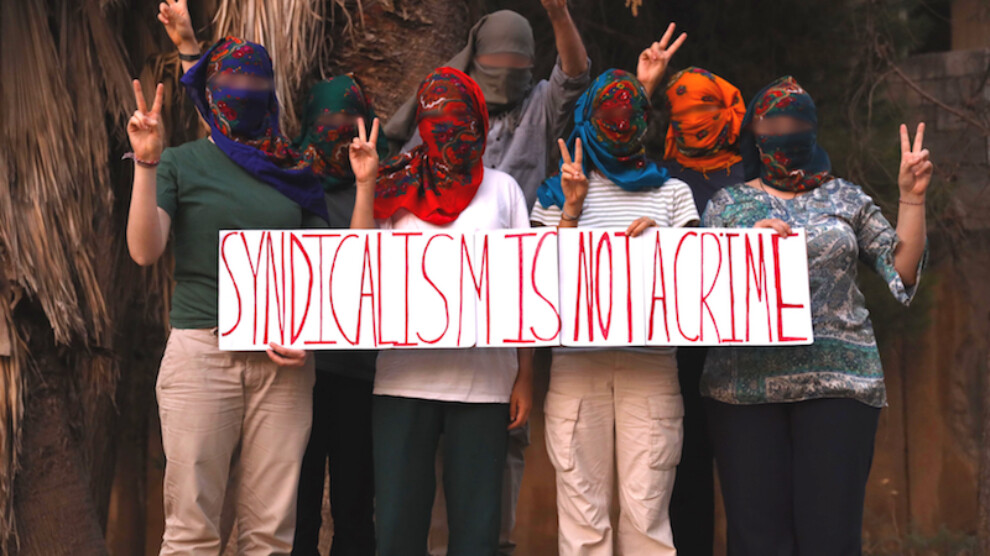
From Rojava to Xixón: Syndicalism is not a crime!

The Internationalist Commune of Rojava condemned the attack on six members of the Confederación Nacional del Trabajo (CNT) in the Spanish state.


ANF
NEWS DESK
Friday, 4 October 2024,

The Internationalist Commune of Rojava issued a statement to condemn the attack on six members of the Confederación Nacional del Trabajo (CNT). An attack, said the statement "that shows the Spanish state is widening its repression of unions in an attempt to weaken workers who fight for better conditions at work."

La Suiza Six are CNT members, 5 women and 1 man, who were involved to varying degrees in a trade union conflict that the CNT Xixón (Asturies) has with the bakery, La Suiza.

The statement said: "The case has been going on since 2017 after union members organised themselves to challenge the treatment of a worker at the bakery. One of the members of La Suiza Six is the worker herself, who was working in the bakery and brought to light the conditions she was working in. Some of the other members participated in the protests against the bakery. They received heavy sentences of three and a half years in prison and a fine of over €125,000 to compensate the bakery’s owner, €90,000 of which is for moral damages to the businessman and his wife and two adult children.

The workers fought the sentences and their legal battle brought the case to the Spanish state’s Supreme Court, but the court upheld the sentences on 24 June 2024."

More about the case here https://6delasuiza.info/#


The statement added: "Today, we answer the call from our friends in Spain and join with the hundreds of friends who’ve taken their own direct actions to denounce this ruling of a huge fine and time in prison.

From us here in Rojava to Xixón, Spain, we send our love, strength, and solidarity to La Suiza Six, CNT members, and all workers fighting for a better world."


OSTA expresses continued support for the global campaign for Öcalan’s freedom

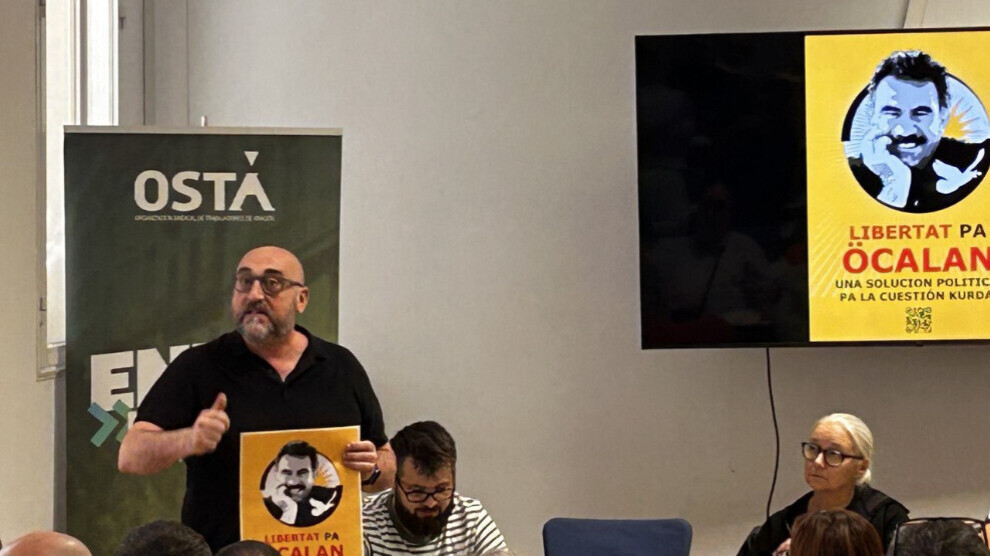
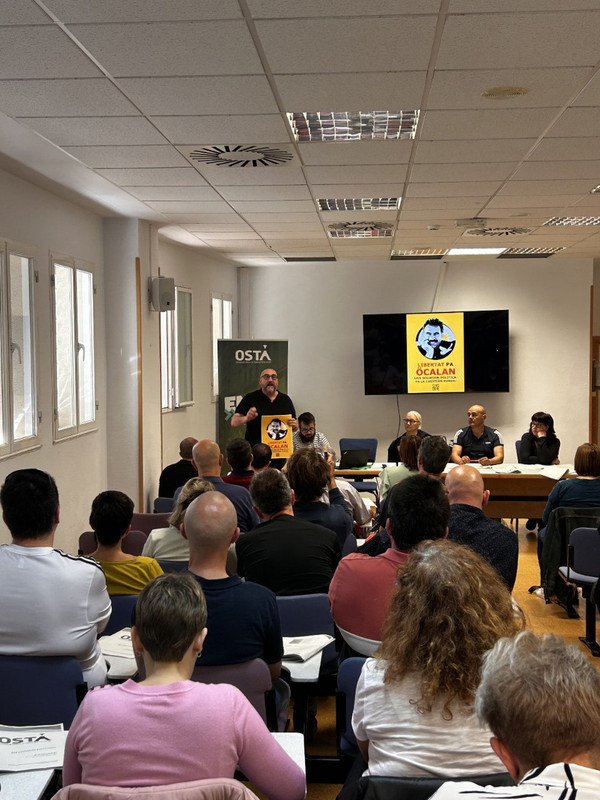
The Trade Union Organization of Workers of Aragon in Spain convened with a single agenda item titled “Freedom for Abdullah Öcalan”.


ANF
NEWS DESK
Friday, 4 October 2024, 17:2


The Trade Union Organization of Workers of Aragon (OSTA) held a meeting at the union building on the occasion of the first anniversary of the global campaign ‘Freedom for Abdullah Öcalan, a Political Solution to the Kurdish Question’. The only agenda item of the meeting, which was held with the participation of the executive board members of the union, was the global campaign that was launched globally on 10 October 2023.

After the meeting, Pedro Lebara, General Secretary of OSTA International Relations, made a statement on behalf of the union. The statement recalled that Abdullah Öcalan, a leader recognised as a political representative by millions of Kurds around the world, was kidnapped to Turkey in a conspiracy in 1999. Lebara reiterated OSTA's support for the international campaign ‘Freedom for Abdullah Öcalan, a Political Solution to the Kurdish Question’.


Pedro Lobera also recalled the campaigns in which the union participated, noting that they took part in a press release initiative organised in more than 70 cities, which aimed to publicise the situation of Abdullah Öcalan and the Kurdish people to the international community.

Pointing out that the situation to which Kurdish People's Leader Abdullah Öcalan is subjected is inhumane, Lebara said: “Serious rights violations and continuous human rights violations are taking place. In February 2024, we participated in a conference at the European Parliament in Brussels entitled ‘Where is peace going’ on the situation of political prisoners in Turkey, and in particular the imprisoned Kurdish leader Abdullah Öcalan. We also took part in a large demonstration in Cologne, Germany, demanding an end to the isolation of the Kurdish leader and revolutionary philosopher Abdullah Öcalan. Öcalan has been imprisoned on Imrali Island for 25 years and there are many political prisoners in Turkish prisons today for the same reason. In October, OSTA will continue to participate in the campaign to pressure the Turkish government to release Abdullah Öcalan and end hostilities against the Kurdish people.”

The union meeting ended with the slogan ‘Freedom for Abdullah Öcalan’.


KURDISH LIBERATION STRUGGLE

‘Freedom Shall Prevail’ promoted in London

The graphic novel ‘Freedom Shall Prevail’ about Abdullah Öcalan's life was promoted in London. Sean Michael Wilson, the award-winning author of the novel, said: “I learnt many things from the leader of the Kurdish people. I am a student of this book."


ANF
LONDON
Saturday, 5 October 2024

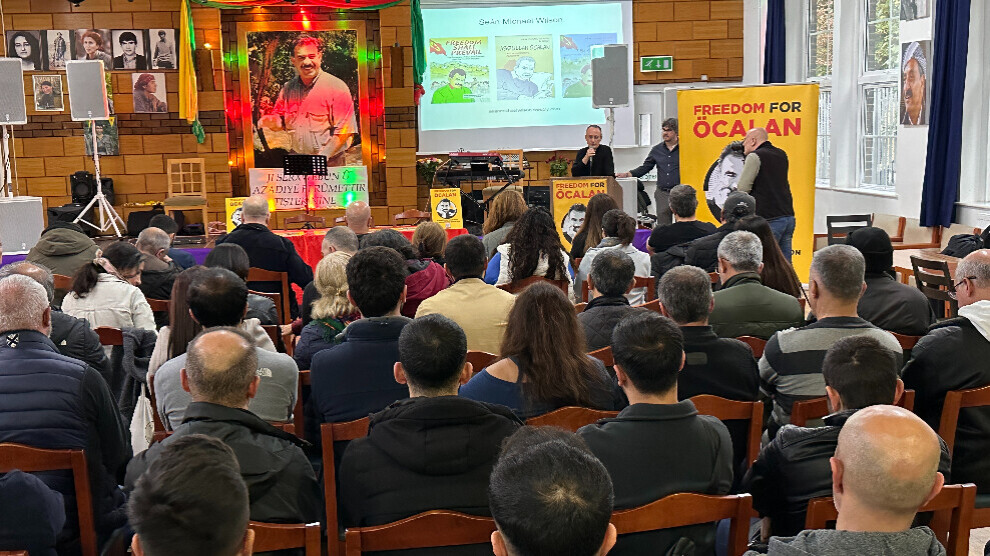
As part of the global Freedom for Abdullah Öcalan Days, a promotion meeting was held in London presenting the graphic novel ‘Freedom Shall Prevail: The Struggle of Abdullah Öcalan and the Kurdish People’.

The promotion meeting organised by the Foreign Affairs Committee of the Kurdish People's Assembly in Britain and the Freedom for Abdullah Öcalan Movement Committee at the Kurdish Community Centre (KCC) building was well attended. Scottish writer Sean Michael Wilson, the award-winning author of the graphic novel, and Reimar Heider from the International Initiative for the Freedom of Abdullah Öcalan attended the launch meeting.


Seyit Suruç, Co-Chair of the Kurdish People's Assembly in Britain, made the opening speech of the event, which started with a minute of silence in memory of the martyrs of the Kurdistan revolution. Drawing attention to the importance of the global campaign ‘Freedom for Abdullah Öcalan, a Political Solution to the Kurdish Question’, Suruç said: “The captivity of Leader Öcalan is the captivity of the Kurdish people. The freedom of the leader means the freedom of the Kurdish and Middle Eastern peoples.”

The graphic novel brings the new generation together with the Leader

The project editor of the book, Reimar Heider from the International Initiative for the Freedom of Abdullah Öcalan, pointed out that the new generation especially has difficulty with reading books and said, “We have tried to develop a more practical solution. We have created this graphic novel book which develops an easy and understandable reading.”

Noting that Kurdish People's Leader Abdullah Öcalan's influence on the Rojava revolution had a positive effect, Reimer said, “Unfortunately, Leader Öcalan did not have a direct connection with the new generation. In the ’90s, the Leader could address Kurds and the world directly on television. This graphic novel especially brings the new generation together with the Leader.”

Sean Michael Wilson, the author of the book, made a presentation on the process of the book. Wilson stated that the Democratic Confederalism paradigm is important for him and said: “I spent my childhood in Belfast. My interest in Kurdistan and Rojava is related to my childhood experiences. I can empathise between the times when the police-military pointed a gun at my face and what is happening in Kurdistan today. And Democratic Confederalism is a good example for society to get rid of this disease of capitalism and to heal.”

An important tool in terms of reaching the new generation

Remarking that he has written 45 graphic novels to date, including names such as Noam Chomsky and Jeremy Corbyn, Wilson said that the formation process of the book began when he met his Kurdish friend Estella Schmid at an event in Britain. Explaining the process of the book's formation and the techniques they used, Wilson said he was happy that there was great interest in the book, especially in Kurdistan. He stated that the book consists of two parts. The first part is about Abdullah Öcalan's childhood, and the second part is about Rojava and the Democratic Confederalism paradigm: “The new generation does not read many books. Comic books are used more. And this is an important tool in terms of reaching this new generation... This book was important in terms of showing the struggle in written and graphic novel form. In this book you can visually go back to Öcalan's childhood. The life experience of the leader during his childhood, his childhood among different peoples and his experience here turns into a paradigm and philosophy, and this is how the paradigm of Democratic Confederalism is shaped. And you will see that this experience has become vital in the paradigm of democratic confederalism.”

Stating that they could not include all the stages of Democratic Confederalism in the book, Wilson said, “Estella, one of the living main characters of the book, makes a simple sentence at the end of the book. She says ‘democratic organisation’ for all of us. This means that in Kurdistan, in Ireland, wherever we are, developing democracy locally and from below is the essence of Democratic Confederalism.”


Wilson's speech was followed by a question-and-answer session. The participants thanked Michael Wilson.

‘I am a student of this book’

Stating that the process of the book's creation was a studentship for him, Wilson said: “With this book, I got to know and read Abdullah Öcalan, the leader of the Kurdish people. I learnt about Abdullah Öcalan's enormous ideas. A graphic novel means being a student to learn about some struggles. I learnt many things from the leader of the Kurdish people. Being a writer is being a student. I am a student of this book.” Citing Noam Chomsky's remark ‘We need leaders with good ideas’, Wilson said: “Abdullah Öcalan is not just a good leader. Abdullah Öcalan is a good leader with good ideas.”

Signing the book, Wilson said that the Kurdish people and their leader taught him a lot and said, “Thank you for teaching me so much.”

The meeting continued with a cultural programme entitled ‘Let's unite around the ideas of Leader Öcalan’.

Participants of the event then danced to songs written for Kurdish People's Leader Abdullah Öcalan and the Kurdish freedom struggle.

Background

Freedom Shall Prevail is the first graphic novel exploring the life and struggle of Abdullah Öcalan, affectionately known as “Apo.”

Highly regarded around the world, Öcalan led the Kurdish freedom struggle as the head of the PKK from its foundation in 1978 until his abduction by the Turkish state in 1999. He has, so far, spent twenty-five years in captivity. In this graphic novel we learn, in his own words, what Öcalan’s childhood was like in the partially Kurdish areas of Eastern Turkey and how his political awareness and commitment grew as a student in the late 1960s and early 1970s. Through the personal struggle of Öcalan we also see the terrible devastation that Kurdish people have suffered and learn about the tumultuous and dramatic history of the relationship between the Kurds and the Turkish state.

The book also dives into the theories developed by Öcalan that continue to influence the ongoing struggle today. Expanding on these, the second part of the book gives us a wider consideration of the issues and policies around women's freedom, democratic confederalism and paints an inspiring picture of one of the most impressive attempts to build a genuinely grassroots democratic system anywhere in the world. The struggle going on in the Autonomous Administration of North and East Syria, also known as Rojava, is one that is directly combatting gender and racial discrimination and the abuses of the capitalist economic system—in truly interconnected ways.

The wonderfully illustrated graphic novel is a collaboration between award-winning Scottish writer Sean Michael Wilson and Kurdish artist Keko, with backing and research help from the Peace in Kurdistan Campaign and the International Initiative “Freedom for Abdullah Öcalan—Peace in Kurdistan,” groups with long-term and impassioned commitment to the cause of Öcalan and the Kurdish people’s freedom.


Internationalist Commune of Rojava republish letter by Öcalan about prison life on Imrali island

The Internationalist Commune of Rojava republished a letter from Abdullah Öcalan about the conditions in solitary confinement in Imrali.


ANF
NEWS DESK
Saturday, 5 October 2024, 12:02

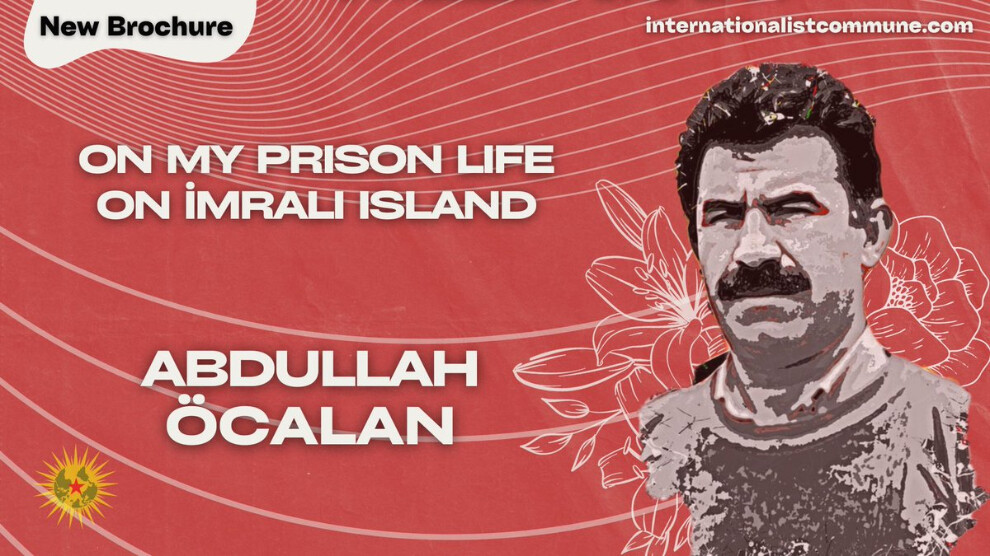
As part of the Global Free Öcalan Days, the Internationalist Commune of Rojava republished a brochure with a letter from Abdullah Öcalan about the conditions in solitary confinement and how he resists under these circumstances.

In the letter he wrote in 2011 to the European Court of Human Rights, Abdullah Öcalan outlines the conditions of his solitary confinement on Imralı Island, where he has been held since 1999. He describes the severe isolation, limited communication, and psychological challenges he faces, shedding light on his experiences & methods of resistance during over two decades of imprisonment.

Öcalan wrote: "I have now spent twelve years in solitary confinement on this island. İmralı is notorious as an island where highlevel state officials were put to serve sentences throughout history. The climate is both extremely humid and also harsh. It causes the body’s constitution to deteriorate physically. Add to this isolation in a closed room, and the debilitating effect on the constitution is amplified still more. Also, I was placed on this island as I was starting to age. I was detained under supervision of the Special Forces Command for a long time. I think it is about two years since the Ministry of Justice took over my supervision. I had no means of communicating with the outside world other than one book, one newspaper, and one magazine at a time, and a radio that only tuned to one station."
EXPLAINER

What’s at stake in Tunisia’s presidential election on Sunday?

And what is the political climate in the country under the leadership of President Kais Saied?

Tunisians take part in a protest against President Kais Saied on Friday, September 13, 2024 on Avenue Habib Bourguiba in the capital, Tunis. A banner in Arabic reads 'Where is sugar? Where is oil? Where is freedom? Where is democracy?' [Anis Mili/AP]

By Simon Speakman Cordall
Published On 5 Oct 2024

Sunday’s election in Tunisia will mark the first since President Kais Saied was elected to power as an independent with no prior political experience in 2019 and later extended his rule in a “self-coup” in July 2021. He suspended parliament, dismissed the prime minister, Hichem Mechichi, and assumed executive authority.

Rights groups, both international and domestic, have decried plummeting standards in civil liberties, freedom of speech and the waves of arbitrary arrests to have targeted the president’s critics and opponents under Saied’s presidency.

Recommended Storieslist of 4 itemslist 1 of 4
Algeria’s Tebboune re-elected president with 94.7 percent votelist 2 of 4
‘Reject AIPAC’: US progressives join forces against pro-Israel lobby grouplist 3 of 4
Why is Tunisia’s Administrative Court at odds with its electoral authority?list 4 of 4
Pezeshkian sworn in as Iran’s president, vows to work to remove sanctionsend of list

Nevertheless, against a backdrop of widespread public disillusionment with party politics, few doubt that Saied will be returned for a second term in an election widely regarded by observers at home and abroad as “rigged” in advance.
How far has Tunisia fallen?

A long way.

While far from perfect, Tunisia had long been hailed as the sole success of the series of 2011 revolutions that some observers termed the “Arab Spring”. In Tunisia, the uprising – referred to by some as the Jasmine Revolution – culminated in the ousting of dictator Zine El Abidine Ben Ali in January 2011.
Advertisement


In the wake of the revolution, the appetite for political engagement was almost tangible. Rights groups, NGOs and individual activists surged forward, eager to take part in a society that was rediscovering itself after years of autocracy.

Sign up for Al Jazeera
Weekly Newsletter
The latest news from around the world. Timely. Accurate. Fair.
Subscribe


By signing up, you agree to our Privacy Policyprotected by reCAPTCHA

Even the assassinations of two high profile politicians, Chokri Belaid and Mohamed Brahmi, in 2013 failed to derail the transition from autocracy to democracy, with tens of thousands of Tunisians returning to the streets to defend the gains made since 2011.

The unrest, rather than crush the hopes of 2011, prompted the intervention of four of the country’s major civil society organisations, the country’s general labour union, the UGTT; the commercial union, UTICA; the Tunisian Human Rights League, LTDH; and the bar association, ONAS – which together ensured parliamentary democracy withstood the shock and the transition remained on course.

The groups’ efforts were later recognised internationally, with each awarded the Nobel Peace Prize in 2015.

Were things in Tunisia perfect before Saied’s power grab?

Not really.

Tunisia’s democracy was messy. For the 10 years between Tunisia’s revolution and its current president’s power grab, the country experienced nine wildly unstable governments.

Against a background of ingrained unemployment, economic decline and religiously inspired unrest, Tunisia’s politicians faced accusations that they were prioritising self interest and alliance-building above firm action, not least in confronting the country’s security services and economy, which remained almost entirely unreformed.

Tunisia’s final parliament before its dissolution in 2021 proved to be especially chaotic. Arguments between the parliament’s members frequently turned violent, politicians staged sit-ins within the chamber and one member, Abir Moussi – a vocal opponent of Saied who was arrested in 2023 – arrived for a debate dressed in body armour and a crash helmet in May 2021.

Meanwhile, poverty, protests and social unrest were growing, causing popular disillusionment with party politics and, particularly, with the country’s dominant political party, the self-styled Muslim democrats, Ennahdha.

Still, this period saw Tunisia enact some landmark laws too.

Though its implementation has remained patchy, 2017 saw the parliament pass groundbreaking laws criminalising violence against women and girls. A year later — in a highly ironic move, given the current racially charged treatment of Black migrants — the parliament also oversaw the passing of a bill criminalising racism.

A supporter of Tunisian President Kais Saied holds his image along the Habib Bourguiba Avenue in Tunis, on Thursday, July 25, 2024. The protest commemorated the anniversary of Kais Saied consolidating his power in a constitutional coup, and was also the 67th anniversary of the foundation of the republic [Ons Abid/AP]


Can the election fix Tunisia’s problems?

It’s very unlikely to.

At present, including Saied, there are only three candidates in Sunday’s vote. One, Ayachi Zammel, is in prison, serving multiple sentences after being convicted of falsifying his electoral papers. The other, Zouhair Maghzaoui, prior to his candidacy, was a noted supporter of the president.

Fourteen other candidates for the presidential vote were rejected by the Independent High Authority for Elections (ISIE) earlier this year. However, at least three of those rejections were overturned by one of the country’s highest judicial bodies, the Administrative Court in September, casting further doubt on the credibility of the ISIE. The body had been restructured by Saied in April 2022 and has since been headed by presidential loyalist Farouk Bouasker.

In late September, the country’s parliament, which was reconstructed in 2022 to a constitution of Saied’s design, broke the deadlock, stripping the Administrative Court of its powers to oversee elections.

In addition to those candidates precluded by the ISIE are the many political figures and critics of the president who are languishing in jail on charges characterised by rights groups including Amnesty International of being “trumped up.”

Among those in prison are both the former Ennahdha leader, 83-year-old Rached Ghannouchi, and his archrival, Abir Moussi, leader of the pre-revolutionary continuation party, the Free Destourian Party (PDL).

President of Tunisia’s Free Destourian Party Abir Moussi speaks to the media during a protest in Tunis on November 20, 2021. She was arrested just over one year ago, on October 3, 2023 [Zoubeir Souissi/Reuters]

What about the judiciary?

Other than the Administrative Court, Tunisia’s judiciary has largely been neutered since Saied dissolved the elected High Judicial Council (HJC) in February 2022, replacing it with a body largely appointed by himself.

In June of the same year, the president also arbitrarily dismissed 57 judges. Their appeal against this dismissal was later approved by the Administrative Court in August of that year. However, none have resumed their posts.

More fundamentally, according to Amnesty, the 2022 constitution whose drafting was overseen by Saied, removed many of the safeguards for the judiciary to function with full independence and impartiality.
What about the press?

The media has largely been silent.

Many critics of President Saied or his allies have been jailed under the terms of Decree 54, a controversial piece of legislation passed in 2022 that essentially criminalises any public speech subsequently determined to be false.

Since its passing, according to Human Rights Watch, many of the country’s best-known critics have been jailed or subjected to judicial harassment under the terms of the 2022 legislation or some of the archaic laws left over from before the revolution.

The upshot has been to silence public criticism of the regime, with lifestyle shows taking the place of the political discussion programmes that once crowded the schedules and the national press returning to the standard of rigour formerly extended to the country’s autocrats.

What about civil society?

While public protest did follow Saied’s power grab, demonstrations were largely muted and eventually fizzled out.

Secular supporters of the former parliament refused to protest alongside their Islamist counterparts, while Tunisia’s wider activist community – long attuned to protesting against the members of the former parliament – proved markedly reluctant to demonstrate in their favour.

Over subsequent years, many civil society organisations, including those speaking on behalf of the thousands of migrants who often transit through Tunisia, have been shuttered and their leadership jailed.

Among those arrests were those of antiracism campaigner Saadia Mosbah, arrested in May on charges of financial crimes, and Sihem Ben Sedrine, the former head of the country’s Truth and Dignity Commission, the body charged with investigating the injustices of the former regime, who was jailed in August on charges of falsifying a report.

However, while small in scale compared with Tunisia’s previous mass demonstrations, protests have recently returned to the streets of the capital. In mid-September, thousands demonstrated against the president’s clampdown on freedom of speech and what many see as electoral interference. However, while the demonstrations have continued, none have rivalled the initial protests in scale.

Source: Al Jazeera