Pushing Back, Short-Term and Long
February 10, 2025
Source: The Crucial Years

The black half of this drawing is the logo for Sun Day, with huge thanks to Brian Collins, Eron Lutterman, and Beth Johnson. The orange half is illustrative of what we need from you right now—your drawing of the sun.
We’re a week in, and the Trump blitzkrieg has had its desired effect—everyone is stunned by the sweep and depth of the cruelty and silliness on display, bludgeoned into a kind of fish-faced silence because what, really, do you say to someone who has just by fiat renamed the Gulf of Mexico?
The attacks on sensible energy policy have been swift and savage. We exited the Paris climate accords, paused IRA spending, halted wind and solar projects, gutted the effort to help us transition to electric vehicles, lifted the pause on new LNG export projects, canceled the Climate Corps just as it was getting off the ground, and closed the various government agencies dedicated to environmental justice. Oh, and we declared an “energy emergency” to make it easier to do all of the above. “The dizzying pace of announcements gives the impression that the nation’s entire climate landscape has changed in less than a week,” Bloomberg reported (though as Lever News added, the Biden administration did succeed in shoveling a good deal of money out the door in its final weeks, dollars that will be hard for the new guys to claw back.)
I don’t plan on taking apart every one of these dumb decisions—I’ve written a lot about why they were worthy and important efforts, and in any event the Trump administration and the Congress are not responding to reason or evidence. As the Guardian just reported, Big Oil spent $445 million in the last election cycle, and they now have a firm grip on the controls of power. The question is how to erode that grip—which won’t happen in a week, or a year. It will take steady organizing, occurring against the stern backdrop of physics, which will be piling up climate damage even as we work. No easy answers or quick victories; November’s loss was deep and profound.
Some of the fronts on which we’ll fight are obvious. Lawyers from the big environmental groups are already heading to court to try and blunt the worst of Trump’s measures, many of which are blatant attempts to override statutory process engrained in federal law. We shall see how robust the commitment of our judiciary to that law remains.
And in blue states and cities we can continue to pass important legislation. I think the most promising measures may be modelled on New York’s recently adopted Climate Superfund “polluter pays” laws—a similar effort is now gaining steam for obvious reasons in California, and may be spreading to Illinois. These are huge economies; they matter. And there are lots and lots of other things to be done, some of which don’t require vast amounts of federal money—Manhattan’s new congestion pricing law, for instance, has produced 51% fewer crashes and injuries. There are a thousand such good ideas in the air, and places we can enact them.
But we have, I think, a bigger task, which is to shift the zeitgeist around energy.
For some time now, the climate movement has perceived a central task as resisting the depredations of the fossil fuel industry. Since those are manifold, it’s been important work, and often effective. As Cynthia Kaufman writes in an important new paper, activists have been attempting to undermine the power of Big Oil in many ways, from stopping pipelines to divesting pension funds. Power, she writes,
can be challenged in a piecemeal fashion, and a movement can move forward in a somewhat uncoordinated way, something like the game of Jenga, where supports for a structure are removed in a piecemeal fashion. As with the game of Jenga, it is never clear which undermining move will cause the tower to topple. But at some point, with enough challenges, the structure becomes unstable and small moves can have large consequences.
That’s been, I think, the theory that unites many of these efforts, and to a very great extent it worked: the IRA could not have been passed, for instance, without the two proceeding decades of resistance, most of which had nothing to do with the IRA.
But two things have changed. One is that the second Trump presidency seems to be unlike anything that came before it (including his ugly but befuddled first administration). We are seeing a triumph of illiberalism unlike anything in our recent history, when cruelty is not obscured but exalted. I think for me the single most disheartening news of the past week—not close to the most important, but somehow the most illustrative—was the news that the Air Force would no longer be telling its new recruits about the history of the Tuskegee Airmen. That is to say, our proto-fascists want to erase the history of men who fought fascism in Germany and, by their example, helped erode racism in America. (Co-president Musk this weekend called on Germans to “move beyond” any guilt over their history).
The at-least-temporary triumph of this kind of illiberalism narrows somewhat the scope for protest of the sort that’s been useful in the past. Much of the American tradition of nonviolent movement building draws on the epic history of the civil rights movement. We were reminded of that noble history this weekend when Thomas Gaither died at the age of 86. He’d helped to bravely pioneer the “jail no bail” tactics of the early sit-ins, opting for thirty days on the chain gang in Rock Hill South Carolina rather than pay a $100 fine, a gesture that made life difficult for southern sheriffs whose jails began to fill to overflowing, but also underscored the seriousness of the commitment of these young people. That commitment mattered enormously—in a fast-liberalizing country, which was America in the 1960s, it helped build the momentum that within a few years would pass the Civil Rights Act and the Voting Rights Act.
But we are not a liberalizing country right now—we’re closer to a reactionary one, where many people are consumed with grievance real or imagined. And so such gestures have less purchase on the broad center that defines political outcomes. That center is—again, at least for the moment—not broadly responding to this kind of sacrifice; indeed, the ascendant Trumpians welcome resistance so they can smash it, physically (the Proud Boys celebrated their release from jail this week with vows of revenge) and legally—I suspect that the sentences for protest going forward may not be thirty days, but closer to the brutal ones imposed last year on climate protesters in the UK, now languishing in jail for many years to come. (Here is the superb prison diary of one of these protesters, and here is the insane and maddening story of one of her colleagues, a 78-year-old woman returned to jail yesterday because the authorities couldn’t find an ankle or wrist monitor small enough to fit her bones).
It’s not that protest needs to end; it’s that we need to explore some new ways. And there’s plenty to choose from. If there’s one book I’d recommend spending some time with, just to stretch your thinking, it’s volume two of Gene Sharp’s Methods of Nonviolent Action—here, thanks to the War Resister’s League, is a crib sheet of his catalogue of 198 practices, most of which bear little resemblance to the canonical civil rights sit ins. Many of them won’t fit, because in a divided country they produce more anger than resolve. But some will—again, a guide from elsewhere can be found in the history of Otpor, the Serbian resistance movement that eventually overthrew the country’s totalitarian leader Slobodan Milosevic. As one of its leaders, Ivan Marcovic, told Waging Nonviolence last year:
When we started, society was largely in a state of despair and apathy. And that is why we decided to use hope as one of our major forms of messaging. People were like, “How can you be hopeful? It looks like things are getting worse by the day.” But we didn’t care how people reacted to the message of hope, or that they reacted with skepticism. What we were focused on was whether people had a need for hope — and they did. They desperately wanted to hope. They were skeptical because they didn’t want to get hurt or disappointed. Cynicism and apathy were at the surface, but below that was actually a common desire to live in a normal country. That’s why one of our slogans was “We want Serbia to be a normal country.” It was silly because just wanting things to be normal was kind of outrageous. But this is why persistence is important.
To me, that sounds a bit like where we are right now. Otpor famously used humor to make its points; I think that will be key here too (The Emperor’s New Clothes should be standard reading too).
And in the climate movement we have something else going for us. All those years of pipeline fights and divestment battles occurred in a period when fossil fuel was the cheapest way to power a society. That’s no longer true; now it’s Trump and his friends fighting uphill against economic gravity. And they know it—Trump moved so fast to ban new wind and solar—indeed to literally define ‘energy’ to exclude them—because every poll shows they are far more popular than hydrocarbons.
We need to figure out how to leverage those facts in the years ahead—creatively, in ways that make use of our advantage in truth and beauty and minimize our current lack of political power. That’ll be part two, and it may come with an assignment!
First things first—this is the most desperate moment I can remember in my life as an American, and neither I, nor anyone else, has any plan that’s going to fix it in short order.
Real and painful things are happening by the minute—just in our world of climate advocacy, as Zahra Hirji and Canielle Bochove made clear with excellent reporting this morning, illegal funding cutoffs have caused “confusion and panic among groups and researchers that work on clean energy, climate change and environmental justice.” If you’re a glutton for punishment, the Times has a litany of similar stories from IRA-funded projects across the nation. And that’s nothing compared to the trauma that immigrants, and transgender Americans, and federal workers, and overseas AIDS patients, and lots of others are feeling. Even for those who are not for the moment directly affected, the sight of Elon Musk and his minions enthusiastically trashing systems that took decades of careful bipartisan work to build is nauseating. W
That said, there are signs these last days that some kind of opposition is finally starting to find its feet—that the shock and awe are producing a reaction of gathering resolve. As groups like Third Act and Indivisible have flooded switchboards with calls and rallied outside the Treasury, some Congressional leaders have begun to find their voice. Predictably, it was the ever-eloquent Jamie Raskin who, outside the shuttered offices of USAID yesterday, summed it up with the first great line of this resistance: “There’s not a fourth branch of government called Elon Musk.”
The lawsuits are beginning to be filed—which is good, but also scary, since there’s no guarantee that if the courts stand up for the constitution, Trump will obey their rulings. (And if he doesn’t then God knows). Foreign leaders are finding a voice, too—it appears that the Canadians and Mexicans managed to call his bluff on tariffs, at least for now.
All of us need to keep up this pressure. I’ve been talking to Senators from across the country, but I’ve also been calling my state congressional offices daily—we don’t need, I keep telling them, another press release. “We need you, out in front like Raskin or AOC have been, speaking boldly and without fear.” There are other beautiful ideas emerging. Beginning tomorrow, a group called Choose Democracy is asking all of us to take one minute each Wednesday to pause for silent reflection on the damage being done—it’s happening at 12:53 p.m., which is the moment that thugs breached the Capitol on January 6, and also apparently the precise time that the billionaires took their seats for Trump’s inauguration. This won’t by itself do a thing—but as Ivan Marovic, the Serbian nonviolence guru, told a bunch of us the other night, in an authoritarian regime, simply paying witness is crucial. People will assemble at state capitols tomorrow; they rallied outside the Treasury this afternoon.
As is often the case, I think the political commentator Josh Marshall has sage advice. Our job is not to stop what Trump is doing, because we can’t. For the moment, he has the power he needs, though Congressional Democrats can find some small fingerholds—the need to extend the country’s debt ceiling, for instance—and use them to exact concessions. Our basic job is to make what he’s doing is deeply unpopular, because that will stiffen the backbone of the courts and any remaining moderate Republicans, and set us up for possible gains if and when we next have elections. So: witness, communicate, ridicule, amplify strong voices.
It’s defense, and in a moment like this defense is crucial.
But it’s also not enough. So I want to talk about the slightly longer term as well—about the chances for going on offense, especially on climate where the passage of time is literally deadly. We simply don’t have four years to lay on the ropes absorbing blows, because physics could care less about the political cycle: I mean, it was 20 degrees Celsius above normal at the North Pole today, which means ice was melting there in midwinter. So, we have to look for the place where we have an advantage, and then work like hell to exploit it. We have to go on offense too.
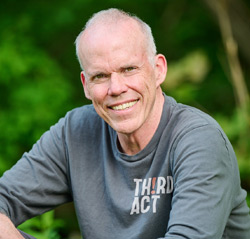
Bill McKibben is an author, environmentalist, and activist. In 1988 he wrote The End of Nature, the first book for a common audience about global warming. He is a co-founder and Senior Advisor at 350.org, an international climate campaign that works in 188 countries around the world.

The black half of this drawing is the logo for Sun Day, with huge thanks to Brian Collins, Eron Lutterman, and Beth Johnson. The orange half is illustrative of what we need from you right now—your drawing of the sun.
We’re a week in, and the Trump blitzkrieg has had its desired effect—everyone is stunned by the sweep and depth of the cruelty and silliness on display, bludgeoned into a kind of fish-faced silence because what, really, do you say to someone who has just by fiat renamed the Gulf of Mexico?
The attacks on sensible energy policy have been swift and savage. We exited the Paris climate accords, paused IRA spending, halted wind and solar projects, gutted the effort to help us transition to electric vehicles, lifted the pause on new LNG export projects, canceled the Climate Corps just as it was getting off the ground, and closed the various government agencies dedicated to environmental justice. Oh, and we declared an “energy emergency” to make it easier to do all of the above. “The dizzying pace of announcements gives the impression that the nation’s entire climate landscape has changed in less than a week,” Bloomberg reported (though as Lever News added, the Biden administration did succeed in shoveling a good deal of money out the door in its final weeks, dollars that will be hard for the new guys to claw back.)
I don’t plan on taking apart every one of these dumb decisions—I’ve written a lot about why they were worthy and important efforts, and in any event the Trump administration and the Congress are not responding to reason or evidence. As the Guardian just reported, Big Oil spent $445 million in the last election cycle, and they now have a firm grip on the controls of power. The question is how to erode that grip—which won’t happen in a week, or a year. It will take steady organizing, occurring against the stern backdrop of physics, which will be piling up climate damage even as we work. No easy answers or quick victories; November’s loss was deep and profound.
Some of the fronts on which we’ll fight are obvious. Lawyers from the big environmental groups are already heading to court to try and blunt the worst of Trump’s measures, many of which are blatant attempts to override statutory process engrained in federal law. We shall see how robust the commitment of our judiciary to that law remains.
And in blue states and cities we can continue to pass important legislation. I think the most promising measures may be modelled on New York’s recently adopted Climate Superfund “polluter pays” laws—a similar effort is now gaining steam for obvious reasons in California, and may be spreading to Illinois. These are huge economies; they matter. And there are lots and lots of other things to be done, some of which don’t require vast amounts of federal money—Manhattan’s new congestion pricing law, for instance, has produced 51% fewer crashes and injuries. There are a thousand such good ideas in the air, and places we can enact them.
But we have, I think, a bigger task, which is to shift the zeitgeist around energy.
For some time now, the climate movement has perceived a central task as resisting the depredations of the fossil fuel industry. Since those are manifold, it’s been important work, and often effective. As Cynthia Kaufman writes in an important new paper, activists have been attempting to undermine the power of Big Oil in many ways, from stopping pipelines to divesting pension funds. Power, she writes,
can be challenged in a piecemeal fashion, and a movement can move forward in a somewhat uncoordinated way, something like the game of Jenga, where supports for a structure are removed in a piecemeal fashion. As with the game of Jenga, it is never clear which undermining move will cause the tower to topple. But at some point, with enough challenges, the structure becomes unstable and small moves can have large consequences.
That’s been, I think, the theory that unites many of these efforts, and to a very great extent it worked: the IRA could not have been passed, for instance, without the two proceeding decades of resistance, most of which had nothing to do with the IRA.
But two things have changed. One is that the second Trump presidency seems to be unlike anything that came before it (including his ugly but befuddled first administration). We are seeing a triumph of illiberalism unlike anything in our recent history, when cruelty is not obscured but exalted. I think for me the single most disheartening news of the past week—not close to the most important, but somehow the most illustrative—was the news that the Air Force would no longer be telling its new recruits about the history of the Tuskegee Airmen. That is to say, our proto-fascists want to erase the history of men who fought fascism in Germany and, by their example, helped erode racism in America. (Co-president Musk this weekend called on Germans to “move beyond” any guilt over their history).
The at-least-temporary triumph of this kind of illiberalism narrows somewhat the scope for protest of the sort that’s been useful in the past. Much of the American tradition of nonviolent movement building draws on the epic history of the civil rights movement. We were reminded of that noble history this weekend when Thomas Gaither died at the age of 86. He’d helped to bravely pioneer the “jail no bail” tactics of the early sit-ins, opting for thirty days on the chain gang in Rock Hill South Carolina rather than pay a $100 fine, a gesture that made life difficult for southern sheriffs whose jails began to fill to overflowing, but also underscored the seriousness of the commitment of these young people. That commitment mattered enormously—in a fast-liberalizing country, which was America in the 1960s, it helped build the momentum that within a few years would pass the Civil Rights Act and the Voting Rights Act.
But we are not a liberalizing country right now—we’re closer to a reactionary one, where many people are consumed with grievance real or imagined. And so such gestures have less purchase on the broad center that defines political outcomes. That center is—again, at least for the moment—not broadly responding to this kind of sacrifice; indeed, the ascendant Trumpians welcome resistance so they can smash it, physically (the Proud Boys celebrated their release from jail this week with vows of revenge) and legally—I suspect that the sentences for protest going forward may not be thirty days, but closer to the brutal ones imposed last year on climate protesters in the UK, now languishing in jail for many years to come. (Here is the superb prison diary of one of these protesters, and here is the insane and maddening story of one of her colleagues, a 78-year-old woman returned to jail yesterday because the authorities couldn’t find an ankle or wrist monitor small enough to fit her bones).
It’s not that protest needs to end; it’s that we need to explore some new ways. And there’s plenty to choose from. If there’s one book I’d recommend spending some time with, just to stretch your thinking, it’s volume two of Gene Sharp’s Methods of Nonviolent Action—here, thanks to the War Resister’s League, is a crib sheet of his catalogue of 198 practices, most of which bear little resemblance to the canonical civil rights sit ins. Many of them won’t fit, because in a divided country they produce more anger than resolve. But some will—again, a guide from elsewhere can be found in the history of Otpor, the Serbian resistance movement that eventually overthrew the country’s totalitarian leader Slobodan Milosevic. As one of its leaders, Ivan Marcovic, told Waging Nonviolence last year:
When we started, society was largely in a state of despair and apathy. And that is why we decided to use hope as one of our major forms of messaging. People were like, “How can you be hopeful? It looks like things are getting worse by the day.” But we didn’t care how people reacted to the message of hope, or that they reacted with skepticism. What we were focused on was whether people had a need for hope — and they did. They desperately wanted to hope. They were skeptical because they didn’t want to get hurt or disappointed. Cynicism and apathy were at the surface, but below that was actually a common desire to live in a normal country. That’s why one of our slogans was “We want Serbia to be a normal country.” It was silly because just wanting things to be normal was kind of outrageous. But this is why persistence is important.
To me, that sounds a bit like where we are right now. Otpor famously used humor to make its points; I think that will be key here too (The Emperor’s New Clothes should be standard reading too).
And in the climate movement we have something else going for us. All those years of pipeline fights and divestment battles occurred in a period when fossil fuel was the cheapest way to power a society. That’s no longer true; now it’s Trump and his friends fighting uphill against economic gravity. And they know it—Trump moved so fast to ban new wind and solar—indeed to literally define ‘energy’ to exclude them—because every poll shows they are far more popular than hydrocarbons.
We need to figure out how to leverage those facts in the years ahead—creatively, in ways that make use of our advantage in truth and beauty and minimize our current lack of political power. That’ll be part two, and it may come with an assignment!
First things first—this is the most desperate moment I can remember in my life as an American, and neither I, nor anyone else, has any plan that’s going to fix it in short order.
Real and painful things are happening by the minute—just in our world of climate advocacy, as Zahra Hirji and Canielle Bochove made clear with excellent reporting this morning, illegal funding cutoffs have caused “confusion and panic among groups and researchers that work on clean energy, climate change and environmental justice.” If you’re a glutton for punishment, the Times has a litany of similar stories from IRA-funded projects across the nation. And that’s nothing compared to the trauma that immigrants, and transgender Americans, and federal workers, and overseas AIDS patients, and lots of others are feeling. Even for those who are not for the moment directly affected, the sight of Elon Musk and his minions enthusiastically trashing systems that took decades of careful bipartisan work to build is nauseating. W
That said, there are signs these last days that some kind of opposition is finally starting to find its feet—that the shock and awe are producing a reaction of gathering resolve. As groups like Third Act and Indivisible have flooded switchboards with calls and rallied outside the Treasury, some Congressional leaders have begun to find their voice. Predictably, it was the ever-eloquent Jamie Raskin who, outside the shuttered offices of USAID yesterday, summed it up with the first great line of this resistance: “There’s not a fourth branch of government called Elon Musk.”
The lawsuits are beginning to be filed—which is good, but also scary, since there’s no guarantee that if the courts stand up for the constitution, Trump will obey their rulings. (And if he doesn’t then God knows). Foreign leaders are finding a voice, too—it appears that the Canadians and Mexicans managed to call his bluff on tariffs, at least for now.
All of us need to keep up this pressure. I’ve been talking to Senators from across the country, but I’ve also been calling my state congressional offices daily—we don’t need, I keep telling them, another press release. “We need you, out in front like Raskin or AOC have been, speaking boldly and without fear.” There are other beautiful ideas emerging. Beginning tomorrow, a group called Choose Democracy is asking all of us to take one minute each Wednesday to pause for silent reflection on the damage being done—it’s happening at 12:53 p.m., which is the moment that thugs breached the Capitol on January 6, and also apparently the precise time that the billionaires took their seats for Trump’s inauguration. This won’t by itself do a thing—but as Ivan Marovic, the Serbian nonviolence guru, told a bunch of us the other night, in an authoritarian regime, simply paying witness is crucial. People will assemble at state capitols tomorrow; they rallied outside the Treasury this afternoon.
As is often the case, I think the political commentator Josh Marshall has sage advice. Our job is not to stop what Trump is doing, because we can’t. For the moment, he has the power he needs, though Congressional Democrats can find some small fingerholds—the need to extend the country’s debt ceiling, for instance—and use them to exact concessions. Our basic job is to make what he’s doing is deeply unpopular, because that will stiffen the backbone of the courts and any remaining moderate Republicans, and set us up for possible gains if and when we next have elections. So: witness, communicate, ridicule, amplify strong voices.
It’s defense, and in a moment like this defense is crucial.
But it’s also not enough. So I want to talk about the slightly longer term as well—about the chances for going on offense, especially on climate where the passage of time is literally deadly. We simply don’t have four years to lay on the ropes absorbing blows, because physics could care less about the political cycle: I mean, it was 20 degrees Celsius above normal at the North Pole today, which means ice was melting there in midwinter. So, we have to look for the place where we have an advantage, and then work like hell to exploit it. We have to go on offense too.
Bill McKibben is an author, environmentalist, and activist. In 1988 he wrote The End of Nature, the first book for a common audience about global warming. He is a co-founder and Senior Advisor at 350.org, an international climate campaign that works in 188 countries around the world.