Monday, February 17, 2025

NAKBA 2.0

Watchdog says plans advancing for nearly 1,000 more settler homes in West Bank

Peace Now accuses government of operating ‘on steroids’ to establish facts on the ground even as hostages languish in captivity in Gaza

By AP and ToI Staff
Today

View of Efrat and its surroundings on a winter day, in Gush Etzion, in the West Bank on January 18, 2021. (Gershon Elinson/Flash90)

Israel issued a tender for the construction of nearly 1,000 additional settler homes in the West Bank, an anti-settlement watchdog said Monday.

Peace Now said the development of 974 new housing units would allow the population of the Efrat settlement to expand by 40 percent and further block the development of the nearby Palestinian city of Bethlehem. The project, approved last year, will increase the land area of Efrat by 644 dunams (160 acres), Peace Now said, expanding the settlement’s footprint by about 10%.


Hagit Ofran, who leads the group’s settlement monitoring, said construction can begin after the contracting process and issuing of permits, which could take another year at least.

The left-wing Peace Now, which favors a negotiated two-state solution to the Iraeli-Palestinian conflict, accused Prime Minister Benjamin Netanyahu’s government of pressing ahead with settlement construction while dozens of hostages captured in Hamas’s October 7, 2023, invasion languish in captivity in the Gaza Strip.

“While the people of Israel (set) their sights on the release of the hostages and an end to the war, the Netanyahu government is operating ‘on steroids’ to establish facts on the ground that will destroy the chance for peace and compromise,” it said in a statement.

On October 7, 2023, Palestinian terror group Hamas led thousands of terrorists to invade southern Israel, killing 1,200 people, abducting 251 as hostages to Gaza, and triggering war.

A complex and fragile three-stage ceasefire that began last month includes the release of hostages.


View of houses in the West Bank settlement of Efrat, south of Jerusalem. October 25, 2021. (Gershon Elinson/Flash90)

Last year the Civil Administration’s High Planning Subcommittee approved 3,500 new settlement homes across the West Bank including 694 in Efrat.

In its statement, Peace Now claimed there would be also be an additional 280 units for assisted living.

Israel captured the West Bank, along with the Gaza Strip and East Jerusalem, in the 1967 Six Day War. The Palestinians want all three territories for their future state and view the settlements as a major obstacle to peace, a position with wide international support. According to Peace Now, Efrat juts into territory that would be needed by the Palestinians for a contiguous state in the northern and southern West Bank.

Israel has annexed East Jerusalem and sees it as part of its unified capital.

US President Donald Trump lent unprecedented support to the settlements during his previous term and also moved the US embassy to the capital. Israel has also steadily expanded settlements during Democratic administrations, which were more critical but rarely took any action to curb them.
JEP’s Ruling: The Unresolved Dilemma of Armed Groups and Environmental Impact


17.02.25 | 
Opinio Juris

[Carolina Trejos (LLM in Public International Law) is a consultant at the Special Jurisdiction of Peace, on macro-case 07 regarding child recruitment. She was a legal fellow at the Center for Reproductive Rights and interned at Women’s Link Worldwide and the Inter-America Commission of Human Rights.]

Introduction

On February 2023, the Special Jurisdiction of Peace (JEP), the transitional justice tribunal in Colombia, released Rule 01 of 2023. This groundbreaking decision criminalises environmental harms committed by the former guerrilla Fuerzas Armadas Revolucionarias de Colombia (FARC) as war crimes. The judgment is a valuable opportunity for International Criminal Law (ICL) to start listening to the different affectations of crimes against nature and to evaluate the complex relationship of Non-State Armed Groups (NSAGs) with the environment.

This post questions specific aspects of the decision, particularly emphasizing the need for a clear definition of environmental crimes. It argues that a distinction must be made between acts linked to armed conflict and those constituting ecocide as a separate offence from war crimes. The post concludes with a brief reflection on the characterization of NSAGs solely as “ecocides,” highlighting that in some regions, these groups have also played a crucial role in conserving resources for civilian populations.

Questionable Points of the JEP’s Decision

In its decision, the JEP recognises that the FARC was the “State” in the zones of Cauca North and Valle del Cauca South at the time of the facts. It even acknowledges that they exercised dual power, on the one hand, military and, on the other hand, social, economic and political power over the civilian population. In the norm, they considered themselves a type of “green rebel governance”. However, the JEP argues that from a real-life approach, such guerrilla either actively supported or turned a blind eye to illegal mining and the unlawful expansion of the agricultural frontier (P. 489-502).

The judgment relates the main three activities as war crimes: First, illegal and legal mining activity with severe impacts on primary forests using backhoe loaders. The prosecutor mentioned that they recollected a tax to allow these activities in the zone. Secondly, the alteration of land for the cultivation of illicit drugs occurred without adherence to any environmental regulations. Finally, the attacks and invasion of the Páramo zones (protected areas in Colombia) with camp setups and the installation of antipersonnel mines caused significant disruption and environmental harm.

The Tribunal made no significant distinction among the three acts as war crimes during the judicial qualification. Instead, it lumps them into the “anti-green” package of conducts in Section G.2.37. The decision states that those activities were the economic motor of violence to the extent that capturing their revenues was a strategic objective of the guerrilla. However, the Tribunal does not clarify where the funds were directed or what specific purposes they served.

The Nexus Dilemma

The decision’s discussion of the nexus is vague. It consists of four paragraphs in the general part of the judgment without further specifying why the three conducts mentioned are related to the armed conflict (Para 781-784). As this decision pioneered criminalising crimes against nature, the nexus dilemma should have been evaluated thoroughly.

War crimes are grave breaches of IHL and thus are conducts “closely related to the conflict”. The Elements of the Crime of the Rome Statute defines them as acts which “took place in the context of and were associated with an international armed conflict”. Associated suggests that the conduct is in relation to the conflict but not necessarily in the middle of the battlefield. As stated by the ICTY in the Kunarac case, “a violation of the laws or customs of war may therefore occur at a time when and in a place where no fighting is actually taking place”.

Some of the widely known elements to define the nexus requirement in Kunarac Appeals Judgment include that the perpetrator is a combatant, the victim is a noncombatant, and the fact that the victim is a member of the opposing party. However, a commonly overlooked element, as in the JEP’s decision, is that the conduct serves the ultimate goal of the military campaign. Rule 01 of 2023 does not specify how the recollection of taxes for legal and illegal mining or the high deforestation produced to cultivate illicit crops is connected to a series of military operations.

It’s reasonable to state that military activities that the FARC-Ep took inside the Páramos are closely related to the conflict, and in fact, they can amount to war crimes if other criteria are met. The nexus requirement is fulfilled if the conducts are “directed towards the actual war-fighting capabilities of a party to the conflict” (P.340). Nevertheless, illegal mining and cultivation of illicit crops, as much damage as they caused, could only indirectly sustain the war effort. And yet, this is still conditional on the JEP’s ability to demonstrate that these activities were indeed financing military actions and were not aimed at supporting daily life activities in the controlled territory.

In that sense, the decision’s major drawback is accurately distinguishing between actions that cause significant environmental damage due to hostilities or military campaigns, those indirectly financing war efforts, and those resulting from everyday activities in guerrilla-controlled territories. In the second category, there is the majority of conduct that JEP described under the section on war crimes.

Ecocide: Autonomous from War Crimes but Near to IEL

One of the JEP’s main strengths is the diversity of national and international sources it can use to define conduct related to the conflict. The Legislative Act 01 of 2017 provides that the Tribunal may base charges on the Criminal National Code, International Human Rights Law, IHL, and ICL. Unfortunately, there is no mention of International Environmental Law (IEL), but this does not imply that it cannot be utilised as an interpretive tool.

The JEP could have based its assessment on national legislation and used the category of “crimes against nature” in the Criminal Code instead of focusing only on the category of war crimes. In particular, former Article 328 of the Criminal Code, applicable at the time of the conduct, punishes the unlawful use of natural resources. Activities causing significant environmental damage to support the economic revenue of armed groups’ military operations may be prosecuted under these domestic rules.

Moreover, in 2022, it was introduced into national law the crime of Ecocide, which aims to punish any severe impact on the natural environment or the natural resources, disassociating it from war effort activities. The JEP cannot use this provision since it is outside the time of the facts under its jurisdiction. Nonetheless, it still has an important deterrence effect for armed groups currently operating in some zones. Most notably, the “seriousness” of the consequences stemming from the damage can be evaluated through international environmental frameworks, offering a clearer and more predictable application of the norm.

One key element that IEL can contribute to prosecuting NSAG for “anti-green” crimes is precisely evaluating their capabilities to avoid, predict, or mitigate environmental damage. As Sassoli pointed out, the aim is not to impose unrealistic rules on NSAGs or to punish them for failing to comply with impossible standards designed mainly for States. On the contrary, IEL instruments look into the abilities of the party to carry out a harm analysis rather than imposing a unique standard. Thus, to evaluate the wrongfulness of the NSAG’s conduct, it’s crucial to consider their limitations based on the adaptability provided by IEL.

Beyond the Criminalisation towards Green Rebel Governance

Regarding the governance of NSAGs, there’s no definitive right or wrong answer concerning their environmental conduct. In other words, labelling all utilisation of natural resources in their territorial control as ecocide or internationally criminalised overshadows the substantial range of different legal and social responses. Therefore, it would have been worthwhile for the JEP to explore the relationship between FARC’s governance and the territory beyond criminalisation.

IHL does not have rules about regulating natural resources in non-international armed conflicts (NIACs). This is because States couldn’t conceive that NSAGs had access to the State’s resources or implemented government tasks in the territory under their control. Arguably, one may apply Article 4(2)(g) of Additional Protocol II about the prohibition of pillage to hold NSAGs responsible for exploiting conflict resources. Indeed, the International Court of Justice (ICJ) in the Armed Activities on the territory of Congo Judgment, took this approach about the exploitation of natural resources by the conflict’s parties. However, this provision was not designed to cover situations where such exploitation goes beyond the self-interest of NSAGs and for the benefit of the civilian population under their control.

From a purely policy perspective, regulating natural resources should contemplate their sustainable exploitation by NSAGs, mainly when intended to benefit the civilian population. In this regard, Dam-de Jong argues that not all exploitation of natural resources by NSAGs should be deemed illegal. She states, “an exception can be envisaged for small-scale natural resources exploitation that would enable armed groups to ensure the continuation of daily life in the territories under their control” (P.184). She supports her argument by relying on the Namibia Advisory Opinion by the ICJ, which considers the legality of acts conducted by illegal regimes based on the welfare of the civilian population under their control.

There is a range of contradictions regarding the environment and the activities of the former FARC. In the case under JEP’s jurisdiction, egregious acts against nature have highly impacted the population, especially indigenous communities who have a special link with the Páramo Territories. For example, military activities in specially protected areas, contamination of water sources, and widespread deforestation for illicit crops are activities that should undoubtedly be prosecuted as ecocide (or war crimes, if the required nexus is met).

Nonetheless, these acts are not enough to define the relationship between the FARC-Ep and the exploitation of natural resources. According to the Crisis Group, in numerous regions, the FARC implemented explicit regulations accompanied by corresponding penalties for transgressions, aiming to curb deforestation and other detrimental practices. Some local FARC commanders also perceived a responsibility to safeguard the environment for the welfare of small-scale farmers (P.5). Moreover, they also took actions viewed as restorative, such as planting food crops in relation to coca cultivation. In those last cases, it may be worth exploring if the Namibia principle may be applica
South Korea bans new DeepSeek AI downloads


João da Silva
Business reporter
BBC ASIA


South Korea has banned new downloads of China's DeepSeek artificial intelligence (AI) chatbot, according to the country's personal data protection watchdog.

The government agency said the AI model will become available again to South Korean users when "improvements and remedies" are made to ensure it complies with the country's personal data protection laws.

In the week after it made global headlines, DeepSeek became hugely popular in South Korea leaping to the top of app stores with over a million weekly users.

But its rise in popularity also attracted scrutiny from countries around the world which have imposed restrictions on the app over privacy and national security concerns.


South Korea's Personal Information Protection Commission said the DeepSeek app became unavailable on Apple's App Store and Google Play on Saturday evening.

It came after several South Korean government agencies banned their employees from downloading the chatbot to their work devices.

South Korea's acting president Choi Sang-mok has described Deepseek as a "shock", that could impact the country's industries, beyond AI.

Despite the suspension of new downloads, people who already have it on their phones will be able to continue using it or they may just access it via DeepSeek's website.

'DeepSeek moved me to tears': How young Chinese find therapy in AI


DeepSeek: The Chinese AI app that has the world talking


DeepSeek: How China's 'AI heroes' overcame US curbs to stun Silicon Valley


China's Deepseek rocked the technology industry, the markets and America's confidence in its AI leadership, when it released its latest app at the end of last month.

Its rapid rise as one of the world's favourite AI chatbots sparked concerns in different jurisdictions.

Aside from South Korea, Taiwan and Australia have also banned it from all government devices.

Italy's regulator, which briefly banned ChatGPT in 2023, has done the same with DeepSeek, which has been asked to address concerns over its privacy policy before it becomes available again on app stores.

Meanwhile, lawmakers in the US have proposed a bill banning DeepSeek from federal devices, citing surveillance concerns.

At the state-government level, Texas, Virginia and New York, have already introduced such rules for their employees.

DeepSeek's "large language model" (LLM) has reasoning capabilities that are comparable to US models such as OpenAI's o1, but reportedly requires a fraction of the cost to train and run.

That has raised questions about the billions of dollars being invested into AI infrastructure in the US and elsewhere.

Additional reporting by Jean Mackenzie in Seoul
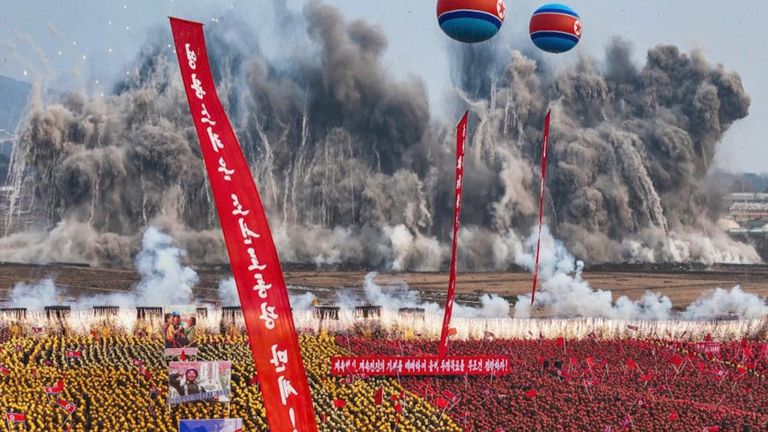
North Korea leader Kim Jong Un triggers huge explosion in capital for construction project

The development in the Hwasong suburb of Pyongyang aims to build 10,000 flats, part of a five-year project to construct 50,000 new apartments.

THEY DON'T HAVE NUKES BUT THEY DO HAVE ULTRA HIGH EXPLOSIVES

Monday 17 February 2025 08:39, UK

A huge blast, detonated by Kim Jong Un, created enormous clouds of dust and smoke. Pics: Korean Central News Agency (KCNA)


North Korea's leader Kim Jong Un has detonated explosives creating a massive blast during a groundbreaking ceremony at a construction site in the capital, state-run media has reported.
Footage showed Mr Kim making a speech in Pyongyang on Sunday, surrounded by enthusiastically cheering crowds, before twisting a switch to ignite explosions.
The blast threw enormous clouds of dust and smoke into the air.

Mr Kim addressing crowds of people, reportedly construction workers

The project in the Hwasong suburb aims to build 10,000 flats, part of a five-year plan to construct 50,000 new apartments.

He addressed hundreds of people, reportedly construction workers, who were standing in coordinated sections.

They had been assembled with matching hard hats to create colourful sections in the crowds.

Enthusiastic crowds waved flags, clapped and cheered as Mr Kim arrived for the groundbreaking ceremony

"The Hwasong area will soon become more famous not only as a cradle of the happy and civilised life of the people but as a land of history, which tells new miraculous tales of indomitable socialist Korea," Mr Kim said in a speech translated by the state-run Korean Central News Agency (KCNA).

Canadian warship in Taiwan Strait ‘undermines peace: China

 GUNBOAT DIPLOMACY & NATO IMPERIALISM

Canadian warship in Taiwan Strait ‘undermines peace: China

TEHRAN, Feb. 17 (MNA) – A Canadian warship passing through the Taiwan Strait “undermines peace” in the sensitive waterway, China’s military said Monday.

Beijing views self-ruled Taiwan as a renegade province and claims jurisdiction over the body of water that separates the island from the Chinese mainland, AFP reported.

The Canadian vessel passed through the strait on Sunday and was the first to do so this year, Taiwan’s foreign ministry said, coming days after two US ships made the passage.

Canada’s actions “deliberately stir up trouble and undermine peace and stability across the Taiwan Strait,” Li Xi, a spokesperson for the Eastern Theater Command of the Chinese People’s Liberation Army (PLA), said in a statement.

The army had dispatched its naval and air forces to monitor and guard the passage of the ship, Li said, adding that the troops will “resolutely counter all threats and provocations.”

The United States and its allies regularly pass through the 180-kilometer (112-mile) strait to reinforce its status as an international waterway, angering China.

A US destroyer and an ocean survey ship traveled through the strait starting on February 10, drawing criticism from China’s military, which said it sent the “wrong signal and increased security risks.”

Washington’s latest passage through the strait was the first since US President Donald Trump took office in January.

Taiwan’s defense ministry, meanwhile, said it recorded 41 Chinese aircraft and nine warships near the island in the 24 hours to 6:00 am on Monday.

Beijing has never ruled Taiwan, but it claims the island as part of its territory and has threatened to bring it under its control by force.

SD/

News ID 228451


China says Canada 'deliberately stirred up trouble' with warship sailing in Taiwan Strait

Canadian ship was monitored and warned by naval and air forces, China says

A row of flags is pictured.
China's military on Monday condemned the sailing of a Canadian warship in the Taiwan Strait, saying its air and naval forces had monitored and warned the ship. (Adrian Wyld/The Canadian Press)Social Sharing

China's military on Monday condemned the sailing of a Canadian warship in the Taiwan Strait, saying its air and naval forces had monitored and warned the ship, a mission that came just a few days after U.S. navy ships made a similar mission.

The U.S. navy, and occasionally ships from allied countries like Canada, Britain and France, transits the strait about once a month. China, which claims Taiwan as its own territory, also says the strategic waterway belongs to it.

Canada's actions "deliberately stirred up trouble" and undermined peace and stability in the strait, the People's Liberation Army's Eastern Theatre Command said in a statement.

"Theatre forces maintain a high level of alert at all times and resolutely counter all threats and provocations," it added.

There was no immediate response by Global Affairs Canada to the Chinese statement.

A ship.
HMCS Ottawa approaching the Taiwan Strait in September 2023. Both the Chinese and Taiwanese governments identified the ship that recently sailed in the Taiwan Strait as the Ottawa. (Lyzaville Sale/CBC)

Both the Chinese and Taiwanese governments identified the ship as HMCS Ottawa.

Taiwan's Defence Ministry said on Sunday that the ship had sailed in a northerly direction, adding that Taiwanese forces also kept watch.

Taiwan's Ministry of Foreign Affairs welcomed the sailing.

"Canada has once again taken concrete actions to defend the freedom, peace and openness of the Taiwan Strait and has demonstrated its firm position that the Taiwan Strait is international waters," it said on Sunday.

Last October, a U.S. and a Canadian warship sailed together through the strait, less than a week after China conducted a new round of war games around the island.

Taiwan's democratically elected government rejects Beijing's sovereignty claims, saying only the island's people can decide their future.


Canadian warship’s Taiwan Straits transit
sends wrong signals but poses little threat:
expert

By Liu Xuanzun
 Feb 17, 2025 
GLOBAL TI MES CH.

A view of the Taiwan Straits is seen from Xiamen port, in East China's Fujian Province. Photo: IC

The island of Taiwan's external affairs authority said that a Canadian frigate sailed through the Taiwan Straits on Sunday while its defense authority claimed it detected 24 Chinese People's Liberation Army (PLA) aircraft conducting joint training with PLA vessels on the same day. A Chinese mainland expert said on Sunday that the Canadian warship sent wrong signals to "Taiwan independence" secessionist forces, but posed little military threat.

Taiwan's external affairs authority said in a statement that the Royal Canadian Navy's Halifax-class frigate HMCS Ottawa sailed through the Taiwan Straits on Sunday, AFP reported.

Citing the island's defense authority, AFP further claimed that 24 PLA aircraft, including fighter jets and drones, were detected carrying "joint combat readiness patrols" with military vessels around the island.

During the Canadian warship's passage, the PLA radioed the ship and warned it to change course, AFP reported, citing media on the island of Taiwan.

Song Zhongping, a Chinese mainland military expert, told the Global Times on Sunday that the Canadian warship's Taiwan Straits transit has sent wrong signals to Taiwan authorities, creating the illusion that they can rely on external countries in seeking "independence."

The Taiwan question concerns China's core interests, Song said, noting that China is fully capable of resolving the Taiwan question, and no one can prevent its resolution.

The HMCS Ottawa has been operating in waters near China since the beginning of the year. Canadian news outlet CTV National News reported that PLA warships tracked the Canadian frigate in the East China Sea and the South China Sea in January.

Song noted that a single Canadian warship poses little threat to China in military terms, and it is normal and legitimate that the PLA monitors its movements on China's doorsteps.

Less than a week earlier, the PLA announced that it monitored the transit of two US warships through the Taiwan Straits.

From February 10 to Wednesday, the US destroyer USS Ralph Johnson and the oceanographic survey ship USNS Bowditch transited the Taiwan Straits. The PLA Eastern Theater Command deployed naval and air forces to monitor the entire passage of the US vessels, effectively responding to and managing the situation, said Senior Captain Li Xi, spokesperson for the PLA Eastern Theater Command, on Wednesday.

The US' actions sent wrong signals and increased security risks. The Eastern Theater Command remains on high alert, resolutely safeguarding national sovereignty and security, as well as regional peace and stability, Li stressed.
HIGH SEAS MONOPOLY CAPITALI$M 

Powerhouse: OSM Thome

The 2023 merger of OSM Maritime and the Thome Group created a ship management powerhouse. That was just the beginning.

Courtesy OSM Thome

Published Feb 16, 2025 2:39 PM by Tony Munoz


(Article originally published in Nov/Dec 2024 edition.)

It’s been a good – no, an exceptional year – for OSM Thome, marked by significant growth, strategic achievements and new opportunities in the maritime and offshore sectors. It all began with the merger of OSM Maritime and the Thome Group a year earlier.

“The merger between OSM Maritime and the Thome Group has been a success,” says Finn Amund Norbye, CEO of OSM Thome. “It was driven by a strategy to create a company of scale capable of meeting the increasing demands of the maritime industry. By combining resources, expertise and a global presence, we’ve strengthened our ability to serve clients across a diverse range of vessels and operations.”

It also positioned OSM Thome to lead in key areas such as sustainability, digitalization and regulatory compliance.

With shared Norwegian roots and 96 years of combined experience between the two merged companies, OSM Thome today ranks as the third largest ship management company in fleet size and the leading ship management, crew management and marine services company.

But it’s more than that. By uniting OSM’s innovation and operational excellence with Thome’s deep commitment to quality, sustainability and strong client relationships, OSM Thome stands as a leader in navigating the complexities of today’s maritime landscape and shaping the industry’s future.

That leadership is embodied in the company’s logo – a two-colored arrowhead pointing upward and symbolizing the company’s forward-looking approach and cutting-edge technology. The two colors – blue and red – are taken from the Norwegian flag. They symbolize two equal partners joining forces to create an even stronger ship management powerhouse with a clear strategy of promoting a sustainable future in maritime.

“The new branding is a physical representation of our commitment to providing the highest standards of safety, quality and reliability to our clients,” says Norbye.

It extends to the company’s culture as well. Following the merger, the company co-created its Vision, Mission and Values to reflect its unified identity and ambitious future. The Vision, "Leading Excellence at Sea," speaks to its drive to set new benchmarks in maritime management and operations. Its Mission is to be a trusted industry powerhouse – one that clients rely on, communities respect and employees proudly call home.

At the heart of OSM Thome are its Values: Safety, Transparency, Relationships and Innovation. These values guide every decision, fostering trust, embracing teamwork, advancing sustainability and putting people at the forefront. Together, they form the foundation for a shared purpose, inspiring passion and excellence in everything OSM Thome does.

Services

The company offers a broad range of services, and its clients represent a diverse range of sectors within the industry – from tankers and bulkers to chemical carriers, shuttle and offshore vessels. It consciously selects markets where its expertise can deliver the most value, focusing on segments that demand specialized skills and high-quality management.

Services are divided into three main business units – Technical Management/Ship Management, Crew Management and Marine Services. The Marine Services unit encompasses a variety of offerings and subsidiaries including OSERV Maritime Catering, Axia Maritime Procurement and Energia Global Travel.

Offshore wind is an increasingly important area of focus.

As the global transition to renewable energy accelerates, OSM Thome is leveraging its extensive experience in offshore operations to support this growing sector. Services include managing vessels specifically designed for offshore wind projects like service operation vessels (SOVs) and wind turbine installation vessels (WTIVs). The company’s expertise in technical and crew management, combined with its commitment to sustainability, positions it as a trusted partner in advancing clean energy initiatives.

And despite its significant size, it prioritizes a personalized approach for each client. Its decentralized structure empowers local teams to make decisions that align with the specific requirements and cultural nuances of the regions they serve, ensuring customized solutions that uphold the highest standards of quality and efficiency.

By serving a broad spectrum of shipping and offshore industries, OSM Thome remains adaptable to shifting market dynamics while playing an active role in shaping the future of maritime and offshore energy.

Seafarers

Seafarers are a critical component of the company’s success.

“At OSM Thome,” says Norbye, “we recognize that our crew is our most valuable asset, and we are committed to sourcing and training seafarers who embody our values.”

The company has recruitment offices in more than 20 countries, ensuring good access and close interaction with seafarers and enabling it to connect with a diverse pool of talent across more than 70 nationalities. An extensive digital platform with over 150,000 registered seafarer profiles provides additional opportunity to efficiently match qualified candidates with specific vessel requirements.

When it comes to training and development, the OSM Thome Maritime Leaders Academy (MLA) in the Philippines serves as a central pillar, focusing on the training and development of competent seafarers. MLA’s programs are regularly updated to comply with new legislation, onboard technologies and best practices, ensuring crew personnel are well-prepared to operate vessels safely and efficiently.

Going beyond training, the company strives to create an inclusive and supportive work environment, emphasizing the well-being and professional growth of its seafarers. “Our commitment to safety, transparency and fostering strong relationships reflects our dedication to being a ‘preferred employer’ in the maritime industry,” Norbye states.

It’s a well-known fact that the global maritime industry faces a significant shortfall of trained seafarers in the next few years. To help mitigate this challenge, OSM Thome is actively enhancing its recruitment and training initiatives to promote gender diversity and attract new talent to the industry.

By investing heavily in its crew and maintaining high standards, OSM Thome aims to ensure a sustainable and competent workforce for the future.

Growth Through Consolidation

Building on its steady growth, in October OSM Thome acquired Norwegian-based Klaveness Ship Management. The move adds to its expanding portfolio of offerings and reaffirmed its commitment to a strategy of growth through consolidation.

“The recent acquisition of Klaveness Ship Management reflects our strategic approach to growth through consolidation,” explains Norbye, “allowing us to enhance our capabilities and expand into a new and interesting shipping segment of environmentally efficient combination vessels. It aligns with our commitment to providing comprehensive and innovative solutions to our clients.”

The ship management industry is undergoing significant transformation, driven by key trends like digitalization, sustainability and increased collaboration.

Digital technologies are revolutionizing operations, enabling real-time monitoring, predictive maintenance and data-driven decision-making. Sustainability has become a central focus with the industry striving to reduce emissions and adopt environmentally friendly practices in response to global environmental concerns. Collaboration among industry stakeholders is also on the rise, fostering shared knowledge and resources to address complex challenges.

“At OSM Thome, we’re committed to leading these trends,” Norbye says. “We’re investing in advanced digital tools to optimize vessel performance and operational efficiency. Our sustainability initiatives aim to minimize environmental impact and promote green shipping practices. Additionally, we actively seek partnerships and collaborative opportunities to drive innovation and set new industry standards.”

By embracing these developments, the company aims to not only adapt to the evolving landscape but also to shape the future of ship management, ensuring it continues to meet the needs of clients and the industry at large.

The Road Ahead

Looking ahead to 2025, OSM Thome is optimistic about maintaining the current momentum.

“Our clients’ trust and our team’s dedication are the cornerstone of our success,” Norbye says.

The company will continue to identify strategic partnerships and potential acquisitions that will drive future growth and innovation and create value for clients. It will focus on expanding service offerings, enhancing operational efficiency and deepening the commitment to sustainability by exploring new technologies and investing in talent development.

“I’m a strong believer in our business, and we are excited to lead the industry into the future.”

Tony Munoz is Founder, Publisher & Editor-in-Chief of The Maritime Executive.

The opinions expressed herein are the author's and not necessarily those of The Maritime Executive.


Op-Ed: Economic Coercion is On the Rise

Port
iStock

Published Feb 16, 2025 8:04 PM by The Strategist


[By David Uren]

The rising use of economic coercion is a symptom of an increasingly unstable world that is struggling to contain rise of China and is no longer bound by the institutions established in the wake of World War II.

US President Donald Trump’s scattergun threats of punitive tariffs are a continuation of this trend. The Biden administration redoubled use of export controls to slow the spread of US technology to China. The West coordinated sanctions on Russia over its invasion of Ukraine, including the appropriation of its foreign exchange reserves. And China has repeatedly used boycotts and regulatory punishments targeting businesses of nations that have displeased it.

US legal firm Gibson Dunn, which tracks the use of economic coercion, says the Biden administration pursued "the most aggressive and far-reaching use of international trade tools of any US administration in history." The number of individual designations under the US economic sanctions regime more than doubled to 16,400 in the past four years, with 3300 names added just last year.

The United States intensified its financial squeeze on Russia last year, imposing secondary sanctions on financial institutions of third countries that facilitated transactions with Russia’s military or industry, even if they had no knowledge of the prohibited activity.

The Biden administration also expanded the use of export controls on technology sales to China to cover artificial intelligence, quantum computing and chip-making equipment. A new development was a restriction on outbound investment in Chinese advanced technology businesses.

It is early days, but the Trump administration shows signs of further intensifying economic coercion. In its first three weeks, it issued direct threats of punitive tariffs on Canada and Mexico, demanding tighter border control on migration and fentanyl, and on Colombia, demanding it abandon its rejection of military deportation flights. Canada, Mexico and Colombia all took steps to appease the US.

Trump has also threatened punitive tariffs on Denmark and Panama, if they fail to hand over Greenland and the Panama Canal respectively. He has directed similar threats towards Egypt and Jordan if they fail to accept relocation of the Palestinian population.

The new administration is yet to spell out its policy towards Russia. However, Trump threatened ‘high-level taxes, tariffs, and sanctions’ if it refused to negotiate over Ukraine.

The administration has also reinstated strict sanctions on Iran, including secondary sanctions on foreign organizations facilitating Iranian trade. It is unclear whether this will extend to Chinese banks, which the Biden administration was reluctant to attack. Furthermore, Trump has rescinded a deal negotiated by the Vatican under which the US would relax sanctions on Cuba and remove its designation as a sponsor of terrorism in return for the release of political prisoners.

China is ramping up export controls on critical minerals. Last December it banned the export of germanium and gallium, used for microchips, and antimony, used for ammunition, to the US. This month it added a requirement for government approval on the export of five further metals, including tungsten.

China is also restricting the export of critical minerals processing technology, which could affect planned rare earths and lithium processing plants in Australia.

Economic coercion has been accelerating alongside globalization since the mid-1980s. As trade rose from 15 percent to 25 percent of global GDP, it became an attractive target. According to the historian Nicholas Mulder, sanctions were used twice as much in the 1990s and the 2000s as in the period from 1950 to 1985. Their use had doubled again by 2010. It has likely more than doubled once more since Russia’s attacks on Ukraine.

International trade agreements matter little when powerful nations use economic coercion. China ignored its 2015 trade agreement with Australia when it imposed bans on Australian exports. The US’s latest tariffs on aluminium and steel which have been justified on national security grounds, ignore both its trade agreement with Mexico and Canada and World Trade Organisation (WTO) standards.

China has foreshadowed a complaint to the WTO over the US’s 10 percent tariff on Chinese exports. However, the US has effectively shut down the organization’s appeal panel as presidents, starting with Barack Obama, have refused to approve new members. The US contends that the WTO has facilitated the rise of China at the expense of US manufacturing.

During the first Trump administration, legislation was drafted to withdraw from the WTO. Now, an executive order that establishes a review of US participation in all multilateral organizations will likely confirm US withdrawal. The governor of the Bank of England, Andrew Bailey, has expressed concern that the review may also lead US to pull out of the International Monetary Fund and the World Bank.

Those organizations and the General Agreement on Tariffs and Trade, the predecessor of the WTO, were established in 1944 to avert the sort of breakdown in international economic relations that created the conditions for WWII. Seventy years on, they are proving to be inadequate brakes on the rise of economic hostility.

David Uren is an ASPI senior fellow. This article appears courtesy of The Strategist and may be found in its original form here.

The opinions expressed herein are the author's and not necessarily those of The Maritime Executive.


Why the IMO Must Tighten Rules On Shipping’s Carbon Emissions

Vessel
iStock

Published Feb 16, 2025 4:02 PM by John Maggs


The International shipping sector provides an outsized and growing contribution to the climate crisis. Slower, more efficient ships can help slash climate emissions, but this will not happen without ambitious regulation.

Fortunately, the International Maritime Organization’s (IMO) current revision of the rules around its Carbon Intensity Indicator, a metric for measuring and regulating ships’ carbon emissions provides such an opportunity. Governments are consulting and reviewing evidence on barriers to efficiency and potential solutions, with a final decision on improving the indicator due by January 1, 2026. 

If properly designed, these new rules could address almost half of shipping’s climate impacts and deliver massive ocean health co-benefits. But the outcome is far from certain.

The scope of the problem

The vast majority of internationally traded goods travel by ship, and these massive ships burn a lot of fuel. As a result, the shipping industry generates around three per cent of all climate emissions globally—a contribution equivalent to that of the whole economy of a country like Germany or Japan. 

Ships also undermine ocean health. I am not just talking about the environmental harm caused by oil spills when a tanker runs aground or sinks. As we have seen recently in the Black Sea this remains a very serious problem, but ships are also responsible for a myriad of other routine yet damaging operational practices—some legal, some not—that threaten ocean wildlife: oil and chemical discharges, toxic paint coatings, underwater noise pollution, sewage and grey water discharges, and the dumping of plastics, to name just a few.

Human health is also threatened, with an estimated 250,000 deaths and millions of childhood asthma cases annually caused by toxic air pollution from fossil-fuel powered shipping.

In all these areas, regulation has failed to keep up with the growth of the industry. Sporadic and weak measures mean the problem keeps getting worse.

Turning the page?

The Carbon Intensity Indicator revision provides the IMO with an important opportunity to address both the climate and ocean health impacts of global shipping and turn the tide on some of these problems.

By far the most effective way to reduce ship climate impacts is to slow ships down. A ten per cent speed reduction can lower the emissions of an individual ship’s journey by almost 20% per cent. Even though this will mean, in some cases, using additional ships, there are still large net emission reduction benefits. What’s more, slowing ships down can happen immediately—we don’t need new technology just to take our foot off the gas pedal. 

We must also look at wind power. In a case of “back to the future,” new high-tech sails can dramatically reduce fuel burn (and thus emissions) on existing ships, and can go even further when new ships are designed from scratch to use wind as their primary means of propulsion. No other transport mode can harness wind power directly in this way - it is shipping’s climate crisis superpower. 

Most underwater noise pollution is caused by ship propellers, compromising the ability of whales and other marine life to forage and reproduce. Using sails and slowing ships down has a dramatic effect on noise levels, and slower ships are also less likely to strike and kill whales and other marine wildlife. 

Any action that reduces the amount of fuel burned not only reduces climate emissions, but also cuts emissions of everything connected to burning fuel, including the particulates that are harmful to human health. The oily sludge that ship fuels generate, which sadly still often ends up being discharged illegally at sea, is also reduced. 

Reducing fuel burn also decreases the volume of toxic waste produced by the exhaust gas cleaning systems, known as scrubbers, that shipowners are installing to avoid using cleaner fuels. This shocking new waste stream is largely unregulated and dwarfs other shipping pollution in terms of volume.

An outsider looking in could easily assume that ship owners would operate their vessels more efficiently purely out of self interest and a desire to minimise costs, but there are a number of factors working against this.

For instance, there’s industry’s “split incentive” - whereby the entity responsible for the technical efficiency of a ship and its equipment isn’t always the one paying for the fuel. 

Inefficient ship operation is also often written into long-established conventions and contractual arrangements—the most famous one being the instruction in charter agreements to travel at "utmost dispatch” (quickly) and then wait at the destination if you get there too early. Slowing down and arriving on time would make more sense, and have a massive impact on climate emissions, but would also be a breach of the agreement.

And in a booming market when few ships are without work, an individual owner acting from a business perspective might prefer to speed up and squeeze in an extra trip. Unfortunately, this is the worst approach from a climate, environment and ocean health point of view.

It is rare that a single measure or regulation holds the potential to have such wide-ranging positive impacts on the climate and environmental footprint of an industry. The revision of the IMO’s Carbon Intensity Indicator truly holds the possibility to set the shipping industry on a much more sustainable course. 

This week’s IMO meeting, which is set to discuss the shipping sector’s impact on the global climate (Intersessional Working Group on Reduction of Greenhouse Gas Emissions from Ships - ISWG-GHG 18) must agree on an ambitious set of new climate measures, including a global zero- and near-zero GHG fuel standard, along with a levy on ship emissions to drive emission reductions and ensure a just climate transition for international shipping. 

However, to keep the cost of the shipping energy transition down and see to it that emission cuts happen quickly enough to meet the IMO GHG strategy’s 2030 and 2040 goals, these measures must be aligned with an ambitious, transparent and enforceable energy efficiency measure. To build a more ocean-friendly shipping industry, governments must close their ears to “special pleading” from industry and make sure both the fuel standard and levy align with the concurrent IMO’s Carbon Intensity Indicator revision, ahead of April’s Intersessional Working Group on Air Pollution and Energy Efficiency.

John Maggs is a board member of the Clean Shipping Coalition and is the coalition’s accredited representative at the International Maritime Organization.

The opinions expressed herein are the author's and not necessarily those of The Maritime Executive.


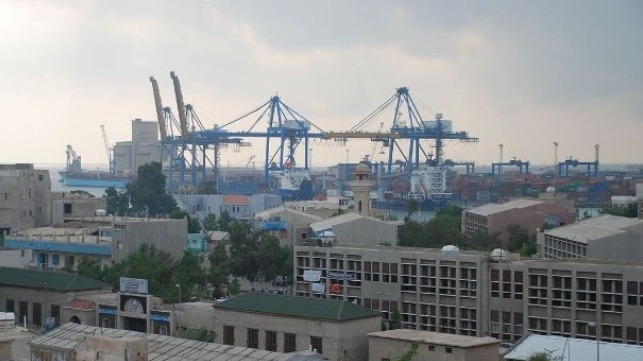
Sudanese Foreign Minister: No Obstacles for Russian Base in Port Sudan

Port Sudan
Port Sudan (file image)

Published Feb 16, 2025 2:57 PM by The Maritime Executive


With Russia’s footprint in the Mediterranean facing uncertainty, the deal for a naval base in Sudan has reached a new milestone. Last week, Sudanese Armed Forces (SAF) foreign minister Ali Youssef Ahmed al-Sharif was in Moscow, where he met his Russian counterpart Sergei Lavrov. Although the negotiations for the base were not part of the meeting, Ali Sharif said there was no disagreement on the deal, assuming that the SAF can win or reach a stalemate in its two-year civil war against the breakaway Rapid Support Forces (RSF).

“There was a deal which was signed and there are no obstacles. We are in complete agreement,” said Sharif.

Russia signed an agreement with the government of Sudan for the naval base under the regime of former dictator Omar al- Bashir, who was ousted in a coup by his former generals back in 2019, leading eventually to the SAF’s rule over most of the country. In 2021, SAF leaders said that the government would review the deal to align with the country’s interests.

The ongoing civil war in Sudan since 2023 has stalled progress on the base deal. A logistical base for Russia is Sudan - the first in Africa - could provide Moscow with desperately-needed access to a regional basing arrangement. Russia’s 50-year foothold in the Mediterranean at the port of Tartus, Syria, is endangered and may already be lost. The setbacks facing the Russian Mediterranean flotilla has likely sent Moscow on an overdrive for an alternative base. It remains to be seen if Eastern Libyan warlord Khalifa Haftar or the government of Algeria might offer a base to the Russian Mediterranean fleet, or if such a basing arrangement could be a suitable replacement for Tartus.

Either way, the willingness of Sudan to offer Russia a base is still good news for Moscow. As a logistics support point for the Russian navy, the Port of Sudan could easily accommodate four warships, including nuclear-powered ones. Some analysts believe that the base would restore Russia’s permanent presence in the Indian Ocean. Russia lost this privilege at the end of the Cold War: the Soviet-era naval base in Berbera, Somalia closed in 1997, and the Nokra base in Eritrea (then part of Ethiopia) closed in 1991.

But given its location, the Port of Sudan base would have serious limitations as an alternative launch pad for reconstituting Russia’s Mediterranean Flotilla.

“The logistical constraints of negotiating Suez Canal, particularly in cases of requiring emergency maintenance, are significant. Operationally, canal transits also clearly signpost ship movements to adversaries,” argue naval experts Edward Black and Sidharth Kaushal.  


Iran's "Drone Carrier" May Join Exercise With Russia and China

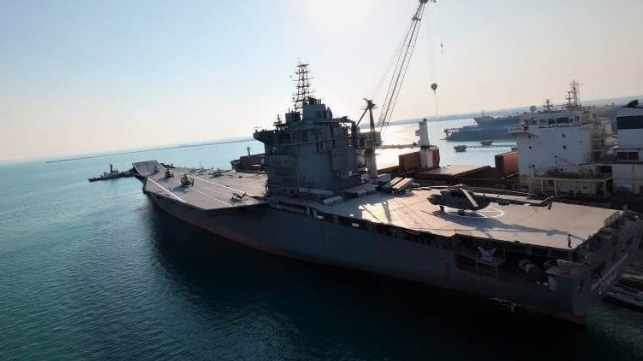
Converted boxship Shahid Bagheri, Iran's "drone carrier" (Sepah News / CC BY 4.0)

Published Feb 16, 2025 1:44 PM by The Maritime Executive


The annual Iranian-Chinese and Russian naval codenamed Exercise Maritime Security Belt normally takes place in mid-March, in a pattern established over a number of years. 

Maritime Security Belt 2025 is likely to feature the outgoing Chinese Navy Group, which is nearing the completion of its six month forward deployment to the PLA Navy’s Project 141 Overseas Support Base at Doraleh, in Djibouti. The departing 46th Naval Escort Group consists of the Type 052D destroyer Jiaozuo (D163), Type-054A frigate Xuchang (F536) and the Type 903A logistics vessel Honghu (K963). 

The Maritime Security Belt 2025 exercise will be the first of a number that they will carry out with cooperating navies on their way back to their homeport of Zhanjiang in Guangdong, headquarters of the PLA Navy’s South Sea Fleet. 

The Chinese Navy’s Project 141 Overseas Support Base at Doraleh, in Djibouti (Google Earth)

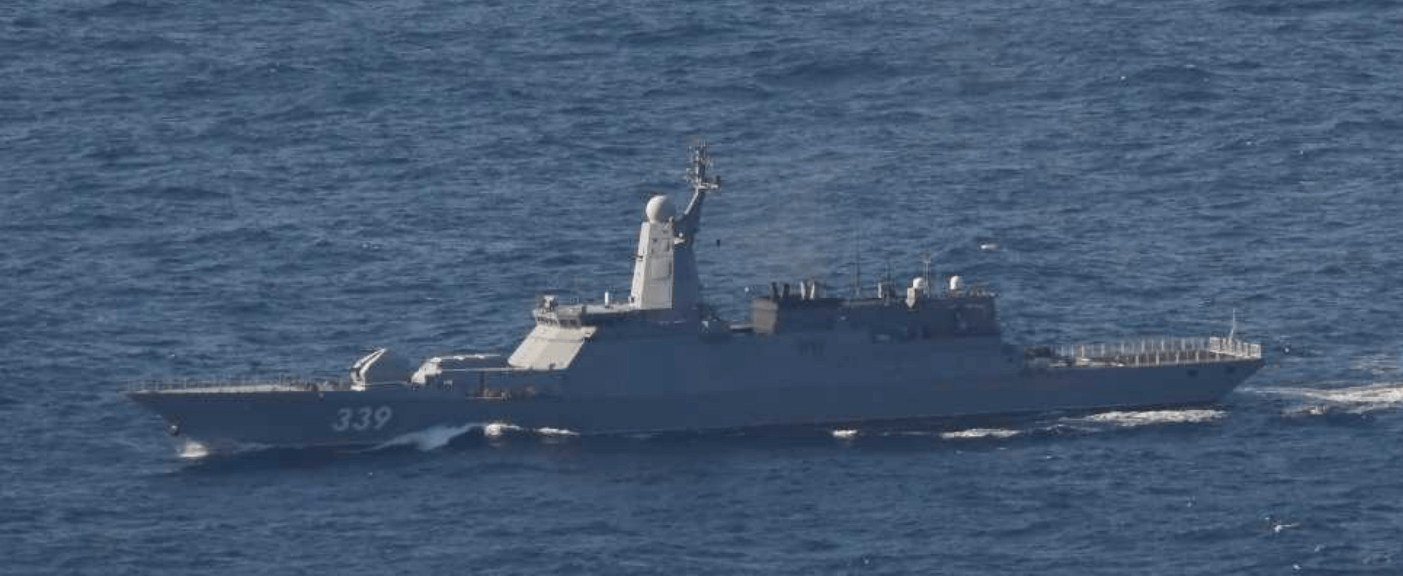
The Russian participants are likely to be Steregushchiy Class Project 20380 missile corvettes Hero of the Russian Federation Aldar Tsydenzhapov (F339) and Rezkiy (F343) and the oiler Pechenga (IMO 7710977). The Press Office of the Pacific Fleet via Izvestia reported their departure from Vladivostok on February 3 for "tasks in the Asia Pacific Region." While transiting the Sea of Japan the flotilla conducted air defence training to counter drones and drills ‘to repel attacks of uncrewed boats’, which could be useful if any of Iran’s Houthi allies operating in the Red Sea and Gulf of Aden mistakes the Russian ships for unfriendly vessels.

The Pechenga is sailing without its AIS automatic identification system switched on, but the flotilla en route is known to have arrived off Bali on February 15 to take part with the Indonesian Navy in Exercise Komodo-2025.

Hero of the Russian Federation Aldar Tsydenzhapov (F339) (Japan Ministry of Defense, 2021)

The Iranian naval representation in the exercise, from the both the IRGC (Nedsa) and regular Navy (Nedaja) will become apparent closer to the time and will be dependent on ship serviceability, always an issue in the aging Iranian fleet. However, the exercise is likely to feature drone and missile firings, which is the Iranian preoccupation at present.

It may also present the Nedsa an opportunity to demonstrate that their new drone carrier Shahid Bagheri (C110-4), last seen in its normal anchorage off Bandar Abbas on a cloudless February 1,  is operationally viable.  Some press reports greeted the Nedsa’s promotional video of a small jet-powered one-way attack drone, akin to a model aircraft, taking off from the Shahid Bagheri as representing a radical shift in the balance of power at sea which would concern Israel. 

Whilst one-way drone launches may be viable, the ship can launch missiles, helicopters and fast attack boats, as any frigate could. But there is no indication yet that a fixed-wing air vehicle could recover to the Shahid Bagheri’s 180-meter flight deck, overcoming the pitch and roll characteristics of the off-center flight deck and air turbulence created by the ship’s towering sterncastle. 

Except in conditions of stable peacetime, the survivability of this 20-year-old converted tanker in wartime, or even in times of increased tension, would probably be measured in hours rather than days. Notwithstanding its sturdy Korean construction, a ship surveyor would probably have consigned the Perarin to the scrap heap rather than allow it to be converted into the Shahid Bagheri, pride of the Nedsa fleet.

Top image: Converted boxship Shahid Bagheri, Iran's "drone carrier" (Sepah News / CC BY 4.0)

The opinions expressed herein are the author's and not necessarily those of The Maritime Executive.